Adams & Company (San Francisco, CA)

Episode Information

Episode UID
3834310490649
Episode Type
Run β†’ Suspension β†’ Closure
Bank Type
private
Bank ID
383431049 hash
Start Date
January 27, 1854
Location
San Francisco, California (37.780, -122.419)

Metadata

Model
gpt-5-mini (chosen from majority vote of a three-model LLM ensemble)
Short Digest
51d7684dd43788dc

Response Measures

None

Description

An isolated misinformation-driven run occurred in Jan 1854; a larger panic in Feb–Mar 1855 produced a suspension and receivership from which the house did not recover.

Events (4)

1. January 27, 1854 Run
Cause
Rumor Or Misinformation
Cause Details
Name omitted from shipper lists created panic though the firm had shipped large sums; panic was based on mistaken belief.
Random Run
Yes
Random Run Snippet
Name omitted from steamship shippers list; panic despite shipments being made.
Measures
Paid depositors and met demands; public reassurance that house would continue to meet demands.
Newspaper Excerpt
For the first time ... there was a 'run' last evening and this morning, upon ... Adams & Co ... occasioned by ... the name of the firm failing to appear among the shippers by the steamers of the 16th.
Source
newspapers
2. February 17, 1855 Run
Cause
Local Banks
Cause Details
Run triggered by news of suspension/embarrassment of Page, Bacon & Co. (a correspondent/related banking house), producing indiscriminate withdrawals across San Francisco banks.
Measures
None specifically noted for Adams & Co. in articles describing this run (other houses negotiated 30/60 day arrangements).
Newspaper Excerpt
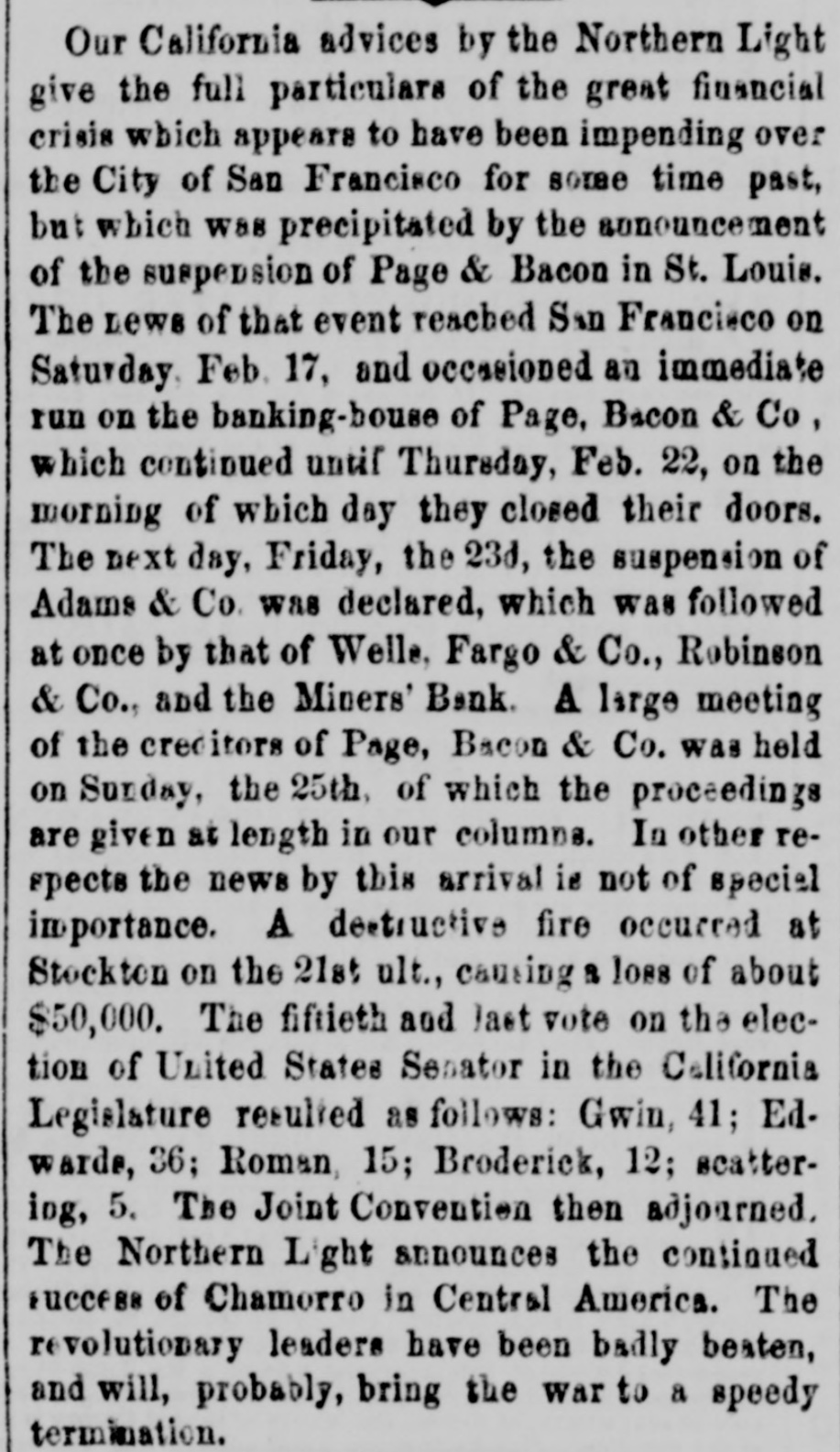
The news of that event [suspension of Page & Bacon in St. Louis] reached San Francisco on Saturday Feb. 17, and occasioned an immediate run ...
Source
newspapers
3. March 23, 1855 Suspension
Cause
Local Banks
Cause Details
Suspension declared following the widespread runs precipitated by the suspension of Page & Bacon and consequent loss of depositor confidence; firm later applied for benefit of insolvent laws.
Newspaper Excerpt
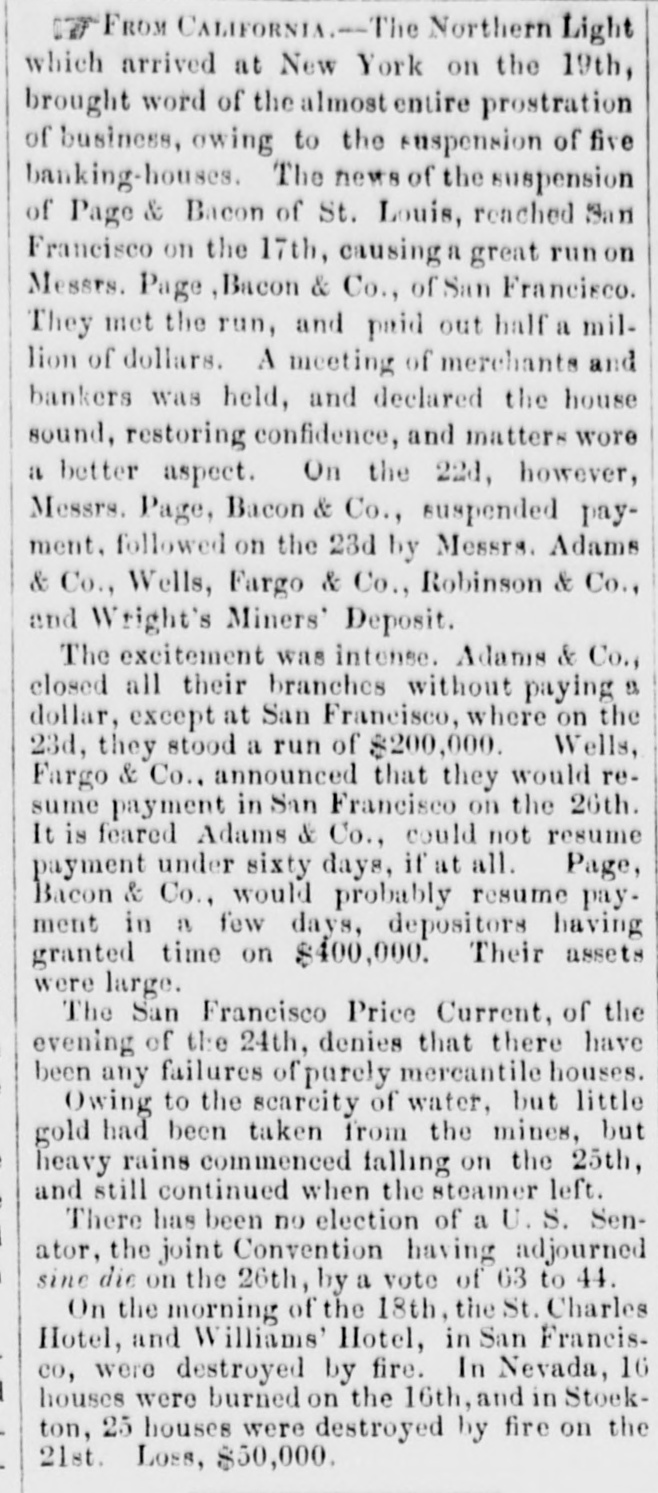
Friday, the 23d, the suspension of Adams & Co. was declared ...
Source
newspapers
4. March 27, 1855 Receivership
Newspaper Excerpt
The three principal houses ... immediately after their suspension had receivers appointed, for the purpose of keeping off their creditors. ... The three principal houses-Page, Bacon & Co., Wells, Fargo & Co., and Adams & Co. -immediately after their suspension had receivers appointed ... (reports dated March 27).
Source
newspapers

Newspaper Articles (25)

Article from The Weekly Placer Herald, January 28, 1854

Click image to open full size in new tab

Article Text

For the first time, we believe, in the history of San Francisco, there was a "run" last evening and this morning, upon one of the leading banking houses of this city Messrs. Adams & Co -a house as solid, financially, as the rock of Gibraltar is, physically. The run was occasioned by a panic created by the circumstance of the name of the firm failing to appear among tho shippers by the steamers of the 16th. Casual depositors, and parties making irregular remittances, became alarmed, supposing that Adams & Co., had sent nothing by the steamers; while in fact, they had shipped per John L. Stephens, $255,909; per Sierra Nevada, 122,000; total shipment on the 16th, $377,902. The house has of course met, and will continue to meet, all demands that have been or may be made upon it. Eve. Picayune.


Article from The Weekly Lancaster Gazette, March 16, 1854

Click image to open full size in new tab

Article Text

INCIDENT OF THE "Run." The recent run upon the banking house of Messrs. Adams & Co., in San Francisco, gave rise, to an exhibition of some eurious phases of human nature. Quite a number of amusing incidents occurred. One old lady, after elbowing her way through the thronging crowd, presented herselΓ­ at the counter with a face blooming like a peony and a frame trembling in every nerve. She solemnly assured the teller that "she didn't have nary f ar for her money ($50) but then she had a dream the night afore which troubled her. " She was paid, and went on her way rejoicing. One man presented two seconds of exchange, which were issued eighteen months since, and paid long ago in New York.The fraud was at once dedected. Another man presented a check for $100 payable to his order. He was told to endorse his name upon it, but replied that he could not write. "Then bring some one to swear to your identity," said the teller. He finally went away without his money. One individual, a laborer, who was indignant at the idea of any doubts existing as to the integrity of Adams & Co., forced his way to the counter, and pulled out a bag of money, saying, "Here are thirty-nine dollars-all I have now-but I will have four hundred more to. night, which you can take. I am now going up to pledge my watch." Then, turning to those around him, with a look of ineffable disdain, he said, in a triumphant tone, "I swear by Adams & Co." It was with much difficulty he could be persuaded to take back his money.


Article from Georgetown Weekly News, March 1, 1855

Click image to open full size in new tab

Article Text

CIRCULAR BY ADAMS & Co.-We have received a Circular from Mr. I. C. WOODS, the principal man in this firm, giving a statement of the reasons of their failure. As we have not room for the entire circular, in the present number, we will briefly say that Mr. WOODS charges their failure; first on the duplicity of Page, Bacon & Co. for whom they had advanced large sums of coin, and secondly upon the unexpected run, which he affirms could not have been foreseen, The following is a proposition which Mr. WOODS desires to make to the creditors of the house throughout the State: "That within thirty days from this date the Receiver shall pay them twenty-five per cent in cash upon all our claims. That the creditors shall receive the bal. ance of their claims from the Reciver as fast as he can declare the dividends, and for this purpose he shall be allowed to administer the assetts, notes, real estate, &c., of the house, and realize them as promptly as possible, without hindrance, and to the best ad. vantage for the creditors, and for the great. er security of the creditors; that his present bonds, which are for one million of dollars, shall be increased if deemed necessary. That Adams & Co. shall be allowed to resume their business as heretofore, with such aid as they can obtain from their friends and customers; and in this connection I am deeply gratified to siate, that the whole body of our clerks, with a devotion to the house which they have done SO much to build up, for which no words can thank them, have volunteered each and all, their services for an entire year, without hire or reward beyond a bare subsistence. As it is desirable that we should obtain as promptly as possible the sense of our creditors upon this proposition, which I am confident is for their best interests, and will secure the early payment of their claims in full, we earnestly request them to notify us, at our Banking House in San Francisco, of their assent thereto. I need not say how acceptable that assent will be, nor that we shall endeavor to requite it with the same energy and fidelity, of which we hope the Public has had some proof in its former dealings with our house." C. WOODS.


Article from New-York Daily Tribune, March 20, 1855

Click image to open full size in new tab

Article Text

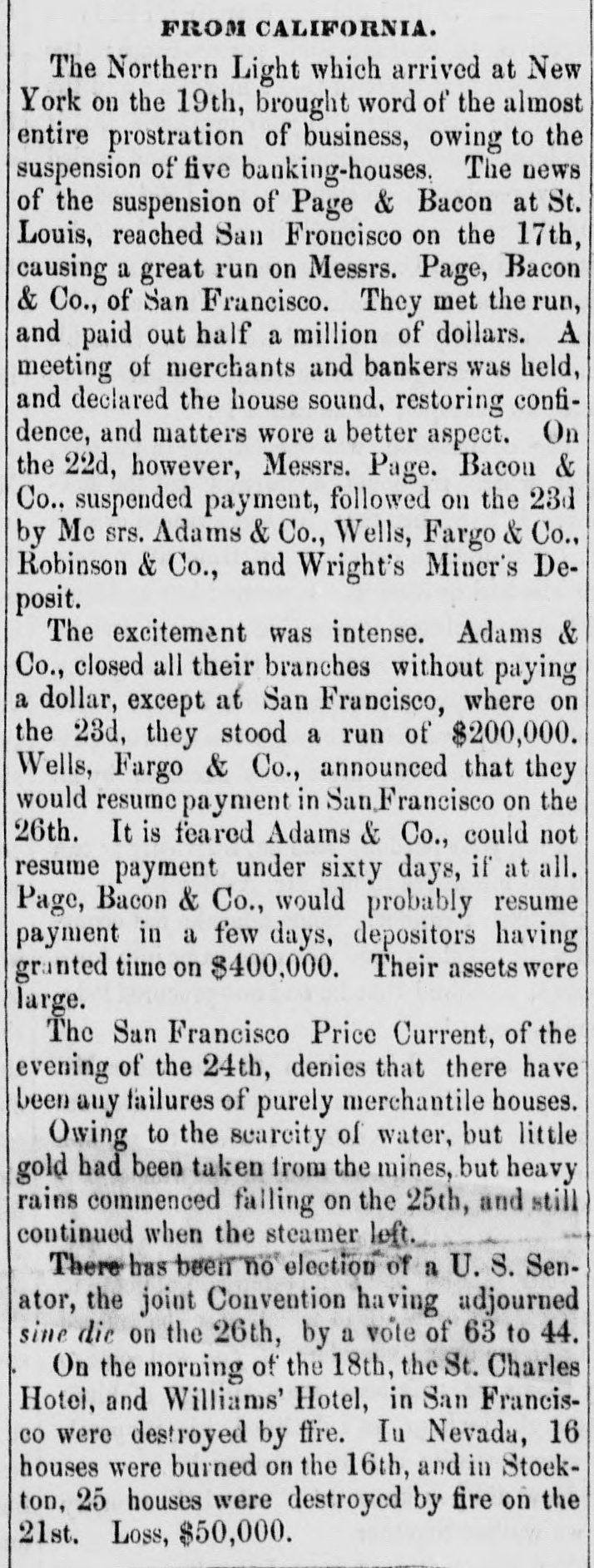
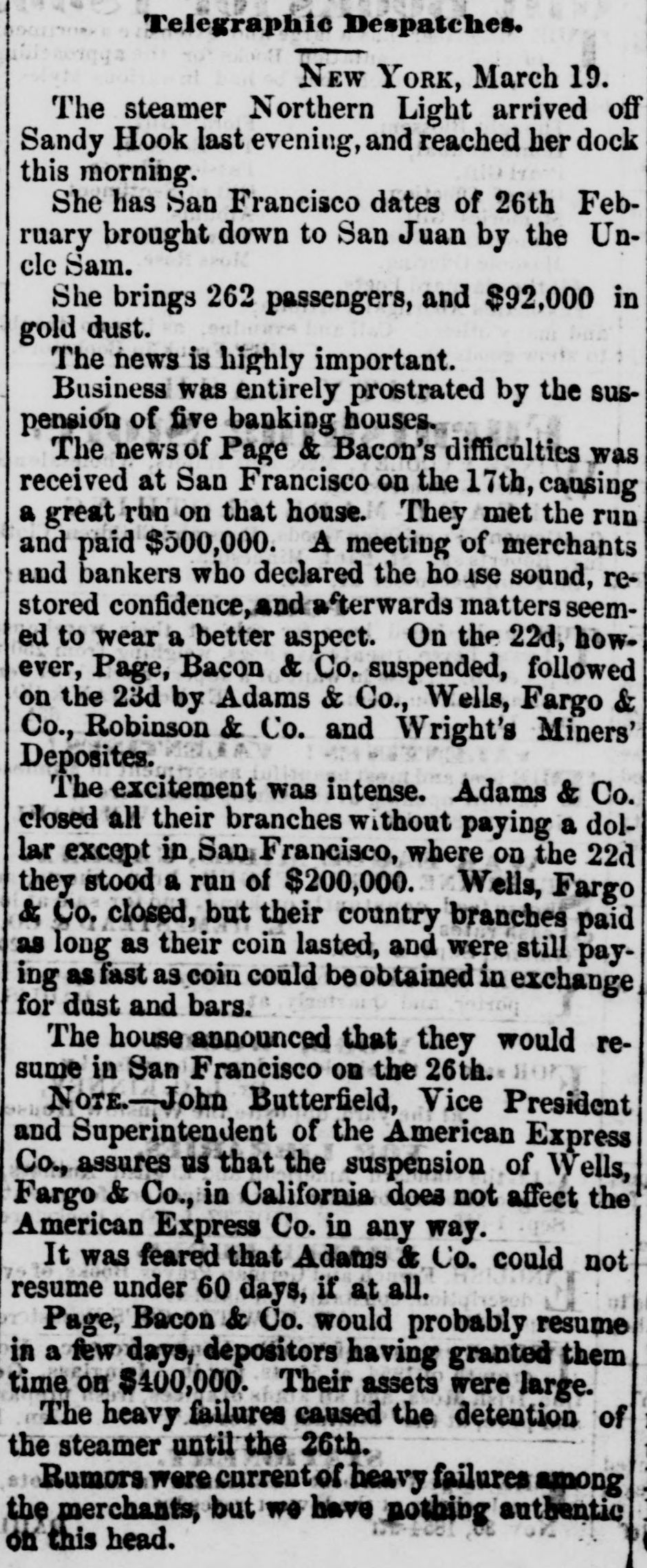
Our California advices by the Northern Light give the full particulars of the great financial crisis which appears to have been impending over the City of San Francisco for some time past, but which was precipitated by the announcement of the suspension of Page & Bacon in St. Louis. The news of that event reached San Francisco on Saturday Feb. 17, and occasioned an immediate run on the banking-bouse of Page, Bacon & Co, which continued until Thursday, Feb. 22, on the morning of which day they closed their doors. The next day, Friday, the 23d, the suspension of Adams & Co. was declared, which was followed at once by that of Welle, Fargo & Co., Robinson & Co., and the Miners' Bank. A large meeting of the creditors of Page, Bacon & Co. was held on Sunday, the 25th, of which the proceedings are given at length in our columns. In other respects the news by this arrival is not of special importance. A destructive fire occurred at Stockton on the 21st ult., causing a loss of about $50,000. The fiftieth and last vote on the election of United States Senator in the California Legislature resulted as follows: Gwin, 41; Edwards, 36; Roman, 15; Broderick, 12; scattering, 5. The Joint Convention then adjourned. The Northern Light announces the continued success of Chamorro in Central America. The revolutionary leaders have been badly beaten, and will, probably, bring the war to a speedy termination.


Article from The New York Herald, March 25, 1855

Click image to open full size in new tab

Article Text

The News. No signs of the Atlantic at twelve o'clock last might. Size is now in her fifteenth day out from Liverpool. By the arrival of the stea ner George Law, we have late and interesting news from California, the West Coast of Mexice, the South Pacific, Australia, and the Isthmus of Penama. Our San Francisco advices are to the 1st inst.three days later. Fell details of the news are given in another part of this morning's paper. The monetary excitement continued to increase in San Francisco and other parts of the State, and the people were rapidly being brought to a consciousness of the hollowness of a portion of the business community. They had very nearly or quite reached the bettom, however, and were beginning to look around for some substantial basis on which they might again raise themselves. Among all the establishments which suspended during the first onset the house of Wells, Fargo& Co. is the only one that has re_ sumed and re-established their business operations; but it was presumed that Page, Bacon & Ce., with the assistance that had been tendered them, would shortly be enabled to take their stand among the solvent bankers. As for the others-Adams & Co., Robinson & Co., Wright's Exchange Bank, and Read & Co., of Sacramento-there was very little hope of their ever emerging from the vortex, the former and the last named concerns having applied for the benefit of the insolvent a ct. The extent of the run on the banking houses in San Francisco, during the excitement, may be imagined by reading the. following table, showing the amount of monow drawn ent previous to the gnspension:


Article from Worcester Daily Spy, March 26, 1855

Click image to open full size in new tab

Article Text

TEN DAYS LATER FROM CALIFORNIA. ARRIVAL OF THE GEORGE LAW. 317,800 DOLLARS IN GOLD!! The steamship George Law left Aspinwall at half-past 12 o'clock on the morning of the 16th inst., and arrived at New York at halfpast 10 Saturday morning. She brings the California mails of March 1, $317,800 in treasure, on freight, and 234 passengers. Col. Fremont is among the passengers by the Geo. Law. The San Francisco correspondent of the New York Tribune writes as follows in relation to the financial difficulties that commenced just previous to the sailing of the last steamer. The amount of money drawn from the banks during the panic is estimated at three millions of dollars. The three principal houses-Page, Bacon & Co., Wells, Fargo & Co., and Adams & Co. -immediately after their suspension had receivers appointed, for the purpose of keeping off their creditors. On the 27th, Wells, Fargo & Co. called a meeting of their heaviest depositors, who agreed to wait upon them 30 and sixty days for the amounts due them, whereupon that house immediately resumed, and is now in active operation. It would have been fortunate for the public, if Adams & Co. could have come out in a similar manner, but it is feared, and very generally believed, that that house is insolvent.J. C. Wood, the principal manager of the concern, has applied for the benefit of the Insolvent Act. The statement made by him, of the assets and liabilities of the house, show it to have been one of the worst managed concerns in the country. In the assets are the following items:-


Article from Daily American Organ, March 26, 1855

Click image to open full size in new tab

Article Text

From the New York Heral L From California and South America. Our San Francisco advices are to the 1st inst.three days later. The monetary excitement continued to increase in San Francisco and other parts of the State, and the people were rapidly being brought to a consciousness of the hollowness of a portion of the business community. They had very nearly or quite reached the bottom, however, and were beginning to look around for some substantial basis on which they might again raise themselves. Among all the establishments which suspended during the first onset, the house of Wells, Fargo, & Co., is the only one that has resumed and reestablished their business operations; but it was presumed that Page, Bacon, & Co., with the assistance that had been tendered them, would shortly be enabled to take their stand among the solvent bankers. As for the others-Adams & Co., Robinson & Co., Wright's Exchange Bank, and Read & Co., of Sacramento-there was very little hope of their ever emerging from the vortex, the former and the last named concerns having applied for the benefit of the insolvent act. The extent of the run on the banking houses in San Francisco, during the excitement, may be imagined by reading the following table, showing the amount of money drawn out previous to the suspension :


Article from Washington Sentinel, March 27, 1855

Click image to open full size in new tab

Article Text

GRONGE HERVELS THE ao THE LAW. Three DayS Later from California. The Financial Panic Subsided-Resumption of Wells, Fargo & Co.-The House of Page, Bacon & Co. open to special Depositorsplication of Adams & Co. for the benefit of the Insolvent Laws-The House Threatened -yung sburang D fo D fiq Shipments of Gold Excitement at ShastaRain at fast-The Mines, dec. The steamer George Law arrived at New York on Saturday with dates from San Francisco to the 1st instant, only three days later. She brought 234 passengers, among them Colonel Fremont, and $317,800 in gold. The following are the principle consignees: Messrs. Drexel & Co., $100,000: Metropolitan Bank, $70,000; Rich & Brothers, $25,000; Wells, Fargo & Co., $50,000; Adams & Co., $10,000, with other smaller amounts, reaching in all $317,800. The steamship "Golden Gate," Allan McLane, commander, left San Francisco at 10.30 p. m., on the 1st, and made the run to Panama in 11 days and 4 hours, (running time,) the quickest time ever make by any steamer on the Pacific. The outward passengers by the "George Law" were landed at Aspinwall on the morning of the 15th, and left Panama on the "Golden Age" the same day. From the San Francisco Herald, March 1st. The Bank Excitement. The excitement of the past few days seems to have, in some degree, subsided, and as the public became informed of the true position of banking affairs, a disposition is manifest to await the result rather than risk a serious loss by pressing immediate liquidation. of . "II M We take great pleasure in announcing that Wells, Fargo & Co. resumed business yesterday, and everything connected with their estab. lishment went on as usual. The suit of Washburn and others against Pordee, commenced in the Fourth District Court, in which the injunetion was granted, has been discontinued, and an order was entered vacating the appointment jo suairs the jo statement V Receiver. B jo the house shows the assets to be $743,499, and the liabilities $354,394. Nearly all their offices in the interior were able to stand the run upon them without being compelled to shut their doors. Page, Bacon & Co. The banking house of Messrs. Page, Bacon & Co., was open yesterday to special depositors, and parties having property placed in the custody of this house for safe-keeping were afforded an opportunity to withdraw the same. The bank will be open again to-day. Messrs. Page, Bacon & Co. promise, in their new arrangement for resuming their business, to issue certificates of deposit, bearing interest at one per cent per month, which certificates are guaranteed by some of our first men to the 199 dollars. Jo million B JOAO Jo funous bond guaranteeing the certificates has been uoos se puu puu executed as the amount required by the firm is made up, which will, doubtless, be done shortly, the certificates will be issued and the house placed basis. pood B uodn of TP swepv This firm have confessed themselves insolvent, and applied for the benefit of the insolvent act. A stay of all proceedings on the part of the creditors of the firm, and of I. C. Woods is ordered by Judge Lake, and notice is given that the creditors appear on the 31st of March, to show cause why the prayer of the insolvent to be discharged from his debts should not be granted. Application of Adams & Co. for the benefit JO U--AUT Instruction the 10 their affairs. A petition in insolvency was filed in the Fourth District Court by Mr. Isaiah C. Woods, of the firm of Adams & Co., praying to make a cession of his estate and that of his copartnership, to his creditors, and to be released from his debts. The petitioner recites that "in consequence of the general panic which took possession of the people throughout the State, the said firm have recently been called upon to pay an unusual large proportion of the moneys and debts which they owe, and not having on hand sufficient money to meet said demands, within the true meaning of the act," &c., &c. In submitting the schedule of his assets, the : BABS pettion "I entered into the co-partnership of Adams & Co. on the 12th day of May, 1854. I was then perfectly solvent, and possessed property and means over and above all my debts and engagements of the value of two hundred and fifty thousand dollars. I have individually sustained no losses of any considerable amount, nor has the firm of Adams & Co. since I into said co-partnership, except in the preciation of the market value of the erty owned by me and them. The cause of the failure of said firm is only the fact of being called upon to redeem all its liabilities in cash at once, which, from the nature of the business, and the well recognized implied understanding between depositors and banks, is not expected." The following is a statement of the affairs of the House, and of Mr. Woods, individually, made up from the schedules on file: Balance of bank accounts against the house, say $275,000 Balance of certificates 705'167 Bills of exchange on Adams & Co. N., York. 100,000 Liabilities of the country offices, established at 000'00S Total $1,582,19 Individual debts of C. Wood, on which judgments have been confessed. 000'19 Grand total of liabilities. The following is the account of the assets of House the Debts due by depositors, who haveoverdrawn their accounts, say $200000 Negotiable notes and bills 2735796 Notes in suit and over due, say 000'94
Article from The Daily Minnesota Pioneer, April 2, 1855

Click image to open full size in new tab

Article Text

St. Louis Banking Houses. The Banking establishments of St. Louis occupy an enviable position before the country. The mammoth concern of PAGE & BACON which suspended temporarily both at St. Louis and San Francisco, has resumed business in both cities on a firmer basis than before. When the news reached San Francisco of the embarrassment of Messrs. PAGE & BACON, of St. Louis, the rush on the branch house there was so great that a suspension was forced upon them the fifth day thereafter. In that time over half a million of money was paid out. They resumed on the first of March. Another house of immense means in St. Louis and San Francisco, withstood the pressure triumphantly in both cities. LUCAS, SIMONDS & Co., of St. Louis, and Lucas, TURNER & Co., of San Francisco, endured a run in both places, fully equal to that made on PAGE & BACON, without flinching for a moment. A house that can stand the pressure under such panics as existed in St. Louis and San Francisco, may be regarded as good for all time. WELLS, FARGO & Co., and ADAMS & Co., of San Francisco, connected with heavy houses in New York, failed during the same panic, and have not resumed payment.


Article from The Weekly Minnesotian, April 7, 1855

Click image to open full size in new tab

Article Text

Trouble at San Francisco. A terrible financial storm swept over San Francisco, last month, prostrating the banking houses of Page, Bacon & Co., Adams & Co., Wells, Fargo & Co., Robinson & Co., and Wright's Miners' Deposit. The immediate cause of the trouble was the reception of intelligence of the suspension of the banking house of Page, Bacon & Co., of St. Louis. This led to a run on Page, Bacon & Co., which they met for five days, paying out in that time half a million of specie, but were finally compelled to suspend. The suspension of the other houses followed soon after under the effect of a general and indiscriminate run. The steamer brings rumors of several failures among the merchants of San Francisco, but nothing of a definite character was known at the time of her departure. It was thought that most of the suspended banking houses would resume shortly. This news, says the Chicago Press, has been expected for several weeks, and those parties in the Atlantic States, who are immediately concerned in the result, have had time to prepare for it. The American Express Company will not be damaged by the suspension of Wells, Fargo & Co., and we have assurances from parties entitled to confidence, that Page & Bacon, of St. Louis, are fortified so strongly that the calamity to their San Francisco bouse will not affect their St. Louis business at all. The small amount of treasure brought by this steamer, together with her unpleasant financial news, will have a momentary unfavorable effect upon business, but it can last for a short while only. No election of a U. S. Senator had taken place yet, the Convention having adjourned sine die on the 16th, by a vote of 63 to 44. Those voting in the majority were principally the friends of Mr. Gwin.


Article from New-York Daily Tribune, April 9, 1855

Click image to open full size in new tab

Article Text

Total From Our Own Correspondent. SAN FRANCISCO, Friday, March 16, 1855. Business of all kinds has been very dull during the past two weeks. The suspension of some of the banking houses caused such & check of credit, and created such a degree of distruct, that every person seems disposed to wait and see what will be the end of the present state of affairs. One thing is certain, that this city has not presented such a dull appearance during the last two years as it now does. atters are undergoing. a severe ordeal, and it is difficult to tell who will come out with & whole skin. Adams & Co. affairs are now in the Courts, to fee lawyers, and squander even what little the poor creditors might, under fair management, have obtained. I never saw or heard of a more wretchedly-managed concern than this has been. The house did a very extensive business, and had branches in every mining district in the State. By this means it obtained the hard earnings of thousands of laboring people, many of whom will ill now lose the last dollar they possessed. The attempt to unravel A. & Co 8 affairs necessa. rily brin gs to light other rascally transactions. A noted law firm-Halleck, Peschy & B lings-a are accused of having extorted money from Adams & Co, and Jam King, by threatening to expose their pecuniary condition unless they were paid a handsome sum as hush-money. The suit nacitated for the re. covery of what was unlawfully received asks for & judgment of $15,000, although the sum paid by Adams & Co. is supposed to have been much larger; inmor says more than $30 000. Probably there is no State in the Union where lawyers have had richer pickings and stealings than they have bad in California. Ad the value of lands became enhanced, the henorable profession began to move-and the way they walked into the pockets of every person who employed them, need not be told to any person ho really knows what the legal profession is. The amount of perjury and corrution in the Courts, the bloody fights and murders test have been committed, are fr ghtful in the extreme; and to no one class of the community are we SO much indebted for all this, 88 to the lawyers Mr. G. J. Hubert Sanders-another lawyer-has been transacting a great business of late, 8 trifle outside of his profession. In addition to his practice, be was a Notary Public Like some of our bankers, he offered his services to those who had money and didn't know how to take care of it, while he did He has obtained over $100 $100,000, upon mortgages signed with fictitious names, and acknowledged before bimself. His business was mostly with the French. He was arrested and held to bail in the sum of $10,000 but has since fled. Sanders was a very fastionable man. have in this goodly City a State Marine Hospital for the purpose of taking care of such of the sick as are unable to take care of themselves. The object of the institution is, of course, commen dable. An investigation has recently been made concerning its management, and the following testimony elicited: E. F EUSTICK- storekeeper from July to August '54; have known the steward to receipt for one hut dred or more loaves of bread more than were received; the bills were signed by Dr Mills and were passed by Trustees; have known the steward to buy brandy at $10 per gallon for private of Mills and himself the bills for which were made out for Hospital urposes and double the quantity of brandy at $5 per gailon, in order to deceive the Trustees; have known Claughlev to buy champasne and cigars for the use of Mills and himself, the same being charged to Hospital; his orders from the Trustees, to keep an account of all stores received and disbursed, were covitermanded by Dr Mills and Claughley; the later sent a new carpet belonging to the Hospital to his wife at Secramento and also purchased linen, muslin, oysters, sardines, etc., for his own use on account Witness also states have been ordered to send wines to a house of prostitution in this city, by Dr Mills and Ciaughley; it was a daily occurrence; I have been ordered by the prosecuting physician to give fresh eggs to patients, but Claughlev ordered me to give them Boston eggs, which in nine cases out of ten proved rotten; Dr Wing told me that the bills for perfumery cost so much he was ashan ed of it; these articles were bought for Dr. Mille's woman, and charged to the hospital as medicines; the woman's Lame is Louisa Haywood; the bills amounted to $75 or $80 per month and the same was also bought for Claughley's woman. also charged as medicines; I have known bills be changed by Claughiey before they were submitted to the Trustees. both in amounts and articles; have heard him remark that certain Trustees were too d -d honest, and that be would have them out or break the hospital; I have known men not patients to board at the hospit hospital for week at . time; I have known employes to be requested to vote a certain ticket, otherwise they would be discharged; patients who could go out were also told to vote the same way; Dr Mille's patients were carried out, and some of them voted four or five times; cake left at the Treasurer's office was entered as bread; five dollars was charged for brandy when one was used. Doctor S. B. Mills is the resident physician, and James A. Claughley the steward of the hospital. There is other testimony of the same sort. For the credit of California I am glad to state that the institution is about to be closed. Having had the frankness to expose all these dark spote on our character, I trust DO self- righteous Pharisee will at once jump to the conclusion th at there is nothing good in California raia There are good and bad men, here the same as everywhere re else More vice and corruption are apparent here. because there is less attempt at concealment. You see exactly what people are-doing without fear or restraint just what their natural impulses a: d inclinations lead them to do. This unlimited freedom to do as you please exhibits great variety and great excess. It would be strange were it otherwise. I do not say that it is the best state of society or of affairs, but is it not something to live outside of the straight-jacket system which is imposed upon all, because & portion is too weak to stand alene. I must not omit to state, what will be gratifying to your numerous readers. that the news of the return of Mr. Seward to the United States Senate was received by hundreds of persons in this city with great gratification. He is looked upon as the leader of the great progressive movement nt in opposition to the dom. ineering and degrading influences of those who have charge of the peculiar institution." The accounts of the extreme cold weather and the suffer suffering of the poor in your city, present a marked contrast with things here. We the havethe finest weather imagicable, and provisions in the greatest abundance. One of our city papers thus speaks of the weather: " During the Syst ten days in February the thermometer in San Francisco Lever marked lower then 600 at midday; on three days it stool at 68Β°, and on three others at 67Β°, At midnight it ranged from 49Β° to 57Β° The skies were gloriously bright, the air was sot and balmy the sun's genial rays were tempered by gentle breeze, and the climate generally so do


Article from The Daily Union, April 18, 1855

Click image to open full size in new tab

Article Text

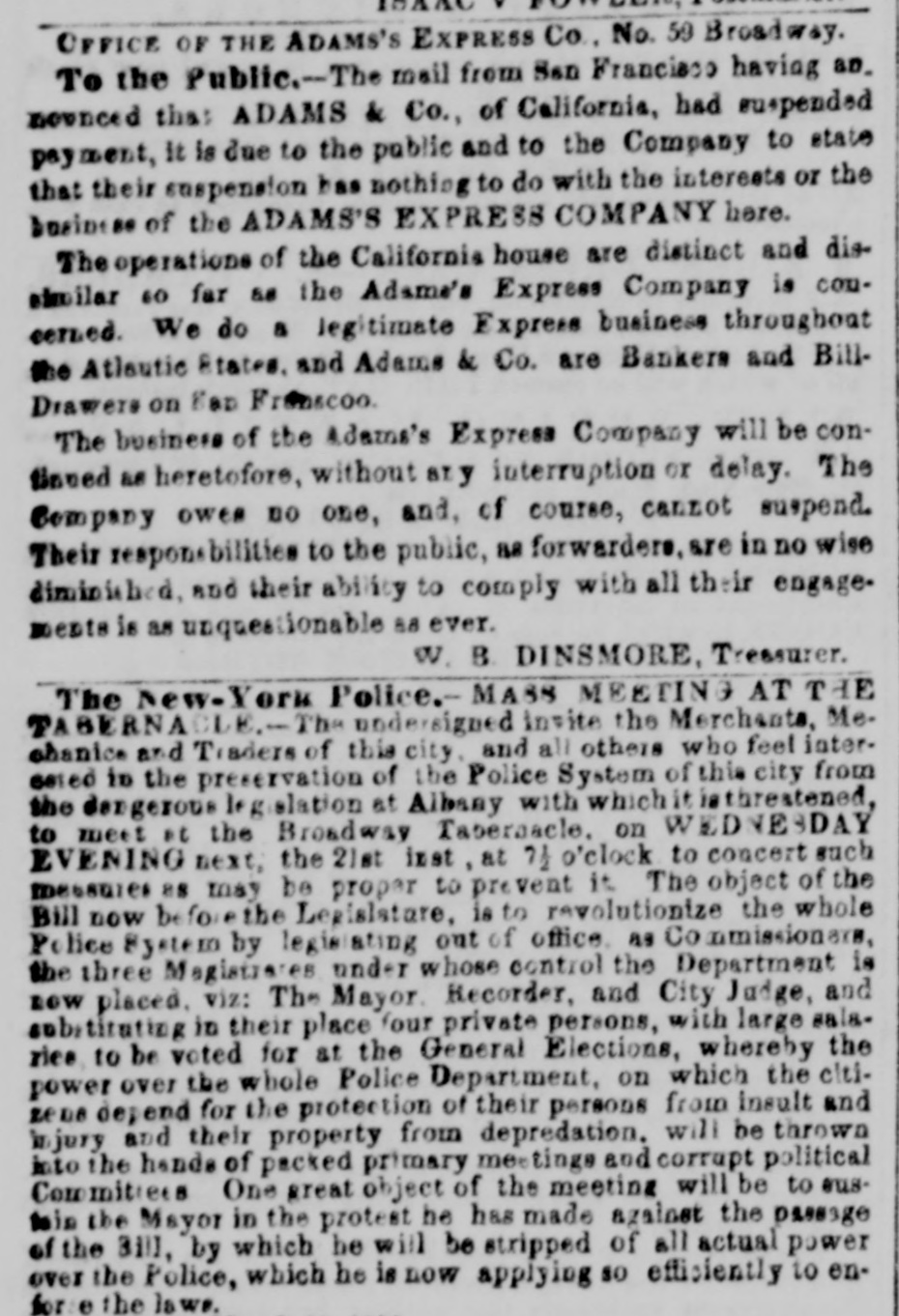
ADAMS'S EXPRESS COMPANY. Mr. George W. Cass, of Pittsburg, Pa., has been elected president of the Adams Express Company. The Boston Traveller, noticing this election, says: "The Adams Express Company, of which Mr. C. has been elected president, is a joint stock association, formed July 1, 1854, under the laws of New York, with some forty stockholders residing in Massachusetts, Rhode Island, Connecticut, New York, Pennsylvania, Maryland, Georgia, and Ohio, and who are individually liable for all the losses of the company. The business is conducted by nine managers, who are large shareholders, and effects are vested in three trustees. The Adams Express Company have no connexion with the suspended firm of Adams & Co., San Francisco. The latter are bankers and bill-drawers, while the former do nothing but a legitimate express business throughout the Atlantic States; hence, the failure of the San Francisco house will in no way affect the Express Company."


Article from Grand River Times, April 18, 1855

Click image to open full size in new tab

Article Text

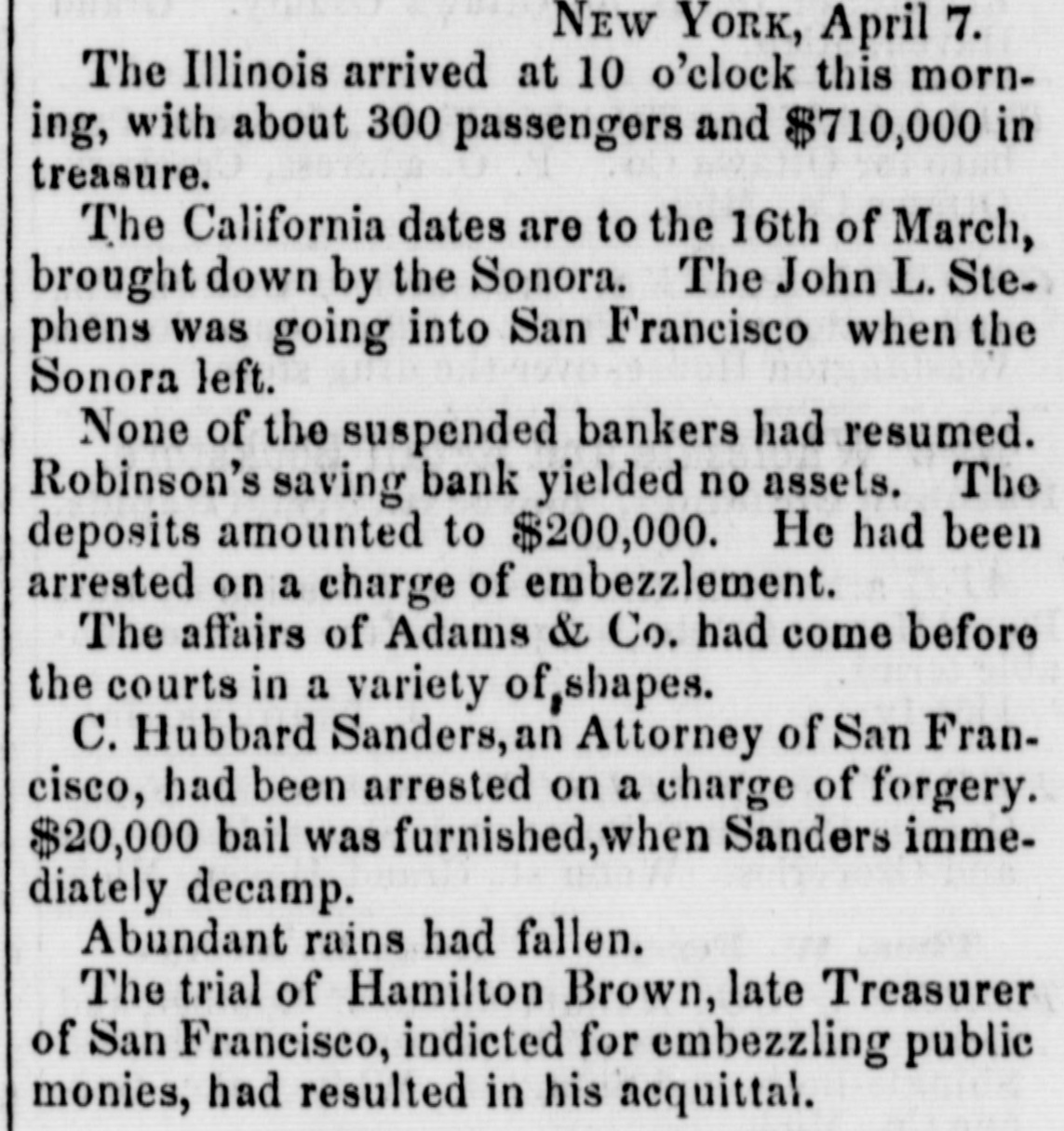
NEW YORK, April 7. The Illinois arrived at 10 o'clock this morning, with about 300 passengers and $710,000 in treasure. The California dates are to the 16th of March, brought down by the Sonora. The John L. Ste. phens was going into San Francisco when the Sonora left. None of the suspended bankers had resumed. Robinson's saving bank yielded no assets. The deposits amounted to $200,000. He had been arrested on a charge of embezzlement. The affairs of Adams & Co. had come before the courts in a variety of,shapes. C. Hubbard Sanders, an Attorney of San Francisco, had been arrested on a charge of forgery. $20,000 bail was furnished, when Sanders immediately decamp. Abundant rains had fallen. The trial of Hamilton Brown, late Treasurer of San Francisco, indicted for embezzling public monies, had resulted in his acquittal.


Article from The Daily Dispatch, May 1, 1855

Click image to open full size in new tab

Article Text

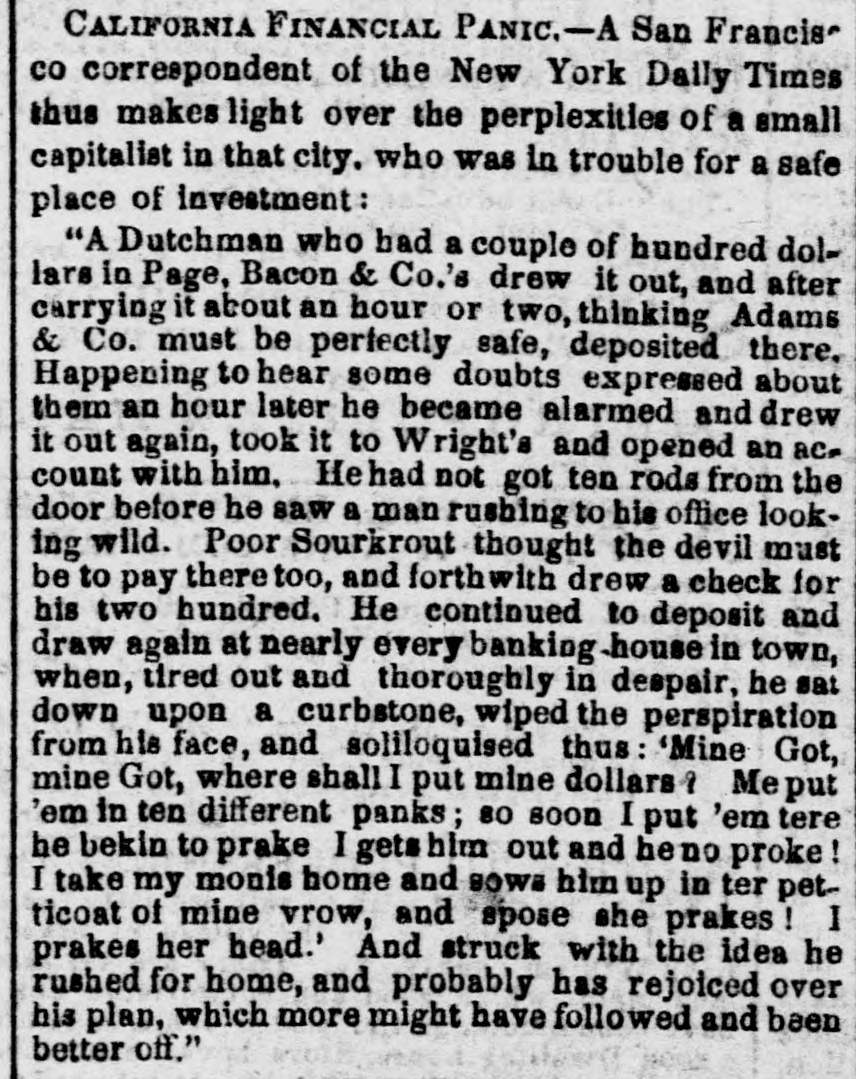
CALIFORNIA FINANCIAL PANIC.-A San Francis^ CO correspondent of the New York Daily Times thus makes light over the perplexities of a email capitalist in that city. who was in trouble for a safe place of investment: "A Dutchman who had a couple of hundred dollars in Page, Bacon & Co.'s drew it out, and after carrying it about an hour or two, thinking Adams & Co. must be perfectly safe, deposited there, Happening to hear some doubts expressed about them an hour later he became alarmed and drew it out again, took it to Wright's and opened an ac. count with him. He had not got ten rods from the door before he saw a man rushing to his office looking wild. Poor Sourkrout thought the devil must be to pay theretoo and rthwith drew a check for his two hundred. He continued to deposit and draw again at nearly every banking house in town, when, tired out and thoroughly in despair, he sat down upon a curbstone, wiped the perspiration from his face, and soliloquised thus: 'Mine Got, mine Got, where shall I put mine dollars I Me put 'em in ten different panks; 80 soon I put 'em tere he bekin to prake I gets him out and he no proke! I take my monis home and BOWS him up in ter petticoat of mine vrow, and spose she prakes I prakes her head.' And struck with the idea he rushed for home, and probably has rejoiced over his plan, which more might have followed and been better off."


Article from Staunton Spectator, May 16, 1855

Click image to open full size in new tab

Article Text

THE DUTCHMAN AND HIS BANK ACCOUNT.β€” During the money panic at San Francisco, a poor Dutchman who had a couple of hundred dollars in Page, Bacon & Co's drew it out, and after carrying it about an hour or two, thinking Adams & Co. must be perfectly safe, deposited there; happening to hear some doubts expressed about them an hour later, he became alarmed, and drew it out again; took it to Wright's, and opened an account with him; he had not got ten yards from the door before fie saw a man rushing in his office looking wild. Poor Sourkrout thought the devil must be to pay there too, and forthwith drew a check for his two hundred. He continued to desposit and draw again at nearly every banking-house in town, when getting tired out, and thoroughly in despair, sat down upon a curbstone, wiped the perspiration from his face and soliloquized thus : 'Mine Cot, Mine Cot, vere shall I put mine tollar ? Me put him in ten different Pank; SO soon I put him tere he pekin to break-I gets him out, and no preak. I tink every man vos proke. I take him home, and SOWS him up in ter petticoat of my vrow, and spose she prake I prakes her head ;'' and struck with the idea, he rushed for home, and probable found cause to rejoice over his new and safe sub-treasury.


Article from The Nevada Journal, June 8, 1855

Click image to open full size in new tab

Article Text

The following rich scene is reported to have taken place at San Francisco during the financial panic in February last : The day of the panic it was a very puzzling thing to know what to do with the money that had been drawn. A poor Dutchman who had a couple of hundred dollars in Page, Bacon & Co.'s, drew it out, and after carrying it about an hour or two, thinking Adams & Co. must be perfectly safe, deposited there. Happening to hear some doubts expressed about them an hour later, he became alarmed and drew it out again; he then took it to Wright's, and opened an account with him; he had not got ten yards from the door, before he saw a man rushing in his office, looking very wild. Poor Sourkrout thought the devil must be to pay there, too, and forthwith drew a check for his two hundred. He continued to deposit and draw out again at nearly every banking house in town, when, getting tired out, and thoroughly in despair, he sat down on a curb-stone, wiped the perspiration from his face and soliloquized thus: "Mine Cot, mine Cot, vere shall I put mine tollars ? Me put him in ten tifferent Pank; so soon I put him dere, he pekin to preak-I gets him out, and he no preak. I tink every man vos proke. I take him home, and SOWS him up in ter petticoat of mine vrow-and spose she prake, I preakes her head." And struck with this idea, he rushed home, and probably has rejoiced over his plan.


Article from New-York Daily Tribune, June 25, 1855

Click image to open full size in new tab

Article Text

Snow is yet lying several feet In depth on the Sierra Nevada Mountains. A fight between two men named Francisco Cruciana and Charles Lambert took place on the Pulgas Ranch near this city on the 21st inst., in which the former was instantly killed. An Irishman named Edward Dunn attempted to commit suicide on the night of the 21st by cutting his throat with a penknife. He was saved by careful attention and carried to the Marine Hospital. After B veral weeks' discussion the Board of County Supervisors have determined to purchase the lot and building situated at the corner of Greenwich and Jones-sts. for a County Hospital. An appropriation of $24,000 bas been made for the purchase. The State havis X resigned all interest in the old State Marine Hospital, all the County and city indigent sick will henceforth be at the expense of the county, and the above provision has been made for their accommodation. The number is now 150. The sentence of death pronounced upon John Blake for murder has been commuted by Gov. Bigierto one year's imprisonment in the State Prison. He was to have been hung on the 25th of May. The creditors and time-certificate holders of the late banking house of Page, Bacon & Co. have held several large meetings in the Merchants Exchange, and at the banking house, relative to the refusal of Mr. Daniel D. Page to make the parties whole who came forward two months since to sustain the house at the time of its first suspension. Committees have been appointed to examine the accounts and affairs generaly. Finally, at a meeting on the 29th of May, Mr. C.K. Garrison came forward and pledged his property to the amount of $400,000 in support of the house by way of securing the reditors and staying all further legal proceedings. The proposition seems to have given very general satisfaction and the creditors are looking forward with renewed hope to being finally indemnified. The proceedings at these several meetings, and the general correspondence and all matters in Jull will be found in the steamer Alta Culifornia. The affairs of Adams & Co. are now being investigated in the Fourth District Court. It has been decided by Judge Lake that bankers are entitled to the benefit of the Insolvent law. News has been published in The Alta California of the fugitive forger, G. J. Hubert Sanders, who was last heard from at Honolulu, en route for Hong Kong in the bark Elvira Harbeck. He was said to have very bittle money with him. Our dates from the Sandwich Islands are to May 5. There was no news of importance. A fire took place on the night of May 25, near the United States Marine Hospital, at which about $1,200 worth of hay was destroyed. Another, on the morning of the 27th, destroyed the interior of house of illfame on Dupont-st.


Article from The Cedar County Advertiser, August 15, 1855

Click image to open full size in new tab

Article Text

h Bank Accou t Pa During t e money panie at an FranCISCO, a poor Dutenman who had a coupt of hundred dollars in Page, Bacon & Co.'s drew 11 out, and after carrying 11 about an hour or wo, thinking Adams & Co. must be perfectly sale, deposited there. Happening to hear some doubts about an hour later, he became alarmed. and drew it out again. took it to Wright's and opened an account with bun; he had not gone ten yards from the door before he saw a man rushing to his office. looking wild. Poor Sourkrout thought the devil must be to pay there, too, and forthwith drew a check for his two hundred. He continued to deposit and draw again at nearly every banking house in town, when. getting tired out, and nearly 10 despair, be sat down upon a curb-stone. wiped the perspiration from his face, and soliloquized thus: *Mine Cot, mine Cot, vere shall I rut mine tollar? Me put him in ten differ. ent bank; so soon [ put him tere he pekia to break; I gets unn out and he no break. I link every man vas broke. I take hin home and sow him up in ter petticoat of mine vrow, and spose she break 1 break her head ," and struck with the idea, he rushed for home, and probably found occasion to rejoice of his new and sale sub-treasury.


Article from New-York Daily Tribune, January 30, 1856

Click image to open full size in new tab

Article Text

tralia, and this added to the material for slander against Cohen. And now a regular persecution 8 com menced, which has rarely been equaled in civilized community. A new Judge had takenthe 10j dillate элош 99 04 pesoddns SEM oum certain purposes than the former incumbent. Application was made for the appointment of a new Receiver, and as the candidate for that office, Mr. Hei N. Naglee, was regarded as eminently qualified, having himself been a banker, and hav. ing closed his doors against his creditors in the palmy days of San Francisco, and being withal a bosom friend and bed-fellow of the new Judge, the change was effected. Meanwhile The Erening Bulletin had been established by James King of Wm., for the purpose of gratifying the personal vanity and the personal malignity of the editor, and reforming the world. The editor presented himself as a public mendicant, and appealed to the sympathies of the citizens on behalf of bis wife and children. He entered on a furious crusade against Cohen, Jones, and Palmer, Cook & Co., and every one who stood in the way of his envy or prejudice. He attacked individuals in the most personal and violent manner, and with epithets not current among gentlemen. Private conversations. street gossip, and all manner of tattle and scandal were the current coin of this filthy sheet. He did not want backers, especially in his warfare on Palmer, Cook & Co. That firm had been identified with the Northern wing of the Democratic party, and was supposed to have furnished that party with the means of triumph formerly, and latterly to have prevented the election of Mr. Gwin to the United States Senate. Hence a powerful array of enemies existed against them, many of whom, though they despised the instrument and the means, were nevertheless и illing to give aid and comfort in the accomplishment of the purpose of breaking them down. Day after day The Bulletin teemed with virulent attacks on that house. The records of every. the city and county were examined, and be pine thing relating to their business that learned and that might injure them was published. The longer he labored. the more rabid became the assailant. The end justifies the means" was the sentiment that inspired him. When he had been for some time predicting their failure, and straining every nerve to bring about that result, the readers of his paper were startled one evening us Surpuy 4q 1! peusdo they which in flaming capitals- FAILURE OF PALMER, Cook & Co." But it was simply the heading of an article similar to the others predicting that event. Lhanks Jo 949 the uo SUM 11 giving Day, when the closed doors of the bank might confirm the deception in the minds of some who bad read the caption and not the comments. Another article in The Bulletin, referring to a Sheriff's officer, was headed: Hang Billy Mulligan These facts will show the temper and character of the paper. It is of the Flash and Paul Pry order. but perhaps with less truth in its statements. The editor is not a murderer in the common acceptation, but something as bad-the assassin of character. Of course he must engender feelings like his own in the hearts of others. Among those he has attacked the passion of revenge is neturally aroused, and bloodshed will be the result. The only marvel is that the knife and the pistol hove not already been put in requisition. The endurance of the parties 80 ferociously assailed and slandered is no slight evidence that they have the truth and the right ON their side. No sooner had Mr. Cohen reached New-York, than he was overtaken by the slanderous statements already referred to. Arranging his affairs there as speedily as speedily as possible he returned to Fan Francisco to meet his defamers face to face. Mr. Naglee was DOW struggling to get into his hands the funds of Adams & Co., and the Judge was known to be his friend. A referee was appointed to examine the accounts, before whom an inquisitorial investigation was set on foot by Mr. Park, tending to disclose the private affairs of Palmer, Cook & Co. The assignees, by advice of counsel, refused to answer certain questions. The Judge required them to answer, IIB MAIL Mere apring spuns and am 1010 TEUT 04 them order pus garnisheed in their hands, and on other grounds, and sought an appeal to the Supreme Court of the State. But the Judge refused the appeal, and fined them $500 each for contempt of Court, and ordered them to prison till the funds were paid over. By a babeas corpus and other legal pro ceedings the case was suspended for decision by the Supreme Court, which ordered that Jokes & Cohen should give bonds for the money, as they had already proposed to do, until the Supreme Court should determine the question. The sum at stake was, I think, $125,000, and the amount of bonds required was double that sum. A number of our best citizens came forward with alacrity as bondsmen. They were subjected investion as piss 99 Aven B 04 examination-all their liabilities of every kind taken in view, and their capabilities reduced to the lowest possible figure. There was no want of individuals as securities, but the examination was conducted 80 as to throw every obstacle in the way, while The Bulletin made a regular business every day of abusing the parties who dared come forward to justify, in order to deter others if possible. There was an object in this delay. Mr. Cohen had been already detained here some two or three months, and was known to be very anxious to return to his family, and also to establish some business relations in New-York. Mr. Park was determined. in carrying out his plans of revenge, to prevent him if possible. At length, when it was supposed the securities obtained were ample, the Judge decided that a certain additional amount was requisite. Yesterday, Michael Reese, esq., one of our most substantial men, justified before the referee, in a much larger sum than the balance required. Unless the Judge can find some pretext for delay which no one else anticipates, the bond will be accepted in the morning, and the matter settled for the present. A distinguished


Article from The Trinity Journal, August 23, 1856

Click image to open full size in new tab

Article Text

Palmer, Cook & Co. and Adams & Co. We clip the following from the San Francisco Bulletin of the 19th inst., received through Rhodes & Whitneys Express on yesterday. The Bulletin keeps a watchful eye on those Banking institutions : What course do the creditors of Adams & Co. intend to pursue with Palmer, Cook & Co? It is time they were examining into matters, and ascertaining whether anything is likely to be realized from the $100.000 already said to be secured by collaterals. There is also the small sum of $200.000 of Bills receivable turned over to these corrupt hounds, which the creditors Adams & Co. have an interest in, that has not been looked after. Whose duty is it to inquire were after these Bills Receivable ? We under the impression it was the duty of the Receiver, Mr. Naglee ; but he seems too much engaged with an examination of himself, now pending before a referee. Alvin Adams may be of the opinion that his attorney, Mr. Park, should see to the matter. Between all hands the affair has culpably been overlooked, and the firm of Palmer, Cook & Co., ever on the alert to take advantage of legal delays, or put their opponents on the wrong scent, have had an opportnity to make way with the Bills Receivable. What a set of corrupt hounds ! God help the creditors of Adams & Co. We fear they will never get their just rights unless he does and it is an old adage that he will not, unless they show a disposition to help themselves.


Article from Oroville Daily Butte Record, November 29, 1856

Click image to open full size in new tab

Article Text

# Judgment against Palmer, Cook & Co for $101,000. Mr. Naglee, the receiver of Adams & Co., obtained yesterday a judgment against Palmer, Cook & Co. for $101,000, despite the hard fighting of the counsel of that firm and the desperate attempt made to gain time and further profit by the laws delay. The Bulletin, governed by its hatred of the Receiver, did not even inform its readers of the judgment, and will no doubt wait before it does so, to add to it that other interesting information that Stanley is sueing for a fee of $20,000! We predict that this miscalled banking firm of Palmer, Cook & Co. will appeal this judgment to the Supreme Court, and thus still further baffle the creditors. Their useful auxiliary, the Bulletin, will cover up their defeat, no doubt, with the usual daily attacks upon the Receiver. But the time is fast approaching when these men and their supporters can no longer deceive the people by false issues and false charge.-S. F. Globe.


Article from Butte Record, December 6, 1856

Click image to open full size in new tab

Article Text

Judgment against Palmer, Cook & Co for $101,000. Mr. Naglee, the receiver of Adams & Co., obtained yesterday a judgment against Palmer, Cook & Co. for $101,000, despite the hard fighting of the counsel of that firm and the desperate attempt made to gain time and further profit by the laws delay. The Bulletin, governed by its hatred of the Receiver, did not even inform its readers of the judgment, and will no doubt wait before it does so, to add to it that other interesting information that Stanley is sueing for a fee of $20,000 We predict that this miscalled banking firm of Palmer, Cook & Co. will appeal this judgment to the Supreme Court, and thus still further baffle the creditors. Their useful auxiliary, the Bulletin, will cover up their defeat, no doubt, with the usual daily attacks upon the Receiver. But the tin. e is fast approaching when these men and their supporters can no longer deceive the people by false issues and false charge.-S. F. Globe.


Article from The Nevada Democrat, December 9, 1857

Click image to open full size in new tab

Article Text

AFFAIRS OF ADAMS & Co.-It seems there is still left Fome $50,000 in cash, belonging to the creditors of the late firm of Adams & Co., over which the courts, lawyers and bankers of San Francisco are quarreling. Judge Hager made an order the other day that the above sum which was in the hands of the receiver. should be deposited in the banking house of Parrott & Co. As soon as this money is expended, we may e pect litigation will cease. The creditors of the defunct banking firm have long since given up all idea of ever getting any portion of their demands


Article from The San Francisco Call, December 19, 1897

Click image to open full size in new tab

Article Text

will not PRIMITIVE METHODS permit a GIVE WAY TO detailed * DEVELOPMENT. sketch of * the egrowth of the banking business in this city during the first decade of its existence. The year 1855 was the beginning of a series of financial disturbances which continued for years and were responsible for the failure of Page, Bacon & Brown, Adams & Co., and Palmer, Cook & Co. During this panic Wells, Fargo & Co. suspended payments for three days, unnecessarily, as was afterward demonstrated, and Drexel, Sather & Church were forced to suspend for a time owing to the loss of the steamship Central American with $1,800,000 in gold on board. The Fraser River excitement of 1858 served to unsettle business for two years, and many of the smaller banking concerns retired from the field. Those that remained formed the nucleus of the banking system of today. In the beginning of the second decade of banking the primitive methods of the banker began to give way before the gradual process of development through which the State was passing. Agriculture was becoming a strong rival of mining, and while the one was building up the financial resources of the community, the other began to make heavy drafts upon the reserves of coin. The rate of interest declined with the expansion of the profitable employment of capital. Other banks sprang into existence from year to year, the competition in this field being therefore very active. During the '60's there were many business failures, in consequence of which numerous banks were obliged to retire from the field. Later came the rich discoveries on the Comstock, the output of which found its way to San Francisco. The banks had plenty of money, and the disposition of their managers was to keep it in circulation as much as possible. Mushroom concerns arose periodically, but they did not last long, and toward the close of 1874, when the Consolidated Virginia and California mines on the Comstock lode began to boom, the banks which are in existence to-day reaped the benefits. It is true the period had its upheavals and severe depressions in the money market, but the effect was temporary, and while a few weak concerns went down, the majority rode the storm in safety. It is of these banks that it is now proposed to give some account.


Article from The Detroit Times, July 9, 1912

Click image to open full size in new tab

Article Text

OLD ROBBERS' ROOST IS LOCATED BY PROSPECTOR MEDFORD, Ore., July 8:-A romance of hidden treasure was recalled last week when J. M. Howard stumbled on a rotting cabin on the banks of a mountain stream in Jackson county. The cabin is said in have been the home of a gang of men who buried a vast treasure, looted from the Adams Express Company bank, in San Francisco, when it failed in the early '50s. Mr. Howard. a pioneer prospector, was told of the cabin six years ago by a man giving the name of Charles H. Owens of Michigan, who searched the hills for several years and then went to Portland. For six years Howard has look ed for the cabin. Although he has found the cabin Howard has not uncovered the treasure, nor does he expect to until he locates Owens, who alone holds the key to the mystery. Owens described the old hut in detail just as Howard found it, and stated that once the cabin was found he could point out the hiding place of the money. In 1854 the Adams Express Company's bank in San Francisco failed, having been looted by its officers, so the story runs. The robbers attempted to escape to sea, but were in turn robbed by the sailors of the small vessel they boarded. These sailors came ashore, built the cabin and buried the money. Two of them showed up in Jacksonville and were well known. It is from one of these sailors that Owens received his information. Failing to locate Owens, Howard will make an independent search for the loot which he believes will make him independent for life.