Click image to open full size in new tab
Article Text
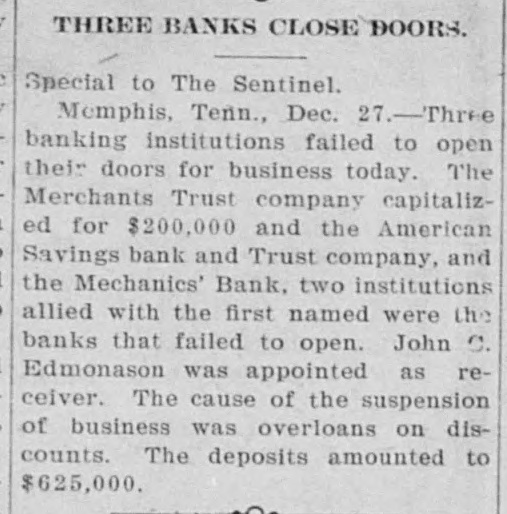
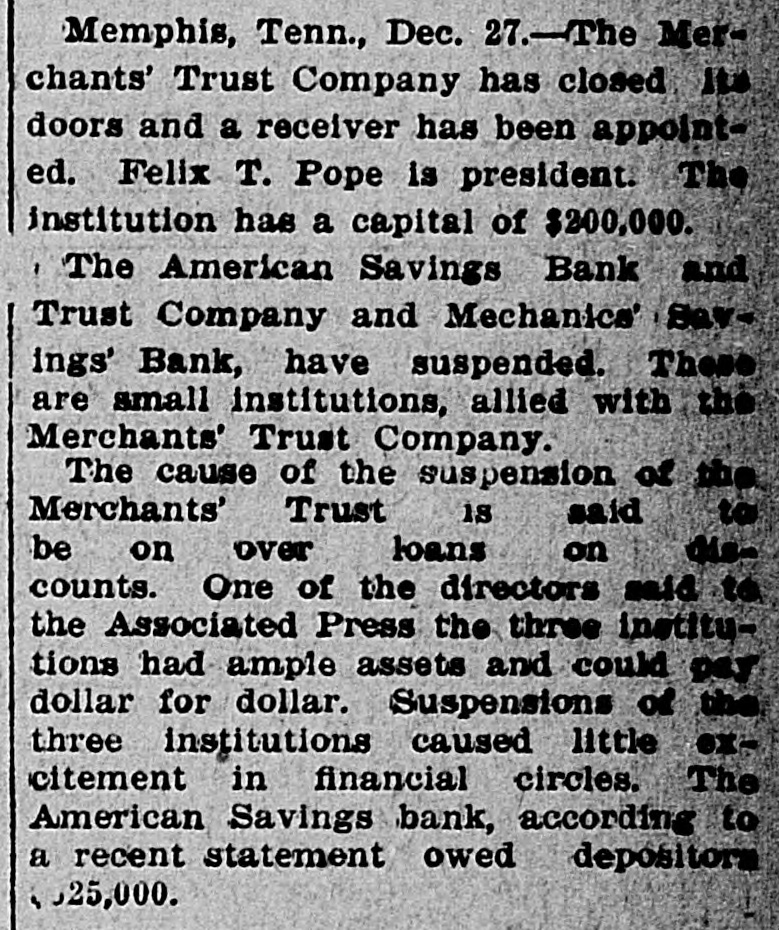
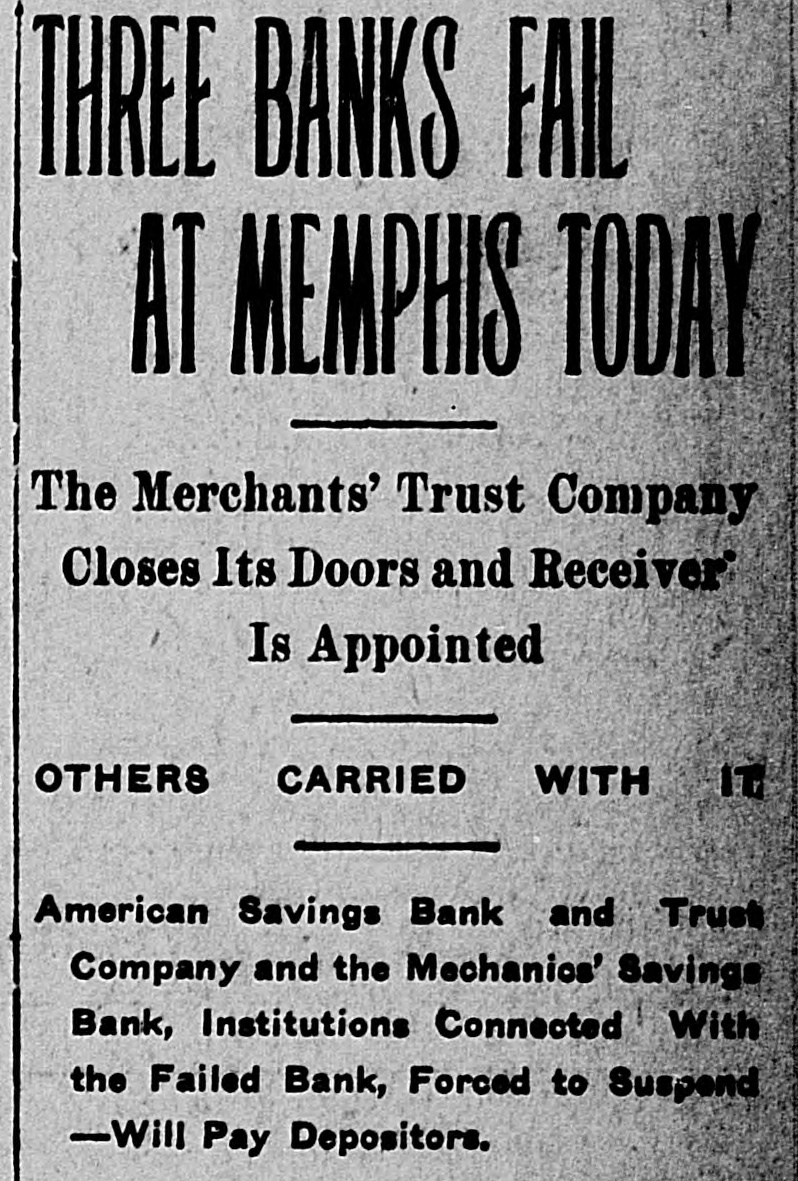
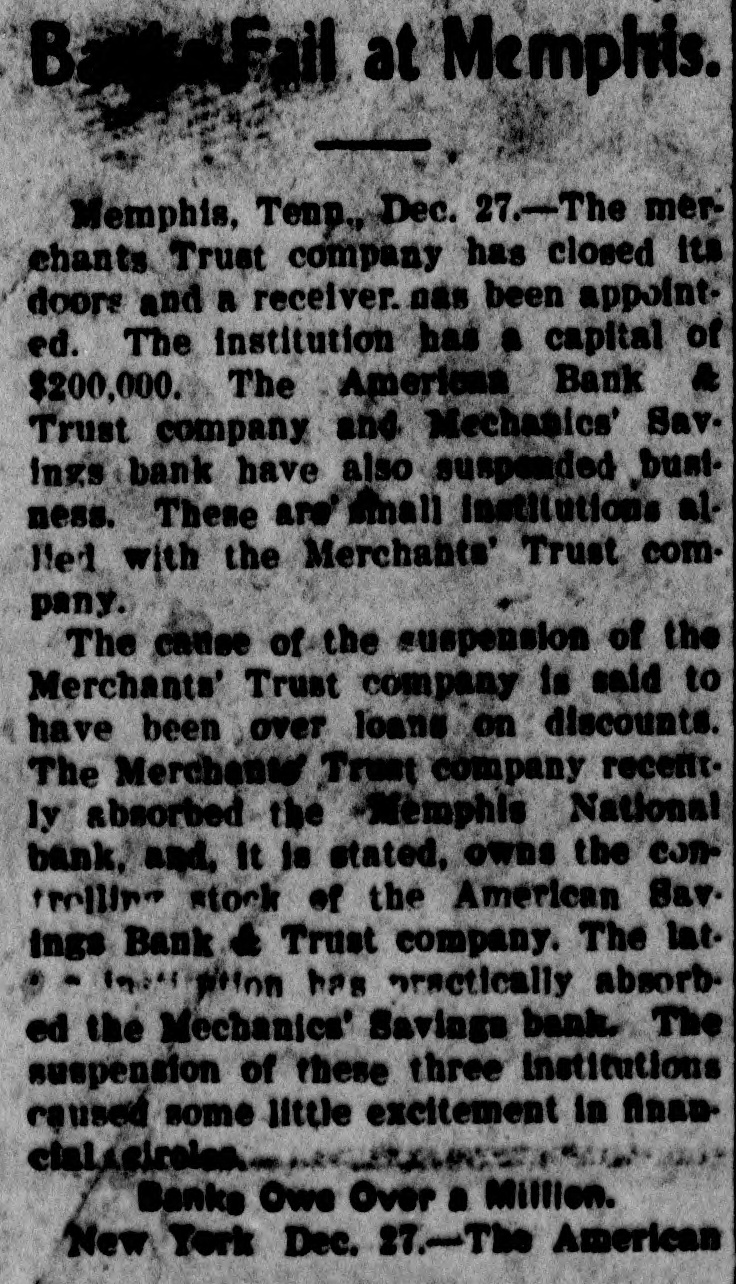
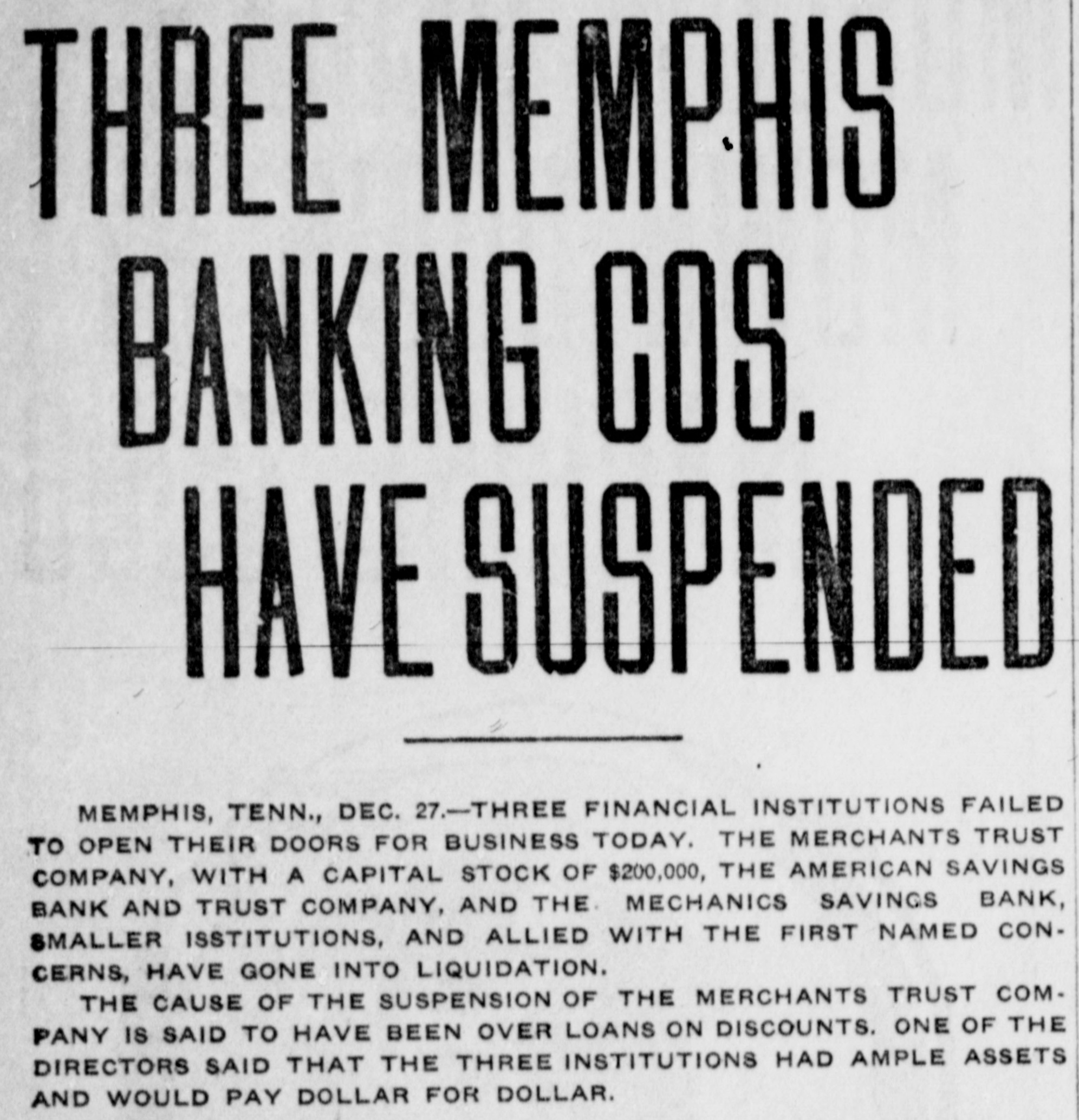
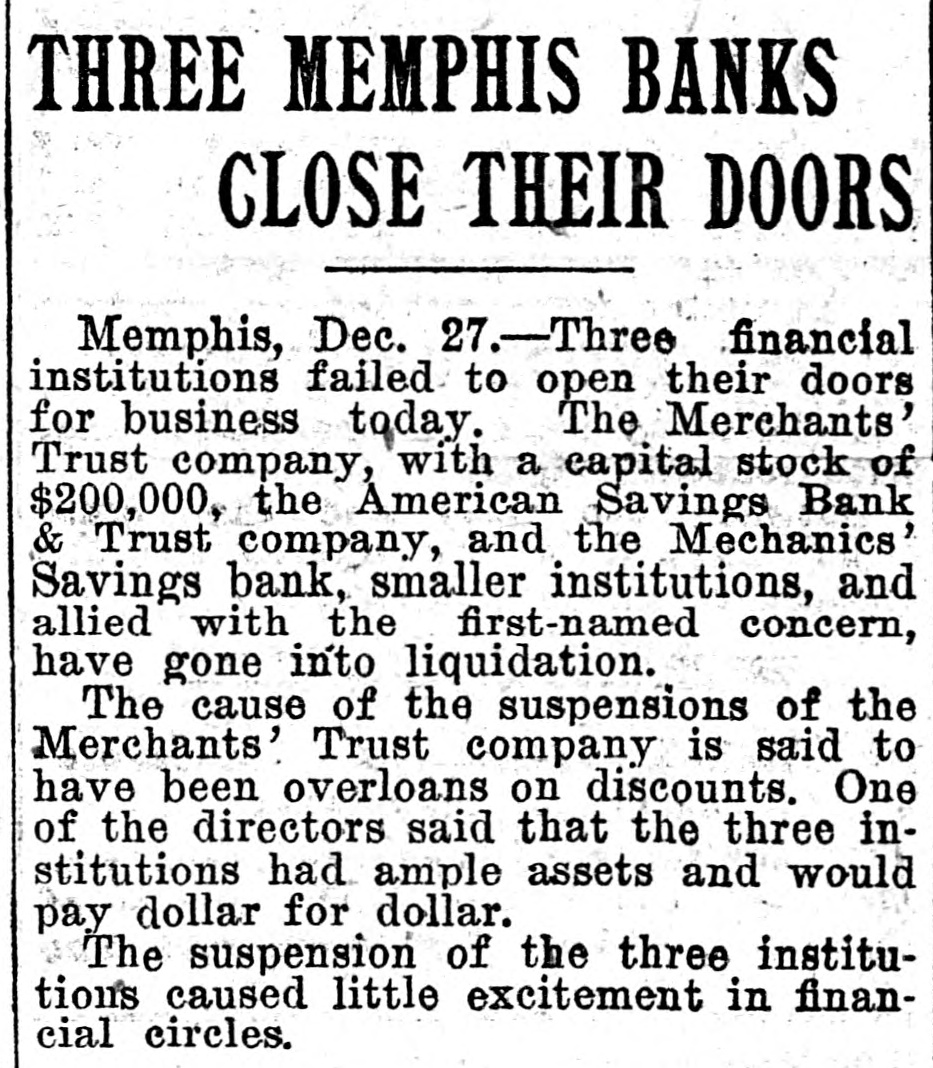
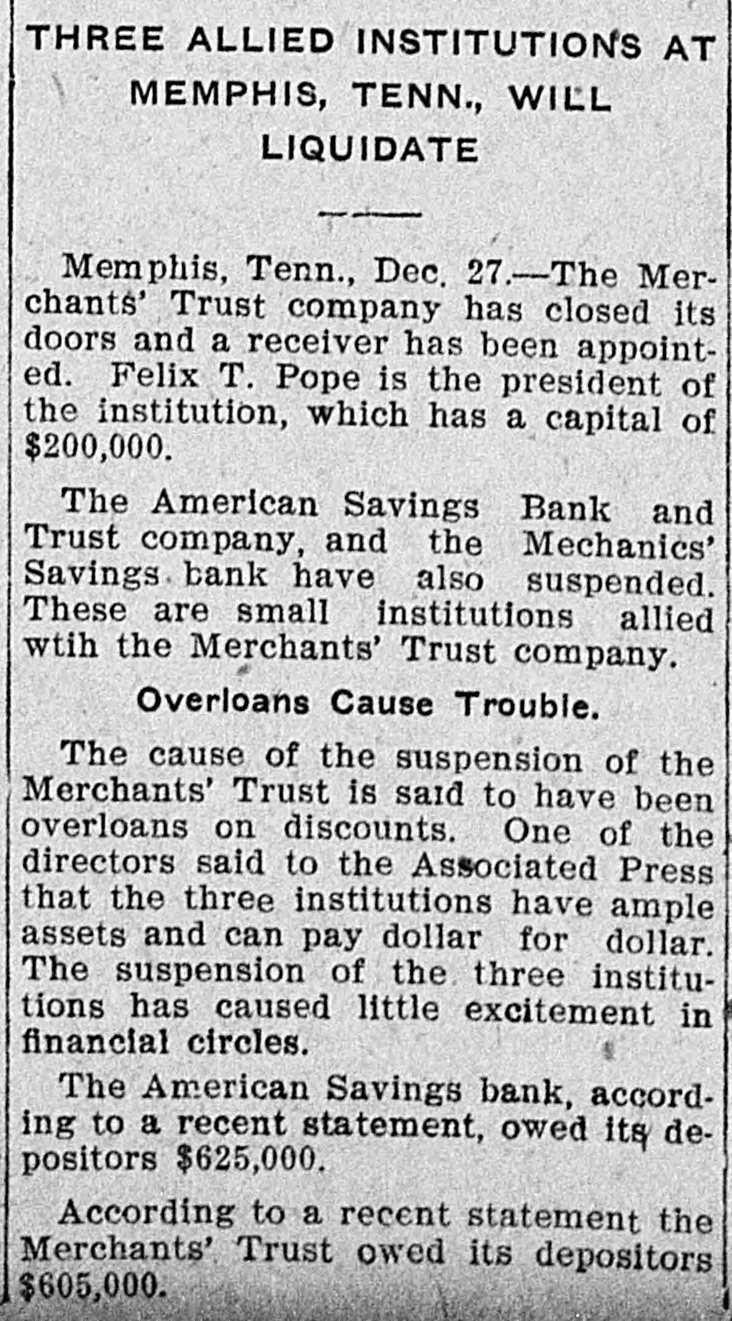
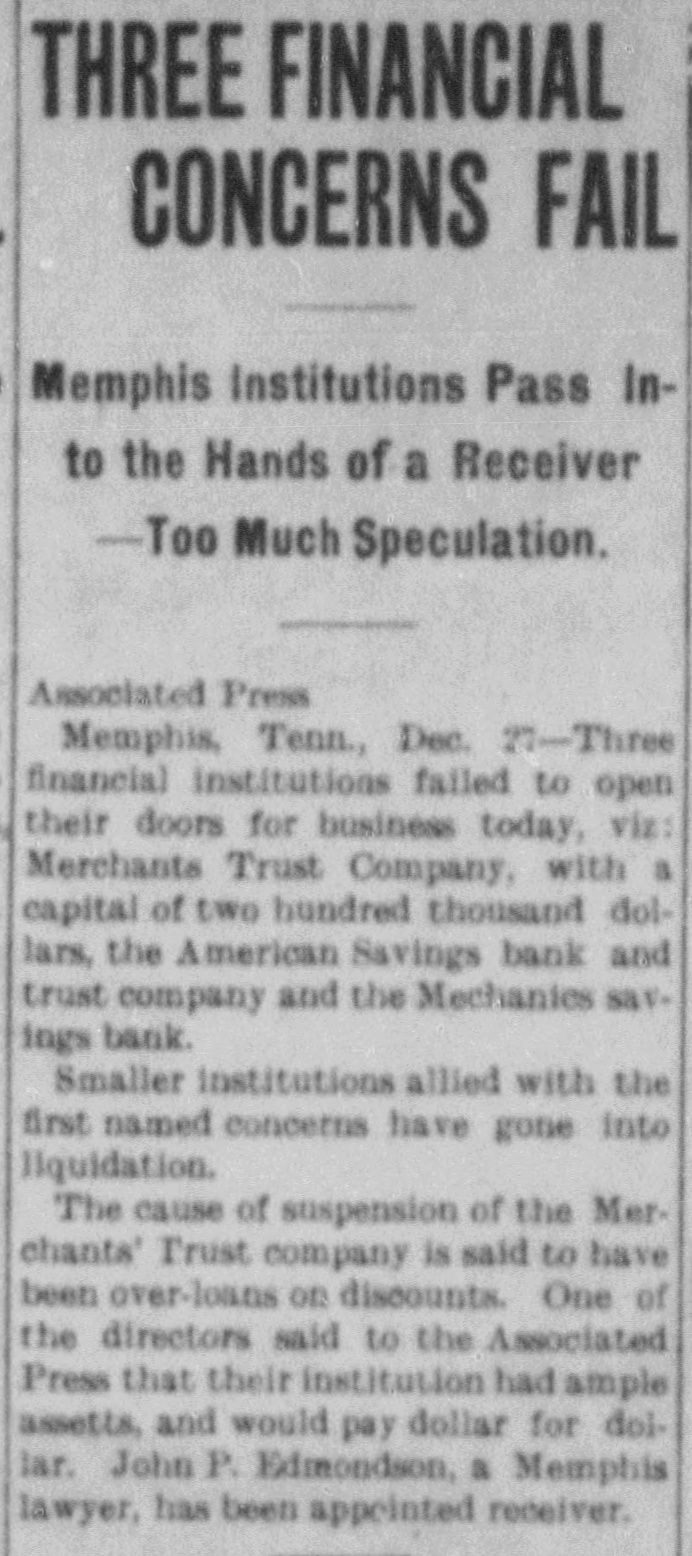
THREE MEMPHIS BANKS GO DOWN Assets Said to Be Ample to Pay the Depositors. RESULT OF SPREADING OUT FAILURE CAUSED LITTLE OR NO EXCITEMENT. EMPHIS, Tenn., Dec. 27.-Three institutions failed to open their M doors for business today. The Merchants' Trust company. with a capital stock of $200,000; the American Savings bank & Trust company, and the Mechanics' Savings bank, smaller institutions allied with the first named concern, have gone- into liquidation. The following notice was posted on the doors of the Merchants' Trust company: "This bank is closed by order of the board of directors, and will go into liquidation. (Signed.) "FELIX T. POPE. "President." Another notice reads: "This bank has gone into liquidation. John P. Edmonson has been appointed receiver.' Assets Are Ample. The cause of the suspension of the Merchants' Trust company is said to have been over-loans on discounts. One of the directors said to a representative of the Associated Press that the three institutions had ample assets and would pay dollar for dollar. When the officers of the Merchants' Trust company decided to suspend business, Chancellor Heiskell was asked to appoint a receiver for the institution, and named John P. Edmonson, a Memphis lawyer. The Merchants' Trust company recently absorbed the Memphis National bank, and, it is stated, owns the controlling stock of the American Savings Bank & Trust company: The latter institution has practically absorbed the Mechanics' Savings bank. The suspension of the three institutions caused little excitement in financial circles. A Run Was Feared. It was later learned that the American Savings Bank & Trust company had actually absorbed the Mechanics' Savings bank several days ago. It was stated today that the suspension of this institution is only temporary and that its affairs are in good shape. Officers say that the suspension was decided upon because they feared a run when the doors were opened this morning, the public generally being aware of the bank's relation to the Merchants' Trust company. At the latter institution it was announced that a thorough reorganizatio would be made, and hope was expressed that the company would again open its doors for business in a short time. A condensed statement of the condition of the Merchants' Trust company at the close of business Dec. 26 was given out, as follows: Total assets, $3,665,055: indebtedness of every character to depositors, $2,132,319; all other obligations exclusive of capital stock, $889,058; cash actually on hand, $30,000. Aided by Clearing House. C. W. Schulte, president of the Memphis Clearing House association, made the following statement in behalf of the association: "Fifteen days ago the Merchants' Trust company applied for help to the Memphis Clearing House association. The Clearing House association appointed a committee to investigate the matter. The committee went over the assets of the Merchants' Trust company as carefully as the limited time allowed, and the association advanced through the Merchants' Trust company the sum of $160,000. "Subsequent investigation revealed the fact that while it was the opinion of the members of the Clearing House association that the depositors of the concern are safe, yet it would take an extraordinarily large sum to pay all the demands. "In the interests of the city and depositors and of the various institutions of the city, which for the last month have anticipated some such movement, it was deemed wisest totallow the concern to close its doors. Other Banks Safe. "Representatives of the large banks of New York, Chicago and St. Louis are in the city with great quantities of money in furtherance of the legitimate business interests of the city. "It is deemed advisable that no undue excitement be indulged in. Old and experienced bankers and members of the Memphis Clearing House association have the situaiton well in hand. No danger is apprehended and the commercial interests of the city are competent to meet any sttuation that is liable to arise." Major G. W. McRae. president of the Memphis Savings bank, said: "I believe the-liquidation to be a result of taking on too much business by the Merchants' Trust company, too much spreading out and too large advances in purchasing other properties."