Henry Siegel & Company (New York, NY)

Episode Information

Episode UID
3883357291368
Episode Type
Suspension โ†’ Run โ†’ Closure
Bank Type
private
Bank ID
388335729 hash
Start Date
December 30, 1913
Location
New York, New York (40.714, -74.006)

Metadata

Model
gemini-3-flash-preview (chosen from majority vote of a three-model LLM ensemble)
Short Digest
c9d5eea7d5620ea1

Response Measures

None

Description

The bank suspended as part of a broader corporate bankruptcy of the Siegel Stores Corporation; subsequent depositor agitation and 'stormy' meetings occurred as they attempted to recover funds.

Events (5)

1. December 30, 1913 Other
Newspaper Excerpt
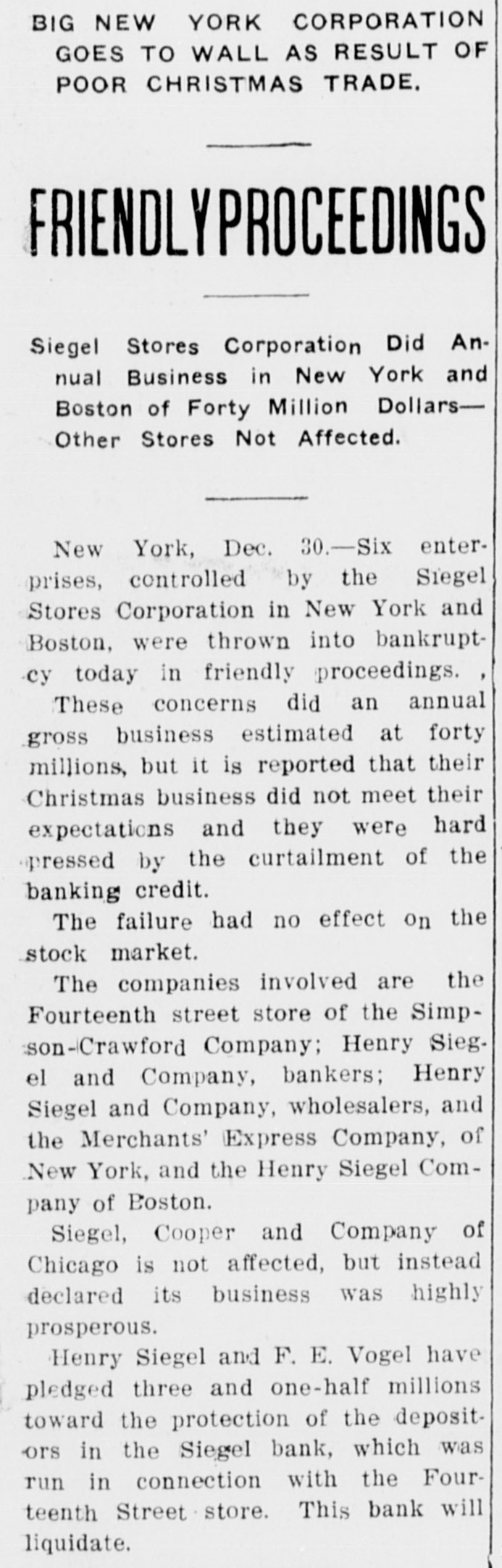
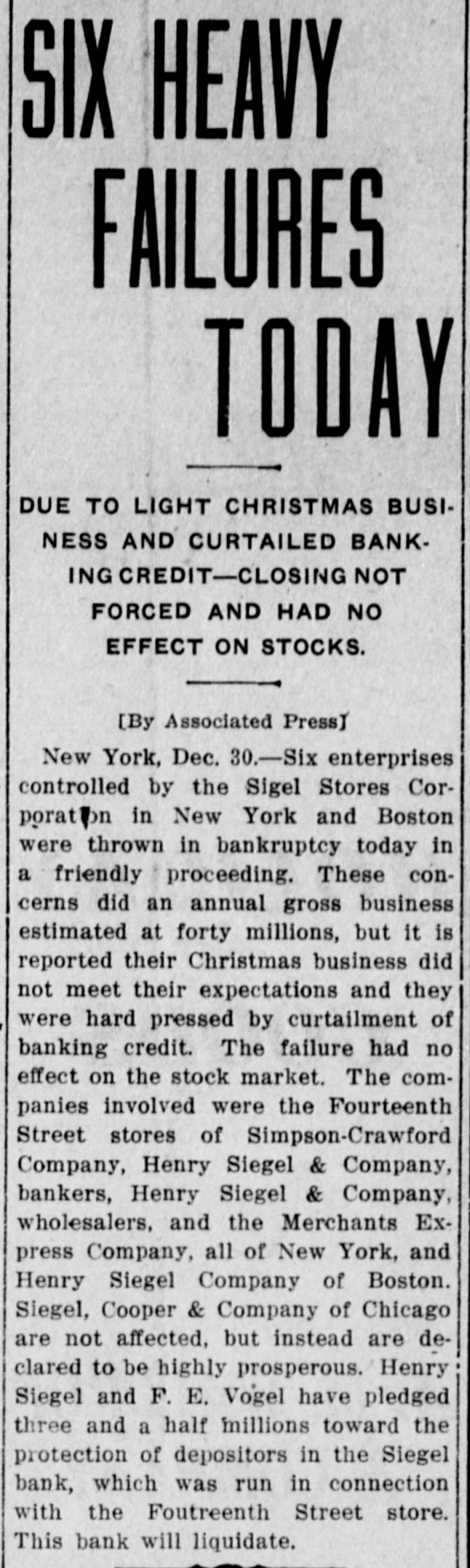
Henry Siegel and F. E. Vogel have pledged three and one-half millions toward the protection of the depositors in the Siegel bank... This bank will liquidate.
Source
newspapers
2. December 30, 1913 Receivership
Newspaper Excerpt
Henry Melville, the receiver, and his assistants reached there there were several score looking for money
Source
newspapers
3. December 30, 1913 Suspension
Cause
Bank Specific Adverse Info
Cause Details
Failure of the parent Siegel Stores Corporation due to poor Christmas trade and curtailment of banking credit.
Newspaper Excerpt
Henry Sieg. el and Company, bankers... were thrown into bankrupt, cy today in friendly proceedings.
Source
newspapers
4. December 31, 1913 Run
Cause
Bank Specific Adverse Info
Cause Details
Depositors gathered and clamored for cash immediately following the announcement of the bank's failure and receivership.
Measures
Police were assigned to prevent trouble and receivers met with depositor committees to advise patience.
Newspaper Excerpt
Several hundred depositiors met there in the hope of getting some hint as to when their money might be returned to them. Impromptu meetings, that threatened to end in riots, were held
Source
newspapers
5. March 11, 1914 Other
Newspaper Excerpt
the grand jury... returned three joint indictments against him and his partner in the banking enterprise, Frank E. Vogel.
Source
newspapers

Newspaper Articles (25)

Article from The Daily Ardmoreite, December 30, 1913

Click image to open full size in new tab

Article Text

BIG NEW YORK CORPORATION GOES TO WALL AS RESULT OF POOR CHRISTMAS TRADE. FRIENDLYPROCEEDINGS Siegel Stores Corporation Did Annual Business in New York and Boston of Forty Million DollarsOther Stores Not Affected. New York, Dec. 30.-Six enterprises, controlled by the Siegel Stores Corporation in New York and Boston, were thrown into bankrupt, cy today in friendly proceedings. These concerns did an annual gross business estimated at forty millions, but it is reported that their Christmas business did not meet their expectations and they were hard pressed by the curtailment of the banking credit. The failure had no effect on the stock market. The companies involved are the Fourteenth street store of the Simpson-Crawford Company; Henry Sieg. el and Company, bankers; Henry Siegel and Company, wholesalers, and the Merchants' Express Company, of New York, and the Henry Siegel Company of Boston. Siegel, Cooper and Company of Chicago is not affected, but instead declared its business was highly prosperous. Henry Siegel and F. E. Vogel have pledged three and one-half millions toward the protection of the depositors in the Siegel bank, which was run in connection with the Fourteenth Street . store. This bank will liquidate.


Article from Bryan Daily Eagle and Pilot, December 30, 1913

Click image to open full size in new tab

Article Text

SIX HEAVY FAILURES TODAY DUE TO LIGHT CHRISTMAS BUSINESS AND CURTAILED BANK. INGCREDIT-CLOSING NOT FORCED AND HAD NO EFFECT ON STOCKS. [By Associated Press] New York, Dec. 30.-Six enterprises controlled by the Sigel Stores Corporation in New York and Boston were thrown in bankruptcy today in a friendly proceeding. These concerns did an annual gross business estimated at forty millions, but it is reported their Christmas business did not meet their expectations and they were hard pressed by curtailment of banking credit. The failure had no effect on the stock market. The companies involved were the Fourteenth Street stores of Simpson-Crawford Company, Henry Siegel & Company, bankers, Henry Siegel & Company, wholesalers, and the Merchants Express Company, all of New York, and Henry Siegel Company of Boston. Siegel, Cooper & Company of Chicago are not affected, but instead are declared to be highly prosperous. Henry Siegel and F. E. Vogel have pledged three and a half millions toward the protection of depositors in the Siegel bank, which was run in connection with the Foutreenth Street store. This bank will liquidate.


Article from New-York Tribune, January 1, 1914

Click image to open full size in new tab

Article Text

Several Hundred Gather to Learn When They Will Get Their Money. COMMITTEE CONSULTS COUDERT BROTHERS Greenhut-Siegel Cooper Co. Not Connected with Concern in Receivers' Hands. Interest in the affairs of the several concerns dominated by Henry Siegel, which on Tuesday were taken possession of by receivers appointed by the United States Court. centred yesterday in the private banking firm of Henry Siegel & Co., which now has quarters in a loft at No. 45 West 13th street. Several hundred depositiors met there in the hope of getting some hint as to when their money might be returned to them. Impromptu meetings, that threatened to end in riots, were held, and the excitement ceased only when darkness came. It was finally agreed to meet at the loft to-morrow morning at 7 o'clock and discuss ways and means of protecting the interests of all. If the use of the loft is denied for the purpose the depositors will assemble in the street Bright and early yesterday morning the depositors began to arrive at the loft. and when Henry Melville, the receiver. and his assistants reached there there were several score looking for money Mr. Melville had no money to give them. He informed all that it was impossible to determine where the depositors stand until the examination of the firm's books is at least partially completed. Until then he advised patience. Lawyers Busy in Throng. Previous to Mr. Melville's arrival a group of lawyers and their runners arrived and began seeking depositors' names. Some sought a power of attorney from each depositor they could get to listen to them, and succeeded in obtaining many. One of the attorneys, more enterprising than the rest, secured in some mysterious way a chair and a table, and did a lively business until a little woman in gray denounced him as a "shyster," and demanded that the receiver's representative put him out of the place. He ceased his activities after that. Some of the depositors formed a committee that called upon Coudert Brothers, Jacob H Latzer, of No. 451 East 182d street, who has $6,000 in the bank. acting as spokesman. He reported back to the meeting that Mr Murray, of the law firm. had advised against any hasty proceeding. telling the committee it had bet ter find out all about the case from the receiver and other sources and then it would be possible to decide what to do. He added it might be well for the depositors to work together and do nothing in the way of beginning litigation that might prove unnecessary and only result in delay and waste of assets. Meanwhile two firms of accountants had begun the work of overhauling the books of the drygoods houses and of the banking house. Not much progress was made, the accountants merely blocking out some of the work on which they expect to start in earnest to-day. The task will take several weeks The inventorying of stock will also begin to-day preparatory to efforts on the part of the receivers to turn part of the marchandise on hand into cash as quickly as possible. There is much doubt expressed on the part of those familiar with the affairs of the involved concerns as to the status of the depositors of the banking house. In some circles the impression has gone forth that they will be treated as preferred creditors, but Mr. Melville declared yesterday he could not see wherein they had any preference over the general creditors of Henry Siegel and Frank A. Vogel, his partner in the banking and wholesale business, to whom, he said, they stood in the position of lenders of money. L. A. Price Appointed Manager. L. A. Price, whose interests in the Rothenberg store were taken over by the Siegel interests, has been appointed to manage the Fourteenth Street Store, the SimpsonCrawford Company and the Henry Siegel Company store, in Boston, for the receivers. Opposition to Messrs. Marble and Sheppard continuing as receivers of the Boston store developed in that city yesterday when A. Davis & Co., of New York, who have a claim of $3,469. filed a petition asking for the appointment of a co-receiver on the grounds that the men designated by the court in New York will necessarily operate the business in Boston for the advantage of the Siegel stores. Action on the petition was deferred to next week. There is no connection between any of the establishments of Henry Siegel and the Greenhut-Siegel-Cooper Company, according to a statement made yesterday by B. J. Greenhut, secretary and treasurer of the Greenhut-Siegel-Cooper concern. Inquiries made following the announcement on Tuesday that Henry Siegel's mercantile establishments had been placed in the hands of a receiver disclosed the fact that Mr. Siegel's intersts in the department store at 18th street and Sixth avenue had been sold twelve lears ago. "My father. J. B. Greenhut, bought Mr. Siegel's interest in our company twelve years ago, said Mr. Greenhut, "and since that time there has been no connection between us. Some time Mr. Sieget opened a banking business in his 14th street store, similar to that which we conduct. That gave rise to the idea that we have deposited money there "I want to make it very plain that Greenhut-Siegel-Cooper & Co., bankers, as distinguished from the Greenhut-Slegel-Cooper Company, merchants, is a copartnership. It has no connection with our mercantile business "Every dollar of deposits with this company is either in cash or marketable securities, and the biggest part of these securities is in the best commercial paper in the country. The Greenhut Siegel Cooper Company is not using a dollar of its depositors' money in its business. Our firm does not owe a dollar to any bank, nor is any of our paper on the market.


Article from New-York Tribune, January 3, 1914

Click image to open full size in new tab

Article Text

SIEGEL ENTERPRISES Mercantile and Bank Creditors Unite in Effort to Aid Receivers. BANK DEPOSITORS CLAMOR FOR CASH Are Told They Must WaitCrowd Accuses a Woman Adviser of Being Firm's Agent. Mercantile and bank creditors of the several Siegel enterprises, representing claims totalling about $1,000,000. met yesterday in the offices of White & Case, in the Bankers Trust Building, and formed a committee to aid the receivers in reorganizing the companies and conserving the Interests of the creditors. This committee, of which Pierre Jay, vice-president of the Bank of the Manhattan Company. is chairman, and Joseph M. Hartfield, of White & Case, is secretary. will confer with William A. Marble and John S. Sheppard, Jr., receivers of the Siegel mercantile establishments, to-day and report results to a meeting of creditors on Monday. Mr. Jay is serving on the committee as the representative of the Bank of the Metropolis and other banking creditors. The other members of the committee are Clifton M. Dwinell. representing the First National Bank of Boston: E. L. Myers, of L. Meyers & Sons. glovers: Leo Frank, of the H. B. Claffin Company, and Edmund Wright, who represents F. Vietor & Achelis, dry goods wholesaTers. "I estimate that the claims represented by the committee total perhaps $1,000,000," said Mr. Hartfield to a Tribune reporter last night, "but the committee represents no group of creditors. It will be glad to have them all come in. What we want to do is to co-operate in working out some scheme to reorganize. If these properties are forced to a sacrifice, cleared up at once, there will undoubtedly be loss. They must be kept going. The goodwill alone is very valuable. Whether or not 100 per cent will be paid no one knows as yet. We may learn something between row and Monday." Depositors in the banking house of Henry Siegel & Co. met in the early morning and there was a repetition of the scenes of Wednesday, when everybody began clamoring for money at once. Henry Melville, the receiver, told them none was to be had, and that no information would be forthcoming for probably a week. Another effort was made to appoint a committee to hire lawyers, but this was headed off by Miss Jessie A. Martin, who is in a magazine enterprise. She advised all against wasting money upon lawyers. She was thereupon accused of being an agent of the head of the firm. She prevailed, however, and a committee, headed by Jacob H. Latzer, was sent to see Henry Siegel and ascertain his attitude toward the depositors. This committee will report at 10 o'clock this morning. James N. Rosenberg. of Rosenberg & Lewis, yesterday defined the position of the creditors of the bank. They will come first in the distribution of the proceeds of the 500,000 Siegel Stores Corporation


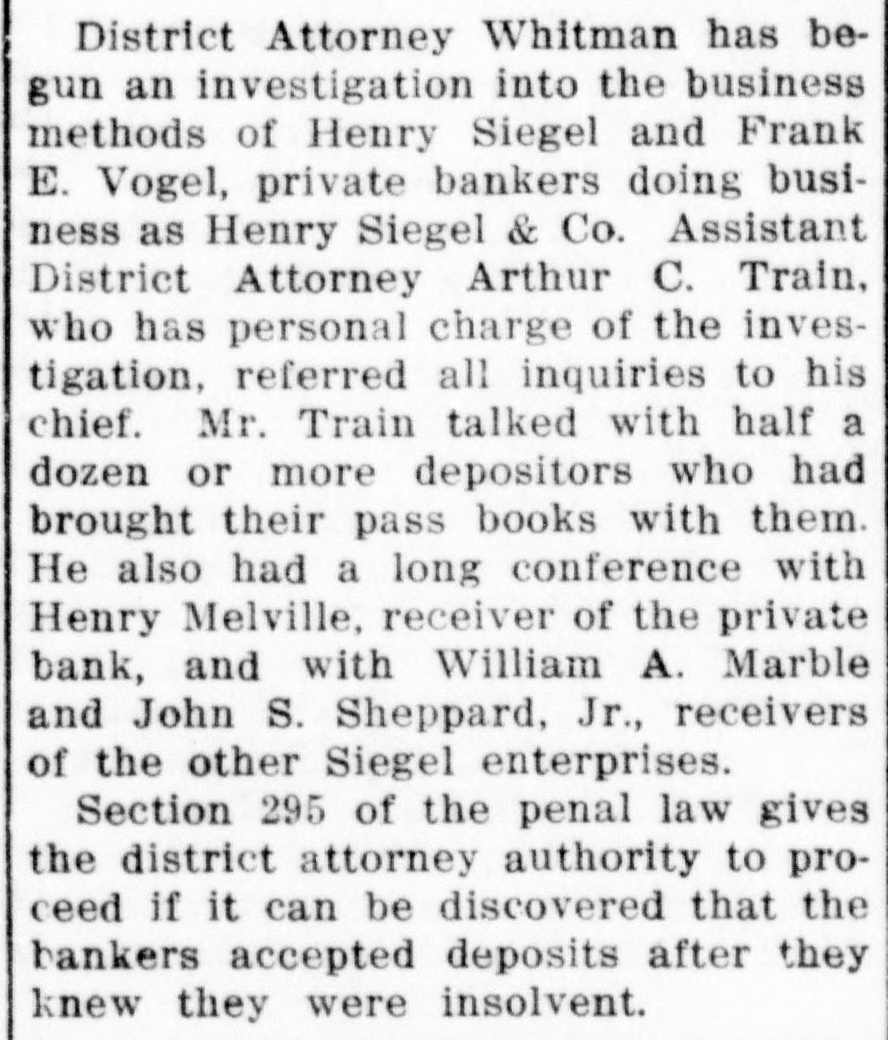
Article from New-York Tribune, January 8, 1914

Click image to open full size in new tab

Article Text

District Attorney Whitman yesterday ordered Arthur C. Train, head of the newly established bureau of commercial frauds, to look into the circumstances surrounding the closing of the private bank of Henry Stegel & Co. As a result of the closing of the Siegel bank the state Senate yesterday authorized an investigation by the Senate Banking Committee of the business of private bankers in the state. The resolution was introduced by Senator Pollock and adopted by a vote of 27 to 8. The District Attorney, who acted only after numerous complaints had been made that deposits had been received up to the close of business on the day that Judge Hough placed the Siegel enterprises in the hands of receivers, and after it was known that the Siegel concerns were shaky, refused to discuss the matter. "The case is under investigation," he told a Tribune reporter. "There is nothing more that I can say." Mr. Train, who was present at the interview, was equally reticent. It is known, however, that Henry Melville, receiver of the bank, called at the Criminal Courts Building at the request of Mr. Train, and was closeted with him more than an hour. He left behind him a transcript of the preliminary report of the American Audit Company, which has been overhauling the affairs of the bank.


Article from The Daily Gate City, January 8, 1914

Click image to open full size in new tab

Article Text

SEIGEL BANK TO BE INVESTIGATED Was Private Concern and One Depositor Lost Mind When Doors Closed, NEW YORK, Jan. 8.-A thorough probe in the banking business of Henry Siegel and Co., was being considered today by District Attorney Whitman who announced plans for a state inquiry into the private banking business. The Siegel bank was involved when receivers were appointed recently for the Siegel department stores. Fearing $2,700, his savings of a life time, had been swept away, Rudolph Poensky, a depositor in the Fourteenth street store bank, has lost his reason, his wife declared today, A meeting of depositors of the Sieget bank is called for this afternoon. Fearing possible outbreaks, the receivers asked that police be assigned to prevent trouble. John P. Murray, an attorney representing depositors, today said a plan of rehabilitating the Siegel stores and the private bank was under consideration. A syndicate of ten wealthy men proposes it is said, to put up $1,000,000 80 that the bankrupt stores may be put back on a paying basis and depositors in the bank paid off. The plan provides for the issuance of a million dollars in preferred stock of the Siegel Cooper store of Chicago, each member of the syndicate subscribing $100,000. The Chicago store is not involved in the failure and its profits would then be diverted to the rehabilitation of the eastern stores.


Article from The Detroit Times, January 8, 1914

Click image to open full size in new tab

Article Text

CONSIDER PROBE OF SIEGEL BANKS NEW YORK, Jan. 8.-A thorough probe into the banking busin SS of Henry Siegel & Co. was being considered today by District Attorney Whitman who announced plans for a state inquiry into the private banking business. The Siegel bank was involved when receivers were appointed recently for the Siegel department stores. Fearing that $2,700, his savings of a lifetime, had been swept away, Rudolph Poensky, a depositor in the Fourteenth-st. Store bank, has lost his reason, his wife declared today. A meeting of depositors of the Siegel bank is called for this afternoon. Fearing possible outbreaks the receivers asked that police be assigned to prevent trouble.


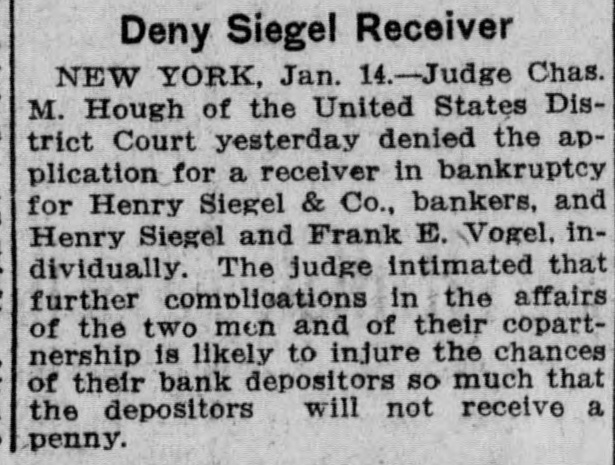
Article from Newark Evening Star and Newark Advertiser, January 14, 1914

Click image to open full size in new tab

Article Text

Deny Siegel Receiver NEW YORK, Jan. 14.-Judge Chas. M. Hough of the United States District Court yesterday denied the application for a receiver in bankruptcy for Henry Siegel & Co., bankers, and Henry Siegel and Frank E. Vogel. individually. The judge intimated that further complications in the affairs of the two men and of their copartnership is likely to injure the chances of their bank depositors so much that the depositors will not receive a penny.


Article from The Evening World, January 21, 1914

Click image to open full size in new tab

Article Text

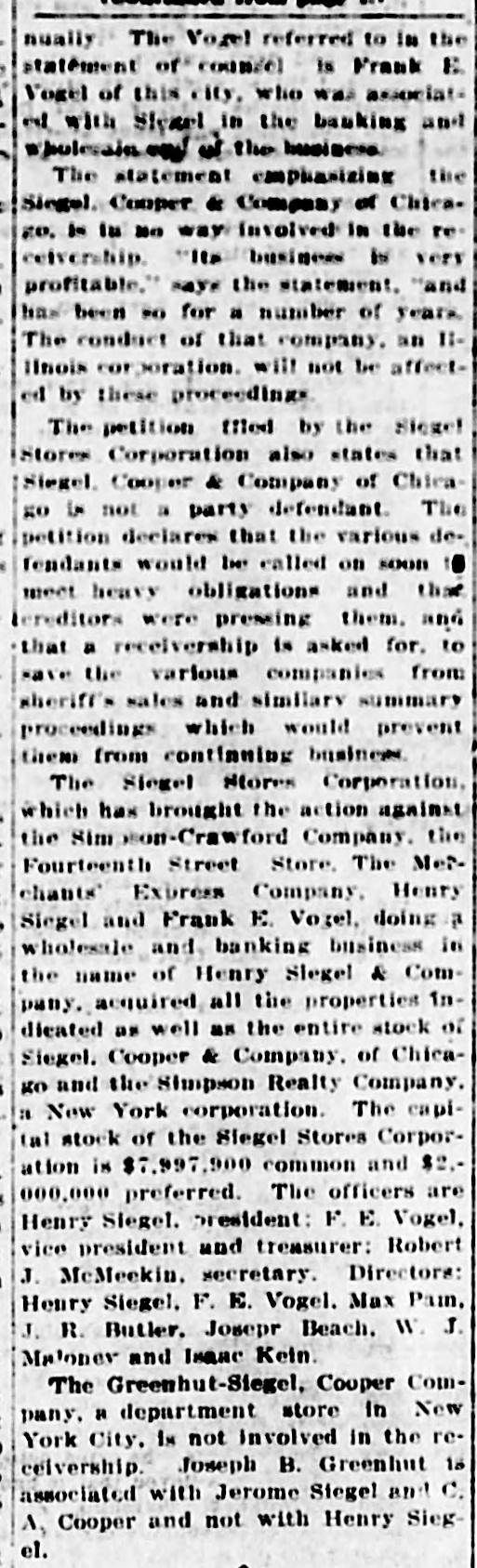
Partner Vogel Says That Went Down as "Personal Loans" to the Business. THE PARTNER IS BROKE. "Haven't a Cent," He Cries, After Tolling Off Millions He's Down for Jointly. The thousands of depositors in the defunct banking firm of Henry Siegel & Co. learned to-day that their money, loaned to the various stores in which Henry Siegel and Frank E. Vogel were co-partners, appeared on the books of the stores as "personal loans" from Siegel and Vogel. Further, they were coolly informed that the bankers had agreed among themselves that all debts of the stores were to be paid off before the depositors' money, borrowed by Siegel and Vogel, was to be returned to the private bank. Frank E. Vogel, Siegel's co-partner, was examined at length to-day before George C. Holt, special master appointed for the examination by Judge Hough, of the United States I District Court. The examination took o place in the offices of Douglass, Armitage & McCann, in the Woolworth Building. $ Vogel, under examination by Joseph N. Rosenburg, was asked: "When Henry Siegel & Co., Bank. ers, loaned money to one of the Siegel stores-Simpson, Crawford & Co., for instance-how did it appear on the books of the store? NOT SHOWN TO BE MONEY OF DEPOSITORS. I "The book-keepers were instructed to post on the books of the store the sum loaned under the caption 8 that it was a 'personal loan' from Henry Siegel and myself to the store," : was the reply. f "And the books of the store do not show that the money was, in reality, 3 the money of the bank's depositor's." "The books show that Henry Siegel I and myself made 'personal loans' to the stores." I Vogel added that he and Siegel had an unwritten agreement among themo selves that all the debts owed to wholesalers for merchandise, to newspapers for advertising and to banks t and brokers for money borrowed was a to be paid in full by the stores beI fore they repaid to the banking firm of Henry Siegel & Co., bankers, the sums they had loaned as "personal a loans" to the various Siegel stores. Much about the money borrowed on notes by Henry Siegel or his partner, Frank E. Vogel, was told in the tesI timony of Mr. Vogel. A committee of depositors was rep= resented by John P. Murray of : Coudert Brothers. John B. Stanchfield represented Henry Siegel and a Mr. Vogel, while Arthur C. Train of 1 the District-Attorney's staff was an a interested spectator. Mr. Vogel was t examined by Joseph N. Rosenburg, attorney for the receivers for the shares. THE CREDIT OF A BIG BUSINESS MAN. Something of a Big Business man's credit was shown by Mr. Vogel when he submitted his schedule of liabilities. He owed the National Bank of the Republic a personal debt of $135,t 835, secured by collateral. He further is indorser for a note for $100,000 to the same bank, the note being made by Siegel, but the collateral being put up Vogel as "an accommodation" to his partner. The same condition exists in a $50,000 loan made by the Central Trust Company of Chicago. Mr. Vogel said he also indorsed a $75,000 note of Siegel, Cooper & Co. of Chicago in the Central Trust Company, but no collateral was put up. His name, with Siegel's, appears as indorser of $715,000 worth of notes of ( the Simpson, Crawford Company, these notes being held by Goldman, Sachs & So., the National Park Bank, the Bank of the Metropolis and the Garfield National Bank. With Siegel, too, he indorsed $1,360,000 worth of notes for Siegel. Cooper & Cc. of Chicago, thees notes being held by A. G. Becker, Goldman, Sachs & Co. and Chicago banks $ Mr. Vogel explained that he and Mr. Siegel are joint indorsers of notes of $250,000 of the Fourteenth Street Store and $287,500 of notes of the
Article from Evening Star, January 21, 1914

Click image to open full size in new tab

Article Text

HOLT ACTS IN SIEGEL CASE. Begins Examination of Assets and Property of Banker and Merchant. NEW YORK, January 21.-Former Judge George C. Holt, who was made a special master by the federal court for an examination of the estate, assets and property of Henry Siegel and his partner, Frank E. Vogel, in the private bank of Henry Siegel & Co., began the hearing today. Henry Melville, receiver of the Siegel bank, has employed John P. Murray and Joseph M. Proskauer to represent him in the examination O Sigel and Vogel. Many other lawyers. representing various interests, were also in attendance.


Article from The Barre Daily Times, January 29, 1914

Click image to open full size in new tab

Article Text

With Notes to Cover Balance of Deposits in Siegel Bank NOTES BACKED BY $4,000,000 STORE Company Recently Went into the Hands of Receivers New York, Jan. 29.-Depositors with Henry Siegel & company, which recently went into the receivers' hands, have been informed that the bankers offer cash payment of 30 per cent. of the money due if the depositors will accept notes for the balance, backed by about $4,000,000 common stock in the Siegel stores corporation. This offer was made by legal representatives of Henry Siegel and Frank E. Vogel. The amount offered aggregated $750,000 cash.


Article from Norwich Bulletin, February 7, 1914

Click image to open full size in new tab

Article Text

Criminal Probe in Siegel Case. New York, Feb. -Facts relating to the bank of Henry Siegel and Company, which recently went into receiver's hands. will be brought to the attention of United States District Attorney H. Snowden Marshall by one of his assistants, Roger B. Wood, with whom Henry Meiville, the receiver for Henry Siegel and Company, was today in conference, for the purpose, it was stated, of determining whether or not there was ground for action in the case by the federal government.


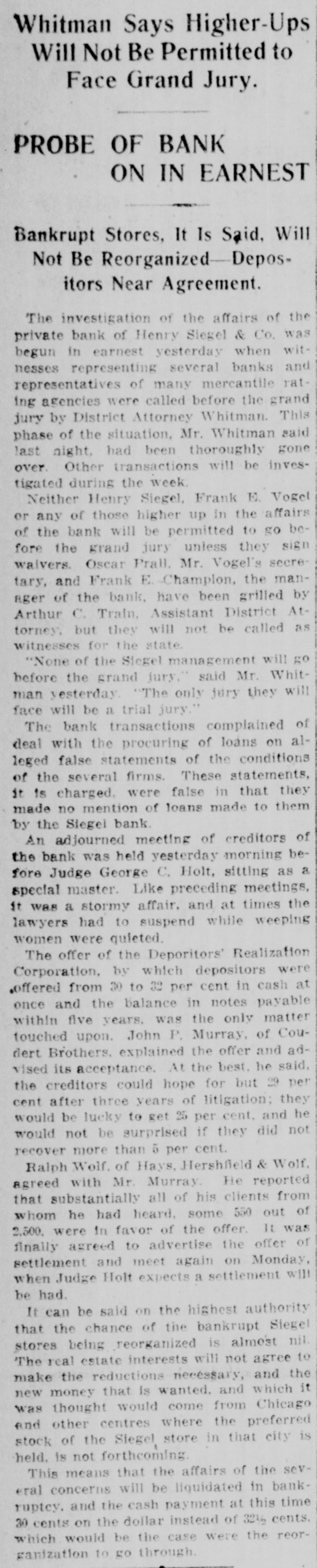
Article from New-York Tribune, March 3, 1914

Click image to open full size in new tab

Article Text

Whitman Says Higher-Ups Will Not Be Permitted to Face Grand Jury. PROBE OF BANK ON IN EARNEST Bankrupt Stores, It Is Said, Will Not Be Reorganized-Depositors Near Agreement. The investigation of the affairs of the private bank of Henry Siegel & Co. was begun in earnest yesterday when witnesses representing several banks and representatives of many mercantile rating agencies were called before the grand jury by District Attorney Whitman. This phase of the situation, Mr. Whitman said last night, had been thoroughly gone over. Other transactions will be investigated during the week. Neither Henry Siegel, Frank E. Vogel or any of those higher up in the affairs of the bank will be permitted to go before the grand jury unless they sign waivers. Oscar Prall. Mr. Vogel's secretary, and Frank E. Champion, the manager of the bank, have been grilled by Arthur C. Train, Assistant District Attorney, but they will not be called as witnesses for the state. "None of the Siegel management will go before the grand jury," said Mr. Whitman yesterday. "The only jury they will face will be a trial jury." The bank transactions complained of deal with the procuring of loans on alleged false statements of the conditions of the several firms. These statements, it is charged, were false in that they made no mention of loans made to them by the Siegel bank. An adjourned meeting of creditors of the bank was held yesterday morning before Judge George C. Holt, sitting as a special master. Like preceding meetings, It was a stormy affair. and at times the lawyers had to suspend while weeping women were quieted. The offer of the Deporitors' Realization Corporation, by which depositors were offered from 30 to 32 per cent in cash at once and the balance in notes payable within five years, was the only matter touched upon. John P. Murray, of Coudert Brothers. explained the offer and advised its acceptance. At the best. he said, the creditors could hope for but 29 per cent after three years of litigation; they would be lucky to get 25 per cent, and he would not be surprised if they did not recover more than 5 per cent. Ralph Wolf. of Hays, Hershfield & Wolf. agreed with Mr. Murray. He reported that substantially all of his clients from whom he had heard, some 550 out of 2,500. were in favor of the offer. It was finally agreed to advertise the offer of settlement and meet again on Monday, when Judge Holt expects a settlement will be had. It can be said on the highest authority that the chance of the bankrupt Siegel stores being reorganized is almost nil. The real estate interests will not agree to make the reductions necessary, and the new money that is wanted. and which it was thought would come from Chicago and other centres where the preferred stock of the Siegel store in that city is held. is not forthcoming This means that the affairs of the several concerns will be liquidated in bankruptcy. and the cash payment at this time 30 cents on the dollar instead of 32ยฝ cents, which would be the case were the reorganization to go through.


Article from New-York Tribune, March 4, 1914

Click image to open full size in new tab

Article Text

Forecasts Made as to How Many Persons May Be Indicted in Near Future. CONCEALED BANK LOANS REFERRED TO Representatives of Mercantile Concerns and Public Accountants Give More Evidence. The grand Jury spent the larger part of yesterday hearing the evidence of witnesses in the investigation into the failure of the private banking house of Henry Siegel & Co. As on Monday, the witnesses were representatives of the banking houses and mercantile credit bureaus. Representatives of the American Audit Company and Flint & West, certified public accoutnants, who have examined the books for the receivers of the wrecked firm, also testified. Other witnesses will be examined today, but the investigation has so far progressed that those usually well informed in the Criminal Courts Building declare that the only question that now remains to be answered is the number of persons who may be named in the indictments that are expected to be voted next week. As new planned by the District Attorney's office. the indictments will be based upon transactions with banks which made loans to the Slegel firms, and which may lead to charges of misrepresenting the condition of the firms by concealing loans made by the banking house. Under one section of the Penal Code this is a misdemeanor and under another may be construed as a felony. It is expected that it is under the latter provisions that Indictments, if any, will be found. The bankers who have thus far testified have told of making loans to the Siegel firms after they had been furnished with written statements of the financial condition of the firms. These statements, which have been presented to the grand jury, do not, it is understood, agree with the books of the bank or of the failed firms. The credit bureau representatives have also presented documentary evidence. This consists of statements made by rep= resentatives of the Siegel firms on which credit ratings were based. These, too, are declared to have been misleading, and to have been given with a view to obtaining credits that otherwise would not have been given. The auditors have testified to the condition of the books as they found them and to the absolute impossibility of making the books kept by the bank square with the books of the three stores. It is possible, though not probable, that the grand jury will also hear witnesses on the matter of the bank accepting deposits after it had become insolvent. The District Attorney's office hesitates about asking indictments on this phase of the situation, as it is felt that the action of the bankers in setting aside money received during the last week of the bank's existence for the benefit of those depositing it to be returned in the event of failure might create sympathy that would make it difficult to convict. The examination of Henry Siegel and Frank E. Vogel before United States Commissioner Alexander Gilchrist is scheduled to begin in the Federal Building this afternoon. No steps to have the order set aside were taken yesterday, though an arrangement to defer examination may be made this morning, lawyers interested in the case not having negotiations calculated to stop


Article from New-York Tribune, March 10, 1914

Click image to open full size in new tab

Article Text

INDICTMENTS DUE IN SIEGEL CASE Bills, Expected To-morrow from Grand Jury, May Hold Three. CONTESTED PAPERS ARE SURRENDERED Bank Depositors in Stormy Hearing - Girl Leader and Crowd Foiled. Unless the unexpected happens, indictments will be voted in the Henry Siegel & Co. bank failure to-morrow. Three persons. it is understood, will be charged with misrepresenting the financial condition of the Slegel stores here and in Boston to banks and mercantile creditors. Under one section of the code this is a misdemeanor; under another at is a felony. It is expected that the indictment will be so drawn as to allow the District Attorney to elect which section he may wish to go to trial upon. The presenting of evidence to the grand jury in the Siegel case will be resumed to-morrow morning. It is expected that before nightfall the indictments will be ready. Louis S Levy, of Stanchfield & Levy, counsel for Henry Siegel and his associates. yesterday decided to contest no longer the demands of Arthur C. Train, Assistant District Attorney, for the papers in his possession declared to be the property of the several Siegel corporations, but which he declined to give up on the ground that they were the private property of Siegel. As such he had urged he could not be compelled to produce them. His change of mind relieved him from the contempt of court proceedings begun on Friday. Three balance sheets were sent to Mr. Train. Late in the afternoon additional papers were sent to him. These were received after Mr. Train had conferred with William A. Marble and John S. Sheppard. jr., receivers of the Siegel mercantile enterprises in this city Henry A. Melville of the bank. and Joseph Friedel. treasurer of the Henry Siegel Company. of Boston, These men are among those expected to testify at the trial of the cases growing out of the failures. In addition to these the principal witnesses against the persons whom it is purposed to indict are the credit men of several mercantile houses, officers of banks and employes of mercantile agencies, with Oscar Prall, a confidential employe of the Slegel concerns. the star witness. By him and through the papers given up by Mr. Levy yesterday the people will expect to prove the necessary knowledge to establish guilt. Mr. Platt, who represents the Vogel interests more than those of Slegel, is described as the man on whom the reorganization of the stores to a great extent depends. He is authorized, according to reports, to subscribe $700,000 to float the new company It is probable that the Department Stores Corporation, soon to secure a charter in Albany will bid for the properties. This concern, as now planned. will have $4,000,000 capital. Of this amount $1,000,000 will be preferred stock. The announcement in The Tribune on Sunday that the Siegel stores would shortly be offered for sale to the highest bidder or bidders was officially confirmed yesterday at a meeting of the bank creditors before Judge George C. Holt, sitting as a special master James N. Rosenberg. representing the receivers, asked that an order issue for the sale of these properties, on which, he declared. money is being lost daily. The hearing before Judge Holt was stormy, as Siegel depositors' meetings are wont to be. Once Judge Holt had to threaten to adjourn the hearing in order to secure quiet. At this hearing John Murray, for the depositors, asked that the Depositors' Realization Corporation, which had offered to pay the depositors 30 per cent of their claims in cash and


Article from The Birmingham Age-Herald, March 12, 1914

Click image to open full size in new tab

Article Text

Action Grows out en e ceivership Proceedings Against Business Firm ANGRY DEPOSITORS SEARCH FOR BANKER Stormy Session at Bankruptcy Hearing When Many Are Ejected The Crowd Threatens Siegel New York, March 11.-While Henry Siegel, head of department stores in New York, Chicago and Boston, was testifying today in a riotous bankruptcy hearing, the grand jury that has been investigating the failure of the Siegel stores in New York and the savings bank conducted in connection with them returned three joint indictments against him and his partner in the banking enterprise, Frank E. Vogel. Siegel and Vogel were arraigned on the charges and later released on $25,000 bail each. Three hundred angry depositors who had been forcibly ejected from the bankruptcy hearing, hunted around the federal building for Siegel in vain. At the time they were looking for him he and his banking partner were standing before Judge Rosalsky pleading "not "guilty" to the indictments. Larceny Charged One indictment charges Siegel and Nogel with grand larceny in that they made false statements to the bank of commerce in order to borrow $25,000. The others allege that the two bankers accepted deposits when they knew the bank of Henry Siegel & Co. to be insolvent. Siegel testified at the bankruptcy proceedings that he did not invest any capital in the private bank that bore his name. He got about that far in his testimony when Miss Jessie Martin on nounced that she had a right to represent the depositors. at the hearing She was urged to remain quiet. When he refused to do so. she was led from the courtroom by United States Marshai Kenkel. Three hundred depositors who were standing around the corridors also h were put out. They gathered in front of the window of Marshal Henkel's of fice and shouted threats of violence against Siegel. Siegel testified that he and Vogel fued R bond and purchased fixtures for the bank. Then, he admited, they accepted deposits and made them act as a doatthe capital for the bank. Siegel declared he had no money to pay wrat a he owed, and he declined to answer as question as to whether an entry made on the books of the stores when they borrowed from the bank, on the ground that it might incriminate I/ m Agreed to Divide Profits In regard to his partnership with Vo. gel in the private bank. Siegel said he and his partner had agreed to divide the profits at the end of each year. He said his salary from various stores was $46,0000 a year, and that his wife spent most of it. It was a little after 3 o'clock in the afternoon when one of District Attorney Whitman's detectives told Siegel's attorney that the indictments had been returned. The lawyer leaned over to Siegel and whispered the information to him. Siegel turned pale and from then on stammered out his answers to evestions put to him. Siegel and Vogel were taken to the ground floor of the court building in a private elevator that they might dodg the mob of depositors. When the pair arrived before Judge Rosalsky both appeared dazed. District Attorney Whic man was waiting for them, Attorneys entered a plea of not guilty for the wo men. They were then given one week in which to withdraw the pleas if they 80 desired. After having their bail accepted both men left the court. Neither would talk. Proceedings Not Ended The indictments by no means end the proceedings of the grand jury. It is alleged that an investigation by the district attorney's office has disclosed discrepancies of nearly $2,000,000 between the books of the Siegel stores and banking enterprises and the financlal statement used as a basis of additional credits before the failure. It is said the total of the discrepancies may even reach a higher figure. The Fourteenth street store, the Simpson Crawford company, the bank. ing firm of Henry Siege: & Co., Henry Siegel & Co., wholesalets, and the Mer chants Express company, of this city all allied with and controlled by the Siegel stores corporation, of which Henry Siegel is directing head and presIdent. and of which Frank E. Vogel is vice president, went into the hands of receivers December 30. last. The same day a receiver was appointed for the department stores of Henry Siegel & Co. in Boston. The Siegel store in Chicago, also controlled by the Siegel stores corporation, was not affected. No settlement has been made with the depistors in the bank. whose deposits aggregated about $2,000,000. As has appeared in testimony in various proceedings deposits in the bank were drawn freely by the various stores when funds were needed in their business operations. The stores have been continued in operation by the receiv-


Article from Bisbee Daily Review, March 14, 1914

Click image to open full size in new tab

Article Text

OFFER FORTY ON DOLLAR. Siegel Attorney Appears Before Meeting of Creditors. NEW YORK, March 13.-An offer to settle on a basis of forty cents on the dollar will be made tomorrow to the depositors in the private bank of Henry Siegel & Co. This announcement was made tonight at a meeting of depositors, by Louis Hoffman, appearing on behalf of the attorneys for Henry Siegel and Frank Vogal, who are under indictment in connection with the failure of the Siegel department stores here. The stores will be closed tomorrow and the assets sold by receivers.


Article from The Richmond Virginian, March 16, 1914

Click image to open full size in new tab

Article Text

HOPE SPRINGS UP IN SIEGEL CASE Petition in Bankruptcy is Withheld Temporarily For Possible Adjustment Out of Court. NEW YORK, March 15.-A new hope, of slight proportions, is held out for the depositors in the private bank of Henry Siegel & Co., and as a result the petition in bankruptcy against the bank and the other Siegel enterprises, which was to have neen filed tomorrow before Judge Hough, in the United States District court, has been withheld. An offer by the mercantile creditors, through Joseph M. Hartfield, their attorney, to pay the bank depositors $200,000 in cash, has caused the attorney for Michael Hupport, and two other depositors, to agree to keep the petition back for a few days, until the new proposition can be considered by all the depositors. With the $200,000 from the mercan. tile creditors, $100,000 from the Fidelity and Guarantee company, and $25,000 which the bank receiver has in cash, the bank depositors would get about 12 per cent of their deposits after the $50,000 or more for expenses had been deducted. If the Siegel concerns were thrown into bankruptcy an almost endless chain of litigation would ensue, and legal men say that it would be vintually impossible to untangle things for a year to come.


Article from The Sun, March 20, 1914

Click image to open full size in new tab

Article Text

VAN TUYL TO HELP SIEGEL DEPOSITORS State Banking Superintendent Offers to Liquidate if Named Trustee. INVENTORIES OF STORES Stock and Accounts of Concerns Here $1,731,271-Will Bring About a Half. Banking Superintendent George C. Van Tuyl. Jr., announced yesterday that if the Siegel bank depositors will make him trustee he will endeavor to effect a settlement for them at the same cost It now takes to liquidate banks under his jurisdiction. Mr. Van Tuyl's statement was brought forth by the letter of Frederic R. Coudert to Gov. Glynn in which Mr. Coudert asserted that it was the duty of the Attorney-General to act as counsel for the depositors and for the Banking Superintendent to do their investigating, because the blame for the losses was due to the neglect of the Legislature to pass adequate banking laws. The Banking Superintendent said: "I would be pleased to take over the liquidation of the private bank of Henry Siegel & Co., but under the law I am not authorized to step in. They are beyond any supervision or control of this department. Would Work Out Plan. "There is one way in which this department might be brought into it, however, and that is for the depositors themselves to have me appointed their trustee. If that were done I would go to the Attorney-General and we would work out a plan whereby the entire force of this department would assist me in investigating and settling. "Naturally, there would be no fees to any of the officers and only the actual expenses of liquidation would be charged. The depositors would simply file their claims with me and there would be no costs for receivers, other trustees, attorneys on all sides, stenographers, experts small." and clerks. The cost would be very The inventories of the Simpson Crawford Company and the Fourteenth Street Store ordered as before the sale on March 24 were finished yesterday. The figures include everything except the fixtures. The net cost of the stock and all materials on hand in the Simpson Crawford Company is $581,340 and the accounts recelvable are $668,282. The greater part of this amount is made up of the instalment accounts, pianos, phonographs, carpets, rugs, furniture, household goods and the like. Of this amount also $129,383 is marked off as "in suspense," which means that it is bad.


Article from The Birmingham Age-Herald, March 25, 1914

Click image to open full size in new tab

Article Text

BIDS FOR SIEGEL PROPERTY OPEN New York, March 24.-Bids for the various Siegel properties in this city, opened today. totaled only $876,000 for assets valued at more than $1,730,000 wholesale. United States Judge Charles M. Hough will decide tomorrow whether the bids shall be accepted. In the acceptance lies the hope of creditors of the bankrupt stores of obtaining an immediate dividend. Whether depositors in the failed private bank of Henry Siegel & Co. will benefit by acceptances will be decided by the receivers.


Article from The Salt Lake Tribune, March 25, 1914

Click image to open full size in new tab

Article Text

Bids for Properties. NEW YORK, March 24.-Bids for the various Siegel properties in this city were opened today by the federal receivers. who expressed disappointment that they totaled only $876,000 for assets valued at more than $1,730,000, wholesole. United States Judge Charles M. Hough will decide tomorrow whether the bids shall be accepted. In the acceptance lles the hope of creditors of the bankrupt stores of obtaining an immediate dividend. Whether the depositors in the private bank of Henry Siegel & Co., which failed, would benefit by acceptances was decided by the receivers.


Article from Newark Evening Star and Newark Advertiser, October 20, 1914

Click image to open full size in new tab

Article Text

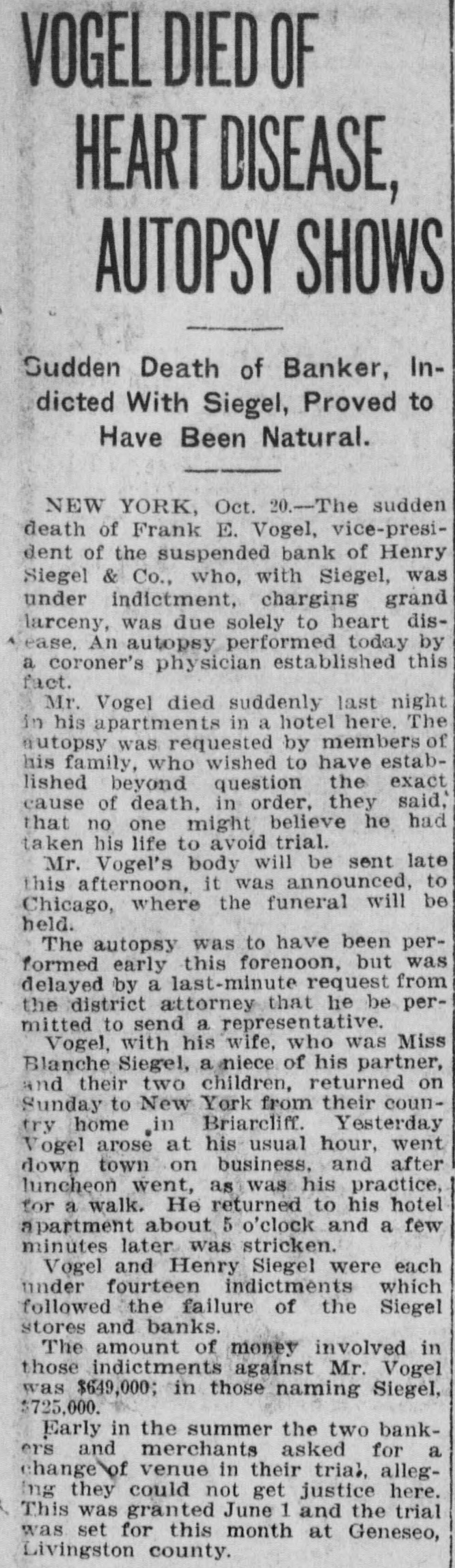
# VOGEL DIED OF # HEART DISEASE, # AUTOPSY SHOWS Sudden Death of Banker, Indicted With Siegel, Proved to Have Been Natural. NEW YORK, Oct. 20.-The sudden death of Frank E. Vogel, vice-president of the suspended bank of Henry Siegel & Co., who, with Siegel, was under indictment, charging grand larceny, was due solely to heart disease. An autopsy performed today by a coroner's physician established this fact. Mr. Vogel died suddenly last night in his apartments in a hotel here. The autopsy was requested by members of his family, who wished to have established beyond question the exact cause of death, in order, they said, that no one might believe he had taken his life to avoid trial. Mr. Vogel's body will be sent late this afternoon, it was announced, to Chicago, where the funeral will be held. The autopsy was to have been performed early this forenoon, but was delayed by a last-minute request from the district attorney that he be permitted to send a representative. Vogel, with his wife, who was Miss Blanche Siegel, a niece of his partner, and their two children, returned on Sunday to New York from their coun- try home in Briarcliff. Yesterday Vogel arose at his usual hour, went down town on business, and after luncheon went, as was his practice, for a walk. He returned to his hotel apartment about 5 o'clock and a few minutes later was stricken. Vogel and Henry Siegel were each under fourteen indictments which followed the failure of the Siegel stores and banks. The amount of money involved in those indictments against Mr. Vogel was $649,000; in those naming Siegel, $725,000. Early in the summer the two bank- ers and merchants asked for a change of venue in their trial, alleg- ing they could not get justice here. This was granted June 1 and the trial was set for this month at Geneseo, Livingston county.


Article from The Star-Independent, October 20, 1914

Click image to open full size in new tab

Article Text

HEART DISEASE KILLED VOGEL Died Suddenly In His Apartments In New York Hotel By Associated Press. New York, Oct. 20.-The sudden death of Frank E. Vogel, vice president of the suspended bank of Henry Siegel & Company, who, with Siegel, was under indictment charging grand larceny, was due solely to heart disease. An autopsy preformed to-day by a Coroner's physician established this fact. Mr. Vogel died suddenly last night in his apartments in a hotel here.


Article from Daily Kennebec Journal, October 21, 1914

Click image to open full size in new tab

Article Text

# DEATH OF FRANK E. VOGEL DUE TO HEART DISEASE New York, Oct. 20.-The sudden death of Frank E. Vogel, vice presi-dent of the suspended bank of Henry Siegel & Co., who with Siegel, was un-der indictments charging grand larceny, was wholly due to heart disease. An autopsy performed today by a coroner's physician established this fact. Mr. Vogel died suddenly last night in his apartments in a hotel here. The autopsy was requested by members of his family, who wished to have established beyond question the exact cause of death, in order, they said, that no one might believe he had taken his life to avoid trial.


Article from Audubon County Journal, October 29, 1914

Click image to open full size in new tab

Article Text

Death of Vogel Due to Heart Disease. New York, Oct. 2"t-The sudden death of Frank E. Vogel, vice president of the suspended bank of Henry Siegel & Co., who with Siegel, was under indictment, charging grand larceny, was due solely to heart disease. An autopsy performed by a coroner's physician established this #act.