Kansas State Bank (Salina, KS)

Episode Information

Episode UID
3966141391433
Episode Type
Suspension β†’ Closure
Bank Type
state
Bank ID
396614139 hash
Start Date
May 29, 1919
Location
Salina, Kansas (38.840, -97.611)

Metadata

Model
gpt-5-mini (chosen from majority vote of a three-model LLM ensemble)
Short Digest
fe927978a6f017a6

Response Measures

None

Description

Cashier H. J. Lefferdink fled and is accused of manipulating funds; receiver appointed immediately after closure.

Events (2)

1. May 29, 1919 Receivership
Newspaper Excerpt
Colonel Fitzpatrick Appointed Receiver of Salina Bank. ...Arrangements will be made to place Colonel Fitzpatrick in immediate control of the bank. ... Cashier H. J. Lefferdink has not returned to Salina and has not been arrested, altho it is asserted that his manipulation of the bank's funds was responsible for closing the doors.
Source
newspapers
2. May 29, 1919 Suspension
Cause
Government Action
Cause Details
Closed by the state banking department / state bank commissioner Walter E. Wilson after discovery of shortages and alleged manipulation of funds by cashier H. J. Lefferdink.
Newspaper Excerpt
Col. Fred Fitzpatrick of Salina was today appointed receiver of the defunct Kansas State bank...Many of the depositors placed their funds in the Reserve State bank, which was organized several days ago and opened business in the same building and with the fixtures of the Kansas State when that institution was closed.
Source
newspapers

Newspaper Articles (19)

Article from The Topeka State Journal, May 29, 1919

Click image to open full size in new tab

Article Text

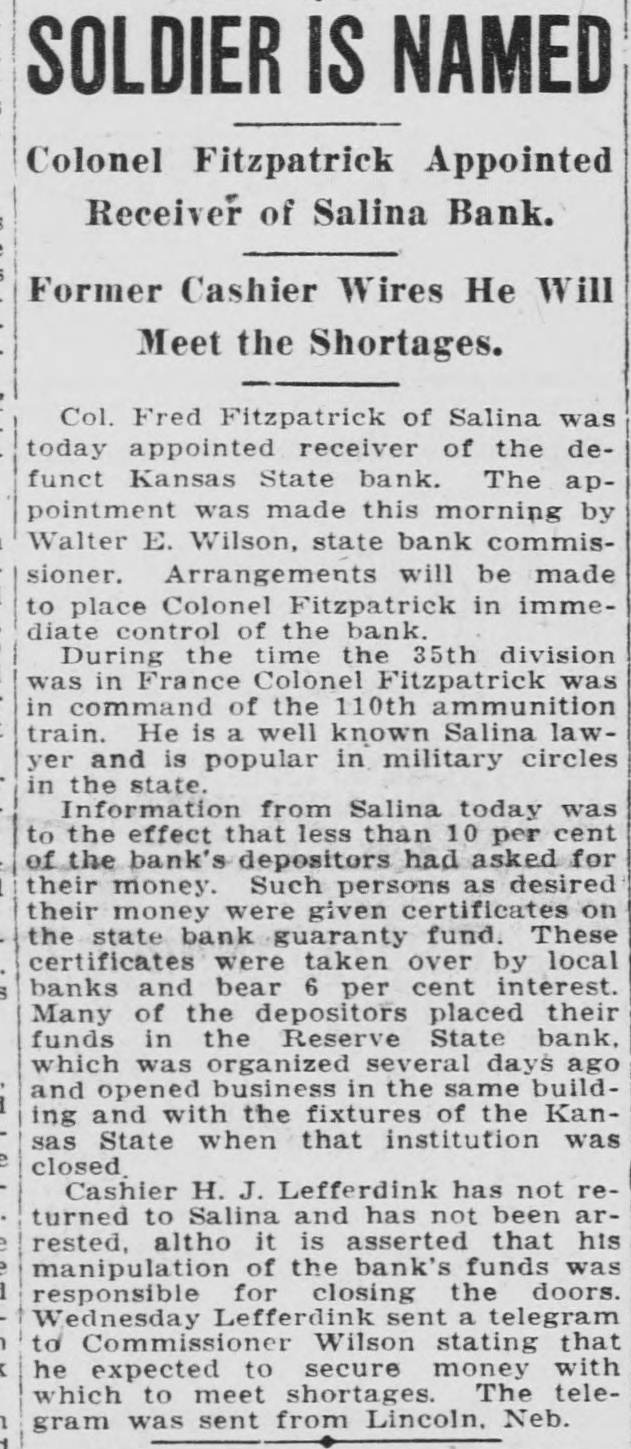
SOLDIER IS NAMED Colonel Fitzpatrick Appointed Receiver of Salina Bank. Former Cashier Wires He Will Meet the Shortages. Col. Fred Fitzpatrick of Salina was today appointed receiver of the defunct Kansas State bank. The appointment was made this morning by Walter E. Wilson, state bank commissioner. Arrangements will be made to place Colonel Fitzpatrick in immediate control of the bank. During the time the 35th division was in France Colonel Fitzpatrick was in command of the 110th ammunition train. He is a well known Salina lawyer and is popular in military circles in the state. Information from Salina today was to the effect that less than 10 per cent of the bank's depositors had asked for their money. Such persons as desired their money were given certificates on the state bank guaranty fund. These certificates were taken over by local banks and bear 6 per cent interest. Many of the depositors placed their funds in the Reserve State bank, which was organized several days ago and opened business in the same building and with the fixtures of the Kansas State when that institution was closed Cashier H. J. Lefferdink has not returned to Salina and has not been arrested, altho it is asserted that his manipulation of the bank's funds was responsible for closing the doors. Wednesday Lefferdink sent a telegram to Commissioner Wilson stating that he expected to secure money with which to meet shortages. The telegram was sent from Lincoln. Neb.


Article from The Topeka State Journal, June 2, 1919

Click image to open full size in new tab

Article Text

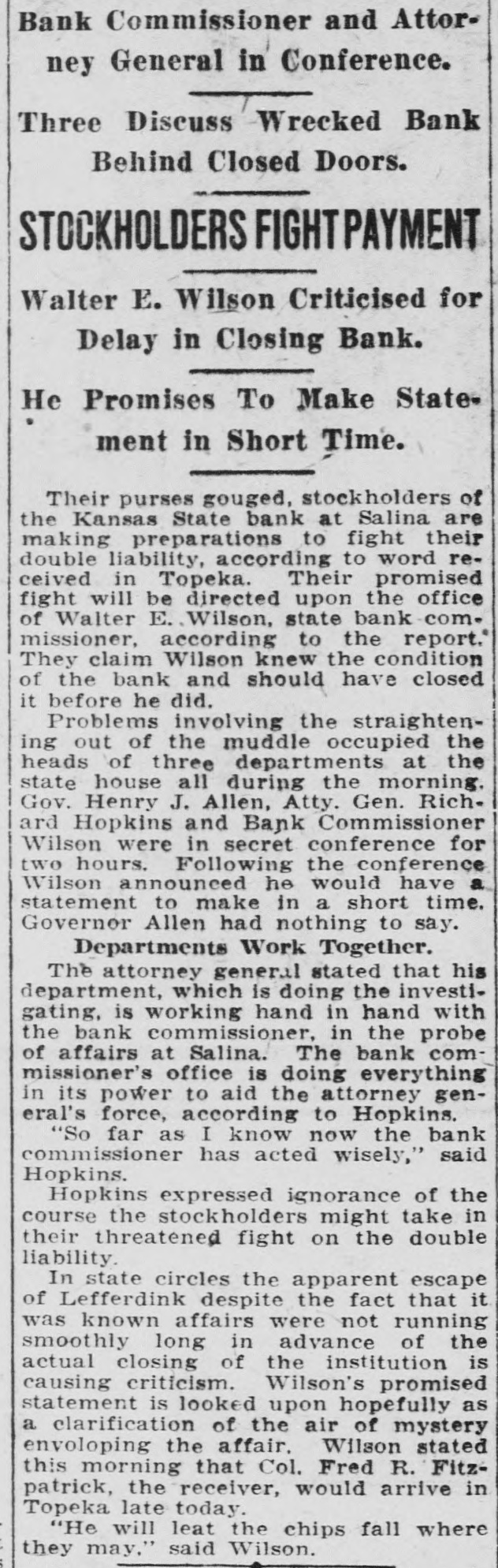
Bank Commissioner and Attorney General in Conference. Three Discuss Wrecked Bank Behind Closed Doors. STOCKHOLDERS FIGHT PAYMENT Walter E. Wilson Criticised for Delay in Closing Bank. He Promises To Make Statement in Short Time. Their purses gouged, stockholders of the Kansas State bank at Salina are making preparations to fight their double liability, according to word received in Topeka. Their promised fight will be directed upon the office of Walter E. Wilson, state bank commissioner, according to the report." They claim Wilson knew the condition of the bank and should have closed it before he did. Problems involving the straightening out of the muddle occupied the heads of three departments at the state house all during the morning. Gov. Henry J. Allen, Atty. Gen. Richard Hopkins and Bank Commissioner Wilson were in secret conference for two hours. Following the conference Wilson announced he would have a statement to make in a short time. Governor Allen had nothing to say. Departments Work Together. The attorney general stated that his department, which is doing the investigating, is working hand in hand with the bank commissioner, in the probe of affairs at Salina. The bank commissioner's office is doing everything in its power to aid the attorney general's force, according to Hopkins. "So far as I know now the bank commissioner has acted wisely," said Hopkins. Hopkins expressed ignorance of the course the stockholders might take in their threatened fight on the double liability. In state circles the apparent escape of Lefferdink despite the fact that it was known affairs were not running smoothly long in advance of the actual closing of the institution is causing criticism. Wilson's promised statement is looked upon hopefully as a clarification of the air of mystery envoloping the affair. Wilson stated this morning that Col. Fred R. Fitzpatrick, the receiver, would arrive in Topeka late today. "He will leat the chips fall where they may." said Wilson.


Article from The Topeka State Journal, June 3, 1919

Click image to open full size in new tab

Article Text

Governor Thinks Legislature Will Remember Salina Crash. Enact Statute To Prevent Looting of Guaranty Fund. LEFFERDINK STILL FREE MAN No Arrests Have Been Made by the State Officials. Receiver Has Not Yet Reported Condition of Bank. Banking reforms in Kansas as a n result of disclosures surrounding the 1 failure of the Kansas State bank of t Salina, were predicted today by Gov. 11 Henry J. Allen. The governor asle serted that in his judgment the next t n legislature will take steps to safeguard against plunging and reckless financial exploits by speculators who are t permitted to engage in the banking business. Conservative bankers as well as the S banking public will demand laws pret venting a wanton loot of the state e bank guaranty fund, the governor asp serted. He said that the evidence dis1. closed in the Salina failure had le proven the wisdom of a prophecy by y bankers who fought the guaranty act e ten years ago. Generally prosperous conditions in the state, the governor said, doubtless have prevented similar cases. It is not the purpose of Gov7. ernor Allen to destroy the guaranty d act. Rather he wants to safeguard the fund by restricting the operation of a certain class of bankers. e New Law Is Needed. e of "The Salina failure has presented a r. situation not foreseen by the state e legislature," said Governor Allen. "It al shows the absolute necessity of statutory provisions which prohibit the campaign for funds by unscrupulous d bankers. When a bunch of crooked e speculators get control of a bank and is offer a bonus for deposits under the argument that the depositor can lose r nothing since the bank funds are Is guaranteed, it is high time for the legislature to take some action. of "This situation has proven that in e one instance, at least, the opponents of the bank guaranty act were good y prophets. Their argument was to the r effect that unscrupulous bankers would take advantage of the fund. al That is just the thing which seems to y have happened at Salina. The legislare ture never dreamed that such wanton practices would be engaged in." Big Bonus Reported Paid. e According to one report, H. J. Lefn fereink, cashier of the defunct bank. paid a bonus for deposits in certain instances. One report is to the effect that a $15,000 deposit was secured by the assurance that a $5,000 bonus would be given for use of the money for a ninety-day period. The depositor was then assured that he could not suffer loss since the deposits of the bank were guaranteed. This deposit is said to have been secured but 1, a few days before the state bank commissioner closed the doors of the institution. While no statement was made to that effect today, it is quite certain S that Governor Allen will recommend to the next legislature several decided changes in the present bank guaranty law. The governor is continuing his n, investigation of the bank failure. He e declined to make a statement today as vy to the policy of the state banking denpartment in failing to order an earlier closing of the bank. s, Lefferdink Is Still Free. to Walter E. Wilson, state bank comd missioner, and R. J. Hopkins, attory, ney general, were today in conference d, with W. H. Litowich of Salina, an attorney for the receiver. Wilson statLa ed that the receiver had not comof pleted his check of the assets and liang bilities of the bank. Nothing has been a heard this year from Felix Broeker, nalleged to have been associated with be Cashier Lefferdink in his financial operations. Lefferdink is still a free man. He left Salina the day before ht the bank was closed and after a warrrant for his arrest is said to have ty been placed in the hands of the Saline county sheriff. No other arrests in connection with the failure have been ordered. K


Article from The Topeka State Journal, June 5, 1919

Click image to open full size in new tab

Article Text

GET DEED TO LAND Outlook Is Brighter for Closed Salina Bank. Large Sum May Be Saved to Guaranty Fund. BRING BROEKER INTO CASE? That Was Report Current at State House Today. Calima Property Now in Hands of the Receiver. The sun is shining on the defunct Kansas State bank for the first time since the bank was closed ten days ago. Deeds to several hundred thousand dollars' worth of LefferdinkBroeker-Guilbert property have been secured For the first time since Walter E. Wilson, state bank commissioner,


Article from The Topeka State Journal, June 7, 1919

Click image to open full size in new tab

Article Text

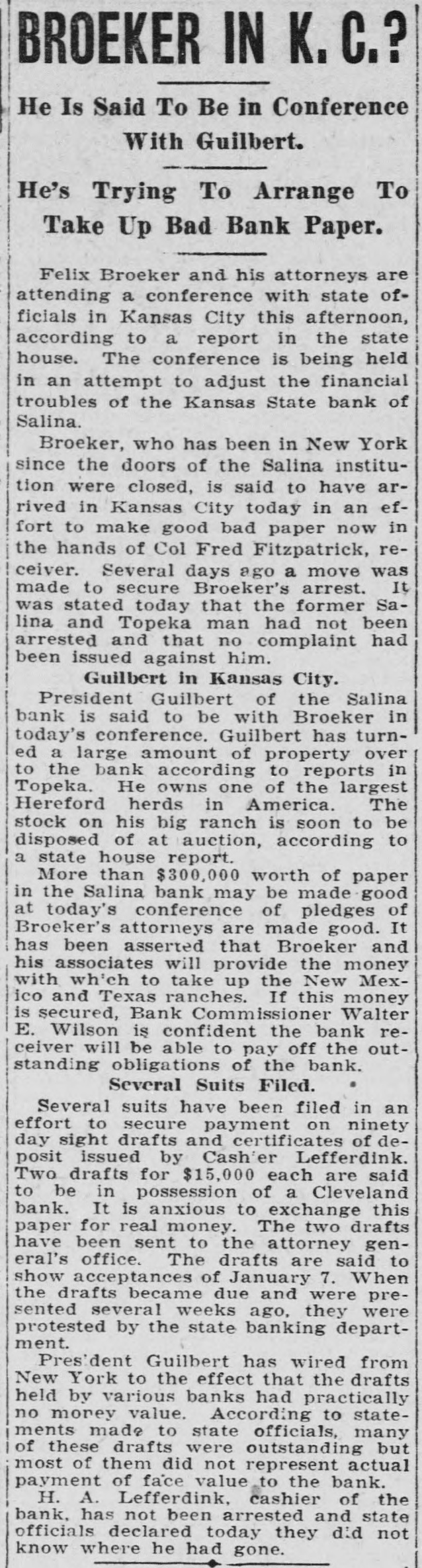
BROEKER IN K.C.? He Is Said To Be in Conference With Guilbert. He's Trying To Arrange To Take Up Bad Bank Paper. Felix Broeker and his attorneys are attending a conference with state officials in Kansas City this afternoon, according to a report in the state house. The conference is being held in an attempt to adjust the financial troubles of the Kansas State bank of Salina. Broeker, who has been in New York since the doors of the Salina institution were closed, is said to have arrived in Kansas City today in an effort to make good bad paper now in the hands of Col Fred Fitzpatrick, receiver. Several days ago a move was made to secure Broeker's arrest. It was stated today that the former Salina and Topeka man had not been arrested and that no complaint had been issued against him. Guilbert in Kansas City. President Guilbert of the Salina bank is said to be with Broeker in today's conference. Guilbert has turned a large amount of property over to the bank according to reports in Topeka. He owns one of the largest Hereford herds in America. The stock on his big ranch is soon to be disposed of at auction, according to a state house report. More than $300,000 worth of paper in the Salina bank may be made good at today's conference of pledges of Broeker's attorneys are made good. It has been asserted that Broeker and his associates will provide the money with which to take up the New Mexico and Texas ranches. If this money is secured, Bank Commissioner Walter E. Wilson is confident the bank receiver will be able to pay off the outstanding obligations of the bank. # Several Suits Filed. Several suits have been filed in an effort to secure payment on ninety day sight drafts and certificates of deposit issued by Cash'er Lefferdink. Two drafts for $15,000 each are said to be in possession of a Cleveland bank. It is anxious to exchange this paper for real money. The two drafts have been sent to the attorney general's office. The drafts are said to show acceptances of January 7. When the drafts became due and were presented several weeks ago, they were protested by the state banking department. President Guilbert has wired from New York to the effect that the drafts held by various banks had practically no money value. According to statements made to state officials, many of these drafts were outstanding but most of them did not represent actual payment of face value to the bank. H. A. Lefferdink, cashier of the bank, has not been arrested and state officials declared today they did not know where he had gone.


Article from The Topeka State Journal, June 10, 1919

Click image to open full size in new tab

Article Text

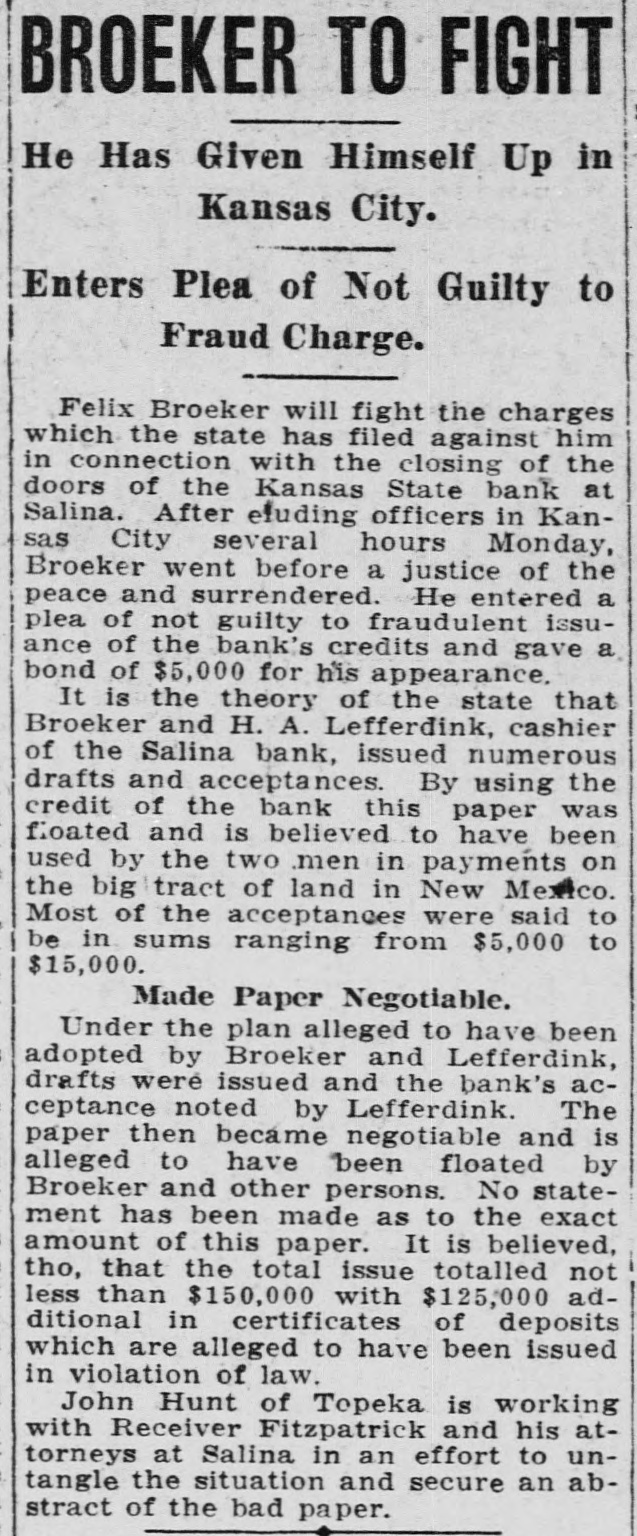
BROEKER TO FIGHT He Has Given Himself Up in Kansas City. Enters Plea of Not Guilty to Fraud Charge. Felix Broeker will fight the charges which the state has filed against him in connection with the closing of the doors of the Kansas State bank at Salina. After eluding officers in Kansas City several hours Monday, Broeker went before a justice of the peace and surrendered. He entered a plea of not guilty to fraudulent issuance of the bank's credits and gave a bond of $5,000 for his appearance. It is the theory of the state that Broeker and H. A. Lefferdink, cashier of the Salina bank, issued numerous drafts and acceptances. By using the credit of the bank this paper was floated and is believed to have been used by the two men in payments on the big tract of land in New Mexico. Most of the acceptances were said to be in sums ranging from $5,000 to $15,000. Made Paper Negotiable. Under the plan alleged to have been adopted by Broeker and Lefferdink, drafts were issued and the bank's acceptance noted by Lefferdink. The paper then became negotiable and is alleged to have been floated by Broeker and other persons. No statement has been made as to the exact amount of this paper. It is believed, tho, that the total issue totalled not less than $150,000 with $125,000 additional in certificates of deposits which are alleged to have been issued in violation of law. John Hunt of Topeka is working with Receiver Fitzpatrick and his attorneys at Salina in an effort to untangle the situation and secure an abstract of the bad paper.


Article from The Topeka State Journal, June 10, 1919

Click image to open full size in new tab

Article Text

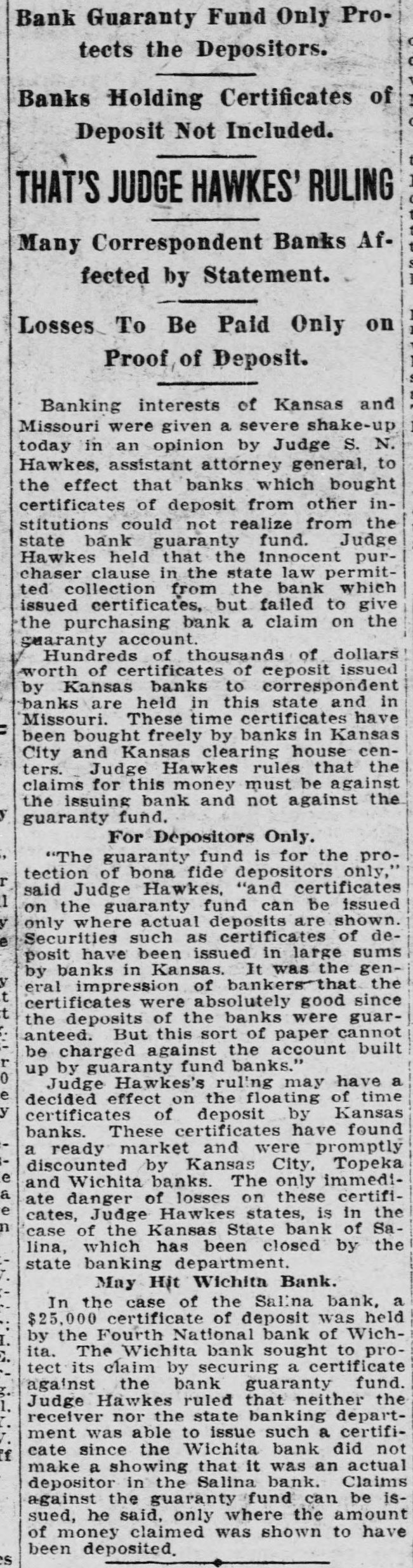
Bank Guaranty Fund Only Protects the Depositors. Banks Holding Certificates of Deposit Not Included. # THAT'S JUDGE HAWKES' RULING Many Correspondent Banks Affected by Statement. Losses To Be Paid Only on Proof of Deposit. Banking interests of Kansas and Missouri were given a severe shake-up today in an opinion by Judge S. N. Hawkes, assistant attorney general, to the effect that banks which bought certificates of deposit from other institutions could not realize from the state bank guaranty fund. Judge Hawkes held that the innocent purchaser clause in the state law permitted collection from the bank which issued certificates, but failed to give the purchasing bank a claim on the guaranty account. Hundreds of thousands of dollars worth of certificates of ceposit issued by Kansas banks to correspondent banks are held in this state and in Missouri. These time certificates have been bought freely by banks in Kansas City and Kansas clearing house centers. Judge Hawkes rules that the claims for this money must be against the issuing bank and not against the guaranty fund. For Depositors Only. "The guaranty fund is for the protection of bona fide depositors only," said Judge Hawkes, "and certificates on the guaranty fund can be issued only where actual deposits are shown. Securities such as certificates of deposit have been issued in large sums by banks in Kansas. It was the general impression of bankers that the certificates were absolutely good since the deposits of the banks were guaranteed. But this sort of paper cannot be charged against the account built up by guaranty fund banks." Judge Hawkes's ruling may have a decided effect on the floating of time certificates of deposit by Kansas banks. These certificates have found a ready market and were promptly discounted by Kansas City, Topeka and Wichita banks. The only immediate danger of losses on these certificates, Judge Hawkes states, is in the case of the Kansas State bank of Salina, which has been closed by the state banking department. May Hit Wichita Bank. In the case of the Salina bank, a $25,000 certificate of deposit was held by the Fourth National bank of Wichita. The Wichita bank sought to protect its claim by securing a certificate against the bank guaranty fund. Judge Hawkes ruled that neither the receiver nor the state banking department was able to issue such a certificate since the Wichita bank did not make a showing that it was an actual depositor in the Salina bank. Claims against the guaranty fund can be issued, he said, only where the amount of money claimed was shown to have been deposited.


Article from The Topeka State Journal, July 8, 1919

Click image to open full size in new tab

Article Text

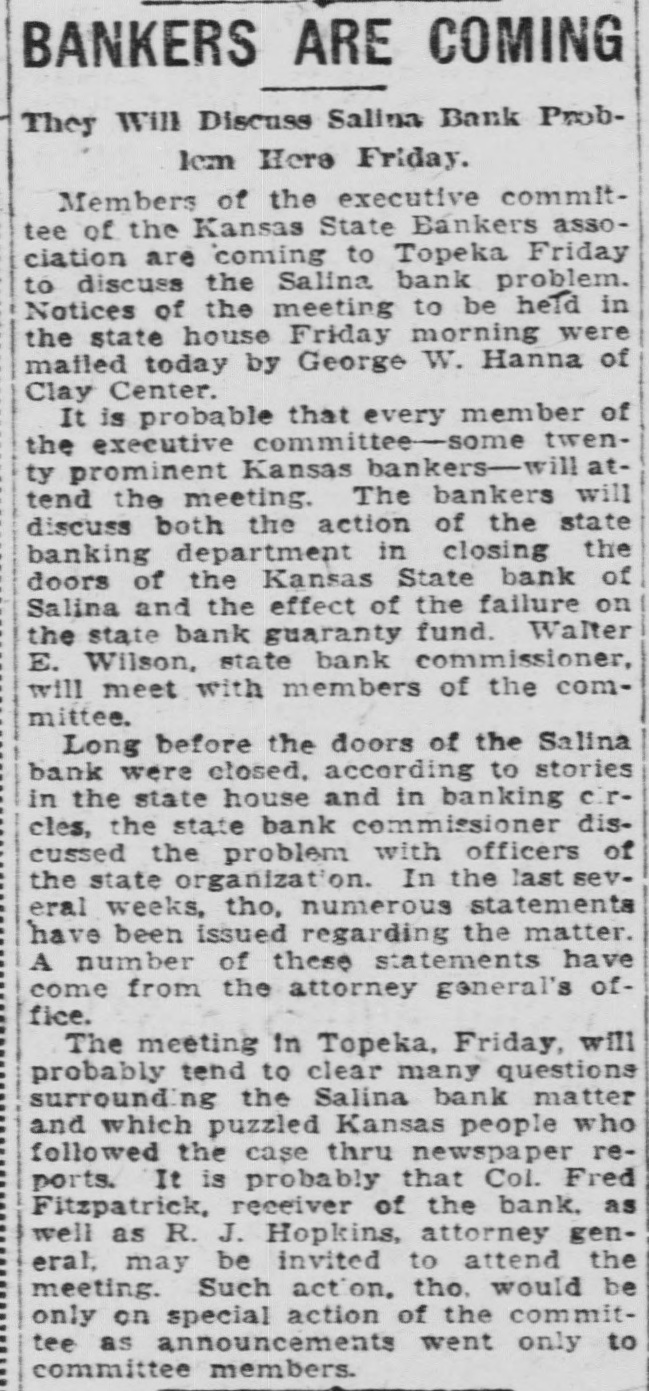
BANKERS ARE COMING They Will Discuss Salina Bank Probtem Here Friday. Members of the executive committee of the Kansas State Bankers association are coming to Topeka Friday to discuss the Salina bank problem. Notices of the meeting to be held in the state house Friday morning were mailed today by George W. Hanna of Clay Center. It is probable that every member of the executive committee-some twenty prominent Kansas bankers-will attend the meeting. The bankers will discuss both the action of the state banking department in closing the doors of the Kansas State bank of Salina and the effect of the failure on the state bank guaranty fund. Walter E. Wilson, state bank commissioner, will meet with members of the committee. Long before the doors of the Salina bank were closed. according to stories in the state house and in banking c.rcles, the state bank commissioner discussed the problem with officers of the state organization. In the last several weeks, tho, numerous statements have been issued regarding the matter. A number of these statements have come from the attorney general's office. The meeting in Topeka, Friday, will probably tend to clear many questions surrounding the Salina bank matter and which puzzled Kansas people who followed the case thru newspaper reports. It is probably that Col. Fred Fitzpatrick, receiver of the bank. as well as R. J. Hopkins, attorney general, may be invited to attend the meeting. Such action. tho, would be only on special action of the committee as announcements went only to committee members.


Article from The Hays Free Press, August 21, 1919

Click image to open full size in new tab

Article Text

H. J. Lefferdink, cashier of the defunct Kansas State Bank at Salina, has been made the defendant in a suit in which Receiver Fred R. Fitzpatrick charges that he unlawfully withdrew from the bank the sum of $18,400, and asks for a recovery of the same. Lefferdink is a fugitive from justice and his whereabouts is unknown.


Article from The Topeka State Journal, September 5, 1919

Click image to open full size in new tab

Article Text

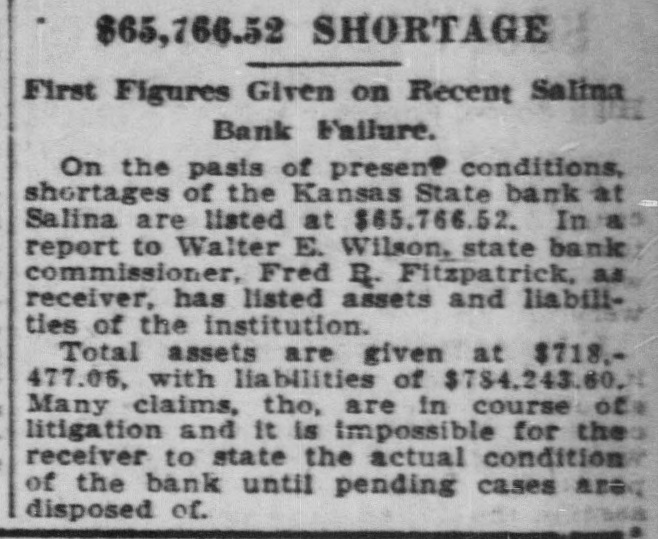
$65,766.52 SHORTAGE First Figures Given on Recent Salina Bank Failure. On the pasis of presen? conditions, shortages of the Kansas State bank at Salina are listed at $65,766.52. In a report to Walter E. Wilson, state bank commissioner, Fred R. Fitzpatrick, as receiver, has listed assets and liabilities of the institution. Total assets are given at $718,477.06, with liabilities of $784,243.60. Many claims, the, are in course of litigation and It is impossible for the receiver to state the actual condition of the bank until pending cases are disposed of.


Article from Abilene Weekly Reflector, October 2, 1919

Click image to open full size in new tab

Article Text

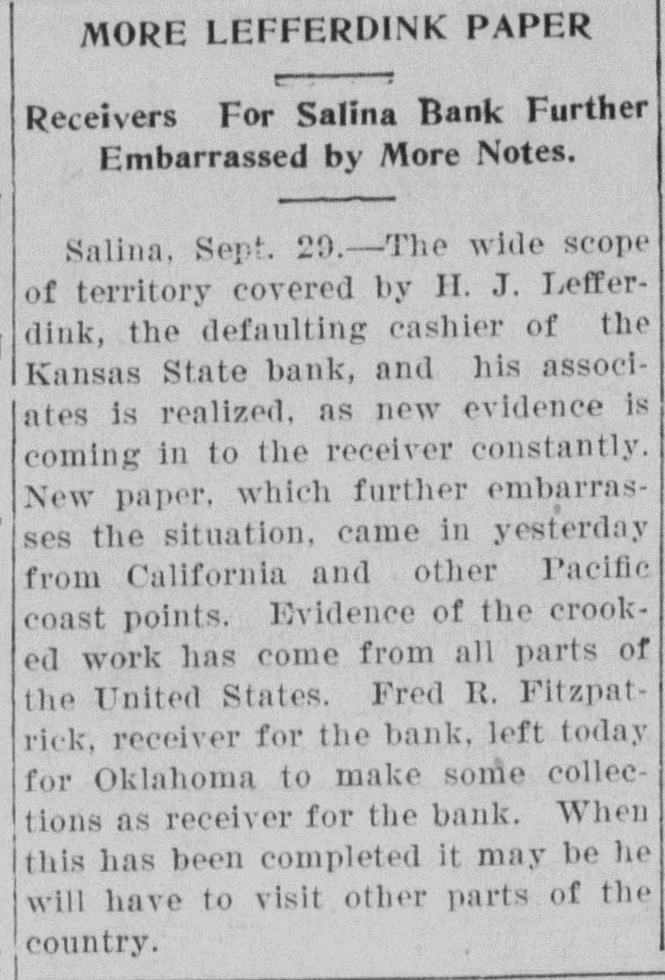
MORE LEFFERDINK PAPER Receivers For Salina Bank Further Embarrassed by More Notes. Salina, Sept. 29.-The wide scope of territory covered by H. J. Lefferdink, the defaulting cashier of the Kansas State bank, and his associates is realized, as new evidence is coming in to the receiver constantly. New paper, which further embarrasses the situation, came in yesterday from California and other Pacific coast points. Evidence of the crooked work has come from all parts of the United States. Fred R. Fitzpatrick, receiver for the bank, left today for Oklahoma to make some collections as receiver for the bank. When this has been completed it may be he will have to visit other parts of the country.


Article from The Topeka State Journal, November 12, 1919

Click image to open full size in new tab

Article Text

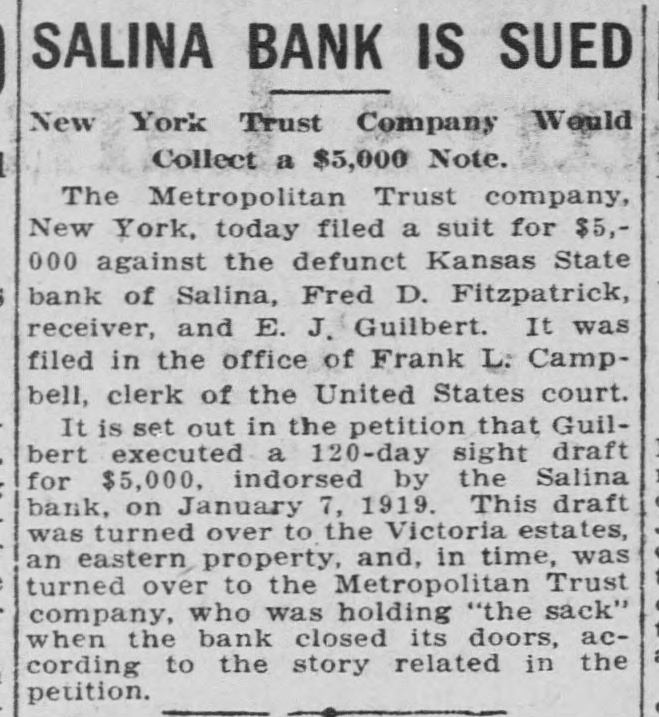
SALINA BANK IS SUED New York Trust Company Would Collect a $5,000 Note. The Metropolitan Trust company, New York, today filed a suit for $5,000 against the defunct Kansas State bank of Salina, Fred D. Fitzpatrick, receiver, and E. J. Guilbert. It was filed in the office of Frank L: Campbell, clerk of the United States court. It is set out in the petition that Guilbert executed a 120-day sight draft for $5,000, indorsed by the Salina bank, on January 7, 1919. This draft was turned over to the Victoria estates, an eastern property, and, in time, was turned over to the Metropolitan Trust company, who was holding "the sack" when the bank closed its doors, according to the story related in the petition.


Article from Abilene Weekly Reflector, May 27, 1920

Click image to open full size in new tab

Article Text

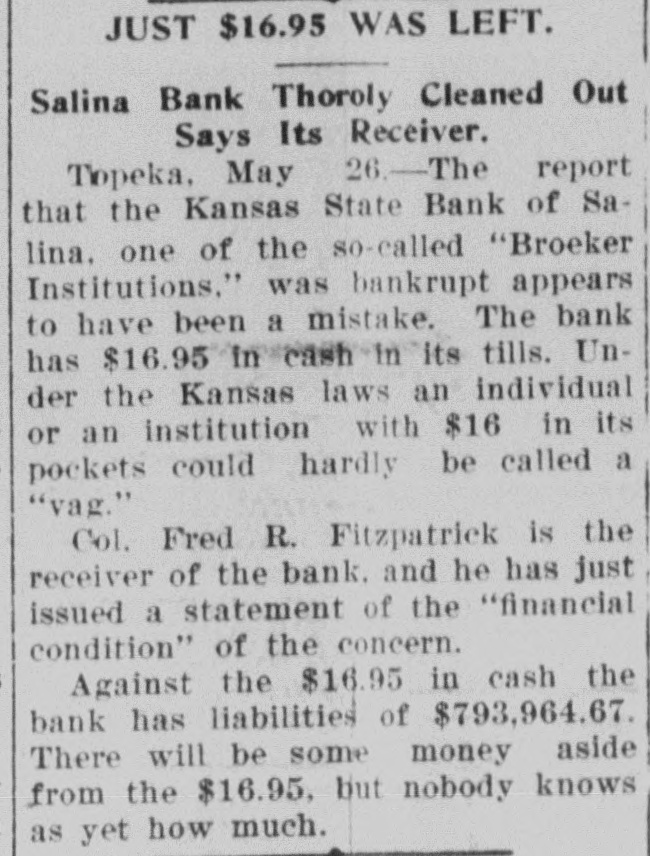
JUST $16.95 WAS LEFT. Salina Bank Thoroly Cleaned Out Says Its Receiver. Topeka, May 26.-The report that the Kansas State Bank of Salina. one of the so-called "Broeker Institutions." was bankrupt appears to have been a mistake. The bank has $16.95 in cash in its tills. Under the Kansas laws an individual or an institution with $16 in its pockets could hardly be called a "vag." Col. Fred R. Fitzpatrick is the receiver of the bank. and he has just issued a statement of the "financial condition" of the concern. Against the $16.95 in cash the bank has liabilities of $793,964.67. There will be some money aside from the $16.95. but nobody knows as yet how much.


Article from The Topeka State Journal, November 26, 1920

Click image to open full size in new tab

Article Text

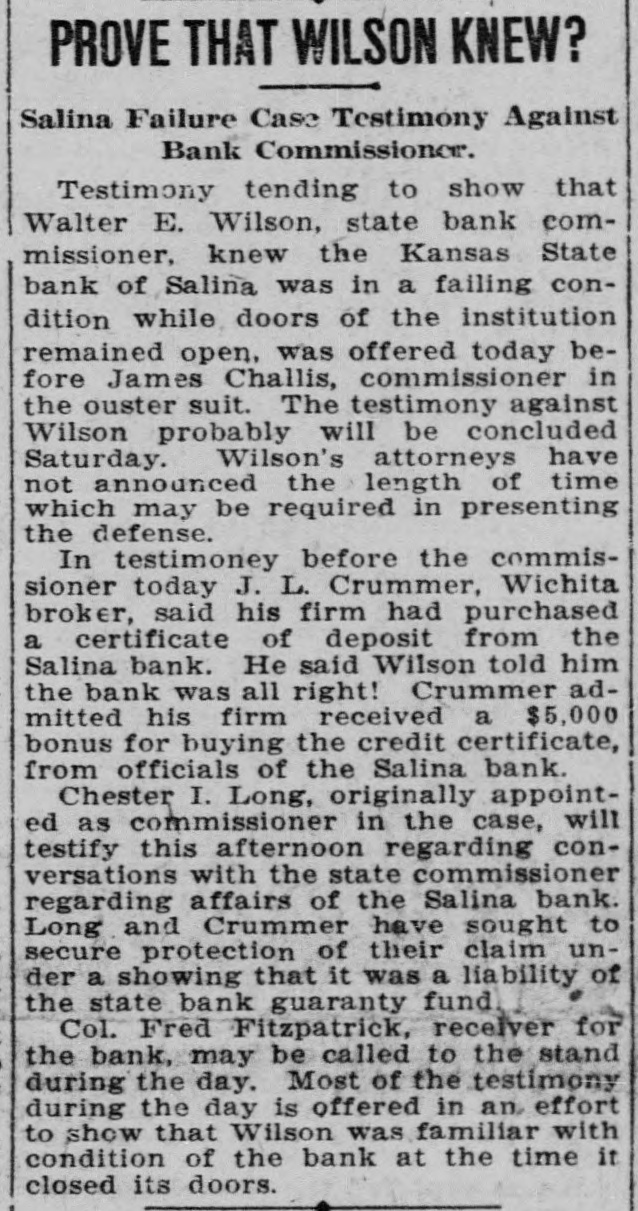
PROVE THAT WILSON KNEW? / Salina Failure Case Testimony Against Bank Commissioner. Testimony tending to show that Walter E. Wilson, state bank commissioner, knew the Kansas State bank of Salina was in a failing condition while doors of the institution remained open, was offered today before James Challis, commissioner in the ouster suit. The testimony against Wilson probably will be concluded Saturday. Wilson's attorneys have not announced the length of time which may be required in presenting the defense. In testimoney before the commissioner today J. L. Crummer, Wichita broker, said his firm had purchased a certificate of deposit from the Salina bank. He said Wilson told him the bank was all right! Crummer admitted his firm received a $5,000 bonus for buying the credit certificate, from officials of the Salina bank. Chester I. Long, originally appointed as commissioner in the case, will testify this afternoon regarding conversations with the state commissioner regarding affairs of the Salina bank. Long and Crummer have sought to secure protection of their claim under a showing that it was a liability of the state bank guaranty fund Col. Fred Fitzpatrick, receiver for the bank, may be called to the stand during the day. Most of the testimony during the day is offered in an effort to show that Wilson was familiar with condition of the bank at the time it closed its doors.


Article from Western Kansas World, December 2, 1920

Click image to open full size in new tab

Article Text

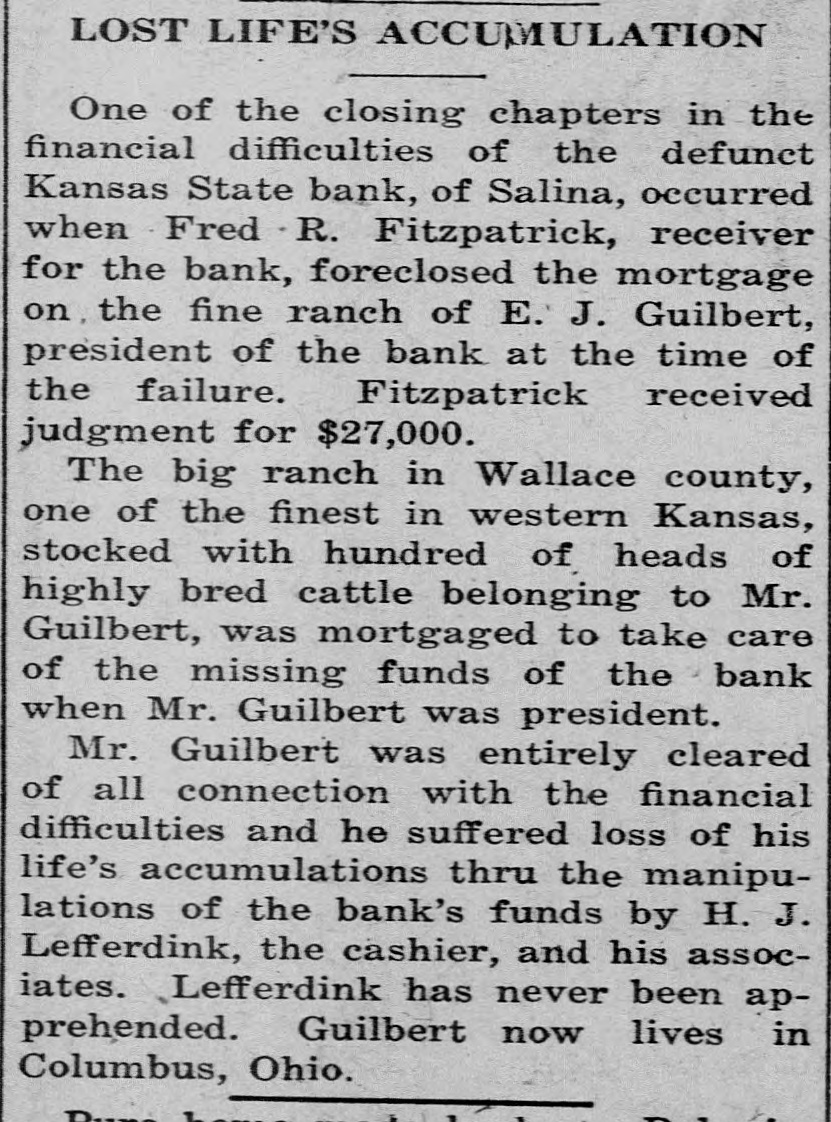
# LOST LIFE'S ACCUMULATION One of the closing chapters in the financial difficulties of the defunct Kansas State bank, of Salina, occurred when Fred R. Fitzpatrick, receiver for the bank, foreclosed the mortgage on the fine ranch of E. J. Guilbert, president of the bank at the time of the failure. Fitzpatrick received judgment for $27,000. The big ranch in Wallace county, one of the finest in western Kansas, stocked with hundred of heads of highly bred cattle belonging to Mr. Guilbert, was mortgaged to take care of the missing funds of the bank when Mr. Guilbert was president. Mr. Guilbert was entirely cleared of all connection with the financial difficulties and he suffered loss of his life's accumulations thru the manipulations of the bank's funds by H. J. Lefferdink, the cashier, and his associates. Lefferdink has never been apprehended. Guilbert now lives in Columbus, Ohio.


Article from The Topeka State Journal, May 3, 1921

Click image to open full size in new tab

Article Text

FILES SUIT AGAINST BROEKER. / Receiver Alleges Salina Man Defaulted on Notes. Salina, May 3.-Suit was filed today by Fred R. Fitzpatrick, receiver of the former Kansas State bank, closed in 1919, against Felix Broeker for the recovery of $52,509.81 on alleged notes given the bank by Broeker on February 7, 1919. The suit has been filed, it was stated by Frank H. Foster, state bank commissioner, on the initiative of the receiver, and not on instructions from the bank commissioner's office, the the suit had been regarded here as probable. Fitzgerald was appointed receiver for the bank when it was closed on order of the state banking commissioner, in 1919, by the state banking commissioner.


Article from The Topeka State Journal, June 11, 1921

Click image to open full size in new tab

Article Text

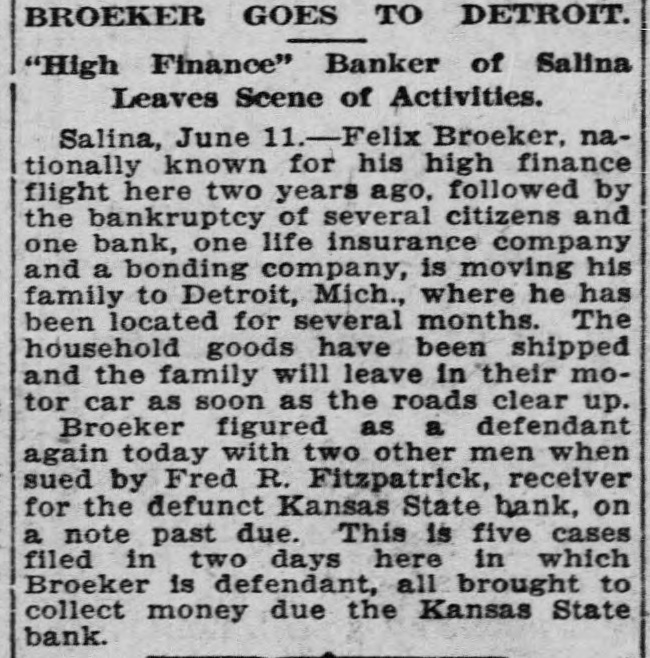
BROEKER GOES TO DETROIT. "High Finance" Banker of Salina Leaves Scene of Activities. Salina, June 11.-Felix Broeker, nationally known for his high finance flight here two years ago, followed by the bankruptcy of several citizens and one bank, one life insurance company and a bonding company, is moving his family to Detroit, Mich., where he has been located for several months. The household goods have been shipped and the family will leave in their motor car as soon as the roads clear up. Broeker figured as a defendant again today with two other men when sued by Fred R. Fitzpatrick, receiver for the defunct Kansas State bank, on a note past due. This is five cases filed in two days here in which Broeker is defendant, all brought to collect money due the Kansas State bank.


Article from Kansas City Journal, April 15, 1923

Click image to open full size in new tab

Article Text

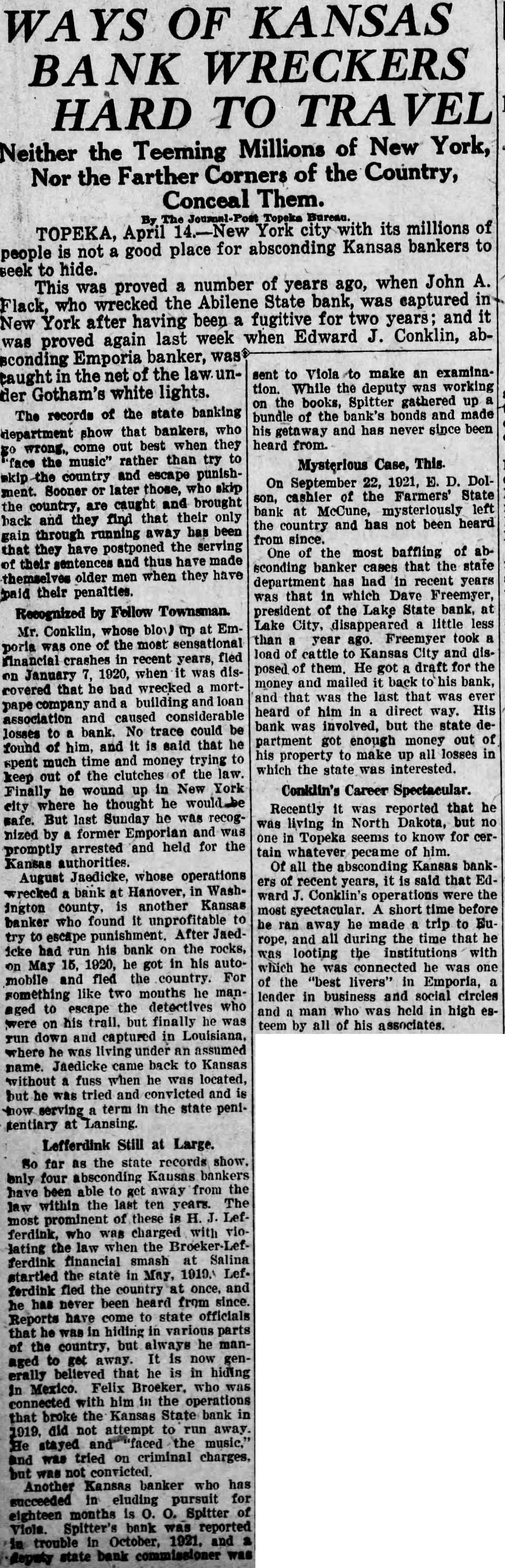
WAYS OF KANSAS BANK WRECKERS HARD TO TRAVEL Neither the Teeming Millions of New York, Nor the Farther Corners of the Country, Conceal Them. By The Journal-Post Topeka Bureau. TOPEKA, April 14.β€”New York city with its millions of people is not a good place for absconding Kansas bankers to seek to hide. This was proved a number of years ago, when John A. Flack, who wrecked the Abilene State bank, was captured in New York after having been a fugitive for two years; and it was proved again last week when Edward J. Conklin, absconding Emporia banker, was caught in the net of the law under Gotham's white lights. The records of the state banking department show that bankers, who go wrong, come out best when they "face the music" rather than try to skip the country and escape punishment. Sooner or later those, who skip the country, are caught and brought back and they find that their only gain through running away has been that they have postponed the serving of their sentences and thus have made themselves older men when they have paid their penalties. Recognized by Fellow Townsman. Mr. Conklin, whose blow up at Emporia was one of the most sensational financial crashes in recent years, fled on January 7, 1920, when it was discovered that he had wrecked a mortgage company and a building and loan association and caused considerable losses to a bank. No trace could be found of him, and it is said that he spent much time and money trying to keep out of the clutches of the law. Finally he wound up in New York city where he thought he would be safe. But last Sunday he was recognized by a former Emporian and was promptly arrested and held for the Kansas authorities. August Jaedicke, whose operations wrecked a bank at Hanover, in Washington county, is another Kansas banker who found it unprofitable to try to escape punishment. After Jaedicke had run his bank on the rocks, on May 15, 1920, he got in his automobile and fled the country. For something like two months he managed to escape the detectives who were on his trail, but finally he was run down and captured in Louisiana, where he was living under an assumed name. Jaedicke came back to Kansas without a fuss when he was located, but he was tried and convicted and is now serving a term in the state penitentiary at Lansing. Lefferdink Still at Large. So far as the state records show, only four absconding Kansas bankers have been able to get away from the law within the last ten years. The most prominent of these is H. J. Lefferdink, who was charged with violating the law when the Broeker-Lefferdink financial smash at Salina startled the state in May, 1919. Lefferdink fled the country at once, and he has never been heard from since. Reports have come to state officials that he was in hiding in various parts of the country, but always he managed to get away. It is now generally believed that he is in hiding in Mexico. Felix Broeker, who was connected with him in the operations that broke the Kansas State bank in 1919, did not attempt to run away. He stayed and "faced the music," and was tried on criminal charges, but was not convicted. Another Kansas banker who has succeeded in eluding pursuit for eighteen months is O. O. Spitter of Viola. Spitter's bank was reported in trouble in October, 1921, and a deputy state bank commissioner was sent to Viola to make an examination. While the deputy was working on the books, Spitter gathered up a bundle of the bank's bonds and made his getaway and has never since been heard from. Mysterious Case, This. On September 22, 1921, E. D. Dolson, cashier of the Farmers' State bank at McCune, mysteriously left the country and has not been heard from since. One of the most baffling of absconding banker cases that the state department has had in recent years was that in which Dave Freemyer, president of the Lake State bank, at Lake City, disappeared a little less than a year ago. Freemyer took a load of cattle to Kansas City and disposed of them. He got a draft for the money and mailed it back to his bank, and that was the last that was ever heard of him in a direct way. His bank was involved, but the state department got enough money out of his property to make up all losses in which the state was interested. Conklin's Career Spectacular. Recently it was reported that he was living in North Dakota, but no one in Topeka seems to know for certain whatever became of him. Of all the absconding Kansas bankers of recent years, it is said that Edward J. Conklin's operations were the most spectacular. A short time before he ran away he made a trip to Europe, and all during the time that he was looting the institutions with which he was connected he was one of the "best livers" in Emporia, a leader in business and social circles and a man who was held in high esteem by all of his associates.


Article from Lexington Herald-Leader, September 14, 1923

Click image to open full size in new tab

Article Text

In several cases the accused bank officials are missing. Only five of the accused bankers have been sent to prison. Five are awaiting trial. One man killed himself. Here is a list of Kansas State banks which have been closed by the State in the last five years because of alleged embezzlement of funds: Kansas State Bank, Salina; H. J. Lefferdink, cashier, missing. Aulne State Bank, Aulne; Volney Johnson, cashier, sent to prison. Homewood State Bank, Homewood; cashier missing. People's State Bank, Coffeyville; A. Newman and R. P. Newman in prison. Banking Trust Co., Kansas City; H. C. Bedel in prison. Lake State Bank, cashier missing. Citizen's State Bank, Manhattan; president awaiting trial. Farmers' State Bank, McCune;