United States Bank of Pennsylvania (Philadelphia, PA)

Episode Information

Episode UID
4026293690449
Episode Type
Suspension โ†’ Reopening
Bank Type
state
Bank ID
402629369 hash
Start Date
May 1, 1837*
Location
Philadelphia, Pennsylvania (39.952, -75.164)

Metadata

Model
gpt-5-mini (chosen from majority vote of a three-model LLM ensemble)
Short Digest
8fa0ef0935cfafec

Response Measures

None

Events (1)

1. May 1, 1837* Suspension
Cause
Macro News
Cause Details
Part of the broad 1837 financial crisis and widespread suspension of specie payments among Philadelphia and other U.S. banks.
Newspaper Excerpt
suspended specie payments Simultaneously with the other Banks in Philadelphia.
Source
newspapers

Newspaper Articles (5)

Article from Staunton Spectator, and General Advertiser, May 18, 1837

Click image to open full size in new tab

Article Text

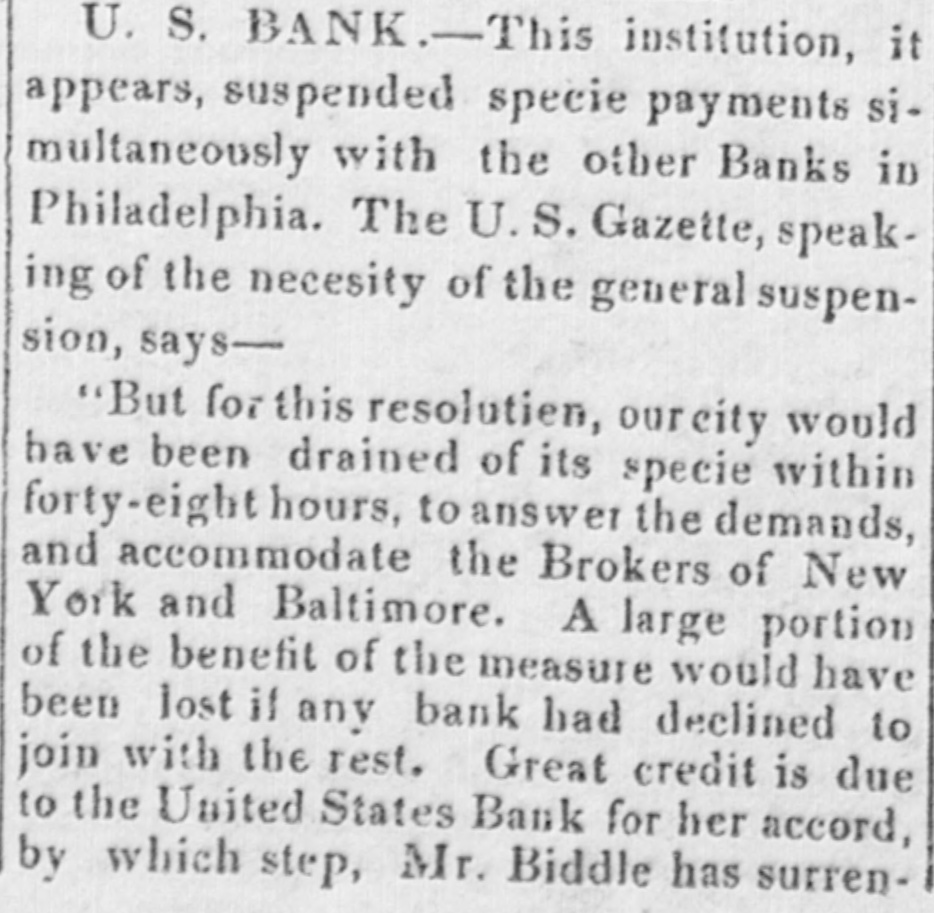
U. S. BANK.-This institution, it appears, suspended specie payments Simultaneously with the other Banks in Philadelphia. The U.S. Gazette, speaking of the necesity of the general suspension, says / "But for this resolutien, ourcity would have been drained of its specie within forty-eight hours, to answer the demands, and accommodate the Brokers of New York and Baltimore. A large portion of the benefit of the measure would have been lost if any bank had declined to join with the rest. Great credit is due to the United States Bank for her accord, by which step, Mr. Biddle has surren-


Article from Vermont Telegraph, May 31, 1837

Click image to open full size in new tab

Article Text

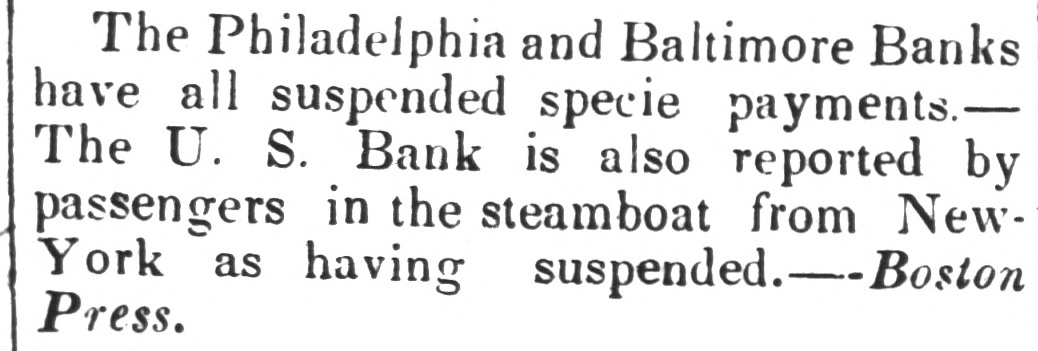
The Philadelphia and Baltimore Banks have all suspended specie payments. - The U. S. Bank is also reported by passengers in the steamboat from New- York as having suspended. --Boston Press.


Article from Southern Telegraph, June 6, 1837

Click image to open full size in new tab

Article Text

ister contains a highly interesting account of the royal family of the Celestial Enpire, which, as we have not seen before, we abridge. Taonkwang, the present temperor, aged 56, constitution ruined hypopiam, has a cle. vor W man he has the throne. and it is supposed a young there of raised the will celestial to be regency during the min rity infant. Keenlang. 1778, while visiting the tom's successors came near his an nundation, life of his by and it was rumor- losing the dead. The intrigues among at Pekin the firmness of diately, ed great he was officers commenced Akwei the nipped imme- prethe escape of the emperor, hud. During promier, them and in the Keenlung's when he had gress through Leasutung, reached Kenchoo, one of the literati prosented him a memorial modesly requesting one of his sons he contended, was not an unfortunate male- as him Kecalung, to name Aisn soothgayer his successor, legiti- precalculated the of as sumptionsly dynasty Keenlung that would the be reign long of as Chow's viz. 800 years. The Emperor was incensed and justified the Pekin Gazette. Keenlong had deemed absurd 89 the partition It of an heir as studied in history-h renders the nomination the of heir the and creates empire among his.sons. apparent cringing proud courtiers-hence domineering, the and successor named Kanghe, had to yield to YungChing. Keenlang therefore, secretly made the choice in his own mind, and each died, till finally it fell on his son, the vile Keak ing The present successor is doubtless nominnted. though unknown. The present Emperor had recommended his noble al when he was assashimself, fither, by defence attacked of his by imperisins, The presnt dynasty is Tarter, and the Quean has an active Chinese party plotting against the Emperor, who is an easy man, unequal to the task of Goverment. In the New York Evening Star of the 9th. there is the following graphic picture of the times: Results of the present Pressure, and pube lic say, that we open terms we opinion may relating thereto.- scarcely general article an exchange paper that the leading is not devoted to the all-absorbing subject of the money pressure, and complaints of minufactories shut and laborers thrown out of employ, produced, it almost universally admitted, by the violent and unconstitution al interference of the United States government with the currency of the country, The manufactories in New Eagland have many of them have been shut up, even in the State of New Hampshire. Con feels it severely, and and as the necticut granite Massachusetts, factories at testify. Rh de Island Fall River, Patucket and Lowell Maine, another of the faithful States, is also groaninz; for there are none to purchase their timber and keep their 2000 saw mills at work. People are breaking in every direction. The trouble has reached the Green Mountains, and even the Vermont wool growers will not sell at the present The Keystone State feele to her heart's core. has received a reduced the staple coal, disease prices. deadly Her blow, great and at Pottsville, &c. to ba their are miners beginning dismissed Minch bonts by Chunk, hun10 time. The equal re stope st and no more coal can be sent, in our cities to n dreds at is ped, no money a purchase forthere it.S, will come a scene a ing the poor, which we to New tn next among winter The Orleans merchants, shudder of suffer. and cotton rk st richest are is think cotton t the of. factors. quirter of flooded planters the country Throughout through with the paper et and banks, in If, houses rained. those States The tottering country of which bankrupt medi um to be a of for as there is no specie it confidence there begins general rigaciously basis want for ir to rest upon-that having been it scized upon by the Kitchen Cabinef, and Id locked up, Heaven knows whore-morg likely converted to their OW/1 purposes. or, Here the distress is universal; and farmers, n-1manufacturers, and merchants. are all inild volved in the general havoc caused by the ce curse of a wicked and despotic ad ministration. The staples of the country, c tton, tobnecy,coal, provisions of all kinds, is are sunk down to such low rates that the at whole of our property suffor in proportionas there is no money to bay with, and pricas est are red uced to yield any profit to the agriculturalists, planters and growers. ve or, The N. O. True American makes out the following list of ispensions of specie payre ments, up to the 20th inst. as far as heard from. he THE GOVERNMENT OF THE UINTED STATES, nd The United States Bank of Pennsylvama. ho Twelve Banks in Bakimore. ers Sixteen Binks in New Orleans. of All the Binks in Philadelphia. Four Binks in the District of Columbia si Nine Banks in New Jersey. Eight Binks in Connecticut cir Three Banks in Rhode Island All the Banks in Mississippi. an Three Banks Tennessee, Safety Fund Binks in


Article from Constantine Republican, June 21, 1837

Click image to open full size in new tab

Article Text

From the New York Times. ### U. S. Bank. The following extract from an article in the Globe, gives a gloomy picture of the probable condition of an institution, the loss of which as a general "regulator of the currency" is so much lamented by the whigs:- "The Bank of the United States has a nominal capital of thirty five millions-more than half of which is in the hands of corporations and individuals to whom the effects of the several branches were sold on long credit at a low rate of interest. Little of this large portion of its means can be realized for years to come, if ever. The balance of its capital is invested in-paper, which, as the times go, may or may not be paid. A great portion of it may probably be placed in the category of "funds unavailable." It has, or rather had, on the day it stopped payment, an amount of specie on hand, somewhat less than a million of dollars, upon the best authority. On the other side of the question is to be found a circulation of nearly ten millions and deposites of about two. Its immediate means, including bank balances-"debts due from the Treasury of the United States," upon which the manifesto of the bank dilated in explaining the reasons for stopping payment, and of which we should be glad, for curiosity's sake, to see a specification-and all other cash items, compared with its immediate liabilities, amounted on the day of its stopping payment to the proportion of about one to eight or ten. The rhomontade of its managers that had the bank only consulted its own 'strength' it could have continued specie payments, was the most barefaced attempt to impose upon public credulity ever promulgated. There probably was not at that hour a single bank in the whole country so weak in actual means to meet its immediate liabilities. It was undoubtedly strong in the opinions of the commercial community. We freely admit that its credit was higher than that of any institution in the country. But a crisis had arrived when credit was no longer useful. Bank promises were no longer cash, according to the doctrines of the "bullionist," Mr. Webster, as many a poor wight too suddenly found who had placed implicit reliance upon the unrivalled sagacity with which the bank was pretended to be managed. The declaration that it was only on account of the interests of Philadelphia that the bank had been induced to stop payment was positively insulting. But in view of the plan proposed by the Examiner, what are its prospective liabilities? To its foreign creditors not short of ten millions-including Mr. Jaudon's loan and its debt to the Barings for bills drawn. This debt, according to Mr. Biddle's doctrine, in his late letter to John Q. Adams, is entitled to a priority over all other claims. It is indebted to the United States about eight millions, to be paid in annual instalments-and to the State of Pennsylvania about five millions as the price of its charter. After paying these debts, redeeming its circulation, and satisfying its depositors, the proprietors of the capital stock will find a great portion of their property returned to them in the shape of bills and notes of the Josephs and other houses, whose immense gambling speculations were carried on by means of the facilities afforded them by Mr. Biddle, unless the government (meaning of course Congress) shall choose to surrender the people of the United States to the shears, for the purpose of sustaining the credit of this bankrupt corporation." We enquired earnestly the other day whether any body had any notice of the way in which relief was to be afforded by Congress at the extra session-if they could say how it was to be done? No answer, no exposition has yet appeared, and we have, in truth, very little hope of obtaining any from those who demanded the session. It is quite doubtful whether the President when he issued the order of convocation had any clear ideas of the nature of the legislation by which Congress were to make money abundant, and relieve the country of the indebtedness which is oppressing it; but public opinion seemed to demand the measure, and, as it could do no harm, the wish of the people was reason enough for the adoption of it. But, as this was the grand panacea prescribed by the opposition, and as legislation is generally more useful when legislators know what they are about, it is well that the matter should be thoroughly discussed, and its merits developed, before they are called upon to act. Let us tell Congress what we want now; let us previously find out what that is; and let that august body assemble with some definite notions of what is expected of them, with some perspicuous views of the course by which they may substitute ease for embarrassment, cheerfulness for despair, and prosperity for adversity. Calling upon Hercules will avail nothing, unless he knows, or you can tell him how to aid you. The Hercules summoned by us is powerful, and most willing to serve, but he must learn the mode by which it may be done. Shall Congress repeal the specie circular? If they do the money will rush back from the interior, and be sent abroad; and every bank that has suspended will tell you and convince you, that its retention affords the only hope and means of resuming cash payments or continuing their ordinary operations, without which the whole business of the country would go to ruin at once. Shall they postpone indefinitely the collection of duty bonds? or in other words, cancel them? You would hardly advise or sanction that! The Treasury Department has already given extension to the utmost limit of proper indulgence. Shall they sanction the suspension of specie payments by the banks-shall they amend the precious distribution law, over which the whigs boasted so much, and allow the deposits to remain where they are though the bank may have stopped for the present? They must do that-or we shall have tenfold worse times than when the deposits were removed before. We must get rid of that beautiful specimen of whig statesmanship, or the business of the country must stop. Shall they repeal the law forbidding the receipt of aught but cash or its equivalent for government dues? If so, what shall they allow to be received-what other safe representation of value would you recommend? But pray tell us what action you desire and expect from Congress, yourselves. Is your measure-show us how it is to operate. Have you really any notions of your own as to the course by which Congress is to relieve us! Or do you hope merely


Article from Morning Herald, August 25, 1837

Click image to open full size in new tab

Article Text

VOLUME III. [From our Evening Edition of yesterday.] PHILADELPHIA, Aug. 23d, 1837. Things are comparatively quiet here. The under currents, however, are strong, and threaten, ere long, to disturb the tranquility that reigns on the surface. You have in this large city, a community of 100,000 souls, taking and paying out a worthless rag currency, with as much sang froid as if it were intrinsically valuable. The chink of silver is no more heard. It is neither heard in the liquor room, the theatre offices, at the bank counter, nor even at the tables of rouge et noir. Paper, irredeemable paper, with its silky rustling where it is new, has usurped the place of real value, and you witness the inexplicable anomaly of thousands of merchants and dealers giving countenance to this villainous scheme of cheating the community. They know, and all know who have any reflection about them, that the ultimate loss of these shin plasters will fall on the industrious poor. But on they all go, and the devil take the hindmost. Honest and dishonest, virtuous and vicious join in the race, and the city of brotherly love, once so famous for the uprightness of its dealings, is now the abode of a whole people striving to delude each other. You may think New York is flooded with shin plasters. You are favored-complain not. Where you have one two shilling rag, the Philadelphians have ten thousand. It is now beginning to be understood, and felt here, that Mr. Biddle has had a heavy hand in producing the catastrophe of suspension, and in sustaining the measure after the step was taken. It is argued, and with justice, too, that there must have been a wide concert of opinion among the nabebs or menied men, prior to the suspension, or they would never have submitted so tamely and so readily to the shin plaster system. A feeling is getting abroad, that Mr. Biddle has been mixing up political feelings and objects too extensively with the great scientific and financial principles that should govern and control a bank like that of the United States. The Philadelphia banks have been like wild young colts in a luxuriant clover field, since the suspension. They have thrown public opinion to the winds; they have discarded the laws by which they are expected to be governed. They have their affairs to themselves, like faithful stewards of one master, and for ought the world knows, they may be all, at this present moment, like the honeyless bee hive after a severe winter. There are men here who believe the vilest and most atrocious acts have been committed-men who place as little confidence in the U. S. Bank, as they do in the ultimate responsibility of some two-penny shin plaster shop to meet its issues. They urge in support of their opinion, the general course of this bank, as well as some few scores of isolated facts, that have leaked out contrary to the wish, or even knowledge of the men concerned. Questions of this kind are asked, and yet no answer comes. Why did Mr. Biddle suspend at all? How many millions did he loan to the Philadelphia merchants, in the shape of bonds, to keep them from all going to ruin? Where were these bonds sold? Who paid the piper? To this they confess-Wall street. What were the deposites, specie, circulation, and profits of the United States Bank on the 1st of June, July, and August, and what will they be on the 1st of September? Has not Mr. Biddle five dollars of the old notes out to one of specie to redeem it? Did not Mr. B. and his cronies in other banks know what sort of a ninnyhammer Ritner was before they concluded to violate the right to hold their charter? Mr. Ritner had not the moral courage to proceed against the Pennsylvania bank. Does not Mr. B. hope to carry the Pennsylvania legislature with him at the next session? The people are beginning to regard Mr. B. in his true light-that of a great financier, with an intellect clouded by the madness of political ambition. But does not the fact that a whole trading community like that of Philadelphia should cut loose the bark of honesty, and embark in a ricketty old hulk, composed of cheatery, shin plasters and dishonesty, argue a great depravation of the high morals that should always animate the body commercial? Is not the apple rotten to the core? Trade is exceedingly dull. Hardly enough doing to keep men alive. The Bank of the United States is putting another flight of steps to her portico. They now run entirely across the whole front. The building is a fine specimen of architecture, but what of that, if all should be as a whitened sepulchre within? There is very little shipping here. Philadelphia is no more calculated to be the money capital of this Union than she is to be the commercial. New York is the great centre where there should be a National Bank, and New Orleans should have the principal branch. Take these two cities, and all others are lost, in a commercial point of view. Leading men here think that Congress will do nothing, because the question of succession will be involved in the decision. I find some who think that Gen. Jackson's letter was intended by Mr. Van Buren to drive rom his ranks the hard-money boys, as he contemplates a union with the interested and stock-jobbing Whigs to carry his National Bank. Ball at Flushing. NEW YORK, Aug. 24. 1837.