Article Text
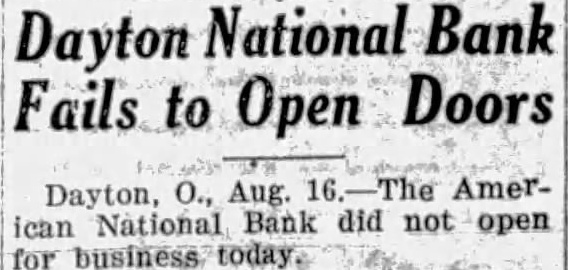
Dayton National Bank Fails to Open Doors
Dayton, O., Aug. 16.—The American National Bank did not open for business today.
Click image to open full size in new tab
Dayton National Bank Fails to Open Doors
Dayton, O., Aug. 16.—The American National Bank did not open for business today.
Click image to open full size in new tab
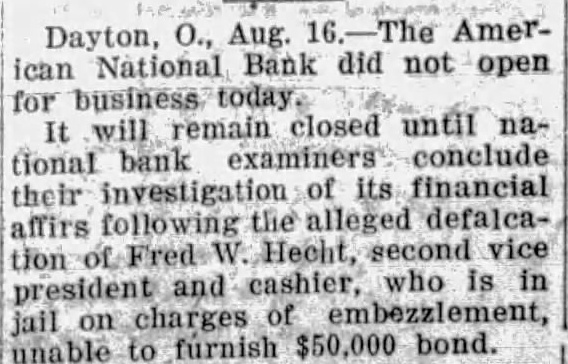
Dayton, O., Aug. 16.—The American National Bank did not open for business today.
It will remain closed until national bank examiners conclude their investigation of its financial affairs following the alleged defalcation of Fred W. Hecht, second vice president and cashier, who is in jail on charges of embezzlement, unable to furnish $50,000 bond.
Click image to open full size in new tab
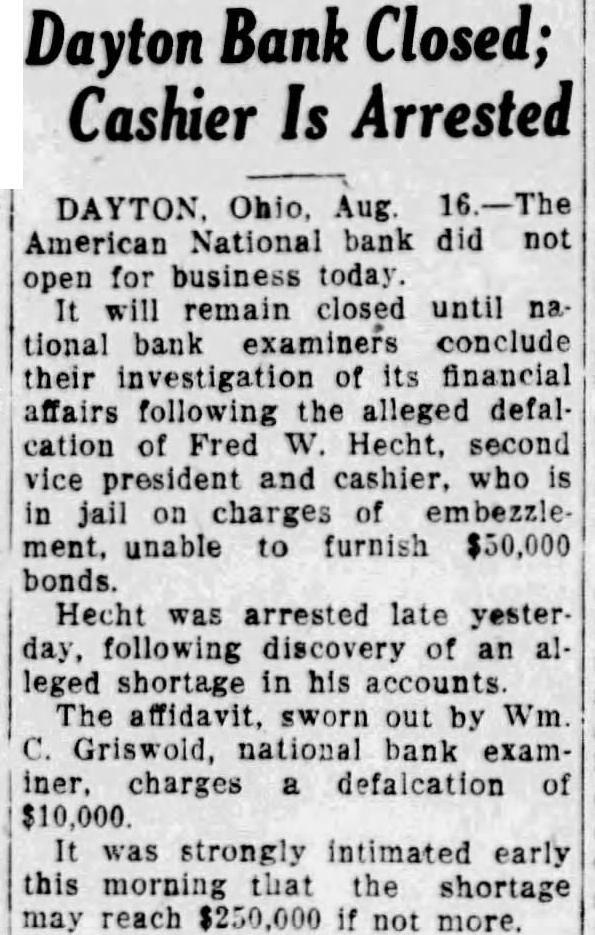
DAYTON, Ohio, Aug. 16.—The American National bank did not open for business today.
It will remain closed until national bank examiners conclude their investigation of its financial affairs following the alleged defalcation of Fred W. Hecht, second vice president and cashier, who is in jail on charges of embezzlement, unable to furnish $50,000 bonds.
Hecht was arrested late yesterday, following discovery of an alleged shortage in his accounts.
The affidavit, sworn out by Wm. C. Griswold, national bank examiner, charges a defalcation of $10,000.
It was strongly intimated early this morning that the shortage may reach $250,000 if not more.
Click image to open full size in new tab
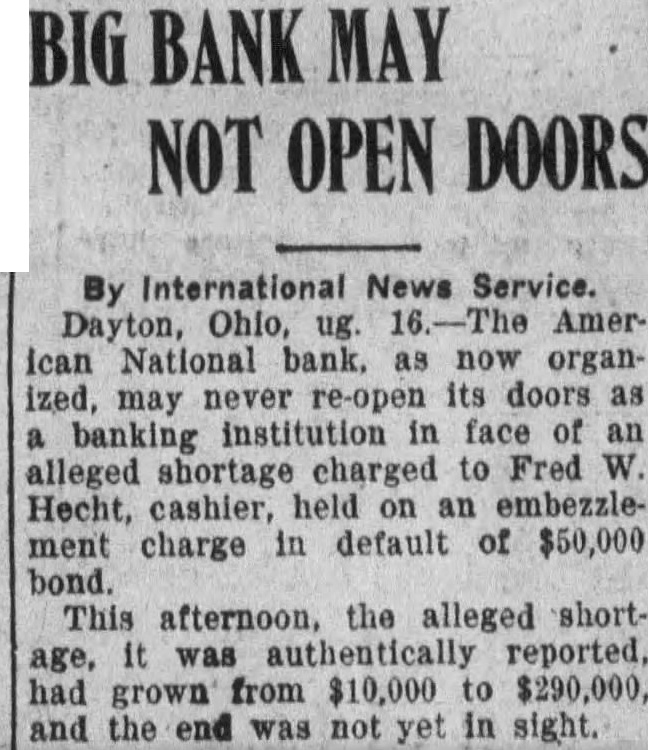
By International News Service. Dayton, Ohio, Aug. 16.—The American National bank, as now organized, may never re-open its doors as a banking institution in face of an alleged shortage charged to Fred W. Hecht, cashier, held on an embezzlement charge in default of $50,000 bond.
This afternoon, the alleged shortage, it was authentically reported, had grown from $10,000 to $290,000, and the end was not yet in sight.
Click image to open full size in new tab
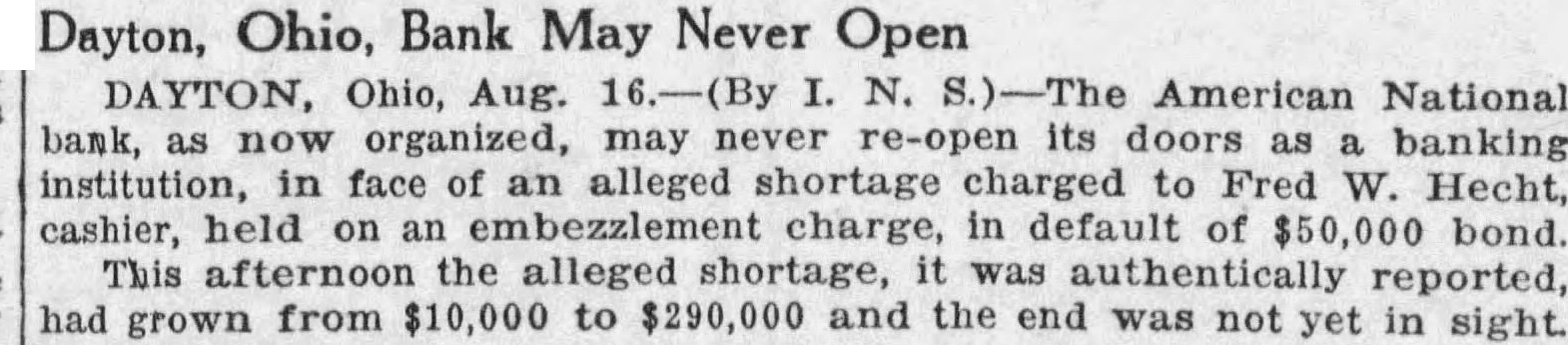
Dayton, Ohio, Bank May Never Open
DAYTON, Ohio, Aug. 16.—(By I. N. S.)—The American National bank, as now organized, may never re-open its doors as a banking institution, in face of an alleged shortage charged to Fred W. Hecht, cashier, held on an embezzlement charge, in default of $50,000 bond.
This afternoon the alleged shortage, it was authentically reported, had grown from $10,000 to $290,000 and the end was not yet in sight.
Click image to open full size in new tab
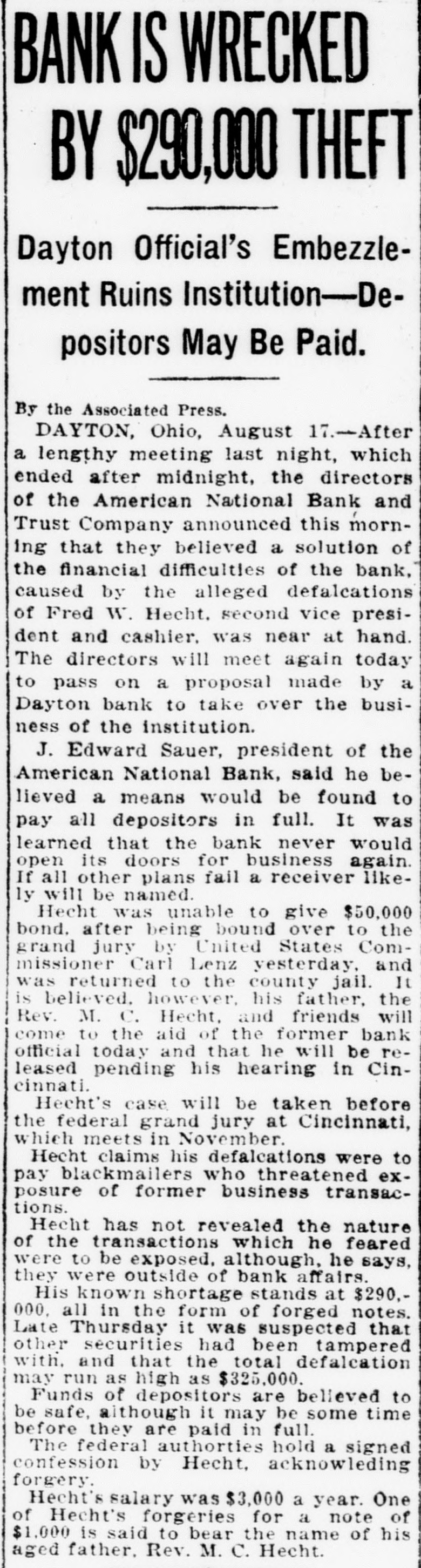
BANK IS WRECKED BY $290,000 THEFT Dayton Official's Embezzlement Ruins Institution-Depositors May Be Paid. By the Associated Press. DAYTON, Ohio, August 17.-After a lengthy meeting last night, which ended after midnight, the directors of the American National Bank and Trust Company announced this morning that they believed a solution of the financial difficulties of the bank, caused by the alleged defalcations of Fred W. Hecht. second vice president and cashier. was near at hand. The directors will meet again today to pass on a proposal made by a Dayton bank to take over the business of the institution. J. Edward Sauer, president of the American National Bank, said he believed a means would be found to pay all depositors in full. It was learned that the bank never would open its doors for business again. If all other plans fail a receiver likely will be named. Hecht was unable to give $50,000 bond. after being bound over to the grand jury by United States Commissioner Carl Lenz yesterday, and was returned to the county jail. It is believed. however, his father, the Rev. M. C. Hecht, and friends will come to the aid of the former bank official today and that he will be released pending his hearing in Cincinnati. Hecht's case will be taken before the federal grand jury at Cincinnati, which meets in November. Hecht claims his defalcations were to pay blackmailers who threatened exposure of former business transactions. Hecht has not revealed the nature of the transactions which he feared were to be exposed. although, he says, they were outside of bank affairs. His known shortage stands at $290.000. all in the form of forged notes. Late Thursday it was suspected that other securities had been tampered with. and that the total defalcation may run as high as $325,000. Funds of depositors are believed to be safe, although it may be some time before they are paid in full. The federal authorties hold a signed confession by Hecht, acknowleding forgery. Hecht's salary was $3,000 a year. One of Hecht's forgeries for a note of $1,000 is said to bear the name of his aged father. Rev. M. C. Hecht.
Click image to open full size in new tab
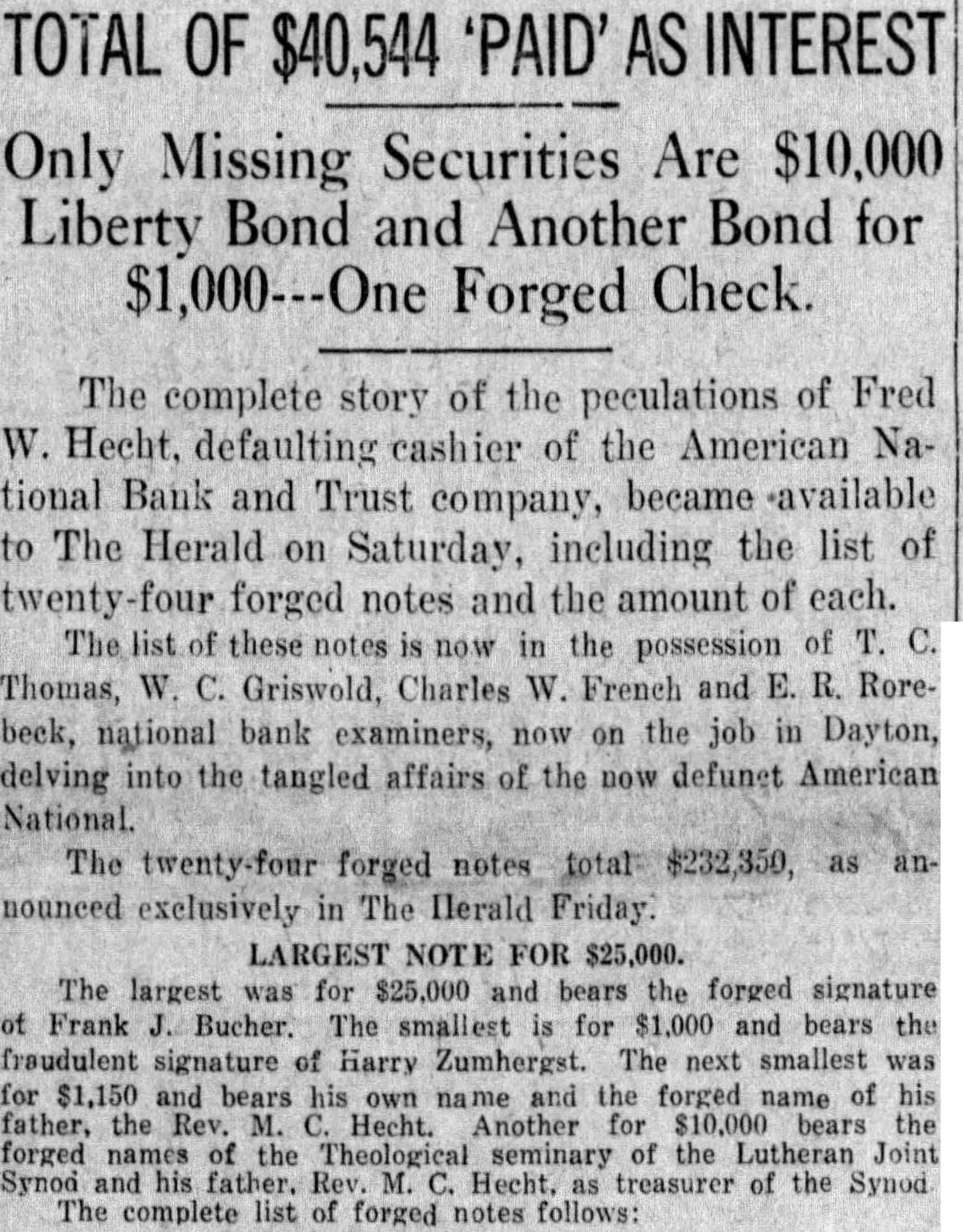
TOTAL OF $40,544 'PAID' AS INTEREST
Only Missing Securities Are $10,000 Liberty Bond and Another Bond for $1,000---One Forged Check.
The complete story of the peculations of Fred W. Hecht, defaulting cashier of the American National Bank and Trust company, became available to The Herald on Saturday, including the list of twenty-four forged notes and the amount of each.
The list of these notes is now in the possession of T. C. Thomas, W. C. Griswold, Charles W. French and E. R. Rorebeck, national bank examiners, now on the job in Dayton, delving into the tangled affairs of the now defunct American National.
The twenty-four forged notes total $232,359, as announced exclusively in The Herald Friday.
LARGEST NOTE FOR $25,000.
The largest was for $25,000 and bears the forged signature of Frank J. Bucher. The smallest is for $1,000 and bears the fraudulent signature of Harry Zumhergst. The next smallest was for $1,150 and bears his own name and the forged name of his father, the Rev. M. C. Hecht. Another for $10,000 bears the forged names of the Theological seminary of the Lutheran Joint Synod and his father, Rev. M. C. Hecht, as treasurer of the Synod.
The complete list of forged notes follows:
Click image to open full size in new tab
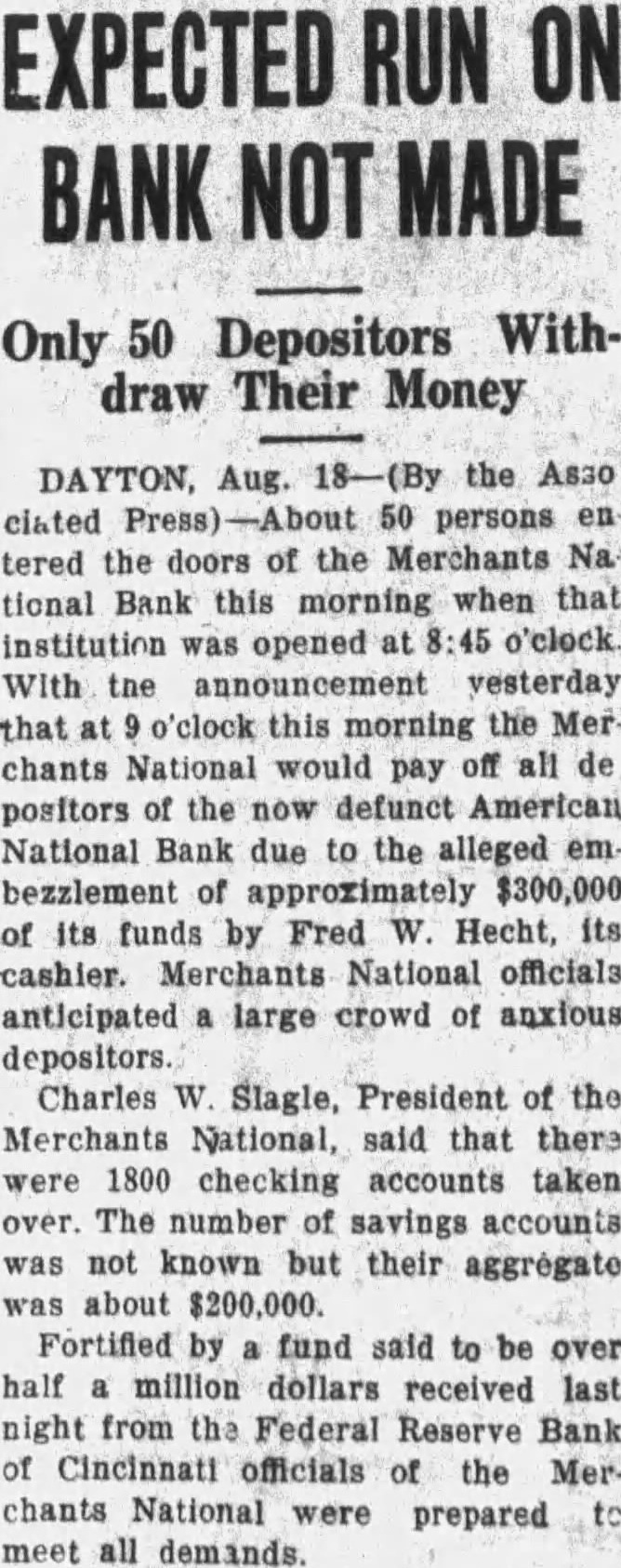
Only 50 Depositors Withdraw Their Money
DAYTON, Aug. 18—(By the Associated Press)—About 50 persons entered the doors of the Merchants National Bank this morning when that institution was opened at 8:45 o'clock. With the announcement yesterday that at 9 o'clock this morning the Merchants National would pay off all depositors of the now defunct American National Bank due to the alleged embezzlement of approximately $300,000 of its funds by Fred W. Hecht, its cashier. Merchants National officials anticipated a large crowd of anxious depositors.
Charles W. Slagle, President of the Merchants National, said that there were 1800 checking accounts taken over. The number of savings accounts was not known but their aggregate was about $200,000.
Fortified by a fund said to be over half a million dollars received last night from the Federal Reserve Bank of Cincinnati officials of the Merchants National were prepared to meet all demands.
Click image to open full size in new tab
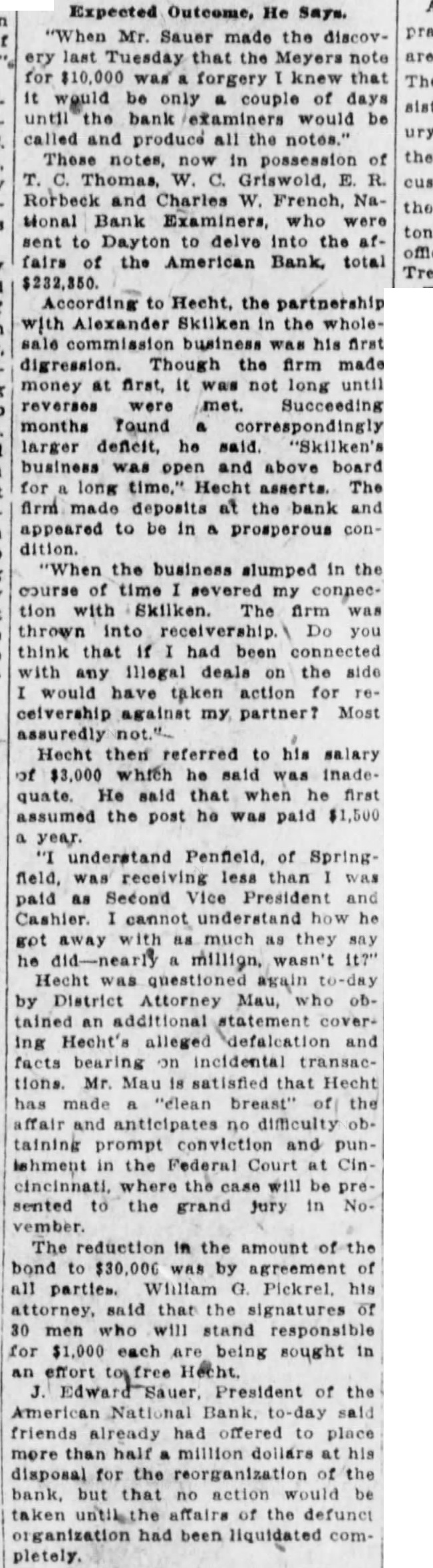
Expected Outcome, He Says.
"When Mr. Sauer made the discovery last Tuesday that the Meyers note for $10,000 was a forgery I knew that it would be only a couple of days until the bank examiners would be called and produce all the notes."
These notes, now in possession of T. C. Thomas, W. C. Griswold, E. R. Rorbeck and Charles W. French, National Bank Examiners, who were sent to Dayton to delve into the affairs of the American Bank, total $232,350.
According to Hecht, the partnership with Alexander Skilken in the wholesale commission business was his first digression. Though the firm made money at first, it was not long until reverses were met. Succeeding months found a correspondingly larger deficit, he said. "Skilken's business was open and above board for a long time," Hecht asserts. The firm made deposits at the bank and appeared to be in a prosperous condition.
"When the business slumped in the course of time I severed my connection with Skilken. The firm was thrown into receivership. Do you think that if I had been connected with any illegal deals on the side I would have taken action for receivership against my partner? Most assuredly not."
Hecht then referred to his salary of $3,000 which he said was inadequate. He said that when he first assumed the post he was paid $1,500 a year.
"I understand Penfield, of Springfield, was receiving less than I was paid as Second Vice President and Cashier. I cannot understand how he got away with as much as they say he did—nearly a million, wasn't it?"
Hecht was questioned again to-day by District Attorney Mau, who obtained an additional statement covering Hecht's alleged defalcation and facts bearing on incidental transactions. Mr. Mau is satisfied that Hecht has made a "clean breast" of the affair and anticipates no difficulty obtaining prompt conviction and punishment in the Federal Court at Cincinnati, where the case will be presented to the grand jury in November.
The reduction in the amount of the bond to $30,000 was by agreement of all parties. William G. Pickrel, his attorney, said that the signatures of 30 men who will stand responsible for $1,000 each are being sought in an effort to free Hecht.
J. Edward Sauer, President of the American National Bank, to-day said friends already had offered to place more than half a million dollars at his disposal for the reorganization of the bank, but that no action would be taken until the affairs of the defunct organization had been liquidated completely.

Click image to open full size in new tab
CONTINUED FROM FIRST PAGE.
can do is to start over again. I am young and have fairly good health. I can do my time and make a fresh start."
He explained that he became heartily sick of his method of making out fresh notes to "renew" those which had expired, and that he knew sooner or later he would get caught.
Expected Outcome, He Says.
"When Mr. Sauer made the discovery last Tuesday that the Meyers note for $10,000 was a forgery I knew that it would be only a couple of days until the bank examiners would be called and produce all the notes."
These notes, now in possession of T. C. Thomas, W. C. Griswold, E. R. Rorbeck and Charles W. French, National Bank Examiners, who were sent to Dayton to delve into the affairs of the American Bank, total $232,350.
According to Hecht, the partnership with Alexander Skilken in the wholesale commission business was his first digression. Though the firm made money at first, it was not long until reverses were met. Succeeding months found a correspondingly larger deficit, he said. "Skilken's business was open and above board for a long time," Hecht asserts. The firm made deposits at the bank and appeared to be in a prosperous condition.
"When the business slumped in the course of time I severed my connection with Skilken. The firm was thrown into receivership. Do you think that if I had been connected with any illegal deals on the side I would have taken action for receivership against my partner? Most assuredly not."
Hecht then referred to his salary of $3,000 which he said was inadequate. He said that when he first assumed the post he was paid $1,500 a year.
"I understand Penfield, of Springfield, was receiving less than I was paid as Second Vice President and Cashier. I cannot understand how he got away with as much as they say he did—nearly a million, wasn't it?"
Hecht was questioned again to-day by District Attorney Mau, who obtained an additional statement covering Hecht's alleged defalcation and facts bearing on incidental transactions. Mr. Mau is satisfied that Hecht has made a "clean breast" of the affair and anticipates no difficulty obtaining prompt conviction and punishment in the Federal Court at Cincinnati, where the case will be presented to the grand jury in November.
The reduction in the amount of the bond to $30,000 was by agreement of all parties. William G. Pickrel, his attorney, said that the signatures of 30 men who will stand responsible for $1,000 each are being sought in an effort to free Hecht.
J. Edward Sauer, President of the American National Bank, to-day said friends already had offered to place more than half a million dollars at his disposal for the reorganization of the bank, but that no action would be taken until the affairs of the defunct organization had been liquidated completely.
Click image to open full size in new tab
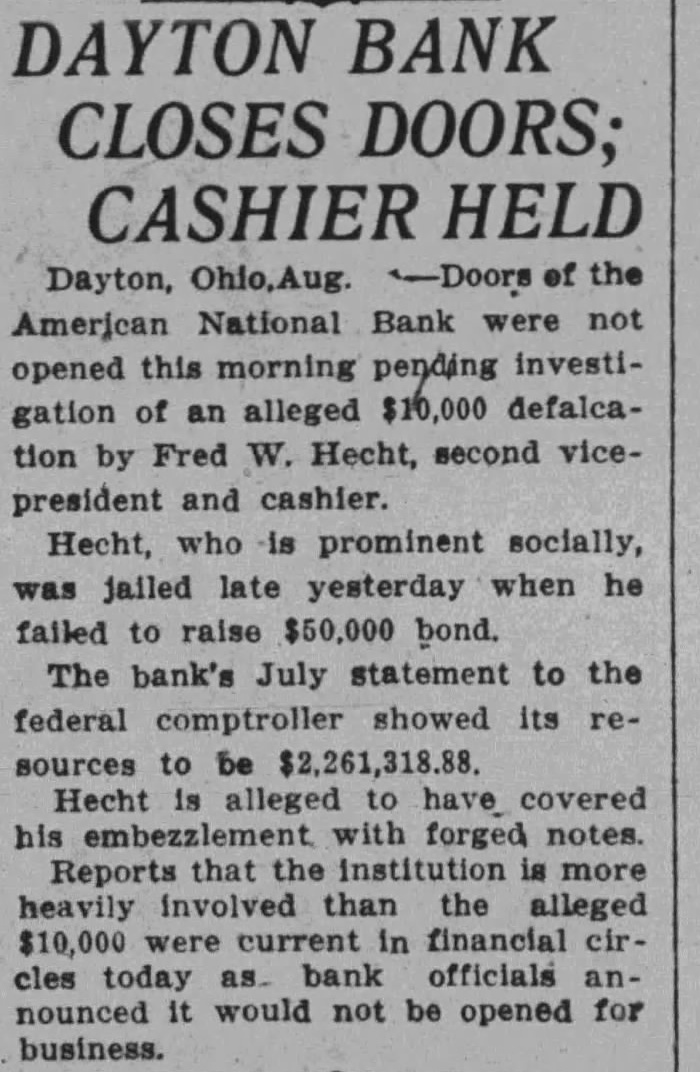
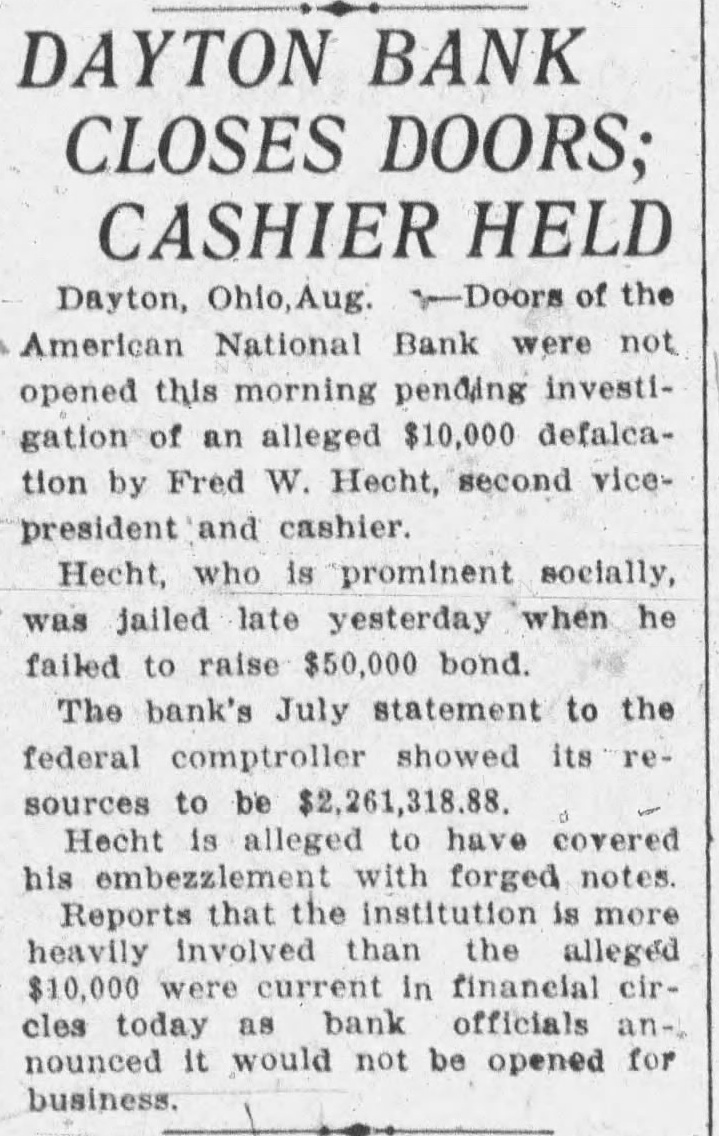
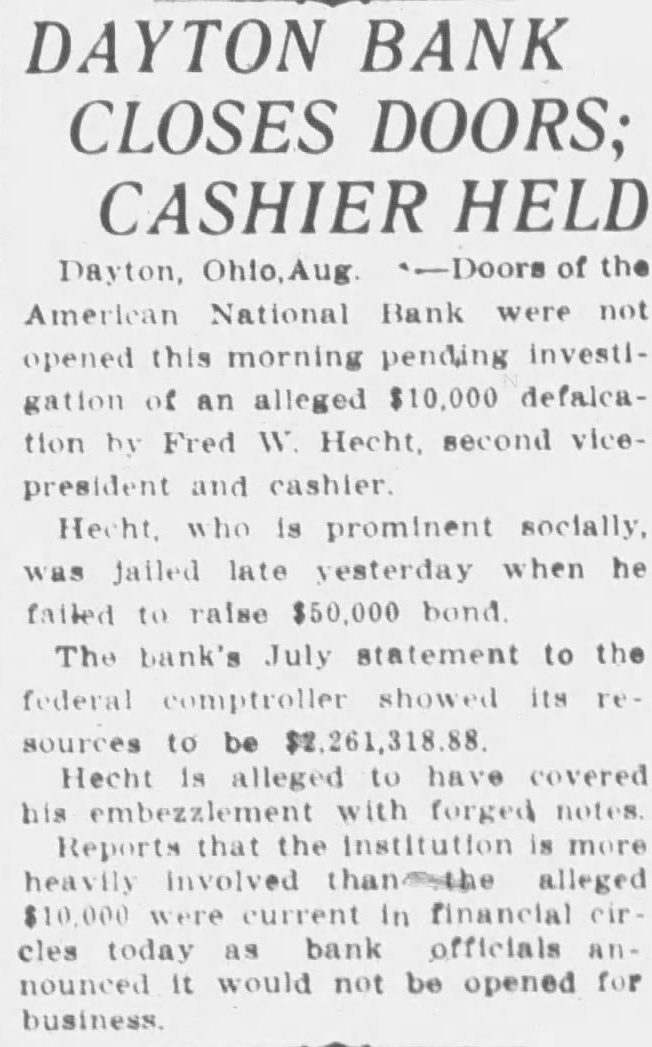
Dayton, Ohio, Aug. — Doors of the American National Bank were not opened this morning pending investigation of an alleged $10,000 defalcation by Fred W. Hecht, second vice-president and cashier.
Hecht, who is prominent socially, was jailed late yesterday when he failed to raise $50,000 bond.
The bank's July statement to the federal comptroller showed its resources to be $2,261,318.88.
Hecht is alleged to have covered his embezzlement with forged notes.
Reports that the institution is more heavily involved than the alleged $10,000 were current in financial circles today as bank officials announced it would not be opened for business.
Click image to open full size in new tab
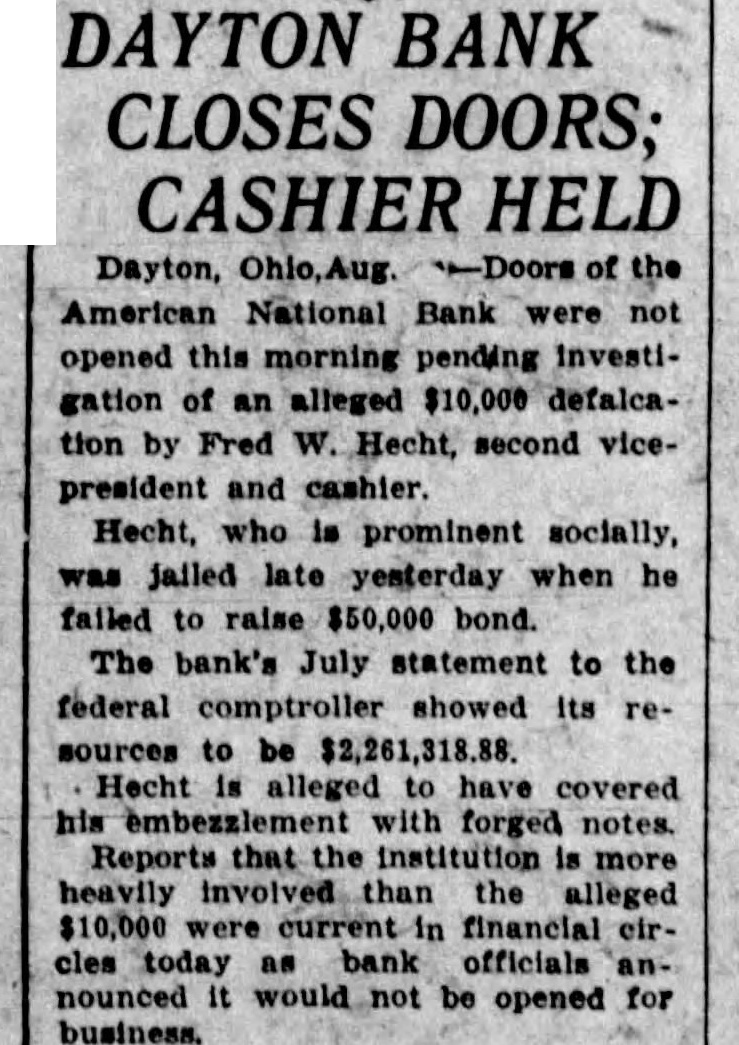
Dayton, Ohio, Aug. — Doors of the American National Bank were not opened this morning pending investigation of an alleged $10,000 defalcation by Fred W. Hecht, second vice-president and cashier.
Hecht, who is prominent socially, was jailed late yesterday when he failed to raise $50,000 bond.
The bank's July statement to the federal comptroller showed its resources to be $2,261,318.88.
Hecht is alleged to have covered his embezzlement with forged notes.
Reports that the institution is more heavily involved than the alleged $10,000 were current in financial circles today as bank officials announced it would not be opened for business.
Click image to open full size in new tab
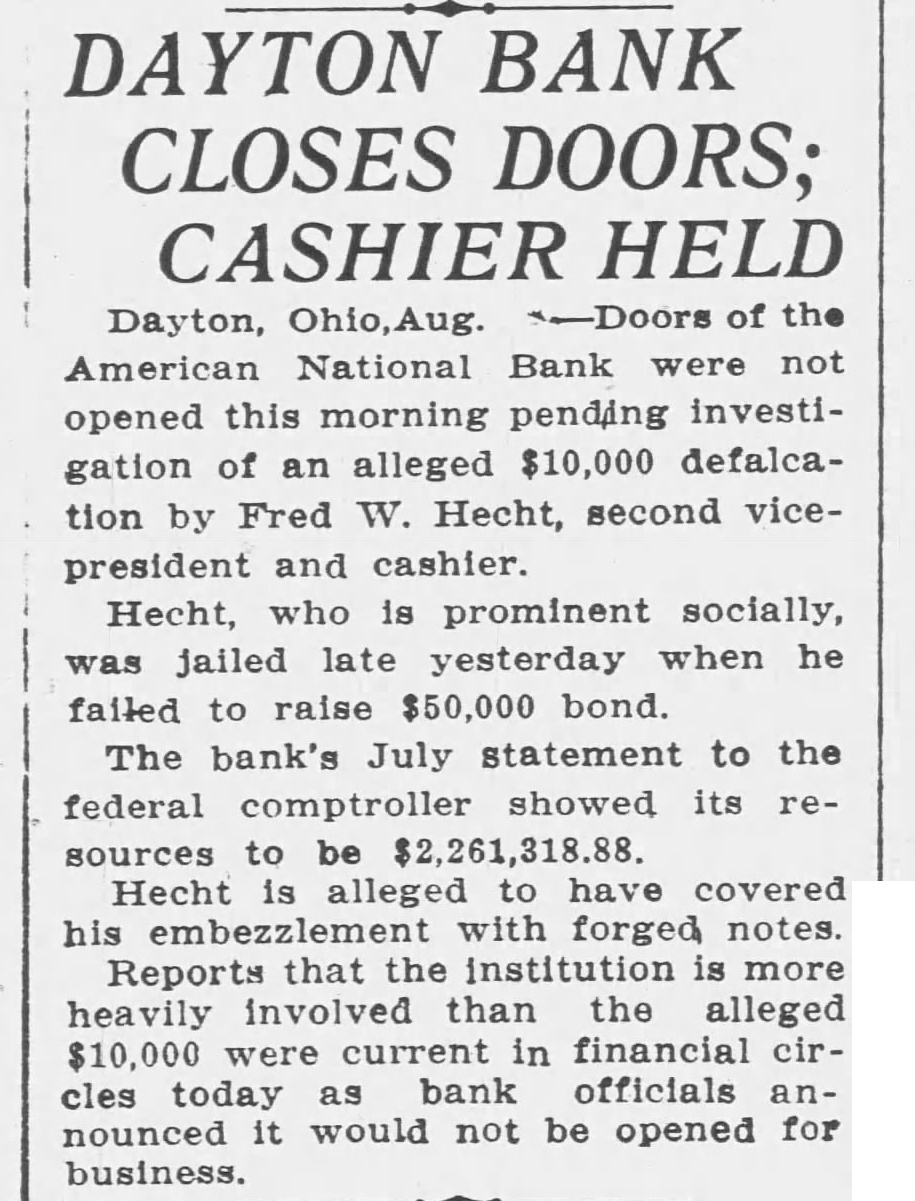
Dayton, Ohio, Aug. — Doors of the American National Bank were not opened this morning pending investigation of an alleged $10,000 defalcation by Fred W. Hecht, second vice-president and cashier.
Hecht, who is prominent socially, was jailed late yesterday when he failed to raise $50,000 bond.
The bank's July statement to the federal comptroller showed its resources to be $2,261,318.88.
Hecht is alleged to have covered his embezzlement with forged notes.
Reports that the institution is more heavily involved than the alleged $10,000 were current in financial circles today as bank officials announced it would not be opened for business.
Click image to open full size in new tab
Dayton, Ohio, Aug. — Doors of the American National Bank were not opened this morning pending investigation of an alleged $10,000 defalcation by Fred W. Hecht, second vice-president and cashier.
Hecht, who is prominent socially, was jailed late yesterday when he failed to raise $50,000 bond.
The bank's July statement to the federal comptroller showed its resources to be $2,261,318.88.
Hecht is alleged to have covered his embezzlement with forged notes.
Reports that the institution is more heavily involved than the alleged $10,000 were current in financial circles today as bank officials announced it would not be opened for business.
Click image to open full size in new tab
Dayton, Ohio, Aug. — Doors of the American National Bank were not opened this morning pending investigation of an alleged $10,000 defalcation by Fred W. Hecht, second vice-president and cashier.
Hecht, who is prominent socially, was jailed late yesterday when he failed to raise $50,000 bond.
The bank's July statement to the federal comptroller showed its resources to be $2,261,318.88.
Hecht is alleged to have covered his embezzlement with forged notes.
Reports that the institution is more heavily involved than the alleged $10,000 were current in financial circles today as bank officials announced it would not be opened for business.
Click image to open full size in new tab
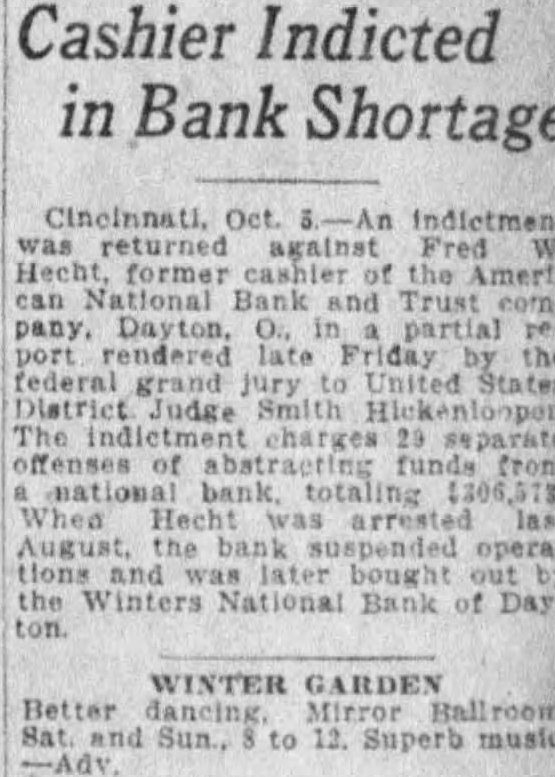
Cincinnati, Oct. 5.—An indictment was returned against Fred W. Hecht, former cashier of the American National Bank and Trust company, Dayton, O., in a partial report rendered late Friday by the federal grand jury to United States District Judge Smith Hickenlooper. The indictment charges 29 separate offenses of abstracting funds from a national bank, totaling $306,573. When Hecht was arrested last August, the bank suspended operations and was later bought out by the Winters National Bank of Dayton.
WINTER GARDEN Better dancing, Mirror Ballroom, Sat. and Sun., 8 to 12. Superb music.—Adv.
Click image to open full size in new tab
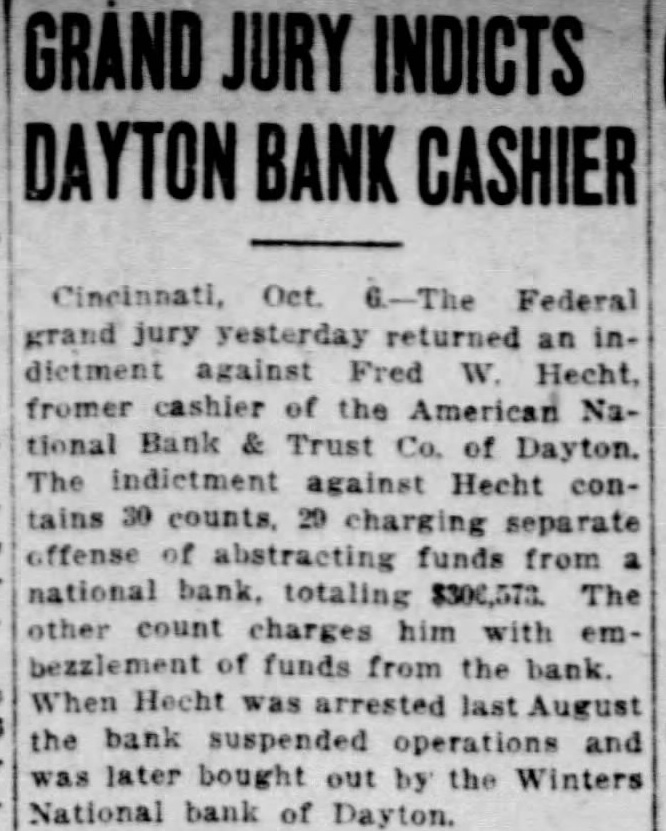
Cincinnati, Oct. 6.—The Federal grand jury yesterday returned an indictment against Fred W. Hecht, former cashier of the American National Bank & Trust Co. of Dayton. The indictment against Hecht contains 30 counts, 29 charging separate offense of abstracting funds from a national bank, totaling $306,573. The other count charges him with embezzlement of funds from the bank. When Hecht was arrested last August the bank suspended operations and was later bought out by the Winters National bank of Dayton.
Click image to open full size in new tab
Cincinnati, Oct. 5.—An indictment was returned against Fred W. Hecht, former cashier of the American National Bank and Trust company, Dayton, Ohio, in a partial report rendered late today by the federal grand jury to United States District Judge Smith Hickenlooper.
The indictment against Hecht contains 30 counts, 29 charging separate offense of abstracting funds from a national bank, totalling $306,573. The other count charges him with embezzlement of funds from the bank. When Hecht was arrested last August, the bank suspended operations, and was later bought out by the Winters National bank of Dayton.
Click image to open full size in new tab
CASHIER INDICTED 30 Counts Contained in Indictment Against Hecht CINCINNATI, O., Oct. 5.-An indictment was returned against Fred W. Hecht, former cashier of the American National Bank and Trust company, Dayton, O., in a partial report rendered late today by the federal grand jury to United States District Judge Smith Hickenlooper. The indictment against Hecht contains 30 counts, 29 charging separate offense of abstracting funds from a national bank totaling $306,573. The other count charges him with emblezzlement of funds from the bank. When Hecht was arrested last August, the bank suspended operations and was later bought out by the Winters National Bank of Dayton.
impossible for the railways to balance their budget of 1932 even though the unconditional payments, which the Young plan places upon them. should be turned back to them now through the Hoover plan. This was accepted as the first official indication that the experts' final report would contain for moratorium on conditional payments rather than for By EDWARD STANLEY London, Dec. 17.-(Copyright, 1931, Normaley Awaited. by the Associated world "As soon as Germany gets back to normal," the subcommittee report is standing on the threshold of the said, "the railways may be expected greatest prosperity It ever has experito attain net earnings comparable to enced-if only the necessary steps are those of the railways in other coun tries." taken-Sir George Paish, noted British An official committee said the comeconomist and member of the British mission had reported: official mission to the United States in First, that from 1925 to the railways were able to pay 660,000,000 1914, said today in an exclusive interin reparations imposed by the view with the Associated Press. Young plan, inasmuch as the net reThree of the chief recommendations were that the 1930 profits dropped to 000 marks, the basis of individual debtor's crease of 13 per cent, and that by capacity December, 1931, receipts had fallen by Even If the conference is limited to 28 per cent, and thus the company the question of German short forced to draw on its credits, official American participawhich included the benefits it derived tioin appeared uncertain due to atfrom the Hoover moratorium. tacks by Congress on alleged pracParleys. tices of political leaders and internaDec. tional bankers. and France began preliminary exchange of views today on the international debts and reparations con- Assets of Defunct Dayton ference to follow the Young plan adBank Listed at $685,171 visory committee sessions under way The committee is investigating Asets and liabilities of the closed Ameri"capacity to pay. The conference folcan National bank, Dayton, were lowing will consider revision. receiver. Thursday by The United States probably will be The receiver issued statement of the by "an observer" since nancial the Washington considers reparations vember the date on which the bank susbusiness purely n. European problem and is The follows: willing to discuss war debts only on hand, assets than bills on and cash hand, $209,616.78. Toon "COMFORTABLE unsecured, $456,VISION" deposits secured by pledge collateral, assets the bank aggregating $240.37 secured by sets of the bank aggregating $65,044.46 specialize in giving eyes bills payable secured by of assets the bank Whether you wear glasses Total, as $45,000. not, you may have me