Monroe National Bank (Monroe, LA)

Episode Information

Episode UID
408201331
Episode Type
Suspension โ†’ Closure
Bank Type
national
Bank ID
40820 national
Charter Number
4082
Start Date
November 1, 1910
Location
Monroe, Louisiana (32.520, -92.077)

Metadata

Model
gpt-5-mini (chosen from majority vote of a three-model LLM ensemble)
Short Digest
736a959eb3b183f9

Response Measures

None

Description

Articles repeatedly refer to a 'Bank of Monroe' that closed and entered receivership; not exactly the provided bank name.

Events (4)

1. July 29, 1889 Chartered
Source
historical_nic
2. April 20, 1907 Voluntary Liquidation
Source
historical_nic
3. November 1, 1910 Receivership
Newspaper Excerpt
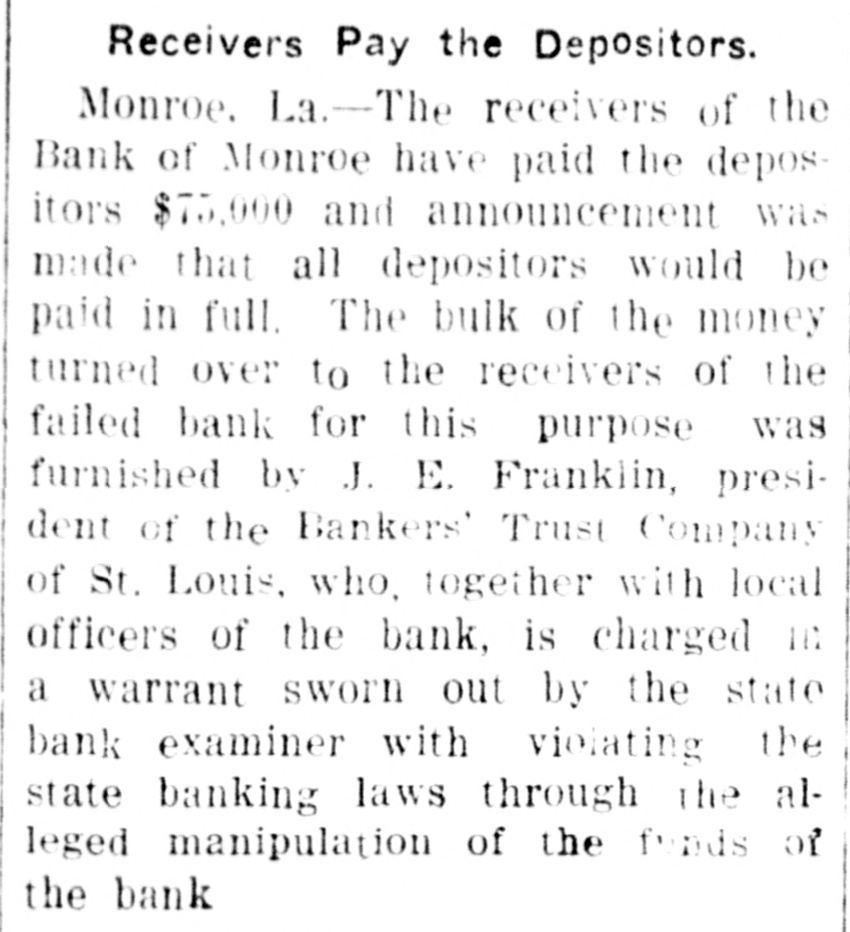
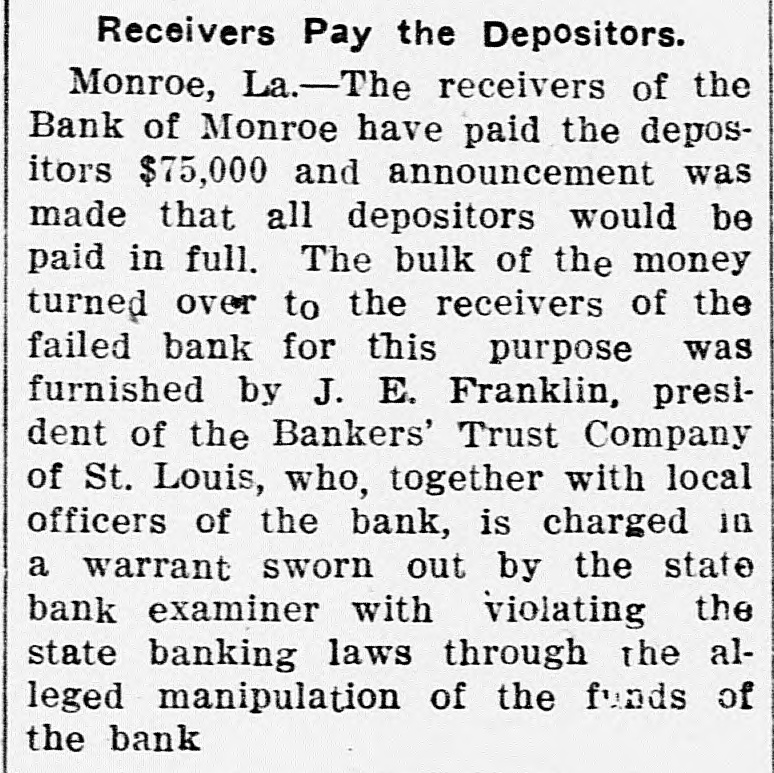
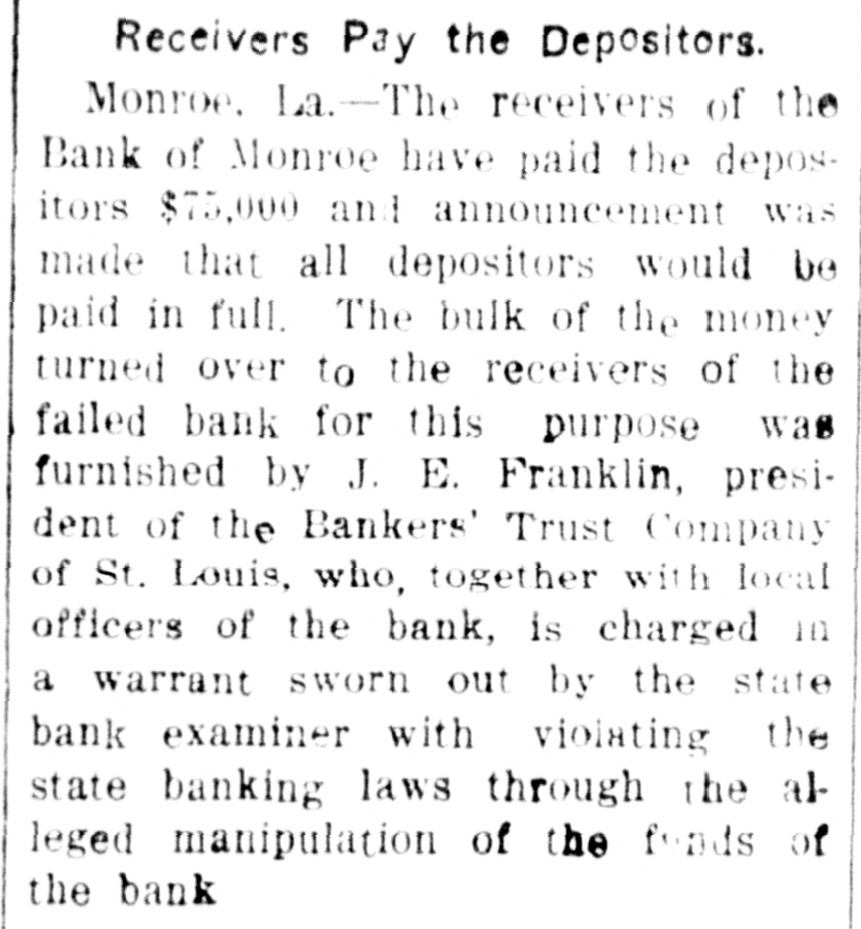
The receivers of the Bank of Monroe have paid the depositors $75,000 and announcement was made that all depositors would be paid in full. ... the failed bank ... the receivers swore affidavits ... the closed bank owes depositors about $100,000 and other banks about $70,000.
Source
newspapers
4. November 1, 1910 Suspension
Cause
Bank Specific Adverse Info
Cause Details
Officials charged with making false statements, receiving deposits while insolvent, manipulation of funds and improper collateral transfers.
Newspaper Excerpt
the Bank of Monroe, which recently closed its doors
Source
newspapers

Newspaper Articles (10)

Article from The Birmingham Age-Herald, November 2, 1910

Click image to open full size in new tab

Article Text

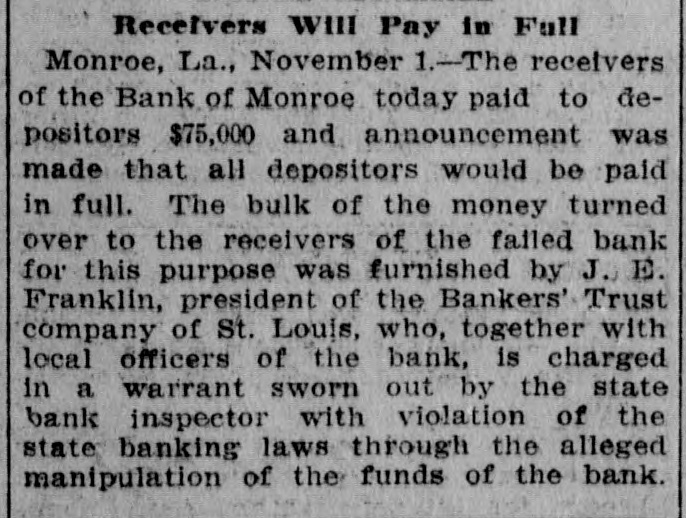
Receivers Will Pay in Full Monroe, La., November 1.-The receivers of the Bank of Monroe today paid to depositors $75,000 and announcement was made that all depositors would be paid in full. The bulk of the money turned over to the receivers of the failed bank for this purpose was furnished by J. E. Franklin, president of the Bankers' Trust company of St. Louis, who, together with local officers of the bank, is charged in a warrant sworn out by the state bank inspector with violation of the state banking laws through the alleged manipulation of the funds of the bank.


Article from The Green Forest Tribune, November 4, 1910

Click image to open full size in new tab

Article Text

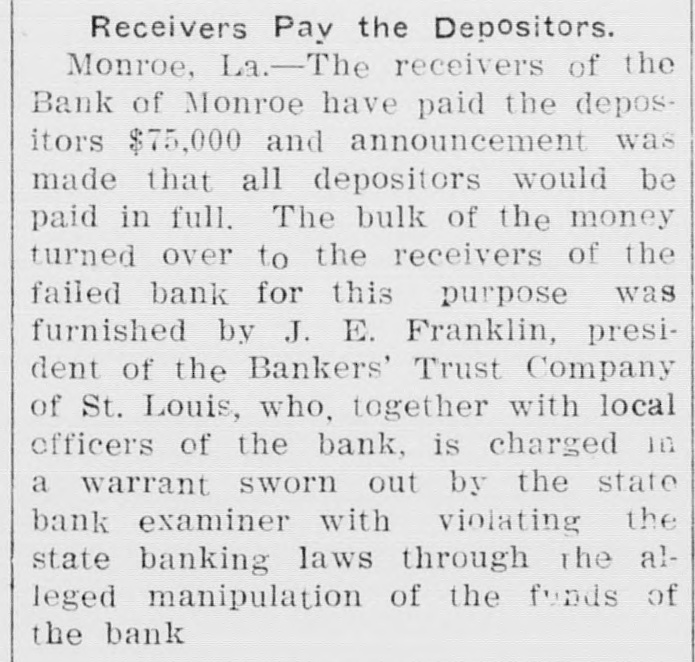
Receivers Pay the Depositors. Monroe, La.-The receivers of the Bank of Monroe have paid the depositors $75,000 and announcement was made that all depositors would be paid in full. The bulk of the money turned over to the receivers of the failed bank for this purpose was furnished by J. E. Franklin, president of the Bankers' Trust Company of St. Louis, who, together with local officers of the bank, is charged in a warrant sworn out by the state bank examiner with violating the state banking laws through the alleged manipulation of the funds of the bank


Article from The Rice Belt Journal, November 4, 1910

Click image to open full size in new tab

Article Text

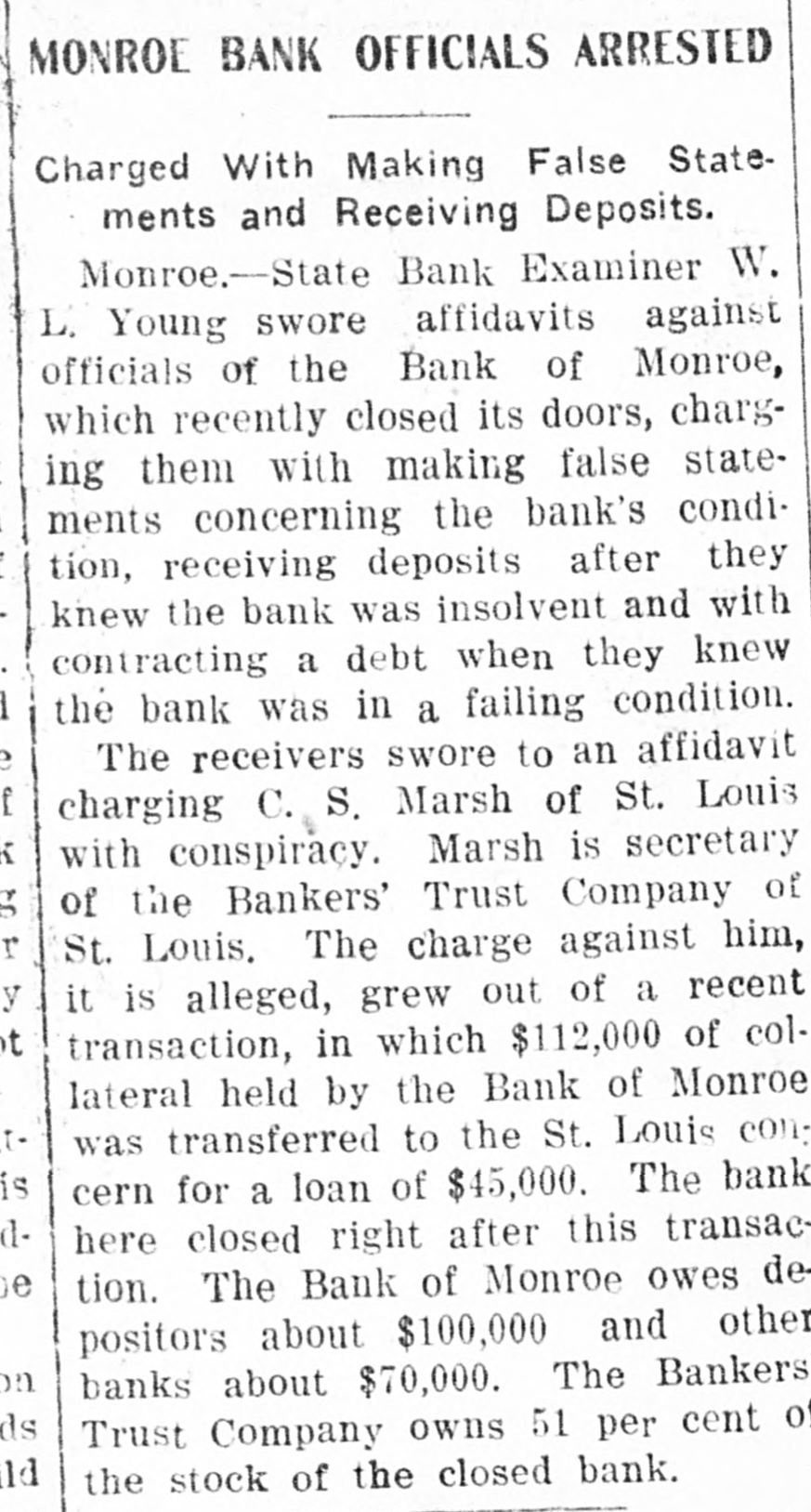
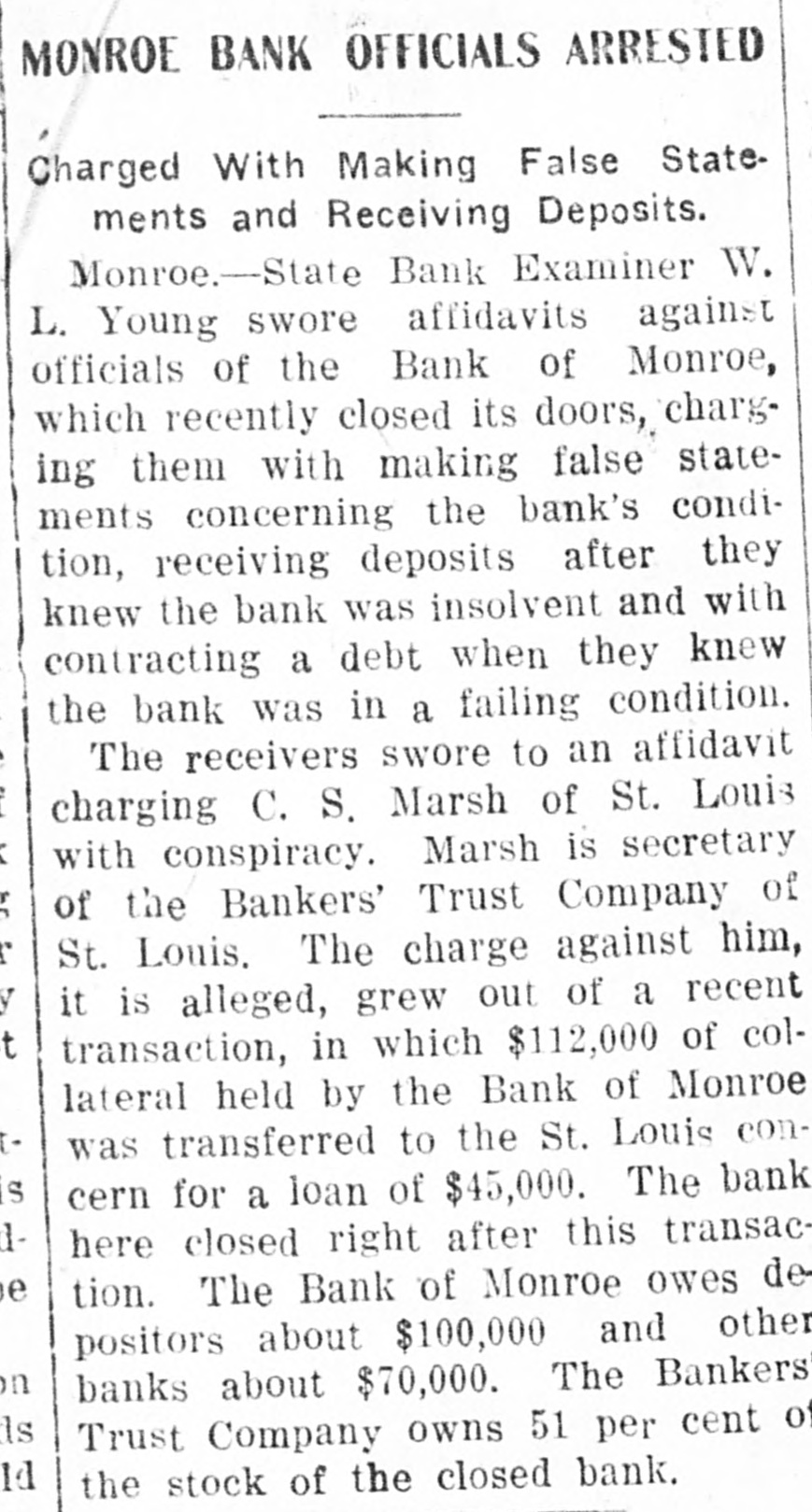
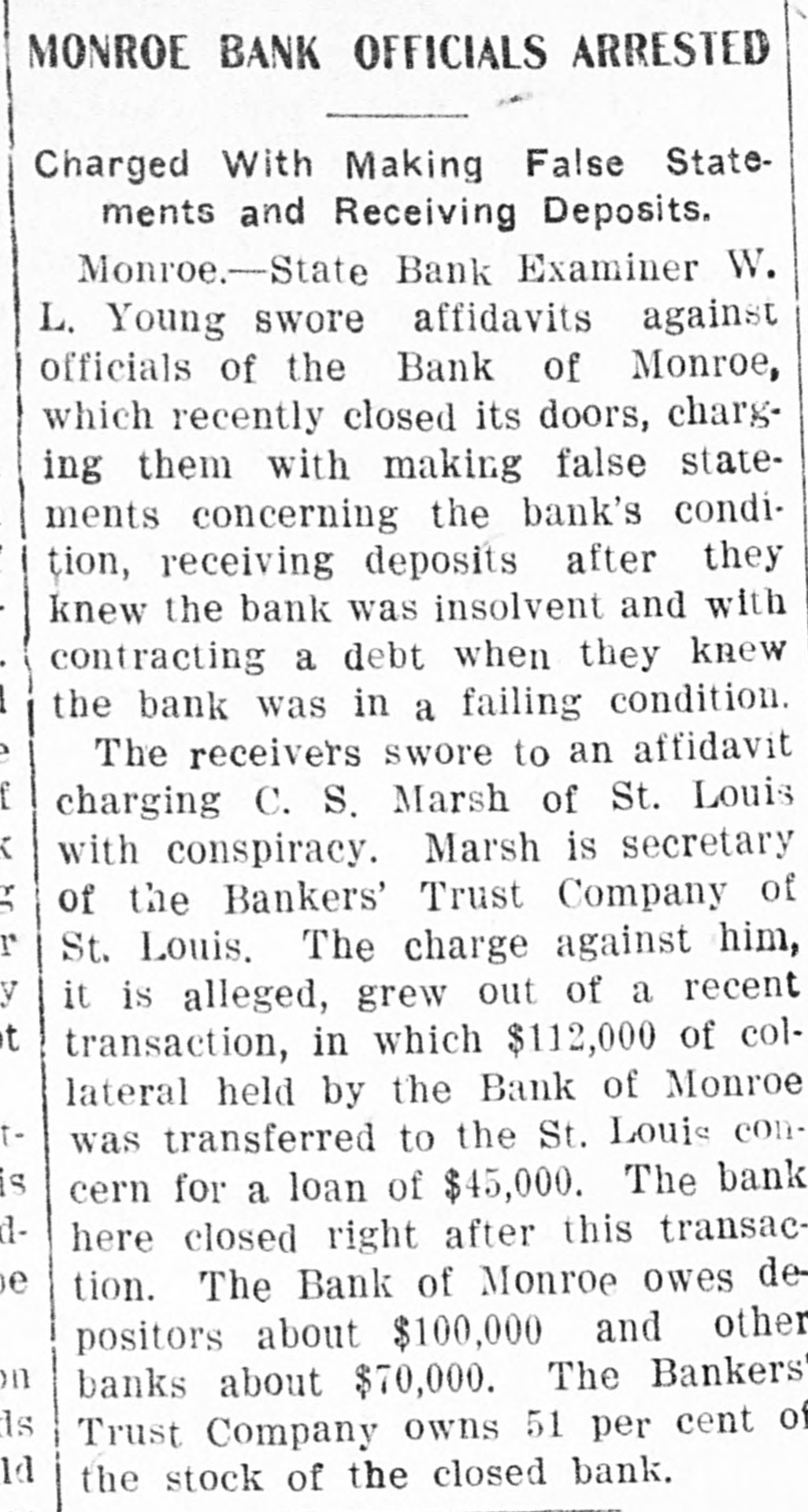
MONROE BANK OFFICIALS ARRESTED Charged With Making False Statements and Receiving Deposits. Monroe.-State Bank Examiner W. L. Young swore affidavits against officials of the Bank of Monroe, which recently closed its doors, charging them with making false statements concerning the bank's condition, receiving deposits after they knew the bank was insolvent and with contracting a debt when they knew the bank was in a failing condition. The receivers swore to an affidavit charging C. S. Marsh of St. Louis with conspiracy. Marsh is secretary of the Bankers' Trust Company of St. Louis. The charge against him, y it is alleged, grew out of a recent transaction, in which $112,000 of collateral held by the Bank of Monroe :was transferred to the St. Louis con: is cern for a loan of $45,000. The bank dhere closed right after this transace tion. The Bank of Monroe owes depositors about $100,000 and other banks about $70,000. The Bankers ds Trust Company owns 51 per cent o 1d the stock of the closed bank.


Article from The Rice Belt Journal, November 11, 1910

Click image to open full size in new tab

Article Text

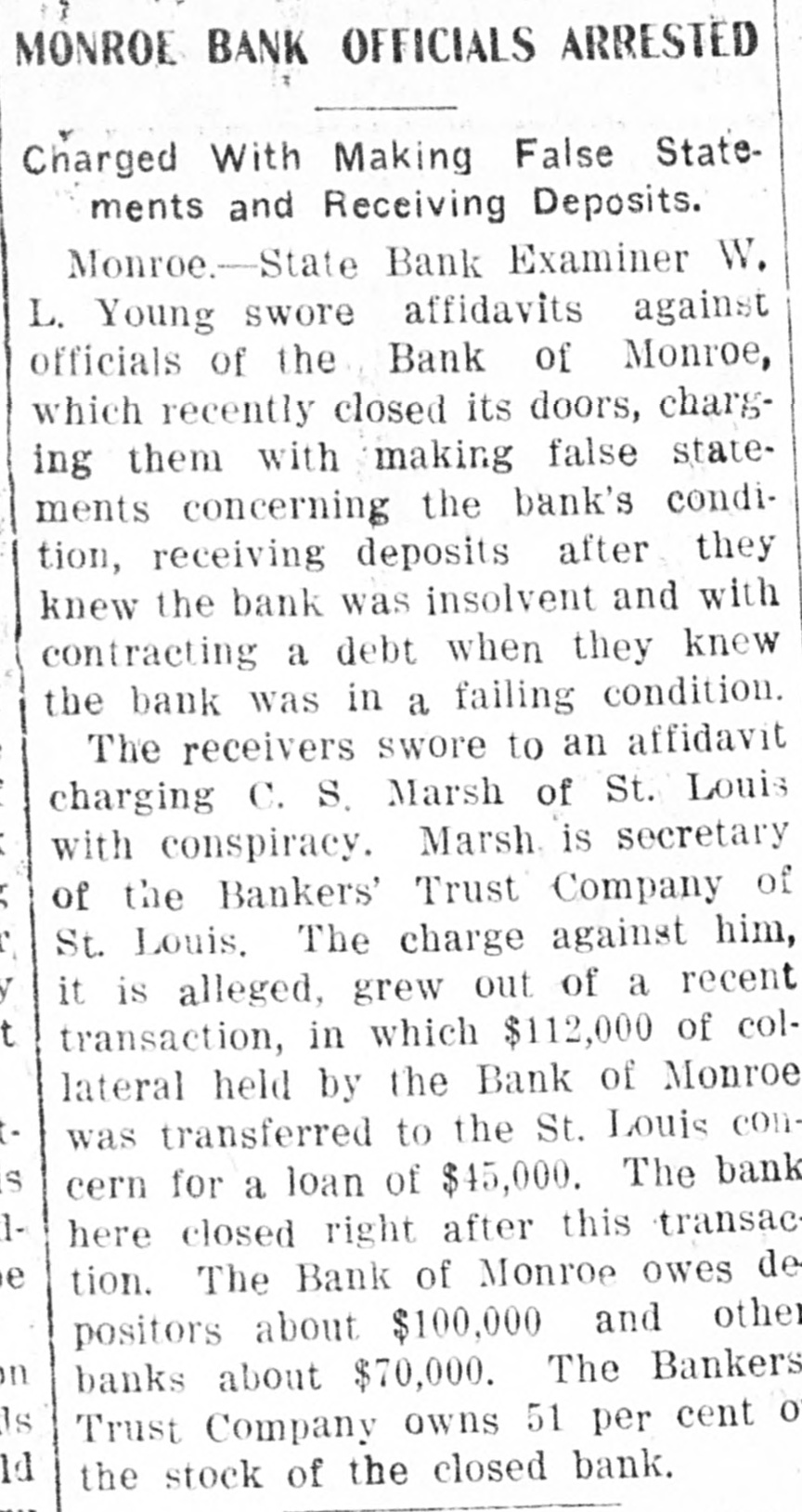
MONROE BANK OFFICIALS ARRESTED Charged With Making False Statements and Receiving Deposits. Monroe.-State Bank Examiner W. L. Young swore affidavits against officials of the Bank of Monroe, which recently closed its doors, charging them with making false statements concerning the bank's condition, receiving deposits after they knew the bank was insolvent and with contracting a debt when they knew the bank was in a failing condition. The receivers swore to an affidavit charging C. S. Marsh of St. Louis with conspiracy. Marsh is secretary of the Bankers' Trust Company of St. Louis. The charge against him, it is alleged, grew out of a recent transaction, in which $112,000 of collateral held by the Bank of Monroe was transferred to the St. Louis conS cern for a loan of $45,000. The bank 1here closed right after this transac e tion. The Bank of Monroe owes de positors about $100,000 and other banks about $70,000. The Bankers Is Trust Company owns 51 per cent o 1d the stock of the closed bank.


Article from Lower Coast Gazette, November 12, 1910

Click image to open full size in new tab

Article Text

Receivers Pay the Depositors. Monroe. La.-The receivers of the Bank of Monroe have paid the depositors $75,000 and announcement Was made that all depositors would be paid in full. The bulk of the money turned over to the receivers of the failed bank for this purpose was furnished by J. E. Franklin, president of the Bankers' Trust Company of St. Louis, who, together with local officers of the bank, is charged 111 a warrant sworn out by the state bank examiner with violating the state banking laws through the alleged manipulation of the funds of the bank


Article from The Thibodaux Sentinel, November 12, 1910

Click image to open full size in new tab

Article Text

Receivers Pay the Depositors. Monroe, La.-The receivers of the Bank of Monroe have paid the depositors $75,000 and announcement was made that all depositors would be paid in full. The bulk of the money turned over to the receivers of the failed bank for this purpose was furnished by J. E. Franklin, president of the Bankers' Trust Company of St. Louis, who, together with local officers of the bank, is charged in a warrant sworn out by the state bank examiner with violating the state banking laws through the alleged manipulation of the funds of the bank


Article from The Rice Belt Journal, November 18, 1910

Click image to open full size in new tab

Article Text

MONROE BANK OFFICIALS ARRESTED Charged With Making False Statements and Receiving Deposits. Monroe.State Bank Examiner W. L. Young swore affidavits against officials of the Bank of Monroe, which recently closed its doors, charging them with making false statements concerning the bank's condition, receiving deposits after they knew the bank was insolvent and with contracting a debt when they knew the bank was in a failing condition. The receivers swore to an affidavit charging C. S. Marsh of St. Louis with conspiracy. Marsh is secretary of the Bankers' Trust Company of St. Louis. The charge against him, it is alleged, grew out of a recent transaction, in which $112,000 of collateral held by the Bank of Monroe was transferred to the St. Louis conS cern for a loan of $45,000. The bank dhere closed right after this transaction. The Bank of Monroe owes depositors about $100,000 and other banks about $70,000. The Bankers is Trust Company owns 51 per cent of 1d the stock of the closed bank.


Article from Lower Coast Gazette, November 19, 1910

Click image to open full size in new tab

Article Text

Receivers Pay the Depositors. Monroe. La.-The receivers of the Bank of Monroe have paid the depositors $75,000 and announcement was made that all depositors would be paid in full. The bulk of the money turned over to the receivers of the failed bank for this purpose was furnished by J. E. Franklin, president of the Bankers' Trust Company of St. Louis, who, together with local officers of the bank, is charged in a warrant sworn out by the state bank examiner with violating the state banking laws through the alleged manipulation of the funds of the bank


Article from The Rice Belt Journal, November 25, 1910

Click image to open full size in new tab

Article Text

MONROE BANK OFFICIALS ARRESTED Charged With Making False Statements and Receiving Deposits. Monroe.-State Bank Examiner W. L. Young swore affidavits against officials of the Bank of Monroe, which recently closed its doors, charging them with making false statements concerning the bank's condition, receiving deposits after they knew the bank was insolvent and with contracting a debt when they knew the bank was in a failing condition. The receivers swore to an affidavit charging C. S. Marsh of St. Louis with conspiracy. Marsh is secretary of the Bankers' Trust Company of St. Louis. The charge against him, it is alleged, grew out of a recent transaction, in which $112,000 of collateral held by the Bank of Monroe was transferred to the St. Louis concern for a loan of $45,000. The bank dhere closed right after this transaction. The Bank of Monroe owes depositors about $100,000 and other banks about $70,000. The Bankers Trust Company owns 51 per cent of 1d the stock of the closed bank.


Article from Iron County Register, January 7, 1915

Click image to open full size in new tab

Article Text

representing the trust company's investment, were pledged to secure liabilities, he said. Officers of the trust company have said that, if they could sell the railroad, the trust company would be in good shape, but Quick's report showed that, as the bonds are pledged, the proceeds of their sale would go to paying the obligations for which they are security. Many liabilities were found, Quick said, which do not appear on the trust company's books. Included in some of the items to which the attention of the Court is called are the following: There is still owning for railroad material and equipment $163,552, which was not carried upon the books of the company as a liability. Bonds of the railroad to the amount of $3,949,000 were carried at par value as an asset. Unsecured notes of the railroad now in a receiver's hands were carried as asset to the amount of $348,964. Notes of the Cross S. Farming company secured by a second deed of trust to unimproved Texas land were carried to the amount of $190,551.27. Having preference over these is a first deed of trust of $720,000. Notes of the Big Wells Township company were carried to the amount of $87,162. These were secured by trust deeds on lots. The town has a population of 600. Notes of a "syndicate" were carried to the amount of $216,553, the collateral being doubtful paper taken out of the State National Bank of Little Rock, Ark., in an effort to prevent the failure of the bank. Notes of W. L. and Lucy Z. Musick were carried to the extent of $83,440 secured by second deeds of trust in the Musick division, St. Louis County. Notes of H. C. Morrow were carried to the extent of $50,000 and as collateral was given shares in the Banker's Trust Co. Among the assets was carried $39,669 due from the liquidating committee of the Bank of Monroe, La., now in the process of liquidation. Stocks held by the company were valued at $710,075.10 and the receiver puts their value at $512,175. Among the stocks listed is $62,499 of a bank now in the hands of a receiver. In telling of the impossibility of arriving at an estimate of assets the receiver states that numerous claims "aggregating several hundred thousand dollars," have been filed upon alleged letters of guarantees upon notes. These claims, he states, were not shown upon the books of the company as a liability. The court is informed that the Bankers Trust Co. entered into an agreement June 30, 1914, with the First National Bank of Granite City by which bonds in the railroad company to the face value of $160,000 were given to the bank to secure notes due or about to become due amounting to about $55,000 and that an agreement was made that if the notes were not taken up in 40 days that security satisfactory to the bank would be provided. Obligations incurred by the Franklin Developing Co., engaged in constructing the railroad and amounting to $139,152 were assumed by the trust company. The receiver states that he does not include this transaction in his report, as certain lands to be transferred by the contracting company to the trust company have not yet been transferred. The receiver also reports that bonds of the railroad to the par value of $230,000 have been pledged with various banks as security for notes to the value of $116,790 and that these notes were not included upon the books of the company as bills payable.