Mercantile National Bank (Pueblo, CO)

Episode Information

Episode UID
410801383
Episode Type
Run โ†’ Suspension โ†’ Closure
Bank Type
national
Bank ID
41080 national
Charter Number
4108
Start Date
March 29, 1915
Location
Pueblo, Colorado (38.254, -104.609)

Metadata

Model
gpt-5-mini (chosen from majority vote of a three-model LLM ensemble)
Short Digest
4999dbace5424558

Response Measures

Full suspension, Books examined

Other: Closed by order of the controller and placed in receivership (receiver appointed); subsequent indictments for falsifying books/embezzlement noted.

Receivership Details

Depositor recovery rate
84.0%
Date receivership started
1915-03-30
Date receivership terminated
1923-09-19
OCC cause of failure
Fraud
Share of assets assessed as good
48.7%
Share of assets assessed as doubtful
17.8%
Share of assets assessed as worthless
33.5%

Description

Articles report a depositor run followed by official closing and appointment of a receiver; later indictments/embezzlement allegations appear.

Events (5)

1. August 31, 1889 Chartered
Source
historical_nic
2. March 29, 1915 Run
Cause
Bank Specific Adverse Info
Cause Details
Runs followed sudden resignation of a bank officer and reports of poor loans and an examiner's investigation.
Measures
Bank closed its doors; investigations by examiners preceded closure.
Newspaper Excerpt
The Mercantile National bank closed its doors here today, after the beginning of a run by depositors.
Source
newspapers
3. March 30, 1915 Receivership
Source
historical_nic
4. March 30, 1915 Receivership
Newspaper Excerpt
Coney Slaughter, cashier of the Mercantile National bank of Pueblo, Colo., now in the hands of a receiver, was indicted ...
Source
newspapers
5. March 30, 1915 Suspension
Cause
Government Action
Cause Details
Closed by order of state controller/controller of currency following the run and examiner findings.
Newspaper Excerpt
The Mercantile National bank ... was closed today by order of the state controller.
Source
newspapers

Newspaper Articles (17)

Article from The Topeka State Journal, March 29, 1915

Click image to open full size in new tab

Article Text

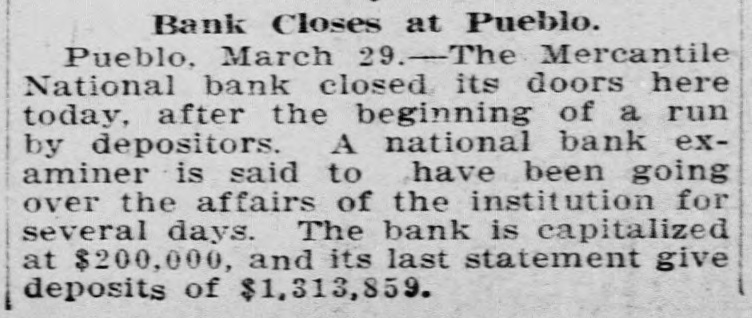
Bank Closes at Pueblo. Pueblo, March 29.-The Mercantile National bank closed its doors here today, after the beginning of a run by depositors. A national bank examiner is said to have been going over the affairs of the institution for several days. The bank is capitalized at $200,000, and its last statement give deposits of $1,313,859.


Article from Daily Capital Journal, March 29, 1915

Click image to open full size in new tab

Article Text

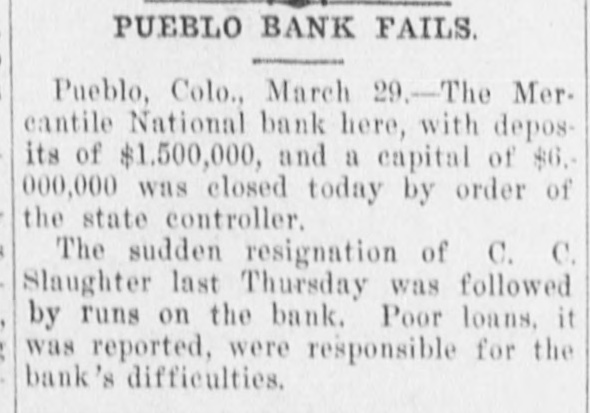
PUEBLO BANK FAILS. Pueblo, Colo., March 29.-The Mercantile National bank here, with deposits of $1,500,000, and a capital of $6.000,000 was closed today by order of the state controller. The sudden resignation of C. C. Slaughter last Thursday was followed by runs on the bank. Poor loans, it was reported, were responsible for the bank's difficulties.


Article from Daily Kennebec Journal, March 30, 1915

Click image to open full size in new tab

Article Text

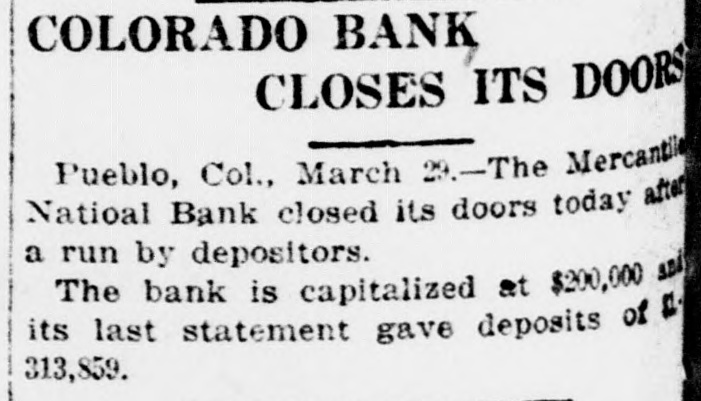
COLORADO BANK CLOSES ITS DOORS Pueblo, Col., March 29.-The Mercantile Natioal Bank closed its doors today after a run by depositors. The bank is capitalized at $200,000 and its last statement gave deposits of n 313,859.


Article from The Pensacola Journal, March 30, 1915

Click image to open full size in new tab

Article Text

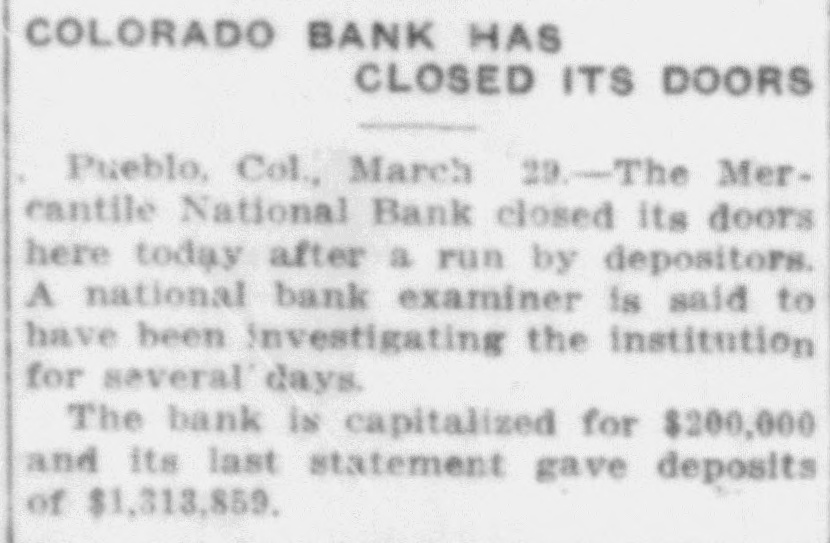
COLORADO BANK HAS CLOSED ITS DOORS Pueblo, Col., March 29.-The Mercantile National Bank closed its doors here today after a run by depositors. A national bank examiner is said to have been investigating the institution for several' days. The bank is capitalized for $200,000 and its last statement gave deposits of $1,313,859.


Article from Weekly Journal-Miner, March 31, 1915

Click image to open full size in new tab

Article Text

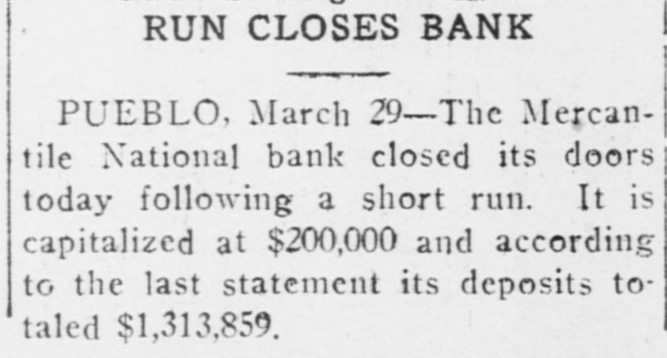
RUN CLOSES BANK PUEBLO, March 29-The Mercantile National bank closed its doors today following a short run. It is capitalized at $200,000 and according to the last statement its deposits to taled $1,313,859.


Article from Abilene Weekly Reflector, April 1, 1915

Click image to open full size in new tab

Article Text

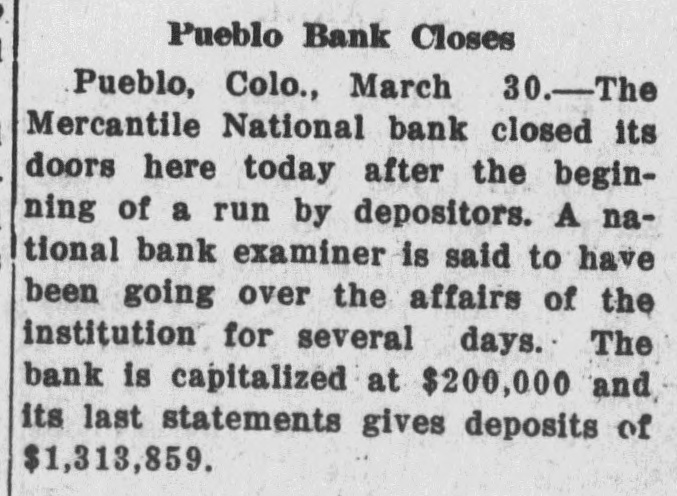
Pueblo Bank Closes Pueblo, Colo., March 30.-The Mercantile National bank closed its doors here today after the beginning of a run by depositors. A national bank examiner is said to have been going over the affairs of the institution for several days. The bank is capitalized at $200,000 and its last statements gives deposits of $1,313,859.


Article from Eagle River Review, April 2, 1915

Click image to open full size in new tab

Article Text

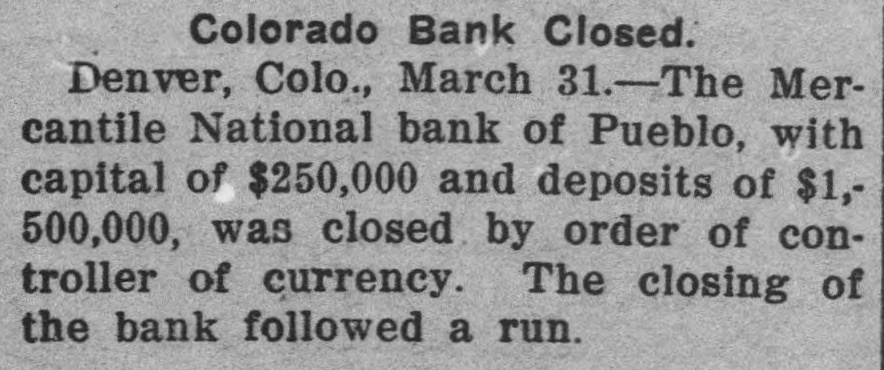
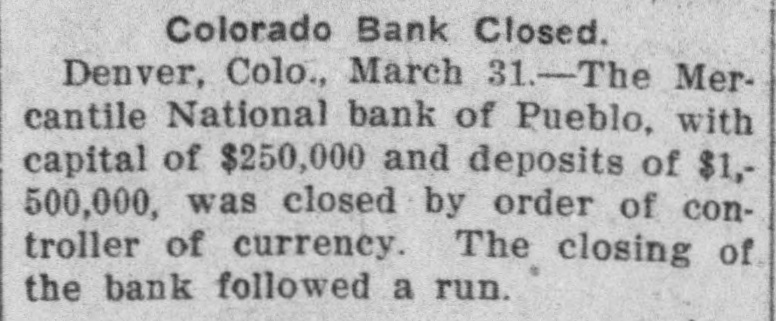
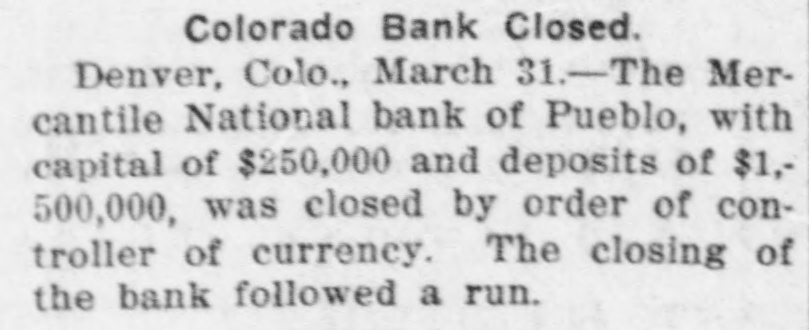
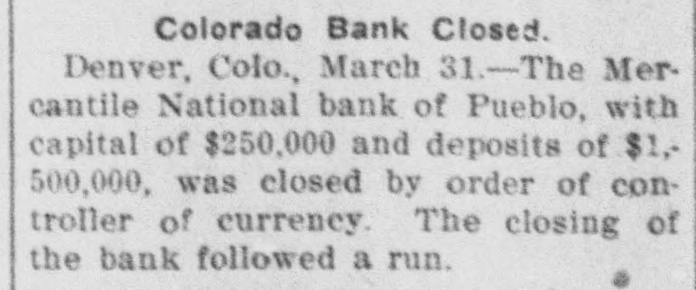
Colorado Bank Closed. Denver, Colo., March 31.-The Mercantile National bank of Pueblo, with capital of $250,000 and deposits of $1,500,000, was closed by order of controller of currency. The closing of the bank followed a run.


Article from Northern Wisconsin Advertiser, April 2, 1915

Click image to open full size in new tab

Article Text

Colorado Bank Closed. Denver, Colo., March 31.-The Mercantile National bank of Pueblo, with capital of $250,000 and deposits of $1,500,000, was closed by order of controller of currency. The closing of the bank followed a run.


Article from Wauwatosa News, April 2, 1915

Click image to open full size in new tab

Article Text

Colorado Bank Closed. Denver, Colo., March 31.-The Mercantile National bank of Pueblo, with capital of $250,000 and deposits of $1,500,000, was closed by order of controller of currency. The closing of the bank followed a run.


Article from Wausau Pilot, April 6, 1915

Click image to open full size in new tab

Article Text

Colorado Bank Closed. Denver, Colo., March 31.-The Mercantile National bank of Pueblo, with capital of $250,000 and deposits of $1,500,000, was closed by order of controller of currency. The closing of the bank followed a run.


Article from Manchester Democrat, April 7, 1915

Click image to open full size in new tab

Article Text

Colorado Bank Closed. Denver, Colo., March 31.-The Mercantile National bank of Pueblo, with capital of $250,000 and deposits of $1,500,000, was closed by order of controller of currency. The closing of the bank followed a run.


Article from Lincoln County Times, April 8, 1915

Click image to open full size in new tab

Article Text

Cashier Indicted. Denver, Colo.-Coney Slaughter, cashier of the Mercantile National bank of Pueblo, Colo., now in the hands of a receiver, was indicted by the federal grand jury on a charge of falsifying the books of the bank.


Article from Montpelier Examiner, April 9, 1915

Click image to open full size in new tab

Article Text

Cashier Indicted. Denver, Colo.-Coney Slaughter, cashier of the Mercantile National bank of Pueblo, Colo., now in the hands of a receiver, was indicted by the federal grand jury on a charge of falsifying the books of the bank.


Article from The Meridian Times, April 9, 1915

Click image to open full size in new tab

Article Text

Cashier Indicted. Denver, Colo.-Coney Slaughter, cashier of the Mercantile National bank of Pueblo, Colo., now in the hands of a receiver, was indicted by the federal grand jury on a charge of falsifying the books of the bank.


Article from Denver Labor Bulletin, June 5, 1915

Click image to open full size in new tab

Article Text

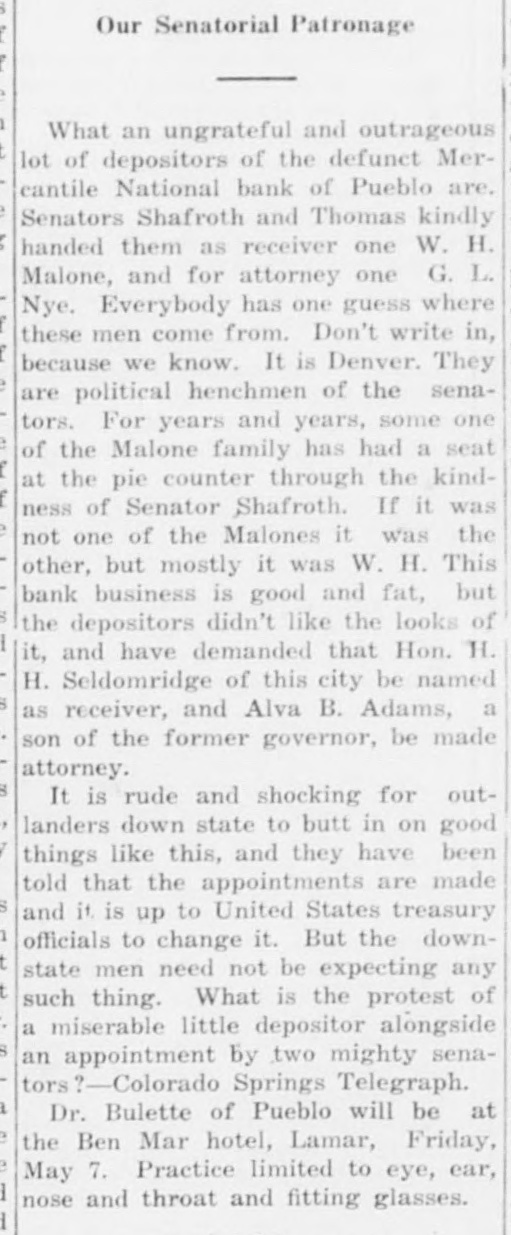
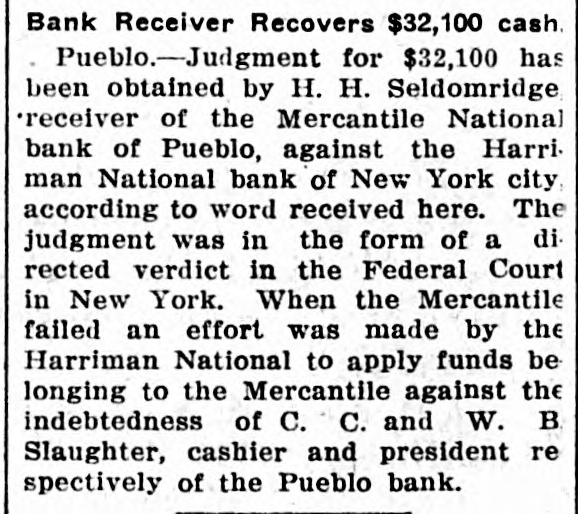
TOLD IN A FEW LINES H. H. Seldomridge of Colorado Springs, former member of congress, has been appointed permanent receiver of the defunet Mercantile National bank of Pueblo, and will assume his duties on June 10.


Article from San Antonio Light, April 10, 1923

Click image to open full size in new tab

Article Text

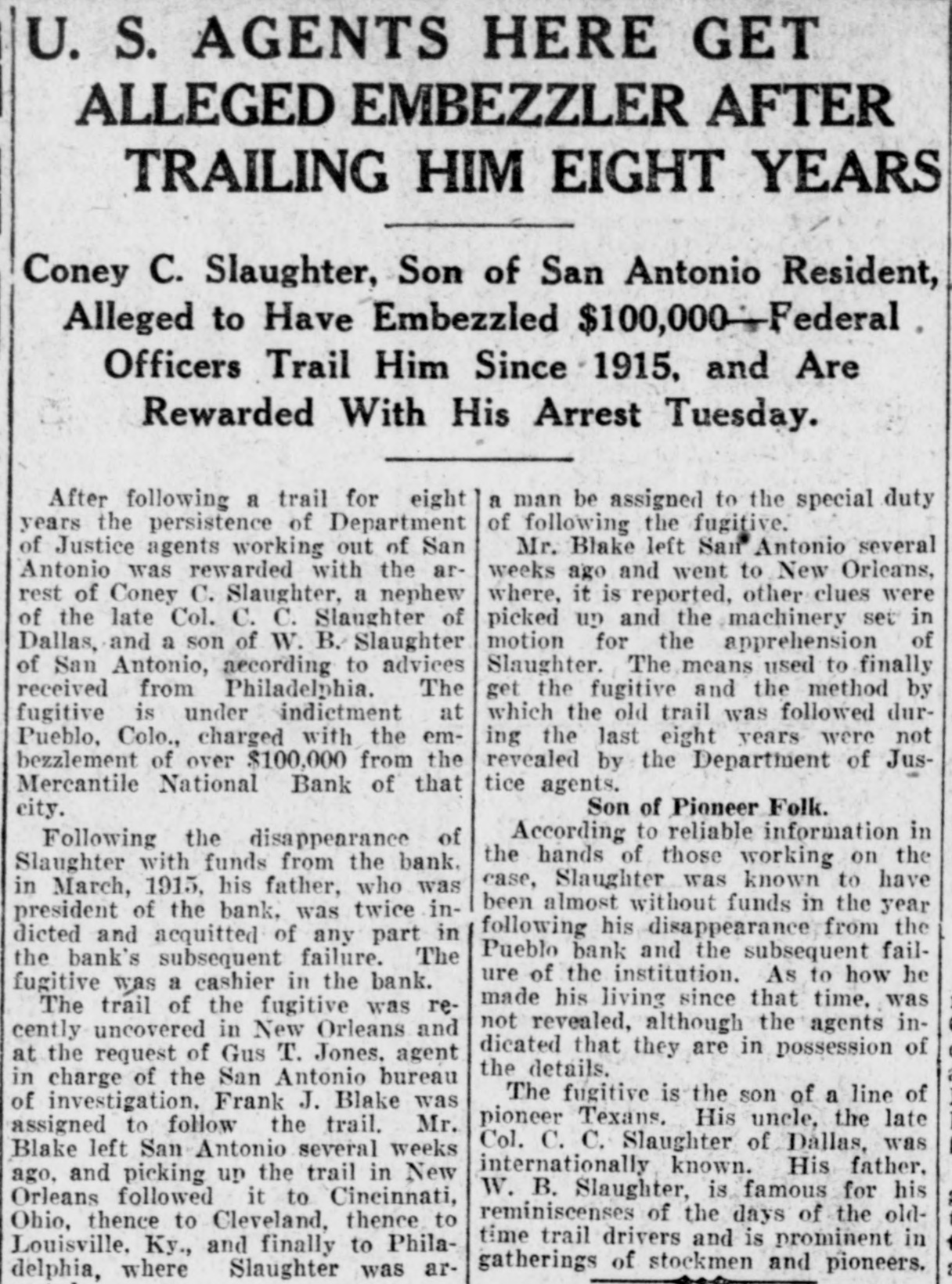
U. S. AGENTS HERE GET ALLEGED EMBEZZLER AFTER TRAILING HIM EIGHT YEARS Coney C. Slaughter, Son of San Antonio Resident, Alleged to Have Embezzled $100,000 Federal Officers Trail Him Since 1915, and Are Rewarded With His Arrest Tuesday. a man be assigned to the special duty After following a trail for eight years the persistence of Department of following the fugitive. Mr. Blake left San Antonio several of Justice agents working out of San Antonio was rewarded with the arweeks ago and went to New Orleans, rest of Coney C. Slaughter, a nephew where, it is reported, other clues were of the late Col. C. C. Slaughter of picked up and the machinery set in Dallas, and a son of W. B. Slaughter motion for the apprehension of Slaughter. The means used to finally of San Antonio, according to advices get the fugitive and the method by received from Philadelphia. The which the old trail was followed durfugitive is under indictment at Pueblo, Colo., charged with the eming the last eight years were not bezzlement of over $100,000 from the revealed by the Department of JusMercantile National Bank of that tice agents. Son of Pioneer Folk. city. According to reliable information in Following the disappearance of the hands of those working on the Slaughter with funds from the bank. case, Slaughter was known to have in March, 1915, his father, who was been almost without funds in the year president of the bank, was twice infollowing his disappearance from the dicted and acquitted of any part in Pueblo bank and the subsequent failthe bank's subsequent failure. The ure of the institution. As to how he fugitive was a cashier in the bank. made his living since that time, was The trail of the fugitive was renot revealed, although the agents incently uncovered in New Orleans and dicated that they are in possession of at the request of Gus T. Jones. agent the details. in charge of the San Antonio bureau The fugitive is the son of a line of of investigation. Frank J. Blake was pioneer Texans. His uncle, the late assigned to follow the trail. Mr. Col. C. C. Slaughter of Dallas, was Blake left San Antonio several weeks internationally known. His father, ago, and picking up the trail in New W. B. Slaughter, is famous for his Orleans followed it to Cineinnati, reminiscenses of the days of the oldOhio, thence to Cleveland, thence to time trail drivers and is prominent in Louisville, Ky., and finally to Philagatherings of stockmen and pioneers. delphia, where Slaughter was ar-


Article from The Kansas City Star, April 10, 1923

Click image to open full size in new tab

Article Text

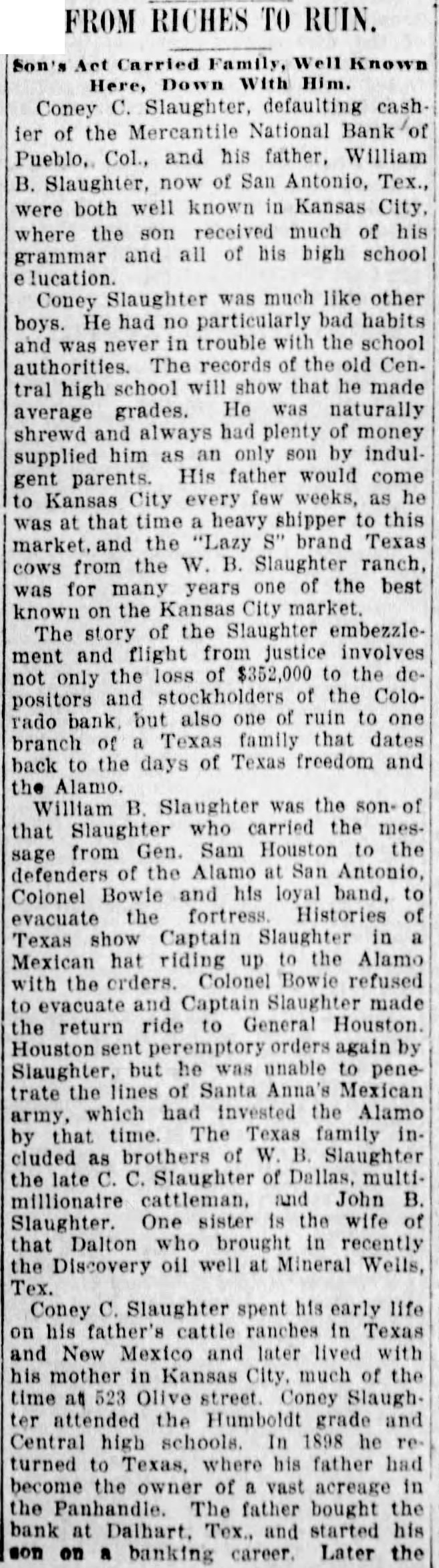
FROM RICHES TO RUIN. Son's Act Carried Family, Well Known Here, Down With Him. Coney C. Slaughter, defaulting cashier of the Mercantile National Bank of Pueblo, Col., and his father, William B. Slaughter, now of San Antonio, Tex., were both well known in Kansas City, where the son received much of his grammar and all of his high school education. Coney Slaughter was much like other boys. He had no particularly bad habits and was never in trouble with the school authorities. The records of the old Central high school will show that he made average grades. He was naturally shrewd and always had plenty of money supplied him as an only son by indulgent parents. His father would come to Kansas City every few weeks, as he was at that time a heavy shipper to this market, and the "Lazy S" brand Texas cows from the W. B. Slaughter ranch, was for many years one of the best known on the Kansas City market. The story of the Slaughter embezzlement and flight from justice involves not only the loss of $352,000 to the depositors and stockholders of the Colorado bank, but also one of ruin to one branch of a Texas family that dates back to the days of Texas freedom and the Alamo. William B. Slaughter was the son of that Slaughter who carried the message from Gen. Sam Houston to the defenders of the Alamo at San Antonio, Colonel Bowie and his loyal band, to evacuate the fortress. Histories of Texas show Captain Slaughter in a Mexican hat riding up to the Alamo with the orders. Colonel Bowie refused to evacuate and Captain Slaughter made the return ride to General Houston. Houston sent peremptory orders again by Slaughter, but he was unable to penetrate the lines of Santa Anna's Mexican army, which had invested the Alamo by that time. The Texas family included as brothers of W. B. Slaughter the late C. C. Slaughter of Dallas, multimillionaire cattleman, and John B. Slaughter. One sister is the wife of that Dalton who brought in recently the Discovery oil well at Mineral Wells, Tex. Coney C. Slaughter spent his early life on his father's cattle ranches in Texas and New Mexico and later lived with his mother in Kansas City, much of the time at 523 Olive street. Coney Slaughter attended the Humboldt grade and Central high schools. In 1898 he returned to Texas, where his father had become the owner of a vast acreage in the Panhandle. The father bought the bank at Dalhart, Tex., and started his son on a banking career. Later the