Old Town Bank (Baltimore, MD)

Episode Information

Episode UID
4119029091212
Episode Type
Run โ†’ Suspension โ†’ Reopening
Bank Type
state
Bank ID
411902909 hash
Start Date
December 26, 1900
Location
Baltimore, Maryland (39.290, -76.612)

Metadata

Model
gpt-5-mini (chosen from majority vote of a three-model LLM ensemble)
Short Digest
8ba86c12906b34a8

Response Measures

None

Description

Receiver appointed by consent of officers; failure attributed to cashier's bad management/endorsements.

Events (3)

1. December 26, 1900 Suspension
Cause
Bank Specific Adverse Info
Cause Details
Appointment of receiver due to mismanagement/insufficient immediately realizable assets after overexposures and endorsements by cashier.
Newspaper Excerpt
Walter T. Gill was today appointed receiver for the Old Town bank by consent of the president and officers of the bank.
Source
newspapers
2. December 27, 1900 Run
Cause
Bank Specific Adverse Info
Cause Details
Depositors alarmed after discovery that cashier Thaddeus/ Theodore Wilcox had indorsed paper of failed concerns (Isaac Robinson, United Milk Producers), and reports of mismanagement.
Measures
Directors applied for appointment of a receiver; bank went into receivership to stem withdrawals.
Newspaper Excerpt
The Old Town bank was surrounded by a vast crowd of disappointed depositors today, who demand their money...the mob that surrounded the Old Town bank at midnight clamoring for deposits dispersed...
Source
newspapers
3. January 8, 1901 Reopening
Newspaper Excerpt
The 'Old Town' bank, a state institution, which closed its doors and went into a receiver's hands a few days ago, will resume business tomorrow.
Source
newspapers

Newspaper Articles (22)

Article from Daily Camera, December 27, 1900

Click image to open full size in new tab

Article Text

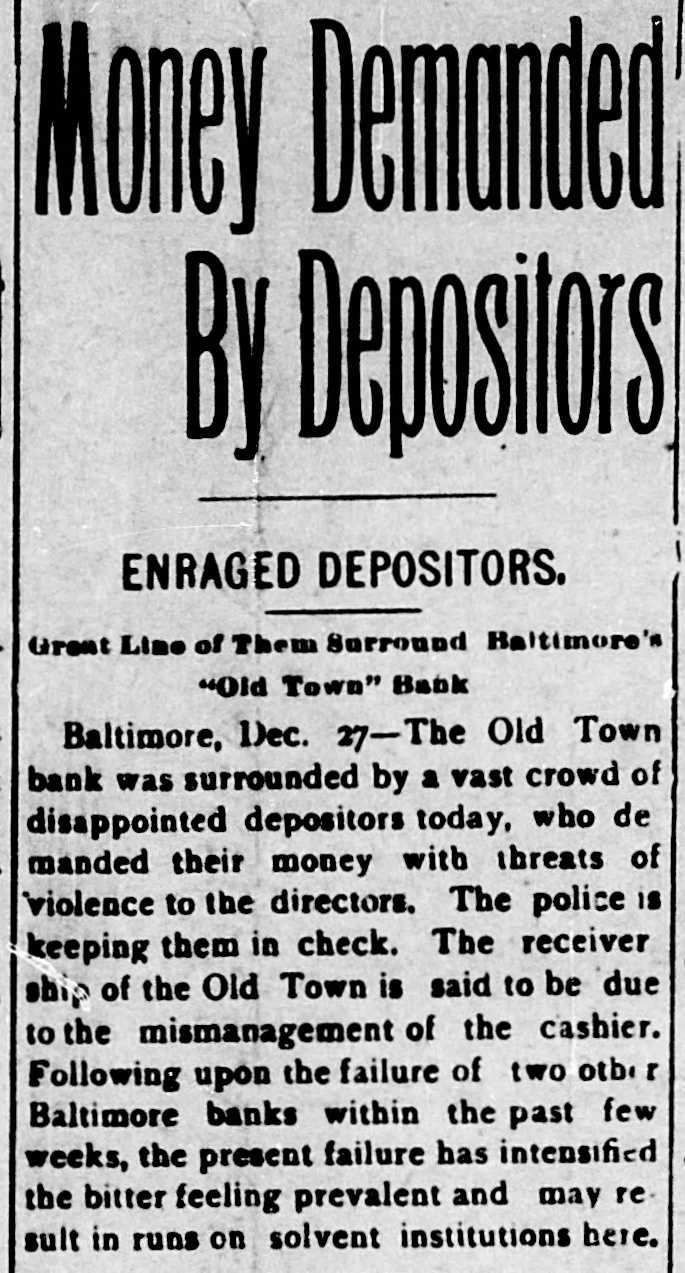
Money Demonded By Depositors ENRAGED DEPOSITORS. Great Line of Them Surround Haltimore's Old Town" Bank Baltimore, Dec. 27- The Old Town bank was surrounded by a vast crowd of disappointed depositors today, who de manded their money with threats of violence to the directors. The police is keeping them in check. The receiver ship of the Old Town is said to be due to the mismanagement of the cashier. Following upon the failure of two other Baltimore banks within the past few weeks, the present failure has intensified the bitter feeling prevalent and may re. sult in runs on solvent institutions here.


Article from Bismarck Daily Tribune, December 27, 1900

Click image to open full size in new tab

Article Text

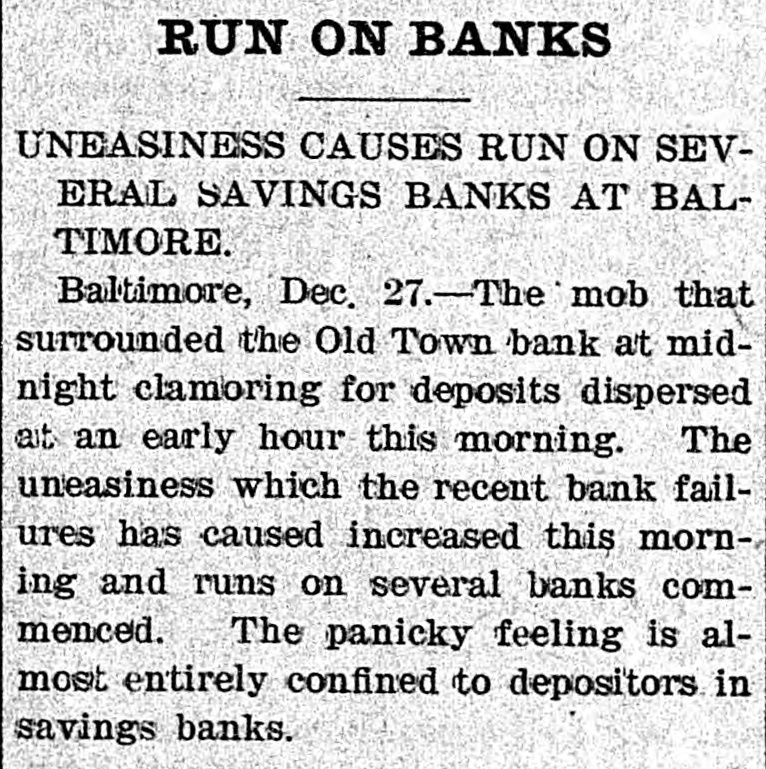
RUN ON BANKS UNEASINESS CAUSES RUN ON SEVERAL SAVINGS BANKS AT BALTIMORE. Baltimore, Dec. 27.-The mob that surrounded the Old Town bank at midnight clamoring for deposits dispersed at an early hour this morning. The uneasiness which the recent bank failures has caused increased this morning and runs on several banks commenced. The panicky feeling is almost entirely confined to depositors in savings banks.


Article from The Florence Daily Tribune, December 27, 1900

Click image to open full size in new tab

Article Text

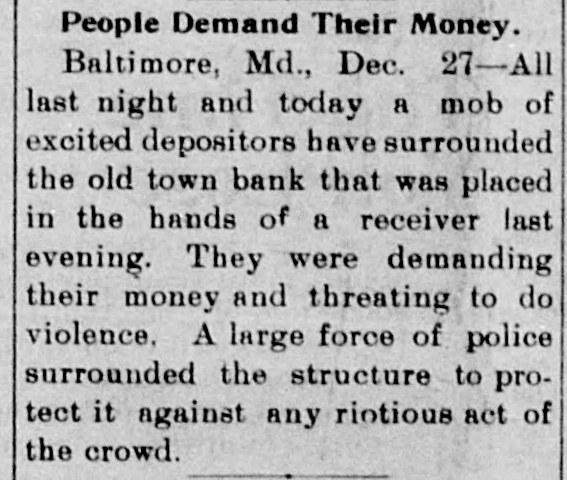
People Demand Their Money. Baltimore, Md., Dec. 27-All last night and today a mob of excited depositors have surrounded the old town bank that was placed in the hands of a receiver last evening. They were demanding their money and threating to do violence. A large force of police surrounded the structure to protect it against any riotious act of the crowd.


Article from The Morning Astorian, December 27, 1900

Click image to open full size in new tab

Article Text

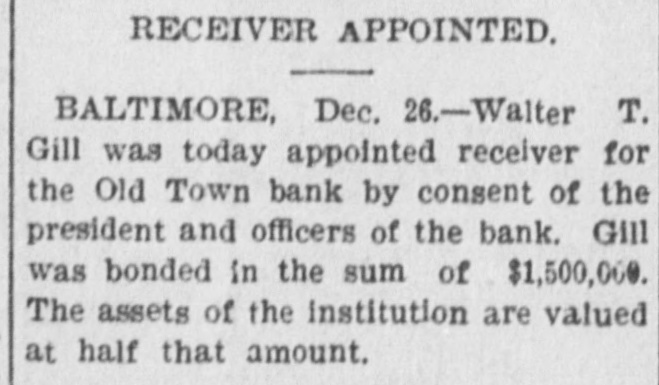
RECEIVER APPOINTED. BALTIMORE, Dec. 26.-Walter T. Gill was today appointed receiver for the Old Town bank by consent of the president and officers of the bank. Gill was bonded in the sum of $1,500,000. The assets of the institution are valued at half that amount.


Article from The Salt Lake Herald, December 27, 1900

Click image to open full size in new tab

Article Text

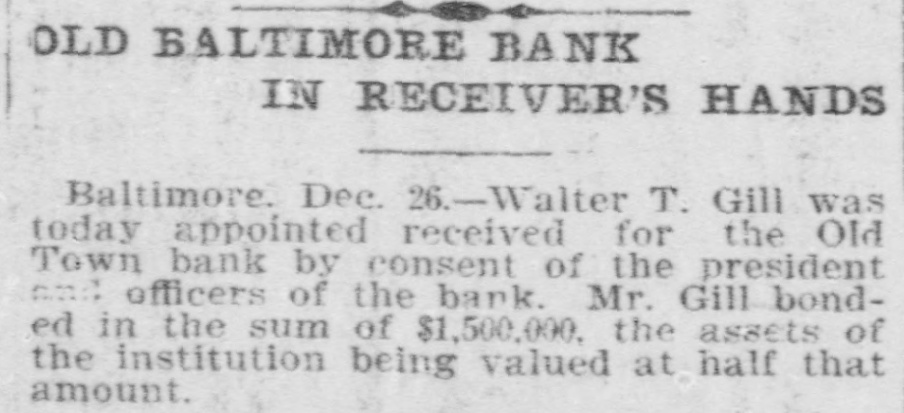
OLD BALTIMORE BANK IN RECEIVER'S HANDS Baltimore. Dec. 26.-Walter T. Gill was today appointed received for the Old Town bank by consent of the president and officers of the bank. Mr. Gill bonded in the sum of $1,500,000. the assets of the institution being valued at half that amount.


Article from The St. Louis Republic, December 28, 1900

Click image to open full size in new tab

Article Text

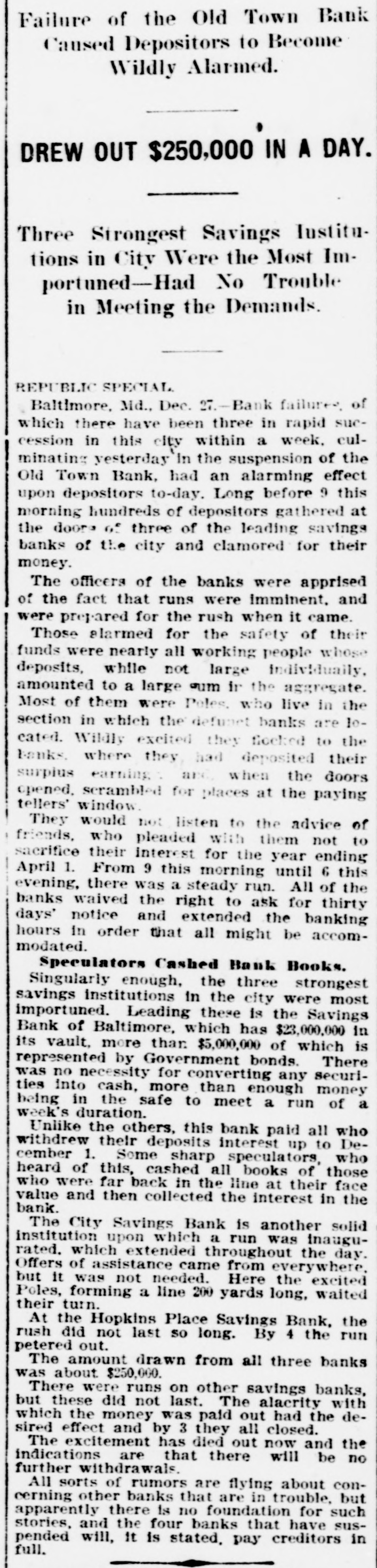
Failure of the Old Town Bank Caused Depositors to Become Wildly Alarmed. DREW OUT $250,000 IN A DAY. Three Strongest Savings Institutions in City Were the Most Importuned-Had No Trouble in Meeting the Demands. REPUBLIC SPECIAL Baltimore, Md., Dec. 27.-Bank failures. of which there have been three in rapid succession in this city within a week. culminating yesterday In the suspension of the Old Town Bank, had an alarming effect upon depositors to-day. Long before 9 this morning hundreds of depositors gathered at the doors of three of the leading savings banks of the city and clamored for their money. The officers of the banks were apprised of the fact that runs were imminent. and were prepared for the rush when it came. Those alarmed for the safety of their funds were nearly all working people whose deposits, while not large individually, amounted to a large sum in the aggregate. Most of them were Poles. who live in the section in which the defunct banks are 10cated. Wildly excited they flocked to the banks. where they had deposited their surplus earning : are when the doors opened. scrambled for places at the paying tellers' window They would not listen to the advice of friends, who pleaded with them not to sacrifice their interest for the year ending April 1. From 9 this morning until 6 this evening, there was a steady run. All of the banks waived the right to ask for thirty days' notice and extended the banking hours in order that all might be accommodated. Speculators Cashed Bank Books. Singularly enough, the three strongest savings institutions in the city were most importuned. Leading these is the Savings Bank of Baltimore, which has $23,000,000 in its vault, more than $5,000,000 of which is represented by Government bonds. There was no necessity for converting any securities into cash, more than enough money being in the safe to meet a run of a week's duration. Unlike the others, this bank paid all who withdrew their deposits interest up to December 1. Some sharp speculators, who heard of this, cashed all books of those who were far back in the line at their face value bank. and then collected the interest in the The City Savings Bank is another solid institution upon which a run was Inaugurated. which extended throughout the day. Offers of assistance came from everywhere, but It was not needed. Here the excited Poles, forming a line 200 yards long, waited their turn. At the Hopkins Place Savings Bank, the rush did not last SO long. By 4 the run petered out. The amount drawn from all three banks was about $250,000. There were runs on other savings banks, but these did not last. The alacrity with which the money was paid out had the desired effect and by 3 they all closed. The excitement has died out now and the indications are that there will be no further withdrawals. All sorts of rumors are flying about concerning other banks that are in trouble, but apparently there is no foundation for such stories, and the four banks that have suspended will, It is stated, pay creditors in full.


Article from The Times, December 28, 1900

Click image to open full size in new tab

Article Text

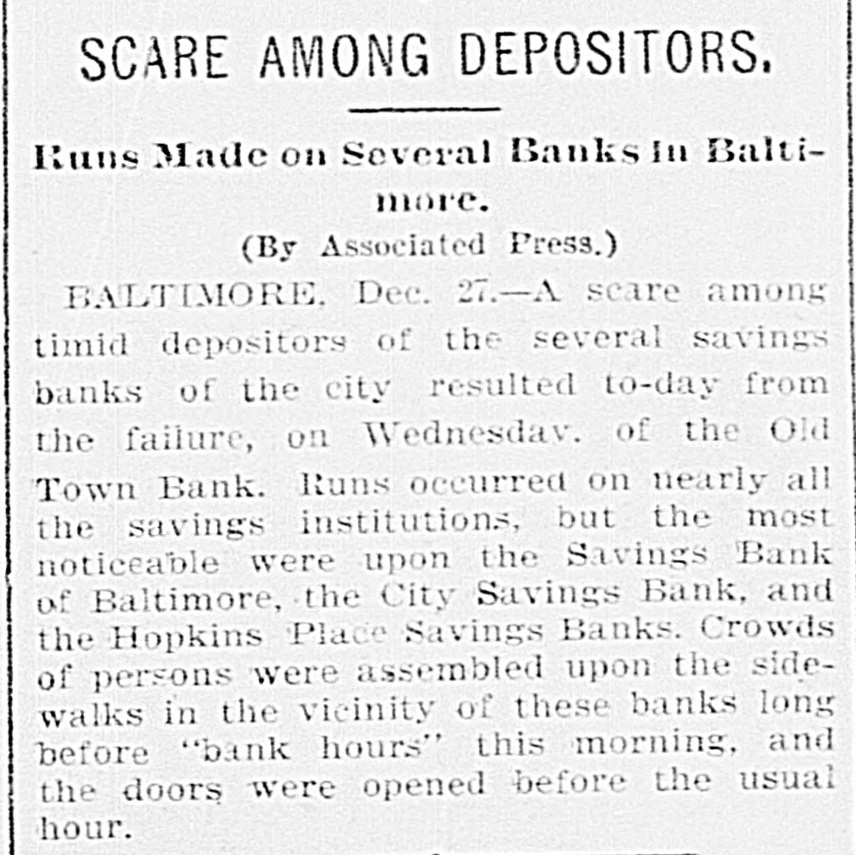
SCARE AMONG DEPOSITORS. Runs Made on Several Banks In Baltimore. (By Associated Press.) BALTIMORE, Dec. 27.-A scare among timid depositors of the several savings banks of the city resulted to-day from the failure, on Wednesday. of the Old Town Bank. Runs occurred on nearly all the savings institutions, but the most noticeable were upon the Savings Bank of Baltimore, the City Savings Bank, and the Hopkins Place Savings Banks. Crowds of persons were assembled upon the sidewalks in the vicinity of these banks long before "bank hours" this morning, and the doors were opened before the usual hour.


Article from Daily Inter Mountain, December 28, 1900

Click image to open full size in new tab

Article Text

Baltimore, Dec. 28.-Because of the appointment of a receiver for the Old Town bank. a general run was made on all of the city banks. It was soon stopped.


Article from The Democratic Advocate, December 29, 1900

Click image to open full size in new tab

Article Text

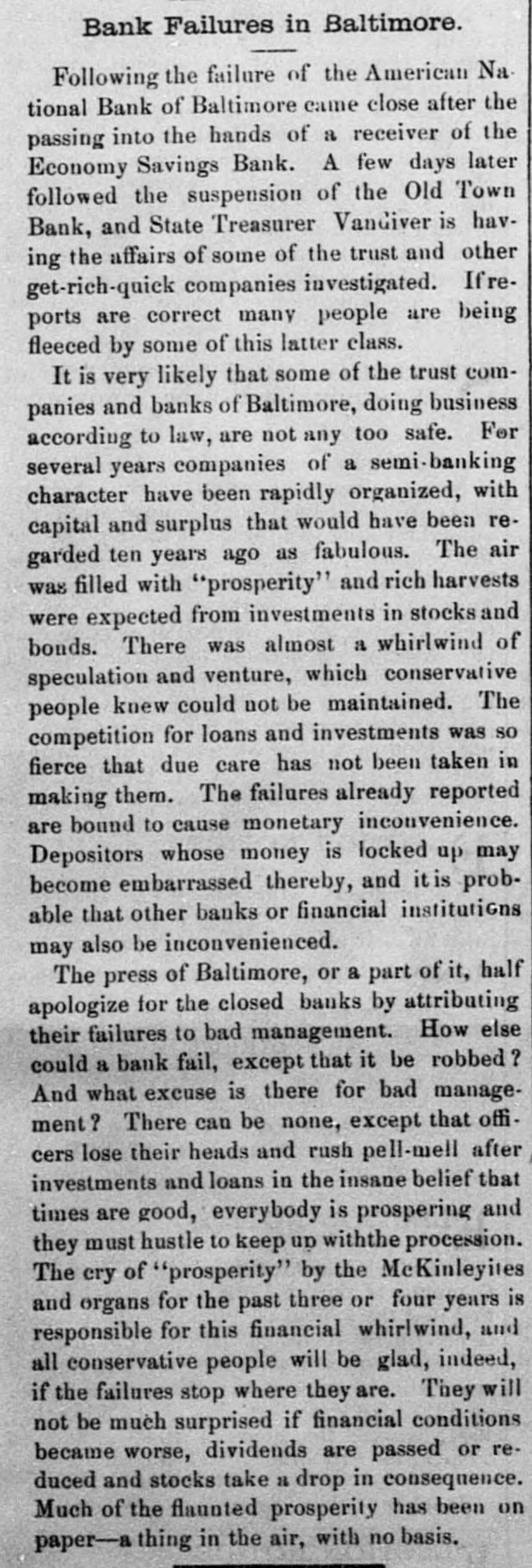
Bank Failures in Baltimore. Following the failure of the American Na tional Bank of Baltimore came close after the passing into the hands of a receiver of the Economy Savings Bank. A few days later followed the suspension of the Old To 0 Bank, and State Treasurer Vandiver is having the affairs of some of the trust and other get-rich-quick companies investigated. If ports are correct many people are being fleeced by some of this latter class. It is very likely that some of the trust companies and banks of Baltimore, doing business according to law, are not any too safe. For several years companies of a semi-banking character have been rapidly organized, with capital and surplus that would have been re. garded ten years ago as fabulous. The air was filled with "prosperity" and rich harvests were expected from investments in stocks and bonds. There was almost a whirlwind of speculation and venture, which conservative people knew could not be maintained. The competition for loans and investments was so fierce that due care has not been taken in making them. The failures already reported are bound to cause monetary inconvenience. Depositors whose money is locked up may become embarrassed thereby, and it is probable that other banks or financial institutions may also be inconvenienced. The press of Baltimore, or a part of it, half apologize for the closed banks by attributing their failures to bad management. How else could a bank fail, except that it be robbed ? And what excuse is there for bad management? There can be none, except that officers lose their heads and rush pell-mell after investments and loans in the insane belief that times are good, everybody is prospering and they must hustle to keep up withthe procession. The cry of "prosperity" by the McKinleyites and organs for the past three or four years is responsible for this financial whirlwind, and all conservative people will be glad, indeed, if the failures stop where they are. They will not be much surprised if financial conditions became worse, dividends are passed or reduced and stocks take a drop in consequence. Much of the flaunted prosperity has been on paper-a thing in the air, with no basis.


Article from The Democratic Advocate, December 29, 1900

Click image to open full size in new tab

Article Text

Bank Failures in Baltimore. Following the failure of the American Na. tional Bank of Baltimore came close after the passing into the hands of a receiver of the Economy Savings Bank. A few days later followed the suspension of the Old Town Bank, and State Treasurer Vandiver is having the affairs of some of the trust and other get-rich-quick companies investigated. Ifreports are correct many people are being fleeced by some of this latter class. It is very likely that some of the trust companies and banks of Baltimore, doing business according to law, are not any too safe. For several years companies of a semi-banking character have been rapidly organized, with capital and surplus that would have been regarded ten years ago as fabulous. The air was filled with "prosperity" and rich harvests were expected from investments in stocks and bonds. There was almost a whirlwind of speculation and venture, which conservative people knew could not be maintained. The competition for loans and investments was so fierce that due care has not been taken in making them. The failures already reported are bound to cause monetary inconvenience. Depositors whose money is locked up may become embarrassed thereby, and it is probable that other banks or financial institutions may also be inconvenienced. The press of Baltimore, or a part of it, half apologize for the closed banks by attributing their failures to bad management. How else could a bank fail, except that it be robbed ? And what excuse is there for bad management ? There can be none, except that officers lose their heads and rush pell-mell after investments and loans in the insane belief that times are good, everybody is prospering and they must hustle to keep up withthe procession. The cry of "prosperity" by the McKinleyites and organs for the past three or four years is responsible for this financial whirlwind, and all conservative people will be glad, indeed, if the failures stop where they are. They will not be much surprised if financial conditions became worse, dividends are passed or reduced and stocks take a drop in consequence. Much of the flaunted prosperity has been on paper-a thing in the air, with no basis.


Article from Manchester Democrat, January 2, 1901

Click image to open full size in new tab

Article Text

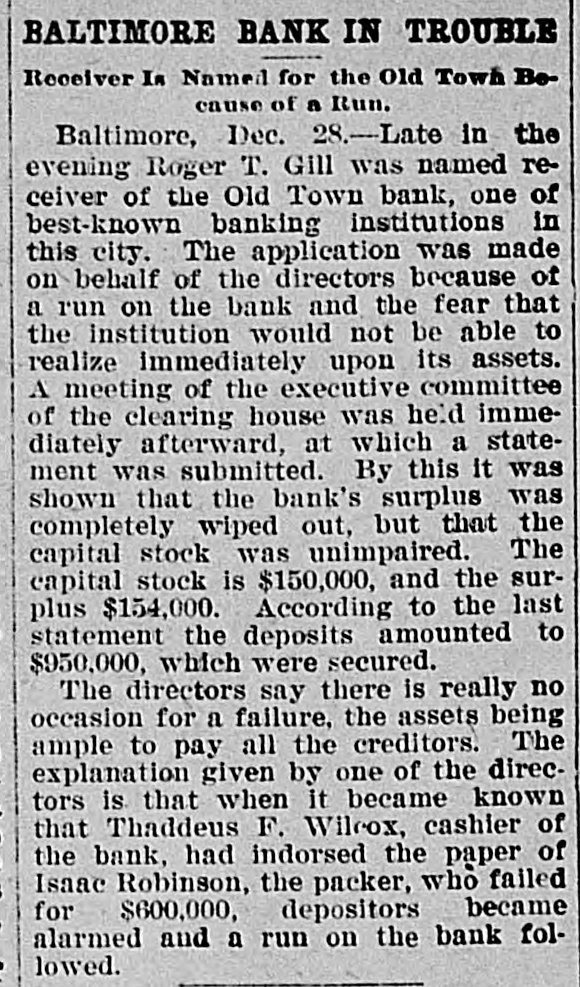
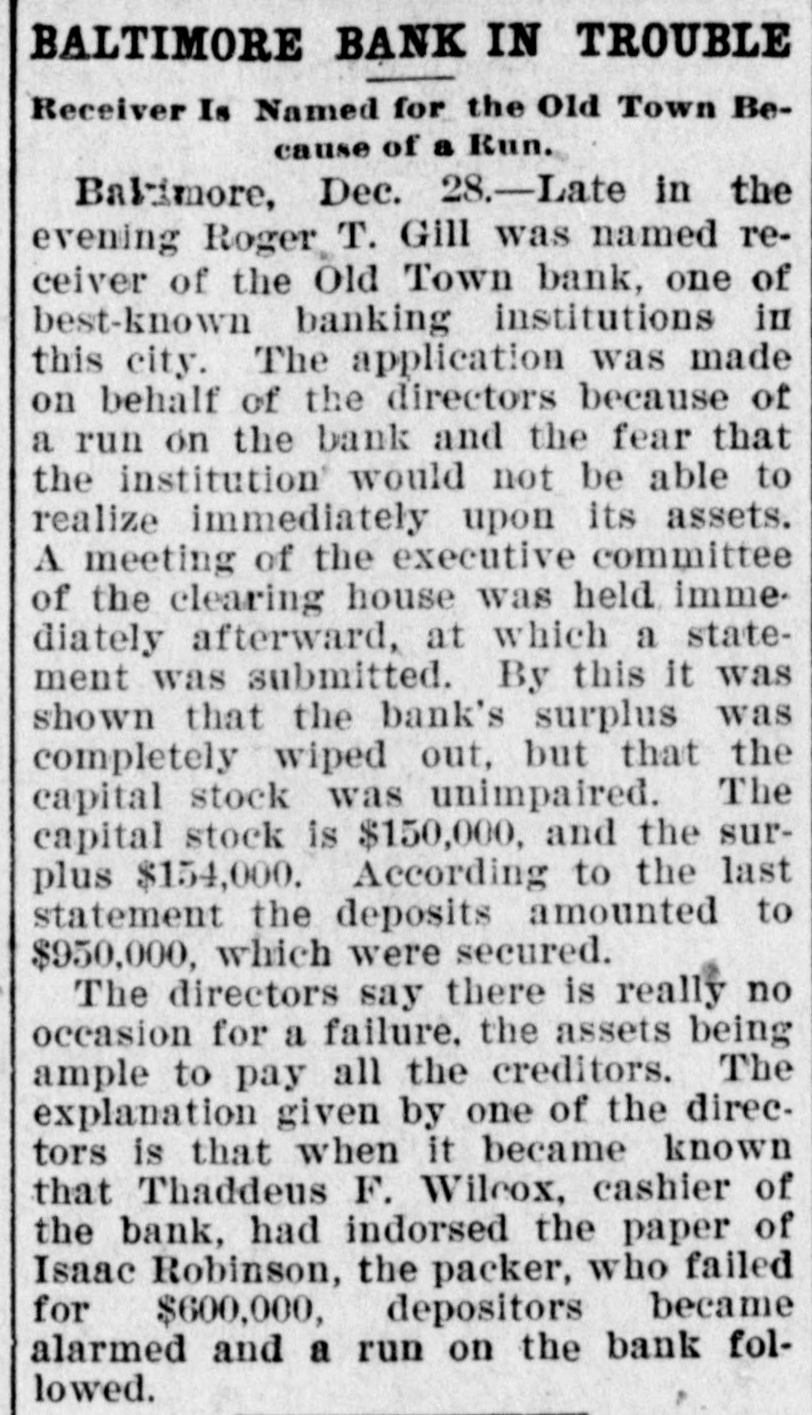
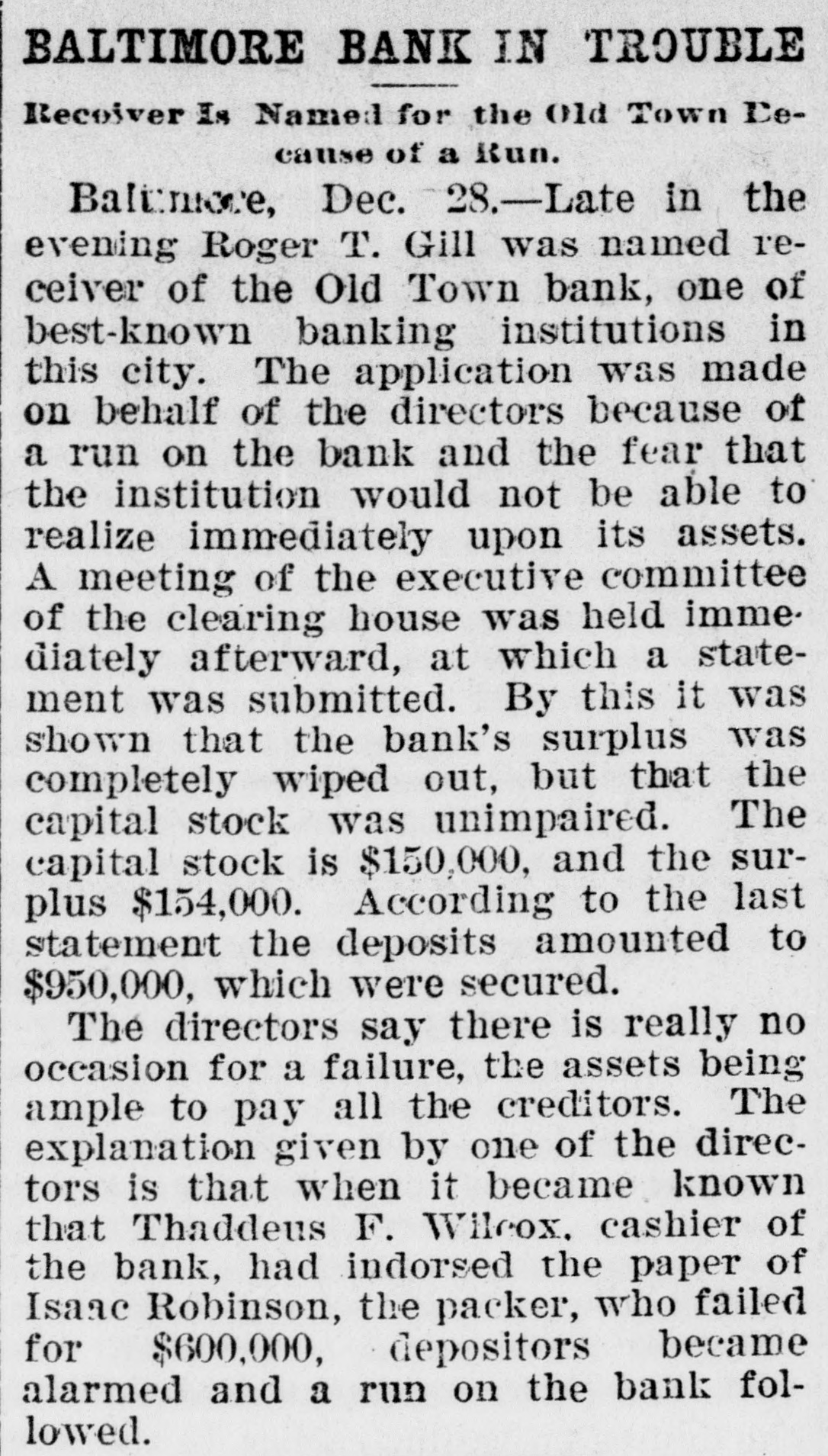
BALTIMORE BANK IN TROUBLE Receiver Is Named for the Old Town Because of a Run. Baltimore, Dec. 28.-Late in the evening Roger T. Gill was named receiver of the Old Town bank, one of best-known banking institutions in this city. The application was made on behalf of the directors because of a run on the bank and the fear that the institution would not be able to realize immediately upon its assets. A meeting of the executive committee of the clearing house was held immediately afterward, at which a statement was submitted. By this it was shown that the bank's surplus was completely wiped out, but that the capital stock was unimpaired. The capital stock is $150,000, and the surplus $154,000. According to the last statement the deposits amounted to $950,000, which were secured. The directors say there is really no occasion for a failure, the assets being ample to pay all the creditors. The explanation given by one of the directors is that when it became known that Thaddeus F. Wilcox, cashier of the bank, had indorsed the paper of Isaac Robinson, the packer, who failed for $600,000, depositors became alarmed and a run on the bank followed.


Article from Decorah Public Opinion, January 2, 1901

Click image to open full size in new tab

Article Text

BALTIMORE BANK IN TROUBLE Receiver Is Named for the Old Town Because of a Run. Bavimore, Dec. 28.-Late in the evening Roger T. Gill was named receiver of the Old Town bank, one of best-known banking institutions in this city. The application was made on behalf of the directors because of a run on the bank and the fear that the institution would not be able to realize immediately upon its assets. A meeting of the executive committee of the clearing house was held immediately afterward, at which a statement was submitted. By this it was shown that the bank's surplus was completely wiped out, but that the capital stock was unimpaired. The capital stock is $150,000, and the surplus $154,000. According to the last statement the deposits amounted to $950,000, which were secured. The directors say there is really no occasion for a failure, the assets being ample to pay all the creditors. The explanation given by one of the directors is that when it became known that Thaddeus F. Wilcox, cashier of the bank, had indorsed the paper of Isaac Robinson, the packer, who failed for $600,000, depositors became alarmed and a run on the bank followed.


Article from The Butler Weekly Times, January 3, 1901

Click image to open full size in new tab

Article Text

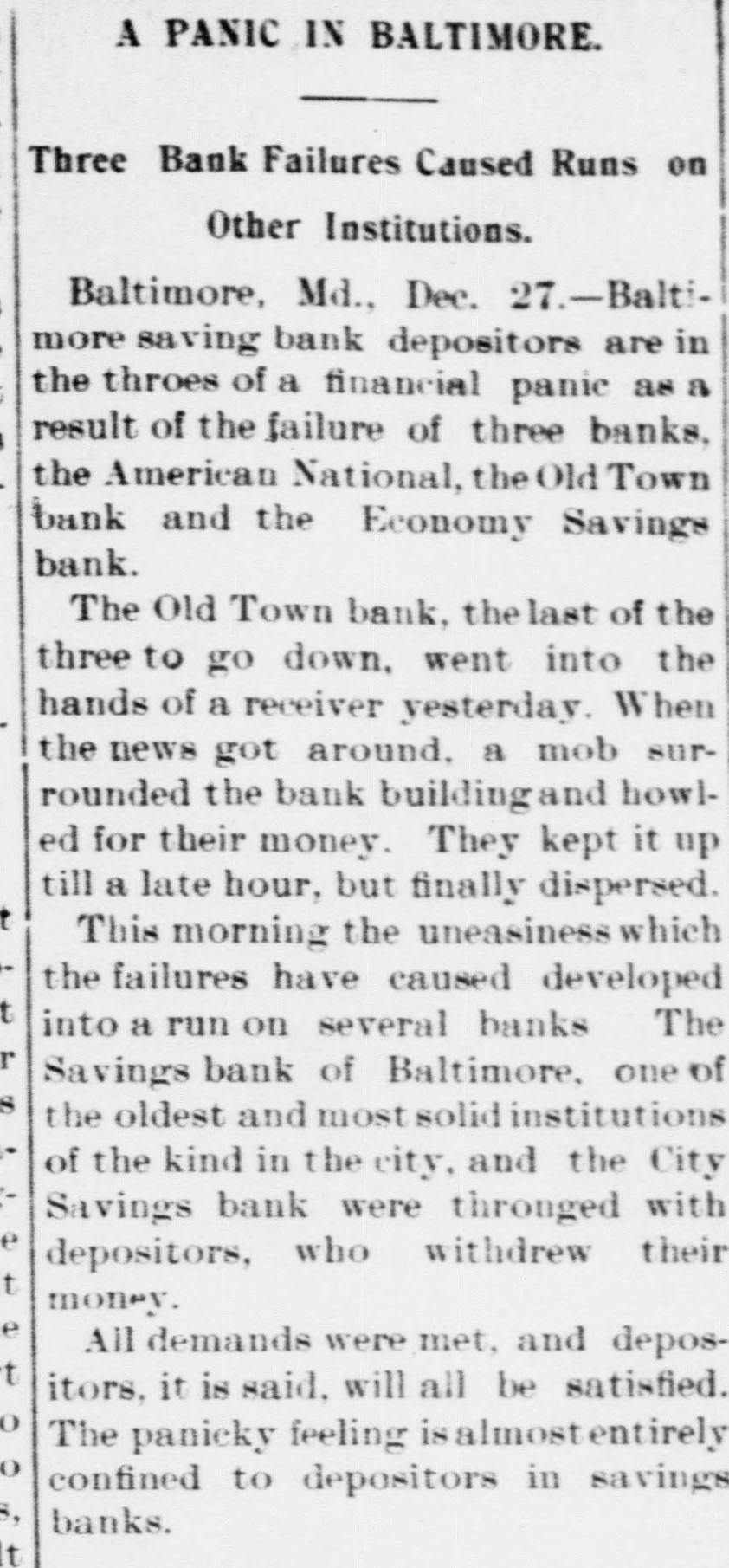
A PANIC IN BALTIMORE. Three Bank Failures Caused Runs on Other Institutions. Baltimore, Md., Dec. 27.-Baltimore saving bank depositors are in the throes of a financial panic as a result of the failure of three banks, the American National, the Old Town bank and the Economy Savings bank. The Old Town bank, the last of the three to go down. went into the hands of a receiver yesterday. When the news got around, a mob surrounded the bank buildingand howled for their money. They kept it up till a late hour, but finally dispersed. This morning the uneasiness which the failures have caused developed into a run on several banks The Savings bank of Baltimore, one of the oldest and most solid institutions of the kind in the city, and the City Savings bank were thronged with depositors, who withdrew their money. All demands were met, and depositors, it is said, will all be satisfied. The panicky feeling isalmostentirely confined to depositors in savings banks.


Article from The Wisconsin Tobacco Reporter, January 4, 1901

Click image to open full size in new tab

Article Text

BALTIMORE BANK IN TROUBLE Receiver Is Named for the Old Town Lecause of a Run. Baltimore, Dec. 28.-Late in the evening Roger T. Gill was named receiver of the Old Town bank, one of best-known banking institutions in this city. The application was made on behalf of the directors because of a run on the bank and the fear that the institution would not be able to realize immediately upon its assets. A meeting of the executive committee of the clearing house was held immediately afterward, at which a statement was submitted. By this it was shown that the bank's surplus was completely wiped out, but that the capital stock was unimpaired. The capital stock is $150,000, and the surplus $154,000. According to the last statement the deposits amounted to $950,000, which were secured. The directors say there is really no occasion for a failure, the assets being ample to pay all the creditors. The explanation given by one of the directors is that when it became known that Thaddeus F. Wilcox. cashier of the bank, had indorsed the paper of Isaac Robinson, the packer, who failed for $600,000, depositors became alarmed and a run on the bank followed.


Article from The Pioneer Express, January 4, 1901

Click image to open full size in new tab

Article Text

FINANCIAL PANIC. Frequent Failures Frighten Baltimore Bank Depositors, Baltimore, Dec. 28.-The Old Town bank went into the hands of a receiver yesterday. This makes three bank failures here recently and depositors are in the throes of a financial panie. This morning there was a run on the Savings Bank of Baltimore. All den ands were promptly met.


Article from The Washburn Leader, January 5, 1901

Click image to open full size in new tab

Article Text

FINANCIAL PANIC. Frequent Failures Frighten Baltimore Bank Depositors. Baltimore, Dec. 29.-The Old Town bank went into the hands of a receiver yesterday. This makes three bank failures here recently and depositors are in the throes of a financial panic. This morning there was B. run on the Savings Bank of Baltimore. All demands were promptly met.


Article from Evening Star, January 8, 1901

Click image to open full size in new tab

Article Text

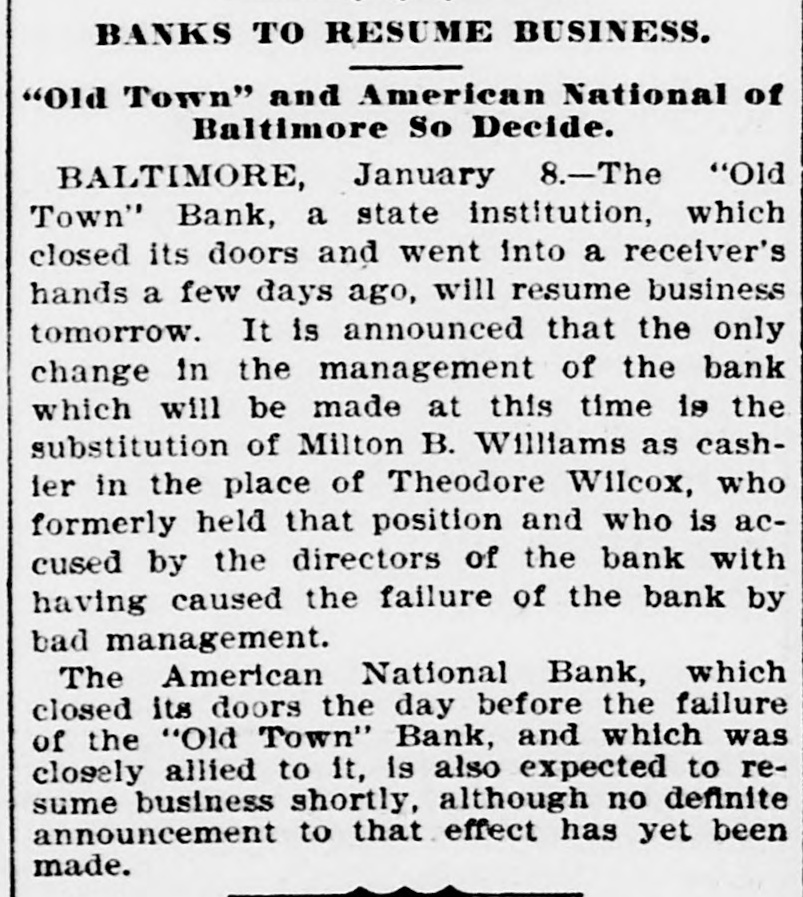
BANKS TO RESUME BUSINESS. "Old Town" and American National of Baltimore So Decide. BALTIMORE, January 8.-The "Old Town" Bank, a state institution, which closed its doors and went into a receiver's hands a few days ago, will resume business tomorrow. It is announced that the only change in the management of the bank which will be made at this time is the substitution of Milton B. Williams as cashier in the place of Theodore Wilcox, who formerly held that position and who is accused by the directors of the bank with having caused the failure of the bank by bad management. The American National Bank, which closed its doors the day before the failure of the "Old Town" Bank, and which was closely allied to it, is also expected to resume business shortly, although no definite announcement to that effect has yet been made.


Article from The Hawaiian Gazette, January 8, 1901

Click image to open full size in new tab

Article Text

# WORLD NEWS CONDENSED The Samoa is to be made a transport. Giacomini's comet has been seen again. Lord Roberts has arrived at Gibraltar. The Queen of Holland will wed in September. Andree has at last been given up for lost. There is a corner on the bean market now. Hank Haff will sail the Boston cup defender. Russia will take over the Manchurian railroads. New York is to have an orthodox Russian church. The Colombian rebels have met with more reverses. Jules Riviere, a famous musical conductor, is dead. There is a strong anti-foreign movement in Corea. Depressing weather marked the English Christmas. Prof. Moses Coit Tyler of Cornell University, is dead. Dr. Alfred Momerie, the noted English churchman, is dead. The value of the Pullman estate has increased to $13,000,000. Dreyfus vigorously demands the reopening of his case. Secretary Hay is again at his desk in the State Department. The Great Northern telegraph operators threaten a strike. Glasgow has established a work-house for habitual drunkards. The prune men of San Jose have failed to reach any conclusion. Representative Hull thinks the Army reorganization bill is safe. The corn crop of 1900 was one of the four largest ever gathered. Turkey has signed the ship-building contract with the Cramps. Claus Spreckels will invest $5,000,000 in a San Francisco gas plant. Gold has been found in the crop of a wild goose from Pitt Lake, B. C. There is a plan on foot among prominent Democrats to depose Bryan. De Wet failed in his attempt to break the British lines and escape south. Joseph Owen, six years ago a mill hand, has received a fellowship at Oxford. The Duke of Westminster is to marry the beautiful Miss Cornwallis-West. A heavy snowstorm occurred near Albuquerque, New Mexico, December 28. Booz' brother declares that former Cadet Oscar L. Booz was not a coward. A new Emperor of China is said to have been appointed by the Dowager. The ship Lodore was struck by a squall off Newcastle and turned side up. Thirty-five thousand new men began business in the United States during 1899. The Italian bandit Mussolino has been cornered and will either be taken or killed. Mrs. Lulu C. Jenkins, widow of a lynched man, has recovered $4,000 damages. The new Panama Canal Company on December 27 held a lively meeting in New York. The British have reoccupied Ficksburg which has been in the hands of the Boers. A Mexican bank has failed for over two millions owing to financial stringency. The Southern Educational Convention met in session December 27, in Richmond, Virginia. One lone bandit stopped an Arizona stage and rifled the contents of the express box. H. A. Seymour, a New York broker, has failed, with liabilities of $688,630, asset $750,695. Diamonds, or what closely resembles diamonds, have been found near Capitan, N. M. A wealthy Oakland, Cal., citizen has left the bulk of his property to the Salvation Army. Sydney Miller, the kidnaped 7-year-old grandson of Attorney General Miller, has been returned. Members of the English Embassy were grossly insulted at Constantinople by the Sultan's troops. Crowe, the supposed abductor of young Cudahy, is supposed to be escaping in woman's dress. Great Britain is building eleven battleships, nineteen cruisers and fourteen smaller vessels. Owing to general starvation, human flesh is being offered for sale in the province of Shan-si. Decision has been given against Kipling in regard to the elephant's head as a copyright mark. A run on all the banks of Baltimore followed the announcement of the Old Town Bank failure. Roosevelt refuses to extradite Rockefeller to Texas for alleged violation of the anti-trust law. Wesley Dugan, a public school teacher in Petersburg, Ind., was brutally hazed by his pupils. The Tugari tribe from Dutch New Guinea raided the English possessions there on December 27. The Methodist and Baptist churches of Illinois and adjoining States are preparing for a great revival. Senator Allison says the Senate Committee on Finance will grant no hearings on war revenue matters. Postal robbers on the Michigan Central made a haul of $100,000 in negotiable paper. A pouch was stolen. It is rumored that Mrs. Phoebe Hearst has left the Episcopal Church and taken up with Christian Science. Americans on December 28 joined a British and German expedition to clear the country east of Peking. W. L. Fletcher of the Missouri Pacific says San Francisco is developing faster than any city in the Union. Alfred Harmsworth, the London editor, says he sees no reason why America should not control the canal. W. F. H. Fickstone of San Jose has been engaged by Cecil Rhodes to cultivate his acres in South Africa. Mystery shrouds the shooting of a prominent Masonic Indiana official, William H. Smythe, on December 27. British cavalry en route to South Africa are discarding the lance and carbine and taking rifles and sabers. Owing to the Lindley disaster last May several British yeomanry officers, including Colonel Spragge, have resigned. The Senate Committee on Relations with Cuba will consider the question of irregularities under the Cuban service. A woman of seventy, who married a man of twenty-three and gave up to him her estate, now claims she was deceived.
Article from The Sun, January 9, 1901

Click image to open full size in new tab

Article Text

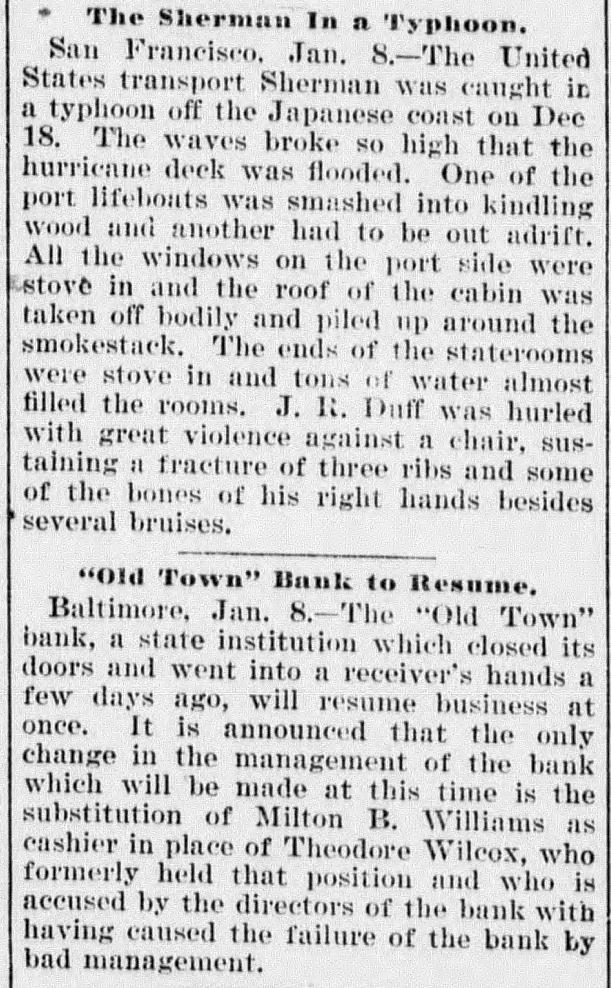
The Sherman In a Typhoon. San Francisco, Jan. 8.-The United States transport Sherman was caught in a typhoon off the Japanese coast on Dec 18. The waves broke SO high that the hurricane deck was flooded. One of the port lifeboats was smashed into kindling wood and another had to be out adrift. All the windows on the port side were stove in and the roof of the cabin was taken off bodily and piled up around the smokestack. The ends of the staterooms were stove in and tons of water almost filled the rooms. J. R. Duff was hurled with great violence against a chair, sustaining a fracture of three ribs and some of the bones of his right hands besides several bruises. "Old Town" Bank to Resume. Baltimore, Jan. 8.-The "Old Town" bank, a state institution which closed its doors and went into a receiver's hands a few days ago, will resume business at once. It is announced that the only change in the management of the bank which will be made at this time is the substitution of Milton B. Williams as cashier in place of Theodore Wilcox, who formerly held that position and who is accused by the directors of the bank with having caused the failure of the bank by bad management.


Article from New-York Tribune, January 9, 1901

Click image to open full size in new tab

Article Text

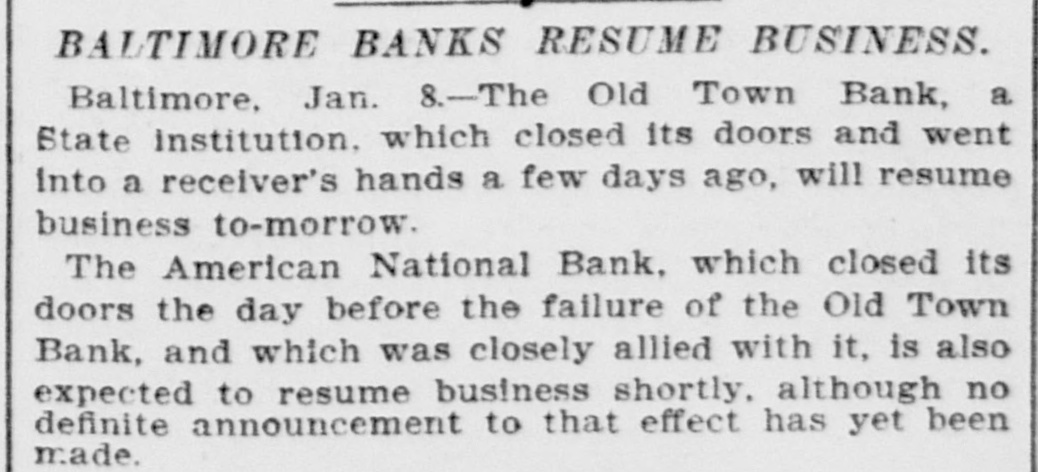
BALTIMORE BANKS RESUME BUSINESS. Baltimore, Jan. 8.-The Old Town Bank, a State institution. which closed its doors and went Into a receiver's hands a few days ago, will resume business to-morrow. The American National Bank, which closed its doors the day before the failure of the Old Town Bank, and which was closely allied with it, is also expected to resume business shortly. although no definite announcement to that effect has yet been made.


Article from The Democratic Advocate, January 19, 1901

Click image to open full size in new tab

Article Text

days. Wm. C. Volans, aged 93 years, died in Annapolis last Saturday. House burglars and sneak thieves are very industrious in Baltimore. Isabella, wife of ex-Judge Lynch, of Frederick, died Monday. Diphtheria and grip are on the increase in Cecil and Harford counties. A receiver is asked for the Crown Savings and Loan Association of Baltimore. Five persons and firms applied for bankruptcy proceedings in Baltimore Monday. The Old Town Bank of Baltimore has reopened. It is backed by the Clearing House. A receiver has been appointed for the Atlantic Trust and Deposit Company of Baltimore. Rockville is to have a manual training school for which the State appropriates $1,500 each year. Boonsboro has been selected as the place of holding the 82d annual synod of the Lutheran Church this year. Navigation on the Chesapeake and Delaware Canal was closed Saturday by the sinking of a SCOW loaded with pigiron. Receivers have been appointed for the Columbia Hydraulic and Engineering Co., Baltimore; also for T. A. Fitzpatrick & Co. Last year there were 604 deaths in Frederick city and county, 137 persons dying in the city, and 467 in the county. The Baltimore and Ohio Railroad has ordered 100 new engines and expects to spend $1,500,000 in new piers at Locust Point. Mrs. Elizabeth Bond, aged 93 years, died in Belair on the 13th instant. She retained all her faculties to a remarkable degree. Owing to the recent report of the grand jury, the directors of the Baltimore Female House of Refuge have asked for a full investigation. John Willis Brubaker, proprietor of the Taylor Hotel, Winchester, Va., died suddenly on Monday. He was a native of Frederick county, Dr. David Caldwell, aged 57 years, and Cornelius Howard Shipley, aged 76 years, well-known citizens of Baltimore, died from the grip on Monday. George A. Buckey, aged 61 years, one of the oldest engineers of the Western Md. Railroad, died in Williamsport last week. He leaves a wife and four children. Owing to sickness the attendance at the public schools of Baltimore county has fallen below the average, and some schools are closed because of the illness of teachers. Mrs. Susannah Hall, aged 83 years, died in Beltsville, Prince George's county, Monday. She was prominent in M. E. Church work. She was of that courtly school that is now nearly extinct. John Minnis, aged 92 years, died in Baltimore last week. He was greatly respected. In early life he was a slave in the family of Henry Clay, and others in the South, and was proud that he belonged to the quality. Burglars attempted to rob the German Savings Bank at Cumberland at an early hour last Sunday morning, but they were driven off by the watchman and a policeman. Two snspects were arrested in West Virginia, near Cumberland, Monday, who had fresh bullet wounds. Baltimoreans who invested about $100,000, Washingtonians who invested $375, 000 and others who bought stock in R.C. Flower's Arizona Eastern and Montana Smelting, Ore Purchasing and Developing Company are very anxious to find Mr. Flower, the "promoter." Bon Sonburg, a Student at the Maryland Medical College, Baltimore, was SO severely "hazed" Thursday night of last week that he was ill for several days. If he had "hazed" some of the villians with a knife they would have received their just deserts, and until a few examples are made hazing will be continued. Peter B. Small, Jr., of Washington county, was arrested Monday on the charge of forgery, and in default of bail was sent to jail. His arrest caused a decided sensation, as he had heretofore born an excellent character, was magistrate under Gov. Lowndes, and had been a trusted employe in the sub treasury, Baltimore. il The new six-mile extension of the Altenwald Cut-Off, Western Maryland railroad, was finished Tuesday. The work d has taken 18 months and the cost of the six miles of road will exceed $150,000. The greatest cut was 39 feet, at Grindstone Ridge. The force of workmen employed averaged 200, the majority of which were negroes. Robinson & McGraw, of Baltimore, sued Col. Calvin R. Nutt of Frederick, on a


Article from The Evening Times, October 15, 1901

Click image to open full size in new tab

Article Text

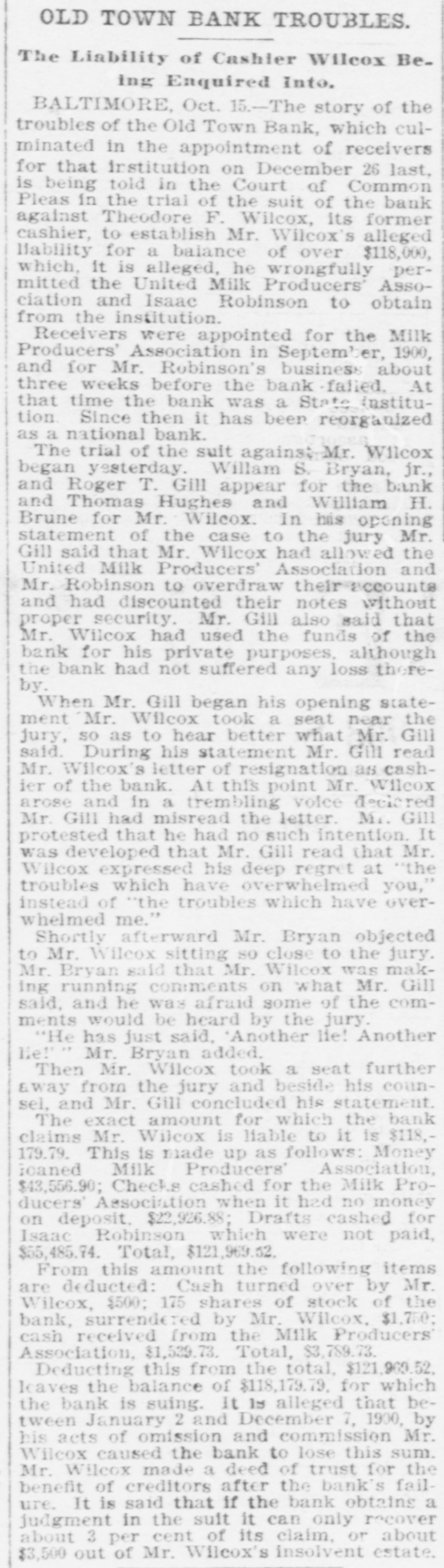
OLD TOWN BANK TROUBLES. The Liability of Cashier Wilcox Being Enquired Into. BALTIMORE, Oct. 15.-The story of the troubles of the Old Town Bank, which culminated in the appointment of receivers for that institution on December 26 last, is being told in the Court of Common Pleas in the trial of the suit of the bank against Theodore F. Wilcox, its former cashier, to establish Mr. Wilcox's alleged liability for a balance of over $118,000, which, it is alleged, he wrongfully permitted the United Milk Producers' Association and Isaac Robinson to obtain from the institution. Receivers were appointed for the Milk Producers' Association in September, 1900, and for Mr. Robinson's business about three weeks before the bank failed. At that time the bank was a State institution Since then it has been reorganized as a national bank. The trial of the suit against Mr. Wilcox began yesterday. Willam S. Bryan, jr., and Roger T. Gill appear for the bank and Thomas Hughes and William H. Brune for Mr. Wilcox. In his opening statement of the case to the jury Mr. Gill said that Mr. Wilcox had allowed the United Milk Producers' Association and Mr. Robinson to overdraw their accounts and had discounted their notes without proper security. Mr. Gill also said that Mr. Wilcox had used the funds of the bank for his private purposes, although the bank had not suffered any loss thereby. When Mr. Gill began his opening statement Mr. Wilcox took a seat near the jury, so as to hear better what Mr. Gill said. During his statement Mr. Gill read Mr. Wilcox's letter of resignation as cashier of the bank. At this point Mr. Wilcox arose and in a trembling voice declared Mr. Gill had misread the letter. Mr. Gill protested that he had no such intention. It was developed that Mr. Gill read that Mr. Wilcox expressed his deep regret at "the troubles which have overwhelmed you," instead of "the troubles which have overwhelmed me." Shortly afterward Mr. Bryan objected to Mr. Wilcox sitting so close to the jury. Mr. Bryan said that Mr. Wilcox was making running comments on what Mr. Gill sald, and he was afraid some of the comments would be heard by the jury. "He has just said, 'Another lie! Another lie!" Mr. Bryan added. Then Mr. Wilcox took a seat further away from the jury and beside his counsel, and Mr. Gill concluded his statement. The exact amount for which the bank claims Mr. Wilcox is liable to it is $118,179.79. This is made up as follows: Money loaned Milk Producers' Association, $43,556.90; Checks cashed for the Milk Producers' Association when it had no money on deposit. $22,926.88; Drafts cashed for Isaac Robinson which were not paid, $55,485.74. Total, $121,969.52. From this amount the following items are deducted: Cash turned over by Mr. Wilcox, $500; 175 shares of stock of the bank, surrendered by Mr. Wilcox, $1,750; cash received from the Milk Producers' Association, $1,539.73. Total, $3,789.73. Deducting this from the total, $121,960.52. leaves the balance of $118,179.79, for which the bank is suing. It is alleged that between January 2 and December 7, 1900, by his acts of omission and commission Mr. Wilcox caused the bank to lose this sum. Mr. Wilcox made a deed of trust for the benefit of creditors after the bank's failure. It is said that if the bank obtains a judgment in the suit it can only recover about 3 per cent of its claim, or about $3,500 out of Mr. Wilcox's insolvent estate.