Article Text
BANK RECEIVER MAKES CHANGES AMONG HELPERS
Kern, Shrock and Schwartz Are Retired From Staff of Assistants.
WILL REDUCE OVERHEAD
Carpenter Says Change Made Dec. 1 Will Save $5,000 Yearly in Overhead.
Three men who were members of the staff of assistants of Frank W. Bryant while he was receiver of the Citizens National Bank, were retired from their respective positions by the present receiver, James W. Carpenter, December 1.
The three are Otto Kern, who handled most of the city real estate which was acquired by the receiver in settlement of loans made by the bank; John N. Shrock, who handled the farm properties the bank took over and who also assisted in administering the affairs of the Russiaville National Bank, of which Mr. Bryant was also receiver, and Arthur H. Schwartz, who for the last two or three years had looked after the renting of office suites in the Citizens National building.
When Receiver Carpenter was seen Wednesday about the changes he had made, he said the retirement of Kern, Shrock and Schwartz became effective the first of the current month, and that the action was pursuant to a policy of reducing the overhead of the receivership.
Now in Other Hands
The departments that were handled by the three men mentioned, the receiver explained, are now to be looked after by W. J. Eberwein, chief assistant to the receiver, and Fred Goyer, retained from the former receiver's staff, with such help as Mr. Carpenter himself can find time to give them. He remarked that the consolidation of the several jobs would mean a saving of approximately $5,000 a year in the receivership's overhead.
At the time Bryant relinquished the receivership to Carpenter, the Tribune indicated that some changes in the staff probably would follow within a short time. The change of receivers took place at the close of business on September 20, a little more than two months ago. Kern and Shrock were mentioned as among those whose connection with the receivership probably would be terminated ere long. It seems that while he was framing the consolidation of jobs, Receiver Carpenter decided also to include the position held by Schwartz.
What Three Are Doing
Mr. Schwartz has been engaged in the real estate business for several years and handled the Citizens Bank property from an office he maintained in the building.
Mr. Shrock was engaged in the real estate business before he took over the farm division for the Citizens National. He has returned to the line, having opened an office in room 314 of the bank building.
Mr. Kern, who came here from Indianapolis about four years ago, to become chief assistant to Receiver Bryant, has returned to the capital city, where it is understood he has a position.
No Dividend News
When Receiver Carpenter was asked Wednesday as to when another dividend could be expected for creditors of the Citizens National, he said he was not prepared at this time to make any statement on that subject, further than to say that he was working toward that end as rapidly as possible.
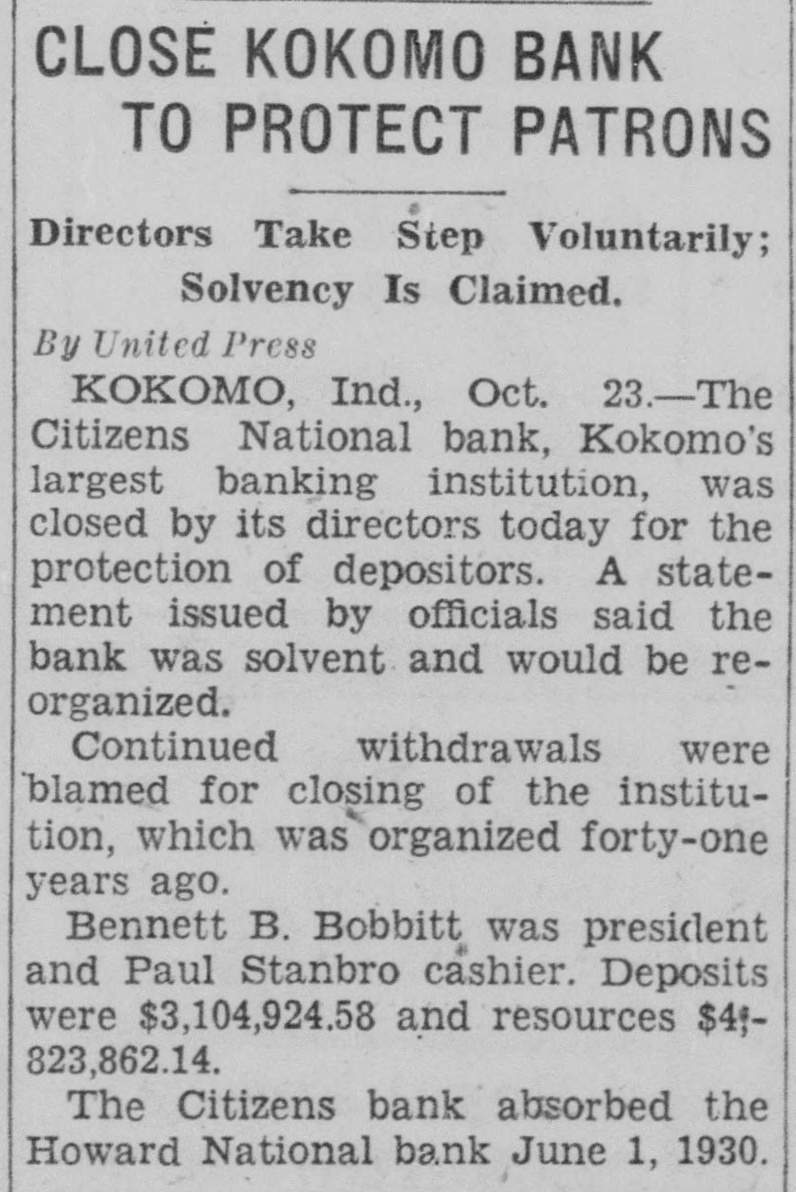
It is a certainty, of course, that no further dividend will be paid this year. The last dividend, the fourth since the bank was closed on October 23, 1931, was paid last March. It carried the total distribution up to 61 2-3 per cent of the total of deposits at the time the bank suspended operations.
Much Real Estate
Receiver Carpenter says the bank still owns a large amount of real estate, composed in the main of downtown Kokomo business properties, a number of factory buildings, some of which are small, and several dwellings and vacant lots. The amount paid creditors in the future will depend largely on whether or not this real estate can be disposed of advantageously.
Mr. Carpenter and Mr. Eberwein were out all Wednesday forenoon making a personal inspection of some of the real estate, with a view of determining prices to be asked for it should opportunities for sales arise in the near future.
Real estate values have been rising in Kokomo the last few months, but whether they have appreciated enough to bring the bank's properties up to a level where they could be sold to the reasonable advantage of the bank's creditors is a question.