Citizens Bank (New Orleans, LA)

Episode Information

Episode UID
4210989090736
Episode Type
Run โ†’ Suspension โ†’ Unsure
Bank Type
state
Bank ID
421098909 hash
Start Date
April 17, 1861
Location
New Orleans, Louisiana (29.955, -90.075)

Metadata

Model
gpt-5-mini (chosen from majority vote of a three-model LLM ensemble)
Short Digest
b952f4b0e7a151f6

Response Measures

None

Description

Suspensions were driven by gubernatorial/Confederate policy; later reopening not documented in these articles.

Events (3)

1. April 17, 1861 Run
Cause
Macro News
Cause Details
Large withdrawals to subscribe to the Confederate (Southern) loan in response to wartime mobilization/news.
Newspaper Excerpt
A great run was made on the Citizens' Bank to take the Southern Loan. Two millions was taken at par before 12 M.
Source
newspapers
2. September 16, 1861 Suspension
Cause
Government Action
Cause Details
Governor's proclamation/recommendation and state/legal constraints led banks (including Citizens' Bank) to suspend specie payments to accept Confederate treasury notes.
Newspaper Excerpt
I recommend to the several Banks of New Orleans immediately to suspend specie payment.
Source
newspapers
3. April 24, 1862 Suspension
Cause
Government Action
Cause Details
Decree/mandate forbidding paying out specie (authorities' order) causing Citizens' Bank to cease specie payments.
Newspaper Excerpt
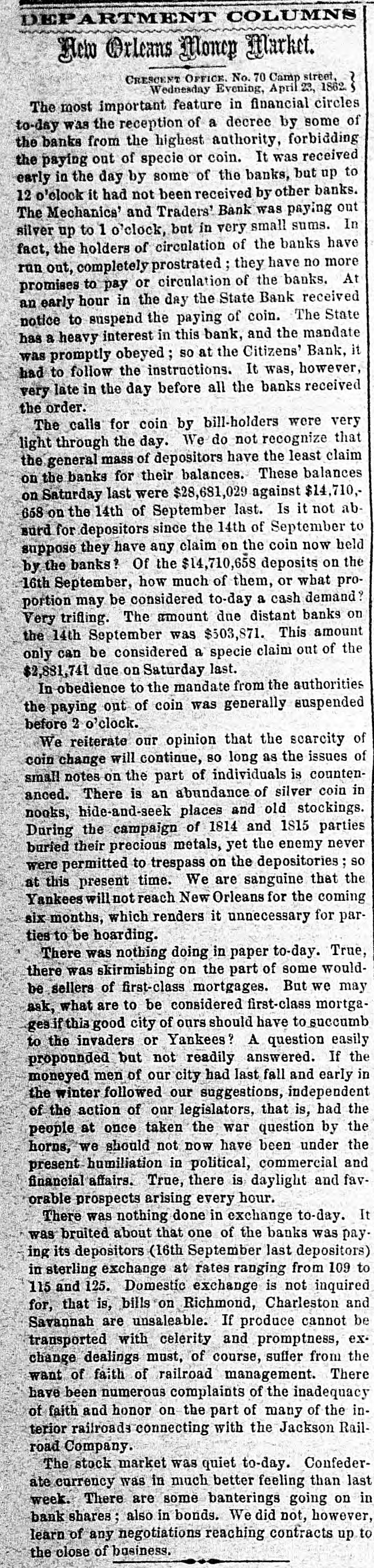
The State Bank received notice to suspend the paying of coin. The State has a heavy interest in this bank, and the mandate was promptly obeyed; so at the Citizens' Bank, it had to follow the instructions.
Source
newspapers

Newspaper Articles (12)

Article from Gazette and Sentinel, April 20, 1861

Click image to open full size in new tab

Article Text

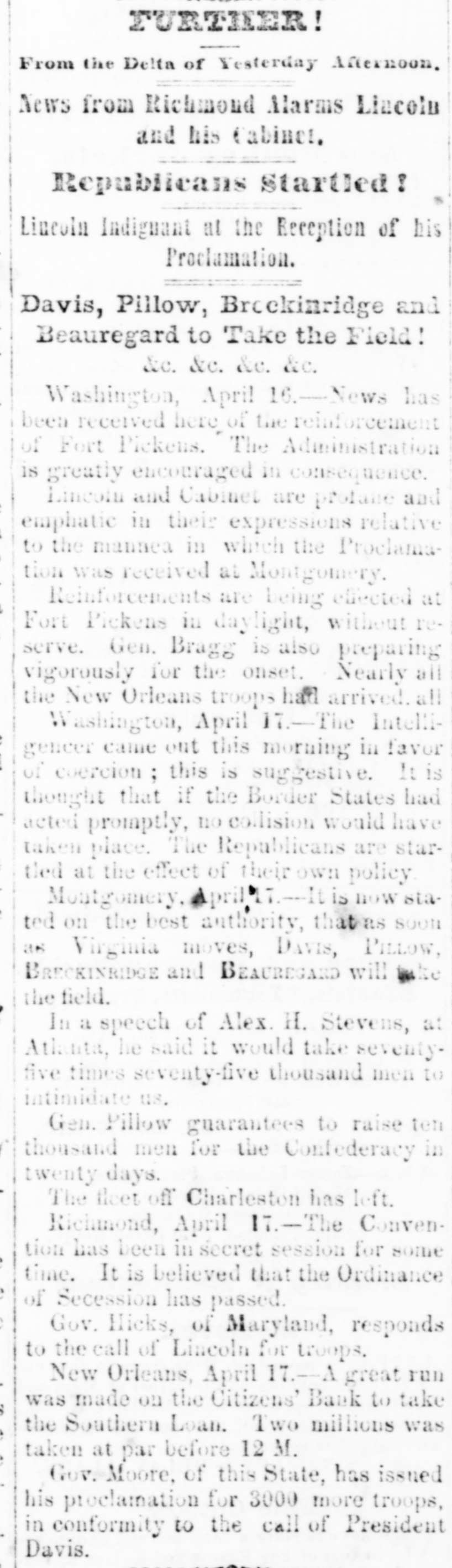
! From the Delta of Yesterday Afternoon. News from Richmond Alarms Liacoln and his Cabinet. Republicans startled ? Lincoln Indignant at the Reception of his Proclamation. Davis, Pillow, Brcckinridge and Beauregard to Take the Field! &c. &c. &c. &c. Washington, April 16. -News has been received here of the reinforcement of Fort Pickens. The Administration IS greatly encouraged in consequence. Lincoln and Cabinet are protaite and emphatic in their expressions relative to the mannea in which the Proclamation was received at Montgomery. Reinforcements are being effected at Fort Pickens in daylight, without reserve. Gen. Bragg is also preparing vigorously for the onset. Nearly all the New Orleans troops had arrived. all Washington, April 17.-The Intelligencer came out this morning in favor of coercion ; this is suggestive. It is thought that if the Border States had acted promptly, no collision would have taken place. The Republicans are startied at the effect of their own policy Montgomery, April 17 -- It is now stated on the best authority, that as soon as Virginia moves, Davis, PILLOW, Banckinridge and BEAUREGARD will who the field. In a speech of Alex. H. Stevens, at Atlanta, he said it would take seventyfive times seventy-five thousand men to intimidate us. Gen. Pillow guarantees to raise ten thousand men for the Confederacy in twenty days. The fleet off Charleston has left. Richmond, April 17.-The Couvention has been in secret session for some time. It is believed that the Ordinance of Secession has passed. Gov. Hicks, of Maryland, responds to the call of Lincoln for troops. New Orleans, April 17.-A great run was made on the Citizens' Bank to take the Southern Loan. Two millions was taken at par before 12 M. Gov. Moore, of this State, has issued his proclamation for 3000 more troops, in conformity to the call of President Davis.


Article from New Orleans Daily Crescent, September 18, 1861

Click image to open full size in new tab

Article Text

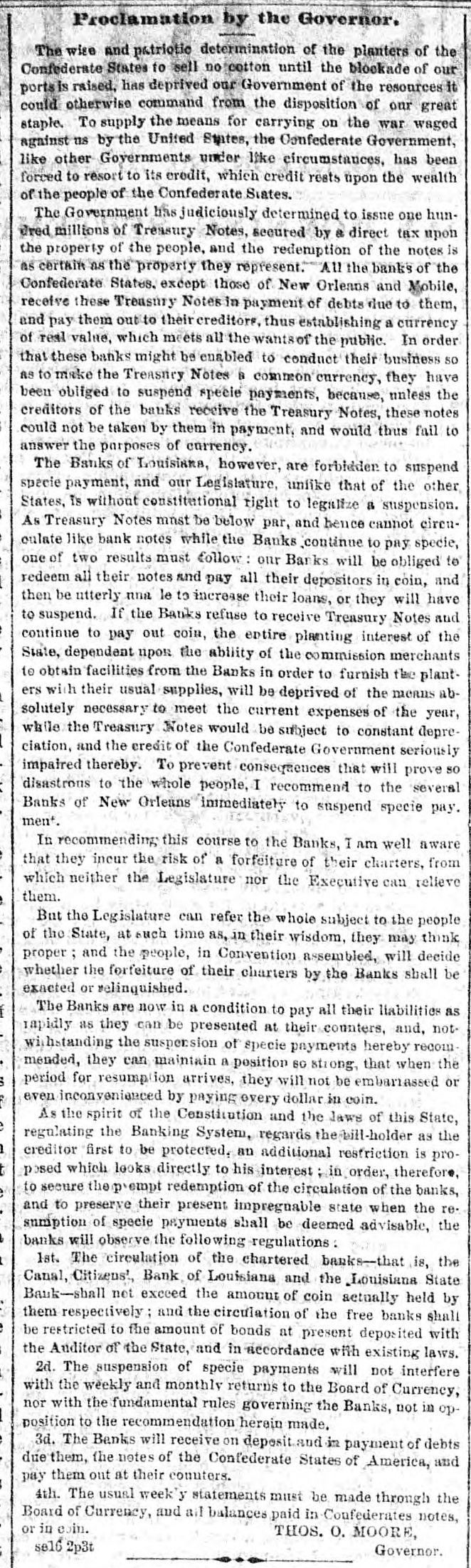
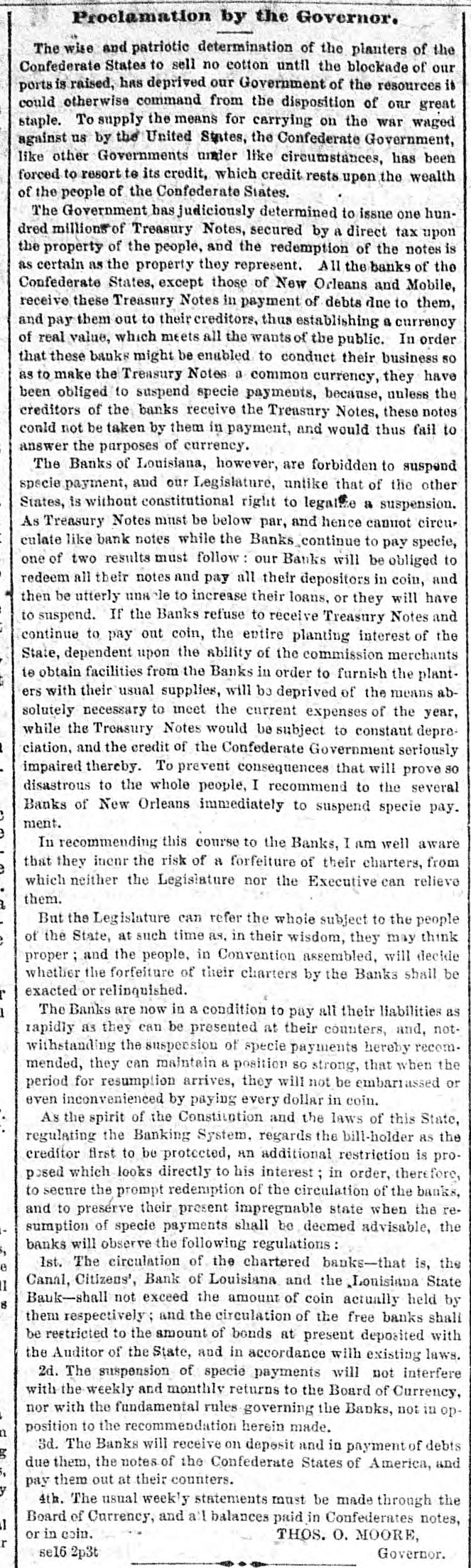
Proclamation by the Governor. The wise and patriotic determination of the planters of the Confederate States to sell no cotton until the blookade of our portsis raised, has deprived our Government of the resources it could otherwise command from the disposition of our great staple. To supply the means for carrying on the war waged against us by the United States, the Confederate Government, like other Governments under like circumstances, has been forced to resort to its credit, which credit rests upon the wealth of the people of the Confederate States. The Government has judiciously determined to issue one hundred millions of Treasury Notes, secured by a direct tax upon the property of the people, and the redemption of the notes is as certain as the property they represent. All the banks of the Confederate States. except those of New Orleans and Mobile, receive these Treasury Notes in payment of debts due to them, and pay them out to their creditors, thus establishing a currency of real value, which meets all the wants of the public. In order that these banks might be enabled to conduct their business so AS to make the Treasney Notes B common currency, they have been obliged to suspend specie payments, because, unless the creditors of the banks receive the Treasury Notes, these notes could not be taken by them in payment. and would thus fail to answer the purposes of currency. The Banks of Louisiana, however, are forbidder to suspend specie payment, and our Legislature, unlike that of the other States, is without constitutional right to legalize a suspension. As Treasury Notes mnst be below par, and hence cannot circuculate like bank notes while the Banks (continue to pay specie, one of two results must follow: our Banks will be obliged to redeem all their notes and pay all their depositors in coin, and then be utterly nna le to increase their loans, or they will have to suspend. If the Banks refuse to receive Treasury Notes and continue to pay out coin, the entire planting interest of the State, dependent upon the ability of the commission merchants to obtain facilities from the Banks in order to furnish the planters with their usual supplies, will be deprived of the morns absolutely necessary to meet the current expenses of the year, while the Treasury Notes would be subject to constant depreI ciation, and the credit of the Confederate Government seriously impaired thereby. To prevent consequences that will prove so : disastrous to the whole people, I recommend to the several Banks of New Orleans immediately to suspend specie pay. men't In recommending this course to the Banks, I am well aware that they incur the risk of a forfeiture of their charters, from which neither the Legislature nor the Executive can relieve them. ) But the Legislature can refer the whole subject to the people of the State, at such time as, in their wisdom, they may think proper ; and the people, in Convention assembled, will decide whether the forfeiture of their charters by the Banks shall be exacted or relinquished. f The Banks are now in a condition to pay all their liabilities as rapidly as they can be presented at their counters, and, notwithstanding the suspension of specie payments hereby recom mended, they can maintain a position 60 strong, that when the $ period for resumption arrives, they will not be embariassed or F even inconvenienced by paying every dollar in coin. As the spirit of the Constitution and the Jaws of this State, ) regulating the Banking System, regards the bill-holder as the 1 creditor first to be protected. an additional restriction is prot posed which looks directly to his interest in order, therefore, e to secure the prempt redemption of the circulation of the banks, and to preserve their present impregnable state when the resumption of specie payments shall be deemed advisable, the / banks will observe the following regulations : 1st. The circulation of the chartered banks-that is, the Canal, Citizens!, Bank of Louisiana and the Louisiana State Bauk-shall net exceed the amount of coin actually held by : them respectively ; and the circulation of the free banks shall e be restricted to the amount of bonds at present deposited with the Auditor of the State, and in accordance with existing laws. 2d. The suspension of specie payments will not interfere 1 with the weekly and monthly returns to the Board of Currency, nor with the fundamental rules governing the Banks, not in opposition to the recommendation herein made. : 3d. The Banks will receive on deposit and in payment of debts due them, the notes of the Confederate States of America, and pay them out at their counters. : 4th. The usual week'y statements must be made through the Board of Currency, and all balances paid in Confederates notes, or in coin. THOS. O. MOORE, self 2p3t Governor.


Article from New Orleans Daily Crescent, September 19, 1861

Click image to open full size in new tab

Article Text

Proclamation by the Governor. The wise and patriotic determination of the planters of the Confederate States to sell no cotton until the blockade of our ports is raised, has deprived our Government of the resources it could otherwise command from the disposition of our great staple. To supply the means for carrying on the war waged against us by the United States, the Confederate Government, like other Governments under like circumstances, has been forced to resort to its credit, which credit rests upon the wealth of the people of the Confederate States. The Government has judiciously determined to issue one hundred millions of Treasury Notes, secured by a direct tax upon the property of the people, and the redemption of the notes is as certain as the property they represent. All the banks of the Confederate States, except those of New Orleans and Mobile, receive these Treasury Notes in payment of debts due to them, and pay them out to their creditors, thus establishing a currency of real value, which meets all the wants of the public. In order that these banks might be enabled to conduct their business so as to make the Treasury Notes a common currency, they have been obliged to suspend specie payments, because, unless the creditors of the banks receive the Treasury Notes, these notes could not be taken by them in payment, and would thus fail to answer the purposes of currency. The Banks of Louisiana, however, are forbidden to suspend spscie payment, and our Legislature, unlike that of the other States, is without constitutional right to legalize a suspension. As Treasury Notes must be below par, and hence cannot circuculate like bank notes while the Banks continue to pay specie, one of two results must follow our Banks will be obliged to redeem all their notes and pay all their depositors in coin, and then be utterly unacl to increase their loans, or they will have to suspend. If the Banks refuse to receive Treasury Notes and continue to pay out coin, the entire planting interest of the State, dependent upon the ability of the commission merchants to obtain facilities from the Banks in order to furnish the planters with their usual supplies, will be deprived of the means absolutely necessary to meet the current expenses of the year, while the Treasury Notes would be subject to constant depre1 ciation, and the credit of the Confederate Government seriously impaired thereby. To prevent consequences that will prove so disastrous to the whole people, I recommend to the several Banks of New Orleans immediately to suspend specie pay. ment. In recommending this course to the Banks, I am well aware that they inenr the risk of 8 forfeiture of their charters, from which neither the Legislature nor the Executive can relieve them. But the Legislature can refer the whole subject to the people of the State, at such time as. in their wisdom, they may think proper ; and the people, in Convention assembled, will decide whether the forfeiture of their charters by the Banks shall be exacted or relinquished. The Banks are now in a condition to pay all their liabilities as rapidly as they can be presented at their counters, and, notwithstanding the suspersion of specie payments hereby recommended, they can maintain 8 position SO strong, that when the period for resumption arrives, they will not be embarrassed or even inconvenienced by paying every dollar in coin. As the spirit of the Constitution and the laws of this State, regulating the Banking System. regards the bill-holder as the creditor first to be protected, an additional restriction is proposed which looks directly to his interest; in order, therefore, to secure the prompt redemption of the circulation of the banks, and to preserve their present impregnable state when the resumption of specie payments shall be deemed advisable, the banks will observe the following regulations: , 1st. The circulation of the chartered banks-that is, the e Canal, Citizens', Bank of Louisiana and the Louisiana State 11 Bauk-shall not exceed the amount of coin actually held by 8 them respectively and the circulation of the free banks shall be restricted to the amount of bonds at present deposited with the Auditor of the State, and in accordance wilh existing laws. 2d. The suspension of specie payments will not interfere with the weekly and monthly returns to the Board of Currency, nor with the fundamental rules governing the Banks, not in opposition to the recommendation herein made. n 3d. The Banks will receive on deposit and in payment of debts g due them, the notes of the Confederate States of America, and pay them out at their counters. y 4th. The usual weekly statements must be made through the Board of Currency, and all balances paid in Confederates notes, I or in coin. THOS. O. MOORE, r Governor. se16 2p3t


Article from New Orleans Daily Crescent, September 21, 1861

Click image to open full size in new tab

Article Text

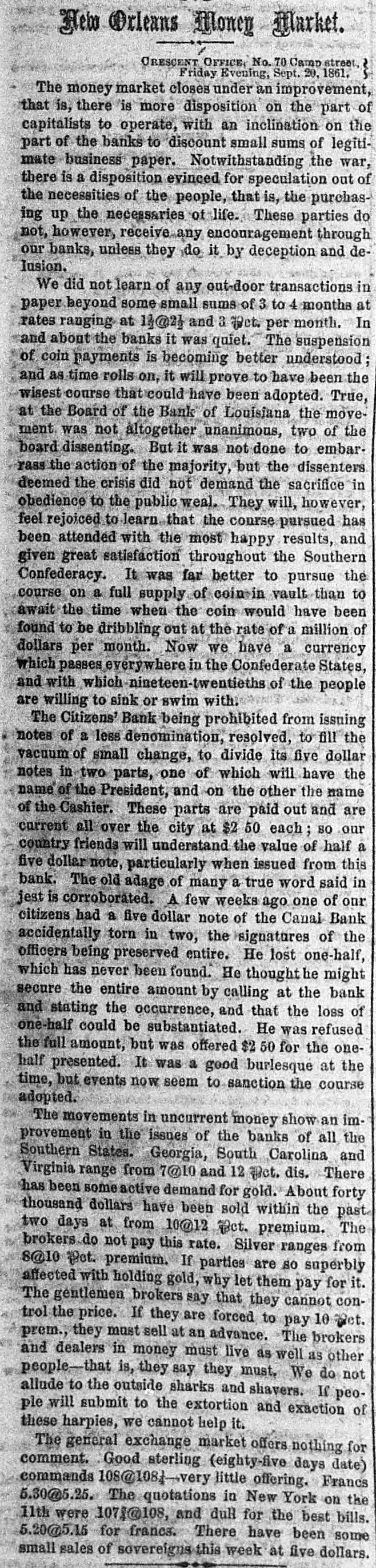
Hebo Orleans Money Market. CRESCENT OFFICE No. 70 Camp street, Friday Evening, Sept. 20, 1861. The money market closes under an improvement, that is, there is more disposition on the part of capitalists to operate, with an inclination on the part of the banks to discount small sums of legitimate business paper. Notwithstanding the war, there is a disposition evinced for speculation out of the necessities of the people, that is, the purchasing up the necessaries of life. These parties do not, however, receive any encouragement through our banks, unless they do it by deception and delusion. We did not learn of any out-door transactions in paper beyond some small sums of 3 to 4 months at rates ranging at 1122 and 3 Pet. per month. In and about the banks it was quiet. The suspension of coin payments is becoming better understood and as time rolls on, it will prove to have been the wisest course that could have been adopted. True, at the Board of the Bank of Louisiana the movement. was not altogether unanimous, two of the board dissenting. But it was not done to embarrass the action of the majority, but the dissenters deemed the erisis did not demand the sacrifice in obedience to the public weal. They will, ho wever, feel rejoiced to learn that the course pursued has been attended with the most happy results, and given great satisfaction throughout the Southern Confederacy. It was far better to pursue the course on a full supply of coin in vault than to await the time when the coin would have been found to be dribbling out at the rate of a million of dollars per month. Now we have a currency which passes everywhere in the Confederate States, and with which-nineteen-twentieths of the people are willing to sink or swim with. The Citizens' Bank being prohibited from issuing notes of a less denomination, resolved, to fill the vacuum of small change, to divide its five dollar notes in two parts, one of which will have the name of the President, and on the other the name of the Cashier. These parts are paid out and are current all over the city at $2 50 each SO our country friends will understand the value of half a five dollar note, particularly when issued from this bank. The old adage of many a true word said in jest is corroborated. A few weeks ago one of our citizens had a five dollar note of the Canal Bank accidentally torn in two, the signatures of the officers being preserved entire. He lost one-half, which has never been found. He thought he might secure the entire amount by calling at the bank and stating the occurrence, and that the loss of one-half could be substantiated. He was refused the full amount, but was offered $2 50 for the onehalf presented. It was a good burlesque at the time, but events now seem to sanction the course adopted. The movements in uncurrent money show an improvement in the issues of the banks of all the Southern States. Georgia, South Carolina and Virginia range from 7@10 and 12 Oct. dis. There has been some active demand for gold. About forty thousand dollars have been sold within the past two days at from 10@12 Pct. premium. The brokers do not pay this rate. Silver ranges from 8@10 Pot. premium. If parties are so superbly affected with holding gold, why let them pay for it. The gentlemen brokers say that they cannot control the price. If they are forced to pay 10 Pet. prem., they must sell at an advance. The brokers and dealers in money must live as well as other people-that is, they say they must. We do not allude to the outside sharks and shavers. If people will submit to the extortion and exaction of these harpies, we cannot help it. The general exchange market offers nothing for comment. Good sterling (eighty-five days date) commands 108@108.-very little offering. Francs 5.30@5.25. The quotations in New York on the 11th were 107 @ 108, and dull for the best bills. 5.20@5.16 for francs. There have been some small sales of sovereigns this week at five dollars.


Article from New Orleans Daily Crescent, April 24, 1862

Click image to open full size in new tab

Article Text

DEP ARTMENT COLUMNS Acto Orleans Monep Market. CRESCENT OFFICE. No. 70 Camp street, Wednesday Evening, April 1862 The most important feature in financial circles to-day was the reception of a decree by some of the banks from the highest authority, forbidding the paying out of specie or coin. It was received early in the day by some of the banks, but up to 12 o'clock it had not been received by other banks. The Mechanics' and Traders' Bank was paying out silver up to 1 o'clock, but in very small sums. In fact, the holders of circulation of the banks have run out, completely prostrated; they have no more promises to pay or circulation of the banks. At an early hour in the day the State Bank received notice to suspend the paying of coin. The State has a heavy interest in this bank, and the mandate was promptly obeyed; so at the Citizens' Bank, it had to follow the instructions. It was, however, very late in the day before all the banks received the order. The calls for coin by bill-holders were very light through the day. We do not recognize that he.general mass of depositors have the least claim on the banks for their balances. These balances Saturday last were $28,681,029 against $14,710,668 on the 14th of September last. Is it not absurd for depositors since the 14th of September to suppose they have any claim on the coin now held by the banks? Of the $14,710,658 deposits on the 16th September, how much of them, or what proportion may be considered to-day a cash demand? Very trifing. The amount due distant banks on the 14th September was $503,871. This amount only can be considered a specie claim out of the $2,881,741 due on Saturday last. In obedience to the mandate from the authorities the paying out of coin was generally suspended before 2 o'clock. We reiterate our opinion that the scarcity of coin change will continue, 80 long as the issues of small notes on the part of individuals is countenanced. There is an abundance of silver coin in nooks, hide-and-seek places and old stockings. During the campaign of 1814 and 1815 parties buried their precious metals, yet the enemy never were permitted to trespass on the depositories so at this present time. We are sanguine that the Yankees will not reach New Orleans for the coming six months, which renders it unnecessary for parties to be hoarding. There was nothing doing in paper to-day. True, there was skirmishing on the part of some wouldbe sellers of first-class mortgages. But we may ask, what are to be considered first-class mortgages if this good city of ours should have to succumb to the invaders or Yankees? A question easily propounded but not readily answered. If the moneyed men of our city had last fall and early in the winter followed our suggestions, independent of the action of our legislators, that is, had the people at once taken the war question by the horns, we should not now have been under the present humiliation in political, commercial and financial affairs. True, there is daylight and favorable prospects arising every hour. There was nothing done in exchange to-day. It was bruited about that one of the banks was pay ing its depositors (16th September last depositors) in sterling exchange at rates ranging from 109 to 115 and 125. Domestic exchange is not inquired for, that is, bills on Richmond, Charleston and Savannah are unsaleable. If produce cannot be transported with celerity and promptness, exchange dealings must, of course, suffer from the want of faith of railroad management. There have been numerous complaints of the inadequacy of faith and honor on the part of many of the interior railroads connecting with the Jackson Railroad Company. The stock market was quiet to-day. Confederate currency was in much better feeling than last week. There are some banterings going on in bank shares; also in bonds. We did not, however, learn of any negotiations reaching contracts up to the close of business.


Article from Memphis Daily Appeal, April 26, 1862

Click image to open full size in new tab

Article Text

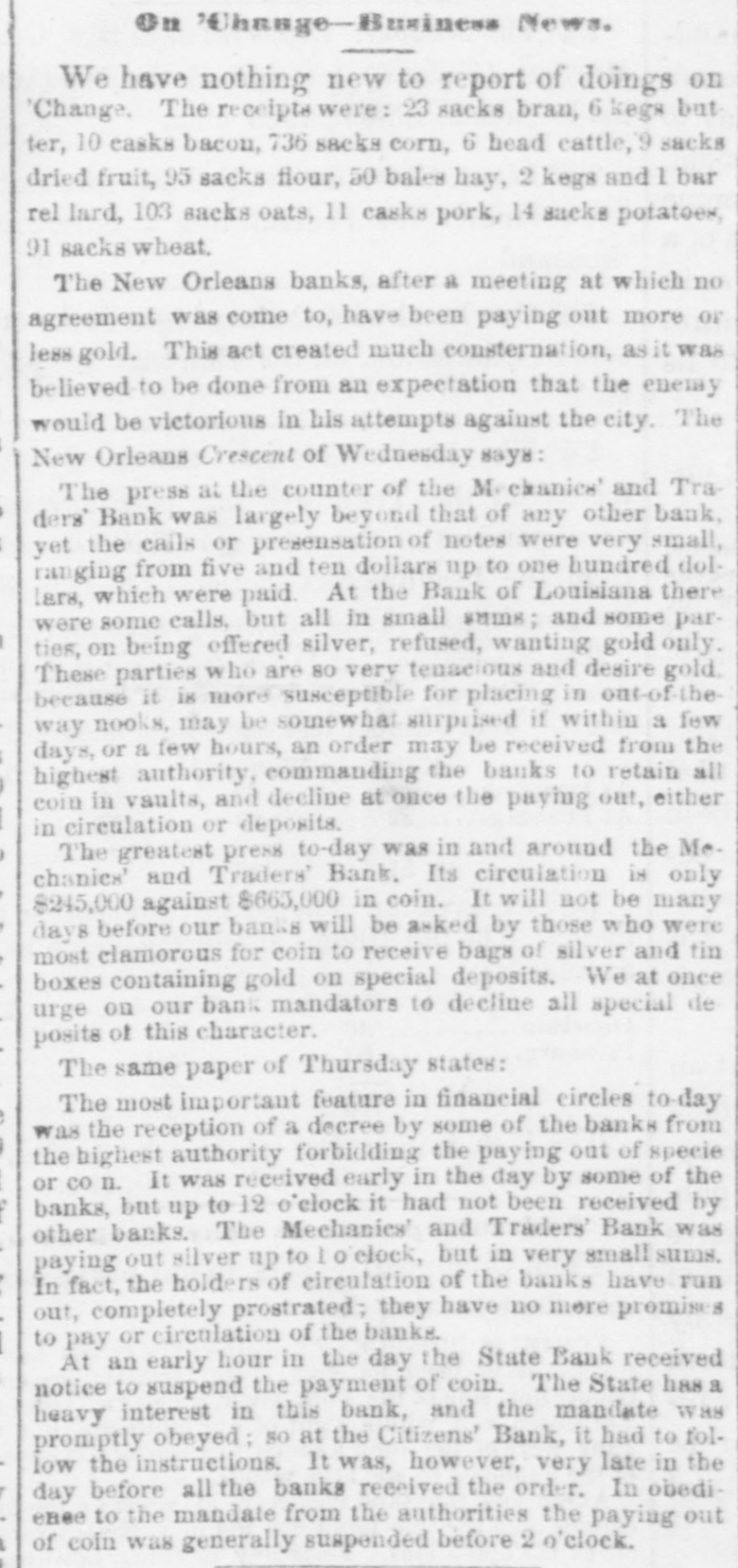
On Phaage-Business News. We have nothing new to report of doings on 'Change. The receipts were: 23 sacks bran, 6 kegs but ter, 10 easks bacon, 736 sacks corn, 6 head cattle, sacks dried fruit, 95 sacks flour, 50 bales hay, 2 kegs and 1 bar rel lard, 103 sacks oats, 11 casks pork, 14 sacks potatoes, 91 sacks wheat The New Orleans banks, after a meeting at which no agreement was come to, have been paying out more or less gold. This act created much consternation, as it was believed to be done from an expectation that the enemay would be victorious in his attempts against the city. The New Orleans Crescent of Wednesday says: The press at the counter of the M. chanica' and Traders' Bank was largely beyond that of any other bank, yet the cails or presensation of notes were very small, ranging from five and ten dollars up to one hundred dollars, which were paid. At the Bank of Louisiana there were some calls, but all in small amma; and some parties, on being offered silver, refused, wanting gold only. These parties who are 80 very tenacious and desire gold because it is more susceptible for placing in out-of the way nooks, may be somewhat surprised if within a few days, or a few hours, an order may be received from the highest authority, commanding the banks to retain all coin in vaults, and decline at once the paying out, either in circulation or deposits. The greatest press to-day was in and around the Me. chanies' and Traders' Bank. Its circulation is only $245,000 against $663,000 in coin. It will not be many days before our banks will be asked by those who were most clamorous for coin to receive bags of silver and tin boxes containing gold on special deposits. We at once urge on our bank mandators to decline all special de posits of this character The same paper of Thursday states: The most important feature in financial circles to-day was the reception of a decree by some of the banks from the highest authority forbidding the paying out of specie or CO n. It was received early in the day by some of the banks, but up to 12 o'clock it had not been received by other banks. The Mechanics and Traders' Bank was paying out silver up to I bleck, but in very small sums. In fact, the holders of circulation of the banks have run out, completely prostrated; they have no more promises to pay or circulation of the banks. At an early hour in the day the State Bank received notice to suspend the payment of coin. The State has a heavy interest in this bank, and the mandate was promptly obeyed; so at the Citizens' Bank, it had to follow the instructions. It was, however, very late in the day before all the banks received the order. In obedienee to the mandate from the authorities the paying out of coin was generally suspended before 2 o'clock.


Article from Vermont Watchman and State Journal, May 23, 1862

Click image to open full size in new tab

Article Text

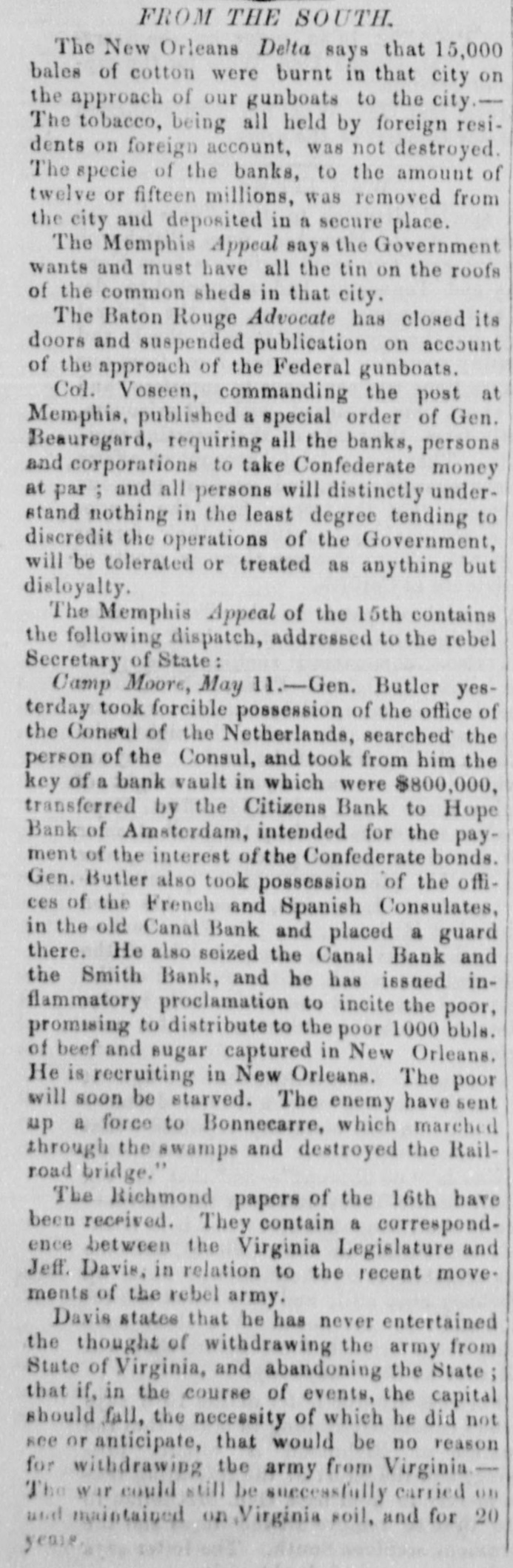
FROM THE SOUTH, The New Orleans Delta says that 15,000 bales of cotton were burnt in that city on the approach of our gunboats to the city.The tobacco, being all held by foreign residents on foreign account, was not destroyed. The specie of the banks, to the amount of twelve or fifteen millions, was removed from the city and deposited in a secure place. The Memphis Appeal says the Government wants and must have all the tin on the roofs of the common sheds in that city. The Baton Rouge Advocate has closed its doors and suspended publication on account of the approach of the Federal gunboats. Col. Voseen, commanding the post at Memphis, published a special order of Gen. Beauregard, requiring all the banks, persons and corporations to take Confederate money at par and all persons will distinctly understand nothing in the least degree tending to discredit the operations of the Government, will be tolerated or treated as anything but disloyalty. The Memphis Appeal of the 15th contains the following dispatch, addressed to the rebel Secretary of State: Camp Moore, May 11. -Gen. Butler yesterday took forcible possession of the office of the Consul of the Netherlands, searched the person of the Consul, and took from him the key of a bank vault in which were $800,000, transferred by the Citizens Bank to Hope Bank of Amsterdam, intended for the payment of the interest of the Confederate bonds. Gen. Butler also took possession of the offices of the French and Spanish Consulates, in the old Canal Bank and placed a guard there. He also seized the Canal Bank and the Smith Bank, and he has issued inflammatory proclamation to incite the poor, promising to distribute to the poor 1000 bbls. New The of He beef is recruiting and sugar in captured New Orleans. in Orleans. poor will soon be starved. The enemy have sent up a force to Bonnecarre, which marched through the swamps and destroyed the Railroad bridge." The Richmond papers of the 16th have been received. They contain a correspondence between the Virginia Legislature and Jeff. Davis, in relation to the recent movements of the rebel army. Davis states that he has never entertained the thought of withdrawing the army from the course the that State if, of in Virginia, the and abandoning of events, capital State should fall, the necessity of which he did not see or anticipate, that would be no reason for withdrawing the army from Virginia The war could still be successfully carried on and maintained on Virginia soil, and for 20 years


Article from The New York Herald, August 11, 1862

Click image to open full size in new tab

Article Text

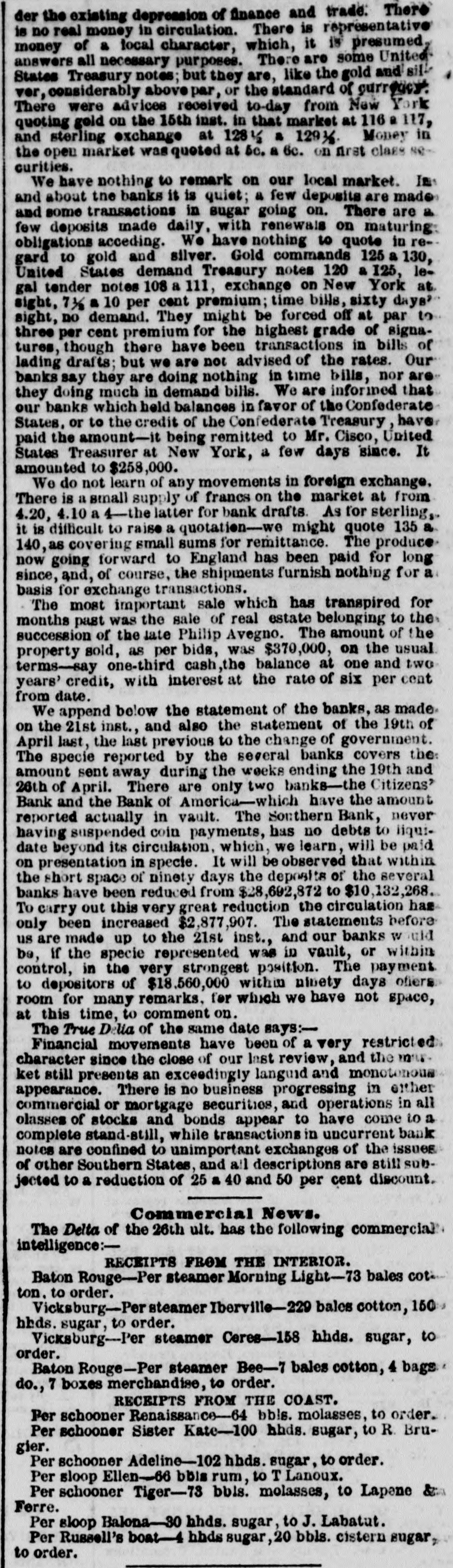
der the existing depression of finance and trade. There is no real money in circulation. There is representative money of a local character, which, it is presumed answers all necessary purposes. There are some United States Treasury notes; but they are, like the gold and sil ver, considerably above par, or the standard of surrency. There were advices received to-day from New York quoting gold on the 15th inst. in that market at 116 a 117, and sterling exchange at 128 1/2 a 129 1/6. Money in the open market was quoted at 5c. a 6c. on first class securities. We have nothing to remark on our local market. In and about the banks it is quiet; a few deposits are made and some transactions in sugar going on. There are a few deposits made daily, with renewals on maturing obligations acceding. We have nothing to quote in regard to gold and silver. Gold commands 125 a 130, United States demand Treasury notes 120 a 125, legal tender notes 108 a 111, exchange on New York at sight, 7 1/2 a 10 per cent premium; time bills, sixty days sight, DO demand. They might be forced off ut par to three per cent premium for the highest grade of signatures, though there have been transactions in bills of lading drafts; but we are not advised of the rates. Our banks say they are doing nothing in time bills, nor are they doing much in demand bills. We are informed that our banks which held balances in favor of the Confederate States, or to the credit of the Confederate Treasury, have paid the amount-it being remitted to Mr. Cisco, United States Treasurer at New York, a few days since. It amounted to $258,000. We do not learn of any movements in foreign exchange. There is a small supply of francs on the market at from 4.20, 4.10 a 4-the latter for bank drafts. As for sterling, it is difficult to raise a quotation-we might quote 135 140, as covering small sums for remittance. The produce now going forward to England has been paid for long since, and, of course, the shipments furnish nothing for a basis for exchange transactions. The most important sale which has transpired for months past was the sale of real estate belonging to the succession of the late Philip Avegno. The amount of the property sold, as per bids, was $370,000, on the usual terms-say one-third cash, the balance at one and two years' credit, with interest at the rate of six per cent from date. We append below the statement of the banks. as made on the 21st inst., and also the statement of the 19th of last, the last previous to the change of government. The specie reported by the several banks covers the amount sent away during the weeks ending the 19th and 26th of April. There are only two banks-the Citizens' Bank and the Bank of America-which have the amount reported actually in vault. The Southern Bank, never having suspended coin payments, has no debts to liquidate beyond its circulation, which, we learn, will be paid on presentation in specte. It will be observed that within the short space of ninety days the deposits of the several banks have been reduced from $28,692,872 to $10,132,268. To carry out this very great reduction the circulation has only been increased $2,877,907. The statements before us are made up to the 21st inst., and our banks W old be, If the specie represented was in vault, or within control, in the very strongest position. The payment to depositors of $18.560,000 within ninety days ofiers room for many remarks. for which we have not space, at this time, to comment on. The True elia of the same date says:Financial movements have been of a very restricted character since the close of our last review, and the mus ket still presents an exceedingly langund and monotonous appearance. There is no business progressing in other commercial or mortgage securities, and operations in all olasses of stocks and bonds appear to have come to a complete stand-still, while transactions in uncurrent bank notes are confined to unimportant exchanges of the issues of other Southern States, and all descriptions are still subjected to a reduction of 25 a 40 and 50 per cent discount. Commercial News. The Delta of the 26th ult. has the following commercial intelligence:RECEIPTS FROM THE INTERIOR. Baton Rouge-Per steamer Morning Light-73 bales cotton. to order. Vicksburg-Persteamer Iberville-229 bales cotton, 150 hbds. sugar, to order. Vicksburg-Per steamer Ceres-158 hhds. sugar, to order. Baton Rouge-Per steamer Bee-7 bales cotton, 4 bags do., 7 boxes merchandise, to order. RECEIPTS FROM THE COAST. Per schooner Renaissance-64 bbls. molasses, to order. Per schooner Sister Kate-100 hhds. sugar, to R Brugier. Per schooner Adeline-102 sugar, to order. Per sloop Ellen-66 bbin rum, to T Lanoux. Per schooner Tiger-73 bbls. molasses, to Lapene & Ferre. Per sloop Balona-30 hhds. sugar, to J. Labatat. Per Russell's boat hhds sugar, 20 bbls. cistern sugar, to order.


Article from The Charleston Daily News, March 9, 1867

Click image to open full size in new tab

Article Text

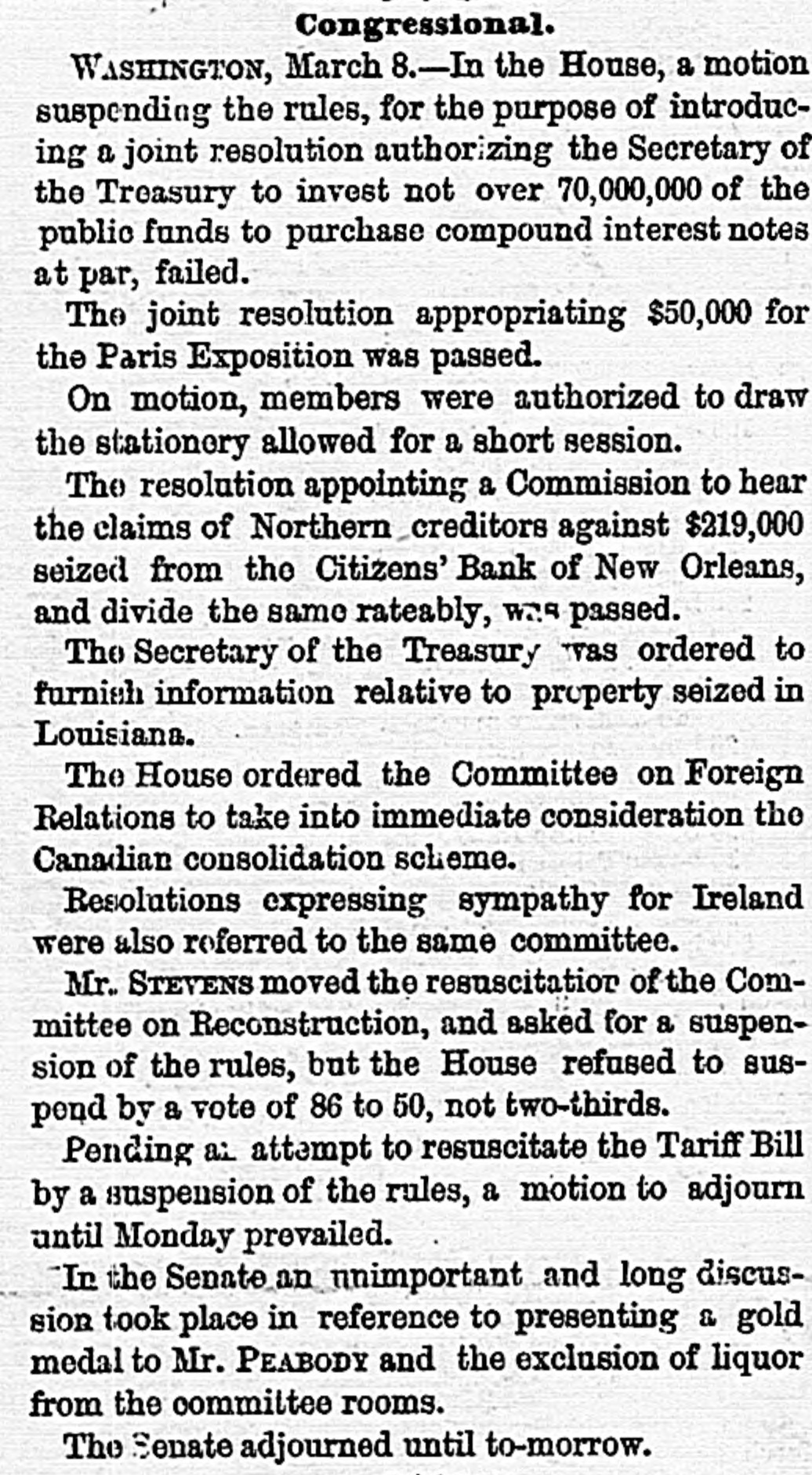
Congressional. WASHINGTON, March 8.-In the House, a motion suspending the rules, for the purpose of introducing a joint resolution authorizing the Secretary of the Treasury to invest not over 70,000,000 of the public funds to purchase compound interest notes at par, failed. The joint resolution appropriating $50,000 for the Paris Exposition was passed. On motion, members were authorized to draw the stationery allowed for a short session. The resolution appointing a Commission to hear the claims of Northern creditors against $219,000 seized from the Citizens' Bank of New Orleans, and divide the same rateably, was passed. The Secretary of the Treasury was ordered to furnish information relative to property seized in Louisiana. The House ordered the Committee on Foreign Relations to take into immediate consideration the Canadian consolidation scheme. Resolutions expressing sympathy for Ireland were also referred to the same committee. Mr. STEVENS moved the resuscitation of the Committee on Reconstruction, and asked for a suspension of the rules, but the House refused to suspend by a vote of 86 to 50, not two-thirds. Pending ai attempt to resuscitate the Tariff Bill by a suspension of the rules, a motion to adjourn until Monday prevailed. "In the Senate an unimportant and long discussion took place in reference to presenting a gold medal to Mr. PEABODY and the exclusion of liquor from the committee rooms. The Senate adjourned until to-morrow.


Article from The Laurens Advertiser, May 26, 1886

Click image to open full size in new tab

Article Text

expressed, they passed at par in several seaports of Dixie "for at least a month," as Col. Capers carefully puts it, "after they were issued." Several large bills of exchange were bought in London and Paris at par. But the financial boom of the Confederacy didn't last long. When it came to be August, '61, the Canal and Citizens' banks in New Orleans were the only ones handling Confederate money at par. On the 9th of August even they suspended specie payments, notifying the Richmond authorities of their intention two days in advance by a private cipher dispatch. Col. Capers has the original of this dispatch, in pursuance of which the Government made quite a saving speculation for itself by buying up all the foreign exchange it could lay its hands on in New Orleans, Mobile, Savannah, Charleston and Richmond during the two days of grace. Col. Capers's recollection of those early days of the war are a continuous story of makeshifts and expedients. The young Government lived from hand to mouth. One of the first naval officers to report for duty was Raphael Semmes, afterwards commander of the *Alabama*. He was on hand before they had a deck for him to stand on, and worked for a short time in the treasury department at Montgomery. A merchant vessel was soon bought and Semmes, after inspecting her, returned to Montgomery and announced to his fellow-clerk, Col. Capers: "She is a good craft, sir, a good craft. When I have strengthened her timbers and cut her down to fighting trim, my word for it, she will do brave work, sir." She was accordingly altered and armed and, with Semmes on her quarter-deck, made good his prediction to the dire cost of such as went down to the sea in ships under the Stars and Stripes in those days. The vessel was the *Sumter*. # SEMMES WHITTLES FOR I'S PAPERS. But when she was read to sail and her register made out, it was discovered at the last moment that the treasury department of the Confederate States had no seal. There wasn't an engraver to be found in Montgomery, and Semmes was impatient to get his papers and be off. So he and Col. Capers, aided by a handy young army surgeon, and at the expense of two or three penknives, carved a rude seal upon a piece of boxwood, which met the immediate need. Semmes got his register, and the *Sumter* set sail under the Stars and Bars. There was quite a time over the adoption of that flag. A considerable number were in favor of sticking to the old flag, with slight modifications, but Mr. Miles, of South Carolina, chairman of the Congressional flag committee, argued at length in his report against this sentimental idea, and added, by way of a clincher, that Liberia and the Sandwich Islands had flags very similar to ours, and the committee was not disposed, therefore, if for no other reason, "to keep, copy or imitate it. They have no inclination to borrow second-hand what has already been pilfered or appropriated by a free negro community and a race of savages." The very first Confederate flag that the sun ever saw, Col. Capers testifies, was hoisted by Judge Clitherall at Montgomery. He was in the confidence of the flag committee, and as soon as they told him the design selected he got his lady friends together and had one made. On the day the committee was to report to Congress he mounted the roof of the Capitol, fixed his flag to the halyards of the staff and waited. The recommendation of the committee was approved. He got his signal from below, and in the twinkling of an eye the new ensign of the South was floating proudly in the caresses of the gentle March wind. The news spread quickly through the city, and when Judge Clitherall shouted down from his lofty perch, "Three cheers for the Confederate flag" the crowd answered with a mighty greeting that, it was thought at the time, must have given an earache to the bronze statue on the dome of the far Northern Capitol.
Article from The Abbeville Messenger, June 8, 1886

Click image to open full size in new tab

Article Text

pany of Georgians, commanded by Capt. George Washington Lee. They were the first body of troops enlisted by the Confederacy. When their provisional Congress provided for a loan of $15,000,000 "to meet the emergencies of Government." they thereby provided another emergency. The Government had no paper to print their bonds, certificates and notes upon. They managed to get the chief ingredient of paper money credit very well, but stuck fast a while for lack of what is usually comparatively valueless. The paper mills of the South made only the ordinary newspaper and the common wrapping paper of the shops. The finer manufactories of the country lay north of the line of separation. G. B. Lamar, president of the Bank of the Republic, in New York, acting as agent for the to Comfederate Government, arranged have the work done by the American Bank Note Company, but when the bonds and notes were all handsomely printed and ready to be shipped the secret service officers of the National Government swooped down and confiscated the whole batch. The difficulty of finding paper and engravers was not solved until the removal of the Government from Montgomery to Richmond. The Richmond paper mills were finally able to furnish a sort of bank note paper, but the first issue was printed by a firm of German engravers in Richmond on paper smuggled through, the lines from Baltimore. The proof-sheet, of eight one-hundred dollar bills, was far from handsome, but they were in a hurry and they approved it. It is now in the possession of Col. Capers, and bears upon the back of it this incription, made at the time, in the d-writing of Secretary Memminger : "When the money changers become familiar with the peculiar features of these uncanny bills it will be as difficult to pass a counterfeit as if they were engraved on steel by an expert; maybe more 80." Secretary Memininger seems to have been both a wit and a philosopher. Unattractive in as they were appearuncertain in the promise they passed at par ance expressed, and they in several sea ports of Dixie "for at least a month," as Col. Capers carefully puts it, "after they were issued." Several large bills of exchange were bought in London and Paris at par. But the financial boom of the Confederacy didn't last long. When it came to be August, '61, the Canal and Citizens' banks in New Orleans were the only ones handling Confederate moiey at par. On the 9th of August even they suspended specie payments, notifying the Richmond authorities of their intention two days in advance by a private cipher dispatch. Col. Capers has the original of this dispatch, in pursuance of which the Government made quite a saving speculation.for itself by buying up all foreign exchange it could lay its hand3 on in New Orleans, Mobile, Savannah, Charleston and Richmond during the two days of grace. Col. Capers's recollection of those early days of the war are a continuous story of makeshifts and expedients. The young Government lived from hand to mouth. One of the first naval officers to report for duty was Rapheal Semmes, afterwards commander of the Alabama. He was on hand before had a deck for him to on for a short time in worked they the stand treasury and department at Montgomery. A merchant vessel was soon bought and Semmes, after inspecting her, returned to Montgomery and announced to his fellowclerk, Col. Capers : "She is a good craft, sir. a good craft. When I have strengthened her timbers and cut her down to fighting trim, my word for it, she will do brave work, sir." She was accordingly altered and armed and with Semmes on her quarter-deck made good his prediction to the dire cost of such as went down to the sea in ships under the Stars and Stripes in those days. The vessel was the Sumter. SEMMES


Article from The Banner-Democrat, January 2, 1897

Click image to open full size in new tab

Article Text

Some Southern Financial History. Representative Dalzell sprang a question in financial history in Congress a few days ago, when he asserted that the Tennessee and Louisiana bank notes, which Mrs. Flora Darling owned and which had been seized by Federal soldiers, were not worth par in gold. It depends upon what banks issued the notes. Louisiana had one of the best banking systems in the Union at the time the war broke out. Its "free banking" law is regarded by historians as a model. During the panic of 1857 most of the New Orleans banks with-stood the storm, and maintained specie payments, though the New York banks made no pretense of doing 80 with the EXception of the Chemical. The Pennsylvania banks suspended al. most at the beginning of the trouble -in fact, as early as August 24. Here in the Ohio valley, in South Carolina and New Orleans the banks promptly redeemed their notes. At the breaking out of the war the State Bank of Louisiana had the largest specie reserve of any State in the Union, $4,133,000. The Citizens' Bank held $3,332,000. There is little doubt that these banks, all of which were managed by able financiers, could have kept up specie payments during the war. At the request of the Governor, however, they suspended September 16, 1861, the Southern alone excepted. This was done in order to help maintain the credit of the Con. federate notes. Representative Boatner says the bank notes continued to circulate at par, and he is doubtless right. Banking historians pay high tributes to the financial institutions in many parts of the South. Among others the State Bank of South Carolina is on record as being one of the best managed concerns in the world. It did not suspend payments for sixty years. While the Tennessee banks have not 60 honorable a record, the Bank of Tennessee was 80 well managed that in the course of twenty years it paid the State a net profit of $4,700,000. It removed all its assets to the South early in the war, and although they were never recovered yet when the bank was wound up by the Legislature in 1866 the notes were all redeemed. No doubt they freely circulated while greenbacks were depreciated, just as the bonds of this and other States remained at par while United States bonds were going begging at a discount. Mr. Dalzell is a man of too great ability and reputation to make such a point against a bill without proper investigation. If he would read the history of banking during the war be would learn many things that would surprise him. He would learn, also, that many Southern States have a much more honorable financial history than his own, populous and wealthy though it was as compared to them.-Courier Jour. nal.