Click image to open full size in new tab
Article Text
IN NEW HAMPSHIRE
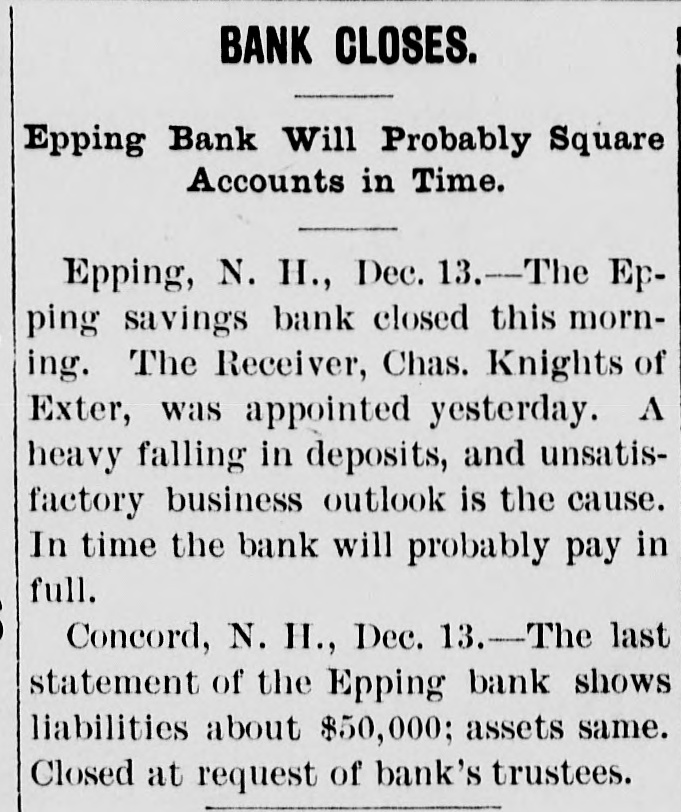
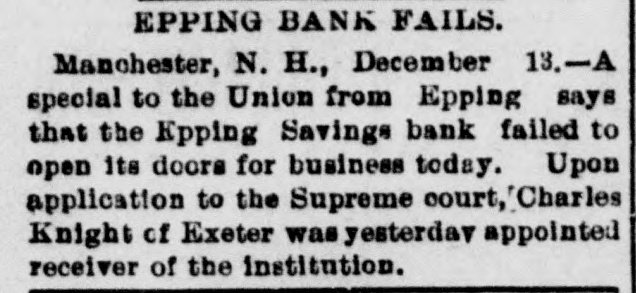
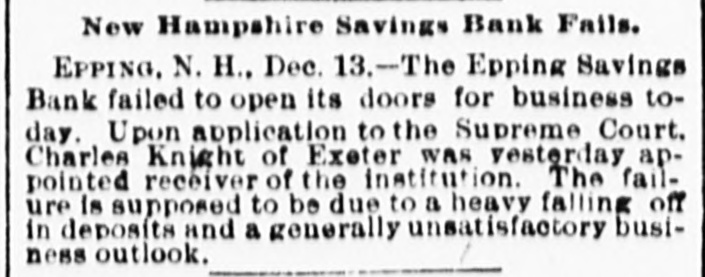
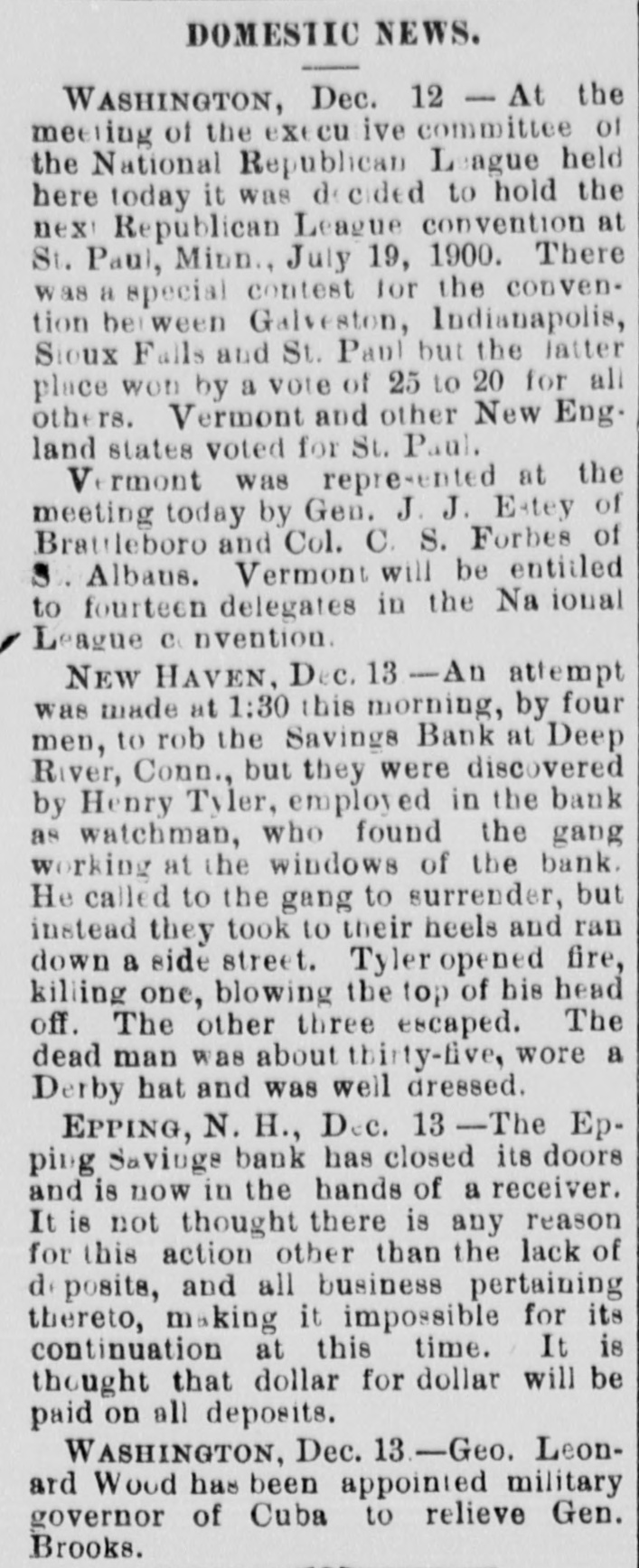
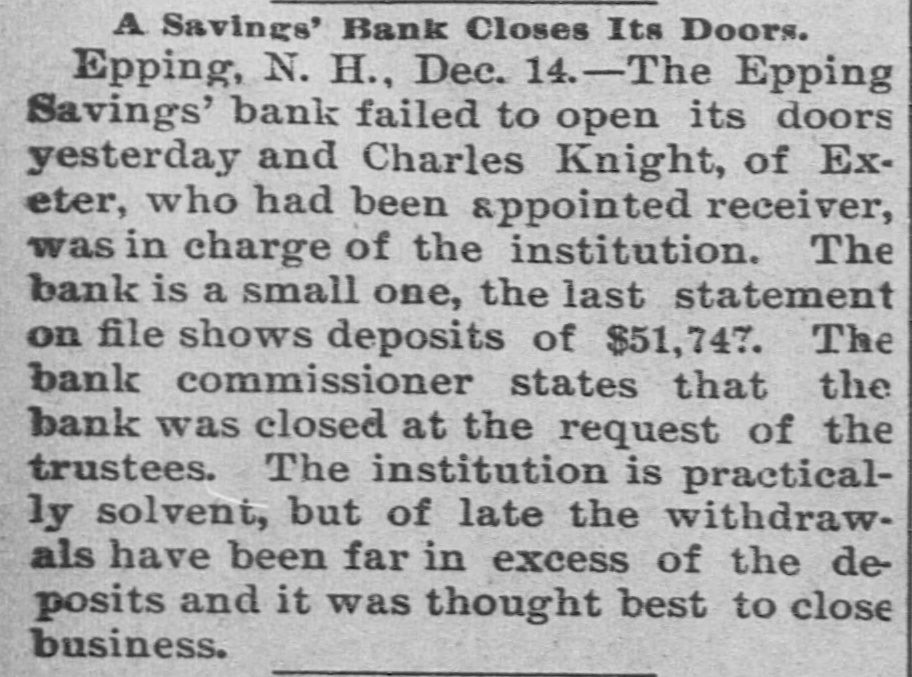
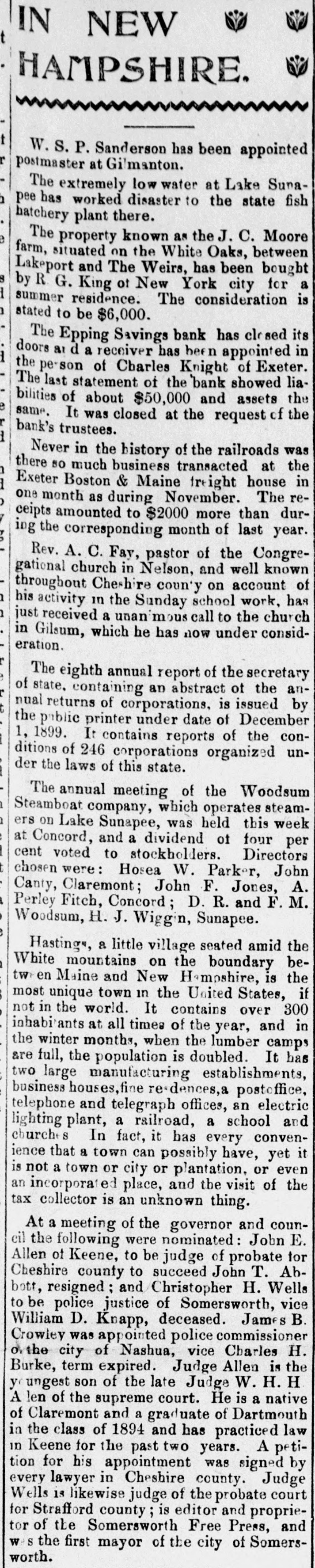
W. S. P. Sanderson has been appointed postmaster at Gilmanton. The extremely low water at Lake Sunapee has worked disaster to the state fish hatchery plant there. The property known as the J. C. Moore farm, situated on the White Oaks, between Lakeport and The Weirs, has been bought by R G. King of New York city for a summer residence. The consideration is stated to be $6,000. The Epping Savings bank has closed its doors at d a receiver has bee n appointed in the person of Charles Knight of Exeter. The last statement of the bank showed liabilities of about $50,000 and assets the same. It was closed at the request of the bank's trustees. Never in the history of the railroads was there so much business transacted at the Exeter Boston & Maine freight house in one month as during November. The receipts amounted to $2000 more than during the corresponding month of last year. Rev. A. C. Fay, pastor of the Congregational church in Nelson, and well known throughout Cheshire coun'y on account of his activity in the Sunday school work, has just received a unan mous call to the church in Gilsum, which he has now under consideration. The eighth annual report of the secretary of state. containing an abstract of the annual returns of corporations, is issued by the public printer under date of December 1, 1899. It contains reports of the conditions of 246 corporations organized under the laws of this state. The annual meeting of the Woodsum Steamboat company, which operates steamers on Lake Sunapee, was held this week at Concord, and a dividend of four per cent voted to stockholders. Directors chosen were: Hosea W. Parker, John Canty, Claremont; John F. Jones, A. Perley Fitch, Concord; D. R. and F. M. Woodsum, H. J. Wiggin, Sunapee. Hastings, a little village seated amid the White mountains on the boundary betw en Maine and New Hampshire, is the most unique town in the United States, if not in the world. It contains over 300 inhabitants at all times of the year, and in the winter months, when the lumber camps are full, the population is doubled. It has two large manufacturing establishments, business houses, fine re-dences,a postoffice, telephone and telegraph offices, an electric lighting plant, a railroad, a school and churches In fact, it has every convenience that a town can possibly have, yet it is not a town or city or plantation, or even an incorporated place, and the visit of the tax collector is an unknown thing. At a meeting of the governor and council the following were nominated: John E. Allen of Keene, to be judge of probate for Cheshire county to succeed John T. Abbott, resigned and Christopher H. Wells to be police justice of Somersworth, vice William D. Knapp, deceased. James B. Crowley was appointed police commissioner o, the city of Nashua, vice Charles H. Burke, term expired. Judge Allen is the y ungest son of the late Judge W. H. H A len of the supreme court. He is a native of Claremont and a graduate of Dartmouth in the class of 1894 and has practiced law in Keene for the past two years. A petition for his appointment was signed by