First National Bank (Rockford, IL)

Episode Information

Episode UID
42900831
Episode Type
Suspension โ†’ Closure
Bank Type
national
Bank ID
4290 national
Charter Number
429
Start Date
March 15, 1869
Location
Rockford, Illinois (42.271, -89.094)

Metadata

Model
gpt-5-mini (chosen from majority vote of a three-model LLM ensemble)
Short Digest
f8477b2de7612990

Response Measures

None

Receivership Details

Depositor recovery rate
41.9%
Date receivership started
1869-03-15
Date receivership terminated
1875-12-04
OCC cause of failure
Fraud
Share of assets assessed as good
89.6%
Share of assets assessed as doubtful
10.4%

Description

Reports describe disappearance of the cashier and apparent embezzlement uncovered by the examiner.

Events (4)

1. May 20, 1864 Chartered
Source
historical_nic
2. March 15, 1869 Receivership
Source
historical_nic
3. March 15, 1869 Receivership
Newspaper Excerpt
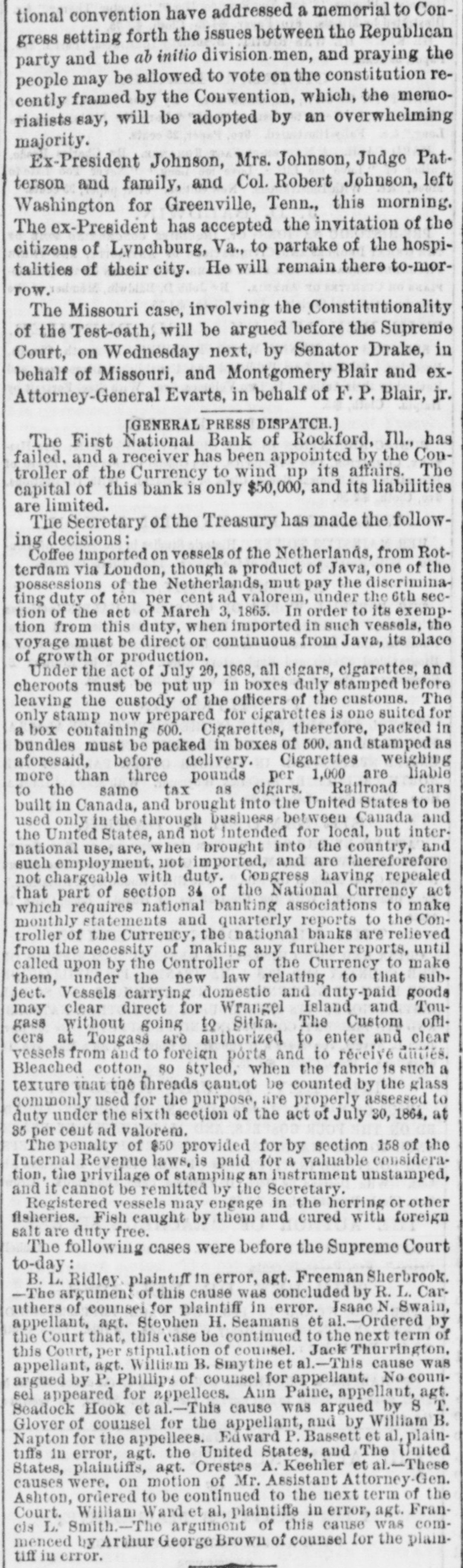
The First National Bank of Rockford, Illinois, has failed, and a receiver has been appointed by the Comptroller of the Currency to wind up its affairs.
Source
newspapers
4. March 15, 1869 Suspension
Cause
Government Action
Cause Details
Comptroller of the Currency appointed a receiver to wind up the bank after discovery of missing assets and irregularities.
Newspaper Excerpt
The First National Bank of Rockford, Ill., has failed, and a receiver been appointed.
Source
newspapers

Newspaper Articles (11)

Article from The Portland Daily Press, March 19, 1869

Click image to open full size in new tab

Article Text

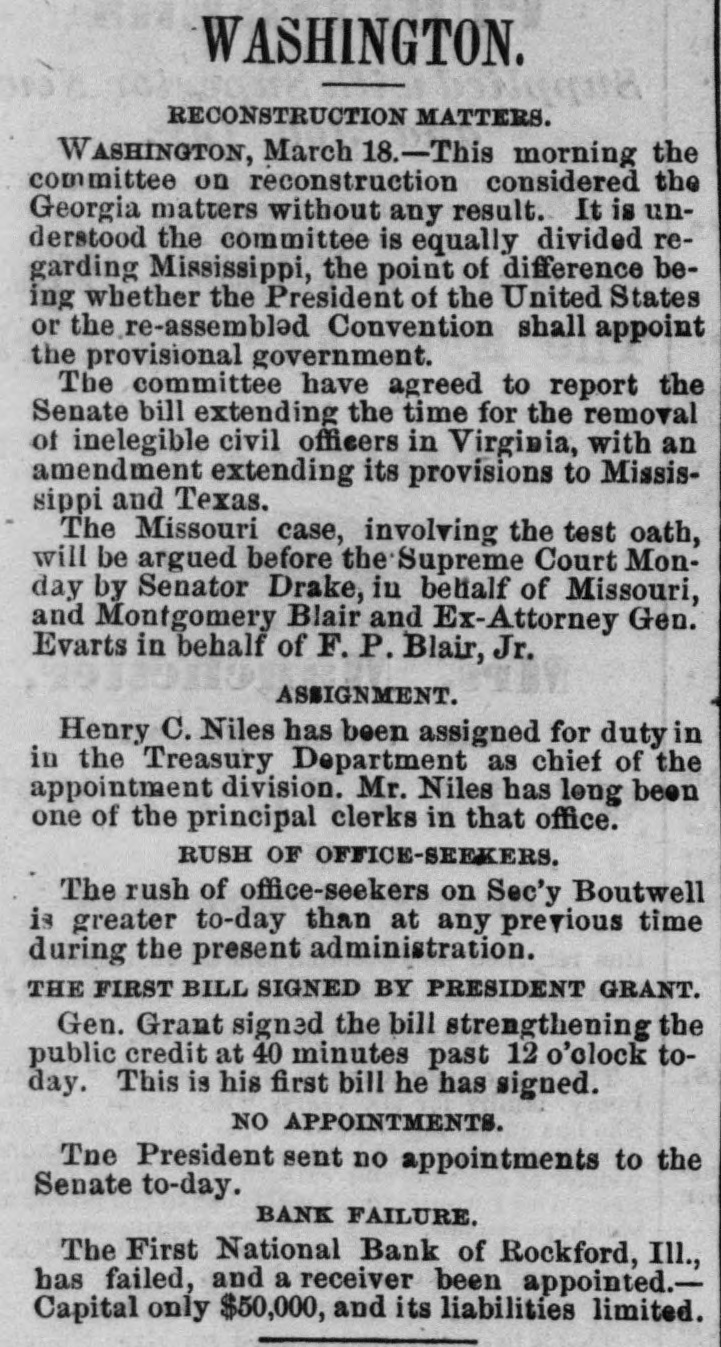
WASHINGTON. RECONSTRUCTION MATTERS. WASHINGTON, March 18.-This morning the committee on reconstruction considered the Georgia matters without any result. It is understood the committee is equally divided regarding Mississippi, the point of difference being whether the President of the United States or the re-assembled Convention shall appoint the provisional government. The committee have agreed to report the Senate bill extending the time for the removal of inelegible civil officers in Virginia, with an amendment extending its provisions to Mississippi and Texas. The Missouri case, involving the test oath, will be argued before the Supreme Court Monday by Senator Drake, in behalf of Missouri, and Montgomery Blair and Ex-Attorney Gen. Evarts in behalf of F. P. Blair, Jr. ASSIGNMENT. Henry C. Niles has been assigned for duty in in the Treasury Department as chief of the appointment division. Mr. Niles has long been one of the principal clerks in that office. RUSH OF OFFICE-SEEKERS. The rush of office-seekers on Sec'y Boutwell is greater to-day than at any previous time during the present administration. THE FIRST BILL SIGNED BY PRESIDENT GRANT. Gen. Grant signed the bill strengthening the public credit at 40 minutes past 12 o'olock today. This is his first bill he has signed. NO APPOINTMENTS. The President sent no appointments to the Senate to-day. BANK FAILURE. The First National Bank of Rockford, Ill., has failed, and a receiver been appointed.Capital only $50,000, and its liabilities limited.


Article from The New York Herald, March 19, 1869

Click image to open full size in new tab

Article Text

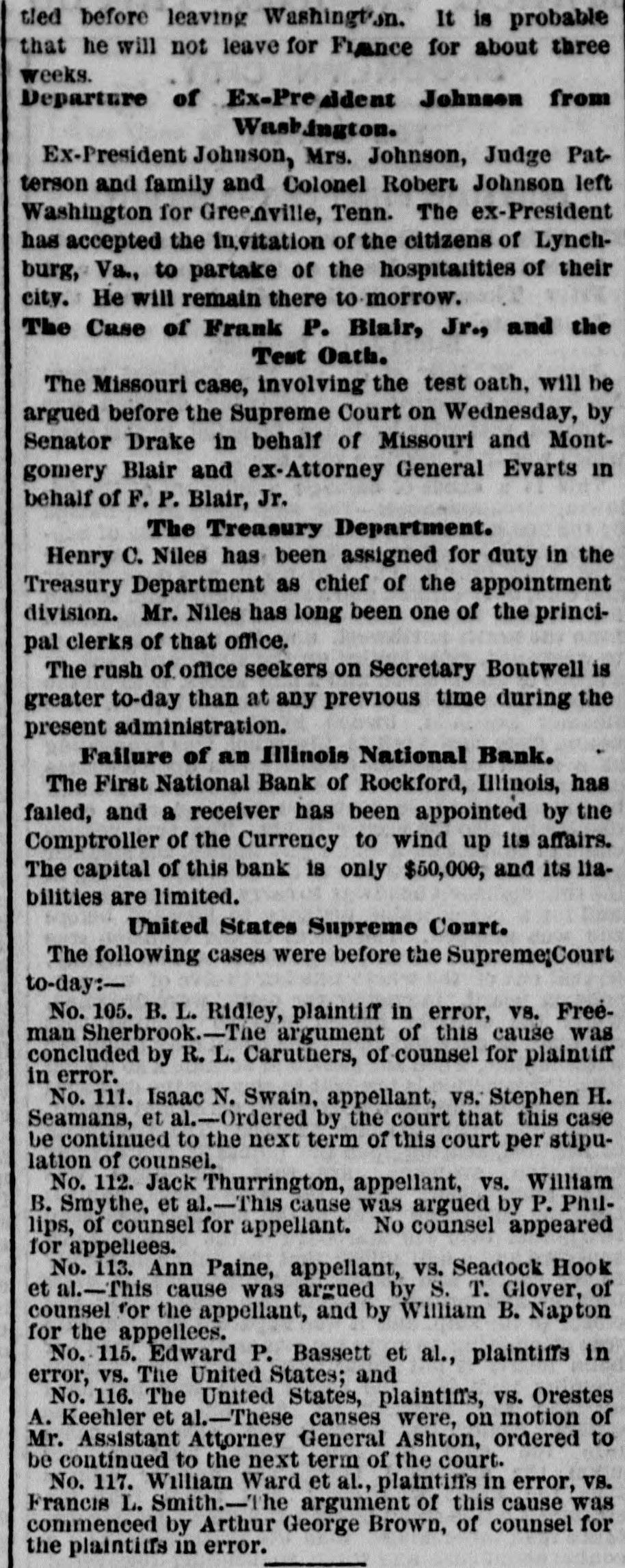
tled before leaving Washington. It is probable that he will not leave for Figance for about three weeks. Departure of Ex-Pre-ident Johnson from Washington. Ex-President Johnson, Mrs. Johnson, Judge Patterson and family and Colonel Robert Johnson left Washington for Greenville, Tenn. The ex-President has accepted the invitation of the citizens of Lynchburg, Va., to partake of the hospitalities of their city. He will remain there to-morrow. The Case of Frank P. Blair, Jr., and the Test Oath. The Missouri case, involving the test oath, will be argued before the Supreme Court on Wednesday, by Senator Drake in behalf of Missouri and Montgomery Blair and ex-Attorney General Evarts in behalf of F. P. Blair, Jr. The Treasury Department. Henry C. Niles has been assigned for duty in the Treasury Department as chief of the appointment division. Mr. Niles has long been one of the principal clerks of that office. The rush of office seekers on Secretary Boutwell is greater to-day than at any previous time during the present administration. Failure of an Illinois National Bank. The First National Bank of Rockford, Illinois, has failed, and a receiver has been appointed by the Comptroller of the Currency to wind up its affairs. The capital of this bank is only $50,000, and its liabilities are limited. United States Supreme Court. The following cases were before the SupremeCourt to-day:No. 105. B. L. Ridley, plaintiff in error, vs. Freeman Sherbrook.-The argument of this cause was concluded by R. L. Carutners, of counsel for plaintiff in error. No. 111. Isaac N. Swain, appellant, vs. Stephen H. Seamans, et al.-Ordered by the court that this case be continued to the next term of this court per stipulation of counsel. No. 112. Jack Thurrington, appellant, vs. William B. Smythe, et al.-This cause was argued by P. Phillips, of counsel for appellant. No counsel appeared for appellees. No. 113. Ann Paine, appellant, vs. Seadock Hook et 1.-This cause was argued by S. T. Glover, of counsel for the appellant, and by William B. Napton for the appellees. No. 115. Edward P. Bassett et al., plaintiffs in error, vs. The United States; and No. 116. The United States, plaintiffs, vs. Orestes A. Keehler et al.-These causes were, on motion of Mr. Assistant Attorney General Ashton, ordered to be continued to the next term of the court. No. 117. William Ward et al., plaintiffs in error, vs. Francis L. Smith.- The argument of this cause was commenced by Arthur George Brown, of counsel for the plaintiffs in error.


Article from The Daily Dispatch, March 20, 1869

Click image to open full size in new tab

Article Text

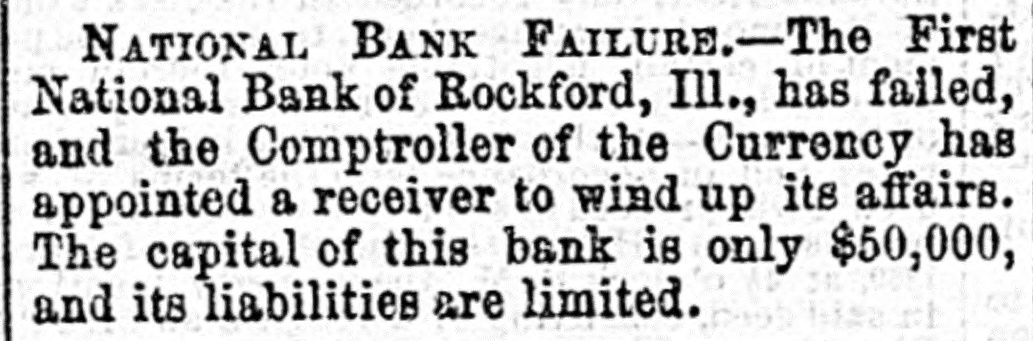
NATIONAL BANK FAILURE.-The First National Bank of Rockford, Ill., has failed, and the Comptroller of the Currency has appointed a receiver to wind up its affairs. The capital of this bank is only $50,000, and its liabilities are limited.


Article from Chicago Tribune, March 22, 1869

Click image to open full size in new tab

Article Text

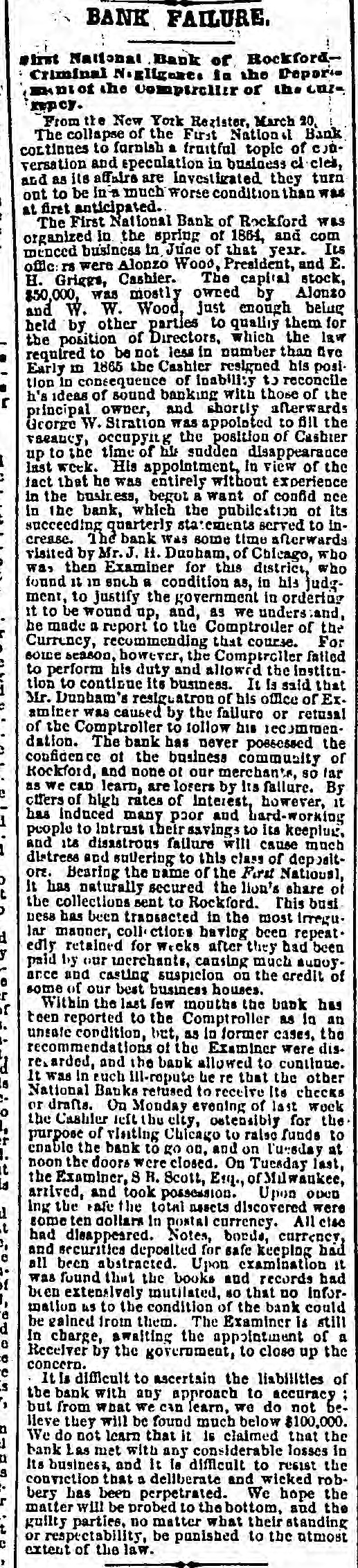
BANK FAILURE. wint National Bank of RockfordCriminal Nigligents in the Depart= nt of the Computer or the curKepcy. From the New York Register, March 20, The collapse of the First National Bank cortinues to farnish a fruitful topic of C)D versation and epeculation in business cl cles, and as its affairs are Investigated they turn out to be in a much worse condition than was at firet anticipated. The First National Bank of Rockford was organized in the spring of 1864, and com menced business in June of that year. Its offic rs were Alonzo Wood, President, and E. H. Griggs, Cashier. The capital stock, $50,000, was mostly owned by Alonzo and W. W. Wood, just enough belug held by other parties to quality them for the position of Directors, which the law required to be not less in number than five Early in 1865 the Cashier resigned his post tion in consequence of inability to reconcile h's ideas of sound banking with those of the r principal owner, and shortly afterwards George W. Stration was appolated to fill the vacaucy, occupying the position of Cashier up to the time of his sudden disappearance last week. His appointment, in view of the fact that he was entirely without experience in the business, begot a want of confid nce in the bank, which the pubilication ot its succeeding quarterly sta ements served to in crease. The bank was some time afterwards visited by Mr.J. H. Duoham, of Chicago, who was then Examiner for this district, who found it in such B condition as, in his judg ment, to justify the government in ordering it to be wound up, and, as we unders and, he made a report to the Comptroder of the Currency, recommending that course. For soice season, however, the Comptrciler failed to perform his duty and allowed the Institution to continue its business. It Is said that Mr. Dunbam's resignation of his office of Ex. smiter was caused by the failure or retusal of the Comptroller to follow his recommend dation. The bank has never possessed the confidence of the business community of Rockford, and none ot our merchants, so far as we can learn, are losers by its failure. By offers of high rates of Interest, however, it has Induced many poor and hard. working people to Intrust their savings to its keeplue. and its disastrous failure will cause much distress and sullering to this class of depositore. Bearing the name of the First National, It has naturally secured the lion's share ot the collections sent to Rockford. This busi ness has been transacted in the most Irregular manner, collections baving been repeat edly retained for weeks after they had been paid by our merchants, causing much aunoy. ance and casting suspicion on the credit of some of our best business houses. Within the last few mouths the bank has teen reported to the Comptroller as in an unsate condition, but, as in former cases, the recommendations of the Examiner were dis re. arded, and the bank allowed to continue. It was In such ill-repute be re that the other National Bauks refused to receive Its checks or drafts. On Monday evening of last work the Cashier left the city, ostensibly for the purpose of visiting Chicago to ralso funds to enable the bank to go on. and on l'unsday at noon the doors were closed. On Tuesday last, the Examiner, SR. Scott, Etq., of Milwaukee, a open arrived, and took possession. Upon Ing the rafe the total assets discovered were someten dollars In postal currency. All cisc had disappeared. Notes, bords, currency, and securities deposited for safe keeplog had all been abstracted. Upon examination it was found that the books and records had of been extensively mutilated, 40 that no infor, mation 45 to the condition of the bank could e be gained from them. The Examiner is still In charge, awaiting the appointment of a Receiver by the government, to close up the concern. It Is difficult to ascertain the liabilities of the bank with any approach to accuracy but from what we can learn, we do not belleve they will be found much below $100,000. We do not learn that it is claimed that the bank Las met with any considerable losses In Its business, and It la difficult to resist the conviction that a deliberate and wicked rob bery has been perpetrated. We hope the matter will be probed to the bottom, and the guilty parties. no matter what their standing or respectability, be panished to the atmost extent of the law.


Article from Memphis Daily Appeal, March 23, 1869

Click image to open full size in new tab

Article Text

Stocks were weak at the opening today, and seemed to favor a further decline, which soon took place, but they became steadier before noon. At the 2 o'clock board there was more activity, but no improvement in prices, and closed very much unsettled : Wells & Fargo Ex., 301; American Ex., 404; Adams' Ex., 58 ; U. 8. Ex., 541; Merchants Union Ex., 16; Quicksilver, 20; Canton 57; Pacific Mail, 861; West. ern Union Telegraph Co., 37 ; New York Central, 1543; Erie, 343 to -; Hudson, 1361; Reading, 911; Chicago & Alton, 149; preferred, 151; Toledo, W. and W., 66; preferred St. Paul, 69 ; - preferred 78A; Ft. Wayne, 1191; Ohio and Mississippi,32}; Michigan Central, 117; Michigan Southern, 96; Illinois Central, 138; Cieveland & Pittsburg, 87; Cleveland & Toledo, 1061; Rock Island, 1281 ; Chicago & Northwestern, 831; preferred, 911. The First National Bank of Rockford, Ill., has failed, and a receiver been appointed. The capital is only $50,000, and liabilities limited. The new National Stock Exchange, of New York, which was brought into life mainly from the sale of Erie stock since the latter has been dropped from the call at the old board, was organized a few days ago. The authorities at Washington sustain United States Assessor Webster in his efforts to collect the tax on the actual as well as the specific tax employed by brokers in their business, whether the amount 80 used be borrowed from themselves or others. Preparations are now being made for the introduction of the new series of postage stamps. The one-cent stamp is headed with the vignette of Franklin, the first Postmaster General under the Colonial system, as well as the first under the confederation preparatory to the Federal Union. In the two, three and twelve cent stamps there is an illustration of the improvements in mail transportation, from the primitive rider on horeeback to the railroad train for the land service and the steamship for the ocean service. The remaining six stamps of the set form a series of their own, beginning in the six cent stamps with an accurate copy of the face of Washington, as shown in Stuart's picture at the Executive Mansion, and ending in the ninety cent stamp, with the head of Lincoln as significant of a new era of universal freedom. Two others of this national series, fleen and twenty-four cent respectively, have miniature copies of the landing of Columbus-and of the Declaration of Independence in the rotunda of the capitol. In the ten cent stamps the American eagle appears resting upon the American shield, and in the thirty cent stamps are comprised in one group all the national emblems of the eagle, the shield and the flag, and presenting, also, the national colors, red white and blue.


Article from The Democratic Press, April 1, 1869

Click image to open full size in new tab

Article Text

BANK FAILUER-The First National Bank of Rockford, Ill., has recently failed, and a receiver has been appoint= ed by the Comptroller of the Currency to close up its affairs. The capital stock of the bank is $50,000. The liabilities are supposed to be $100,000.An examination showed the entire assets in the vaults to be about ten dollars. "Perfectly safelimism


Article from The Kenosha Telegraph, April 8, 1869

Click image to open full size in new tab

Article Text

From the Rockford (III.) Gazette. The Rockford Bank "Failure." The more we here in regard to the conduct of the owners of the late First National bank of this city, the more heartless and criminal do they appear. Besides the poor, hard-working man and woman who have been swindled out of their earnings, we are daily hearing of acts of dishonesty, and lately even of forgery, to a large ammount, which we deemed impossible, but are black, hard facts. Under the energetic administration of Dr. R. P. Lane, the receiver, the rascalities, large and small, of the officers of the late swindle, are being unearthed. He is daily receiving certificates and proofs of deposit, and is filing them away in their order, for the examination of the bank anthorites at Washington he is also energetically proceeding to develop what he can of the lawful assets of the bank, and other property, are being put under the scrutiny of the officers of the law. Every effort is being made to recover all that is possible from the wreck.


Article from Memphis Daily Appeal, September 22, 1873

Click image to open full size in new tab

Article Text

WASHINGTON, September 20.-The comptroiler of the currency is paying dividends of twenty-five per cent. to creditors of the first national bank of Rockford, Illinois, one hundred per cent. to the creditors of the first national bank of Fort Smith, Arkansas, and thirty-five per cent. to the creditors of the national bank of Vicksburg. The comptroller of currency has directed the collecti 13 paper of the first national bank of Washington to be deposited for collection with the National Metropolitan bank, and correspondents are requested to correspond with the latter bank in reference thereto, and thus facilitate the business of the receiver.


Article from The Daily State Journal, September 22, 1873

Click image to open full size in new tab

Article Text

WASHINGTON. Suspended and Broken National Banks -Measures Taken to Liquidate their Indebtedness. WASHINGTON, September 21.-The comptroller of the currency is paying dividends of twenty-five per cent. to the creditors of the First national bank of Rockford, Illinois; one hundred per cent. to the creditors of the First national bank of Fort Smith, Arkansas, and thirty-five per cent. to creditors of the national bank of Vicksburg, Mississippi dividends of thirty-five per cent. to the creditors of the First national bank of Selma, Alabama, and fifteen per cent. to the creditors of the Atlantic national bank of New York, will be paid as soon as the necessary schedule can be prepared. Dividends to the creditors of the First national bank and Crescent City national banks of New Orleans will also be made in the month of October. The comptroller of the currency has directed the collection paper of the First national bank of Washington to be deposited for collection with the National metropolitan bank, which is located next door. Correspondents are requested to correspond with the latter bank in reference thereto, thus facilitating the business of the receiver. Items. WASHINGTON, September 22.-A piivate dispatch from Shreveport in relation to the yellow fever is discouraging. Information has been received here announcing the conclusion of a treaty with the Ute Indians of Colorado, ceding to the United States four millions of acres of land, believed to be of great value on account of mineral deposits. One of the most remarkable features of our present financial disturbances, if not of all past commotions, is, that not one Jewish bank or banker has suspended ; and this leads to a consideration of the general fact that in Europe they are regarded by leading statesmen as the most clear-headed and reliable financiers.


Article from Wilmington Daily Gazette, September 23, 1873

Click image to open full size in new tab

Article Text

The Keystone Bank-Its Suspension Monday Morning. The State financial institutions in Philadelphia are one by one suspending payment, in consequence of the inability on their part to secure currency. The one cry is "Greenbacks! Greenbacks!" to which, unfortunately, there in no response. This morning the Keystone Bank, on Chestnut stteet, opposite the Mint, refused to cash checks, believing that justice would be better meted out to all by suspending at once instead of paying on the start some tifteen or twenty depositors to the exclusion of the rest. The bank has on hand any amount of securities, but all are holding their greenbacks for their own particular purposes.The difficulty is not in the drawing out of large amounts, but all are retaining their deposits to meet their own payments, fearing that a call upon the bank would not be promptly met. The mational banks this morning were to have furnished certain amounts in currency, but instead they sent their cheeks. The officers have been mying to those who caffed with checks that they hoped to pay currency in the morning.-Telegraph of Monday. DIVIDENDS TO CREDITORS OF BANKRUPT NATIONAL BANKS. The Controller of the Currency is paying dividends of 25 percent. to the creditors of the First National Bank of Rockford, Illinois ; 100 per cent. to the creditors of the First National Bank of Fort Smith, Arkansas, and 35 per cent. to the creditors of the National Bank of Vicksburg, Mississippi. Dividends of 35 per cent. to the creditors of the First National Bank of Selma, Alabama, and of 15 per cent. to the creditors of the Atlantic National Bank of New York, will be paid as soon as the necessary schedules can be prepared. Dividends to the creditors to the First National and Crescent City National Banks of New Orleans, will also be made in the month of October.


Article from The San Francisco Call, June 25, 1897

Click image to open full size in new tab

Article Text

YEARLY LOSS OF PAPER MONEY. To the Editor of the San Francisco Call-SIR: In order to obtain the annual percentage of loss of paper money in circulation I have searched through the reports of the Treasury Department from 1867 to 1897 for a record of National banks which have failed and have had their circulation withdrawn and canceled as the law requires. In no report have I found any reference made to the annual percentage of loss. On page 27 of Comptroller Knox's report for 1883 we find groups of failed banks with dates of organization. By going back through the record of the department to the volume for 1875 we find the dates when receivers were appointed for the fifteen banks which had failed prior to 1870. With the date of organization and date of failure thus found we are able to determine how long these fifteen banks were in existence, and having the percentage of the lost notes given at the last date named (1883) we can calculate the annual percentage of loss. I have selected eight of these fifteen National banks as a fair average of the whole fifteen, which are thus reported: Attica, N. Y.; Farmers' and Citizens', Brooklyn, N. Y.; First National, Bethel, Conn.; Rockford, III.: Austin, Nev.; Merchants', D. C.; Memphis, Tenn., and New Orleans, La. They may be numbered and grouped as follows: