Sherman Bank (New York, NY)

Episode Information

Episode UID
4463032791132
Episode Type
Run โ†’ Suspension โ†’ Closure
Bank Type
state
Bank ID
446303279 hash
Start Date
April 21, 1894
Location
New York, New York (40.714, -74.006)

Metadata

Model
gpt-5-mini (chosen from majority vote of a three-model LLM ensemble)
Short Digest
4b74407444294f3d

Response Measures

None

Description

Run in April 1894 preceded a voluntary liquidation declared July 1894; a receiver was later appointed (1897).

Events (3)

1. April 21, 1894 Run
Cause
Correspondent
Cause Details
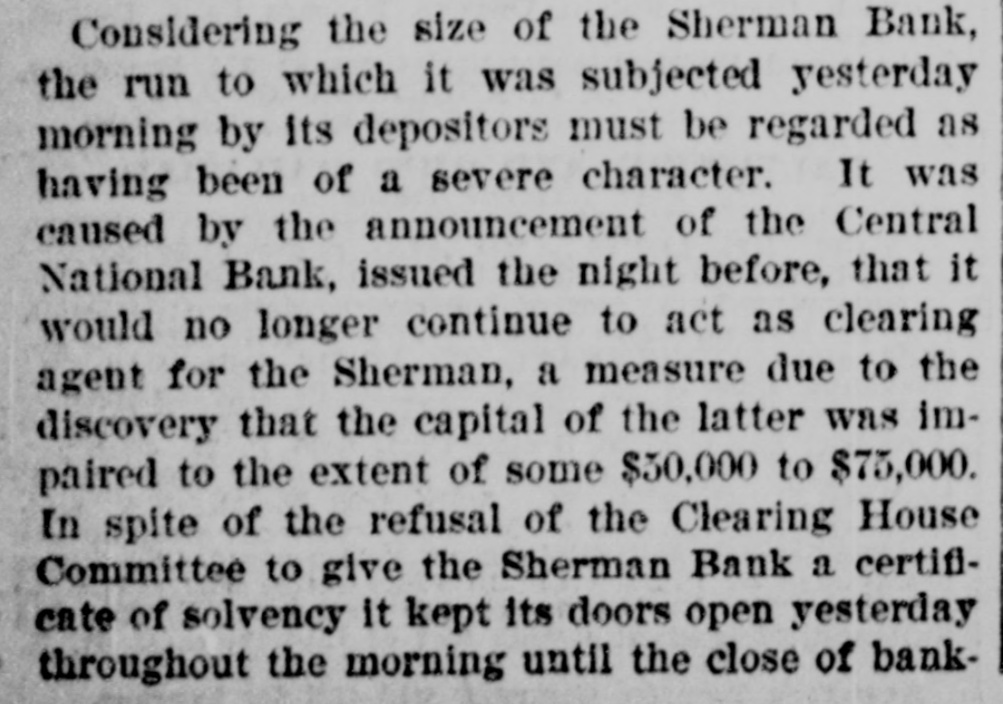
Clearing-house/clearing bank (United States/Central National) refused or withdrew clearing support, precipitating withdrawals.
Measures
Directors and wealthy directors guaranteed deposits; other banks (Central National) sent assistance and directors announced paying depositors in full as asked.
Newspaper Excerpt
A quiet but persistent run on the Sherman bank continued throughout the day. Between $75,000 and $100,000 was pulled out.
Source
newspapers
2. July 21, 1894 Suspension
Cause
Voluntary Liquidation
Cause Details
Directors and stockholders decided to cease business and voluntarily liquidate due to diminished business and depleted surplus after the April run.
Newspaper Excerpt
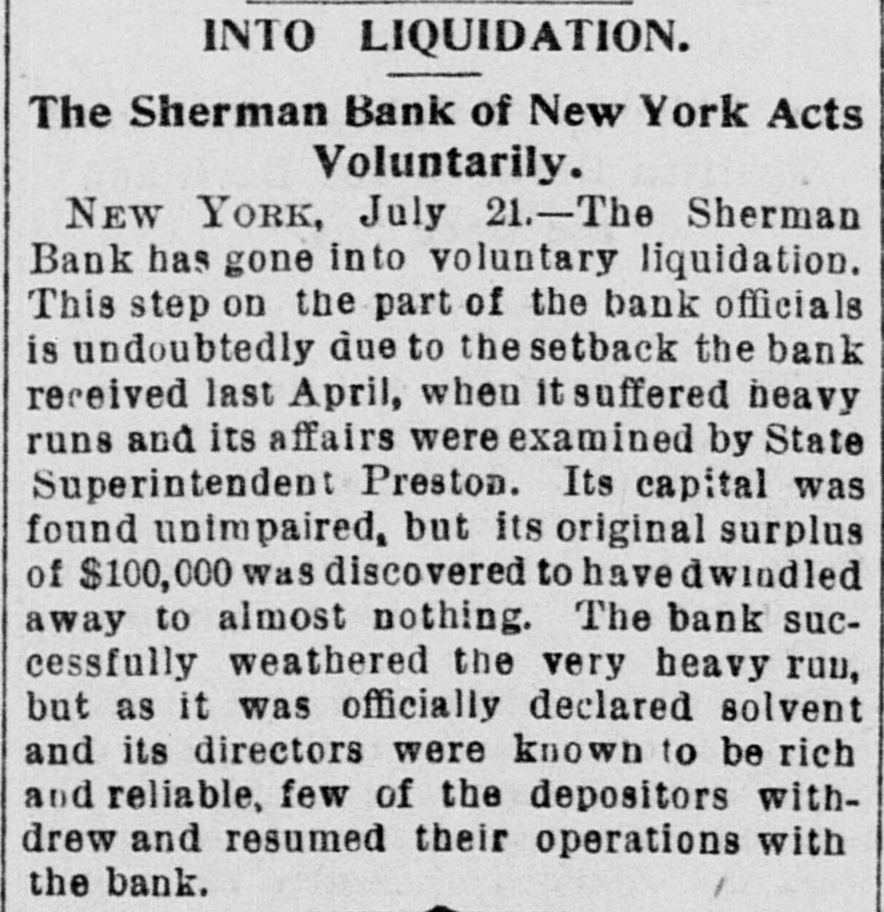
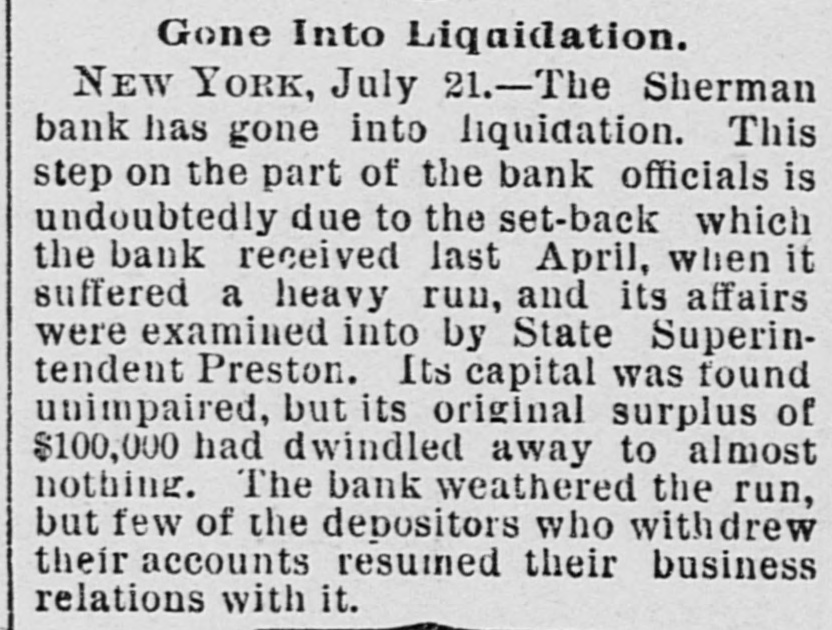
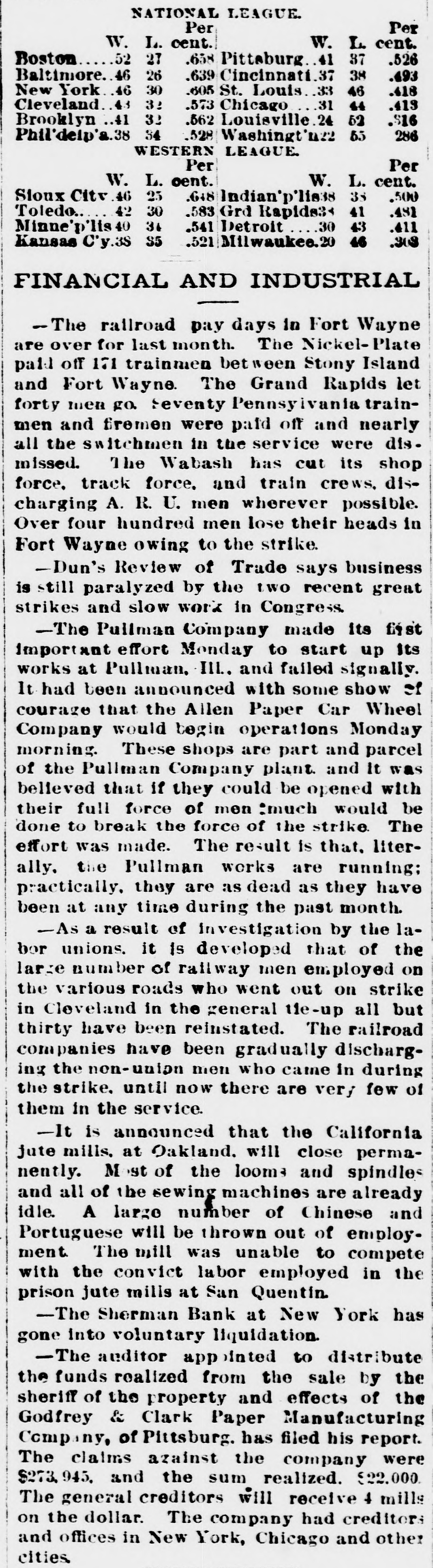
The Sherman Bank has gone into voluntary liquidation.
Source
newspapers
3. June 11, 1897 Receivership
Newspaper Excerpt
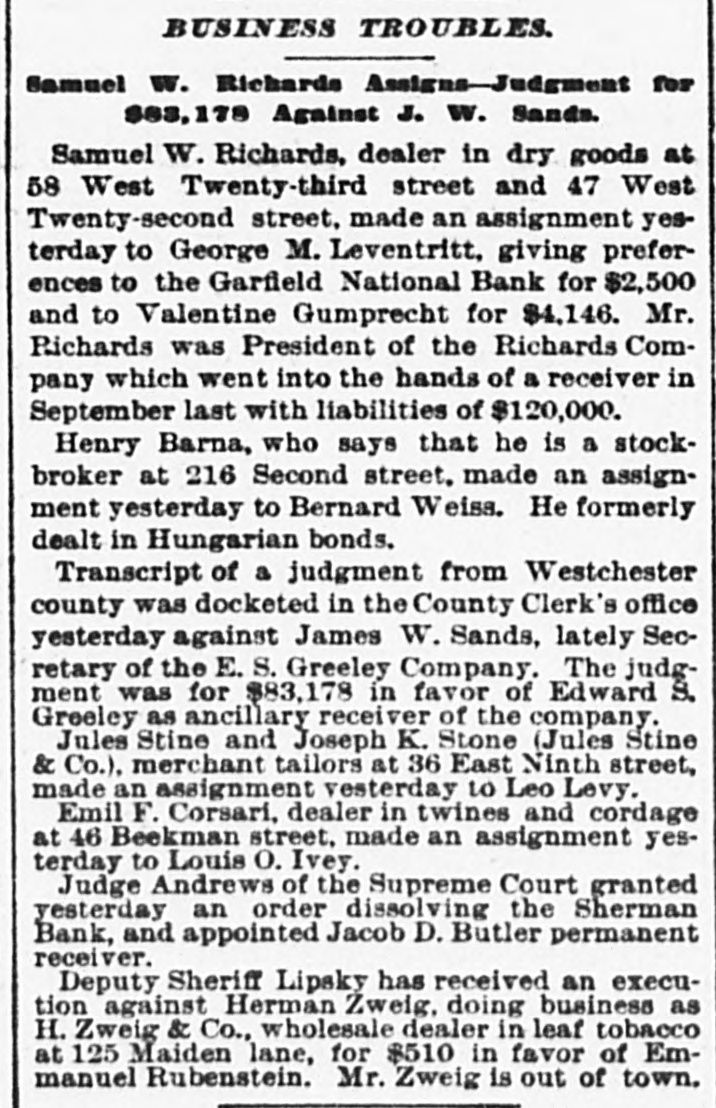
Judge Andrews of the Supreme Court granted yesterday an order dissolving the Sherman Bank, and appointed Jacob D. Butler permanent receiver. (The Sun, 1897-06-11). }
Source
newspapers

Newspaper Articles (22)

Article from Evening Journal, April 21, 1894

Click image to open full size in new tab

Article Text

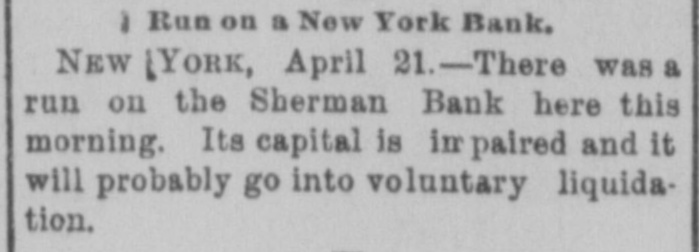
1 Run on a New York Bank. NEW [YORK, April 21.-There was a run on the Sherman Bank here this morning. Its capital is impaired and it will probably go into voluntary liquidation.


Article from The Herald, April 22, 1894

Click image to open full size in new tab

Article Text

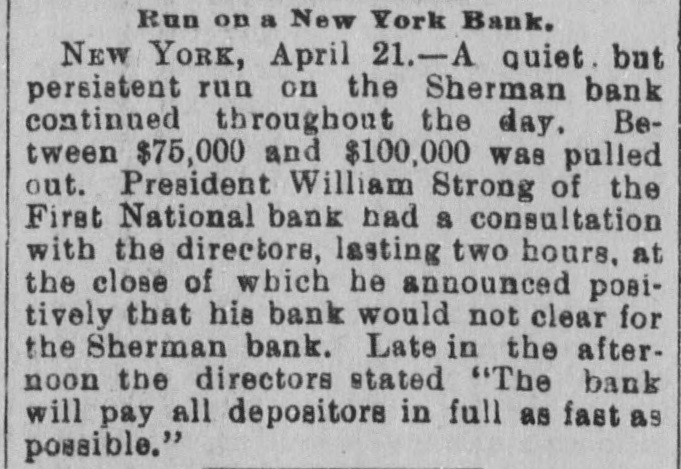
Run on a New York Bank. NEW YORK, April 21.-A quiet. but persistent run on the Sherman bank continued throughout the day. Between $75,000 and $100,000 was pulled out. President William Strong of the First National bank had a consultation with the directors, lasting two hours. at the close of which he announced positively that his bank would not clear for the Sherman bank. Late in the afternoon the directors stated "The bank will pay all depositors in full as fast as possible."


Article from The Salt Lake Herald, April 22, 1894

Click image to open full size in new tab

Article Text

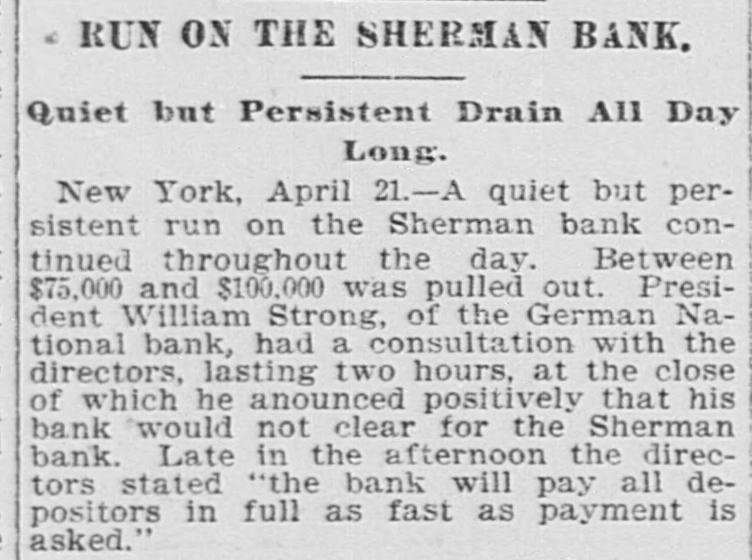
6. RUN ON THE SHERMAN BANK. Quiet but Persistent Drain All Day Long. New York, April 21.-A quiet but persistent run on the Sherman bank continued throughout the day. Between $75,000 and $100,000 was pulled out. President William Strong, of the German National bank, had a consultation with the directors, lasting two hours, at the close of which he anounced positively that his bank would not clear for the Sherman bank. Late in the afternoon the directors stated "the bank will pay all depositors in full as fast as payment is asked."


Article from Daily Kennebec Journal, April 23, 1894

Click image to open full size in new tab

Article Text

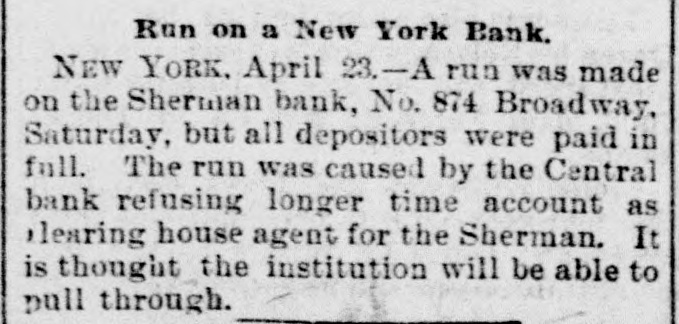
Run on a New York Bank. NEW YORK, April 23.-A run was made on the Sherman bank, No. 874 Broadway. Saturday, but all depositors were paid in full. The run was caused by the Central bank refusing longer time account as learing house agent for the Sherman. It is thought the institution will be able to pull through.


Article from New-York Tribune, April 25, 1894

Click image to open full size in new tab

Article Text

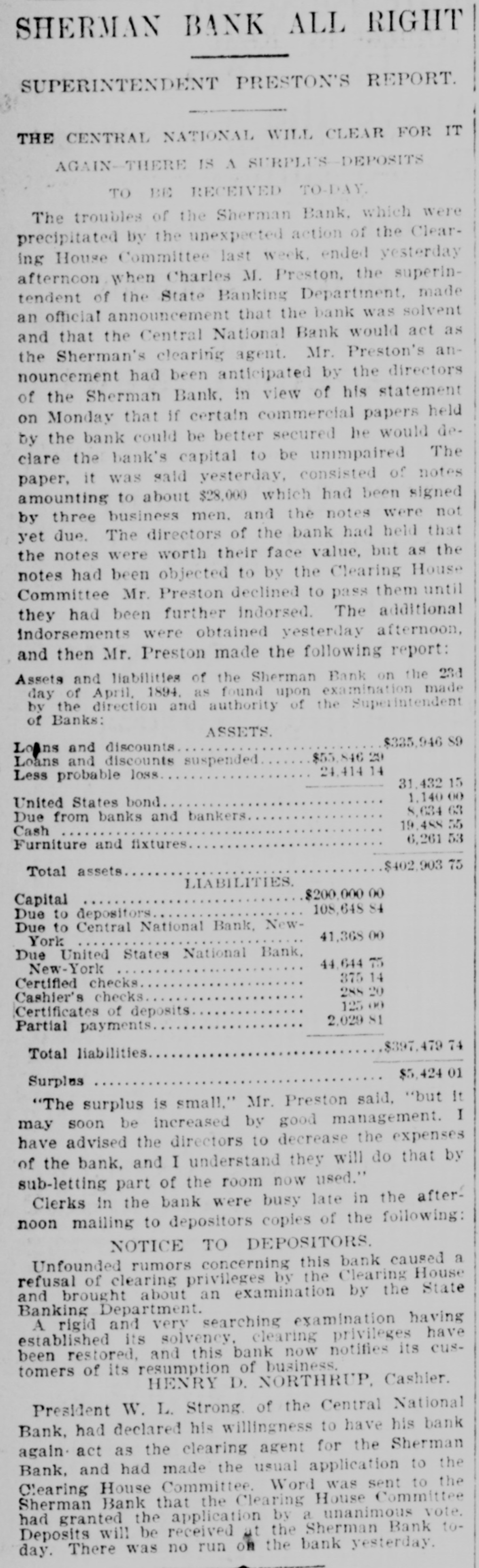
SHERMAN BANK ALL RIGHT SUPERINTENDENT PRESTON'S REPORT. THE CENTRAL NATIONAL WILL CLEAR FOR IT AGAIN-THERE IS A SURPLUS DEPOSITS TO BE RECEIVED TO-DAY. The troubles of the Sherman Bank, which were precipitated by the unexpected action of the Clearing House Committee last week, ended yesterday afternoon when Charles M. Preston, the superintendent of the State Banking Department, made an official announcement that the bank was solvent and that the Central National Bank would act as the Sherman's clearing agent. Mr. Preston's announcement had been anticipated by the directors of the Sherman Bank, in view of his statement on Monday that if certain commercial papers held by the bank could be better secured he would declare the bank's capital to be unimpaired The paper, it was said yesterday, consisted of notes amounting to about $28,000 which had been signed by three business men. and the notes were not yet due. The directors of the bank had held that the notes were worth their face value, but as the notes had been objected to by the Clearing House Committee Mr. Preston declined to pass them until they had been further indorsed. The additional indorsements were obtained yesterday afternoon, and then Mr. Preston made the following report: Assets and liabilities of the Sherman Bank on the 28d day of April, 1894. as found upon examination made by the direction and authority of the Superintendent of Banks: ASSETS. $335,946 S9 Loins and discounts $55,846.29 29 Loans and discounts suspended 24,414.14 Less probable loss 31,432 1,140.00 United States bond 8,634 Due from banks and bankers 19,488 Cash 6,261 53 Furniture and fixtures $402,903 75 Total assets LIABILITIES. $200,000.0 Capital 108,648 84 Due to depositors Due to Central National Bank, New41,368.00 York Due United States National Bank, 44,644 75 New-York 375 14 Certified checks 288 20 Cashier's checks 125.00 Certificates of deposits 2,029 81 Partial payments $397,479.74 Total liabilities $5,424.01 Surplus "The surplus is small," Mr. Preston said, "but It may soon be increased by good management. I have advised the directors to decrease the expenses of the bank, and I understand they will do that by sub-letting part of the room now used." Clerks in the bank were busy late in the afternoon mailing to depositors copies of the following: NOTICE TO DEPOSITORS. Unfounded rumors concerning this bank caused a refusal of clearing privileges by the Clearing House and brought about an examination by the State Banking Department. A rigid and very searching examination having established its solvency, clearing privileges have been restored, and this bank now notifies its customers of its resumption of business. HENRY D. NORTHRUP, Cashier. President W. L. Strong. of the Central National Bank, had declared his willingness to have his bank again. act as the clearing agent for the Sherman Bank, and had made the usual application to the Clearing House Committee. Word was sent to the Sherman Bank that the Clearing House Committee had granted the application by a unanimous vote. Deposits will be received at the Sherman Bank today. There was no run OR the bank yesterday.


Article from The Evening World, April 26, 1894

Click image to open full size in new tab

Article Text

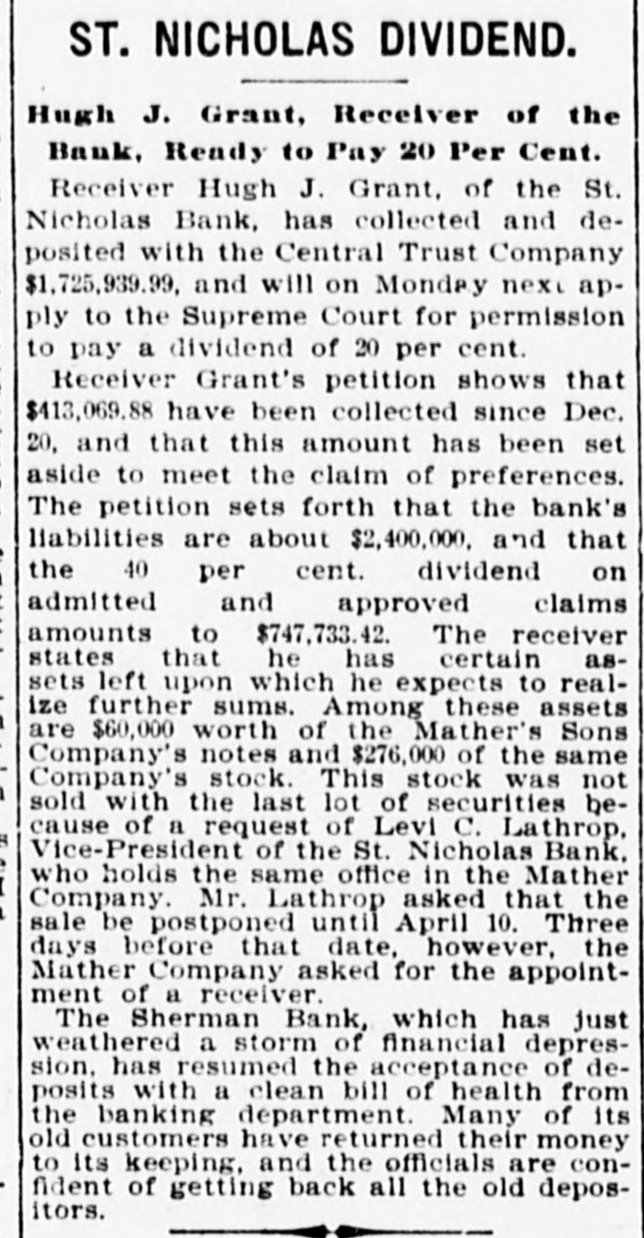
ST. NICHOLAS DIVIDEND. Hugh J. Grant, Receiver of the Bank, Ready to Pay 20 Per Cent. Receiver Hugh J. Grant, of the St. Nicholas Bank, has collected and deposited with the Central Trust Company $1,725,939.99, and will on Monday next apply to the Supreme Court for permission to pay a dividend of 20 per cent. Receiver Grant's petition shows that $413,069.88 have been collected since Dec. 20, and that this amount has been set aside to meet the claim of preferences. The petition sets forth that the bank's liabilities are about $2,400,000, and that the 40 per cent. dividend on admitted and approved claims amounts to $747,733.42. The receiver states that he has certain assets left upon which he expects to realize further sums. Among these assets are $60,000 worth of the Mather's Sons Company's notes and $276,000 of the same Company's stock. This stock was not sold with the last lot of securities because of a request of Levi C. Lathrop, Vice-President of the St. Nicholas Bank, who holds the same office in the Mather Company. Mr. Lathrop asked that the sale be postponed until April 10. Three days before that date, however, the Mather Company asked for the appointment of a receiver. The Sherman Bank, which has just weathered a storm of financial depression, has resumed the acceptance of deposits with a clean bill of health from the banking department. Many of its old customers have returned their money to its keeping, and the officials are confident of getting back all the old depositors.


Article from The Evening World, April 26, 1894

Click image to open full size in new tab

Article Text

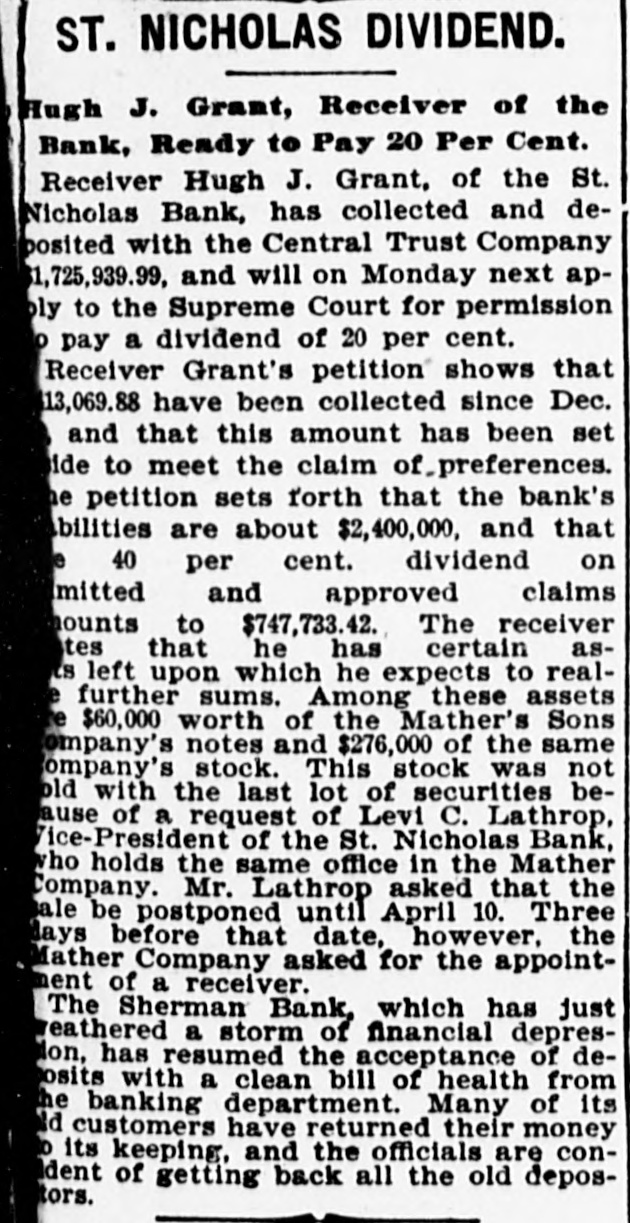
ST. NICHOLAS DIVIDEND. Hugh J. Grant, Receiver of the Bank, Ready to Pay 20 Per Cent. Receiver Hugh J. Grant, of the St. Nicholas Bank, has collected and deposited with the Central Trust Company $1,725,939.99, and will on Monday next apbly to the Supreme Court for permission pay a dividend of 20 per cent. Receiver Grant's petition shows that 13,069.88 have been collected since Dec. and that this amount has been set ide to meet the claim of preferences. e petition sets forth that the bank's bilities are about $2,400,000, and that e 40 per cent. dividend on mitted and approved claims ounts to $747,733.42. The receiver tes that he has certain asis left upon which he expects to realfurther sums. Among these assets e $60,000 worth of the Mather's Sons ompany's notes and $276,000 of the same ompany's stock. This stock was not old with the last lot of securities beause of a request of Levi C. Lathrop, 7ice-President of the St. Nicholas Bank, who holds the same office in the Mather Company. Mr. Lathrop asked that the ale be postponed until April 10. Three ays before that date, however, the Mather Company asked for the appointnent of a receiver. The Sherman Bank, which has just eathered a storm of financial depreslon, has resumed the acceptance of deosits with a clean bill of health from he banking department. Many of its Id customers have returned their money D its keeping, and the officials are condent of getting back all the old depostors.


Article from The Evening World, April 26, 1894

Click image to open full size in new tab

Article Text

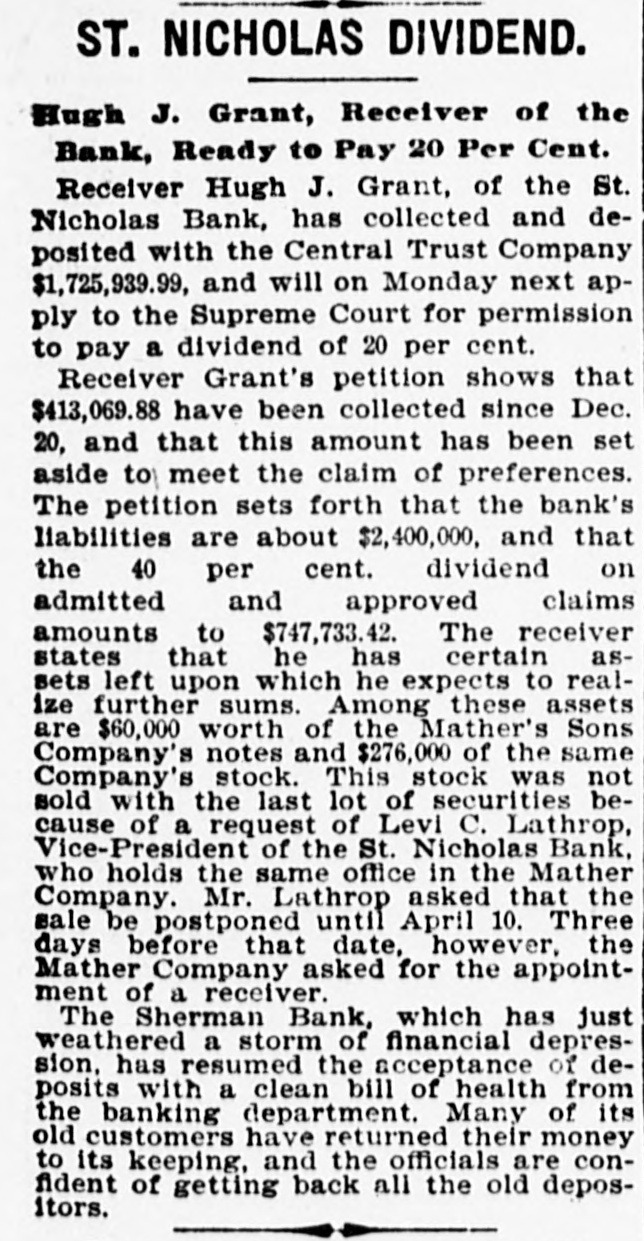
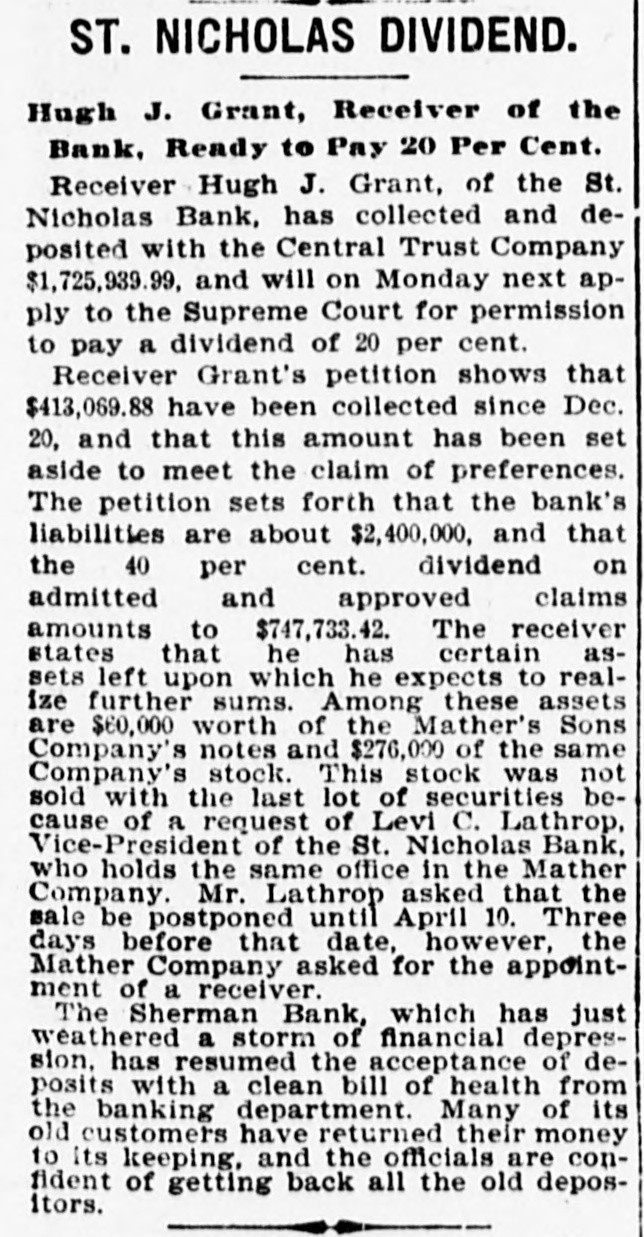
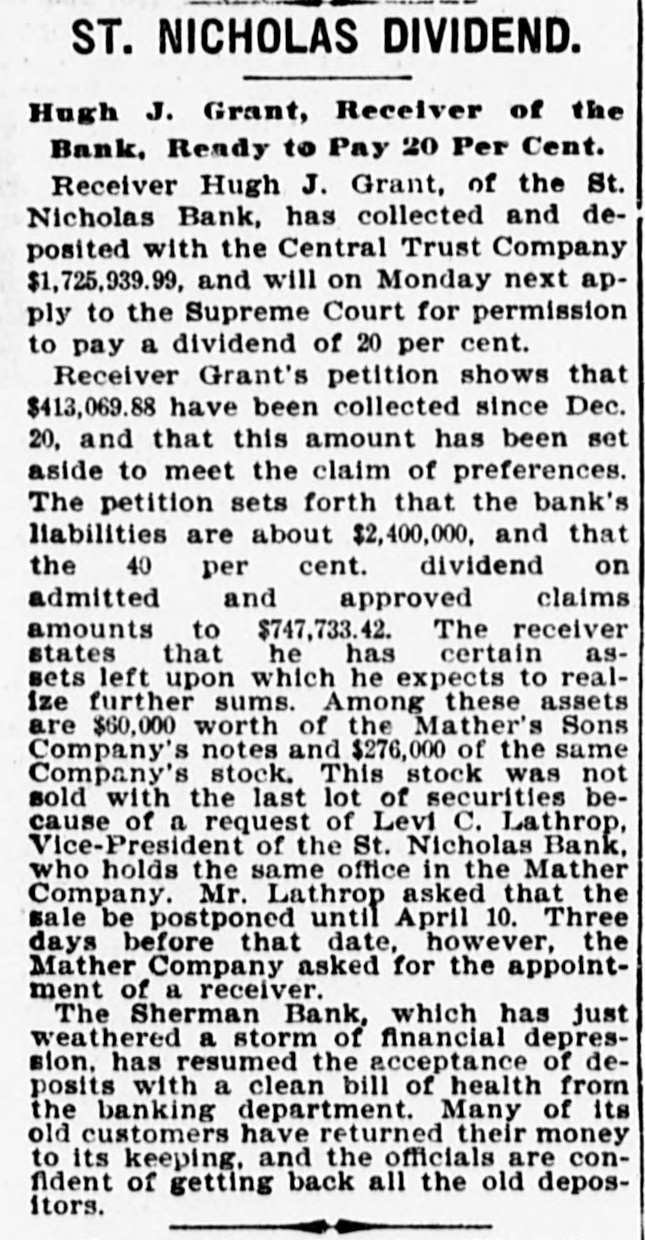
ST. NICHOLAS DIVIDEND. Hugh J. Grant, Receiver of the Bank, Ready to Pay 20 Per Cent. Receiver Hugh J. Grant, of the St. Nicholas Bank, has collected and deposited with the Central Trust Company $1,725,939.99, and will on Monday next apply to the Supreme Court for permission to pay a dividend of 20 per cent. Receiver Grant's petition shows that $413,069.88 have been collected since Dec. 20, and that this amount has been set aside to meet the claim of preferences. The petition sets forth that the bank's liabilities are about $2,400,000, and that the 40 per cent. dividend on admitted and approved claims amounts to $747,733.42. The receiver states that he has certain assets left upon which he expects to realize further sums. Among these assets are $60,000 worth of the Mather's Sons Company's notes and $276,000 of the same Company's stock. This stock was not sold with the last lot of securities because of a request of Levi C. Lathrop, Vice-President of the St. Nicholas Bank, who holds the same office in the Mather Company. Mr. Lathrop asked that the sale be postponed until April 10. Three days before that date, however, the Mather Company asked for the appointment of a receiver. The Sherman Bank, which has just weathered a storm of financial depression, has resumed the acceptance of deposits with a clean bill of health from the banking department. Many of its old customers have returned their money to its keeping, and the officials are confident of getting back all the old depositors.


Article from The Evening World, April 26, 1894

Click image to open full size in new tab

Article Text

ST. NICHOLAS DIVIDEND. Hugh J. Grant, Receiver of the Bank, Ready to Pay 20 Per Cent. Receiver Hugh J. Grant, of the St. Nicholas Bank, has collected and deposited with the Central Trust Company $1,725,939.99, and will on Monday next apply to the Supreme Court for permission to pay a dividend of 20 per cent. Receiver Grant's petition shows that $413,069.88 have been collected since Dec. 20, and that this amount has been set aside to meet the claim of preferences. The petition sets forth that the bank's liabilities are about $2,400,000, and that the 40 per cent. dividend on admitted and approved claims amounts to $747,733.42. The receiver states that he has certain assets left upon which he expects to real1ze further sums. Among these assets are $60,000 worth of the Mather's Sons Company's notes and $276,000 of the same Company's stock. This stock was not sold with the last lot of securities because of a request of Levi C. Lathrop, Vice-President of the St. Nicholas Bank, who holds the same office in the Mather Company. Mr. Lathrop asked that the sale be postponed until April 10. Three days before that date, however, the Mather Company asked for the appointment of a receiver. The Sherman Bank, which has just weathered a storm of financial depression, has resumed the acceptance of deposits with a clean bill of health from the banking department. Many of its old customers have returned their money to Its keeping, and the officials are confident of getting back all the old depositors.


Article from The Evening World, April 26, 1894

Click image to open full size in new tab

Article Text

ST. NICHOLAS DIVIDEND. Hugh J. Grant, Receiver of the Bank, Ready to Pay 20 Per Cent. Receiver Hugh J. Grant, of the St. Nicholas Bank, has collected and deposited with the Central Trust Company $1,725,939.99, and will on Monday next apply to the Supreme Court for permission to pay a dividend of 20 per cent. Receiver Grant's petition shows that $413,069.88 have been collected since Dec. 20, and that this amount has been set aside to meet the claim of preferences. The petition sets forth that the bank's liabilities are about $2,400,000, and that the 40 per cent. dividend on admitted and approved claims amounts to $747,733.42. The receiver states that he has certain assets left upon which he expects to realize further sums. Among these assets are $60,000 worth of the Mather's Sons Company's notes and $276,000 of the same Company's stock. This stock was not sold with the last lot of securities because of a request of Levi C. Lathrop, Vice-President of the St. Nicholas Bank, who holds the same office in the Mather Company. Mr. Lathrop asked that the sale be postponed until April 10. Three days before that date, however, the Mather Company asked for the appointment of a receiver. The Sherman Bank, which has just weathered a storm of financial depression, has resumed the acceptance of deposits with a clean bill of health from the banking department. Many of its old customers have returned their money to its keeping, and the officials are confident of getting back all the old depositors.


Article from The Salt Lake Herald, July 22, 1894

Click image to open full size in new tab

Article Text

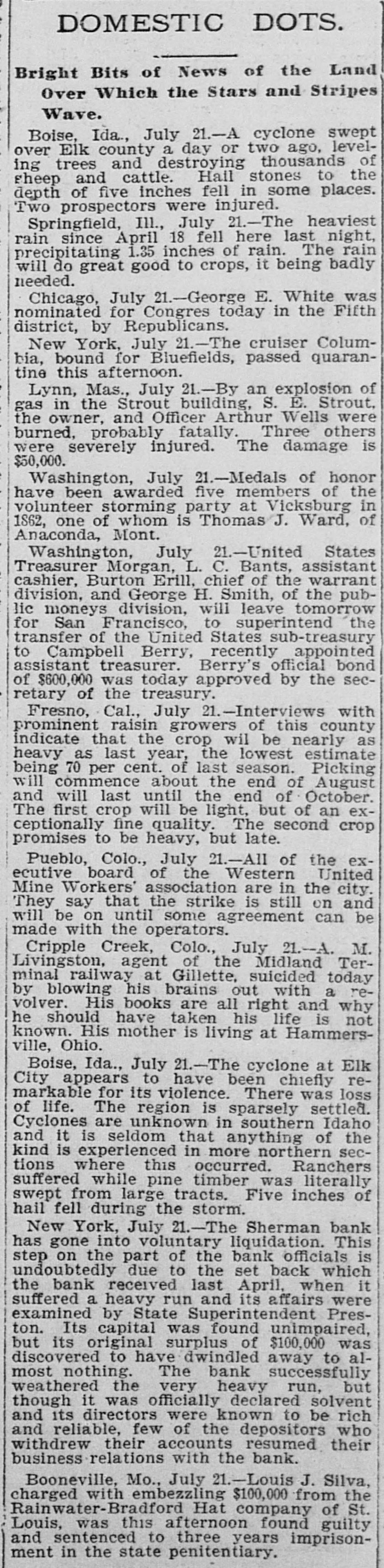
DOMESTIC DOTS. Bright Bits of News of the Land Over Which the Stars and Stripes Wave. Boise, Ida., July 21.-A cyclone swept over Elk county a day or two ago, leveling trees and destroying thousands of sheep and cattle. Hall stones to the depth of five inches fell in some places. Two prospectors were injured. Springfield, Ill., July 21.-The heaviest rain since April 18 fell here last night, precipitating 1.35 inches of rain. The rain will do great good to crops, it being badly needed. Chicago, July 21.-George E. White was nominated for Congres today in the Fifth district, by Republicans. New York, July 21.-The cruiser Columbia, bound for Bluefields, passed quarantine this afternoon. Lynn, Mas., July 21.-By an explosion of gas in the Strout building, S. E. Strout, the owner, and Officer Arthur Wells were burned, probably fatally. Three others were severely injured. The damage is $50,000. Washington, July 21.-Medals of honor have been awarded five members of the volunteer storming party at Vicksburg in 1862, one of whom is Thomas J. Ward, of Anaconda, Mont. Washington, July 21.-United States Treasurer Morgan, L. C. Bants, assistant cashier, Burton Erill, chief of the warrant division, and George H. Smith, of the public moneys division, will leave tomorrow for San Francisco, to superintend the transfer of the United States sub-treasury to Campbell Berry, recently appointed assistant treasurer. Berry's official bond of $600,000 was today approved by the secretary of the treasury. Fresno, Cal., July 21.-Interviews with prominent raisin growers of this county indicate that the crop wil be nearly as heavy as last year, the lowest estimate being 70 per cent. of last season. Picking will commence about the end of August and will last until the end of October. The first crop will be light, but of an exceptionally fine quality. The second crop promises to be heavy, but late. Pueblo, Colo., July 21.-All of the executive board of the Western United Mine Workers' association are in the city. They say that the strike is still on and will be on until some agreement can be made with the operators. Cripple Creek, Colo., July 21.-A. M. Livingston, agent of the Midland Terminal railway at Gillette, suicided today by blowing his brains out with a revolver. His books are all right and why he should have taken his life is not known. His mother is living at Hammersville, Ohio. Boise, Ida., July 21.-The cyclone at Elk City appears to have been chiefly remarkable for its violence. There was loss of life. The region is sparsely settled. Cyclones are unknown in southern Idaho and it is seldom that anything of the kind is experienced in more northern sections where this occurred. Ranchers suffered while pine timber was literally swept from large tracts. Five inches of hail fell during the storm. New York, July 21.-The Sherman bank has gone into voluntary liquidation. This step on the part of the bank officials is undoubtedly due to the set back which the bank received last April, when it suffered a heavy run and its affairs were examined by State Superintendent Preston. Its capital was found unimpaired, but its original surplus of $100,000 was discovered to have dwindled away to almost nothing. The bank successfully weathered the very heavy run, but though it was officially declared solvent and its directors were known to be rich and reliable, few of the depositors who withdrew their accounts resumed their business relations with the bank. Booneville, Mo., July 21.-Louis J. Silva, charged with embezzling $100,000 from the Rainwater-Bradford Hat company of St. Louis, was this afternoon found guilty and sentenced to three years imprisonment in the state penitentiary.


Article from The Morning Call, July 22, 1894

Click image to open full size in new tab

Article Text

INTO LIQUIDATION. The Sherman Bank of New York Acts Voluntarily. NEW YORK, July 21.-The Sherman Bank has gone into voluntary liquidation. This step on the part of the bank officials is undoubtedly due to the setback the bank received last April, when it suffered heavy runs and its affairs were examined by State Superintendent Preston. Its capital was found unimpaired, but its original surplus of $100,000 was discovered to have dwindled away to almost nothing. The bank successfully weathered the very heavy run, but as it was officially declared solvent and its directors were known to be rich and reliable, few of the depositors withdrew and resumed their operations with the bank.


Article from St. Paul Daily Globe, July 22, 1894

Click image to open full size in new tab

Article Text

Gone Into Liquidation. NEW YORK, July 21.-The Sherman bank has gone into liquidation. This step on the part of the bank officials is undoubtedly due to the set-back which the bank received last April, when it suffered a heavy run, and its affairs were examined into by State Superintendent Preston. Its capital was found unimpaired, but its original surplus of $100,000 had dwindled away to almost nothing. The bank weathered the run, but few of the depositors who withdrew their accounts resumed their business relations with it.


Article from New-York Tribune, July 24, 1894

Click image to open full size in new tab

Article Text

TO CLOSE THE SHERMAN BANK. IT IS GOING INTO VOLUNTARY LIQUIDA TION. DEPOSITORS AND STOCKHOLDERS WILL PAID IN FULL-HISTORY OF THE INSTITUTION. The ground floor of the building No. 874 Broadway is to let. It is now occupied by the Sherman Bank, which was organized in 1892 with a paid-up capital of $200,000 and a cash surplus of $100,000. Business has become steadily ess since last April, when, in consequence of a combination of circumstances, a run was made on the bank which for a time threat. ened Its existence. The shrinkage in business since then, and the generally depressed state of affairs, caused the d/rectors to give notice on last Tuesday that no more accounts would be opened, and depositors were requested to withdraw any balance which might be due them, the majority of the stockholders meanwhile having decided that the bank should go into voluntary liquidation. D. R. Satteriee was the first president of the bank, and was succeeded by Charles E. Bulkeley, who, after a few months' service, was succeeded by Eugene N Howell. James H. Parker, president of the United States National Bank. was a director of the Sherman Bank. but resigned, together with two other members of the board. when Mr. Howell became president, and his bank. which had been the Clearing House agent for the Sherman Bank from its start. refused longer to clear for it. This step on the part of the United States Bank caused much comment The Central National Bank succeeded the United States National as the Sherman Bank clearing agent, Another change in the presidency of the bank took place in April, when Louis C. Fuller succeeded Mr. Howell, and the Board of Directors was changed. The statements of the bank show that it had over six hundred depositors, and that in March, 1894, its deposits amounted to $401,375, an increase of $102.961 over September, 1893. In April the United States Bank made application to become the clearing agent once more for the Sherman Bank, whereupon an investigation was ordered, which took place April 18, and resulted in the United States Bank's request being granted. Two days after this there was a run on the bank. which though it was not serious, injured the bank. The Central Bank, which had always been friendly to the Sherman. then (without intent. the Sherman people say) caused the bank which was in trouble additional worry by Issuing a circular announcing that the bank would cease to redeem checks or drafts drawn or made payable to the Sherman Bank. That was on April 20, and the next day came another and more serious run on the bank. in a single day-April 21-the deposits shrank from over $300,000 to $100,000. But other banks came to the assistance of the Sherman. President Strong, of the Central Bank, sent up $15,000 to help it along. Several of the rich directors personally guaranteed the deposits, and the run was speedily checked. Mr. Judson. State Bank Examiner. reported that the bank's original surplus was nearly wiped out, but that the bank's capital was not impaired. He declared also that the bank was solvent and could borrow money. He criticised the management of the first president, under whose administration worthless loans had been made. and he cut down the bank's furniture inventory from $21,000 to $6,000. The cashier, Henry D. Northrop, was seen at the bank yesterday. He said: We are simply going out of business-something which many concerns would like to do If they could. We are doing It slowly and without any fuss. Mr. Northrop also confirmed the following statement made by him yesterday: Our expenses are large, our deposits are running & down and business has been poor. Although number of substantial business men have said that they would come in with us in the fall, the dlrectors thought that it would be wiser to pay our depositors and pay off the stockholders. The deposits are in small amounts. for the most part, and most of them are private accounts We did a regular banking business. We lent to some of the depositors of the Madison Square Bank 50 per cent of their accounts, taking an assignment of the whole as collateral. Of this money we have recelved about 50 per cent. The whole amount was $10,000. For several days we have been refusing deposits, and as fast as depositors have come in we have been asking them to close their accounts We have all the money necessary to pay our depositors, either in our own vaults or on deposit with our redeeming agents. It will take a long time to close up. We still have about $115,000 of deposits, and paid out to-day $17,000 Many of our depositors were unwilling to withdraw their money and in no instance has there been any anxiety on the part of depositors. The following notice was issued yesterday: A meeting of the stockholders of the Sherman Bank for the purpose of devising means to protect will their interests in the liquidation of said bank be held at the Holland House, Thirtieth-st and Tuesday July 31. 1894, at


Article from The Farmers' Union, August 2, 1894

Click image to open full size in new tab

Article Text

NATIONAL LEAGUE. | | W. | L. | Per cent. | | W. | L. | Per cent. | | -------- | ---- | ---- | --------- | -------- | ---- | ---- | --------- | | Boston | 52 | 27 | .658 | Pittsburg | 41 | 37 | .526 | | Baltimore | 46 | 26 | .639 | Cincinnati | 37 | 38 | .493 | | New York | 46 | 30 | .605 | St. Louis | 33 | 46 | .418 | | Cleveland | 43 | 32 | .573 | Chicago | 31 | 44 | .419 | | Brooklyn | 41 | 32 | .562 | Louisville | 24 | 52 | .316 | | Phil'delp'a | 38 | 34 | .528 | Washingt'n | 22 | 55 | .286 | WESTERN LEAGUE. | | W. | L. | Per cent. | | W. | L. | Per cent. | | --------- | ---- | ---- | --------- | --------- | ---- | ---- | --------- | | Sioux City | 46 | 25 | .648 | Indian'p'lis | 38 | 33 | .500 | | Toledo | 42 | 30 | .583 | Grd Rapids | 34 | 41 | .481 | | Minne'p'lis | 40 | 34 | .541 | Detroit | 30 | 43 | .411 | | Kansas C'y | 35 | 35 | .521 | Milwaukee | 20 | 46 | .303 | FINANCIAL AND INDUSTRIAL -The railroad pay days in Fort Wayne are over for last month. The Nickel-Plate paid off 171 trainmen between Stony Island and Fort Wayne. The Grand Rapids let forty men go. Seventy Pennsylvania trainmen and firemen were paid off and nearly all the switchmen in the service were dismissed. The Wabash has cut its shop force, track force, and train crews, discharging A. R. U. men wherever possible. Over four hundred men lose their heads in Fort Wayne owing to the strike. -Dun's Review of Trade says business is still paralyzed by the two recent great strikes and slow work in Congress. -The Pullman Company made its first important effort Monday to start up its works at Pullman, Ill., and failed signally. It had been announced with some show of courage that the Allen Paper Car Wheel Company would begin operations Monday morning. These shops are part and parcel of the Pullman Company plant, and it was believed that if they could be opened with their full force of men much would be done to break the force of the strike. The effort was made. The result is that, literally, the Pullman works are running; practically, they are as dead as they have been at any time during the past month. -As a result of investigation by the labor unions, it is developed that of the large number of railway men employed on the various roads who went out on strike in Cleveland in the general tie-up all but thirty have been reinstated. The railroad companies have been gradually discharging the non-union men who came in during the strike, until now there are very few of them in the service. -It is announced that the California jute mills, at Oakland, will close permanently. Most of the looms and spindles and all of the sewing machines are already idle. A large number of Chinese and Portuguese will be thrown out of employment. The mill was unable to compete with the convict labor employed in the prison jute mills at San Quentin. -The Sherman Bank at New York has gone into voluntary liquidation. -The auditor appointed to distribute the funds realized from the sale by the sheriff of the property and effects of the Godfrey & Clark Paper Manufacturing Company, of Pittsburg, has filed his report. The claims against the company were $273,945, and the sum realized $22,000. The general creditors will receive 4 mills on the dollar. The company had creditors and offices in New York, Chicago and other cities.


Article from The Washington Bee, August 4, 1894

Click image to open full size in new tab

Article Text

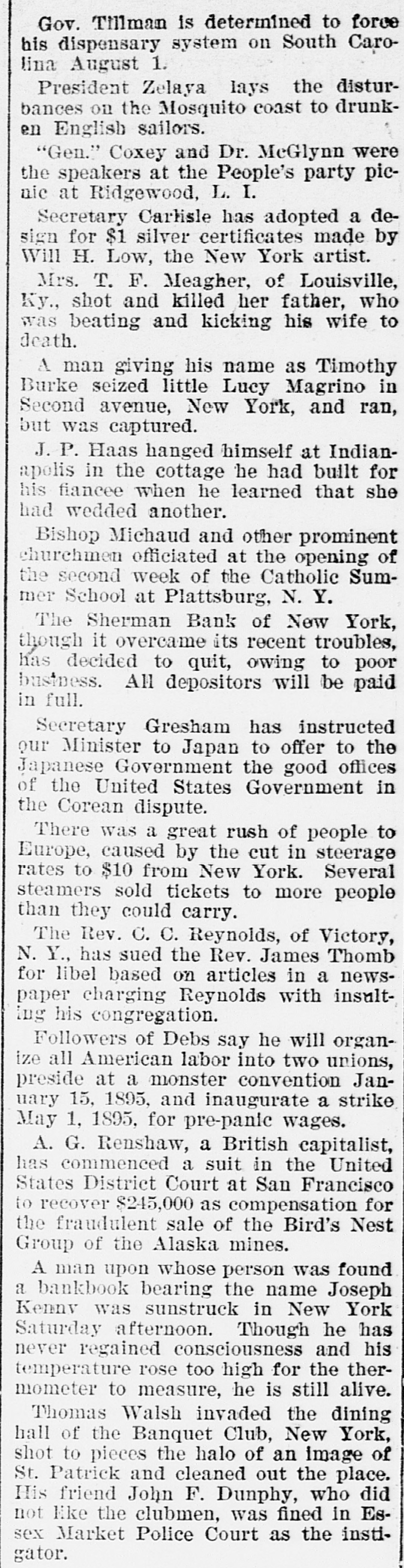
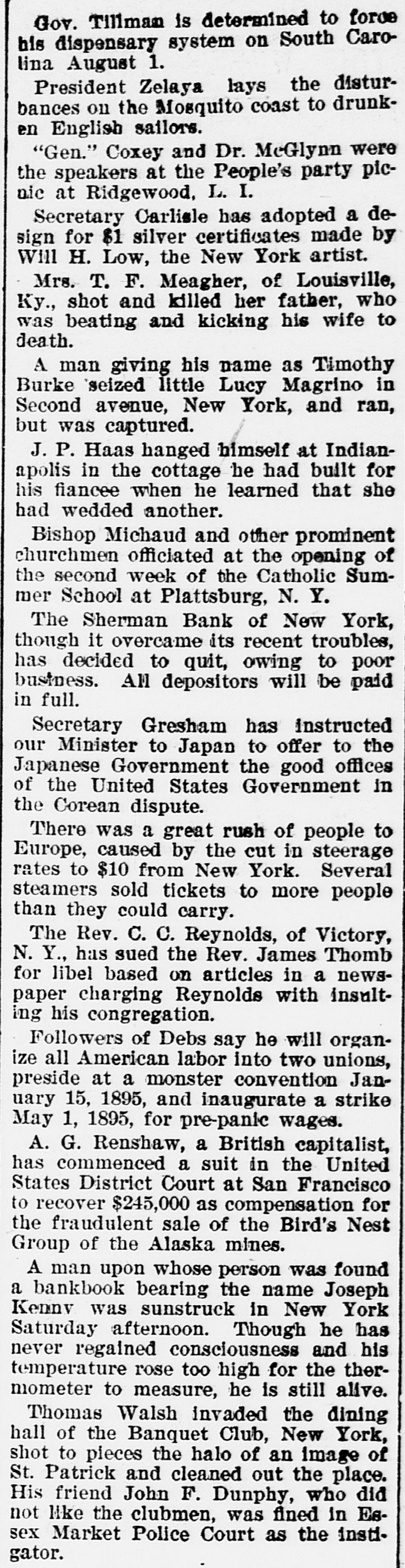
Gov. Tillman is determined to force his dispensary system on South Carolina August 1. President Zelaya lays the disturbances on the Mosquito coast to drunken English sailors. "Gen." Coxey and Dr. McGlynn were the speakers at the People's party picnic at Ridgewood, L. I. Secretary Carlisle has adopted a design for $1 silver certificates made by Will H. Low, the New York artist. Mrs. T. F. Meagher, of Louisville, Ky., shot and killed her father, who was beating and kicking his wife to death. A man giving his name as Timothy Burke seized little Lucy Magrino in Second avenue, New York, and ran, but was captured. J. P. Haas hanged himself at Indianapolis in the cottage he had built for his fiancee when he learned that she had wedded another. Bishop Michaud and other prominent churchmen officiated at the opening of the second week of the Catholic Summer School at Plattsburg, N. Y. The Sherman Bank of New York, though it overcame its recent troubles, has decided to quit, owing to poor business. All depositors will be paid in full. Secretary Gresham has instructed our Minister to Japan to offer to the Japanese Government the good offices of the United States Government in the Corean dispute. There was a great rush of people to Europe, caused by the cut in steerage rates to $10 from New York. Several steamers sold tickets to more people than they could carry. The Rev. C. C. Reynolds, of Victory, N. Y., has sued the Rev. James Thomb for libel based on articles in a newspaper charging Reynolds with insulting his congregation. Followers of Debs say he will organize all American labor into two unions, preside at a monster convention January 15, 1895, and inaugurate a strike May 1, 1895, for pre-panic wages. A. G. Renshaw, a British capitalist, has commenced a suit in the United States District Court at San Francisco to recover $245,000 as compensation for the fraudulent sale of the Bird's Nest Group of the Alaska mines. A man upon whose person was found a bankbook bearing the name Joseph Kenny was sunstruck in New York Saturday afternoon. Though he has never regained consciousness and his temperature rose too high for the thermometer to measure, he is still alive. Thomas Walsh invaded the dining hall of the Banquet Club, New York, shot to pieces the halo of an image of St. Patrick and cleaned out the place. His friend John F. Dunphy, who did not like the clubmen, was fined in Essex Market Police Court as the instigator.


Article from The Washington Bee, August 11, 1894

Click image to open full size in new tab

Article Text

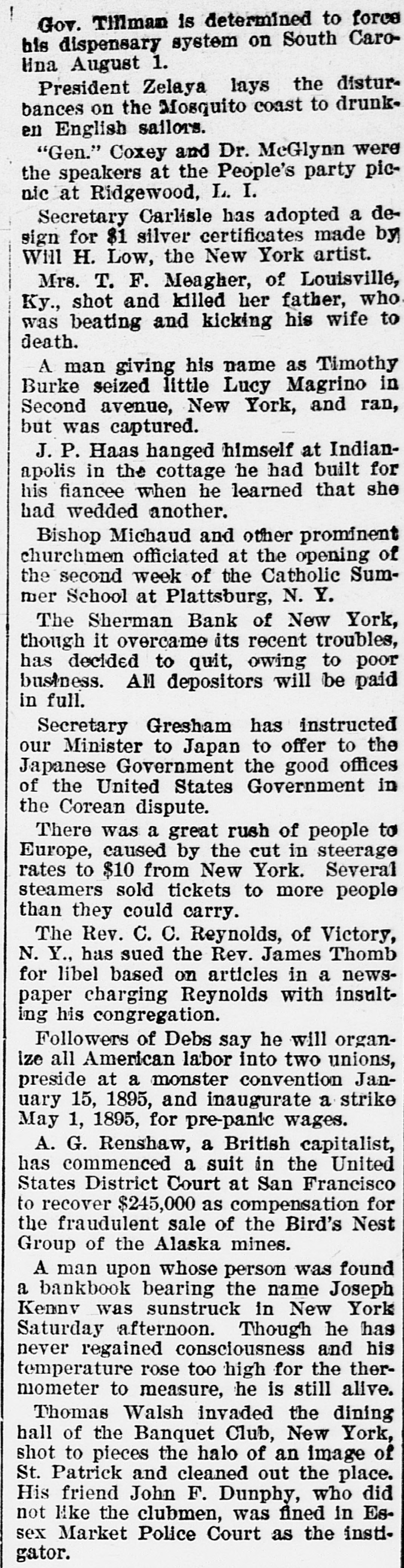
Gov. Tillman is determined to force his dispensary system on South Carolina August 1. President Zelaya lays the disturbances on the Mosquito coast to drunken English sailors. "Gen." Coxey and Dr. McGlynn were the speakers at the People's party picnic at Ridgewood, L. I. Secretary Carlisle has adopted a design for $1 silver certificates made by Will H. Low, the New York artist. Mrs. T. F. Meagher, of Louisville, Ky., shot and killed her father, who was beating and kicking his wife to death. A man giving his name as Timothy Burke seized little Lucy Magrino in Second avenue, New York, and ran, but was captured. J. P. Haas hanged himself at Indianapolis in the cottage he had built for his fiancee when he learned that she had wedded another. Bishop Michaud and other prominent churchmen officiated at the opening of the second week of the Catholic Summer School at Plattsburg, N. Y. The Sherman Bank of New York, though it overcame its recent troubles, has decided to quit, owing to poor business. All depositors will be paid in full. Secretary Gresham has instructed our Minister to Japan to offer to the Japanese Government the good offices of the United States Government in the Corean dispute. There was a great rush of people to Europe, caused by the cut in steerage rates to $10 from New York. Several steamers sold tickets to more people than they could carry. The Rev. C. C. Reynolds, of Victory, N. Y., has sued the Rev. James Thomb for libel based on articles in a newspaper charging Reynolds with insulting his congregation. Followers of Debs say he will organize all American labor into two unions, preside at a monster convention January 15, 1895, and inaugurate a strike May 1, 1895, for pre-panic wages. A. G. Renshaw, a British capitalist, has commenced a suit in the United States District Court at San Francisco to recover $245,000 as compensation for the fraudulent sale of the Bird's Nest Group of the Alaska mines. A man upon whose person was found a bankbook bearing the name Joseph Kennv was sunstruck in New York Saturday afternoon. Though he has never regained consciousness and his temperature rose too high for the thermometer to measure, he is still alive. Thomas Walsh invaded the dining hall of the Banquet Club, New York, shot to pieces the halo of an image of St. Patrick and cleaned out the place. His friend John F. Dunphy, who did not like the clubmen, was fined in Essex Market Police Court as the instigator.


Article from The Washington Bee, August 18, 1894

Click image to open full size in new tab

Article Text

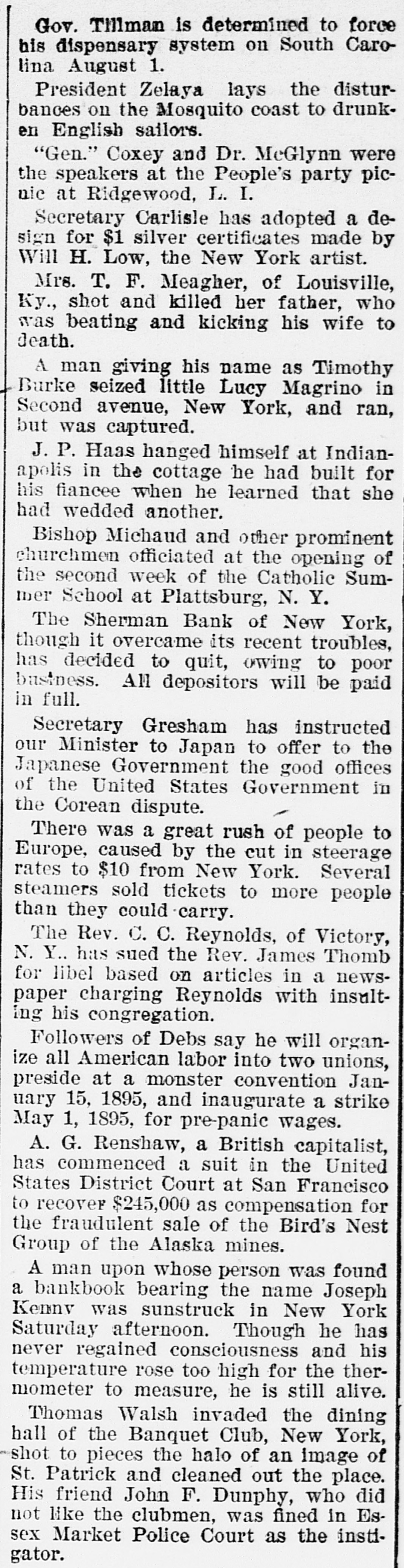
Gov. Tillman is determined to force his dispensary system on South Carolina August 1. President Zelaya lays the disturbances on the Mosquito coast to drunken English sailors. "Gen." Coxey and Dr. McGlynn were the speakers at the People's party picnic at Ridgewood, L. I. Secretary Carlisle has adopted a design for $1 silver certificates made by Will H. Low, the New York artist. Mrs. T. F. Meagher, of Louisville, Ky., shot and killed her father, who was beating and kicking his wife to death. A man giving his name as Timothy Burke seized little Lucy Magrino in Second avenue, New York, and ran, but was captured. J. P. Haas hanged himself at Indianapolis in the cottage he had built for his fiancee when he learned that she had wedded another. Bishop Michaud and other prominent churchmen officiated at the opening of the second week of the Catholic Summer School at Plattsburg, N. Y. The Sherman Bank of New York, though it overcame its recent troubles, has decided to quit, owing to poor business. All depositors will be paid in full. Secretary Gresham has instructed our Minister to Japan to offer to the Japanese Government the good offices of the United States Government in the Corean dispute. There was a great rush of people to Europe, caused by the cut in steerage rates to $10 from New York. Several steamers sold tickets to more people than they could carry. The Rev. C. C. Reynolds, of Victory, N. Y., has sued the Rev. James Thomb for libel based on articles in a newspaper charging Reynolds with insulting his congregation. Followers of Debs say he will organize all American labor into two unions, preside at a monster convention January 15, 1895, and inaugurate a strike May 1, 1895, for pre-panic wages. A. G. Renshaw, a British capitalist, has commenced a suit in the United States District Court at San Francisco to recover $245,000 as compensation for the fraudulent sale of the Bird's Nest Group of the Alaska mines. A man upon whose person was found a bankbook bearing the name Joseph Kennv was sunstruck in New York Saturday afternoon. Though he has never regained consciousness and his temperature rose too high for the thermometer to measure, he is still alive. Thomas Walsh invaded the dining hall of the Banquet Club, New York, shot to pieces the halo of an image of St. Patrick and cleaned out the place. His friend John F. Dunphy, who did not like the clubmen, was fined in Essex Market Police Court as the instigator.


Article from The Washington Bee, August 25, 1894

Click image to open full size in new tab

Article Text

Gov. Tillman is determined to force his dispensary system on South Carolina August 1. President Zelaya lays the disturbances on the Mosquito coast to drunken English sailors. "Gen." Coxey and Dr. McGlynn were the speakers at the People's party picnic at Ridgewood, L. I. Secretary Carlisle has adopted a design for $1 silver certificates made by Will H. Low, the New York artist. Mrs. T. F. Meagher, of Louisville, Ky., shot and killed her father, who was beating and kicking his wife to death. A man giving his name as Timothy Burke seized little Lucy Magrino in Second avenue, New York, and ran, but was captured. J. P. Haas hanged himself at Indianapolis in the cottage he had built for his fiancee when he learned that she had wedded another. Bishop Michaud and other prominent churchmen officiated at the opening of the second week of the Catholic Summer School at Plattsburg, N. Y. The Sherman Bank of New York, though it overcame its recent troubles, has decided to quit, owing to poor business. All depositors will be paid in full. Secretary Gresham has instructed our Minister to Japan to offer to the Japanese Government the good offices of the United States Government in the Corean dispute. There was a great rush of people to Europe, caused by the cut in steerage rates to $10 from New York. Several steamers sold tickets to more people than they could carry. The Rev. C. C. Reynolds, of Victory, N. Y., has sued the Rev. James Thomb for libel based on articles in a newspaper charging Reynolds with insulting his congregation. Followers of Debs say he will organize all American labor into two unions, preside at a monster convention January 15, 1895, and inaugurate a strike May 1, 1895, for pre-panic wages. A. G. Renshaw, a British capitalist, has commenced a suit in the United States District Court at San Francisco to recover $245,000 as compensation for the fraudulent sale of the Bird's Nest Group of the Alaska mines. A man upon whose person was found a bankbook bearing the name Joseph Kenny was sunstruck in New York Saturday afternoon. Though he has never regained consciousness and his temperature rose too high for the thermometer to measure, he is still alive. Thomas Walsh invaded the dining hall of the Banquet Club, New York, shot to pieces the halo of an image of St. Patrick and cleaned out the place. His friend John F. Dunphy, who did not like the clubmen, was fined in Essex Market Police Court as the instigator.


Article from The Washington Bee, September 1, 1894

Click image to open full size in new tab

Article Text

Gov. Tillman is determined to force his dispensary system on South Carolina August 1. President Zelaya lays the disturbances on the Mosquito coast to drunken English sailors. "Gen." Coxey and Dr. McGlynn were the speakers at the People's party picnic at Ridgewood, L. I. Secretary Carlisle has adopted a design for $1 silver certificates made by Will H. Low, the New York artist. Mrs. T. F. Meagher, of Louisville, Ky., shot and killed her father, who was beating and kicking his wife to death. A man giving his name as Timothy Burke seized little Lucy Magrino in Second avenue, New York, and ran, but was captured. J. P. Haas hanged himself at Indianapolis in the cottage he had built for his fiancee when he learned that she had wedded another. Bishop Michaud and other prominent churchmen officiated at the opening of the second week of the Catholic Summer School at Plattsburg, N. Y. The Sherman Bank of New York, though it overcame its recent troubles, has decided to quit, owing to poor business. All depositors will be paid in full. Secretary Gresham has instructed our Minister to Japan to offer to the Japanese Government the good offices of the United States Government in the Corean dispute. There was a great rush of people to Europe, caused by the cut in steerage rates to $10 from New York. Several steamers sold tickets to more people than they could carry. The Rev. C. C. Reynolds, of Victory, N. Y.. has sued the Rev. James Thomb for libel based on articles in a newspaper charging Reynolds with insulting his congregation. Followers of Debs say he will organize all American labor into two unions, preside at a monster convention January 15, 1895, and inaugurate a strike May 1, 1895, for pre-panic wages. A. G. Renshaw, a British capitalist, has commenced a suit in the United States District Court at San Francisco to recover $245,000 as compensation for the fraudulent sale of the Bird's Nest Group of the Alaska mines. A man upon whose person was found a bankbook bearing the name Joseph Kenny was sunstruck in New York Saturday afternoon. Though he has never regained consciousness and his temperature rose too high for the thermometer to measure, he is still alive. Thomas Walsh invaded the dining hall of the Banquet Club, New York, shot to pieces the halo of an image of St. Patrick and cleaned out the place. His friend John F. Dunphy, who did not like the clubmen, was fined in Essex Market Police Court as the instigator.


Article from New-York Tribune, October 11, 1895

Click image to open full size in new tab

Article Text

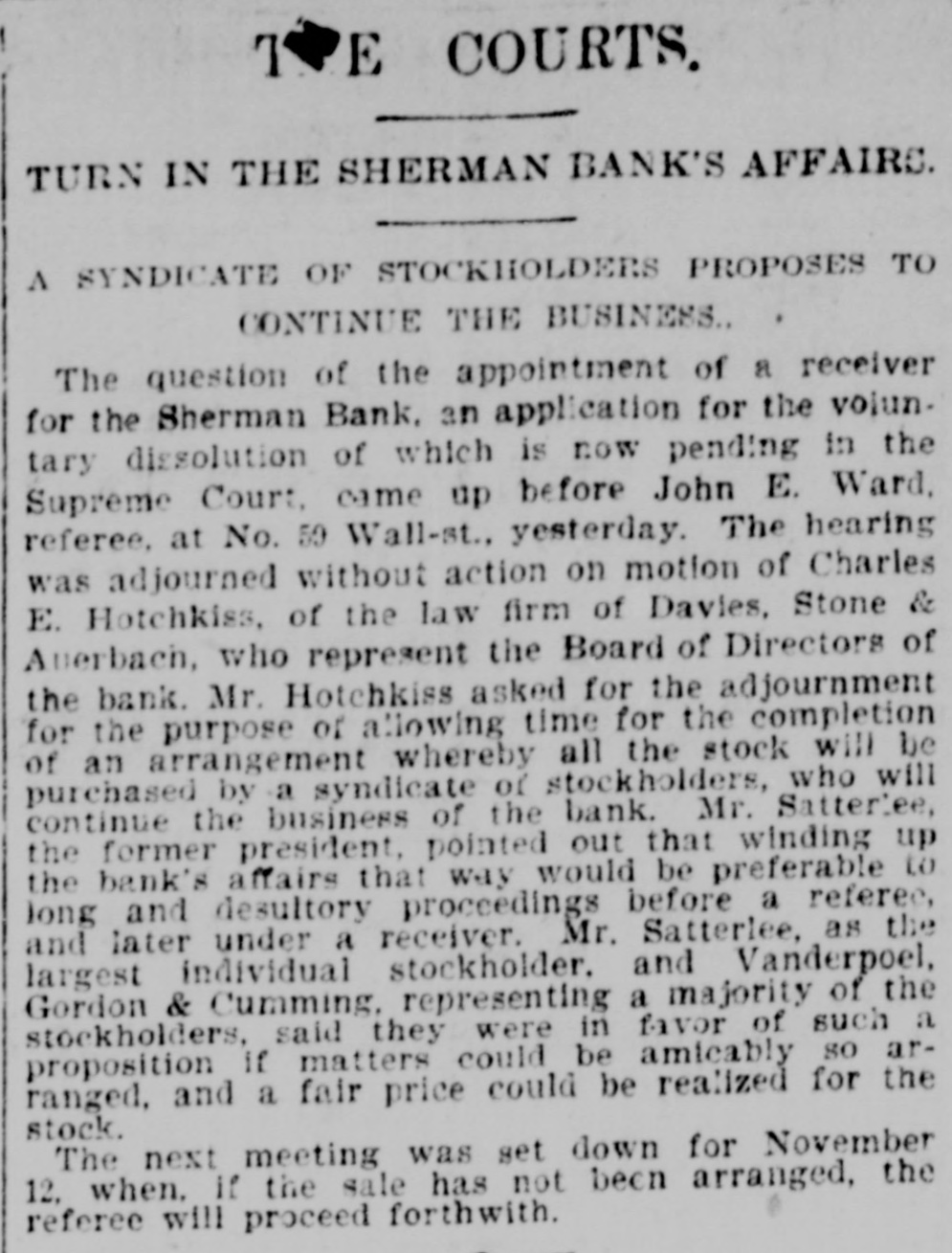
TE COURTS. TURN IN THE SHERMAN BANK'S AFFAIRS. A SYNDICATE OF STOCKHOLDERS PROPOSES TO CONTINUE THE BUSINESS. The question of the appointment of a receiver for the Sherman Bank, an application for the voluntary dissolution of which is now pending in the Supreme Court, came up before John E. Ward. referee, at No. 50 Wall-st., yesterday. The hearing was adjourned without action on motion of Charles E. Hotchkiss, of the law firm of Davies, Stone & Auerbach, who represent the Board of Directors of the bank. Mr. Hotchkiss asked for the adjournment for the purpose of allowing time for the completion of an arrangement whereby all the stock will be purchased by a syndicate of stockholders, who will continue the business of the bank. Mr. Satteriee, the former president, pointed out that winding up the bank's affairs that way would be preferable to long and desultory proceedings before a referec, and later under a receiver. Mr. Satterlee, as the largest individual stockholder. and Vanderpoel, Gordon & Cumming. representing a majority of the stockholders, said they were in favor of such a proposition if matters could be amicably so arranged, and a fair price could be realized for the stock. The next meeting was get down for November 12, when. if the sale has not been arranged, the referee will proceed forthwith.


Article from The Sun, June 11, 1897

Click image to open full size in new tab

Article Text

BUSINESS TROUBLES. Samuel W. Richards Assigus-Judgment for $83,178 Against J. W. Sands. Samuel W. Richards, dealer in dry goods at 58 West Twenty-third street and 47 West Twenty-second street, made an assignment yesterday to George M. Leventritt, giving preferences to the Garfield National Bank for $2,500 and to Valentine Gumprecht for $4,146. Mr. Richards was President of the Richards Company which went into the hands of a receiver in September last with liabilities of $120,000. Henry Barna, who says that he is a stockbroker at 216 Second street. made an assignment yesterday to Bernard Weiss. He formerly dealt in Hungarian bonds. Transcript of a judgment from Westchester county was docketed in the County Clerk's office yesterday against James W. Sands, lately Secretary of the E. S. Greeley Company. The judgment was for $83,178 in favor of Edward S. Greeley as ancillary receiver of the company. Jules Stine and Joseph K. Stone (Jules Stine & Co.), merchant tailors at 36 East Ninth street, made an assignment vesterday to Leo Levy. Emil F. Corsari, dealer in twines and cordage at 46 Beekman street, made an assignment yesterday to Louis O. Ivey. Judge Andrews of the Supreme Court granted yesterday an order dissolving the Sherman Bank, and appointed Jacob D. Butler permanent receiver. Deputy Sheriff Lipsky has received an execution against Herman Zweig, doing business as H. Zweig & Co., wholesale dealer in leaf tobacco at 125 Maiden lane, for $510 in favor of Emmanuel Rubenstein. Mr. Zweig is out of town.