Article Text
CAPT. EADS'S DEFENCE.
The Bank of Missouri's Failure Due to "Universal Depreciation in Values."
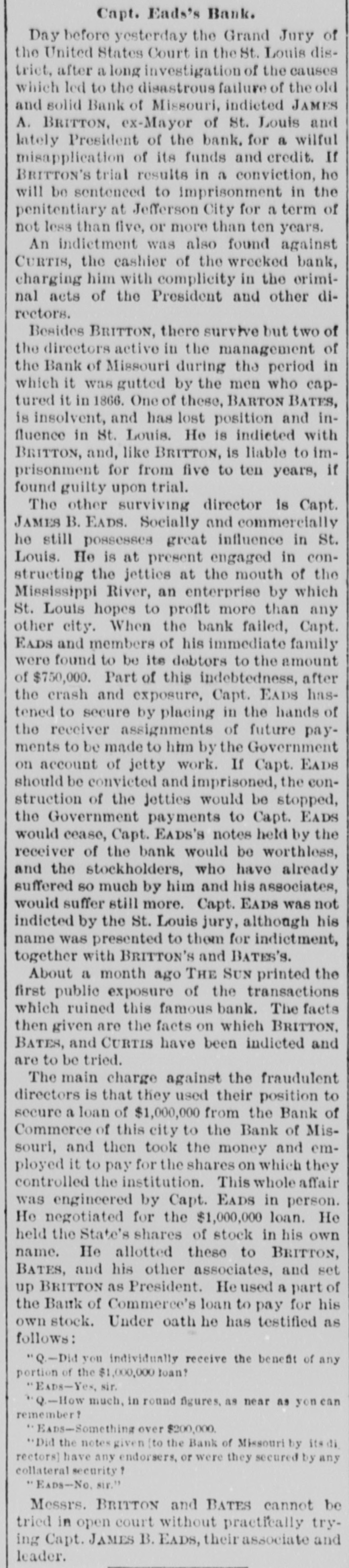
TO THE EDITOR OF THE SUN --Sir: I have just read in your paper a five-column letter dated in this city and containing one of the most malicious and libellous attacks upon me which it is possible to form by an adroit combination of fact and falsehood. At a future time I shall give more attention to this subject. For the present I will confine this letter to the sim- ple declaration that your correspondent has grossly misled you in regard to my character and my connection with the affairs of the Na- tional Bank of Missouri, and will give you a few facts in proof of this declaration. Your correspondent says:
Twelve years ago, when Eads, working with a capital of brains only, rabded and captured the Bank of the State of Missouri, its stock was wort's 150 for invest- ment. The history of the capture and ruin of the Missouri bank tan story of brains working without cash and with- out conscience. The chief character is Capt James B Eads, a financial adventurer, who talks in millions and deals in audacity, perseverance, and persuasive words. The following brieftletter from my book- keeper (who needs no endorsement for truth- fulness and integrity in this community) gives the amount of income on which I paid taxes the year previous to the purchase of the stock from the State, and shows that I was not "working with a capital of brains only" at the time your correspondent refers to:
ST. LOUIS, Mo, Dec. 27, 1878. Mr. Jas. B. Eads -- Dear Sir: In answer to your in- quiry, I find on examination that your net income for 1861 was $72,006.98; your gross rents from real estate during that year were $20,126.58. $11,785.00 of national, State, and local taxes, paid by you in 1861, were de- ducted from the above amount of your net income, leav- ing $61,319.02 as the amount on which you paid in 1865 an income tax to the United States of $1,783.65. This tax was exclusive of the taxes paid by corporations in which you held stock. Very respectfully yours, GEO. C. FAZIAN
None of the gentlemen then interested in the purchase of the stock, and who afterward as- sumed the management of the bank, was at that time worth less than $100,000. Several of them were worth much more, and one of them, John J. Roe, was worth between two and three millions. The following letter from Gov. Fletcher dis- proves your correspondent's assertion that the stock of the old bank was "worth 150 for in- vestment" at the time of the sale:
ST. LOUIS, Dec. 27, 1878. JAMES B. EADS, Esq -- Dear Sir: In reply to your inquiry, I find, on reference to some data in my possession, that the bid of the Bank of the State of Missouri for the 10,000 shares of the stock held by the State was $81.50 per share, and that yours was $108.50 per share, both payable in the bonds and coupons of the State at par. The bonds were at the time greatly depreciated in the market, owing to the fact that the State was unable to pay its interest. The bids were made on the 4th of June, 1861, at the day designated in the advertisement made by the Commissioner under the law. After I had verbally noti- fied you that I would accept your bid, the bank addressed me an offer of $108.33 per share. I then hesitated about giving my official approval to your bid. You thereupon made a second offer of 108.50 per share. That offer I ac- cepted and officially approved. On the day following this approval of your bid, and after the papers had been by me filed in the office of the Secretary of State, the bank telegraphed that it would give $200,000 more than your bid of $108 per share, if I would open the sale again to public competition, well knowing that I had no power to do so. Truly yours, (Signed) THOMAS C. FLETCHER
At the time of the sale the market value of the bonds reduced by bid of $108.50 to a cash equivalent of $66 per share, and the bank's bid of $81.50 to less than $50 cash per share. The bank had nine branches located through- out the State. Some of these were believed to be insolvent, as their assets were largely com- posed of the obligations of persons who hau been ruined by the war. Their condition and the total assets of the mother bank were only known to its managers, and instead of its being "the solidest bank of the West," they were not willing to bid fifty cents in cash for the State's stock until after I was declared to be the highest bidder for it. The bank had made but one dividend (and that only three per cent.), during the three years previous to the sale. The stock purchased by us was less than one-third of the capital, and to convert the old bank into a national bank required a vote of two-thirds of the whole stock. Your corre- spondent says:
Suddenly, by a sharp trick, the bank was wrested from these respectable hands and seized by men who put the institution to a purpose for which neither Provi- dence nor its founders ever designed it. It was known that Jas. H. Britton was to be the President of the bank after its reorganiza- tion, and who a majority of the directors were to be. Mr. Britton was known to have been the President of the Southern Bank, afterward changed to the Third National Bank of St. Louis. Instead of the control being wrested "by a sharp trick" it was put into the hands of the new directory by an almost unanimous vote of the whole stock. Under the new manage- ment the bank earned and paid to its stockhold- ers 85 per cent, in dividends, being an average of nearly 8 per cent, per annum for the eleven years preceding its failure. During the last year or two it paid no dividends, and after a very thorough examination, maden few months before its failure by a special Government ex- pert, he reported that its capital was impaired to the extent of but 40 per cent. The capital of the bank was $3,410,000, of which I owned about one-tenth. I was, there- fore, deeply interested, not only in making the bank profitable, but in keeping it sound, and its failure was as much a matter of surprise to me as to the public. With regard to the large discounts made to the directors, a subject grossly distorted by your correspondent, it should be remembered that the law permits each director to be a borrower to the amount of 10 per cent, of the bank's cap- ital, and that the capital was an exceptionally large one, and each of the directors was the holder of a very large amount of its stock. These loans were in reality all made before the panic of 1873, and were at that time se- cured by collaterals fully worth the loans. The discounts to myself and the other direc- tors, made since the panic, were renewals or reductions of these loans, or discounts of other paper, properly secured at the time to meet the interest on these loans. The last dis- count which went to my credit, and which (ex- cept $10,000) was applied in reducing previous loans, was secured by an assignment of $150,000 from payments to be made to me by the Government for building the jetties, and really added that amount to the securities then held by the bank. If it be charged that this se- curity was of no value, I answer that on similar assignments I have received large amounts of money from capitalists in New Orleans and New York to be applied to the construction of the jetties. On the failure of the bank I volun- tarily gave the receiver similar assignments to cover my liabilities to it. The statement that the bank was "captured" to aid in building the St. Louis bridge is the sheerest absurdity. The building of the bridge was not thought of at the time. It was built by the individual subscriptions of capitalists in New York and St. Louis, and was not a bor- rower from the bank until after the panic, but was one of its best depositors, having at one time two million dollars on deposit in it. Your correspondent makes an utterly false statement in saying that at the time of the pur- chase of the State's stock by me "most of the gentlemen connected with the management of the Bank of Commerce in New York were concerned in the various Missouri enterprises in which Eads was so deeply inter- ested." None of them were interested in the stock at the time stated, nor was any one of them interested in the enterprises referred to when I negotiated the loan from the Bank of Commerce, for none of these enterprises had then been commenced. His statement that the directors "took these bonds out of their bank vaults, held them on their good faith until they had advanced in value, sold them or used them at the advanced price, and paid back into the bank part of the proceeds and pocketed the dif- ference," is totally false. The bonds referred to had been bought up by the old bank with a view to buy the State stock, and they were neither borrowed nor bought by the new Board from the bank, but were sold in the market by it at cur- rent rates and converted into money. Your correspondent begins his letter by singling me out with the declaration that I "was last week presented to the Grand Jury" in connection with these transactions. Surely the fact that the Grand Jury were investigating the affairs of the bank at this time should have closed your columns against the publication of such a malignant attack. The misfortunes of the bank are directly due to the universal depreciation in values which succeeded the panic of 1873, and while they might have been avoided by the exercise of better judgment on the part of myself and my co-directors, no law has been violated by them or myself, as charged by your correspondent, but we have been the severest sufferers by its failure. ST. LOUIS, Dec. 27, 1878. JAS. B. EADS,