Article Text
Another Rotten Bank Goes Down
CHICAGO, April 22.-The Cook County Savings bank has suspended as a bank of deposit, and will immediately wind up its affairs.
Click image to open full size in new tab
CHICAGO, April 22.-The Cook County Savings bank has suspended as a bank of deposit, and will immediately wind up its affairs.
Click image to open full size in new tab
CHICAGO, April 22.-The Cook County Savings Bank has suspended as a bank of deposit, and will immediately wind up its affairs. It had $80,000 in deposits and $60,000 capital, which the directors have loaned out. Its assets are $150,000, besides $15,000 in judgment notes, which are of some account. There about six thousand depositors, mostly Scandavanians, who, the directors affirm, will receive nearly, if not quite, dollar for dollar. The bank has been in a feeble condition for a long time.
Click image to open full size in new tab
BANK SUSPENSION. CHICAGO, April, 22.-The Cook county savings bank has suspended as a bank of deposit, and will immediately wind up its. affairs. Its liabilities are $80,000 deposits; and $60,000 which the directors . have loaned it. Its assets are $150,000, resides $15,000 in judgement notes which are of |some account. There are 600 depositors, mostly Scandinavians who the directors affirm will reoeive nearly if not -quite dollar for dollar. The bank has been in a feeble condition for a long time.
Click image to open full size in new tab
21A2 Bank Suspension. Chicago, April 22.-The Cook County Savings Bank has suspended as a bark of deposit and will immediately wind up its affairs. Its liabilities are $80,000 in deposits and $60,000 which the directors have loaned it. Its assets are $150,000, besides fifteen thousand in judgment notes, which are of some account. There are 600 depositors, mostly Scandinavians, who, the directors affirm, will receive nearly if not quite dollar for dollar. The bank has been in a feeble condition for a long time. Chicago Municipal Affairs. It is now propose I that Hon. Thos. Hoyne, who received a large majority of the votes cast for Mayor at the recent city election, should at once apply to one of the judges of the State Supreme Court for a writ of mandamus requiring Colvin, the usurper, to surrender the office of Mayor to Mr. Hoyue. It now seems probable either that this will be done or that the new common council, as soon as it shall have organized, will declare the office vacant and elect one of their own members Mayor. as in such caso S provided by the newcity charter.
Click image to open full size in new tab
CHICAGO, April 22 -The Cook County Savings Bank has suspended business as a bank of deposit. and wwi immediately wind up its affairs. Its liabilities are $80,000 devosits and $60,000 which the directors have lent 11. Its assets are $150,000, Desides $13,000 in judg ment notes which are of some account. There are 600 depositors, mostly Sounda vians, WHO, the director affirm, will receive nearly if no quite dollar for dollar. The bana has been in a sucble condition for a long time.
Click image to open full size in new tab
Crops on the Pacific. San FRANCISCO, April 21.-The Weekly Buletin this morning publishes a complete crop report from nearly every agricultural county in the State, All dispatches argee is reporting that the prospects for the grain crop were never better, and that an unprecedentedly large yield may be expected, with a continuance of reasonably favorable weather. Fruit also promises well, though in some districts it has suffered somewhat from late frosts. Internal Revenue Examination. General Hawley, Supervisor of internal Revenue, with Special Agents Crane and Clark. have been engaged all day in examining tax accounts and property of ColSector of Internal Revenue Sedgewick. The officials are very reticent, but the belief is strong that something important is in the wind. Pacific Mail Property Attached. The coal and stores of the Pacific Mail Steamship Company were attached to-day by the Panama Railroad Company. A Costly Kereseme Fire. PATERSON, N. J., April 22.-A kerosene lamp explosion burned the Arcado building. Loss $75,000. Paper Mill Burned. CONCORD, N. H., April 22.-The Dillinghave paper mill burned to-day. Loss $20,000. At the Centennial Grounds. PHILADELPHIA, April 22.-The President and Mrs. Grant visited the centennial grounds to-day. Get Through. The Congressional Naval Committee have concluded their labors and left the city. Prairie Fire. SEOUX CITY, April 22.-Great prairie these occurred in Iowa, Nebraaka and South Dakota. Much property was destroyed, but no lives lest. A Chicago Bank Suspended. CHICAGO, April 22.-The Cook County Savings Bank suspended. Liabilities $80,w The depositors number 600, mostly Scandiesviana of a Camp Seeding Ground. PHYNBURG, April 22 -One hundred and irame cottages on the Methodist camp meeting grounds as Tarentar burned. The collages were generally of four and of meat architroture.
Click image to open full size in new tab
Chicago, has suspended as a bank of deposit. Its liabilities are $80,000. There are six hundred depositors, mostly Scandinavians, who, the directors affirm, will receive nearly, if not quite, dollar for dollar.
Click image to open full size in new tab
CHICAGO, April 22.-The Cook County Savings Bank has suspended as a bank of deposit, and will immediately wind up its affairs. Its liabilities are $80,000 deposits, and $60,000 which the directors have loaned it. Its assets are $150,000, besides fifteen thousand dollars in judgment notes, which are of some account. There are 600 depositors, mostly Scandinavians who the directors affirm will receive nearly if not quite dollar for dollar. The bank has been in a feeble condition for a long time.
Click image to open full size in new tab
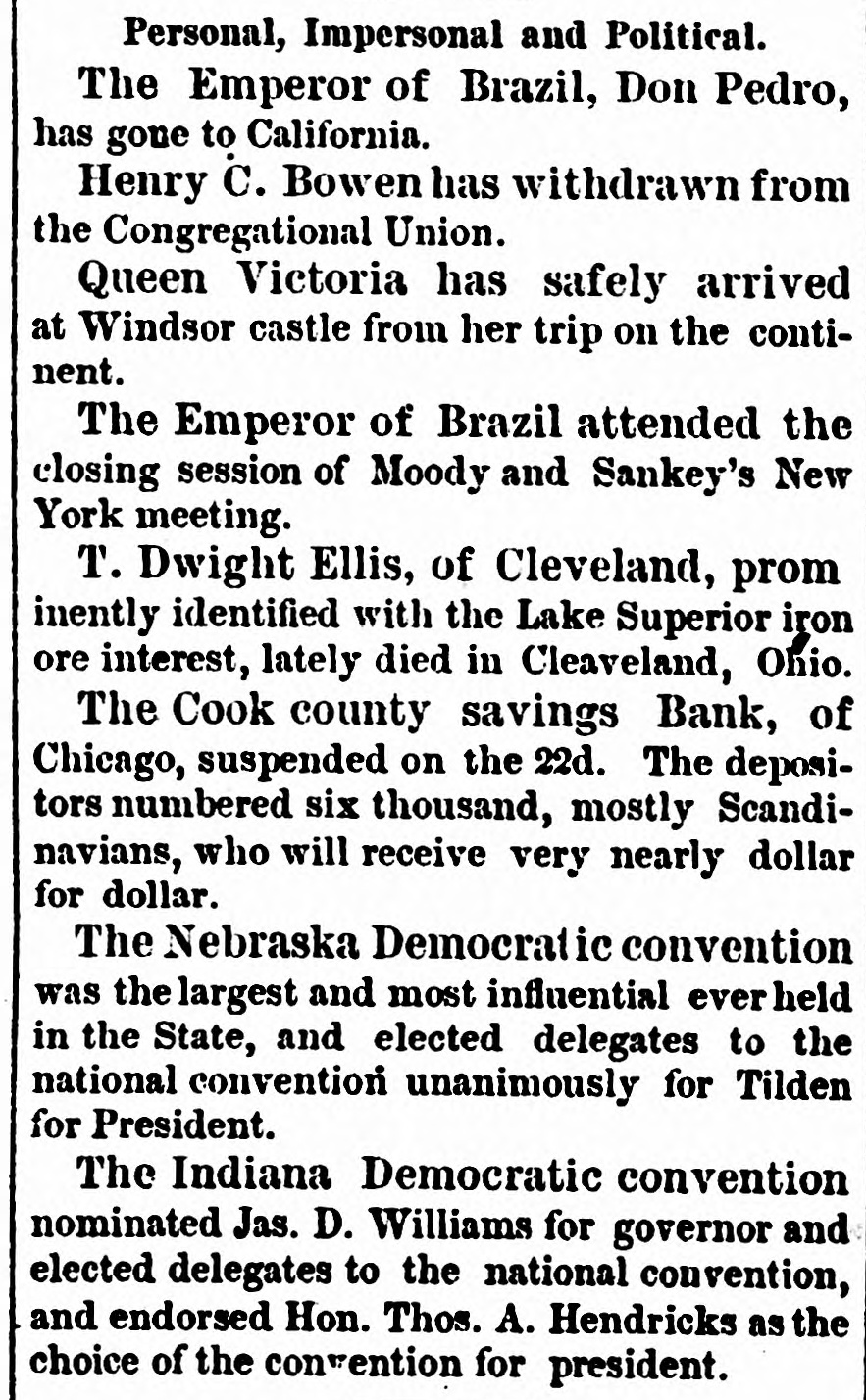
Personal, Impersonal and Political. The Emperor of Brazil, Don Pedro, has gone to California. Henry C. Bowen has withdrawn from the Congregational Union. Queen Victoria has safely arrived at Windsor castle from her trip on the continent. The Emperor of Brazil attended the closing session of Moody and Sankey's New York meeting. T. Dwight Ellis, of Cleveland, prom inently identified with the Lake Superior iron ore interest, lately died in Cleaveland, Ohio. The Cook county savings Bank, of Chicago, suspended on the 22d. The depositors numbered six thousand, mostly Scandinavians, who will receive very nearly dollar for dollar. The Nebraska Democrat ic convention was the largest and most influential ever held in the State, and elected delegates to the national convention unanimously for Tilden for President. The Indiana Democratic convention nominated Jas. D. Williams for governor and elected delegates to the national convention, and endorsed Hon. Thos. A. Hendricks as the choice of the convention for president.
Click image to open full size in new tab
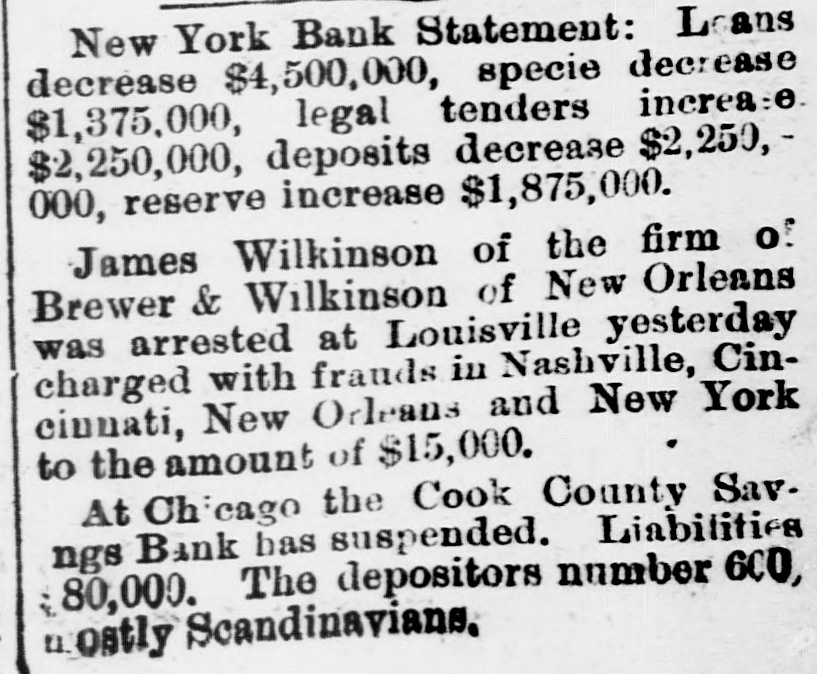
Loans decrease $4,500,000, specie decrease $1,375,000, legal tenders increa-e $2,250,000, deposits decrease $2,259, 000, reserve increase $1,875,000. James Wilkinson of the firm of Brewer & Wilkinson of New Orleans was arrested at Louisville yesterday charged with frauds in Nashville, Cinciunati, New Orleans and New York to the amount of $15,000. At Chicago the Cook County Savngs Bank has suspended. Liabilities 80,000. The depositors number 600, nostly Scandinavians,
Click image to open full size in new tab
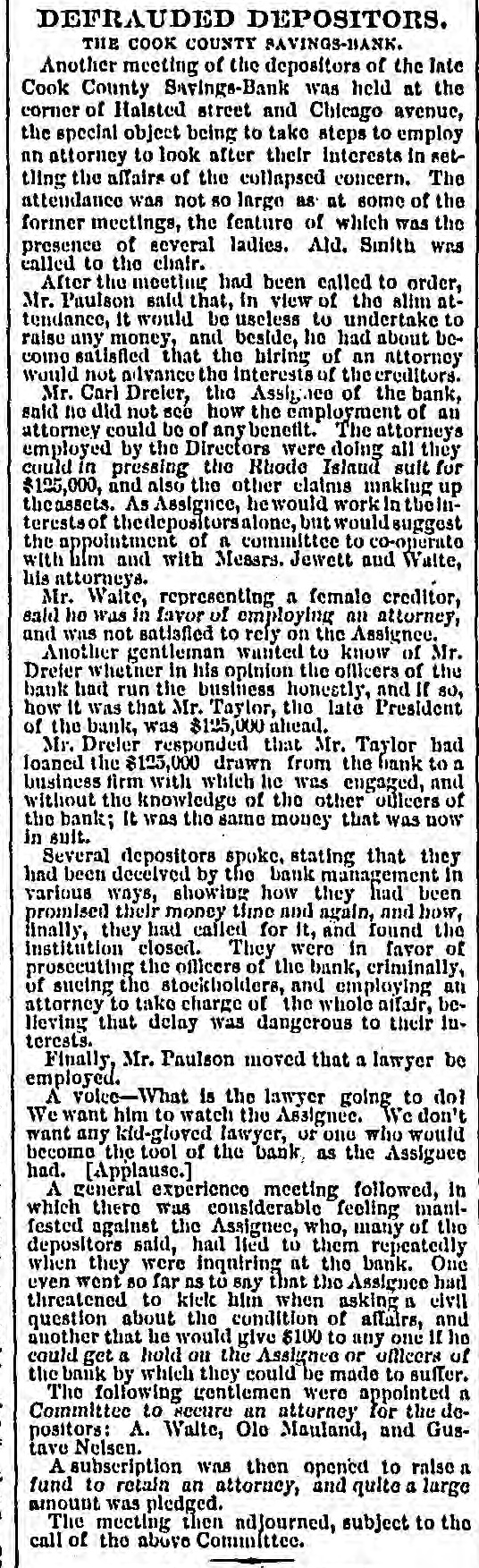
THE COOK COUNTY SAVINGS-BANK. Another meeting of the depositors of the late Cook County Savings-Bank was held at the corner of Halsted street and Chicago avenue, the special object being to take steps to employ an attorney to look after their Interests in settling the affairs of the collapsed concern. The attendance was not so large as at some of the former meetings, the feature of which was the presence of several ladies. Ald. Smith was called to the chair. After the meeting had been called to order, Mr. Paulson said that, in view of the alim attendance, it would be useless to undertake to raise any money, and beside, he had about becomo satisfied that the hiring of an attorney would not advance the interests of the creditors. Mr. Carl Dreier, the Assignee of the bank, said no did not see how the employment of an attorney could be of any benefit. The attorneys employed by the Directors were doing all they could in pressing the Rhode Island suit for $125,000, and also the other claims making up theassets. As Assignce, he would work In thelnterests of thedepositorsalonc, but would suggest the appointment of a committee to co-operate with him and with Measrs. Jewett and Waite, his attorneys. Mr. Waite, representing a female creditor, sald he was In favor of employing an attorney, and was not satisfied to rely on the Assignee. Another gentleman waited to know of Mr. Drefer whether in his opinion the officers of the bank had run the business honestly, and If so, how it was that Mr. Taylor, the late President of the bank, was $125,000 ahead. Mr. Dreler responded that Mr. Taylor had loaned the $125,000 drawn from the bank to n business firm with which lic was engaged, and without the knowledge of the other officers of the bank; It was the same money that was now in suit. Several depositors spoke. stating that they had been decelved by the bank management In various ways, showing how they had been promised their money time and again, and how, finally, they had called for It, and found the Institution closed. They were in favor of prosecuting the officers of the bank, criminally, of sucing the stockholders, and employing an attorney to take charge of the whole affair, believing that delay was dangerous to their Interests. Finally, Mr. Paulson moved that a lawyer be employed. A voice-What is the lawyer going to dol We want him to watch the Assignee. We don't want any kid-gloved lawyer, or one who would become the tool of the bank as the Assignee had. [Applause.] A general experience meeting followed, In which there was considerable feeling mantfested against the Assignee, who, many of the depositors said, had lied to them repeatedly when they were inquiring at the bank. One even went so far ns to any that the Assignee had threatened to kield him when asking a civil question about the condition of affairs, and another that he would give $100 to any one If he could get a hold ou the Assignee or officers of the bank by which they could be made to suffer. The following gentlemen were appointed a Committee to secure an attorney for the depositors: A. Walte, Olo Mauland, and Gustave Nelsen. A subscription was then opened to raise a fund to retain an attorney, and quite a large amount was pledged. The meeting then adjourned, subject to the call of the above Committee.
Click image to open full size in new tab
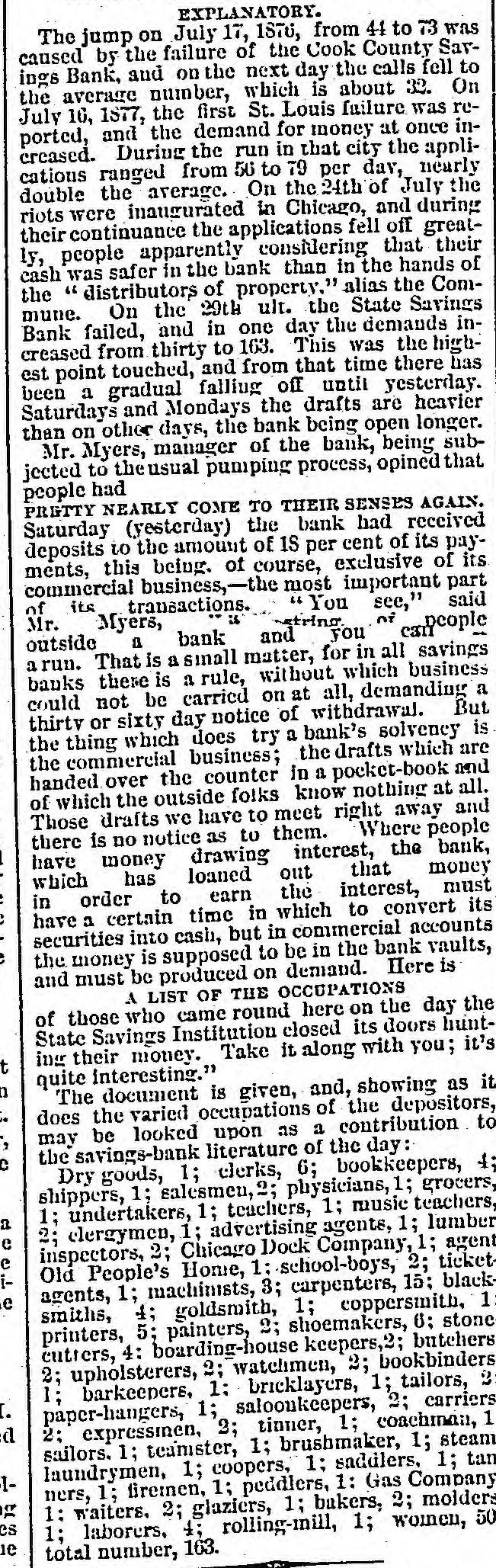
The jump on July 17, 1876, from 44 to 73 was caused by the failure of the Cook County Savings Bank, and on the next day the calls fell to the average number, which is about 32. On July 16, 1S77, the first St. Louis failure was reported, and the demand for money at once increased. During the run in that city the applications ranged from 56 to 79 per day, nearly double the average. On the 24th of July the riots were inaugurated in Chicago, and during their continuance the applications fell off greatly, people apparently considering that their cash was safer in the bank than in the hands of the " distributors of property." alias the Commune. On the 29th ult. the State Savings Bank failed, and in one day the demands increased from thirty to 163. This was the highest point touched, and from that time there has been a gradual falling off until yesterday. Saturdays and Mondays the drafts are heavier than on other days, the bank being open longer. Mr. Myers, manager of the bank, being subjected to theusual pumping process, opined that people had PRETTY NEARLY COME TO THEIR SENSES AGAIN. Saturday (yesterday) the bank had received deposits to the amount of IS per cent of its payments, this being. of course, exclusive of its commercial business,-the most important part said You see," its transactions. of of a Mr. Myers, outside a bank and string. you carreople a run. That is a small matter, for in all savings banks there is a rule, without which business could not be carried on at all, demanding a thirtv or sixty day notice of withdrawal. But the thing which does try a bank's solvency is the commercial business; the drafts which are handed over the counter in a pocket-book and of which the outside folks know nothing at all. Those drafts we have to meet right away and there is no notice as to them. Where people have money drawing interest, the bank, which has loaned out that money in order to earn the interest, must have a certain time in which to convert its securities into cash, but in commercial accounts the money is supposed to be in the bank vaults, and must be produced on demand. Here is A LIST OF THE OCCUPATIONS of those who came round here on the day the State Savings Institution closed its doors hunting their money. Take it along with you; it's t quite Interesting." n The document is given, and, showing as it does the varied occupations of the depositors, may be looked upon as a contribution to , the savings-bank literature of the day: c Dry goods, 1; clerks, 6; bookkeepers, 4; shippers, 1; salesmen, 2; physicians, 1; grocers, 1; undertakers, 1; teachers, 1; music teachers, a 2; clergymen, 1; advertising agents, 1; lumber e inspectors, 2; Chicago Dock Company, 1; agent e Old People's Home, 1: school-boys, 2; ticketiagents, 1; machinists, 3; carpenters, 15; blacke smiths, 4; goldsmith, 1; coppersmith, 1 printers, 5; painters, 2; shoemakers, 6; stone cutters, 4: boarding-house keepers,2; butchers 2; upholsterers, 2; watchmen, 2; bookbinders 1; barkeepers, 1: bricklayers, 1; tailors, 2 paper-hangers, 1; saloonkeepers, 2; carriers d 2; expressmen, 3; tinner, 1; coachman, 1 sailors. 1; teamster, 1; brushmaker, 1; steam laundrymen, 1; coopers, 1; saddlers, 1; tan 1ners, 1; firemen, 1; peddlers, 1: Gas Company g 1: waiters. 2; glaziers, 1; bakers, 2; molders es 1; laborers, 4; rolling-mill, 1; women, 50 1€ total number, 163.
Click image to open full size in new tab
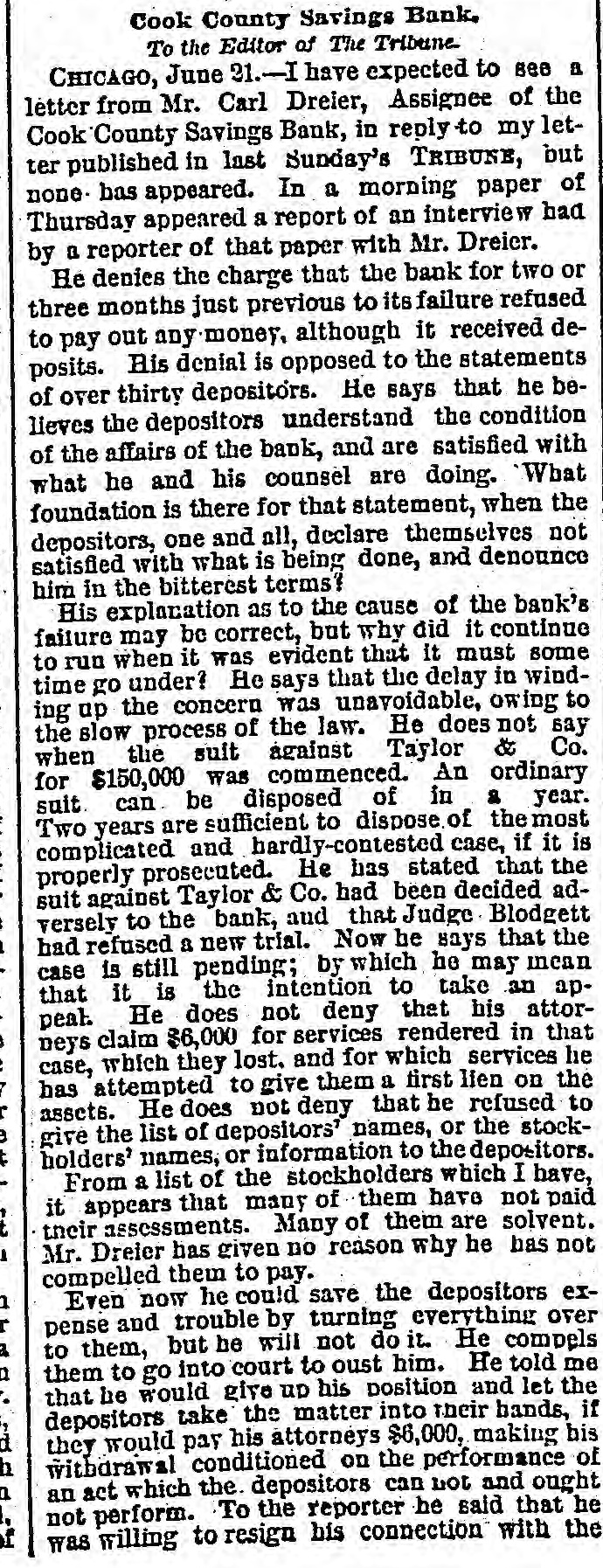
To the Editor of The Tribune CHICAGO, June 31.-I have expected to see a letter from Mr. Carl Dreier, Assignee of the Cook County Savings Bank, in reply to my letter published in last Sunday's TRIBUNE, but none. has appeared. In a morning paper of Thursday appeared a report of an interview had by a reporter of that paper with Mr. Dreier. He denies the charge that the bank for two or three months just previous to its failure refused to pay out any money, although it received deposits. His denial is opposed to the statements of over thirty depositors. He says that he believes the depositors understand the condition of the affairs of the bank, and are satisfied with what he and his counsel are doing. 'What foundation is there for that statement, when the depositors, one and all, declare themselves not satisfied with what is being done, and denounce him in the bitterest terms? His explanation as to the cause of the bank's failure may be correct, but why did it continue to run when it was evident that it must some time go under? He says that the delay in winding up the concern was unavoidable, owing to the slow process of the law. He does not say when the suit against Taylor & Co. for $150,000 was commenced. An ordinary suit. can be disposed of in & year. Two years are sufficient to dispose, of the most complicated and hardly-contested case, if it is properly prosecuted. He has stated that the suit against Taylor & Co. had been decided adversely to the bank, and that Judge Blodgett had refused a new trial. Now he says that the case is still pending; by which he may mean that it is the intention to take an appeal. He does not deny that his attorneys claim $6,000 for services rendered in that case, which they lost. and for which services he has attempted to give them a first lien on the assets. He does not deny that he refused to give the list of depositors' names, or the stockholders' names, or information to the depositors. From a list of the stockholders which I have, it appears that many of them have not paid their assessments. Many of them are solvent. Mr. Dreier has given no reason why he has not compelled them to pay. Even now he could save the depositors expense and trouble by turning everything over to them, but be will not do it. He compels them to go into court to oust him. He told me that he would give up his position and let the depositors take the matter into their hands, if they would pay his attorneys $6,000, making his withdrawal conditioned on the performance of an act which the depositors can not and ought not perform. To the reporter he said that he was willing to resign his connection with the