Moscow National Bank (Moscow, ID)

Episode Information

Episode UID
458401166
Episode Type
Suspension โ†’ Closure
Bank Type
national
Bank ID
45840 national
Charter Number
4584
Start Date
February 4, 1897
Location
Moscow, Idaho (46.732, -117.000)

Metadata

Model
gpt-5-mini (chosen from majority vote of a three-model LLM ensemble)
Short Digest
7a680008206c30f1

Response Measures

None

Receivership Details

Depositor recovery rate
39.4%
Date receivership started
1897-02-04
Date receivership terminated
1903-09-30
OCC cause of failure
Fraud
Share of assets assessed as good
7.2%
Share of assets assessed as doubtful
46.4%
Share of assets assessed as worthless
46.4%

Description

Comptroller placed the bank in the hands of an examiner/receiver on Feb 4, 1897.

Events (4)

1. June 17, 1891 Chartered
Source
historical_nic
2. February 4, 1897 Receivership
Source
historical_nic
3. February 4, 1897 Receivership
Newspaper Excerpt
placed in the hands of Eugene T. Wilson, bank examiner, as receiver: J. H. Maguire and C. H. Brune, vice presidents ... Earnest Delashmutt and S. Barghoorn, assistant cashiers.
Source
newspapers
4. February 4, 1897 Suspension
Cause
Government Action
Cause Details
Comptroller of the Currency closed the bank and placed it in the hands of an examiner/receiver
Newspaper Excerpt
which was on February 4, 1897, placed in the hands of Eugene T. Wilson, bank examiner, as receiver
Source
newspapers

Newspaper Articles (20)

Article from Red Lodge Picket, February 13, 1897

Click image to open full size in new tab

Article Text

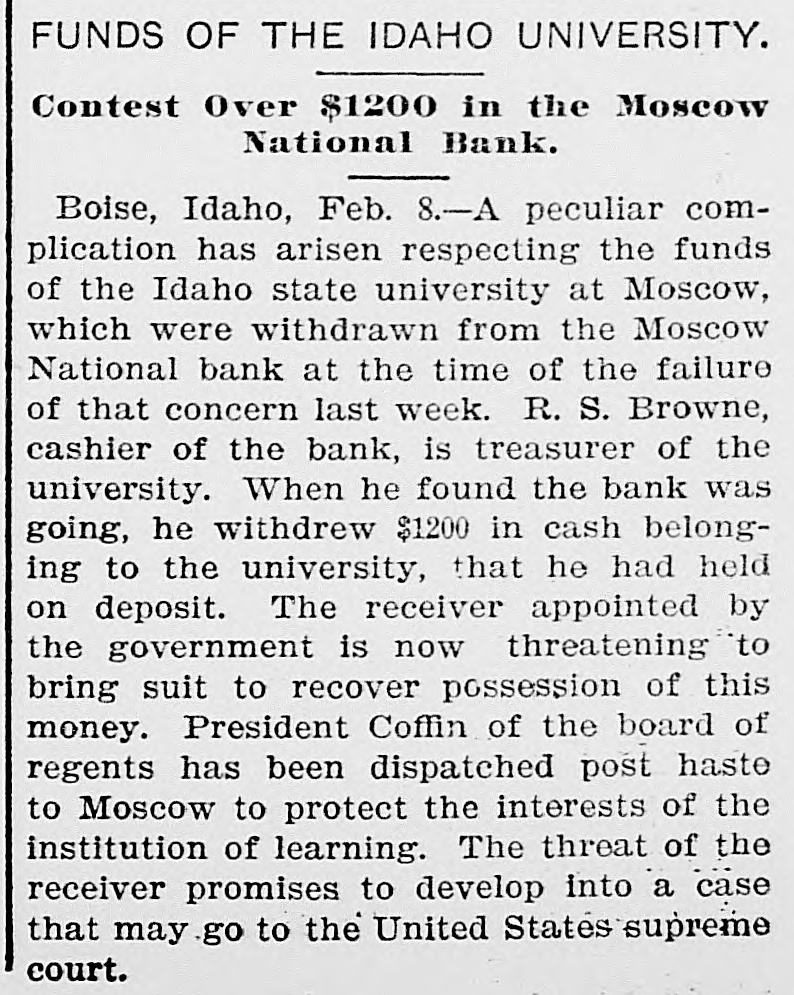
FUNDS OF THE IDAHO UNIVERSITY. Contest Over $1200 in the Moscow National Bank. Boise, Idaho, Feb. 8.-A peculiar complication has arisen respecting the funds of the Idaho state university at Moscow, which were withdrawn from the Moscow National bank at the time of the failure of that concern last week. R. S. Browne, cashier of the bank, is treasurer of the university. When he found the bank was going, he withdrew $1200 in cash belonging to the university, that he had held on deposit. The receiver appointed by the government is now threatening to bring suit to recover possession of this money. President Coffin of the board of regents has been dispatched post haste to Moscow to protect the interests of the institution of learning. The threat of the receiver promises to develop into a case that may go to the United States supreme court.


Article from Montpelier Examiner, February 17, 1897

Click image to open full size in new tab

Article Text

For the first time in the history of the*state, an opinion of the Supreme court was given relative to the case of Winters, Parsons and Boomer against the state for extra work done on the state wagon road. The court decided the contractors are entitled to $6744.25 for extra work on the Lemhi and Custer county divisions, and the legislature is to make an appropriation for the purpose of settling the claim. A peculiar complication has arisen respecting the funds of the Idaho State University at Moscow, which were withdrawn from the Moscow National bank at the time of the failure of that concern, last week. R. 3. Brown.cashier of the bank. is treasurer of the university. When he found the bank was going. he withdrew $12,000 in cash belonging to the university, that he had held on deposit. The receiver appointed by the Government is now threatening to bring suit to recover possession of this money. President Coffin of the Board of Regents has been dispatched-poste haste to Moscow to protect the interests of the institution of learning. The threat of the receiver promises to develop into a case that may go to the United States supreme court.-Salt Lake Tribune.


Article from The Seattle Post-Intelligencer, February 19, 1897

Click image to open full size in new tab

Article Text

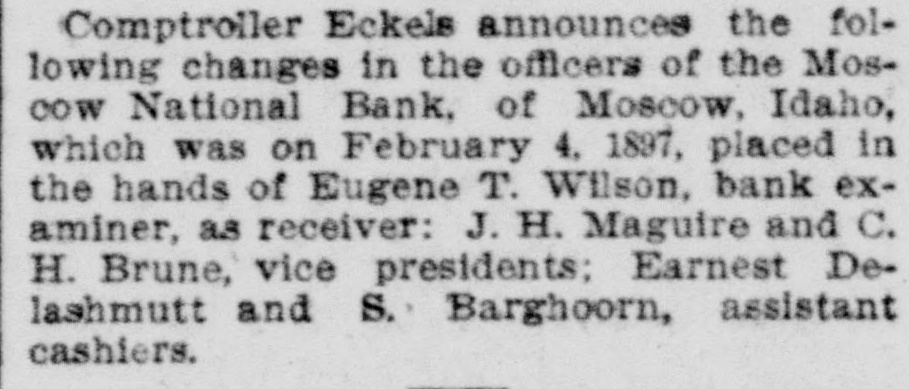
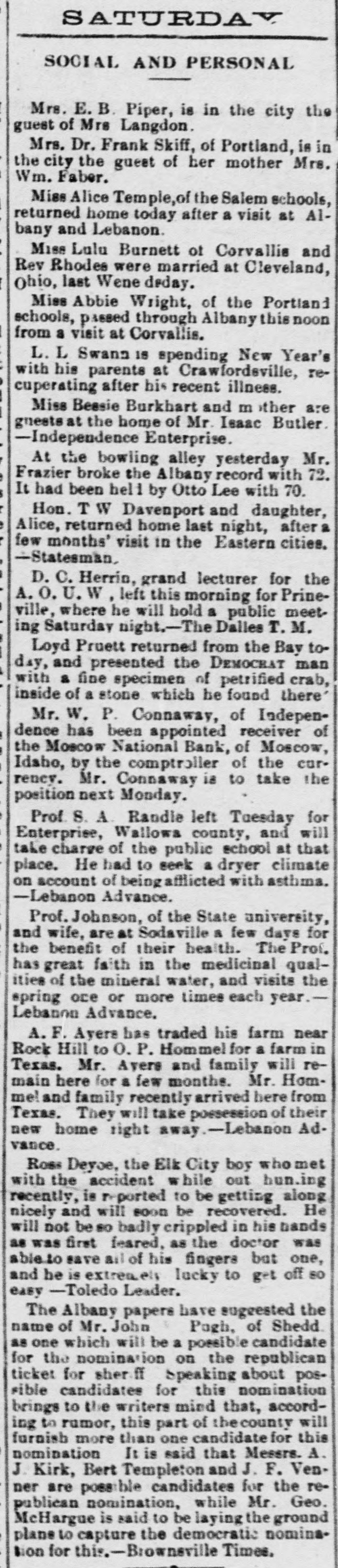
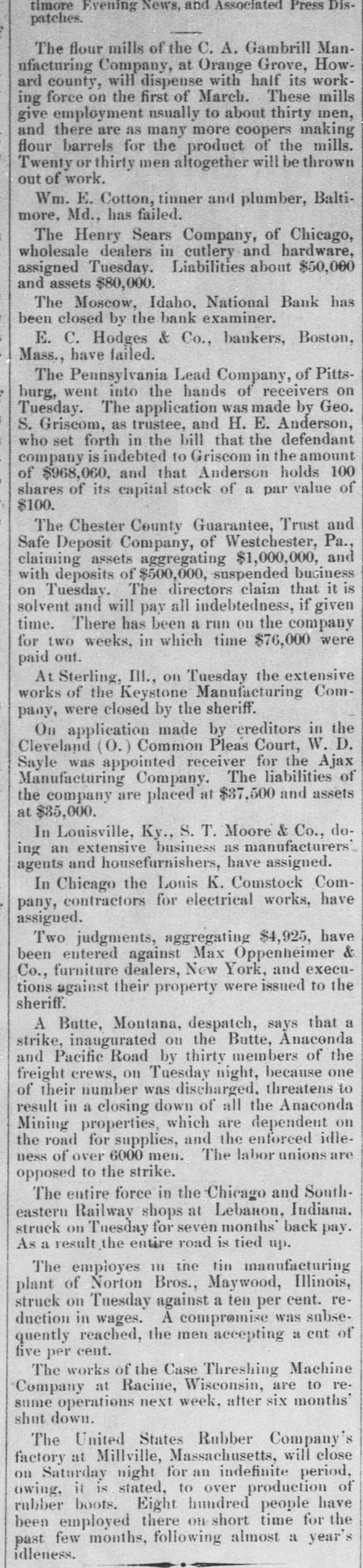
Comptroller Eckels announces the following changes in the officers of the Moscow National Bank, of Moscow, Idaho, which was on February 4. 1897, placed in the hands of Eugene T. Wilson, bank examiner, as receiver: J. H. Maguire and C. H. Brune, vice presidents: Earnest Delashmutt and S. Barghoorn, assistant cashiers.


Article from The Topeka State Journal, February 22, 1897

Click image to open full size in new tab

Article Text

RICHWITHOUT KNOWING IT An Investment of $50 Brings a Fortune to an Idaho Man. Portland, Ore., Feb. 22.-A well known business man just back from a trip to Idaho, vouches for the truth of this story of phenomenally good luck: About two weeks ago a miner offered Morris Yenzell, a Moscow, (Idaho) tailor, a handful of mining stocks for a suit of clothes. Yenzell declined that sort of currency in payment for his labor and goods, on the ground that the people had no luck in stocks. He remarked that five years ago a miner gave him 5,000 shares of stock, then supposed to be worth one cent a share, for a suit of clothes. He never realized anything on the stock. The miner jocosely said that if it had been Leroi stock, it would have made him rich. The tailor was startled and replied that he was quite certain that that was the name of the stock. He could not remember what he did with it, as he never expected it to amount to anything. A few days after Yenzel went to the suspended Moscow National bank for an insurance policy and some other papers deposited there and among which he found the missing 5,000 shares of the Leroi stock, now quoted at $8 per The share, with accrued dividends. Leroi mine owners have been negotiating with an English syndicate for the sale of the property but the latter declined to accept the mine with out the transfer of every share of stock SO far issued. This lot of 5,000 shares was long advertised for, but now there will be no further obstacle to the sale of the property if the owners come to Yenzel's terms. He demands $20 a share, or $10,000,000 for the whole and probably will get it.


Article from The Wilmington Daily Republican, February 23, 1897

Click image to open full size in new tab

Article Text

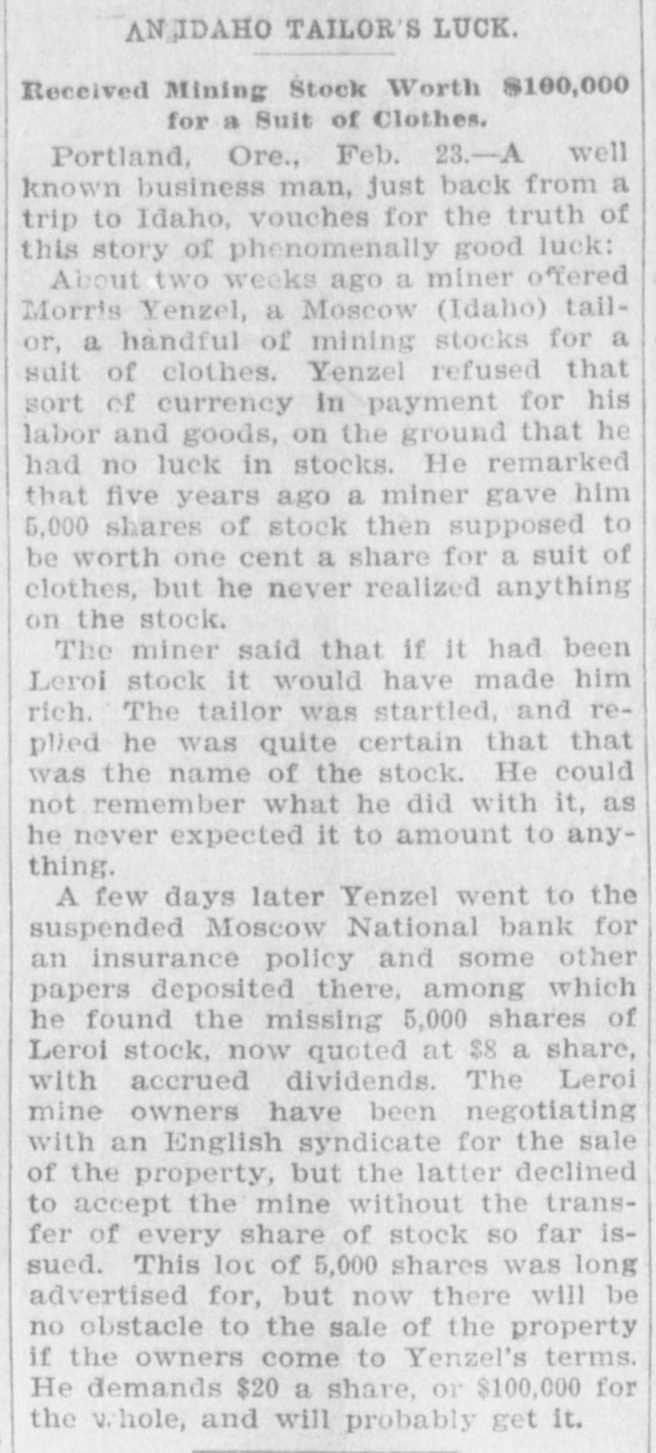
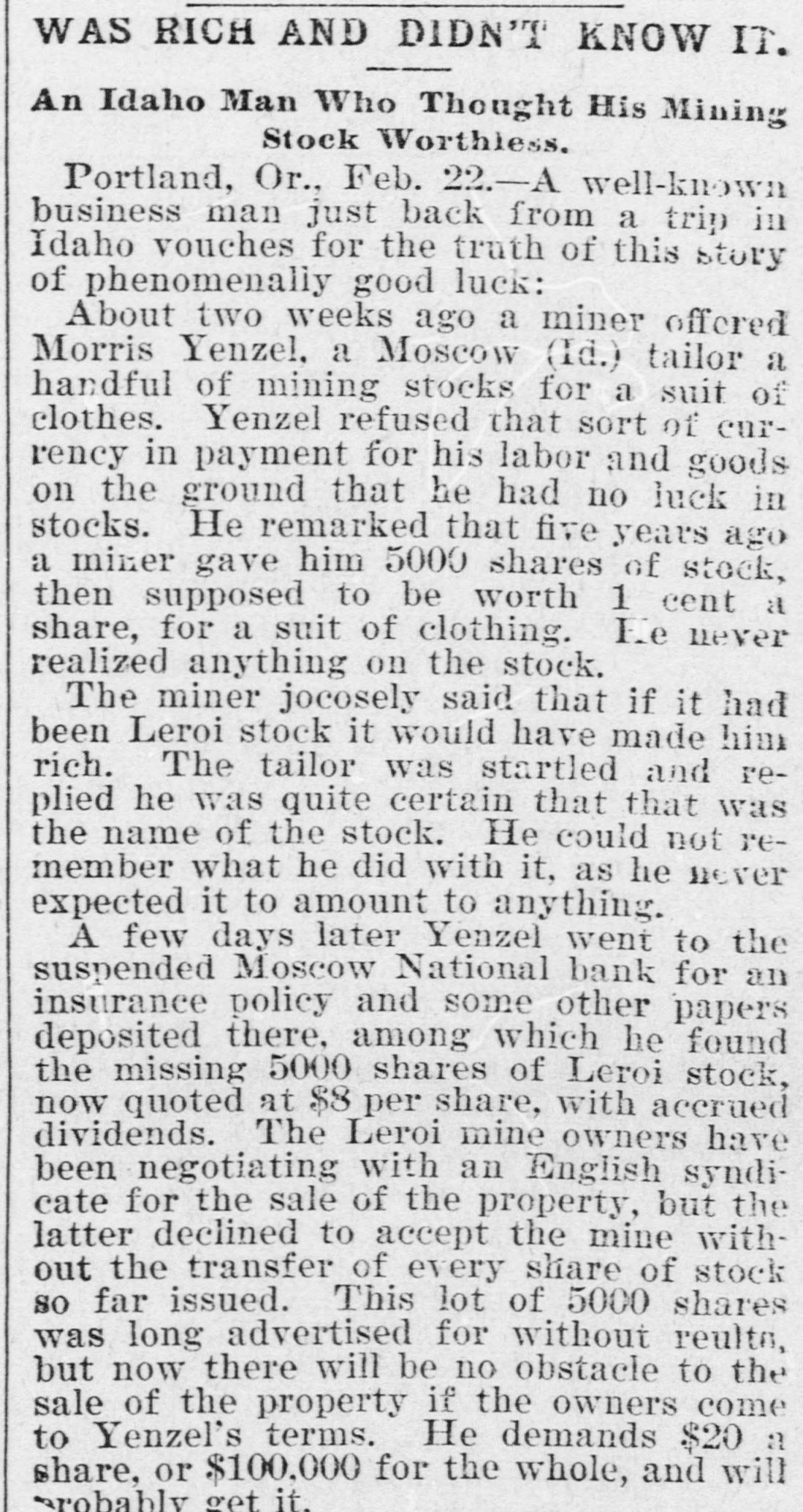
AN IDAHO TAILOR'S LUCK. Received Mining Stock Worth $100,000 for a Suit of Clothes. Portland. Ore., Feb. 23.-A well known business man, just back from a trip to Idaho, vouches for the truth of this story of phenomenally good luck: About two weeks ago a miner offered Morris Yenzel, a Moscow (Idaho) tailor, a handful of mining stocks for a suit of clothes. Yenzel refused that sort of currency in payment for his labor and goods, on the ground that he had no luck in stocks. He remarked that five years ago a miner gave him 5,000 shares of stock then supposed to be worth one eent a share for a suit of clothes, but he never realized anything on the stock. The miner said that If it had been Leroi stock it would have made him rich. The tailor was startled, and replied he was quite certain that that was the name of the stock. He could not remember what he did with It, as he never expected it to amount to anything. A few days later Yenzel went to the suspended Moscow National bank for an Insurance policy and some other papers deposited there, among which he found the missing 5,000 shares of Leroi stock, now quoted at $8 a share, with accrued dividends. The Lerol mine owners have been negotiating with an English syndicate for the sale of the property, but the latter declined to accept the mine without the transfer of every share of stock so far issued. This lot of 5,000 shares was long advertised for, but now there will be no obstacle to the sale of the property if the owners come to Yenzel's terms. He demands $20 a share, or $100,000 for the whole, and will probably get it.


Article from The Evening Herald, February 23, 1897

Click image to open full size in new tab

Article Text

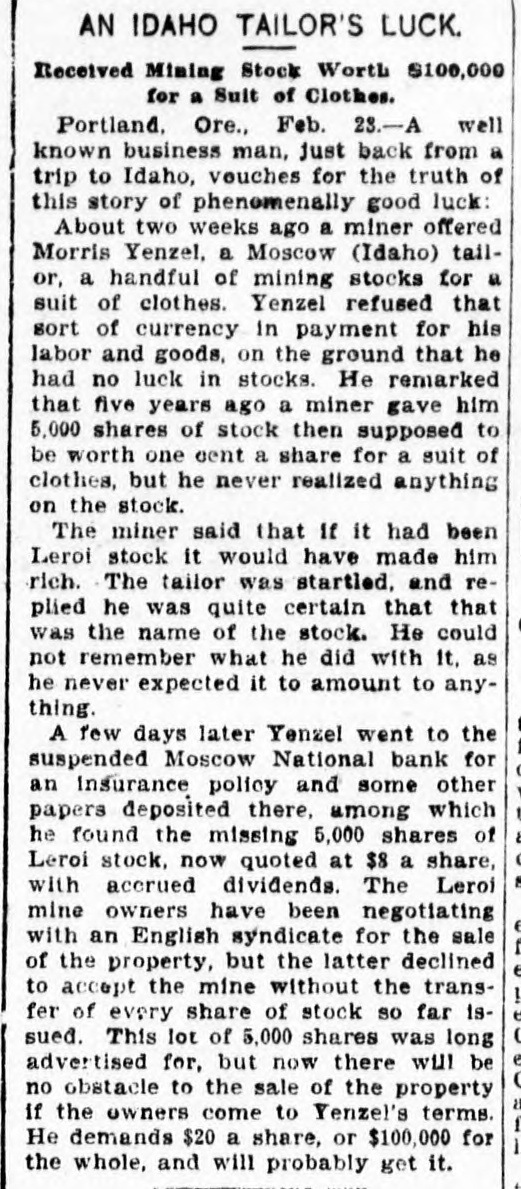
# AN IDAHO TAILOR'S LUCK. Received Mining Stock Worth $100,000 for a Suit of Clothes. Portland, Ore., Feb. 23.-A well known business man, just back from a trip to Idaho, vouches for the truth of this story of phenomenally good luck: About two weeks ago a miner offered Morris Yenzel, a Moscow (Idaho) tailor, a handful of mining stocks for a suit of clothes. Yenzel refused that sort of currency in payment for his labor and goods, on the ground that he had no luck in stocks. He remarked that five years ago a miner gave him 5,000 shares of stock then supposed to be worth one cent a share for a suit of clothes, but he never realized anything on the stock. The miner said that if it had been Leroi stock it would have made him rich. The tailor was startled, and replied he was quite certain that that was the name of the stock. He could not remember what he did with it, as he never expected it to amount to anything. A few days later Yenzel went to the suspended Moscow National bank for an insurance policy and some other papers deposited there, among which he found the missing 5,000 shares of Leroi stock, now quoted at $8 a share, with accrued dividends. The Leroi mine owners have been negotiating with an English syndicate for the sale of the property, but the latter declined to accept the mine without the transfer of every share of stock so far issued. This lot of 5,000 shares was long advertised for, but now there will be no obstacle to the sale of the property if the owners come to Yenzel's terms. He demands $20 a share, or $100,000 for the whole, and will probably get it.


Article from Omaha Daily Bee, February 23, 1897

Click image to open full size in new tab

Article Text

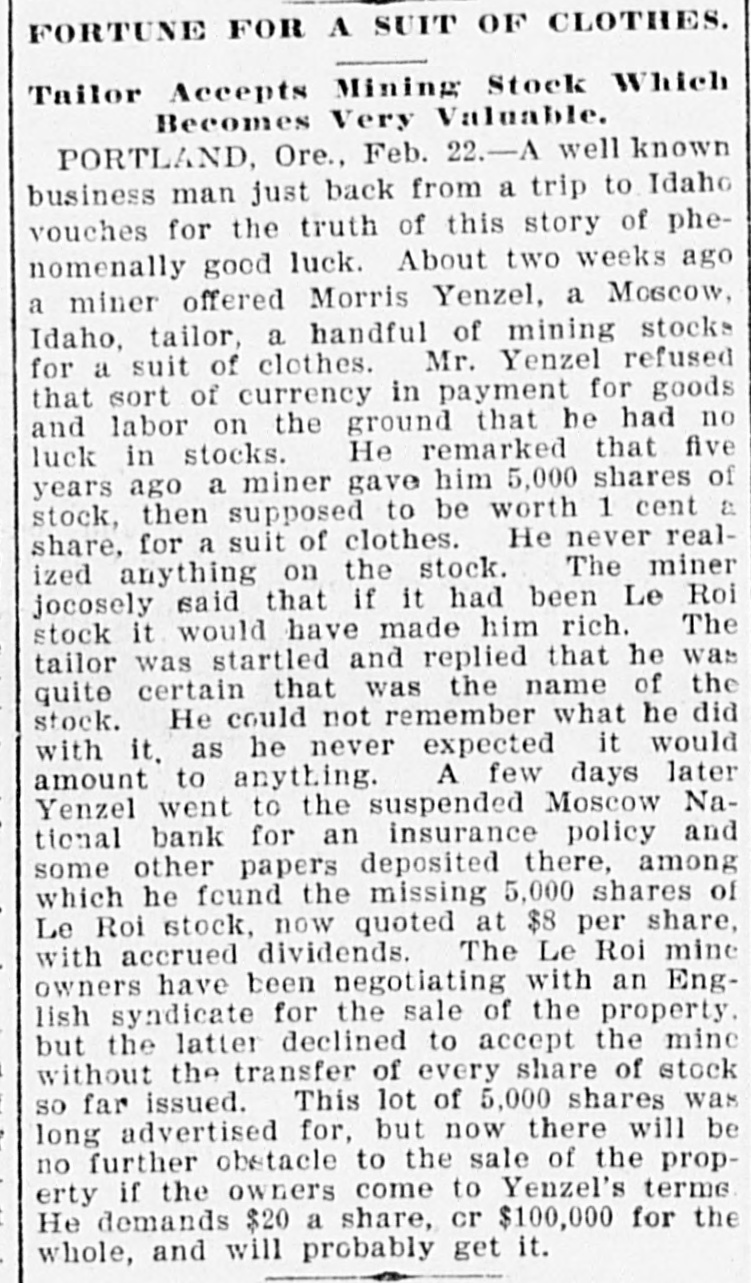
FORTUNE FOR A SUIT OF CLOTHES. Tailor Accepts Mining Stock Which Becomes Very Valuable. PORTLAND, Ore., Feb. 22.-A well known business man just back from a trip to Idaho vouches for the truth of this story of phenomenally good luck. About two weeks ago a miner offered Morris Yenzel, a Moscow, Idaho, tailor, a handful of mining stocks for a suit of clothes. Mr. Yenzel refused that sort of currency in payment for goods and labor on the ground that he had no luck in stocks. He remarked that five years ago a miner gave him 5,000 shares of stock, then supposed to be worth 1 cent a share, for a suit of clothes. He never realized anything on the stock. The miner jocosely said that if it had been Le Roi stock it would have made him rich. The tailor was startled and replied that he was quite certain that was the name of the stock. He could not remember what he did with it, as he never expected it would amount to anything. A few days later Yenzel went to the suspended Moscow National bank for an insurance policy and some other papers deposited there, among which he found the missing 5,000 shares of Le Roi stock, now quoted at $8 per share, with accrued dividends. The Le Roi mine owners have been negotiating with an English syndicate for the sale of the property, but the latter declined to accept the mine without the transfer of every share of stock so far issued. This lot of 5,000 shares was long advertised for, but now there will be no further obstacle to the sale of the property if the owners come to Yenzel's terms. He demands $20 a share, or $100,000 for the whole, and will probably get it.


Article from Daily Kennebec Journal, February 24, 1897

Click image to open full size in new tab

Article Text

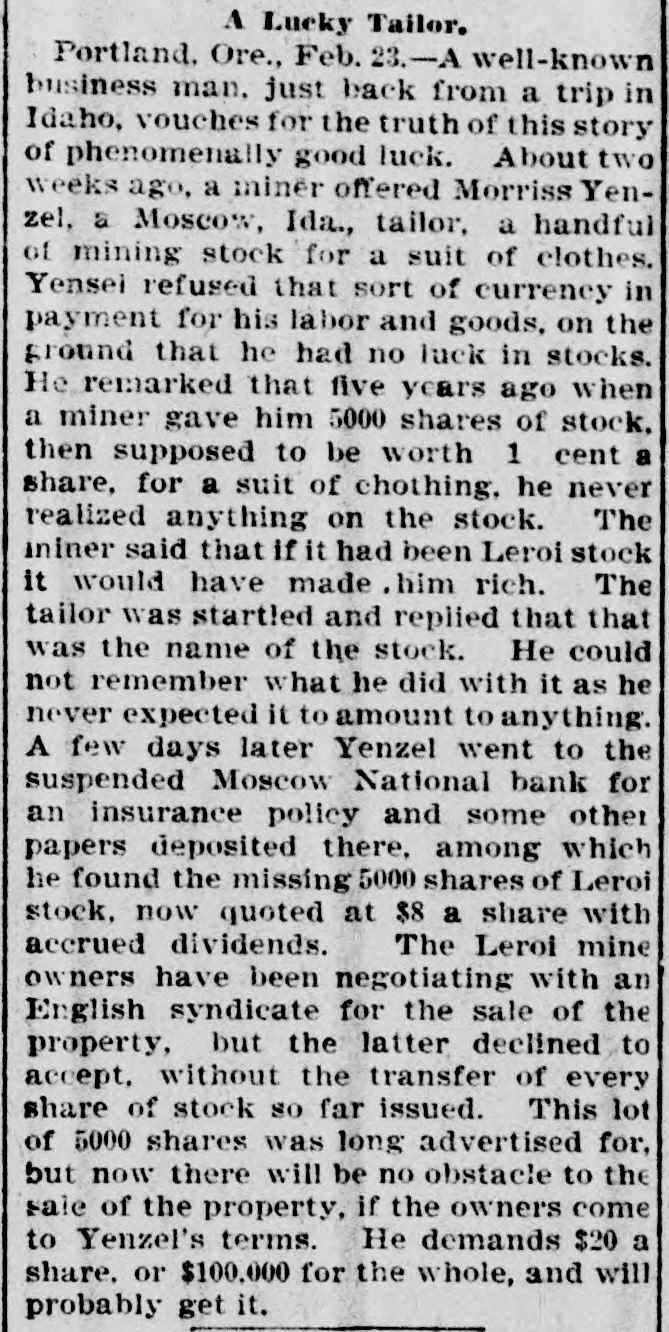
# A Lucky Tailor. Portland, Ore., Feb. 23. -A well-known business man, just back from a trip in Idaho, vouches for the truth of this story of phenomenally good luck. About two weeks ago, a miner offered Morriss Yenzel, a Moscow, Ida., tailor, a handful of mining stock for a suit of clothes. Yensei refused that sort of currency in payment for his labor and goods, on the ground that he had no luck in stocks. He remarked that five years ago when a miner gave him 5000 shares of stock, then supposed to be worth 1 cent a share, for a suit of chothing, he never realized anything on the stock. The miner said that if it had been Leroi stock it would have made him rich. The tailor was startled and replied that that was the name of the stock. He could not remember what he did with it as he never expected it to amount to anything. A few days later Yenzel went to the suspended Moscow National bank for an insurance policy and some other papers deposited there, among which he found the missing 5000 shares of Leroi stock, now quoted at $8 a share with accrued dividends. The Leroi mine owners have been negotiating with an English syndicate for the sale of the property, but the latter declined to accept, without the transfer of every share of stock so far issued. This lot of 5000 shares was long advertised for, but now there will be no obstacle to the sale of the property, if the owners come to Yenzel's terms. He demands $20 a share, or $100,000 for the whole, and will probably get it.


Article from The Morning News, February 28, 1897

Click image to open full size in new tab

Article Text

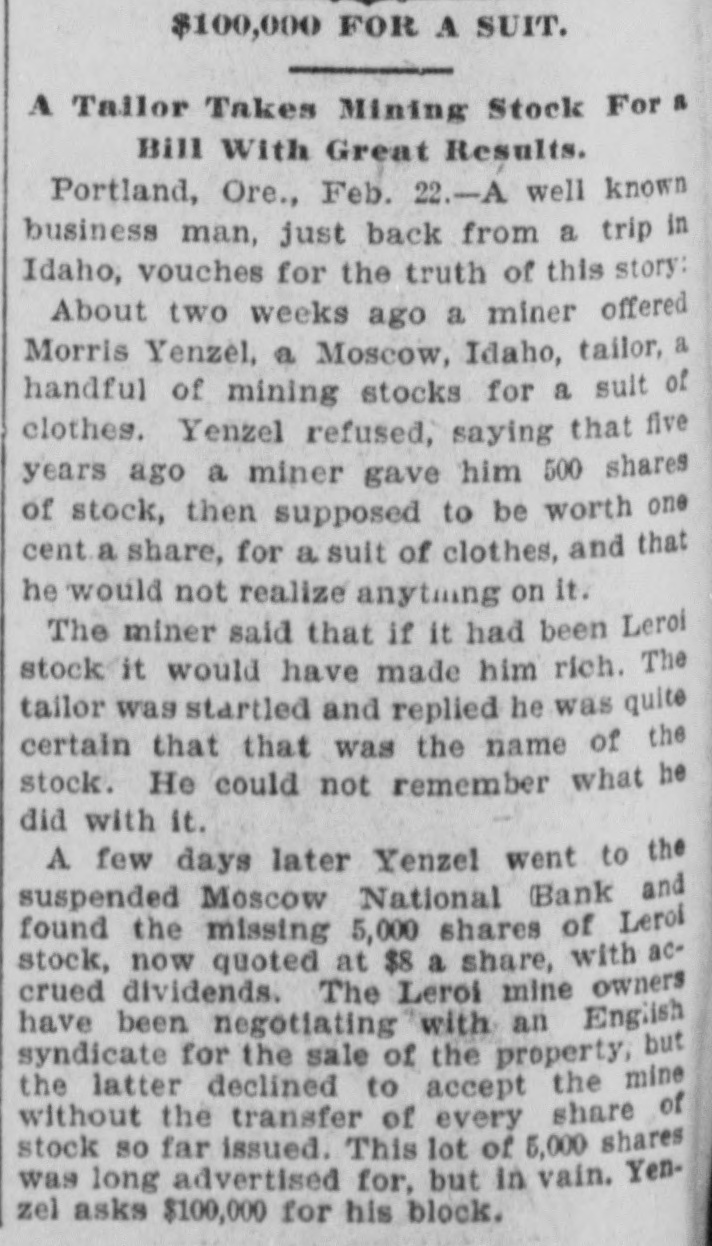
$100,000 FOR A SUIT. A Tailor Takes Mining Stock For a Bill With Great Results. Portland, Ore., Feb. 22.-A well known business man, just back from a trip in Idaho, vouches for the truth of this story: About two weeks ago a miner offered Morris Yenzel, a Moscow, Idaho, tailor, a handful of mining stocks for a sult of clothes. Yenzel refused, saying that five years ago a miner gave him 500 shares of stock, then supposed to be worth one cent a share, for a suit of clothes, and that he would not realize anything on it. The miner said that if it had been Leroi stock it would have made him rich. The tailor was startled and replied he was quite certain that that was the name of the stock. He could not remember what he did with it. A. few days later Yenzel went to the suspended Moscow National Bank and found the missing 5,000 shares of Lerol stock, now quoted at $8 a share, with accrued dividends. The Leroi mine owners have been negotiating with an English syndicate for the sale of the property, but the latter declined to accept the mine without the transfer of every share of stock so far issued. This lot of 5,000 shares was long advertised for, but in vain. Yenzel asks $100,000 for his block.


Article from The Evening Tribune, March 1, 1897

Click image to open full size in new tab

Article Text

LUCKY IDAHO TAILOR. Stock Given Him For a Suit of Clothes Makes His Fortune. About two weeks ago a miner offered Morris Yenzel, a Moscow (Ida.) tailor, a handful of mining stocks for a suit of clothes. Yenzel refused and said that five years ago a miner gave him 5,000 shares of stock, then supposed to be worth 1 cent a share, for a suit of clothing. He never realized anything on the stock. A few days later Yenzel went to the suspended Moscow National bank for an insurance policy and some other papers deposited there, among which he found the missing 5,000 shares of Leroi stock, now quoted at $8 per share, with accrued dividends. The Leroi mine owners have been negotiating with an English syndicate for the sale of the property, but the latter declined to accept the mine without the transfer of every share of stock so far issued. This lot of 5,000 shares was long advertised for, but now there will be no obstacle to the sale of the property if the owners come to Yenzel's terms. He demands $20 a share, or $100,000 for the whole, and will probably get it. -New York Times.


Article from The Copper Country Evening News, March 3, 1897

Click image to open full size in new tab

Article Text

LUCKY IDAHO TAILOR. Stock Given Him For a Suit of Clothes Makes His Fortune. About two weeks ago a miner offered Morris Yenzel, a Moscow (Ida. ) tailor, a handful of mining stocks for a suit of clothes. Yenzel refused and said that five years ago a miner gave him 5,000 shares of stock, then supposed to be worth 1 cent a share, for a suit of clothing. He never realized anything on the stock. A few days later Yenzel went to the suspended Moscow National bank for an insurance policy and some other papers deposited there, among which he found the missing 5,000 shares of Leroi stock, now quoted at $8 per share, with accrued dividends. The Leroi mine owners have been negotiating with an English syndicate for the sale of the property, but the latter declined to accept the mine without the transfer of every share of stock SO far issued. This lot of 5,000 shares was long advertised for, but now there will be no obstacle to the sale of the property if the owners come to Yenzel's terms. He demands $20 a share, or $100,000 for the whole, and will probably get it. -New York Times.


Article from The Evening Times, March 4, 1897

Click image to open full size in new tab

Article Text

Scorned the Mining Stock. About two weeks, ago a miner offered Morris Yenzel, a Moscow, Idaho, tailor, a handful of mining stocks for a suit of clothes. Yenzel refused and said that five years ago a miner gave him 5,000 shares of stock, then supposed to be worth a cent a share, for a suit of clothing. He never realized anything on the stock. A few days later Yenzel went to the suspended Moscow National Bank for an insurance policy and some other papers deposited there, among which he found the missing 5,000 shares of Leroi stock, now quoted at $8 per share, with accrued dividends. The Leroi mine owners have been negotiating with an English syndicate for the sale of the property, but the latter declined to acceptthe mine without the transfer of every share of stock so far issued. This lot of 5,000 was long advertised for, but now there will be no obstacle to the sale of the property if the owners come to Yenzel's terms. He demands $20 a share, or $100,000 for the whole, and will probably get it.


Article from Pullman Herald, July 10, 1897

Click image to open full size in new tab

Article Text

-E. K. Sheldon, of Colfax, is in Pullman. -F. D. Richardson is in the city from Grangeville, Idaho. -Max Aronson was over from Moscow one day this week. -Receiver Stufflebeam of the Moscow National bank, was in the city Thursday evening. -The Pullman base hall team will-cross bats with the Union Flat team, on the Flat, tomorrow. -The crops are now practically past all danger, and are promising an enormous yield. Fall wheat is "in the dough," and harvest will probably commence within three weeks. The ground is still wet. and can not possibly dry out before the grain is ripe.


Article from The Daily Morning Astorian, October 14, 1897

Click image to open full size in new tab

Article Text

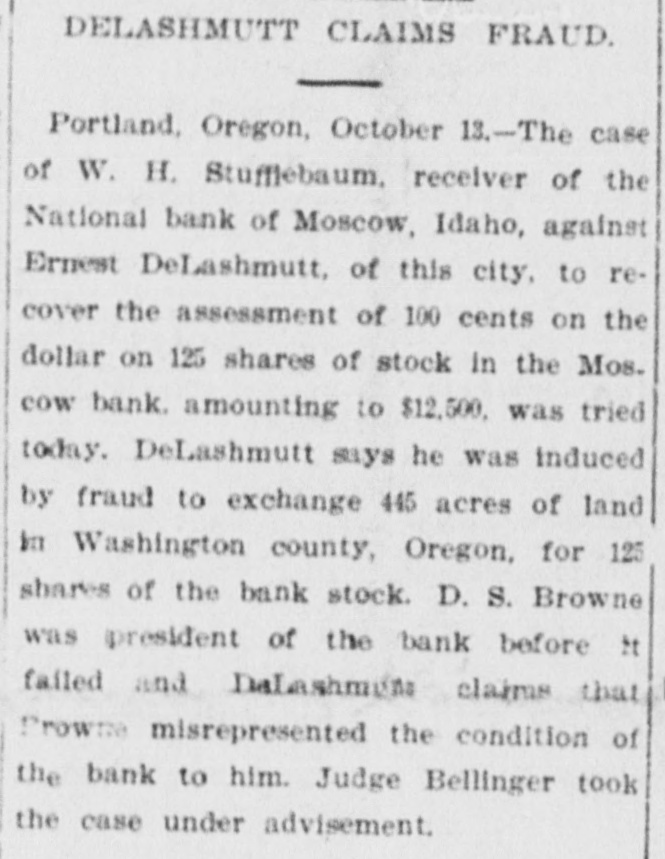
DELASHMUTT CLAIMS FRAUD. Portland, Oregon, October -The case of W. H. Stufflebaum, receiver of the National bank of Moscow, Idaho, against Ernest DeLashmutt, of this city, to recover the assessment of 100 cents on the dollar on 125 shares of stock in the Mos. cow bank. amounting to $12,500. was tried today. DeLashmutt says he was induced by fraud to exchange 445 acres of land in Washington county, Oregon, for 125 shares of the bank stock. D. S. Browne was president of the bank before It failed and DaLashmin claims that Prown misrepresented the condition of the bank to him. Judge Bellinger took the case under advisement.


Article from The Anaconda Standard, January 11, 1898

Click image to open full size in new tab

Article Text

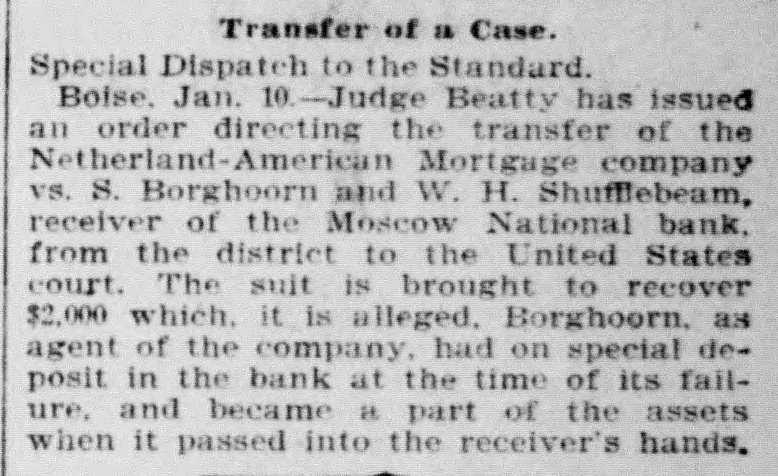
Transfer of a Case. Special Dispatch to the Standard. Boise, Jan. 10.-Judge Beatty has issued an order directing the transfer of the Netherland-American Mortgage company vs. S. Borghoorn and W. H. Shufflebeam, receiver of the Moscow National bank, from the district to the United States court. The suit is brought to recover $2,000 which. it is alleged. Borghoorn, as agent of the company, had on special deposit in the bank at the time of its failure, and became a part of the assets when it passed into the receiver's hands.


Article from The Salt Lake Herald, January 11, 1898

Click image to open full size in new tab

Article Text

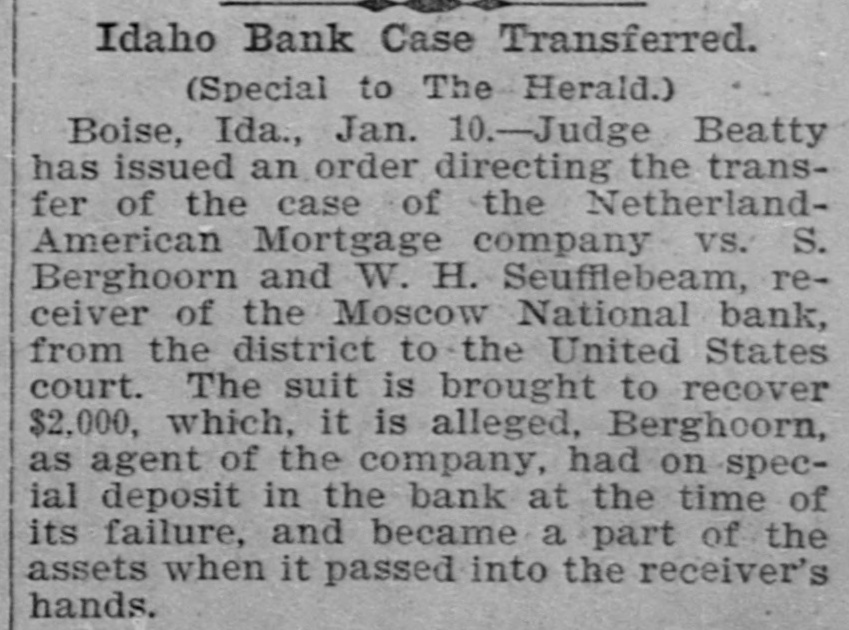
Idaho Bank Case Transferred. (Special to The Herald.) Boise, Ida., Jan. 10.-Judge Beatty has issued an order directing the transfer of the case of the NetherlandAmerican Mortgage company vs. S. Berghoorn and W. H. Seufflebeam, receiver of the Moscow National bank, from the district to - the United States court. The suit is brought to recover $2,000, which, it is alleged, Berghoorn, as agent of the company, had on special deposit in the bank at the time of its failure, and became a part of the assets when it passed into the receiver's hands.


Article from The Salt Lake Herald, March 16, 1899

Click image to open full size in new tab

Article Text

IN THE FEDERAL COURTS. An Idaho Bank Suit Involving Fifteen Thousand Dollars. In the federal court yesterday a suit was filed by W. P. Connoway, as receiver of the Moscow National bank of Moscow, Ida., against Edward Byrne, one of the shareholders, for $15,000. It is alleged that on Feb. 1, 1897, the Moscow National bank, its assets being insufficient to pay its liabilities, was, by order of the comptroller of the currency of the United States, closed, and has not transacted any business since that date, its affairs being under the control of the comptroller; that on Jan. 3, 1898, the complainant was appointed receiver of said bank; that the defendant was a shareholder to the extent of 150 shares of the capital stock of the par value of $100 per share; that on June 14, 1897, the comptroller, in order to pay the liabilities, made an assessment of $100 per share upon the capital stock; that the defendant became indebted to the petitioner in the sum of $15,000, with interest, no part of which has been paid. Wherefore, the plaintiff asks judgment against the defendant for $15,000, with interest at 7 per cent, from June 14, 1897, The suit was brought under the direction of the comptroller of the currency, in accordance with the national banking laws, which makes each shareholder liable for the debts of the bank to the amount of 100 per cent in excess of the par value of his stock or a double liability.


Article from The Daily Journal, August 5, 1899

Click image to open full size in new tab

Article Text

The above case has dragged along until the present term of court, when the final arguments were submitted. It appears that the DeLashmutts had traded the Witch Hazel farm near Reedville, worth several thousand dollars, to R. S. Browne for stock in the Moscow National bank, of Moscow, Idaho. The bank thereafter failed, and the DeLashmutts were called upon to pay the depositors. Upon citation to make good the deposits, the plaintiffs secured a foothold to stop forced collection, by suing Browne and the receiver of the bank, asking that the farm property be set back to them upon the grounds that the trade was made through, and by means of fraud upon the part of Browne. Judge McBride, Tuesday, decided that the farm should revert to the DeLashmutts. This saves them the valuable farm besides the loss which payment of the bank's depositors would entail.--Argus Aug. 3, '99.


Article from The Colfax Gazette, November 23, 1900

Click image to open full size in new tab

Article Text

PERSONAL MENTION, Ben Binnard returned Monday from Spokane, where he went to visit his daughter, Miss Birdie, who is ill at a hospital there. A successful surgical operation was performed and the young lady is on the high road to recovery. Fred Doolittle left Monday for Ellensburg to join a Northern Pacific surveying corps. Mrs. Clara Burrall arrived Friday from Battle Creek, Michigan, on a visit with her daughter, Mrs. R. F. Banker. W. P. Connaway, receiver of the Moscow National Bank, passed through Colfax Tuesday, enroute to Salt Lake City, with the books and records of the bank, to give evidence in the federal court in a case in which the institution is interested. R. H. Squibb, who accompanied Albert Gerber to Europe recently, returned last Tuesday. He visited the Paris exposition and many points of interest beyond the Atlantic.


Article from Deseret Evening News, December 1, 1900

Click image to open full size in new tab

Article Text

Miss Zane left for the East today. Mrs. Nelson Cooper, of "Walbrook," Baltimore, Md., is in the city visiting her son, Mr. W. P. Cooper, 734 East Brigham street. # IN THE FEDERAL COURT. The jury in the case of W. P. Connaway, receiver of the Moscow (Ida.) National bank against Edward Byrne, returned a verdict yesterday afternoon in favor of the defendant. The case was brought to recover $15,000 for delinquent assessment on the stock of the bankrupt institution. It seems that most of the trouble has grown out of mismanagement. The case of the United States vs J. S. Black of Sanpete county for cutting timber on government lands, was tried in the Federal court yesterday afternoon. It was a suit to recover $1,000, and after examining three witnesses the jury was instructed to return a verdict of $115.16 in favor of the plaintiff. On motion of the plaintiff the case of the United States vs George A. Petty, for cutting timber on government land, was dismissed.