First State Bank (Shelby, MT)

Episode Information

Episode UID
4592177191483
Episode Type
Run → Suspension → Reopening
Bank Type
state
Bank ID
459217719 hash
Start Date
July 10, 1923
Location
Shelby, Montana (48.505, -111.857)

Metadata

Model
gpt-5-mini (chosen from majority vote of a three-model LLM ensemble)
Short Digest
4e02706bf21dcf77

Response Measures

None

Description

Stanton Bank's mistaken telegram left correspondent short; local rumors about the mayor amplified withdrawals.

Events (3)

1. July 10, 1923 Run
Cause
Local Banks
Cause Details
Withdrawals accelerated after the Stanton Trust & Savings Bank (correspondent) failed/was suspended and rumors spread that Mayor Johnson was financially ruined by the fight.
Measures
No special measures reported beyond examiner involvement and depositor cooperation later.
Newspaper Excerpt
There was a run on the bank, and its closing inevitable.
Source
newspapers
2. July 10, 1923 Suspension
Cause
Correspondent
Cause Details
Closed immediately following suspension/closure of the Stanton Trust & Savings Bank of Great Falls, which left Shelby short of cash and triggered depositor withdrawals.
Newspaper Excerpt
The First State Bank of Shelby ... closed its doors Tuesday morning due to a lack of ready cash.
Source
newspapers
3. December 29, 1923 Reopening
Newspaper Excerpt
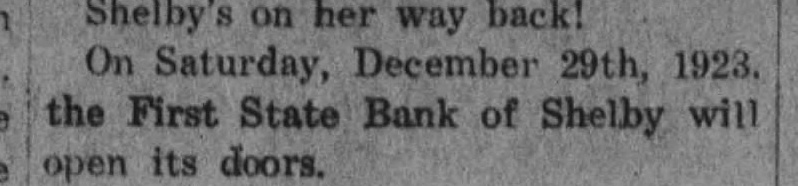
On Saturday, December 29th, 1923, the First State Bank of Shelby will open its doors.
Source
newspapers

Newspaper Articles (22)

Article from Wilkes-Barre Times Leader, the Evening News, July 11, 1923

Click image to open full size in new tab

Article Text

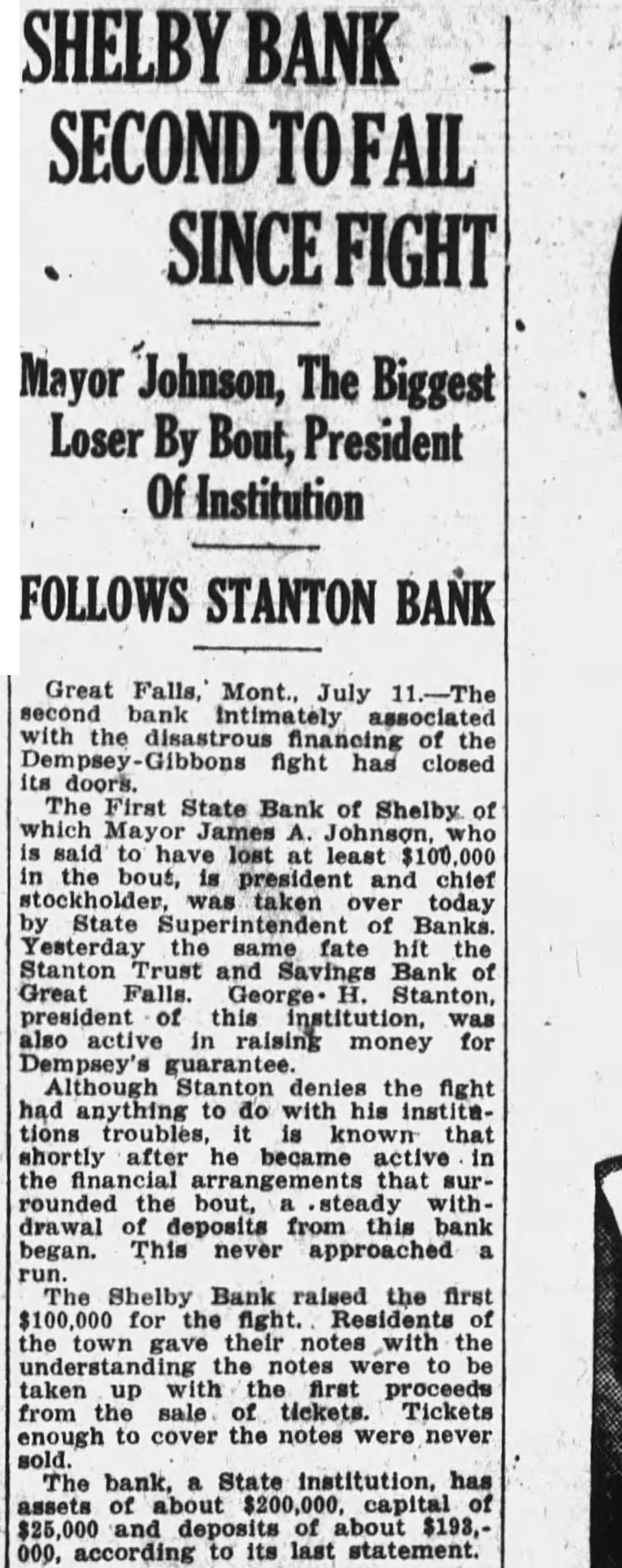
SHELBY BANK SECOND TO FAIL SINCE FIGHT Mayor Johnson, The Biggest Loser By Bout, President Of Institution FOLLOWS STANTON BANK Great Falls, Mont., July 11.—The second bank intimately associated with the disastrous financing of the Dempsey-Gibbons fight has closed its doors. The First State Bank of Shelby of which Mayor James A. Johnson, who is said to have lost at least $100,000 in the bout, is president and chief stockholder, was taken over today by State Superintendent of Banks. Yesterday the same fate hit the Stanton Trust and Savings Bank of Great Falls. George H. Stanton, president of this institution, was also active in raising money for Dempsey's guarantee. Although Stanton denies the fight had anything to do with his institutions troubles, it is known that shortly after he became active in the financial arrangements that surrounded the bout, a steady withdrawal of deposits from this bank began. This never approached a run. The Shelby Bank raised the first $100,000 for the fight. Residents of the town gave their notes with the understanding the notes were to be taken up with the first proceeds from the sale of tickets. Tickets enough to cover the notes were never sold. The bank, a State institution, has assets of about $200,000, capital of $25,000 and deposits of about $193,000, according to its last statement.


Article from The Omaha Morning Bee, July 11, 1923

Click image to open full size in new tab

Article Text

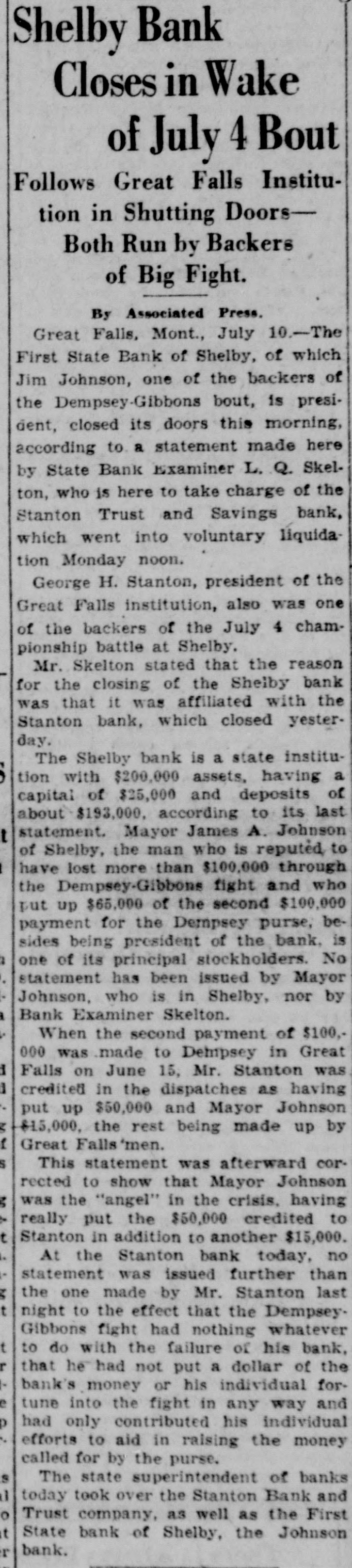
Shelby Bank Closes in Wake of July 4 Bout Follows Great Falls Institution in Shutting DoorsBoth Run by Backers of Big Fight. By Associated Press. Great Falls, Mont., July 10.-The First State Bank of Shelby, of which Jim Johnson, one of the backers of the Dempsey-Gibbons bout, is president, closed its doors this morning, according to a statement made here by State Bank Examiner L. Q. Skelton, who is here to take charge of the Stanton Trust and Savings bank, which went into voluntary liquidation Monday noon. George H. Stanton, president of the Great Falls institution, also was one of the backers of the July 4 championship battle at Shelby. Mr. Skelton stated that the reason for the closing of the Shelby bank was that it was affiliated with the Stanton bank, which closed yesterday. The Shelby bank is a state institution with $200,000 assets, having a capital of $25,000 and deposits of about $193,000. according to its last t statement. Mayor James A. Johnson of Shelby, the man who is reputed to have lost more than $100,000 through the Dempsey-Gibbons fight and who put up $65,000 of the second $100,000 payment for the Dempsey purse, besides being president of the bank. is 1 one of its principal stockholders. No statement has been issued by Mayor Johnson, who is in Shelby, nor by Bank Examiner Skelton. When the second payment of $100,000 was made to Dehipsey in Great I Falls on June 15, Mr. Stanton was I credited in the dispatches as having . put up $50,000 and Mayor Johnson < $15,000. the rest being made up by f Great Falls 'men. S This statement was afterward corrected to show that Mayor Johnson b was the "angel" in the crisis, having really put the $50,000 credited to t Stanton in addition to another $15,000. At the Stanton bank today, no statement was issued further than b the one made by Mr. Stanton last t night to the effect that the DempseyGibbons fight had nothing whatever t to do with the failure of his bank, r that he had not put a dollar of the bank's money or his individual fore tune into the fight in any way and p had only contributed his individual efforts to aid in raising the money called for by the purse. S The state superintendent of banks 1 today took over the Stanton Bank and o Trust company, as well as the First t State bank of Shelby, the Johnson bank. r


Article from Clarion-Ledger, July 11, 1923

Click image to open full size in new tab

Article Text

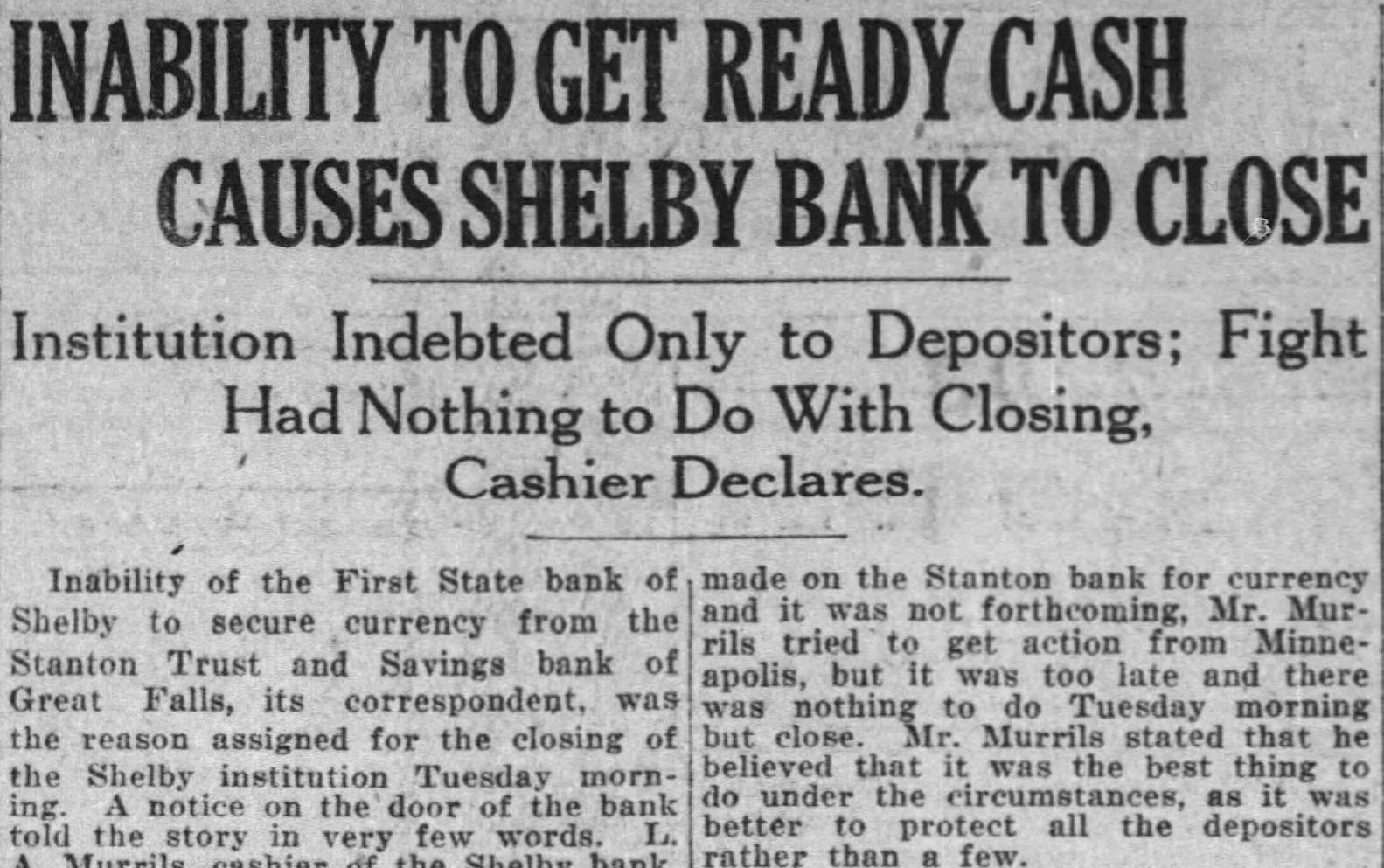
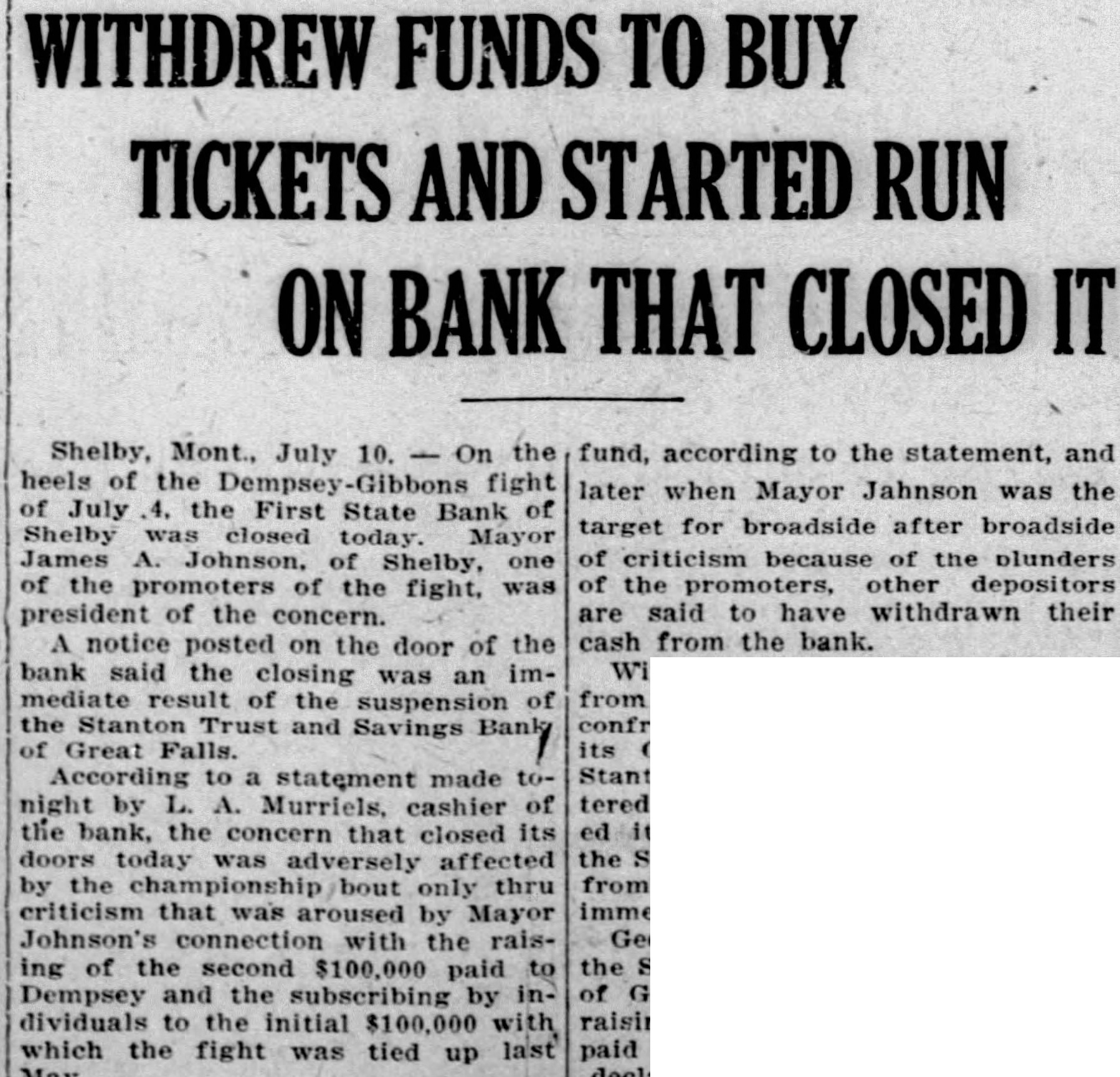
WITHDREW FUNDS TO BUY TICKETS AND STARTED RUN ON BANK THAT CLOSED IT Shelby, Mont., July 10. — On the heels of the Dempsey-Gibbons fight of July 4, the First State Bank of Shelby was closed today. Mayor James A. Johnson, of Shelby, one of the promoters of the fight, was president of the concern. A notice posted on the door of the bank said the closing was an immediate result of the suspension of the Stanton Trust and Savings Bank of Great Falls. According to a statement made tonight by L. A. Murriels, cashier of the bank, the concern that closed its doors today was adversely affected by the championship bout only thru criticism that was aroused by Mayor Johnson's connection with the raising of the second $100,000 paid to Dempsey and the subscribing by individuals to the initial $100,000 with which the fight was tied up last May. fund, according to the statement, and later when Mayor Johnson was the target for broadside after broadside of criticism because of the blunders of the promoters, other depositors are said to have withdrawn their cash from the bank.


Article from Evening star, July 11, 1923

Click image to open full size in new tab

Article Text

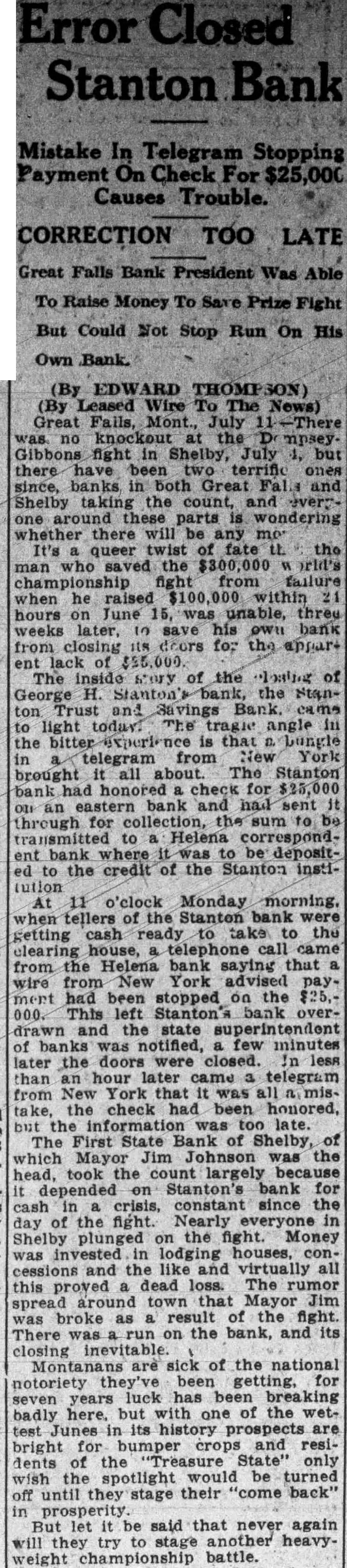
Special Dispatch to The Star. GREAT FALLS, Mont., July 11.—There was no knockout at the Dempsey-Gibbons fight in Shelby July 4, but there have been two terrific ones since, banks in both Great Falls and Shelby taking the count, and every one around these parts is wondering whether there will be any more. It's a queer twist of fate that the man who saved the $300,000 world championship fight from failure when he raised $100,000 within twenty-four hours on June 15 was unable, three weeks later, to save his own bank from closing its doors for the apparent lack of $25,000. The inside story of the closing of George H. Stanton's bank, the Stanton Trust and Savings Bank, came to light today. The tragic angle in the bitter experience is that a bungle in a telegram from New York brought it all about. The Stanton Bank had honored a check for $25,000 on an eastern bank and had sent it through for collection, the sum to be transmitted to a Helena correspondent bank, where it was to be deposited to the credit of the Stanton institution. At 11 o'clock Monday morning when tellers of the Stanton bank were getting cash ready to take to the clearing house, a telephone call came from the Helena bank saying that a wire from New York advised payment had been stopped on the $25,000. This left Stanton's bank overdrawn and the state superintendent of banks was notified. A few minutes later the doors were closed. In less than an hour later came a telegram from New York that it was all a mistake, the check had been honored, but the information was too late. Whole Town Plunged. The First State Bank of Shelby, of which Mayor Jim Johnson was the head, took the count largely because it depended on Stanton's bank for cash in a crisis, constant since the day of the fight. Nearly every one in Shelby plunged on the fight. Money was invested in lodging houses, concessions and the like and virtually all this proved a dead loss. The rumor spread around town that Mayor Jim was broke as a result of the fight. There was a run on the bank, and its closing inevitable. Montanans are sick of the national notoriety they've been getting; for seven years luck has been breaking badly here, but with one of the wettest Junes in its history prospects are bright for bumper crops and residents of the "treasure state" only wish the spotlight would be turned off until they stage their "comeback" in prosperity. But let it be said that never again will they try to stage another heavyweight championship battle.


Article from The World-News, July 11, 1923

Click image to open full size in new tab

Article Text

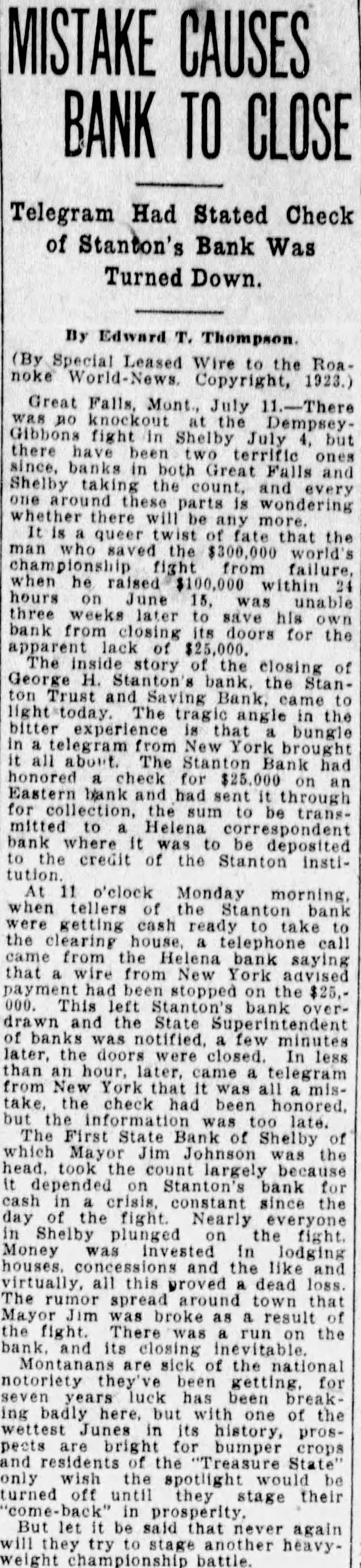
MISTAKE CAUSES BANK TO CLOSE Telegram Had Stated Check of Stanton's Bank Was Turned Down. By Edward T. Thompson. (By Special Leased Wire to the Roanoke World-News. Copyright, 1923.) Great Falls, Mont., July 11.—There was no knockout at the Dempsey-Gibbons fight in Shelby July 4, but there have been two terrific ones since, banks in both Great Falls and Shelby taking the count, and every one around these parts is wondering whether there will be any more. It is a queer twist of fate that the man who saved the $300,000 world's championship fight from failure, when he raised $100,000 within 24 hours on June 15, was unable three weeks later to save his own bank from closing its doors for the apparent lack of $25,000. The inside story of the closing of George H. Stanton's bank, the Stanton Trust and Saving Bank, came to light today. The tragic angle in the bitter experience is that a bungle in a telegram from New York brought it all about. The Stanton Bank had honored a check for $25,000 on an Eastern bank and had sent it through for collection, the sum to be transmitted to a Helena correspondent bank where it was to be deposited to the credit of the Stanton institution. At 11 o'clock Monday morning, when tellers of the Stanton bank were getting cash ready to take to the clearing house, a telephone call came from the Helena bank saying that a wire from New York advised payment had been stopped on the $25,000. This left Stanton's bank overdrawn and the State Superintendent of banks was notified, a few minutes later, the doors were closed. In less than an hour, later, came a telegram from New York that it was all a mistake, the check had been honored, but the information was too late. The First State Bank of Shelby of which Mayor Jim Johnson was the head, took the count largely because it depended on Stanton's bank for cash in a crisis, constant since the day of the fight. Nearly everyone in Shelby plunged on the fight. Money was invested in lodging houses, concessions and the like and virtually, all this proved a dead loss. The rumor spread around town that Mayor Jim was broke as a result of the fight. There was a run on the bank, and its closing inevitable. Montanans are sick of the national notoriety they've been getting, for seven years luck has been breaking badly here, but with one of the wettest Junes in its history, prospects are bright for bumper crops and residents of the "Treasure State" only wish the spotlight would be turned off until they stage their "come-back" in prosperity. But let it be said that never again will they try to stage another heavyweight championship battle.


Article from The Jersey Journal, July 12, 1923

Click image to open full size in new tab

Article Text

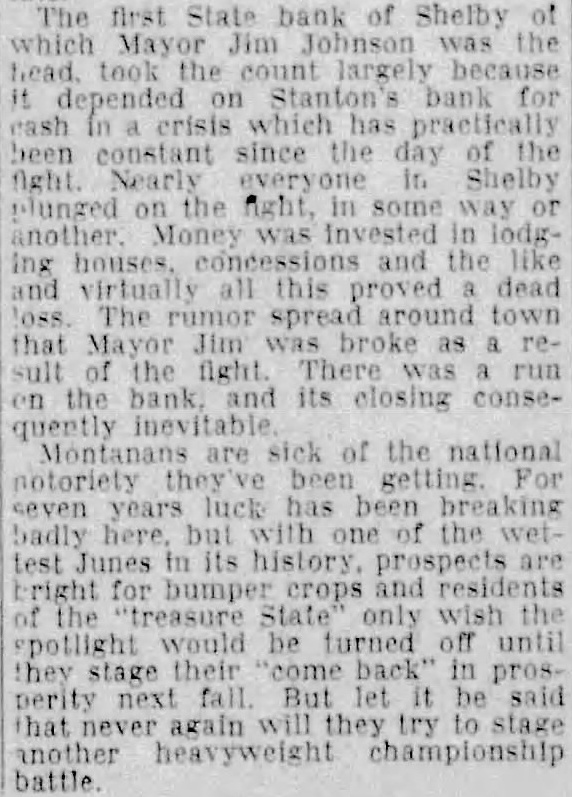
The first State bank of Shelby of which Mayor Jim Johnson was the head, took the count largely because it depended on Stanton's bank for cash in a crisis which has practically been constant since the day of the fight. Nearly everyone in Shelby plunged on the fight, in some way or another. Money was invested in lodging houses, concessions and the like and virtually all this proved a dead loss. The rumor spread around town that Mayor Jim was broke as a result of the fight. There was a run on the bank, and its closing consequently inevitable. Montanans are sick of the national notoriety they've been getting. For seven years luck has been breaking badly here, but with one of the wettest Junes in its history, prospects are bright for bumper crops and residents of the "treasure State" only wish the spotlight would be turned off until they stage their "come back" in prosperity next fall. But let it be said that never again will they try to stage another heavyweight championship battle.


Article from The Telegraph-Courier, July 12, 1923

Click image to open full size in new tab

Article Text

SHELBY MARKS TIME IN NEW BANK CRISIS Bank Examiners to Make Report on Condition of First State Bank of Shelby Tomorrow. (By Associated Press Leased Wire) Shelby, Mont.-Reports of banking examiners working on the books of the First State bank of Shelby, which closed its door yesterday, were expected to be available by tomorrow. Meanwhile depositors in the institution of which Mayor James Johnson, of Shelby, treasurer for the promoters of the Dempsey-Gibbons fight, was president, marked time. No statement was forthcoming as to the exact amount of cash on hand. The action was an immediate result of the suspension of the Stanton Trust and Savings bank of Great Falls. Geo. H. Stanton, who aided in the financing of the fight, was president of the Great Falls institution.


Article from Great Falls Tribune, July 12, 1923

Click image to open full size in new tab

Article Text

(Tribune's Shelby Bureau). Shelby, July 11.—That the First State Bank of Shelby, which closed its doors Tuesday morning due to a lack of ready cash, will reopen shortly, is the apparent opinion of depositors and business men here. The status of the bank is one of the chief subjects in conversations here, and the majority of citizens seem to hold the opinion that there is nothing wrong with the manner in which the finances were handled. Many predict that business will be resumed by the bank within 30 days at


Article from The Richmond Item, July 12, 1923

Click image to open full size in new tab

Article Text

BANK BACK OF BATTLE FAILS Men Who Saved Dempsey-Gibbons Bout Unable to Save Own Institution By EDWARD THOMPSON Special Dispatch to The Item Copyright 1923 by Richmond Item GREAT FALLS, Mont., July 11—There was no knockout at the Dempsey-Gibbons fight in Shelby July 4 but there have been two terrific since, banks in both Great Falls and Shelby taking the count, and every one around these parts is wondering whether there will be any more. Its a queer twist of fate that the man who save the $300,000 world's championship fight from failure when he raise $100,000 within 24 hours on June 15, was unable, three weeks later, to save his own bank from closing its doors for the apparent lack of $25,000. The inside story of the closing of George H. Stanton's bank, the Stanton Trust and Savings bank, came to light today. The tragic angle in the bitter experience is that a bungle in a telegram from New York brought it all about. The Stanton bank had honored a check for $25,000 on an eastern bank and had sent it through for collection, the sum to be transmitted to a Helena correspondent bank, where it was to be deposited to the credit of the Stanton institution. At 11 o'clock Monday morning when tellers of the Stanton bank were getting cash ready to take to the clearing house, a telephone call came from the Helena bank saying that a wire from New York advised payment had been stopped on the $25,000. This left Stanton's bank overdrawn and the state superintendent of banks was notified. A few minutes later the doors were closed. In less than an hour later came a telegram from New York that at was all a mistake, the check had been honored but the information was too late. The First State bank of Shelby, of which Mayor Jim Johnson was the head, took the count largely because it depended on Stanton's bank for cash in a crisis, constant since the day of the fight. Nearly every one in Shelby plunged on the fight. Money was invested in lodging houses concessions and the like and virtually all this proved a dead loss. The rumor spread around town that Mayor Jim was broke as a result of the fight. There was a run on the bank and its closing was inevitable. Montanans are sick of the national notoriety they've been getting. For seven years luck has been breaking badly here but with one of the wettest Junes in its history, prospects are bright for bumper crops and residents of the "treasure state" only wish the spotlight would be turned off until they stage their "come-back" in prosperity. But let it be said that never again will they try to stage another heavyweight championship battle.


Article from The Gadsden Times, July 12, 1923

Click image to open full size in new tab

Article Text

Flashes Helena, Mont., July 12.—The First State Bank of Joplin, Montana, affiliated with the Stanton Trust and Savings Bank of Great Falls, has closed its doors also, it was disclosed today by L. Q. Skelton, state bank examiner. The closing of the First State Bank of Shelby, another institution affiliated with the Stanton Bank, already had been announced. Camden, Ala., July 12.—The body of Corporal Taylor Hines, who was drowned while trying to save a fellow soldier, in Lake Michigan on July 4th, reached Camden Monday and the funeral was held at the cemetery from the train. His remains were accompanied by a soldier as escort.


Article from Lexington Herald-Leader, July 12, 1923

Click image to open full size in new tab

Article Text

At 11 o'clock Monday morning, when tellers of the Stanton bank were getting cash ready to take to the clearing house, a telephone call came from the Helena bank saying that a wire from New York advised payment had been stopped on the $25,000. This left Stanton's bank overdrawn and the State superintendent of banks was notified. A few minutes later the doors were closed. Less than an hour later came a telegram from New York that it was all a mistake, the check had been honored—but the information was too late. The First State Bank of Shelby, of which Mayor Jim Johnson was the head, took the count largely because it depended on Stanton's bank for cash in a crisis, constant since the day of the fight. Nearly every one in Shelby plunged on the fight. Money was invested in lodging houses, concessions and the like and virtually all this proved a dead loss. The rumor spread around town that Mayor Jim was broke as a result of the fight. There was a run on the bank and its closing was inevitable. Montanans are sick of the national notoriety they've been getting. For seven years luck has been breaking badly here but with one of the wettest Junes in its history, prospects are bright for bumper crops and residents of the "treasure State" only wish the spotlight would be turned off until they stage their "come back" in prosperity. But let it be said that never again will they try to stage another heavyweight championship battle.


Article from Hysham Echo, July 12, 1923

Click image to open full size in new tab

Article Text

SHELBY AND GREAT FALLS BANKS FAIL STANTON BANK AND TRUST CO. CLOSED MONDAY AND AFFILIATED SHELBY STATE FAILS TO OPEN TUESDAY — OFFICERS DECLARE TROUBLE NOT DUE TO FIGHT. The doors of the Stanton Bank and Trust company closed its doors Monday morning, being unable to meet the morning's clearings. Capital stock of the bank amounted to $250,000 with deposits of $600,000. George H. Stanton, who was prominent in handling the finances of the Dempsey-Gibbons fight at Shelby, was president of the institution. Mr. Stanton declared the closing was due to the failure to realize on the bank's assets, but that every dollar will be paid depositors. President Stanton declares that the bank's failure was in no way due to his participation in the fight, and that the loan of $50,000 made was fully covered by collateral. Johnson's Bank Closed Tuesday The First State bank of Shelby closed its doors Tuesday morning, due according to Cashier Murrells, to a slow run on the bank following the closing of its correspondent bank, the Stanton Trust and Savings bank of Great Falls, the day previous. The First State Bank of Shelby is a state bank with $200,000 footings, having a capital of $25,000 and deposits of about $193,000, according to its last statement, but since that time are said to have grown to around $300,000. Mayor James A. Johnson of Shelby, the man who is reputed to have lost over $100,000 through the Dempsey-Gibbons fight, and who put up $65,000 of the second $100,000 payment to the Dempsey purse, is president of the bank and one of its principal stockholders. When the second payment of $100,000 was made to Dempsey in Great Falls on June 15, George H. Stanton was credited in the dispatches with having put up $50,000 and Mayor Johnson $15,000, the rest being made up by Great Falls individuals.


Article from The Ely Miner, July 13, 1923

Click image to open full size in new tab

Article Text

SHELBY BANK CLOSES DOORS Suspension Follows That of Great Falls Bank-Fight Denied Cause. Great Falls, Mont.-The First State Bank of Shelby, of which Mayor James Johnson, one of the backers of the Dempsey-Gibbons bout, is president, has closed, according to a statement made here by State Bank Examiner L. G| Skelton, who is here to take charge of the Stanton Trust and Savings bank, which went into voluntary liquidation.


Article from The Ithaca Journal, July 14, 1923

Click image to open full size in new tab

Article Text

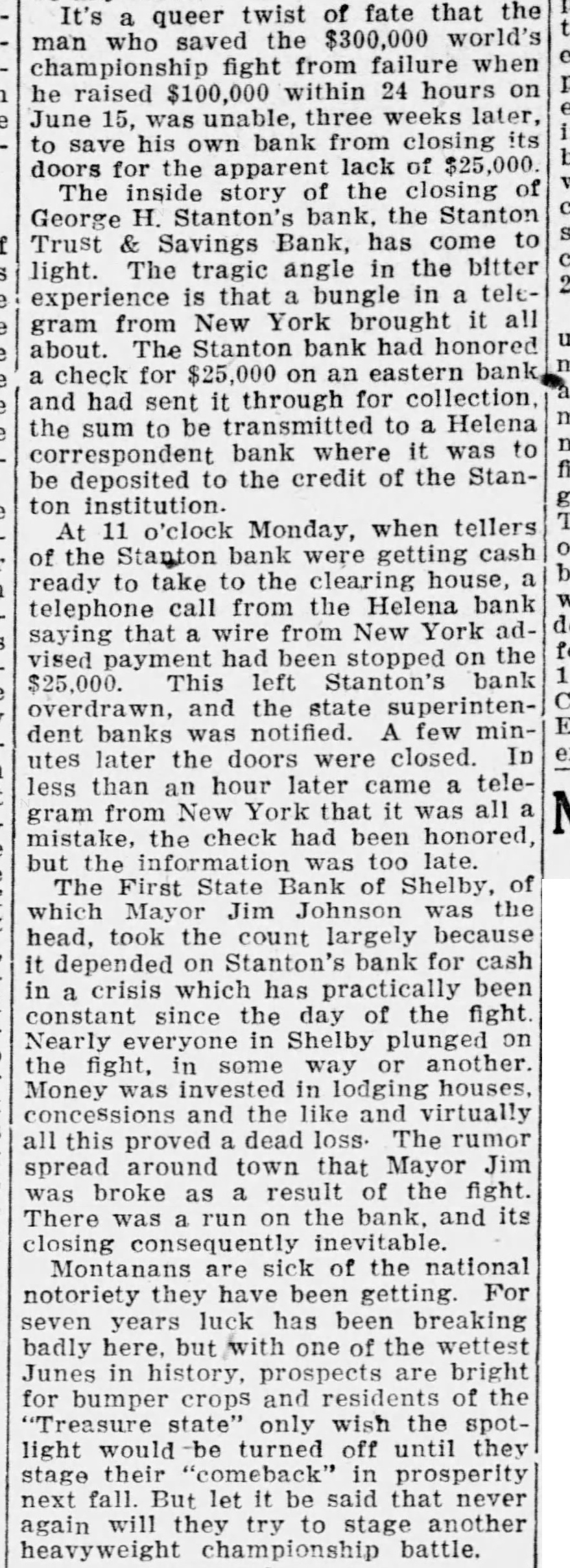
It's a queer twist of fate that the man who saved the $300,000 world's championship fight from failure when he raised $100,000 within 24 hours on June 15, was unable, three weeks later, to save his own bank from closing its doors for the apparent lack of $25,000. The inside story of the closing of George H. Stanton's bank, the Stanton Trust & Savings Bank, has come to light. The tragic angle in the bitter experience is that a bungle in a telegram from New York brought it all about. The Stanton bank had honored a check for $25,000 on an eastern bank and had sent it through for collection, the sum to be transmitted to a Helena correspondent bank where it was to be deposited to the credit of the Stanton institution. At 11 o'clock Monday, when tellers of the Stanton bank were getting cash ready to take to the clearing house, a telephone call from the Helena bank saying that a wire from New York advised payment had been stopped on the $25,000. This left Stanton's bank overdrawn, and the state superintendent banks was notified. A few minutes later the doors were closed. In less than an hour later came a telegram from New York that it was all a mistake, the check had been honored, but the information was too late. The First State Bank of Shelby, of which Mayor Jim Johnson was the head, took the count largely because it depended on Stanton's bank for cash in a crisis which has practically been constant since the day of the fight. Nearly everyone in Shelby plunged on the fight, in some way or another. Money was invested in lodging houses, concessions and the like and virtually all this proved a dead loss. The rumor spread around town that Mayor Jim was broke as a result of the fight. There was a run on the bank, and its closing consequently inevitable. Montanans are sick of the national notoriety they have been getting. For seven years luck has been breaking badly here, but with one of the wettest Junes in history, prospects are bright for bumper crops and residents of the "Treasure state" only wish the spotlight would be turned off until they stage their "comeback" in prosperity next fall. But let it be said that never again will they try to stage another heavyweight championship battle.


Article from The Challis Messenger, August 8, 1923

Click image to open full size in new tab

Article Text

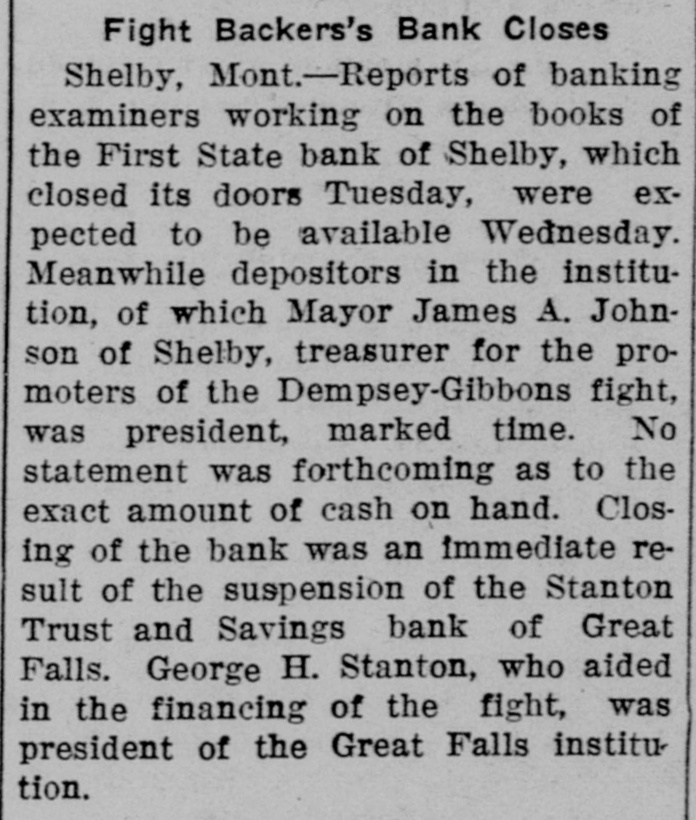
Fight Backers's Bank Closes Shelby, Mont.-Reports of banking examiners working on the books of the First State bank of Shelby, which closed its doors Tuesday, were expected to be available Wednesday. Meanwhile depositors in the institution, of which Mayor James A. Johnson of Shelby, treasurer for the promoters of the Dempsey-Gibbons fight, was president, marked time. No statement was forthcoming as to the exact amount of cash on hand. Closing of the bank was an immediate result of the suspension of the Stanton Trust and Savings bank of Great Falls. George H. Stanton, who aided in the financing of the fight, was president of the Great Falls institution.


Article from The Spokane Press, August 17, 1923

Click image to open full size in new tab

Article Text

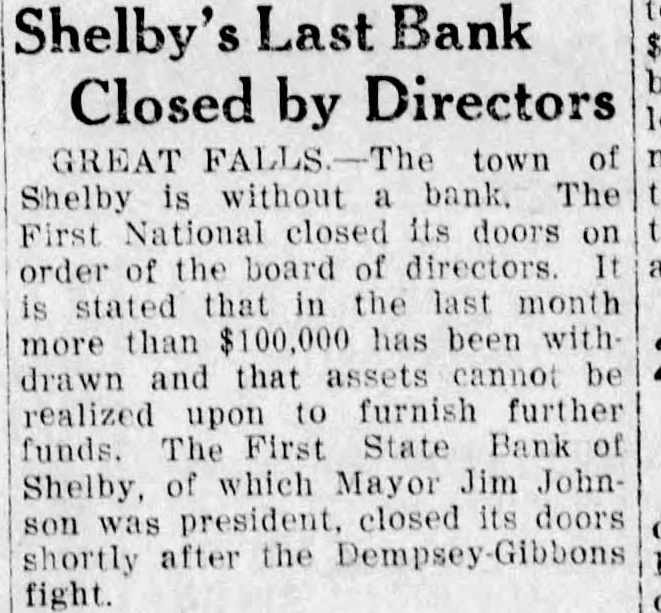
Shelby's Last Bank Closed by Directors GREAT FALLS.—The town of Shelby is without a bank. The First National closed its doors on order of the board of directors. It is stated that in the last month more than $100,000 has been withdrawn and that assets cannot be realized upon to furnish further funds. The First State Bank of Shelby, of which Mayor Jim Johnson was president, closed its doors shortly after the Dempsey-Gibbons fight.


Article from Butte Gazette, August 23, 1923

Click image to open full size in new tab

Article Text

DEMPSEY-GIBBONS FIGHT FIZZLE LEAVES SHELBY MINUS BANK Great Falls, Mont., Aug. 16.—The First National bank of Shelby closed its doors Thursday on order of the board of directors. It's last statement showed deposits of $337,000. In the month since then it is stated that about $100,000 had been withdrawn and the assets of the bank could not be realized upon to furnish further cash. This leaves Shelby without a bank. The First State bank, of which Mayor James A. Johnson was president, having closed shortly after the Dempsey-Gibbons fight, July 4. Mayor Johnson was treasurer of the fight and active in raising a portion of the $300,000 which Dempsey was to have received as his bonus for the fight.


Article from The St. Edward Advance, August 24, 1923

Click image to open full size in new tab

Article Text

DEMPSEY-GIBBONS FIGHT FIZZLE LEAVES SHELBY MINUS BANK Great Falls, Mont., Aug. 16.—The First National bank of Shelby closed its doors Thursday on order of the board of directors. Its last statement showed deposits of $337,000. In the month since then it is stated that about $100,000 had been withdrawn and the assets of the bank could not be realized upon to furnish further cash. This leaves Shelby without a bank. The First State bank, of which Mayor James A. Johnson was president, having closed shortly after the Dempsey-Gibbons fight, July 4. Mayor Johnson was treasurer of the fight and active in raising a portion of the $300,000 which Dempsey was to have received as his bonus for the fight.


Article from The Shelby Promoter, December 20, 1923

Click image to open full size in new tab

Article Text

FIRST STATE BANK WILL RE-OPEN OPENING TO BE ON A SOUND BASIS—IS BIG STEP TOWARD COMPLETE RECOVERY IN BUSINESS AFFAIRS. Shelby's on her way back! On Saturday, December 29th, 1923, the First State Bank of Shelby will open its doors. Closed on July 10th, during the adverse conditions resulting from the Dempsey-Gibbons fight and following the failure of its correspondent bank in Great Falls, month after month of steady work has finally surmounted all obstacles in the way, and late Thursday night word was received from L. Q. Skelton, Superintendent of Banks, that the affairs of the First State were in such shape that business could be resumed. Tireless efforts on the part of the stockholders, aided by the State Banking Department, and with the splendid cooperation of the citizens of Shelby, have finally been rewarded with success. Altho the Banking Department did all that could be done to assist, giving the aid of M. T. Weikle, whose services have been of great value, banking conditions in Montana today are such that the strictest of regulations had to be met before the Department would permit the bank to reopen, making such requirements as to give absolute assurance that it would stay open. The First State Bank will reopen for business on a sound basis. It will not owe a dollar, and will have cash reserves adequate for all requirements. The capital stock has been assessed 100%, which has been paid in. All doubtful paper has been removed from the note pouch. Certificates of deposit will be issued to all having accounts, 50% being due on or before November 1, 1925 and the balance due on or before November 1, 1926, with interest at 5% per annum. Cooperation of practically every depositor was secured, notably the Ohio Oil Company, who had more than $33,000 on deposit and who signed up for the plan of reopening on the same basis as the smallest depositor, and of Toole county and the city of Shelby. The stock of the bank has been placed among business men of Shelby the list of stockholders being as follows: L. N. Eckel, W. W. Thorne, Jesse G. Henderson, Thomas Costello, J. B. Pike, W. F. Rhoda, Frank Rhoda, B. F. Boyce, Fred Williams, Charles L. Emmons, Mrs. Emma Aylward, L. A. Murrills, George Brewerton, M. J. Steers, A. L. Jaqueth, and Henry Gerharz. The Promoter wishes to congratulate the men who have been responsible for this good work in the face of so many difficulties, and to congratulate the city of Shelby on its high type of citizenship, who have faith in its future and who are willing to persistently work for such accomplishments as this. We are glad to tell the world that Shelby has not only a Past, but a Future!


Article from The Cincinnati Enquirer, December 22, 1923

Click image to open full size in new tab

Article Text

Louisville, Ky., December 21.—Offerings on the local tobacco market to-day totaled 307 hogsheads, consisting of 283 of burley, 21 of old burley and three of dark. Of these 272 were original inclusions, with 35 reviews. Yesterday's rejections were 58 hogsheads of burley. To-day's sales were: Kentucky and Louisville warehouses, 138 hogsheads of burley $6 50 to $29 50; old burley $4 to $11 and three new dark $3 50 to $14; Main Street warehouse, 81 hogsheads new burley $7 to $26 50. SPECIAL DISPATCH TO THE ENQUIRER. Hopkinsville, Ky., December 21.—The average on loose floor tobacco sales to-day showed another small increase, the figures being $9 89 against $9 63 yesterday. Total sales for the day were 120,000 pounds, which paid the growers $11,885 53, prices ranging from $2 to $30 50. The offerings continue to show the great preponderance of low grade and damaged tobacco. Added to this was that nearly all of it this week is entirely too high in order. To-day's sales will be the last until December 31. SPECIAL DESPATCH TO THE ENQUIRER. Maysville, Ky., December 21.—The leaf tobacco market to-day was strong, the average being over $19 straight. The Gray Warehouse had an unreported list, but the average there was $18 60. One of the remarkable crop sales at the Gray house was that of Homer Young, a twelve-year-old Adams County (Ohio) youth, who delivered and sold his first crop, which averaged $25, the high basket bringing $40 per 100. The sales at the Liberty were 44,125 pounds, high price $37, low $1.50, average $20 12. To-day closed the Maysville market until after Christmas. The sales reopen on Thursday, December 27. SPECIAL DISPATCH TO THE ENQUIRER. Huntington, W. Va., December 21.—The tobacco market here to-day was slightly stronger on all grades than yesterday, 100,250 lbs selling at an average of $21.22 per pound. The best grade brought as high as 37c. Sales at Hurricane, W. Va., aggregated 10,000 lbs at an average of 21.22c per pound. The quality of the offerings at both markets was fair. Both markets closed to-day, to be reopened December 27. Lexington, Ky., December 21.—Report at the five independent tobacco warehouses in Lexington to-day purchased a total of 280,445 pounds of the weed for $57,477.40 and an average of $20 48 was obtained. This shows an increase of 39 cents a hundred over the average of the previous day's sales. The market will be closed for the holidays until December 27. Paducah, Ky., December 21.—Approximately 40,000 pounds of tobacco sold on the loose-leaf floors here to-day. The market is unchanged. Mayfield, Ky., December 21.—A very common grade of tobacco was offered in the chute to-day and the bulk of the weed sales ranged around $10 per 100 pounds. Rain hindered the delivery, and only 31 loads were sold to-day. They averaged to-day $9 00, the lowest of the season, while the best of the weed sold commanded a price of $16 25. Most of the weed was wet and of the lowest grade. Owensboro, Ky., December 21.—So great has been the rush of tobacco to the Owensboro market this week that the sales were not completed this afternoon, and it was believed necessary to put two sets of buyers on the floor in the morning to clean up the remaining deliveries. The rush this week has been one of the greatest in the history of the Owensboro loose-leaf houses. For the five days 1,321,145 pounds of Green River tobacco has been sold and the growers have been paid more than $250,000. The sales to-day amounted to 530,000 pounds. The growers were paid $60,000, an average of $11 36 per 100 pounds. Reported deliveries this week at the warehouses of the Dark Tobacco Growers' Co-operative warehouse amounted to 473,555 pounds. The total advance to the poolers is $26,015 26, an average advance of $5 49. NEW RULES ARE ADOPTED By New York State Athletic Commission—Gamblers Barred. New York, December 21.—The New York State Athletic Commission's warfare on gambling took definite form to-day when the ring solons adopted a new rule providing that persons caught betting or recognized as professional gamblers be barred from all boxing matches in the state. At the same time the commission adopted three other rules designed to minimize the opportunity for criticism of fight decisions which has been particularly apparent since the verdict by which Johnny Dundee regained the junior lightweight title from Jack Bernstein. Ringside opinion in that contest was almost unanimous in favor of Bernstein. The new rules in this connection provide that no person be allowed to sit at the ringside on the side where the judges are seated except the timekeeper, who must be at least six feet away; that no one may remain standing during the progress of a match at any club, and that no one except managers and seconds may enter the dressing rooms. The commission did not discuss the question of mixed bouts, pointing out that no official barrier to such contests exists. Nevertheless, it is understood the boxing solons have frowned upon mixed matches of outstanding importance, and that the way has not yet been cleared for such proposed fights as those between Harry Wills, New Orleans negro, and either Luis Firpo or Jack Dempsey. New York, December 21.—Young Stribling, Georgia schoolboy, light heavyweight, who is matched with Dave Rosenberg, of Brooklyn, at Newark on New-Year's Day, expects to work out with Jack Dempsey, heavyweight title holder, prior to the bout. Young Stribling will arrive next week to complete his training at Feddy Welsh's health farm at Summit, N. J., where Dempsey also has established quarters. Paris, December 21.—Charles Ledoux, the French bantamweight, told a representative of L'Auto that after meeting Edouard Mascart, the new European featherweight champion, he planned to sail for the States, probably about May, where he knew several fights awaited him. Shelby, Mont., December 21.—Officers of the First State Bank of Shelby, which closed in July, shortly after the Dempsey-Gibbons fight, announced last night that the bank would reopen Saturday, December 29. Buenos Aires, December 21.—Luis Firpo, the South American heavyweight champion, announced to-day that he had been approached by a local promoter, who proposed to match him with the Italian heavyweight champion, Erminio Spalla, for a bout in Buenos Aires. Firpo expressed the opinion, however, that unless Spalla was able to come here early in February there was little danger of the match materializing. Firpo said negotiations were still continuing in an effort to bring a big fight from the United States for a fight prior to his departure for the United States early in March, the proceeds of the match to go to charity.
Article from The Chester Reporter, December 27, 1923

Click image to open full size in new tab

Article Text

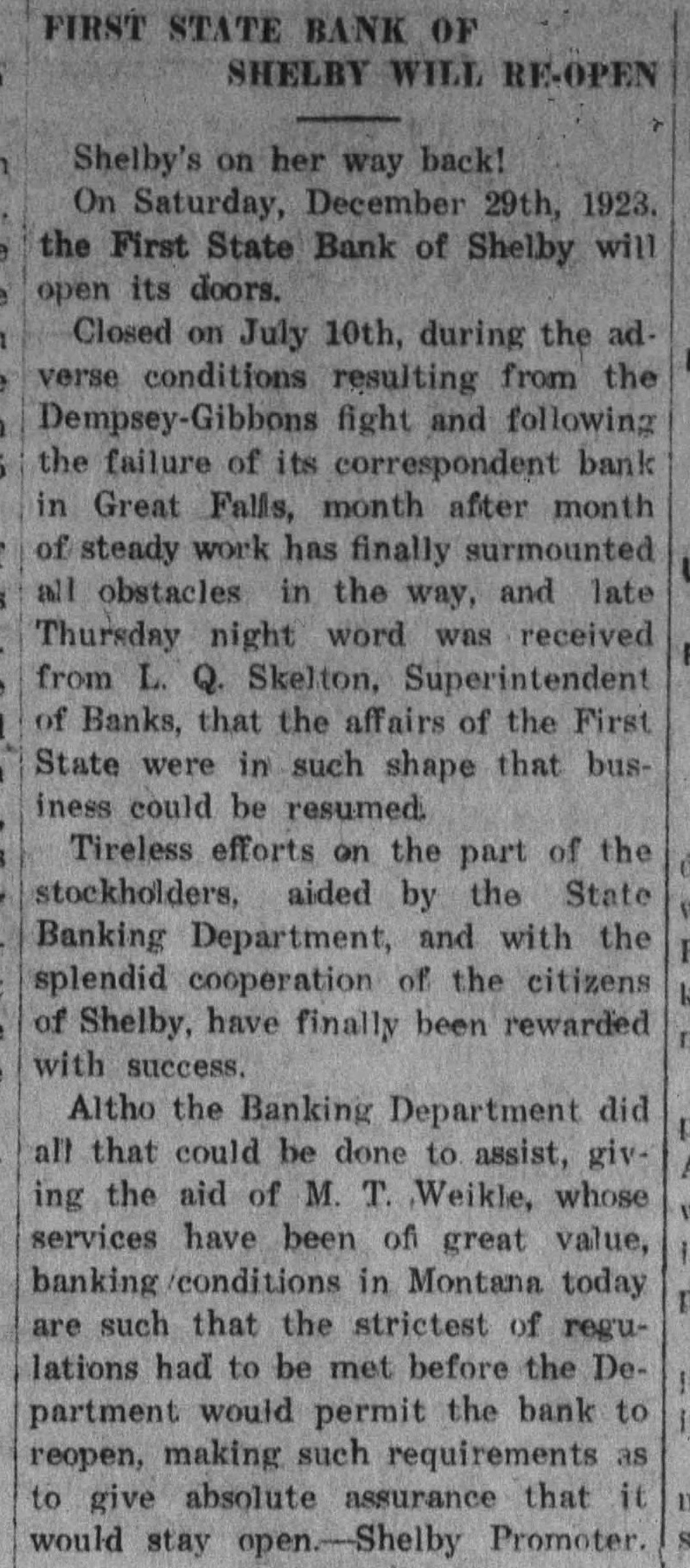
FIRST STATE BANK OF SHELBY WILL RE-OPEN Shelby's on her way back! On Saturday, December 29th, 1923, the First State Bank of Shelby will open its doors. Closed on July 10th, during the adverse conditions resulting from the Dempsey-Gibbons fight and following the failure of its correspondent bank in Great Falls, month after month of steady work has finally surmounted all obstacles in the way, and late Thursday night word was received from L. Q. Skelton, Superintendent of Banks, that the affairs of the First State were in such shape that business could be resumed. Tireless efforts on the part of the stockholders, aided by the State Banking Department, and with the splendid cooperation of the citizens of Shelby, have finally been rewarded with success. Altho the Banking Department did all that could be done to assist, giving the aid of M. T. Weikle, whose services have been of great value, banking conditions in Montana today are such that the strictest of regulations had to be met before the Department would permit the bank to reopen, making such requirements as to give absolute assurance that it would stay open.—Shelby Promoter.


Article from The Chester Reporter, December 27, 1923

Click image to open full size in new tab

Article Text

Shelby's on her way back! On Saturday, December 29th, 1923, the First State Bank of Shelby will open its doors.