Oberlin Bank (Oberlin, OH)

Episode Information

Episode UID
4594870291259
Episode Type
Run β†’ Suspension β†’ Closure
Bank Type
state
Bank ID
459487029 hash
Start Date
November 1, 1904*
Location
Oberlin, Ohio (41.294, -82.217)

Metadata

Model
gpt-5-mini (chosen from majority vote of a three-model LLM ensemble)
Short Digest
04300695f145248f

Response Measures

None

Description

Articles identify a receiver and refer to 'Citizens' National Bank of Oberlin' in testimony, suggesting a national charter.

Events (3)

1. November 1, 1904* Run
Cause
Bank Specific Adverse Info
Cause Details
Withdrawals driven by discovery that securities (Carnegie notes) held as collateral for loans to Mrs. Chadwick were forgeries and worthless.
Measures
None reported beyond attempts to obtain funds and threatened disclosures by bank officials.
Newspaper Excerpt
it sustained a small run Saturday and shut its doors Monday.
Source
newspapers
2. December 1, 1904* Suspension
Cause
Bank Specific Adverse Info
Cause Details
Bank closed its doors after losses from loans to Mrs. Cassie L. Chadwick backed by forged/ worthless securities were revealed.
Newspaper Excerpt
The Oberlin bank that closed because of loans made to Mrs. Chadwick say they expect a large sum today, and if it is not forthcoming threaten sensational disclosures.
Source
newspapers
3. December 6, 1904 Receivership
Newspaper Excerpt
Receiver Lyons, of the Oberlin bank, arrived from Cleveland this morning accompanied by his legal adviser. He brought here the Carnegie notes found in the Oberlin bank. (Dec. 6 articles.)
Source
newspapers

Newspaper Articles (25)

Article from The Yale Expositor, December 2, 1904

Click image to open full size in new tab

Article Text

Disclosure of Doings of the Chadwicks Expected In Cleveland. WOMAN FOUND IN NEW YORK Hubby Has Probably Scuttled For Europe-Suit of Massachusetts Banker Caused Closing of Bank at OberlinAlleged Noted Men Are Implicated. Cleveland, O., Nov. 29.-The Chadwick case has closed a bank in Oberlin and caused runs on several banks in Cleveland. Mrs. Chadwick, who vanished from Cleveland on Thurs: day, has been located in New York. Chadwick is believed to have scuttled to Europe. Banker Newton expects to be in Cleveland today when his case against Mrs. Chadwick is called in court. Amazing tales of gullibility of financiers and misuse of world-famous names are promised. These are the latest developments in the astonishing Chadwick sensation, which promises to eclipse every other swindling case ever unearthed in this country. These are the cases against Mrs Chadwick, to come up at once in Cleveland, starting with the Newton case: Several Cases. Herbert Newton, banker, Brookline. Mass., sues for $190,000, loaned on worthless notes and pretenses to possession of $5,000,000 invested in securitles in New York and $2,500,000 in real property elsewhere, none of which has any known existence. Euclid Avenue Savings Co., Cleveland, sues to recover on notes for $58,231. Savings Deposit Bank & Trust Co., Elyria, O., sues for $10,000. American Exchange National bank sues on notes for $28,808. How much the Oberlin bank was "let down" for is not known, as it has not yet begun suit. It sustained a small run Saturday and shut its doors Monday. Disclosures Promised. Great interest is manifested in the hearing to begin in the common pleas court here today on a motion to have a receiver named to take charge of the alleged securities said to be in custody of Iri Reynolds at the Wade Park bank, on which Mrs. C. L. Chadwick secured various sums from banks in this city and elsewhere. The attorney for Herbert L. Newton of Brookline, Mass., arrived here last night and seems confident that Mrs. Chadwick will settle before the hour of hearing arrives. He says if she does not there will be some startling disclosures. The officials of the Oberlin bank that closed because of loans made to Mrs. Chadwick say they expect a large sum today, and if it is not forthcoming threaten sensational disclosures. Mrs. Chadwick claims that one note for $500,000 is signed by one of the richest men in the country, and bankers who have seen this and other notes call them gild-edged security. Late last night President Beckwith of the Oberlin bank admitted that he had aided Mrs. Chadwick in getting loans aggregating $102,000.


Article from The Seattle Star, December 6, 1904

Click image to open full size in new tab

Article Text

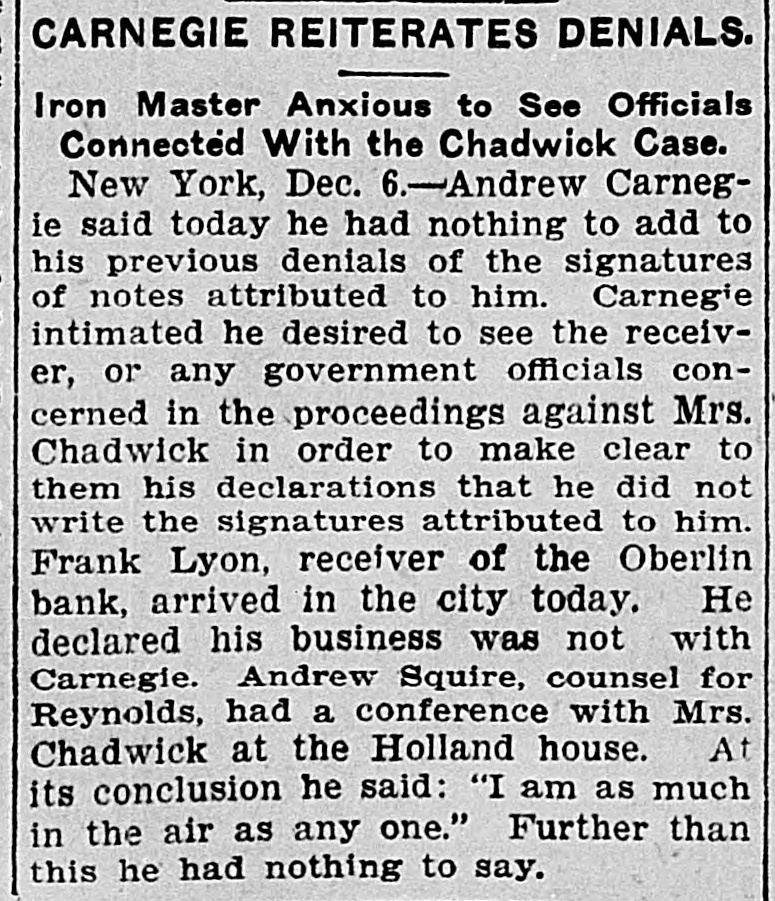
Beckwith is in a state bordering on nervous collapse, and is In a worse condition than at any time since the bank closed its doors. He continued: "I believed the signatures genuine. She told me they were, and 80 did a lawyer, who said he represented Andrew Carnegie. Others came here with her and said the notes were good for all that she could borrow up to their face value. I thought she was telling the truth. It is too late now, too late." NEW YORK, Dec. 6.-Receiver Lyons, of the Oberlin bank, arrived from Cleveland this morning. accompanied by his legal adviser. He is here with the Carnegie notes found in the Oberlin bank. It is understood he will present them to Carnegie today for identification. Ira Reynolds, receiver for Lyon. and Andrew Squire, an Ohio lawyer formerly Mrs. Chadwick's attorney, held a conference at the Waldorf Astoria, after which Squire went to the Holland house to see Mrs. Chadwick. Carnegie was interviewed today. He declined to say anything other than the denial made by his secretary. He sald, however, that he would be glad to welcome federal officials investigating the Chadwick affairs.


Article from The Evening Statesman, December 6, 1904

Click image to open full size in new tab

Article Text

Carnegie to See Forged Notes. NEW YORK, Dec. 6.-Receiver Lyons of the Oberlin bank arrived from Cleveland this morning accompanied by his legal adviser. He brought here the Carnegie notes found in the Oberlin bank. It is understood he will present them to Carnegie today for identification.


Article from Daily Capital Journal, December 6, 1904

Click image to open full size in new tab

Article Text

CARNEGIE WILL SEE PAPERS Notes Were Brought to New York for Identification I New York, Dec. 6.-Receiver Lyons, of the Oberlin bank, arrived from Cleveland this morning, accompanied by a legal adviser. He brought here the Carnegie notes found in the Oberlin bank, and it is understood he will present them to Carnegie today for identification.


Article from Ottumwa Tri-Weekly Courier, December 8, 1904

Click image to open full size in new tab

Article Text

Oberlin bank which of the has myster- been the as one result Mr. Emery closed ious traveling Chadwick through case. been Ohio mak- and is Pennsylvania and has -:ing Oberlin his headquarters. York, Dec. 7.-Mrs. Chad- hoNew the New Amsterdam to wick tel this left afternoon and has gone the Hotel Breslin. Carnegie said today inAndrew had not the slightest anybody that he of prosecuting to the tention forging his signature investigafor even if further forgery tion notes, should show that such been committed. has prominent man from today: Ohio, "In One now here, said will a who day is or two will revelations show this to be be made which colossal affair of the York centhe most Five prominent New not yet men, tury. whose mentioned, names will Chadwick have be involved been as Mrs. and as deeply number of wealthy also prom- be A western men will and numerinent into the case follow. dragged prosecutions will made public ous These facts will be jury investigation which row." through the begins grand at Elyria tomorYork, Dec. 7.-Decisive Cassie ac- L. New in the case of Mrs. be held in tion Chadwick seems some to powerful confer- influabeyance despite by the frequent yesterday. ence in this city the ences It was held reported today due that to a measure of delay desire was to prevent in upon a an the imposition banks with had hardships Mrs. Chadwick has her which but whose part affairs has that if nancial dealings, not said yet in been fl- it public. It is had made made known other banks run on were to Mrs. Chadwick and a that loans might be started injury. them do them great would No one not case intimately knows what connected these of with the nor what has become Presithe note for of the banks are $500,000 which Oberlin dent bank Beckwith says he indorsed for Mrs. Chadwick noon a hurried sumJust was before sent to Dr. Moore, asking Mrs. him Chadwick's mons physician, Amsterdam to call at the New No information could hotel be at obtained once. as to the reason for the summons. Cleveland, Ohio. Dec. 7. - a Ref- moRemington. acting Loeser, upon reeree filed by Nathan has istion for Mrs. Chadwick. all the se ceiver attachment for latter in sued an belonging to the Reynolds. curities the possession is commanded of Ira to Monday appear Reynolds before the the referee stocks. next bonds and Mrs. sewith all him for curities held by The referee has isChadwick. injunction restraining dissued an from transferring or -:Reynolds posing of any of the securities. to ex New York, Dec. 7.-Contrary were taken at an pectations, no steps to determine whethe to th time yesterday the signatures attached the Citizens or not were held by and signe National bank are forgeries, notes that Carnegie of Uberlin bank, an a by Andrew the receiver of the the comp though representing her an currency troller yesterday, a series from during the day in persons attorney Cleveland of the various reached and case wer in o engaged conferences in diffc.ent with sides of the to terested Report Comptroller. in ques Oldham, the attorney last evening r Judge to Washington make a tion, it went is understood, will He d Comptroller a port to the issuance of is warrant nied that for any further he knows. and, templated, as far as Ridgely. arrest the federa note CO understood that brought her be with him, last night, and to me a willingness drew master which It was Carnegie Receiver expresed would States Lyon official submitted or other the to iro hin pe A any United who might call on son interested, took place, however,an last nigh was No conference announcement pas the latest a replica of those for a week (Continued on Page 4.)


Article from The Fargo Forum and Daily Republican, December 9, 1904

Click image to open full size in new tab

Article Text

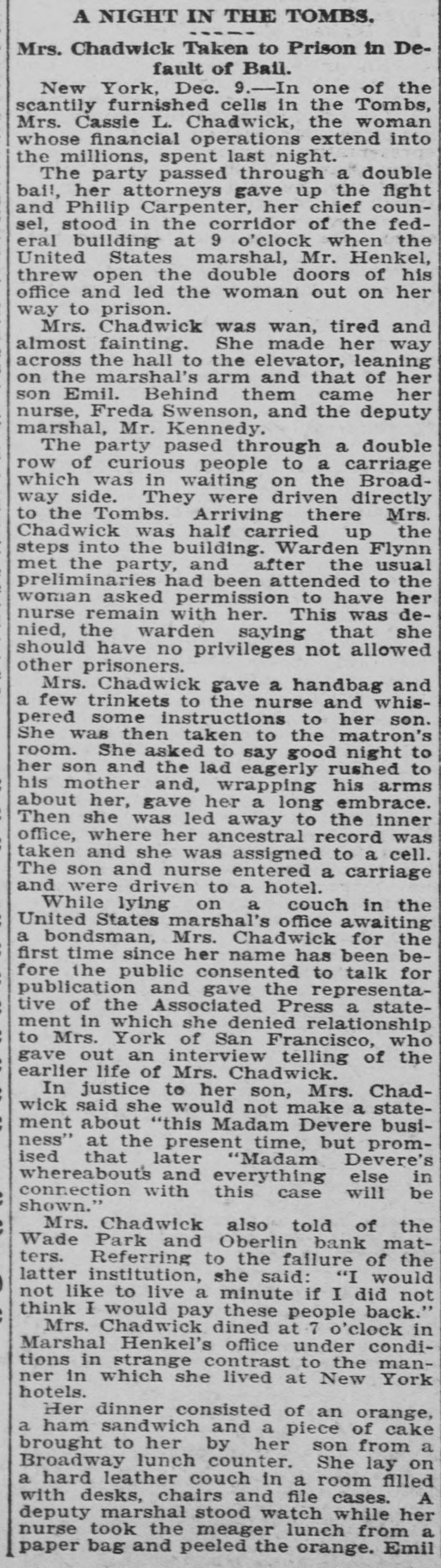
MRS. CHADWICK WAS SENT TO THE TOMBS New York, Dec. 9.-Mrs. Cassie L. Chadwick last night occupied one of the scantily furnished cells in the Tombs. After a fruitless search all day for bail, her attorneys gave up the fight and Phillip Carpenter, her chief counsel, stood in the corridor of the federal building at 9 o'clock when United States Marshal Henkel threw open the double doors of his office and led the woman out on her way to prison. Mrs. Chadwick was wan, tired and almost fainting. She made her way across the hall to the elevator, leaning heavily on the marshal's arm and that of her son, Emil. Behind them came her nurse. Freda Swenson, and Deputy Marshal Kennedy. The party passed through a double row of curious people to a carriage which was in waiting on the Broadway side. They were driven directly to the Tombs. Arriving there Mrs. Chadwick was half carried up the steps and into the building. Warden Flynn met the party and after the usual preliminaries had been attended to the woman asked permission to have her nurse remain with her. This was denied, the warden saying she could have no privileges not allowed other prisoners. Mrs. Chadwick gave a hand bag and a few trinkets to the nurse and whispered some instructions to her son. Marshal Henkel formally turned his prisoner over to the warden and she was taken to the matron's room. She asked to say good night to her SOIN and the lad eagerly rushed to his mother and wrapping his arms about her gave her a long embrace. Then she was led away to the inner office, where her pedigree was taken and she was assigned to a cell. The son and nurse entered a carriage and were driven to a hotel. While lying on a couch in the United States marshal's office awaiting a bondsman, Mrs. Chadwick for the first time since her name has been before the public consented to talk for publication and gave the representative of the sociated Press a statement in which she denied relationship to Mrs. York, of San Francisco, who gave out an interview Wednesday, telling of the early life of Mrs. Chadwick In justice to her son, Mrs. Chadwick said she would not make a statement about "this Madame Devere business" at the present time, but promised that later "Madame Devere's, whereabouts and everything else in connection with this case will be shown." Mrs. Chadwick also told of the Wade Park and Oberlin bank matters. Referring to the failure of the latter institution she said: "I would not like to live a minute, if I did not think I could pay these poor people back." When asked concerning Andrew Carnegie's connection with her financial affairs, she declined absolutely to talk, referring her interviewer to her counsel. To add to her cup of woe it was learned that a charge of forgery would very likely be made against the woman in Ohio, based on the Carnegie notes and other papers given as securities for loans. Practically all interest in the case is centered in conjecture as to what the future will reveal. Men who profess to have an intimate knowledge of the affairs of the woman have hinted that only a suggestion of the real case has yet become public, One man is credited with the statement that time will show this to be the most stupendous and farreaching case of its kind in many years. Already the country has been startled by the disclosures which have followed


Article from The Times Dispatch, December 9, 1904

Click image to open full size in new tab

Article Text

Institute Proceedings. Receiver Lyons, of the Oberlin Bank, which recently closed its doors, told a representative of the Associated Press to-night that he would leave for Cleveland to-morrow morning, where criminal proceedings will be taken against Mrs. Chadwick. He said he had been in communication with Prosecutor Sullivan, or Cleveland, to-day and that developments in the bank's case against Mrs.


Article from The Providence News, December 10, 1904

Click image to open full size in new tab

Article Text

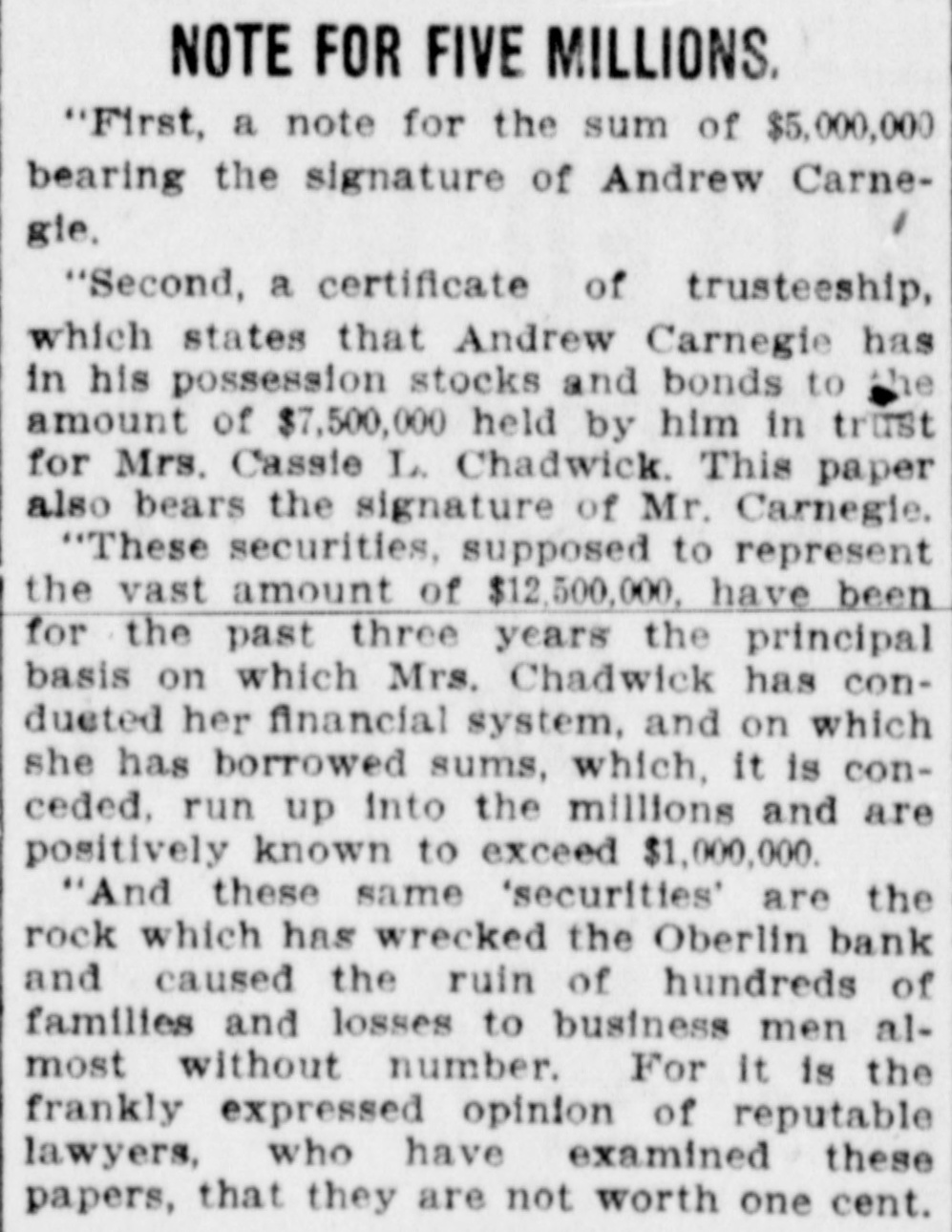
# NOTE FOR FIVE MILLIONS. "First, a note for the sum of $5,000,000 bearing the signature of Andrew Carnegie. "Second, a certificate of trusteeship, which states that Andrew Carnegie has in his possession stocks and bonds to the amount of $7,500,000 held by him in trust for Mrs. Cassie L. Chadwick. This paper also bears the signature of Mr. Carnegie. "These securities, supposed to represent the vast amount of $12,500,000, have been for the past three years the principal basis on which Mrs. Chadwick has conducted her financial system, and on which she has borrowed sums, which, it is conceded, run up into the millions and are positively known to exceed $1,000,000. "And these same 'securities' are the rock which has wrecked the Oberlin bank and caused the ruin of hundreds of families and losses to business men almost without number. For it is the frankly expressed opinion of reputable lawyers, who have examined these papers, that they are not worth one cent.


Article from The News & Observer, December 10, 1904

Click image to open full size in new tab

Article Text

MRS. CHADWICK INTERVIEWED. A Conversation in Which Carnegie's and Madame DeVere's Names Figure Strikingly. (By the Associated Press.) New York, Dec. -Mrs. Chadwick was interviewed by a representative of the Associated Press tonight as she lay on a couch in the office of United States Marshal Henkel waiting for her counsel to obtain bondsmen for her. She and her nurse and son were in the office with a deputy marshal. The nurse and boy sat beside the weeping woman and were trying to comfort her. Mrs. Chadwick's face was inflamed and she had all the appearance of a woman suffering greatly from nervousness. Mrs. Chadwick's son Emil, was asked if he had seen the statement made by Mrs. York, of San Francisco, relative to his mother's past life. He said he had. "Will you ask your mother if she will see a reporter on that statement made by Mrs. York?' Emil went to his mother, talked to in a low tone for a few seconds her and then came back and said his it. mother would say something about Will Say Nothing of De Vere. Lying on the couch and interrupted intervals by slight nervous tremat ors, Mrs. Chadwick said in reference to Mrs. York's statement: "I have not read all of it. but I will leave it to public opinion and to refined and educated persons what conclusion they might draw when one sister makes a statement like that against another sister. "Mrs. Chadwick, is Mrs. York your sister No. she is neither my sister nor my half sister, nor my sister-in-law. We were reared together. "Will you say anything about her statement that you are Madame De Vere?" 'I have made absolutely no statement about this Madame DeVere business from beginning to end. Out of jus- it tice to my little boy I would not do the present time. I don't think at that any responsible person would pay any attention to a statement made by Mrs. York. 'Everything will/work its way out all right for me and I don't want all. to anything against Mrs. York at say I shall make a statement here in the in near future and also one very Cleveland. The newspapers possibly have written up a great sensation, but De I wish you to say that Madame Vere's whereabouts and everything else in connection with this case will be shown in a very short time. "In justice to my child, I don't think it. right to make any further statement at this time.' I Am Not Her Daughter. "Mrs. Chadwick, it is intimated in the afternoon papers woman you some this young of have but rela- here that with you is not your maid, a tive of yours, possibly a daughter?") The young woman was sitting beside her and she spoke up immediately, saying: "I am not related to Mrs. Chadwick any way; neither am I her maid. in I am her nurse. I ant a graduate nurse of an institution in Stockholm, Sweden, and I am Swedish by birth.' Mrs. Chadwick told of the Oberlin bank failure, saying it would not have oboccurred if the bank could have tained its funds in a Cleveland bank. It could not do so, she said, because the run was on Saturday night, when the Cleveland bank was closed. She continued: "If it had only happened differently the bank would not have had to fail, because the obligation would have been paid. I would not like to live Γ‘ minute if I did not think I could pay these poor people back. I have asked Emil, my son, if anything should happen to me that he would do everything to see that the obligations were paid.' Silent as to Carnegie Notes. "Mrs. Chadwick, those alleged Carnegie notes have figured so largely that as a sensational feature in this case no doubt the public would like to know what you had to say in relation to that." "Whatever is said about those notes must be said by my attorney, Mr. e


Article from The Evening Statesman, December 12, 1904

Click image to open full size in new tab

Article Text

Cleveland Grand Jury at Work, <v CLEVELAND, Ohio, Dec. 12.-The grand jury investigating the Chadwick case resumed work this morning. Receiver Lyon of the Oberlin bank testified a million and a quarter dollar note of the alleged Carnegie securities held by the bank were placed in evidence.


Article from The Minneapolis Journal, December 12, 1904

Click image to open full size in new tab

Article Text

CARNEGIE HALED IN CHADWICK CASE Continued from First Page. President C. T. Beckwith of the failed Oberlin bank, has told of the peculiar manner in which he was led to cling to the Carnegie forgeries and to defer action against Mrs. Chadwick. The facts are related in the confession secured at Oberlin last week by representatives of Fedral Attorney Sullivan of this city. Beckwith tells how both he and Spear were beset with fears when they could get no money from Mrs. Chadwick, and realized how deeply the bank was involved. They counseled together as to what course they should take and decided to come to Cleveland and make a last desperate appeal to Mrs. Chadwick. They did so, and she promised to convince them within twenty-four hours that the Carnegie notes were genuine. This was last September, and the two bank officials returned to Oberlin to spend fear. another day between hope and Royally Entertained. The next day they returned to Cleveland. They were received by Mrs. Chadwick as honored guests and were royally entertained. Nothing that could be done for their entertainment was left undone. Mrs. Chadwick showed them thru her house from top to bottom and pointed out paintings and bits of bric-a-brac that she said had been given to her by this or that distinguished person, or that she had purchased on her trips abroad. She pointed out an oil painting of a fine looking, venerable man, and then told them in a whisper that it was a portrait of Andrew Carnegie. But Beckwith and Spear were impatient to get at the real business of their visit and could scarcely conceal their impatience. Finally a maid came in and announced the name of a lawyer from New York. "Ah," cried Mrs. Chadwick, 'now, then, gentlement, I will soon set all your fears at rest.'' Carnegie's Business Agent. They were introduced to the visitor from New York, who she said was acting for Mr. Carnegie's business agent. The lawyer said he was acting directly for "Mr. Frances, Mr. Carnegie 's cashier, and for Frederick T. Baldwin, Mr. Carnegie's head financial man. Beckwith produced the Carnegie note yer. for $250,000 and handed it to the law"Is that Andrew Carnegie's signature? he asked. The old banker and his young assistant anxiously awaited the verdict of the lawyer. The latter examined the note carefully and then looking up, replied calmly: That is Mr. Carnegie's signature." Have you any doubt about it?'' asked Beckwith. Not the slightest, gentlemen, and you need have none either. That note was signed by Mr. Carnegie. Then, said Beckwith, get us the cash for it at once. The solvency the is bank depends on it. Mr. Carnegie of giving away millions in libraries, out. surely he does not need to have a note Extravagant Woman. The lawyer said that Mr. Carnegie knew what a dangerously extravagant woman Mrs. Chadwick was and wanted to do something to save her estate. Beckwith said that Mrs. Chadwick had told him that she had $735,000 in actual cash, held by Mr. Carnegie. The lawyer replied that it was true that she once had that amount, but that she had spent it all and was rapidly consuming her stocks and bonds. The banker renewed his plea for immediate relief and the lawyer answered that he would return to New York at once and lay the matter before Mr. Carnegie. Much relieved in mind the old and his companion returned to Oberlin. man Within twenty-four hours they received a telegram saying that Mr. Carnegie had sailed for Europe and that Mr. Frances and Mr. Baldwin declined to do anything in his absence. The Cuyahoga grand jury will be asked to return an indictment against the New York lawyer, who, according to Beckwith's sworn statement, was of such assistance to Mrs. Chadwick in obtaining the large sums from the Oberlin bank. Already the man's record is being investigated in New York. No. Visible


Article from Yorkville Enquirer, December 13, 1904

Click image to open full size in new tab

Article Text

MERE-MENTION. The crop report of the department of agriculture, issued Saturday, shows the wheat acreage to be 31,155,000 a decrease of 1.6 per cent from last year. In the United States circuit court at Mobile, Saturday, Mrs. Malvina Bodden of Selma, Ala., secured a verdict of $2,111 against the sovereign camp Woodmen of the World, on account of the drowning of her husband in the Carribean sea eighteen months ago. Payment on his policy had been refused by the sovereign camp because there was no proof of his death Hugh McLaughlin, for many years leader of the Democratic party of Kings county, New York, died at his home in Brooklyn, Wednesday, aged seventy-seven years Governor-elect William L. Douglass of Massachusetts, has announced that General Nelson A. Miles will be at the head of his staff. Six schoolboys, none more than fourteen years old, killed a Jewish rabbi in Chicago, Friday, by striking him on the head with a snowball containing a rock C. L. Mason, a wealthy coal dealer of Paducah, Ky., disappeared in St. Louis Nov. 19. He had diamonds and money to the amount of $1,700 on his person, and it is believed that he met with foul play Six workmen on a dirt road along the Ohio river near Ashland, Ky., were killed by an explosion of nitro-glycerine, SatThe British steamer Seurday cundra, with a cargo of oil and rice, bound from Madras to New York, was wrecked off the coast of Ceylon Saturday, and seven of her crew were lost. The Bethlehem steel corporation, capitalized at $30,000,000, was incorporated at Trenton, N. J., Saturday, to succeed the United States Ship-building company, now in the hands of a receiver President Hadley of Yale university, has announced his intention to make a trip through the south early next spring, to meet the Yale alumni associations of Georgia, AlaThe bama, Louisiana and Texas special grand jury of Lorain county, O., appointed to investigate the affairs of the defunct Oberlin bank, reported on Saturday that there was not sufficient evidence to indict Mrs. Cassie L. Chadwick, and turned the cases of President Beckwith and Cashier Spear over to the regular grand jury Mortimer Brooks, a New York millionaire, was accidentally shot on a hunting expedition near Pittsboro, N. C., Friday, and his recovery is doubtful. The engagement of Miss Daisy Leiter, daughter of the late Levi Leiter of Chicago, and sister of the vicereine of India, to the Earl of Suffolk of Berkshire county, England, was announced Saturday The three masted schooner Montana, on her way from Baltimore to Charleston, stranded at Pea island, N. C., fifty miles north of Cape Hatteras, Saturday night, with one member of her crew of seven frozen to death, and the other six seriously ill from exposure and exhaustion. The vessel is a total wreck.


Article from The Spokane Press, December 14, 1904

Click image to open full size in new tab

Article Text

(Scripps News Association.) CLEVELAND, O., Dec. 14.-The federal grand jury of the northern district of Ohio this morning began its investigation of the Chadwick case. After a conference, President Beckwith was placed before the jury. Receiver Lyon of the defunct Oberlin bank appeared as a witness. The grand jury returned five indictments against Mrs. Chadwick, four against Beckwith and four against Shears.


Article from The San Francisco Call, December 15, 1904

Click image to open full size in new tab

Article Text

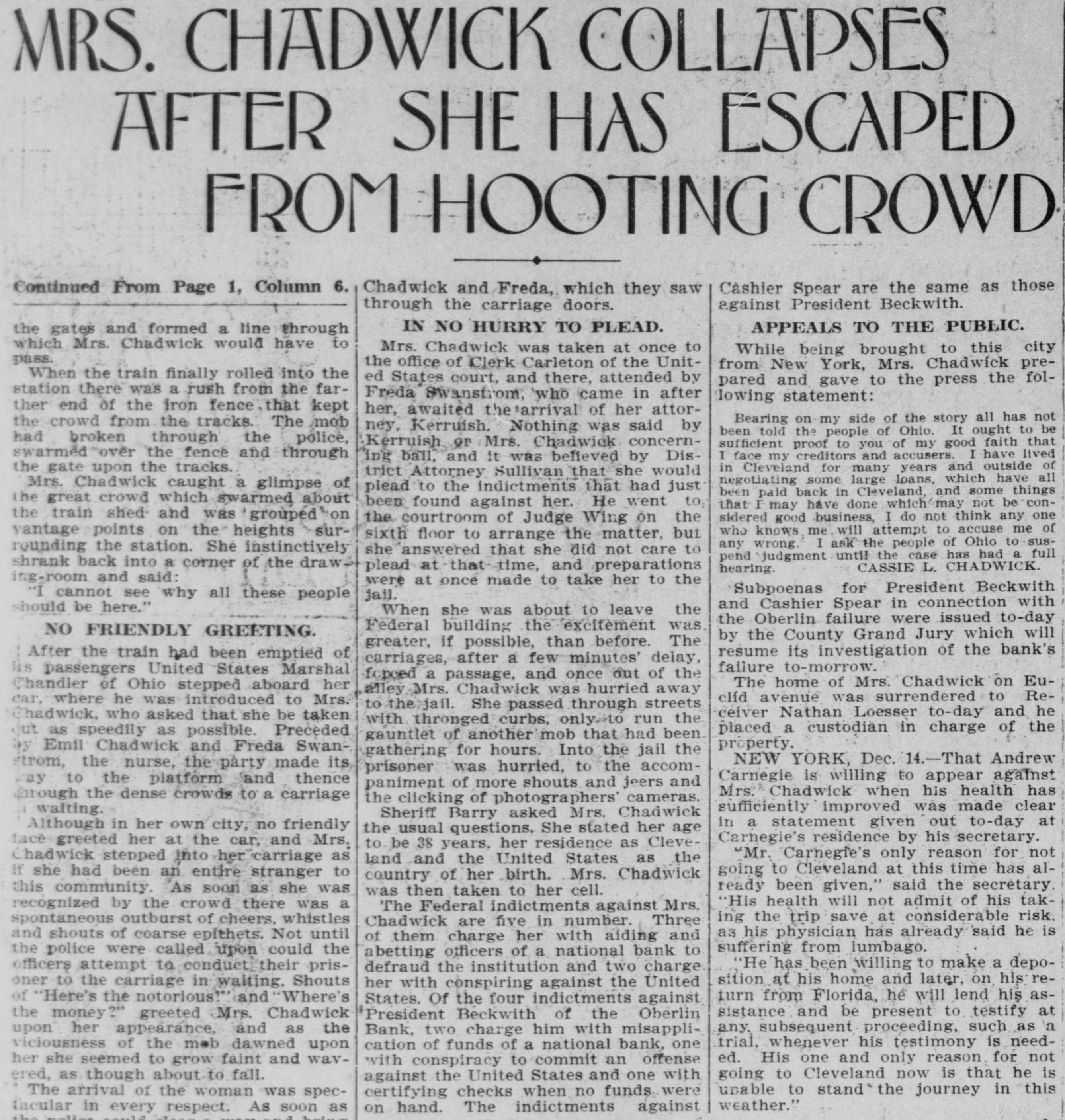
MRS CHADWICK LAPSES AFTER SHE HAS ESCAPED FROM CROWD Continued From Page 1, Column 6. Cashier Spear are the same as those Chadwick and Freda, which they saw against President Beckwith. through the carriage doors. IN NO HURRY TO PLEAD. APPEALS TO THE PUBLIC. the gates and formed a line through which Mrs. Chadwick would have to Mrs. Chadwick was taken at once to While being brought to this city pass. the office of Clerk Carleton of the Unitfrom New York, Mrs. Chadwick preWhen the train finally rolled into the ed States court, and there, attended by pared and gave to the press the folstation there was a rush from the farFreda Swansfrom, who came in after lowing statement: ther end of the iron fence that kept her, awaited the arrival of her attorBearing on my side of the story all has not the crowd from the tracks. The mob ney, Kerruish. Nothing was said by been told the people of Ohio. It ought to be had broken through the policè, Kerruish or Mrs. Chadwick concernsufficient proof to you of my good faith that swarmed over the fence and through I face my creditors and accusers. I have lived ing bail, and it was believed by Disin Cleveland for many years and outside of the gate upon the tracks. trict Attorney Sullivan that she would negotiating some large loans, which have all Mrs. Chadwick caught a glimpse of plead to the indictments that had just been paid back in Cleveland, and some things the great crowd which swarmed about been found against her. He went to, that r may have done which may not be conthe train shed and was grouped on sidered good business, I do not think any one the courtroom of Judge Wing on the who knows me will attempt to accuse me of vantage points on the heights sursixth floor to arrange the matter, but any wrong. I ask the people of Ohio to susrounding the station. She instinctively she answered that she did not care to pend judgment until the case has had a full shrank back into a corner of the draw plead at that time, and preparations CASSIE L. CHADWICK. hearing. ing-room and said: were at once made to take her to the Subpoenas for President Beckwith "I cannot see why all these people jail. and Cashier Spear in connection with should be here." When she was about to leave the the Oberlin failure were issued to-day Federal building the excitement was NO FRIENDLY GREETING. by the County Grand Jury which will greater, if possible, than before. The resume its investigation of the bank's After the train had been emptied of carriages, after a few minutes' delay, failure to-morrow. its passengers United States Marshal forced a passage, and once out of the The home of Mrs. Chadwick on EuChandler of Ohio stepped aboard her alley Mrs. Chadwick was hurried away clid avenue was surrendered to Recar, where he was introduced to Mrs. to the jail. She passed through streets ceiver Nathan Loesser to-day and he Chadwick, who asked that she be taken with thronged curbs, only. run the placed a custodian in charge of the ut as speedily as possible. Preceded gauntlet of another mob that had been property. ay Emil Chadwick and Freda Swangathering for hours. Into the jail the NEW YORK, Dec. 14.-That Andrew trom, the nurse, the party made its prisoner was hurried, to the accomCarnegie is willing to appear against ay to the platform and thence paniment of more shouts and jeers and Mrs. Chadwick when his health has grough the dense crowds to a carriage the clicking of photographers' cameras. sufficiently improved was made clear waiting. Sheriff Barry asked Mrs. Chadwick in a statement given out to-day at Although in her own city, no friendly the usual questions. She stated her age Carnegie's residence by his secretary. face greeted her at the car, and Mrs. to be 38 years, her residence as Cleve"Mr. Carnegie's only reason for not Chadwick stepped into her carriage as land and the United States as the going to Cleveland at this time has alif she had been an entire stranger to country of her birth. Mrs. Chadwick ready been given," said the secretary. this community. As soon as she was was then taken to her cell. "His health will not admit of his takrecognized by the crowd there was a The Federal indictments against Mrs. ing the trip save at considerable risk, spontaneous outburst of cheers, whistles Chadwick are five in number. Three as his physician has already said he is and shouts of coarse epithets. Not until of them charge her with aiding and suffering from lumbago. the police were called upon could the abetting officers of a national bank to "He has been willing to make a depoofficers attempt to conduct their prisdefraud the institution and two charge sition at his home and later, on reoner to the carriage in waiting. Shouts her with conspiring against the United of "Here's the notorious." and Where's turn from Florida, hé will lend his asStates. Of the four indictments against sistance and be present to testify at President Beckwith of the Oberlin the money greeted Mrs. Chadwick any, subsequent proceeding, such as a upon her appearance, and as the Bank, two charge him with misapplitrial, whenever his testimony is needviciousness of the mob dawned upon cation of funds of a national bank, one ed. His one and only reason for not her she seemed to grow faint and wavwith conspiracy to commit an offense going to Cleveland now is that he is ered, as though about to fall. against the United States and one with unable to stand the journey in this certifying checks when no funds were The arrival of the woman was specweather." on hand. The indictments against facular in every respect. As soon as


Article from The Pacific Commercial Advertiser, December 28, 1904

Click image to open full size in new tab

Article Text

til the Cleveland exposure came and the securities held by Iri Reynolds were examined and found to be worth- less. Then the Oberlin bank went into the hands of a receiver.


Article from The Hawaiian Gazette, December 30, 1904

Click image to open full size in new tab

Article Text

til the Cleveland exposure came and the securities held by Iri Reynolds were examined and found to be worthless. Then the Oberlin bank went into the hands of a receiver.


Article from The Salt Lake Herald, January 24, 1905

Click image to open full size in new tab

Article Text

# WORTHY PHILANTHROPY. CAPTIOUS CRITICS have said of Andrew Carnegie that, while he goes about doing good, he never neg-lects to give his right hand information as to what his left hand is doing, and vice versa. In other words, Mr. Carnegie does good to the accompaniment of a brass band. However that may be, the ironmaster certainly does dispose of a lot of money in the course of a year for charitable purposes, for free libraries and for other good things. His most recent effort does him a great deal of credit. When the suspension of the Oberlin bank that was looted because its president was hypnotized by Mrs. Chadwick was announced, some very bad half-hours were experienced by many students in the Oberlin col-


Article from Sistersville Daily Oil Review, March 7, 1905

Click image to open full size in new tab

Article Text

Chadwick Trial May be Finished In Three Days said the directors were not inSpecial to The Oil Review. formed of loans made Mrs. ChadCleveland, O., March 7.-Diswick until the day before the trict Attorney Sullivan stated bank suspended. At the same this morning that he. did not time President Beckwith's action think the Chadwick trial will exwere made known. Directors tend over three days. Court opRandolph and Doolittle followed ened at 9:30 this morning. Mrs. Chadwick seemed anxious and ill with substantially the same evidence, and were not cross-examat ease. Her husband, Dr. Leroy ined. Vice President Marshall, Chadwick, was not in court. Anof the Cleveland First National drew Carnegie was also absent. at bank, testified honoring a $15,000 opening of court. Ernest H. Holtz, check drawn by the defendant a director of the defunct Oberlin and certified by Beckwith. bank, resumed witness stand and


Article from The Spokane Press, March 7, 1905

Click image to open full size in new tab

Article Text

(Scripps News Association.) CLEVELAND, O., March 7.-When Mrs. Chadwick appeared in court this morning she was seized by nervousness. Dr. Chadwick was in court. Director Holter of the Oberlin bank resumed the stand. He said the directors were not informed of loans to Mrs. Chadwick until the day the bank suspended. Director Randolph testified that the directors met every two weeks and Cashier Spears read what was supposed to be a complete list of loans, but never mentioned the name of Mrs. Chadwick. Vice President Marshall of the First National bank of Cleveland testified that he had known Beckwith and Spear for 10 years and Mrs. Chadwick since last May. She kept


Article from East Oregonian : E.O, March 7, 1905

Click image to open full size in new tab

Article Text

Cleveland, March 7.-When Mrs. Chadwick appeared in court this morning, she was seized with nervousness and was ill at ease. Dr. Chadwick was in court. Director Holter, of the Oberlin bank, resumed the-stand. He said the directors were not informed of the loans to Mrs. Chadwick until the day the bank suspended. Director Randolph testified the directors met every two weeks. Cashier Spear read what he supposed to be a complete list of the loans, but never mentioned the name of Chadwick.


Article from Evening Journal, March 8, 1905

Click image to open full size in new tab

Article Text

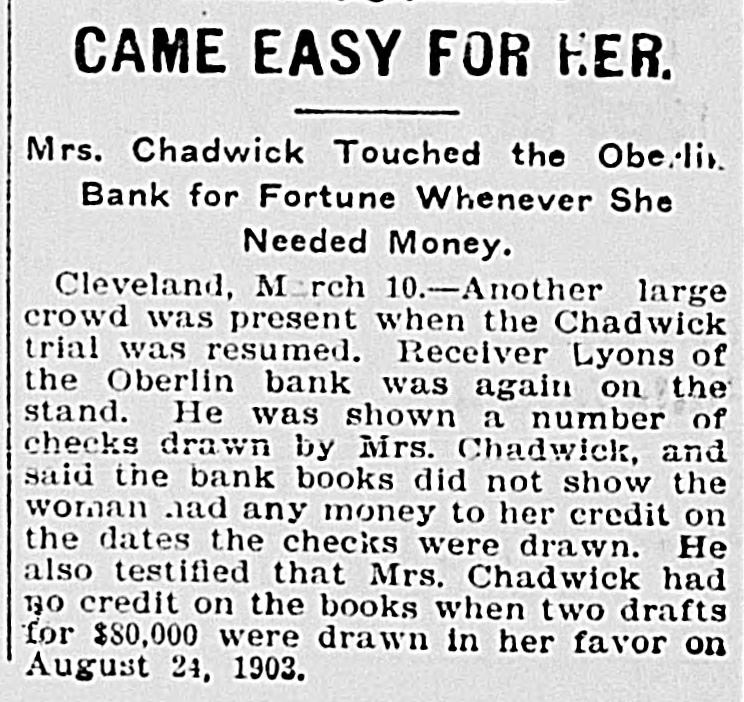
CARNEGIE MAY NOT TESTIFY Doubtful Whether He Will Give Evidence in Mrs. Chadwick's Trial SHE HAD IN BANK OBERLIN $15,000 Cleveland, O., March 8.-Nine witaesses were examined in the Chadwick trial, and the defense established the fact that the claim of the government that Mrs. Chadwick had no money in the Oberlin bank at the time of drawing checks which were certified by Spear and Beckwith was incorrect in two instances at least. It was shown that in the general run of the bank in November, 1903, when Mrs. Chadwick received a certified check for $10,000, an entry crediting her with that amount was made on the journal of the bank, and a deposit for $10,000 was made out in her name. The entry and the slip were in the handwriting of Cashier Spear. Another entry of similar nature amounting to $5,000 was also found. These facts were brought out on cross-examination by Judge Wing, counsel for Mrs. Chadwick, after long and tedious questioning of H. H. Avery, assistant cashier of the Oberlin bank. Avery at first testified that Mrs. Chadwick at no time had neither money in or credit at the bank. It is doubtful if Andrew Carnegie will take the stand. District Attorney Sullivan said; "It is not my present intention to put Mr. Carnegie on the stand, and I do not think that he will be called upon to testify unless his evidence should be needed in rebuttal of something introduced by the defense." It was the object. of Judge Wing, who conducted the cross-examination of Mr. Avery in behalf of Mrs. Chadwick, to discredit as much as possible the statements made by the witness that there had not appeared on the books of the Oberlin bank any entry to the credit of Mrs. Chadwick, and that she had not at any time any deposit in the bank, with the exception of once, when she had $10,000 there. The lawyer and the witness waded through a labyrinth of technicalities relating to banking in general, and the books of the Oberlin bank in particular, and the witness finally discovered on the general journal of the bank an entry showing that Mrs. Chadwick has received discounted a note of $10,000. Then ensued a long wrangle as to 5 whether or not this was a credit. The witness became badly confused at times and announced that it was a credit, and then declared that it was not a credit. He asserted that it was "an item of credit," but not necessarily a Β£ credit. Then District Attorney Sullivan would resume his direct examination, f and the witness would assert that there was no credit to Mrs. Chadwick on the books of the bank. Then Judge Wing would get him to admit that it "might be a credit," and all three would once more swing around the circle of "credit," "items of credit," "direct account," "ledger account" and "journals." The matter finally became so confusing that Judge Tayler asked several questions for his own enlightenment. It was finally shown that an item of $10,000 and one of $5000 were on the books to the credit of Mrs. Chadwick. Horace G. Waite, bookkeeper of the Oberlin bank, was so nervous when he took the stand after it had been vacated by Mr. Avery that he could not sit in his chair. He stood up and leaned over the end of Judge Tayler's desk, until the judge suggested that it would be well for him to sit down. When he adopted the idea of Judge Tayler he perched on the extreme/outside of his chair, and twisted and untwisted his legs. He testified that the entry giving credit to Mrs. Chadwick for $10,000 was in the handwriting of Cashier Spear, and that the deposit slip for the same amount was also in Spear's handwriting. Robert Lyons, receiver for the Citizens' National Bank of Oberlin, was the last witness of the day. He said that the books did not show that any account had ever existed by which Mrs. Chadwick could draw checks on the bank. All the accounts of the bank balanced, with the exception of that with the First Na. t tional Bank of Cleveland, where ther was a discrepancy of about $27,000 in favor of the Cleveland institution.


Article from The Fairmont West Virginian, March 8, 1905

Click image to open full size in new tab

Article Text

MRS. CHADWICK CAUCED ANOTHER SENSATION TO-DAY WHEN SHE SPOKE IN COURT. (By Publishers' Press.) CLEVELAND, O., March 8.-Mrs. Chadwick was first heard in the case when she interrupted the district attorney just before the close of the morning session. In a threat to bring in the Carnegie note, though he did not mention it by name, Sullivan said the government might try to bring in everything. "That's just what we want," exclaimed Mrs. Chadwick, leaning over the trial table toward Sullivan. Though her voice was low pitched it was heard throughout the court room, and caused a sensation. The interruption received no attention from the court. Mrs. Chadwick smiled and smiled over her exploit. Lyon testified that the two drafts were drawn on a New York bank. Although issued on August 24, 1903, they were not entered on bank books until September, 24, 1903. Lyon said in answer to other questions that when the Oberlin bank suspended its books showed that it had $90,000 on deposit with the First National Bank of Cleveland; in fact the Oberlin bank was indebted to the Cleveland bank to the amount of $17,000.


Article from Milford Chronicle, March 10, 1905

Click image to open full size in new tab

Article Text

MRS. CHADWICK'S TRIAL Defense Shows She Had Credit of $15,000 In Oberlin Bank. Cleveland, O., March 8.-Nine witnesses were examined in the Chadwick trial, and the defense established the fact that the claim of the government that Mrs. Chadwick had no money in the Oberlin bank at the time of drawing checks which were certified by Spear and Beckwith was incorrect in two instances at least. It was shown that in the general run of the bank in November, 1903, when Mrs. Chadwick received a certified check for $10,000, an entry crediting her with that amount was made on the journal of the bank, and a deposit for $10,000 was made out in her name. The entry and the slip were in the handwriting of Cashier Spear. Another entry of similar nature amounting to $5,000 was also found. These facts were brought out on cross-examination by Judge Ving, counsel for Mrs. Chadwick, after long and tedious questioning of H. H. Avery, assistant cashier of the Oberlin bank. Avery at first testified that Mrs. Chadwick at no time had neither money in or credit at the bank. It is doubtful if Andrew Carnegie will take the stand. District Attorney Sullivan said: "It is not my present intention to put Mr. Carnegie on the stand, and I do not think that he will be called upon to testify unless his evidence should be needed in rebuttal of something introduced by the defense."


Article from Richmond Planet, March 11, 1905

Click image to open full size in new tab

Article Text

MRS. CHADWICK'S TRIAL Defense Shows She Had Credit of $15,000 In Oberlin Bank. Cleveland, O., March 8.-Nine witnesses were examined in the Chadwick trial, and the defense established the fact that the claim of the government that Mrs. Chadwick had no money in the Oberlin bank at the time of drawing checks which were certified by Spear and Beckwith was incorrect in two instances at least. It was shown that in the general run of the bank in November, 1903, when Mrs. Chadwick received a certified check for $10,000, an entry crediting her with that amount was made on the journal of the bank, and a deposit for $10,000 was made out in her name. The entry and the slip were in the handwriting of Cashier Spear. Another entry of similar nature amounting to $5,000 was also found. These facts were brought out on cross-examination by Judge Wing, counsel for Mrs. Chadwick, after long and tedious questioning of H. H. Avery, assistant cashier of the Oberlin bank. Avery at first testified that Mrs. Chadwick at no time had neither money in or credit at the bank. It is doubtful if Andrew Carnegie will take the stand. District Attorney Sullivan said: "It is not my present intention to put Mr. Carnegie on the stand, and I do not think that he will be called upon to testify unless his evidence should be needed in rebuttal of something introduced by the defense."


Article from The Stark County Democrat, December 26, 1905

Click image to open full size in new tab

Article Text

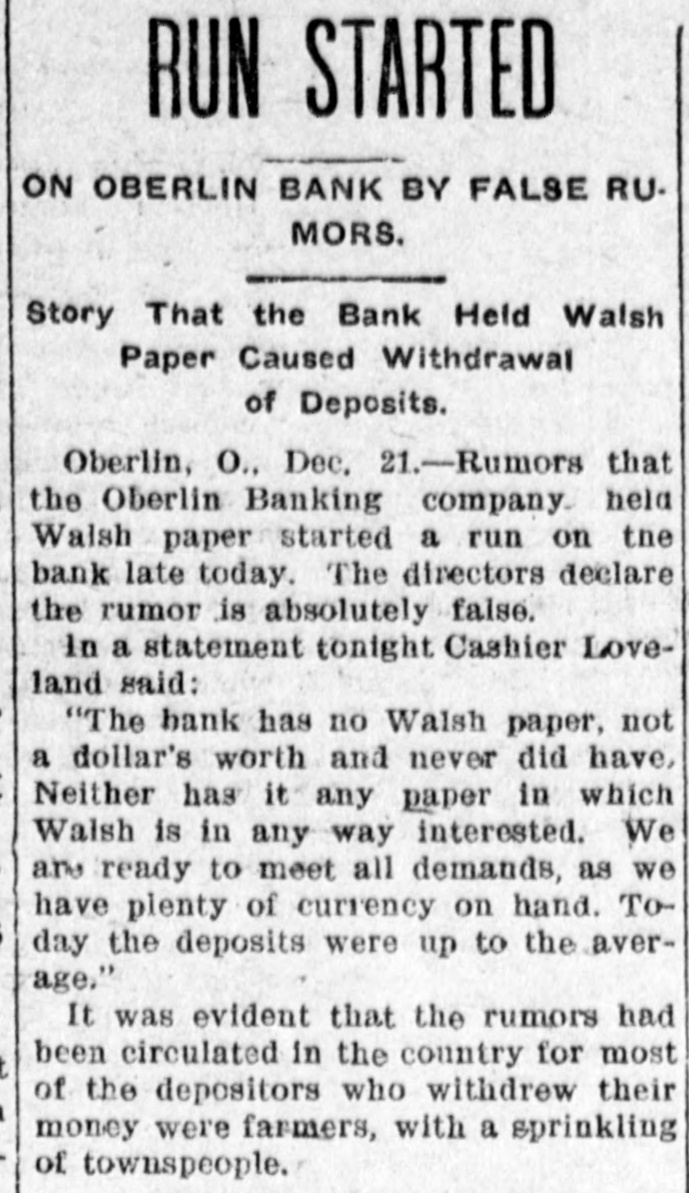
RUN STARTED ON OBERLIN BANK BY FALSE RUMORS. Story That the Bank Held Walsh Paper Caused Withdrawal of Deposits. Oberlin, O., Dec. 21.-Rumors that the Oberlin Banking company held Walsh paper started a run on the bank late today. The directors declare the rumor is absolutely false. In a statement tonight Cashier Loveland said: "The bank has no Walsh paper, not a dollar's worth and never did have, Neither has it any paper in which Walsh is in any way interested. We are ready to meet all demands, as we have plenty of currency on hand. Today the deposits were up to the average." It was evident that the rumors had been circulated in the country for most of the depositors who withdrew their money were farmers, with a sprinkling of townspeople.