Click image to open full size in new tab
Article Text
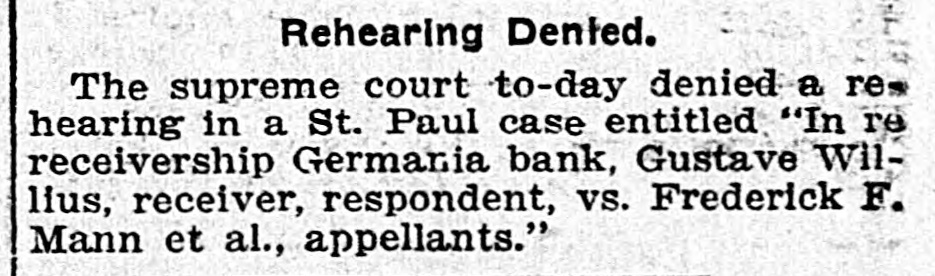
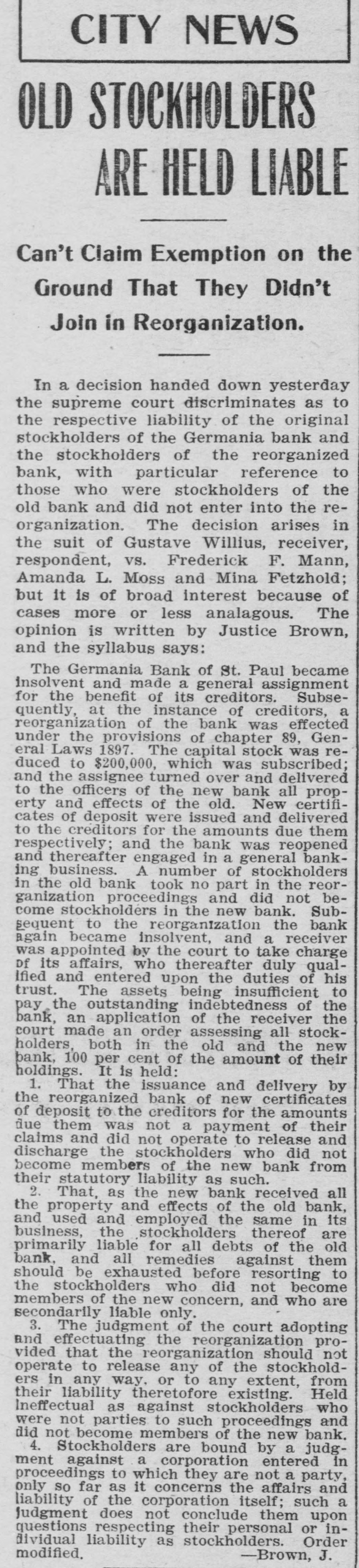
CITY NEWS OLD STOCKHOLDERS ARE HELD LIABLE Can't Claim Exemption on the Ground That They Didn't Join in Reorganization. In a decision handed down yesterday the supreme court discriminates as to the respective liability of the original stockholders of the Germania bank and the stockholders of the reorganized bank, with particular reference to those who were stockholders of the old bank and did not enter into the reorganization. The decision arises in the suit of Gustave Willius, receiver, respondent, vs. Frederick F. Mann, Amanda L. Moss and Mina Fetzhold; but it is of broad interest because of cases more or less analagous. The opinion is written by Justice Brown, and the syllabus says: The Germania Bank of St. Paul became insolvent and made a general assignment for the benefit of its creditors. Subsequently, at the instance of creditors, a reorganization of the bank was effected under the provisions of chapter 89, General Laws 1897. The capital stock was reduced to $200,000, which was subscribed; and the assignee turned over and delivered to the officers of the new bank all property and effects of the old. New certificates of deposit were issued and delivered to the creditors for the amounts due them respectively; and the bank was reopened and thereafter engaged in a general banking business. A number of stockholders in the old bank took no part in the reorganization proceedings and did not become stockholders in the new bank. Subsequent to the reorganization the bank again became insolvent, and a receiver was appointed by the court to take charge Df its affairs, who thereafter duly qualIfied and entered upon the duties of his trust. The assets being insufficient to pay the outstanding indebtedness of the bank, an application of the receiver the court made an order assessing all stockholders, both in the old and the new bank, 100 per cent of the amount of their holdings. It is held: 1. That the issuance and delivery by the reorganized bank of new certificates of deposit to the creditors for the amounts due them was not a payment of their claims and did not operate to release and discharge the stockholders who did not become members of the new bank from their statutory liability as such. 2. That, as the new bank received all the property and effects of the old bank, and used and employed the same in its business. the stockholders thereof are primarily liable for all debts of the old bank, and all remedies against them should be exhausted before resorting to the stockholders who did not become members of the new concern, and who are secondarily liable only. 3. The judgment of the court adopting and effectuating the reorganization provided that the reorganization should not operate to release any of the stockholders in any way, or to any extent, from their liability theretofore existing. Held Ineffectual as against stockholders who were not parties to such proceedings and did not become members of the new bank. 4. Stockholders are bound by a judgment against a corporation entered in proceedings to which they are not a party, only So far as it concerns the affairs and liability of the corporation itself; such a Judgment does not conclude them upon questions respecting their personal or individual liability as stockholders. Order modified. -Brown, J.