Mechanics National Bank (Chicago, IL)

Episode Information

Episode UID
46600889
Episode Type
Suspension → Closure
Bank Type
national
Bank ID
4660 national
Charter Number
466
Start Date
January 21, 1874
Location
Chicago, Illinois (41.850, -87.650)

Metadata

Model
gpt-5-mini (chosen from majority vote of a three-model LLM ensemble)
Short Digest
281c40d670bb4cad

Response Measures

None

Description

Bank went into voluntary liquidation after suspension; troubles traceable to management and connected concerns.

Events (4)

1. June 28, 1864 Chartered
Source
historical_nic
2. January 21, 1874 Other
Newspaper Excerpt
The Executive Committee of the Chicago Clearing-House Association yesterday invited the Mechanics National Bank of this city to withdraw from its membership, to-morrow, Jan. 21.
Source
newspapers
3. December 30, 1874 Voluntary Liquidation
Source
historical_nic
4. January 1, 1875 Suspension
Cause
Bank Specific Adverse Info
Cause Details
Longstanding insolvency and mismanagement tied to J. Y. Scammon and related concerns led to inability to meet obligations; stockholders resolved voluntary liquidation.
Newspaper Excerpt
The officers of the Mechanics' National Bank ... informed the members of the Clearing-House Association yesterday that they should make no clearings, and that they had suspended business.
Source
newspapers

Newspaper Articles (23)

Article from The Daily State Journal, October 16, 1871

Click image to open full size in new tab

Article Text

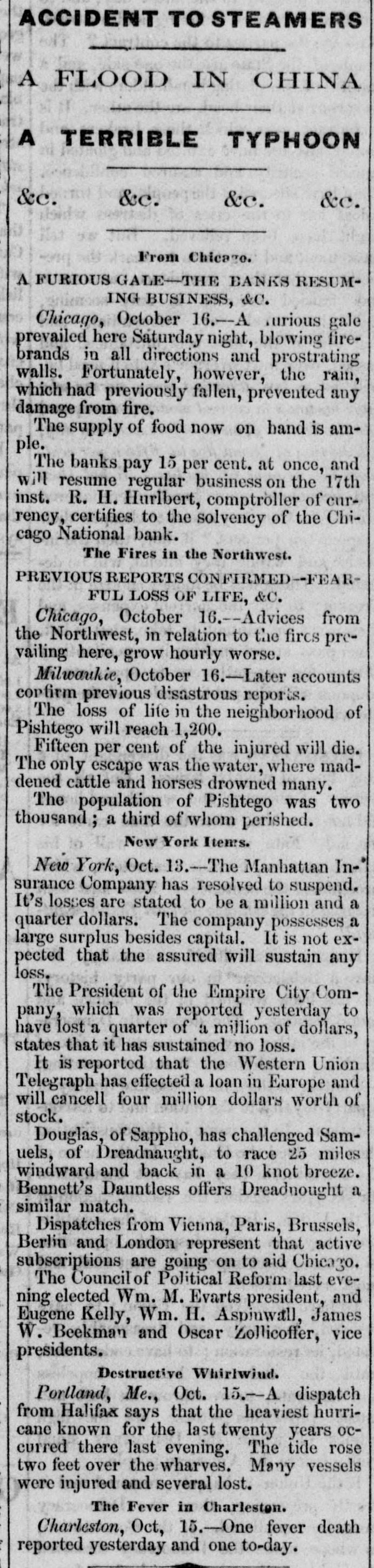
ACCIDENT TO STEAMERS A FLOOD IN CHINA A TERRIBLE TYPHOON &c. &c. &c. &c. From Chicago. A FURIOUS GALE-THE BANKS RESUMING BUSINESS, &C. Chicago, October 16.-A urious gale prevailed here Saturday night, blowing firebrands in all directions and prostrating walls. Fortunately, however, the rain, which had previously fallen, prevented any damage from fire. The supply of food now on hand is ample. The banks pay 15 per cent. at once, and will resume regular business on the 17th inst. R. H. Hurlbert, comptroller of currency, certifies to the solvency of the Chicago National bank. The Fires in the Northwest. PREVIOUS REPORTS CONFIRMED-FEARFUL LOSS OF LIFE, &C. Chicago, October 16.--Advices from the Northwest, in relation to the fircs prevailing here, grow hourly worse. Milwaukie, October 16.-Later accounts corfirm previous disastrous reports. The loss of life in the neighborhood of Pishtego will reach 1,200. Fifteen per cent of the injured will die. The only escape was the water, where maddened cattle and horses drowned many. The population of Pishtego was two thousand; a third of whom perished. New York Items. New York, Oct. 13.-The Manhattan Insurance Company has resolved to suspend. It's losses are stated to be a million and a quarter dollars. The company possesses a large surplus besides capital. It is not expected that the assured will sustain any loss. The President of the Empire City Company, which was reported yesterday to have lost a quarter of a million of dollars, states that it has sustained no loss. It is reported that the Western Union Telegraph has effected a loan in Europe and will cancell four million dollars worth of stock. Douglas, of Sappho, has challenged Samuels, of Dreadnaught, to race 25 miles windward and back in a 10 knot breeze. Bennett's Dauntless offers Dreadnought a similar match. Dispatches from Vienna, Paris, Brussels, Berlin and London represent that active subscriptions are going on to aid Chicago. The Council of Political Reform last evening elected Wm. M. Evarts president, and Eugene Kelly, Wm. H. Aspinwall, James W. Beekman and Oscar Zollicoffer, vice presidents. Destructive Whirlwind. Porlland, Me., Oct. 15.-A dispatch from Halifax says that the heaviest hurricane known for the last twenty years occurred there last evening. The tide rose two feet over the wharves. Many vessels were injured and several lost. The Fever in Charleston. Charleston, Oct, 15.-One fever death reported yesterday and one to-day.


Article from The Daily State Journal, October 18, 1871

Click image to open full size in new tab

Article Text

# THE WRIT OF HABEAS CORPUS SUSPENDED IN SOUTH CAROLINA, &C. Washington, October 17.--The President to-day, after reciting the causes and quoting the laws under which he acts, issued a proclamation in which he suspends the writ of habeas corpus in Spartanburg, York, Marion, Chester, Laurens, Newberry, Fairfield, Lancaster, and Chesterfield counties, of South Carolina. The suspension extends to the arrest by the United States marshal, his deputies, any military officer of the United States, or any soldier or citizen acting under the orders of said marshal, deputy, or such military officer within said counties, of persons charged with any violation of the Ku-Klux act of Congress during the continuance of the "rebellion" in said counties. The Attorney-General has a dispatch from North Mississippi that five Ku-Klux with disguises complete have been captured. Seven hundred and fifty thousand dollars in revenue stamps were found safe in the government vault in Chicago. Secretary Boutwell has received the following dispatch from Chicago: "The Chicago banks are saved, and are paying every dollar on demand. A good feeling prevails. [Signed] H. R. Hurlbut, Comptroller of Currency." Mexican Affairs. Havana, October 17.-A steamer just arrived from Vera Cruz brings late dates from the Mexican capital. Juarez had been re-elected President by Congress, receiving 108 votes-all that were cast. The opposition abstained from voting. Everything was quiet in the city. The telegraph wire between the capital and Matamoras had been cut by Trevina. Telegraphic Summary. Eighty Catholic children have arrived at Cincinnati from Chicago, and have been committed to the care of the bishop. The cholera has again appeared in an epidemie form in Constantinople. Sixty deaths have occurred in two days, nine of whom are Englishmen. Hon. James McNab, Governor of Nova Scotia, is dead. The preparations for the exposition of the Industrial Association of Georgia, to be held in Savannah on the 21st of November, are nearly complete. A suit has been instituted in the Federal Court at Memphis, Tenn., against Gen. Forrest and others, by Capt. Houston, of the steamer Hester, for arms destroyed some years ago by disguised men. A dispatch from Raleigh states that the exhibition of the North Carolina State Fair at that place is unsurpassed in every respect. The sub-Ku-Klux Committee has been investigating at Montgomery, Ala., whence they go to Demopolis, in the same State, and thence return to Washington. Four deaths from yellow fever have occurred in Charleston during the past two days. The Security Insurance Company has suspended. Fires are raging in Deer and Harrison Creek Valley; extending to Jefferson county, Nebraska. The loss is estimated at $50,000. A later dispatch from Glocester, Canada, says an American fleet of four vessels is outside, and that any attempt to seize the "Horton" will meat with disastrious defeat. The vessels spoke the "Horton," but did not see the British gunboats.


Article from Litchfield Enquirer, October 26, 1871

Click image to open full size in new tab

Article Text

Money is extremely scarce in Paris, and the Bank of France is issuing notes of small denominations. Favorable reports have been received from Algeria. Prince Napoleon has been mobbed in Valence. Germany.-A labor riot has occurred at Mayence. The new treaty with France has been approved by the Emperor William. ; Switzerland.-An international Workingmen's Congressis in session at Geneva. Turkey.-The deaths from cholera in Constantinople average 30 per day. China.-It is reported that 3,000 lives have been lost by the floods in China. Persia.-A terrible state of affairs pre) vails. The whole country is in a state of an arcby, and the capita! in posession of a band of insurgents. Southern America.-The Spanish Consul at Port-au-Priuce has demanded the surrender of the steamer Hornet, but the Haytian Government has refused to comply with the request. Juarez has been re elected President of Mexico. The Brazilian Senate has passed the Abolition bill. . Cabral's victory over Gen. Baez in San to Domingo is confirmed. North Pole.-The reports of the last German Expedition claim the discovery of an open Polar Sea, free from ice and swarming with whales. DOMESTIC. A fishing schooner which had been arrested by the Canadian authorities was cut out by the Americans and brought into Glouscester, Mass. last week. One prominent Mormon has been arres. ted for adultery and another for murder. Brigham Young's trial has not yet commenced. The Chicago banks have resumed business. A large number of shipwrecks have occurred on the lakes. The President has declared martial law and suspended the writ of habeas corpus in nine counties of South Carolina. Five Ku Klux have been arrested in Mississipbi while in disguise. Destructive forest fires have occurred in Kansas. One man has been killed and several injured, in New Orleans, by the explosion of a wagon-load of Union torpedoes. A church was blown down in Malone, N. Y., on Sunday. A steamer has foundered in Saginaw Bay, several lives being lost. The local insurance companies of Chicago are charged with fraud. Hawkins, the Mormon Elder, has been found guilty of adultery. A daring robbery has occurred on the Mobile and Ohio Railway. A committee of the National Police Convention has endorsed the St. Louis system of treating the Social Evil. Asteamboat's crew has been fired on near Mulatto Bayon, Red River, and seval of them wounded. Serious forests fires are reported in Nsw York and Kentucky. Active operations have been commenced against the South Carolina Ku-Klux, a large number of whom have been arrested.


Article from New-York Tribune, December 2, 1872

Click image to open full size in new tab

Article Text

THE CURRENCY. We complete to-day our extracts from the annual report of the Controller of the Currency, of which we printed a portion on Saturday. The limit of the National Bank issues in each State and Territory is fixed on the basis of population. resources, businees, and bank capital, as ascertained by the census. The last census required a new apportionment, as it showed a total increase in the population of the Union of more than 7,000,000 persons, and in wealth of nearly $14,000,000,000. An act was accordingly passed providing for an additional issue of $54,000,000. Of this the largest sum, $8,400,000, apportioned to any State, went to Illinois; Ohio and Kentucky each got over $5,000,000; Indiana, $4,000,000; Michigan and Louisiana each over $3,000,000; the distribution being made one-half on the population and one-half on the wealth of the country. It will be noticed that the increase all goes to the South and West, and more is yet needed to give those sections their due apportionment; to accomplish this, $25,000,000 is to be withdrawn and redeemed from the circulation of banks in New-York and New-England, and a corresponding amount authorized to banks in States that have not now their quota. It is a commonly received but somewhat erroneous opinon that the amount of currency in the hands of each individual member of the community has been on the average largely increased by the National Bank system; but this report only gives it now as, for the whole United States, $9 18 per capita, against $7 59 before National Banks existed: but the circulation of U. S. Treasury notes should be added before any conclusion is reached from these figures. The State of Rhode Island has the largest per capita circulation: $61 56; Mississippi the least:-one centexcept Florida and California, which have none. New-York has but $14 08. The National Banks have paid in the last eight years some $40,000,000 taxes to the United States; their State and national taxes for four specified years together amount to $71,000,000. The bank dividends are not so large on the average as is generally supposed: they do not exceed in the aggregate those of the old State banks; for the whole Union they but slightly exceed five per cent on invested capital. The great question of the proper reserve to be held by the National Banks is discussed in this report, and the conclusion reached that it is only the smaller and weaker banks that want to go below the present limit. Their necessities arise from putting out their funds at interest on deposit with Eastern banks-a condition which has more than once given riso to the most serious financial convulsions, as in 1857 - and a remedy proposed by the Controller is the issue of a new security by Government which will afford these banks the needful investment at interest. Not the least interesting feature of this report is the announcement that the Chicago banks, 80 far from being crippled as was anticipated after the fire by losses on discounted paper and the withdrawal of their balances, in point of fact steadily increased in business and profit, after resuming without embarrassment as soon as their safes were cool. There is a similar prospect in Boston, where the aggregate losses since the fire on bills receivable are estimated at less than three millions of dollars, which the bank surpluses will cover without touching capital or reserve. The question of usury is discussed. It appears that the penalty for its practice by National Banks is not clearly defined, and the Controller therefore declines to institute proceedings concerning it. A general law for the establishment of Savings Banks in the District of Columbia seems desirable. Locking up greenbacks is reprehended, and the New-York Stock Board and Clearing House are asked to discourage it. A table of the specie kept on hand by the banks shows it as less in October last than in many years before; as $10,000,000 against a usual average of $25,000,000. In the few cases of failure among the National Banks, the unfortunate institutions seem to be wound up with less ruinous loss to depositors and stockholders than has ever been re-


Article from The Rock Island Daily Argus, September 25, 1873

Click image to open full size in new tab

Article Text

# Banks In Chicago all Suspended. Telegrams received here this afternoon, announce that all the Chicago banks have suspended. This is probably by a united agreement to suspend until some plan of action can be agreed on. Things look blue, and there is great probability that the panic will become general and extend all over the country.


Article from The True Northerner, September 26, 1873

Click image to open full size in new tab

Article Text

# True Northerner. PAW PAW, MICHIGAN, Sept. 26, 1873. # Local Department. Hon. Wilder D. Foster, Representative in Congress from the Fifth District of Michigan, died in Grand Rapids Sept. 20. H. P. McFarlin will hold an Auction Sale at the residence of Fdward Stowman, two miles north-west of Glendale P. O., Oct. 11. We advise every young man or lady who wish to qualify for business to attend the Kalamazoo Business College. The Ann Arbor Courier says the seating capactity of the new University Hall is 3,000, and by the use of temporary seats 4,000 can be accommodated. Charles Smolk has removed his Sewing Machine Depot to the new building on the corner of Main and Niles streets, adjoining the residence of T. A. Granger. The Fair of the Paw Paw Valley Agricultural Society commenced last Wednesday and closed to-day. We will give a more extended notice of it in our next issue. REV. R. C. WELCH, who has been assigned by the Michigan Conference to the charge of the M. E. Church in this place for the ensuing year. preached his first sermon on Sunday morning last. All the Banks of Chicago entered into an arrangement by which they closed their doors yesterday morning, and take thirty days in which to pay depositors. A genral derangement of business must be the result. The South Haven Sentinel says: "The condition of religion is good." That is just as we had supposed, and we are right glad to see that fact verified in so public a manner, for the past season has been unusually sickly. The Government Printing office in the City of Washington, in the Territory of Columbia, is one of the largest printing offices in the world. Six colored compositors are employed at the case in that concern. The Lapeer Clarion wants the fat men to stand back in future and give the lean men of the State a chance to hold a convention and get a good, square meal out of East Saginaw or some other philanthropic city. At a public gathering lately one of the gentlemen present was called upon for a speech, and this is how he responded: "Gentlemen and women, I ain't no speecher. More'n 20 years ago I came here a poor idiot boy, and now what are I?" On Saturday last, Miss Emma Pugsley left for Ann Arbor to enter the State University. She is a graduate of the school here, and is an excellent scholar. There are now two young ladies attending the University from this village, the other being Mies Emma Andrews. who has been there for the past two years. The Circuit Court has been in session during the past week. On Monday the Matteson case came up on a motion for change of venue, which motion, after a hearing and the reading of affidavits in support of the motion and counter affidavits opposed to it, was denied. The time for the trial will probably be set down for the next term of the Court. The most important other matter before the Court was a case between A. M. Merrifield and Philo Reed. LAWRENCE, Sept. 16, 1873. TRUE NORTHERNER: DEAR. SIR, I have been away all summer, and have but just returned. The first newspaper I saw after getting home was yourself going "Up in a Balloon." If a little money will save you, the enclosed Two Dollars will help. Keep the thing flying till they all respond, and keep the paper coming. Can't keep house without it. Yours Truly, The State Fair, held at Grand Rapids last week, was a success as regards the magnitude of the exhibition in all its departmentst-he Lumber of people who attended and financially. We learn that the receipts exceeded thirty thousand dollars. Our own Van Buren County maintained the ascendency she had heretofore attained. She bore off the highest prize for her County Collection of Fruit; the township of South Haven took the first prize for her Township collection of Fruit; and the Williams' process for evaporating fruit was pronounced superior to the Alden process. Mr. Williams. the inventor, is a resident and fruit grower of South Haven, in this countv. Our worthy and honored friend. Judge Monroe. met with a very serious mishap on Saturday night last, by which he is now lying in a critical condition. He had arrived here on the nine o'clock train on his way home from Grand Rapids, where he had been attending the State Fair. He started for his home, aboat eight miles from town, on foot and leading a ball by a cord attached to a ring in his nose. When about one-half mile from town the bull became somewhat refractory and refused to go. the Judge meanwhile pulling him along by the cord, when the animal suddenly attacked nim, throwing him to the ground and trampling him under his feet, bruising and lacerating him very seriously about the chest, side and bowels. fter becoming released the Judge crawled to the house of Mr. Clancy and aroused the inmates. who took him in and cared for him until he was taken home, Sunday morning. Ir not unfrequently happens that a party political convention is moved to deliberately falsify history in their platforms, declarations and resolves, as was the case of the Ohio in ther recant numatform adopted by


Article from Chicago Daily Tribune, September 30, 1873

Click image to open full size in new tab

Article Text

LAWRENCE, KS. Special Dispatch to The Chicago Tribune. LAWRENCE, Ks., Sept. 20.-Financial matters are looking brighter. The news of resumption by the Chicago banks is hailed with delight. Our banks have paid without suspension through the panic.


Article from Chicago Daily Tribune, September 30, 1873

Click image to open full size in new tab

Article Text

SAN FRANCISCO. Special Dispatch to The Chicago Tribune. SAN FRANCISCO, Sept. 20.-To-day was devoted almost exclusively to collections and legitimate channels, and the result inspirod confidence. Tho resumption of business by the Chicago banks was the subject of much congratulation, showing the panic had no serious effects on Western finance and stability. This, with the promptness with which to-day's matured obliga- tions were mot, has reopened the current of exchange, which resumed with some briskness. Coin drafts on New York sold at ¾ to 1 por cent; telegraphic transfers at 2 por cent. The panic has fully demonstrated the unadvisability of stock speculations. Capitalists are more unwilling than ever to invest in outside real estate, preferring legitimate enter- prises and staple products. The panic is charged


Article from Burlington Weekly Free Press, October 3, 1873

Click image to open full size in new tab

Article Text

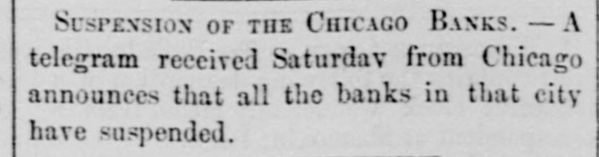
SUSPENSION OF THE CHICAGO BANKS. - A A telegram received Saturday from Chicago announces that all the banks in that city have suspended.


Article from Chicago Daily Tribune, October 14, 1873

Click image to open full size in new tab

Article Text

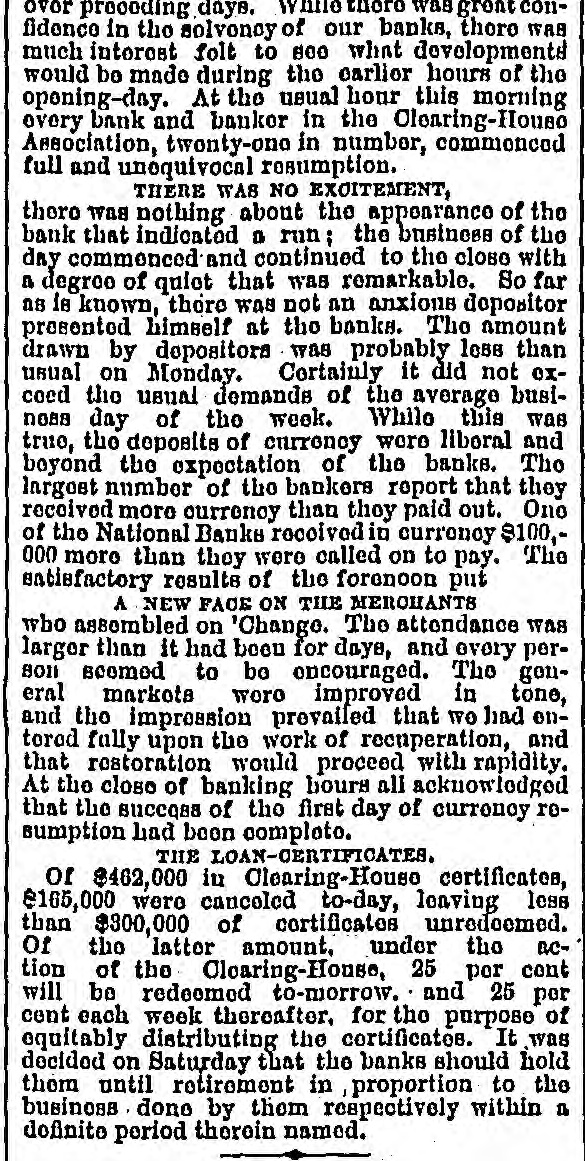
ovor proceding days. While thero was gront con- fidence in the solvency of our banks, thoro was much intorost folt to see what developments would be made during the carlior hours of the oponing-day. At the usual hour this morning overy bank and banker in the Olearing-Houso Association, twonty-ono in number, commenced full and unequivocal resumption. # THERE WAS NO ΕΧΟΙΤΕMENT, thero was nothing about the appearance of the bank that indicated a run; the business of the day commenced and continued to the close with a degroo of quiet that was remarkable. So far as is known, there was not an anxions depositor presented himself at the banks. The amount drawn by depositora was probably less than usual on Monday. Cortainly it did not ex- coed the usual demands of the average busi- noss day of the week. While this was true, the deposits of currency were liboral and boyond the expectation of the banks. Tho largost number of the bankers report that they recoived more currency than they paid out. Ono of the National Banks received in currency $100,- 000 more than they were called on to pay. The entisfactory results of the forenoon put # A NEW FACE ON THE MEROHANTS who assembled on 'Change. The attendance was larger than it had been for days, and overy per- son seemed to be encouraged. The gen- eral markots woro improved in tone, and the impression prevailed that we had en- torod fully upon the work of recuperation, and that restoration would proceed with rapidity. At the close of banking bours all acknowlodged that the success of the first day of curronoy ro- sumption had been comploto. # THE LOAN-CERTIFICATES. Of $462,000 in Clearing-House certificates, $165,000 wero canceled to-day, leaving less than $300,000 of cortificates unredeemed. Of the lattor amount, under the ac- tion of the Clearing-House, 25 por cont will be redeemed to-morrow. and 25 per cent each week thereafter, for the purpose of equitably distributing the cortificatos. It was decided on Saturday that the banks should hold them until retirement in proportion to the business done by them respectively within a definite period theroin named.


Article from The Lambertville Record, October 22, 1873

Click image to open full size in new tab

Article Text

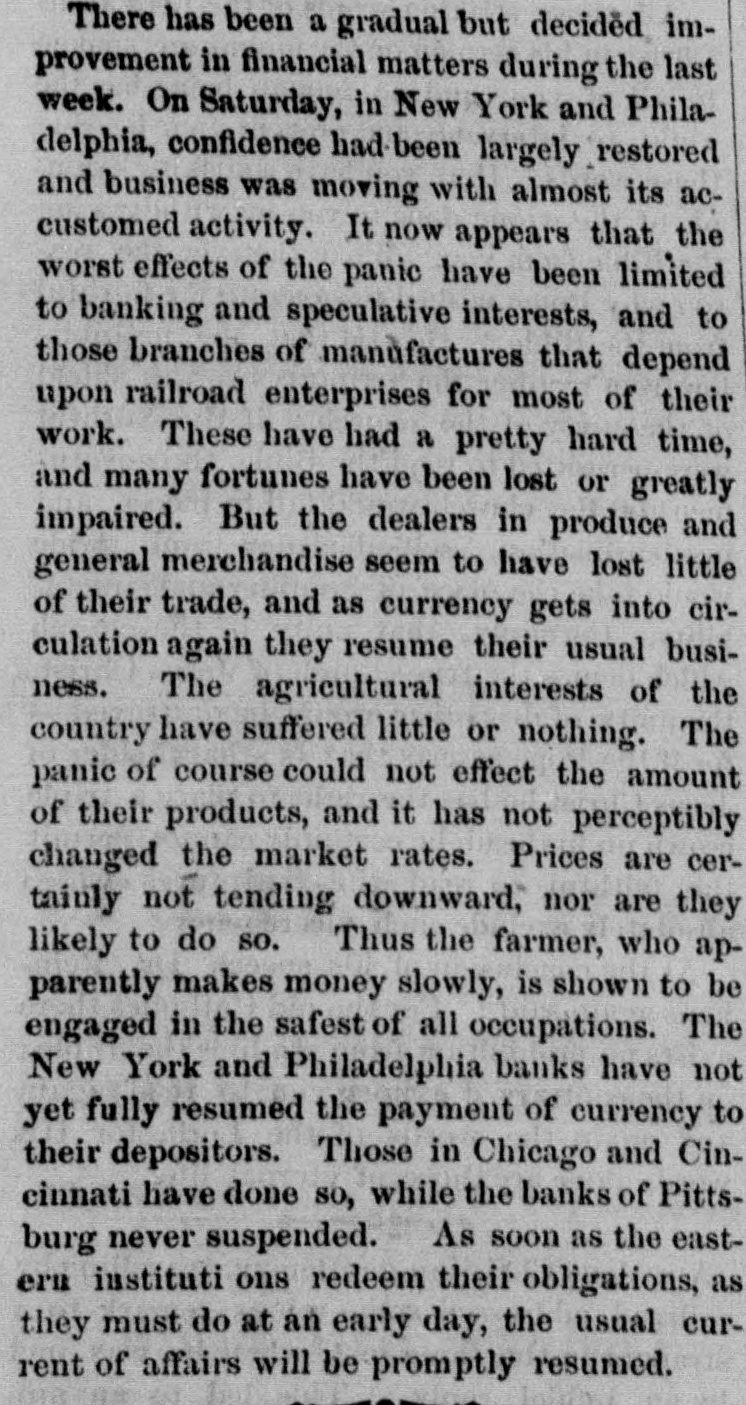
There has been a gradual but decided improvement in financial matters during the last week. On Saturday, in New York and Philadelphia, confidence had-been largely restored and business was moving with almost its accustomed activity. It now appears that the worst effects of the panic have been limited to banking and speculative interests, and to those branches of manufactures that depend upon railroad enterprises for most of their work. These have had a pretty hard time, and many fortunes have been lost or greatly impaired. But the dealers in produce and general merchandise seem to have lost little of their trade, and as currency gets into circulation again they resume their usual business. The agricultural interests of the country have suffered little or nothing. The panic of course could not effect the amount of their products, and it has not perceptibly changed the market rates. Prices are certainly not tending downward, nor are they likely to do so. Thus the farmer, who apparently makes money slowly, is shown to be engaged in the safest of all occupations. The New York and Philadelphia banks have not yet fully resumed the payment of currency to their depositors. Those in Chicago and Cincinnati have done so, while the banks of Pittsburg never suspended. As soon as the eastern instituti ons redeem their obligations, as they must do at an early day, the usual current of affairs will be promptly resumed.


Article from Chicago Daily Tribune, January 21, 1874

Click image to open full size in new tab

Article Text

MONEY AND COMMERCE. MONETARY TUESDAY EVENING, Jan. 20, There has not been much relaxation in the money market yot, but the tendonoy in that direction, the cause boing an increase in the suj ply of exchange mhilo against shipments of grain, and some iuflux of nuouoy from the country in the way of merchants collections, and of amounts sout in by country banks to loan ou collaterals or invest in commercial paper in the open market But It cannot be expected that there will be any very great increase of loanablo Yunde in this market until the rk-packers and )spoculators ship off and sell part of the several million dollare worth of pork and out meats now being hold here by them. The banks are accommodating all their regular customers at 10 por cont, but are taking very little outside paper. In the open market money is to be had at 12 per cont on primo col gaterale, though 15 por cent is paid in many instances. Now York exchange was little firmer to-day than yesterday, and sold between banks at 25 cente per $1,000 discount. THE MEOHANICS' NATIONAL BANK. The Executive Committee of the Chicago Clearing-House Association yosterday invited the Mechanics National Bank of this city to withdraw from its mom borship, to-morrow, Jan. 21. This is only polito modo of expulsion, and eventua it will probably result in the winding no of the bank. The bank was believed to be in a very unsatisfactory condition before the papic thoug not sufficiently 60 to warrant eithor the Bank Examinor or the Clearing- House Committee in making any decided move against its continu inco in business. The panic, of course, only made its condition worse, but the other bauksin the city have been disposed, until now, to at least lend the Mechanics' National their countenance by allowing it to remain in the Clearing House, partly because they wore afraid turb the recovery of public confidence from the effects of the panic, and partly because they were in hopes that its condition might improve with the gonoral improvement of affairs In the last two months. No improvemont however, in its condition appears to have been made since the panio. According to Site recently published statement the bank has only about percent of its deposit in cash lte Acaus are understood to bo now just about where they woro two months or more ago. It is alloged the bank has been unablo to reduce them, bo cause great portion of them are suspended paper which is past due and cannot be collected without great delay As the Executive Committeo of the Clearing House did not examine the dotails of the condition of the Mechanics National Bank yesterday. it is not positively known what the $178,000 of bills payable' in the published statement of the bank represents, but whatover olso it ie. is an evidence that the bank has increased its liabilities in some other way than the of logitimate one of an increase deposits, and only shows the more necessity that it should be put into the hauds of a ReDelver and wound up BANKRUPT FUND DEPOSITORIES. But if the condition of the Mechanics Nationbl Bank is disgrace to the city, it is not 80 of treat an outrage on the public as the order in the Bankrupt Court that all bankrupt funds the hands of Assignees should be deposited in the Dichanics National This order WAS, we believe, subsequent ly modified, 80 as to include the National Bank of Illinois, but, even with this modification, the keeping of bankrupt funds is a disgraceful monopoly managed by a littlo ring for their own benefit. The Assignees it in Bankruptcy are a part of it. and seems now to be an acknowledged fact that none but 8 few bangers on of the Register in Bankruptcy can be appointed to those offices. One of the results of this ringmanagement is that large amount of bankrupt funds have boon locked up, for nobody knows how long, in the Mechanic National Several bankrupt concerns, whose affairs have beon to a great extent adjudicated would have paid dividende to their creditors long ago, only that the Mechanics' National has not been able to pay This farce of settling up bankrupt estates through bank that cau DAY is played out. As far as the National Bank of Illinois is concerned of courso, nobody has any objection to its condition. It is, we believe, sound, well-mauaged bank, but has no right to any monopoly of the baukrupt faude in the hands of Assiguees. BANK. CHEQUE A new kind of financial institution line been started in Eugland called a cheque bank the effect of which is to makd a larger circula tion of bank checks in place of 0010, thus in one sense making au increasing supply of currency, and econom the use of coin for all emall payments. To the small tradesmen, artienne and other persons whose accounts are too small to be very desirable to the larger commercial banks, its conveniences are very great. Ite peouliarity is that, instead of being a competi tor of other banks, it in fact co-operates with them, so that all the ther motropolita: banks are practically made branches of the cheque bank. Chambers' Journal gives the following details of its operation When money is deposited, the only receipt given is at check-book containing chocks for the amount lodged. Tho largest amount for which any one check can be drawn is £10. If we deposit £100 we receive a check book containing ten checks for £10 we may, howev have twenty checks for £5. or 100 check for $1 Now, we can draw only to the amount of our doposit, and no further. for. in the corner of each check, its value is perforated in words, time boing indelibly fixed. In this way it is shoor impossibility for us to overdraw our account, for, though we may make out & chock for any less amount than that specified on it, we cannot for greater. This is great advantage, as there can never be any check re. turned to the payee with No funds inscribed on it, as too often is the case with the old eyea tem. If, then, we make out some checks for less amount than that specified. there must be balance standing at our credit when the checkbook is finished. This we may have carried on towards new book, or we like. may draw on surrondering the counterfoils of the old check-book. All checks are made ble to ordor, and are crossed besides: 80 that, before recoiving payment, the check must have been indorsed This puts such an effectual barrier to unfair dealing, that the risk run by the Oheque Bank is comparatively insignificant Each book of checks contains ten, for which the uniform price is onesbilling teuponce boing for Government stamps, and the odd twopence boing divided between the expense of the paper and bank commission The way in which the book is kept is poculiar. and SAVER an enormous amount of time and trouble Instead of each check being entered in the books some half dozen times, the total amount only of all the checks paid out is placed in the books. And to avoid all risk, the check are 80 caref indoxed and put past, that ton years linese chool cashed now will be found quite roadily also, their checks are cleared dail thus avoiding the necessity of passing through the bankers ClearHouse The leading peculiaritie of this norv instit tion are: 1. N interest is allowed on doposite 2. It does not keep its own cash. 9. It transacts no financial business whatever. 4. Beiug intended only for small accounts (ne no intorest given), it essentially a bank for the million 5. It discounts no bills. The sources of profit to the stockholders are 1. The interest on the £100.000 reserve fund in vested in government consols. Largo returus cannot be looked for here, as the be at security and not a high percentage issought. 2. The divi dends arising from the investment of the doposita terest the
Article from Chicago Daily Tribune, January 23, 1874

Click image to open full size in new tab

Article Text

How It Is Connected with Mr. Scammon's Other Banks. The Outcome Turns upon the Condition of Mr. Scammon's Personal Affairs. How His Building Operations Have Involved Him in Debt. His Property Believed to Be Ample to Pay Off All Liabilities. The difficulties of the Mechanics' National Bank, and the entering up of sundry judgments against Mr. J. Y. Scammon, have brought the embarrassments of the latter gentleman, which have been for a long time the subject of street talk, into the public prints. We sincerely regret that financial misfortunes have overtaken one who has done 80 much as Mr. Scammon has to rebuild and beautify the city since the fire, Probably nobody except Mr. Potter Palmer crithas done more. Although constrained to leise Mr. Scammon with some severity TEIBview in more prosperous his times, embarrassments THE UNE anything cannot less than a calamity to the city with as which be has been 80 long and 80 prominently the identified. Nor should we now allude to matter but for the fact that the very magnitude of of his enterprises takes it out of the category ordinary business complications. MIL. BCAMMON'S BANKING BUSINESS the turning point in the situation, and the is that Le is the President and principal owner of fact the Mechanics' National Bank has brought his affairs under closer and prompter scruting Mr. they would otherwise have received. quadrichan really been the head of a Scammon has institution, -consisting of the lateral wanking Bank, the Marine Comtue pany, mechanics savings National department of the MaY. Seammon, private Ad banker. Time Company, шеве and Lanking J. institutions are in the direct control the same building, and The under Marine Company may of air. Scammon. Mechanics National, and Mr. borrow 100m the Marine Company, and BO on Scammon from affairs the of one bank are, therethrough. The mixed up with the addite of fore, more or less condition of all depends in the others, and the condition of Mr. Seammon's personal the end прод the Tue first to be examined 15 assure. THE MECHANICS NATIONAL, it is subject DO the rules of tue Clearing- Currency as House and w the Comptroller Examiner. of the turough L.10 local Bank Hearmg-House Association The action or the briefly told. some time пр to yesterday may Committee De was instructed to the Investigate ago, the Executive condition OI the Mechanics Nanot For favorable. nonal, am 163 reports ement were has been made in the SIXLY days no improved The Date receivable were condition of the bank. amount the reserve request by a very small National Currency act has required by the and the business has instedDOL been kept up; large proportion 01 tue deposally Tanen ulf. 4 and crust runds, shich 110 of bankrupt out, and could not Da paid have not been drawn bank has met ILS clearing every on demand. The constant bervousness day, LUC there DRB been Banks that it mght шилий the Associated any шше. That it Las not been call LU do be forced ILC to this extreme is of the forbearance due in part to and the III part to the fact tast large depositors, drawn on the Mecustries. Vely IGW CHECKS are DJUKS, however. have reseverator the leading checks on the Mecushics, rused to that certified would release the makers of the such acceptance parsued the placthe cuecks. and others сцеска to the Mechanics' for LICE of sending the presentation WILLIOUS waitcodection upon mer 'Ine statuing or the back mg was Deell for and Queertain clearings. and feebre over since the pame. There has been a growing tuey sentiment were carry among is the Associated Battles CURE risk and W the detrisnaky ment of mentation the strong at the Lanks. atechanics' It was, therefore, determined TO WITHDRAW to IDVALE FROM tue THE CLEARING-HOUSE, to THIS exce: was and 16 formal the notification bank Tuesday by tue Executive upon response LO cus, Mr. Scammen Committee. 111 to the Executive Contract sent a ccmmunication of which IS not known, tee, the CAUCE purport to have been a request DUE time should the suspend condided action of a lew days, with a produse improved. that The Executive Committee a at the bank should and be this communication under Led meeting consideration and decidthen Wednesday to take afternoon, LUO responsibility of time, either out ed not the bank or extending the Assoto suspending the whole matter back upon the YESTERDAY'S clation. MEETING OF THE 18d CLEARING-HOUSE. to a call 101 a the of meeting at 1. was this declared was watch 4 at was Its held rooms afternoon yesterary no DUE o'clock, when the Bubject There was presented, was all informal formal action was LEARN. whole agair, ID which two discussion of the A points were notable: 1. to from WILHOUTH timent that the Mechanics the Association one or on the every pait hesitation 10 the to take bringing initiative all a ON was hope about a withdrawal. There need the invitation sides that the bank would and the Association withdraw already issued, leaving the to adjourned until one day stand. next week, The attation, 15 this then. but of 16 the stili member notice to that effect Tue Mechanics to National requested Bank 18 Association, Williaw voluntarily to retire. If it does of not next weed, or dues not before meanwhile the make middle good its Association. reserve, 16 will probabiy be expelled from Associated the Banks of the city to It 18 due to the have :aken was adopted say that the course they and regret, and that they as with much hesitation the whole matter have endeavored to keep considerateness has private as possible. more This by & sense of regret and 5 been sympathy suggested for Mr. Scainmon's embarrassment THE than by anything BANK EXAMINER'S else. STATEMENT. ExaminBluk Mr. Altred Spink. Government relative to the status or the er, when stated questioned that he had not made an examina- semi-anbank, since the regular the nual inspection III it at was time that tion of its condition last fall, previous much to better that panic by as at shown than present, condition then was it its Last statement, its though legal reserve. Mr. about $30, 000 short of the bank to better its Since Sprink at that time then caused the Bank Examiner had to Currency condition. received no instructions examine from into the the Comptroller up its winding he Unless of the the bank nor to take received steps toward such instructions, were that deposits or affairs. depositor made complaint he could not a not paid on demand, The last statement Comptroller tion whatever. would probably induce good the its reserve recently require the bank to make into liquidation. to within thirty days or to assets, go Mr. Spink said that the was capital due With regard to $250,000. the and the surplus from reserve other amount the not was banks due from 80 Was owed $150,000 more over the $200,000. and, hence, the Marine if whole amount the banker, and J. Y. private Bank Scammon, even supposbe still secured, Scammon depositors would Bank and Mr. reing that the Marine The deposits and the


Article from Chicago Daily Tribune, January 23, 1874

Click image to open full size in new tab

Article Text

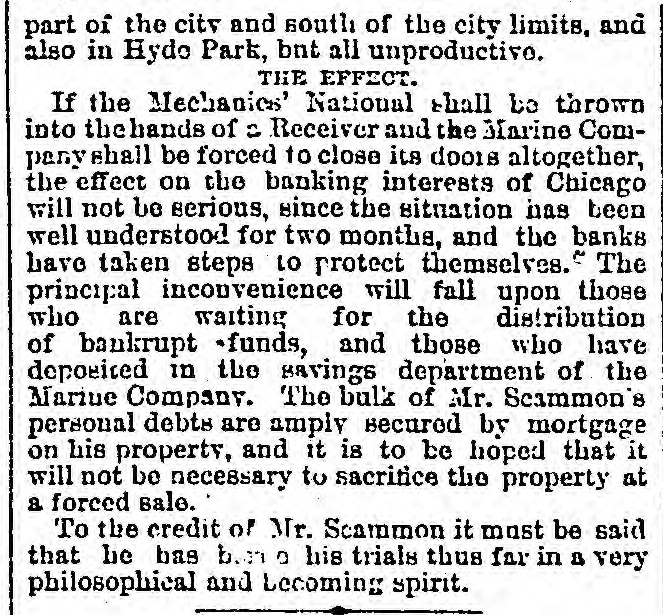
part of the citv and south of the city limits, and also in Hydo Park, but all unproductive. THE EFFECT. If the Mechanics' National shall be thrown into the hands of = Receiver and the Marine Company shall be forced to close its doors altogether, the effect on the banking interests of Chicago will not be serious, since the situation has been well understood for two months, and the banks have taken steps to protect themselves. The principal inconvenience will fall upon those who are waiting for the distribution of bankrupt -funds, and those who have deposited in the savings department of the Mariue Company. The bulk of Mr. Scammon's personal debts are amply secured by mortgage on his property, and it is to be hoped that it will not be necessary to sacritice the property at a forced sale. To the credit of Mr. Scammon it must be said that he bas b.n 0 his trials thus far in a very philosophical and becoming spirit.


Article from Chicago Daily Tribune, January 31, 1874

Click image to open full size in new tab

Article Text

FRIDAY EVENING, Jan. 30. demand for monoy in the local market made The ntinues notive, owing to the to proparations pay for and provision speculators delivered noxt B) ПОЛОДОН oq 07 foodxo son quility JOAO BE 'Souour JO Addres our BE onday. and after this temporary domand noxt wook. -=== 01 Salllim more on 01 start at 'po -jo at Mon иоло OJU 0111 JO our mo 0A80 their loans if satisfactory papor red. York exchange is still rather 50o scarco, and but 18 80100 """ '{up-0} onslor 111110 NON U BY 0 per discount. Cleary a Mr. the collect the war-paint dug up his raid against the banks to that ow in their capital stock, and declares shall not none) our mom Youuv 10 WORTY uuo on no sox on "O And 7" fou DATE M AUM Any of noglected." the banks in this contest. recent account YORKS подов uno up should eAuq OM from 0 the ntrary, logal in proceedings of the the last present dead-lock, of quest 01 BROI quilt MOU DAVI DAVID on not 14 an over made before, by the and Collectors to get taxpayer them is, to Алоло puu citizen dood OA And pmone on pood LIGAT -rod uo BOXUT 0111 jo 20017 POLITION orners A -op 0111 81 nous ballord all on JO JI the OM pus BRING 0111 [" of donble taxation sottled. But 03 on aus stock JO on mo at shares Cleary's worry soop "truo 07 puv on KUM 02 peace -ep and sp controll Allu up butho on Aount P settle the law question ; entirely froo from on " Intered approving JOJ put D D pind oq 2011 0.10M PINOM 1875 JOJ BOXE) raug JO JO 08 notedens D 001117 plud 0.10M 11 II puu 01018 on MOTIOM JO 000'9 am JOAO BUILL Collector units No Lotton couth nths honco. The to the County in Treasurer, the puu ACOR on up put 880 World motiey at only TO 0811 om BUTT spoped Collettor cortining 7% superscript(1) only quilt monthly obthod JOJ 000'000 on oring Include understand you op OM me 10 ean 0 III ammont 00001 onour Autu 109 pmont county 20 OM7 neqt мои fromsul pus #11 of u MECHANICS' NATIONAL BANK. for NO morj -AJOAO -1100 Supply sun goinuring UU 'A 'f BU # Program FILL **** of no dy that Mr. Presidency, and, ns he claims, National from any Bank of -Dq Rueq on distriction JOJ Supply pood U on Bp 7I THE uon: 180 icago. Mr. Scammon's embarrassed financial condibank on 07 Medicoss JO and I " were an element thing for THE TRIBUNE, oq JeSuoi ou IIIA runq excellent uu OB[V BI the reason that the is said in THE TRID11q BI Invoice on JO compution MADIUM our 7047 claim 01 o inv E derogatory to animosity entertained WALL ompted by any personal TRIBUNE toward Mr. quits and JO on ran up U.I. BUM on claims while on . 'nowin OAL on understand, M 01 rivals any 1" uils OM голошол the Any attitude chance of for a charge of can now say projudice IV tu 71°J snq) Bujeq find pur our DAUG OM 11017 Frooly uno 0.1 701 only -[" uno 111 out this 010309 of put -XO JO mom detension on 07 jo 00111100 one 10] Com- from 01 IS on JO 0117 into Con too did chanice' not National Bank as the they were in recommendation honor Cou U 008 you PIP Joisu op 07 pm Con Con -UN on Committed 10 our "PIP A Cou on Lup-07 моая fou affairs om JO quouro: JOU youq onf JO recordable op they pau "rug 1ut WHILE OIU 8:00,. pun merely nat RW 'shop 10 pood #1119 91119 on nons JO fund "U THAT ed.iv[ portion BIJA y believed The by Committee simply of took the the uu 'avw ono JO on BOAN Subtotaly pun ruvq om atatement [tig Quie 811 the pus Auntis 1017 or on: 07 'If uupV persond mood put HIT u! chall u! 000 N°M ilities to depositors The Mechanics Ame: 000'0018 No pjud DAUH month. only u! 000'0 nun Pacif cash III 000'09$ poundow you could rust [stio] its deposits and legitimate manner, MaN EMO Allia 811 JO 000'0018 Anu 10 u! 'LZ DOD since 'gop| EPIO opt by the collecting venture the assertion that LUII part MOTH cannot your OM puu [Jun Mechanics National The Mechanics National notw puu on 80 shill SMI MON 10 Have NATIONAL 'ouop nead Butt E Nort MON 01 anoixue nood sull 101 000 ялоц OAL 'BUTE objaiord on 1110 juno ased MaN or[1 TOR 09 sigh 761[7 pus 'oputu 'SUM вшов u! on J78 JO 'f 'X ured lerstand, by the mortgages on Mechanics National, Scamate Marine Company, and of Mr. National Bank does TLL on JOJ fieuou www.do.netu 7! on Inc "II recor deal in real estate the Mechanics National bad 01 BI # J! puu "II 07 onp 1 other 09[0 pus cash up 000 & Wer poBo that the Metropolitan, obligations of the pun and Invol to purmop onp and on plon Brjt 000'1$ chanics' National, will once. The demands of Eigl JO -UN $112,000 enf Altio fott 7" aboseb Aquout u! the dated 80 banks will the Mechanics' JUIV ash" hold yesterday by as the Mechanics' will dated U u! Bit more your HU and "[" IIIM on JO no rechize 07 ald p80 101 op shodes JO uI Susta pc polup owners of the $326,000 that these banks, Lari OR oq IIIM National osoddne son OCI Monor .41 THEM ditors of the the Mechanics depositors to draw rung uplacent as to allow they (the creditor banks) *009'02 their money while leavings and the poorest Page our think 101 receivable only 01[0] 07 Aq pa 16 "UCT condition V mg 10A AI Billa on 10 7. on morj on 'si the 1913 "II inp fully justifies its Committee of the dated aring -Houso. House The after once Executive having to taken examine this po- the now I "nor on owo it the to bills the public receivable of the in Mechan- the IVJ,I ash and Bank otherwise they stand reasonable National indorsing, without any mos rotton peout NOTIX MOL Haids -ord DABY they почт institution JO us opn; 'osn into of bout two wooks ago Bank unless the Examiner Mechanics pnd perup JO recordeble - JO the AUH 07 proof anor " etuos more $200 uo PI only TEAD canble JO 1 ITM "II 000'01$ -Stru DAUH puodens 07 07 DAVI pu [point Dative 01 HORBOJ LIVE OM claim 100 soop III II read 10MT, pull Lash on JO condition puy puix real on 10 So peter ошоя open u 10 Companition on: 07 UNOUT ont II Wabe dated has not renoy-which, been for done-he would have now, apnota up 0.1030 Hunq 047 JOJ "цоя polup bottor 0117 shand little ошоя U Juoy O.IU III are 7007 "HI that " poru ou 101 NOL PIO 0.18 they par 0.11 on this a dition than provent the preceis 'non 1071 Sq and the JO 01 Jomod tom u! II" 20 Russell 0.10 one pue actitul 10 TOTAL 10tt personsed 09 Committee 07 n8nouo '7.1 006 "THI Kinp THE the In 101 IIIA *** 18aq on Christic only pus Suppling off, '05% Total up pusodo.id uooq gut uo thist 'BI 0011 Bi. """I" you # BU ronor 10T -Jno arom THAT one JOJ FI'80'0 op no M one OROUT Jo oron RMOIA JO om 08[1] 7nq on & ey, toward specie resumption. its eighth mouth 200 JO providers the 7"


Article from Chicago Daily Tribune, January 1, 1875

Click image to open full size in new tab

Article Text

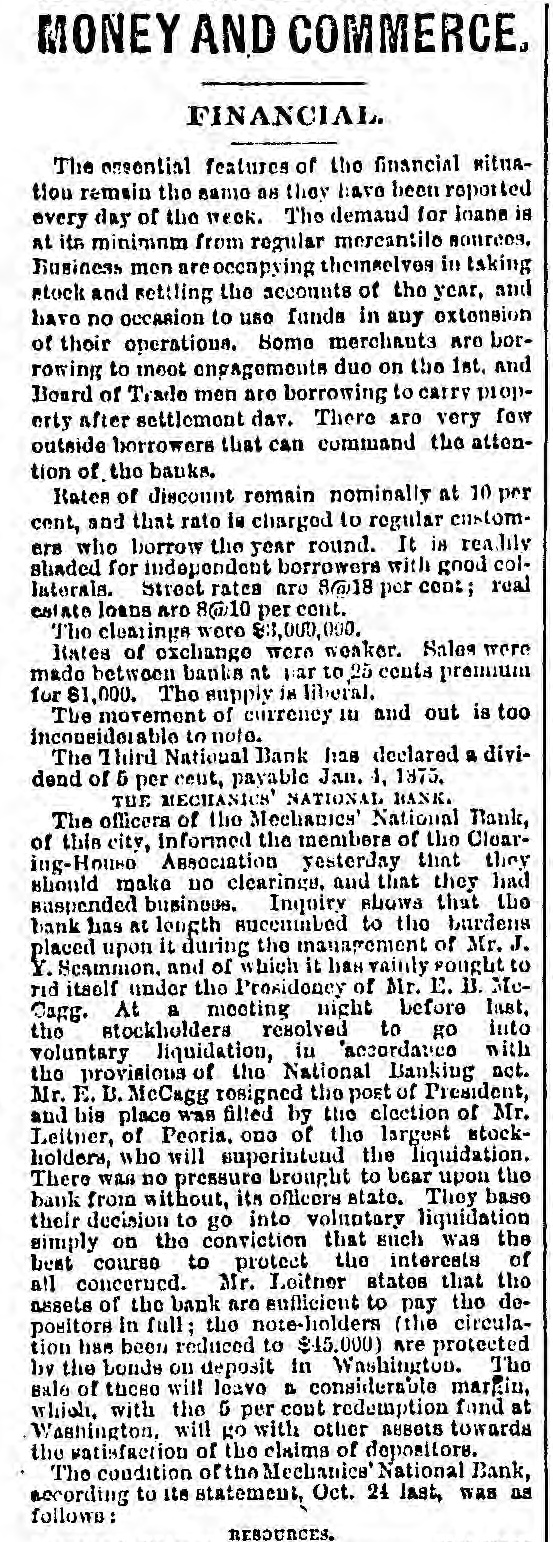
MONEY AND COMMERCE. FINANCIAL. The ossential features of the financial rituation remain the same as they have been reported every day of the week. The demand for loans is at its minimum from regular mercantile sources. Business men are occupying themselves in taking stock and settling the accounts of the year, and have no occasion to use funds in any extension of their operations. Some merchants are borrowing to moot engagements due on the 1st. and Board of Trade men are borrowing to carry property after settlement dav. There are very fow outside borrowers that can command the attention of the banks. Rates of discount remain nominally at 10 per cent, and that rato is charged to regular customare who borrow the year round. It in readily shaded for independent borrowers with good colInterals. Street rates are 86/18 per cent; real estate loans are 8(a/10 per cent. The clearings were $3,000,000. Rates of exchange were weaker. Sales were made between banks at war to 25 cents premium for $1,000. The supply is liberal. The movement of currency III and out is too inconsiderable to note. The Third National Bank has declared a dividend of 5 per cent, payable Jan. 1, 1875. TUE MECHANICS' NATIONAL BANK. The officers of the Mechanics' National Bank, of this city, informed the members of the Clearing-House Association yesterday that they should make no clearings, and that they had suspended business. Inquiry shows that the bank has at length sucembed to the burdens placed upon it during the management of Mr. J. Y. Scammon. and of which it has valuly songht to rid itself under the Prosidency of Mr. E. B. MeCarg. At a meeting night before last, the stockholders resolved to go into voluntary liquidation, in accordance with the provisions of the National Banking not. Mr. E. B. McCagg resigned the post of President, and his place was filled by the election of Mr. Leitner, of Peoria, one of the largest stockholders, who will superintend the liquidation. There WILL no pressure brought to bear upon the bank from without, its officers state. They base their decision to go into voluntary liquidation simply on the conviction that such was the best course to protect the interests of all concerned. Mr. Leitner states that the assets of the bank are sufficient to pay the depositors in full; the note-holders (the circulation has been reduced to $45.000) are protected by the bonds on deposit in Washington. The sale of these will leave a considerable markin, which, with the 5 per cont redemption fond at Washington, will go with other assets towards the watisfaction of the claims of depositors. The condition of the Mechanics' National Bank, according to its statement, Oct. 24 last, was as follows: RESOURCES.


Article from New-York Tribune, January 6, 1875

Click image to open full size in new tab

Article Text

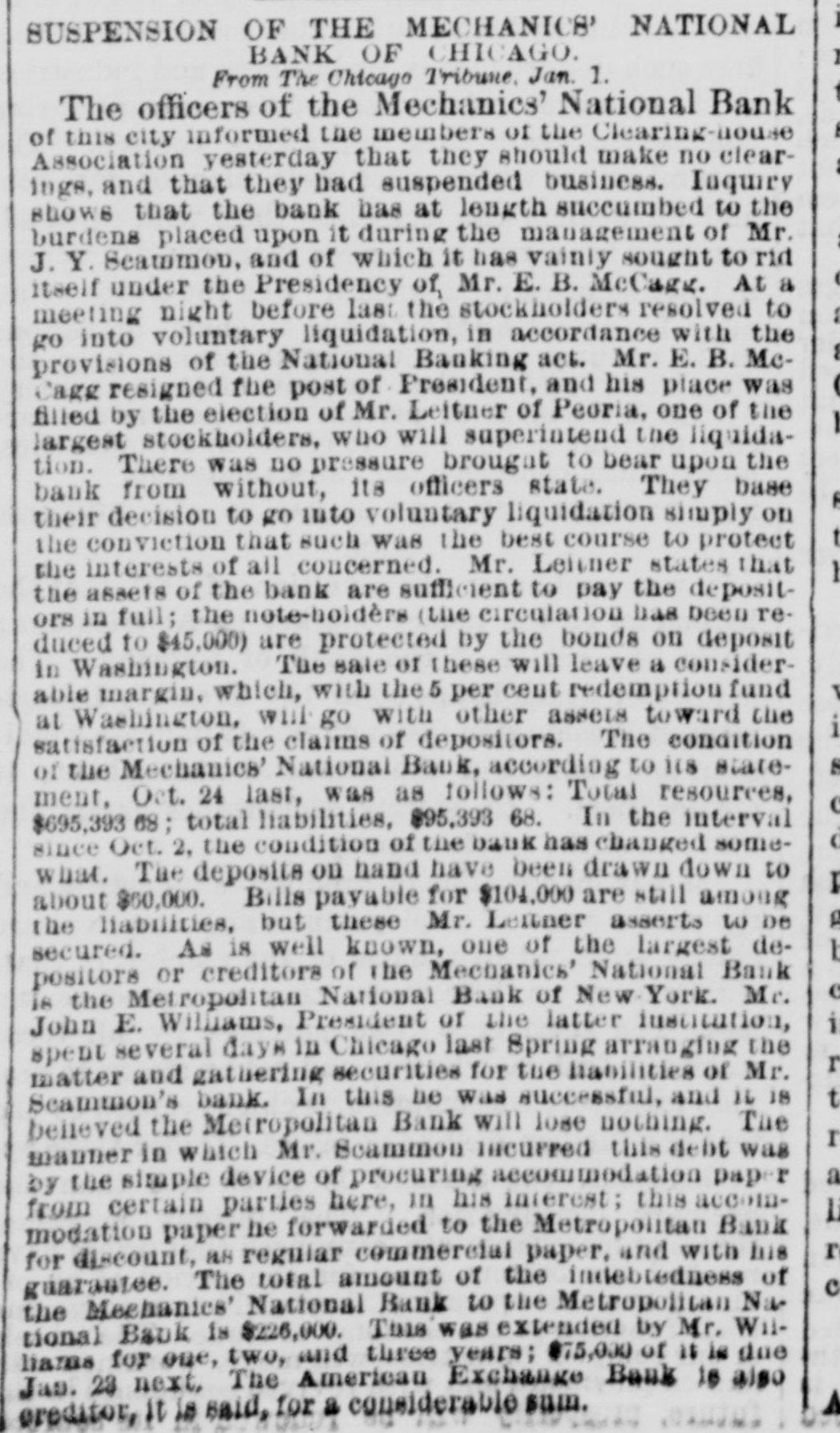
SUSPENSION OF THE MECHANICS' NATIONAL BANK OF CHICAGO. From The Chicago Tribune, Jan. 1. The officers of the Mechanics' National Bank of this city informed the members of the Clearing-house Association yesterday that they should make no clearings, and that they had suspended business. Inquiry shows that the bank has at length succumbed to the burdens placed upon it during the management of Mr. J. Y. Seammon, and of which it has vainly sought to rid itself under the Presidency of, Mr. E. B. McCage. At a meeting night before last the stockholders resolved to go into voluntary liquidation, in accordance with the provisions of the National Banking act. Mr. E. B. McCagg resigned fhe post of President, and his place was filled by the election of Mr. Leitner of Peoria, one of the largest stockholders, who will superintend the liquidation. There was no pressure brought to bear upon the bank from without, its officers state. They base their decision to go into voluntary liquidation simply on the conviction that such was the best course to protect the interests of all concerned. Mr. Leitner states that the assets of the bank are sufficient to pay the depositors in full; the note-holdèrs (the circulation has been reduced to $45,000) are protected by the bonds on deposit in Washington. The sale of these will leave a considerable margin, which, with the 5 per cent redemption fund at Washington, will go with other assets toward the satisfaction of the claims of depositors. The condition of the Mechanics' National Bank, according to its statement, Oct. 24 last, was as follows: Total resources, $695,393 68; total liabilities, $95,393 68. In the interval since Oct. 2, the condition of the bank has changed somewhat. The deposits on hand have been drawn down to about $60,000. Bills payable for $104,000 are stall among the liabilities, but these Mr. Lettner asserts to De secured. As is well known, one of the largest depositors or creditors of the Mechanics' National Bank is the Metropolitan National Bank of New York. Mr. John E. Williams, President of the latter institution, spent several days in Chicago last Spring arranging the matter and gathering securities for tue habilities of Mr. Scammon's bank. In this he was successful, and 16 18 believed the Metropolitan Bank will lose nothing. The manner in which Mr. Scammon incurred this debt was by the simple device of procuring accommodation paper from certain parties here, in his interest; this accommodation paper he forwarded to the Metropolitan Bank for discount, AH regular commercial paper, and with his guarantee. The total amount of the indebtedness of the Mechanics' National Bank to the Metropolitan Na. tional Bank is $226,000. This was extended by Mr. Williams for one, two, and three years; $75,000 of it is due Jan. 28 next, The American Exchange Bank 15 also creditor, st is said, for a considerable sum.


Article from New-York Tribune, January 7, 1875

Click image to open full size in new tab

Article Text

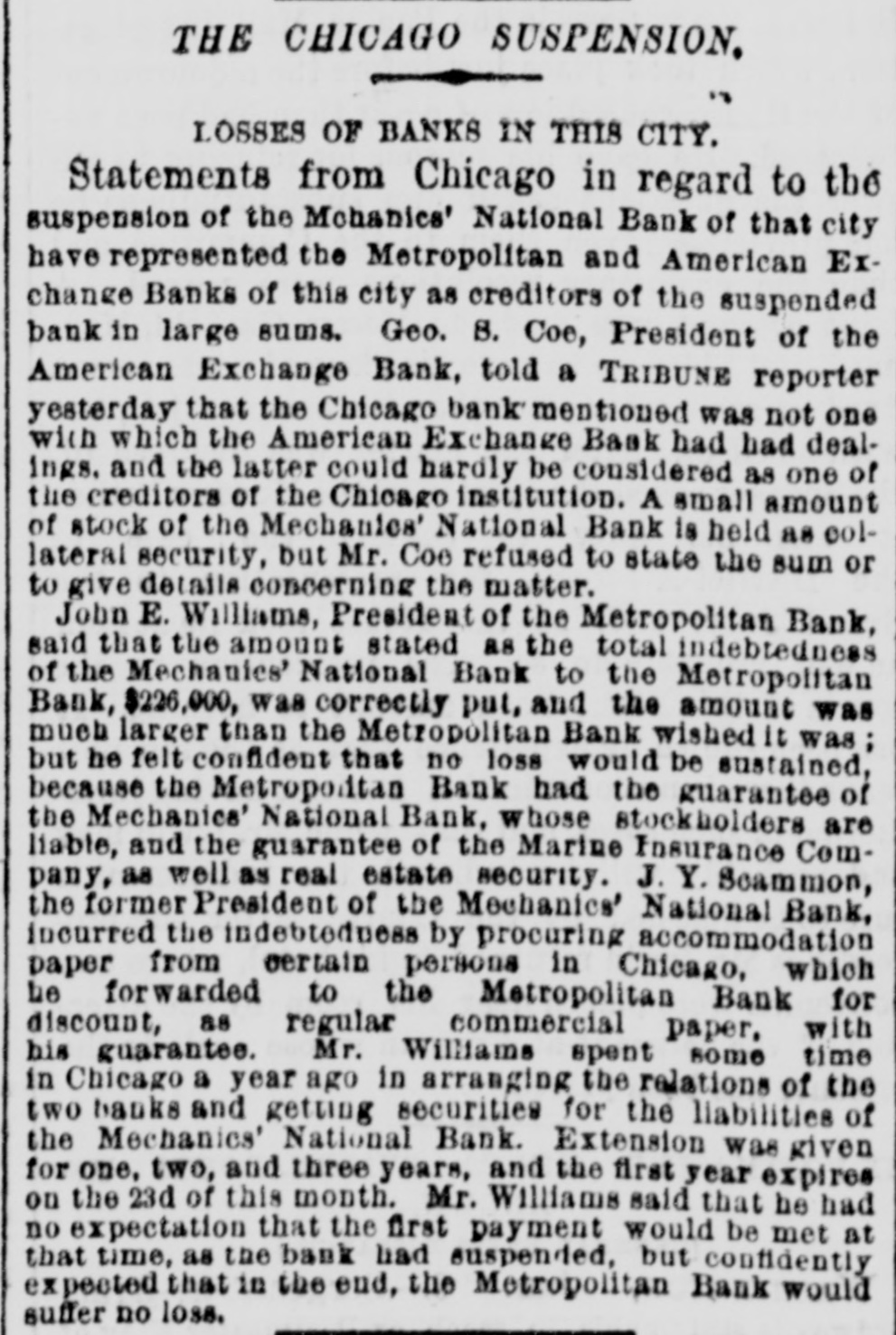
# THE CHICAGO SUSPENSION, LOSSES OF BANKS IN THIS CITY. Statements from Chicago in regard to the suspension of the Mohanics' National Bank of that city have represented the Metropolitan and American Exchange Banks of this city as creditors of the suspended bank in large sums. Geo. B. Coe, President of the American Exchange Bank, told a TRIBUNE reporter yesterday that the Chicago bank mentioned was not one with which the American Exchange Bank had had dealings, and the latter could hardly be considered as one of the creditors of the Chicago institution. A small amount of stock of the Mechanics' National Bank is held as collateral security, but Mr. Coe refused to state the sum or to give details concerning the matter. John E. Williams, President of the Metropolitan Bank, said that the amount stated as the total indebtedness of the Mechanics' National Bank to the Metropolitan Bank, $226,000, was correctly put, and the amount was much larger than the Metropolitan Bank wished it was; but he felt confident that no loss would be sustained, because the Metropodtan Bank had the guarantee of the Mechanics' National Bank, whose stockholders are liable, and the guarantee of the Marine Insurance Company, as well as real estate security. J. Y. Scammon, the former President of the Mechanics' National Bank, incurred the indebtedness by procuring accommodation paper from certain persons in Chicago, which he forwarded to the Metropolitan Bank for discount, as regular commercial paper, with his guarantee. Mr. Williams spent some time in Chicago a year ago in arranging the relations of the two banks and getting securities for the liabilities of the Mechanics' National Bank. Extension was given for one, two, and three years, and the first year expires on the 23d of this month. Mr. Williams said that he had no expectation that the first payment would be met at that time, as the bank had suspended, but confidently expected that in the end, the Metropolitan Bank would suffer no loss.


Article from New-York Tribune, January 26, 1875

Click image to open full size in new tab

Article Text

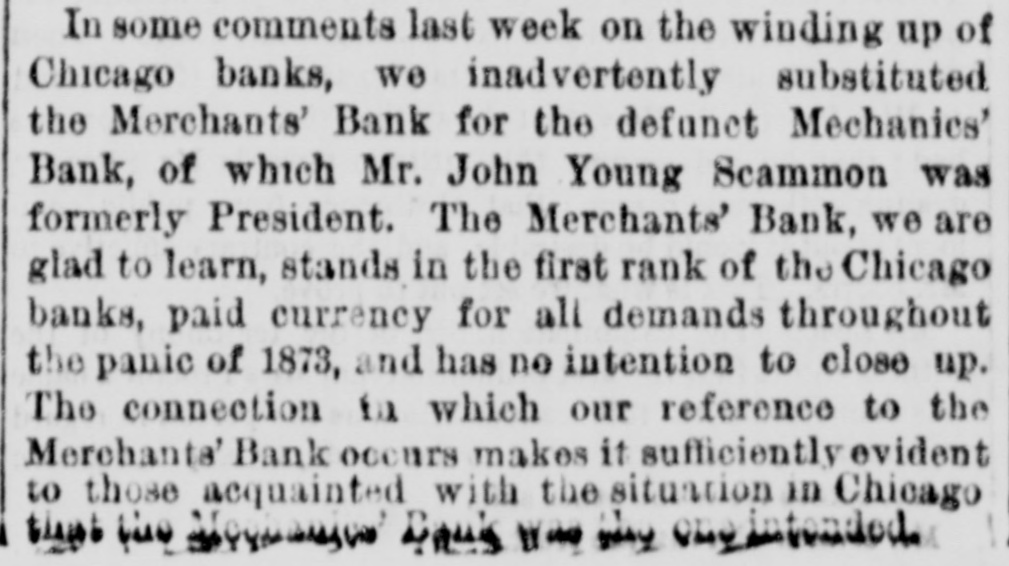
In some comments last week on the winding up of Chicago banks, we inadvertently substituted the Merchants' Bank for the defunct Mechanics' Bank, of which Mr. John Young Scammon was formerly President. The Merchants' Bank, we are glad to learn, stands in the first rank of the Chicago banks, paid currency for all demands throughout the panic of 1873, and has no intention to close up. The connection in which our reference to the Merchanta' Bank occurs : makes it sufficiently evident to those acquainted with the situation in Chicago tines


Article from Chicago Daily Tribune, March 10, 1875

Click image to open full size in new tab

Article Text

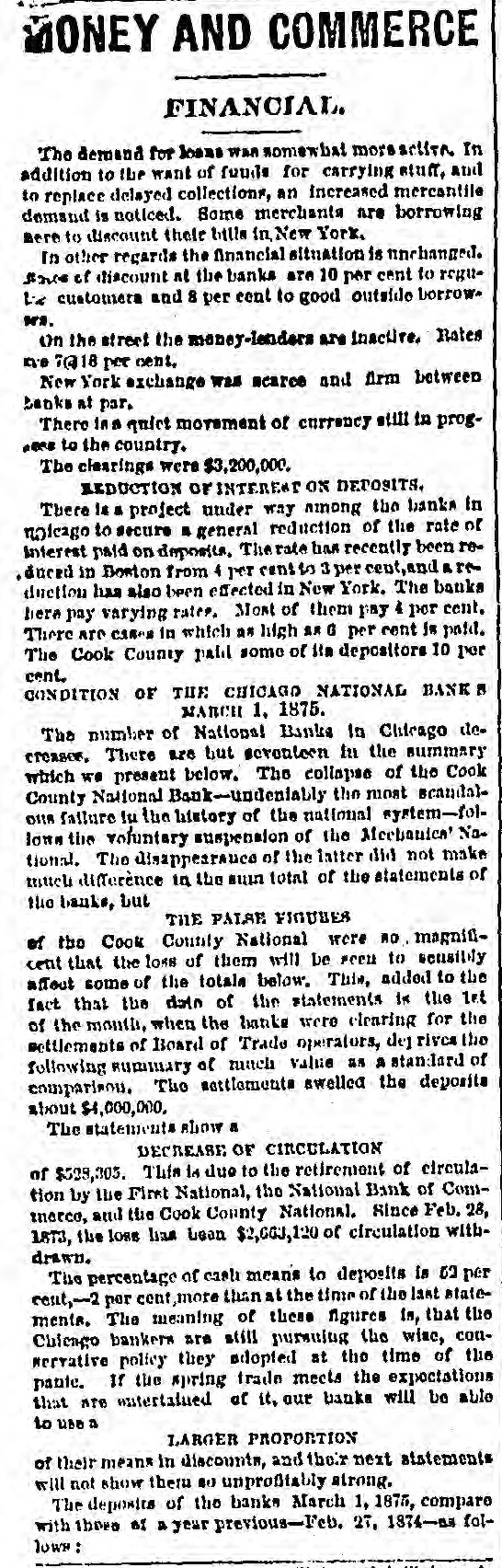
MONEY AND COMMERCE FINANCIAL The demand for loans was somewhat more In addition to the want of funds for carrying stuff, and to replace delayed collections, an increased mercantile demand is noticed. Some merchants are borrowing Bere to discount their bills in New York, In other regards the financial situation is unchanged. since of discount nt the banks are 10 per cent to regu12 customers and 8 per cent to good outside borrow* wa. on the street the money-lenders are insclive. Rates are TO per cent. New York exchange was scares and firm between banks at par. There in a quiet movement of currency still in prog- to the country. The clearings were $3,200,000. REDUCTION or INTEREST ON DEPOSITS. There is a project under way among the banks in noicago to secure a general reduction of the rate of Interest paid on deposits, The rate has recently been reduced in Boston from 4 per cent is 3 per cent,and a reduction has also been effected in New York. The banks here pay varying rates. Most of them pay 4 por cent. There are cases in which as high as 0 per cent in paid. The Cook County paid some of its depositors 10 por cent. CONDITION OF THE CHICAGO NATIONAL BANK R MARCH 1, 1875. The number of National Banks in Chicago decreaser, There are but seventeen in the summary which we present below. The collapse of the Cook County National Bank-undeniably the most scandalDIER failure tu the history of the national system-follown the voluntary suspension of the Mechanica' No. tional. The disappearance of the latter did not make much difference in the suin total of the statements of the banks, but THE PALSE FIGURES of the Cook County National were RO. magnincent that the loss of them will be peen to sensibly affect some of the totals below. This, added to the fact that the date of the statements is the 1st of the month, when the banks were clearing for the settlements of Board of Trade operators, de] rives the following summary of much value as A standard of comparison. The settlements swelled the deposits about $4,000,000. The statements show a DECREASE OF CIRCULATION of $528,305. This la due to the retirement of circulation by the First National, the National Bank of Cominerce, and the Cook County National. Since Feb. 28, 18T3, the loss has Lean $2,003,120 of circulation withdrawn. The percentage of cash means to deposits is 02 per cent,-2 per cent,more than at the time of the last statements. The meaning of these figures in, that the Chicago bankers are still pursuing the wise, conservative policy they adopted at the time of the panic. If the spring trade meets the expectations that ATE intertatued of it, our banks will be able to use a LARGER PROPORTION of their means in discounts, and their next statements will not show them 10 unproditably strong. The deposits of the banks March 1, 1875, compare with three of a year previous-Feb. 27, 1874-as follows :


Article from The Star, May 18, 1875

Click image to open full size in new tab

Article Text

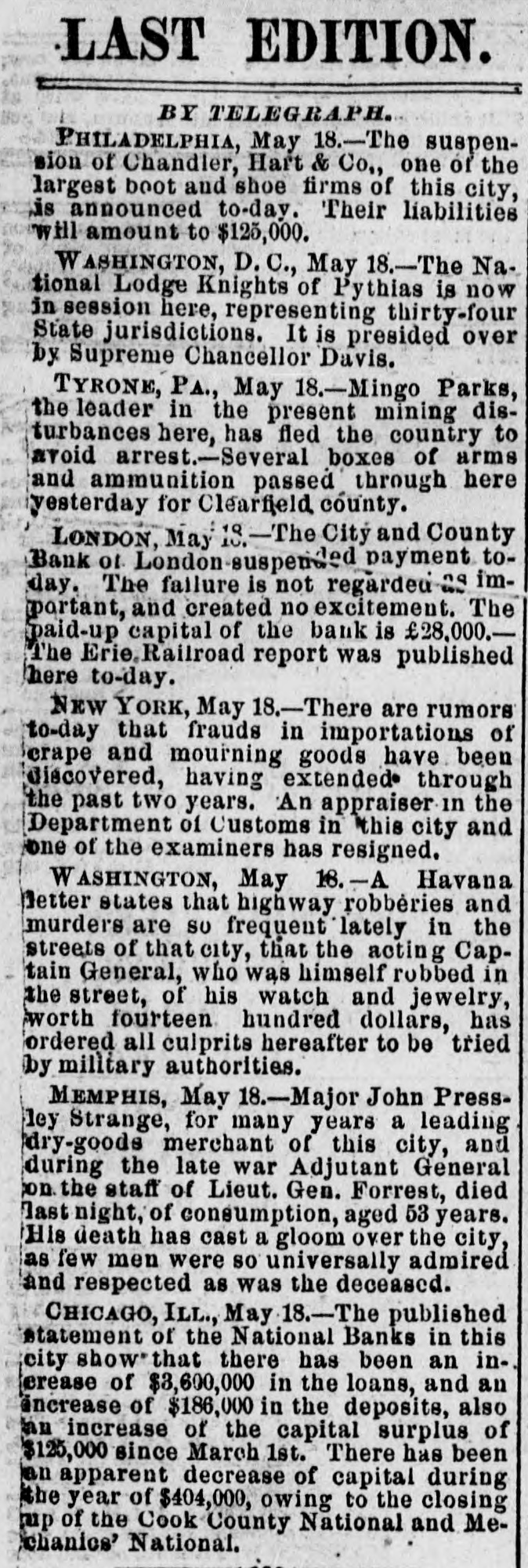
LAST EDITION. BY TELEGRAPH. Philadelphia, May 18.-The suspension of Chandler, Hart & Co,, one of the largest boot and shoe firms of this city, is announced to-day. Their liabilities will amount to $125,000. WASHINGTON, D.C., May 18.-The National Lodge Knights of Pythias is now in session here, representing thirty-four State jurisdictions. It is presided over by Supreme Chancellor Davis. TYRONE, PA., May 18.-Mingo Parks, the leader in the present mining disturbances here, has fled the country to avoid arrest.-Several boxes of arms and ammunition passed through here yesterday for Clearfield county. LONDON, May 18-The City and County Bank of London suspended payment today. The failure is not regarded na important, and created no excitement. The paid-up capital of the bank is £28,000.The Erie. Railroad report was published here to-day. NEW YORK, May 18.-There are rumors to-day that frauds in importations of crape and mourning goods have been discovered, having extended. through the past two years. An appraiser in the Department of Customs in this city and one of the examiners has resigned. WASHINGTON, May 18.-A Havana letter states that highway robbèries and murders are S0 frequent lately in the streets of that city, that the acting Captain General, who was himself robbed in the street, of his watch and jewelry, worth fourteen hundred dollars, has ordered all culprits hereafter to be tried by military authorities. MEMPHIS, May 18.-Major John Pressley Strange, for many years a leading dry-goods merchant of this city, and during the late war Adjutant General on the staff of Lieut. Gen. Forrest, died last night, of consumption, aged 53 years. His death has cast a gloom over the city, as few men were so universally admired and respected as was the deceased. CHICAGO, ILL., May 18.-The published statement of the National Banks in this city show' that there has been an increase of $3,600,000 in the loans, and an increase of $186,000 in the deposits, also an increase of the capital surplus of $125,000 since March 1st. There has been an apparent decrease of capital during the year of $404,000, owing to the closing up of the Cook County National and Mechanics' National.


Article from Chicago Daily Tribune, September 23, 1877

Click image to open full size in new tab

Article Text

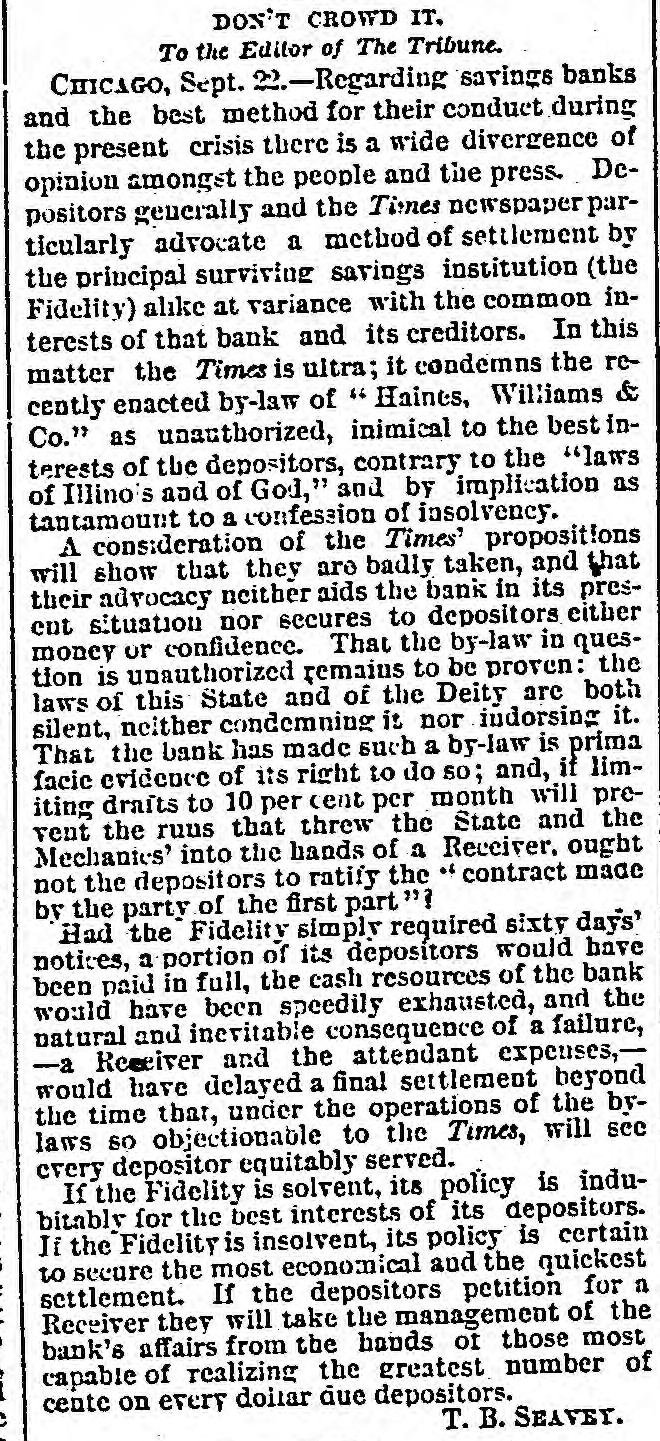
DON'T CROWD IT. To the Editor of The Tribune. CHICAGO, Sept. 22.-Regarding savings banks and the best method for their conduct during the present crisis there is a wide divergence of opinion amongst the people and the press. Depositors generally and the Times newspaper particularly advocate a method of settlement by the principal surviving savings institution (the Fidelity) alike at variance with the common interests of that bank and its creditors. In this matter the Times is ultra; it condemns the recently enacted by-law of " Haines, Williams & Co." as unauthorized, inimical to the best interests of the depositors, contrary to the "laws of Illino's and of God," and by implication as tantamount to a confession of insolvency. A consideration of the Times' propositions will show that they are badly taken, and that their advocacy neither aids the bank in its present situation nor secures to depositors either money or confidence. That the by-law in question is unauthorized remains to be proven: the laws of this State and of the Deity are both silent, neither condemning is nor indorsing it. That the bank has made such a by-law is prima facie evidence of its right to do so; and, if limiting draits to 10 per cent per month will prevent the runs that threw the State and the Mechanics' into the hands of a Receiver. ought not the depositors to ratify the of contract made by the party of the first part Had the Fidelity simply required sixty days' notices, a portion of its depositors would have been paid in full, the cash resources of the bank would have been speedily exhausted, and the natural and inevitable consequence of a failure, -a Receiver and the attendant expenses,would have delayed a final settlement beyond the time that, under the operations of the bylaws so objectionable to the Times, will see every depositor equitably served. If the Fidelity is solvent, its policy is indubitably for the best interests of its depositors. If the Fidelity is insolvent, its policy is certain to secure the most economical and the quickest settlement. If the depositors petition for a Receiver they will take the management of the bank's affairs from the hands of those most capable of realizing the greatest number of cente on every dollar due depositors. T. B. SEAVEY.


Article from Deseret Evening News, September 16, 1893

Click image to open full size in new tab

Article Text

be right in that there are not fifty who would throw bombs but in times of panic and starvation you cannot tell how soon thousands can be organized into mobs." "What will be the effect of the times on political parties?" "If the hard times continue the Republicans will carry the country by a large majority and if McKinley should carry Ohio by an overwhelming vote the logic of the situation would point to him as our next presidential candidate. If however time should ease up under a revised tariff McKinley could not be nominated as he could be the head of a high protective tariff platform. If ConI gress should repeal the tax on state banks and legislate the national banks out of existence we might have flush times for a year or so and then the trouble would be worse than ever. In such a case the revised tariff might be carried on with apparent prosperity. It is hard to tell what will happen. I am afraid of Congress. If it does nothing times will certainly continue hard. If it does what some of its members wish to do the situation may grow better for a time only to leave us in a worse state than ever. HOW SENATOR CULLOM SAVED A BANK. I here asked Senator Cullom as to the panic of 1873 and his experiences in it. He replied: "I don't think the panic of 1873, or that of 1883 is to be compared to this. I was in business at the time of the panic in 1873. I left Congress in 1871, and was president of a bank in Springfield. We had six or seven banks in the place, and the situation for a time was critical. The New York banks had closed their doors. The banks of St. Louis and Chicago had suspended payment and the bank presidents of Springfield debated for a week whether they should not follow suit. We had meetings every day and every evening of this week up to Friday night, The next day was Saturday and we knew that the farmers would come in from the (country and that many of them would demand their money. At the beginning of the meeting the oldest bank president in the city had made a motion that we all suspend on the morrow. This hung fire until late and at last the chairman said: 'I suppose it is the sense of this meeting that all the banks will be closed tomorrow morning. All this time I had said nothing. I was thinking of the effect of the action upon my political career rather than upon myself as a banker. I was very ambitious and I did not want to appear before the people in the future as the ex president of a bursted bank. I got up and said: 'Gentlemen; I am, I think, the youngest bank president here. My bank has no more capital than the others. I probably know less about banking than any of you, but I say here and now, that rather than close my bank while I have a copper cent to pay out I would put my hand and arm in a red hot stove.' This speech changed the sense of the meeting. It restored con fidence to the others. We decided not to close and we passed through the next day without trouble. We have not had a failure since that time, and my speech saved us. What the country needs to day is more back-bone and nerve. A large part of the panic is due to fright, and what we need is confidence in ourselves." PRESIDENT LINCOLN AS A FINANICER. "You knew President Lincoln quite well, Senator, what kind of a financier was he?" "Theoretically and on political-economical grounds he was great. Practically he knew little about money and took no care of it. He kept no books to speak of, and I have been in his law office when he had returned from riding in circuit. He parcticed at the courts of all the counties about Springfleld. After trying a case he would take a piece of paper and wrap up the fee that he received from client and write on the back of the paper the name of the case. He would put the money thus wrapped away in his pocket. The next fee would be wrapped up in like manner and stored away in another pocket, and when he came home he would take out the fees from the different pockets one at a time and divide them with his partners." LINCOLN AS A LAWYER. "Was Abraham Lincoln a great lawyer?" "Yes," replied Senator Cullom, "I think there is no doubt of that. My g father knew him very well, and when asked to advise as to a lawyer for any person he would say: 'Get Judge n Logan if you can, but if you can't there U. is a young man in his office by the name of Lincoln who will do just as a well.' Lincoln was very strong with W both court and jury. He had a great deal of personal magnetism and his honest, common, plain way captured C the jurors. He would lean over them, W gesturing with his long arms and would hold them by his homely eloquence. yo "President Lincoln,' Senator Cullom fir went on, "was the greatest man this h: country has ever produced. He was a up great writer and his papers are full of n literary merit. He grasped things intuiW tively. He knew how to handle men th and he was able to make Congress do as to he judged best. I remember being one day at the White House when the news of Owen Lovejoy's death in New York was received. President Lincoln was very much affected by it. He walked IR up and down the room and during the talk about the death said: "Lovejoy D was a great radical in Congress but I could send him and