Click image to open full size in new tab
Article Text
"BUSTED
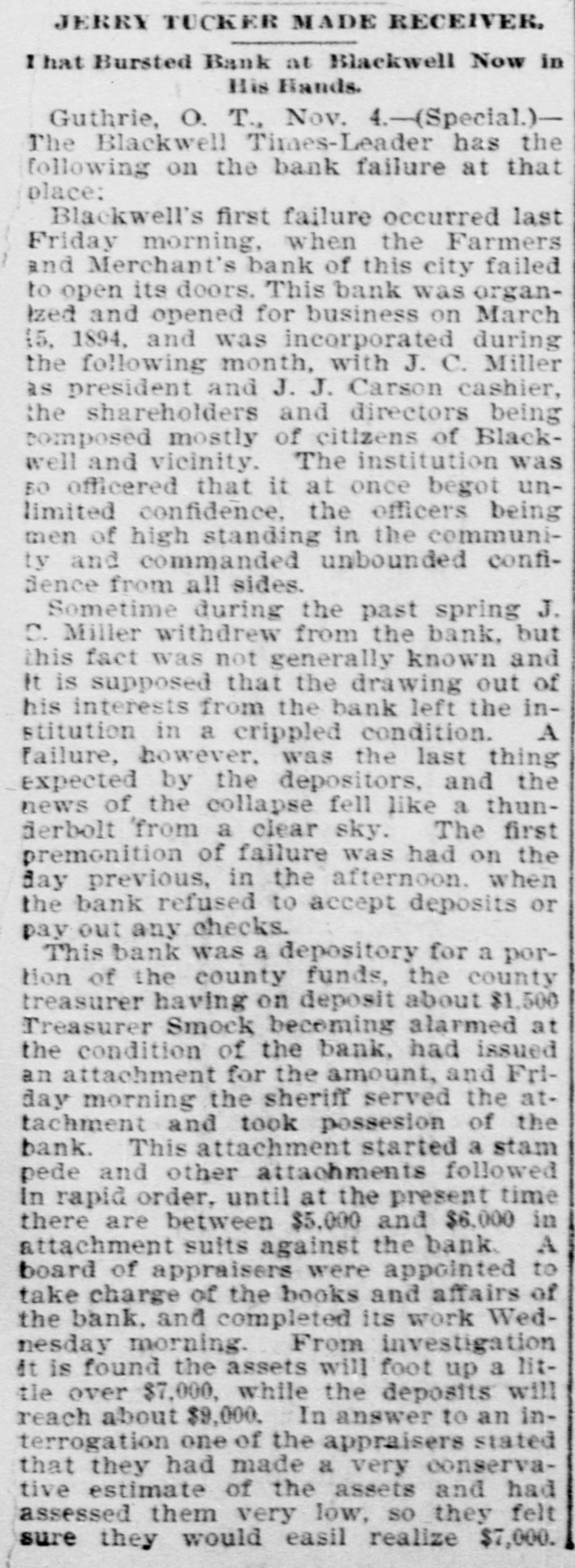
" THE GOLD STANDARD AT WORK. The Appeal to Reason says: Mercantile Cloak Company, New York, failed for $125,000. Too many cloaks and too little money. Western Building and Loan Association, of St. Louis, assigned. Liabilities way up there. People don't want any homes-want nothing but money. Big lumber firm in Ontario assigned for want of stuff. Plenty of lumber, but law does not compel men to have lumber, but money. Too little money to go 'round. Farmers' bank at Blackwell, Okla., went down last week with $60 in the vault. Lots of notes and mortgages, Too but deman who has de mon is de boss. little money and too many notes. The prosperity of the country continues with great eagerness. The First National bank of Wellington, Kansas, has joined the angels with asbestos wings in the next world. The bank at Ashgrove, Mo., has yielded to the grim monster of contraction. The State bank at Gothenburg, Neb., flew up the flue. The state bank at Washburn, Wis., has vanished with much cash. Judge Woods has granted Coffin, the wrecker of a great bank of Indianapolis a. new trial. Business houses all over the country are tumbling like a row of bricks, and the concentration of wealth into fewer and fewer hands is accelerated. Whoop em up. Glorious system to vote for. Sultzbach, great clothier of Philadel. phia, is out in the cold because he tried to make clothing for the people. People don't want any clothing want only filthy lucre. Nakedness and money is what they want-but money at any rate. Don't know enough to supply the demand. These people didn't have the mun to pay the officers or judges: Evictions of settlers on the Omaha reservation in Nebraska occur daily. Yesterday four families whose arms were badly lacerated by a rope employed to hasten their departure from their homes and who were otherwise severly treated, swore out a warrant for the arrest of Wm. and Sam Ashford, leadeers of the evicting parties of Indian police. Leo Mayer, big merchant of Janesville, Wis., failed 'because of his inability to make collections." So much money in the banks the people haven't any, see? Washburn, Wis., bank failed and a lot of howling dervishes who believe in putting their money in the hands of bankers are wailing their loss. Never put in bank more than you can afford to lose. M. Rosenberg & Co., wholesale hosiery, New York, failed. Liabilities many thousands. M. Bixby & Co., of New York, manufacturers of blacking, harness oil, etc., have succumbed to the returning prosperity. Liabilities, $240,028; actual assetts, $91,743. HERE'S ANOTHER BATCH. Fort Scott, Kan., Jan. 18.-The plant of the Fort Scott Paper Company, valued at $30,000 was today placed in the hands of W. T. Seagrave, as receiver, by Judge Simons, of the District Court. The application was made by the Bank of Fort Scott, which holds a mortgage on the factory. A few days ago the plant was closed down and the employes sued and got judgment for $2,300 back wages. The factory was built as an experiment to make paper out of bagasse, from the sugar mill. The experiment proved a success, but the company did not have money enough to carry on the business. The Receiver expects to resume operations soon. Philadelphia, Pa. Jan. 18.-The fifth failure has been reported consequent on the failure of Keene, Sutterlee & Co., the leather dealers. Charles W. Fink and Charles H. Heilgman, trading as Hartly, Fink & Co., morocco manufacturers, made an assignment. Liabilities are said to be at least $60,000. Several judgments were entered and a Sheriffs' sale realized between $8,000 and $9,000 on the firm's assets. Little Rock, Ark., Jan. 18.-Dave W. Pollock, clothing and furnishing goods dealer, was attached by the German National Bank and other local creditors tonight. Liabilities, $8,500; nominal assets the same. Duluth, Minn., Jan. 18.-The Duluth Provision and Dry Goods Company, operating a large department store in this city assigned today to Joseph C. Helm. Some of the creditors have applied for the appointment of a Receiver. The company was organized about two years ago, with a capital stock of $100,000. Gloversville, N. Y., Jan. 18.-Daniel B. Judson, manufacturer of gloves, has assigned to his son, John B. Judson, of this city, and J. P. Argensinger, of Johnstown. Liabilities, $65,000. Judson failed two years ago. Lexington, Ky., Jan. 18.-Frederick Halderman made an assignment here today to Leonard N. Deall. Assets, $2,800; liabilities, $3,000. Halderman is a diaryman. HERE'S THE RECORD OF ONE DAY. Philadelphia, Jan. 15.-The leather a trade of this city was thrown into state of consternation today by the announcement that the liabilities of Keen, Sutterlee & Co., leather dealers and Importers, who failed Saturday, will reach, if they do not exceed, $4,000,000. Leather was only one of the commodities handled by the firm. They were heavy importers of goat skins, chemicals, coffees, wool and hides, most of which came from South American ports. Four other leather houses have since gone down in the crash which wrought the ruin of the larger firm. These are: John M. Fenlin, liabilities nearly $100,000; Charles W. Landell, $150,000; Charles Illingsworth, trading as the Eagle Glazed Kid Company, and John A. Duncan. The liabilities of the latter two houses are not yet known. Frederick W. Sutterlee and Fenlin have not been seen since last Thursday. Mr. Sutterlee and Mr. Fenlin were intimates in their business life, as well as socially, and their absence has led many to suppose that they have gone together, although Mr. Sutterlee announced his departure in search of his health. From whisperings in the trade it would be supposed that many of the men who best knew the concern and its methods are inclined to believe that the failure hinges considerably more upon the disappearance of these two men than is commonly