Article Text
STATE SAVINGS INSTITUTION
Run on the Bank—A Change of Charter—The Old and New Compared.
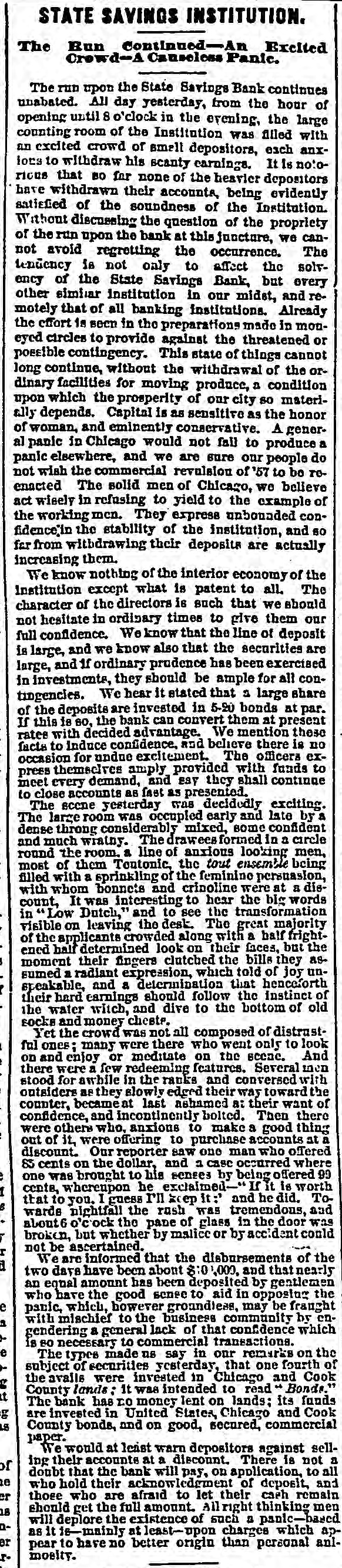
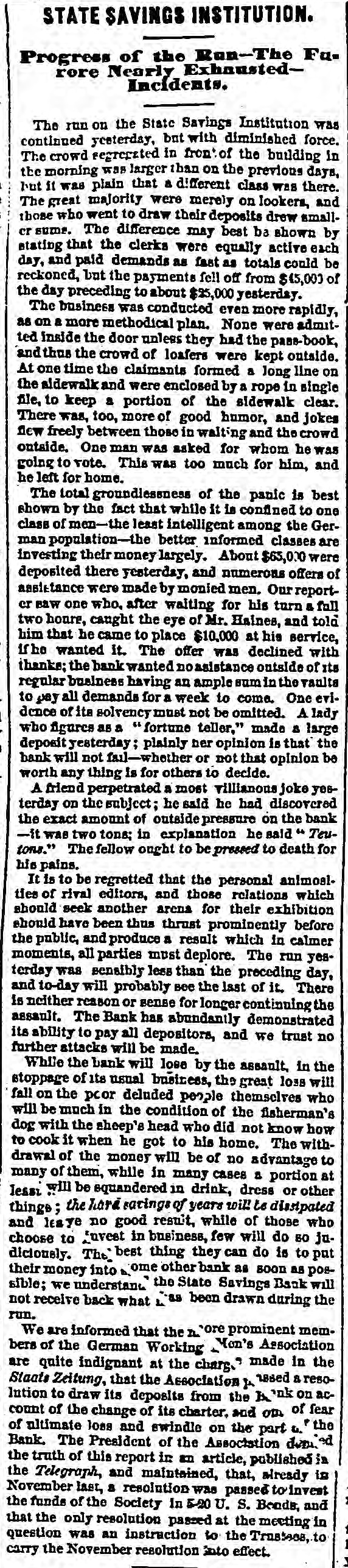
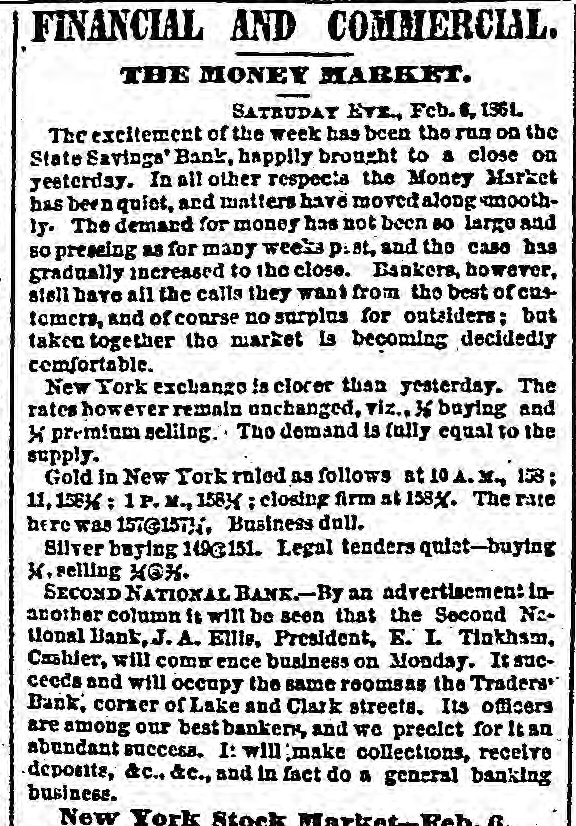
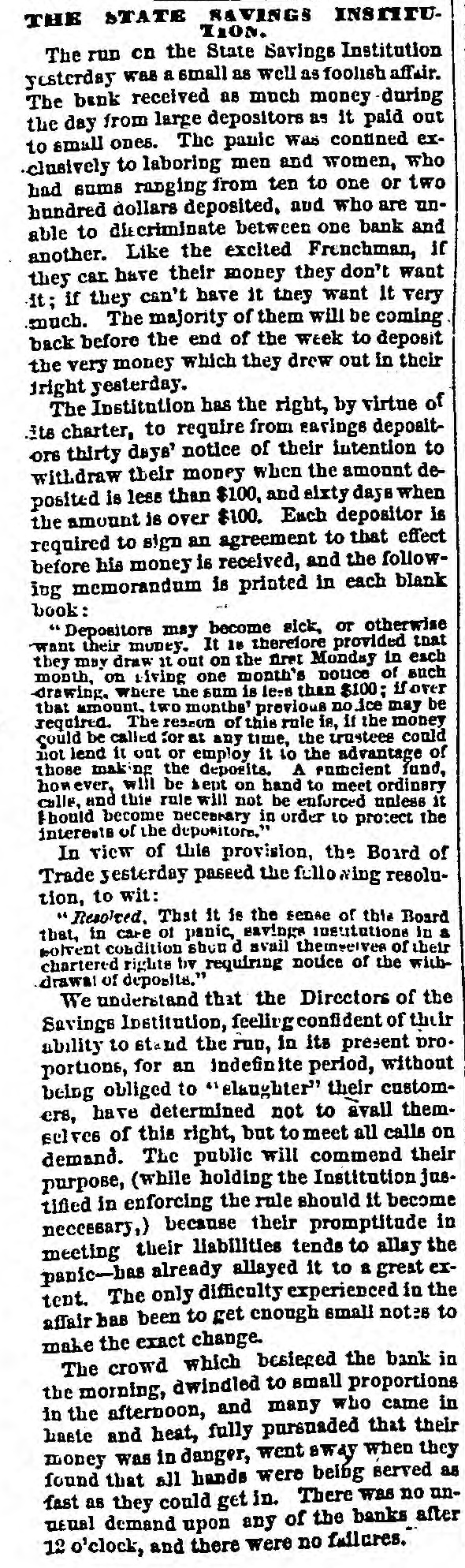
The office of the State Savings Institution, located at No.'s 104 and 106 Washington street, was yesterday the theatre of considerable excitement. At the hour of opening the counter was surrounded by a number of persons, principally Germans, who had deposit accounts with the bank. The attendance continued all day till the time of closing. A casual passer-by might have thought that the bank was doing a thriving business. A closer examination would, however, have shown him that the draught was all, or nearly all, one way. Each wanted to draw his deposit; in other words, there was a run on the bank.
The sight was an unusual one. It is now some years since a bank has been thus pressed for payment. The closing of R. K. Swift & Co., in 1857, and the subsequent one of Hoffman, Gelpcke & Co., in 1861, are indeed about the sum total of failures since Chicago took her real stride towards prosperity. In consequence of the novelty, the run attracted much attention, and many of those who had no money to draw went to look on at the crowd and speculate on the mutabilities of human affairs generally. They were, however, disappointed as to the denouement: the bank paid all demands, and the officers announced their perfect willingness to honor them as long as presented.
The cause of the run on the bank is the discovery that the owners of the institution are doing business under a different charter from that which the public supposed. It commenced business about six years ago, under the name of the Illinois Savings' Institution, under a charter procured in 1857, and continued until August 1st, 1863—six months ago, when the managers of the bank bought the charter of the "State Savings' Institution," which was a charter granted in 1861 to Hoffman, Gelpcke & Siller, which we elsewhere publish in full, and began to change the accounts of depositors from the one concern to the other. We think they are to blame for not publicly advertising the change of charters, and notifying their depositors thereof, so that each one might have the free option to transfer his account from the Chicago to the State Savings' Bank or withdraw it as he might see fit. However this was not done and many accounts were doubtless transferred on the pass books without the depositors really discovering or understanding the nature of the change. The officers of the bank assure us that many or most of the depositors were apprised of the substitution of charters, but some we are confident were not, and did not understand or perceive by their new pass-book that any change of charters had occurred.
There are two questions in which the patrons of the institution feel an interest: first, the solvency of the bank; second, the character of the present charter. Under the old charter there were no stockholders, no capital paid in, no personal liability, nothing but the good faith and honor of the gentlemen who volunteered to become the Trustees of the institution. There was but one salaried officer belonging to the bank—the Cashier.
The 13th Article of the By-Lays of the old bank set forth that "The Trustees undertaking these duties (management of the bank) without pay or emolument, will not hold themselves responsible for any losses whatever." Other by-laws provide for the payment of interest on deposits not exceeding six per cent—the average being perhaps about four and a half or five per cent. The profits made by the managers consisted of the difference between what they loaned the deposits at and the rate of interest paid on them—less the taxes, rent, fuel, light, public printing, advertising, salary of the cashier, and other expenses of keeping an office; consequently it could not be very large; indeed it was so small that the Board of Trustees paid very little attention to its affairs, rarely looking at its books, but leaving the whole management to Mr. John C. Haines, Nathan R. Kidder and Geo. Schneider, the active managers.
The Institution was carefully and honestly conducted by these gentlemen, and brought triumphantly through the great financial crash of 1857, as we stated in our item yesterday. So much as regards the bank under its old charter.
The present charter grants larger powers to the Managers, but imposes greater responsibilities, as will be seen from its perusal. The managers are stockholders and have put in $100,000 of capital. Section 9 of the charter makes them individually liable to the depositors to the whole extent of each stockholder's capital invested. To this extent depositors are certainly better secured than under the former charter.
The management of the funds of the banks is almost identically the same at present as formerly. The rule adopted by the officers is, to invest one-half in United State 5-20 bonds. Surely that is safe and good security, as any depositor could desire. These bonds are now worth a premium of 4 per cent, and can be converted into "Greenbacks" on five minutes notice. One quarter of the moneys of the bank is invested in Chicago and Cook County lands and in Illinois State stocks, and the remaining quarter is loaned on good collaterals and securities to business men on 30 and 60 days, the same as other banks, keeping on hand, of course, a sufficient amount of currency for daily use. The officers of the bank are perfectly willing to submit their books to the inspection of a committee of prominent citizens whom the depositors may designate, who shall report on the financial soundness of the Institution. They have no apprehensions from such an examination; they claim that there is not a sounder or more carefully managed bank in the city or State, which we presume is true. The reports set afloat that the President or Vice President has invested the deposits of the bank in horse railway stocks, or have speculated in which, are wholly untrue, as we are personally assured by those gentlemen. They have invested not a dollar of the deposits of the bank in any speculation whatever. Every cent loaned is on ample security.
In justice to Mr. Haines, the President of the Bank, we deem it only right to say to those who do not personally know him, that he is esteemed to be an exceedingly prudent, cautious, conservative man in money matters, who has accumulated a large fortune by careful business management, prudence and industry. And certainly there is no more cautious, discreet, or upright man in all financial dealings than the Vice President, George Schneider. And each of the other officers are men of similar make of minds.
According to the by-laws of the Institution, each depositor having less than one hundred dollars deposited, must give one week's notice of his intention to withdraw his account, and if the sum exceeds $100, the notice shall be one month. Yesterday this notice was not required, but each man, up to the hour of closing, got his money on demand. If the run shall continue from day to day, until all the deposits be withdrawn, the effect on the bank will simply be to oblige Mr. Haines, first to sell all the 5-20 United States bonds, next all the Chicago, Cook county and Illinois bonds, and lastly to take a part of the notes of merchants and business men given to the bank, secured by United States and other stocks as collaterals, judgement notes, and pork or beef, at half its market value. And long before the last depositors drew out their accounts, the first ones will have got over their foolish panic and gone back to the bank with their money. The bank can be put to inconvenience, but nothing more. It is too strong and carefully managed to be seriously damaged by any run on it.