Merchants Trust Company (New York, NY)

Episode Information

Episode UID
4754227691265
Episode Type
Suspension → Closure
Bank Type
trust
Bank ID
475422769 hash
Start Date
May 23, 1905
Location
New York, New York (40.714, -74.006)

Metadata

Model
gpt-5-mini (chosen from majority vote of a three-model LLM ensemble)
Short Digest
123940a1d36c9f74

Response Measures

None

Events (2)

1. May 23, 1905 Suspension
Cause
Bank Specific Adverse Info
Cause Details
Unable to realize quickly on large loans secured by Hudson Valley and Rutland railway securities, impairing cash and capital.
Newspaper Excerpt
The Merchants' Trust Company ... closed its doors this morning. ... posted on its doors the following notice: The Merchants' Trust Company is closed by order of F. D. Kilburn, state superintendent of banks.
Source
newspapers
2. May 24, 1905 Receivership
Newspaper Excerpt
Upon the application of the state attorney general, Douglas Robinson ... was appointed one of the receivers of the company.
Source
newspapers

Newspaper Articles (24)

Article from Evening Star, May 23, 1905

Click image to open full size in new tab

Article Text

BUSINESS SUSPENDED Merchants' Trust Company of New York Closes Doors. STATEMENT ISSUED UNABLE TO TURN SECURITIES INTO CASH QUICKLY. President Phillips Exonerated From All Blame in the MuddleReceiver Shortly. Special Dispatch to The Star. NEW YORK, May 23.-The Merchants' Trust Company, which has its main office at 346 Broadway, and a branch at 300 West 59th street, closed its dors this morning. Shortly before 10 o'clock, the usual hour for opening the bank, Samuel Untermeyer, counsel for the company, emerged from a meeting of directors and announced that upon his advice the officers had decided to suspend the business. By 10 o'clock there were a dozen persons in line, as usual, waiting to draw out money, and a similar number ready to make deposits, but the tellers' wickets were not open. Bank Examiner A. C. Judson was behind the counter, and about ten minutes after the time the bank should have opened he posted on its doors the following notice: "The Merchants' Trust Company is closed by order of F. D. Kilburn. state superintendent of banks." While Mr. Judson was posting up his notice, Mr. Untermeyer was preparing the following statement, which he issued shortly thereafter: "In view of the publicity that has been given to the efforts of the company to increase Its cash resources and to the unmarketable character of certain of the securities, which it holds as collateral for large loans, I have advised the president to recommend the suspension of business so as to prevent a run on the institution. "Mr. Philips has been president for only a few months. The loans that have crippled the cash resources were not made under his administration and he has no responsibility for them. Ever since Mr. Phillips assumed office his efforts have been directed toward inducing those under whose administration these loans were made to take them out of the institution. This has not yet been done, but it may be done. The president will probably make a statement later." President Jacob L. Phillips said at the time Mr. Untermeyer issued the foregoing statement that the directors were still in session and that as soon as they concluded their meeting a statement would be issued by the president, probably early in the afternoon. Until the issuance of his statement he said that he did not care to discuss the company's troubles. Receiver Shortly. Bank Examiner Judson said that a receiver would probably be appointed shortly upon application to the attorney general. Mr. Judson added that it would probably be a week or ten days before the state banking department completed its present examination of the books, and that until that time he was not at liberty to discuss the affairs of the bank. As the bank counters transacted no business this morning there were no new deposits accepted and no money paid out. The number of patrons at the trust company's offices this morning, as It closed, was normal. None manifested any anxiety. If anyone present suspected that the company was in serious trouble he did not show it. Not until the news of the company's suspension spread rapidly through the dry goods and the financial districts was there any commotion at 346 Broadway. The Present Officers. The present officers of the Merchants' Trust Company are as follows: President, Jacob L. Phillips; vice president, Cassius M. Wicker; secretary-treasurer, Frederick P. Davis; asistant treasurer, Jacob J. Coyne. Directors: George C. Batcheller, Ronald K. Brown, John Cantlege, George C. Clarke, Frederick P. Davis, Thomas L. Feitner, Charles J. Follmer, Edwin Langdon, John P. Munn, Jacob L. Phillips, James E. Reynolds, Henry Sampson, David S. Walton and Cassius M. Wicker. The company has been in operation about six years. Its statement at the close of business December 31, 1904. showed that It had a capital stock of $500,000, a surplus of $1,000,000, undivided profits of $198.737 and deposits amounting to $3,367,617. It had loans amounting to $2,074,000, cash on hand in banks of $1,481,608, and it had $507,500 worth of New York city bonds and about $980,000 worth of other stocks, bonds and investments. A person familiar with the affairs of the company said today that the principal cause of the suspension was the inability of the company to realize rapidly upon large loans it had made upon bonds of the Hudson Valley railroad and some Rutland property. This financier said: "The Merchants' Trust Company has as collateral $1,200.000 worth of bonds of the Hudson Valley railroad, a system of trolley companies operating between Albany and Saratoga, and it loaned about $700,000 worth upon some Rutland property. Meeting of Directors. "When the directors met this morning about 9:30 o'clock, there was a disposition on the part of those present to make heroic efforts to weather the financial gale which they expected would follow the rumors in circulation about the Merchants' Trust Company ever since late

Article from Perth Amboy Evening News, May 24, 1905

Click image to open full size in new tab

Article Text

Merchants' Trust Goes Under. NEW YORK, May 24.-For once it was not the unexpected that happened in the financial district when the Merchants' Trust company. with main offices at 346 Broadway and a branch office at Broadway and Fifty-ninth street, closed its doors yesterday and went into the hands of receivers.


Article from Evening Journal, May 24, 1905

Click image to open full size in new tab

Article Text

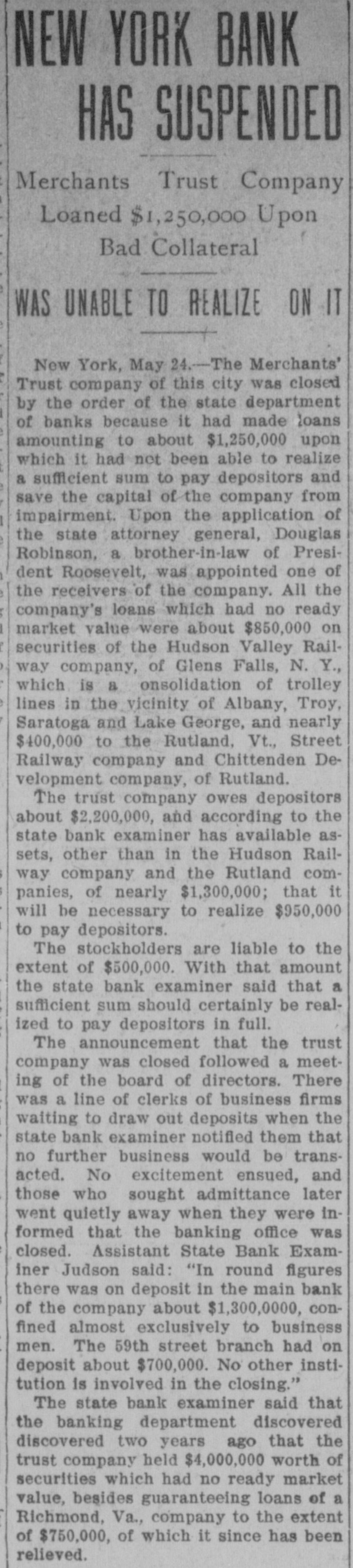
NEW YORK BANK HAS SUSPENDED Merchants Trust Company Loaned $1,250,000 Upon Bad Collateral WAS UNABLE TO REALIZE ON IT New York, May 24.-The Merchants' Trust company of this city was closed by the order of the state department of banks because it had made loans amounting to about $1,250,000 upon which it had not been able to realize a sufficient sum to pay depositors and save the capital of the company from impairment. Upon the application of the state attorney general, Douglas Robinson, a brother-in-law of President Roosevelt, was appointed one of the receivers of the company. All the company's loans which had no ready market value were about $850,000 on securities of the Hudson Valley Railway company, of Glens Falls, N. Y., which is a consolidation of trolley lines in the vicinity of Albany, Troy, Saratoga and Lake George, and nearly $400,000 to the Rutland, Vt., Street Railway company and Chittenden Development company, of Rutland. The trust company owes depositors about $2,200,000, and according to the state bank examiner has available assets, other than in the Hudson Railway company and the Rutland companies, of nearly $1,300,000; that it will be necessary to realize $950,000 to pay depositors. The stockholders are liable to the extent of $500,000. With that amount the state bank examiner said that a sufficient sum should certainly be realized to pay depositors in full. The announcement that the trust company was closed followed a meeting of the board of directors. There was a line of clerks of business firms waiting to draw out deposits when the state bank examiner notified them that no further business would be transacted. No excitement ensued, and those who sought admittance later went quietly away when they were informed that the banking office was closed. Assistant State Bank Examiner Judson said: "In round figures there was on deposit in the main bank of the company about $1,300,0000, confined almost exclusively to business men. The 59th street branch had on deposit about $700,000. No other institution is involved in the closing." The state bank examiner said that the banking department discovered discovered two years ago that the trust company held $4,000,000 worth of securities which had no ready market value, besides guaranteeing loans of a Richmond, Va., company to the extent of $750,000, of which it since has been relieved.


Article from The Salt Lake Herald, May 24, 1905

Click image to open full size in new tab

Article Text

Relative of Roosevelt. New York, May 23.-Douglas Robinson, who has been appointed receiver of the Merchants' Trust company, is a brother-in-law of President Roosevelt.


Article from The Hawaiian Star, May 24, 1905

Click image to open full size in new tab

Article Text

ONE OF THE FAMILY. NEW YORK, May 24-Douglas Robinson, brother-in-law of President Roosevelt, has been made receiver of the Merchants' Trust Co.


Article from The Vinita Weekly Chieftain, May 25, 1905

Click image to open full size in new tab

Article Text

Albany, N. Y., May 23.- -Justice Cochrane, of the supreme court today appointed Druglas Robinson and the New York Trust company as receivers of the Merchants' Trust Company of New York City. Robinson's bond was fixed at a half million dollars.


Article from New-York Tribune, May 25, 1905

Click image to open full size in new tab

Article Text

DELAY SAVES DEPOSITORS so INSISTS MR. KILBURN. Says Merchants' Trust Company Will Pay in Full. Otto T. Bannard, president of the New-York Trust Company. one of the receivers of the Merchants' Trust Company. expressed yesterday the belief that the customers of the falled institution would receive the full amount of their deposits, although probably not for a considerable time. In addition to the assets, in realizing on some of which there might be necessary a good deal of delay. there was the stockholders' 100 per cent liability. amounting to $500,000. The loans on the Hudson Valley Railway and Rutland Street Railway properties are regarded by competent judges as good, although slow. W. B. Ellison, counsel for the Merchants' Trust Company, declined yesterday to make any statement as to the alleged conspiracy among the directors, but it is understood that the situation is about as follows: The Merchants' Trust Company was Interested to the extent of $1,250,000 in the Hudson Valley Railway Company and was in receipt of a standing offer for its interest of $750,000. The directors were. however, convinced that they would within six months be in a position to get $1,300,000 for this collateral. and therefore determined to hold on. The trolley company, it is declared. is in a flourishing condition. and the reason its accounts do not make a better showing is that certain expenditures that might have been charged to capital were met out of income. HUDSON VALLEY COMPANY MAY BE SOLD. It is thought to be not unlikely too, that the Hudson Valley Railway Company, the line of which crosses the Delaware and Hudson's tracks at five different points, may be taken over by that company, just as the New-York Central. the NewHaven and other important steam railways have acquired trolley systems paralleling and competing with them. Two weeks ago, it is alleged. the whole condition of the Merchants' Trust Company was laid before Superintendent Kilburn. with the request for authorization of the increase of the capital stock from $500.000 to $1,000,000. Mr. Kilburn assented. it is said, on condition that the interests of the depositors should be protected. Two of the directors of the trust company are. however, said to have gone into Wall Street last week. trying to raise heavy loans, a step which gave rise to rumors which resulted in the suspension of the company. It is asserted that if the additional capital had been secured there would have been no reason to close the doors of the trust company. The New-York Trust Company yesterday. as receiver, took possession of the Merchants' Trust Company, William V. King. third vice-president of the former company. being assigned to take charge of the main office of the concern. and A. S. Webb. jr., second vice-president. to the branch office at Broadway and 59th-st. A conference of directors of the Merchants' Trust Company was held yesterday morning at the main office, but it was said afterward that no action had been taken. Ex-President Langdon held conferences with some of these directors, but subsequently refused to make any statement. State Bank Examiner Judson was asked yesterday afternoon about a statement made by a lawyer that proceedings might be brought against certain of the directors under a section of the banking act, which provides that no corporation of like kind, or the employes of such corporation, shall loan more than 25 per cent of its capital stock and surplus to any one person or corporation. In reply Mr. Judson said: This section does not apply to any loan made by the Merchants' Trust Company. It refers to loans made without collateral. Moreover, many of the loans of the Merchants' Trust Company were underwritings, to which twenty or thirty names were appended. and in no case has more than the legal sum been loaned to any one person. I do not think that the law has been violated in any way. When asked about the action of the State Superintendent of Banks in allowing the Merchants' Trust Company to continue for two years after he had discovered its condition was unsatisfactory, Mr. Judson said: By SO doing the Superintendent has saved the interests of the depositors. If the trust company had been thrown into the hands of a receiver two years ago the depositors would not have realized 30 cents on the dollar. The securities would have been slaughtered. as securities always are when they are thrown on the market. Now, I think the depositors will realize 100 cents on the dollar. "Has the letter of the law been complied with?" Mr. Judson was asked. cannot criticise Mr. Kilburn. He has been indorsed by three Governors, and that means that he is a pretty good man. He acted solely in the interest of the depositors. and his reason for acting now was simply to prevent a run on the trust company. which was already just beginning when I took charge yesterday.' MR. KILBURN'S STATEMENT Albany, May 24 (Special).-F. D. Kilburn, State Superintendent of Banks, to-day discussed the affairs of the Merchants' Trust Company, and declared that his'firm belief was that the depositors would be paid in full. Mr. Kilburn said: When I discovered the condition of the company about two years ago, I exercised my best judgment, and. instead of closing the company. thought it best to relieve it of securities which, if forced to a sale at that time would in all probability have netted the company less than was finally raised upon them. For example, $2,267.000 invested pronerties was.collected and in ad-


Article from The Free Lance, May 25, 1905

Click image to open full size in new tab

Article Text

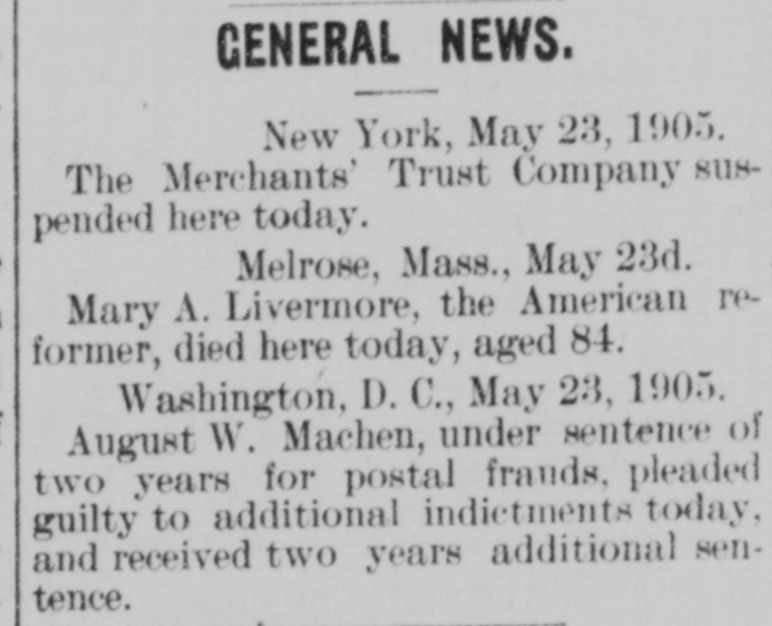
GENERAL NEWS. New York, May 23, 1905. The Merchants' Trust Company suspended here today. Melrose, Mass., May 23d. Mary A. Livermore, the American reformer, died here today, aged 84. Washington, D.C., May 23, 1905. August W. Machen, under sentence of two years for postal frauds, pleaded guilty to additional indictments today, and received two years additional sentence.


Article from The Minneapolis Journal, May 26, 1905

Click image to open full size in new tab

Article Text

BOSTON BANKERS IN HUGE FAILURE Nearly Two Millions Liabilities with Less Than $200,000 Assets. Boston, May 26.-Seventy-one banks and trust companies, most of them in Massachusetts, but several located in various parts of the country, are among the creditors of the banking firm of Burnett, Cummings & Co., this city, which has filed a voluntary petition in bankruptcy, with liabilities placed at $1,714,348. The assets are stated to be uncertain. The creditors have been given to understand that they will not exceed $200,000, if, indeed, they prove to be of any value whatsoever. The bankruptcy petition is the heaviest ever filed in this district. Explains the Cause. J. T. Auebach, counsel for the bankrupt firm, said that the cause of the failure was the building and financing of the Concord & Boston Street Railway company, the Middleboro, Wareham & Buzzards Bay Street Railway company, the Lowell & Boston Street railway and the Bristol County Railway company. These roads were in thinly settled districts and were unable to make suitable connections with roads running to Boston. The four companies were placed in the hands of receivers and their notes became valueless. Auebach said also that the bank's financial crisis was hastened by the buying of the Hampden Trust company of Springfield and of the Taunton Safe Deposit & Trust company of Easton, both of which, unknown to the firm, were in serious financial straits and were placed in the hands of receivers. The refusal of extension of credits then made a continuance of business impossible. Banks as Creditors. The secured creditors number eightyseven and the unsecured eighty-one. There are thirty-two Massachusetts savings banks in the list of creditors and thirteen Massachusetts national banks. One of the heaviest creditors is the Worcester Five Cents Savings bank, with a claim of $80,600, Other banking-institution creditors are the Danvers Savings bank of Danvers for $26,700, the Millbury Savings bank of Millbury for $26,600, and the International Trust company of Boston for $44,495. All these claims are in the secured list. Among the western institutions affected are the Chicago Savings bank, Chicago, $30,390; the State Savings bank, Ann Arbor, Mich., $20,314; the Western Trust & Savings bank, Chicago, $11,896; Fort Dearborn National bank, Chicago, $7,866, and the State Bank of Chicago, Chicago, $10,425. Helen Gould a Loser. New York, May 26.-Chief among the developments from the failure of the Merchants' Trust company is the statement that Miss Helen Gould and her brother Frank were induced by fraudulent practices to invest in the securities of the Virginia Passenger & Power company of Richmond, Va., on the securities of which the trust company made heavy loans, and that they have charged George E. Fisher with taking $2,000,000 to which he is not entitled. Their charge is in answer to his suit for a receivership for the Virginia Passenger & Power company, of which he was a promoter. befine AMILS of Mineral City Bank Closed. Canton, May 26.-The People's Deposit Bank of Mineral City, Ohio, closed. its doors today. The president of the institution says loans of about $50,000 have been made by the bank to W. L. Davis of Canton, whose heavy loans are said to have caused the suspension of the Canton State bank yesterday. Directors of the Mineral City bank say it will resume business in a day or two. Failure in Cincinnati. Cincinnati, May 26.-Holzman & Co, bankers and brokers in the Union Trust building and members of the New York Stock exchange, assigned to. day to Lepman & Levi. Alfred Holzman, a member of the firm, says their assets and liabilities are about equal, at $100,000. He attributes their embarrassment to the rumors concerning the loss of $55,000 from the reserve fund of the German National bank and to the recent run on the Union Trust company bank. Now Another Ohio Bank. Washington, May 26.-The First National Bank of Barberton, Ohio, has been ordered closed by the controller of the currency on the ground that the bank is insolvent. The capital stock is $50,000. snn VIVDL


Article from The San Francisco Call, May 26, 1905

Click image to open full size in new tab

Article Text

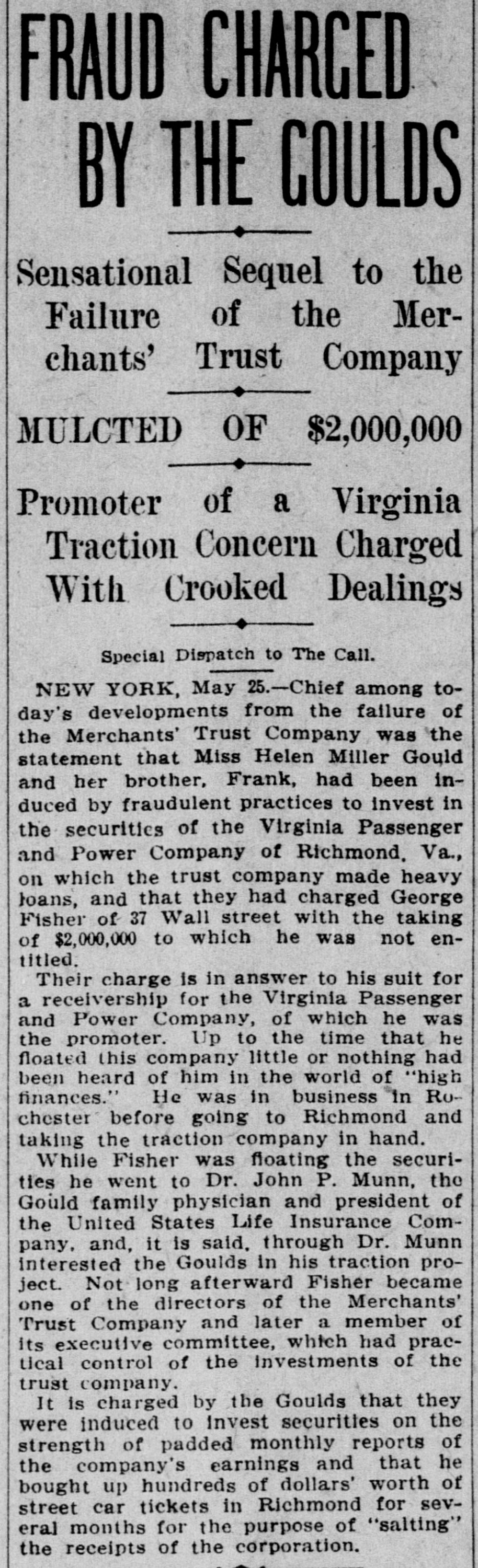
FRAUD CHARGED BY THE GOULDS Sensational Sequel to the of the MerFailure chants' Trust Company MULCTED OF $2,000,000 Promoter of a Virginia Traction Concern Charged With Crooked Dealings Special Dispatch to The Call. NEW YORK, May 25.-Chief among today's developments from the failure of the Merchants' Trust Company was the statement that Miss Helen Miller Gould and her brother, Frank, had been induced by fraudulent practices to invest in the securities of the Virginia Passenger and Power Company of Richmond, Va., on which the trust company made heavy loans, and that they had charged George Fisher of 37 Wall street with the taking of $2,000,000 to which he was not entitled. Their charge is in answer to his suit for a receivership for the Virginia Passenger and Power Company, of which he was the promoter. Up to the time that he floated this company little or nothing had been heard of him in the world of "high finances." He was in business in Rochester before going to Richmond and taking the traction company in hand. While Fisher was floating the securities he went to Dr. John P. Munn, the Gould family physician and president of the United States Life Insurance Company, and, it is said, through Dr. Munn interested the Goulds in his traction project. Not long afterward Fisher became one of the directors of the Merchants' Trust Company and later a member of its executive committee, which had practical control of the investments of the trust company. It is charged by the Goulds that they were induced to invest securities on the strength of padded monthly reports of the company's earnings and that he bought up hundreds of dollars' worth of street car tickets in Richmond for several months for the purpose of "salting" the receipts of the corporation.


Article from The San Francisco Call, May 26, 1905

Click image to open full size in new tab

Article Text

NEW YORK, May 25.-District Attorney Jerome announced to-day that he had assigned one of his assistants to make a thorough investigation of the recent failure of the Merchants' Trust Company in this city.


Article from The Irish Standard, May 27, 1905

Click image to open full size in new tab

Article Text

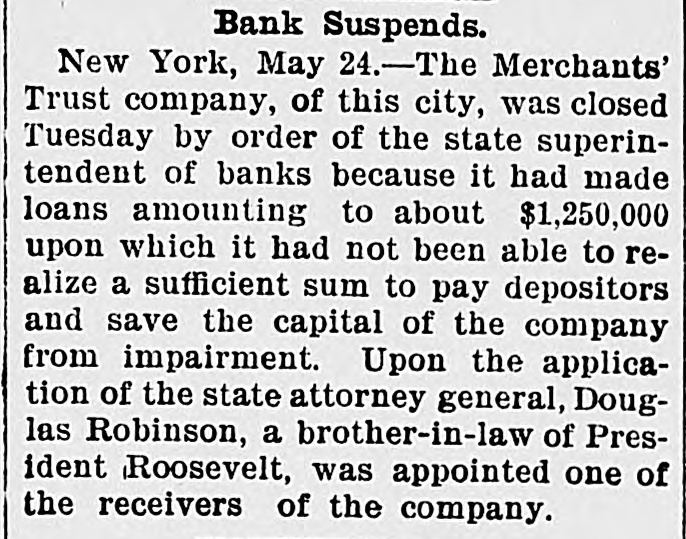
Bank Suspends. New York, May 24.-The Merchants' Trust company, of this city, was closed Tuesday by order of the state superintendent of banks because it had made loans amounting to about $1,250,000 upon which it had not been able to realize a sufficient sum to pay depositors and save the capital of the company from impairment. Upon the application of the state attorney general, Douglas Robinson, a brother-in-law of President Roosevelt, was appointed one of the receivers of the company.


Article from The Labor World, May 27, 1905

Click image to open full size in new tab

Article Text

DEPOSITORS WILL GET THEIR MONEY NEW YORK, May 24.-The depositors of the closed Merchants' Trust company eventually will be paid in full, was the opinion expressed today by President Otto T. Bannard, of the New York Trust company, one of the receivers for the suspended company. He said that an assessment may have to be levied upon the stockholders. The receiver took full charge of the company today.


Article from Chicago Eagle, May 27, 1905

Click image to open full size in new tab

Article Text

# Loans Wreck Bank. Its money frittered away on the securities of almost worthless companies organized by its officers, the Merchants' Trust Company passed into the hands of a receiver in New York. The receivers are Douglas Robinson, brother-in-law of President Roosevelt, and the New York Trust Company.


Article from New-York Tribune, June 1, 1905

Click image to open full size in new tab

Article Text

TO CARE FOR SECURITIES. MERCHANTS' TRUST PLAN. Special Meeting To-morrow-Past and Present Directors Invited. A special meeting, to include both past and present directors of the Merchants' Trust Company. it was learned by The Tribune yesterday, has been called for to-morrow to consider the question of underwriting the Hudson Valley and Rutland securities, on which the company lent upward of $2,000,000. At the meeting, it is said, the directors will be told that these securities cannot at present be disposed of, at least for anything above a fraction of the amount of the loans. Should they agree to "take care" of these securities, the directors, it is said. will be told that an assessment of the stock will be entirely unnecessary. The proposed taking care of the securities will be part of a plan to be formulated at the meeting for the rehabilitation and the reorganization of the company. Every living director who at any time has served on the board has been invited to attend. and a lively session is looked for. The call was sent out yesterday. W. B. Ellison, the counsel of the company, when seen at his home by a Tribune reporter last night, said he would not admit that any call had been sent out, and declined to discuss the matter in any shape or form. Should the plan to be formulated meet with success an application may be made to prevent/the appointment of a permanent receiver. It had been expected that this appointment would be made on Satfurday. Louis E. Spencer, secretary of George E. Fisher. promoter, of No. 37 Wall-st., expressed indignation yesterday at the introduction of his name into the failure of the company by counsel for Frank J. and Helen M. Gould. Mr. Spencer said: I deny that I have made any statement that I have had any dealings with the Merchants' Trust Company. I never borrowed a dollar from that company, nor do I owe the company a dollar. I wish to be left out of this controversy entirely. Said Mr. Fisher: I wish to state that nearly every statement made by the Gould lawyers is a misstatement. Mr. Battie states that $1,000,000 was lost in the Merchants' Trust stock. That is not so. Mr. Gould made $20,000 by the sale of 500 shares of stock, and his net loss, as I understand it. was only $110,000. I never mentioned Miss Helen Gould's name in this case. I bought some bonds from Frank J. Gould, and I gave him a check for $50,000, which is one-half of the money invested. Mr. Gardiner's statement of a loss of $130,000 is incorrect because he fails to subtract therefrom the $20,000 profit made by Mr. Gould. In the syndicate formed in April, 1900. there were 200.000 shares of stock subscribed, 100,000 of the Richmond Passenger Power Company, of which Charles A. Gardiner was the chairman. He received for that $80,000 in consolidated bonds and $200,000 in preferred stocks, and a bonus of $100,000 in common stock. I may say here that my personal attorney was Charles A. Gardiner. Suits have been brought in Virginia against Mr. Gould. and judgments have been secured there against him. He has never been able to win a case in Virginia. George Gordon Battle told the reporter that he never remembered having said that $1,000,000 was lost in the stock. "As to the suits in Virginia," Mr. Battle added, "I am not personally familiar with them. but it is my belief that the judgments went just the other way." The report that a banking house seeks to buy the Hudson Valley securities, to obtain control of the railway company, could not be confirmed from any authoritative source.


Article from The Cooperstown Courier, June 1, 1905

Click image to open full size in new tab

Article Text

Bank Suspends. New York, May 24.-The Merchants' Trust company, of this city, was closed Tuesday by order of the state superintendent of banks because it had made loans amounting to about $1,250,000 upon which it had not been able to realize a sufficient sum to pay depositors and save the capital of the company from impairment. Upon the application of the state attorney general, Douglas Robinson, a brother-in-law of President Roosevelt, was appointed one of the receivers of the company.


Article from The United Opinion, June 2, 1905

Click image to open full size in new tab

Article Text

The Merchants Trust Failure New York, May 26.-District At. torney Jerome announces that he has assigned one of his assistants to make a thorough investigation of the recent failure of the Merchants' Trust company in this city.


Article from The Star, June 7, 1905

Click image to open full size in new tab

Article Text

# GOULDS FIGURE IN FAILURE Helen and Frank Charge Fisher With Taking $2,000,000. Chief among developments from the failure of the Merchants Trust Company of New York was the statement that Miss Helen Gould and her brother, Frank, has been induced by fraudulent practices to invest in the securities of the Virginia Passenger & Power Company of Richmond, Va., on the securities of which the trust company made heavy loans, and that they have charged George E. Fisher with taking $2,000,000 to which he was not entitled. Their charge is in answer to his suit for a receivership for the Virginia Passenger & Power Company, of which he was promoter.


Article from La Democracia, June 9, 1905

Click image to open full size in new tab

Article Text

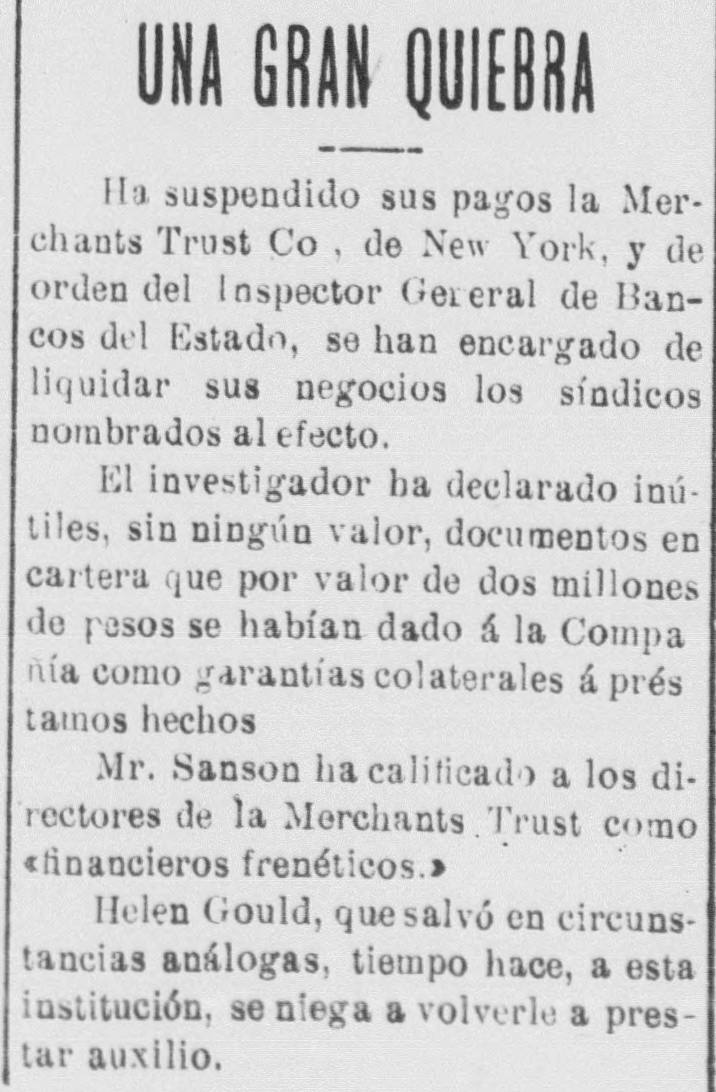
UNA GRAN QUIEBRA Ha suspendido sus pagos la Merchants Trust Co, de New York, y de orden del Inspector Gereral de Bancos del Estado, se han encargado de liquidar sus negocios los síndicos nombrados al efecto. El investigador ba declarado inútiles, sin ningún valor, documentos en cartera que por valor de dos millones de resos se habían dado á la Compa ñía como garantías colaterales á prés tamos hechos Mr. Sanson ha calificado a los directores de la Merchants Trust como «financieros frenéticos.» Helen Gould, quesalvó en circunstancias análogas, tiempo hace, a esta institución, se niega a volverle a prestar auxilio.


Article from Evening Star, June 20, 1905

Click image to open full size in new tab

Article Text

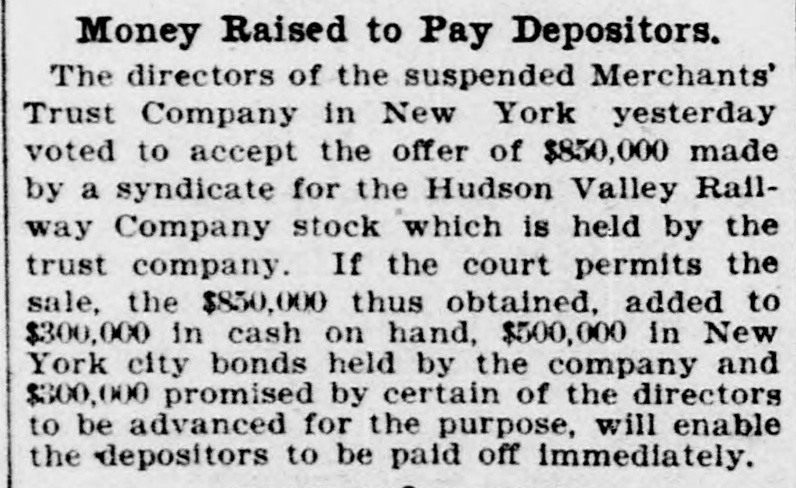
Money Raised to Pay Depositors. The directors of the suspended Merchants' Trust Company in New York yesterday voted to accept the offer of $850,000 made by a syndicate for the Hudson Valley Railway Company stock which is held by the trust company. If the court permits the sale, the $850,000 thus obtained, added to $300,000 in cash on hand, $500,000 in New York city bonds held by the company and $300,000 promised by certain of the directors to be advanced for the purpose, will enable the depositors to be paid off immediately.


Article from New-York Tribune, June 22, 1905

Click image to open full size in new tab

Article Text

ANOTHER MERCHANTS TRUST MEETING, Another long meeting of the past and present directors of the Merchants' Trust Company was held yesterday at the office of William B. Ellison. It was learned that the discussion had been over going into court next Saturday and acceding to or opposing the permanency of the receiverships.


Article from Evening Star, July 20, 1905

Click image to open full size in new tab

Article Text

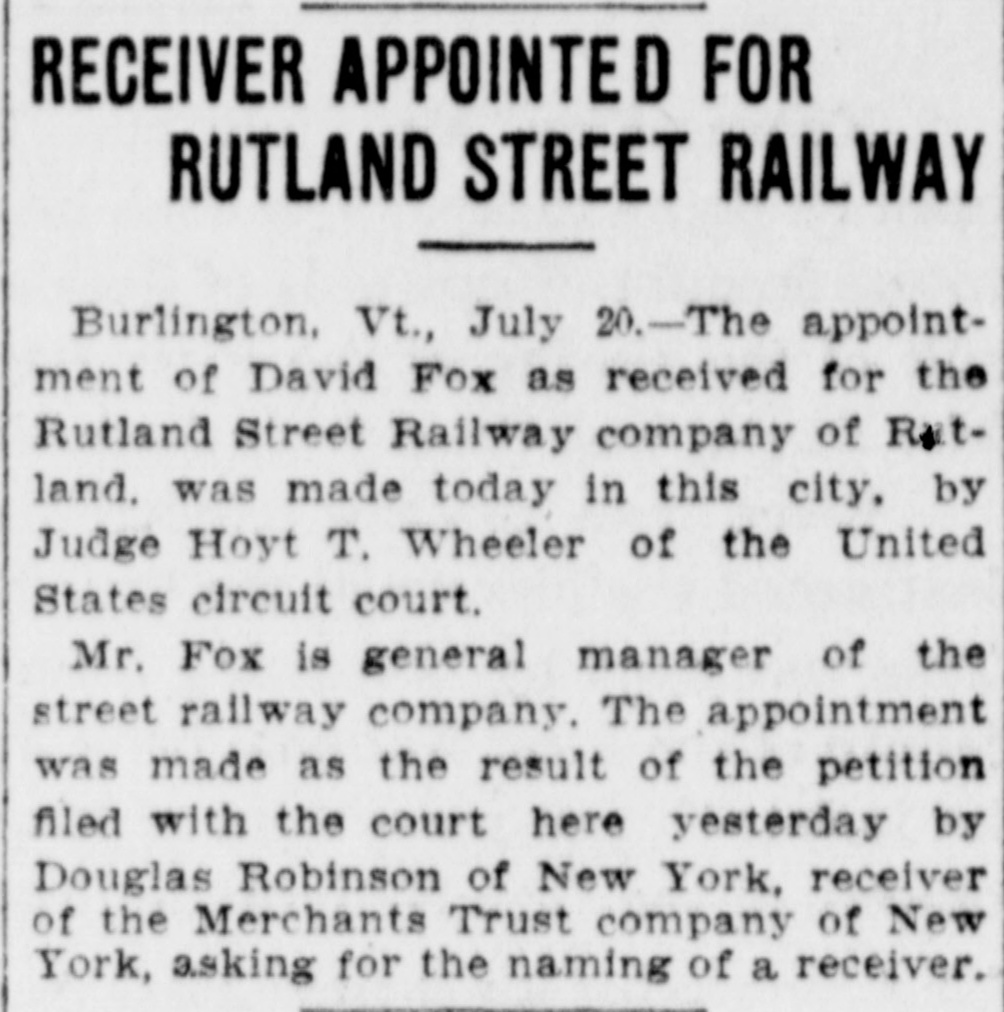
the company, and also of the People's Gas Light Company and the Chittenden Power Company of Rutland. The appointment was made as the result of a petition filed with the court by Douglas Robinson of New York, receiver of the Merchants' Trust Company of New York, asking for the naming of a receiver for the street raflway company.


Article from Evening Star, August 5, 1905

Click image to open full size in new tab

Article Text

Depositors Want a Speedy Answer. Depositors of the suspended Merchants' Trust Company of New York, organized as the Merchants' Trust Company Protective Association, yesterday sent to Receiver Douglass Robinson a series of questions concerning the condition of the company. The depositors demand that an answer be speedily given. They ask if there is not on hand $1,000,000 in cash. $100,000 in New York city bonds, a $700,000 bid for Hudson Valley Railroad securities, and a $300,000 bid for Rutland Railroad securities, from which sufficient funds could be realized to pay off depositors in full, leaving the receivers on hand sundry assets, for which they could obtain $100,000 or more.


Article from Iowa County Democrat, August 10, 1905

Click image to open full size in new tab

Article Text

DEPOSITORS want money. Claim That Receiver Has Ample Funds to Pay in Full. New York, Aug. 8.-Depositors of the suspended Merchants' Trust company of this city, organized as the Merchants' Trust Company Protective association, yesterday sent to Receiver Robinson a series of questions concerning the condition of the company. The depositors demand that an answer be shortly given. They ask if there is not on hand $1,000,000 in cash, $100,000 New York city bonds, $700,000 bids for Hudson Valley railroad securities and a $300,000 bid for Rutland railroad securities, from which sufficient funds could be realized to pay off the depositors in full, leaving the receivers on hand sundry assets for which they could obtain $100,000 or more.