First National Bank (Pittsburg, PA)

Episode Information

Episode UID
4801363
Episode Type
Suspension → Closure
Bank Type
national
Bank ID
480 national
Charter Number
48
Start Date
July 7, 1913
Location
Pittsburg, Pennsylvania (40.441, -79.996)

Metadata

Model
gpt-5-mini (chosen from majority vote of a three-model LLM ensemble)
Short Digest
65a610283f83bad0

Response Measures

None

Description

Newspapers use the variant spelling 'Pittsburg' (common at the time) rather than 'Pittsburgh'.

Events (6)

1. August 5, 1863 Chartered
Source
historical_nic
2. April 19, 1913 Voluntary Liquidation
Source
historical_nic
3. July 7, 1913 Other
Newspaper Excerpt
Receivers were appointed for the American Water Works company and the Kuhn banking interests; criminal action and investigations by Treasury/Justice announced.
Source
newspapers
4. July 7, 1913 Receivership
Newspaper Excerpt
receivers were appointed for the First and Second National banks...and receivers were appointed for J. S. and W. S. Kuhn, Incorporated, and the American Water Works and Guarantee Company.
Source
newspapers
5. July 7, 1913 Suspension
Cause
Bank Specific Adverse Info
Cause Details
Impaired capital and deficient reserves due to heavy investments in waterworks and other depreciated collateral; government examiners ordered closure and receivers appointed.
Newspaper Excerpt
closed their doors today on orders from the comptroller of the currency, and receivers were appointed.
Source
newspapers
6. July 9, 1913 Run
Cause
Bank Specific Adverse Info
Cause Details
Depositors began withdrawing after learning of the bank's precarious condition and rumors of deficient reserves; large withdrawals by big depositors prompted closure.
Measures
Government closed the bank to protect small depositors; other banks sent securities to New York to obtain cash; tellers paid depositors where possible.
Newspaper Excerpt
The run on the Pittsburg bank for savings continued today, but it is believed the measures adopted will enable the bank to weather the storm.
Source
newspapers

Newspaper Articles (17)

Article from The Tacoma Times, July 7, 1913

Click image to open full size in new tab

Article Text

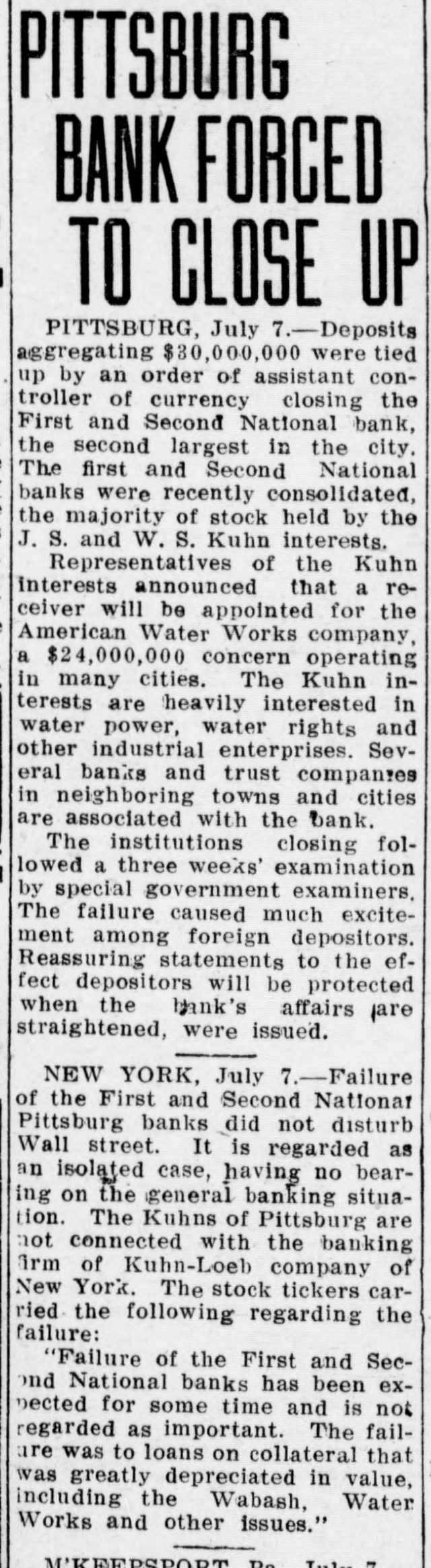
PITTSBURG BANK FORCED TO CLOSE UP PITTSBURG, July 7.-Deposits aggregating $30,000,000 were tied up by an order of assistant controller of currency closing the First and Second National bank, the second largest in the city. The first and Second National banks were recently consolidated, the majority of stock held by the J. S. and W. S. Kuhn interests. Representatives of the Kuhn interests announced that a receiver will be appointed for the American Water Works company, a $24,000,000 concern operating in many cities. The Kuhn interests are heavily interested in water power, water rights and other industrial enterprises. Several banks and trust companies in neighboring towns and cities are associated with the bank. The institutions closing followed a three weeks' examination by special government examiners. The failure caused much excitement among foreign depositors. Reassuring statements to the effect depositors will be protected when the bank's affairs are straightened, were issued. NEW YORK, July 7.-Failure of the First and Second National Pittsburg banks did not disturb Wall street. It is regarded as an isolated case, having no bearing on the general banking situation. The Kuhns of Pittsburg are not connected with the banking firm of Kuhn-Loeb company of New York. The stock tickers carried the following regarding the failure: "Failure of the First and Second National banks has been expected for some time and is not regarded as important. The failare was to loans on collateral that was greatly depreciated in value, including the Wabash, Water Works and other issues." Do L.L. my


Article from Albuquerque Evening Herald, July 7, 1913

Click image to open full size in new tab

Article Text

INTERESTS OF PITTSBURG FINANCIAL TROUBLES First-Second National Bank, One of Largest in City, Fore ed to Close; Subsidiaries Fol. low Suit. DIFFICULTY DECLARED TO BE ONLY TEMPORARY Heavy Investments in Water Works Guaranty Said to Be Responsible for Suspensions in Smoky City. (By Lessed Wire to Evening Herald.) Pittsburgh, Pa., July 7.-A series financial difficulties of of National The Pittsburgh the First-Second financial district occupied bank, today. one the largest banks in the First National an adjoining and failed McKeesport. short during time to open the Its doors. the City, Within country. bank closed of a appointed for the and Guarantee terworks were of the afternoon American company receivers Wa. ons largest companies of United States house of 3. 8. Inc. ing in the Also and and for w the 8. its Kuhna bank Kind made during the day a run was inga. on the Pittsburgh Bank for Sav. a large Institution The troubles were due to financial difficulties confronting the Kuba terests barrassment of this city. It Is said the em- in is only temporary that there is no Immediate and alarm. Heavy investments cause in water for works propositions. coal and oil lands and Interurban railway companies, to. gether with the financing of a oky scraper bank and office building.spa given up as some of the CRUSSIS leading to today's suspensions. The trouble first made Its ance in the First-Becond National appear been bank. It la said the government has investigating conditions past the month or since June last, last statement was made when legal leged deficiency of $2,140,000 in An al- the reserve of the bank and the subto sequent examination brought matters elimax. gated Several thousand persons congreat bank about the First-Second Nation. was at noon. A aquad of police moving. necessary to keep the great crowd J. S. and W. S. Kuhn, Incorporated. bankers, known as the Kulin interests are Incorporated in Delaware with capitol stock of $500,000. James a Kuhn is chairman of the board 8. directors and his brother. W. S of is vice president. James S. Kuhn, president of the Waterworks also of Guarantee company. with a capital and $20,000,000 and W. 8. Kuhn is vide president of this company. The Kuhn Interests have largely in of late in Irrigation centered projects the west. They also Penn Traction and a combination of West line er company. Water control trolley Pow- the Interests in western Pennsylvania of a mines in this tuminous ly and the the operations state, group hapecial. of blW. United Coal company of which tor. 8. Kuhn la president and Other Interests of W. E direc- Kuhn are this the Colonial Trust company and city, Commercial National of this Commonwealth Trust company bank of tor city in all of which he is a vice president. and director direc+ National bank of the First National vice president rector McKeesport, tor First of Allegheny; and bank of direc. the di- of of the Pittsburgh ings: president and and Leechburg president Rallway director Bank company Kitaning for SavValley and director Sacramento Side and Irrigation company: president Land director Twinfalls North and Water company. Kuhn is president and of the American rector and James 8. Waterworks diand Guarantee company: director First National president Bank Allegheny: First president and director of reutor National Bank McKeesport; diin the Colonial bank of this Fisher & ton: and tor in Freehold Kuhn, Trust Co., city: Inc., company direc- Box. president and director for Savings: director curity Falls Bank Investment company Pittsburgh of and the Se. North Side Water and Twin vice president and Coal company company. also Penn of company: Penn United Traction and of director Land West Traction and Water Power West house Dany and director in the Westing- comcompany. Electric and manufauturiug ASKED 8 RECEIVER Pittsburgh. WATERWORKR July -Attornors this FOR COMPANY afternoon P appeared before of in the federal for Orr receivers court and Judge for the American Water asked works and Guarantee alao for the firm of company and o, Krhn. Incorporated. For the and these 8 were appointed: S. Kuhn former Kuhn. J H. Purdy, a get of the company general manah or Balley, For Jr.n bank official and of Simuel the Kuhn company was la 1. J. K. Duff. company. who is treasurer of 2 dered filed for Bonds each of $50,000 receiver. ware or se WORKS BANK OFFICIALS WATER


Article from Brownsville Herald, July 8, 1913

Click image to open full size in new tab

Article Text

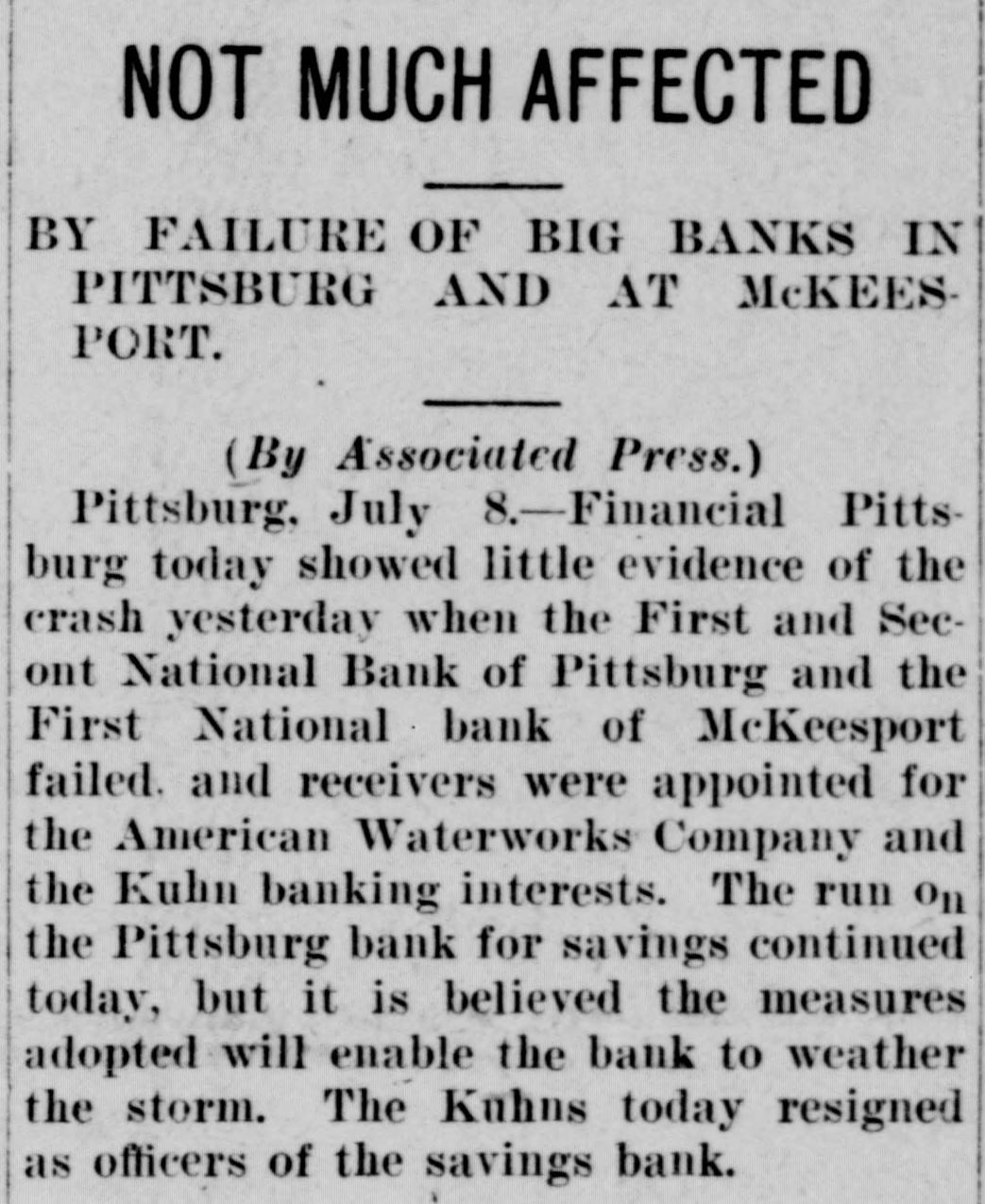
NOT MUCH AFFECTED BY FAILURE OF BIG BANKS IN PITTSBURG AND AT McKEES PORT. (By Associated Press.) Pittsburg, July 8.-Financial Pittsburg today showed little evidence of the crash yesterday when the First and Secont National Bank of Pittsburg and the First National bank of McKeesport failed. and receivers were appointed for the American Waterworks Company and the Kuhn banking interests. The run on the Pittsburg bank for savings continued today, but it is believed the measures adopted will enable the bank to weather the storm. The Kuhns today resigned as officers of the savings bank.


Article from The Birmingham Age-Herald, July 8, 1913

Click image to open full size in new tab

Article Text

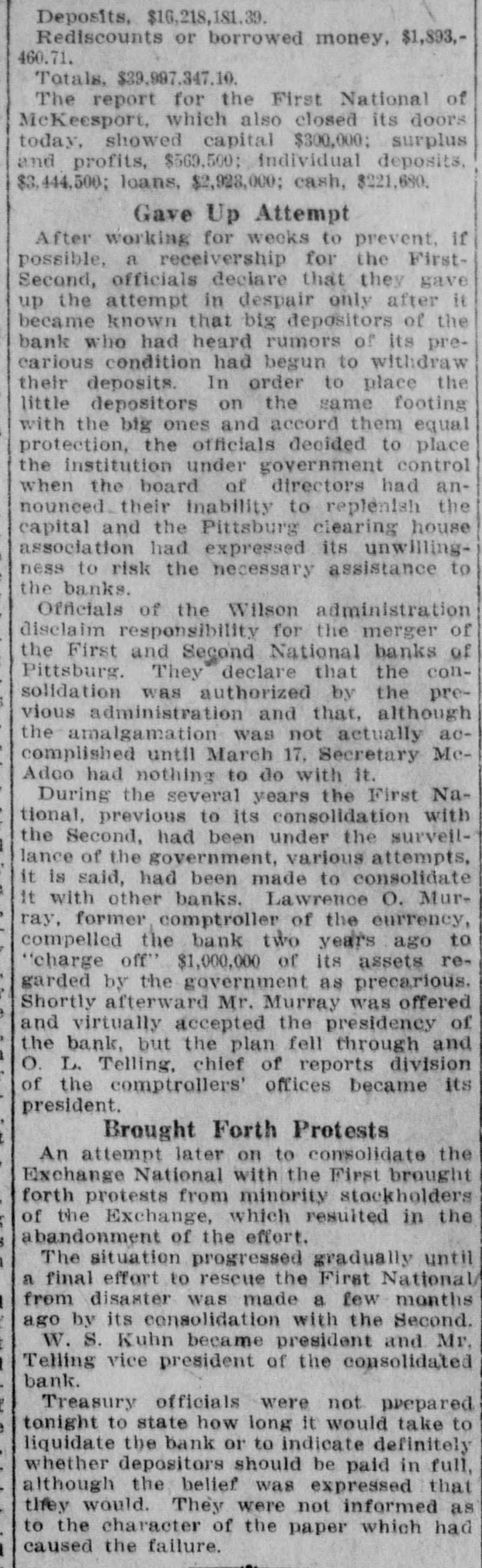
Deposits, $10,218,181.39. Rediscounts or borrowed money, $1,893,460.71. Totals. $39,997,347.10. The report for the First National of McKeesport, which also closed its doors today, showed capital $300,000; surplus and profits, $569,500; individual deposits, $3,444,500; loans, $2,928,000; cash, $221,680. Gave Up Attempt After working for weeks to prevent, if possible, a receivership for the FirstSecond, officials declare that they gave up the attempt in despair only after it became known that big depositors of the bank who had heard rumors of its precarious condition had begun to withdraw their deposits. In order to place the little depositors on the same footing with the big ones and accord them equal protection, the officials decided to place the institution under government control when the board of directors had announeed. their inability to replénish the capital and the Pittsburg clearing house association had expressed its unwillingness to risk the necessary assistance to the banks. Officials of the Wilson administration disclaim responsibility for the merger of the First and Second National banks of Pittsburg. They declare that the consolidation was authorized by the previous administration and that, although the amalgamation was not actually accomplished until March 17, Sécretary MeAdoo had nothing to do with it. During the several years the First National, previous to its consolidation with the Second, had been under the surveilI lance of the government, various attempts, it is said, had been made to consolidate it with other banks. Lawrence O. Murray, former comptroller of the currency, compelled the bank two years ago to "charge off" $1,000,000 of its assets regarded by the government as precarious. Shortly afterward Mr. Murray was offered e and virtually accepted the presidency of the bank, but the plan fell through and 1 O. L. Telling, chief of reports division of the comptrollers' offices became its president. Brought Forth Protests An attempt later on to consolidate the Exchange National with the First brought forth protests from minority stockholders of the Exchange, which resulted in the : abandonment of the effort. 3 I The situation progressed gradually until a final effort to reseue the First National I from disaster was made a few months ago by its consolidation with the Second. I W. S. Kuhn became president and Mr. I Telling vice president of the consolidated bank. E Treasury officials were not prepared e tonight to state how long it would take to liquidate the bank or to indicate definitely whether depositors should be paid in full, although the belief was expressed that they would. They were not informed as to the character of the paper which had caused the failure.


Article from The Salt Lake Tribune, July 8, 1913

Click image to open full size in new tab

Article Text

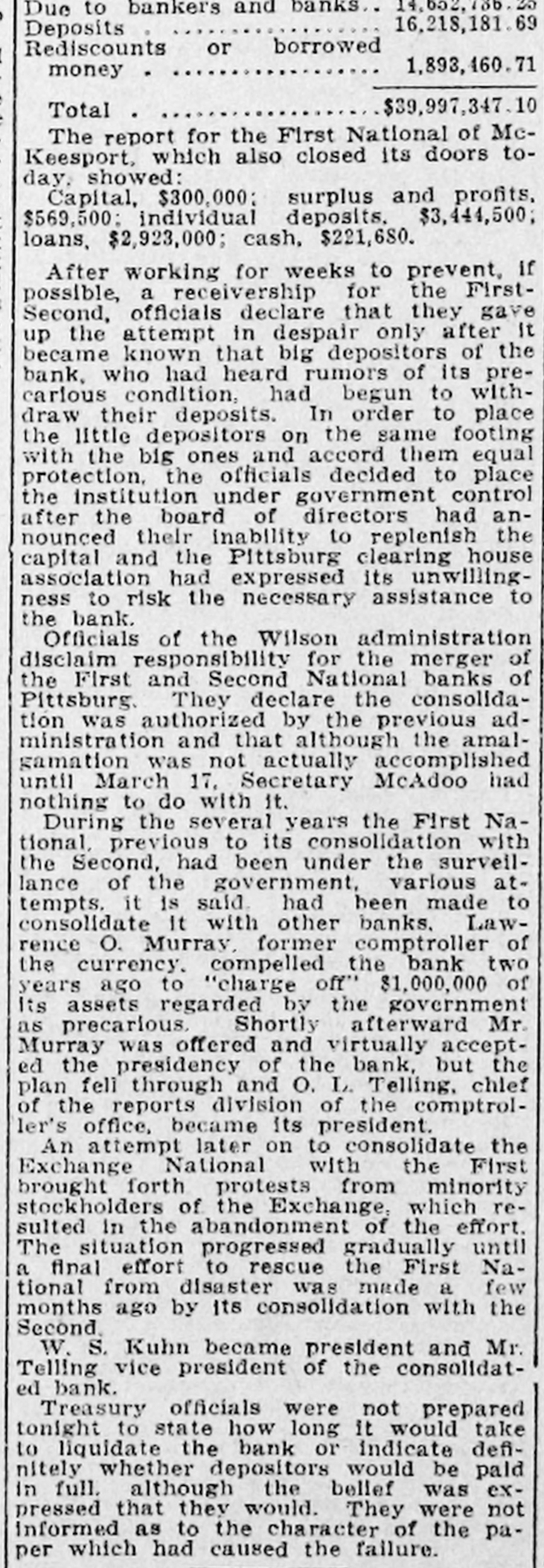
14,652,736.20 Due to bankers and banks. 16,218,181.69 Deposits Rediscounts or borrowed 1,893,460.71 money $39,997,347.10 Total The report for the First National of McKeesport, which also closed its doors today. showed: Capital, $300,000: surplus and profits, $569,500; individual deposits, $3,444,500; loans, $2,923,000; cash, $221,680. After working for weeks to prevent, If possible, a receivership for the FirstSecond, officials declare that they gave up the attempt in despair only after It became known that big depositors of the bank, who had heard rumors of its precarlous condition, had begun to withdraw their deposits. In order to place the little depositors on the same footing with the big ones and accord them equal protection, the officials decided to place the institution under government control after the board of directors had announced their inability to replenish the capital and the Pittsburg clearing house association had expressed its unwillingness to risk the necessary assistance to the bank. Officials of the Wilson administration disclaim responsibility for the merger of the First and Second National banks of Pittsburg. They declare the consolidation was authorized by the previous administration and that although the amalgamation was not actually accomplished until March 17, Secretary McAdoo had nothing to do with it. During the several years the First National, previous to its consolidation with the Second, had been under the surveillance of the government, various attempts. it is said. had been made to consolidate It with other banks. Lawrence O. Murray, former comptroller of the currency. compelled the bank two years ago to "charge off" $1,000,000 of Its assets regarded by the government as precarious. Shortly afterward Mr. Murray was offered and virtually accepted the presidency of the bank, but the plan fell through and O. L. Telling, chief of the reports division of the comptroller's office, became its president. An attempt later on to consolidate the Exchange National with the First brought forth protests from minority stockholders of the Exchange, which resulted in the abandonment of the effort. The situation progressed gradually until a final effort to rescue the First National from disaster was made a few months ago by its consolidation with the Second. W. S. Kuhn became president and Mr. Telling vice president of the consolidated bank. Treasury officials were not prepared tonight to state how long it would take to liquidate the bank or indicate definitely whether depositors would be paid In full. although the bellef was expressed that they would. They were not informed as to the character of the paper which had caused the failure.


Article from The Alaska Daily Empire, July 9, 1913

Click image to open full size in new tab

Article Text

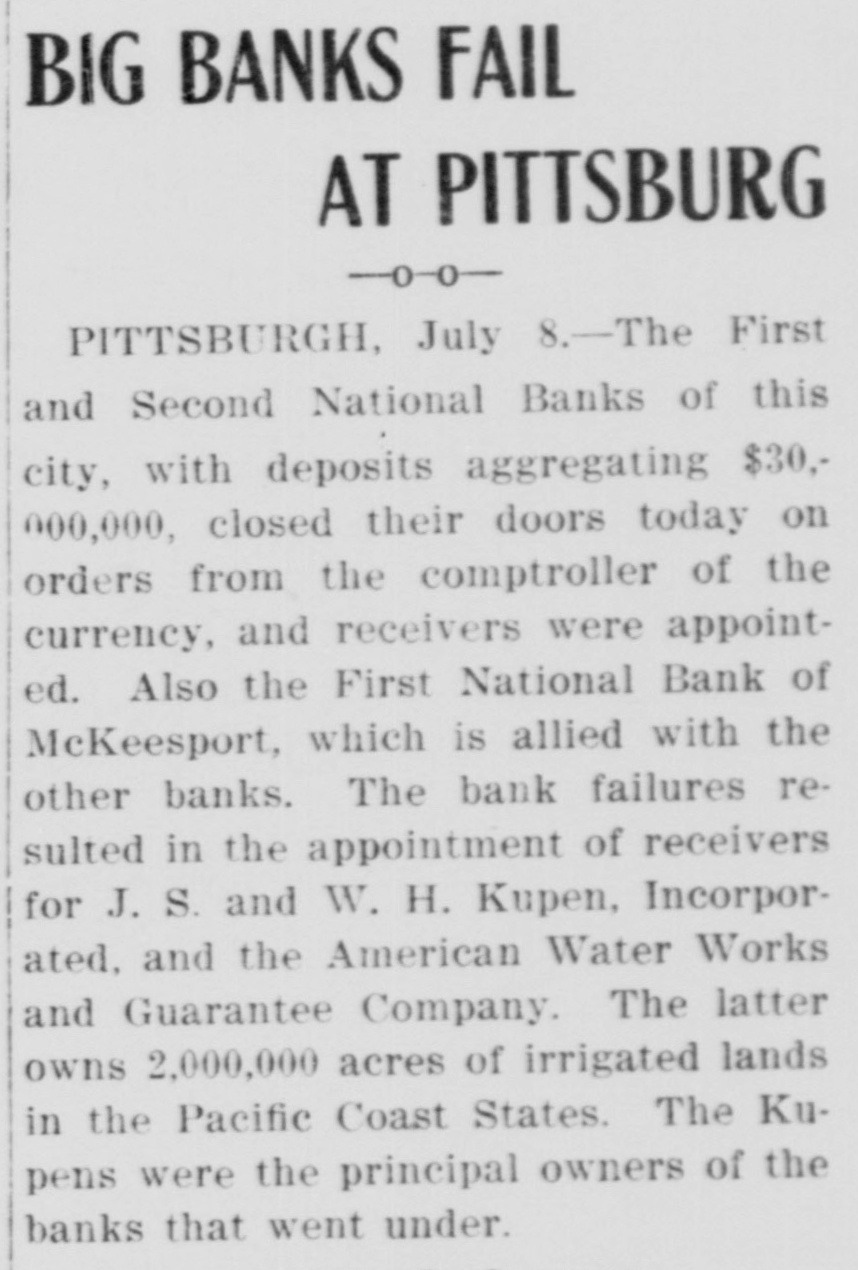
BIG BANKS FAIL AT PITTSBURG o PITTSBURGH, July 8.-The First and Second National Banks of this city, with deposits aggregating $30,000,000, closed their doors today on orders from the comptroller of the currency, and receivers were appointed. Also the First National Bank of McKeesport, which is allied with the other banks. The bank failures resulted in the appointment of receivers for J. S. and W. H. Kupen, Incorporlated, and the American Water Works and Guarantee Company. The latter owns 2,000,000 acres of irrigated lands in the Pacific Coast States. The Kupens were the principal owners of the banks that went under.


Article from St. Croix Avis, July 9, 1913

Click image to open full size in new tab

Article Text

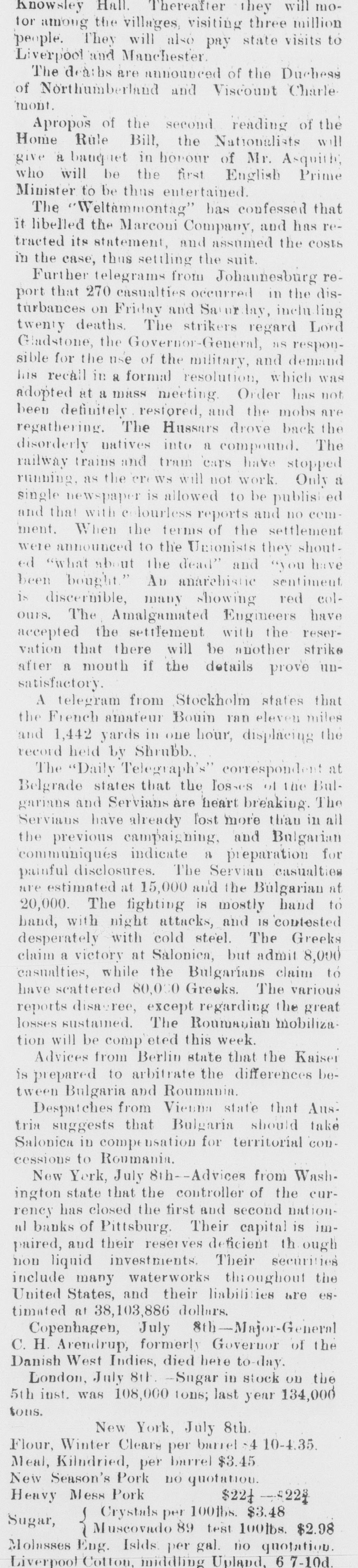
been definitely restored, and the mobs are regathering. The Hussars drove back the disorderly natives into a compound. The railway trains and train cars have stopped running, as the WS will not work. Only a single newspaper is allowed to be publis| ed and that with evlourless reports and no comment. When the terms of the settlement were announced to the Unionists they shouted "what about the dead" and "you have been bought." AD anàrehistic sentiment is discernible, many showing red colours. The Amalgamated Engineers have accepted the settlement with the reservation that there will be another strike after a month if the details prove unsatisfactory. A telegram from Stockholm states that the French amateur Bouin ran eleven miles and 1,442 yards in one hour, displäcing the record held by Shrubb. The "Daily Telegraph's" correspondent at Belgrade states that the losses of the Bulgarians and Servians are heart breaking. The Servians have already lost more than in all the previous campaigning, and Bulgarian communiqués indicate a preparation for painful disclosures. The Servian casualties are estimated at 15,000 and the Bülgarian at 20,000. The fighting is mostly band to hand, with night attacks, and IS contested desperately with cold steel. The Greeks claim a victory at Salonica, but admit 8,000 casualties, while the Bulgarians claim to have scattered 80,000 Greeks. The various reports disagree, except regarding the great losses sustained. The Roumanian mobilization will be completed this week. Advices from Berlin state that the Kaiser is prepared to arbitrate the differences between Bulgaria and Roumania. Despatches from Vienna state that Austria suggests that Bulgaria should take Salonica in compensation for territorial concessions to Roumania. New York, July 8th--Advices from Washington state that the controller of the currency has closed the first and second national banks of Pittsburg. Their capital is impaired, and their reserves deficient th ough non liquid investments. Their securities include many waterworks throughout the United States, and their liabilities are estimated at 38,103,886 dollars. Copenhagen, July 8th-Major-General C. H. Arendrup, formerly Governor of the Danish West Indies, died here to-day. Lula Sani


Article from Brownsville Herald, July 9, 1913

Click image to open full size in new tab

Article Text

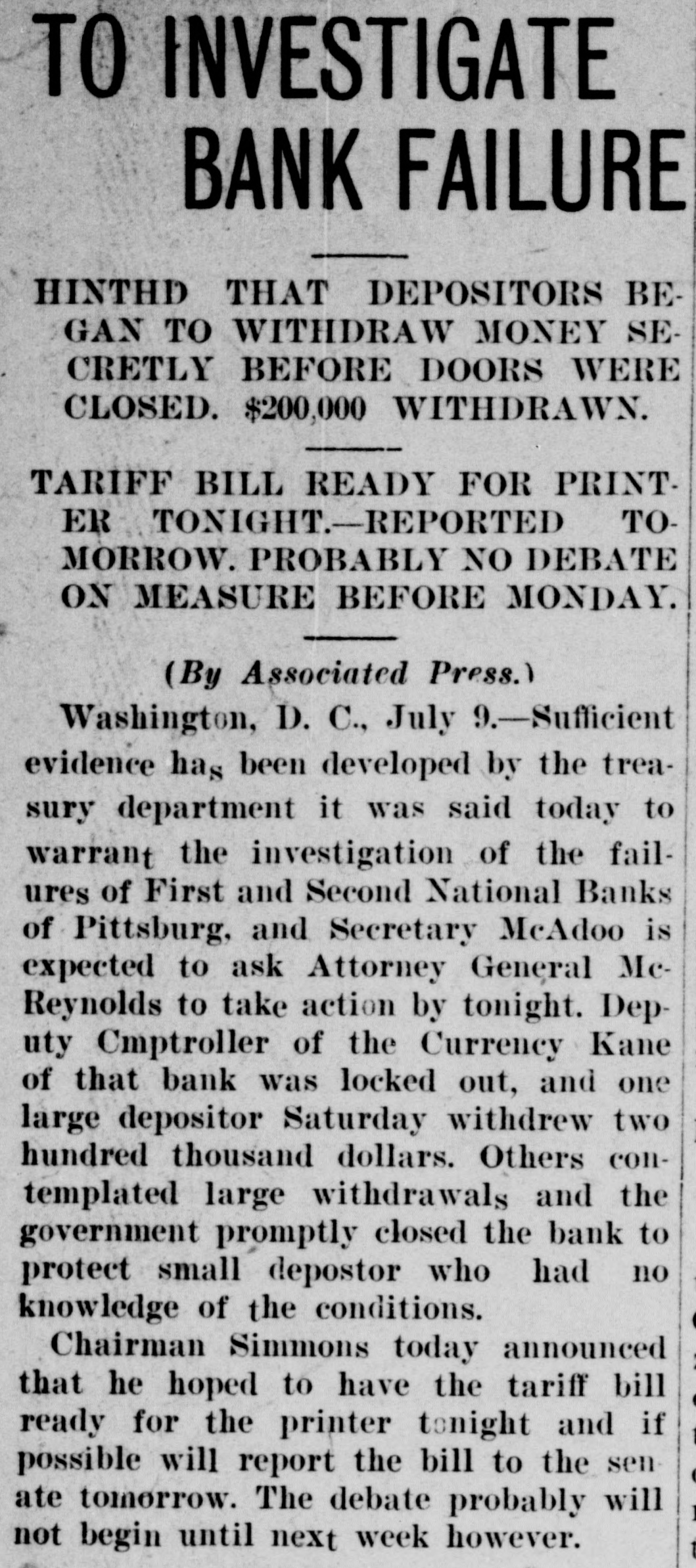
TO INVESTIGATE BANK FAILURE HINTHD THAT DEPOSITORS BEGAN TO WITHDRAW MONEY SECRETLY BEFORE DOORS WERE CLOSED. $200,000 WITHDRAWN. TARIFF BILL READY FOR PRINTER TONIGHT.-REPORTED TOMORROW. PROBABLY NO DEBATE ON MEASURE BEFORE MONDAY. (By Associated Press.) Washington, D. C., July 9.-Sufficient evidence has been developed by the treasury department it was said today to warrant the investigation of the failures of First and Second National Banks of Pittsburg, and Secretary McAdoo is expected to ask Attorney General MeReynolds to take action by tonight. Deputy Cmptroller of the Currency Kane of that bank was locked out, and one large depositor Saturday withdrew two hundred thousand dollars. Others contemplated large withdrawals and the government promptly closed the bank to protect small depostor who had no knowledge of the conditions. Chairman Simmons today announced that he hoped to have the tariff bill ready for the printer tonight and if possible will report the bill to the sen ate tomorrow. The debate probably will not begin until next week however.


Article from Valdez Daily Prospector, July 9, 1913

Click image to open full size in new tab

Article Text

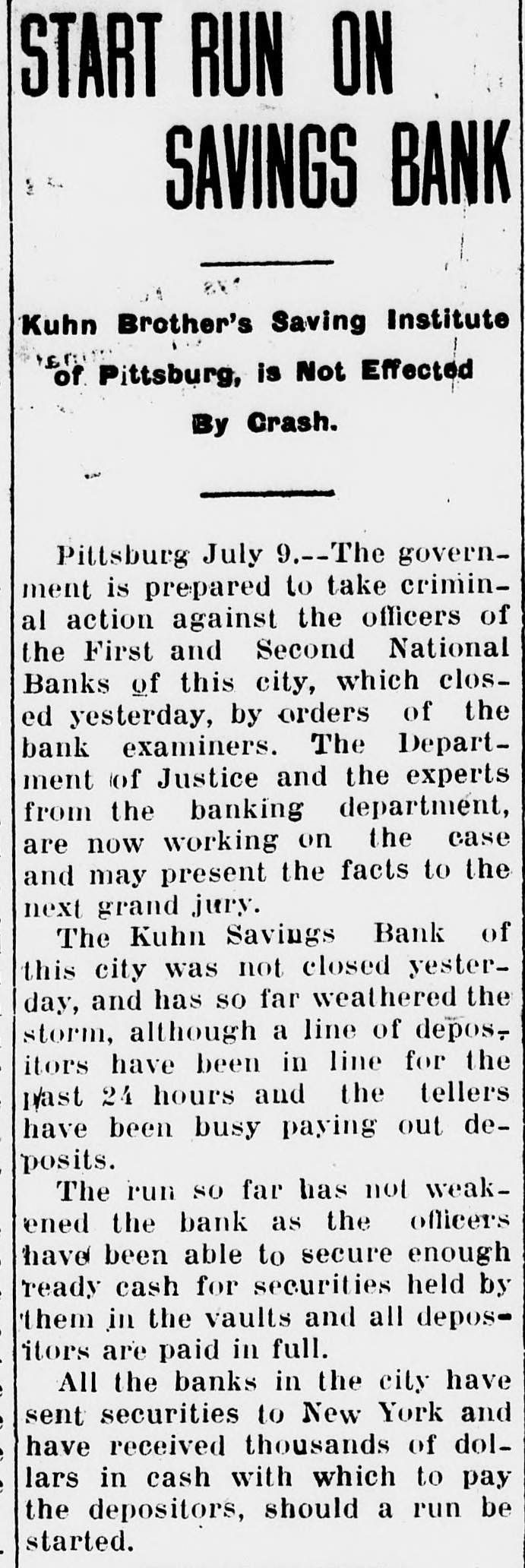
START RUN ON SAVINGS BANK Kuhn Brother's Saving Institute of Pittsburg, is Not Effected By Crash. Pittsburg July 9.--The government is prepared to take criminal action against the officers of the First and Second National Banks of this city, which closed yesterday, by orders of the bank examiners. The Department of Justice and the experts from the banking department, are now working on the case and may present the facts to the next grand jury. The Kuhn Savings Bank of this city was not closed yesterday, and has SO far weathered the storm, although a line of depositors have been in line for the past 24 hours and the tellers have been busy paying out deposits. The run so far has not weakened the bank as the officers have been able to secure enough ready cash for securities held by them in the vaults and all depositors are paid in full. All the banks in the city have sent securities to New York and have received thousands of dollars in cash with which to pay the depositors, should a run be started.


Article from The Cairo Bulletin, July 9, 1913

Click image to open full size in new tab

Article Text

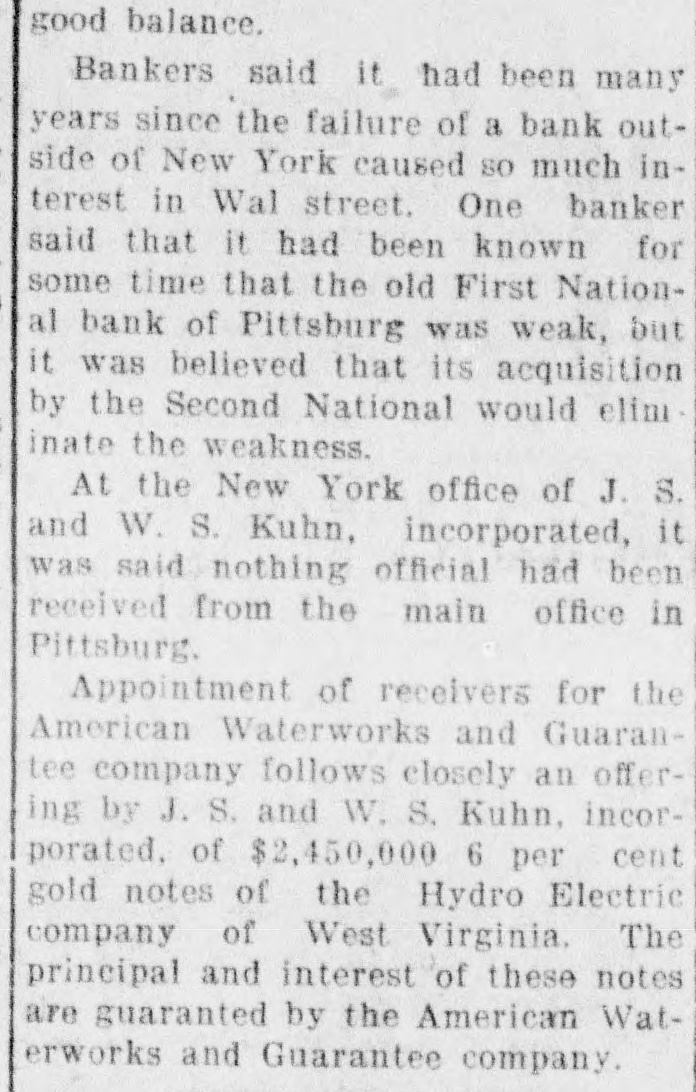
good balance. Bankers said it had been many years since the failure of a bank outside of New York caused so much interest in Wal street. One banker said that it had been known for some time that the old First National bank of Pittsburg was weak, but it was believed that its acquisition by the Second National would elim. inate the weakness. At the New York office of J. S. and W. S. Kuhn, incorporated, it was said nothing official had been received from the main office in Pittsburg. Appointment of receivers for the American Waterworks and Guarantee company follows closely an offering by J. S. and W. S. Kuhn, incorporated, of $2,450,000 6 per cent gold notes of the Hydro Electric company of West Virginia. The principal and interest of these notes are guaranted by the American Waterworks and Guarantee company.


Article from New-York Tribune, July 10, 1913

Click image to open full size in new tab

Article Text

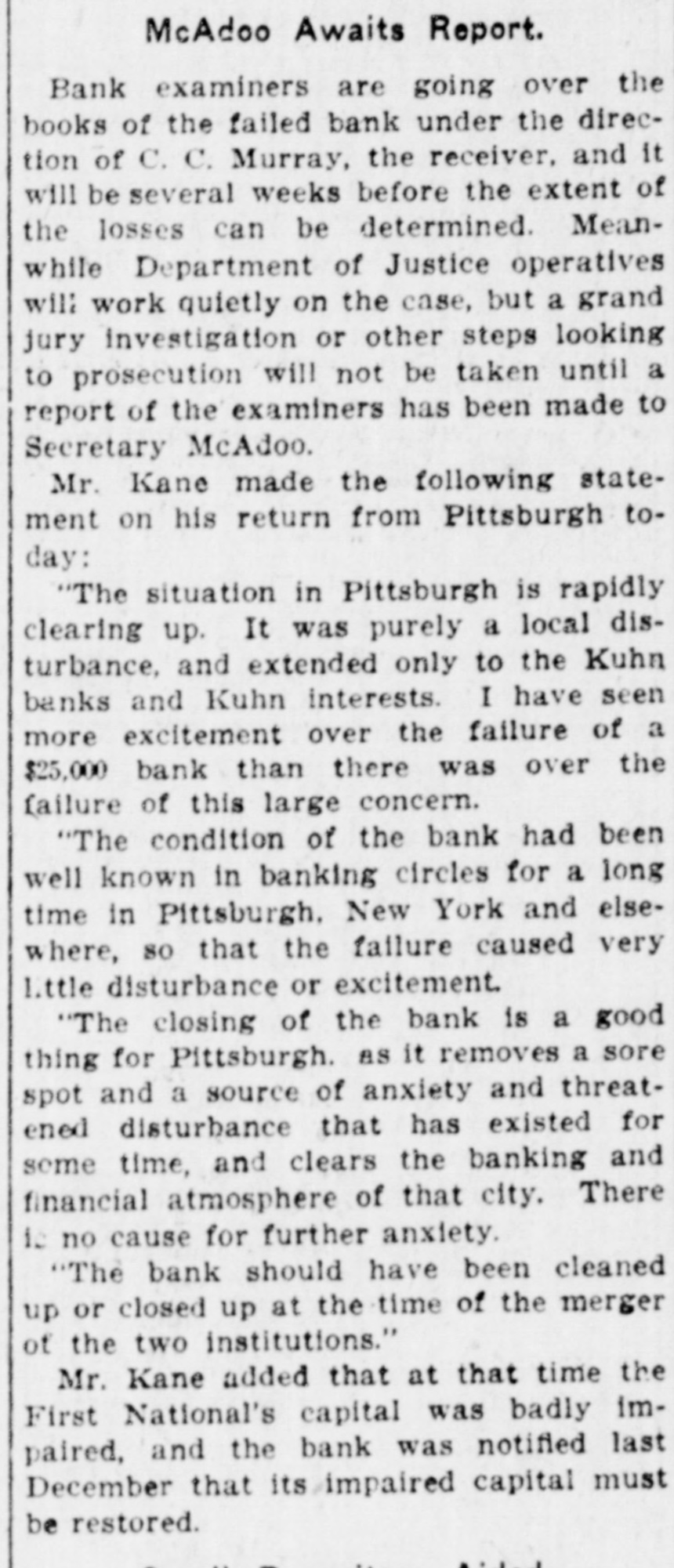
McAdoo Awaits Report. Bank examiners are going over the books of the failed bank under the direction of C. C. Murray, the receiver, and it will be several weeks before the extent of the losses can be determined. Meanwhile Department of Justice operatives will work quietly on the case, but a grand jury investigation or other steps looking to prosecution will not be taken until a report of the examiners has been made to Secretary McAdoo. Mr. Kane made the following statement on his return from Pittsburgh today: "The situation in Pittsburgh is rapidly clearing up. It was purely a local disturbance, and extended only to the Kuhn banks and Kuhn interests. I have seen more excitement over the failure of a $25,000 bank than there was over the (ailure of this large concern. "The condition of the bank had been well known in banking circles for a long time in Pittsburgh. New York and elsewhere, so that the failure caused very Lttle disturbance or excitement. "The closing of the bank is a good thing for Pittsburgh. as it removes a sore spot and a source of anxiety and threatened disturbance that has existed for some time, and clears the banking and financial atmosphere of that city. There is no cause for further anxiety. "The bank should have been cleaned up or closed up at the time of the merger of the two institutions." Mr. Kane added that at that time the First National's capital was badly impaired, and the bank was notified last December that its impaired capital must be restored.


Article from The Citizen-Republican, July 10, 1913

Click image to open full size in new tab

Article Text

also for and the ompany, S. and W. S. Kuhn & the former of these were J. S. Kuhn, W. S. H. Purdy. general manthe company, and Samuel a bank official of this Kuhn company was apK. Duff, who is treasurer ompany. Bonds of $50,000 filed for each rePa., July 8.-The firstbank, of Pittsburg, largest in the city and one in the country was by order of the compthe currency. The First Bank of McKeesport, Pa., an also closed its doors. uhn and J. S. Kuhn own the interests in both banks and led to persistent reports would be asked for for Waterworks & Guarthe largest concern of the country with which the prominently identified. This over 40 waterworks the United States. Are No Good. between the officials of Second National bank and department over the of the bank's assets are said to the order closing its details of the differences announced by the treasury this afternoon. st-Second National bank is onsolidation of the First and ational banks of Pittsburgh eposits of more than $30,000,reserve of the Firstbank of Pittsburgh by $2,145,000 on June 4, the last call by the compthe currency. This brought to a climax. pension fo the institution a run on the Pittsburgh Savings of which W. J. Kuhn tsburgh Clearing House assotaken charge of the situafurther trouble is expected. the officials of the bank a statement this morning, affairs will be in the hands officials. of the First-Second Naof Pittsburgh are: J. S. esident, and J. M. Young. McConway and Oscar L. presidents. Mr. Young is merican Waterworks and company is the largest opvaterworks company in the The concern is also terested in irrigation projects, terurban and electric lightprises. chartered in Pennsylvania in has an outstanding capital 5,000,000. Since 1889 the stock an annual dividend of 6 per in June of last year a stock of 150 per cent was declared surplus. This called for the of more than $5,000,000. Condition June 4. statement of the bank's made upon the call of the as of close of business discounts $15,704,901.16 secured and unse2,571.76 bonds. to secure 1,000,000.00 bonds, to secure deposits 171,000.00 bonds on hand 16,000.00 on United States 40,121.26 etc curities. 8,549,236.95 house, furniture and 176,755.04 estate owned 1,541,977.65 National banks, not agents 1,178,987.06 state banks and 1,316,820.23 approved reserve 4,216,447.75 other cash items 160,076.23 for clearing houses. 692,230.43 ther National banks. 360,000.00 paper currency 13,237.88 reserve in bank, viz.: legal tenders notes. $ 1,881,023.00 fund with United easury (5 per cent of 95,000.00 trons. States United


Article from The Alaska Citizen, July 14, 1913

Click image to open full size in new tab

Article Text

ENERAL NEWS BY TELEGRAPH THREE BANKS FAIL TTSBURG. July The First Second National banks of Pitts and the First National bank of Reesport closed their doors today warning to their deposit who have in the aggregate. more $40,000,000 at stake. banks are controlled by the interests and it is generally here that the suspensions temporary. BANKS ORDERED CLOSED. ASHINGTON July The clos of the First and Second National of Pittsburg today was direct by the Wilson administrati n in to protect the small stock whose interests. it is be are endangered. It is under that as soon as the controll interests comply with certain reements of the government. the will be permitted to reoper business. KUHN'S WIFE IS ILL. EVERLEY. July 7. William president of one of the stockholders in the Pittsbanks is in the city at the of his wife. who is seriously FEDERALS DEFEATED AGLE PASS. Tex., July 7.-Ad from across the Mexican line that the federals have been deby the constitutionalists at ELKS IN SESSION. OCHESTER. N. Y., July 7.- The y-ninth annual convention of will open in this city tonight a large representation of the branches of he order thr ugh the country Governor Sulzer deliver the address of welcome NORWEGIAN HOSPITAL EATTLE July T-The Norwe residents of this city. headed Mrs. Gunar Lund. are planning establishment of a hospital modeled after those of the old Under the direction of Mrs the movement has gained conrable headway. and the carrying of the plan is practically as HOOTCH FACTORY BURNED. EORIA. III.. July The disbelonging to the Clark com is being destroyed by fire this the flaames having gained headway that there is little of saving any part of the plant. The distillery. which largest in the world.is valued $1,500,000. WAS "APPROACHED." ASHINGTON, July 7. Edward terbach. member of the New law firm of Hoadley. Lauter & Johnson. admitted to the lotal probe committee that he had "approached" Lewis yard. counsel for J. P. Morgan. the statement that he represent Speaker Champ Clark. Lauter said Le had used the name of speaker without the authority of latter. the deception being necessary to accomplish a object which he had in view. auterbach is a Republican. JACK LONDON ILL. AKLAND. July 7.-Jack London. author. was taken seriously il with an attack of appendici He has been taken 1 Merritt and if his condition does improve tonight he will be opupon tomorrow. DIGGING UP GRAFT. LOUIS. July 7.-A federal jury, summoned for the pur of investigating reports of among officials of the muni-


Article from The Alaska Citizen, July 14, 1913

Click image to open full size in new tab

Article Text

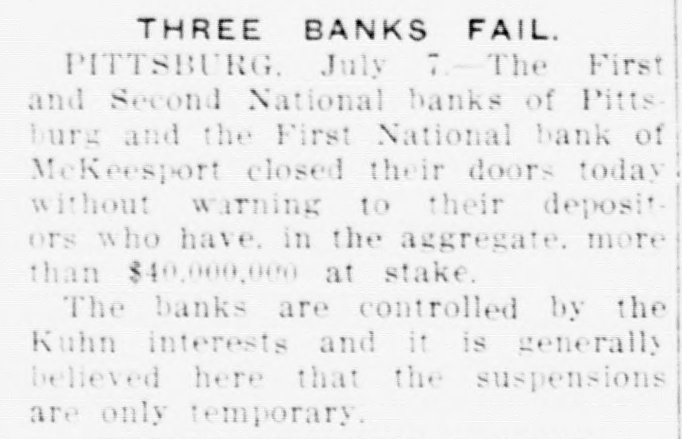
THREE BANKS FAIL. PITTSBURG. July The First and Second National banks of Pittsburg and the First National bank of McKeesport closed their doors today without warning to their depositors who have. in the aggregate. more than $40,000,000 at stake. The banks are controlled by the Kuhn interests and it is generally believed here that the suspensions are only temporary.


Article from The Chitina Leader, July 15, 1913

Click image to open full size in new tab

Article Text

pudiated his confession of seven murders committed in Ohio. WASHINGTON, July 8.-Mrs. May Jorgensen, sister-in-law of Senator Poindexter and General Charles Morton, was attacked by a negro after she had retired. CHICAGO, July 8.-J. Henry Scott, of San Francisco, formerly engaged in mining at Nome, Alaska, committed suicide at a local hotel last night, by blowing out his brains in his room. No cause is assigned for the rash act. WASHINGTON, July 8.-Secretary of the Treasury McAdoo declared that the banking conditions at Pittsburg and throughout the entire country were good and the failure of the First and Second National banks of the former city were simply a sporadic case of unsound banking. WASHINGTON, July 8.-Fortyseven senators have agreed to vote for the Underwood tariff bill as agreed upon in caucus. Senators Hitchcock and Culbertson are absent from the city, but are known to favor the bill, thus giving a majority of one. LONDON, July 8.-The will of the late Sir John Murray, giving $5,000,000 to Lady Sacville, has been sustained. WASHINGTON, July- 8. - The President today appointed Frederick C. Penfield, of Pennsylvania, ambassador to Austria. LONDON, July 8-The suffragettes burned in effigy, Sir William Lever, a noted physician and founder of Port Sunlight. HOUSTON, July 8.-Lieutenant Loren H. Call, an army aviator, was instantly killed by the collapse and fall of an aeroplane. WASHINGTON, July 8.-"If Mr. Fisk does not resign as postmaster at San Francisco, he will be removed," declared Postmaster General Burleson in discussing Fisk's refusal to vacate office after having been requested to do so by the department. SAN FRANCISCO, July 8.-The west slope of Tamalpais is afire and Muir woods are also in danger of being destroyed by the flames. SAN FRANCISCO, July 8.-A thousand soldiers, civilians and firemen saved Muir woods and the National Sequoia Park from destruction by the forest fires. SEATTLE, July 8.-After declaring that he was too good for servile labor and reproaching the nation for not making life easy for him, J. D. Wilhite, a Spanish-American soldier, committed suicide. KETCHIKAN, July 8.-That the steamship Curacao, of the Pacific Coast Steamship Co., which was wrecked near Warm Chuck, on the west coast of Prince of Wales Island recently, may be raised, is the opinion of shipping men. The vessel is reported as resting on an even keel near shore, with about 15 feet of water covering her decks at low tide. Eleven large steel can buoys have just been received by the lighthouse inspector to be used to marke some of the most dangerous of the numerous uncharted rocks which abound in this vicinity. It is largely owing to the untiring efforts of Ray L. Hankinson, inspector in charge of the 16th district, say shipping men, that a neglectful government is induced to give even the few aids to navigation with which the dangerous waters of Alaska are marked. Ever since his appointment to the office in the North, Hankinson has lost no opportunity to impress on the government the necessity of numerous buoys and lighthouses to guide the navigator through the hazardous places along the entire Alaskan coast. Since the wreck of the steamships Yukon and Curacao, both of which, it is asserted by steamhip men, might yet be afloat had the coast of Alaska been properly surveyed and buoyed, it is expected that the federal government will awaken to the needs of the territory. Although the Yukon was steaming over a course but little used, yet the route is traveled enough to merit the protection of ships by buoys and lighthouses. The west coast of Prince of Wales Island, is for the most part not even surveyed by the government. Most of the charts in use by the government have been prepared by the captains of the numerous vessels which ply those waters.


Article from The Washington Herald, September 13, 1913

Click image to open full size in new tab

Article Text

# NEW ROLES FOR M'ADOO AND AID Secretary and Assistant Conducting Office of Comptroller of Currency. # SITUATION IS UNUSUAL Plan, Says Report, Is to Have Mr. Williams Step Into Place After Currency Bill Passes. Secretary of the Treasury McAdoo's recent statement in regard to the investi-gation which the national bank examiner has been making into the legality of the National City Bank's $44,000,000 loan to the Chicago Street Railways Syndicate has directed attention here to an extra-ordinary situation. Secretary McAdoo and his assistant, John Skelton Williams, are, and have been for several months, virtually con-ducting the affairs of the office of the Comptroller of the Currency. This is in-dicated by the statement issued by Sec-retary McAdoo in regard to the National City Bank, in which he comments on the report of the examiner. This state of affairs is absolutely at variance with the practice that hitherto has prevailed in the administration of the great banking interests of the coun-try. Furthermore, the question is be-ing seriously raised here whether the Secretary of the Treasury is not ex-ceeding his power under the law when he assumes to direct the affairs of the Comptroller's office or turn them over to his first assistant in the Treasury Department. # Explanation May Be Asked. There has been talk recently among members of Congress in regard to this extraordinary condition, and Mr. McAdoo is likely to be confronted with a demand for an explanation. The assertion is made that the present investigation, for instance, into the Na-tional City Bank loan is a matter for supervision exclusively by the Comptrol-ler of the Currency, and that his de-cision should be final and in no sense subject to review by the Secretary of the Treasury or his assistant. Not only, however, has John Skelton Williams assumed charge of this inquiry, but recently he appeared more publicly as directing the affairs of the Comptrol-ler's office. When the First-Second Na-tional Bank of Pittsburgh closed its doors, Mr. McAdoo's assistant went per-sonally to that city, assumed charge of the investigation into the bank's af-fairs, and issued statements in regards to the conditions that had been found there. What in former days had been considered the sole province of the Comptroller of the Currency was pre-empted by Mr. Williams, and many bankers in Pittsburgh resented his inter-ference as unauthorized and without warrant and law. # Powers of Comptroller. The national banking act, creating the office of Comptroller of the Currency, charges that he shall perform his duties "under the general direction of the Sec-retary of the Treasury." When it comes to the enumeration of his duties, how-ever, specific power is lodged in each in-stance with him and when that power is to be shared by the Secretary of the Treasury a special provision is made. There are but three matters in which the Secretary of the Treasury is given concurrent power with the Comptroller of the Currency. They are (1) the is-suing of charters to national banks hav-ing a capital of less than $100,000; (2) the appointment of bank examiners; (3) the appointment of receivers for banks which have failed on account of a short-age in reserve. In each of these cases the approval of the Secretary of the Treasury is required, but in other mat-ters the decision of the Comptroller of the Currency heretofore has been su-preme. The Comptroller of the Currency has, in fact, been regarded in the past as an independent officer, and many Comptrol-lers have taken pride in asserting that independence. The law requires that the Comptroller shall make his annual report to Congress, and not to the Secretary of the Treasury, and that he shall submit recommendations for legislation. Furthermore, he is to be appointed by the President for a term of five years, thereby introducing another element of in-dependence. # When Opinions Differed. There have been notable instances in former days when radical differences of opinion have existed between this high officer and the Secretary of the Treasury. For instance, when Lyman J. Gage was Secretary of the Treasury he advocated asset currency. Charles G. Dawes, who was then Comptroller of the Currency, not only opposed it in conference be-tween the two men, but submitted a re-port to Congress condemning it. Also when Leslie M. Shaw was Secretary of the Treasury, certain bankers complained to him of the practices of another banker, and Secretary Shaw or-dered that banker to discontinue his ob-jectionable acts. From the banker came the reply that he would not discontinue them until Secretary Shaw could show him any authority in law by which the


Article from New-York Tribune, May 24, 1914

Click image to open full size in new tab

Article Text

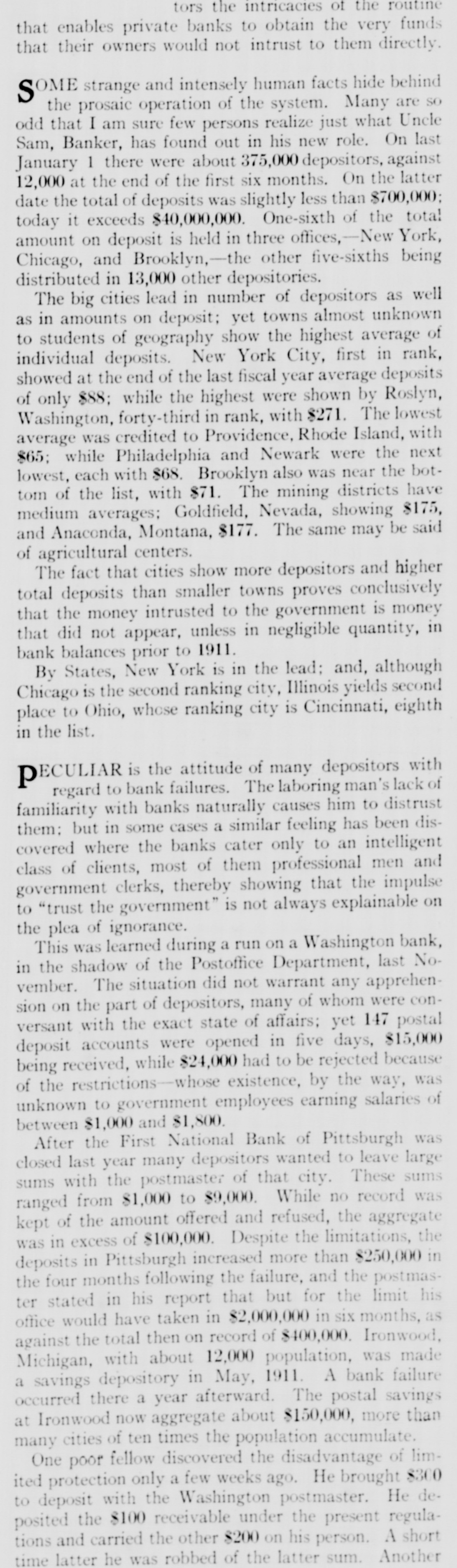
tors the intricacies of the routine that enables private banks to obtain the very funds that their owners would not intrust to them directly. OME strange and intensely human facts hide behind S the prosaic operation of the system. Many are so odd that I am sure few persons realize just what Uncle Sam, Banker, has found out in his new role. On last January 1 there were about 375,000 depositors, against 12,000 at the end of the first six months. On the latter date the total of deposits was slightly less than $700,000; today it exceeds $40,000,000. One-sixth of the total amount on deposit is held in three offices,-New York, Chicago, and Brooklyn,-the other five-sixths being distributed in 13,000 other depositories. The big cities lead in number of depositors as well as in amounts on deposit; yet towns almost unknown to students of geography show the highest average of individual deposits. New York City, first in rank, showed at the end of the last fiscal year average deposits of only $88; while the highest were shown by Roslyn, Washington, forty-third in rank, with $271. The lowest average was credited to Providence, Rhode Island, with $65; while Philadelphia and Newark were the next lowest, each with $68. Brooklyn also was near the bottom of the list, with $71. The mining districts have medium averages; Goldfield, Nevada, showing $175, and Anaconda, Montana, $177. The same may be said of agricultural centers. The fact that cities show more depositors and higher total deposits than smaller towns proves conclusively that the money intrusted to the government is money that did not appear, unless in negligible quantity, in bank balances prior to 1911. By States, New York is in the lead; and, although Chicago is the second ranking city, Illinois yields second place to Ohio, whose ranking city is Cincinnati, eighth in the list. ECULIAR is the attitude of many depositors with P regard to bank failures. The laboring man's lack of familiarity with banks naturally causes him to distrust them: but in some cases a similar feeling has been discovered where the banks cater only to an intelligent class of clients, most of them professional men and government clerks, thereby showing that the impulse to "trust the government" is not always explainable on the plea of ignorance. This was learned during a run on a Washington bank, in the shadow of the Postoffice Department, last November. The situation did not warrant any apprehension on the part of depositors, many of whom were conversant with the exact state of affairs; yet 147 postal deposit accounts were opened in five days, $15,000 being received, while $24,000 had to be rejected because of the restrictions-whose existence, by the way, was unknown to government employees earning salaries of between $1,000 and $1,800. After the First National Bank of Pittsburgh was closed last year many depositors wanted to leave large sums with the postmaster of that city. These sums ranged from $1,000 to $9,000. While no record was kept of the amount offered and refused, the aggregate was in excess of $100,000. Despite the limitations, the deposits in Pittsburgh increased more than $250,000 in the four months following the failure, and the postmaster stated in his report that but for the limit his office would have taken in $2,000,000 in six months, as against the total then on record of $400,000. Ironwood, Michigan, with about 12,000 population, was made a savings depository in May, 1911. A bank failure occurred there a year afterward. The postal savings at Ironwood now aggregate about $150,000, more than many cities of ten times the population accumulate. One poor fellow discovered the disadvantage of limited protection only a few weeks ago. He brought $300 to deposit with the Washington postmaster. He deposited the $100 receivable under the present regulations and carried the other $200 on his person. A short time latter he was robbed of the latter sum. Another