Barker Brothers. & Company (Philadelphia, PA)

Episode Information

Episode UID
4803526891091
Episode Type
Suspension โ†’ Reopening
Bank Type
private
Bank ID
480352689 hash
Start Date
November 20, 1890
Location
Philadelphia, Pennsylvania (39.952, -75.164)

Metadata

Model
gpt-5-mini (chosen from majority vote of a three-model LLM ensemble)
Short Digest
e33036a586baea99

Response Measures

None

Events (3)

1. November 20, 1890 Suspension
Cause
Bank Specific Adverse Info
Cause Details
Inability to realize on outside securities and unprofitable railroad investments led to assignment and suspension
Newspaper Excerpt
the large and well-known banking house of Barker Brothers & Co. had made an assignment
Source
newspapers
2. November 21, 1890 Other
Newspaper Excerpt
The doors of Barker Bros. & Co.'s banking house were opened again this morning and affairs in and around the bank resumed something of their wonted appearance, although of course no business was being transacted.
Source
newspapers
3. January 30, 1891 Reopening
Newspaper Excerpt
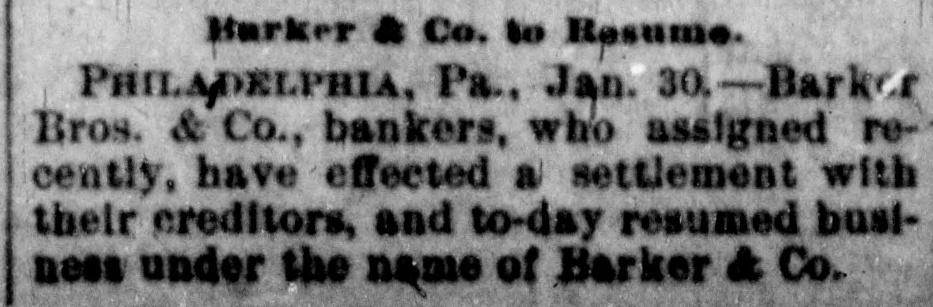
Barker Bros. & Co., bankers, who assigned recently, have effected a settlement with their creditors, and to-day resumed business under the name of Barker & Co.
Source
newspapers

Newspaper Articles (22)

Article from Evening Star, November 20, 1890

Click image to open full size in new tab

Article Text

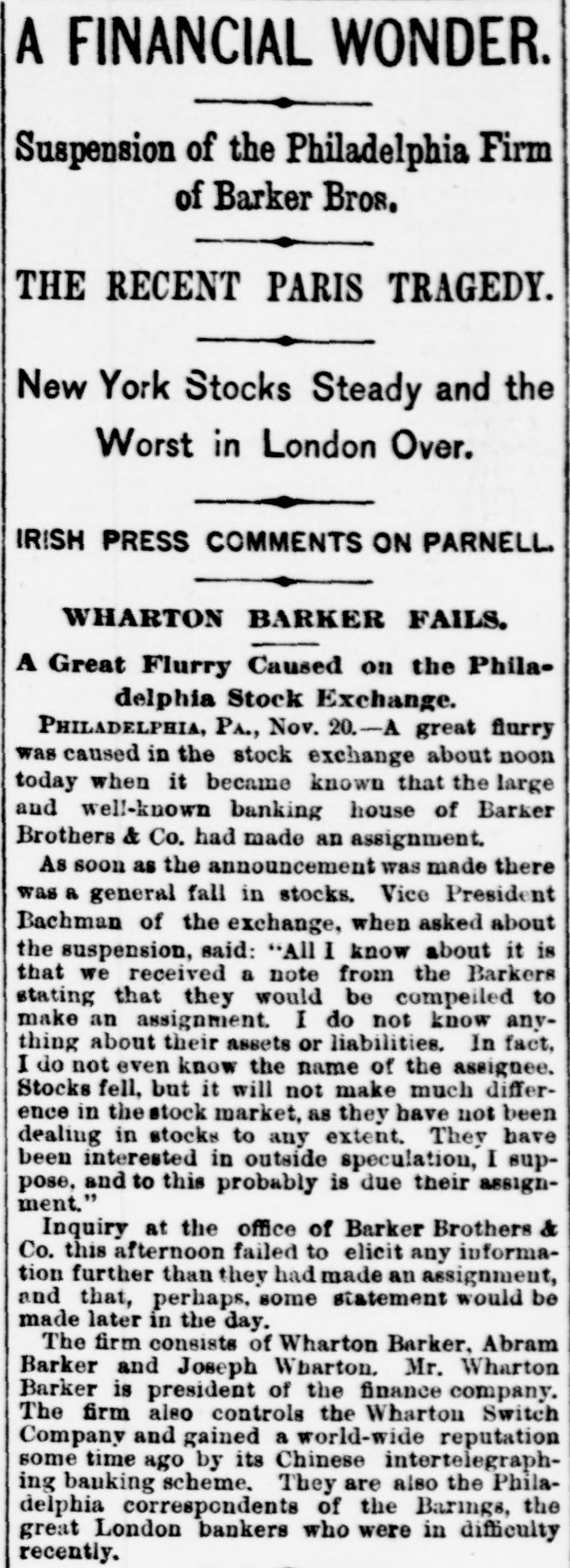
A FINANCIAL WONDER. Suspension of the Philadelphia Firm of Barker Bros. THE RECENT PARIS TRAGEDY. New York Stocks Steady and the Worst in London Over. IRISH PRESS COMMENTS ON PARNELL WHARTON BARKER FAILS. A Great Flurry Caused on the Philadelphia Stock Exchange. PHILADELPHIA, PA., Nov. 20.-A great flurry was caused in the stock exchange about noon today when it became known that the large and well-known banking house of Barker Brothers & Co. had made an assignment. As soon as the announcement was made there was a general fall in stocks. Vice President Bachman of the exchange, when asked about the suspension, said: "All I know about it is that we received a note from the Barkers stating that they would be compeiled to make an assignment. I do not know anything about their assets or liabilities. In fact, I do not even know the name of the assignee. Stocks fell, but it will not make much difference in the stock market, as they have not been dealing in stocks to any extent. They have been interested in outside speculation, I suppose, and to this probably is due their assignment." Inquiry at the office of Barker Brothers & Co. this afternoon failed to elicit any information further than they had made an assignment, and that, perhaps, some statement would be made later in the day. The firm consists of Wharton Barker, Abram Barker and Joseph Wharton. Mr. Wharton Barker is president of the finance company. The firm also controls the Wharton Switch Company and gained a world-wide reputation some time ago by its Chinese intertelegraphing banking scheme, They are also the Philadelphia correspondents of the Barings, the great London bankers who were in difficulty recently.


Article from The Cheyenne Daily Leader, November 21, 1890

Click image to open full size in new tab

Article Text

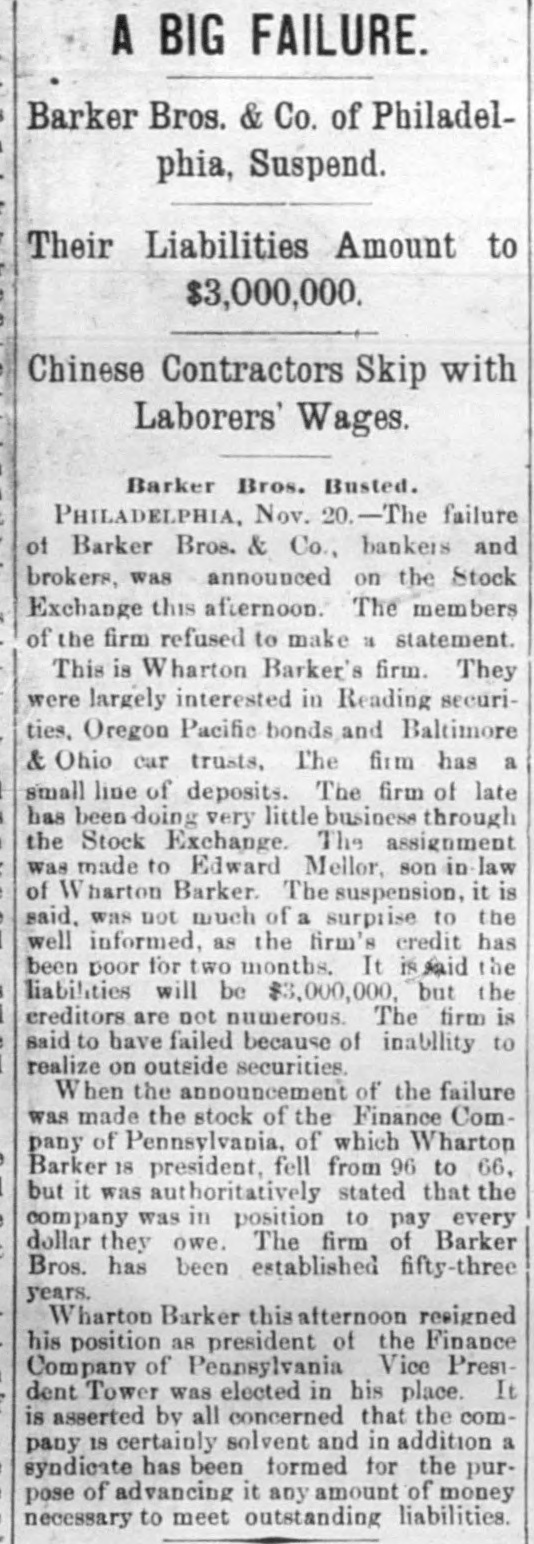
A BIG FAILURE. Barker Bros. & Co. of Philadelphia, Suspend. Their Liabilities Amount to $3,000,000. Chinese Contractors Skip with Laborers' Wages. Barker Bros. Busted. PHILADELPHIA, Nov. 20.-The failure of Barker Bros. & Co., bankers and brokers, was announced on the Stock Exchange this afternoon. The members of the firm refused to make a statement. This is Wharton Barker's firm. They were largely interested in Reading securities, Oregon Pacific bonds and Baltimore & Ohio car trusts, The firm has a small line of deposits. The firm of late has been doing very little business through the Stock Exchange. The assignment was made to Edward Mellor, son in law of Wharton Barker. The suspension, it is said, was not much of a surprise to the well informed, as the firm's credit has been poor for two months. It is said the liabilities will be $3,000,000, but the ereditors are not numerous. The firm is said to have failed because of inability to realize on outside securities. When the announcement of the failure was made the stock of the Finance Company of Pennsylvania, of which Wharton Barker 18 president, fell from 96 to 66, but it was authoritatively stated that the company was in position to pay every dollar they owe. The firm of Barker Bros. has been established fifty-three years. Wharton Barker thisafternoon resigned his position as president of the Finance Company of Pennsylvania Vice Prestdent Tower was elected in his place. It is asserted by all concerned that the company IS certainly solvent and in addition a syndicate has been formed for the purpose of advancing it any amount of money necessary to meet outstanding liabilities.


Article from Los Angeles Herald, November 21, 1890

Click image to open full size in new tab

Article Text

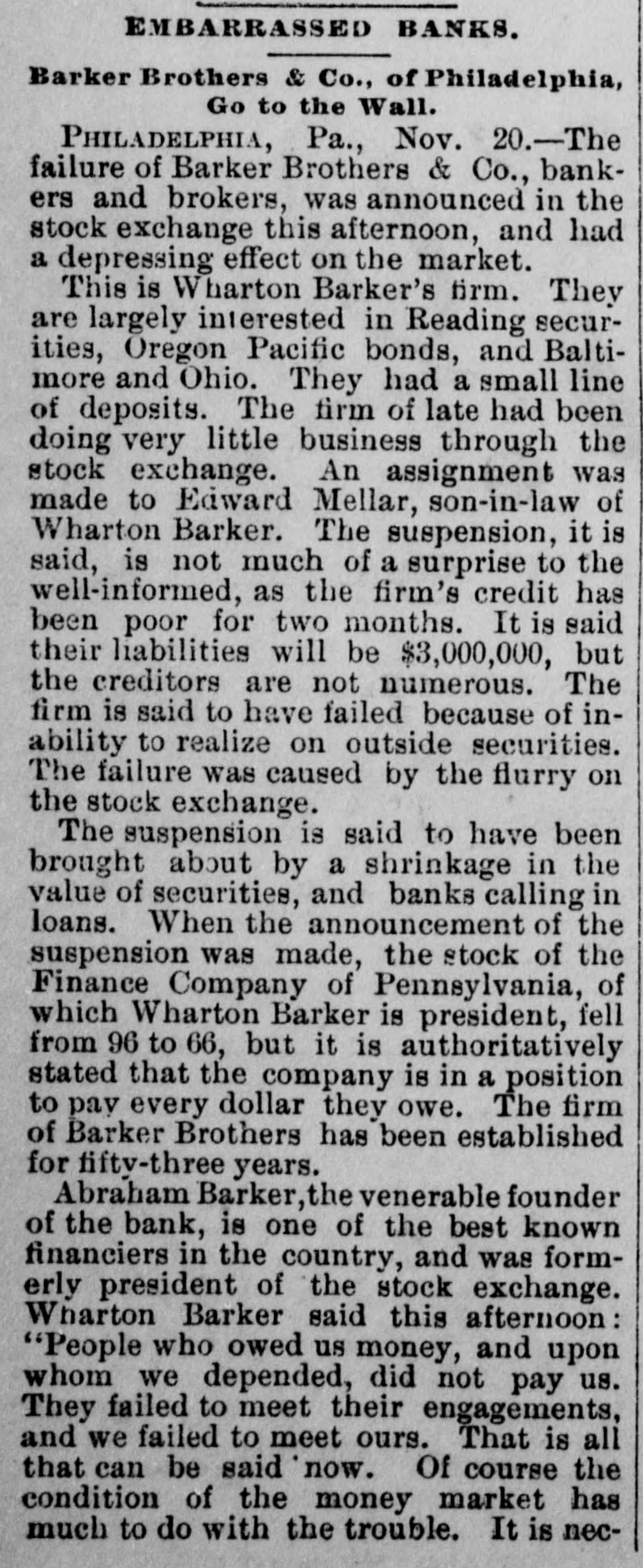
EMBARRASSED BANKS. Barker Brothers & Co., of Philadelphia, Go to the Wall. PHILADELPHIA, Pa., Nov. 20.-The failure of Barker Brothers & Co., bankers and brokers, was announced in the stock exchange this afternoon, and had a depressing effect on the market. This is Wharton Barker's firm. They are largely interested in Reading securities, Oregon Pacific bonds, and Baltimore and Ohio. They had a small line of deposits. The firm of late had been doing very little business through the stock exchange. An assignment was made to Edward Mellar, son-in-law of Wharton Barker. The suspension, it is said, is not much of a surprise to the well-informed, as the firm's credit has been poor for two months. It is said their liabilities will be $3,000,000, but the creditors are not numerous. The firm is said to have failed because of inability to realize on outside securities. The failure was caused by the flurry on the stock exchange. The suspension is said to have been brought about by a shrinkage in the value of securities, and banks calling in loans. When the announcement of the suspension was made, the stock of the Finance Company of Pennsylvania, of which Wharton Barker is president, fell from 96 to 66, but it is authoritatively stated that the company is in a position to pay every dollar they owe. The firm of Barker Brothers has been established for fiftv-three years. Abraham Barker, the venerable founder of the bank, is one of the best known financiers in the country, and was formerly president of the stock exchange. Wharton Barker said this afternoon: "People who owed us money, and upon whom we depended, did not pay us. They failed to meet their engagements, and we failed to meet ours. That is all that can be said now. Of course the condition of the money market has much to do with the trouble. It is nec-


Article from Alexandria Gazette, November 21, 1890

Click image to open full size in new tab

Article Text

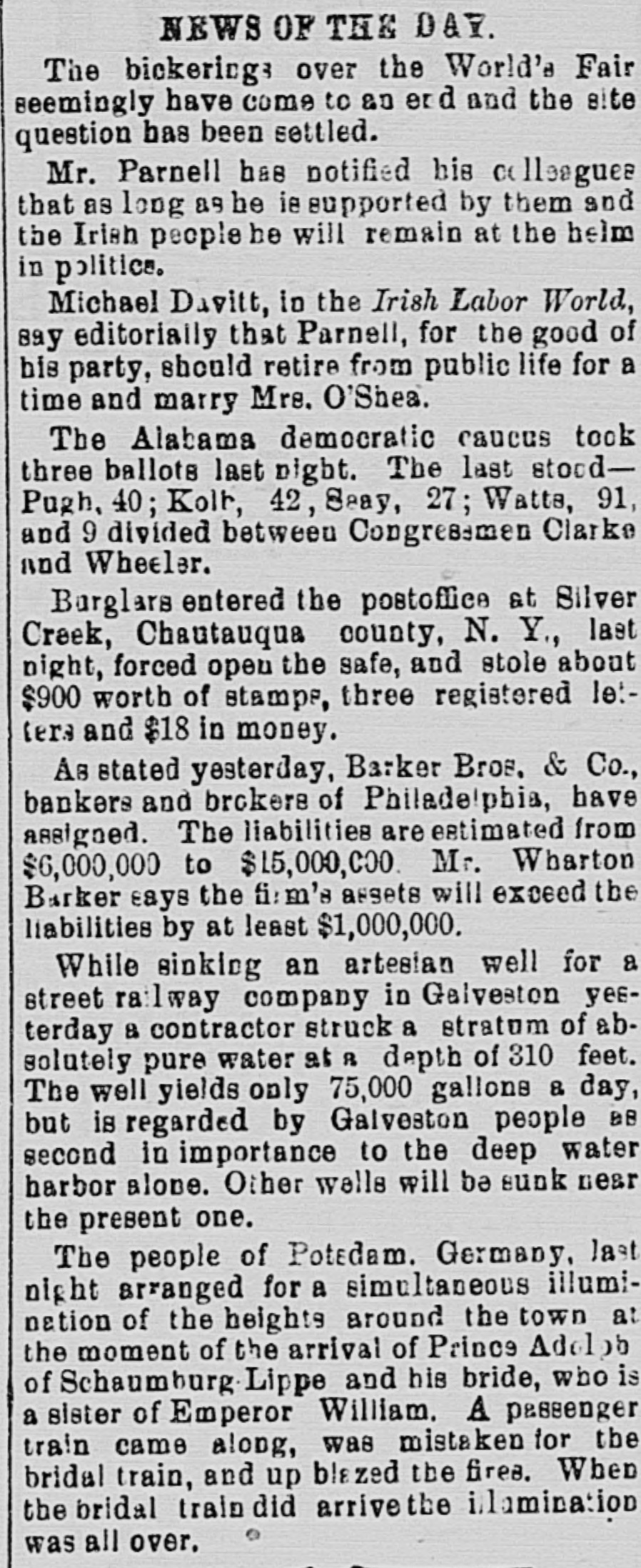
NEWS OF THE DAY. The bickerings over the World's Fair seemingly have come to ao end and the site question has been settled. Mr. Parnell has notified his colleagues that as long as he ie supported by them and the Irish people he will remain at the helm in politics. Michael Davitt, in the Irish Labor World, say editorially that Parnell, for the good of his party, should retire from public life for a time and marry Mrs. O'Shea. The Alabama democratic caucus took three ballots last night. The last stoodPugh, 40; Kolt, 42, Seay, 27; Watts, 91, and 9 divided between Congressmen Clarke and Wheeler. Burglars entered the postoffice at Silver Creek, Chautauqua county, N. Y., last night, forced open the safe, and stole about $900 worth of stamps, three registered le:ters and $18 in money. As stated yesterday, Barker Bros. & Co., bankers and brokers of Philadelphia, have assigned. The liabilities are estimated from $6,000,000 to $15,000,000. Mr. Wharton Barker eays the firm's assets will exceed the liabilities by at least $1,000,000. While sinking an artesian well for a street railway company in Galveston yesterday a contractor struck a stratum of absolutely pure water at 8 depth of 310 feet. The well yields only 75,000 gallons a day, but is regarded by Galveston people 08 second in importance to the deep water harbor alone. Other wells will be sunk near the present one. The people of Potedam. Germany, last night arranged for a simultaneous illumination of the heights around the town at the moment of the arrival of Prince Adolob of Schaumburg Lippe and his bride, who is a sister of Emperor William. A passenger train came along, was mistaken for the bridal train, and up blazed the fires. When the bridal train did arrivethe illamination was all over.


Article from St. Paul Daily Globe, November 21, 1890

Click image to open full size in new tab

Article Text

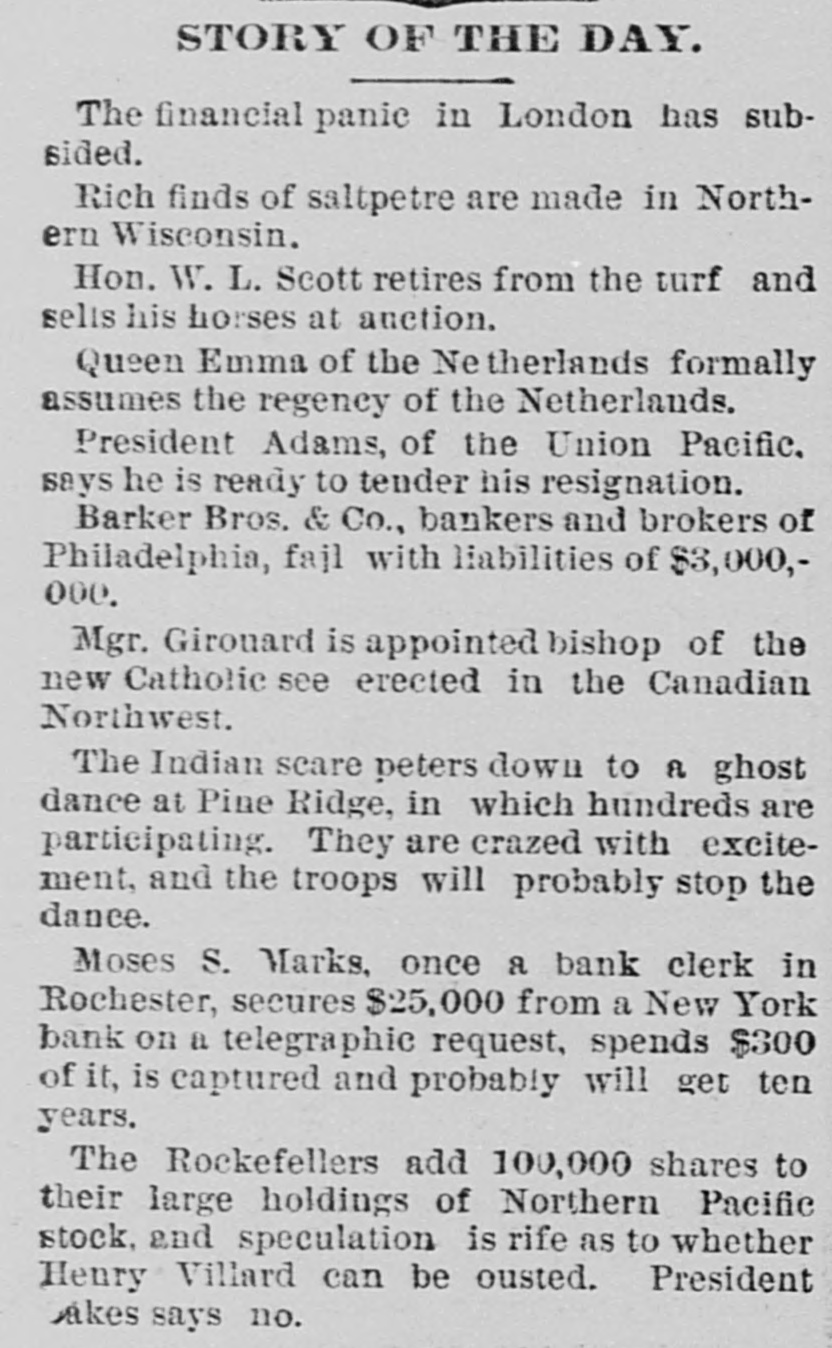
STORY OF THE DAY. The financial panic in London has subsided. Rich finds of saltpetre are made in Northern Wisconsin. Hon. W. L. Scott retires from the turf and selts his horses at anction. Queen Emma of the Ne therlands formally assumes the regency of the Netherlands. President Adams, of the Union Pacific. says he is ready to tender his resignation. Barker Bros. & Co., bankers and brokers of Philadelphia, fajl with liabilities of $3,000,000. Mgr. Girouard is appointed bishop of the new Catholic see erected in the Canadian Northwest. The Indian scare peters down to a ghost dance at Pine Ridge, in which hundreds are participating. They are crazed with excitement, and the troops will probably stop the dance. Moses S. Marks, once a bank clerk in Rochester, secures $25,000 from a New York bank on a telegraphic request, spends $300 of it, is captured and probably will get ten years. The Rockefellers add 100,000 shares to their large holdings of Northern Pacific stock, and speculation is rife as to whether Henry Villard can be ousted. President Akes says no.


Article from Evening Star, November 21, 1890

Click image to open full size in new tab

Article Text

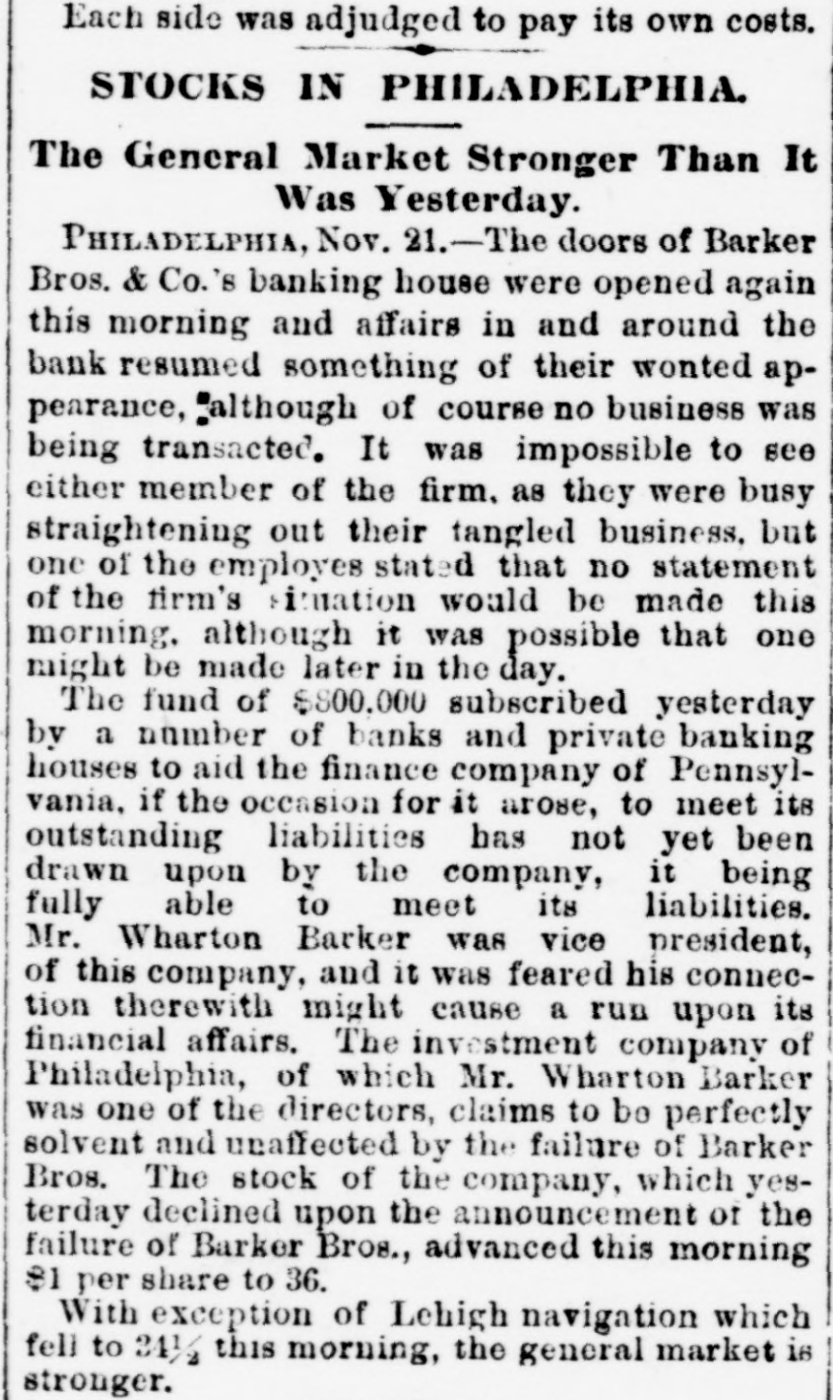
Each side was adjudged to pay its own costs. STOCKS IN PHILADELPHIA The General Market Stronger Than It Was Yesterday. PHILADELPHIA, Nov. 21.-The doors of Barker Bros. & Co.'s banking house were opened again this morning and affairs in and around the bank resumed something of their wonted appearance, "although of course no business was being transacted. It was impossible to see either member of the firm. as they were busy straightening out their tangled business. but one of the employes stated that no statement of the firm's situation would be made this morning, although it was possible that one might be made later in the day. The fund of $800,000 subscribed yesterday by a number of banks and private banking houses to aid the finance company of Pennsylvania, if the occasion for it arose, to meet its outstanding liabilities has not yet been drawn upon by the company, it being fully able to meet its liabilities. Mr. Wharton Barker was vice president, of this company, and it was feared his connection therewith might cause a run upon its financial affairs. The investment company of Philadelphia, of which Mr. Wharton Barker was one of the directors, claims to be perfectly solvent and unaffected by the failure of Barker Bros. The stock of the company, which yesterday declined upon the announcement of the failure of Barker Bros., advanced this morning $1 per share to 36. With exception of Lehigh navigation which fell to 34ยฝ this morning, the general market is stronger.


Article from St. Paul Daily Globe, November 21, 1890

Click image to open full size in new tab

Article Text

DUTY OF AMERICANS. Ex-President Cleveland Defines it in Speaking of "Our Country." It is to Protect, Defend, Foster and Improve the Republic. Failure of the Oldest Banking and Brokerage Firm in Philadelphia. Barker Bros. & Co. Owe Three Millions and Suspend Payment. NEW YORK, Nov. 20.-The jewelers' mual banquet was spread at Delmonco's to-night, and ex-President Cleveand was one of the guests. He responded to the toast, "Our Country," and in part he said: "I know of no better way to deal with the sentiment than to divide it and consider one branch or part of my text, as is sometimes done with a long text in the pulpit. I therefore propose to say something about the word 'our' as related to the sentiment 'our country.' This is 'our' country, because the people have established it, because they rule it, because they have developed it, because they have fought for it. and because they love it. And still each generation of Americans hold it only III trust for those who shall come after them; and they are charged for the obligation, to transmit It as strong and sound as it came to their hands. It is not ours to sell and it is not ours to neglect and injure. It is ours as our families are ours, and as our ehurches and schools are ours-to protect and defend, to foster and improve. As its strength and its fitness to reach its promised destinvi depends


Article from Fort Worth Daily Gazette, November 21, 1890

Click image to open full size in new tab

Article Text

to Lucas & Lewis, who open up a new establishment here. The price paid is $1800 cash. WANTS TO RETIRE. Special to the Gazette. HILLSBORO, TEX., Nov. 20.-J. L. Burns, dealer in furniture, made a deed of trust yesterday to J. R. Patty, as trustee, for the benefit of certain preferred creditors, as follows: J. H. Miller for $33.25; Hawkins & Larry, landlords, at the rate of $60 per month from November 1 to August 31, 1890; Hill county national bank, for the sum of $500 and interest. His assets are thought to be sufficient to discharge his entire indebtedness. He wishes to go out of business. He assigns that as a reason for execuring this deed of trust. $28,605 FAILURE AT ROUND ROCK. Special to the Gazette. GEORGETOWN, TEX., Nov. 19.-M. Weiss. dealer in general merchandise at Round Rock, filed a deed of trust here to-day in favor of H. B. Sheppard, trustee. His liabilities are as follows: W. L. Moody & Co., Galveston, $1500; American national bank, Austin, $200; J. A. Hudson, Round Rock, $3500; William Weiss, Beaumont, $3800; William & V. Weiss, Beaumunt, $4000; R. B. Murry, Round Rock, $400; Dr. T. E. Hudson, Round Rock, $325; Davis sewing machine company Chicago, $1800; M. Davis, Travis county, $1450; J. P. Huggins, Taylor, $400; First National bank of Taylor. $3500; G. B. Powell, Travis county, $400; A. S. Zeimmerman, Williamson county, $800; John Orr, Austin, $630; V. Wells, Beaumont, $400; Bradford & Rowe Bros., Round Rock, $5500. Of the creditors the following are preferred: W. L. Moody & Co., Galveston, $1500; American National bank, Austin, $2000; William Weiss, Beaumont, $3800; J. A. Hudson, Round Rock, $3500; William and V. Weiss, Beaumont, $4000. This is the heaviest failure that was ever recorded in Williamson county. The assets consist of stock of goods, notes and accounts, insurance policies on stock and furniture, lease on building and twenty-seven bales of cotton. Enough, it is thought, to pay all claims. PORK AND BEEF PACKERS FAIL. CINCINNATI, OHIO, Nov. 20.-Charles Jacob, Jr., & Co., pork and beef packers at Plum and Findlay streets, assigned this morning to George C. Jacobs. Liabilities, $60,000; assets. $40,000. The preferences are given in favor of George Quest for $17,000. A PHILADELPHIA BANK FAILURE. PHILADELPHIA, PA., Nov. 20.-The failure of Barker Bros. & Co., bankers and brokers, was announced on the stock exchange this afternoon. The failure has been caused largely by various unprofitable railroad investments. Barker Bros. & Co. were identified with a number of railroad sohemes which the more conservative financiers and capitalists avoided, and when the money stringency came they found it impossible to realize upon them. Among the railroad securities with which they were identified in recent years were the Ohio and Northwestern, Oregon Pacific, San Antonio and Aransas Pass and Charleston, Cincinnati and Chicago. : The Ohio and Northwestern railway broke down sometime ago, and its bonds, which Barker Bros. & Co., published, and a large stock of which is now held by prominent financial institutions, are selling far below par. The San Antonio and Aransas Pass railroad went into the hands of a receiver on July 14. It had a heavy floating debt, and holders of $13,000,000 of bonds applied for the appointment of a receiver. The board of directors of the company declared that the bondholders would get their money and advised them not to sell. The Oregon Pacific railway and other
Article from New-York Tribune, November 22, 1890

Click image to open full size in new tab

Article Text

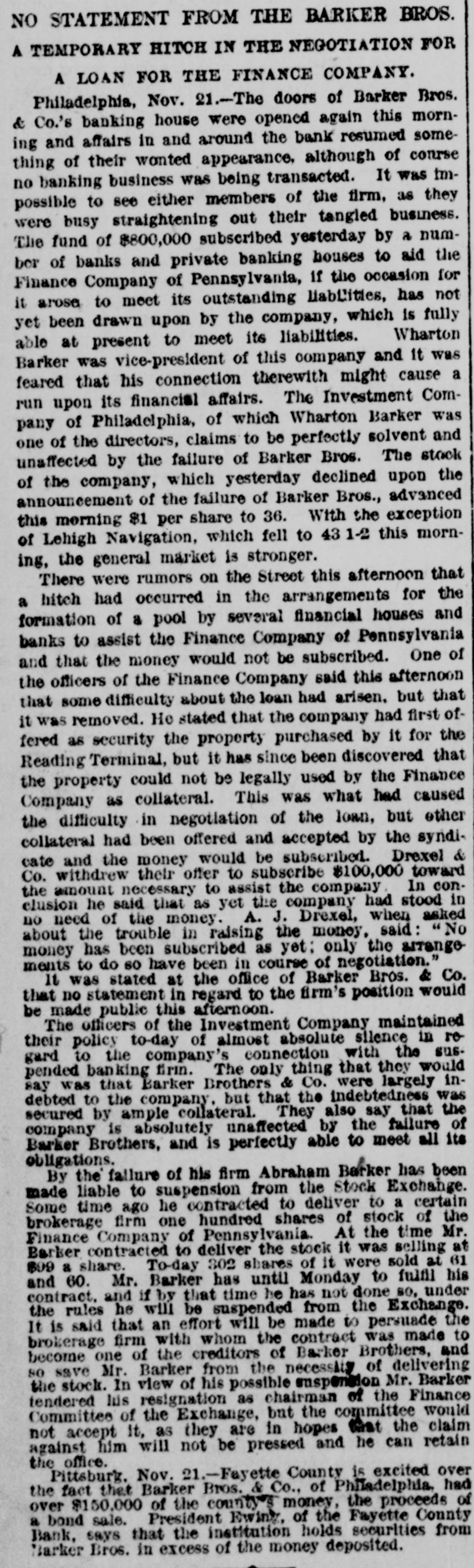
NO STATEMENT FROM THE BARKER BROS. A TEMPORARY HITCH IN THE NEGOTIATION FOR A LOAN FOR THE FINANCE COMPANY. Philadelphia, Nov. 21.-The doors of Barker Bros. & Co.'s banking house were opened again this morning and affairs in and around the bank resumed something of their wonted appearance, although of course no banking business was being transacted. It was tmpossible to see either members of the firm, as they were busy straightening out their tangled business. The fund of $800,000 subscribed yesterday by a number of banks and private banking houses to aid the Finance Company of Pennsylvania, if the occasion for it arose to meet its outstanding liabilities, has not yet been drawn upon by the company, which is fully able at present to meet its liabilities. Wharton Barker was vice-president of this company and 1t was feared that his connection therewith might cause a run upon its financial affairs. The Investment Company of Philadelphia, of which Wharton Barker was one of the directors, claims to be perfectly solvent and unaffected by the failure of Barker Bros. The stock of the company, which yesterday declined upon the announcement of the failure of Barker Bros., advanced this morning $1 per share to 36. With the exception of Lehigh Navigation, which fell to 43 1-2 this morning, the general market is stronger. There were rumors on the Street this afternoon that a hitch had occurred in the arrangements for the formation of a pool by several financial houses and banks to assist the Finance Company of Pennsylvania and that the money would not be subscribed. One of the officers of the Finance Company said this afternoon that some difficulty about the loan had arisen. but that it was removed. He stated that the company had first offered as security the property purchased by it for the Reading Terminal, but it has since been discovered that the property could not be legally used by the Finance Company as collateral. This was what had caused the difficulty in negotiation of the loan, but other collateral had been offered and accepted by the syndicate and the money would be subscribed. Drexel & Co. withdrew their offer to subscribe $100,000 toward the amount necessary to assist the company In conclusion he said that as yet the company had stood in no need of the money. A. J. Drexel, when asked about the trouble in raising the money, said: No money has been subscribed as yet; only the arrange ments to do so have been in course of negotiation." It was stated at the office of Barker Bros. & Co. that no statement in regard to the firm's position would be made public this afternoon. The officers of the Investment Company maintained their policy to-day of almost absolute silence in regard to the company's connection with the suspended banking firm. The only thing that they would say was that Barker Brothers & Co. were largely indebted to the company. but that the indebtedness was secured by ample collateral. They also say that the company is absolutely unaffected by the failure of Barker Brothers, and is perfectly able to meet all its obligations. By the failure of his firm Abraham Barker has been made liable to suspension from the Stock Exchange. Some time ago he contracted to deliver to a certain brokerage firm one hundred shares of stock of the Finance Company of Pennsylvania. At the time Mr. Barker contracted to deliver the stock it was selling at $99 a share. To-day 302 shares of it were sold at 61 and 60. Mr. Barker has until Monday to fulfil his contract. and if by that time he has not done so, under the rules he will be suspended from the Exchange. It is said that an effort will be made to persuade the brokerage firm with whom the contract was made to become one of the creditors of Barker Brothers, and so save Mr. Barker from the necessity of delivering the stock. In view of his possible suspension Mr. Barker tendered his resignation as chairman of the Finance Committee of the Exchange, but the committee would not accept it, as they are in hopes that the claim against him will not be pressed and he can retain the office. Pittsburk. Nov. 21.-Fayette County is excited over the fact that Barker Bros. & Co., of Philadelphia, had over $150,000 of the county's money, the proceeds of a bond sale. President Ewing. of the Fayette County Bank, says that the institution holds securities from Barker Bros. in excess of the money deposited.


Article from Los Angeles Herald, November 22, 1890

Click image to open full size in new tab

Article Text

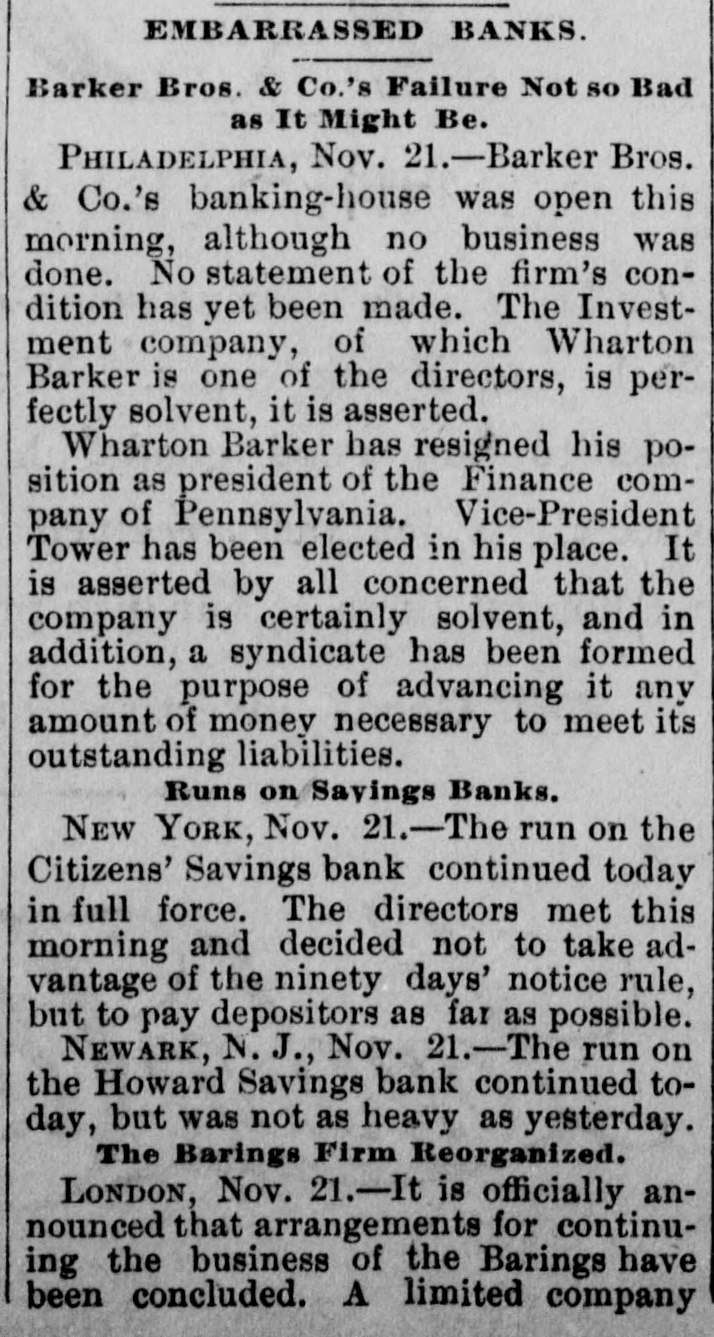
EMBARRASSED BANKS. Barker Bros. & Co.'s Failure Not so Bad as It Might Be. PHILADELPHIA, Nov. 21.-Barker Bros. & Co.'s banking-house was open this morning, although no business was done. No statement of the firm's condition has yet been made. The Investment company, of which Wharton Barker is one of the directors, is perfectly solvent, it is asserted. Wharton Barker has resigned his position as president of the Finance company of Pennsylvania. Vice-President Tower has been elected in his place. It is asserted by all concerned that the company is certainly solvent, and in addition, a syndicate has been formed for the purpose of advancing it any amount of money necessary to meet its outstanding liabilities. Runs on Savings Banks. NEW YORK, Nov. 21.-The run on the Citizens' Savings bank continued today in full force. The directors met this morning and decided not to take advantage of the ninety days' notice rule, but to pay depositors as far as possible. NEWARK, N. J., Nov. 21.-The run on the Howard Savings bank continued today, but was not as heavy as yesterday. The Barings Firm Reorganized. LONDON, Nov. 21.-It is officially announced that arrangements for continuing the business of the Barings have been concluded. A limited company


Article from The Brookhaven Leader, November 27, 1890

Click image to open full size in new tab

Article Text

av Pa., on the 20th. WILLIAM ROBINSON, passenger agent in Michigan for the Grand Trunk rail. way, was killed at Lapeer, Mich., while attempting to board a moving train. THE members of Tong Yoong & Co., a Chinese merchandise house, of San Francisco, have fled to China, leaving their employes unpaid. There was a riot in Chinatown in consequence. IT is again asserted that Mr. Adams will be compelled to retire from the Union Pacific. THERE is a report that Secretary Windom will recommend the issuing of bonds at a low rate of interest, redeemable at will in currency. CHARLES JACOB, JR., & Co., pork packers, Cincinnati, have failed. BARKER BROS. & Co., bankers and brokers of Philadelphia, have failed. The failure was heavy and was caused by unprofitable railroad investments. IT is said Baring Bros. will reorganize as a joint stock company. A. M. LOFTUS shot and killed his father, H. C. Loftns, six miles east of Gainsboro, Tenn., in a personal difficulty, accidentally killing his brother with him at the same time. The son is said to have acted in self defense, in defending his mother from an attack by his father. THE weekly statement of the Bank of France shows a decrease in gold of 81,851,000 francs and an increase of silver of 2,975,000 francs. CARDINAL GIBBONS says that the report of his bringing a libel suit against the publishers of a book dedicated to him was entirely untrue and was probably set afloat to advertise the work. JACK MAPLES, colored, was hanged for rape at Knoxville, Tenn. He vigorously protested his innocence on the scaffold and accused a man named Connors of swearing his life away. CHIEF MAYES has sent a message to the Cherokee Legislature advising that the Nation make the best terms it can with the Government for the Cherokee Strip. JAY GOULD thinks better times are at hand for Wail street. BUSINESS failures (Dun's report) for the seven daysended November 20 numbered 274, as compared with 266 the previous week and 272 the corresponding week of last year. THE Commercial National Bank of Guthrie, Ok., failed on the 21st. THE run on the Howard Savings Bank at Newark, N. J., gradually tapered off. It was the result of a foolish scare. ITALIAN laborers and citizens had a fight recently at Paris, Ky. The Italians were driven out of town after several had been hurt. The trouble was caused by runaway horses dashing into the Italians, when they attacked the driver. IDA JONES, a colored courtesan convicted of stabbing Steven Zimmer, of St. Paul, to death last June, has been sentenced at Denver, Col., to fifteen years in the penitentiary. A motion for a new trial was denied. DORSEY EDWARDS was hanged at Yazoo City, Miss., for the murder of his wife in September last. THE Twenty-sixth Ward Bank of Brooklyn, of which Ditmas Jewell, formerly of the Brooklyn Bank, is president, was robbed of a package containing $5,000 in bills. The work is supposed to be that of a band of clever sneak thieves. W. S. WHARTON, the Chicago broker who was arrested in Philadelphia on the charge of swindling a number of persons in that city out of amounts aggregating about $50,000, was committed to await the action of the Illinois authorities.


Article from The Middleburgh Post, November 27, 1890

Click image to open full size in new tab

Article Text

THE BARKER FAI URE. They Are the Barings' Philadelphia Agent. Philadelphia, November 20.-The failure of Barker Bros. & Co., bankers and brokers, was announced on the Stock Exchange this afternoon. The firm is composed of Abraham and Wharton Barker and Joseph Wharton. The firm at 1 o'clock stoped receiving deposits at their office at Fourth and Chestnut streets and at 1:15 o'clock the doors were closed. The members of the firm refused to make any explanation of their troubles, Mr. Wharton Barker stating to an Associated Press reporter that the firm had no statement to make whatever. As soon as the announcement was m d on 'Change there was a general fall in stocks. Mr. Wharton Barker is president of the Finance Company. The firm also controls the Wharton Switch Company, and gained a world-wide reputation some time ago by its Chinese Inter-Telegraphing Banking scheme They are also the Philadelphia correspondents of the 'Barings, the great London bankers, who were in difficulty recently. The firm of late has been doing very little business through the Stock Exchange, An assignment has been made to Edward Mellor, who is the son-in-law of Mr. Wharton Barton. The suspension was not much of a surprise to the well-informed, as the firm's credit has been poor for the past two months, It is said that the liabilities will be about $3,. 000,000, but the creditors are not numerons The firm is said to have an interest in the stock market and failed because of their inability to realize on outside securities.


Article from Delaware Gazette and State Journal, November 27, 1890

Click image to open full size in new tab

Article Text

THE BARKER FAILURE. It Has Not Pulled Down Anything Else With It Yet. PHILADELPHIA, Nov. 21.-The doors of Barker Bros. & Co.'s banking house were opened again this morning and affairs in and around the bank resumed something of their wonted appearance, although, of course, no banking business was being transacted. It was impossible to see either member of the firm, as they were busy straightening out their tangled business; but one of the employes stated that no statement of the firm's situation would be made this morning, although it was possible that one might be made later in the day. The fund of $800,000, subscribed yesterday by a number of banks and private banking houses to aid the Finance Company of Pennsylvania if the occasion for it arose to meet its outstanding liabilities, has not yet been drawn upon by the company, it being fully able to meet its liabilities. Mr. Wharton Barker was vice-president of this company, and it was feared his connection therewith might cause a run upon its financial affairs. The Investment Company of Pniladelphia. of which Mr. Wharton Barker was a director, claims to be perfectly solvent and unaffected by the failure of Barker Bros. The stock of the company, which yesterday declined upon the announcement of the failure of Barker Bros., advanced this morning $1 per share to 36. With the excepttion of Lehigh Navigation, which fell to 431 this morning, the general market is stronger.


Article from Delaware Gazette and State Journal, November 27, 1890

Click image to open full size in new tab

Article Text

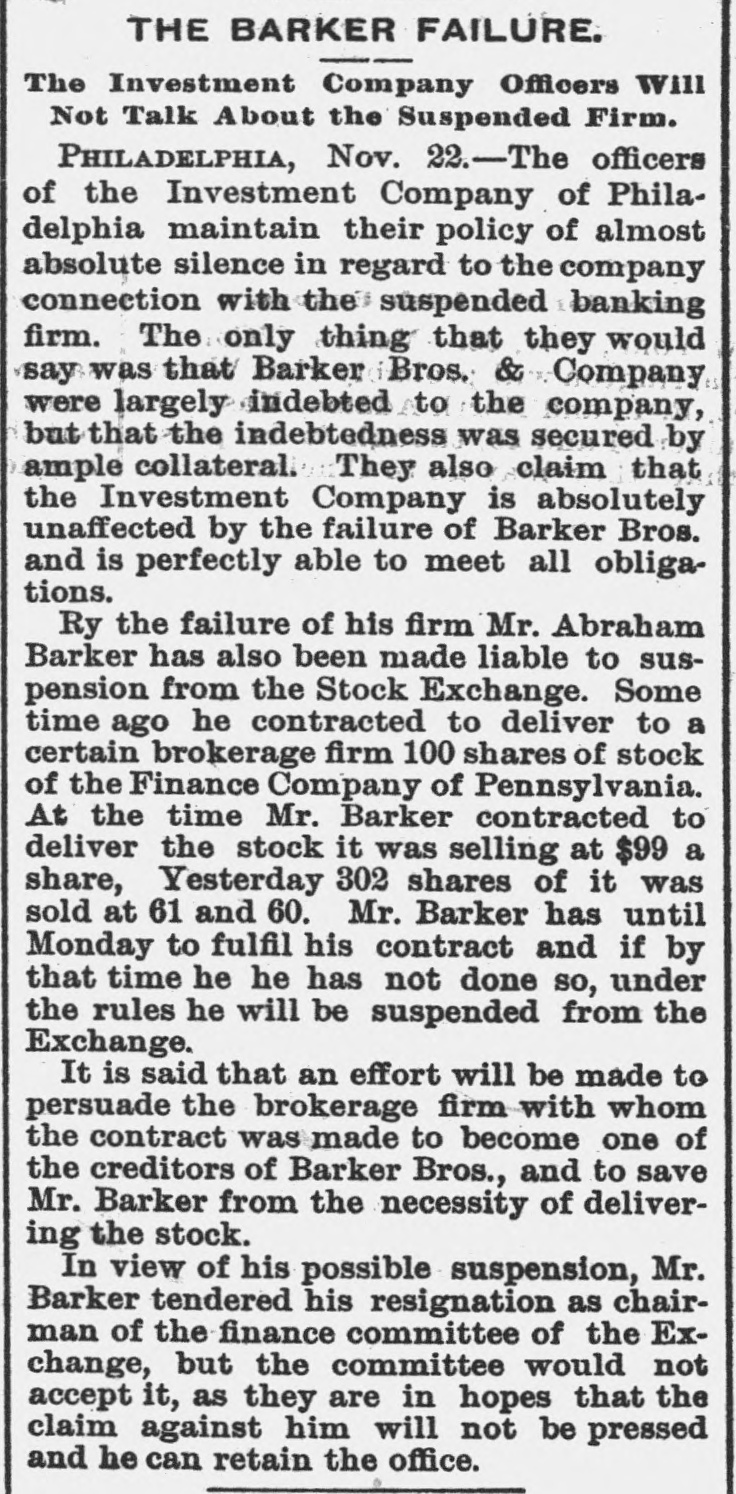
THE BARKER FAILURE. Nothing Since the Jay Cooke Disaster Has Created Such Excitement. PHILADELPHIA, Nov. 20.-Excepting the first receivership of the Philadelphia & Reading Railroad Company no event in financial circles of this city since the historial failure of Jay Cooke has created more widespread interest and greater excitement here than the suspension of the banking house of Barker Brothers & Co. Owing to the high personal character of the members of the firm and its foremost position among the banking houses of the city the effect of the announcement was startling. The excitement was not confined to this city. In a short time after the intelligence was flashed over the wires inquiries began to flow in from bankers in New York, Boston. Chicago, Cincinnati, St. Louis and other cities for particulars of the disaster. Despite the excitement in London attending the financial convulsion in that great monetary centre the failure excited notice there also, and Philadelphia correspondents of London houses were plied with queries over the cables.


Article from Delaware Gazette and State Journal, November 27, 1890

Click image to open full size in new tab

Article Text

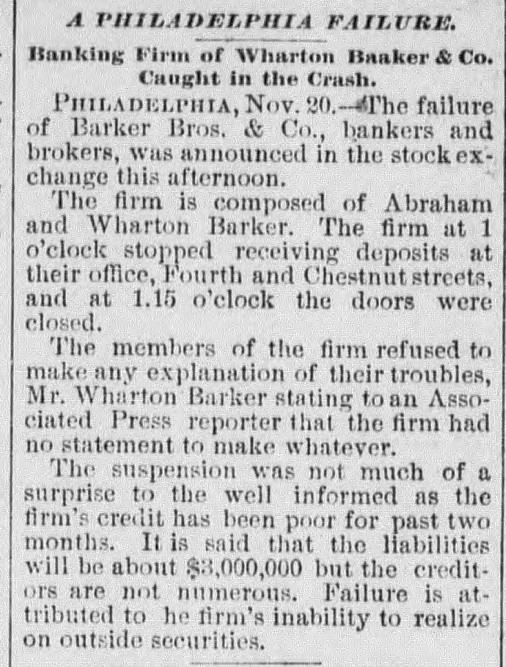
A PHILADELPHIA FAILURE. Banking Firm of Wharton Baaker & Co. Caught in the Crash. PHILADELPHIA, Nov. 20.-The failure of Barker Bros. & Co., bankers and brokers, was announced in the stock exchange this afternoon. The firm is composed of Abraham and Wharton Barker. The firm at 1 o'clock stopped receiving deposits at their office, Fourth and Chestnut streets, and at 1.15 o'clock the doors were closed. The members of the firm refused to make any explanation of their troubles, Mr. Wharton Barker stating to an Associated Press reporter that the firm had no statement to make whatever. The suspension was not much of a surprise to the well informed as the firm's credit has been poor for past two months. It is said that the liabilities will be about $3,000,000 but the creditors are not numerous. Failure is attributed to he firm's inability to realize on outside securities.


Article from The Mankato Free Press, November 28, 1890

Click image to open full size in new tab

Article Text

MANKATO, MINNESOTA, FRIDAY, NOVEMBER 28 Within โ‚น E A HEAVY failure is announced in Phip A CORRESPONDENT in last week's Lak adelphia. Barker Bros. & Co., bank Crystal Mirror, signing himself "A FRE STAR ers, suspend business with liabilities PRESS Subscriber," comments on an A placed at $3,000,000. It is expected that sociated Press dispatch from Washing 9dT the company will be able to pay their ton which quoted an editorial from indebtedness dollar for dollar. New York paper, warning capital t ะขะญะะฏะขะฅะญ 1000


Article from Evening Star, December 26, 1890

Click image to open full size in new tab

Article Text

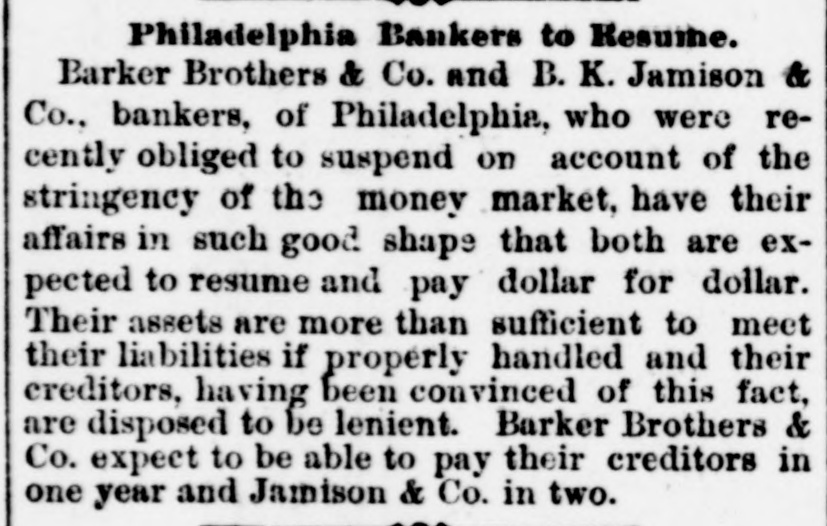
Philadelphia Bankers to Resume. Barker Brothers & Co. and B. K. Jamison & Co., bankers, of Philadelphia, who were recently obliged to suspend on account of the stringency of the money market, have their affairs in such good shape that both are expected to resume and pay dollar for dollar. Their assets are more than sufficient to meet their liabilities if properly handled and their creditors, having been convinced of this fact, are disposed to be lenient. Barker Brothers & Co. expect to be able to pay their creditors in one year and Jamison & Co. in two.


Article from The Madison Daily Leader, February 2, 1891

Click image to open full size in new tab

Article Text

Harker & Co. to Resume. PHILADELPHIA, Pa., Jan. 30.-Barkcr Bros. & Co., bankers, who assigned recently. have effected a settlement with their creditors, and to-day resumed business under the name of Barker & Co.


Article from Gilpin Observer, October 20, 1904

Click image to open full size in new tab

Article Text

SURPLUS AND DEFICIT. Comparison by Bryan to the Credit of Cleveland's Administration. Speaking of the panie of 1893. William J. Bryan says in the current issue of the Commoner: "The first indication of its coming appeared November 11. 1890, when the New York Clearing House Assoclation voted its certificates to banks in need of assistance, November 17 the Boston Clearing House did likewise. Barker Eros. & Co., bankers. of Philadelphia, failed with liabilities of $5,000,000. Mr. Bryan then gives a long list of failures, beginning with the United Rolling Stock Company. of Chicago, November 22, 1890, and ending with that of the Spring Garden Bank, of Philadelphia, May 8. 1891. Then came the Homestead and other great labor troubles. followed by the election of Cleveland to the Presidency. In May, 1893, there were more failures, and finally the raids on the United States Treasury. January 17. 1894, the Administration ordered a $50,000,000 bond issue. August 1. 1894, the Wilson tariff went into effeet." Continuing with his most interesting and timely retrospect, Mr. Bryan says: "It will be observed that the Cleveland Administration ordered the $50.000,000 bond issue January 17. 1894. That was seven months before the Wilson bill became a law. Perhaps it is not significant. but in view of Mr. Roosevelt's claim. it is at least interesting. that the first indications of the panic occurred November 11. 1890, a little more than thirty days after the McKinley tariff bill became a law. From that date the panic raged and while its effects were felt for several years. it reached its worst stage in 1893 and during the early days of 1894, during all of which time the McKinley tariff law was in effect. "It may not be out of place to point out that when the Democratic Administration surrendered the reins of government, March 4, 1889, there wax in the Federal Treasury the largest surwent power, plus party in history. out When of the Republican March 4. 1893. there was a large deficit and the incoming Administration was finally persuaded to make the bond issues which its Republican predecessor had at one time thought to be essary, but had skillfully avoided."


Article from Valentine Democrat, October 20, 1904

Click image to open full size in new tab

Article Text

SURPLUS AND DEFICIT. Comparison by Bryan to the Credit of Cleveland's Administration. Speaking of the panic of 1893. William J. Bryan says in the current issue of the Commoner: "The first indication of its coming appeared November 11, 1890, when the New York Clearing House Association voted its certificates to banks in need of assistance. November 17 the Boston Clearing House did likewise. Barker Bros. & Co., bankers, of Philadelphia, failed with liabilities of $5,000,000. Mr. Bryan then gives a long list of failures, beginning with the United Rolling Stock Company, of Chicago. November 22, 1890, and ending with that of the Spring Garden Bank, of Philadelphia, May S. 1891. Then came the Homestead and other great labor troubles. followed by the election of Cleveland to the Presidency. In May, 1893, there were more failures, and finally the raids on the United States Treasury. January 17, 1894. the Administration ordered a $50,000,000 bond issue. August 1, 1894, the Wilson tariff went into effect." Continuing with his most interesting and timely retrospect, Mr. Bryan says: "It will be observed that the Cleveland Administration ordered the $50,000,000 bond issue January 17, 1894. That was seven months before the Wilson bill became a law. Perhaps it is not significant, but in view of Mr. Roosevelt's claim. it is at least interesting, that the first indications of the panic occurred November 11, 1S90, a little more than thirty days after the McKinley tariff bill became a law. From that date the panic raged and while its effects were felt for several years. it reached its worst stage in 1893 and during the early days of 1894. during all of which time the McKinley tariff law was in effect. "It may not be out of place to point out that when the Democratic Administration surrendered the reins of government. March 4. 1889, there was in the Federal Treasury the largest surplus in history. When the Republican party went out of power,- March 4, 1893. there was a large deficit and the incoming Administration was finally persuaded to make the bond issues which its Republican predecessor had at one time thought to be necessary. but had skillfully avoided."


Article from Spirit of Jefferson, October 25, 1904

Click image to open full size in new tab

Article Text

SURPLUS AND DEFICIT. Comparison by Bryan to the Credit of Cleveland's Administration. Speaking of the panic of 1893. William J. Bryan says in the current issue of the Commoner: "The first indication of its coming appeared November 11, 1830, when the New York Clearing House Association voted its certificates to banks in need of assistance. November 17 the Boston Clearing House did likewise. Barker Bros. & Co., bankers, of Philadelphia, failed with liabilities of $5,000,000. Mr. Bryan then gives a long list of failures, beginning with the United Rolling Stock Company, of Chicago, November 22, 1890, and ending with that of the Spring Garden Bank, of Philadelphia, May 8, 1891. Then came the Homestead and other great labor troubles. followed by the election of Cleveland to the Presidency. In May, 1893, there were more failures, and finally the raids on the United States Treasury. January 17, 1894, the Administration ordered a $50,000,000 bond issue, August 1, 1894, the Wilson tariff went into effect." Continuing with his most interesting and timely retrospect, Mr. Bryan says: "It will be observed that the Cleveland Administration ordered the $50,000,000 bond issue January 17, 1894. That was seven months before the Wilson bill became a law. Perhaps it is not significant, but in view of Mr. Roosevelt's claim, it is at least interesting, that the first indications of the panic occurred November 11, 1890, a little more than thirty days after the McKinley tariff bill became a law. From that date the panic raged and while its effects were felt for several years, it reached its worst stage in 1893 and during the early days of 1894, during all of which time the McKinley tariff law was in effect. "It may not be out of place to point out that when the Democratic Administration surrendered the reins of government, March 4, 1889, there was in the Federal Treasury the largest surplus in history. When the Republican party went out of power, March 4, 1893, there was a large deficit and the incoming Administration was finally persuaded to make the bond issues which its Republican predecessor had at one time thought to be necessary. but had skillfully avoided."


Article from Iron County Register, January 30, 1908

Click image to open full size in new tab

Article Text

TALKING about panics, the following facts relating to that which culminated under Cleveland in 1903, are of peculiar interest: November 11, 1890, the reports showed financial distress in New York. The New York clearing house association voted its certificates to banks in need of assistance. The Boston clearing house association did the same thing November 17. Barker Bros. & Co., big bankers in Philadelphia, suspended at that time, with liabilities placed at $5,000,000. November 19, 1890, there was a run on the Citizen's Savings bank of New York, and a receiver was appointed for the North River bank. November 22, 1890, the United Rolling Stock company of Chicago assigned, with liabilities at $6,851,000. November 28, 1890, B. K. Jamieson & Co., the Philadelphia bankers, failed, with liabilites at $2,000,000. December 6, 1890, the Oliver iron and steel mills of Pittsburg shut down, discharging 2,000 employes. On the same date the cotton firm of Meyer & Co., of New Orleans failed, with liabilities at $2,000,000. January 3, 1891, tne Scotdale rolling mills and pike works and the Charlotte furnace and coke works in Pennsylvania closed, throwing 10,000 employes out of work. January 18, 1891, the American National bank at Kansas City suspended, with liabilities at $2,250,000. May 8, 1891, the Spring Garden National bank at Philadelphia closed its doors, and the Pennsylvania Safe Deposit and Trust company made an assignment. The Homestead strike and other strikes during 1892, and prior to election day, are well remembered by the people.