Washington Bank (Minneapolis, MN)

Episode Information

Episode UID
4903776591164
Episode Type
Run β†’ Suspension β†’ Closure
Bank Type
state
Bank ID
490377659 hash
Start Date
December 29, 1896
Location
Minneapolis, Minnesota (44.980, -93.264)

Metadata

Model
gpt-5-mini (chosen from majority vote of a three-model LLM ensemble)
Short Digest
d2218ef86a45ebcf

Response Measures

None

Description

Initial suspension was driven by runs after other local bank failures; subsequent records show receivership and asset disposition.

Events (4)

1. December 29, 1896 Run
Cause
Local Banks
Cause Details
Heavy withdrawals triggered by failures/suspensions of the Columbia National and Scandia banks in Minneapolis
Measures
Bank arranged for $50,000 in cash to meet demands; cashier telephoned examiner and attempted to obtain funds
Newspaper Excerpt
the suspension of the Columbia and Scandia ... created consternation among the patrons of the Washington Bank, and such a run ensued
Source
newspapers
2. December 30, 1896 Suspension
Cause
Local Banks
Cause Details
Officials suspended operations after run provoked by other banks' failures and inability to secure promised cash
Newspaper Excerpt
The Washington bank, a small state institution, closed its doors at noon.
Source
newspapers
3. January 1, 1897* Receivership
Newspaper Excerpt
requested him to take charge. This he did at once. (receiver later A. Ueland referenced in court reports.)
Source
newspapers
4. January 30, 1898 Other
Newspaper Excerpt
The report of the receiver in the Washington bank shows receipts of $141,079.25 and disbursements of $123,789.11 ... dividends declared of $99,551.77
Source
newspapers

Newspaper Articles (22)

Article from Richmond Dispatch, December 30, 1896

Click image to open full size in new tab

Article Text

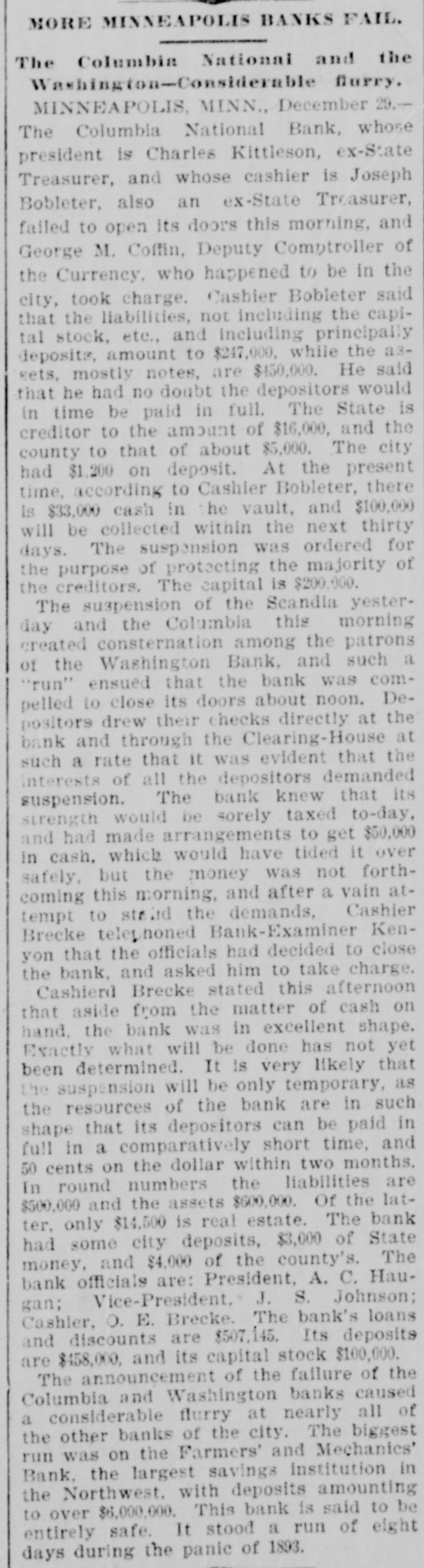
MORE MINNEAPOLIS BANKS FAIL. The Columbia National and the Washington-Considerable Burry. MINNEAPOLIS, MINN.. December 29.The Columbia National Bank, whose president is Charles Kittleson, ex-State Treasurer, and whose cashier is Joseph Bobleter, also an ex-State Treasurer, failed to open its doors this morning, and George M. Coffin, Deputy Comptroller of the Currency, who happened to be in the city, took charge. Cashier Bobleter said that the liabilities, not including the capital stock, etc., and including principally deposits, amount to $247,000. while the assets, mostly notes, are $450,000. He said that he had no doubt the depositors would in time be paid in full. The State is creditor to the amount of $16,000. and the county to that of about $5,000. The city had $1,200 on deposit. At the present time, according to Cashier Bobleter, there Is $33,000 cash in he vault, and $100,000 will be collected within the next thirty days. The suspension was ordered for the purpose of protecting the majority of the creditors. The capital is $200,000. The suppension of the Scandia yesterday and the Columbia this morning created consternation among the patrons of the Washington Bank, and such a "run" ensued that the bank was compelled to close its doors about noon. Depositors drew their checks directly at the bank and through the Clearing-House at such a rate that it was evident that the interests of all the depositors demanded suspension. The bank knew that its strength would be sorely taxed to-day, and had made arrangements to get $50,000 in cash. which would have tided it over safely, but the money was not forthcoming this morning, and after a vain attempt to stand the demands, Cashier Brecke telephoned Bank-Examiner Kenyon that the officials had decided to close the bank, and asked him to take charge. Cashierd Brecke stated this afternoon that aside from the matter of cash on hand, the bank was in excellent shape. Exactly what will be done has not yet been determined. It is very likely that the suspension will be only temporary, as the resources of the bank are in such shape that its depositors can be paid in full in a comparatively short time, and 50 cents on the dollar within two months. In round numbers the liabilities are $500,000 and the assets $600,000. Of the latter, only $14,500 is real estate. The bank had some city deposits, $3,000 of State money, and $4,000 of the county's. The bank officials are: President, A. C. Haugan; Vice-President. J. S. Johnson: Cashier, O. E. Brecke. The bank's loans and discounts are $507,145. Its deposits are $458,000, and its capital stock $100,000. The announcement of the failure of the Columbia and Washington banks caused a considerable flurry at nearly all of the other banks of the city. The biggest run was on the Farmers' and Mechanics' Bank. the largest savings institution in the Northwest, with deposits amounting to over $6,000,000. This bank is said to be entirely safe. It stood a run of eight days during the panic of 1893.
Article from Birmingham State Herald, December 30, 1896

Click image to open full size in new tab

Article Text

TWO BANKS In Minneapolis Close Their Doors-Almost a Panic in the City. Minneapolis, Minn., Dec. 29.-The Columbia National bank, whose president is Charles Kittelson, ex-state treasurer, and whose cashier is Joseph Bobleter, also an ex-state treasurer, failed to open its doors this morning, and George M. Coffin, deputy comptroller of the currency, who happened to be in the. city, took charge. Cashier Bobleter said that the liabilities, not including the capital stock, etc., and including principally deposits, amounted in round numbers to $247,000, while the assets, mostly notes, amounted to $450,000. He said that he had no doubt but that the depositors would in time be paid in full. The state is creditor to the amount of $16,000, and the county to about $5,000. The city had $1,200 on deposit at the present time. According to Cashier Bobleter, there is $33,000 cash in the vault and $100,000 will be collected within the next thirty days. The suspension was ordered for the purpose of protecting the majority of the creditors. The bank's capital is $200,000. The suspension of the Scandia yesterday and the Columbia this morning created consternation among the patrons of the Washington bank and such a run ensued that the bank was compelled to close its doors shortly after noon. Depositors drew their checks directly at the bank and through the clearing house at such a rate that it was evident that the interests of all the depositors demanded suspension of business. The bank knew that its strength would be sorely taxed today and had made arrangements to get $50,000 in cash, which would have tided it over safely, but the money was not forthcoming this morning and after a vain at-


Article from Morris Tribune, December 30, 1896

Click image to open full size in new tab

Article Text

The Washington Bank. MINNEAPOLIS, Minn., Dec. 30.-The Washington bank, a small state institution, closed its doors at noon. It had a capital of $100,000. A. C. Haugan, city treasurer. was one of the founders of the bank and is one of its directors. The closing of the Columbia National caused a run and it was decided best to*close. The bank is said to be perfectly solvent and its assets will be quickly realized upon.


Article from The Madison Daily Leader, December 30, 1896

Click image to open full size in new tab

Article Text

The Washington Bank. MINNEAPOLIS, Minn., Dec. 30.-The Washington bank, a small state institution, closed its doors at noon. It had a capital of $100,000. A. C. Haugan, city treasurer, was one of the founders of the bank and is one of its directors. The closing of the Columbia National caused a run and it was decided best to close. The bank is said to be perfectly solvent and its assets will be quickly realized upon.


Article from The Times, December 30, 1896

Click image to open full size in new tab

Article Text

BUSINESS TROUBLES. Two Minneapolis Banks Close Their Doors Other Failures, MINNEAPOLIS, MINN., Dec. 29.-The Columbian National bank, of this city, closed its doors this morning owing to inability to make collections. It is a comparatively new bank, having been organized about five years ago with exState Treasurer Charles Kittleson as its president and ex-State Treasurer Bobleter as cashier, which positions they still held. Its capital on December 18th was $200,000 with a surplus of about $6,000. loans and discounts were $348,000 and its deposits $264,000. It has never been profitable. Deputy Controller of the Currency George W. Coffin, who happened to be in the city, took charge of the bank. Its officers claim that they will be able to pay depositors in full. The Washington Bank, of this city, has closed its doors. Its last statement, December 17th, shows loans and discounts of $500,000. and deposits of $540,000. Its capital is $100,000 and its surplus $13,000. A. C. Haugan, its president, is city treasurer and it is likely that quite an amount of city funds will be lΓΆcked up by the failure. Its business is largely with working people. The officers claim that they will be able to pay them in full. The#suspension of the Scandia yesterday and the Columbia this morning created consternation among the patrons of the Washington Bank, and such a "run" ensued that the bank was compelled to close its doors about noon. Cashier Brecke stated this afternoon that aside from the matter of cash on hand, the bank was in excellent shape. Exactly what will be done has not yet been determined. It is very likely that the suspension will be only temporary, as the resources of the bank are in such shape that its depositors can be paid in full in a comparatively short time. and fifty cents on the dollar within two months. In round numbers, the liabilities are $500,000 and the assets $600,000. the latter only $14,500 is real estate. The announcement of the failure of the Columbia and Washington Banks caused a considerable flurry at nearly all of the other banks of mers city. The and biggest run was on the Mechanics Bank, the largest savings institution in the Northwest, with deposits of over $6,000,000. This bank is said to be entirely safe. It stood a run of eight days during the panic of 1893. PROVIDENCE, R I., Dec. 29.-The Phoenix Woolen Company filed its petition of insolvency in the Appellate Court to-day. Liabilities, $300,000. The assets about $250,000. CHICAGO, ILL., Dec. 29.-As a result of the voluntary liquidation of the Atlas National Bank, of this city, W11liam M. and John S. Van Nortwick, who held 464 shares of stock in that bank, and were borrowers therefrom to the amount of $300,000, made an assignment yesterday to the Equitable Trust Company, of Chicago, who took possession of the Van Nortwick's bank at Batavia yesterday. The failure involves the entire interests of the Van Nortwicks, whose estimated wealth. according to their last statement, is $2,500,000, often estimated at three times that amount, and representing besides the Van Nortwick Bank and other property at Batavia, large manufacturing interests. The total nabilities will be near $2,000,000. BALTIMORE, Dec. 29.-L. Snellberger & Son, leading retail dry-goods merchants, of South Baltimore, made an assignment Mo-day. Liabilities, $50,000; assets, about the same amount. Pressure of creditors and slow collections caused the suspension. SIOUX CITY IA.. Dec. 29.-On application of W. T. Honsinger, vice-president, and a large shareholder in the Farmers' Trust Company, of this place; G. H. Hollister was to-day appointed receiver for the institution. Receiver Hollister estimates assets at $238,000 and lia-

Article from The Saint Paul Globe, December 30, 1896

Click image to open full size in new tab

Article Text

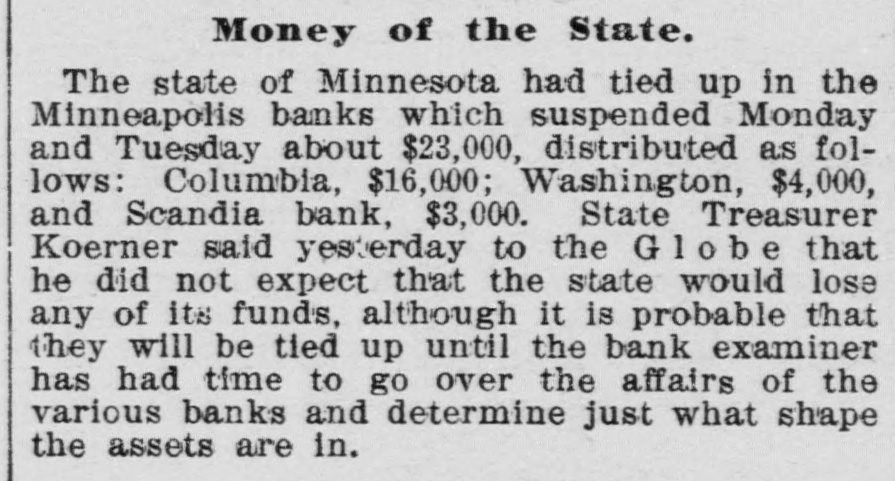
Money of the State. The state of Minnesota had tied up in the Minneapolis banks which suspended Monday and Tuesday about $23,000, distributed as follows: Columbia, $16,000; Washington, $4,000, and Scandia bank, $3,000. State Treasurer Koerner said yesterday to the Globe that he did not expect that the state would lose any of its funds, although it is probable that they will be tied up until the bank examiner has had time to go over the affairs of the various banks and determine just what shape the assets are in.


Article from The Columbian, December 31, 1896

Click image to open full size in new tab

Article Text

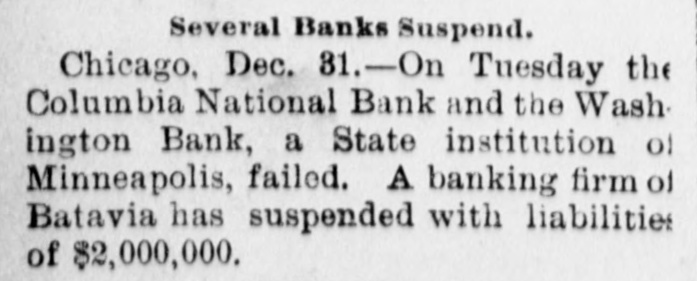
Several Banks Suspend. Chicago, Dec. 31.-On Tuesday the Columbia National Bank and the Wash ington Bank, a State institution of Minneapolis, failed. A banking firm of Batavia has suspended with liabilities of $2,000,000.


Article from The Sauk Centre Herald, December 31, 1896

Click image to open full size in new tab

Article Text

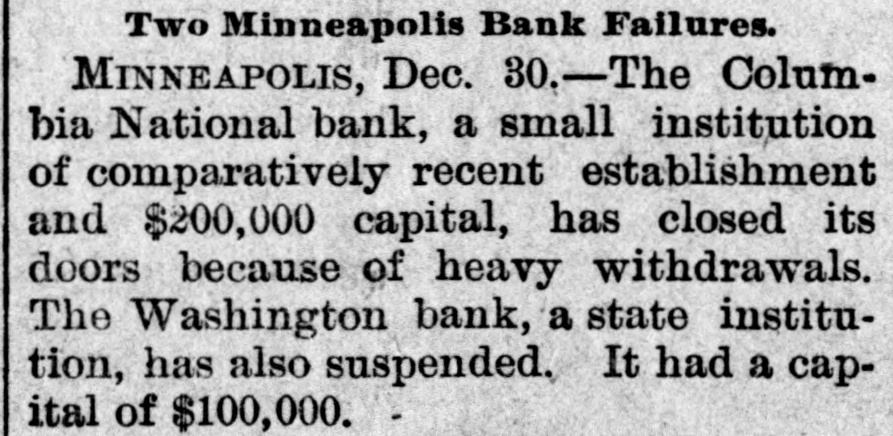
Two Minneapolis Bank Failures. MINNEAPOLIS, Dec. 30.-The Columbia National bank, a small institution of comparatively recent establishment and $200,000 capital, has closed its doors because of heavy withdrawals. The Washington bank, a state institution, has also suspended. It had a capital of $100,000.


Article from The Columbia Herald, January 1, 1897

Click image to open full size in new tab

Article Text

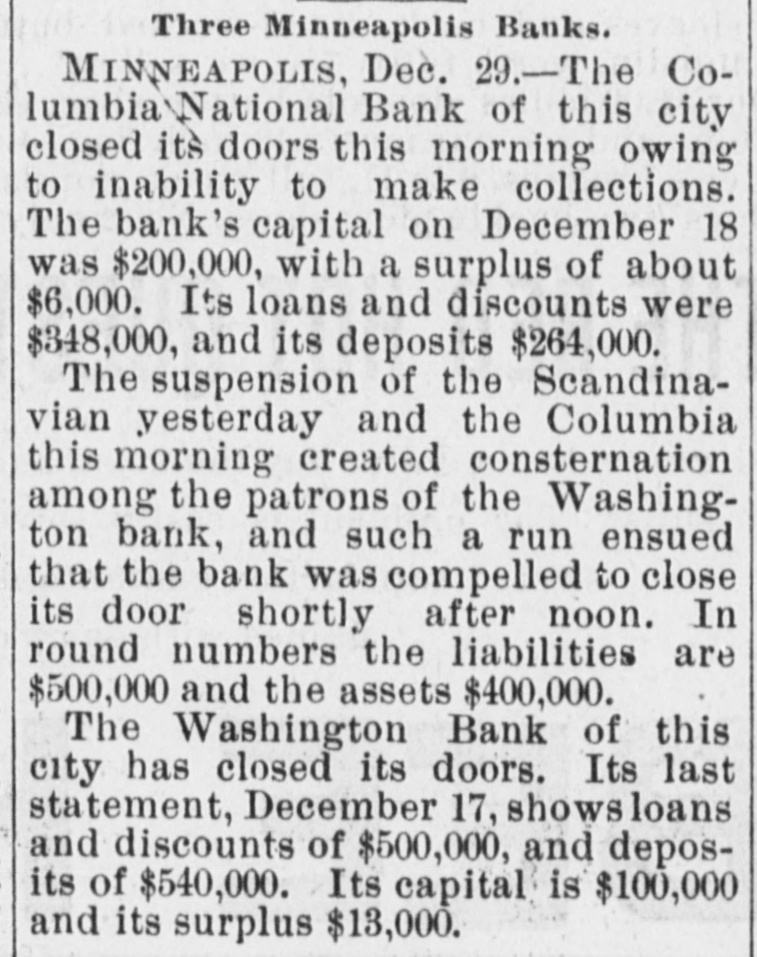
Three Minneapolis Banks. MINNEAPOLIS, Dec. 29.-The Columbia National Bank of this city closed its doors this morning owing to inability to make collections. The bank's capital on December 18 was $200,000, with a surplus of about $6,000. Its loans and discounts were $348,000, and its deposits $264,000. The suspension of the Scandinavian yesterday and the Columbia this morning created consternation among the patrons of the Washington bank, and such a run ensued that the bank was compelled to close its door shortly after noon. In round numbers the liabilities are $500,000 and the assets $400,000. The Washington Bank of this city has closed its doors. Its last statement, December 17, shows loans and discounts of $500,000, and deposits of $540,000. Its capital is $100,000 and its surplus $13,000.


Article from Little Falls Weekly Transcript, January 1, 1897

Click image to open full size in new tab

Article Text

Two Minneapolis Bank Failures. MINNEAPOLIS, Dec. 30.-The Columbia National bank, a small institution of comparatively recent establishment and $200,000 capital, has closed its doors because of heavy withdrawals. The Washington bank, a state institution, has also suspended. It had a capital of $100,000.


Article from The Broad Ax, January 2, 1897

Click image to open full size in new tab

Article Text

PRΓ“SPERITY ABROAD. THE way in which the business interests of the United States are recuperating, after learning of McKinley's election, is truly astonishing. The following took the situation to heart on the 28th inst., in the manner and form following, that is to say: Superior Bank, of Superior, Wis., failed. George F. Grassel & Co., of Cincinnati, dry goods merchants for twenty years, assigned. White & Howe, retail shoe dealer, of Sioux City, Ia., croaked. The Stetson & Post Sawmill Co., of Seattle, Wash., closed, throwing seventy men out of employment. And on the 29th inst., it came to pass, as follows, that is to say: The Columbia Bank, of Minneapolis, failed to open its doors. The Washington Bank, of the same place, flunked. Commercial Bank, of Roanoke, Va., followed suit. Farmers' Trust Co., of Sioux City, Ia., busted. Adolph Scheyer & Co., of Leadville, Colo., a wholesale liquor house, dried up. Atlas Bank, of Chicago, and the National Bank of Illinois, found themselves short of dough. And the end is not yet.


Article from The Diamond Drill, January 2, 1897

Click image to open full size in new tab

Article Text

which it could not realize. A Car Company Closes Shop. Laconia, N. H., Dec. 29.-The Laconia Car company was forced into insolvency Monday. The total liabilities are placed at $617,000 and assets at $407,000. Minneapolis Banks Suspend. Minneapolis, Minn., Dec. 30.-The Columbia national bank, whose president is Charles Kittleson, ex-state treasurer, and whose cashier is Joseph Bobleter, also an ex-state treasurer. failed to open its doors Tuesday morning, and George M. Coffin, deputy controller of the currency, who happened to be in the city, took charge. Cashier Bobleter said that the liabilities, not including the capital stock, etc., and including principally deposits, amount in round numbers to $247,000, while the assets, mostly notes, amounted to $450,000. He said that he had no doubt but that the depositors would in time be paid in full. The state is a creditor to the amount of $16,000 and the county to about $5,000. The city had $1,200 on deposit. At the present time, according to Cashier Bob. leter, there is $33,000 cash in the vault, and $100,000 will be collected within the next 30 days. The suspension was ordered for the purpose of protecting the majority of the creditors. The bank's capital is $200,000. Closed Its Doors. The suspension of the Seaudia Monday and the Columbia Tuesday morning created consternation among the patrons of the Washington bank and such a run ensued that the bank was compelled to close its doors shortly after noon. Depositors drew their checks directly at the bank and through the clearing house at such a rate that it was evident that the interests of all the depositors demanded a suspension of business. The bank knew that its strength would be sorely taxed, and had made arrangements to get $50,000 in cash which would have tided it over safely, but the money was not forthcoming Tuesday morning, and after a vain attempt to stand the demands, Cashier Brecke telephoned Bank Examiner Kenyon that the officials had decided to close the bank and asked him to take charge. A Kansas County Insolvent. Dighton, Kan., Dec. 30.-Lane county has formally. been declared insolvent by the county commissioners and the county treasurer has been ordered to stop further payment of interest on the county's bonded indebtedness, which amounts to $125,000. The securities are held by 40 corporations and individuals in New York and New England and have been quoted almost at par. Chairman Helmie, of the county board, declared the settlers were not repudiators and paid their taxes promptly, but the nonresident land-owners, such as the Jarvis-Conklin Mortgage company, had not paid any taxes for years, which prevented the county from raising enough money by taxation to meet its obligations. A Virginia National Bank Fails. Washington, Dec. 30.-The failure of the Commercial national bank of Roanoke, Va., was made known to the comptroller of the currency by telegraph and Comptroller Eckels immediately wired Bank Examiner Sands to take charge. The failure is attributed partly to speculation incident to the Roanoke boom. Mr. Eckels says the failure is not important. On November 21, the date of the last report of the condition of the bank, the assets were $263,704. including bonds to secure circulation: stock, $100,000: surplus, $25,000: undivided profits, $6,000; owing depositors, $75,000; other liabilities, $35,000 Receiver Named. Sioux City, Ia., Dec. 30.-On application of W. T. Honsinger, vice president and a large shareholder in the Farmers' Trust company of this place, G. H. Hollister was on Tuesday appointed re. ceiver for the institution. Tightness of the money market rendered it impossible for the company to meet its debentures when the makers of notes


Article from The Irish Standard, January 2, 1897

Click image to open full size in new tab

Article Text

WASHINGTON BANK. It Goes the Way of the Other Unfortunates. The Washington Bank, incorporated under the state laws, closed its doors yesterday at about noon. Its customers were largely of the same class that had patronized the Scandia and Columbia National banks, and the suspension of those two institutions caused a "run" on the Washington, which was located on the corner of Washington and Second avenues south. The bank officials had anticipated the run and had arranged for some $50,000 to carry them through the day, but at the last moment the amount was not forthcoming, and after making a vain endeavor to stem the tide and meet all demands as fast as presented, Cashier Brecke finally wired Public Examiner Kenyon that the directors had decided to close the bank; and requested him to take charge. This he did at once. The closing of these two banks, following so closely on the suspension of the Scandia on the day before, caused the wildest rumors to be circulated regarding a number of other banks. Happily there appears to be no foundation whatever for these rumors. At least, members of the clearing house association, who are certainly qualified to speak intelligently upon the subject, assert most emphatically that there will be no further suspensions among the banks. In reference to the affairs of the Washington bank, Cashier Brecke stated yesterday afternoon that aside from the matter of cash on hand, the bank was in excellent shape. Exactly what will be done has not yet been determined. It is very likely that the suspension will be only temporary, as the resources of the bank are in such a shape, according to Mr. Brecke, that its depositors can be paid in full in a comparatively short time, and 50 cents on the dollar within two months. In round numbers the liabilities are $500,000 and the assets $600,000. Of the latter only $14,500 are real estate. The bank had some city deposits, $3,000 of state money, and $4,000 of the county's. The bank's officials are as follows: President, A. C. Haugan; vice president, A. E. Johnson; cashier, O. E. Brecke; assistant cashier, August Breckman. Inquiry was made at the city hall in reference to the amount of funds on deposit by the city, not only in the suspended banks, but also in all the other banks in the city. Assistant City Treasurer Ankeny stated that he would prepare the information and present it to the mayor for communication to the city council at its next meeting. Until


Article from Willmar Tribune, January 5, 1897

Click image to open full size in new tab

Article Text

Two Minneapolis Bank Failures. MINNEAPOLIS, Dec. 30.-The Columbia National bank, a small institution of comparatively recent establishment and $200,000 capital, has closed its doors because of heavy withdrawals. The Washington bank, a state institution, has also suspended. It had a capital of $100,000.


Article from The Indianapolis Journal, April 7, 1897

Click image to open full size in new tab

Article Text

MINNESOTA BANKS. Sensational Disclosures as to Failed Concerns of the Twin Cities. ST. PAUL, Minn., April 6.-The joint legislative committee investigating insolvent banks to-day made public the testimony secured during the past two months. The committee investigated banks in St. Paul and Minneapolis, and some of the disclosures are sensational in the extreme. As to the Bank of Minnesota, W. H. Lightner, one of the receivers. stated that on Oct. 7 $135,606 was due to the bank from the Fort Dearborn National Bank of Chicago. This balance was incorrect. The accounts between these two banks were falsified to the extent of $100,000. At the time of the failure of the bank there was owing to it by the bank officials the following sums: William Dawson, sr., about $90,000: William Dawson, jr., $59,950: R. A. Smith did owe the bank $50,000, and has since paid $35,000. In addition to that William Dawson, jr., was guarantor of $35,000, of which $30,000 was overdrawn. As to the cause of the failure of the bank it was testified that William Dawson, sr., owed it $281,000. As to the Scandia Bank, of Minneapolis, the committee state that its failure, according to the evider ce, was honest and it may yet pay in full. Lack of judgment in loans caused its suspension. Taking up the case of the Washington Bank of Minneapolis, the committee says that it went under for want of paid-up capital, direct and indirect loans to its officers and from a lack of supervision. Assets were accepted at par when practically worthless. Stock was simply issued without capital or paid in part in securities of doubtful or worthless character. Dwelling upon the affairs of the Allemania Bank of St. Paul, the report says the assets, or a large portion of them, were worthless. The directors were heavy borrowers and were guilty of misstatements. As to the affairs of the Minnesota Savings Bank of St. Paul, directly or indirectly, the committee states the officers were borrowers to an amount more than double the capital stock. The character of their accounts is shown by the asset of $10,000 cash they exhibited, when the receiver found it to be $1 in actual coin. Their loans were worthless. The last examination was made in October, 1895, and on its evidence the bank examiner ought to have closed it then.


Article from The Times, April 8, 1897

Click image to open full size in new tab

Article Text

SENSATIONAL DISCLOSURES MADE A Legislative Committee Investigating Bank Failures. St. Paul, Minn., April 7.-The jointlegislative committee investigating insolvent banks in this city and Minneapolis has made public the testimony secured during the past two months. Some of the disclosures are highly sensational. As to the Bank of Minnesota, of which William Dawson, Sr., was the president, and William Dawson, jr., cashier, W. H. Lightner, one of the receivers, stated that on October 7 $135,606 was due to the bank from the Fort Dearborn National Bank of Chicago. The balance, he said, was incorrect, accounts between these two banks being falsified to the extent of $100,000. At the time of the failure of the bank there was owing to it by the officials the following sums: William Dawson, sr., about $90,000; William Dawson, jr., $59,950: R. A. Smith, $50,000, of which he has since paid $35,000. In addition to that, William Dawson, jr., was guarantor of $53,000, of which $30,000 was overdrawa. As to thecause of the failure of the bank, it was testified that William Dawson, sr., owed it $281,000. The schedules of assets and liabilities of William Dawson, jr., have been filed in the district court. The assets are placed at $239,168.78, and the liabilities, $868,452.47. The face value of the assets is much higher. By far the largest portion of Mr. Daw. son's direct liabilities consists of in dividual notes. A few of these are secured, but most of them only by the indorsement of William Dawson, sr. As to the Scandia Bank, of Minneapolis, the committee states that its failure, according to the evidence, was honest, and it may yet pay in full. The committee says that the Washington Bank, of Minneapolis, went under for want of paid-up capital, direct and indirect loans to its officers, and from a lack of supervision. Dwelling upon the affairs of the Allemania Bank, of St. Paul, the report says that the assets, or a large portion of them, were worthless. The directors, it states, were heavy borrowers, and were guilty of misstatements. As to the affairs of the Minnesota Savings Bank, of St. Paul, the committee states the officers were borrowers. directly or indirectly. to an amount more than double the capital stock.


Article from Perrysburg Journal, April 10, 1897

Click image to open full size in new tab

Article Text

ROTTEN BANKS. Sensational Disclosures Concerning Insolvent Concerns in St. Paul and Minneapolis. ST. PAUL, Minn., April 7.-The joint legislative committee investigating insolvent banks yesterday made public the testimony secured during the past two months. The committee investigated banks in St. Paul and Minneapolis and some of the disclosures are sensational in the extreme. As to the Bank of Minnesota, W. H. Lightner, one of the receivers, stated that on October 7, $135,606 was due to the bank from the Fort Dearborn national bank, of Chicago. This balance was incorrect. The accounts between these two banks were falsified to the extent of $100,000. At the time of the failure of the bank there was owing to it by the bank officials the following sums: William Dawson, about $90,000; William Dawson, jr., $59,950; R. A. Smith did owe the bank $50,000 and has since paid $35,000. In addition to that William Dawson, jr., was guarantor of $53,000, of which $30,000 was overdrawn. As to the cause of the failure of the bank, it was testified that William Dawson, sr., owed it $281,000. As to the Scandia bank, of Minneapolis, the committee state that its failure was honest and it may yet pay in full. Lack of judgment in the loans caused its suspension. Taking up the case of the Washington bank, of Minneapolis, the committee say that it went under for want of paid up capital, direct and indirect loans to its officers and from a lack of supervision. Assets were accepted at par when practically worthless. As to the Minnesota Savings bank, of St. Paul, the officers were borrowers to an amount more than double the capital stock. The character of their accounts is shown by the asset of $10,000 cash they exhibited when the receiver found it to be $1 in actual coin. Their loans are worthless.


Article from The Saint Paul Globe, January 30, 1898

Click image to open full size in new tab

Article Text

MINNEAPOLIS. OFFICE 65 SOUTH FOURTH STREET. # MINNEAPOLIS GLOBULES. Maud McBride has begun suit for divorce from Harry L. McBride on the grounds of desertion. Rika Peterson, who has been employed as domestic, was examined as to her sanity in the probate court and ordered committed to the asylum. Harriet Elizabeth Reeves has filed a petition for letters of administration in the estate of Delia R. Capron, who leaves $28,500 to six heirs. P. W. De Lancey, of Minneapolis, and Schmidt Brothers, of West Superior, Wis., were awarded the contract for the new flour warehouse at Superior for the Eastern Railway of Minnesota. It requires nearly 10,000 piles and 5,000,000 feet of lumber. That rollicking, roaring farcical review of R. F. Outcault's pen pictures, lately so popular in New York, will be the attraction at the Bijou for one week, beginning at today's matinee, and comes under the familiar title of "McFadden's Row of Flats." The board of sinking fund commissioners met yesterday morning in the office of Mayor Pratt, and agreed to accept the compromise of the bondsmen of A. C. Haugan, in so far as it related to the money of the sinking fund. The amount which the fund receives is $17,680. John Peterson, the new collector of customs for the district of Minnesota, made the rounds of the federal building yesterday morning. He stated that he would take up the office on Feb. 1, but gave no intimations of his intentions regarding the Minneapolis collectorship. "The Geisha, which had an unprecedented run at the Savoy theater in London, and at Daly's theater in New York, will be seen at the Metroplitan theater this week, commencing this evening, with the same elaborate scenery and costumes, several of the London and nearly all of the New oYrk favorites in the cast. The report of the receiver in the Washington bank shows receipts of $141,079.25 and disbursements of $123,789.11, with cash on hand of $14,039.12. There have been dividends declared of $99,551.77 and money returned depositors by order of court amounting to $11,961.17. The receiver leaves the value of his services to the court. The matter will be heard Feb. 26.


Article from The Saint Paul Globe, April 22, 1898

Click image to open full size in new tab

Article Text

Bids for Lands. W. D. Washburn Jr. has made an offer to A. Ueland, receiver of the Washington bank, Minneapolis, for all the unimproved farm land owned by the bank in Minnesota and Dakota. The report is made to the court that there are 3,858 acres upon which the bank loaned money and finally acquired. It is is situated in eleven different Minnesota counties and several Dakota counties. The offer averages $1.75 per acre and foots up $6,751.90. It is expected that the offer will be accepted by the court.


Article from The Saint Paul Globe, May 20, 1898

Click image to open full size in new tab

Article Text

BANK IS SUSTAINED. Washington Bank Wins the Suit of Brusegard. Thomas Brusegaard put some checks in the Washington bank, of Minneapolis, shortly before it suspended. Before the checks were collected the bank closed. Brusegard sued for their return. The court holds that the checks were deposited with the condition that if they were not paid on presentation it could rescind the act of giving credit, and also holds that it has not been sworn by the plaintiff that the officers of the bank knew it was insolvent at the time that they took the checks for collection. The syllabus is: In rereceivership Washington bank. Thomas Brusezard, petitioner, appellant, vs. Andreas Ueland, receiver, respondent. On the petition and answer, held the petitioner has not established the fact that when the insolvent bank received the deposit from him, its officers knew it was insolvent. Petitioner kent an account in the bank. and it received his deposit, consisting of checks under an agreement that they should be credited to that account, and if not pa'd on presentation, they should be charged back against his account. Held, the title to the checks passed to the bank, subject to the condition intended for its protection, that if the checks were not paid on presentation, It could rescind the act of giving credit, and its title would thereupon be divested. Held, further, the failure of the bank after it had received the checks and before the same were collected, did not divest its title. Order affirmed. -Canty, J.


Article from Willmar Tribune, August 30, 1899

Click image to open full size in new tab

Article Text

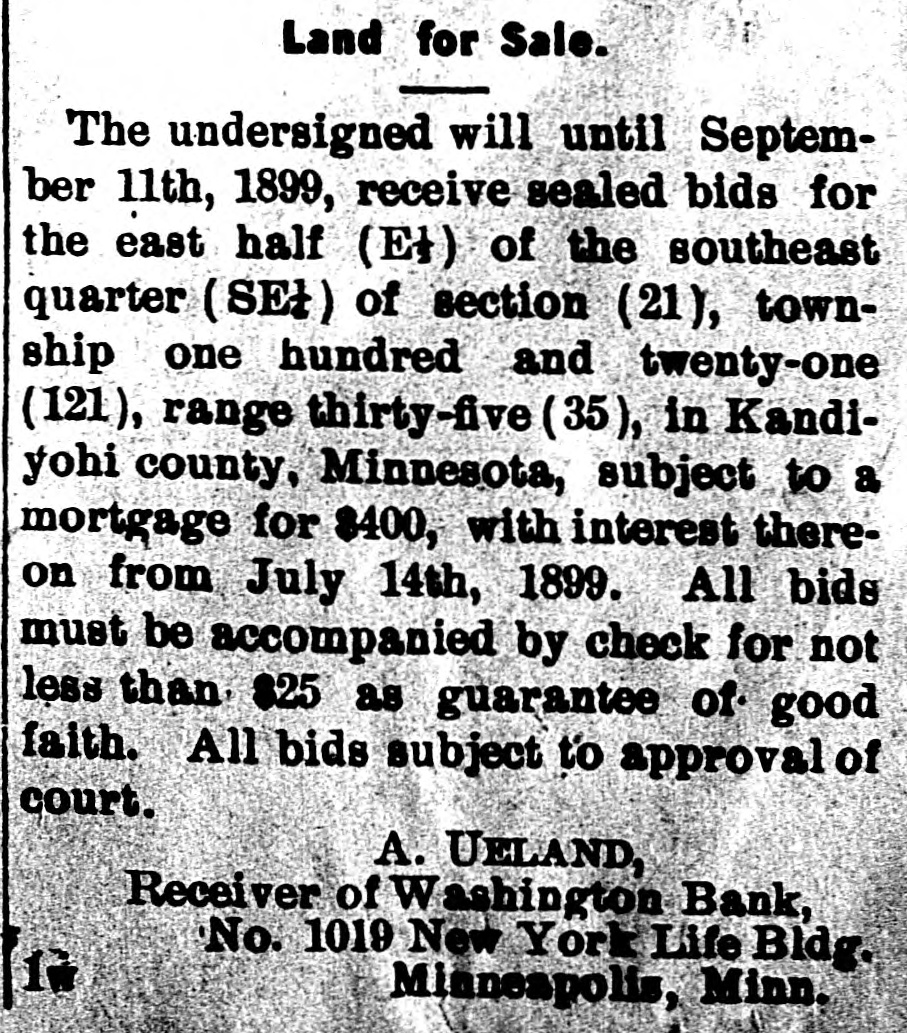
i Land for Sale. The undersigned will until September 11th, 1899, receive sealed bids for the east half (E) of the southeast quarter (SEt) of section (21), township one hundred and twenty-one (121), range thirty-five (35), in Kandiyohi county, Minnesota, subject to a mortgage for $400, with interest thereon from July 14th, 1899. All bids must be accompanied by check for not less than 825 as guarantee of. good faith. All bids subject to approval of court. A. UELAND, Receiver of Washington Bank, No. 1019 New York Life Bldg. 1a Mianeapolis, Minn.


Article from The Saint Paul Globe, September 12, 1900

Click image to open full size in new tab

Article Text

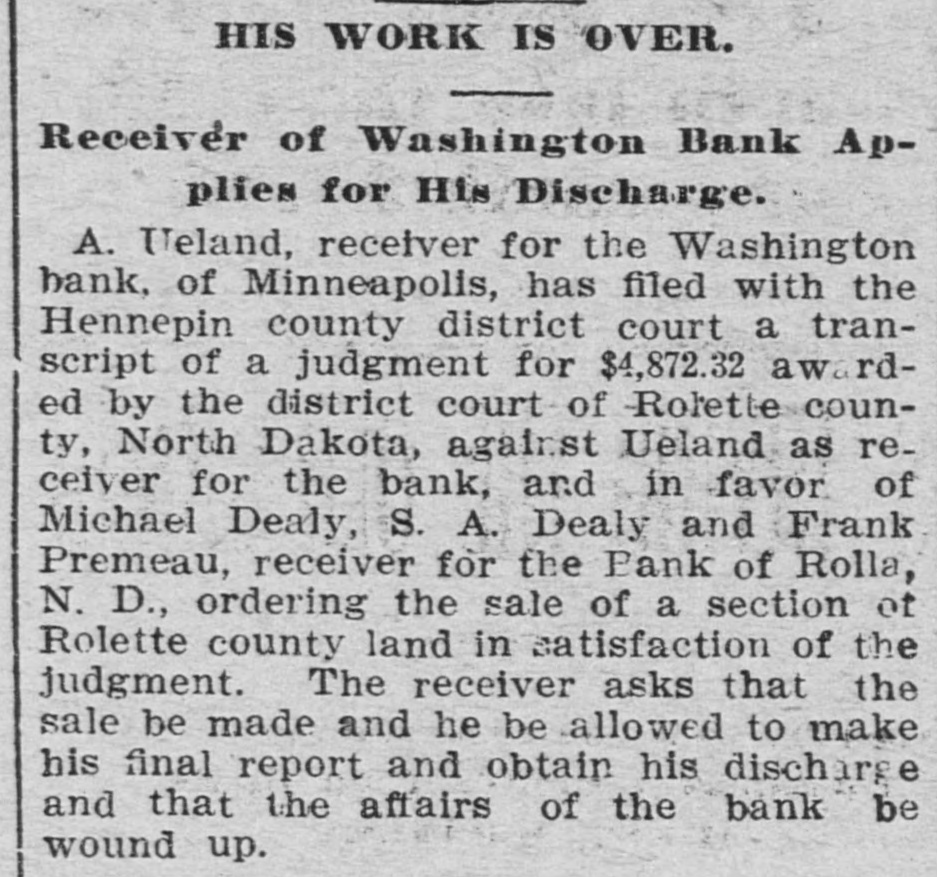
HIS WORK IS OVER. Receiver of Washington Bank Applies for His Discharge. A. Ueland, receiver for the Washington bank, of Minneapolis, has filed with the Hennepin county district court a transcript of a judgment for $4,872.32 awarded by the district court of Rolette county, North Dakota, against Ueland as receiver for the bank, and in favor of Michael Dealy, S. A. Dealy and Frank Premeau, receiver for the Bank of Rolla, N. D., ordering the sale of a section of Rolette county land in satisfaction of the judgment. The receiver asks that the sale be made and he be allowed to make his final report and obtain his discharge and that the affairs of the bank be wound up.