Roseville Trust Company (Newark, NJ)

Episode Information

Episode UID
4915971991364
Episode Type
Run β†’ Suspension β†’ Reopening
Bank Type
trust
Bank ID
491597199 hash
Start Date
August 1, 1913*
Location
Newark, New Jersey (40.736, -74.172)

Metadata

Model
gpt-5-mini (chosen from majority vote of a three-model LLM ensemble)
Short Digest
e082dfe7323ba61b

Response Measures

None

Events (3)

1. August 1, 1913* Suspension
Cause
Government Action
Cause Details
State banking examiners/department took charge and the trust company was closed following discovery of the large shortage.
Newspaper Excerpt
The Trust company suspended last August.
Source
newspapers
2. August 15, 1913 Run
Cause
Bank Specific Adverse Info
Cause Details
Public revelation of a large shortage/embezzlement by the missing secretary-treasurer Raymond E. Smith triggered depositor panic and heavy withdrawals.
Measures
Directors and large depositors pledged funds and sought reorganization; directors later pledged cash to make up shortages.
Newspaper Excerpt
Depositors of the Roseville Trust Company were panic-stricken to-night when the news became public that the total shortage of the bank would reach, if not exceed, half a million dollars.
Source
newspapers
3. February 23, 1914 Reopening
Newspaper Excerpt
The Mutual Bank of Roseville, organized out of the wreck of the Roseville Trust Company, will open its doors to the public tomorrow morning ... prepared to meet any demands made upon it.
Source
newspapers

Newspaper Articles (22)

Article from The Times Dispatch, August 16, 1913

Click image to open full size in new tab

Article Text

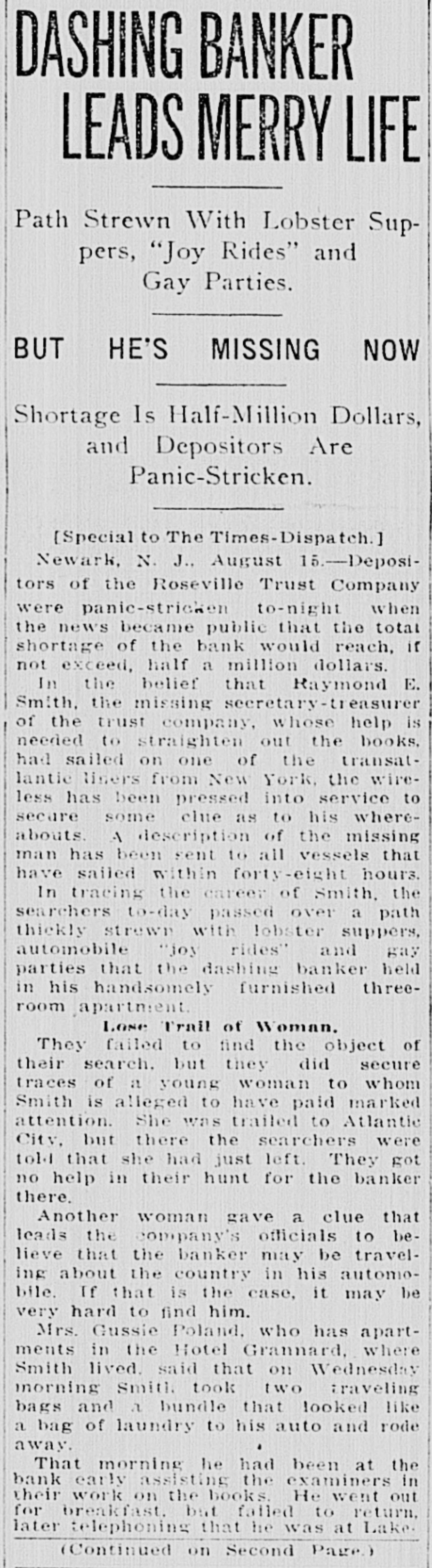
DASHING BANKER LEADS MERRY LIFE Path Strewn With Lobster Suppers, "Joy Rides" and Gay Parties. BUT HE'S MISSING NOW Shortage Is Half-Million Dollars, and Depositors Are Panic-Stricken. [Special to The Times-Dispatch.] Newark, N. J.. August 15.-Depositors of the Roseville Trust Company were panic-stricken to-night when the news became public that the total shortage of the bank would reach, if not exceed, half a million dollars. In the belief that Raymond E. Smith, the missing secretary-treasurer of the trust company, whose help is needed to straighten out the books. had sailed on one of the transatlantic liners from New York, the wireless has been pressed into service to secure some clue as to his whereabouts. A description of the missing man has been sent to all vessels that have sailed within forty-eight hours. In tracing the career of Smith. the searchers to-day passed over a path thickly strewn with !obster suppers, automobile "joy rides" and gay parties that the dashing banker held in his handsomely furnished threeroom apartment Lose Trail of Woman. They failed to find the object of their search. but they did secure traces of a young woman to whom Smith is alleged to have paid marked attention. She was trailed to Atlantic City, but there the searchers were told that she had just left. They got no help in their hunt for the banker there. Another woman gave a clue that leads the company's officials to believe that the banker may be traveling about the country in his automobile. If that is the case, it may be very hard to find him. Mrs. Gussie Poland. who has apartments in the Hotel Grannard, where Smith lived. said that on Wednesday morning Smith took two traveling bags and a bundle that looked like a bag of laundry to his auto and rode away. That morning he had been at the bank early assisting the examiners in their work on the books. He went out for breakfast. but failed to return. later telephoning that the was at Lake. (Continued on Second Page.)


Article from New-York Tribune, August 20, 1913

Click image to open full size in new tab

Article Text

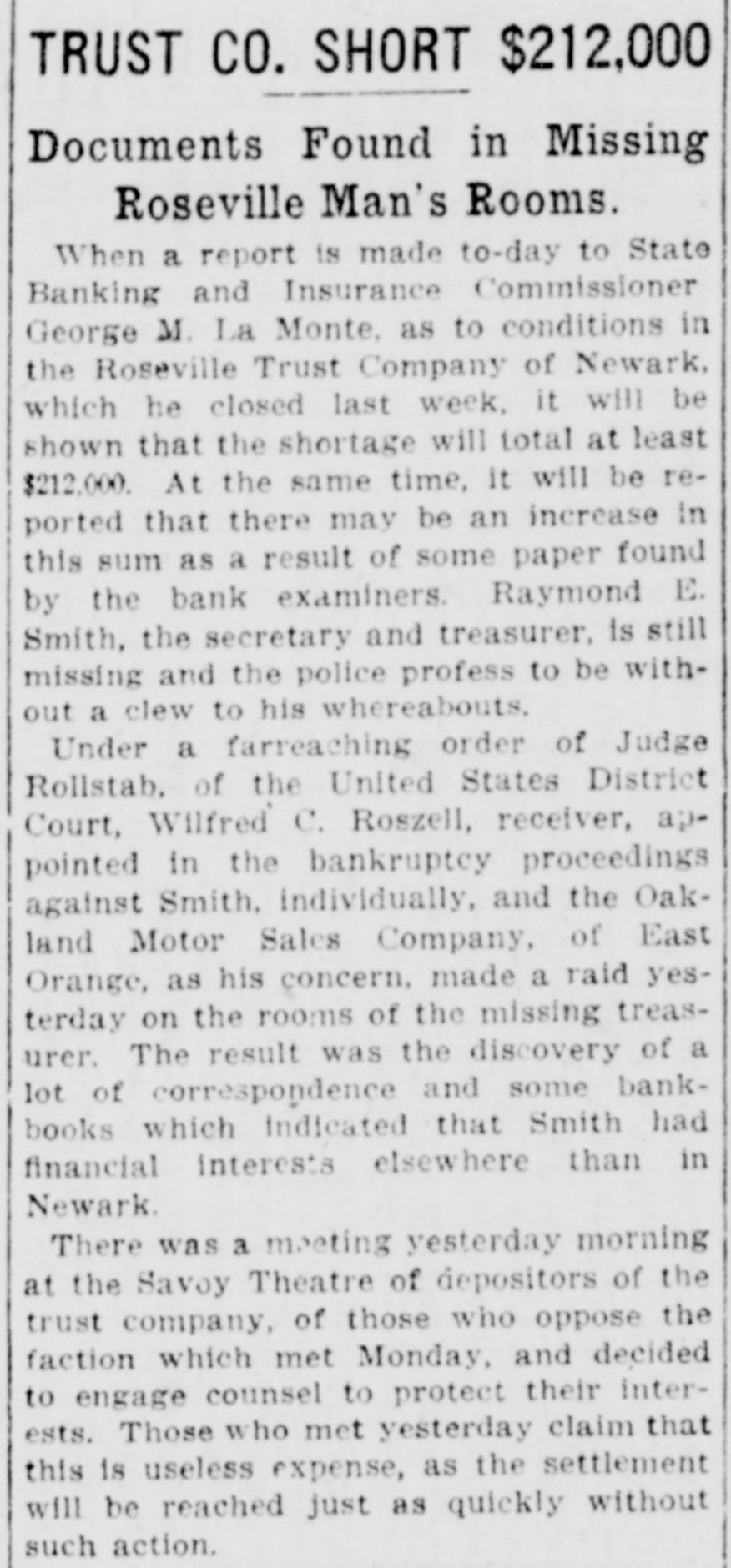
TRUST CO. SHORT $212,000 Documents Found in Missing Roseville Man's Rooms. When a report is made to-day to State Banking and Insurance Commissioner George M. La Monte, as to conditions in the Roseville Trust Company of Newark, which he closed last week, it will be shown that the shortage will total at least $212,000. At the same time, it will be reported that there may be an increase in this sum as a result of some paper found by the bank examiners. Raymond E. Smith, the secretary and treasurer, is still missing and the police profess to be without a clew to his whereabouts. Under a farreaching order of Judge Rollstab, of the United States District Court, Wilfred C. Roszell, receiver, appointed in the bankruptcy proceedings against Smith, individually, and the Oakland Motor Sales Company, of East Orange, as his concern, made a raid yesterday on the rooms of the missing treasurer. The result was the discovery of a lot of correspondence and some bankbooks which indicated that Smith had financial interests elsewhere than in Newark. There was a meeting yesterday morning at the Savoy Theatre of depositors of the trust company, of those who oppose the faction which met Monday, and decided to engage counsel to protect their interests. Those who met yesterday claim that this is useless expense, as the settlement will be reached just as quickly without such action.


Article from Newark Evening Star and Newark Advertiser, August 21, 1913

Click image to open full size in new tab

Article Text

Miss Anna McCarrick, Friend of Raymond E. Smith, Found at Atlantic City. DENIES KNOWING HIDING PLACE OF MISSING BANKER Breaks Down and Weeps When Expose Did Comes-Cries, "Why He Disgrace Me and My Mother?' Through the watch-picture clue found by The Evening Star, Miss Anna McCarrick, the woman whose name has been connected with that of Raymond E. Smith, missing secretary and treasurer of the looted Roseville Trust Company, was discovered today in her hiding place at Atlantic City by an Evening Star correspondent She was distraught, nervous and evidently suffering from excitement. "Do you know where Smith is was the first question she was asked Hasn't Heard from Smith. "No," she cried. "I wish I did The would give anything to know whole thing has driven me nearly crazy. I haven't seen him for weeks or heard from him.' When she was questioned further, Miss McCarrick broke down and wept bitterly 'Why has he brought this disgrace on me and my mother she sobbed She said that since she had been found she would return to her home, 11 Snyder street, Orange. Met Smith in Orange When Smith was an Orange councilman he resided not far from the home of the McCarricks It was at that time that he first met the five pretty McCarrick sisters Friendship sprang up between the debonaire bank official and Miss Anna McCarrick. Smith had quarreled with his wife and they had separated Nevertheless, there was nothing in Smith's attention to Miss McCarrick to cause the slightest gossip or comment. The only objection Mrs. McCarrick had to his friendship for her daughter lay in the fact that he was mar ried and his religion was different. When Smith dropped out of sight a week ago last Wednesday just at the time the bank examiners were discovering indications of a shortage in excess of $350,000, he left practically no clue behind him except Miss McCarrick's picture It was found in the case of his watch by an Evening Star reporter But the 'woman in the case," as she could literally be called, had dropped out of sight. While Mrs. McCarrick insisted that her daughter was in Atlantic City, a thorough canvas of the resort failed to reveal her whereabouts. Detectives and reporters alike failed to find her. Intimate friends who had seen her when she first went to the shore, two weeks ago, said that they could not tell what had become of her. She was found today, however, and despite her reticence, it is possible she may be able to throw some light on the remarkably clever get-away made by Smith In an effort to smooth over the looting of the Roseville Trust Company and, it is said, to stave off any criminal action against them, the directors of the bank sought today to round up every stray share of stock Twenty of the stockholders have signed the agreement presented to them by the directors representatives. That agreement seta forth that the stockholders will sell their holdings for cash at a valuation set by three Newark bank presidents, acting as appraisers. The proposed reorganization is to be financed with a fund of contributions from the officers of the bank. Already $100,000 is said to have been pledged Commissioner La Monte, head of the department of banking and insurance, will agree to the reorganization. it is reported, if the shortage is wiped out and a fund of $100,000 for the resumption of business is provided. Plan Criminal Action. While this scheme was under way, a group of the depositors, headed by H. W. Van Sant and Valentine B. Kane, worked hard on a plan to fasten a charge of criminal negligence against the officers and directors. The depositors, 200 of whom have joined a protective association to obtain justice for themselves. look with suspicion upon the directors' apparent plan to reorganize. They think that it is merely designed to prevent action on the part of the stockholders in participating in legal action to press home allegations of negligence and recover the missing $358,000. As a matter of fact, said Mr. Kane, 'I am informed by a lawyer who is an authority on banking that the officers and directors can now. upon the evidence already adduced, be convicted of gross negligence, although they are not now liable for the shortage We are going the limit in making them pay the penalty Officers Confident. On the other hand the officers and directors think everything will be easily settled. despite the fact that the loss is more than half the total deposits and may run still higher. "The way we are going to do it. said Edward D. Dunn. one of the directors, today. "we will be able to give the depositors and stockholders dollar for dollar, but it will take time. This is the agreement that is being offered to the stockholders for their signatures 'We, the undersigned stockholders of the Roseville Trust Company, of Newark, N. J., in consideration of one dollar, lawful money of the United States, to each of us in hand paid by G. Roland Munroe and Edward D. Dunn. or their assigns, receipt whereof is hereby acknowledged, do sΓ©verally agree to sell and assign to the said G. Roland Munroe and Edward D. Dunn the number of shares of stock of the said Roseville Trust Company set opposite our respective names at a such price as may represent


Article from The Greenville Journal, August 21, 1913

Click image to open full size in new tab

Article Text

Bank Loss Is Growing. Newark, N. J., Aug. 18.-Depositors of the Roseville Trust company were panic-stricken when the news became public that the total shortage of the bank would reach, if not exceed, ualf a million dollars.


Article from The Manitowoc Pilot, August 21, 1913

Click image to open full size in new tab

Article Text

Bank Loss Is Growing. Newark, N. J., Aug. 18.-Depositors of the Roseville Trust company were panic-stricken when the news became public that the total shortage of the bank would reach, If not exceed, half a million dollars.


Article from New-York Tribune, August 23, 1913

Click image to open full size in new tab

Article Text

TO SAVE ROSEVILLE TRUST Directors Hold Secret Meeting and Pledge $70,000. The directors of the failed Roseville Trust Company, in Newark, discussed at a secret meeting on Thursday night several plans for the rehabilitation of the institution, but with no definite result. William Fairlie, vice-president, was authority for the statement that each director was pledged not to divulge anything. There were three absentees. including Raymond E. Emith. the missing treasurer, who will be called to account for the shortage, which up to this time totals $358,000. The meeting was called for the purpose of a show down. There were a few of the directors who felt that the reorganization would be the only salvation for depositors and directors alike, and three, including Mr. Fairlie, Edward D. Dunn and William P. Odell, the president of the bank, came forward with pledges that aggregated $70,000 with a view of replenishing the funds of the institution. All that could be learned about the happenings of the meeting was that all present agreed that reorganization was the only way out of the present difficulty. The trouble came, It is said, over the question of method. It was decided that the directors be called together at a time to be fixed by President Odell, at which final action could be decided on. The fact that the directors did not want to discuss their session was construed as an indication that there was still uncertainty about the bank's affairs that prompted them to go slow. The finding of more assets belonging to Smith by Wilfred C. Rozsel, receiver under a federal appointment, was the cause of favorable comment. and may have had some effect on the decision to defer deflnite action. Rozsel found an interest in a New York apartment house, another automobile concern in Newark, and the controlling interest in the Home Ice and Products Company, of Johnstonville, Penn.


Article from New-York Tribune, August 30, 1913

Click image to open full size in new tab

Article Text

ROSEVILLE LOSSES STAND Directors Unable to Raise Fund for Depositors. Another fruitless meeting of the directors of the wrecked Roseville Trust Company, of Newark, was held in the bank building on Thursday night. It had been the hope of some of the officials that at this meeting enough money would be subscribed to make good the $189,000 that at present the depositors stand to lose, but, as in the case of previous sessions, there were many directors absent and no action could be taken. The banking department late yesterday turned over to George J. Furst, as counsel for Wilfred C. Rozsel, receiver, a number of securities belonging to Raymond E. Smith, the missing secretary and treasurer of the bank. They are valued at $70,000 and will be used to help make good the losses to depositors If it is found that Smith's liabilities outside of the bank are not more than they appear to be.


Article from New-York Tribune, September 3, 1913

Click image to open full size in new tab

Article Text

BANK EXPERTS DECEIVED Shortages in Roseville Trust Co. Existed Long Before Crash. Simultaneously with a statement by Chester W. Fairlie, son of Vice-President William Fairlie of the wrecked Roseville Trust Company, of Newark, shifting blame for the success with which Raymond E. Smith, the missing secretary and treasurer, manipulated the books of the institution. an admission was made by the bank examiner's yesterday that Smith's operations dated back beyond a previous examination by the State Banking and Insurance Department. Larue R. Vredenburgh, a special deputy in charge of the examination of the wrecked institution, admitted that Smith's shortages extended beyond the examination made of the trust company's books in October last year, but he would not state specifically how long the alleged peculations had been going on. He excused the bank experts, who failed to discover the irregularities a year ago, by characterizing Smith's alleged methods as clever and of a kind that would easily have deceived the examiners. Vice-Chancellor Stevens, at Newark, yesterday appointed Ray F. Anthony to be receiver of L. J. Weirth & Co., one of Raymond E. Smith's enterprises. A receiver in bankruptcy is already in charge of the business, and there may be a clash.


Article from Newark Evening Star and Newark Advertiser, September 3, 1913

Click image to open full size in new tab

Article Text

DEPOSITORS WILL AID DIRECTORS TO REORGANIZE BANK Board Meeting This Afternoon Supplemented by That of Creditors Tonight. Some of the wealthier depositors in the Roseville Trust Company will raise a fund, probably $150,000. to aid in reorganizing and reopening the bank, according to George E. Mutchler, the secretary of the Depositors' Association. There were rumors to that effect today and he was asked how true they were. "We are going to hold a meeting tonight," he said. "The directors have raised $150,000. The depositors are likely to raise the same amount. It will be best for all concerned to have the bank put on its feet again." Mr. Mutchler admitted that he and Clifford MacEvoy, the president of the Depositors' Association, were the leading spirits in the plan and that they both expected to be members of the directorate of the trust company if the reorganization was successfully accomplished. Both men are real estate operators. The depositors will meet in the hall above the bank at Roseville avenue and Orange street. Invitations are to be extended to William C. Odell, the president; William Fairlie, Harry W. Foster and Edward D. Dunn. If the plan can be worked out, Mr. Mutchler thinks that the trust company will soon be in running order. The smaller depositors, he says, will be able to draw their money dollar for dollar, if they wish to, while the larger depositors will be repaid for their advances in cash by profit earned by the stock allotted to them. At another meeting of the directors of the trust company this afternoon it was expected that the $150.000 fund already pledged to reopen the institution would be raised to $200,000. Several members of the directorate who have been backward in entering the plan for reorganization broached by Mr. Odell and Mr. Dunn expressed their intention of attending today's conference.


Article from Newark Evening Star and Newark Advertiser, September 6, 1913

Click image to open full size in new tab

Article Text

the To protect the depositors of plundered Roseville Trust Cor the State department of banking is prepared to sue individually every the member of the directorate for huge shortage. That assurance was given a committee representing the Depositors' by Protective Association today Frank C. Ferguson, a bank examiner, who spoke for L. R. Vredenburgh, deputy commissioner of banking and insurance. Furthermore, Mr. Ferguson said on there had been such laxity he that the part of the bank officials that had no hope whatever of collecting the $20,000 due on the bond of Raymond E. Smith. the vanished secretary and treasurer. By these statements Mr. Ferguson verified two of the exclusive stories have appeared in the Evening dithat to the effect that the Star-one were individually liable in a rectors way, and the other, yesterday, that civil announcing the depositors belief collected Smith's bond could not be upon. B. Tower a justice Valen- of the Henry Michael Kane, jr., and deposipeace; B. Kane, who form the William tine committee. first visited defunct tors' P. Odell, president of the bank. asked him to demand the Na- the They Surety Company to pay $20,000 tional due on Smith's bond. 'That will be done at the proper time," 'And he when replied. will that be?" he was ing asked. "That department. is in the You hands had of better the bank see Mr. Vredenburgh. the committee called at and the bank When building, Roseville avenue met Orange street, Mr. Ferguson them. in the absence of the deputy what commissioner. He was asked bond had been done to recover on the the missing treasurer. of The directors," he answered. with and emphatic deliberation. slow have not shown any disposition to demand the money from the company. the event that they do not de"In it or make up the money themselves, mand Mr. Vredenburgh, as receiver, will sue the surety company. do not think however, that there col"I grounds upon which to that are any thoroughly convinced laxity on the part lect. there I was am conditions of the directors in allowing this clause affairs to exist. There is a of Smith's bond that requires any rewrong-doing in on his part to be to the surety company as soon in ported becomes known. That clause, as it opinion, will enable the surety my company to successfully contest payment. "It is true that the surety comdislike to have a controversy, claims, panies sometimes prefer to pay case and matter of policy. But this the is as so a flagrant that I do not think company will pay the claim. the event that we cannot receiver collect In from them, the against the money bring suit individually will member of the directorate. each all the directors but one are one unIf we can force that able to to pay, make good the entire loss, sion. director even if it strips him of every possesofficers and directors of Odell, the The company are: William P. vicetrust William Fairlie, first second president: Harry W. Foster, Smith. vice-president president: Raymond E. who has secretary and treasurer, Bannister, the James B. T. Benjamin. John Keim, William disappeared; S. Bell, W. Foster, William F. Krug, Harry Kilgus, George E. Mott, G. Frederiek C. Lurich, Harvey Scarlett, Charles Monroe, John B. D. Elmer Rowland K. Sexton and Edward Dunn. before the depositors reShortly the assurance that the bank- proceived department was prepared to Vreding against the directors, Mr. shortage ceed had hinted that the will enburgh accounts of the institution estiin be the far in excess of the previous mate of $378,000. of this increased deficit deDiscovery to the checking up of was positors' due passbooks with the depositors' ledger- procedure used in looting these The was brazen but simple. accounts no elaborate or bothersome entries There was the books. The falsifying of noted in the passbooks, of but were many correctly of them were left out the ledger entirely, had checked up only a When the he passbooks, Mr. Vrenden- which he burgh few of issued a statement in Continued on Page 2. Column 1.) for


Article from Newark Evening Star and Newark Advertiser, September 9, 1913

Click image to open full size in new tab

Article Text

New Organization Must Bear Name Other Than Roseville Trust Co. LIABILITIES AND ASSETS OF OLD CONCERN TAKEN OVER Directors and Large Depositors Have Furnished $400,000 in Funds to Be Used for This Purpose. George M. La Monte, State Commissioner of Banking and Insurance, said today that the joint reorganization plan of the directors and larger depositors of the Roseville Trust Company had been conditionally approved by him. Coincident with this reassuring news for the directorate of the wrecked bank came the rumor that Raymond E. Smith, the missing secretary and treasurer, had been found and was on his way to Newark in charge of detectives. While no official verification of the reported capture of Smith could be obtained. his appearance at this time, it is thought, would be followed by a sensational revelation of exactly what manipulations caused the fallure of the trust company and who were the men, if there were others beside himself, who benefited. The plan for reorganization, as approved by Mr. La Monte, is this: A new bank, bearing some name other than the Roseville Trust Company, will be organized to take over the liabilities and assets of the defunct institution. For this purpose a sum of $400,000 has been provided by the directors and Upon the the larger opening depositors. of the new bank, depositors will be permitted to withdraw 75 per cent. of their deposits at once. The remaining 25 per cent. will be given to them in the shape of stock in the new trust company. This stock will be redeemable for its full value at the end of a period of either one. two or three years, probably the latter, but interest will be paid at a rate to be decided upon later. At first Mr. La Monte was no: impressed by the feasibility of any reorganization scheme, but he was convinced at yesterday's conference, it is said, that such a move would be far better than a liquidation of the affairs of the trust company that would leave the depositors with DOB sibly not fifteen cents on the dollar. The principal obstacle to the speedy consummation of this plan is the fact that an audit of the bank's books is a task of titanic dimensions. Until all the passbooks are in there is little chance that a statement evenly approximately accurate can be cast up. Three-quarters of the passbooks have not yet been taken to the bank, despite the repeated request of Deputy Commissioner L. R. Vredenburgh. Meeting Was Satisfactory. In referring to yesterday's conference to discuss the proposed reorganization Mr. La Monte made this statement to the Evening Star toe day: 'The meeting in the offices of Pitney. Hardin & Skinner was vary satisfactory from all points of view. A definite statement was made to I me of the plan of settlement that las been formulated by the directors and some of the depositors and I approved of it as it was shown to me. i "I shall make a definite statement , as soon as the preliminary work is e , completed. Everything is now being done toward expediting the set1 tlement." 1 Mr. La Monte's principal desire, it 1 is understood, is to see in tangible e shape, either in cash or securities, the $400,000 that the directors and larger depositors say that they have raised to protect the depositors and stockholders and provide a working cap. Ital for a new trust company. S Clifford MacEvoy, president of the Depositors' Association. when seen at ) (Continued on Page 2. Column 7.)


Article from Newark Evening Star and Newark Advertiser, September 13, 1913

Click image to open full size in new tab

Article Text

TO OFFER LARGER REWARD FOR SMITH Roseville Trust Directors Again Active in Seeking Missing Treasurer. In their effort to clear up the wreckage of the Roseville Trust Company, the directors and depositors were both active today. The developments were: 1. L. R. Vredenburgh, deputy banking commissioner, said the directors would have to open their own books in starting a new bank. The directors thereupon announced their intention of putting auditors to work on Monday. 2. The directors decided to announce a much larger reward for Raymond E Smith next. week. 3. The Depositors' Protective Associaticn sent Banking Commissioner La Monte a petition demanding the revelation of those men whose worthless notes are held by the defunct bank. 4. A rumor reached the ears of the depositors to the effect that the maker of one of the largest notes held by the bank was preparing to flee. Some of the difficulties in the way of a speedy reorganization were outlined by L. R. Vredenburgh, deputy State commissioner of banking and insurance, today. "There is an enormous volume of work in connection with the opening of a set of books for the proposed new bank. All that work, of course, has to be done by the directors and depositors who are interested in the reorganization. There are 3,800 depositors, and all their accounts will have to. be transferred to new ledgers. Edward D. Dunn, the prime mover in the projected reorganization, has indicated, as exclusively told in the Evening Star yesterday, that if all these preliminaries cannot be completed by October 1 it is probable that the plan will have to be abandoned. Yet the one auditor the directors had at work on the bank's books has been withdrawn. 'Are you giving all the assistance possible to the furtherance of the reorganization? Mr. Vredenburgh was asked. 'Yes, but there are great physical difficulties to encounter, he said. "In my work I am troubled by the lack of desk room. Only so many men can work to advantage here.' Mr. Vredenburgh added that he was in sympathy with the reorganization plan When told by an Evening Star reporter of Mr. Vredenburgh's statement the directors professed amazement. "Why, that makes it better than ever for us, said Mr. Dunn. in whose offices William Fairlie, Harry W. Foster and Clifford F. MacEvoy were conferring. "We will put Edward Rorebeck, our auditor. and his assistants back in the bank on Monday to open a new set of books for the new bank. Next week we will decide on who will be president and treasurer. The depositors, who will be stockholders, will, of course, elect the directors. A more complete statement of the shortage will be obtained. the directors think, even as early as next week. The reward of $1,000 for Raymond E. Smith will be raised. The Depositors' Protective Association today sent to George M. La Monte, commissioner of banking, their petition demanding a revelation of the makers of the worthless notes now held by the defunct trust company. The names on the petition are: Frank Blanch, of 6 Boyden street; E. P. Kastner, of 280 Park avenue; Fred Muller, of 127 North Ninth street; T. M. Griffith, 284 North Sixth street: H. W. Keim, of 436 Orange street; Michael Kane, jr., of 57 South Thirteenth street; J. Chankalian, 282 Seventh street; B. Bruh, of 446 Orange street: George Glocasn Simos Chinopekos, of 4461/2 Orange street. (Continued on Page 5, Column 8.)


Article from Newark Evening Star and Newark Advertiser, September 20, 1913

Click image to open full size in new tab

Article Text

CAN'T BOND SMITH, SAYS VREDENBURGH Deputy Bank Examiner An. swers Demand of Depositors. $90,000 in Debts Paid. Asserting that Raymond E. Smith, the alleged bank wrecker, cannot posget a second time and was for a to sibly that it away impossible bond be for Smith was assisting in secured the examiners while he getting facts and so that affairs out and a effected, L. R. Vredreorganization could figures be straightened the tangled in enburg, charge deputy of the banking defunct commissioner Roseville Trust Company, said today: "Smith is of great assistance to us in finding the holders of mortgages, notes and other securities that we have been unable to find, and if taken away at this time our progress in straightening out matters would be gr eatly retarded.' "Several of the depositors have reason to think that Smith could destroy evidence against himself or possibly make away with funds now in the bank's possession and in the vaults, an Evening Star reporter explained to Mr. Vredenburgh. 'Smith has no chance at all of stealing or destroying any evidence that we may have against him and that is in our possession at present," answered Mr. Vredenburgh, who continued his statement that "both Smith and other persons connected with the bank that might have had something to do with the wrecking were under the closest surveillance at all times. Furthermore, there is never more than a few hundred dollars odd cash about the bank that we use to pay off bills that are due. $90,000 in Debts Paid Off Mr. Vredenburg issued a statement in which 'he said that during the time the State banking department has had charge of the institution over $90,000 of debts have been paid off the sale of collateral pledged, $30,000 more be We have paid two through and paid that off. shortly collected, would bills out of money sale of some One of the bills and for pledged. $90,000 the banking securities payable inowing to a New York stitution through the good offices of Mr. Odell and Mr. Fairlie was transferred to a Newark banking instituMessrs. Odell and Fairlie assumed tion. the responsibility in order to induce the Newark bank to take over the loan.' 'The purpose or object of this was the collateral out of New York to get where it was liable to attach- been State, Since then the loan has off and their ment. paid responsibility of $30,000, has ended. We still have a loan of which will be paid up shortly out the money that we are collecting." While the Evening Star reporter in conference with Mr. Vredenwas burgh, Michael Kane, jr., and Protec- Henry Tower, of the Depositors' B. Association, entered the bank and made tive formal demand upon the exam- Smith that bond be secured for or iner he was at work in the bank, also while he be kept out. They else to know who was now rents due from persons wished the that collect- occu- and ing above the demand that the pying offices "former bank made dimade a as they term them, be a rectors," rent every time they held above to pay in the hall on the floor meeting that occupied by the bank." Mr. note of their would Vredenburgh make a answered demands, that no way he explained that there was Mr. but a bond for Smith. the of getting and Towers replied that as bail directors Kane had gone on Smith's to could also go on a bond was pro- at tect they the depositors while he work in the bank. Smith's Auto Is Seized. the first time today Smith his For have an automobile of Trust did not to motor to the own where, by virtue of he is acting as a company, in which the his special bank own assistant proposal, and adviser to examiners. automobile was seized by receiver WilHis Roszel, who is the fred C. bankruptcy proceedings official. pendin the the former bank ing against had a hard time getting As soon Roszel machine away from Smith. pothe as he surrendered and was (Continued on Page 2. Column 8.)


Article from Newark Evening Star and Newark Advertiser, September 23, 1913

Click image to open full size in new tab

Article Text

# OLD TELEPHONE BUILDING IS PUT IN RECEIVER'S HANDS Foreclosure Proceedings Are Brought Against Property by Whitehead & Hoag Co. The Telephone building, at 158-160 Market street, today went into the hands of a receiver. Application for the receiver was made before Vice Chancellor Stevens by Henry H. Dawson, counsel for Whitehead & Hoag, novelty manufacturers on Washington street. The manufacturers hold a second mortgage of $150,000 on the property and have instituted foreclosure proceedings Interest on the Whitehead & Hoag mortgage is novy eight months in arrears. The proceedings are brought against the Glatham Real Estate Company, owners of the building. The first mortgage is $1300,000, held by the Prudential Insurance Company of America, upon which interest is overdue nine months. A third mortgage on the valuable plot is held by Fred H. Smith, jr. Taxes amounting to nearly $8,000 are also due the city of Newark. The Telephone building was purchased by Charles A. Morel from Robert Shoemaker in 1911 with two mortgages. Morel transferred the property to the Glatham Real Estate Company while he retained the third mortgage of $200,000. The Century Realty Company appears as complainant in the foreclosure sult, having assigned the mortgage to the Whitehead & Hoag Company. The present tenants of the Telephone building are the newly organized Chamber of Commerce and the Holland Hotel Company. The Holland Hotel Company occupies the ground floor, the first floor in the rear of the building fronting on Nutria street and the cellar, all of which it leases for $24,000 annually. It is not known what the Chamber of Commerce pays for its lease of the top floor. The building is six stories in height with a frontage of forty-nine feet on Market street. It was built by the then New York and New Jersey Telephone Company for its own use. It was rumored among real estate men that there was a plan on foot to take title to the building through Morel's creditors. It is said that the scheme of taking over the building was headed by Raymond E. Smith, then secretary and treasurer of the Roseville Trust Company. The plan failed when Smith disappeared from the city and the wrecked trust company was placed in the hands of the State examiners. The hearing today before Vice-Chancellor Stevens was the return of a rule to show cause why a receiver should not be appointed. No one appeared for the owners of the telephone building. The Fidelity Trust Company, of this city, was appointed receiver upon producing a bond of $20,000. While the order for a receiver for the Telephone building was being signed by Vice-Chancellor Stevens another application for an order to show cause why a receiver should not be appointed to take over the property of Charles A. Morel, former owner of the old Telephone building, was being made before Vice-Chancellor Howell in the latter's Chancery chambers. The application was made by James Willis Pierson, who was represented by William E. Hampson. In addition, Pierson asked that the court set aside the transfer of forty-two tracts of land in this county by Morel to his sister, Miss Laura Morel. According to Attorney Hampson, his client secured a judgment against Morel in the Supreme Court on August 25 last. The petitioner claims that Morel owed him $2,350.34, and that two days before the judgment was awarded Morel turned over all his property to his sister for the consideration of $1. The petition states that the conveyance was made merely to prevent payment on the judgment secured and to defraud Pierson. It is claimed that Miss Morel has no visible means of support and is dependent upon her brother for support. It is alleged that notwithstanding the transfer, Morel still receives the rents and profits from the property. The property is also said to be heavily mortgaged, while the taxes are also alleged to be in arrears. In applying for a receiver Pierson also asks that Morel and his sister be enjoined from receiving any rents until the order is removed.


Article from Newark Evening Star and Newark Advertiser, October 3, 1913

Click image to open full size in new tab

Article Text

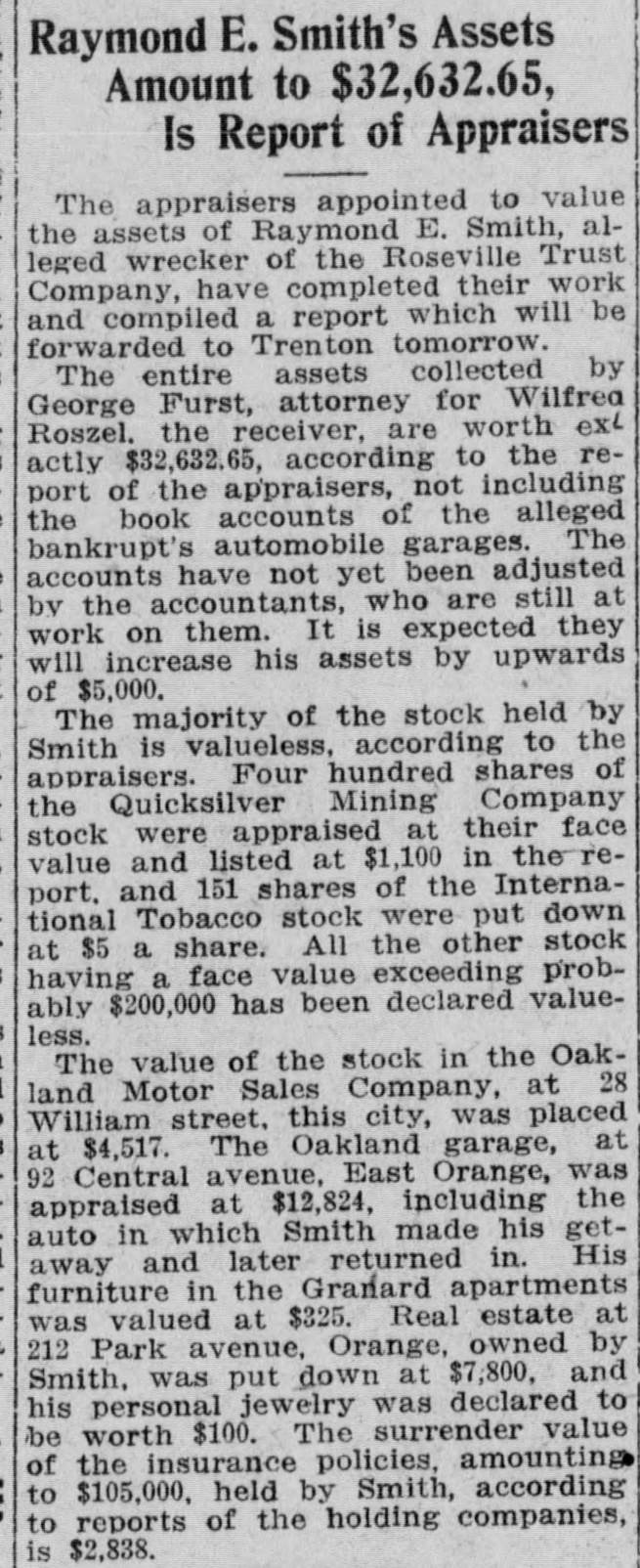
# Raymond E. Smith's Assets Amount to $32,632.65, Is Report of Appraisers The appraisers appointed to value the assets of Raymond E. Smith, alleged wrecker of the Roseville Trust Company, have completed their work and compiled a report which will be forwarded to Trenton tomorrow. The entire assets collected by George Furst, attorney for Wilfred Roszel, the receiver, are worth exactly $32,632.65, according to the report of the appraisers, not including the book accounts of the alleged bankrupt's automobile garages. The accounts have not yet been adjusted by the accountants, who are still at work on them. It is expected they will increase his assets by upwards of $5,000. The majority of the stock held by Smith is valueless, according to the appraisers. Four hundred shares of the Quicksilver Mining Company stock were appraised at their face value and listed at $1,100 in the report, and 151 shares of the International Tobacco stock were put down at $5 a share. All the other stock having a face value exceeding probably $200,000 has been declared valueless. The value of the stock in the Oakland Motor Sales Company, at 28 William street, this city, was placed at $4,517. The Oakland garage, at 92 Central avenue, East Orange, was appraised at $12,824, including the auto in which Smith made his get-away and later returned in. His furniture in the Granard apartments was valued at $325. Real estate at 212 Park avenue, Orange, owned by Smith, was put down at $7,800, and his personal jewelry was declared to be worth $100. The surrender value of the insurance policies, amounting to $105,000, held by Smith, according to reports of the holding companies, is $2,838.


Article from Newark Evening Star and Newark Advertiser, November 7, 1913

Click image to open full size in new tab

Article Text

A pointed attack on the manner in which the State banking department is conducting its investigation of the looted Roseville Trust Company was made today by Morris S. Daniels, of 176 Roseville avenue, a wealthy manufacturer of staves, heading and hoops. His charges, as set forth in a series of categorical questions in a letter to the new Mutual Bank of Roseville, are: 1. The department repeatedly gave the Roseville Trust Company a clean certificate. 2. The expense for examining the books of the bank after its failure was at the rate of $1,000 a week for the first eight weeks. 3. The examination is now continuing at about $100 a day. 4. The examiners get one and one-half times extra pay for night work. 5. The whole examination in a private business would be conducted by efficient accountants, even perhaps to a rewriting of all the books of the business from the time of its origin to the date of suspension, within thirty days. State Department Responsible. He asks the Mutual Bank why it does not threaten the banking department with suit for negligence. That course would be far wiser, he insists, than any hounding of the Roseville Trust Company directors. He says that he will not make an assignment of his account if the reorganization contemplates what he calls a "blackmailing scheme" to force the trust company's directors to buy their release from liability. The letter follows in full: "The Mutual Bank of Roseville, "Newark, N. J. "Gentlemen-Your circular letter of October 24 is received. "Do I understand that the assignment you request carries with it authority to enter suit in my name against any or all of the directors of the Roseville Trust Company? Question of Blackmail. "I notice that your circular says: 'Directors making payment accepted as satisfactory will be released from liability on account of any claim against them for negligence.' You also say: 'Any director who fails to make such payment to the new bank ... will be sued ... as will be later determined.' Is not this blackmail? "Why do you not threaten the department of banking with suit for negligence? Was it not the State banking department, through its authorized agents for the support of which we pay taxes, that repeatedly gave the Roseville Trust Company a clean certificate that its business was being conducted properly? "Why should any depositor say that he deposited in the trust company because of the personnel of the directorate? Did he not have the repeated


Article from Newark Evening Star and Newark Advertiser, December 2, 1913

Click image to open full size in new tab

Article Text

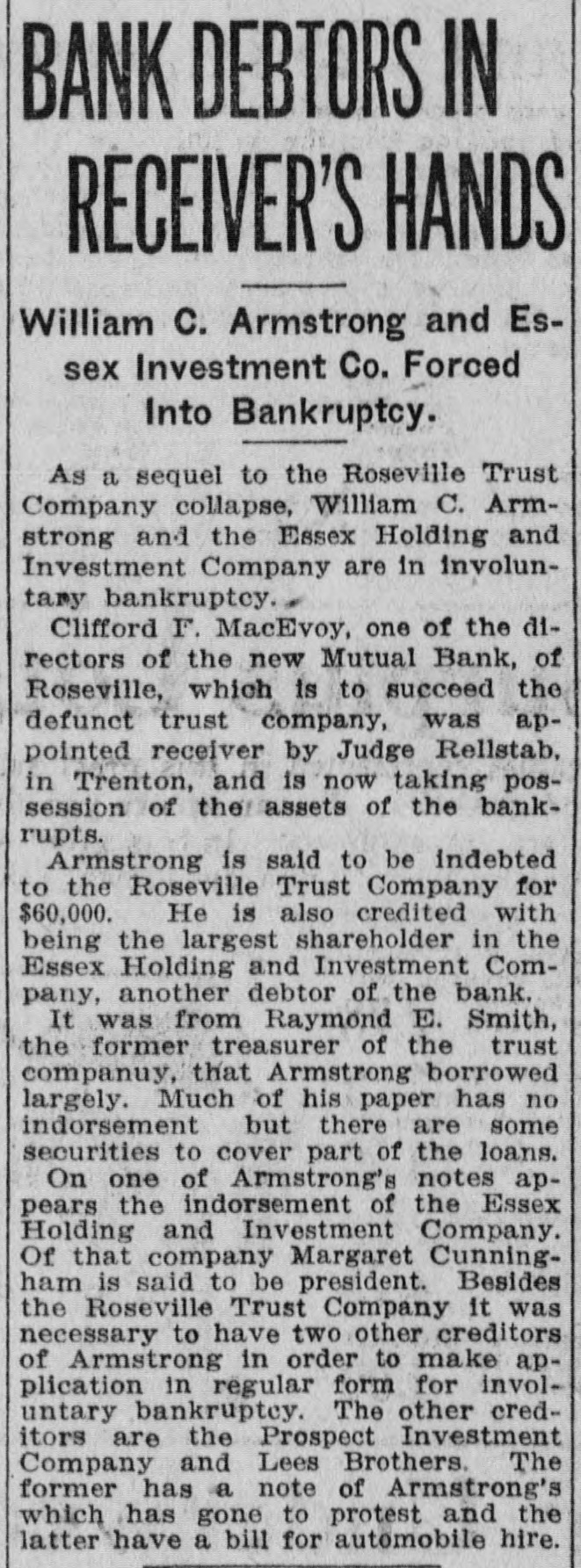
BANK DEBTORS IN RECEIVER'S HANDS William C. Armstrong and Essex Investment Co. Forced Into Bankruptcy. As a sequel to the Roseville Trust Company collapse, William C. Armstrong and the Essex Holding and Investment Company are in involuntary bankruptcy. Clifford F. MacEvoy, one of the directors of the new Mutual Bank, of Roseville, which is to succeed the defunct trust company, was appointed receiver by Judge Rellstab, in Trenton, and is now taking possession of the assets of the bankrupts. Armstrong is said to be indebted to the Roseville Trust Company for $60,000. He is also credited with being the largest shareholder in the Essex Holding and Investment Company, another debtor of the bank. It was from Raymond E. Smith, the former treasurer of the trust companuy, that Armstrong borrowed largely. Much of his paper has no indorsement but there are some securities to cover part of the loans. On one of Armstrong's notes appears the indorsement of the Essex Holding and Investment Company. Of that company Margaret Cunningham is said to be president. Besides the Roseville Trust Company it was necessary to have two other creditors of Armstrong in order to make application in regular form for involuntary bankruptcy. The other creditors are the Prospect Investment Company and Lees Brothers. The former has a note of Armstrong's which has gone to protest and the latter have a bill for automobile hire.


Article from Newark Evening Star and Newark Advertiser, December 4, 1913

Click image to open full size in new tab

Article Text

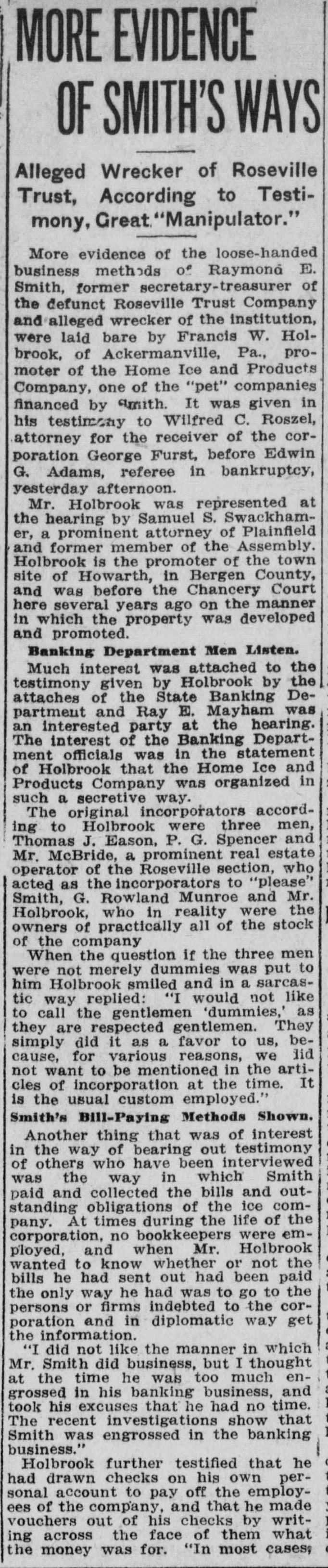
# MORE EVIDENCE OF SMITH'S WAYS Alleged Wrecker of Roseville Trust, According to Testimony, Great "Manipulator." More evidence of the loose-handed business methods of Raymond E. Smith, former secretary-treasurer of the defunct Roseville Trust Company and alleged wrecker of the institution, were laid bare by Francis W. Holbrook, of Ackermanville, Pa., promoter of the Home Ice and Products Company, one of the "pet" companies financed by Smith. It was given in his testimony to Wilfred C. Roszel, attorney for the receiver of the corporation George F. Burst, before Edwin G. Adams, referee in bankruptcy, yesterday afternoon. Mr. Holbrook was represented at the hearing by Samuel S. Swackhamer, a prominent attorney of Plainfield and former member of the Assembly. Holbrook is the promoter of the town site of Howarth, in Bergen County, and was before the Chancery Court here several years ago on the manner in which the property was developed and promoted. # Banking Department Men Listen. Much interest was attached to the testimony given by Holbrook by the attaches of the State Banking Department and Raymond E. Mayham was an interested party at the hearing. The interest of the Banking Department officials was in the statement of Holbrook that the Home Ice and Products Company was organized in such a secretive way. The original incorporators according to Holbrook were three men, Thomas J. Eason, P. G. Spencer and Mr. McBride, a prominent real estate operator of the Roseville section, who acted as the incorporators to "please" Smith, G. Rowland Munroe and Mr. Holbrook, who in reality were the owners of practically all of the stock of the company. When the question if the three men were not merely dummies was put to him Holbrook smiled and in a sarcastic way replied: "I would not like to call the gentlemen 'dummies,' as they are respected gentlemen. They simply did it as a favor to us, because, for various reasons, we did not want to be mentioned in the articles of incorporation at the time. It is the usual custom employed." # Smith's Bill-Paying Methods Shown. Another thing that was of interest in the way of bearing out testimony of others who have been interviewed was the way in which Smith paid and collected the bills and outstanding obligations of the ice company. At times during the life of the corporation, no bookkeepers were employed, and when Mr. Holbrook wanted to know whether or not the bills he had sent out had been paid, the only way he had was to go to the persons or firms indebted to the corporation and in diplomatic way get the information. "I did not like the manner in which Mr. Smith did business, but I thought at the time he was too much engrossed in his banking business, and took his excuses at he had no time. The recent investigations show that Smith was engrossed in the banking business." Holbrook further testified that he had drawn checks on his own personal account to pay off the employees of the company, and that he made vouchers out of his checks by writing across the face of them what the money was for. "In most cases,"


Article from The Birmingham Age-Herald, December 10, 1913

Click image to open full size in new tab

Article Text

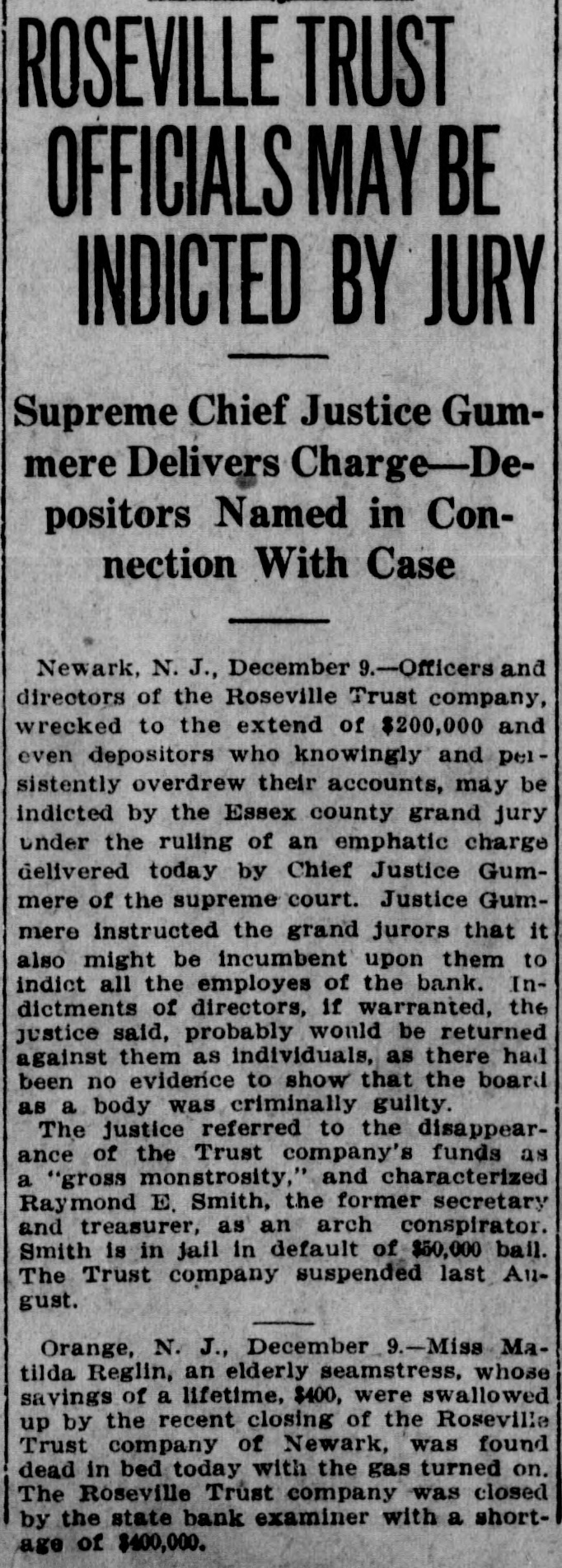
ROSEVILLE TRUST OFFICIALS MAY BE INDICTED BY JURY Supreme Chief Justice Gummere Delivers Charge-Depositors Named in Connection With Case Newark, N. J., December 9.-Officers and directors of the Roseville Trust company, wrecked to the extend of $200,000 and even depositors who knowingly and pel sistently overdrew their accounts, may be indicted by the Essex county grand jury under the ruling of an emphatic charge delivered today by Chief Justice Gummere of the supreme court. Justice Gummere instructed the grand jurors that it also might be incumbent upon them to indict all the employes of the bank. Indictments of directors, if warranted, the Justice said, probably would be returned against them as individuals, as there had been no evidence to show that the board as a body was criminally guilty. The justice referred to the disappearance of the Trust company's funds as a "gross monstrosity," and characterized Raymond E. Smith, the former secretary and treasurer, as an arch conspirator. Smith is in jail in default of $50,000 ball. The Trust company suspended last Allgust. Orange, N. J., December 9.-Miss Matilda Reglin, an elderly seamstress, whose savings of a lifetime, $400, were swallowed up by the recent closing of the Roseville Trust company of Newark, was found dead in bed today with the gas turned on. The Roseville Trust company was closed by the state bank examiner with a shortage of $400,000.


Article from The Sentinel=record, December 10, 1913

Click image to open full size in new tab

Article Text

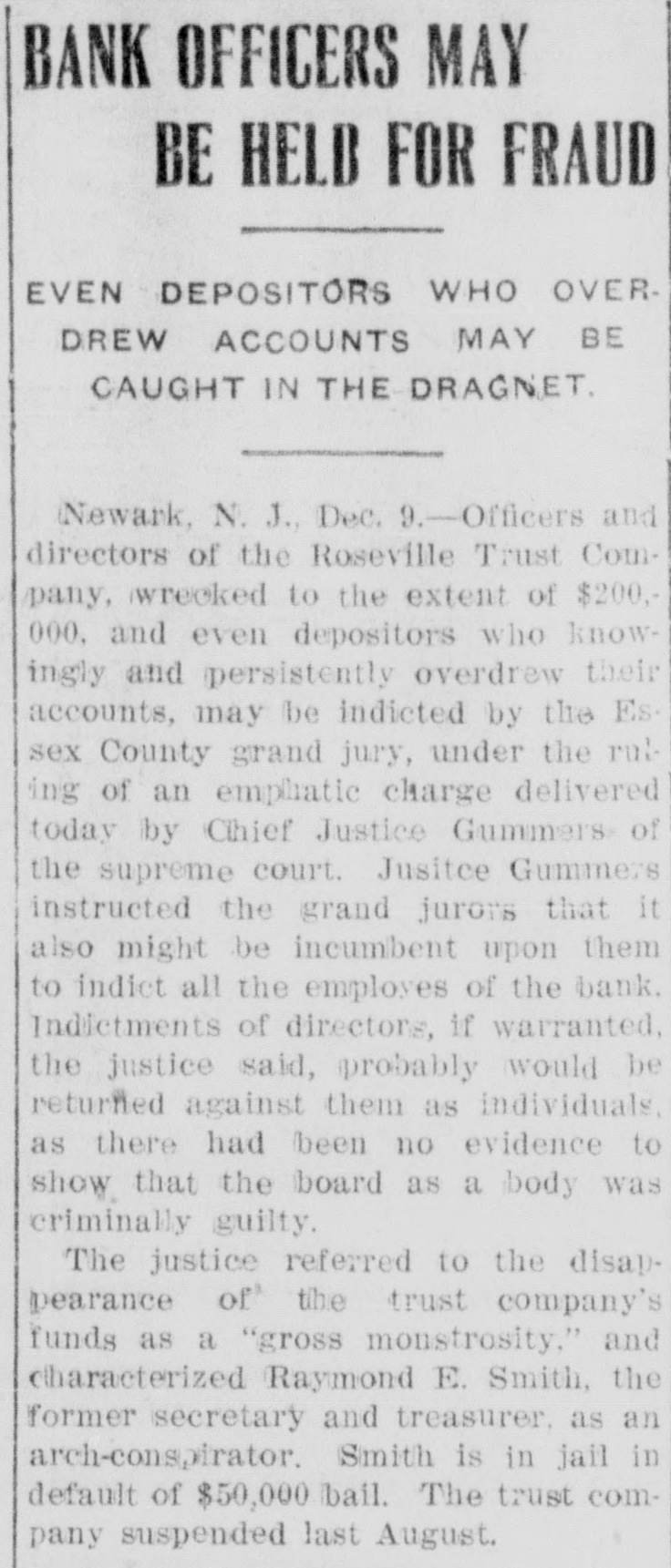
BANK OFFICERS MAY BE HELB FOR FRAUD EVEN DEPOSITORS WHO OVERDREW ACCOUNTS MAY BE CAUGHT IN THE DRAGNET. Newark N. J., Dec. 9.-Officers and directors of the Roseville Trust Company, wrecked to the extent of $200,000, and even depositors who knowingly and persistently overdrew their accounts, may be indicted by the Es. sex County grand jury, under the rub ing of an empliatic charge delivered today by Chhei Justice Gummers of the supreme court. Jusitce Gummers instructed the grand jurors that it also might be incumbent upon them to indict all the employes of the bank. Indictments of directors, if warranted, the justice said, probably would be returned against them as individuals, as there had been no evidence to show that the board as a body was criminally guilty. The justice referred to the disappearance of' the trust company's funds as a "gross monstrosity," and characterized Raymond E. Smith, the former secretary and treasurer. as an arch-conspirator. Smith is in jail in default of $50,000 bail. The trust company suspended last August.


Article from Newark Evening Star and Newark Advertiser, February 23, 1914

Click image to open full size in new tab

Article Text

MUTUAL BANK IS READY TO OPEN Successor to Wrecked Roseville Trust to Start Business Tomorrow. The Mutual Bank of Roseville, organized out of the wreck of the Roseville Trust Company, will open its doors to thep ublic tomorrow morning in the quarters of the old company, Roseville avenue and Orange street, prepared to meet any demands made upon it. There will be $350,000 in cash in the vaults of the new institution when it opens its doors. This sum represents 40 per cent. of the claims of the depositors of the Roseville Trust Company that have been assigned to the new bank, Clifford F. MacEvoy, one of the directors of the old Roseville company, is president of the Mutual Bank. While all of the assignees have been assured by Mr. MacEvoy they can get their money on demand and can have it tomorrow if they desire, it is the belief of the officials that there will not be a run on the new bank or any great demand for money tomorrow. Some of the largest depositors have told Mr. MacEvoy that they would make no withdrawals from their accounts. Preparations have been made by Treasurer J. W. Conger to pay out money rapidly tomorrow if the demand warrants it. A great deal more money than the usual 25 per cent. of the total deposited in the bank required by law to be kept on hand will be kept in the vaults of the new institution for some time to come, declares Mr. Conger. With the exception of a. few disputed claims all work in connection with the opening of the new bank has been cleared by the State Banking Commission. It is understood that Edward F. Clark, counsel for the bank and a prominent figure in its reorganization, will take steps in the near future to sue certain directors of the oid Roseville Trust Company, who refused to contribute toward the reorganization fund. The directors who did contribute received a guarantee of exemption from civil suit by the bank authorities.


Article from Newark Evening Star and Newark Advertiser, December 31, 1914

Click image to open full size in new tab

Article Text

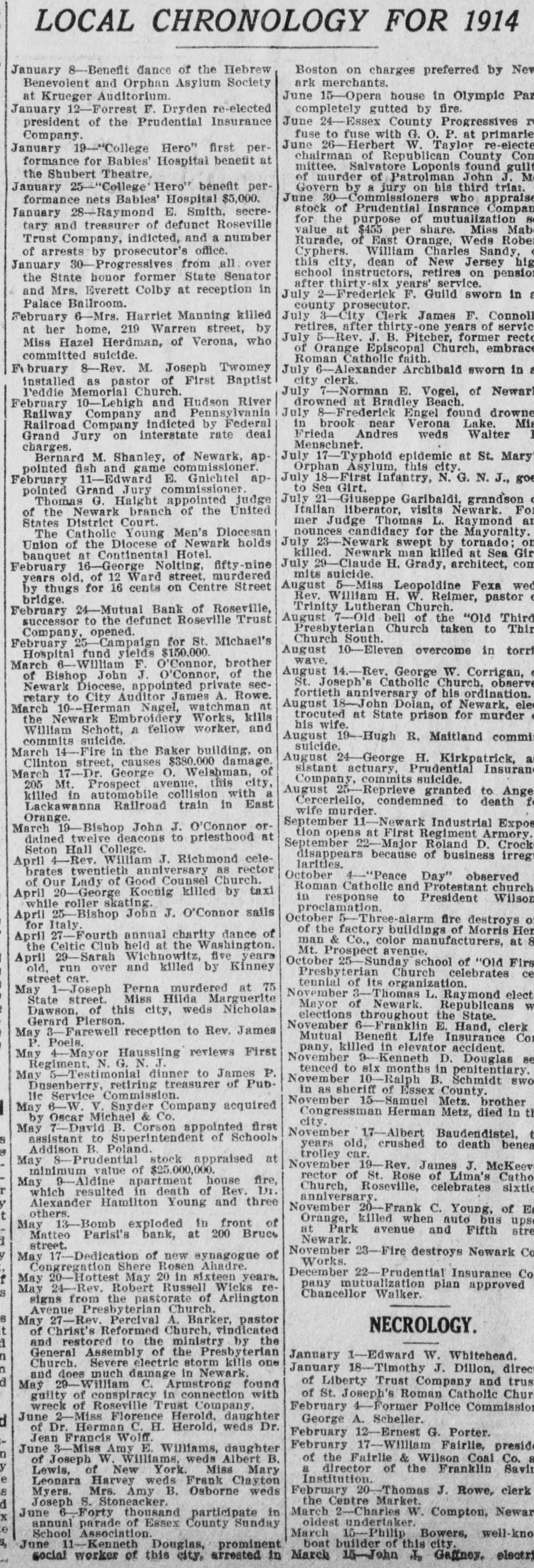
LOCAL CHRONOLOGY FOR 1914 January 8-Benefit dance of the Hebrew Boston on charges preferred by New ark merchants. Benevolent and Orphan Asylum Society at Krueger Auditorium. June 15-Opera house in Olympic Paz completely gutted by fire. January 12-Forrest F. Dryden re-elected June -Essex County Progressives I president of the Prudential Insurance Company. fuse to fuse with G. O. P. at primarie June -Herbert W. Taylor re-electe January 9-College Hero" first perchairman of Republican County Con formance for Babies' Hospital benefit at mittee. Salvatore Loponis found guilt the Shubert Theatre, of murder of Patrolman John J. M Govern by a jury on his third trial. January 25--"College Hero" benefit perJune 30- Commissioners who appraise formance nets Babies' Hospital $5,000. stock of Prudential Insrance Compan January 28-Raymond E. Smith, secrefor the purpose of mutualization B tary and treasurer of defunct Roseville value at $455 per share. Miss Mab Trust Company, indicted, and a number Rurade, of East Orange, Weds Rober ( of arrests by prosecutor's office. Cyphers. William Charles Sandy, this city, dean of New Jersey hig January D-Progressives from all over school instructors, retires on pension the State honor former State Senator after thirty-s years' service. and Mrs. Everett Colby at reception in July 2-Frederick F. Guild sworn in a Palace Ballroom. county prosecutor. July 3- City Clerk James F. Connoll February 6-Mrs. Harriet Manning killed retires, after thirty-one years of service at her home, 219 Warren street, by July 5-Rev. J. B. Pitcher, former recto Miss Hazel Herdman, of Verona, who of Orange Episcopal Church, embrace committed suicide. Roman Catholic faith. February 8-Rev. M. Joseph Twomey July 6-Alexander Archibald sworn in a city clerk. installed as pastor of First Baptist l'eddie Memorial Church. July -Norman E. Vogel, of Newark drowned at Bradley Beach. February 10-Lehigh and Hudson River July 8-Frederick Engel found drowne Railway Company and Pennsylvania in brook near Verona Lake. Mis Railroad Company indicted by Federal Frieda Andres weds Walter 1 Grand Jury on interstate rate deal Menschnet. charges. Bernard M. Shanley, of Newark, ap July 17-Typhoid epidemic at St. Mary Orphan Asylum, this city. pointed fish and game commissioner. July 18-First Infantry, N. G. N. J., goe February 11-Edward E. Gnichtel ap. to Sea Girt. pointed Grand Jury commissioner July 21 Giuseppe Garibaldi, grandson Thomas G. Haight appointed judge Italian liberator, visits Newark. For of the Newark branch of the United mer Judge Thomas L. Raymond an States District Court. nounces candidacy for the Mayoralty. The Catholic Young Men's Diocesan July 3-Newark swept by tornado; on Union of the Diocese of Newark holds killed. Newark man killed at Sea Gir banquet at Continental Hotel. July 29 -Claude H. Grady, architect, com February 16-George Nolting, fifty-nine mits suicide. years old, of 12 Ward street, murdered August 5 Miss Leopoldine Fexa wed by thugs for 16 cents on Centre Street Rev. William H. W. Reimer, pastor € bridge. Trinity Lutheran Church. February 24-Mutual Bank of Roseville, August bell of the "Old Third successor to the defunct Roseville Trust Presbyterian Church taken to Thin Company, opened. Church South. February 25 Campaign for St. Michael's August 10-Eleven overcome in torrt Hospital fund yields $150,000. wave, March -William F. O'Connor, brother August 14.-Rev. George W. Corrigan, e of Bishop John J. O'Connor, of the St. Joseph's Catholic Church, observe Newark Diocese, appointed private secfortieth anniversary of his ordination. retary to City Auditor James A. Rowe. August -John Dolan, of Newark, ele March 10--Herman Nagel, watchman at trocuted at State prison for murder < the Newark Embroidery Works, kills his wife. William Schott, a fellow worker, and August Hugh R. Maitland commis commits suicide. suicide. March -Fire in the Baker building, on August 24 George H. Kirkpatrick, a Clinton street, causes $380.000 damage, sistant actuary, Prudential Insuran March -Dr. George O. Welshman, of Company, commits suicide. 205 Mt. Prospect avenue, this city, August Reprieve granted to Ange killed in automobile collision with a Cerceriello, condemned to death f Lackawanna Railroad train in East wife murder. Orange. September 11-Newark Industrial Expos March 9-Bishop John J. O'Connor ortion opens at First Regiment Armory. dained twelve deacons to priesthood at September 22- Major Roland D. Crock Seton Hall College. disappears because of business irreg April -Rev. William J. Richmond celelarities. brates twentieth anniversary as rector October .."Peace Day" observed of Our Lady of Good Counsel Church. Roman Catholic and Protestant church April -George Koenig killed by taxi in response to President Wilson while roller skating. proclamation. April -Bishop John J. O'Connor sails October 5-Three-alarm fire destroys o for Italy. of the factory buildings of Morris Her April 7-Fourth annual charity dance of man Co., color manufacturers, at 8 the Celtic Club held at the Washington. Mt. Prospect avenue. April -Sarah Wichnowitz, five years October 25- Sunday school of "Old Firs old, run over and killed by Kinney Presbyterian Church celebrates ce street car. tennial of its organization. May 1-Joseph Perna murdered at 75 November -Thomas L. Raymond elect State street. Miss Hilda Marguerite Mayor of Newark. Republicans W Dawson, of this city, weds Nicholas elections throughout the State. Gerard Pierson. November 6-Franklin E. Hand, clerk May B-Farewell reception to Rev. James Mutual Benefit Life Insurance Co P. Poels. pany, killed in elevator accident. May --Mayor Haussling reviews First November 2 Kenneth D. Douglas se Regiment. N. G. N. J. tenced to six months in penitentiary. May 5-Testimonial dinner to James P. November 10-Ralph B. Schmidt SWO Dusenberry, retiring treasurer of Pubin as sheriff of Essex County. 11c Service Commission. November 15-Samuel Metz. brother May B-W. V. Snyder Company acquired Congressman Herman Metz, died in th by Oscar Michael & Co. city May -David B. Corson appointed first November 7-Albert Baudendistel, t assistant to Superintendent of Schools S years old, crushed to death benea Addison B. Poland. g trolley car. May --Prudential stock appraised at November Rev. James J. McKeev minimum value of $25,000,000. rector of St. Rose of Lima's Catho May 9 Aldine apartment house fire, Church, Roseville, celebrates sixtle r which resulted in death of Rev. Dr. anniversary. Alexander Hamilton Young and three y November Frank C. Young, of E others. t Orange, killed when auto bus ups May 13-Bomb exploded in front of at Park avenue and Fifth stre Matteo Parisi's bank, at 200 Bruce Newark. I street. November 23-Fire destroys Newark Co y May Dedication of new eynagogue of Works. Congregation Shere Rosen Ahadre. December 2-Prudential Insurance Co f May 20-Hottest May 20 in sixteen years. pany mutualization plan approved May -Rev. Robert Russell Wicks reS Chancellor Walker. signs from the pastorate of Arlington Avenue Presbyterian Church. 8 May 27-Rev. Percival A. Barker, pastor NECROLOGY. t of Christ's Reformed Church, vindicated and restored to the ministry by the d General Assembly of the Presbyterian January 1-Edward W. Whitehead. n Church. Severe electric storm kills one n January 18-Timothy J. Dillon, direct and does much damage in Newark. d of Liberty Trust Company and trus May 29-William C. Armstrong found of St. Joseph's Roman Catholic Chur guilty of conspiracy in connection with wreck of Roseville Trust Company. February -Former Police Commission June -Miss Florence Herold, daughter George A. Scheller. d of Dr. Herman C. H. Herold, weds Dr. February 12-Ernest G. Porter. Jean Francis Wolff. February 17--William Fairlie, preside June -Miss Amy E. Williams, daughter n of the Fairlie & Wilson Coal Co. of Joseph W. Williams, weds Albert B. y a director of the Franklin Savin Lewis, of New York. Miss Mary Institution. e Leonara Harvey weds Frank Clayton E February 20 Thomas J. Rowe, clerk Myers. Mrs. Amy B. Osborne weds the Centre Market. Joseph S. Stoneacker. d June .Forty thousand participate in March 2-Charles W. Compton, Newar X oldest undertaker. annual parade of Essex County Sunday e School Association. March 15-4 Philip Bowers, well-kno S, boat builder of this city. June 11-Kenneth Douglas, prominent social worker of this city, arrested in March 15-John the Gaffney. electri