
First National Bank of Buchanan County (St Joseph, MO)

Episode Information

Episode UID
493901134
Episode Type
Run Only
Bank Type
national
Bank ID
49390 national
Charter Number
4939
Start Date
June 4, 1894
Location
St Joseph, Missouri (39.769, -94.847)

Metadata

Model
gpt-5-mini (chosen from majority vote of a three-model LLM ensemble)
Short Digest
5b5e76785b8096bc

Response Measures

Accommodated withdrawals, Public signal of financial health, Partial suspension

Clearinghouse involved: Yes (loan, examination, or other measures)

Events (2)

1. February 3, 1894 Chartered
Source
historical_nic
2. June 4, 1894 Run
Cause
Bank Specific Adverse Info
Cause Details
Failure/assignment of major local wholesale firm Steele & Walker (and earlier Schuster failure) undermined confidence because they were large debtors/stockholders of the bank.
Measures
Bank had over $1,000,000 cash on hand; refused clearing-house aid; additional $400,000 in currency was brought to counters.
Newspaper Excerpt
The run on the First National Bank of Buchanan county and the Central Savings Bank was stopped at noon.
Source
newspapers

Newspaper Articles (2)

Article from The Record-Union, June 5, 1894

Click image to open full size in new tab

Article Text

BIG FAILURE IN MISSOURI. A ST. JOE GROCERY HOUSE IN THE HANDS OF A TRUSTEE. The Liabilities Three-Quarters of a Million, With Assets Far Exceeding That Sum. Special to the RECORD-UNION. ST. JOSEPH (Mo.), June 4.-Steele & Walker, the largest wholesale grocery house on the Missouri River, has gone into the hands of a trustee. The failure grew out of the recent failure of A. N. Schuster & Co. The liabilities and assets are large. A run began on the First National and Central Savings Bank, in which Steele & Walker were large stockholders. At the savings bank the depositors were allowed to draw but $50, the thirty-day rule being enforced. At noon, when it became evident the banks had plenty of money, the depositors in line dwindled to a few dozen at 4 o'clock. W. W. Wheeler and Beatty Walker are named as trustees for Steele. The liabilities are placed at $725,000. It is claimed the assets exceed this amount. In making the assignment nothing was reserved except the homestead of Mr. Steele, both the Walkers conveying their residence property to secure the liabilities. The firm was composed of D. N. Steele, S. A. Walker and J. W. Walker and was regarded as one of the strongest in the West, D. N. Steele having been ranked at $700,000 to $1,000,000. The failure was due to a lack of confidence at the time of the Schuster failure, when it became known he was a heavy debtor to the First National Bank. The creditors of Steele and Walker have begun pressing their claims. Late this afternoon D. M. Steele turned over all his Kansas lands for the benefit of the firm's creditors. The land is placed at $75,000, which brings the total amount of assets so far up to $700,000, with additional assets which will be turned in, which will bring the total up to $1,100,000. The list of creditors has now reached a little over $700,000. The firm is indebted to Mrs. Kate Tootle of this city to the amount of $64,000, and Steadman and Wheeler, both old residents, $11,000, with Dunscombe & Jenkins of New York representing $100,000. The total amount due to local creditors is $270,000. The run on the First National Bank of Buchanan County and the Central Savings Bank was stopped at noon. The Buchanan had over $1,000,000 in cash when the trouble started, and while it wasat its hight a wagon drove up and $400,000 more in currency was unloaded and on the counters, with an invithe to come The bank refused money. tation piled to people aid and offered get their by the Clearing-house, which is ready to furnish all that is needed. Over $4,000,000 is in the banks' vaults here, which will be available if needed. At the Central Savings Bank the officials took advantage of the thirty and sixty days notice, and paid no more than $50 to a depositor. The run stopped at 2 o'clock, and when the bank closed, after being kept open until night, no one was asking for money. The run was principally caused by small depositors, and the bank had more money when it closed at night than when topened. S. A. Walker, as soon as the failure of Steele & Walker was announced, tendered his resignation as President of the First National Bank of Buchanan County, and R. S. McAllister was elected in his place. To-night all danger of another run on the banks seems to be past. A BRANCH HOUSE AFFECTED. WICHITA (Kan.), June 4.-The failure of the main house of Steele & Walker, at St. Joseph, involved the branch house in this city in the collapse, and its doors were shut this morning in response to a telegram to the local manager notifying him of the assignment. The house was doing a splendid business, and it is said made $40,000 profits last year. The stock of the house here is quite large, as this has been a distributing point of the main house at St. Joseph for the Southwest. The failure had no effect whatever in business circles. In fact, the house never has been considered in this city as a Wichita institution.

Article from The Indianapolis Journal, June 5, 1894

Click image to open full size in new tab

Article Text

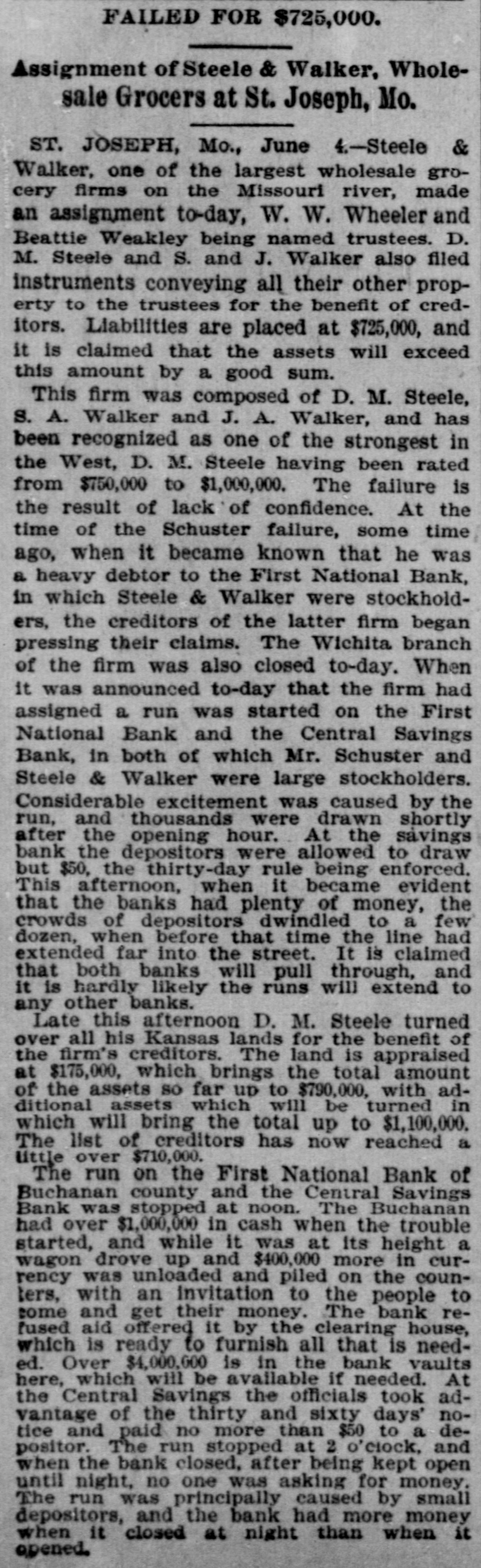
FAILED FOR $725,000. Assignment of Steele & Walker, Wholesale Grocers at St. Joseph, Mo. ST. JOSEPH, Mo., June 4.-Steele & Walker, one of the largest wholesale grocery firms on the Missouri river, made an assignment to-day, W. W. Wheeler and Beattie Weakley being named trustees. D. M. Steele and S. and J. Walker also filed instruments conveying all their other property to the trustees for the benefit of creditors. Liabilities are placed at $725,000, and it is claimed that the assets will exceed this amount by a good sum. This firm was composed of D. M. Steele, S. A. Walker and J. A. Walker, and has been recognized as one of the strongest in the West, D. M. Steele having been rated from $750,000 to $1,000,000. The failure is the result of lack of confidence. At the time of the Schuster failure, some time ago, when it became known that he was a heavy debtor to the First National Bank, in which Steele & Walker were stockholders, the creditors of the latter firm began pressing their claims. The Wichita branch of the firm was also closed to-day. When it was announced to-day that the firm had assigned a run was started on the First National Bank and the Central Savings Bank, in both of which Mr. Schuster and Steele & Walker were large stockholders. Considerable excitement was caused by the run, and thousands were drawn shortly after the opening hour. At the savings bank the depositors were allowed to draw but $50, the thirty-day rule being enforced. that This the afternoon, banks had when plenty it became of evident money, the crowds of depositors dwindled to a few dozen, when before that time the line had extended far into the street. It is claimed that both banks will pull through, and it is hardly likely the runs will extend to any other banks. Late this afternoon D. M. Steele turned over all his Kansas lands for the benefit of the firm's creditors. The land is appraised at $175,000, which brings the total amount of the assets so far up to $790,000, with additional assets which will be turned in which will bring the total up to $1,100,000. The list of creditors has now reached a little over $710,000. The run on the First National Bank of Buchanan county and the Central Savings Bank was stopped at noon. The Buchanan had over $1,000,000 in cash when the trouble started, and while it was at its height a wagon drove up and $400,000 more in currency was unloaded and piled on the counters, with an Invitation to the people to come and get their money. The bank refused aid offered it by the clearing house, which is ready to furnish all that is needed. Over $4,000,000 is in the bank vaults here, which will be available if needed. At the Central Savings the officials took advantage of the thirty and sixty days' notice and paid no more than $50 to a depositor. The run stopped at 2 o'clock, and when the bank closed, after being kept open until night, no one was asking for money. The run was principally caused by small depositors, and the bank had more money when it closed at night than when it opened.