Commercial Bank (New York, NY)

Episode Information

Episode UID
4978963391124
Episode Type
Run β†’ Suspension β†’ Closure
Bank Type
trust
Bank ID
497896339 hash
Start Date
August 12, 1893
Location
New York, New York (40.714, -74.006)

Metadata

Model
gpt-5-mini (chosen from majority vote of a three-model LLM ensemble)
Short Digest
a7f943279380ea68

Response Measures

None

Description

Articles refer to the Commercial Bank of Brooklyn (part of New York City) and document suspension followed by receivership and permanent failure.

Events (4)

1. August 12, 1893 Run
Cause
Bank Specific Adverse Info
Cause Details
Large withdrawals over prior month and discovery of heavy overdrafts/slow assets undermined confidence, causing crowds and heavy withdrawals
Measures
Directors closed bank and Chief Bank Examiner posted notice taking possession; counsel reassured depositors
Newspaper Excerpt
there was consequently a small army of depositors around the bank doors at the accustomed hour of opening
Source
newspapers
2. August 13, 1893 Suspension
Cause
Government Action
Cause Details
State Bank Examiner/Superintendent of Banks took possession and commenced examination after bank closed its doors
Newspaper Excerpt
This bank having closed its doors, I have taken possession of its affairs and commenced an examination into its condition. CHARLES M. PRESTON, Superintendent of Banks.
Source
newspapers
3. August 31, 1893 Receivership
Newspaper Excerpt
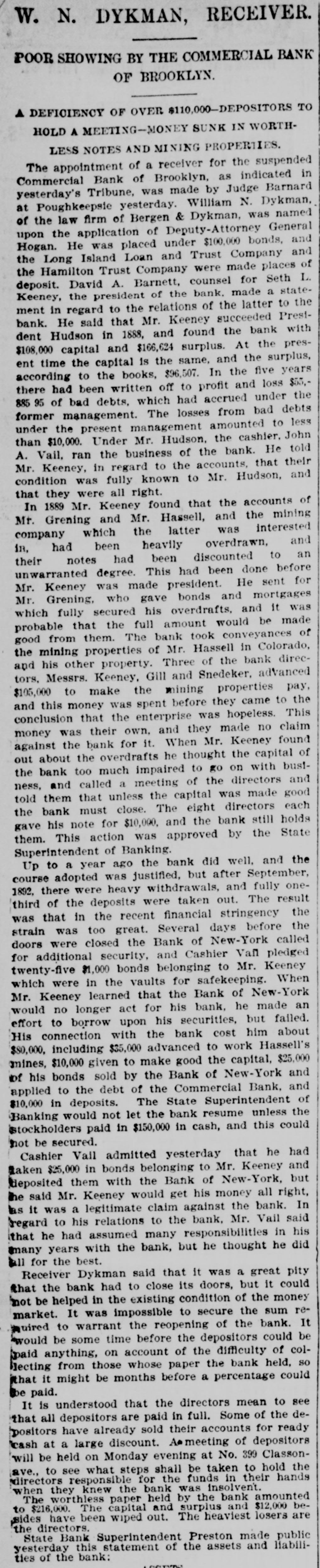
W. N. DYKMAN, RECEIVER...The appointment of a receiver for the suspended Commercial Bank of Brooklyn ... William N. Dykman ... was named upon the application of Deputy-Attorney General Hogan.
Source
newspapers
4. October 20, 1893 Other
Newspaper Excerpt
David Barnett ... has announced that the bank cannot resume. As soon as W. M. Dykman is made permanent receiver he will pay a dividend. He has about $240,000 in his possession as temporary receiver. The application was made yesterday ... the allegation was made that officers of the Bank of New-York carried off $314,000 in securities from the Commercial Bank without warrant of law.
Source
newspapers

Newspaper Articles (23)

Article from The Sun, August 13, 1893

Click image to open full size in new tab

Article Text

This Bank is Closed Temporarily J.J. VAIL, Cashier. There had not been the slightest rumor that the bank was in any financial strait. and even until the closing hours on Friday depositors kept putting in their money. The people who mainly do business with the Commercial are builders. contractors. and boss mechanics. and the closing of the bank on Saturday was a source of special inconvenionce to them. as the money to pay their employees is usually drawn out upon that day. There was consequentiy a small army of depositors around the bank doors at the accustomed hour of opening. and they indulged in varied adjectives on reading the announcement of temporary suspension. Inasmuch as the institution was regarded as one of the most solid in the State. the surprise extended be. yond those directly interested and caused a brief panic among the customers of the other banks. This quickly subsided. however. when it became known that no other local bank was in any way affected by the Commercial's trouble. The action of the directors was se sudden that even W. M. Dykman. counsel of the bank. was not consulted about the matter until resterday morning. He said: "This has been a complete surprise to me. as I knew nothing about it. and. for that mattor. nobody did until the exchanges had been made this morning. Then it was found that there was not enough money to transact the day's business." Mr. Dykman assured the anxious depositors that he was confldent the emburrassment would only be for a short time and that they would all get their money in full. t 11:45 o'clock this official statement was given out by David A. Barnett. who is law counsel for the bank: At the close of banking hours yesterday the National Bank of New York, National Banking Association, through which the Commercial Bank has heretofore transacted its business with the New York Clearing House, refused to act for the Commercial Bank after to-day The deposits at the Commercial Bank have decreased very largely for the last month. This decrease of deposits. with other causes. determined the directors 10 close the bank this morning About three years when Mr. Keeney became President. there were large overdrafts, which the previous administration of the aftairs of the bank had permitted to be made. These have been decreased. and the directors of the bank. under the lead of Mr. Keeney. made good the losses. Since Mr. Keeney became President the bank has lost considerably less than $10,000. The President and directors have been constdent of their ability to make the bank a success and have been prevented only by the unexpected with. drawal of deposits. There should be enough to pay ail depositors and shareholders. This was quickly followed by the posting of the following notice by Chief Bank Examiner A. C. Judson: This bank having closed its doors, I have takes possession of its affairs and commenced an examination into Its condition. CHARLES M. PRESTON, Superintendent of Banks. Mr. Judson told the reporters that his assistants were at work on the books but that he would not be able to make a detailed statement for at least four or five days. The overdrafts referred to were made about four years ago by ex-Alderman Paul C. Grening. an extensive real estate speculator and at present the proprietor of a hotel in Saratoga. and by G. L. Hassell. a teller in the New York Clearing House. When Mr. Seth L. Keeney became President three years ago ho and his fellow directors put up $80,000 to meet the notes. but just what loss they sustained by the overdraits has not been ascertained. Mr. Grening gave the bank as collateral $100,000 in mortgage. on all his property to secure the directors. It is said that it was not until yesterday morning that Mr. Keeney despaired of bridging over the present difficulties. He found that money could only be secured at a big premium. and that he could not dispose of his own valuable securities except at a low figure. This he did not think he could be fairly called up in to do This is the last quarterly statement of the bank. made June 1:
Article from The Sun, August 13, 1893

Click image to open full size in new tab

Article Text

President Keeney was for a long time the partner of the late W. C. Kingsley in the contracting business. and has extensive interests in Brooklyn. Ho is one of the heavlest stockholders in the Eagle, owns a big slice of Brooklyn Elevated road stock. and also stock in the Long Island Trust Company. and has hig contracts of various kinds. He was a Bridge Trustee under the old rΓ©gime, and recently. on the reorganization of the Board. was made one of the Brooklyn representatives. His associates in the bank directorate are: Rufus Resseguie. lumber merchant: George Malcom. brewer: James Lock. retired merchant: Robinson Gill of Gill & Baird: George Wilson. Elbert Snedeker, and David W. Bierns. The Commercial Bank is one of the depositories of the city and county moneys. and yesterday it held of the former $31,877.93 of the Board of Education funds and $12,900.78 of the general fund. and of the latter $40,000. The city and county authorities are protected by bonds of $200,000. It was rumored that the bank had recently made large advances to the Brooklyn and Union Elevated Railrond Company and other corporations in which Mr. Keeney and some of the other directors are interested, and that the suspension was due mainly to that cause. This 18 denied by the directors, who say that the fortheoming statement of the Bank Examiner will show that there was no mismanagement of the tunis. and that the trouble is solelydue to the general which prevails. At the Bank of New York vesterday it was said that the notice refusing longer to clear for the Commercial Bank was sent out late on Friday afternoon. The Clearing House committee made no examination of the Commercial and was not asked to make any. We made our own examination." said the -President of the Bank of New York, We went through the ledger and found that the deposits three monthaago amounted to n million dollars. There had been a gradual withdrawal for some time, and the deposits were decreased about $200,000. We found that nearly all the assets were of a slow charactor. Many consisted of notes which the bank had discounted for builders and dealers in building material. That line of business is very slow. In most cases there are frequent renowals. and It takes at best a long time to realize. The securities were good and all that, but they were too slow." Will the bank resume business?" "I think very likely that it will later on," was the reply. but. in the course of a little further talk. the Vice-President remarked: "The assets I speak of are slow when the bank is open. They are a good deal slower when the bank is closed." The Bank of New York still clears for five Brooklyn banks. The Vice-President said that. without exception. these banks are very strong: as strong as the New York city banks. There are included among the heaviest depositors in the Commercial: David M. Stone, the retired editor of the Journal of Commerce: the Brooklyn Ragle, Ernest Nathan's Son, the Fulton Municipal Gas Light Company, Jeweller Moses Strauss. Milliner H. M. Baum. Mane


Article from Grand Rapids Herald, August 14, 1893

Click image to open full size in new tab

Article Text

STOCKSUPANDDOWN Decrease in Bank Reserve Had an Adverse Influence. NORTHERN PACIFIC WAS WEAK Decline in General Stock List--Wheat Opened Weak, But Closed Firm On an Advance New York, Aug. 12-Money on call is nominally steady at 3 per cent. Prime mercantile paper, 8@12 per cent. Posted rates, $4.82@4.87. Government bonds have been weak. The sales of stocks today aggregated only 51,681 shares. At the opening the market was irregular, a few stocks showing declines and other advance, but the changes either way outside of American Sugar and Lackawanna were elight. The failure of the Commercial bank of Brooklyn, a small state bank, had little or no effect. About 11 o'clock a fair demand set in for Chicago Gas, Lake Shore and Lackavanna. The market held* tolerably firm until the publication of the bank statement. The banks lost over two and half millions in cash, expanded their loans $3,078,000 and decreased their liabilities $741,700. This showing created hearish feeling and a general decline followed. Northern Pacifics were particularly weak. London and Berlin had selling orders in the stock. Northern Pacific preferred from 21% to 18% and the common from 73/2 to 6Β½, Union Pacific was heavy, declining about 2 points upon the application for a receiver for the Union Pacific, Denver & Gulf. The general list fell X to 1Β½ per cent. Among the specialties U. S. Robber preferred declined 7 to 70 and Nashville & Chattanooga 3 to 56, Northwestern preferred juriped 4% to $1.85. Just previous to the close the was a smaller of small proportions, but the tone of the market was rather weak.


Article from The Seattle Post-Intelligencer, August 14, 1893

Click image to open full size in new tab

Article Text

Bilver bars, per ounce. 74@74}/ga Mexican dollars, 61@61}{c. MINING STOCKS Helcher 5 Alpha Con Best & Beicher. a Alta 5 Cholier D Andes 15 Con. Cal. & Va 1 35 Bullion 15 Confidence. Caledonia 5 & 10 Challenge Con Could s Curry Hale & Noreross 50 Crown Point 30 Potost 6 5 Kentuck 5 Ophir 70 Lady Washington. 4 Mexican 40 cavage bierra Nevada 10 Union Con 5 35/Overman Yellow Jacket.. 5 do/Utah NEW YORK MARKETS. STOCK EXCHANGE. NEW YORK, Aug. 12-Stocks opened irregular. American Sugar rose 1 to 74. The changes were generally fractional, and business was moderate. The failure of the Commercial bank of Brooklyn had no influence. Sugar receded to 72% and rallied to 733/4. Grangers and Lake Shore were in moderate demand, advancing. Union Pacific was weakened by the application for a receiver for the Union Pacific, Denver & Gulf road, one of its branch lines, and declined 1%, to 18Β½. At 11 the market was dull and steady. After 11 stocks developed weakness. The loss in bank reserves had an adverse influence. Northern Pacific issues were particularly weak, preferred falling from 21Β½ to 18%. common from 7% to 6Β½. The market closed weak. Government bonds-Steady. A a


Article from Evening Star, August 15, 1893

Click image to open full size in new tab

Article Text

Stockholders to Repay Depositors. William M. Dickman. the counsel for the Commercial Bank of Brooklyn, that suspended last Saturday, said yesterday that the stockholders of the bank were willing to be assessed for any amount necessary to meet the demands of the depositors.


Article from The Providence News, August 30, 1893

Click image to open full size in new tab

Article Text

Brooklyn Commercial Bank. BROOKLYN, Aug. 30.-The Bank Exam ner will apply for a receiver for the Co., mercial Bank, capital and surplus are both wiped out.


Article from New-York Tribune, August 31, 1893

Click image to open full size in new tab

Article Text

W. N. DYKMAN, RECEIVER POOR SHOWING BY THE COMMERCIAL BANK OF BROOKLYN. DEFICIENCY OF OVER $110,000-DEPOSITORS TO HOLD A meeting-money SUNK IN WORTHLESS NOTES AND MINING PROPERTIES. The appointment of a receiver for the suspended Commercial Bank of Brooklyn, as indicated in yesterday's Tribune, was made by Judge Barnard at Poughkeepsie yesterday. William N. Dykman of the law firm of Bergen & Dykman, was named upon the application of Deputy-Attorney General Hogan. He was placed under $100,000 bonds, and the Long Island Loan and Trust Company and the Hamilton Trust Company were made places of deposit. David A. Barnett, counsel for Seth L Keeney, the president of the bank. made a state ment in regard to the relations of the latter to the bank. He said that Mr. Keeney succeeded President Hudson in 1888, and found the bank with $108,000 capital and $166,624 surplus. At the present time the capital is the same, and the surplus, according to the books, $96,507. In the five years there had been written off to profit and loss $55,95 of bad debts, which had accrued under the former management. The losses from bad debts under the present management amounted to less than $10,000. Under Mr. Hudson, the cashier, John A. Vail, ran the business of the bank. He told Mr. Keeney, in regard to the accounts, that their condition was fully known to Mr. Hudson, and that they were all right. In 1889 Mr. Keeney found that the accounts of Mr. Grening and Mr. Hassell, and the mining company which the latter was interested in, had been heavily overdrawn, and their notes had been discounted to an unwarranted degree. This had been done before Mr. Keeney was made president. He sent for Mr. Grening, who gave bonds and mortgages which fully secured his overdrafts, and it was probable that the full amount would be made good from them. The bank took conveyances of the mining properties of Mr. Hassell in Colorado, and his other property. Three of the bank directors, Messrs. Keeney, Gill and Snedeker, advanced $105,000 to make the mining properties pay, and this money was spent before they came to the conclusion that the enterprise was hopeless. This money was their own, and they made no claim against the bank for it. When Mr. Keeney found out about the overdrafts he thought the capital of the bank too much impaired to go on with bustness, and called a meeting of the directors and told them that unless the capital was made good the bank must close. The eight directors each gave his note for $10,000, and the bank still holds them. This action was approved by the State Superintendent of Banking. Up to a year ago the bank did well, and the course adopted was justified, but after September, 1892, there were heavy withdrawals, and fully onethird of the deposits were taken out. The result was that in the recent financial stringency the strain was too great. Several days before the doors were closed the Bank of New-York called for additional security, and Cashier Vafl pledged twenty-five $1,000 bonds belonging to Mr. Keeney which were in the vaults for safekeeping. When Mr. Keeney learned that the Bank of New-York would no longer act for his bank, he made an effort to borrow upon his securities, but failed. His connection with the bank cost him about $80,000, including $35,000 advanced to work Hassell's mines, $10,000 given to make good the capital, $25,000 of his bonds sold by the Bank of New-York and applied to the debt of the Commercial Bank, and $10,000 in deposits. The State Superintendent of Banking would not let the bank resume unless the stockholders paid in $150,000 in cash, and this could


Article from The Sun, September 1, 1893

Click image to open full size in new tab

Article Text

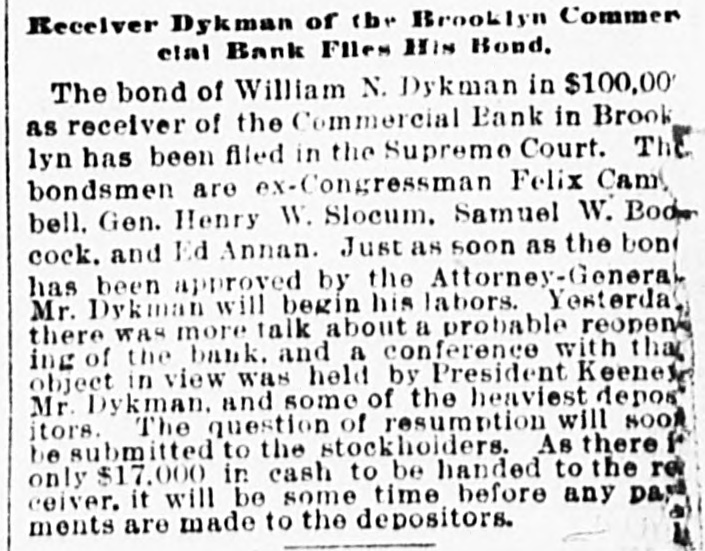
Receiver Dykman of the Brooklyn Commer etal Bank Files His Bond. The bond of William N. Dykman in $100,00' as receiver of the Commercial Bank in Brook lyn has been filed in the Supreme Court. The bondsmen are ex-Congressman Felix Cam bell. Gen. Henry W. Slocum. Samuel W. Bode cock. and Ed Annan. Just as soon as the bon( has been approved by the Attorney-General Mr. Dykman will begin his labors. Yesterda there was more talk about a probable reopend ing of the bank. and a conference with that object in view was held by President Keeney Mr. Dykman. and some of the heaviest depos itors. The question of resumption will SOOP be submitted to the stockholders. As there P only $17.000 in cash to be handed to the rev ceiver. it will be some time before any Das ments are made to the depositors.


Article from The Sun, September 2, 1893

Click image to open full size in new tab

Article Text

THE BROOKLYN COMMERCIAL BANK. Some Dissatisfied Depositors Want an Associate Receiver. The bond of Lawyer W. N. Dykman as receiver of the Commercial Bank in Brooklyn was approved yesterday. and he took charge of the bank. It is said another effort will be made toward resumption. There are some depositors who are dissatisfied with Mr. Dykman as receiver because he is at present counsel of President Keeney, and they have asked Bank Superintendent Preston to appoint an associate receiver. to be designated by the depositors. Mr. Preston, it is understood. has the request under consideration. but it is not thought likely that All associate receiver will be appointed. Owing to the fact that $12, 000 of its money is looked up in the Commercial Bank. the Brooklyn and Brighton Beach Railroad Company has been compolied to default in the payment of the interest on its $500.000 outstanding 5 per cent. bonds. District Attorney Ridgway said yesterday that he had no knowledge of any criminal proceedings against any officers of the bank. So far. he said. he had not been consulted on the matter at all. President Keeney again declared yesterday that the depositors would sooner or Inter get their money in full. and that there was every prospect that business would be resumed. He would not serve again as President under any circumstances.


Article from The Sun, September 6, 1893

Click image to open full size in new tab

Article Text

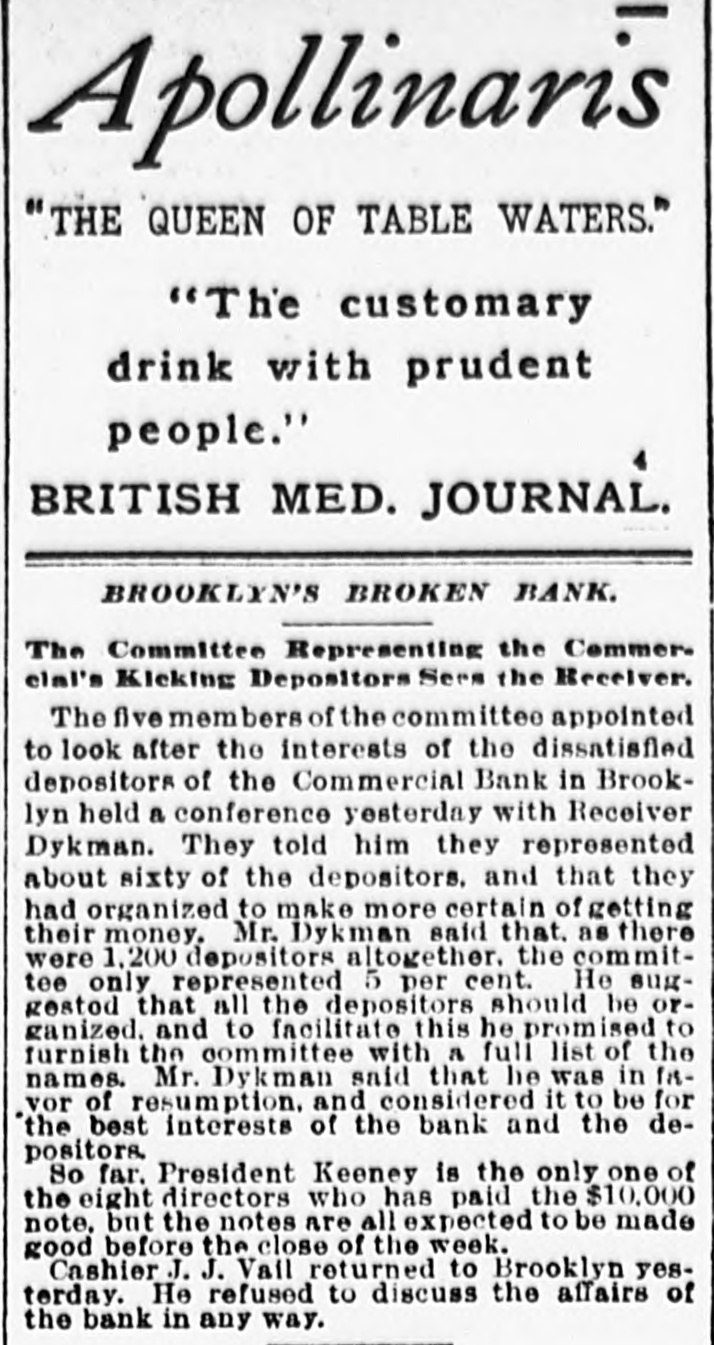
Apollinaris "THE QUEEN OF TABLE WATERS." "The customary drink with prudent people." 4 BRITISH MED. JOURNAL. BROOKLYN'S BROKEN BANK. The Committee Representing the Commerclai's Kleking Depositors Sers the Receiver. The five members of the committee appointed to look after the interests of the dissatisfled depositors of the Commercial Bank in Brooklyn held a conference yesterday with Receiver Dykman. They told him they represented about sixty of the depositors. and that they had organized to make more certain of getting their money. Mr. Dykman said that. as there were 1,200 depositors altogether. the committee only represented 5 per cent. He suggested that all the depositors should be organized. and to facilitate this he promised to furnish the committee with a full list of the names. Mr. Dykman said that he was in firvor of resumption. and considered it to be for the best interests of the bank and the depositors. So far. President Keeney is the only one of the eight directors who has paid the $10,000 note. but the notes are all expected to be made good before the close of the week. Cashier J. J. Vail returned to Brooklyn yesterday. He refused to discuss the affairs of the bank in any way.


Article from The Sun, September 7, 1893

Click image to open full size in new tab

Article Text

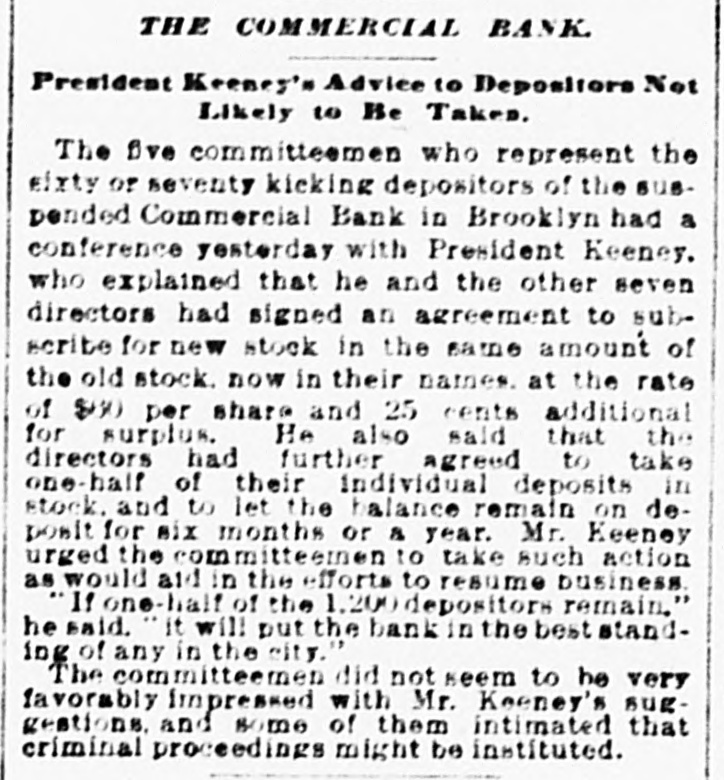
THE COMMERCIAL BANK. President Keeney's Advice to Depositors Not Likely to Be Taken. The five committeemen who represent the sixty or seventy kicking depositors of the suspended Commercial Bank in Brooklyn had a conference yesterday with President Keeney. who explained that he and the other seven directors had signed an agreement to subscribe for new stock in the same amount of the old stock. now in their names. at the rate of $00 per share and 25 cents additional for surplus. He also said that the directors had further agreed to take one-half of their individual deposits in stock. and to let the balance remain on deposit for six months or a year. Mr. Keeney urged the committeemen to take such action as would and in the efforts to resume business. If one-half of the 1.200 1.200depositors remain." he said. " It will put the bank in the best standing of any in the city." The committeemen did not seem to he very favorably impressed with Mr. Keeney's suggestions. and some of them intimated that criminal proceedings might be instituted.


Article from The Herald, September 9, 1893

Click image to open full size in new tab

Article Text

A Bad Investment. NEW YORK, Sept. 8.-The receiver of the wrecked Commercial bank of Brooklvn says the institution lost $160,000 through investments in the Kevin mine in Colorado.


Article from Iron County Register, September 14, 1893

Click image to open full size in new tab

Article Text

AT a meeting of depositors of the suspended Commercial bank of Brooklyn, on the 6th,Mr. Haviland. a real estate man and depositor in the bank, made an address in which he proposed that the depositors criminally prosecute the officers of the bank.


Article from Idaho County Free Press, September 15, 1893

Click image to open full size in new tab

Article Text

Unfortunate Investments. NEW YORK, Sept. 8.-The receiver of the wrecked Commercial bank says the institution has lost $160,000 through investments in the Kexin Mine in Colorado.


Article from The Times, September 15, 1893

Click image to open full size in new tab

Article Text

Almost.$200,000 Lost. BROOKLYN, Sept. 9.-The receiver of the wrecked Commercial bank of Brooklyn has discovered that $168,000 of the bank's funds invested in western mining property is irretrievably lost.


Article from The Providence News, September 23, 1893

Click image to open full size in new tab

Article Text

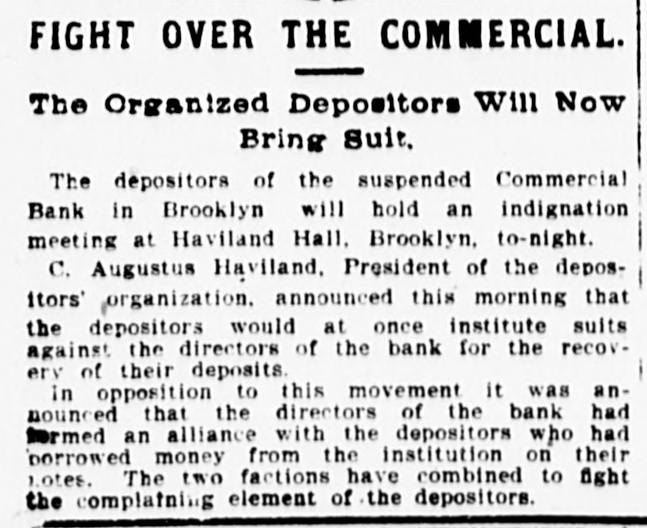
Will Sue the Directors. NEW YORK, Sep. 23. -C. Augustus Haviland, who is heading the movement of the depositors of the suspended Commercial Bank of Brooklyn against the directors, announced this morning that the depositors would at once begin suits against the directors to recover the amount of their deposits.


Article from Waterbury Evening Democrat, October 20, 1893

Click image to open full size in new tab

Article Text

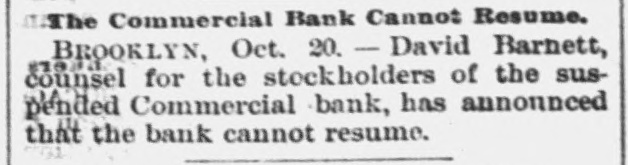
The Commercial Bank Cannot Resume. BROOKLYN, Oct. 20. - David Barnett, counsel $10.00 for the stockholders of the suspended Commercial bank, has announced that the bank cannot resume.


Article from Pawtucket Tribune, October 20, 1893

Click image to open full size in new tab

Article Text

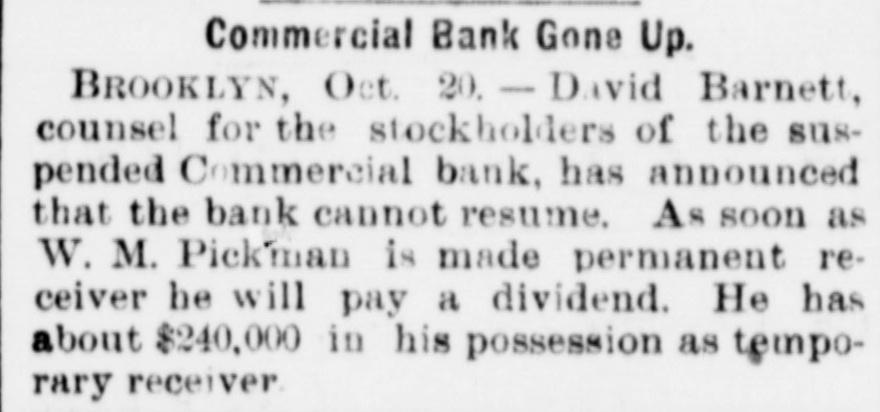
Commercial Bank Gone Up. BROOKLYN, Oct. 20. - David Barnett, counsel for the stockholders of the suspended Commercial bank, has announced that the bank cannot resume. As soon as W. M. Pickman is made permanent receiver he will pay a dividend. He has about $240,000 in his possession as temporary receiver


Article from New-York Tribune, October 20, 1893

Click image to open full size in new tab

Article Text

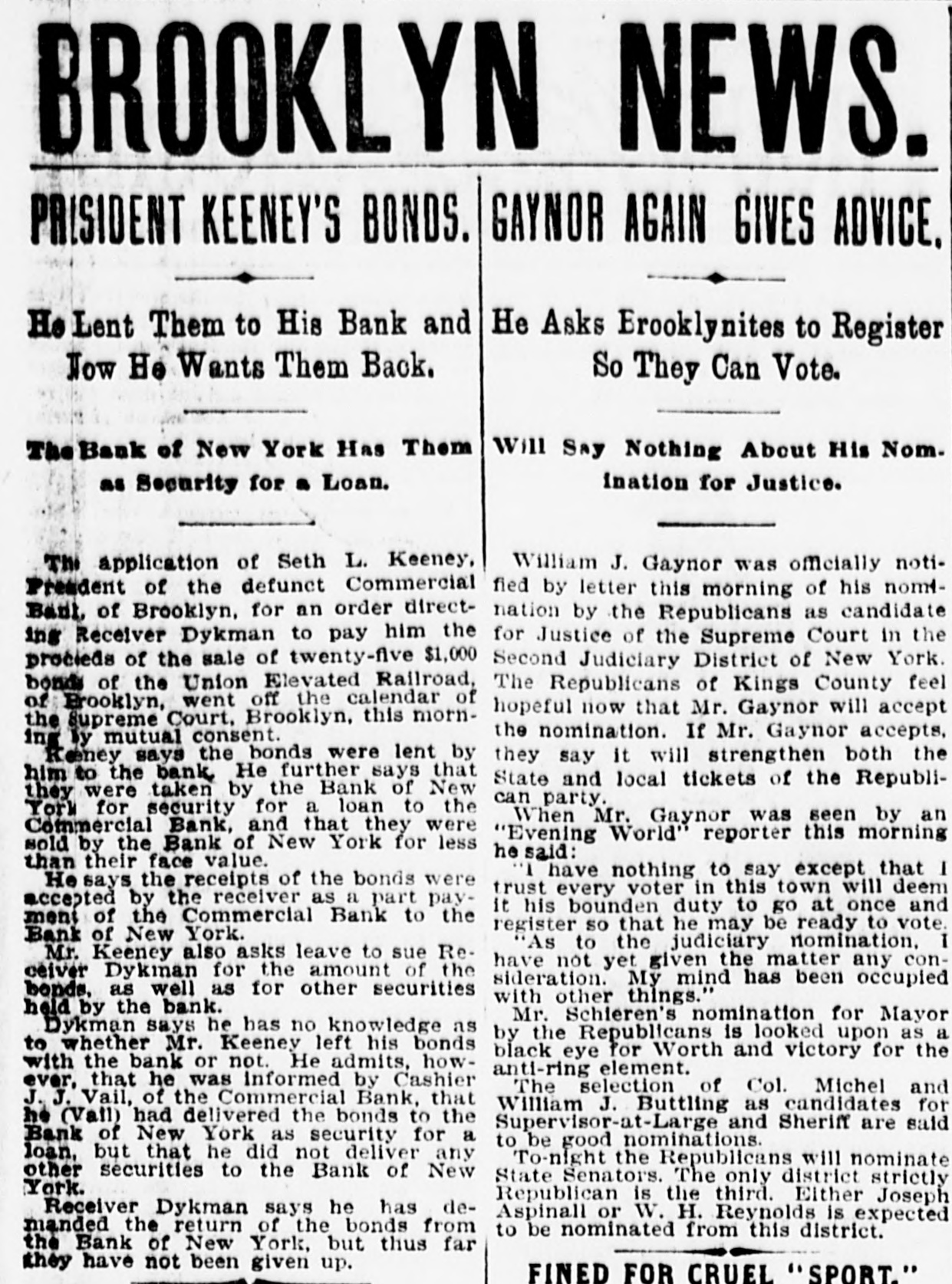
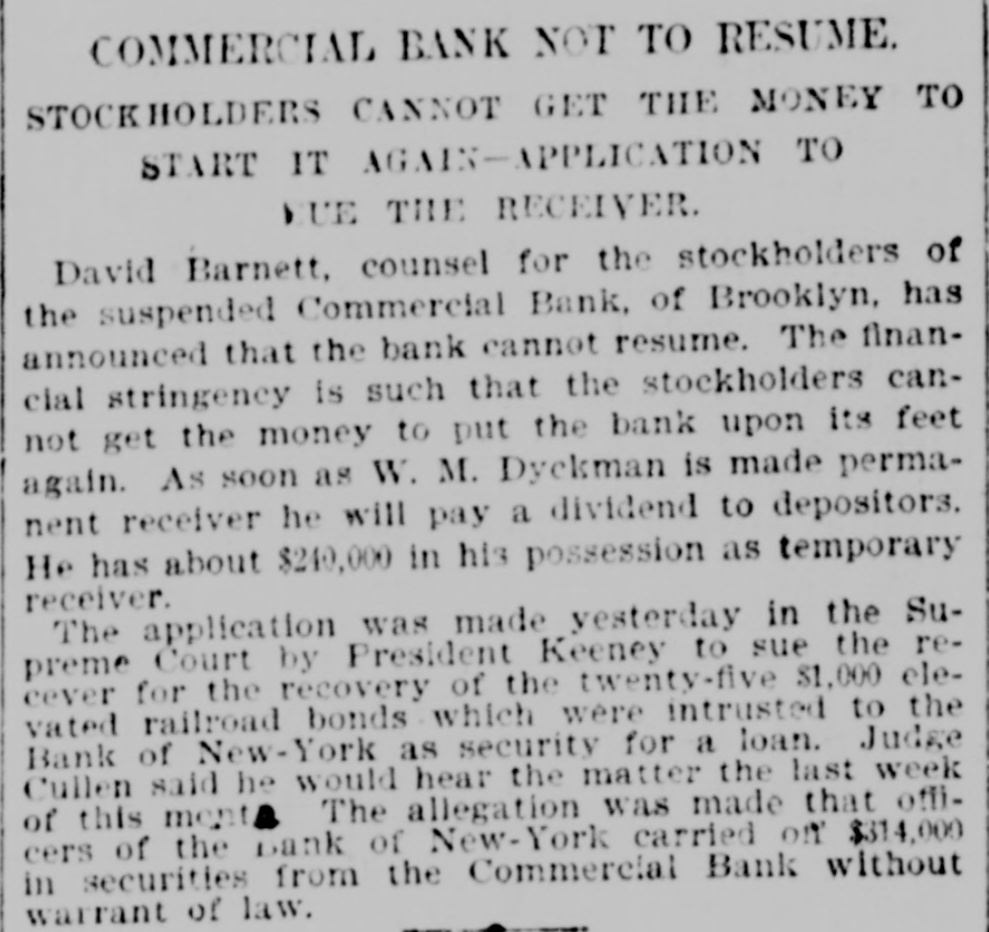
COMMERCIAL BANK NOT TO RESUME. STOCKHOLDERS CANNOT GET THE MONEY TO START IT AGAIS-APPLICATION TO UE THE RECEIVER David Barnett, counsel for the stockholders of the suspended Commercial Bank, of Brooklyn, has announced that the bank cannot resume. The financial stringency is such that the stockholders cannot get the money to put the bank upon its feet again. As soon as W. M. Dyckman is made permanent receiver he will pay a dividend to depositors. He has about $240,000 in his possession as temporary receiver. The application was made yesterday in the Supreme Court by President Keeney to sue the recever for the recovery of the twenty-five $1,000 elevated railroad bonds which were intrusted to the Bank of New-York as security for a loan. Judge Cullen said he would hear the matter the last week The allegation was made that offiof this ment cers of the Bank of New-York carried off $314,000 in securities from the Commercial Bank without warrant of law.


Article from The Providence News, October 31, 1893

Click image to open full size in new tab

Article Text

Brooklyn Commercial Bank. BROOKLYN, N. Y., Nov. 1,-Dykman has been made permanent receiver of the Commercial bank.


Article from The Indianapolis Journal, March 11, 1894

Click image to open full size in new tab

Article Text

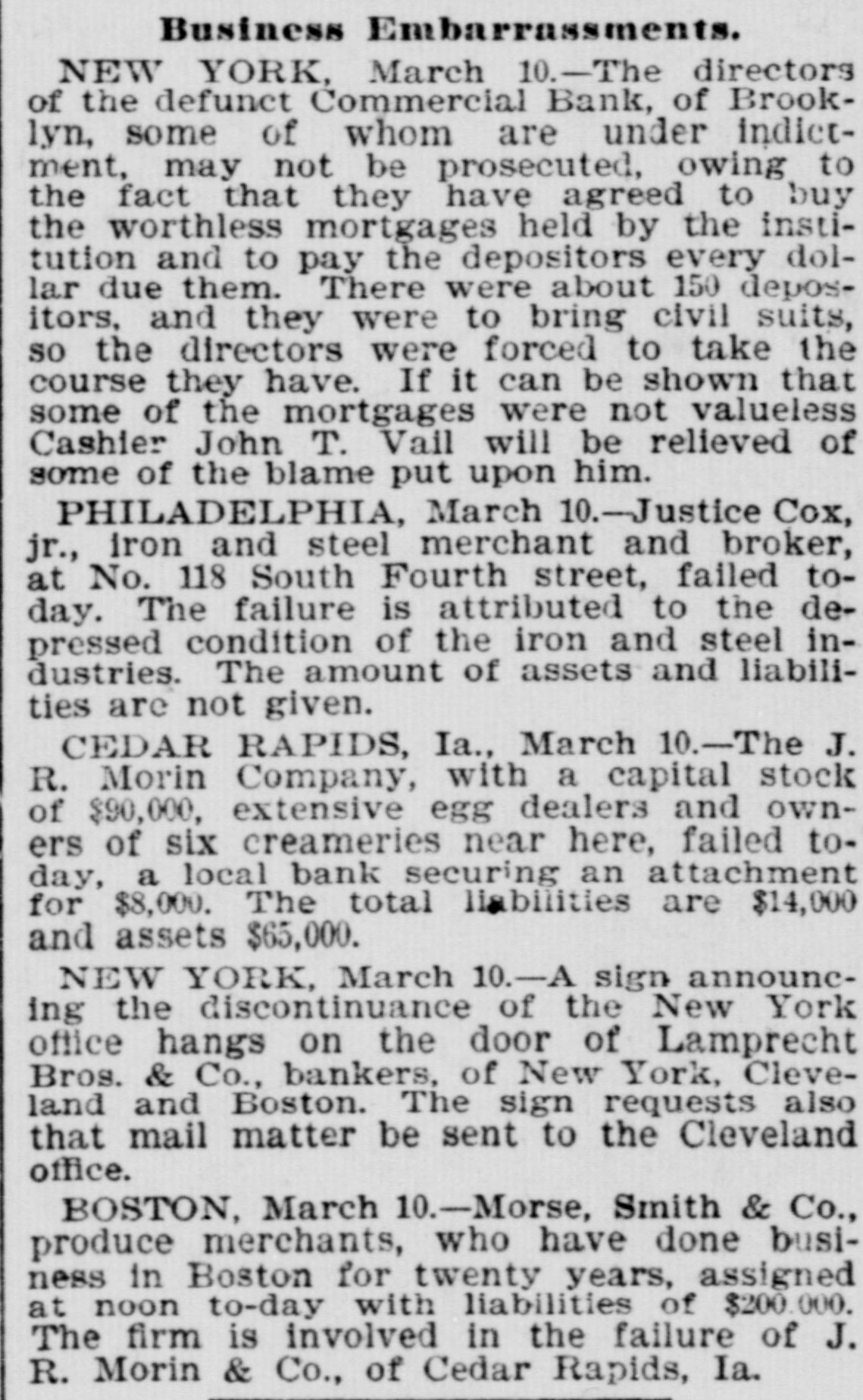
Business Embarrassments. NEW YORK, March 10.-The directors of the defunct Commercial Bank, of Brooklyn, some of whom are under indictment, may not be prosecuted, owing to the fact that they have agreed to buy the worthless mortgages held by the institution and to pay the depositors every dollar due them. There were about 150 depositors, and they were to bring civil suits, SO the directors were forced to take the course they have. If it can be shown that some of the mortgages were not valueless Cashier John T. Vail will be relieved of some of the blame put upon him. PHILADELPHIA, March 10.-Justice Cox, jr., iron and steel merchant and broker, at No. 118 South Fourth street, failed today. The failure is attributed to the depressed condition of the iron and steel industries. The amount of assets and liabilities are not given. CEDAR RAPIDS, Ia., March 10.-The J. R. Morin Company, with a capital stock of $90,000, extensive egg dealers and owners of six creameries near here, failed today, a local bank securing an attachment for $8,000. The total liabilities are $14,000 and assets $65,000. NEW YORK, March 10.-A sign announcing the discontinuance of the New York office hangs on the door of Lamprecht Bros. & Co., bankers, of New York, Cleveland and Boston. The sign requests also that mail matter be sent to the Cleveland office. BOSTON, March 10.-Morse, Smith & Co., produce merchants, who have done business in Boston for twenty years, assigned at noon to-day with liabilities of $200.000. The firm is involved in the failure of J. R. Morin & Co., of Cedar Rapids, Ia.


Article from New-York Tribune, May 1, 1894

Click image to open full size in new tab

Article Text

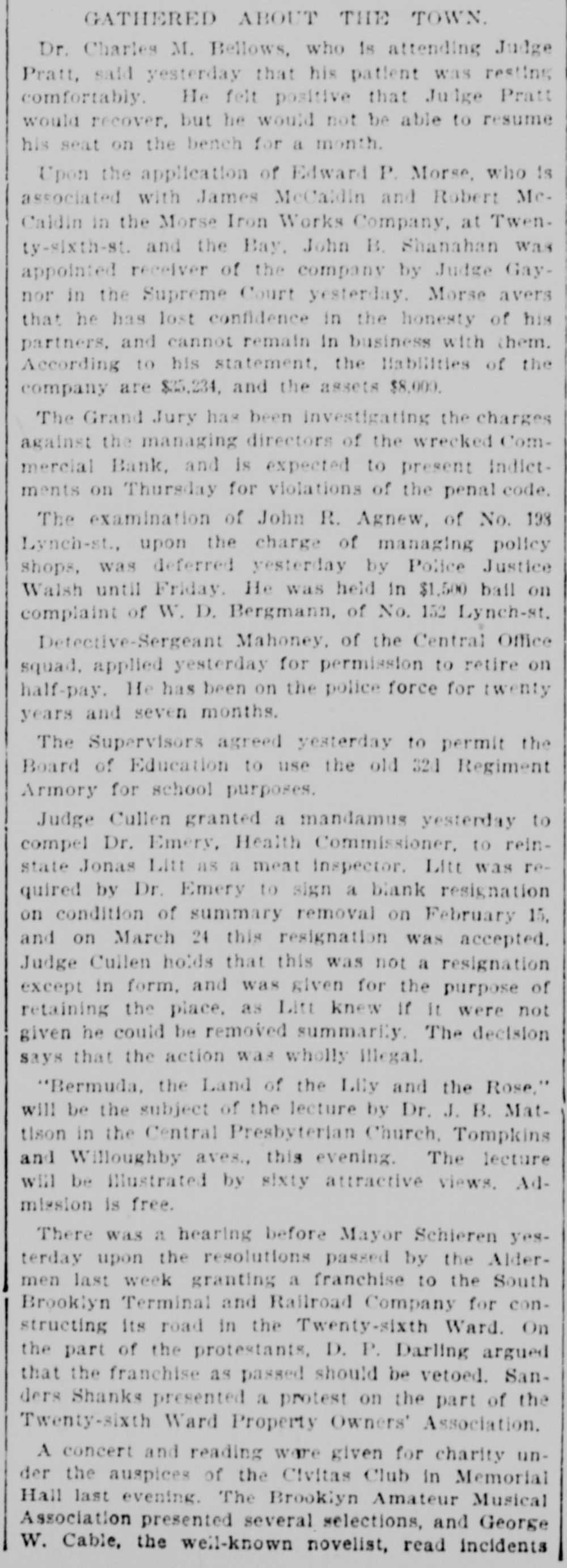
GATHERED ABOUT THE TOWN. Dr. Charles M. Bellows, who is attending Judge Pratt, said yesterday that his patient was resting comfortably. He felt positive that Judge Pratt would recover, but he would not be able to resume his seat on the bench for a month. Upon the application of Edward P. Morse, who is associated with James McCaldin and Robert McCaldin in the Morse Iron Works Company, at Twenty-sixth-st. and the Bay, John B. Shanahan was appointed receiver of the company by Judge Gaynor in the Supreme Court yesterday. Morse avers that he has lost confidence in the honesty of his partners, and cannot remain in business with them. According to his statement, the liabilities of the company are $35,234, and the assets $8,000. The Grand Jury has been investigating the charges against the managing directors of the wrecked Commercial Bank, and is expected to present Indictments on Thursday for violations of the penal code. The examination of John R. Agnew, of No. 198 Lynch-st., upon the charge of managing policy shops, was deferred yesterday by Police Justice Walsh until Friday. He was held in $1,500 ball on complaint of W. D. Bergmann, of No. 152 Lynch-st. Detective-Sergeant Mahoney, of the Central Office squad, applied yesterday for permission to retire on half-pay. He has been on the police force for twenty years and seven months. The Supervisors agreed yesterday to permit the Board of Education to use the old 32d Regiment Armory for school purposes. Judge Cullen granted a mandamus yesterday to compel Dr. Emery, Health Commissioner, to reinstate Jonas Litt as a meat inspector. Litt was required by Dr. Emery to sign a blank resignation on condition of summary removal on February 15, and on March 24 this resignation was accepted. Judge Cullen holds that this was not a resignation except in form, and was given for the purpose of retaining the place, as Litt knew If It were not given he could be removed summarily. The decision says that the action was wholly illegal. "Bermuda, the Land of the Lily and the Rose." will be the subject of the lecture by Dr. J. B. Mattison in the Central Presbyterian Church, Tompkins and Willoughby aves., this evening. The lecture will be illustrated by sixty attractive views. Admission is free. There was a hearing before Mayor Schieren yesterday upon the resolutions passed by the Aldermen last week granting a franchise to the South Brooklyn Terminal and Railroad Company for constructing its road in the Twenty-sixth Ward. On the part of the protestants, D. P. Darling argued that the franchise as passed should be vetoed. Sanders Shanks presented a protest on the part of the Twenty-sixth Ward Property Owners' Association. A concert and reading were given for charity under the auspices of the Civitas Club in Memorial Hall last evening. The Brooklyn Amateur Musical Association presented several selections, and George W. Cable, the well-known novelist, read incidents


Article from New-York Tribune, November 17, 1895

Click image to open full size in new tab

Article Text

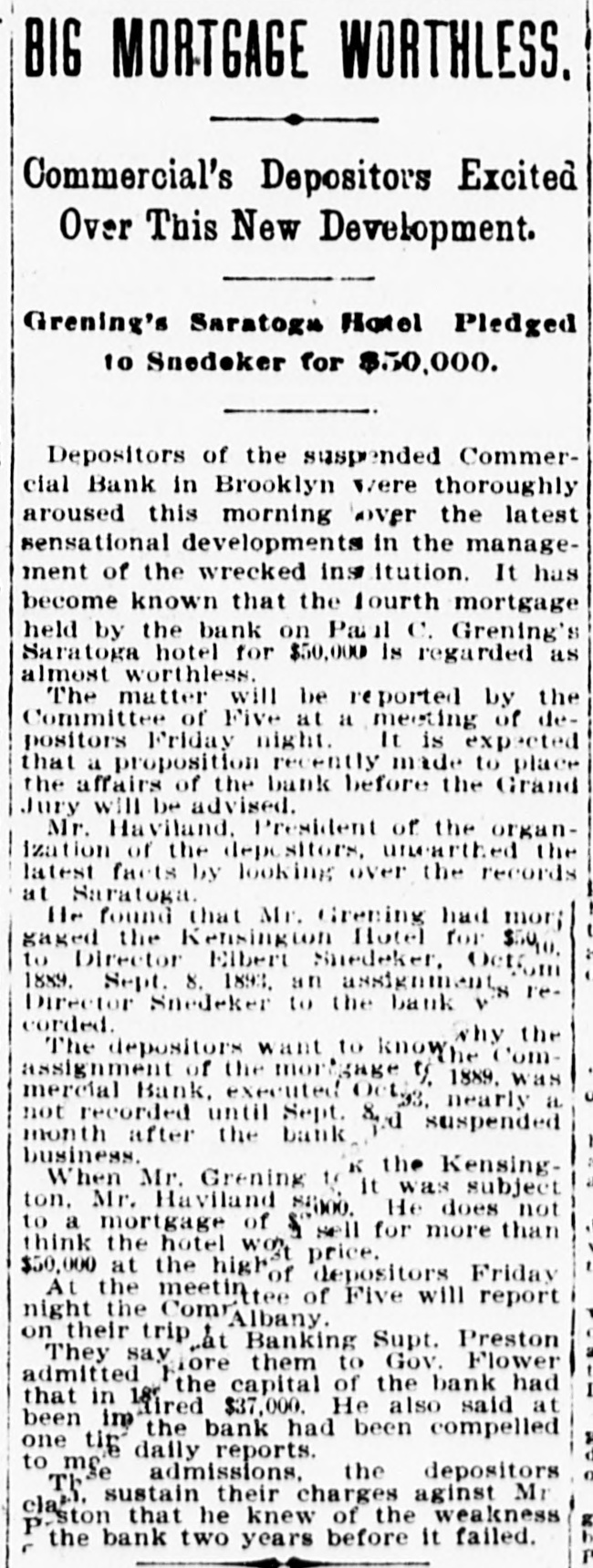
THOSE CHARGES AGAINST PRESION. THE BANK SUPERINTENDENT SAYS THEY WERE INVESTIGATED TWO YEARS AGO AND DISMISSED BY GOVERNOR FLOWER Kingston, N. Y., Nov. 16.-The representative of the United Press called on Bank SuperIntendent Charles M. Preston at his home in this city to-day and asked him regarding the charges made against him by the Depositors' Organization of the Commercial Bank of Brooklyn to Governor Morton. Mr. Preston said all the knowledge he had of the charges was what he saw in the newspapers. and they appear to be the same as presented by the same men to Governor Flower in 1893. They were fully investigated at the time, and dismissed by the Governor. In 1894 they were again presented. then to the State Senate, when they were dismissed after investigation. This is the third time the charges have been presented Mr. Preston said the men who call themselves the Depositors' Organization of the Commercial Bank represent only a few of the depositors of the bank at the time of its suspension. He said he falled to see any reason for the renewal of the charges at this time, because he has been informed the depositors will be paid in full. unless there is a spirit or malice and spite behind it. or else the gentlemen preferring them have a desire for newspaper publicity. In regard to Examiner Cahill reporting the bank insolvent twice, Mr. Preston said that on each of those occasions he went to Brooklyn and caused the bank to be made solvent. He said that he would call on Governor Morton on Monday and ask that a full consideration of the charges be had. As far as he knew, Mr. Preston said. there were not any new facts stated in this last proceeding. They had all been considered by Governor Flower in 1893 and by the last Senate and dismissed.