Enterprise National Bank (Pittsburg, PA)

Episode Information

Episode UID
499101270
Episode Type
Suspension โ†’ Run โ†’ Closure
Bank Type
national
Bank ID
49910 national
Charter Number
4991
Start Date
October 18, 1905
Location
Pittsburg, Pennsylvania (40.441, -79.996)

Metadata

Model
gpt-5-mini (chosen from majority vote of a three-model LLM ensemble)
Short Digest
8b1763ef8b452643

Response Measures

Capital injected, Full suspension, Books examined

Receivership Details

Depositor recovery rate
35.6%
Date receivership started
1905-10-18
Date receivership terminated
1916-10-31
OCC cause of failure
Fraud
Share of assets assessed as good
39.8%
Share of assets assessed as doubtful
54.1%
Share of assets assessed as worthless
6.1%

Description

Cashier T. Lee Clark's suicide and large embezzlements prompted the comptroller to close the bank and a receiver was appointed.

Events (5)

1. April 4, 1895 Chartered
Source
historical_nic
2. October 18, 1905 Receivership
Source
historical_nic
3. October 18, 1905 Receivership
Newspaper Excerpt
Examiner Cunningham was appointed receiver. The comptroller ... ordered the bank closed, declaring it insolvent. Examiner Cunningham was appointed receiver.
Source
newspapers
4. October 18, 1905 Suspension
Cause
Government Action
Cause Details
Comptroller of the Currency ordered closure upon information of insolvency following the cashier's suicide and discovered shortages.
Newspaper Excerpt
The Enterprise National bank of Allegheny, Pa., was closed today by direction of the controller of the currency ... that the bank is insolvent
Source
newspapers
5. November 4, 1905 Other
Newspaper Excerpt
A swarm of women, mostly school teachers, attempted to storm the Enterprise National bank. Rumors became current that some depositors were to be paid off. Receiver Cunningham ordered the doors barred.
Source
newspapers

Newspaper Articles (24)

Article from The Minneapolis Journal, October 18, 1905

Click image to open full size in new tab

Article Text

PENNSYLVANIA BANK CLOSED. Washington, Oct. 18.-The Enterprise National bank of Allegheny, Pa., was closed today by direction of the controller of the currency upon information received from National Bank Examiner John B. Cunningham, that the bank is insolvent and that the cashier had committed suicide. Examiner Cunningham was appointed receiver.


Article from The Seattle Star, October 18, 1905

Click image to open full size in new tab

Article Text

SUICIDES ON EVE OF CRASH. PITTSBURG, Pa., Oct. 18,-T. L Clark, cashier of the Enterprise National bank, committed suicide this morning. The comptroller of the curs rency later ordered the bank closed, declaring It Insolvent. Examiner Cunningham was appointed receiver.


Article from East Oregonian : E.O, October 18, 1905

Click image to open full size in new tab

Article Text

CASHIER SUICIDES. Bank Is Closed Later and a Receiver Appointed. Pittsburg. Oct. 18-T. L. Clark, eashier of the Enterprise National bank, committed suicide this morning. The comptroller of the currency later ordered the bank closed, declaring it insolvent. Examiner Cunningham has been appointed receiver.


Article from New-York Tribune, October 22, 1905

Click image to open full size in new tab

Article Text

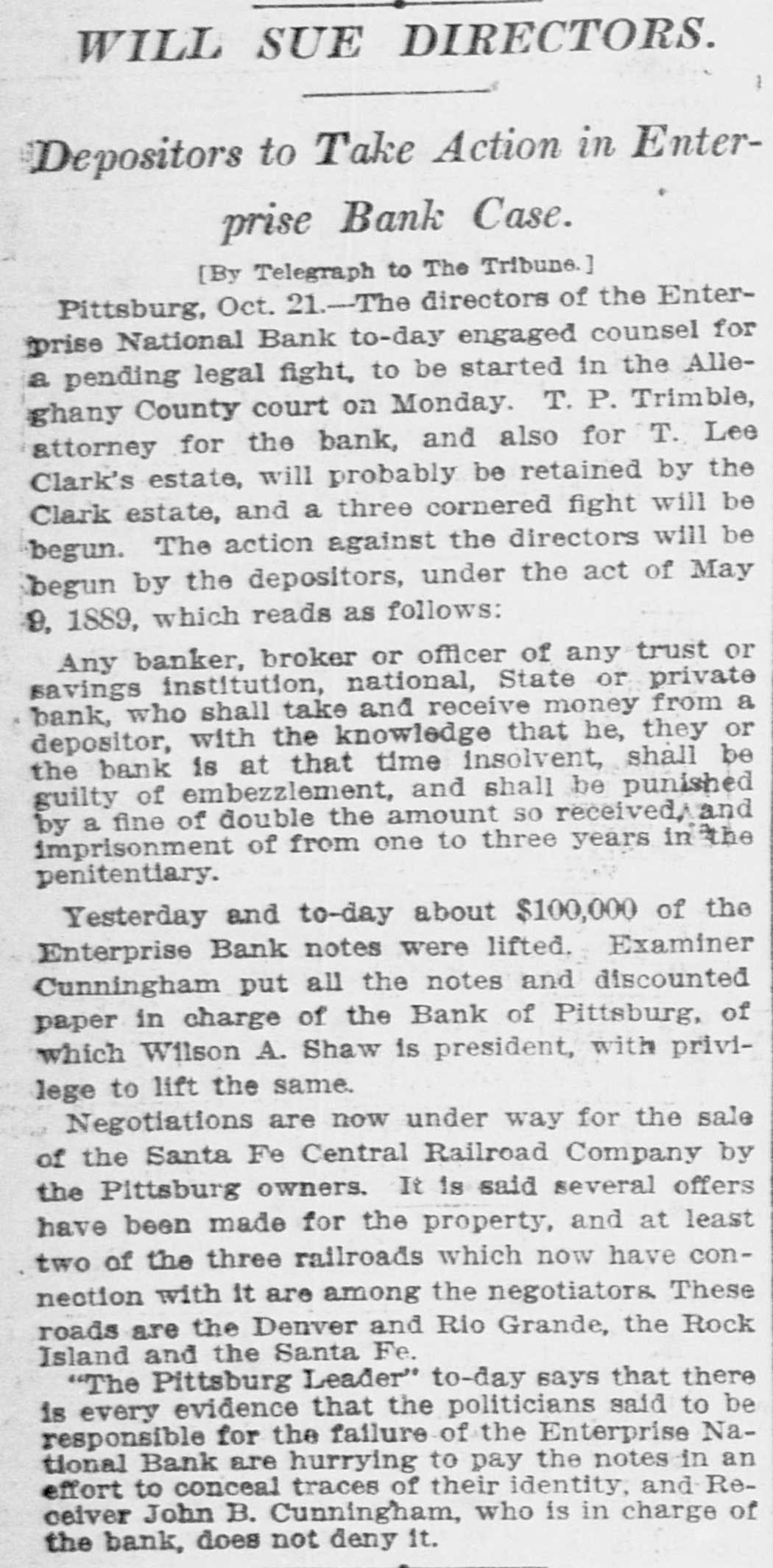
WILL SUE DIRECTORS. Depositors to Take Action in Enterprise Bank Case. [By Telegraph to The Tribune.] Pittsburg, Oct. 21.-The directors of the Enterprise National Bank to-day engaged counsel for a pending legal fight, to be started in the Alleghany County court on Monday. T. P. Trimble, attorney for the bank, and also for T. Lee Clark's estate, will probably be retained by the Clark estate, and a three cornered fight will be begun. The action against the directors will be begun by the depositors, under the act of May 9, 1889, which reads as follows: Any banker, broker or officer of any trust or savings institution, national, State or private bank, who shall take and receive money from a depositor, with the knowledge that he, they or the bank is at that time insolvent, shall be guilty of embezzlement, and shall be punished by a fine of double the amount so received and imprisonment of from one to three years in the penitentiary. Yesterday and to-day about $100,000 of the Enterprise Bank notes were lifted. Examiner Cunningham put all the notes and discounted paper in charge of the Bank of Pittsburg, of which Wilson A. Shaw is president, with privilege to lift the same. Negotiations are now under way for the sale of the Santa Fe Central Railroad Company by the Pittsburg owners. It is said several offers have been made for the property, and at least two of the three railroads which now have connection with It are among the negotiators. These roads are the Denver and Rio Grande, the Rock Island and the Santa Fe. "The Pittsburg Leader" to-day says that there is every evidence that the politicians said to be responsible for the failure of the Enterprise National Bank are hurrying to pay the notes in an effort to conceal traces of their identity, and Receiver John B. Cunningham, who is in charge of the bank, does not deny 1t.


Article from Omaha Daily Bee, October 24, 1905

Click image to open full size in new tab

Article Text

STATE IS AMPLY SECURED Treasurer of Pennsylvania Talks of Funds in Defunet Allegheny Bank. HARRISBURG, Pa., Oct. 23.-State Treasurer Mathuews was at his office today for the first time since the failure of the Enterprise National bank of Allegheny, in which more than $1,000,000 of public funds were deposited. He said that at the time of the failure there was $1,030,000 of state money in the bank, of which $632,000 belonged to the general fund and the balance to the sinking fund. Asked about the report that security which had been furnished by the bank to protect the state from any loss in case of failure was worthless, Mr. Mathuews said he had every reason to believe that the state was amply protected. He also said that these bonds would more than cover the amount of the state's deposit and that he was not giving himself any concern about this feature of the case. A receiver was appointed this afternoon for the National Cable and Wire company, a corporation of which the late T. Lee Clark, cashier of the Enterprise bank, was president. J. H. Hunter was named as receiver and a preliminary injunction was granted by the court restraining the company from disposing of or incumbering the assets in favor of any particular creditor. The company is capitalized at $500,000, half of which is preferred stock. None of the common stock has been issued, but $151,400 worth of the preferred stock has been sold and is now outstanding.


Article from The Manitowoc Pilot, October 26, 1905

Click image to open full size in new tab

Article Text

HIS SHORTAGE MAY REACH $2,000,000. Directors of Alleghany Bank Will Not Know Actual Deficit Until Auditor's Work Is Done. PITTSBURG, Pa., Oct. 23.-It was announced today by National Bank Examiner John B. Cunningham, receiver of the Enterprise National bank of Allegheny, that the audit of the accounts of the institution will not be completed before the latter part of this week. The directors and stockholders of the bank are still in the dark concerning the deficit and do not know whether the private loans made by Cashier Clark will reach $700,000 or greatly exceed that amount. Mr. Gwinner, president of the bank. when pressed for-a statement, said he did not know whether the shortage would be $1000 or $2,000,000. W. A. Seiling. a director, said the prospects were brighter and the bank would soon be able to open its doors. It is reported that 11 syndicate is buying the accounts of the small depositors at 50 cents on the dollar, but sales are few. as the depositors are hopeful of getting back every cent of their money. HARRISBURG, Pa., Oct. 23.State Treasurer Matthews today said that at the time of the Enterprise bank failure there were $1,030,000 of state money in the bank.


Article from The Spokane Press, November 1, 1905

Click image to open full size in new tab

Article Text

MUST PAY THE DEFICIT PITTSBURG, Pa., Nov. 1.-The receiver of the Enterprise National bank today sent the stockholders notice of a 100 per cent assessment on the par value of their stock.


Article from East Oregonian : E.O, November 1, 1905

Click image to open full size in new tab

Article Text

Will Assess Bank Stock. Pittsburg, Nov. 1.-The receiver of the Enterprise National Bank today sent the stockholders notice of a 100 per cent assessment on the par value of all the stock.


Article from The Seattle Star, November 1, 1905

Click image to open full size in new tab

Article Text

PITTSBURG, Pa., Nov. 1.-The receiver of the Enterprise National bank today sent the stockholders a notice of a 100 per cent assessment on the par value of the stock.


Article from Watertown Republican, November 8, 1905

Click image to open full size in new tab

Article Text

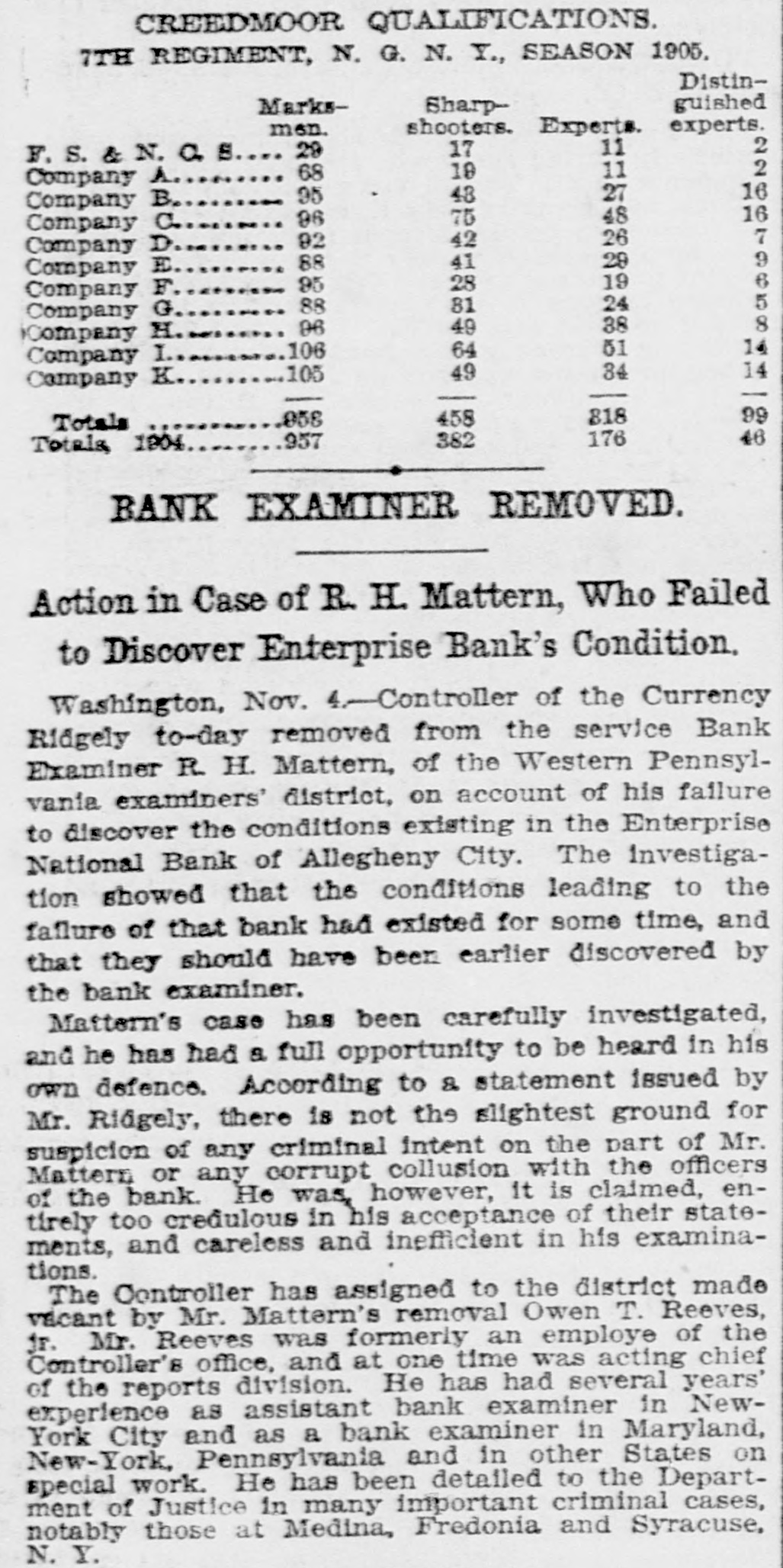
BANK EXAMINER IS DISCHARGED. COMPTROLLER OF CURRENCY TAKES FIRM STAND IN CASHIER CLARK'S CASE. Failure to Discover Conditions in Enterprise National at Allegheny (Pa.) Subject for Action. WASHINGTON, D. C., Nov. 4.The comptroller of the currency today removed from service Bank Examiner R. H. Mattern, on account of his failure to discover the conditions existing in the Enterprise National bank of Allegheny City, Pa. Owen P. Reeves, Jr., has been appointed to fill the vacancy. Mr. Reeves has been an assistant bank examiner in New York city. No Suspicion on Examiner. The case of Examiner Mattern has been carefully investigated and he has been given a full opportunity to be heard in his own defense. According to a statement issued by Comptroller Ridgely there is not the slightest ground for suspicion of any criminal intent on the part of Mr. Mattern or any corrupt collusion with the officers of the bank. He was, however, it is claimed, entirely too credulous in his acceptance of their statements, and careless and inefficient in his examinations. Schoolma'ams Storm Bank. PITTSBURG, Pa., Nov .4.-A swarm of women, mostly school teachers, attempted to storm the Enterprise National bank. Rumors became current that some depositors were to be paid off. Receiver Cunningham ordered the doors barred. It is reported that Receiver Cunningham has made the former employes of the bank sign over their properties to him. He has learned, it is said, that the tellers. bookkeepers and assistants knew of the bank's condition; that he made each one confess that the handwriting on the books was theirs, but that the cash and securities were not as they represented in the accounts; and that they said Cashier Clark compelled them to make false entries under threat of dismissal. Depositors May Get 25 Per Cent. Receiver Cunningham intimates that a final settlement may result in the payment of 25 per cent. to the depositors. The bank directors will make a legal battle on any judgments filed against them. Clark's Books Are Opened. The personal books and papers of Cashier Clark of the Enterprise National Bank of Allegheny, which were found in the dead cashier's desk, were taken up by the examiner today for the first time. It is hoped that in these personal or private books will be found some trace of the missing funds of the institution. Churchman-Banker Confesses. DES MOINES, Nov. 4.-C. H. Dye, vice president of the Tabor State bank at Tabor, treasurer of Tabor college, a trustee of the Congregational church there and treasurer of the local school district, confessed that he had forged notes amounting to between $50,000 and $75,000, which had been discounted by the bank. The bank was closed and the auditor of state immediately dispatched an examiner. The officers claim it is solvent despite the loss. The bank has a capital of $25,000 and deposits amounting to $165,000. He Floated Oil Schemes. Dye declares he abstracted the money from the bank to float oil schemes in Kansas in competition with the Standard Oil company. He also had been operating through the Chicago board of trade and sought to corner the stock of several large mining properties in the west. He took chances on the board and in mines to recoup himself for the oil losses. His father may make good for him. There is no disposition to prosecute the son if the losses are made good. The young man has lived in Tabor twelve years, serving as cashier of the bank for ten years. It was not until he was made a vice president that he attempted to get rich quickly.


Article from Wood County Reporter, November 10, 1905

Click image to open full size in new tab

Article Text

BANK EXAMINER IS DISCHARGED. COMPTROLLER OF CURRENCY TAKES FIRM STAND IN CASHIER CLARK'S CASE. Failure to Discover Conditions in Enterprise National at Allegheny (Pa.) Subject for Action. WASHINGTON, D. C., Nov. 4.The comptroller of the currency today removed from service Bank Examiner R. H. Mattern, on account of his failure to discover the conditions existing In the Enterprise National bank of Allegheny City, Pa. Owen P. Reeves, Jr., has been appointed to fill the vacancy. Mr. Reeves has been an assistant bank examiner in New York city. No Suspicion on Examiner. The case of Examiner Mattern has been carefully investigated and he has been given a full opportunity to be heard In his own defense. According to a statement issued by Comptroller Ridgely there is not the slightest ground for suspicion of any criminal intent on the part of Mr. Mattern or any corrupt collusion with the officers of the bank. He was, however, it is claimed, entirely too credulous in his acceptance of their statements, and careless and inefficient In his examinations. Schoolma'ams Storm Bank. PITTSBURG, Pa., Nov .4.-A swarm of women, mostly school teachers, attempted to storm the Enterprise National bank. Rumors became current that some depositors were to be paid off. Receiver Cunningham ordered the doors barred. It is reported that Receiver Cunningham has made the former employes of the bank sign over their properties to him. He has learned, it is said, that the tellers, bookkeepers and assistants knew of the bank's condition; that he made each one confess that the handwriting on the books was theirs, but that the cash and securities were not as they represented in the accounts; and that they said Cashier Clark compelled them to make false entries under threat of dismissal. Depositors May Get 25 Per Cent. Receiver Cunningham intimates that a final settlement may result in the payment of 25 per cent. to the depositors. The bank directors will make a legal battle on any judgments filed against them. Clark's Books Are Opened. The personal books and papers of Cashier Clark of the Enterprise National Bank of Allegheny, which were found in the dead cashier's desk, were taken up by the examiner today for the first time. It is hoped that in these personal or private books will be found some trace of the missing funds of the institution. Churchman-Banker Confesses. DES MOINES, Nov. 4.-C. H. Dye, vice president of the Tabor State bank at Tabor, treasurer of Tabor college, a trustee of the Congregational church there and treasurer of the local school district, confessed that he had forged notes amounting to between $50,000 and $75,000, which had been discounted by the bank. The bank was closed and the auditor of state immediately dispatched an examiner. The officers claim it is solvent despite the loss. The bank has a capital of $25,000 and deposits amounting to $165,000. He Floated Oil Schemes. Dye declares he abstracted the money from the bank to float oil schemes in Kansas in competition with the Standard Oil company. He also had been operating through the Chicago board of trade and sought to corner the stock of several large mining properties in the west. He took chances on the board and in mines to recoup himself for the oil losses. His father may make good for him. There is no disposition to prosecute the son if the losses are made good. The young man has lived in Tabor twelve years, serving as cashier of the bank for ten years. It was not until he was made a vice president that he attempted to get rich quickly.


Article from Albuquerque Evening Citizen, November 15, 1905

Click image to open full size in new tab

Article Text

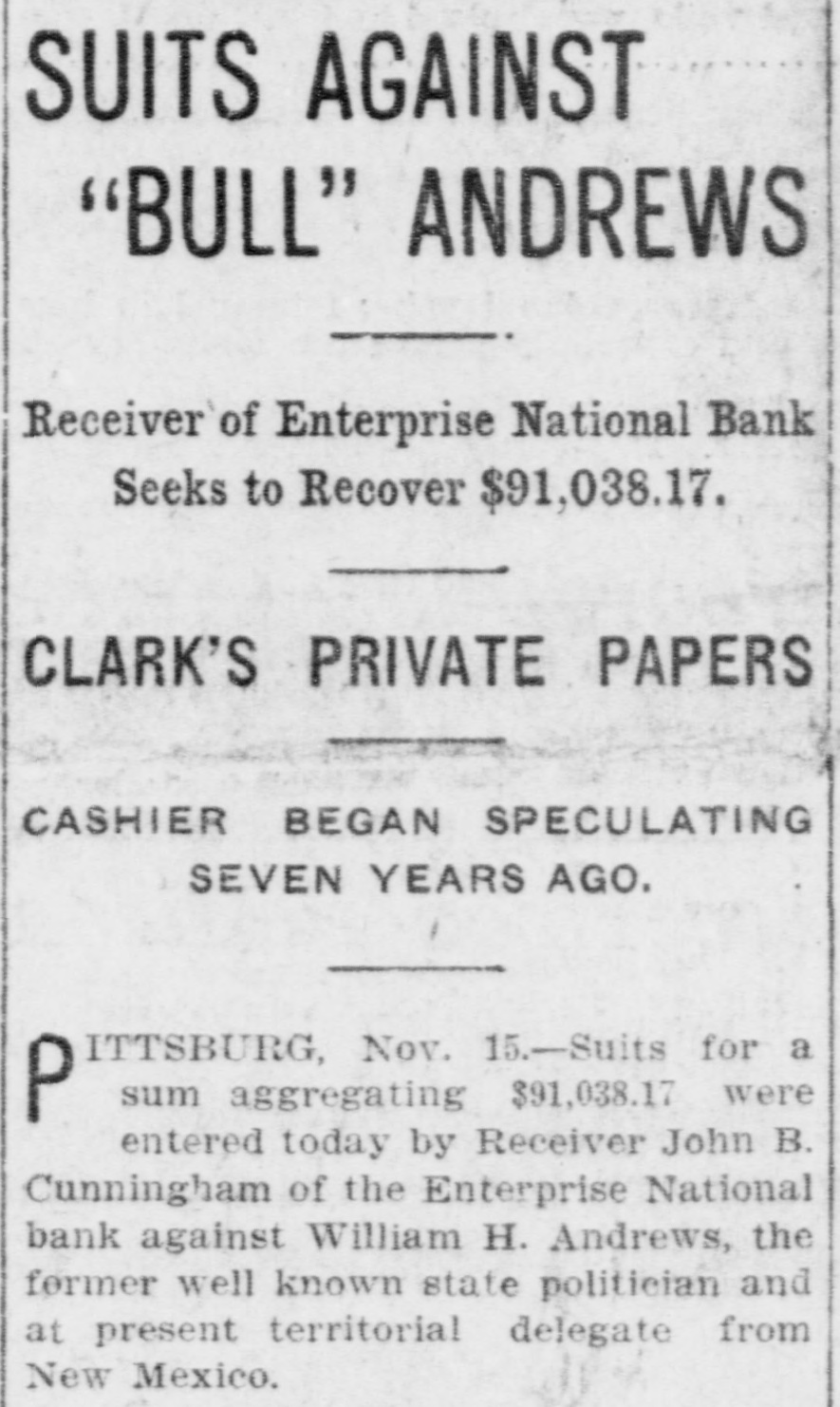
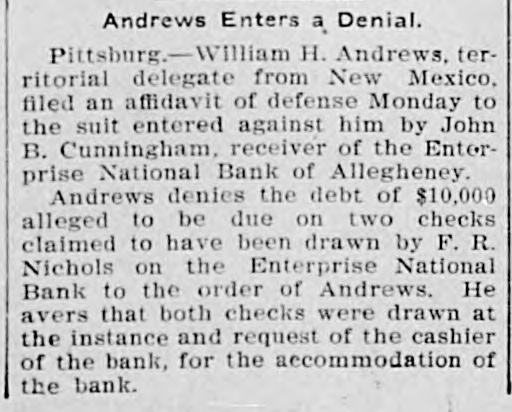
Pittsburg, Pa., Nov. 15.-Another suit on four notes aggregating $90, 138 was entered today by Receiver John B. Cunningham, of the defunct Enterprise bank, against William H. Andrews.


Article from Spirit of the Age, November 18, 1905

Click image to open full size in new tab

Article Text

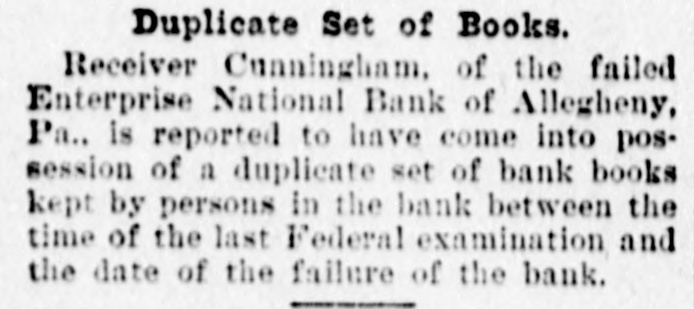
Bank Had Duplicate Books. Pittsburg,-Receiver - Cunningham of the Enterprise bank is in possession of a duplicate set of books kept by persons in the bank between Aug. 25 last, when federal examination was made, and the day the bank closed its doors. The books show many of the alleged fraudulent financial transactions that wrecked the bank.


Article from New-York Tribune, November 28, 1905

Click image to open full size in new tab

Article Text

NAMES ENTERPRISE BANK RECEIVER. Washington, Nov. 27.-The Comptroller of the Currency has appointed Thomas Rinaker, of Carlinville, III., receiver of the Enterprise National Bank of Allegheny, Penn.


Article from Arizona Silver Belt, December 7, 1905

Click image to open full size in new tab

Article Text

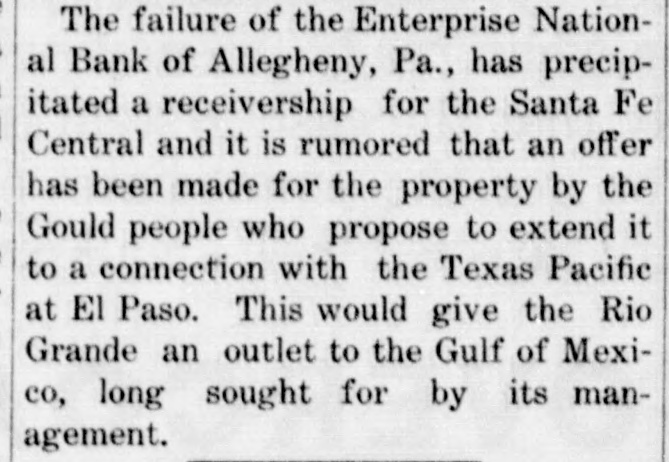
The failure of the Enterprise National Bank of Allegheny, Pa., has precipitated a receivership for the Santa Fe Central and it is rumored that an offer has been made for the property by the Gould people who propose to extend it to a connection with the Texas Pacific at El Paso. This would give the Rio Grande an outlet to the Gulf of Mexico, long sought for by its management.


Article from The St. Louis Republic, December 20, 1905

Click image to open full size in new tab

Article Text

CLARK'S ASSOCIATE FAILS. Joseph Hastings Assigns Because Allegheny Bank Failed. Pittsburg. Pa., Dec. 19.-Joseph Hastings, for years associated in business with the late Cashier Clark of the defunct Enterprise Bank of Allegheny. made an assignment yesterday. The amount of the assignment will be possibly $500,000. The Union Trust Company of Pittsburg was made receiver. Counsel for Mr. Hastings Issued a statement last night saying that his client had been nulled down through trying to take care of bills of Clark. Mr. Hastings was president of the Ohio Valley Water Company, and was connected with many other large enterprises. both in Pennsylvania and other States. He was the owner of an immense stock farm in Kentucky.


Article from The Barre Daily Times, February 15, 1906

Click image to open full size in new tab

Article Text

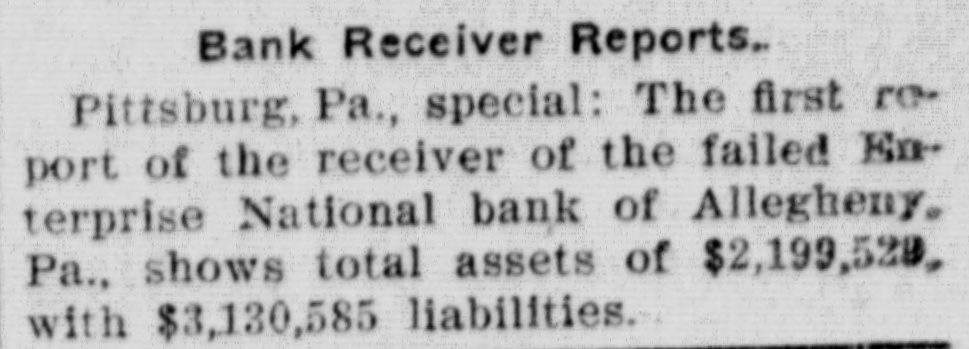
Bank a Million Short. Washington, Feb. 15.-The controller of the currency has received the first report of the receiver of the Enterprise National Bank of Allegheeny, Pa., which closed its doors on October 18. The total assets are $2,199,529; liabilities, $3,130,585.


Article from The Yale Expositor, March 2, 1906

Click image to open full size in new tab

Article Text

Bank Receiver Reports. Pittsburg, Pa., special: The first re port of the receiver of the failed Enterprise National bank of Allegheny, Pa., shows total assets of $2,199,529. with $3,130,585 liabilities.


Article from The Daily Morning Journal and Courier, March 27, 1906

Click image to open full size in new tab

Article Text

FIVE ARRESTS MADE IN ENTERPRISE BANK CASE AFTERCLAP IN SENSATIONAL FAILURE OF ALLEGHENY INSTITUTION. Three Clerks and Forest B. Nichols, Private Secretary to William H. Andrews, and George E. Cooke, an Alleged Partner of Cashier Clark, Who Committed Suicide, the Men Taken Into Custody - Arraigned Before United States Commissioner and Released on Bonds of $5,000 Each. Pittsburg, March 26.-Five arrests were made to-day as a result of the affair of the Enterprise National bank of Alleghany, which suddenly closed its doors last October following the sensational suicide of its cashier, T. Lee Clark. Deputy United States marshals took into custody Forest B. Nichols, private secretary to William H. Andrews; Charles Menzemer, George R. Ralston and Edward P. McMillan, employes of the Enterprise bank and George E. Cooke, an alleged partner of Cashier Clark, in several real estate deals. The charge against Menzemer is that as clerk of the bank he certified checks drawn upon the bank by persons who had not sufficient funds on deposit to meet the checks drawn and so certified, this constituting a false certification. Nichols is charged with conspiring with an officer of the bank who is not named to abstract and wilfully apply unlawfully monies, funds and credits of the bank. Ralston and McMillan, who were clerks in the bank, are charged with making false entries in the books to defraud the bank, while Cook is charged with conspiring to defraud the bank by getting false credits. The charges were formulated some time ago but the warrants were not issued because the officials desired to secure evidence that was being taken in certain civil proceedings. The men were arraigned before a United States commissioner and furnished bonds in $5,000 each. The arrests are a climax in a most sensational financial collapse and are the result of the investigation made by Bank Examiner Edward P. Moxey, who furnished the information to United' States Commissioner William T. Lindsley. The information was baseed of to the use the funds alleged of conspiracy Enterprise of bank Nichols in the interest of the Santa Fe Central Railroad company and the Pennsylvania Construction company. of the ibank is one The story failure of of the tragedy EnOne was throughout. last terprise the community morning startled in October by the Cashier Clark shooting at news ted suicide that by Simultaneously had bis residence commita suburb. of the bank was the in Bellevue, closing announced. among excitement was caused and the Great many depositors started. rumors The ot' heavy defalcations were of the bank later funds of the directors that the bank had admitted been but it was many bestatus of the bank's misused, fore the weeks affairs beknown. Even at this date no statement of the came definite probable receive div- has idend that the creditors will been made although partial reports have been made to the comptroller of the currency, A warrant was also issued for Thomformer paying teller of the but he has not yet bank, as Harvey, been be found. placed under arrest, as the could not there are In add sixty-eight Twenty-two counts are against the six men. Nichols, six against against Ralston, seventeen Menzemer, against eleven Cook, against McMillan, eleven against and one against Harvey, All the charges are for acts alleged to have been done between June, 1903, and the date of the closing of the bank,


Article from Rock Island Argus, April 12, 1906

Click image to open full size in new tab

Article Text

STATE RECOVERS ITS FUNDS More Than Million Saved Out of Wreck of Enterprise Bank. Harrisburg, Pa., April 12.-Gov. Pennypacker issued an official statement today announcing that the commonwealth has recovered all public funds amounting to over a million dollars, on deposit in the Enterprise National bank of Allegheny at the time of its failure.


Article from Albuquerque Morning Journal, July 6, 1907

Click image to open full size in new tab

Article Text

BANK OFFICERS SENTENCED TO PRISON NEW TRIAL DENIED ENTERPRISE CONVICTS Six Years in Prison for Bookkeeper of Defunct Allegheny Institution; Four Years for T Lee Clarke's Accomplice (By Morning Journal Special Leased Wire.) Pittsburg, July 5.-After refusing new trials of the men recently convicted in connection with the failure of the Enterprise bank of Allegheny, Judge Ewing, in the federal court, today sentenced Edward P. MeMillin. the bookkeeper, who pleaded guilty of making false entries and misapplication of funds, to six years' imprisonment on the first charge and six months upon the second. Charles Menzemer, former assistant teller, convicted of misapplication of funds, and abetting T. Lee Clark, the cashier. who committed suicide, was sentenced to five years and six months' imprisonment. Thomas W. Harvey, the former teller, convicted of making false entries, was given until Tuesday to settle up his affairs before sentence is pronounced. Sentence was suspended in the cases of George T. Elson, former individual bookkeeper, who was convicted of abstraction and misapplication of the bank's funds. but acquittd on the charge of making false entries.


Article from Omaha Daily Bee, July 6, 1907

Click image to open full size in new tab

Article Text

BANK WRECKERS SENTENCED Bookkeeper and Assistant Teller of Pittsburg Concern Are Sent to Prison. PITTSBURG, July 5.-After refusing new troals of the men recently convicted in connection with the failure of the Enterprise National bank of Allegheny, Judge Ewing, in the federal court, today sentenced Edward P. McMillen, the bookkeeper who pleaded guilty of making false entries and misapplication of funds to six years' imprisonment on the first charge and six months upon the second. Charles Menzemer, former assistant teller, convicted of misapplication of funds and abetting T. Lee Clark, the cashier, who committed sulcide, was sentenced to five years and six months imprisonment. Thomas W. Harvery, the former teller convicted of making false entries, was given until Tuesday to settle his affairs. Lemert'S. Cook, a real estate dealer, convicted of misapplication of the funds of the bank, was also given a respite until Tuesday. Sentence was auspended in the case of eGorge L. Ralston, former individual bookkeeper, who was convicted of abstraction and misapplication of the bank's funds, but acquitted on the charge of making false entries.


Article from Iowa State Bystander, November 15, 1907

Click image to open full size in new tab

Article Text

HARRIS SUED FOR $20,000. Ex-Treasurer of Pennsylvania Ac. cused of Accepting Bribe. Pittsburg, Pa.-The most surprising of the many sensations which have developed since the failure of the Enterprise National bank of Allegheny, in 1905, occurred Wednesday when Thomas Rinaker, receiver of the defunct institution, entered a suit in assumpsit in the United States district court against ex-State Treasurer of Pennsylvania Frank G. Harris, claiming $20,000 with interest from October 23, 1903. This sum, it is charged, was paid Harris by Cashier Clark, of the bank, as a bribe for his part in permitting the promoters of the Pennsylvania Development company to use the funds of the Enterprise bank and the state.


Article from Wausau Pilot, September 22, 1908

Click image to open full size in new tab

Article Text

like $7,500,000 has been stolen by dishonest bank employes in that city. The banks have concluded that the best course before them-while not wisbing to east suspicion upon anyone is to photograph every one of their employes and take their measurements by the Bertillon system, SO that, when a next defalcation may occur, the police authorities all over the world will have the last embezzler marked down as minutely as though he were the most elusive Max Shinburn who ever alternated between safe-cracking and jail service. If there was one bank officer who would have surrendered his complete control of millions rather th submit to being "mugged" by the police, it was William Montgomery, cashier of the Allegheny National, under arrest in connection with the disappearance of $839,000 of deposits and the entire $500,000 worth of capital stock. He was the intimate friend and confidant of Senator Quay. the man who placed Quay's bets during the Harrison campaign, when Quay won $250,000, and the trusted handler of the moneys of the political machine in that section of the State. When the Allegheny National went down-or up- -the State was backing it with $532,000 of deposits and the city of Pittsburg with $1,532,000. Private depositors were SO wary that they let it have little. When the crash came, after a series of speculations in stocks, the police reported the discovery of no photograph of Montgomery, even during their investigations of the suddenlyacquired fortune of a Pittsburg widow whose wealth leaped in eight years from $10,000 to $333,000. and of other women in Pittsburg and neighboring cities, whose real estate investments had increased with remarkable facility. While the fate of the Allegheny National's money still hung in the balance. pending the decision of Montgomery's allies as to restitution of the million that had gone, a man returned to Pittsburg who for nearly three years had left the police bitterly regretful that the Bertillon system was not compulsory there before the Enterprise National of Allegheny co!lapsed in October. 1905. He was Thomas W. Harvey, teller of the Enterprise. who, in the vain hope of escaping the penalty for his share in the crime, had given up his identity and his home, to wander amid agonies of dread until his fearful spirit could no longer bear the strain. He surrendered himself to the Federal authorities, and on the same day was sentenced to seven years in the penitentiary-and that with no more notoriety than if he were a purse snatcher. Pittsburg was learning to wash its dirty linen with neatness, silence and dispatch. Yet the Enterprise embezzlements were among the most sensational ever known in the State of Pennsylvania. The losses amounted to $1,500,000. It was a "political" bank, like the Allegheny National, and hundreds of thousands of its deposits had gone out to politicians on notes which, unsecured at best, had disappeared when the cashier, T. Lee Clark, both poisoned and shot himself, to make sure of death. Speculation, women and gambling was the way the stolen millions went When the Union Trust Company of Pittsburg discovered its loss of $385,000 in 1906, almost on the anniversary of the Enterprise run. the thieves proved to be a couple of mild young persons, Clinton B. Wray, the teller, and C. S. Hixton, the individual bookkeeper. The gambling crooks took it off these two marks in large chunks Both received ten years apiece when their defalcations were discovered. While the gamblers were enjoying the Union Trust Company's cash, the bucket shops were getting during the year between March, 1907, and March of this year $520,000 taken from the Farmers' Deposit National Bank by Henry Reiber, the paying teller, and John Young. the auditor. They proved themselves fools as simple over wildcat curb adventures as the boys of the Union Trust did over crooked cards. For ten years those two presumably experienced financiers had been stealing $1,105,000 from the Farmers' Deposit Bank. and no one, among either officers or directors. had suspected them. They, too, have been sentenced to ten years each. Pittsburg's example has given the State of Pennsylvania a record that puts the dashing depredations of bank robbers in the Southwest, with their masks and their revolvers, to the blush of poignant shame. SHORT NEWS NOTES. Fire in the lumber yards of the Lake