Article Text
E. B. Jenney Drops His $1,500,000 Damage Suit Against Johnson
Former Senator Hinman, as Attorney for Defendants, Denies That Any One Connected with Corporation Will Be Associated with Enterprise
SUDDEN WITHDRAWAL OF ACTION IS OPPOSED
Supreme Court Justice Leon C. Rhodes this morning dismissed the $1,500,000 conspiracy action brought by Earl Burt Jenney, head of the Endicott Co., Bankers, against George F. Johnson, George W. Johnson, Mrs. George W. Johnson, William F. Dickson, John E. Paden, Chester B. Lord, Maurice E. Page and David E. Warner, upon the motion of Thomas B. Merchant of the firm of Merchant, Waite & Waite, representing Mr. Jenney.
The motion followed the demand of Harvey D. Hinman, of the firm of Hinman, Howard & Kattell, representing the defendants, that Mr. Jenney submit to an examination in court.
Justice Rhodes limited the costs of the action to be paid by the plaintiff upon withdrawing the suit to taxable costs amounting to about $10, saying that as an arrangement had been affected, as he understood in the reorganization of the Jenney bank, he thought it would be better to allow the bank to get on its feet without penalizing the plaintiff with heavy costs, demanded by the defendants and which would amount to about $5,000.
Denies E J Will be Represented in Bank.
Former Senator Hinman, as attorney for the Endicott Johnson Corporation, at the conclusion of the court proceedings which resulted in the discontinuance of the conspiracy action, issued the following statement:
"The statements in the Morning Sun of Saturday, Sept. 15, to the effect that officials of the Endicott Johnson Corporation will be on the board of directors of any of Mr. Jenney's concerns, or of any concerns in which he may later be interested, is untrue.
"No person connected or associated with the Endicott Johnson Corporation is, will be or can be associated in any way with any undertaking or business in which Mr. Jenney is interested or connected, or may in the future be interested or connected."
Mr. Merchant in his motion before the court for a dismissal of the complaint, said:
"This action was brought to recover damages alleged to have been sustained by the plaintiff, arising out of the run on the Endicott Co., Bankers, and alleged efforts on the part of the defendants to block the sale of stock of the United States Capital Corporation.
"A movement is now on foot to reorganize the United States Capital Corporation and eventually to form a National Bank in Endicott, which will supersede The Endicott Co., Bankers. If this proposed reorganization can be put through there would be no point in bringing this action to trial, and if we did push the case for trial we probably could not recover more than nominal damages.
"Believing that this reorganization will redound to the benefit of the community at large and to the plaintiff and be a humanitarian act, we make formal application to withdraw this action.
"On Sept. 8, 1923, we tendered a stipulation to the attorneys for the defendants to withdraw and discontinue this action and tendered them the accrued costs of the action before notice of trial. They declined to accept the costs and declined to sign the stipulation, whereupon we obtained an order to show cause from Your Honor on Sept. 8, 1923, returnable this morning, Sept. 15, and under the circumstances, believe we are entitled to a discontinuance of this action without further costs."
Not Ordinary Law Suit.
Former Senator Hinman, in answering argument against dismissal of the complaint, laid stress upon the damage, which he alleged had been done to his clients by the conspiracy charge. He said:
"In an ordinary lawsuit a defendant should be and usually is willing plaintiff withdraw and discontinue the litigation; but this is not an ordinary lawsuit. It is an unusual and extraordinary case. It was brought by a banker against men of the highest standing and character, and who are officials of the largest concern in this part of the country, to recover $1,500,000 as damages alleged to have been sustained by plaintiff as the result of a conspiracy on the part of the defendants, which plaintiff alleges they entered into and carried on for the purpose of ruining him and his business. Some of the particular and criminal charges against the defendants are that they wrongfully caused the arrest of plaintiff for having used the mails fraudulently and caused a run on his bank through the circulation of false rumors, statements and reports concerning the plaintiff and the solvency of his bank and caused the attorney general of the state to proceed against plaintiff under the provisions of Section 352 of the General Business Law on the ground that plaintiff was engaged in a scheme to defraud by the sale of worthless stock in one of his corporations.
"While it is not usual in this county to file pleadings in the clerk's office until final judgment in the action is filed, the complaint in this action was filed two days after the action was begun. That complaint was given to one of our local newspapers for publication, and was published practically in full, with all its irrelevant and offensive allegations, which, as stated, had nothing to do with the merits of the case. The next day the complaint was published in full in the other local newspaper, thereby giving wide publicity to all the charges made by plaintiff against defendants. In due time defendants appeared in the action and served separate answers to the complaint in which they denied, under oath, all the charges of conspiracy and wrongful and illegal acts on their part. Those answers have not been published. Thereafter, the plaintiff's attorneys of record served an amended complaint in the action, from which they eliminated much of the immaterial and offensive matter contained in the original complaint. Neither that amended complaint, nor any reference to or mention of it had been published. Thereupon the defendants served separate answers to such amended complaint, in which they denied, under oath, the charges of conspiracy and wrongful and illegal acts on their part. Those answers have not been published.
"Now the plaintiff asks to withdraw and discontinue the action. If that is done, it leaves the plaintiff's side of the case fully stated and in the possession of the entire community without the community knowing the defendants' side. If a trial of the action is had, it will enable the defendants to present their side of the case and the facts and to prove they were not guilty of any of the wrongful acts charged against them. In other words, if the action is discontinued, it will, for all practical purposes, as far as the public is concerned, leave plaintiff's charges unanswered and undenied. It was for that reason we declined to consent to a discontinuance of the action. It is true plaintiff's attorneys' presented a stipulation for the discontinuance of the action and asked us to sign same, which we declined to do. They also tendered us the usual taxable costs of the action, which we declined to accept.
"We are aware of the decisions and practice of our courts, which enable a plaintiff to discontinue an action at any time before trial upon payment of costs.
"In view of the decisions, we are not at all certain that this court can refuse the application which plaintiff now makes for the discontinuance of this action, or that it can impose any conditions, except the payment of costs and such extra allowance of costs to be paid by plaintiff to defendants as the court may allow. We do say, and we believe the court will agree with us, that, if in any case, the court has power to refuse and should refuse to grant a discontinuance of an action the facts here present make this such a case.
"If the court shall conclude it has no discretion in the matter and that under the law and the decisions the plaintiff is entitled to discontinue the action on payment of costs, then we submit that the plaintiff should be required to pay not only the taxable costs, but an extra allowance of costs, because the case is a difficult and most extraordinary one. We submit herewith an affidavit showing in a general way, the amount of labor which has been expended and expense incurred on behalf of defendants in the preparation of the case for trial and to prove the falsity of the charges made against defendants by plaintiff.
"The action was begun by personal service of the summons and complaint on the defendant on or about June 26, in which Mr. Jenney charged the defendants with having conspired to ruin him and his various business concerns in Endicott and asked for damages of $1,500,000 which he alleged were sustained by him because of the illegal acts of the defendants.
"The defendants through their attorneys, Hinman, Howard & Kattell, served separate answers to the complaint, in which the conspiracy was denied. Within 20 days after the service of the answers the plaintiff, through Merchant, Waite & Waite, served an amended complaint in which the charges of conspiracy were again charged. These were again answered by the defendants' attorneys who made a motion before Justice Abraham L. Kellogg of Oneonta on Aug. 30, to compel the plaintiff to submit to an examination before trial and to compel him to produce books and records of his private bank and of the United States Capital Corporation for inspection. These papers were very voluminous and contained many affidavits."
Justice Kellogg ordered that the plaintiff show cause at a special term of court on Sept. 4, in this city, why the defendants should not have an examination of Mr. Jenney and also his books and records. The hearing was adjourned from time to time until this morning.
Affidavit by Mr. Hinman.
Mr. Hinman, in his affidavit for an extra allowance for costs of the action to the defendants, says:
"Since this action was begun, I have spent substantially all of my time in connection with the examination of the facts, interviewing persons having knowledge of the various transactions and matters involved in the litigation, the examination of the law, the preparation of the pleadings and motion papers and generally in preparing this case for trial and getting ready for production the evidence to establish defendants' innocence of the charges made against them in the plaintiff's complaint and amended complaint in this action. Likewise, my law partner, Roger P. Clark, has been so engaged and during that time has been nearly two weeks in the State of Michigan investigating the plaintiff's history and transactions while a resident of that state and where he conducted several private banks.
"In addition thereto, much of the time of said Clark and myself has been devoted to an examination of various records, conveyances and documents of record in Broome county clerk's office in which the plaintiff or his said corporations, the United States Capital Corporation and the State National Corporation are named as grantors or grantees. In connection with such examination we have employed and it was necessary for us to employ two experts of wide experience and standing to examine, make photographs of and advise concerning the typewritten matter appearing in such documents, records and conveyances and report to us the result of such examination and investigation, which reports we have and which it was necessary for us to have in preparing for the trial of this case and for use on the trial of the action.
"We have also been obliged to employ and we have employed five of the most competent real estate men in the county to appraise the various properties, the title to which has stood or stands in the name of plaintiff or his said corporations, and which values had a very material bearing on the issues involved in this action and the transactions and dealings of plaintiff. Such appraisal has been completed and the expense necessary incurred and must be paid.
"As I have stated, practically all of the time of my said partner and myself, since the commencement of this action, has been given to such work and necessarily so.
"In such work and in the preparation of the case for trial, and it is practically ready for trial on the part of the defendants, it has been necessary for us to and we have expended and necessarily incurred expenses on behalf of the defendants in the sum of nearly $5,000. In that work, it has been necessary for us to make and we have made trips to Philadelphia, Pa., New York city, N. Y., Albany, N. Y., Rochester, N. Y., Buffalo, N. Y., Indianapolis, Ind., as well as to the state of Michigan, as above stated.
"As appears from the pleadings and the motion papers, herein referred to and which are hereby made a part hereof, this case is a difficult and extraordinary case in my opinion, which is based upon a practice covering a period of 32 years.
"I submit that if the court permits a discontinuance of this action, it should impose as a condition thereof the payment of three separate bills of cost by plaintiff and of an extra allowance of costs due to the fact that the case is not only difficult and extraordinary, but that a large amount of labor has been expended and expenses incurred in preparing the case for trial."
What Charge Alleged?
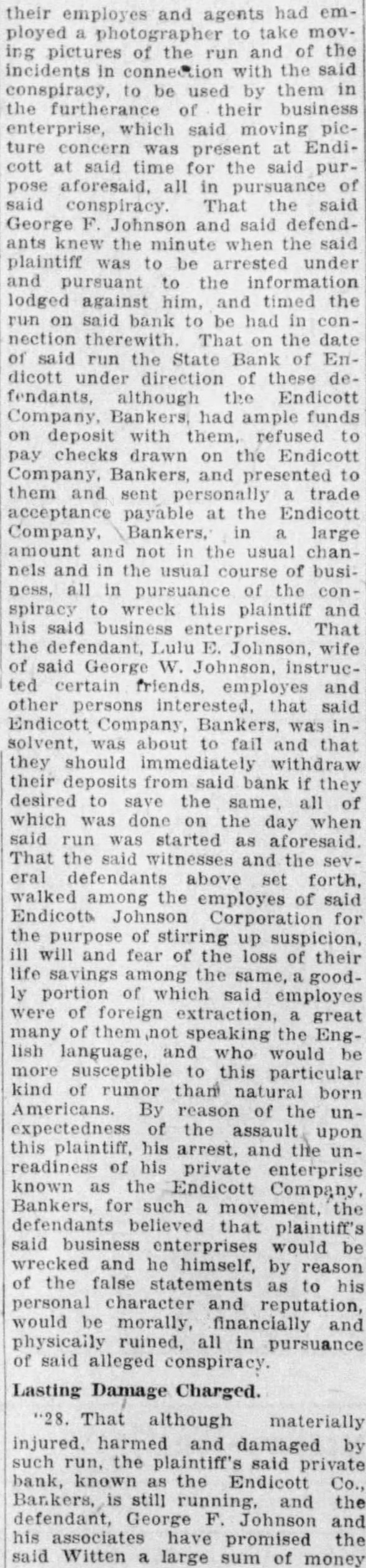
The conspiracy charge in brief alleged that Mr. Johnson and his associates conspired to ruin Jenney dominate and control his banking business in the village of Endicott and because they desired to own, dominate and control his real estate holdings in the town of Union. It also was alleged that the defendants conspired to cause a run on the Endicott Co. Bankers, and also attempted to coerce agents of the United States Capital Corporation into testifying as they wished, by threats and intimidations, to produce the arrest of Jenney on a charge of illegal use of the mails. The complaint also alleged that the defendants attempted to prejudice the courts and used unfair influence and tried to "frame" the plaintiff.
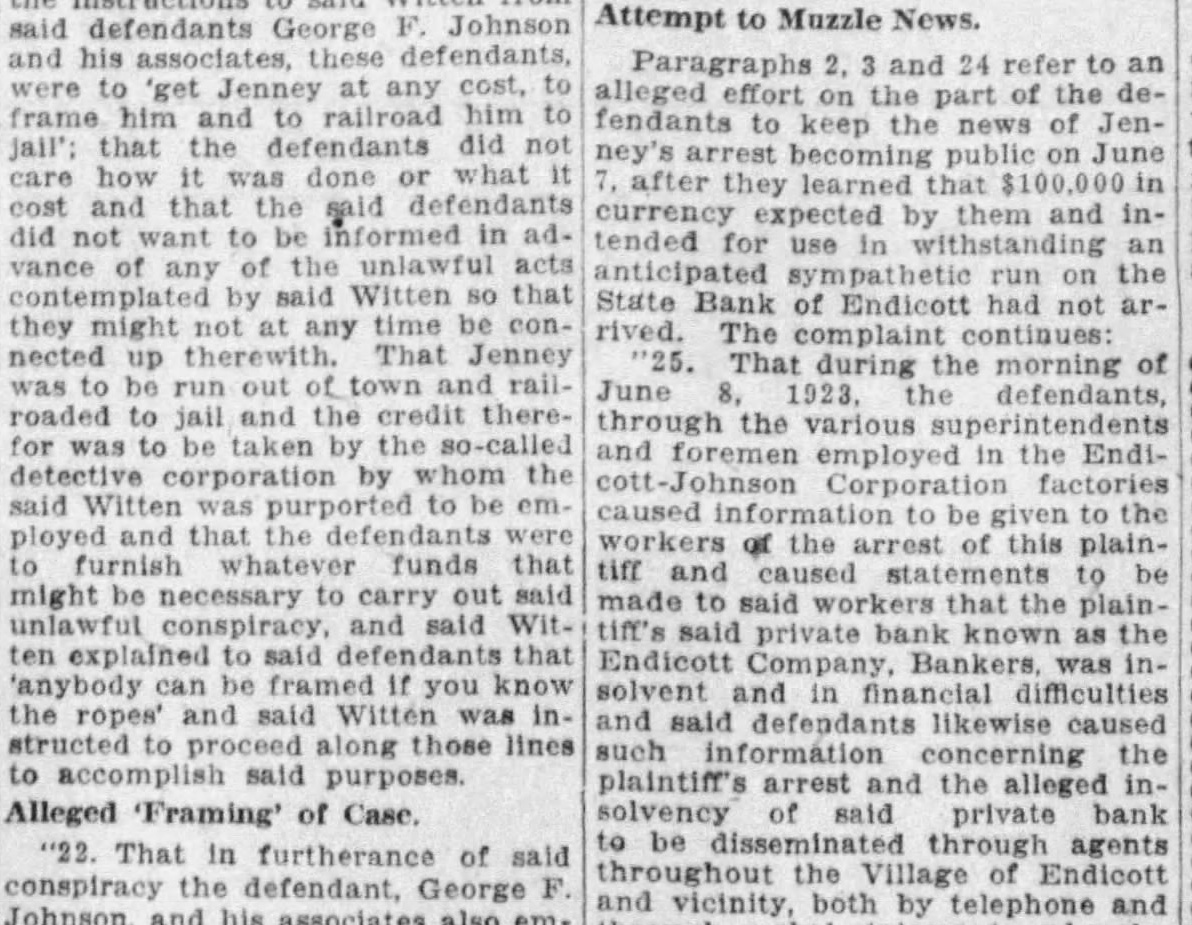
Mr. Jenney in his complaint also alleged an attempt on the part of the defendants to muzzle the news of the arrest of the plaintiff, when they learned that $100,000 in currency expected by them and intended for use in withstanding an anticipated sympathetic run on the State Bank of Endicott had not arrived. That during the morning of June 8, the defendants through superintendents and foremen employed by the Endicott Johnson Corporation factories caused statements to be given to the workers of the Jenney bank's insolvency and arrest of Mr. Jenney, so that a run was precipitated on the Jenney bank.
The first complaint submitted by the plaintiff contained 33 closely typewritten pages.