Closure was by state bank commissioner after a run tied to the Ponzi scandal; later legal/receiver actions followed.
Events (3)
1.August 3, 1920Run
Cause
Bank Specific Adverse Info
Cause Details
Deposits/withdrawals tied to Charles Ponzi's collapsing scheme and related disclosures prompted heavy withdrawals.
Measures
Bank honored many Ponzi checks and paid out large sums to meet withdrawals; attempted to honor notes.
Newspaper Excerpt
For the last two days the Hanover Trust has paid out $300,000 a day on Ponzi checks.
Source
newspapers
+8 days
2.August 11, 1920Suspension
Cause
Government Action
Cause Details
State bank commissioner took charge and closed the bank after examiners found unsafe operations linked to Ponzi exposures.
Newspaper Excerpt
Bank Commissioner Allen today took charge of the Hanover Trust company ... The doors of the bank were closed at 1:45 p. m.
Source
newspapers
+18 months
3.February 14, 1922Other
Newspaper Excerpt
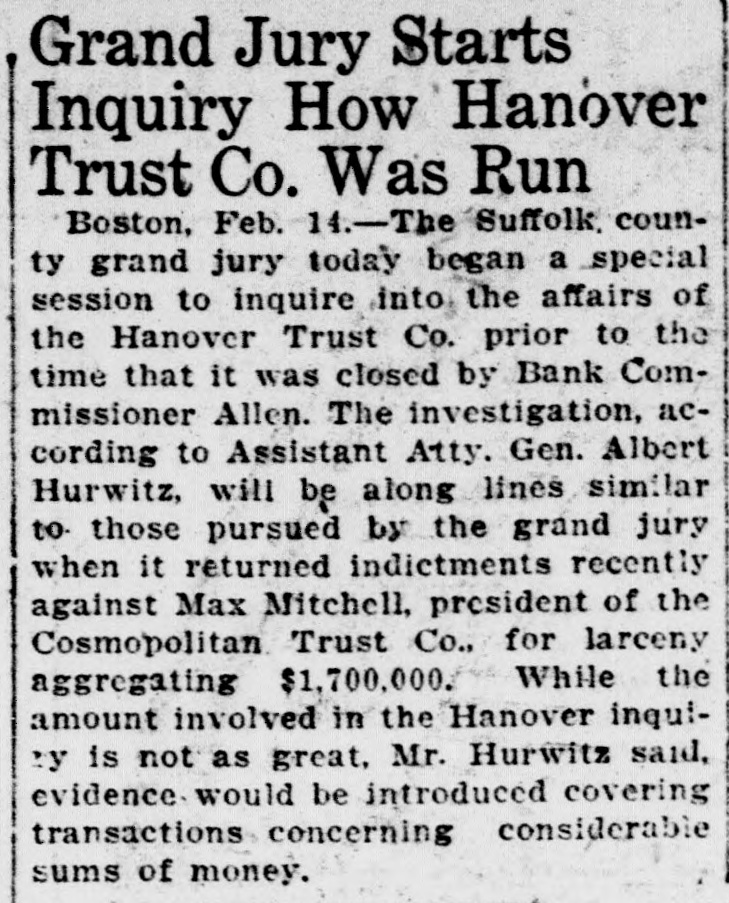
Grand jury began a special session to inquire into the affairs of the Hanover Trust Co. prior to the time that it was closed by Bank Commissioner Allen.
Source
newspapers
Newspaper Articles (23)
1.August 10, 1920The Evening WorldNew York, NY
Click image to open full size in new tab
Article Text
PONZI IS BOASTFUL OF HOW HE FOOLED STATE AUTHORITIES (Continued From First Page.) and part of the $1,500,000 is assigned to çover his shortage. For the last tw odays the Hanover Trust has paid out $300,000 a day on Ponzi checks. "Hot air, all hot air, I gave him hot air and I shall give him more of it if he wishes; I shall ball him up more and more." Thus spake Charles Ponzi as he sat in a weaklegged chair-the only one in "the vacated office of the E. and E. Construction Company on the tenth floor of the Hanover Trust Building, at No. 268 Washington Streetwhen commenting on the alleged facts he had give to Attoreny General Allen of Massachusetts. Concerning his transactions in foreign exchange Joseph C. Allen, Bank Commissioner of Massachusetts had just ordered payments on all Ponzi checks stopped, and newsboys below were yelling: "Ponzi fails!" "Ponzi fails!" "Ponzi bankrupt!" "After what I have told Mr. Allen, he stops my business and all the poor people who have given me their money cannot get it back because he ties up my money not only here, but in New Hampshire, New Jersey, everywhere," continued the financial wizard. "My genius it is not appreciated. You gentlemen all know whatever else I am, I am not a damn fool. I give them bull-much bull. And I say if I could not meet my liabilities I would have what you call in English flew de coop two weeks ago." "Yes," said a reporter, "you wanted to 'flew de coop,' but you couldn't get your passports." "What!" gasped the little Italian waiter dishwasher banker financial wizard as his jaw dropped. He started. "Yes, yes. Oh, yes, I wanted to go La Bella Italia to see my old mother. near Parma, now that I was rich, but the business was SO good-oh, so many hundreds of thousands of lira. They come every day easy, easy-like-a dat. You know I could not go. Now the Government it spoil the trip, and I have my old mamma come to me. It is so nice to have her. "The public officials they are not ethical at all. They try to find out all about me. It is not fair." "Was it ethical to 'bull' the Attorney General?" "Ah, signor, that is another question. This is a free country. He try to ball me up and I ball him up. Is it not fair? I shall do it again. Yes, I give him 'bull'-plenty of it. And I give bull any time it suits me when they try to ball me up. "But I am solvent, gentlemen," he continued' after a slight pause in which he blew the cigarette butt from the holder and slowly snuffed it out under the toe of an immaculate buckskin Oxford. He reached to the floor for a cold bottle of ginger ale, but as he did so a deferential hanger-on gently took it from his hand, opened it for him and handed the drink in a glass. He was the picture of a vaudeville actor sitting in the wings between acts. On his right ring-finger flashed B. gaudy diamond. His shirt proclaimed itself silk and the Palm Beach suit was not smart but natty. INSISTS HIS ASSETS EXCEEDS HIS LIABILITIES. "My obligations are $500,000 and my assets are much more," he continued. "Right here in this bank (he pointed downward with his fore finger to the Hanover Trust Company on the first floor) I have $1,500,000 in cash, but they will not let me touch 1t. I have now on my person in this little bag another $1,500,000 in securities." "Then why don't you pay your claims with that was asked. "Ah, signor, that is my secret. I have my reasons. Charlie Ponzi is no damn fool, what?" "That you are not," a reporter answered. "You bet. Nobody knows Charlie Penzi's business better than himself. Don't you fool yourself about that, signor. You treat me nice-I treat you nice. When I open my business again you put all your money with me. And I make it grow, grow, grow millions. That is Charlie Ponzi-me and the newspaper boys are for the people. We are not the autocracy. "The autocracy stop my business becau % I earn big money for the people, and they cannot. Is it not so? They are what you call Jealous of Ponzi. Some day the people will rise." Here one could not help thinking of the early days of his notoriety when he passed along Washington and Tremont Streets and threw kisses to the yelping mobs that followed and lined the sidewalks to have a glimpse of the new wizard. "And now what will Signor Ponzi do since the autocracy has put its
2.August 10, 1920Richmond Times-DispatchRichmond, VA
Click image to open full size in new tab
Article Text
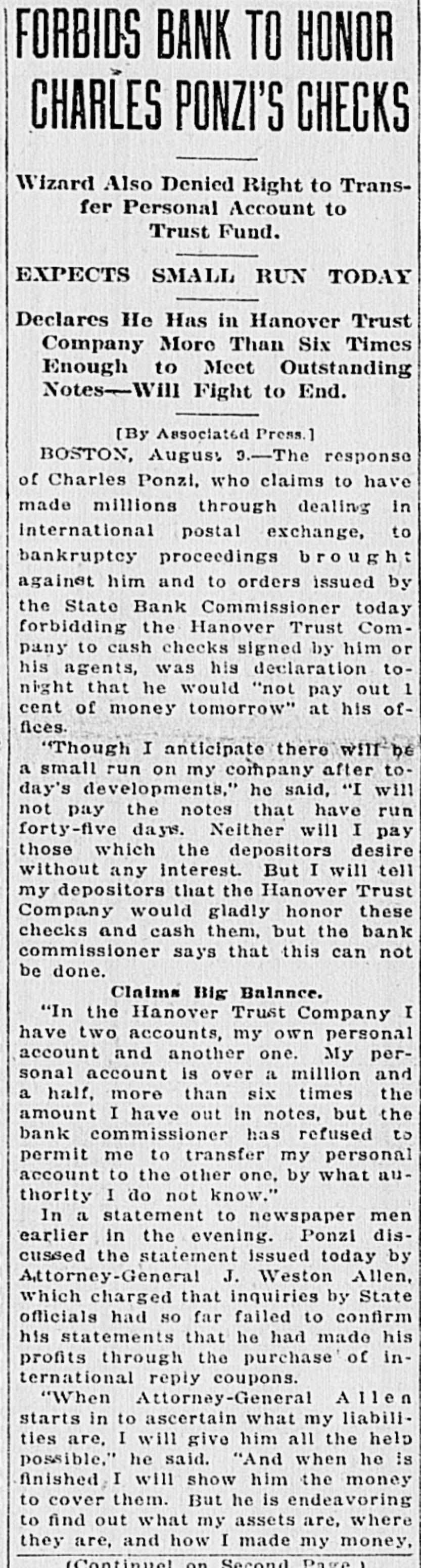
FORBIDS BANK TO HONOR CHARLES PONZI'S CHECKS Wizard Also Denied Right to Transfer Personal Account to Trust Fund. EXPECTS SMALL RUN TODAY Declares He Has in Hanover Trust Company More Than Six Times Enough to Meet Outstanding Notes-Will Fight to End. [By Associated Press. BOSTON, Augus: 3.-The response of Charles Ponzi, who claims to have made millions through dealing in International postal exchange, to bankruptcy proceedings brought against him and to orders issued by the State Bank Commissioner today forbidding the Hanover Trust Company to cash checks signed by him or his agents, was his declaration tonight that he would "not pay out 1 cent of money tomorrow" at his offices. "Though I anticipate there will be a small run on my company after today's developments," he said, "I will not pay the notes that have run forty-five days. Neither will I pay those which the depositors desire without any interest. But I will tell my depositors that the Hanover Trust Company would gladly honor these checks and cash them, but the bank commissioner says that this can not be done. Claims Big Balance. "In the Hanover Trust Company I have two accounts, my own personal account and another one. My personal account is over a million and a half, more than six times the amount I have out in notes, but the bank commissioner has refused to permit me to transfer my personal account to the other one, by what au thority I do not know." In a statement to newspaper men earlier in the evening. Ponzi discussed the statement issued today by Attorney-General J. Weston Allen, which charged that inquiries by State officials had SO far failed to confirm his statements that he had made his profits through the purchase of international reply coupons. "When Attorney-General Allen starts in to ascertain what my liabilities are. I will give him all the help possible." he said. "And when he is finished I will show him the money to cover them. But he is endeavoring to find out what my assets are, where they are, and how I made my money, rContinvel on Second Page )
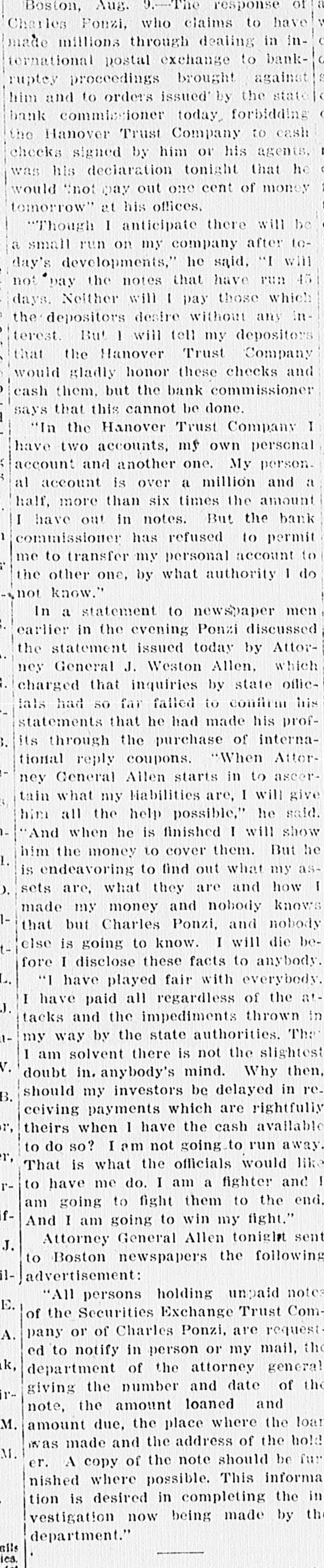
of Boston, Aug. 9. The response Charles Fonzi, who claims to have made millions through dealing in in( ternational postal exchange to bankruptey proceedings brought against him and to orders issued' by the state bank commissioner today, forbidding the Hanover Trust Company to cash checks signed by him or his agents, was his declaration tonight that he would "not pay out one cent of money tomorrow" at his offices. "Though I anticipate there will be a small run on my company after today's developments," he said, "I will not pay the notes that have run 45 days. Neither will I pay those which the depositors desire without any interest. But 1 will tell my depositors that the Hanover Trust Company would gladly honor these checks and cash them, but the bank commissioner says that this cannot be done. "In the Hanover Trust Company I have two accounts, my own personal account and another one. My person. al account is over a million and a half, more than six times the amount I have out in notes. But the bank commissioner has refused to permit me to transfer my personal account to the other one, by what authority I do not know." In a statement to newspaper men earlier in the evening Ponzi discussed the statement issued today by Attorney General J. Weston Allen, which -charged that inquiries by state officials had SO far failed to confirm his statements that he had made his prof1 its through the purchase of international reply coupons. "When Attorney General Allen starts in to ascertain what my liabilities are, I will give him all the help possible," he said. -And when he is finished I will show him the money to cover them. But he 1. is endeavoring to find out what my as). sets are, what they are and how I made my money and nobody knows 1that but Charles Ponzi, and nobody else is going to know. I will die betfore I disclose these facts to anybody L. "I have played fair with everybody I have paid all regardless of the at J. tacks and the impediments thrown in my way by the state authorities. The 1I am solvent there is not the slightest V. doubt in. anybody's mind. Why then, should my investors be delayed in reB. ceiving payments which are rightfully theirs when I have the cash available 1, to do so? I am not going to run away r, That is what the officials would lik to have me do. I am a fighter and -am going to fight them to the end fAnd I am going to win my fight." Attorney General Allen tonight sen J. to Boston newspapers the following iladvertisement: "All persons holding unpaid note E. of the Securities Exchange Trust Com pany or of Charles Ponzi, are request A. ed to notify in person or my mail, the k, department of the attorney general giving the number and date of the irnote, the amount loaned and M. amount due, the place where the loar was made and the address of the hold M. er. A copy of the note should be fur nished where possible. This informa tion is desired in completing the in vestigation now being made by th department." alls ies.
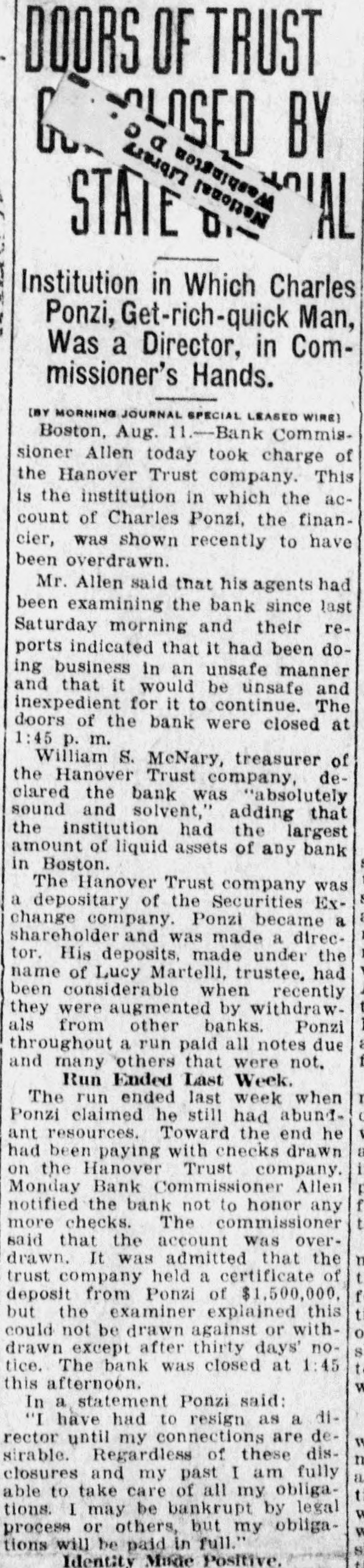
DOORS OF TRUST CLOSED BY STATE Institution in Which Charles Ponzi, Get-rich-quick Man, Was a Director, in Commissioner's Hands. (BY MORNING JOURNAL SPECIAL LEASED WIRE) Boston, Aug. 11.-Bank Commissioner Allen today took charge of the Hanover Trust company. This is the institution in which the account of Charles Ponzi, the financier, was shown recently to have been overdrawn. Mr. Allen said that his agents had been examining the bank since last Saturday morning and their reports indicated that it had been doing business in an unsafe manner and that it would be unsafe and inexpedient for it to continue. The doors of the bank were closed at 1:45 p. m. William S. McNary, treasurer of the Hanover Trust company, declared the bank was "absolutely sound and solvent," adding that the institution had the largest amount of liquid assets of any bank in Boston. The Hanover Trust company was a depositary of the Securities Exchange company. Ponzi became a shareholder and was made a director. His deposits, made under the name of Lucy Martelli, trustee, had been considerable when recently they were augmented by withdrawals from other banks. Ponzi throughout a run paid all notes due and many others that were not. Run Ended Last Week. The run ended last week when Ponzi claimed he still had abundant resources. Toward the end he had been paying with checks drawn on the Hanover Trust company. Monday Bank Commissioner Allen notified the bank not to honor any more checks. The commissioner said that the account was overdrawn. It was admitted that the trust company held a certificate of deposit from Ponzi of $1,500,000. but the examiner explained this could not be drawn against or withO S drawn except after thirty days' notice. The bank was closed at 1:45 t this afternoon. In a statement Ponzi said: "I have had to resign as a director until my connections are desirable. Regardless of these disn closures and my past I am fully a able to take care of all my obligat tions. I may be bankrupt by legal process or others, but my obligations will be paid in full.' S Identity Mide Positive.
5.August 14, 1920The Union Daily TimesUnion, SC
Click image to open full size in new tab
Article Text
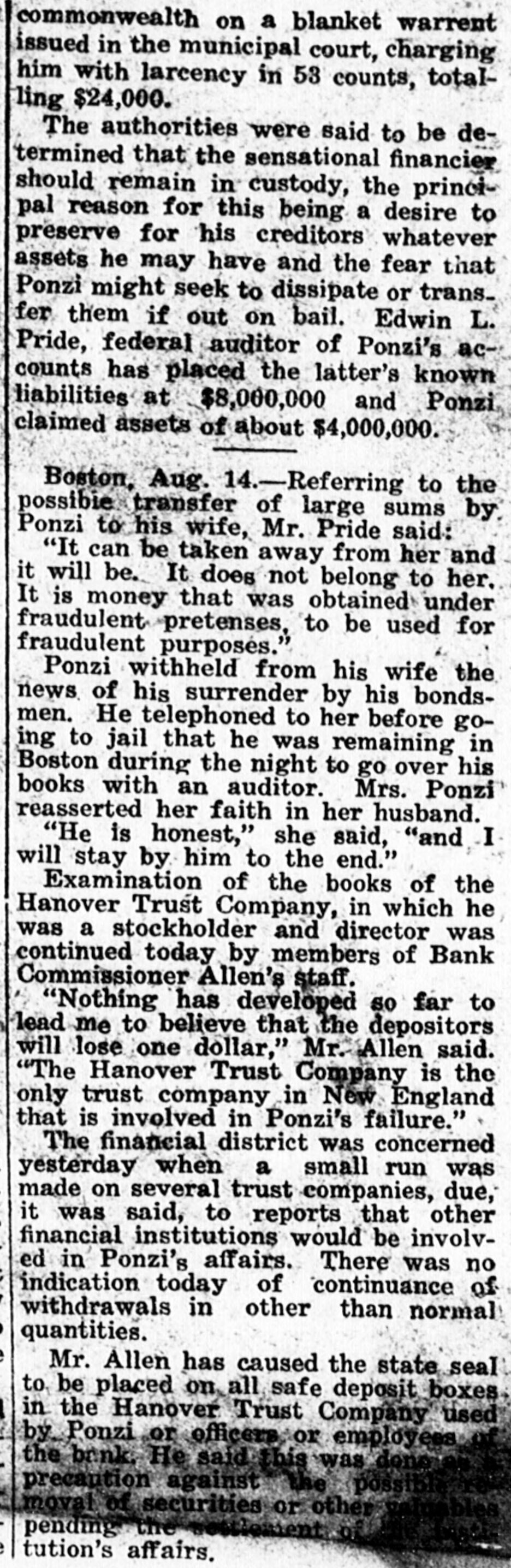
commonwealth on a blanket warrent issued in the municipal court, charging him with larcency in 53 counts, totalling $24,000. The authorities were said to be determined that the sensational financier should remain in custody, the principal reason for this being a desire to preserve for his creditors whatever assets he may have and the fear that Ponzi might seek to dissipate or trans_ fer them if out on bail. Edwin L. Pride, federal auditor of Ponzi's accounts has placed the latter's known liabilities at $8,000,000 and Ponzi claimed assets of about $4,000,000. Boston, Aug. 14.-Referring to the possible transfer of large sums by Ponzi to his wife, Mr. Pride said: "It can be taken away from her and it will be. It does not belong to her. It is money that was obtained under fraudulent pretenses, to be used for fraudulent purposés." Ponzi withheld from his wife the news of his surrender by his bondsmen. He telephoned to her before going to jail that he was remaining in Boston during the night to go over his books with an auditor. Mrs. Ponzi reasserted her faith in her husband. "He is honest," she said, "and I will stay by him to the end." Examination of the books of the Hanover Trust Company, in which he was a stockholder and director was continued today by members of Bank Commissioner Allen's staff. "Nothing has developed so far to lead me to believe that the depositors will lose one dollar," Mr. Allen said. "The Hanover Trust Company is the only trust company in New England that is involved in Ponzi's failure." The financial district was concerned yesterday when a small run was made on several trust companies, due, it was said, to reports that other financial institutions would be involved in Ponzi's affairs. There was no indication today of continuance of withdrawals in other than normal quantities. Mr. Allen has caused the state seal to be placed on all safe deposit boxes in the Hanover Trust Company used by Ponzi or officers or employees the bank He said this was donotary precaution against the moval of securities or other pending the authorient tution's affairs.
6.August 15, 1920Pine Bluff Daily GraphicPine Bluff, AR
Click image to open full size in new tab
Article Text
PONZI'S VICTIMS CROWD OFFICES OF ATTORNEY-GENERAL Holders of Notes for More Than Two Millions Seek Aid ONLY TWO BANKS ARE INVOLVED IN SCHEME Ponzi and Others Arrested in Collapse of Banks Unable to Furnish Bonds Boston, Aug. 14. Assurances that no further bank closings are likely as a result of the collapse of the financial dealings of Charles Ponzi was given tonight by Joseph C.'A1len, state bank examiner. "The Hanover Trust company and the Polish Industrial association are in the only banking institutions New England known to be in any way affected by the Ponzi failure," Mr. Allen said. No bondsmen were fforthcoming today for Ponzi or for three officers of the Old Colony Exchange company, the "100 per cent in six month' concern, who were arrested yesterday. Samuel Zorn an agent, off the foreign exchange company, was released in $2,000 bonds. 7 Bankruptcy petitions were filed against the Old Colony Foreign Exchange company today. Branch offices in several New England cities were closed by county authorities. S The officers of Attorney General J. Weston Allen at the state house were crowded throughout the day with note holders of the Securities Exchange company and the Ild Colony Foreign Exchange company. Presentation of these notes already has disclosed liabilities on Ponzi's company to the extent of $2,000,000. The possibility of a shake-up in the police department as a result of the bursting of the Ponzi financial bubble was seen in a statement issued by Police Commissioner Edwin U. Curtis. The commissioner said it had been called to the attention of departofficials that members of the department including superior officers had invested with Ponzzi, and that it was reported that some policemen had even acted as agents and received commissions. Work of Salvage Begins. The financial ship that has been piloted by Charles Ponzi was high and dry on the rocks today and federal and state officials made determined efforts to salvage the cargo of millions of dollars entrusted to Ponzi by thousands of investors in his "50 per cent in three months." This morning Ponzi ate his breakfast in the Middlesex county jail in East Cambridge, a prisoner of the United States government, in default of $25,000 bond. Three officers of the Old Colony Foreign Exchange company, a rival concern of Ponzi's Securities Exchange company, had their morning meal in the Charles Street jail, prisers of the commonwealth in default of $50,000 bonds each. Samuel Zorn. said to be an employe of the Old Colony Foreign Exchange company, was at headquarters awaiting a hearing on a charge of larceny of $500, also from persons unknown. He had spent the night in jail. The three officers of the company who were held are Charles M. Brightwell, president and treasurer of the concern; Raymond Meyers, office manager, and Fred Meyers, sales agent. The Meyers are brothers. The men were held on technical charges of larceny of $500 from persons unknown. Upon representation of Albert Hurwitz, assistant attorney general, that the company's be transactions probably would shown to have amounted to hundreds of thousands of dollars; the bonds were set at a high figure. Edwin L. Pride, federal auditor of Ponzi's accounts, has placed the latter's known liabilities at $8,000,000 and Ponzi claimed assets of about $4,000,000. In this connection Mr. Pride said: a "I am inclined to believe that great deal of money collected by Ponzi and his agents has been deposited in the names of others." Wife is Loyal. Ponzi withheld from his wife the news of his surrenderer by his bondsmen. He telegraphed to her before going to jail that he was remaining in Boston during the night to go over his books with an auditor. Mrs. Ponzi reasserted her faith in her husband. "He is honest," she said, "and I will stay by him to the end." The second of the two petitions that have been filed to have Pong zi adjudged bankrupt was pending in the federal court today. The three latest petitions, holders of Pond zi's notes for a total of $2,625, asked that two partners of Ponzi, John S. Dondero of Medford and Guglielmo Bertollotti of Parma, Italy, also be adjudged bankrupt. A petition for a receiver to administer Ponzi's affairs also has been filed by creditors. Examination of the books of the Hanover Trust company, Ponzi's chief depositary and in which he was h a stockholder and director, was continued today by members of Bank Continued on page Six
7.August 17, 1920The Washington TimesWashington, DC
Click image to open full size in new tab
Article Text
PONZI'SMONEY MAY BE BOGUS Federal Authorities Have Theory "Wizard" Used Counterfeit Exchange. BOSTON, Aug. 17.-Federal authorities, it became known here today, are working on the theory that there may have been counterfeiting ramifications of Charles Ponzi's "get-rich quick" scheme, either here or abroad. Attempts are being made both here and in Europe, the authorities say, to determine whether there has been any wholesale counterfeiting of marks. lire and other foreign money which might account for the vast sums Ponzi claims to have received from his agents overseas. Investigators declare Ponzi hoped to break the plan fostered by President Henry M. Chmielinski. of the wrecked Hanover Trust Company. to establish trust companies all over the country and to have affiliated with them a chain of automobile repair shops where parts of popular makes of cars could be had quicky at standard prices. Chmielinski, still under forty, one of the young American bank presidents. came here as an immigrant from Poland only a few years ago, and has had a meteoric rise. Besides the Hanover Trust Company he organized the local Polish bank, closed here Saturday by" State Bank Examiner Allen. He has successfully backed a number of such Polish financial associations in different sections of the cast. Chimelinski is American representative of the Polish Bank of Warsaw, according to local Polish bankers. Advices today from the West contain proof of Chmielinski's dream of a chain of trust companies across the continent. Receivership proceedings against Charles Ponzi and his $15,000,000 getrich-quick company began in United States District Court today before Judge Morton. The appointment of a temporary receiver is sought by Attorney John Crowley, chairman of the committee named by State Attorney General Allen to look after the interests of the thousands of speculators in Ponzi's notes. Investigation by State authorities today revealed that Ponzi has been defrauded of a large sum, running into the thousands, through the raising and counterfeiting of his notes. It was also learned that the authorities are seeking $250,000 worth of negotiable liberty bonds bought by Ponzi two weeks ago and of which no trace has been found. Mrs. Ponzi reiterated today her intention to surrender her palatial Lexington home, automobile, and everything in her possession which the authorities believes rightfully to belong to her husband's creditors.
8.August 18, 1920The Washington HeraldWashington, DC
Click image to open full size in new tab
Article Text
PONZI RECEIVERSHIP UP IN FEDERAL COURT Boston, Aug. 17.-Judge James Morton in the United States District Court today took under advisement the petition of the State and of creditors for the appointment of a receiver for Charles Ponzi, the "mushroom millionaire." The arguments of the Commonwealth of Massachusetts for appointment of a receiver were presented by Attorney General John E. Crowley. The attorney general argued that inasmuch as Ponzi had done business through the Hanover Trust Company, the State had special cause for wishing appointment of a receiver.
9.August 18, 1920Alexandria GazetteAlexandria, VA
Click image to open full size in new tab
Article Text
DELAYS NAMING RECEIVERS Belief Growing That Ponzi Is Actually Insane on Money Making Boston. Aug. 18.-Judge James Mor ton, in the United States District Court today, took under advisement the petition of the State and of creditors for the appointment of a receiver for Charles Ponzi, the "bushel basket millionsire." The arguments of the Commonwealth of Massachusetts for appointment of a receiver were presented by Attorney General John E. Crowley. The Attorney-General argued that inasmuch as Ponzi had done business through the Hanover Trust Company, the State had special cause for wishing the appointment of a receiver. When special attorneys were about to make suggestions as regards the receiver, Judge Morton cut short their arguments by stating that he would not allow any names to be mentioned at present. Daniel V. McIsaac, counsel for Ponzi, did not take a prominent part in the proceedings. He told Judge Morton that he would neither argue for or against the bankruptcy proceedings at present. In the meantime Ponzi was still in jail, and there was no indication that his release would be secured today. --- in the Co
PONZI CLAIMS SOLVENCY Money Tied Up in Closed Hanover Trust Company. Boston, Aug. 24, Charles Ponzi today placed the liabilities which he incurred in the promotion of his international postal coupon scheme at between $3,000,000 and $4,000,000 and persisting in his claim that he is solvent. said his assets would run to "pretty near $4,000,000." He said most of his money was on deposit with the closed Hanover Trust company. With a smile, he admitted that he had no stock of international reply coupons, which he had claimed were the medium by which he was rolling up tremendous profits for his investors and himself. The get-rich-quick financier was testifying again at the htarings conducted by the federal receivers of his defunct business.
11.August 25, 1920Arizona RepublicanPhoenix, AZ
Click image to open full size in new tab
Article Text
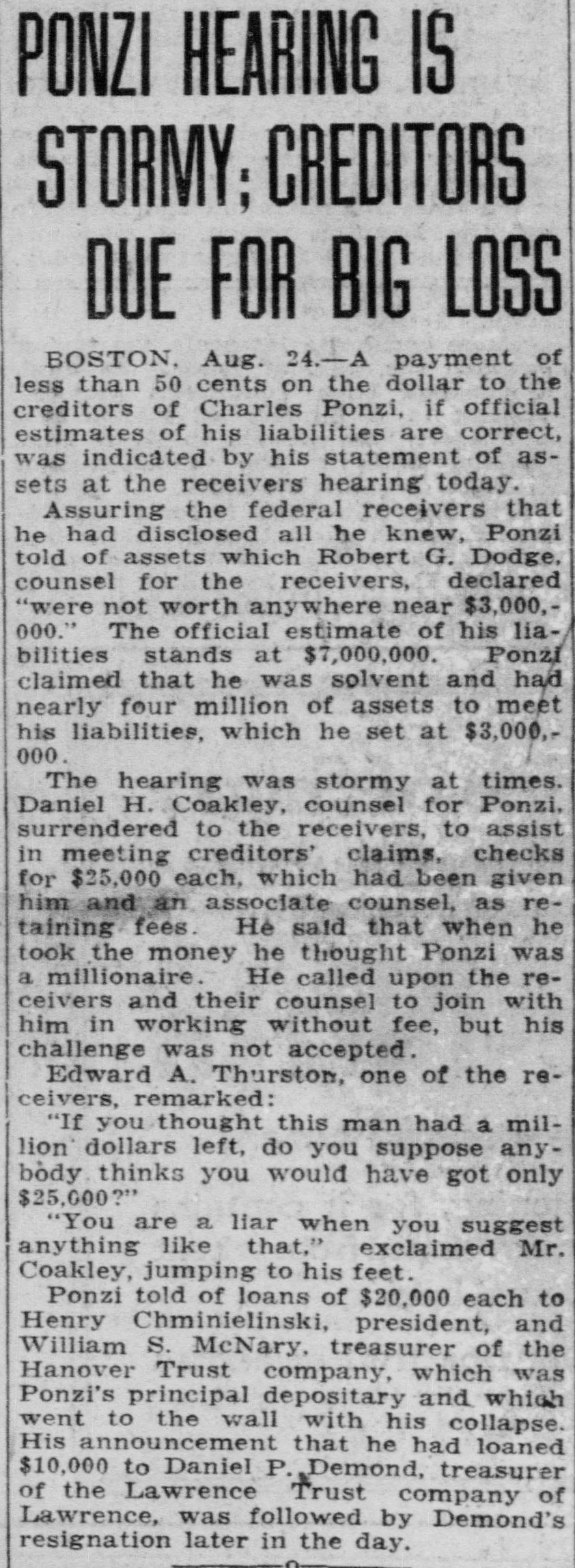
PONZI HEARING IS STORMY
CREDITORS DUE FOR BIG LOSS BOSTON, Aug. 24.-A payment of less than 50 cents on the dollar to the creditors of Charles Ponzi, if official estimates of his liabilities are correct, was indicated by his statement of assets at the receivers hearing today. Assuring the federal receivers that he had disclosed all he knew, Ponzi told of assets which Robert G. Dodge, counsel for the receivers, declared "were not worth anywhere near $3,000,000." The official estimate of his liabilities stands at $7,000,000. Ponzi claimed that he was solvent and had nearly four million of assets to meet his liabilities, which he set at $3,000,000. The hearing was stormy at times. Daniel H. Coakley, counsel for Ponzi. surrendered to the receivers, to assist in meeting creditors' claims, checks for $25,000 each, which had been given him and an associate counsel, as retaining fees. He said that when he took the money he thought Ponzi was a millionaire. He called upon the receivers and their counsel to join with him in working without fee, but his challenge was not accepted. Edward A. Thurston, one of the receivers, remarked: "If you thought this man had a million dollars left, do you suppose anybody thinks you would have got only $25,000?" "You are a liar when you suggest anything like that," exclaimed Mr. Coakley, jumping to his feet. Ponzi told of loans of $20,000 each to Henry Chminielinski, president, and William S. McNary, treasurer of the Hanover Trust company, which was Ponzi's principal depositary and which went to the wall with his collapse. His announcement that he had loaned $10,000 to Daniel P. Demond, treasurer of the Lawrence Trust company of Lawrence, was followed by Demond's resignation later in the day.
12.September 1, 1920The Washington TimesWashington, DC
Click image to open full size in new tab
Article Text
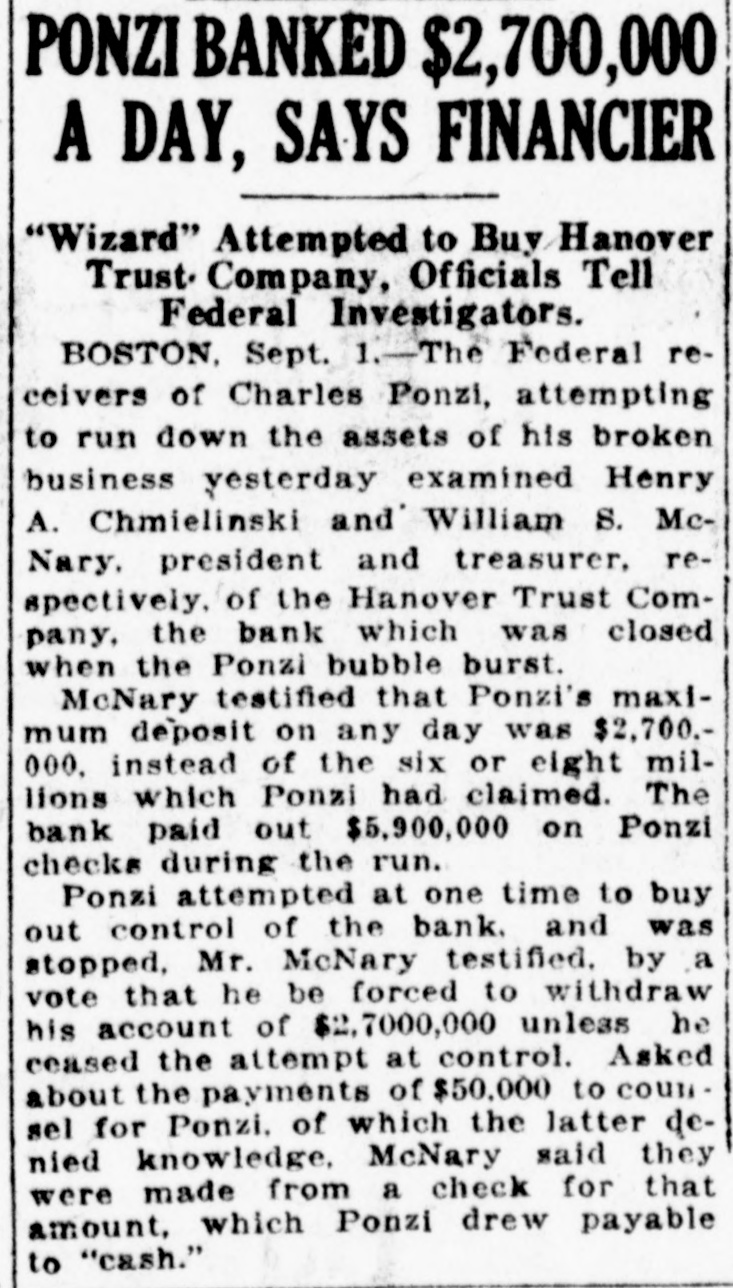
PONZI BANKED $2,700,000 A DAY, SAYS FINANCIER "Wizard" Attempted to Buy Hanover Trust. Company, Officials Tell Federal Investigators. BOSTON. Sept. 1.-The Federal receivers of Charles Ponzi, attempting to run down the assets of his broken business yesterday examined Henry A. Chmielinski and William S. McNary. president and treasurer, respectively. of the Hanover Trust Company, the bank which was closed when the Ponzi bubble burst. McNary testified that Ponzi's maximum deposit on any day was $2,700.000. instead of the six or eight millions which Ponzi had claimed. The bank paid out $5,900,000 on Ponzi checks during the run. Ponzi attempted at one time to buy out control of the bank. and was stopped, Mr. McNary testified. by a vote that he be forced to withdraw his account of $2,7000,000 unleas he ceased the attempt at control. Asked about the payments of $50,000 to coun. sel for Ponzi. of which the latter denied knowledge, McNary said they were made from a check for that amount, which Ponzi drew payable to "cash."
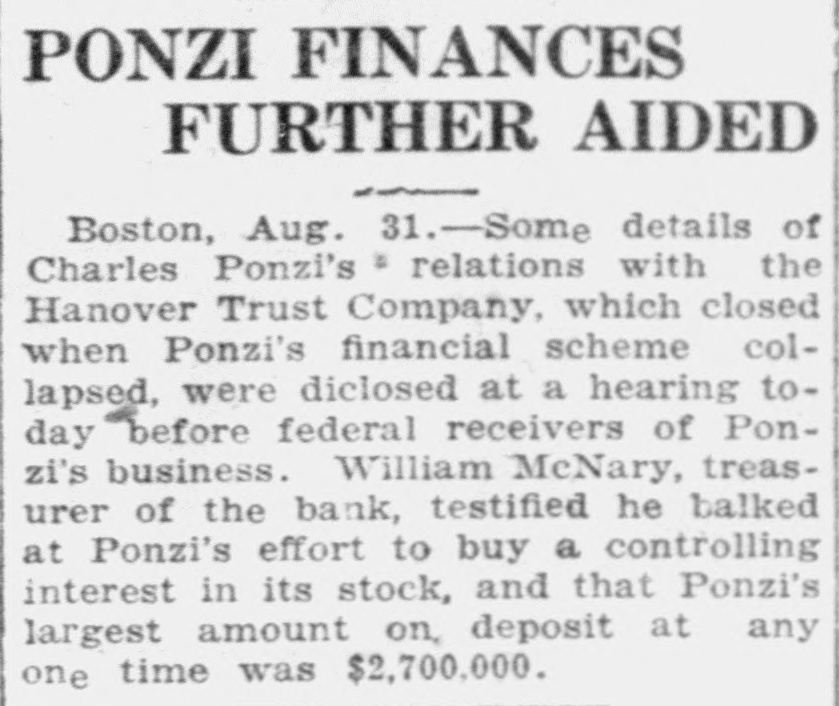
PONZI FINANCES FURTHER AIDED Boston, Aug. 31.-Some details of Charles Ponzi's a relations with the Hanover Trust Company, which closed when Ponzi's financial scheme collapsed, were diclosed at a hearing today before federal receivers of Ponzi's business. William McNary, treasurer of the bank, testified he balked at Ponzi's effort to buy a controlling interest in its stock, and that Ponzi's largest amount on, deposit at any one time was $2,700,000.
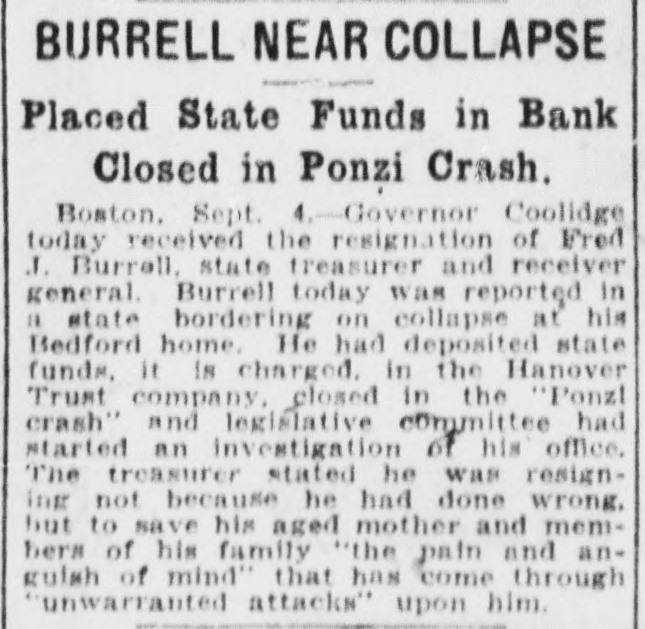
BURRELL NEAR COLLAPSE Placed State Funds in Bank Closed in Ponzi Crash. Boston, Sept. 4. Governor Coolidge today received the resignation of Fred J. Burrell, state treasurer and receiver general. Burrell today was reported in 11 state bordering on collapse at his Bedford home. He had deposited state funds. it is charged. in the Hanover Trust company, closed in the "Ponzl crash" and legislative committee had started an investigation of his office. The treasurer stated he was resigning not because he had done wrong. but to save his aged mother and memhere of his family "the pain and anguish of mind" that has come through "unwarranted attacks' upon him.
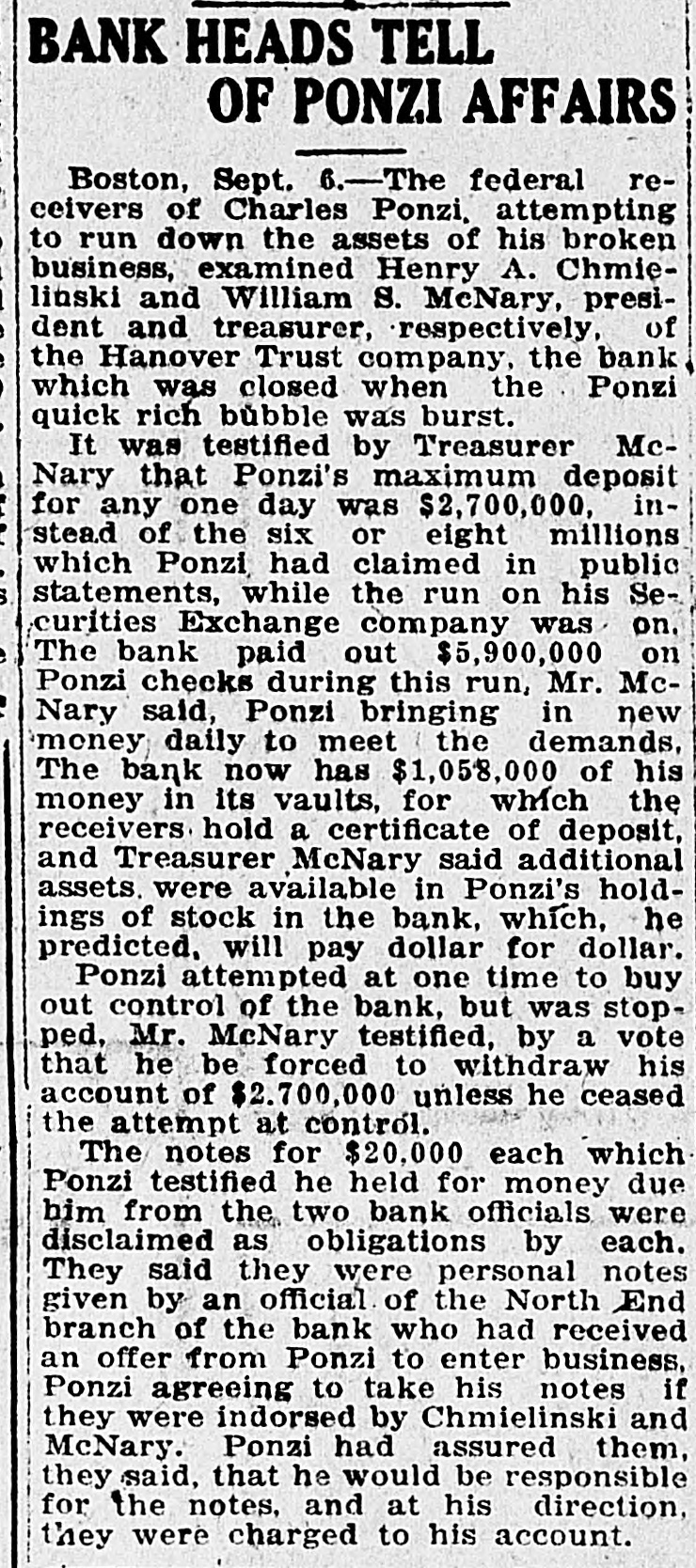
BANK HEADS TELL OF PONZI AFFAIRS Boston, Sept. 6.-The federal receivers of Charles Ponzi, attempting to run down the assets of his broken business, examined Henry A. Chmielinski and William S. McNary, president and treasurer, respectively, of the Hanover Trust company, the bank which was closed when the Ponzi quick rich bůbble was burst. It was testified by Treasurer McNary that Ponzi's maximum deposit for any one day was $2,700,000, instead of the six or eight millions which Ponzi had claimed in public statements, while the run on his Securities Exchange company was on. The bank paid out $5,900,000 on Ponzi checks during this run, Mr. McNary said, Ponzi bringing in new money daily to meet / the demands, The bank now has $1,058,000 of his money in its vaults, for which the receivers. hold a certificate of deposit, and Treasurer McNary said additional assets. were available in Ponzi's holdings of stock in the bank, which, he predicted, will pay dollar for dollar. Ponzi attempted at one time to buy out control of the bank, but was stopped, Mr. McNary testified, by a vote that he be forced to withdraw his account of $2.700,000 unless he ceased the attempt at control. The notes for $20,000 each which Ponzi testified he held for money due him from the two bank officials were disclaimed as obligations by each. They said they were personal notes given by an official of the North End branch of the bank who had received an offer from Ponzi to enter business, Ponzi agreeing to take his notes if they were indorsed by Chmielinski and McNary. Ponzi had assured them, they said, that he would be responsible for the notes, and at his direction, they were charged to his account.
16.September 9, 1920The Butler Weekly Times and the Bates County RecordButler, MO
Click image to open full size in new tab
Article Text
Bay State's Treasurer Caught in Ponzi Crash, Resigns Job. Boston, Mass., Sept. 4.-Gov. Coolidge today received the resignation of Fred J. Burrell, State treasurer and receiver general. Burrell today was reported in a state bordering on collapse at his Medford home. He had deposited State funds, it is charged, in the Hanover Trust Company, closed in the "Ponzi crash," and a Legislative Committee had started an investigation of his office. The treasurer stated he was resigning not because he had done wrong, but to save his aged mother and members of his fambily "the pam and anguish of mind" that has come through "unwarranted attacks" upon him.
17.September 9, 1920The Butler Weekly Times and the Bates County RecordButler, MO
Click image to open full size in new tab
Article Text
Bay State's Treasurer Caught in Ponzi Crash, Resigns Job. Boston, Mass., Sept. 4.-Gov. Coolidge today received the resignation of Fred J. Burrell, State treasurer and receiver general. Burrell today was reported in a state bordering on collapse at his Medford home. He had deposited State funds, it is charged, in the Hanover Trust Company, closed in the "Ponzi crash," and a Legislative Committee had started an investigation of his office. The treasurer stated he was resigning not because he had done wrong, but to save his aged mother and members of his fambily "the pam and anguish of mind" that has come through "unwarranted attacks" upon him.
18.October 5, 1920The Barre Daily TimesBarre, VT
Click image to open full size in new tab
Article Text
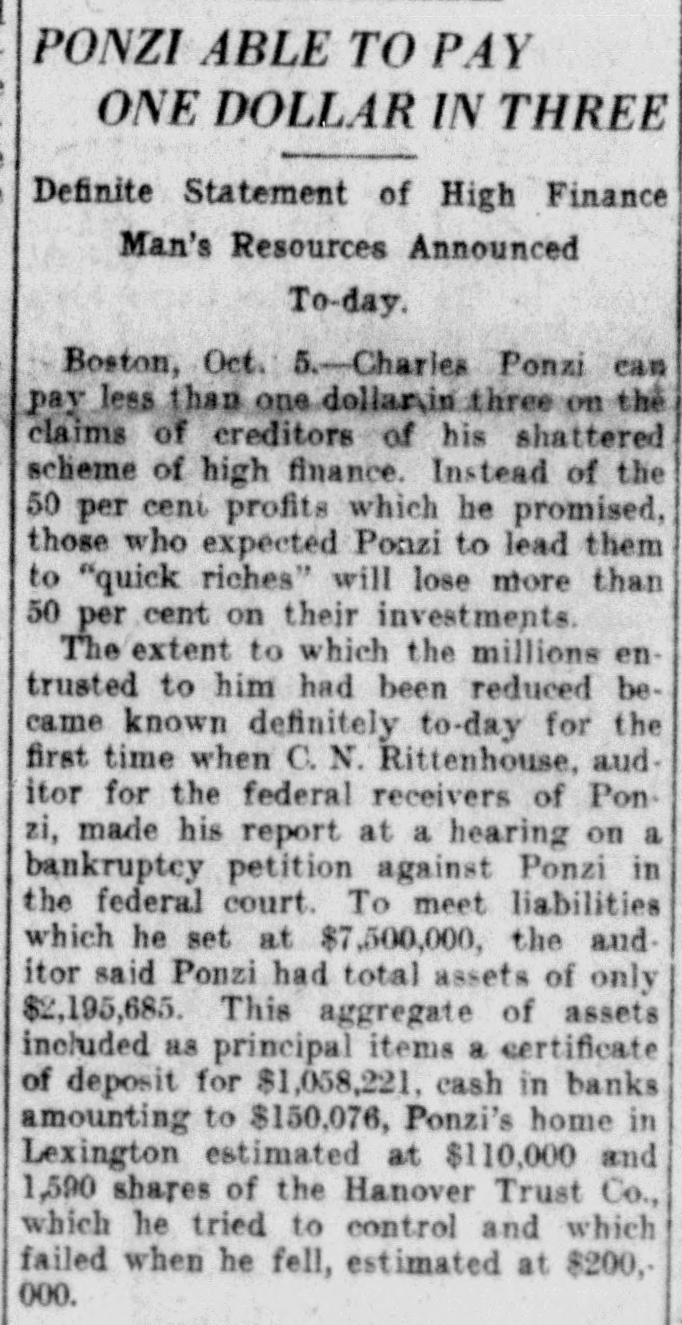
PONZI ABLE TO PAY ONE DOLLAR IN THREE Definite Statement of High Finance Man's Resources Announced To-day. Boston, Oct. 5. -Charles Ponzi can pay less than one dollarsin three on the claims of creditors of his shattered scheme of high finance. Instead of the 50 per ceni profits which he promised, those who expected Ponzi to lead them to "quick riches" will lose more than 50 per cent on their investments. The extent to which the millions entrusted to him had been reduced became known definitely to-day for the first time when C.N. Rittenhouse, auditor for the federal receivers of Ponzi, made his report at a hearing on a bankruptcy petition against Ponzi in the federal court. To meet liabilities which he set at $7,500,000, the and itor said Ponzi had total assets of only $2,195,685. This aggregate of assets included as principal items a certificate of deposit for $1,058,221. cash in banks amounting to $150,076, Ponzi's home in Lexington estimated at $110,000 and 1,590 shares of the Hanover Trust Co., which he tried to control and which failed when he fell, estimated at $200, 000.
19.October 6, 1920New-York TribuneNew York, NY
Click image to open full size in new tab
Article Text
Ponzi Assets Less Than One
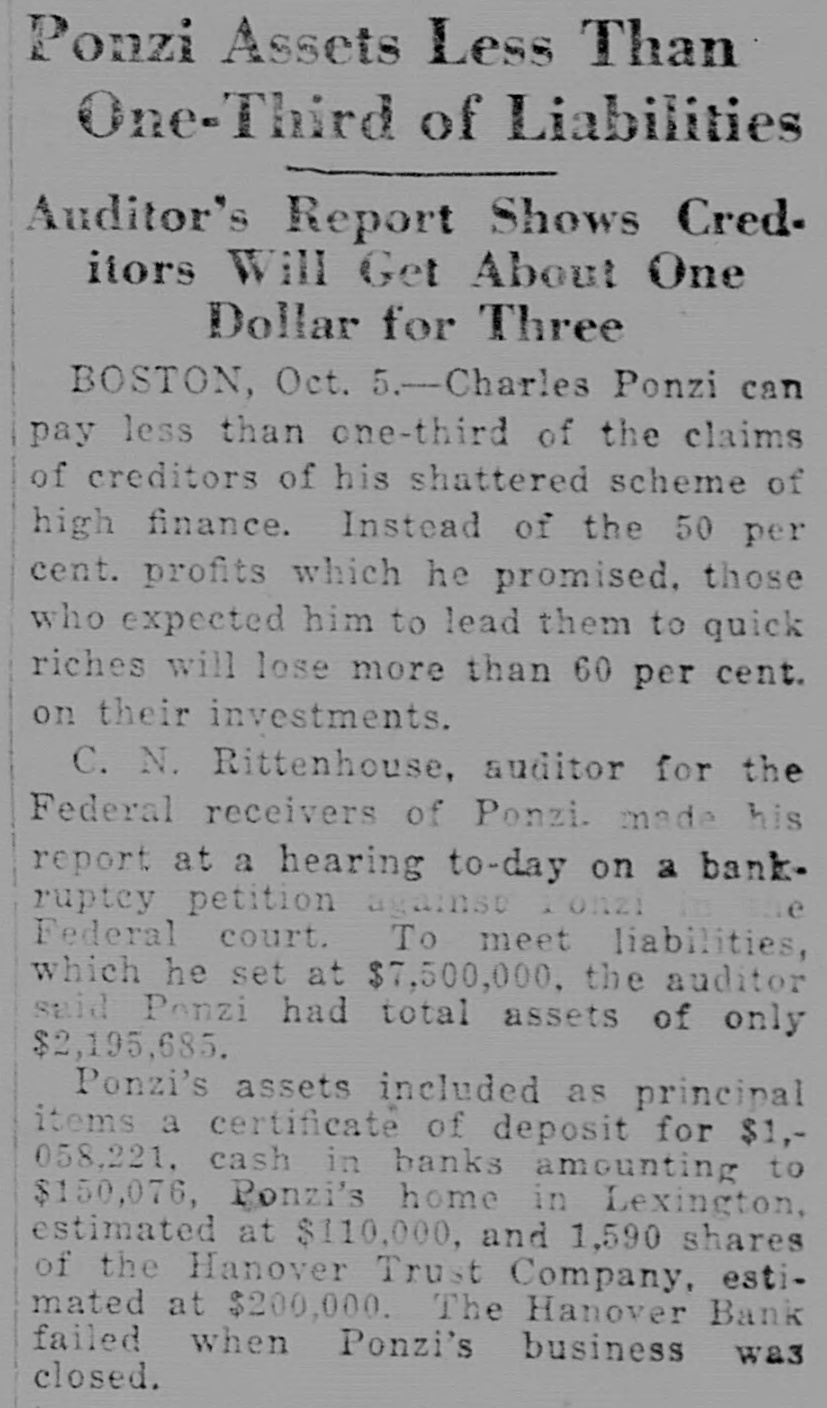
Third of Liabilities Auditor's Report Shows Creditors Will Get About One Dollar for Three BOSTON, Oct. 5.-Charles Ponzi can pay less than one-third of the claims of creditors of his shattered scheme of high finance. Instead of the 50 per cent. profits which he promised. those who expected him to lead them to quick riches will lose more than 60 per cent. on their investments. C. N. Rittenhouse, auditor for the Federal receivers of Ponzi. made his report at a hearing to-day on a bankruptcy petition against 10121 Federal court. To meet liabilities, which he set at $7,500,000. the auditor said Penzi had total assets of only $2,195,685. Ponzi's assets included as principal items a certificate of deposit for $1,058.221, cash in banks amounting to $150,076, Ponzi's home in Lexington, estimated at $110,000, and 1,590 shares of the Hanover Trust Company, estimated at $200,000. The Hanover Bank failed when Ponzi's business wa3 closed.
20.October 6, 1920The New York HeraldNew York, NY
Click image to open full size in new tab
Article Text
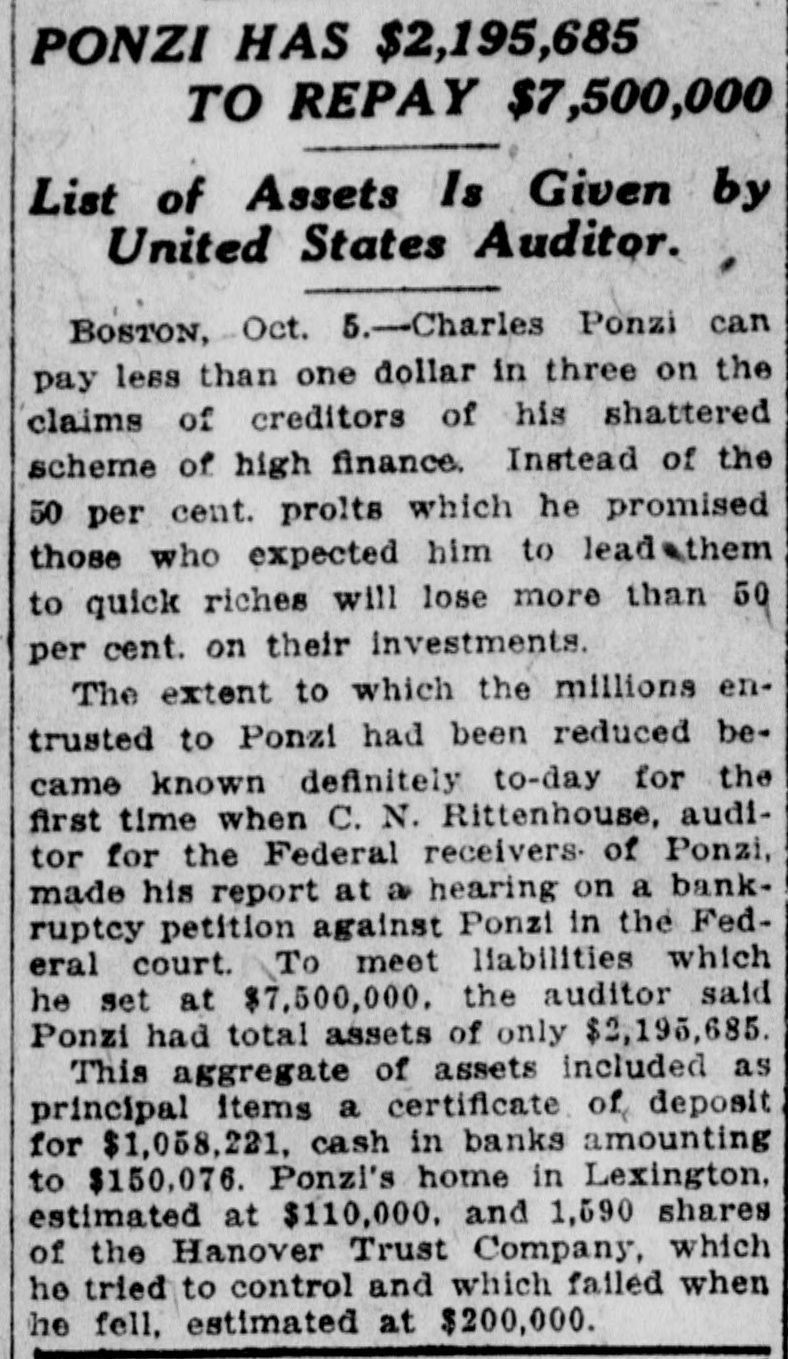
PONZI HAS $2,195,685 TO REPAY $7,500,000 List of Assets Is Given by United States Auditor. BOSTON, Oct. 5.-Charles Ponzi can pay less than one dollar in three on the claims of creditors of his shattered scheme of high finance. Instead of the 50 per cent. prolts which he promised those who expected him to lead them to quick riches will lose more than 50 per cent. on their investments. The extent to which the millions entrusted to Ponzi had been reduced became known definitely to-day for the first time when C. N. Rittenhouse, auditor for the Federal receivers. of Ponzi, made his report at a hearing on a bankruptcy petition against Ponzi in the Federal court. To meet liabilities which he set at $7,500,000. the auditor said Ponzi had total assets of only $2,195,685. This aggregate of assets included as principal items a certificate of deposit for $1,058,221, cash in banks amounting to $150,076. Ponzi's home in Lexington, estimated at $110,000. and 1,590 shares of the Hanover Trust Company, which he tried to control and which failed when he fell, estimated at $200,000.
21.October 6, 1920Daily Kennebec JournalAugusta, ME
Click image to open full size in new tab
Article Text
Ponzi Speculators to Lose More Than Expected Gains Boston Oct. S.-Charles Ponzi can pay less than one dollar in three on the claims of creditors of his shattered scheme of high finance. Instead of the fifty per cent profits which he promised. those who expected Ponzi to lead them to quick riches will lose more than 50 per cent on their investments. The extent to which the millions entrusted to him had been reduced became known definitely today for the first time when C. W. Rittenhouse. auditor for the Federal receivers of Ponzi, made his report at a hearing on a bankruptcy petition against Ponzi in the Federal court. To meet liabilities which he set at $7,500,000 the auditor said Ponzi had total assets of only $2,195,685. This aggregate of assets included as principal items a certificate of deposit for $1,058,221. cash in banks amounting to $150,076. Ponzi's house in Lexington estimated at $110.000 and 1590 shares of the Hanover Trust Company which he tried to control and which failed when he fell. estimated at $200.000.
22.October 20, 1920Americus Times-RecorderAmericus, GA
Click image to open full size in new tab
Article Text
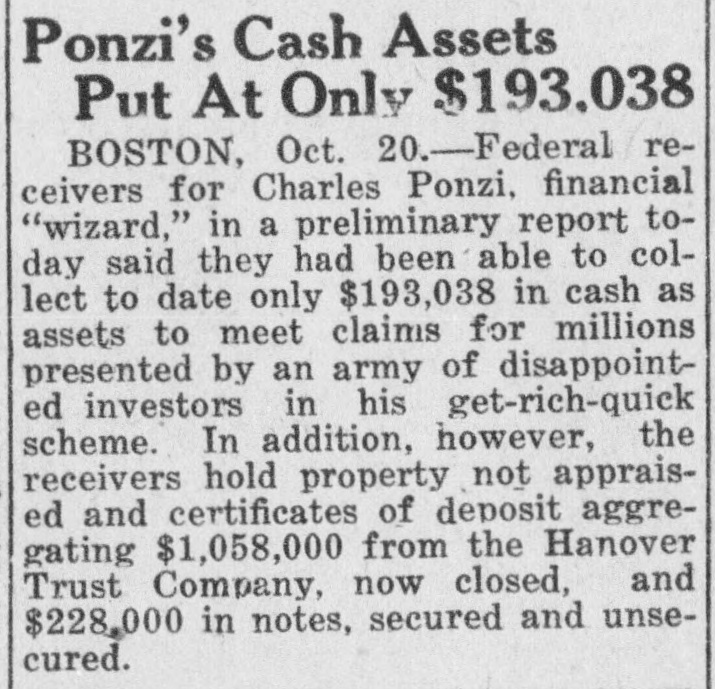
Ponzi's Cash Assets Put At Only $193,038 BOSTON, Oct. 20.-Federal receivers for Charles Ponzi, financial "wizard," in a preliminary report today said they had been able to collect to date only $193,038 in cash as assets to meet claims for millions presented by an army of disappointed investors in his get-rich-quick scheme. In addition, however, the receivers hold property not appraised and certificates of deposit aggregating $1,058,000 from the Hanover Trust Company, now closed, and $228,000 in notes, secured and unsecured.
23.February 15, 1922Daily Kennebec JournalAugusta, ME
Click image to open full size in new tab
Article Text
Grand Jury Starts Inquiry How Hanover Trust Co. Was Run Boston, Feb. 14.-The Suffolk, county grand jury today began a special session to inquire into the affairs of the Hanover Trust Co. prior to the time that it was closed by Bank Commissioner Allen. The investigation, according to Assistant Atty. Gen. Albert Hurwitz, will be along lines similar to those pursued by the grand jury when it returned indictments recently against Max Mitchell, president of the Cosmopolitan Trust Co., for larceny aggregating $1,700,000. While the amount involved in the Hanover inquixy is not as great, Mr. Hurwitz said, evidence would be introduced covering transactions concerning considerable sums of money.
Bank runs are almost always and everywhere a deterioration of bank fundamentals.
But not for you.
You are the measure-zero exception: great fundamentals, solid bank, and yet the Diamond Dybvig fairy spread its rumor. Depositors woke up. Your collateral was not prepositioned. The Clearinghouse had it for you.
Do not pass Go. Do not collect $200. Go directly to jail… or worse.