Bank was first restrained/suspended by court order, later resumed limited business and was then subject to renewed withdrawals leading to receivership.
Events (4)
1.January 27, 1912Suspension
Cause
Bank Specific Adverse Info
Cause Details
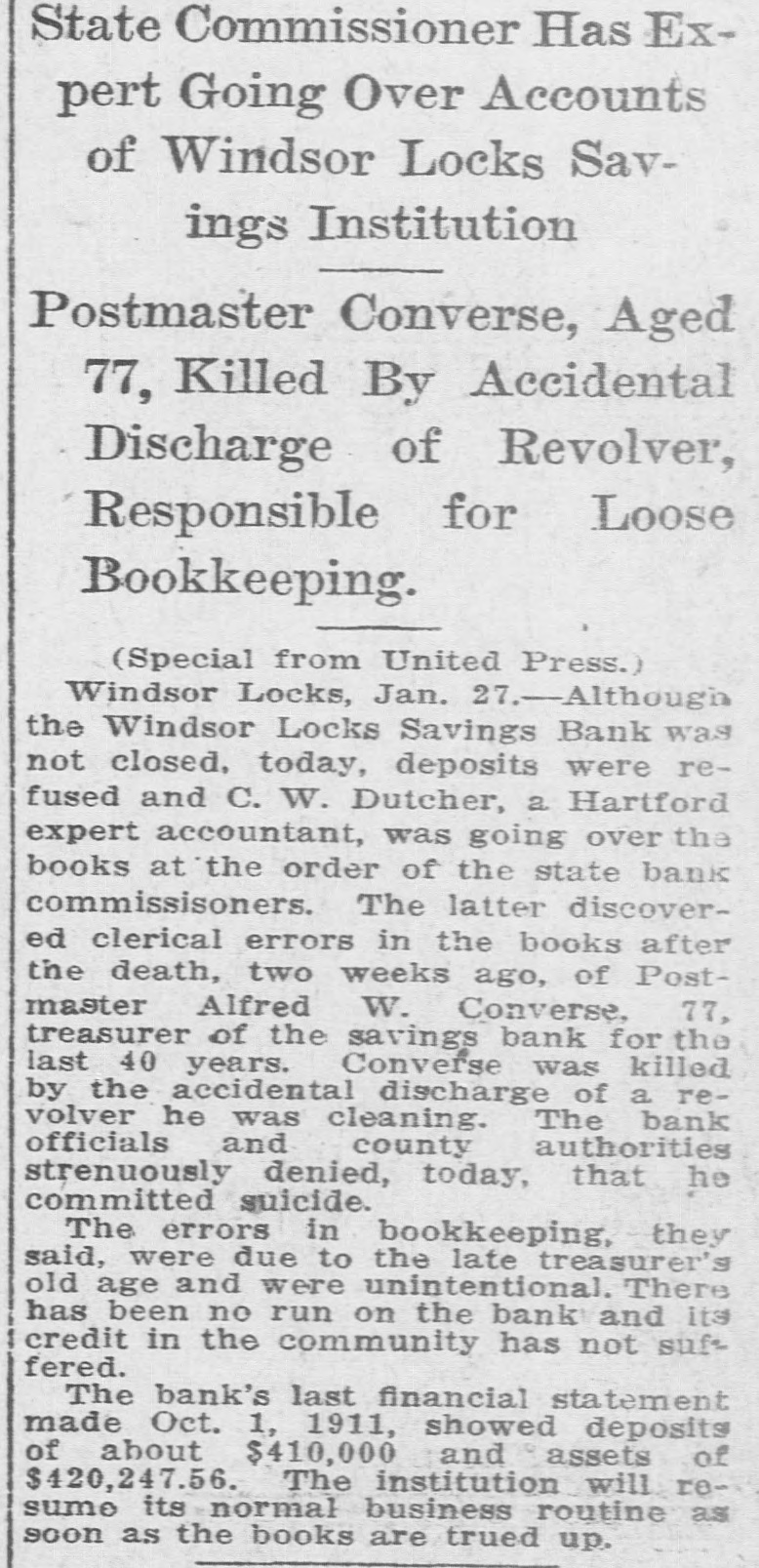
Examiners found long-standing bookkeeping errors and an apparent large shortage (approximately $175,000) after treasurer's death; court restraining order to prevent payouts pending examination
Newspaper Excerpt
The Bank Commissioners petitioned Judge Prentice for the restraining order ... from paying out any of the funds of the bank
Source
newspapers
+3 months
2.April 27, 1912Reopening
Newspaper Excerpt
the bank was permitted to resume business ... decreed that not more than 50 per cent. of any deposit could be withdrawn
Source
newspapers
+14 days
3.May 11, 1912Run
Cause
Bank Specific Adverse Info
Cause Details
Depositors withdrew funds in reaction to the previously disclosed defalcation/shortage and limits on withdrawals
Measures
Payment limit imposed on withdrawals (court order allowed payment of 50% initially); directors had scaled deposits 26% to meet losses
Newspaper Excerpt
More than $60,000 has been withdrawn in a run on the reopened Windsor Locks Savings Bank
Source
newspapers
+6 days
4.May 17, 1912Receivership
Newspaper Excerpt
Bank Commissioners Fred. P. Holt and Norris Lippitt were to-day named as receivers of the Windsor Locks Savings Bank by Judge Curtis in the Superior Court
State Commissioner Has Expert Going Over Accounts of Windsor Locks Savings Institution Postmaster Converse, Aged 77, Killed By Accidental Discharge of Revolver, Responsible for Loose Bookkeeping. (Special from United Press.) Windsor Locks, Jan. 27.-Although the Windsor Locks Savings Bank was not closed, today, deposits were refused and C. W. Dutcher, a Hartford expert accountant, was going over the books at the order of the state bank commissisoners. The latter discovered clerical errors in the books after the death, two weeks ago, of Postmaster Alfred W. Converse, 77, treasurer of the savings bank for the last 40 years. Converse was killed by the accidental discharge of a revolver he was cleaning. The bank officials and county authorities strenuously denied, today, that he committed suicide. The errors in bookkeeping, they said, were due to the late treasurer's old age and were unintentional, There has been no run on the bank and its credit in the community has not suffered. The bank's last financial statement made Oct. 1, 1911, showed deposits of about $410,000 and assets of $420,247.56. The institution will resume its normal business routine as soon as the books are trued up.
2.January 28, 1912The SunNew York, NY
Click image to open full size in new tab
Article Text
CLOSES BANK THAT NEVER TOTTED UP Court Order for a Connecticut Savings Institution 11 Years Old. LIABILITIES ALONE SURE Officers Had Apparently Never Heard of H Trial Balance in Their Profession. HARTFORD Conn Jan 27 The Windsor Locks Savings Bank of Windsor Locks. Conn. was restrained to-day on an order issued by Judge Samuel O Prentice of the Superior Court to State Bank Commissioners Norris S Lippitt and Fred P. Holt from paying out any of the funds of the bank or from declaring any dividends The Bank Commissioners petitioned Judge Prentice for the restraining order Within a week. so they told the Judge they have made an examination of the bank and found the books to be in an unsatisfactory and incomplete condition No trial balance even had been taken in many years. The books indicated that the assets of the bank are largely impaired and perhaps insufficient to pay its depositors in full The commissioners desired to make a more complete and detailed examination to get at the exact financial status of the bank One of the questions put to the treasurer of this bank by Commissioner Holt while he was informally looking over the bank records a few days ago was as to when the last trial balance was taken The treasurer seemed to be surprised at the novelty of it The query was a new one to him. He replied that he did not think there had been a trial balance made since the bank was organized in 1871. forty-one years ago. Commissioner Holt told the treasurer to lose no time in having a trial balance made It would the Commissioner said. take about sixteen days. or at the rate of a little more than a hundred accounts a day. The commissioners have not power to compel a bank to make a trial balance In the meantime the Bank Commis sioners sent their expert. William P Landon to Windsor Locks to examine the books of the bank and to report to the commission The report of Mr Landon was surprising According to the report of the bank to the commission for the year ended September 30. 1911 its assets amounted to $420,247.58 The report of Mr. Landon convinced the commissioners that the bank was not able to pay the full amount of deposits in case a demand was made on it The opinion of the commissioners was based entirely on what the books of the bank showed Commissioner Holt called the directors of the bank together the other day to discuss the situation with them. They were reluctant to believe that the bank was unable to meet its obligations. But when the commissioner submitted facts to prove that appearances were against the position of unshakable confidence which they took they agreed that if the conditions warranted it it was better to suspend the paying out of money Commissioner Holt then had a conference with Gov. Baldwin on the sitnation and he advised the Commissioner that there was nothing for the Bank Commission to do but to make application to a Judge of the Superior Court for a restraining order The prompt action of the Bank Commissioners will have the effect of preventing a run on the bank It has 1.636 depositors The officers and directors of the bank are: President. George Glover; treasurer. C. F. Cleaveland directors, J W. Johnson. J. R. Montgomery, Allen Pease. George P. Clark George Glover. G. M. Montgomery, E B. Bailey, A. B. Stock well. M. P. Robinson F. L. Ashley John M. Morse, James Keevers, C. W Sadler and Charles S. Hoar Alfred W. Converse, who died a few days ago from wounds received from the accidental discharge of a revolver he was cleaning on January 14. was for forty years treasurer of this bank. He resigned a year ago.
3.January 29, 1912The Washington TimesWashington, DC
Click image to open full size in new tab
Article Text
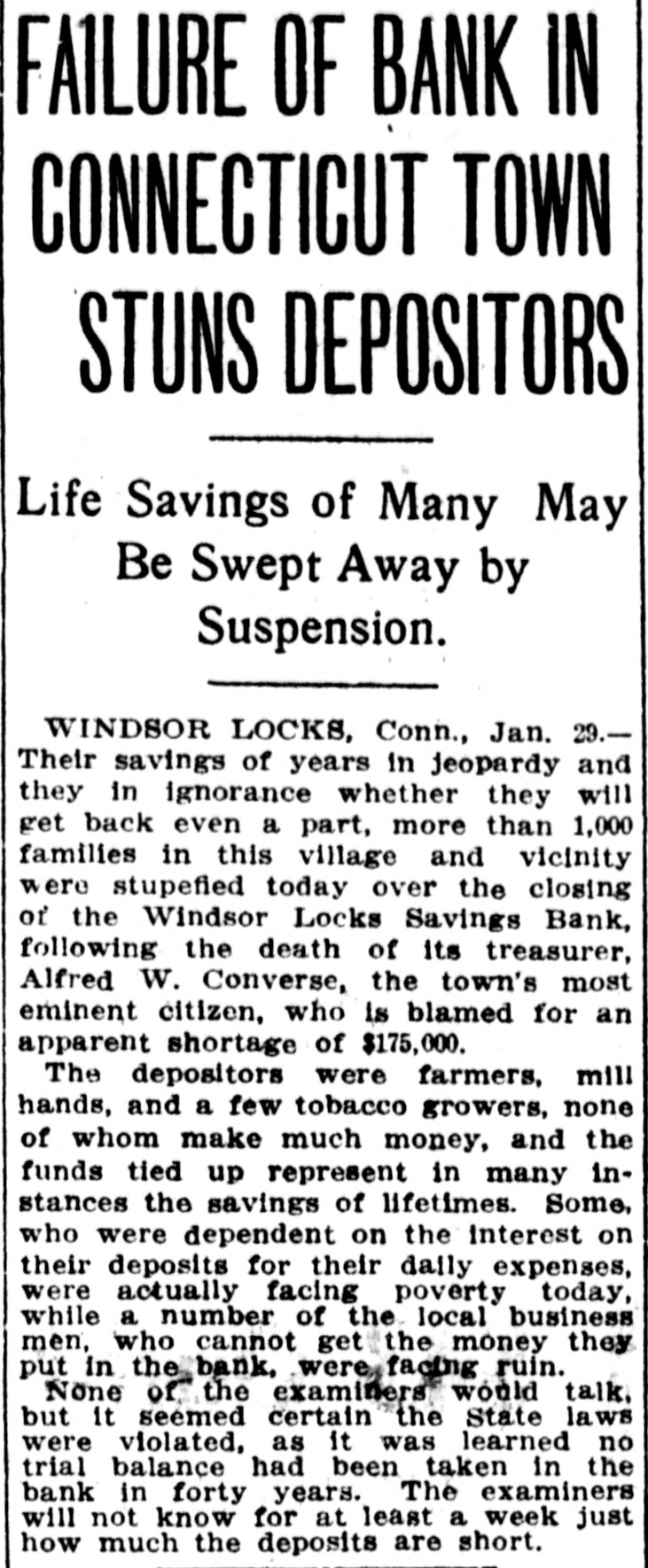
FAILURE OF BANK IN CONNECTICUT TOWN STUNS DEPOSITORS Life Savings of Many May Be Swept Away by Suspension. WINDSOR LOCKS, Conn., Jan. 29.Their savings of years in jeopardy and they in ignorance whether they will get back even a part, more than 1,000 families in this village and vicinity were stupefied today over the closing or the Windsor Locks Savings Bank, following the death of its treasurer, Alfred W. Converse, the town's most eminent citizen, who is blamed for an apparent shortage of $175,000. The depositors were farmers, mill hands, and a few tobacco growers, none of whom make much money, and the funds tied up represent in many instances the savings of lifetimes. Some, who were dependent on the interest on their deposits for their daily expenses, were actually facing poverty today, while a number of the local business men, who cannot get the money they put in the bank, were facing ruin. None of the examiners would talk, but it seemed certain the State laws were violated, as it was learned no trial balance had been taken in the bank in forty years. The examiners will not know for at least a week just how much the deposits are short.
4.January 29, 1912The Birmingham Age-HeraldBirmingham, AL
Click image to open full size in new tab
Article Text
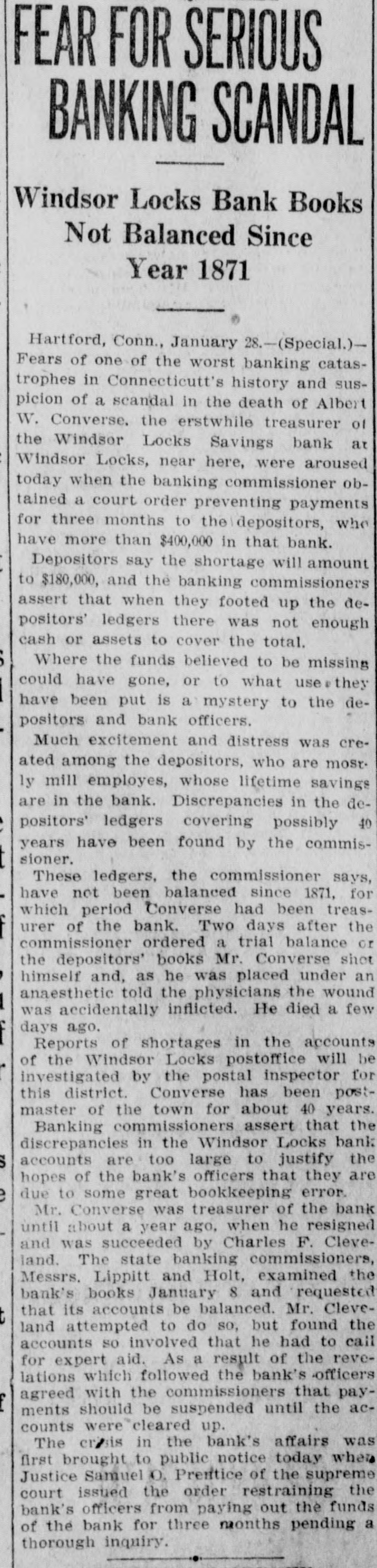
FEAR FOR SERIOUS BANKING SCANDAL Windsor Locks Bank Books Not Balanced Since Year 1871 o Hartford, Conn., January 28.-(Special.)Fears of one of the worst banking catastrophes in Connecticutt's history and suspicion of a scandal in the death of Albert W. Converse. the erstwhile treasurer of the Windsor Locks Savings bank at Windsor Locks, near here, were aroused today when the banking commissioner obtained a court order preventing payments for three months to the depositors, who have more than $400,000 in that bank. Depositors say the shortage will amount to $180,000, and the banking commissioners assert that when they footed up the depositors' ledgers there was not enough cash or assets to cover the total. Where the funds believed to be missing could have gone, or to what use they have been put is a mystery to the depositors and bank officers. Much excitement and distress was created among the depositors, who are most. ly mill employes, whose lifetime savings are in the bank. Discrepancies in the depositors' ledgers covering possibly 40 years have been found by the commissioner. These ledgers, the commissioner says, have not been balanced since 1871, for which period Converse had been treasurer of the bank. Two days after the commissioner ordered a trial balance or the depositors' books Mr. Converse shot himself and, as he was placed under an anaesthetic told the physicians the wound was accidentally inflicted. He died a few days ago. Reports of shortages in the accounts of the Windsor Locks postoffice will be investigated by the postal inspector for this district. Converse has been postmaster of the town for about 40 years. Banking commissioners assert that the discrepancies in the Windsor Locks bank accounts are too large to justify the hopes of the bank's officers that they are due to some great bookkeeping error. Mr. Converse was treasurer of the bank until about a year ago, when he resigned and was succeeded by Charles F. Cleveland. The state banking commissioners, Messrs. Lippitt and Holt, examined the January 8 and requested be that bank's its books accounts balanced. but Mr. found Cleve- the land attempted to do so, accounts so involved that he had to call expert aid. As a result of the revefollowed the lations for which commissioners bank's that officers payagreed with the ments should be suspended until the accounts were cleared up. The crisis in the bank's affairs was first brought to public notice today when Justice Samuel O. Prentice of the supreme issued the order restraining the officers from paying out court bank's pending the funds a of the bank for three months thorough inquiry.
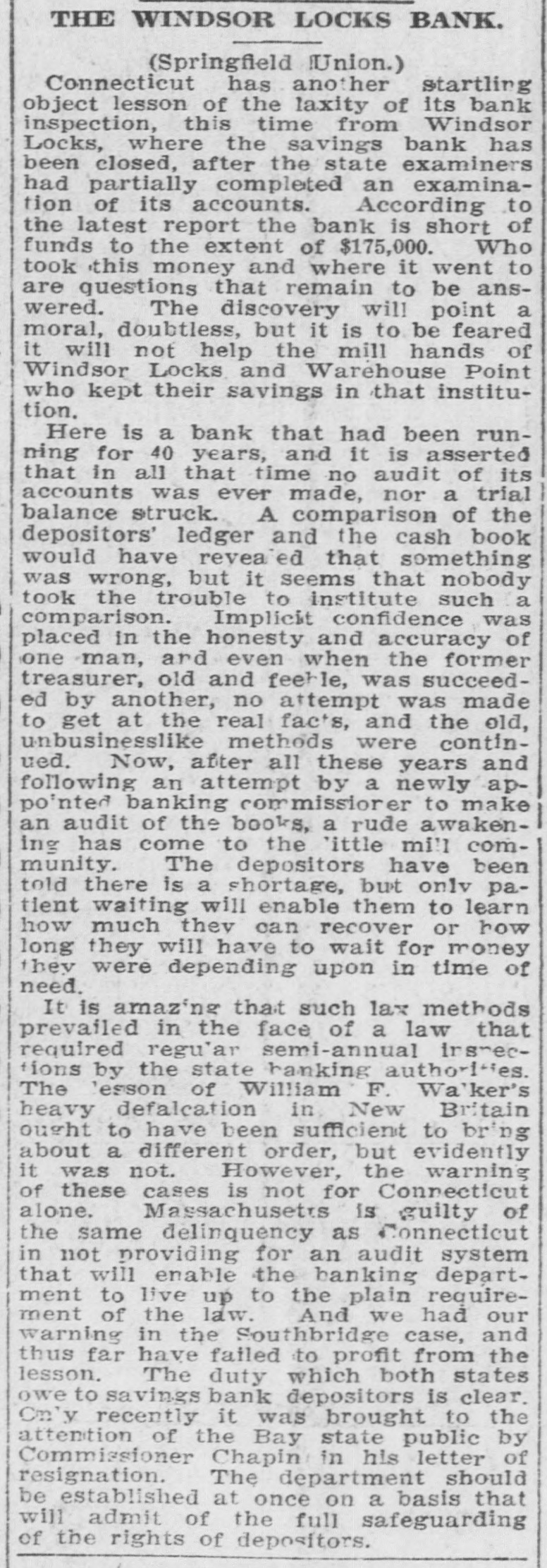
(Springfield Union.) Connecticut has another startling object lesson of the laxity of its bank inspection, this time from Windsor Locks, where the savings bank has been closed, after the state examiners had partially completed an examination of its accounts. According to the latest report the bank is short of funds to the extent of $175,000. Who took this money and where it went to are questions that remain to be answered. The discovery will point a moral, doubtless, but it is to be feared it will not help the mill hands of Windsor Locks and Warehouse Point who kept their savings in that institution. Here is a bank that had been running for 40 years, and it is asserted that in all that time no audit of its accounts was ever made, nor a trial balance struck. A comparison of the depositors' ledger and the cash book would have revealed that something was wrong, but it seems that nobody took the trouble to institute such a comparison. Implick confidence was placed in the honesty and accuracy of one man, ard even when the former treasurer, old and feeble, was succeeded by another, no attempt was made to get at the real facts, and the old, unbusinesslike methods were continued. Now, after all these years and following an attempt by a newly appointed banking commissiorer to make an audit of the books, a rude awakening has come to the little mill community. The depositors have been told there is a shortage, but only patient waiting will enable them to learn how much they can recover or row long they will have to wait for money they were depending upon in time of need. It is amazing that such lax methods prevailed in the face of a law that required regu'ar semi-annual ingrections by the state ranking authorities. The lesson of William F. Wa'ker's heavy defalcation in New Britain ought to have been sufficient to bring about a different order, but evidently it was not. However, the warning of these cases is not for Connecticut alone. Massachusetts is guilty of the same delinquency as Connecticut in not providing for an audit system that will enable the banking department to live up to the plain requirement of the law. And we had our warning in the Southbridge case, and thus far have failed to profit from the lesson. The duty which both states owe to savings bank depositors is clear. On'y recently it was brought to the attention of the Bay state public by Commissioner Chapin in his letter of resignation. The department should be established at once on a basis that will admit of the full safeguarding of the rights of depositors.
6.April 11, 1912Norwich BulletinNorwich, CT
Click image to open full size in new tab
Article Text
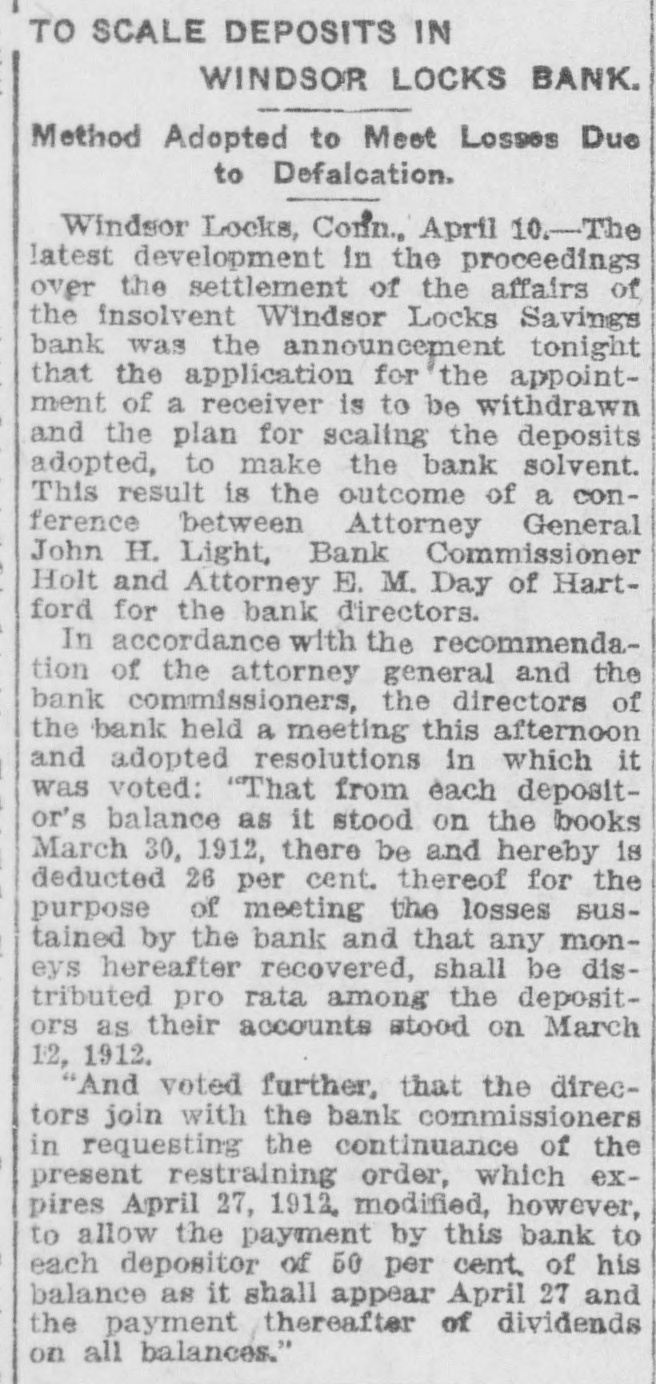
TO SCALE DEPOSITS IN WINDSOR LOCKS BANK. Method Adopted to Meet Losses Due to Defalcation. Windsor Locks, Conn., April 10. -The latest development in the proceedings over the settlement of the affairs of the insolvent Windsor Locks Savings bank was the announcement tonight that the application for the appointment of a receiver is to be withdrawn and the plan for scaling the deposits adopted, to make the bank solvent. This result is the outcome of a conference between Attorney General John H. Light, Bank Commissioner Holt and Attorney E. M. Day of Hartford for the bank directors. In accordance with the recommendation of the attorney general and the bank commissioners, the directors of the bank held a meeting this afternoon and adopted resolutions in which it was voted: "That from each depositor's balance as it stood on the books March 30, 1912, there be and hereby is deducted 26 per cent. thereof for the purpose of meeting the losses sustained by the bank and that any moneys hereafter recovered, shall be distributed pro rata among the depositors as their accounts stood on March 12, 1912. "And voted further, that the directors join with the bank commissioners in requesting the continuance of the present restraining order, which expires April 27, 1912, modified, however, to allow the payment by this bank to each depositor of 50 per cent. of his balance as it shall appear April 27 and the payment thereafter of dividends on all balances."
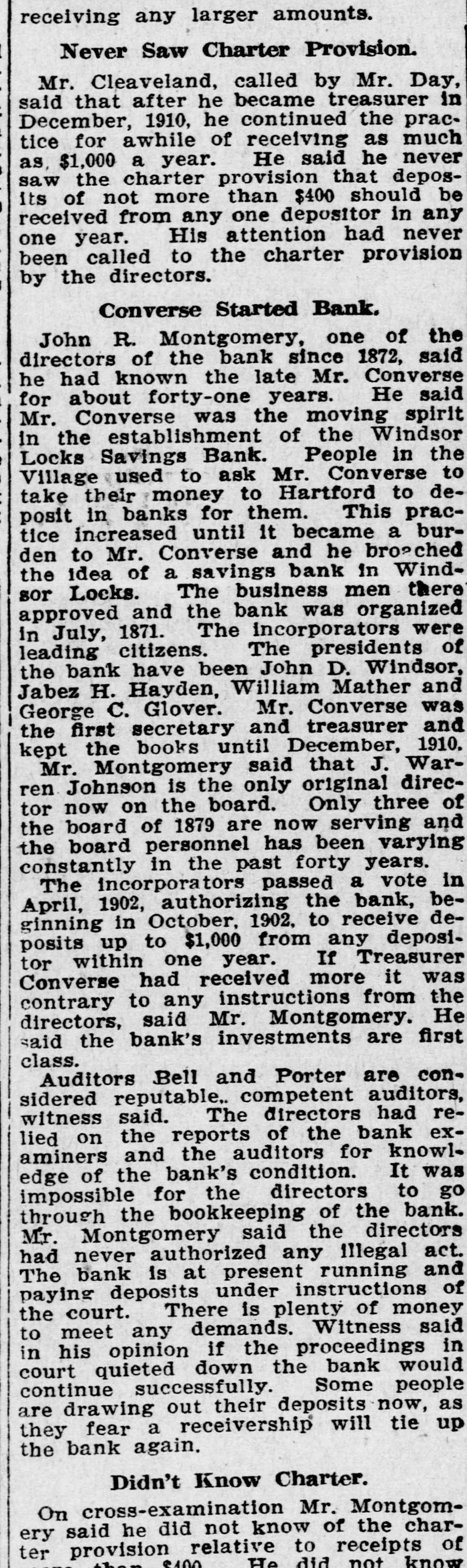
Never Saw Charter Provision. Mr. Cleaveland, called by Mr. Day, said that after he became treasurer in December, 1910, he continued the practice for awhile of receiving as much as, $1,000 a year. He said he never saw the charter provision that deposits of not more than $400 should be received from any one depositor in any one year. His attention had never been called to the charter provision by the directors. Converse Started Bank. John R. Montgomery, one of the directors of the bank since 1872, said he had known the late Mr. Converse for about forty-one years. He said Mr. Converse was the moving spirit in the establishment of the Windsor Locks Savings Bank. People in the Village used to ask Mr. Converse to take their money to Hartford to deposit in banks for them. This practice increased until it became a burden to Mr. Converse and he broached the idea of a savings bank in Windsor Locks. The business men there approved and the bank was organized in July, 1871. The incorporators were leading citizens. The presidents of the bank have been John D. Windsor, Jabez H. Hayden, William Mather and George C. Glover. Mr. Converse was the first secretary and treasurer and kept the books until December, 1910. Mr. Montgomery said that J. Warren Johnson is the only original director now on the board. Only three of the board of 1879 are now serving and the board personnel has been varying constantly in the past forty years. The incorporators passed a vote in April, 1902, authorizing the bank, beginning in October, 1902, to receive deposits up to $1,000 from any depositor within one year. If Treasurer Converse had received more it was contrary to any instructions from the directors, said Mr. Montgomery. He said the bank's investments are first class. Auditors Bell and Porter are considered reputable.. competent auditors, witness said. The directors had relied on the reports of the bank examiners and the auditors for knowledge of the bank's condition. It was impossible for the directors to go through the bookkeeping of the bank. Mr. Montgomery said the directors had never authorized any illegal act. The bank is at present running and paying deposits under instructions of the court. There is plenty of money to meet any demands. Witness said in his opinion if the proceedings in court quieted down the bank would continue successfully. Some people are drawing out their deposits now, as they fear a receivership will tie up the bank again. Didn't Know Charter. On cross-examination Mr. Montgomery said he did not know of the charter provision relative to receipts of han $100 He did not know
8.May 11, 1912East Oregonian : E.OPendleton, OR
Click image to open full size in new tab
Article Text
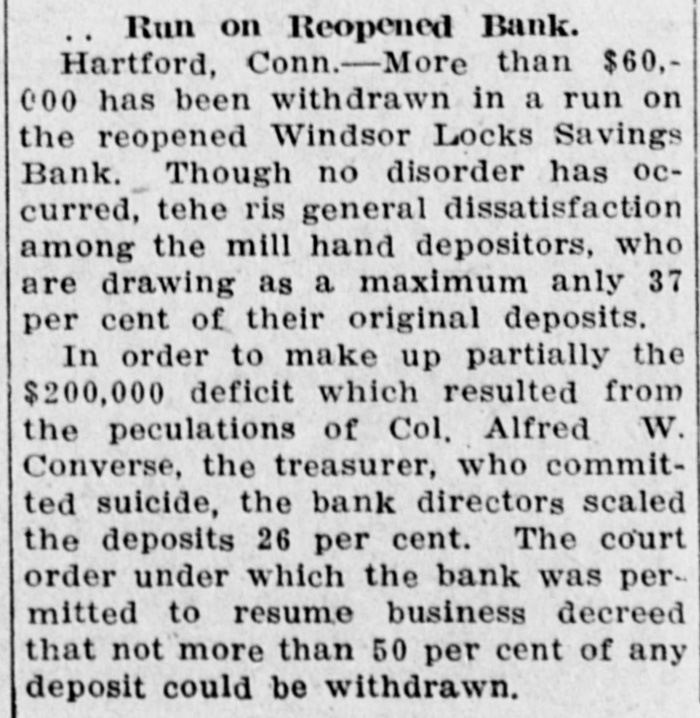
Run on Reopened Bank
Hartford, Conn.-More than $60,000 has been withdrawn in a run on the reopened Windsor Locks Savings Bank. Though no disorder has occurred, tehe ris general dissatisfaction among the mill hand depositors, who are drawing as a maximum anly 37 per cent of their original deposits. In order to make up partially the $200,000 deficit which resulted from the peculations of Col. Alfred W. Converse, the treasurer, who committed suicide, the bank directors scaled the deposits 26 per cent. The court order under which the bank was permitted to resume business decreed that not more than 50 per cent of any deposit could be withdrawn.
9.May 17, 1912The Evening WorldNew York, NY
Click image to open full size in new tab
Article Text
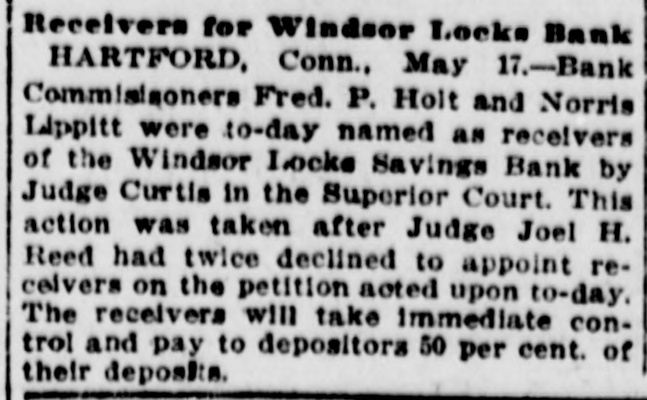
Receivers for Windsor Locks Bank HARTFORD, Conn., May 17.-Bank Commisisoners Fred. P. Holt and Norris Lippitt were to-day named as receivers of the Windsor Locks Savings Bank by Judge Curtis in the Superior Court. This action was taken after Judge Joel H. Reed had twice declined to appoint receivers on the petition acted upon to-day. The receivers will take immediate control and pay to depositors 50 per cent. of their deposits.
10.May 24, 1912Putnam PatriotPutnam, CT
Click image to open full size in new tab
Article Text
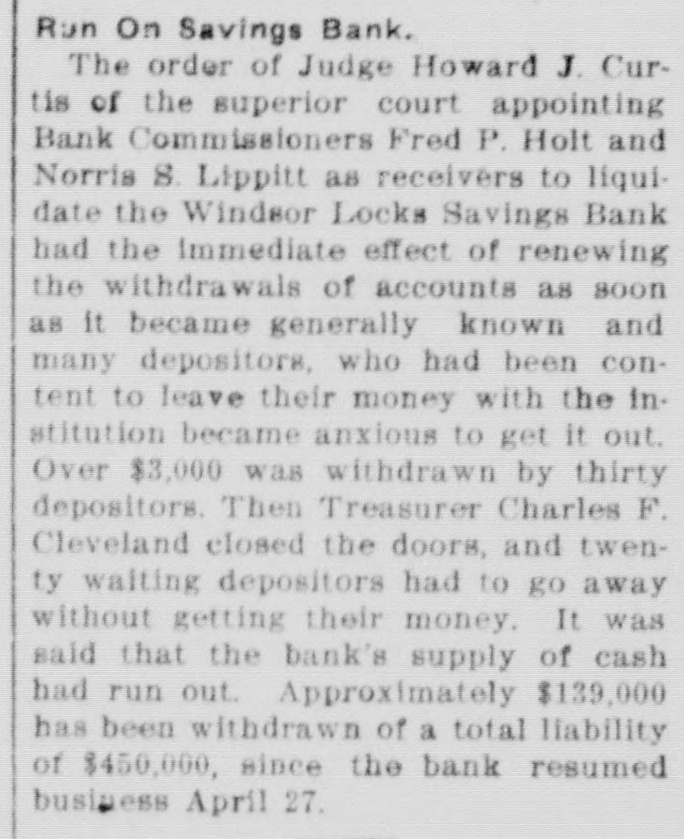
Run On Savings Bank
The order of Judge Howard J. Curtis of the superior court appointing Bank Commissioners Fred P. Holt and Norris 8. Lippitt as receivers to liquidate the Windsor Locks Savings Bank had the Immediate effect of renewing the withdrawals of accounts as soon as it became generally known and many depositors, who had been content to leave their money with the institution became anxious to get it out. Over $3,000 was withdrawn by thirty depositors. Then Treasurer Charles F. Cleveland closed the doors, and twenty waiting depositors had to go away without getting their money. It was said that the bank's supply of cash had run out. Approximately $139,000 has been withdrawn of a total liability of $450,000, since the bank resumed business April 27.
11.June 28, 1912Evening BulletinHonolulu, HI
Click image to open full size in new tab
Article Text
In the Superior Court at Hartford Judge Curtis issued an order appointing Norris S. Lippitt and Fred P. Holt receivers of the Windsor Locks Savings Bank,
12.November 18, 1912Norwich BulletinNorwich, CT
Click image to open full size in new tab
Article Text
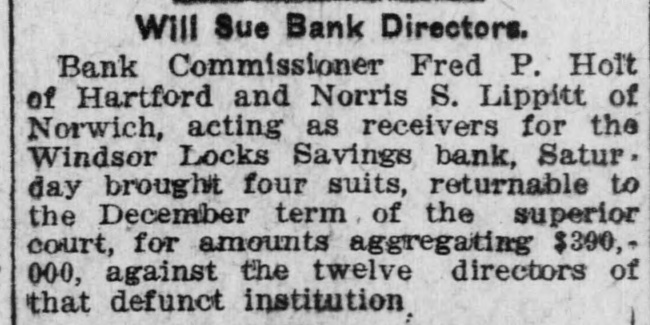
Will Sue Bank Directors
Bank Commissioner Fred P. Holt of Hartford and Norris S. Lippitt of Norwich, acting as receivers for the Windsor Locks Savings bank, Satur. day brought four suits, returnable to the December term. of the superior court, for amounts aggregating $390, 000, against the twelve directors of that defunct institution
13.November 22, 1912Norwich BulletinNorwich, CT
Click image to open full size in new tab
Article Text
Bank Commissioners Fred P
Holt and Norris S. Lippitt are at work signing 1900 checks for the 50 per cent. dividend to be paid depositors of the Windsor Locks Savings bank, now in their hands as receivers.
14.July 2, 1914The SunNew York, NY
Click image to open full size in new tab
Article Text
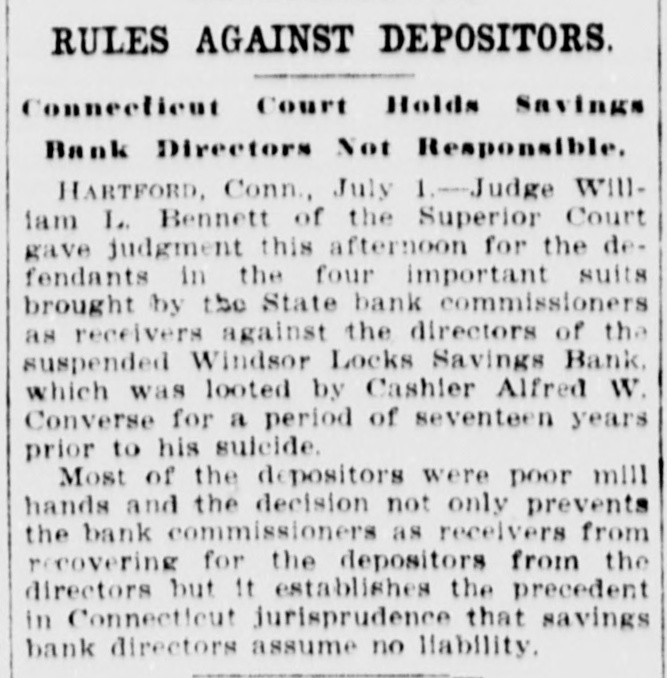
RULES AGAINST DEPOSITORS
Connecticut Court Holds Savings Bank Directors Not Responsible. HARTFORD, Conn., July 1.-Judge William L. Bennett of the Superior Court gave judgment this afternoon for the defendants in the four important suits brought by the State bank commissioners as receivers against the directors of the suspended Windsor Locks Savings Bank. which was looted by Cashier Alfred W. Converse for a period of seventeen years prior to his suicide. Most of the depositors were poor mill hands and the decision not only prevents the bank commissioners as receivers from recovering for the depositors from the directors but It establishes the precedent in Connecticut jurisprudence that savings bank directors assume no liability.
15.July 2, 1914Norwich BulletinNorwich, CT
Click image to open full size in new tab
Article Text
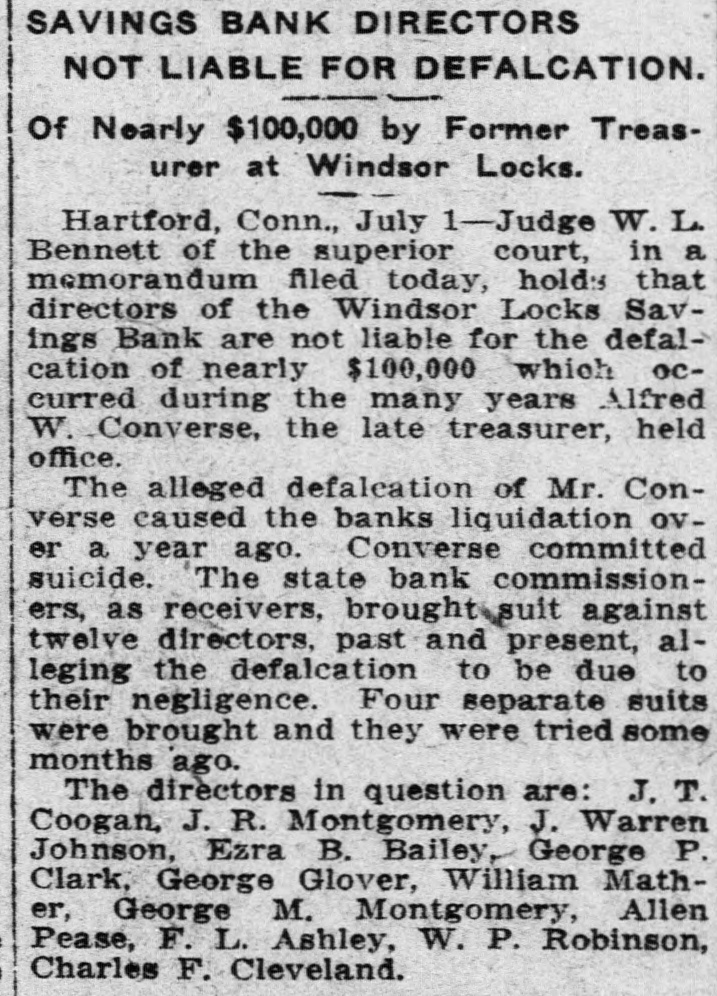
SAVINGS BANK DIRECTORS NOT LIABLE FOR DEFALCATION. Of Nearly $100,000 by Former Treasurer at Windsor Locks. Hartford, Conn., July 1-Judge W. L. Bennett of the superior court, in a memorandum filed today, holds that directors of the Windsor Locks Savings Bank are not liable for the defalcation of nearly $100,000 which occurred during the many years Alfred W. Converse, the late treasurer, held office. The alleged defalcation of Mr. Converse caused the banks liquidation OVer a year ago. Converse committed suicide. The state bank commissioners, as receivers, brought suit against twelve directors, past and present, alleging the defalcation to be due to their negligence. Four separate suits were brought and they were tried some months ago. The directors in question are: J. T. Coogan, J. R. Montgomery, J. Warren Johnson, Ezra B. Bailey, George P. Clark, George Glover, William Mather, George M. Montgomery, Allen Pease, F. L. Ashley, W. P. Robinson, Charles F. Cleveland.
16.November 9, 1914Norwich BulletinNorwich, CT
Click image to open full size in new tab
Article Text
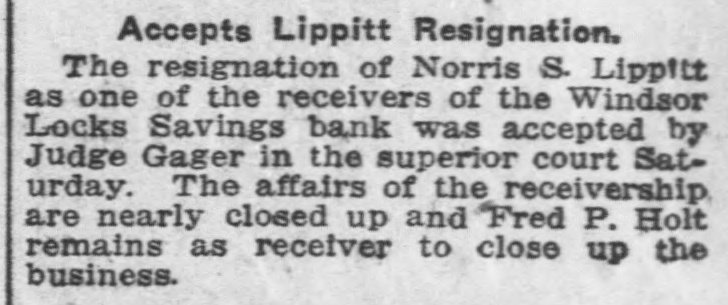
Accepts Lippitt Resignation
The resignation of Norris S. Lippitt as one of the receivers of the Windsor Locks Savings bank was accepted by Judge Gager in the superior court Saturday. The affairs of the receivership are nearly closed up and Fred P. Holt remains as receiver to close up the business.
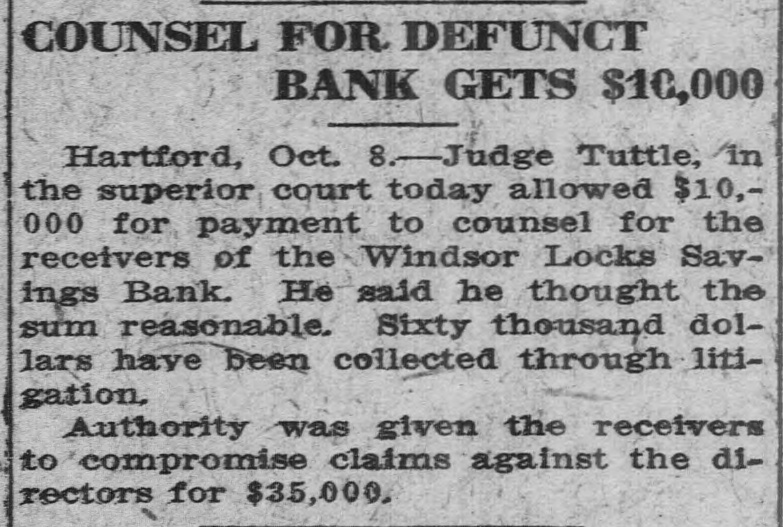
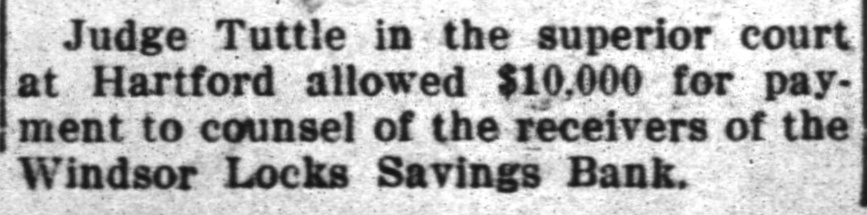
COUNSEL FOR DEFUNCT BANK GETS $10,000 Hartford, Oct. 8.-Judge Tuttle, in the superior court today allowed $10,000 for payment to counsel for the receivers of the Windsor Locks Savings Bank. He said he thought the sum reasonable. Sixty thousand dollars have been collected through litigation, Authority was given the receivers to compromise claims against the directors for $35,000.
18.October 9, 1915Norwich BulletinNorwich, CT
Click image to open full size in new tab
Article Text
Judge Tuttle in the superior court at Hartford allowed $10,000 for payment to counsel of the receivers of the Windsor Locks Savings bank.
19.November 5, 1915Honolulu Star-BulletinHonolulu, HI
Click image to open full size in new tab
Article Text
Judge Tuttle in the superior court at Hartford allowed $10,000 for payment to counsel of the receivers of the Windsor Locks Savings Bank.
Bank runs are almost always and everywhere a deterioration of bank fundamentals.
But not for you.
You are the measure-zero exception: great fundamentals, solid bank, and yet the Diamond Dybvig fairy spread its rumor. Depositors woke up. Your collateral was not prepositioned. The Clearinghouse had it for you.
Do not pass Go. Do not collect $200. Go directly to jail… or worse.
Flag Article for Review
Flag Episode for Review
Windsor Locks Savings Bank · Episode ID 51023771345