Bridgeport Bank (Bridgeport, NE)

Episode Information

Episode UID
5128398191505
Episode Type
Suspension → Closure
Bank Type
state
Bank ID
512839819 hash
Start Date
May 15, 1925
Location
Bridgeport, Nebraska (41.665, -103.099)

Metadata

Model
gemini-3-flash-preview (chosen from majority vote of a three-model LLM ensemble)
Short Digest
7958127e213dbfac

Response Measures

None

Description

The bank was taken over by the Guaranty Fund Commission in May 1925 due to insolvency and operated as a 'going concern' until final receivership in September 1927.

Events (3)

1. May 15, 1925 Suspension
Cause
Bank Specific Adverse Info
Cause Details
The bank was insolvent and lacked $100,000 of having sufficient funds to pay its liabilities.
Newspaper Excerpt
The guaranty fund commission took possession of the assets and business of the Bridgeport bank the 15th day of May, 1925
Source
newspapers
2. September 1, 1927* Other
Newspaper Excerpt
The Bridgeport State bank, that succeeded the old instituation, reports healthy growth.
Source
newspapers
3. September 8, 1927 Receivership
Newspaper Excerpt
J. A. Erickson was guaranty fund commission agent in charge of the bank when receiver was appointed on Sept. 8, 1927
Source
newspapers

Newspaper Articles (17)

Article from The Omaha Morning Bee, The Omaha Daily News, September 12, 1927

Click image to open full size in new tab

Article Text

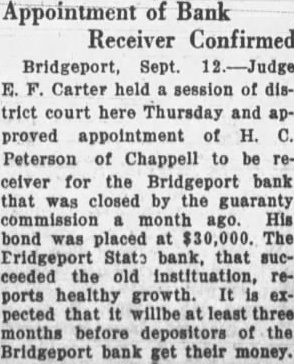
Appointment of Bank Receiver Confirmed Bridgeport, Sept. 12.-Judge E. F. Carter held session of district court here Thursday and approved appointment of H. C. Peterson of Chappell to be receiver for the Bridgeport bank that was closed by guaranty commission month ago. His bond was placed at $30,000. The Fridgeport State bank, that succeeded the old instituation, reports healthy growth. is expected that willbe at least three months before depositors of the Bridgeport bank get their money.


Article from The Omaha Evening Bee-News, January 30, 1929

Click image to open full size in new tab

Article Text

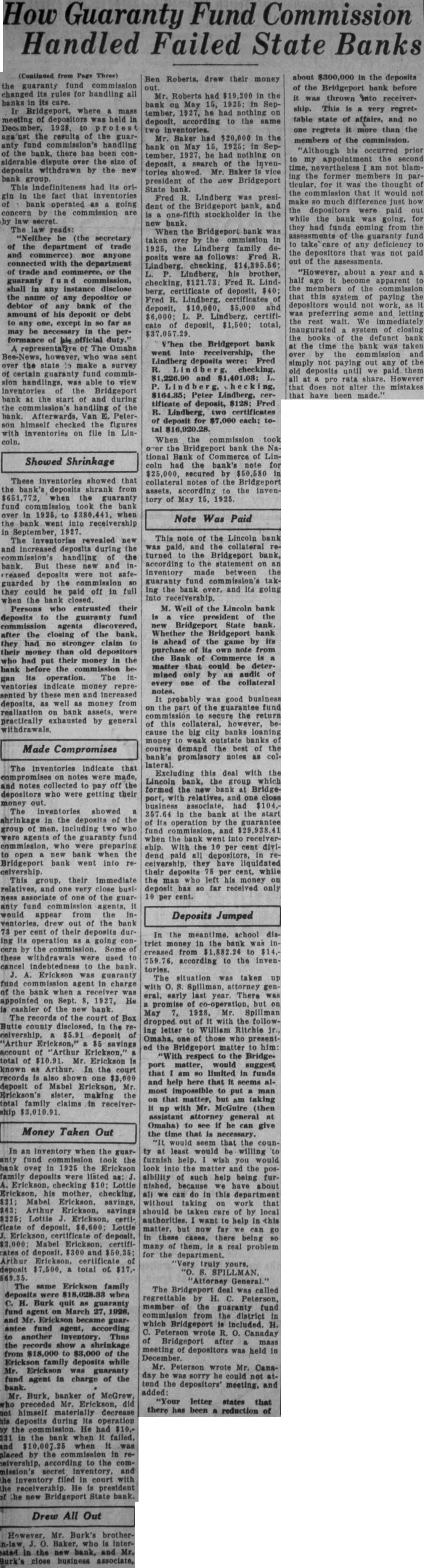
How Guaranty Fund Commission Handled Failed State Banks (Continued from Page Three) the guaranty fund commission changed its rules for handling all banks in its care. Ir Bridgeport, where a mass meeting of depositors was held in December, 1928, to against the results of the guaranty fund commission's handling of the bank, there has been considerable dispute over the size of deposits withdrawn by the new bank group This indefiniteness had its origin in the fact that inventories of bank operated as going concern by the commission are by law secret The law reads: "Neither he (the secretary of the department of trade and commerce) nor anyone connected with the department of trade and commerce, or the guaranty fund commission, shall in any instance disclose the name of any depositor or debtor of any bank of the amount of his deposit or debt to any one, except in so far as may be necessary in the performance of lake official duty.' A representative of The Omaha Bee-News, however, who was sent over the state to make survey of certain guaranty fund commission handlings, was able to view inventories of the Bridgeport bank at the start of and during the commission's handling of the bank. Afterwards, Van E. Peterson himself checked the figures with inventories on file in Lincoln. Showed Shrinkage These inventories showed that the bank's deposits shrank from $651,772. when the guaranty fund commission took the bank over in 1925, to $380,441. when the bank went into receivership in September, 1927. The inventories revealed new and increased deposits during the commission's handling of the bank. But these new and increased deposits were not safeguarded by the commission so they could be paid off in full when the bank closed. Persons who entrusted their deposits to the guaranty fund commission agents discovered, after the closing of the bank, they had no stronger claim to their money than old depositors who had put their money in the bank before the commission began its operation. The inventories indicate money represented by these men and increased deposits, as well as money from realization on bank assets, were practically exhausted by general withdrawals. Made Compromises The inventories indicate that compromises on notes were made, and notes collected to pay off the depositors who were getting their money out. The inventories showed shrinkage in the deposits of the group of men, including two who were agents of the guaranty fund commission, who were preparing to open new bank when the Bridgeport bank went into reThis group, their immediate relatives, and one very close business associate of one of the guaranty fund commission agents, It would appear from the inventories. drew out of the bank 73 per cent of their deposits during Its operation as a going concern by the commission. Some of these withdrawals were used to cancel indebtedness to the bank J. A. Erickson was guaranty fund commission agent in charge of the bank when receiver was appointed on Sept. 8, 1927, He is cashier of the new bank. The records of the court of Box Butte county disclosed, in the receivership, $5.91 deposit of "Arthur Erickson," $5 savings account of "Arthur Erickson, total of $10.91 Mr. Erickson is known as Arthur. In the court records is also shown one $3,000 deposit of Mabel Erickson, Mr. Erickson's sister. making the total family claims in receivership $3,010.91. Money Taken Out In an inventory when the guaranty fund commission took the bank over in 1925 the Erickson family deposits were listed as: A. Erickson, checking $10: Lottle $21; Mabel Erickson, savings, $63: Arthur Erickson, savings $225; Lottle J. Erickson, certificate of deposit, $6,600; Lottle J. Erickson, certificate of deposit, $3,000: Mabel Erickson, certificates of deposit. $300 and $50.35: Arthur Erickson. certificate of deposit $7,500. a total of $17,The same Erickson family deposits were $18,028.33 when C. H. Burk quit as guaranty fund agent on March 27, 1926, and Mr. Erickson became guarantee fund agent, according to another inventory. Thus the records show shrinkage from $18,000 to $3,000 of the Erickson family deposits while Mr. Erickson was guaranty fund agent in charge of the bank. Mr. Burk, banker of McGrew, who preceded Mr. Erickson, did not himself materially decrease his deposits during its operation by the commission. He had $10,231 in the bank when It failed, and $10,007.25 when It was placed by the commission in receivership, according to the commission's secret inventory, and the inventory filed in court with the receivership. He is president of the new Bridgeport State bank. Drew All Out However. Mr. Burk's brotherin-law. J. O. Baker, who is interested in the new bank, and Mr. Burk's close business associate, Ben Roberts. drew their money out. Mr. Roberts had $19,200 in the bank on May 15, 1925: in September, 1927, he had nothing on deposit, according to the same two inventories. Mr. Baker had $20,000 in the bank on May 15, 1925: in September, 1927, he had nothing on deposit, search of the inventories showed. Mr. Baker is vice president of the new Bridgeport State bank. Fred R. Lindberg was president of the Bridgeport bank, and is one-fifth stockholder in the new bank. When the Bridgeport bank was taken over by the ommission in 1925, the Lindberg family deposits were as follows: Fred R. Lindberg. checking, $14,395.56; L. Lindberg, his brother, checking, $121.73; Fred R. Lindberg, certificate of deposit, $40: Fred R. Lindberg, certificates of deposit, $10,000, $5,000 and $6,000; L. P. Lindberg. certificate of deposit, $1,500; total, $37,057.29. V'hen the Bridgeport bank went into receivership, the Lindberg deposits were: Fred R. checking, $1,226.90 and $1,401.03; L. P. k ng, $164.35; Peter Lindberg, certificate of deposit, $128: Fred R. Lindberg, two certificates of deposit for $7,000 each; total $16,920.28. When the commission took over the Bridgeport bank the National Bank of Commerce of Lincoln had the bank's note for $25,000, secured by $50,580 in collateral notes of the Bridgeport assets, according to the inventory of May 15, 1925. Note Was Paid This note of the Lincoln bank was paid, and the collateral returned to the Bridgeport bank, according to the statement on an inventory made between the guaranty fund commission's taking the bank over, and its going into receivership. M. Well of the Lincoln bank is vice president of the new Bridgeport State bank. Whether the Bridgeport bank is ahead of the game by its purchase of Its own note from the Bank of Commerce is matter that could be determined only by an audit of every one of the collateral notes. It probably was good business on the part of the guarantee fund commission to secure the return of this collateral, however. because the big city banks loaning money weak outstate banks of course demand the best of the bank's promissory notes as colExcluding this deal with the Lincoln bank, the group which formed the new bank at Bridgeport, with relatives, and one close business associate, had $104,357 in the bank at the start of its operation by the guarantee fund commission. and $29,938.41 when the bank went into receivership. With the 10 per cent dividend paid all depositors, in receivership, they have liquidated their deposits 75 per cent, while the man who left his money on deposit has so far received only 10 per cent. Deposits Jumped In the meantime. school district money in the bank was increased from $1,882 to $14,759.76, according to the inventories. The situation was taken up with o. S. Spillman, attorney general. early last year. There was promise of co-operation, but on May 7. 1928, Mr. Spillman dropped. out of It with the following letter to William Ritchie jr., Omaha, one of those who presented the Bridgeport matter to him: "With respect to the Bridgeport matter, would suggest that am so limited in funds and help here that It. seems almost impossible to put man on that matter, but am taking If up with Mr. McGuire (then assistant attorney general at Omaha) to see If he can give the time that is necessary. "It would seem that the county at least would be willing to furnish help. wish you would look into the matter and the possibility of such help being furnished, because we have about all we can do in this department without taking on work that should be taken care of by local authorities. want to help in this matter. but now far we can go in these cases, there being so many of them, is a real problem for the department. 'Very truly yours. 'Attorney General.' The Bridgeport deal was called regrettable by H. C. Peterson, member of the guaranty fund commission from the district in which Bridgeport is included. H. C. Peterson wrote R. O. Canaday of Bridgeport after a mass meeting of depositors was held in December. Mr. Peterson wrote Mr. Canaday he was sorry he could not attend the depositors' meeting. and added: "Your letter states that there has been a reduction of about $300,000 in the deposits of the Bridgeport bank before it. was thrown Into receivership. This is a very regrettable state of affairs, and no one regrets it more than the members of the commission. "Although his occurred prior to my appointment the second time, nevertheless am not blaming the former in particular, for it was the thought of the that it would not make so much difference just how the depositors were paid out while the bank was going. for they had funds coming from the of the guaranty fund to take care of any deficiency to the depositors that was not paid out of the assessments. "However, about year and a half ago it become apparent to the members of the commission that this system of paying the depositors would not work, as It was preferring some and letting the rest wait. We immediately inaugurated system of closing the books of the defunct bank at the time the bank was taken over by the commission and simply not paying out any of the old deposits until we paid them all at pro rata share. However that does not alter the mistakes that have been made.'


Article from The Lincoln Star, September 12, 1929

Click image to open full size in new tab

Article Text

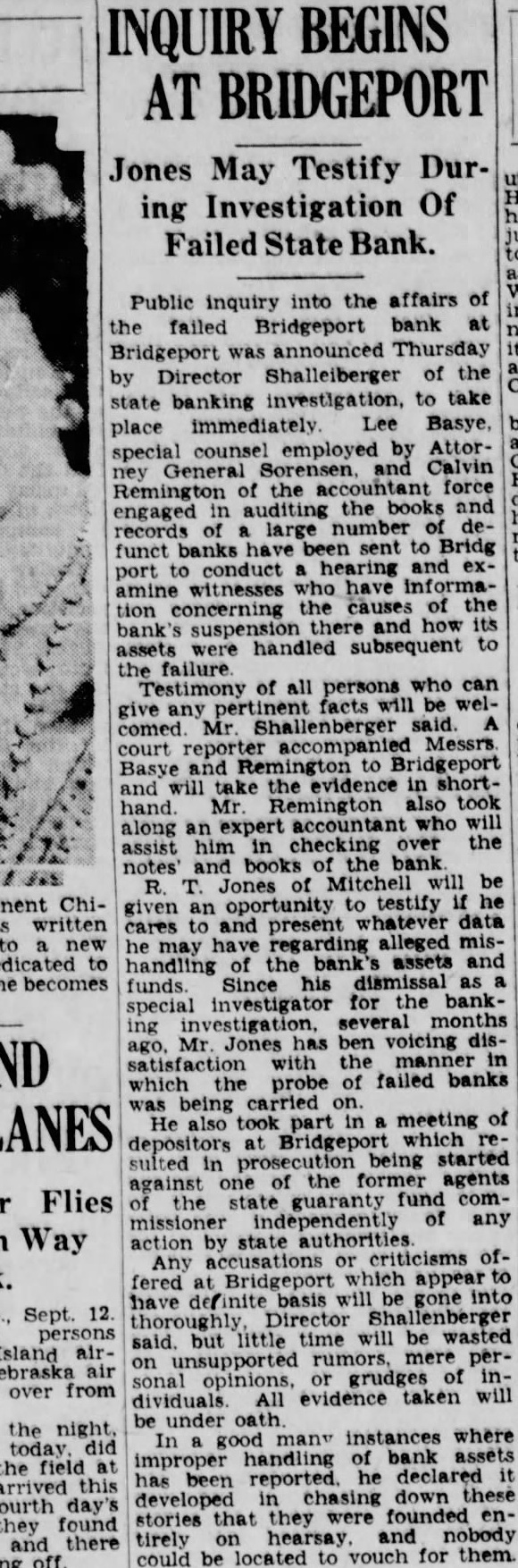
INQUIRY BEGINS AT BRIDGEPORT Jones May Testify During Of Failed State Bank. Public inquiry into the affairs of the failed Bridgeport bank at Bridgeport announced Thursday by Director Shalleiberger of the state banking investigation, to take immediately Lee Basye, place special counsel employed by AttorGeneral Sorensen. Calvin Remington of the accountant force engaged in auditing the books and records of large number defunct banks been sent to Bridg port conduct hearing and amine witnesses have tion concerning the causes of the there and how its assets were handled subsequent the failure Testimony of all persons who can facts will be welgive any pertinent comed Mr. Messrs court reporter Basye and Remington to Bridgeport and will take the evidence in shortRemington also took along an expert accountant who him checking over assist notes and books of the bank Mitchell be Jones of Chi- given an to testify written cares and present whatever data he may regarding alleged mishandling the bank's assets and funds. Since his dismissal for the bankspecial investigator several months ing Mr Jones has ben voicing disago, with the manner in satisfaction of failed banks which probe was being carried on. meeting of He also took part in depositors at Bridgeport being started sulted against of the former agents the state fund commissioner independently of any action state authorities Any accusations criticisms of fered Bridgeport which appear basis will gone into have Director Shallenberger thoroughly little time will be wasted said. unsupported rumors, mere peron grudges insonal opinions, evidence taken will dividuals All be under many instances where In good handling bank assets improper he declared has chasing down these developed stories that they were founded entirely hearsay and nobody could be located to vouch for them


Article Text

DEMURRER IN BANK SUIT TURNED DOWN BY DISTRICT COURT Judge Carter Holds Officials and Former Officials of Bank to Trial District Judge E. F. Carter Wednesday overruled demurrers Morrill county district court at Bridgeport presented by counsel for defendants in the case of the county of Morrill against former bank officials of the defunct Bridgeport Bank, the receiver, guaranty fund, officers and others. The action, asks for an accounting for alleged irregularities in which it is declared that illegal preferences resulted in the loss of approximately $300,000 to depositors. Defense lawyers alleged in their demurrers that there was no liability on the defendants because they were public officers but Judge Carter held that since conspiracy, fraud and bad faith was alleged the demurrers could not be upheld. The case is entitled county of Morrill, plaintiff, vs. Clarence G. Bliss, Henry C. Peterson, receiver of the Bridgeport bank, Kirk Griggs, I. W. Rogers, Fay C. Hill, I. A. Kirk, R. O. Brownell, George I. Parker, Charles H. Burk, John Erickson, Morris A. Weil, Fred Lindberg, National Bank of Commerce of Lincoln, J. O. Baker, Ben F. Roberts, American Surety company of New York and Fidelity and Deposit company of Maryland. The county alleges that it had deposited in the bank $58,223.71 on Sept. 8, 1927, when the bank was closed, after having been operated for about two years by the guaranty fund commission, and that the amount had been designated in court as a preferred claim. However, the petition states, because of the fact that the assets of the bank were placed in the hands of officers and agents of the guaranty fund commission and the receiver, Henry C. Peterson, they became depleted and exhausted in excess of $300,000. Had the sum been properly conserved and legally administered, it would have been available to the discharge of the indebtedness of the bank to the county and all other depositors and creditors, in whose name the county brought the action, it was stated. The petition states that the bank was operated by the commission long after it was insolvent and that the officers knew that it was not a going concern. It alleges that certain officers in charge of the institution fraudulently conspired among themselves to unlawfully prefer certain creditors and depositors and to prefer certain debtors by accepting in saticfaction of debt less money than was due from debtors. They conspired to favor certain of the defendants in the sale of assets for less than actual value and incurred unnecessary expense by continuing the operation of the bank after they knew it was insolvent and should have been reported. Prior to May, 1925, before the bank was taken over by the guaranty fund commission, it is asserted that the officers knowingly permitted to be made loans in excess of 20 per cent of the capital and surplus, and that the officers thereby became personally liable for all losses accountable to the loans, estimated at $60,000. The county asks for an accounting and that court determine the amount of liability of each defendant. Mr. and Mrs. Howard Deal and Miss Fay Deal spent a few days in Denver last week. Mrs. Imo Sillivan underwent an operation for ruptured appendix at the Methodist hospital in Scottsbluff Saturday. Mr. and Mrs. F. Scott Puliver, accompanied by Miss Ona Atkins and Keg Viereg, of Gering, motored to Alliance Sunday. Mr. and Mrs. J. L. Loewenstein will go to Denver Saturday for a few days visit with their daughter, Miss Lillian Loewenstein. Mrs. Mary Peters returned to Scottsbluff Monday after spending a few days here the guest of her daughter, Mrs. Eva Gross. Mr. and Mrs. Loren G. Cushatt had as their guests Sunday the latter's uncle and aunt, Mr. and Mrs. F. R. Conrad, of Minatare. Mrs. R. A. Wisner and Mrs. Mac Halley motored to Alliance Tuesday for a short visit at the home of the former's niece, Mrs. Clay Hulett. Mrs. Joe Mihan returned to her home at Lyman Tuesday after spending a few days here the guestof her sister, Mrs. A. M. Johnston. Mrs, Harry V. Towner was hostess to the members of her bridge club and guests on Wednesday afternoon of last week. Mrs. H. Myers of Minatare, tallied high and Mrs. Ginn received the guest prize. The out-of-club guests were Mrs. A. M. Ginn and Mrs. F. Scott Puliver. Mr. and Mrs. C. H. Ninegar returned Sunday from Aurora where they went last week to attend the funeral of Mrs. Ninegar's uncle, T. E. Williams, who passed away Monday, January 5. They were accompanied on the trip by Mrs. O. J. Hochstettler who visited her parents, Mr. and Mrs. J. M. Beard, at Aurora, and by Mrs. Geo. E. Mason, who visited her father and sister, F. G. Swanson and Mrs. I. F. Backencamp, at Bertrand.


Article Text

DEMURRER IN BANK SUIT TURNED DOWN BY DIST. COURT District Judge E. F. Carter Wednesday overruled demurrers in Morrill county district court at Bridgeport presented by counsel for defendants in the case of the county of Morrill against former bank officials of the defunct Bridgeport bank, the (receiver, guaranty fund officers and others. The action, asks for an accounting for alleged irregularities in which it is declared that illegal preferences resulted in the loss of approximately $300,000 to depositors. Defense lawyers alleged in their demurrers that there was no liability on the defendants because they were public officers but Judge Carter held that since conspiracy, fraud and bad faith was alleged the demurrers could not be united. The case is entitled county of Morrill plaintiff, vs. Clarence G. Bliss, Henry C. Peterson. receiver of the Bridgeport bank, Kirk Griggs, I. W. Rogers, Fay C. Hill. I A. Kirk, Reg O. Brownell, George I. Parker. Charles H. Burk, John A. Erickson, Morris A. Well, Fred Lindberg, National Bank of Commerce of Lincoln, J. O. Baker, Ben F. Roberts. American Surety company of New York and Fidelity and Deposit company of Maryland. The county alleges that it had deposited in the bank $59,223.71 on Sept. 8, 1927. when the bank was closed, after having been operated for about two years by the guaranty fund commission and that the amount had been designated in court as a preferred claim. However, the petition states, because of the fact that the assets of the bank were placed in the hands of officers and agents of the guarantee fund commission and the receiver. Henry C. Peterson, they became depleted and exhausted in excess of $300,000. Had the sum been properly conserved and legally administered, it would have been available to the discharge of the Indebtedness of the bank to the county and all other depositors and creditors, in whose name the county brought the action, it was stated. The petition states that the bank was operated by the commission long after it was insolvent and that the officers knew that it was not a goselves to unlawfully prefer certain debtors by accepting in satisfaction of debt less money than was due from debtors. Prior to May, 1925, before the bank was taken over by the guaranty fund commission, it is asserted that the officers knowingly permitted to be made loans in excess of 20 per cent of the capital and surplus, and that the officers thereby became personally IIable for all losses accountable to the loans, estimated at $60,000. The county asks for an accounting and that the court determine the


Article Text

DEMURRER IN BANK SUIT TURNED DOWN BY DIST. COURT District Judge Carter last week overruled demurrers in Morrill county district court at Bridgeport presented by counsel for defendants in the case of the county of Morrill against former bank officials of the defunct Bridgeport bank, the receiver, guaranty fund officers and others. The action asked for an accounting for alleged irregularities in which declared that illegal preferences resulted in the of approximateto depositors. Defense lawyers alleged in their demurrers that there was no liability on the defendants because they were public officers but Judge Carter held that since conspiracy, fraud and bad faith was alleged the demurrers could not be united. The case is entitled county of rill plaintiff, VS. Clarence G. Bliss, Henry C. Peterson, receiver of the Bridgeport bank, Kirk Griggs, Rogers, Fay Hill, Kirk, Brownell, George Parker, Charles Burk, John A. Erickson, Morris Weil, Fred Lindberg, National Bank of Commerce of Lincoln, Baker, Ben Roberts, American Surety company of New York and Fidelity and Deposit company of Maryland. The county alleges that it had posited in the bank, on Sept. 8, 1927, when the bank was closed, after having been operated for about two years by the guaranty fund commission and that the amount had been designated in court preferred claim. However, the tion states, because of the fact that the assets of the bank were placed in the hands of officers and agents of the guarantee fund commission and the receiver, Henry C. Peterson, they became depleted and exhausted in of $300,000. Had the excess been properly conserved and legally administered, it would have been available to the discharge of the debtedness of the bank to the and all other depositors and itors, in whose name the county brought the action, it was stated. The petition states that the bank was operated by the commission long after was insolvent and that the officers knew that it was not It alleges that certain concern. officers in charge of the institution fraudulently conspired among themselves to unlawfully prefer certain debtors by accepting in satisfaction of debt less money than was due from debtors. They conspired to favor certain of the defendants in the sale of assets for less than actual value and curred unnecessary expense by continuing the operation of the bank after they knew it was insolvent and should have been reported. Prior to May, 1925, before the bank was taken over by the guaranty fund commission, it is asserted that the officers knowingly permitted be made loans in excess of 20 per cent of the capital and surplus, and that the officers thereby became sonally liable for all losses accountable to the loans, estimated at


Article Text

Luikhart Files Suit To Oust Torgeson as Failed More fireworks broke out this week in the defunct bank situation in westNebraska, when word was received that E. H. Luikart and Gov. Bryan were filing suit to have Torgeson removed as receiver eleven failed banks in western Nebraska. Torgeson was appointed by Judge E. Carter some time ago. The Governor charges that Torgeson has received more pay than any other bank receiver, and that such excess salary must come out of the depositors' share of recovered funds in failed banks. further declared that banks in of the state would not pay out percent under Torgeson. Mr. Torgeson states that he will be glad to have an investigation of his management of failed banks. He cites several instances where banks he has handled have paid out considerably more than that, as follows Irrigators, Scottsbluff, 57 per cent; American State, Scottsbluff, 58.25; American bank, Mitchell, 50; Bank Bayard, Bayard, 50; Nebraska State, Bridgeport, 55.9; Mitchell State, Mitchell, 35.5; Lyman, 17; State Bank. of Minatare, Minatare, Bridgeport bank, Bridgeport, 16 per cent.


Article Text

RECEIVER OPENS SUIT E. E. Torgenson Asks $98,000 From J. Whitehead of Mitchell. SCOTTSBLUFF. Torgeson, receiver for the Mitchell State bank, started suit in district court here Friday against Whitehead, former president, for Torgeson alleged that as the person actual charge declared solvent, Whitehead made unsecured loans to persons he knew were insolvent and that made loans in excess of the legal limit. Torgeson totaled these loans and that except for $5,000 already paid they are worthless. petition has been forwarded by Torgeson also to the district court at Lincoln asking $29,000 from the state department trade commerce on behalf the defunct Bridgeport bank. The amount represents assessments made during two year period when the institution was operated by the guaranty fund commission and proceeds which were placed in the bankers' conservation fund.


Article Text

DEPARTMENT TRADE AND COMMERCE SUED Bridgeport Bank Receiver Asks $29,755.14 Collected From Bank Be Returned. Suit against the state department of trade and for $29,755.14 filed in district court Monday E. Torgeson, receiver of the Bridgeport bank of Bridgeport, Neb., which failed and was taken over by the Guaranty Fund commission in May, 1925. It is alleged by Mr. Torgeson that collected for the guaranty fund amounting to 355. from May 16, 1925 July 11, 1927 illegally while bank was being operated by commission. alleged $22,000 was taken to pay the bankers fund, the sale of the building, fixtures, etc., and that this act was The petition states that in May, 1925, the bank was insolvent and lacked $100,000 of having sufficient funds to pay its liabilities was taken by the commission which the bank. It is claimed that as the bank was insolvent and operated by the commission it could not legally made to pay The money sought, it is claimed, was put into the depositors final settlement fund when the legislature passed the law March 18, 1930. The suit was filed by Attorney T. F. Neighbors of Scottsbluff and Butler James of Cambridge.


Article Text

Referee—Pressley, Omaha. BANK RECEIVER OPENS SUIT Scottsbluff—A. E. Torgeson, receiver for the Mitchell State bank, started suit in district court here Friday against J. T. Whitehead, former president, for $98,739. Torgeson alleged that as the person in actual charge of the bank before it was declared insolvent, Whitehead made unsecured loans to persons he knew were insolvent and that he made loans in excess of the legal limit. Torgeson totaled these loans at $193,739 and said that except for $5,000 already paid they are worthless. A petition has been forwarded by Torgeson also to the district court at Lincoln asking $29,000 from the state department of trade and commerce on behalf of the defunct Bridgeport bank. The amount represents assessments made during a two year period when the institution was operated by the guaranty fund commission and proceeds which were placed in the bankers' conservation fund.


Article Text

Bridgeport Bank Receiver Asks $29,755.14 Collected From Bank Be Returned. Suit against the state department of trade and commerce for $29,755.14 was filed in district court Monday by A. E. Torgeson, receiver of the Bridgeport bank of Bridgeport, Neb., which failed and was taken over by the Guaranty Fund commission in May, 1925. It is alleged by Mr. Torgeson that assessments were collected for the guaranty fund amounting to $7,355.14 from May 16, 1925 to July 11, 1927 illegally while the bank was being operated by the commission. It is also alleged that $22,000 was taken to pay the bankers conservation fund, from the sale of the bank building, fixtures, etc., and that this act was illegal. The petition states that in May, 1925, the bank was insolvent and lacked $100,000 of having sufficient funds to pay its liabilities and was taken over by the commission which re-opened the bank. It is claimed that as the bank was insolvent and operated by the commission it could not legally be made to pay such assessments. The money sought, it is claimed, was put into the depositors final settlement fund when the legislature passed the law March 18, 1930. The suit was filed by Attorney T. F. Neighbors of Scottsbluff and Butler James of Cambridge.


Article Text

DEPARTMENT TRADE AND COMMERCE Bridgeport Bank Receiver Asks $29,755.14 Collected From Bank Returned. Suit against the state department trade commerce for $29,755.14 was filed in district court Monday E. Torgeson, receiver the Bridgeport bank of Bridgeport, Neb., which failed and was taken over by the Guaranty Fund commission May, 1925. alleged by Mr. Torgeson that assessments were collected for the guaranty fund amounting from May 16, 1925 July 11, 1927 illegally while bank was being operated by the commission. also alleged that $22,000 taken to pay the bankers fund, from the of the fixtures, etc., and that this was illegal. The petition states that in May, 1925, the bank was insolvent and lacked of having sufficient funds to pay liabilities and was taken over by the commission which the bank. is claimed that as the bank was insolvent and by the commission could not legally be made pay such The money sought, it is claimed, was put into the depositors final settlement fund when the legislature passed the law March 1930. The suit was filed by Attorney Neighbors of Scottsbluff and Butler James of Cambridge


Article Text

RECEIVER OF BRIDGEPORT STITUTION BRINGS SUIT DISTRICT COURT Lincoln, Feb. right the state assess ments against bank while insolvent. being operated the guaranty fund commission argued here today. Torgeson, receiver for Bridgeport bank, brought action district asking for from trade and which the state demurred heard today The taken under Torgeson contended the state legally for the guaranty fund after the bank insolvent asked return the $7,355 collected. The mainder the for state deposit in the bank withdrawn while the guaranty fund commission operated the bank. Atty Gen. Paul who fended the state's demurrer, today said the claims by the statute limitations. He held the actions legal. The suit brought in the interof depositors the failed bank.


Article Text

COUNTY SEEKS TRIAL Claims Guaranty Fund missioners Are Liable Morrill filed an The county of with the supreme court appeal refusal the disTuesday from court grant its recover deposit Bridgeport failed. suit against members the guaranty and brought the theory no operate bank power new the posits and for appeal the original action supreme court. the will consolidated. motion that the the the county did know for several the defendants also attorney for advised the had legal right to operate the bank duty maintain status whereas decision in their based upon their claims good that they acted on the advice counsel. from Skiles filed defendants resisted the quest for trial, cited the to the effect that court decision they correctly followed the was breach privilege as witness after for Skiles had some the defendants the trial. and that an attorney's private opinion as does not determine its validity.


Article Text

MOVE FOR REHEARING IS OVERRULED BY HIGH COURT The state supreme court Wednesday ruled against rehearing of the case instituted by Morrill county and depositors of the failed Bridgeport bank against members of the old bank guaranty fund commission. The plaintiffs sought to hold the commission members individually responsible for losses sustained through operation of the bank by the commission. In this decision the supreme court thereby stood by its recent ruling that commission members could not be held liable for operation of the bank. In asking for a rehearing, attorneys for Morrill county déclared that "never in the history of public administration of the affairs of poor people in the guise C2 paternalistic protection of the state has there been a greater abuse of power and privilege than is exhibited in the features of this case. They contended that there had been discrimination between depositors durIng operation of the bank as a going concern before it closed.


Article Text

(SYLLABUS) Suit for accounting brought by depositor on behalf of himself and all depositors of insolvent state bank against receiver, officers, and members of guaranty fund commission and secretary of department of trade and commerce, is proceeding in connection with insolvency, liquidation, or reorganization of bank, and, such, district judge has jurisdiction at chambers to perform acts with same effect as in open court. Comp. St. 1929, sec. 8-191. Statute not repealed by implication unless repugnance is plain and unavoidable. 3. All statutes relating to same subject are considered as parts homogeneous system and later utes are considered supplementary to preceding enactments on same subject. Statutes relating to subject, although enacted at different times, are IN PARI and should be construed together. Plaintiff who seeks of judgment term at which was rendered must allege and prove that he has valid cause of action; and to entitle him to relief court must judge that such cause of action FACIE valid. Where trial court after term vacates judgment against plaintiff and immediately reenters same judgment on the same record. there no adjudication that plaintiff cause action that valid. The legislature having power to limit the time within which appeal must be taken, essential to the jurisdiction of this court that be taken within that time limit. Trial court has no inherent power. directly or indirectly, to tend time for taking appeal. 9. Where statutes provide that an appeal must be perfected by filing transcript in supreme court, which must contain certificate that cost bond has been given, trial court has to extend time indirectly by vacating decree after term and entering the same judgment. Comp. 1929, 10. Members of guaranty fund commission were public officers vestwith quasi judicial functions quiring judgment and discretion. Laws 1925, 11. an officer is invested with discretion and is empowered exercise his judgment in matters brought before him, he is sometimes called quasi judicial officer, and when so acting he is usually given immunity from liability to persons who may be injured as the result an erroneous decision, provided the acts complained of done within the scope of the officer's authority. and without wilfulness, malice, corruption." 485, sec. Heard before Goss, Rose, Dean, Good, Eberly, Day and DAY, This suit for an accounting brought by Morrill county as depositor of the Bridgeport bank, its behalf and on behalf of all other depositors similarly situated, against the members and agents of the guaranty fund commission of the state Nebraska. The guaranty fund mission took possession of the assets and business of the Bridgeport bank the 15th day of May, 1925, and it concern until the going 8th of September, 1927, during which period deposits solicited and loans made, the accepted, bank's paper was discounted, deposits withdrawn, and all the functions of bank were performed. It leged by the plaintiff that, while the bank was so operated, large amount of deposits were withdrawn, unlawful preference between depositors, the amount of which is unknown to plaintiff and only ascertainable by an accounting. The plaintiff alleges that, during this perof operation by the guaranty fund commission, certain permitted, and which moneys, were fact loans and therefore general claims, were withdrawn, and that the bank was, in fact, unlawfully liquidated while unlawfully operated as going concern. The gist of the action pleaded by plaintiff is in the petition as follows: by reason of the foregoing facts the assets of said bank placed in charge of the defendants who were members, officers and agents of the guaranty commission have become and depleted in in excess of which sum, had said assets been properly and legally administered, would have been available to the discharge of the indebtedness of said bank to this plaintiff and all other depositors and creditors ilarly situated." The trial court found in favor of defendants and entered decree in conformity to its finding, from. which appeals. This is the second appeal filed in this case. The first appeal was taken from decree entered February 1932, and motion for new trial, filed within three days, was overruled May 1932. Defendants filed motion to dismiss this appeal for that no cost bond had been filed and no cash deposit to cover costs or supersedeas bond had been filed as required by section Comp. St. 1929. appearing from the transcript that cost bond had been filed within days from the final order, as providby statute, in conformity to the rule announced by this court in Greb Hansen, Neb. 426, the former appeal was dismissed September 26, 1932, for lack of jurisdiction. On August 29, 1932, during the 1932, term of court, the trial judge in Morrill county, not at the county seat but at Bayard, set aside the order of May 1932, overruling motion for new trial, and the motion was submitted to him and overruled. Later, September 14, 1932, the court at Bridgeport, the county seat of Morrill county, again set aside the order of May 1932, overruling the motion for new trial and, on consideration, the motion was again overruled. on September 1932, the plaintiff's attorneys claim they learned for the first time that the decree of February 1932, had been signed by the trial judge at chambers in Gering, Scotts Bluff county, and was sent to the clerk of the district court at Bridgeport, who entered it on the journal, showing that had been signed by the judge at chambers at Gering, Nebraska. At that time plaintiff filed motion that the decree of February 1932, be held to be void and be set aside on the sole ground that the decree was signed by the trial judge at chambers in Gering, Nebraska, stead of in open court at Bridgeport, Nebraska, and that the motion for new trial with drawn and all orders relative thereto be expunged from the record. October regular day of the May term, the court sustained the motion and reentered the same decree, and overruled plaintiff's motion for trial, filed the same day. This appeal was taken from the decree and order overruling motion for new trial entered October 1932. The appellees, except Bliss, filed motion in this court to dismiss this second appeal for that the transcript was not filed in this court within three months from the rendition of final judgment; that it is an appeal from judgment entered October 1932, which decree is identical with dated February 1932, except the date, from which an appeal was dismissed, and that the reentry of the judgment on October 1932, was for the sole purpose of extending the statutory time perfecting an appeal to this court. This motion to miss the appeal was argued before this court and ruling thereon reserved until the case was submitted upon the merits. demands consideration first. As heretofore noted, the original decree in this was signby the trial judge at chambers at Gering, Scotts Bluff and county, transmitted to the clerk of the trict court for Morrill Did county. this render the decree The judges of the various district courts, have no inherent authority chambers except such they are expressly given by law. The stitution provides: several of the courts of record shall have such jurisdiction at chambers be provided by law. "Const. 23. By section Comp. St. 1929, the legislature has conferred certain powers upon district judges at chainbers, which section however did not authorize the act of the trial judge in signing the decree in this case. However, section Comp. St. 1929, specifically provides that, in such this, judge the district at chambers shall have jurisdiction to perform certain judicial acts. This is suit for an accounting brought by the plaintiff on behalf himself and depositors of the defunct Bridgeport bank to cover alleged losses of the bank while run by the guaranty fund commission. This money, if recovered, would have to be distributed among the depositors of said bank. The receiver party to this action. involves the of this bank from the when it covered to be and, such, within the statute. Section 191, Comp. St. 1929, provides as lows: any proceeding in tion with the insolvency, liquidation reorganization of bank, of the district court shall have jurisdiction in county in the any district for which he elected to perform any official act in the ner and with the same effect he might the county in which the matter arose, or to which it may have been transferred, and he may perform any such act in chambers with the same effect in open In this connection, see State Neligh State Bank, 116 Neb. 858, This suit is proceedin connection with the insolvency. liquidation, or reorganization of bank, and, as such, jurisdiction was conferred by the statute the upon district judge at chambers to perform official acts in the manner and with the same effect he might in the counin which it arose. But the appellant argues if the legislature by the enactment of section Comp. 1929, intended to amend section Comp. St. 1929, then such enactment would be unconstitutional, because the title of the act was not broad enough to clude such amendment. However, section Comp. St. 1929, not amendatory of section 27-317, Comp. St. 1929, but an independent act which confers jurisdiction upon judges of district courts at chambers addition to others under the stitutional provision heretofore quoted. This court has definitely passed upon this question pears as section Comp. 1929, relating to the confirmation of judicial sale, amended in 1875 adding proviso that the judge the district court might confirm mortgage foreclosure sale under certain conditions at vacation. Laws 1875, 38. In this court was required to decide whether this tute authorizing the confirmation of sales in vacation was repealed by the passage of what is section Comp. St. 1929, without later which took effect March 1879. The argument of Judge Maxwell so aptly meets the contention of the appellant that we quote with the ommission of supporting authorities. is evident, however, that there no repugnancy between the several provisions. statute will not be pealed by implication unless the pugnancy between the new provision and the former statute is plain and unavoidable. In this there case, no repugnancy between the statutes, and the earlier one is not pealed by the Lawson Gib18 Neb. 137. To the same effect Beatrice Paper Beloit Iron Works, 46 Neb. Applying the rule to this case and paraphrasing the language, section 8-191, Comp. 1929, does not amend section Comp. St. 1929, by implication otherwise, because the provisions not repugnant, and they must be construed together. Statutes relating to the subject, although enacted different times, are in pari and should be construed together. State Omaha Elevator Co., Neb. 637; 25 1067, Lewis' Sutherland, Statutory Construction, 844, gives the rule: tutes which are not inconsistent with one another, and which relate to the same in pari teria, and should be construed gether; and effect should be given them all, although they contain reference to one another, and passed at different times. Acts pari materia should be construed gether and so as to harmonize and give effect to their various proviRohrer Hastings Brewing 83 Neb. 111; Board of Commissioners Aetna Life Insurance Fed. 222; State Gerhardt, 439; Scarangello Pacione. 126 Supp. 714; Village of North Fargo City of Fargo, Dak statute will not be construed lier statute, unless there plain and unavoidable repugnance. State Omaha Elevator Co., 75 Neb. held: statutes the upon general subject are to be regarded of one and later part system, tutes are to be considered supplementary or complementary to those preceding them on the same Section Comp. St. 1929, an independent and deals with the same general subject as section Comp. 1929, and is not amendatory but and complementary to it. It therefore follows that, since the trial judge was authorized by statute the decree in the case sign at bar at chambers, said decree tered February 1932, was valid Now, the vacation of the decree on October 1932, was solely the ground that, since rendered and signed at chambers, null void. valid judgment can only be vacated after the it was rendered on the application of plaintiff after adjudged that there is valid cause of action. Comp St. 1929, sec. 20-2005. is ficient that the petition state cause, contended by appellant, but applicant must allege and prove valid cause of action. Bond Wycoff, Neb. And in Gilbert Marrow, Neb. held: party who seeks the vacation of judgment after the term at which it was rendered must allege and prove that he has valid cause of action or defense, and to entitle him to lief the court must adjudge that such cause of action or defense is prima facie valid." But there was no such adjudication in this case. The trial court erroneously found the decree pull and void for that it was signed at chambers in another county. was after the term at which rendered. The same judgment was forthwith, without further testimony, immediately reentered, the same cree with the exception that the date was changed. It is obvious from the history of this case that the purpose in vacating the original decree and reentering the same decree was to extend the time for perfecting an appeal. The legislature has general power to fix the time limit for taking an appeal and having prescribed such time, the trial court has no power extend the time directly or indirectly. In 104, it is said: legislature has general power to prescribe the time within which writs of error may be sued out or appeals taken, and it essential to the jurisdiction of the appellate court that the proceeding be taken within the time limited, and the trial court has no inherent power to extend the time, either directly or indirectly. Thus, where an appeal has not been taken within the required time, the court has no power indirectly to tend the time for appealing by cating, for such purpose, the ment, order or decree, and entering of later date." said: tension of time cannot be made directly by repeating the judgment, order, or decree, by an amendment modification not changing its legal effect, by motion to vacate the same, by vacating and reentering refiling it as of recent In Chicago Co. Bend Drainage District, 208 Pac. 872 (29 50) it was held: attempt of the court to reinvest right apeal that has been lost by lapse of the time allowed by Comp. St. 1929, 6202, by vacating the order appealed from and reentering der later date is improper, and the appeal will be dismissed; there beno claim of fraud or mistake in the original entry of the order." In Philbrock Home Drilling 117 Okla. 266, it was held: trial court cannot extend time for peal by vacating the order or decree. and reentering as of more recent In Credit Co. Arkansas Central Rv Co., 258, it was said: attempt made, in this case, to anticipate the actual time of presentand filing the appeal, by enteran order nune tune, does not help the case. When the time for takan appeal has expired, it cannot be arrested or called back by simple order of court. If it could the law which limits the time within which an appeal be taken would be dead letter." The statutes of Nebraska prescribe the time within which appeal may be taken to this court, and is sential to the jurisdiction that the appeal be within the time limit (Comp St. 1929, by filing transcript three months Alexander, 111 Neb. which shall contain certificate that cost bond has been giv(Comp. St. 1929, sec. Greb Hansen, 123 Neb. 426). And the trial court has no power to extend the time either directly or indirectly. such case, where an appeal has not been taken in time, where cost bond has not been filed within time, the court has no power indirectly to extend the time for by vacating after term, for such valid judgment. and purpose, entering it as of later date. Sin this represents an fort to extend the time of appeal from the judgment of February 1932, the appeal is dismissed. Since appellees did not in the motion to dismiss, brief cussion of the merits of contention will be proper. The defendant Bliss was, during part of the time involved this secretary of the department of trade and merce of the state of Nebraska, and, such, an officio member the guaranty fund commission. The other defendants either members of the commission or its agents. The fendants were public officers of the state of or their employee: The state has control, supervision, and inspection of all state banks. guaranty fund commission was charge of the bank under the provisions of the law public ficers. The cases citied by the appellant do not negative this proposition. The commission was created and appointments to it made the with the consent of the senate. They required take the oath required of county cers, give bond for faithful performance of the duties, and an assessment was levied upon state banks under the police power to pay the expenses and compensation the commission. have held that suits against the bank while in charge of the commission were not suits against the state. an opinion by Redick, District Judge, commission an agent appointed by the state to take charge of and manage the ness of the defendant Svoboda Snyder State Bank, 117 Neb. department of trade and commerce and the guaranty fund commission were created by statute governmental agencies of the state and as trustees for the beneficial owners of trust funds coming into the custody of such agencies.' Bliss Continental Nat. Bank, Neb. 568. Some decisions have referred to the state banking department as trustee of trust fund. There nothing inconsistent with public official and trustee. But in the case of the guaranty fund commission had public officials exercising the control of the state over the quasipublic business of The which the defendants took possession of the Bridgestate bank and operated conferred upon them as members of the fund commission section Laws 1925: ever the department of trade and commerce, from any examination or report provided for by this article, that the capital of any corporation transacting banking business under this article is impairsuch department may forthwith take possession of the property and business of such bank, and place in charge of the guaranty fund commission, who shall duct the affairs of said bank, and who shall retain possession of money, rights, credits, assets and property every description belongto such bank, against mesne or final process issued by any court against such bank or corporation whose property has been taken, and may retain such possession for sufficient time to make an examination of its affairs, and dispose thereof provided by law. Any attachment lien against such property, acquired within thirty days next ceding the taking such shall be thereby released and dissolved." This statute was construed in Metropolitan savings Bank Trust Farmers State Bank, Fed. (2d) wherein was held the commission was required to determine within reasonable time whether to operate bank as concern" under section 30 1925, or to liquidate it through section of the same law. In its determining of the future fate of bank. the commission exercised its discretion and judgment. Quoting further from the opinion Metropolitan Savings Bank Trust Co. Farmers State Bank, 20 (2d) 775: our view, the plain meaning of this provision that, when the commission first takes charge and possession bank, merely preliminary, for the purpose of making an examination and 'disposing of the bank provided by law,' which means that the commission must, within sonable time, make its choice whether to operate it 'as going concern' liquidate through receivership. During this while determining which course to adopt, the commission is empowered to hold possession of the money and property of the bank,' as against any or final issued The commission directed in its duties by statute. Section 4, ch. Laws 1925, provides: taking possession the property and busibank, the guaranty fund commission may take charge and on page
Article Text

Deny Morrill County New Bank Suit Trial LINCOLN, Nov. 24, (AP)—Last efforts of Morrill county to have members of the old guaranty fund commission held personally liable for depositors' losses in the Bridgeport bank while it was operated by the commission as a going concern were blocked Friday by the state supreme court. The court upheld a Morrill county district court decision, refusing to grant the county a new trial of its $300,000 accounting suit against the bank receiver, the old members of the commission and sureties. The bank was taken over by the commission May 15, 1925, and operated by it until Sept. 9, 1927.