Click image to open full size in new tab
Article Text
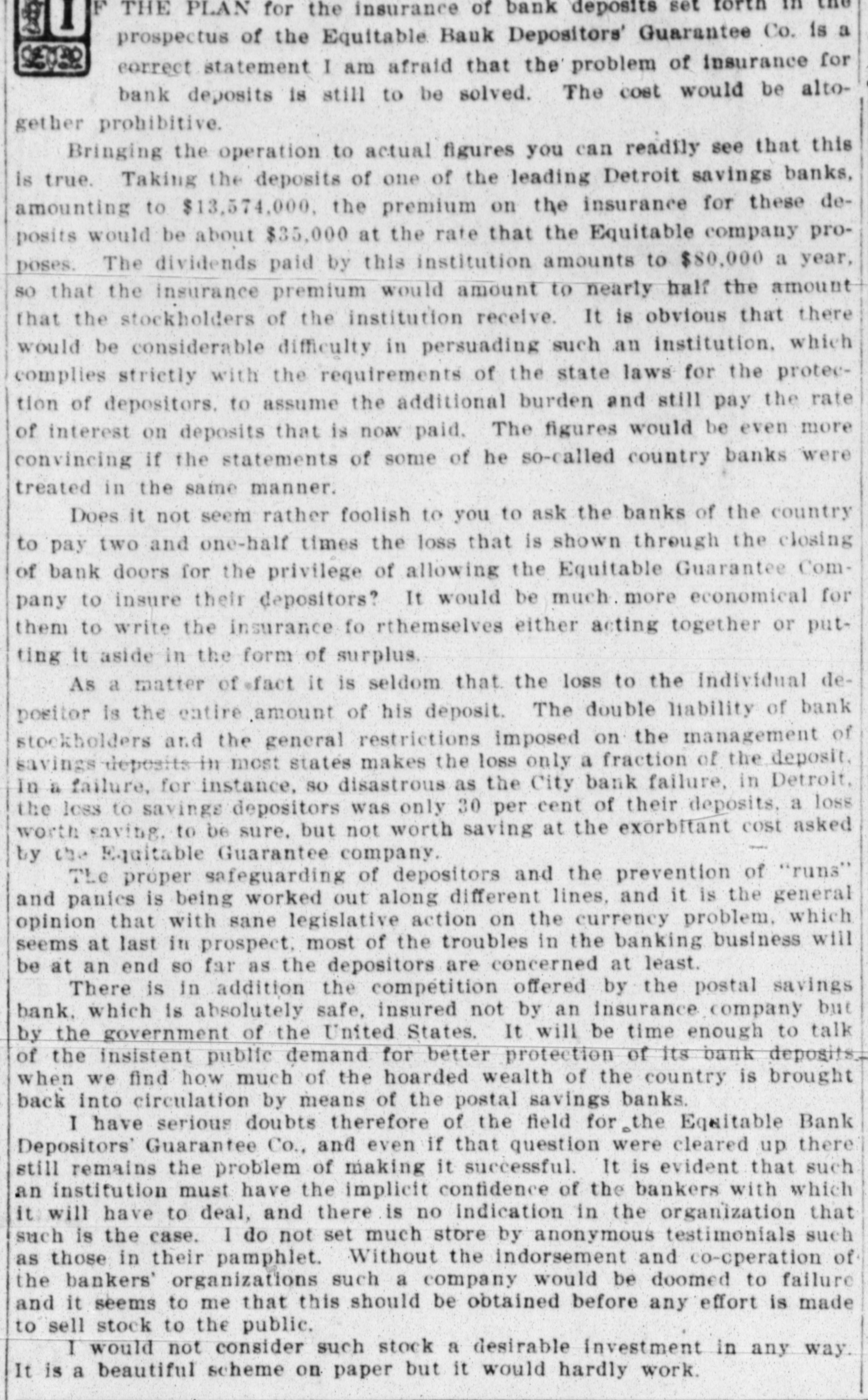
F THE PLAN for the insurance of bank deposits set forth in the prospectus of the Equitable Bauk Depositors' Guarantee Co. is a correct statement I am afraid that the problem of insurance for bank deposits is still to be solved. The cost would be altogether prohibitive.
Bringing the operation to actual figures you can readily see that this is true. Taking the deposits of one of the leading Detroit savings banks, amounting to $13,574,000, the premium on the insurance for these deposits would be about $35,000 at the rate that the Equitable company proposes. The dividends paid by this institution amounts to $80,000 a year, so that the insurance premium would amount to nearly half the amount that the stockholders of the institution receive. It is obvious that there would be considerable difficulty in persuading such an institution, which complies strictly with the requirements of the state laws for the protection of depositors, to assume the additional burden and still pay the rate of interest on deposits that is now paid. The figures would be even more convincing if the statements of some of he so-called country banks were treated in the same manner.
Does it not seem rather foolish to you to ask the banks of the country to pay two and one-half times the loss that is shown through the closing of bank doors for the privilege of allowing the Equitable Guarantee Company to insure their depositors? It would be much more economical for them to write the insurance fo rthemselves either acting together or putting it aside in the form of surplus.
As a matter of fact it is seldom that the loss to the individual depositor is the entire amount of his deposit. The double liability of bank stockholders and the general restrictions imposed on the management of savings deposits in most states makes the loss only a fraction of the deposit. In a failure, for instance, so disastrous as the City bank failure, in Detroit, the less to savings depositors was only 30 per cent of their deposits, a loss worth saving, to be sure, but not worth saving at the exorbitant cost asked by the Equitable Guarantee company.
The proper safeguarding of depositors and the prevention of "runs" and panics is being worked out along different lines, and it is the general opinion that with sane legislative action on the currency problem, which seems at last in prospect, most of the troubles in the banking business will be at an end so far as the depositors are concerned at least.
There is in addition the competition offered by the postal savings bank, which is absolutely safe, insured not by an insurance company but by the government of the United States. It will be time enough to talk of the insistent public demand for better protection of its bank deposits when we find how much of the hoarded wealth of the country is brought back into circulation by means of the postal savings banks.
I have serious doubts therefore of the field for the Equitable Bank Depositors' Guarantee Co., and even if that question were cleared up there still remains the problem of making it successful. It is evident that such an institution must have the implicit confidence of the bankers with which it will have to deal, and there is no indication in the organization that such is the case. I do not set much store by anonymous testimonials such as those in their pamphlet. Without the indorsement and co-operation of the bankers' organizations such a company would be doomed to failure and it seems to me that this should be obtained before any effort is made to sell stock to the public.
I would not consider such stock a desirable investment in any way. It is a beautiful scheme on paper but it would hardly work.