German Bank (Wooster, OH)

Episode Information

Episode UID
523394990479
Episode Type
Run โ†’ Suspension โ†’ Closure
Bank Type
state
Bank ID
52339499 hash
Start Date
November 9, 1839
Location
Wooster, Ohio (40.805, -81.935)

Metadata

Model
gpt-5-mini (chosen from majority vote of a three-model LLM ensemble)
Short Digest
824a687ea9fc8a8f

Response Measures

None

Description

Contemporary reports describe runs, fraudulent management, suspension (Sept 6, 1841) and assignment/receivership by early 1842.

Events (4)

1. November 9, 1839 Suspension
Cause
Bank Specific Adverse Info
Cause Details
Suspension of specie payments attributed to the bank's policy and local difficulties in redeeming notes.
Newspaper Excerpt
The bank of Wooster, and German bank of Wooster, have through a mistaken policy, suspended specie payments.
Source
newspapers
2. February 1, 1841* Run
Cause
Bank Specific Adverse Info
Cause Details
Sustained withdrawals over months driven by the bank's insolvency and fraudulent management (Bentley and others).
Measures
Attempts to ship specie to meet drafts (about $12,000 sent to New York); increased note issues and various exchanges to prop liquidity.
Newspaper Excerpt
McMillen testifies 'that there had been a run on the bank from February 1841, to September 6, 1841,'
Source
newspapers
3. September 6, 1841 Suspension
Cause
Bank Specific Adverse Info
Cause Details
Bank closed on September 6, 1841 amid insolvency and large withdrawals after prolonged mismanagement and questionable transfers.
Newspaper Excerpt
the day it was closed ... the bank became entirely insolvent by the withdrawal ...
Source
newspapers
4. February 1, 1842* Receivership
Newspaper Excerpt
the Bank Commissioners ... visited ... caused the writ of injunction to be served ... and the effects of the bank ... were delivered to Receivers, inspected ... found ... in possession of the bank's books and property and appointed agents for resuscitation of the bank's affairs; the report is dated January 27, 1842 with actions in February 1842.
Source
newspapers

Newspaper Articles (10)

Article from The Columbia Democrat, November 9, 1839

Click image to open full size in new tab

Article Text

OHIO BANKS. The bank of Wooster, and German bank of Wooster. have through a mistaken policy, suspended specie payments. We hear of no other suspension in the Northern portion of Ohio yet, and we trust we shall not. The banks of this city continue to pay specie, and we learn to day that there has been no very considerable demand on them for coin. People.do not care about specie, so long as they now it can be obtained when asked for.


Article from The Illinois Free Trader and Lasalle County Commercial Advertiser, September 24, 1841

Click image to open full size in new tab

Article Text

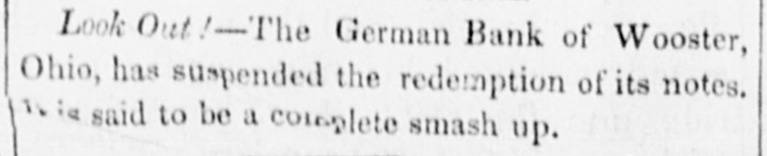
Look Out!-The German Bank of Wooster, Ohio, has suspended the redemption of its notes. is ie said to be a complete smash up.


Article from Wheeling Times and Advertiser, September 30, 1841

Click image to open full size in new tab

Article Text

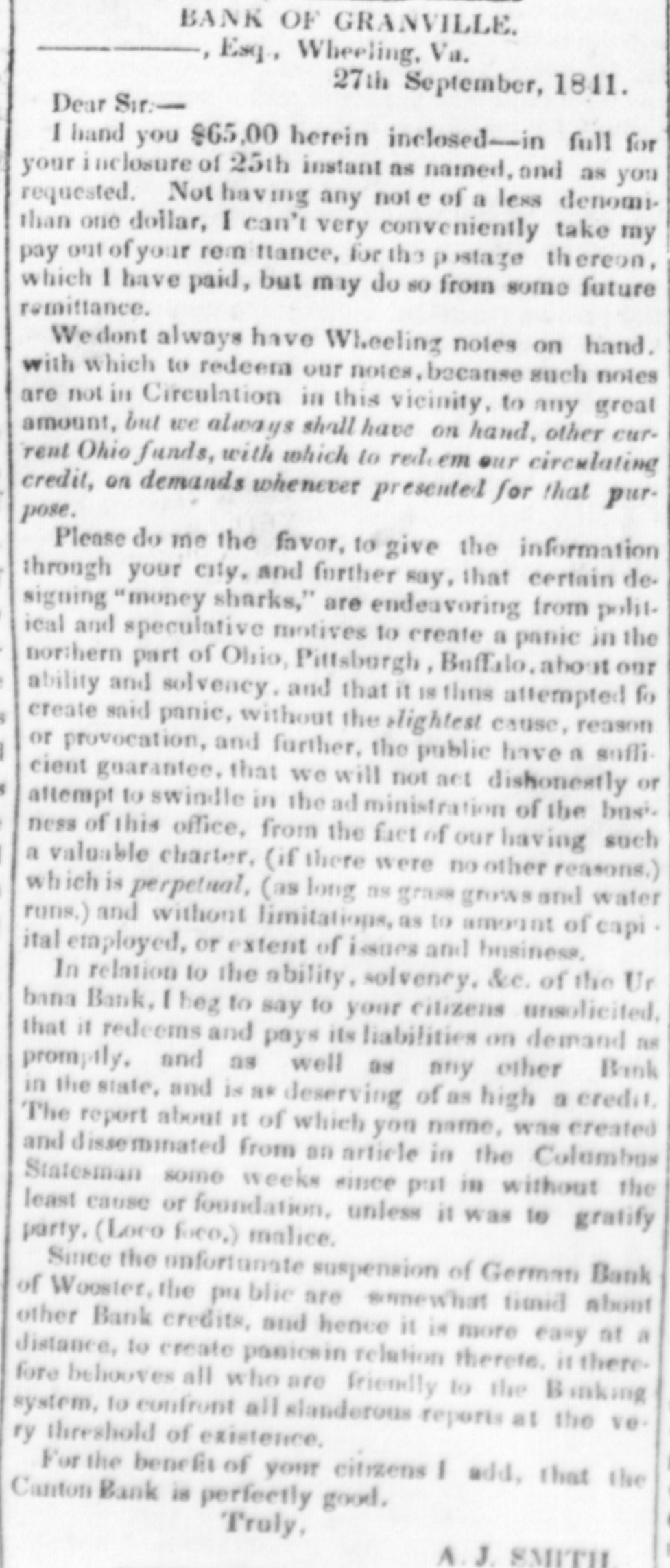
BANK OF GRANVILLE. , Esq. Wheeling, Va. 27th September, 1841. Dear Sir:I hand you $65.00 herein inclosed-in full for your inclosure of 25th instant as named, and as you requested. Not having any note of a less denomithan one dollar, I can't very conveniently take my pay out of your rem thance, for the postage thereon, which I have paid, but may do 80 from some future remittance. We dont always have Wheeling notes on hand. with which to redeem our notes, becanse such notes are not in Circulation in this vicinity, to any great amount, but we always shall have on hand, other current Ohio funds, with which to redeem our circulating credit, on demands whenever presented for that purpose. Please do me the favor, to give the information through your city, and further say, that certain designing "money sharks," are endeavoring from political and speculative motives to create a panic in the northern part of Ohio, Pittsburgh, Buffalo. about our ability and solvency. and that it 18 this attempted fo create said panic, without the slightest cause, reason or provocation, and further. the public have a soflicient guarantee. that we will not act dishonestly or attempt to swindle in the ad ministration of the busi. ness of this office, from the fact of our having such a valuable charter. (if there were no other reasons.) which is perpetual, (as long as grass grows and water runs,) and without limitations, as to amount of capi ital employed, or extent of issues and business. In relation to the ability, solvency. &c. of the Ur bana Bank, I beg to say to your citizens unsolicited. that it redeems and pays its liabilities on demand as promptly. and as well as any other Bank in the state, and is ar deserving of as high a credit The report about it of which you name, was created and disseminated from an article in the Columbus Statesman some weeks since put in without the least cause or foundation. unless it was to gratify party. (Loco foco.) malice. Since the unfortunate suspension of German Bank of Wooster, the public are somewhat finid about other Bank credits, and hence it is more easy at a distance, to create panicsin relation therete. it there. fore behouves all who are friendly to the making system, to confront all slanderous reports at the ve. ry threshold of existence For the benefit of your citizens I add, that the Canton Bank is perfectly good. Truly, A. J.


Article from Wheeling Times and Advertiser, October 7, 1841

Click image to open full size in new tab

Article Text

I BANK OF GRANVILLE. Esq., Wheeling. Va. 27th September, 1841. Dear Sir:I hand you $65.00 herein inclosed-in full for your inclosure of 25th instant as named, and as you requested. Not having any note of a less denomithan one dollar, I can't very conveniently take my pay out of your remittance, for the postage thereon. which I have paid, but may do so from some future remittance. We dont always have Wheeling notes on hand. with which to redeem our notes, becanse such notes are not in Circulation in this vicinity, to any great amount, but we always shall have on hand, other current Ohio funds, with which to redeem our circulating credit, on demands whenever presented for that purpose. Please do me the favor, to give the information through your city. and further say, that certain designing "money sharks," are endeavoring from political and speculative motives to create a panie in the northern part of Ohio, Pittsburgh, Buffalo. about our ability and solvency. and that it is thus attempted fo create said panic, without the slightest cause, reason. or provocation, and further, the public have a sufficient guarantee. that we will not act dishonestly or attempt to swindle in the ad ministration of the business of this office, from the fact of our having such a valuable charter, (if there were no other reasons,) which is perpetual, (as long as grass grows and water runs.) and without limitations, as to amount of capiital employed, or extent of issues and business. In relation to the ability, solvency, &c. of the Ur bana Bank. I heg to say to your citizens unsolicited, that it redeems and pays its liabilities on demand as promptly. and as well as any other Bank in the state, and is as deserving of as high a credit. The report about it of which you name, was created and disse minated from an article in the Columbus Statesman some weeks since put in without the least cause or foundation, unless it was to gratify party. (Loco feeo,) malice. Since the unfortunate suspension of German Bank of Wooster, the pu blic are somewhat limid about other Bank credits, and hence it is more easy at a distance, to create panics in relation thereto. it there. fore behooves all who are friendly to the Banking system, to confront all slanderous reports at the ve. ry threshold of existence. For the benefit of your citizens I add, that the Canton Bank is perfectly good. Truly,


Article from The Ohio Democrat, March 17, 1842

Click image to open full size in new tab

Article Text

REPORT. To the Honorable the General Assembly, of the State of Ohio. obedience to the provisions of the act "to and repeal to In charter of the Gerinan Bank of Wooster, the under the affairs, passed January 27 1842. the close Bank Commissioners, visited of inst. caused the signed, day its February, Wooster injunction served, sec- and alond the Hon Joseph R. Swan to by the of a writ of be the of the bank that sion same into the hands lowed under delivered of by all authority property the mandamus could of took Receivers, inspected posses- found, and for that purpose. They have also oath, its appointed books of the bank, and examined under knowldge the directors, and other persons having institution; all officers, management and condition of the documents ap of of the which will more fully appear in the pended to this report. agent engaged in the reguscitation of the As The principal Bank of Wooster, was Benjamin bankruptcy Bentley. in German of the bank at the time of its and familiar with the claims Wellof its stock. The deposition of condition 1818, Cashier he was against that M: it, D. trifling the and the schedule ftransfers, snow individuals. a man, only of stock was purchased of the time of amount D. Wellman believes that the stock at bank in payM. in 1818, was transferred to the statement 18 the ment failure, of debts by by the the books stockholders. of the bank This for the corroborated to the meeting on the 23d of July 1838, had been pur Prior of directors. only 435 shares obtained of Adappointment Of this amount 400 shares were fachaeed amson Bentley, "without any consideration except vors The previously transfer book rendered. exhibits the following transfers & assignment on the 15th July 1838: Benjamin Wellman, Bentley share; To, Wm. McComb, 5 do: Wellman, Joseph H. B. 1 do: James S. Irvine 1 do; M. D. S Bent Watson, Wm. Childs 5 do; John Robinson. 1 do; do 1 do; 5 do; Levi Rawson. 1 de; L. Chestnu!wood, direc. ley, one of these individuals were appointed above. In Every the meeting on the 23d, as mentioned this stock, and tors at they came in possession of we what manner if paid for it, 80 far as to arrive at the facts, will be has the consideration able any, found he in have their no been MI Wellman,{ testifies stock of of "purchasing one share of 1838.' Wm. McComb, the depositions. recollection in July that and President Benj. ba: of Bentley no consideration, old stock he paid in the paper of or beance on received his shares without the trans" the S. Bentley bank. the paid Bentley believes payment the bank. for the same, and he him a ing called made upon to him for the purpose of making to fer was Wm. Childs was told that stock, enough to him director. eligible as a director was it Bentley, that'he wasnet to pay stock since. Levi Rawson, supposed He make nor by Benjamin has him he transferred for never then, was to him to make him a director. bank bona fide purchase of stock in the or made of the Wellman's, of Benjamin transferred Wooster, testifies German that Bentley, he nevof person. Josepn Watson knowledge: that any other stock in said bank to his transfer er owned purchased any any stock and knew of no the hr never So far we have been enabled to trace of assignment to his name. and transfer of stock at the organization the new testimony board of directors. of H B Wellmah, James S been Irvine, ob The Robinson and Levi Chesnutwood has not was John The fact, however, that one share only that tained. to each of them renders it probably and that transferred made no purchase of stock at that time, the books they whole proceeding was a mere entry upon so the with or without the knowledge of the persons made Jue either directors. The transfers were two inconstituted 1838. On the 23d of the same month and Rob15, called directors, viz: T. G. Jones direc. dividuals, Bentley, met and appointed the new board of on the minutes of that date.) As appears all tors. Thomas G, Jones had The the bank, and four !shares more. G stock ert transfer (See book, favor transferred ofT. Jones stock his in however, shows a balance in the appearance book, dollars seventy-five cents, but re of eight and fresh entries would lead to 8 greater deemed of erasures the transfer book. We, therefore, upon to take the deposition of Mr re the opinion above expressed, than fully it !iance necessary sustains book, Jones, that more which the be placed on the transfer recol and particularly as Mr Jones no stock stock since May 21, to liance book, should of purchasing has 1820 T G the lection that he transferred May 21, directors, and Co., of the stock of all the shares, he held in the on the and subsequently, Jones president, swears German capital 1820, that Bank of to said of 1821, he assigned's Wooster, day bank exceptions.' January, transferred of thesaid cor1st Quimby shares in the capital stock to the Eph further, Thomas G. Jones's of the following transcript of as rectness of the directors of said, July bank the proceedings and bank, the minutes held Ger of 23, 1838 ofall the directors belonging to Jones the man At Bank a meeting of Wooster-present, Thomas G. and Robert BentleyThat Hiram B. Wellman, William D Well. Mc Resolved, Joseph Watson. James S. Irvine, Bentley, M Levi Comb, William Childs, John Robinson, S. Chesnutwood man, Benjamin Bentley and Levi of said bank Rawson, hereby appointed directors of direc. to be fill and the they vacancies are that now exist in the board tors of the said bank. T. G. JONES. ROBT. BENTLEY. have presented the anomaly of Thomas directors G. Here we presiding at a board of as a himself and another, and directly in contravention cerconsisting Jones into being of director, incorporate resolving of the statute, a new 23, 1815, An act passed therein named, and to extend the direo- of tain banks,' sec. 20 'that board banks February incorporated shall be charters the annually existing each of the aforesaid banks, stockhol tors for the 1st Monday of January, by the be a elected for on the time being, and each director shall resident ders, at the time of his election; and a of the stockholder the state, &c.' In the concluding part vawithin section, we have the following, "And directors if any of same at time. happen among the or cancy aforesaid banks, by death, for any the residue of the directors of otherwise, of shall, the any fill such resignation, the bank, vacancy." the shall'elect a director to of time being, provides for the general meeting The 21st section for the purpose electing die thirty days notice in some of making accommodation per, stockholders, rectors The plan after giving annually, directors, newspa January as pres referred to, we find brought down to share viously John Hanna, swears, "that he owns'one to him 1841. in said bank, transferred and assigned for said ofstock Bentley; that he has not paid by instal by Benjamin stock, either to Benjamin Bentley, transferred or to share of to the bank; and supposes it was director." J. W. ments the purpose of making him a Benjamin him had stock transferred to not he since McMillen for testifies, "that he did not him at that by time, the has Bentley and given his obligation to said Bentley for
Article from The Ohio Democrat, March 17, 1842

Click image to open full size in new tab

Article Text

ident of the bank Wm McComb, had no consuitation in relation to the failure of the bank with the officers and directors. before the morning of September 6, 1841." Mr. Hanna testifies, that he was not consulted individu ally, nor d8 a director. in relation to closing its he did not susdoors. suppose Benjamin the bank Bentley would swears, entirely that pend payment two hours before it did. That an entire failure of the bank had been in contemplation by Benjamin Bentley for some time, and that arrangements to lessen its available means, and at the sametime increase its circulation, were also adopted and carried into effect, is clearly apperent. In proof of this we in to the himself. month His deposition conclusion testimony of is, Benjamin refer "that, that the Bentley first in the place, of amount was 000." the same sil. June During the of epecie month. 12,000 about $14,- in ver and gold, were sent to New York, to meet the payment of drafts previously drawn on time. And further, that after the shipment of the 12,000 in June, no efforts were made to increase the amount of specie. The sale of this specie is admitted by J. W. McMillen, Teller of the bank. Another evidence of a fraudulent design on the part of the individuals who managed the bank, is the entire omission of monthly statements of the condition statement The as as of only the explanation the bank, teller upon of the this of omission No book.signed by is want time. statement is recorded after the sale of this specie, and the pledge of the residue to the bank of Wooster, which was sold at a premium of soven per cent. In addition to these evidences of preparation to fail, is the increase of circulation, and the means reserted to by the bank to keep its own paper out. McMillen testifies 'that there had been a run on the bank from February 1841, to September 6, 1841,' the day it was closed. May 31, 1811, the circulation was $120,725 McMillen gives the circulation on the day of failure, 125,000. Notwithstanding this run, the circulation was increased, while the means of the bank were diminished. The manner in which this amount of paper was kept out, will be seen by referring to the depositions of McMillen, M. D. Wellman, Harris and Rhode, viz: by the exchange of notes, and the purchase of the drafts. Again, the amount of bil's discounted was gradually lessened for several months preceding the bankruptcy. March 31, 1841, bills discount $226 263 ed, 218.221 38 April S 30, 211,608 73 May 31, At the date of our examination, the amount of bills discounted, as appears on the ledger, after deducting the amount of Benjamin Bentley's indebtedness, was 70,934 95. On the 11th day of September, 1841, four days after the failure of the German Bank of Wooster, from minute that as the ed to several Benjamin it of appears the Bentley, directors the met, trustee, and assign- all book, effects of said bank. [See minutes of that date.] The character of this assignment, and the loose and summary manner in which the entire effects of the bank were assigned to one man, without security, or even making a schedule of the assets, or their value, !ed irresistably, to the conclusion, that the public good was not properly consulted. It is remarkable, that no reason is assigned. by the directore, for suspending the business of the bank, The causes which rendered euch a step necessary, are not even alluded to, and yet the board met five days after the failure, and as signed to an individual, whose interest, more than that of all persons, would be promoted by the depreciation of the paper in circulation. That no schedule of the effects of the bank was made at the time of assignment, 16 shown by the depositions of Bentley, McMillen, M'Comb and Hanna. It shown by the deposition of S.L. Lorah, a of a Wooster, that endeavored, prblic meeting through of the citizens committee, to a said bank, were obtain but knowledge refused of by the Benjamin condition Bentley of on not that he answer inte(the the ground, said Bentley,) that they would could expect any rogatories that would go to criminate him self. The bank became entirely ins olvent by the withdrawal note of 91,000 an without of Benjamin leaving equivalent. Bentley's From the testimony of several of the wit. nesses, and especially from that of Wellman, it is clear, that only about 60,000 were ever paid on capital stock; and of this sum, between 30,000 and 40,000 were borrowed by the Wellmans at different times, during their connection with the bank, all of which indebtedness was ultimately cancelled by a transfer of their stock to Benjamin Bentley. In the progress of the investigation, teelimony was elicited to prove that B Bentley paid for the stock purchased of the Wellmans and satisfied his own previous indebtedness to the ultito 80 abmately bank, amounted by his individual $94,826, note, that which the on the transfer at his


Article from The Ohio Democrat, March 17, 1842

Click image to open full size in new tab

Article Text

and the final (ransier of Bentley' stock, 10 the amount of $91,000, for the extinguishment of his habilities. In the iesue of small notes we find an at tempt to evade the provisions of the law. July 20, 1839. The Wellmans transferred their stock, and by the charter, their connection with the bank as directors, was dissolved. January 4. 1841 Resolved, That W m. McComb be appointed president of the German Bank of Wooster, to take effect from the 1-t day of February last-(eleven months prior 10 the above date, 11th of July, 1840.) Benjamin Beniley swears-"It has been the uniform course of this bank to conform to the laws of the State as near as practica ble. have, therefore, never received or paid out bills not authorized by law, or the act of the 2nd March, 1840; in the business of the " bank, to the best of mv recollection, since the 1st day of April, 1840 9, 1842. Samuel L. Lorah swears of the year 1841, a amount one notes, dated February "that February dollar in large 1, 1810, and Wm. McComb, as president, of the Bank of Wooster, were put German signed said into cir culation, and that the execution of notes was nearly one year before it was known that said McCombs was made president; and the banks from into circu&c., of a less lation act prohibiting notes, putting denomination 1940, and than took five dollars, passed March 23, effect from and after the 1st day of May 1840, as appears from collated statutes of the state of Ohin, by Joe R. Swan." In the above we have a perepective view of the of the presidency of the Bank of filed nearly one year Wooster, office being after the the vacancy occurred, by a resolution, and in sequel, this president executing notes of aless denomination than five dollars, for the purpose of evading the law of the State prohibiting the circulation of a certain denomination. From the minutes of the directors, it is impossible to ascertain the amount of notes prepared and put into circulation. The only entries to be found are the following: 20th July, 1838 Resolved, That the president and cashier sign notes for circulation to the amount of $30,000." "August 15, 1828. Ordered that the officers of the bank execute the ba'ance of the paper now on hand, for circulation." So far as it relates to the amount put into circulation, no means are efforded by any of this nominal to arrive at conclusion. are nutes made any We directory, therefore entire dri ven to the testimony, he states, that'the amount prepared for circulation was, 311,000; and of this sum, there was burnt, about the time of the passage of the law repealing the charter of the German Bank of Wooster, and necessarily, must now resum of $65,000 in or $246,000, main the there circulation, unaccounted for; which nearly corresponde with the amount unredeemed on the general ledger, of 63,445 dollars. testimony, it appears there in circulation at the In was McMillen's time of the that fai122,000 dollars, consequentdollars must have lure ly 60,000 of the bank, been purchased their by the agents of Bentley, upon his or terms; and estimating the value paid we have the testimony of the persons employed in redeeming their paper. John Hamm swears-That Wm. McComb, the has received at his store, in exfor goods six thousand or more change president, Bank dollars of Wooster of the paper of the German and applied the same in discharge of his own indebtedness to the Bank to the amount of and the residue to of of Benjamin assig2,200 notes purchased dollare, Bentley, payment nee of said Bank; that the amount of bondy or notes belonging to the bank was about 4,000 dollars; that deponent declines giving the names of the persons indebted to the banks on the bonds or notes purchased. James Grant swears, that about two months since he sold to Anthony Wright, a clerk in the store of Wm. McComb, the president of the German Bank of Wooster, paper to said bank, to 100 dollars at 32 per cent discount. Nentzer festifies to the for sold in the store Samuel goods of Wm. prices McComb, paid in at about 25 per cent advance, when paid the notes of the German Bank of Wooster. swears-That at the time the bank failed, he was to 1,500 dollars, and paid pa. since the 6th of September, 1841. Win.Childs indebted and Bank since he has of in Wooster, exchanged own per; with B. Bentley, the paper of the German to the amount of about 5,500 dollars, or, 6,000 dollars for bonds &c. due said bank, that within a few days he has taken notes of the bank at 50 per cent. discount, that about three weeks ago the he selected a lot of unsaleable goods, and placed them on counter to exchange for the paper of the German Bank of Woo ster, that he has purchased of B. Bentley real estate to the am- of ount of 3,000 dollars, which he is to pay for in the paper the German Bank of Wooster; that he made the purchase abou the middle of last week." 5th February, 1842. Wm. Armstrong testifies to nearly the same facts. Shaz Bentley swears,that he was present at the time that bank the transfer was made to B. Bentley, of all the effects of the except the liabilities of such holders as wished to discharge their indebtedness by a transfer of stock to the bank; that he was indebted to the bank, at the time failed about 2,300 dollars to 0- B. and above his deposits, that his bond was assigned Bank ver and has been paid for in notes of the German and that he has also purchased of and paid for them in the paper of Bentley notes Wooster, due the bank, obtained of B the Bentley Ger of Wooster, which notes were mostly on man a discount of fifty per cent prethe which money is to be applied to the sent sale week, Bank of goods at B. Bentley. during payment the of a B. tract of land Harris bought swears. of that he has nurchased 7 or 800 dolH.


Article from The Ohio Democrat, March 17, 1842

Click image to open full size in new tab

Article Text

BANK COMMISSIONERS REPORT. We this week give the report of the Bank Commissioners, on the affairs of the German Bink of Wooster, omitting the documents appended thereto, as the report itself contains their substance. And what a spectacle does it present to the country of this rotten and defunct concern? We haye heard of rascality before-of John Law, of Nick Biddle, of Sam Swartwout, and a hundred other Financiers, but of all the Bank rascality, and Bank villainy, that has ever come to light since the day old Adam packed up his duds and made tracks from the garden of Eden, the career of Bentley eclipses all, when we take into consideration the circumstances by which he was surrounded. Let every man read this repert- especially those who were swindled by that bank. It will show you some of the mysteries of this thing called "Banking," so extensively carried on in these modern times. Follow up Mr. Bentley- mark his course from year to year-his violations all laws-his mode of making officers-rais= ing the wind-expanding and contracting-getting in debt, and out of debt-and all the minor points of financiering, necessary for carrying on his system of uni. versal plunder and robbery-sum all these up, and you have the organization of the whole plan by which a dozen other corporations have filched from the laboring classes of Ohio, more than a million of dollars within the last 18 months. But how could they succeed so long without being found out, asks a friend? The truth is, they were aided by a party-assisted by paity leaders-screened from the public eye by party men. Bentley_himself, was a Whig leader, and stumper of 1840-his accomplices were whig loadera-h bank was a whig engine devoted to corrupting and debauching honest men from their true principles, to the support of Tip, and Tom,' and as a matter of course, the whigs upheld it, and prevented its enormous frauds from being exposed sooner. We have evidence of this, from the facts that the banks shut their doors against the Bank Commissioners; the Whig legislature sustained them, and afterward repealed the Bank Commissioner law altogether. And when the last Democratic legislature re-instated the Bank Com missioners, a majority of the Whigs voted against iteven Governor Corwin refused to acknowledge their bonds, thus virtually sanctioning this bank robbery. On the passage of the hill to repeal the German Bank of Wooster's charter, after its frauds were known, a ma jority of Whigs voted against the measure also These facts cannot be denied, and go to prove that Bentley would have been in the penitentiary long ago, had not the leaders of the Whig party, from Corwin down, aided, abetted, connived at, and protected him in all his rascality from the day of the Bank's resuscitation, to the day the Commissioners seized upon its effects. Bentley has run off; so have the Wellman's, we understand, but that is nothing. The whig leaders are their accessories. They should and will be made responsible for all the fraud and villainy perpetrated upon the people by this swindling institution:


Article from The Ohio Democrat, October 6, 1842

Click image to open full size in new tab

Article Text

Read the following, You who have been swindled by the bursting of the Cleveland Banks: From the Cleveland Plain Dealer. "Harris of the Cleveland Herald, sa's he is authorized by Standart Griffith & Co., to say that they will carry whigs to the newark Convention, on their line of boats without charging a profil" "We are authorized to say that Standard, Griffith & co now owe the defunct banks of this city FIFTY THOUSAND DOLLARS; and instead of devoting the profits of their businees to party purposes, they had better pay their honest debts. It is by means of a few political cormorants, that these banks are now insolvent, and the honest bill-holdere suffering a ruinous depreciation of their faithless promises to pay. The "Co," of this concern has not yet settled his indebtedness to the bank of Cleveland occasioned by the transportation of that brig to Columbus in the winter of 1840." SUCH IS THE WAY, citizene of Tuscarawas county, these banks and bankers have acted and will act again if you give them them the power. Had it not been for the thousands and tens of thousands expended in the campaign of 1840 by Griswold's Canton Bank, German Bank of Wooster, Stokeley's Bank of Steubenville, Granville, Gallipolis, Urbana, West Union, &c. &c. you and your brother citizens of Ohio, would not have suffered as you have done by the bursting up of these banks. THERE IS NO MISTAKE But that the excitement now got up is the whole and sole result of a combination of bank swindlers, who want to live and roll in luxury, by cheating and defrauding the laboring part of the people out of their hardfearnings. THINK YOU These Bunk Lords would come down from their fine houses and talk to you now, if they had not a design of cheating and swinding, & pressing and extorting from you the proceeds of your labor as they have done before? No, indeed they would not. Did you ever see them after election offering you their hands, or speeking to you on politics! No. THEN BEWARE How you trust them, for they are but creating an exciemout to deceive you, and put you off your guard, while they lay their plans to bring upon you another suspension of specie paymente, and the evils which follow-general burst up of Banks-worthless notes on your hands, Sheriff's writs against you, your property sacrificed, and your family and children turtied naked on the world. BELIEVE IT NOT When the Federal leaders tell you the: the legislature was broken up; our government destroyed; to prevent Gerrymandering! Evidence has been given you clear as noon day hat they determined last winter to resign at the extra etssion, and has prevent the Demo-


Article from The Spirit of Democracy, January 24, 1846

Click image to open full size in new tab

Article Text

# FOR GOVERNOR OF OHIO, DAVID TOD, of Trumbull. # THE CONSTITUTIONAL CURRENCY. In our paper of last week, we published the proceedings of the Democratic 8th of January Convention, which put in nomination, as the Democratic candidate for Governor of Ohio, the able advocate of equal rights-DAVID TOD. On the first page of to-day's paper will be found the proceedings of the Democratic Editorial State Convention, for which we bespeak an attentive perusal. The democracy of this county are well aware, that, when the democratic party of Ohio raised the "bank reform" banner, in 1838, they were triumphantly victorious at the ensuing elections. The people were well satisfied, from past experience, that the old villanous banking system needed much reformation, in order to secure them from the almost daily loss of thousands of dollars; a loss resulting as well from the total failure of these rascally shaving shops, as from a partial depreciation in the nominal value of their "promises to pay." In accordance with the views and doctrines, at that time advocated, the democratic members of the General Assembly, at subsequent sessions of the Ohio legislature, passed laws which, it was supposed, would have the effect to make bankers honest men; or, in other words, to prevent the old system of bank swindling of "contractions to-day, and expansions to-morrow"- from ever being again fastened upon the people of this State. Laws were enacted making stockholders liable in their individual capacity for the debts of a bank, in case of failure, as well as other laws equally salutary. When these laws were passed, it was thought that the people would, thereafter, be secured from losses by bank failures, and bank suspensions; and that all banks thereafter chartered would have engrafted in their charters these salutary provisions. But how have the people been disappointed in their hopes and expectations? Would bankers accept of charters with the individual liability clause? No. The determination of the moneyed aristocracy of this State was to grind down the people by enormous taxes, by bank failures, and bank suspensions, until they should be brought to tamely submit to any banking proposition that might be brought forward. The result has been, that by "deception, corruption, and accident," the bank power of the State has once more gained the ascendency in our legislative halls. Immediately, all the salutary measures, demanded by the people, were repealed; and a system of banking enforced upon the people only equalled by the old defunct banks of Gallipolis, West Union, and a host of others. Who does not recollect, and, not only recollect, but, by experience, know the thousands, and we might safely say millions, lost to the people of Ohio, by the explosion of such dens of iniquity as the Bank of Cincinnati, German Bank of Wooster, Bank of Steubenville, Bank of Granville, Bank of Urbana, Bank of Gallipolis, Bank of West Union, Miami Exporting Company, new Bank of Circleville, Lebanon Miami Bank, Bank of Cleveland, Commercial Bank of Lake Erie, Commercial Bank of Scioto, and a long list of others in this State, together with the losses sustained by the failure of the banks of the States of Illinois, Michigan, and others; and we might particularly mention as "last though not least," the Bank of St. Clair, familiarly known as the *Red-dog* bank? Have the people, we ask, forgotten all their losses occasioned by the failure of these institutions? No. They feel that forbearance will soon cease to be a virtue; and will, ere long, speak in tones of thunder to those nabobs of the bank-paper-mills, whose only rule of action seems