Article Text
BANK SUSPENDS NEW YORK, February 1.-The Home Bank of Brooklyn has suspended.
5235018991297 523501899
hash
8f3e3753b0481519None
Click image to open full size in new tab
BANK SUSPENDS NEW YORK, February 1.-The Home Bank of Brooklyn has suspended.
Click image to open full size in new tab
HOME BANK OF BROOKLYN CLOSED Special by United Press Wire: NEW YORK; Feb. 1:-The Home Bank of Brooklyn failed to open its doors today. A run has been in progress for several days. The bank officials announced that the State Banking Department has taken charge. It has a paid up capital of $100,000 with deposits estimated at $389,000.
Click image to open full size in new tab
BROOKLYN BANK CLOSES. Small Institution Could Not Withstand Run. New York, Feb. 1.-The Home Bank of Brooklyn, a small state institution. on which a run was started yesterday, closed its doors today. Its closing is without bearing upon the general financial situation.
Click image to open full size in new tab
SMALL BANK IS CLOSED Failure of Home of Brooklyn Wild Have No Effect on Situation. New York, Feb. 1.-The Home bank of Brooklyn, a small state institution on which a run started yesterday. closed its doors today. Its closing is without bearing upon the general financial situation.
Click image to open full size in new tab
Another Bank Closed. New York, Feb. 1-The Home Bank of Brooklyn failed to open its doors this morning. A run on the bank has been in progress for several davs. A bank official announced that the State Banking Departmenthas taken charge of the institution. The bank was organ'zed in 1905 and had a paid up capital of $100,000, Its deposits are estimated at $389,000.
Click image to open full size in new tab
HOME BANK OF BROOKLYN FAILS By THE JOURNAL'S Special Wire. NEW YORK, Feb. 1.-The Home Bank ,of Brooklyn, failed to open its doors this morning. A run on the bank has been in progress for several days. A. bank official announced that the State Banking Department has taken charge of the institution. The bank was organized in 1905 and had a paid-up capital of $100,000. Its deposits are estimated at $389,000.
Click image to open full size in new tab
The BANK OF PINE BLUFF THE HOME BANK HAS CLOSED Hearst News Special to the Graphic. New York, Feb. 1.-The Home Bank in Brooklyn closed its doors to day, after an all day run yesterday. The bank had deposits aggregating $800,000, much of which has been withdrawn.
Click image to open full size in new tab
BROOKLYN BANK "PUT ON THE BUM." NEW YORK, Feb. 1.-The Home bank of Brooklyn, a state institution on which a run was started yesterday, did not open for business today. The Home bank is a small institution located in South Brooklyn.
Click image to open full size in new tab
COULDN'T STAND RUN. NEW YORK, Feb. 3.-The Home bank of Brooklyn failed to open this morning, a run having been in progress several days. The state banking department has taken charge of the institution. It organized in 1850 and had a capital of $100,000 and deposits estimated at $389,000.
Click image to open full size in new tab
SMALL BANK CLOSES. NEW YORK, Feb. 1-The Home Bank of Brooklyn, a state institution, on which a run started yesterday, did not open for business today. It is a small institution and has a capital stock of $100,000 and surplus and undivided profits of $53,570. The deposits are not large.

Click image to open full size in new tab
NEWS OF THE WORLD SHORT DISPATCHES FROM ALL PARTS OF THE GLOBE. A Review of Happenings in Both Eastern and Western Hemispheres During the Past Week-National, Historical, Political and Personal Events. The Home bank of Brooklyn, an institution on which a run was started Saturday, has failed. David Yerkes, for years a weigher in the United States mint at Philadelphia, died at Spokane recently, at the age of 76 years. The grand jury at Kansas City returned 200 indictments against actors, actresses and theatrical managers and attaches charged with violating the Sunday law. It required $54,000 to cover the necessary bonds. Milton D. Purdy, assistant to the attorney general, "chief trust buster," and originator of the receivership innovation in trust prosecution, will shortly retire from the department of justice. Purdy is said to be slated for a circut judgeship in the eighth circuit. Gil Blas, a paper of Paris, says that Mme. Anna Gould intends to sell her property in Paris and return to America. The monthly coinage statement issued by the director of the mint Saturday shows the amount of coinage executed at the United States mints during January 1908, to have been $15,431,120, as follows: Gold, $13,044,950; silver, $2,129,000; minor coins, $257,170. Mrs. Annie Ackerly, the first woman ever convicted of arson in Brooklyn, has been sentenced to serve 14 years in prisón. It is reported important steps will be taken within the next few days in the effort to cause the removal from office of Lieutenant Governor Dunsmuir. The most disastrous blizzard of the winter passed over Chicago and vicinity Sunday. Oldtime residents of the Northwest have been astonished by the news that "Jack" Lavelle, for many years chief of police in Butte, is dying of cancer of the stomach in a Reno (Nev.) hospital. The memory of John Muir, California's writer and nature lover, will be perpetuated in a forest reservation near San Francisco, made up of giant redwoods and towering douglas firs, thousands of years old. It has been designated the Muir national forest. The trial of Mrs. Dora McDonald, widow of Chicago's millionaire gambler king, for the death of Webster Guerin, furnishes the first instance in the history of Illinois jurisprudence of a dying woman being placed in jeopardy of her life. Chief counsel for the defense of Mrs. McDonald is Colonel James Hamilton Lewis, former congressman from Washington state. The shipbuilders on the northeast coast of England have given notice that the services of all workingmen will be dispensed with on February 10. This action is an outcome of the strike inaugurated January 2, the men refusing to accept a reduction in wages. After the suspension of construction work for the last two months, the Harriman lines are to resume the building of Oregon railroads. General Manager O'Brien issued orders yesterday to assemble men and materials
Click image to open full size in new tab
NEW BANK LAW'S OPERATION. State Superintendent Takes Control of Brooklyn Bank. New York, May 1.-It was learned this afternoon that Clark Williams, superintendent of banks, had taken possession of the Home Bank of Brooklyn ,which suspended on February 1 last, under the new law which has just gone into efféct. permitting the superintendent of banks to undertake the liquidation of all closed institutions. This action by the banking department has precipitated a very intéresting situation, which will undoubtedly come as a complete surprise to Attorney General Jackson who for some reason failed to appoint a receiver for the Erooklyn bank, and has therefore been deprived of selecting a man to set the fat fees which, under the old law, could be charged in such dissolutions.
Click image to open full size in new tab
The effect of one of the bills Governor Hughes forced through the New York Legislature will be appreciated by business men in general. This measure authorized the State superintendent of banking to settle the business of suspended banks. The Home Bank, of Brooklyn, suspended and it has been reopened, under the new law, at a cost, of $666 for the liquidator, nothing for lawyers, and a trifle more than $1000 for other expenses. The expense of liquidating the Knickerbocker Trust Company, the affairs of which were not settled under the new law urged by Governor Hughes, may reach a large sum. Under the old method $40,000 was considered a moderate fee for fixing the affairs of an impaired bank.
Click image to open full size in new tab
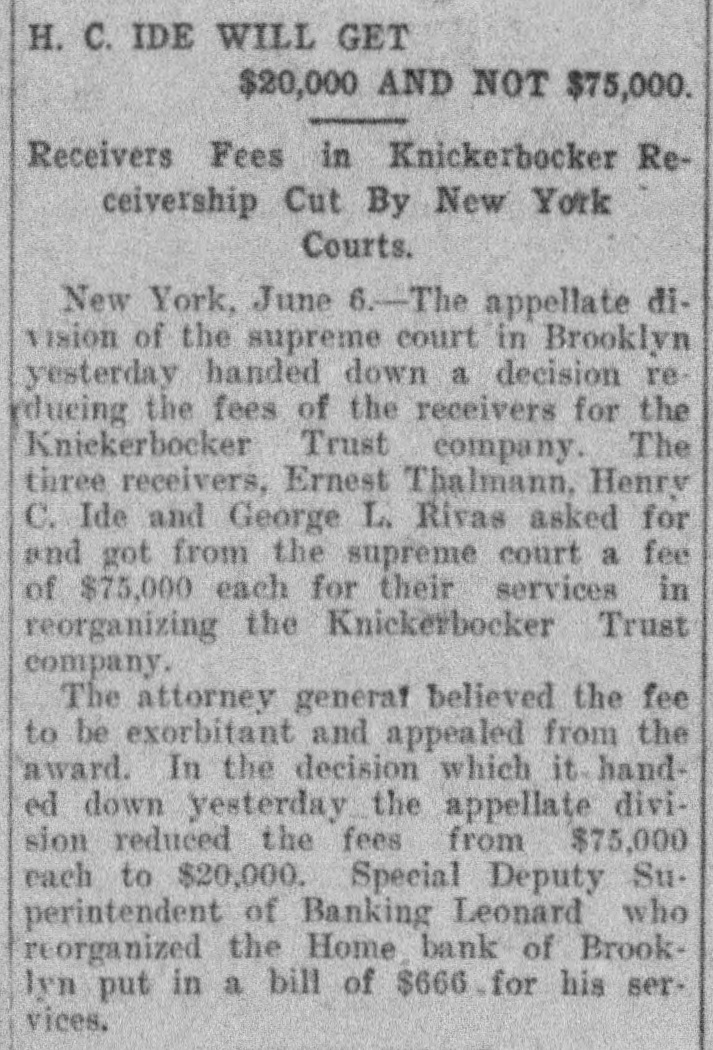
H. C. IDE WILL GET $20,000 AND NOT $75,000. Receivers Fees in Knickerbocker Receivership Cut By New York Courts. New York, June 6.-The appellate division of the supreme court in Brooklyn yesterday handed down a decision rerelueing the fees of the receivers for the Kniekerbocker Trust company. The three receivers, Ernest Thalmann, Henry C. Ide and George L. Rivas asked for and got from the supreme court a fee of $75,000 each for their services in reorganizing the Knickerbocker Trust company. The attorney general believed the fee to be exorbitant and appealed from the award. In the decision which it handed down yesterday the appellate division reduced the fees from $75,000 each to $20,000. Special Deputy Superintendent of Banking Leonard who reorganized the Home bank of BrookIvn put in a bill of $666 for his services.
Click image to open full size in new tab
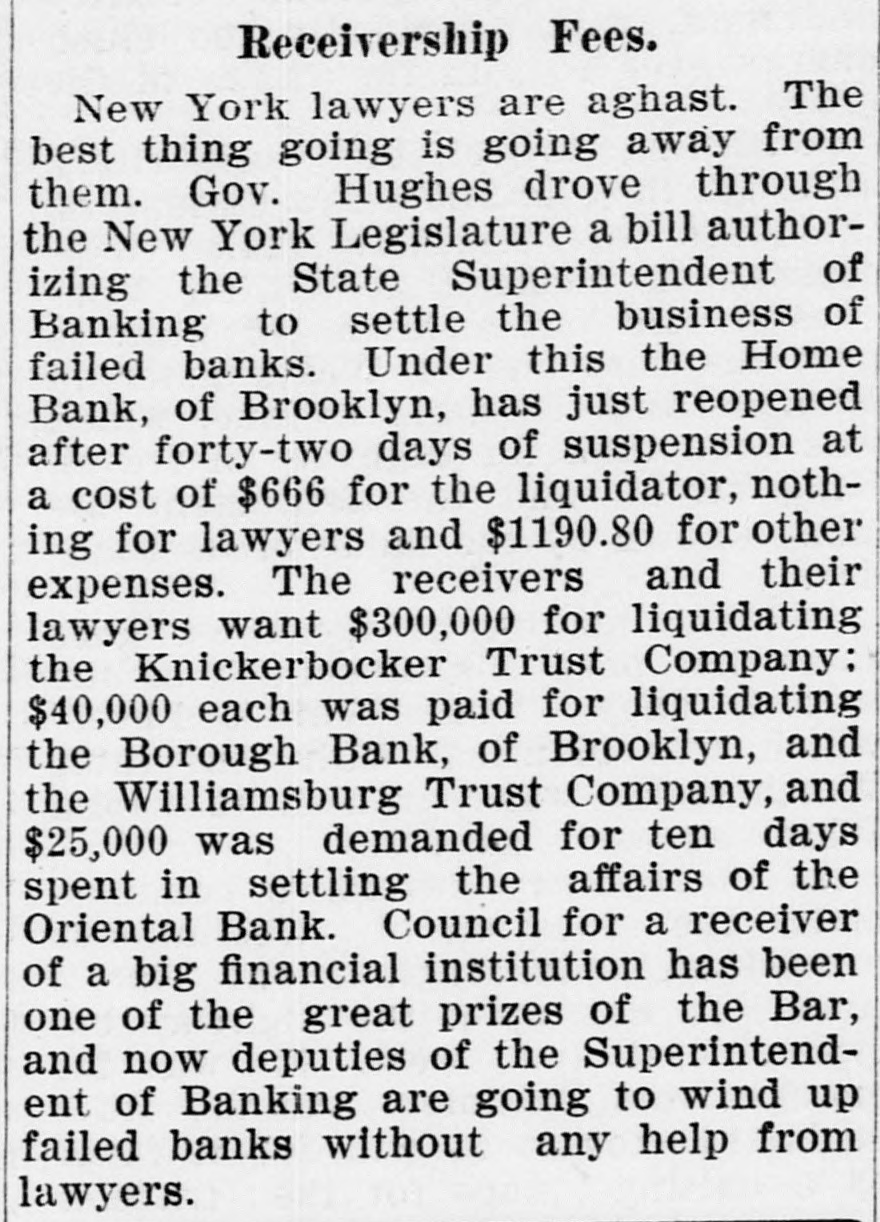
Receivership Fees. New York lawyers are aghast. The best thing going is going away from them. Gov. Hughes drove through the New York Legislature a bill authorizing the State Superintendent of Banking to settle the business of failed banks. Under this the Home Bank, of Brooklyn, has just reopened after forty-two days of suspension at a cost of $666 for the liquidator, nothing for lawyers and $1190.80 for other expenses. The receivers and their lawyers want $300,000 for liquidating the Knickerbocker Trust Company: $40,000 each was paid for liquidating the Borough Bank, of Brooklyn, and the Williamsburg Trust Company, and $25,000 was demanded for ten days spent in settling the affairs of the Oriental Bank. Council for a receiver of a big financial institution has been one of the great prizes of the Bar, and now deputies of the Superintendent of Banking are going to wind up failed banks without any help from lawyers.
Click image to open full size in new tab
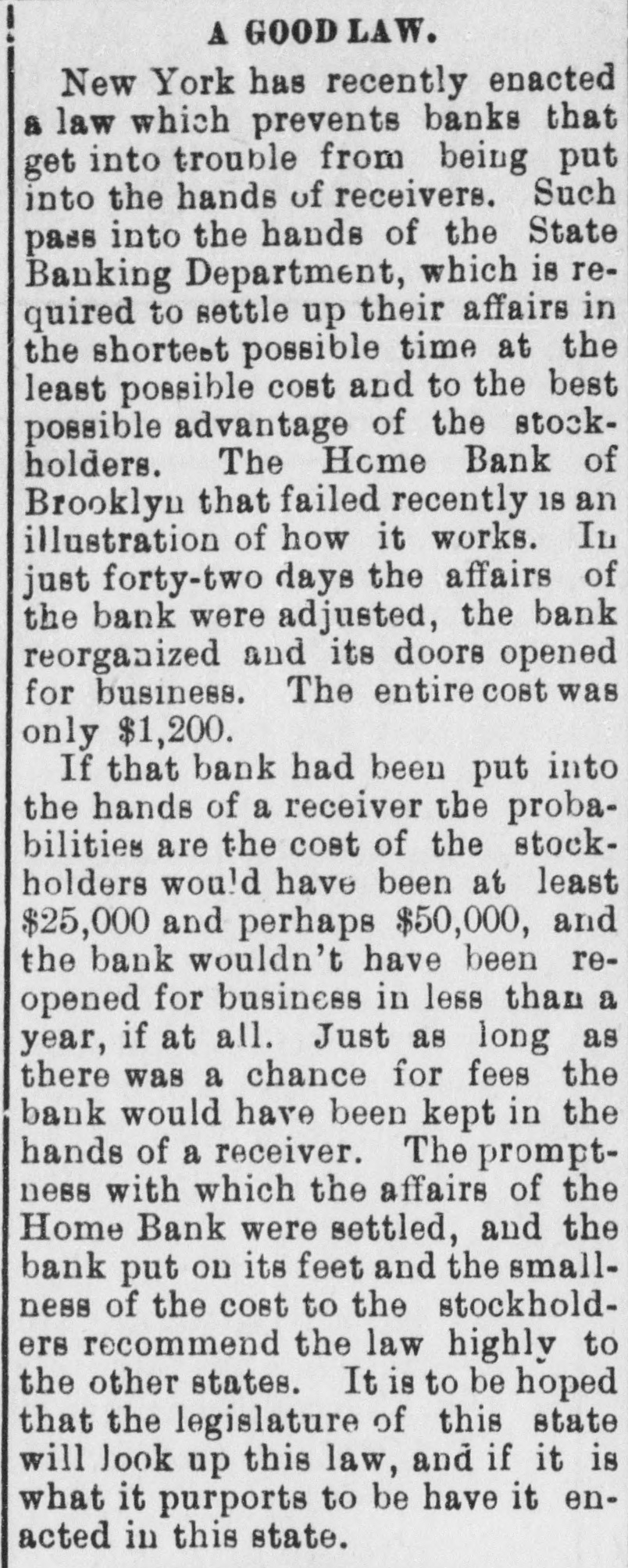
A GOOD LAW. New York has recently enacted a law which prevents banks that get into trouble from being put into the hands of receivers. Such pass into the hands of the State Banking Department, which is required to settle up their affairs in the shortest possible time at the least possible cost and to the best possible advantage of the stockholders. The Home Bank of Brooklyn that failed recently 1S an illustration of how it works. In just forty-two days the affairs of the bank were adjusted, the bank reorganized and its doors opened for business. The entire cost was only $1,200. If that bank had been put into the hands of a receiver the probabilities are the cost of the stockholders would have been at least $25,000 and perhaps $50,000, and the bank wouldn't have been reopened for business in less than a year, if at all. Just as long as there was a chance for fees the bank would have been kept in the hands of a receiver. The promptness with which the affairs of the Home Bank were settled, and the bank put on its feet and the smallness of the cost to the stockholders recommend the law highly to the other states. It is to be hoped that the legislature of this state will look up this law, and if it is what it purports to be have it enacted in this state.
Click image to open full size in new tab
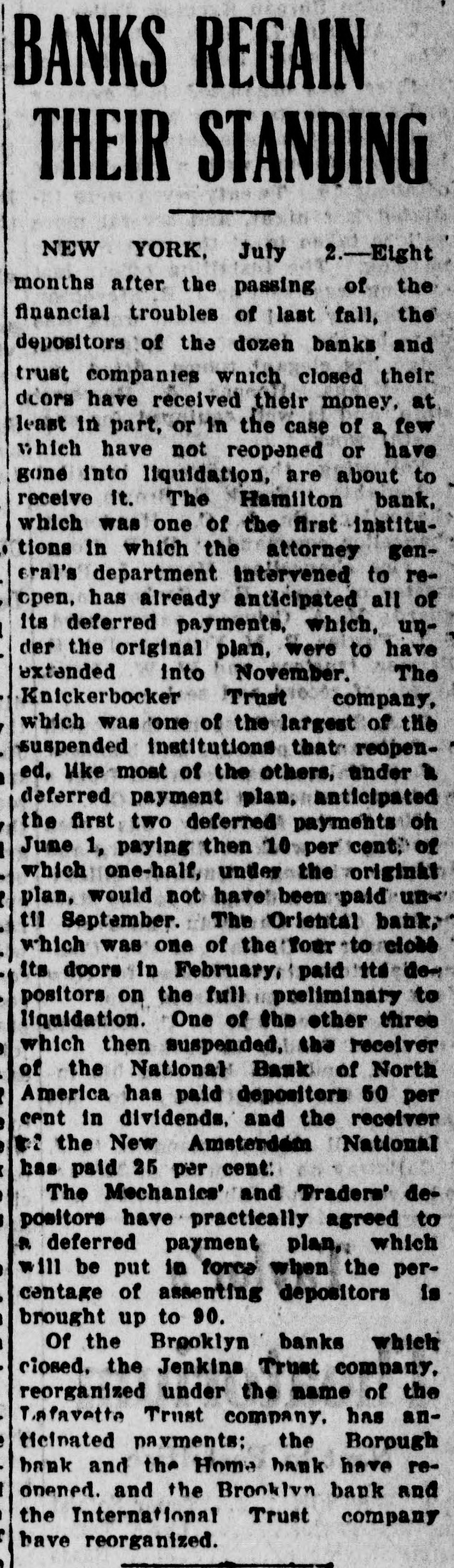
BANKS REGAIN THEIR STANDING NEW YORK, July 2.-Eight months after the passing of the financial troubles of last fall, the depositors of the dozen banks and trust companies which closed their doors have received their money, at least in part, or in the case of a few which have not reopened or have gone into liquidation, are about to receive it. The Hamilton bank, which was one of the first institutions in which the attorney general's department Intervened to reopen, has already anticipated all of its deferred payments, which, under the original plan, were to have extended into November. The Knickerbocker Trust company, which was one of the largest of the suspended institutions that reopened, like most of the others, under in deferred payment plan, anticipated the first two deferred payments oh June 1, paying then 10 per cent, of which one-half, under the original plan, would not have been paid until September. The Oriental bank, which was one of the four to close its doors in February, paid its de-: positors on the full preliminary to liquidation. One of the other three which then suspended, the receiver of the National Bank of North America has paid depositors 50 per cent in dividends, and the receiver to: the New Amsterdam National has paid 25 per cent: The Mechanics' and Traders' depositors have practically agreed to R. deferred payment plan, which will be put in force when the percentage of assenting depositors is brought up to 90. Of the Brooklyn banks which closed. the Jenkins Trust company, reorganized under the name of the T.afavette Trust company. has anticinated payments: the Borough bank and the Home bank have reonened. and the Brooklyn bank and the International Trust company have reorganized.
Click image to open full size in new tab
at 6 per cent interest, without commission. This credit, it is understood, has been repaid. Whether or not the bank will be reopened it is still too early to predict. Some of the larger interests, it is understood, are desirous of putting more money into it, but other important interests are said to consider that policy inadvisable. The wishes of the body of the stockholders have yet to be ascertained, and if they are willing to submit to a considerable assessment the institution may be reopened. Another possibility is that some other bank may make an offer for the Union and take it over. The Union Bank will benefit by having its affairs placed in the hands of the State Superintendent of Banks instead of a receiver. The first case of the sort was that of the Home Bank of Brooklyn, a small institution, which was reopened for business on June 4, 1908, after having been in charge of the Banking Department for forty-two days, at a total cost of only $1,200. Under the new system, it was said at the time, the cost of liquidating the Williamsburg Trust Company would have been not more than $4,200, compared with the $40,000 allowed the receivers and their counsel, which fee did not include the cost of administering the trust. The report of Superintendent Cheney last month noted that the creditors of the Lafayette Trust Company up to date had received 30 per cent and those of the Binghamton Trust Company 50 per cent, the costs of liquidation having been, respectively, 1 per cent and two-thirds of 1 per cent.
Click image to open full size in new tab
DAMRON TRIED FOR USING BANK'S FUND AS HIS OWN. The trial of William C. Damron, former President of the Home Bank of Brooklyn, which went down in the uncertain days following the panic, was continued to-day in the Supreme Court, Brooklyn. An adjournment was taken yesterday when a jury had been obtained. District-Attorney Cropsey opened the case for the prosecution. He said Damron appropriated to his own, use $2,500 belonging to the bank. There was an account in the bank known as the WillIam C. Damron, President, special account. This was a sort of surreptitious account, he said, into which were dumped small profits taken by the bank on deals which might not be considered in accordance with good banking. such as taking bonuses on loans and exacting fees. Damron, Mr. Cropsey said, in October, 1907, when the panic was at its height, drew a check of $2,500 on this account and paid it out on his personal account. The first witness called was John W. Waller, who was cashier of the Home Bank. He testified to the special account, why It was started, what went into It and what was done with It prior to 1907.