Click image to open full size in new tab
Article Text
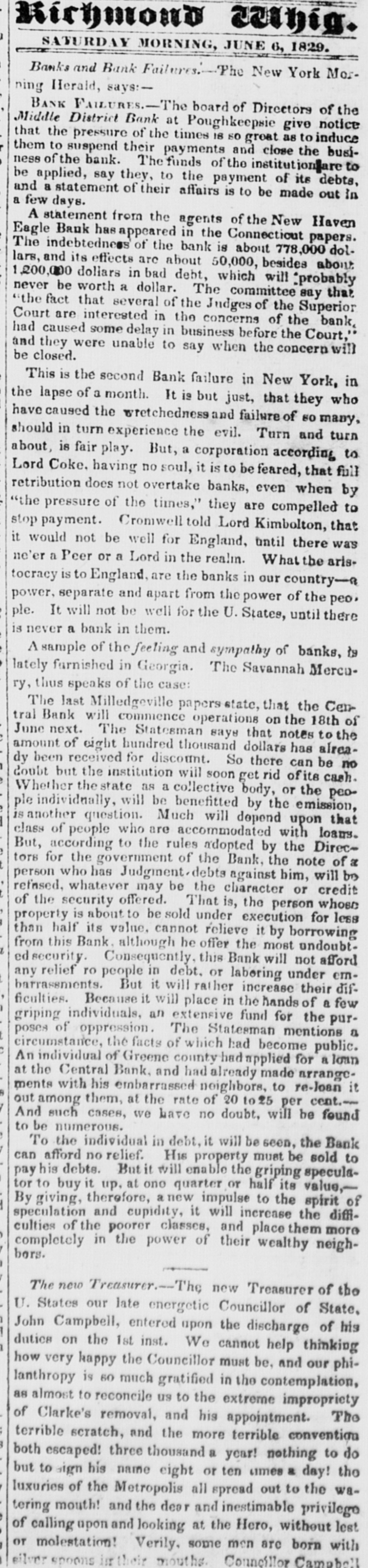
The Constitutional Whig. SATURDAY MORNING, JUNE 6, 1829.
Banks and Bank Failures.—The New York Morning Herald, says:—
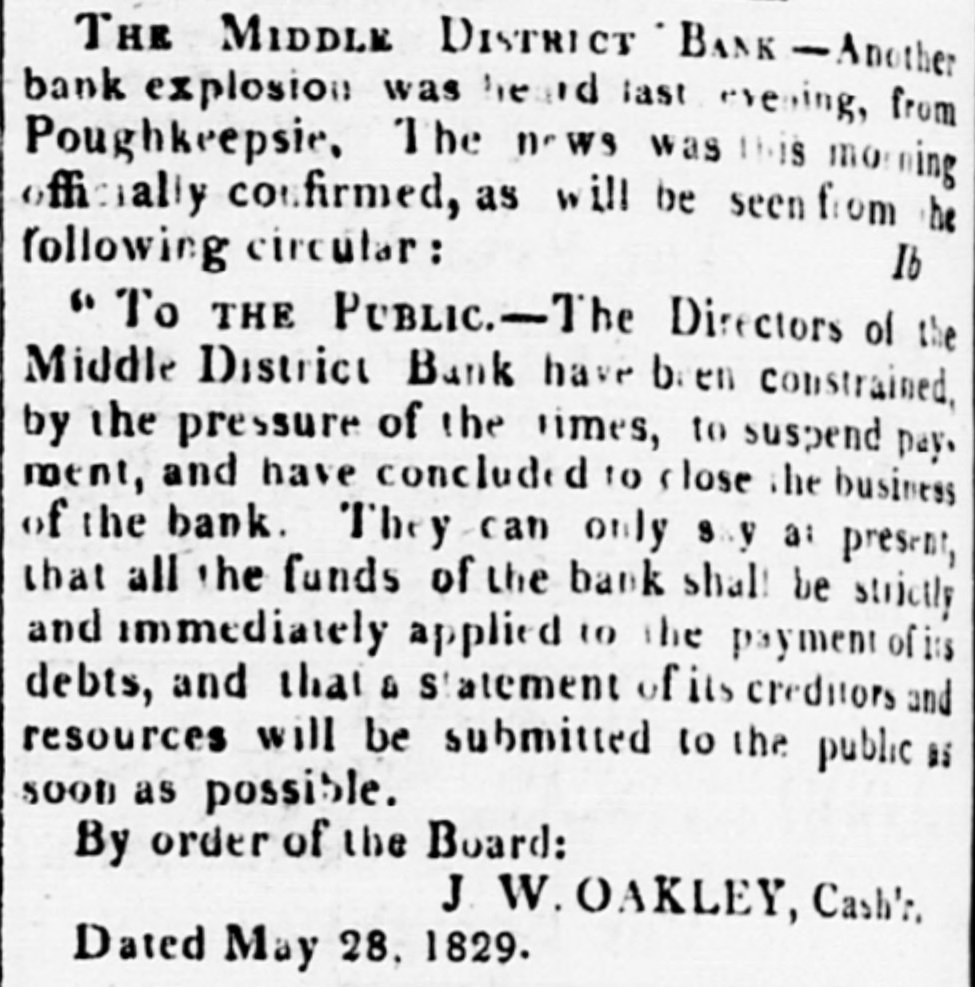
BANK FAILURES.—The board of Directors of the Middle District Bank at Poughkeepsie give notice that the pressure of the times is so great as to induce them to suspend their payments and close the business of the bank. The funds of the institution are to be applied, say they, to the payment of its debts; and a statement of their affairs is to be made out in a few days.
A statement from the agents of the New Haven Eagle Bank has appeared in the Connecticut papers. The indebtedness of the bank is about 778,000 dollars, and its effects are about 50,000, besides about 1,200,000 dollars in bad debt, which will probably never be worth a dollar. The committee say that "the fact that several of the Judges of the Superior Court are interested in the concerns of the bank, had caused some delay in business before the Court," and they were unable to say when the concern will be closed.
This is the second Bank failure in New York, in the lapse of a month. It is but just, that they who have caused the wretchedness and failure of so many, should in turn experience the evil. Turn and turn about, is fair play. But, a corporation according to Lord Coke, having no soul, it is to be feared, that full retribution does not overtake banks, even when by "the pressure of the times," they are compelled to stop payment. Cromwell told Lord Kimbolton, that it would not be well for England, until there was ne'er a Peer or a Lord in the realm. What the aristocracy is to England, are the banks in our country—a power, separate and apart from the power of the people. It will not be well for the U. States, until there is never a bank in them.
A sample of the feeling and sympathy of banks, is lately furnished in Georgia. The Savannah Mercury, thus speaks of the case:
The last Milledgeville papers state, that the Central Bank will commence operations on the 18th of June next. The Statesman says that notes to the amount of eight hundred thousand dollars has already been received for discount. So there can be no doubt but the institution will soon get rid of its cash. Whether the state as a collective body, or the people individually, will be benefitted by the emission, is another question. Much will depend upon that class of people who are accommodated with loans. But, according to the rules adopted by the Directors for the government of the Bank, the note of a person who has judgment debts against him, will be refused, whatever may be the character or credit of the security offered. That is, the person whose property is about to be sold under execution for less than half its value, cannot relieve it by borrowing from this Bank, although he offer the most undoubted security. Consequently, this Bank will not afford any relief to people in debt, or laboring under embarrassments. But it will rather increase their difficulties. Because it will place in the hands of a few griping individuals, an extensive fund for the purposes of oppression. The Statesman mentions a circumstance, the facts of which had become public. An individual of Greene county had applied for a loan at the Central Bank, and had already made arrangements with his embarrassed neighbors, to re-loan it out among them, at the rate of 20 to 25 per cent.—And such cases, we have no doubt, will be found to be numerous.
To the individual in debt, it will be seen, the Bank can afford no relief. His property must be sold to pay his debts. But it will enable the griping speculator to buy it up at one quarter or half its value.—By giving, therefore, a new impulse to the spirit of speculation and cupidity, it will increase the difficulties of the poorer classes, and place them more completely in the power of their wealthy neighbors.
The new Treasurer.—The new Treasurer of the U. States our late energetic Councillor of State, John Campbell, entered upon the discharge of his duties on the 1st inst. We cannot help thinking how very happy the Councillor must be, and our philanthropy is so much gratified in the contemplation, as almost to reconcile us to the extreme impropriety of Clarke's removal, and his appointment. The terrible scratch, and the more terrible convention both escaped! three thousand a year! nothing to do but to sign his name eight or ten times a day! the luxuries of the Metropolis all spread out to the watering mouth! and the dear and inestimable privilege of calling upon and looking at the Hero, without lett or molestation! Verily, some men are born with silver spoons in their mouths. Councillor Campbell upon whom fortune has rained all these blessings at once, really seems to have a patent right to feed out of the public crib. For some twelve or fifteen years, he was Councillor of State in Virginia, and in all that time we dare to say, that the public service never cost him a half day's labor, or a night's uneasiness. Becoming at the end of this time, (that is to say, when the Council is pronounced an incubus by the people) a great advocate for rotation in office, the public when they were looking out for his conforming his practice to his professions, find him translated to a new office of treble emolument, and permanent nature. Is that your rotation, Mr. Treasurer?
All this is bad. Maj. Campbell is a respectable man, but he did not deserve the office, when thousands of old and unprovided public servants, were to be found through the country. There is no adaptation in the claims and qualifications of the man, to the dignity and emolument of the office. The appointment wants symmetry and proportion. On the other hand, the proscription of Mr. Clarke to make way for a man so entirely undeserving public favor, on account of any public services, was to the last degree, unjust and tyrannical.