Article Text
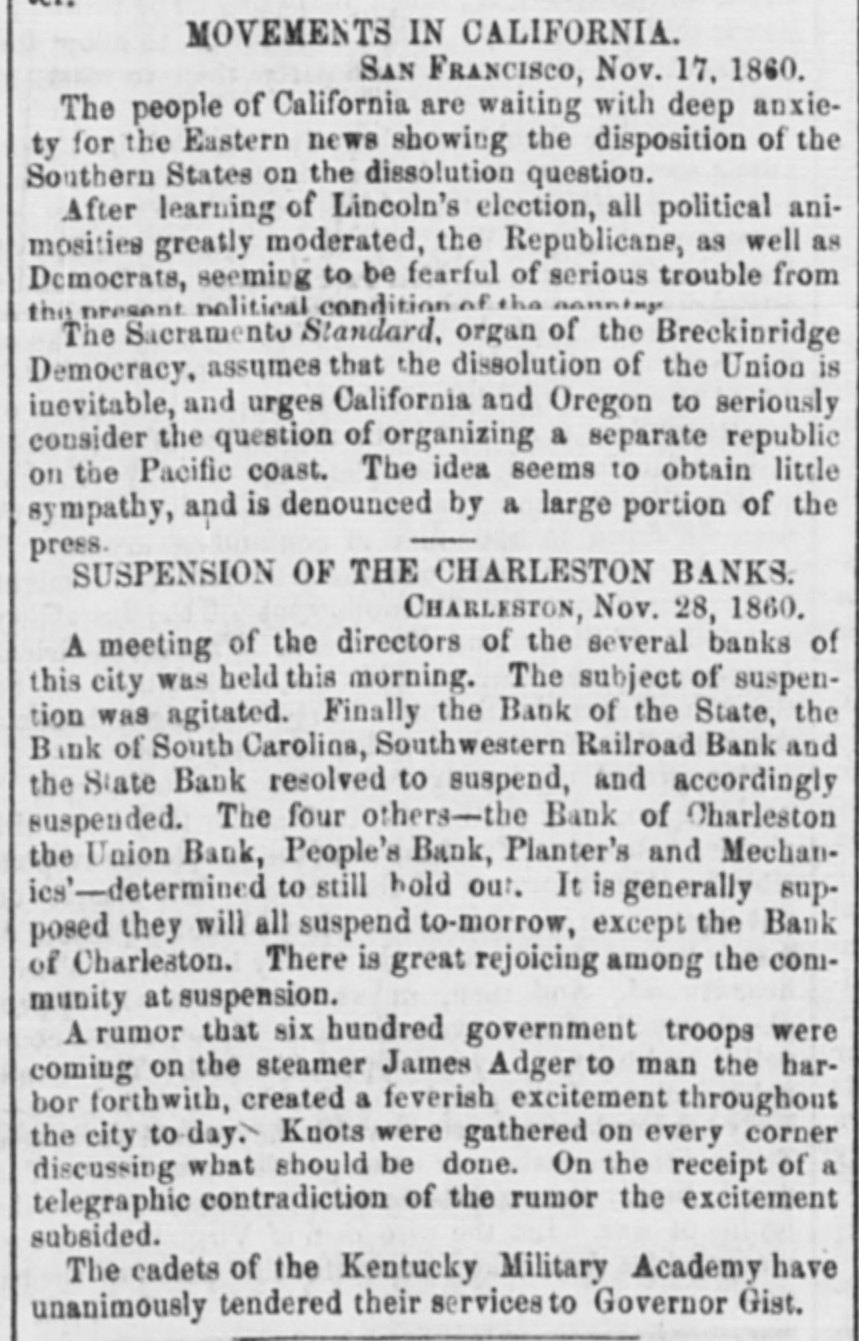
MOVEMENTS IN CALIFORNIA. SAN FRANCISCO, Nov. 17, 1860. The people of California are waiting with deep anxiety for the Eastern news showing the disposition of the Southern States on the dissolution question.
After learning of Lincoln's election all political animosities greatly moderated, the republicans as well as democrats seeming to be fearful of serious trouble from the present political condition of the country.
The Sacramento Standard, organ of the Breckinridge democracy, assumes that the dissolution of the Union is inevitable, and urges California and Oregon to seriously consider the question of organizing a separate republic on the Pacific coast. The idea seems to obtain little sympathy, and is denounced by a large portion of the press.
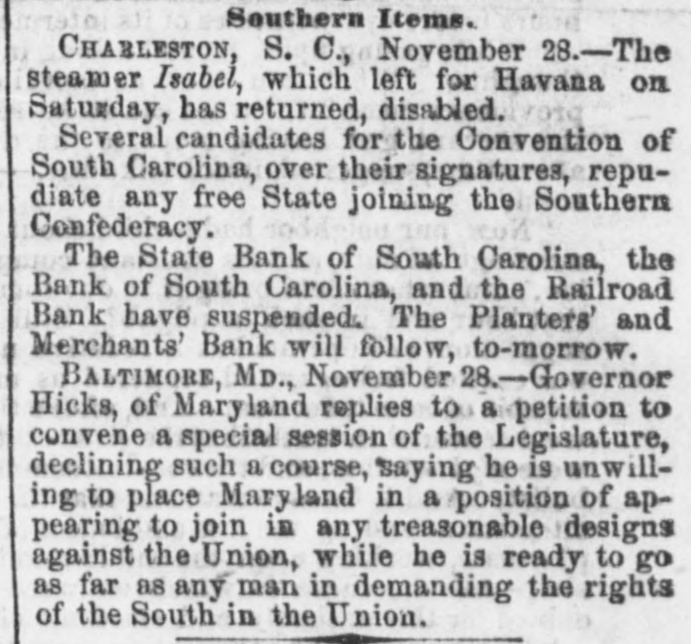
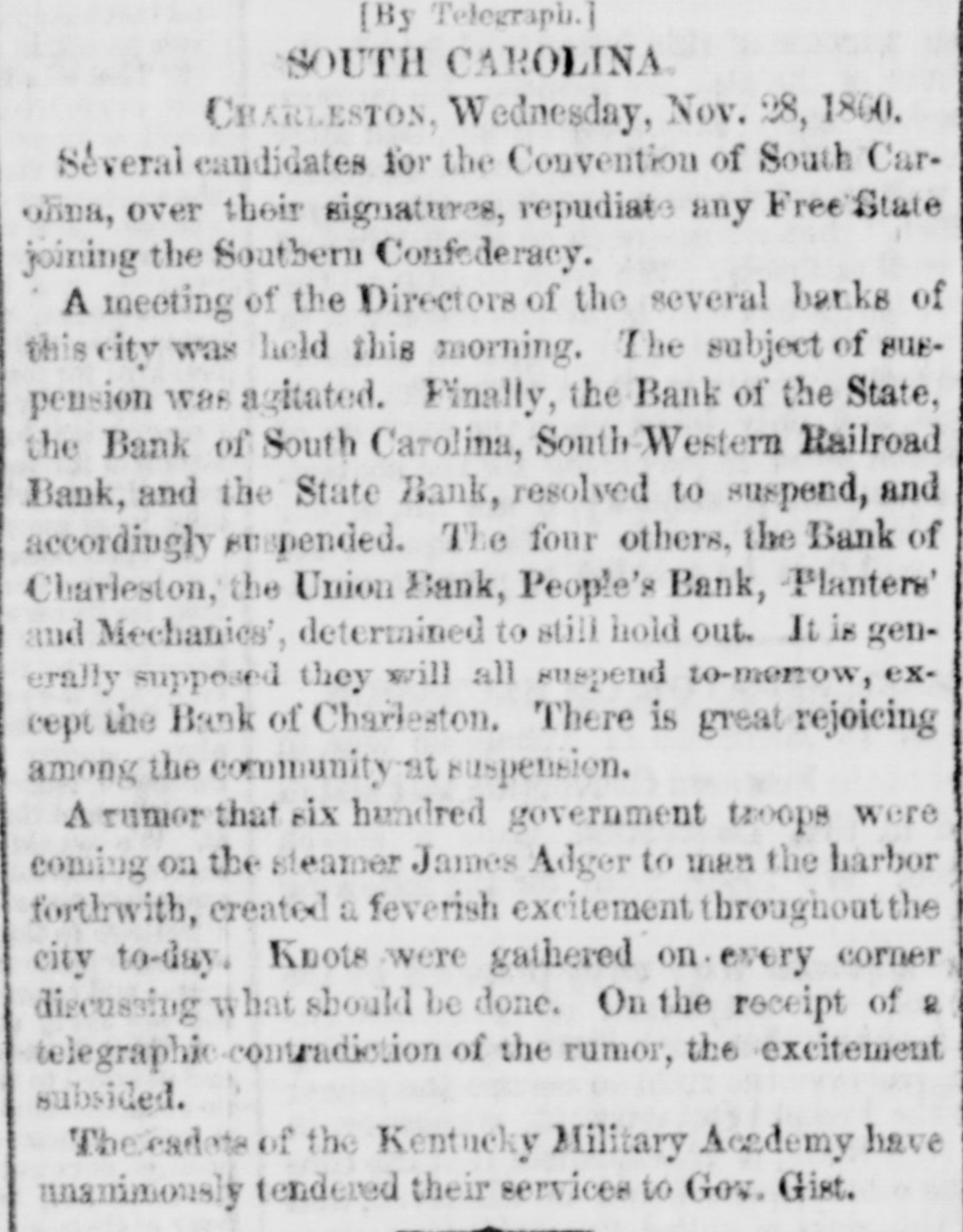
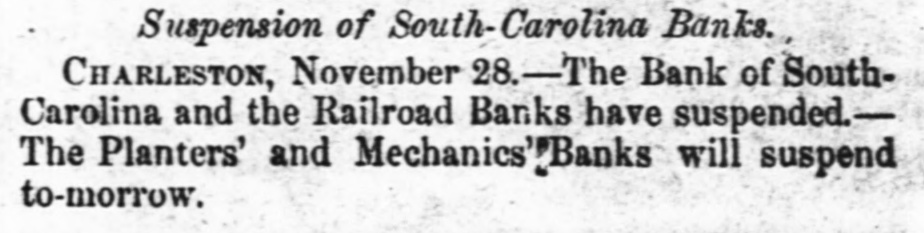
SUSPENSION OF THE CHARLESTON BANKS. CHARLESTON, Nov. 28, 1860. A meeting of the directors of the several banks of this city was held this morning. The subject of suspension was agitated. Finally the Bank of the State, the Bank of South Carolina, Southwestern Railroad Bank and the State Bank resolved to suspend and accordingly suspended. The four others—the Bank of Charleston, the Union Bank, People's Bank, Planters' and Mechanics'—determined to still hold out. It is generally supposed they will all suspend to-morrow, except the Bank of Charleston. There is great rejoicing among the community at suspension.
A rumor that six hundred government troops were coming on the steamer James Adger to man the harbor forthwith, created a feverish excitement throughout the city to-day. Knots were gathered on every corner discussing what should be done. On the receipt of a telegraphic contradiction of the rumor, the excitement subsided.
The cadets of the Kentucky Military Academy have unanimously tendered their services to Governor Gist.
AFFAIRS IN SOUTH CAROLINA. COLUMBIA, Nov. 28, 1860. Nothing specially important took place in the Legislative proceedings to-day in the House. The portions of the Message were severally referred to appropriate committees in both Houses. Special Committees were appointed to provide postal arrangements for the State after secession.
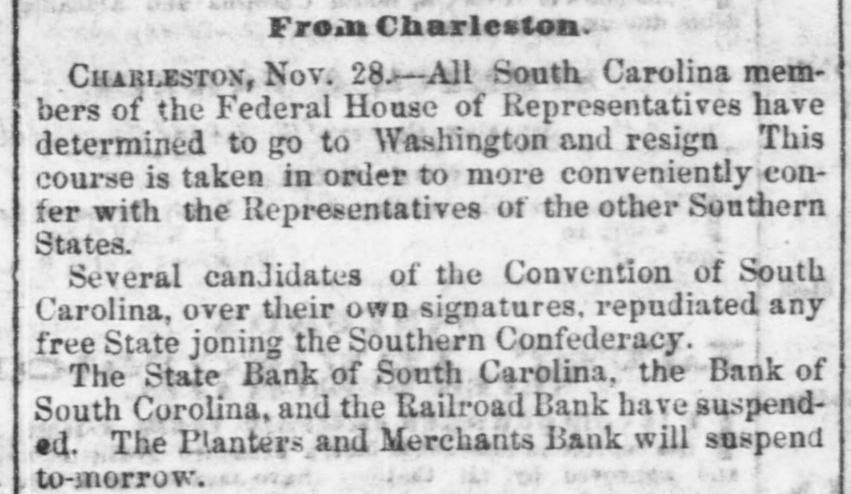
CHARLESTON, Nov. 28, 1860. Several candidates for the Convention of South Carolina, over their signatures, repudiate any free State joining the Southern confederacy.
UNION MEETINGS IN GEORGIA. COLUMBUS, Ga., Nov. 28, 1860. The Union or co-operation men of this city held a meeting last night. The meeting was an entire failure, very few people being in attendance and no enthusiasm. Georgia is beyond doubt more conservative than any other cotton State. The disunion men rely much upon the action of Alabama, South Carolina, Florida and Mississippi. The first two States will undoubtedly secede before the Georgia Convention meets, and this State will join them.
THE FAIR AT MACON, GEORGIA. MACON, Ga., Nov. 28, 1860. The foreign department of the fair opens on Monday; the agricultural and mechanical on the 10th of December, and the stock on the 7th. The room for the articles and accommodations for people are complete.
THE AGITATION IN VIRGINIA. RICHMOND, Wednesday, Nov. 28, 1860. Yost, the presiding genius of the Staunton Vindicator, Douglasite, no doubt speaks the sentiments of many when he reiterates the assertion that no man of prominence in the State, save Gov. Letcher, has come forward with any suggestion looking to a solution of the difficulties that now environ us. Senator Hunter, fearful that he may not strike the current, awaits the developement of the opinions and plans of every one else, before he will venture to present to the nation any devisement by which our country may be saved from impending ruin. He, of all others, should come forward and endeavor to direct the storm. Senator Mason, too dull to emit anything original, and too soporific to play the part of an ingenious plagiarist, amuses himself in the luxurious and dreamy delights of bedizening milk punch and apple toddy, while the very citadel of liberty is trembling and quaking under the shock of the attacks of reckless fanatics. Ex-Gov. Wise, that intellectual comet of the age, throwing himself, Achilles like, stubbornly into the bosom of Princess Anne, ventures no further than to organize his Minute Men, apparently unmindful of the duty he owes to his State and to the country—forgetful that Princess Anne is neither the State nor the Union.
Union and Counter Union meetings are being called in nearly every county in the State.
Hon. Jno. T. Harris, the able successor of Honest John Letcher in Congress from the Tenth Legion District, has made a speech to his constituents. He deplored the possibilities of disunion, and appealed to Virginia to stand firm, with one eye North, the watching guardian of our rights, and the other on the extreme South, exhorting them to return to the government of our fathers. By pursuing this course we might produce a reaction at the North, and a happy re-union of the South. If the worst comes to the worst and Virginia should feel it her duty to act, then she would act as became a sovereign and do whatever under the circumstances seemed to her best. He opposed telling South Carolina in advance that we do not wish to secede, but that we cannot remain in the Union if she goes out—thus inviting her to go, and that Virginia might do what she had never done before—follow. He was in favor of having a convention where the people can vote for delegates expressing their will, opposed to any convention with the object, directly or indirectly, of dissolving the Union for existing causes.
A meeting has been held in Essex county, the home of Senator Hunter, at which, among other resolutions, the following was adopted:—
Resolved, That we earnestly appeal to South Carolina, and the other Southern States, to unite with us in another effort to preserve the Union upon terms consistent with the safety and honor of the South.
Hon. M. R. H. Garnett, Congressional Representative from the aforesaid district, is reported to have urged upon the meeting prompt and decided action, and the expression of such sentiments as would furnish evidence of devotion to the Union of the States so long as that Union afforded ample security to the rights of the South; and to that end he advocated a convention of the States, in order to obtain such additional guarantees as the changes in the constitution of the country, since the adoption of the federal constitution, required. He recommended such a policy on the part of Virginia as would enable her to mediate between the North and the South, should it be necessary, yet to assure the whole country that, in the event of a disruption Virginia would be with the South.
I must be candid, and say that notwithstanding the above conservative sentiments, disunion is deeply imbued in the Old Dominion.
Notes of South Carolina banks are at ten per cent here. The notes of the Planters' and Miners' Bank of North Carolina are at twenty per cent discount, and the notes of all other banks in the State at five per cent.
THE FEELING IN MARYLAND. BALTIMORE, Nov. 28, 1860.