Allemannia Bank (St Paul, MN)

Episode Information

Episode UID
5271236291165
Episode Type
Run โ†’ Suspension โ†’ Reopening
Bank Type
state
Bank ID
527123629 hash
Start Date
January 3, 1897
Location
St Paul, Minnesota (44.944, -93.093)

Metadata

Model
gpt-5-mini (chosen from majority vote of a three-model LLM ensemble)
Short Digest
040d03682e5517a0

Response Measures

None

Description

President Scheffer was later indicted for overdraft; receivership and formal reorganization followed before reopening.

Events (6)

1. January 3, 1897 Run
Cause
Local Banks
Cause Details
News of the failure/suspension of neighboring banks (notably the Germania and Bank of Minnesota) precipitated panic withdrawals against Allemannia.
Measures
None reported beyond calling a directors' meeting and placing affairs before directors/examiner.
Newspaper Excerpt
The Allemannia closed a few minutes before 11 o'clock, with a crowd of depositors clamoring at the paying teller's window for their money.
Source
newspapers
2. January 3, 1897 Suspension
Cause
Local Banks
Cause Details
Heavy withdrawals following failures of other local banks forced the bank to close its doors and suspend.
Newspaper Excerpt
ST. PAUL, Jan. 4.-The Germania, Allemannia and West Side Banks... to-day closed their doors.
Source
newspapers
3. January 5, 1897 Receivership
Newspaper Excerpt
The Germania is in the hands of P. M. Kerst as assignee, and the other two are in the hands of Bank Examiner Kenyon. A receiver will be appointed for the Allemannia tomorrow... Maurice Auerbach, receiver of the Allemannia Bank of St. Paul ... sent out notices ... claims ... filed by June 15, 1897.
Source
newspapers
4. May 19, 1897 Other
Newspaper Excerpt
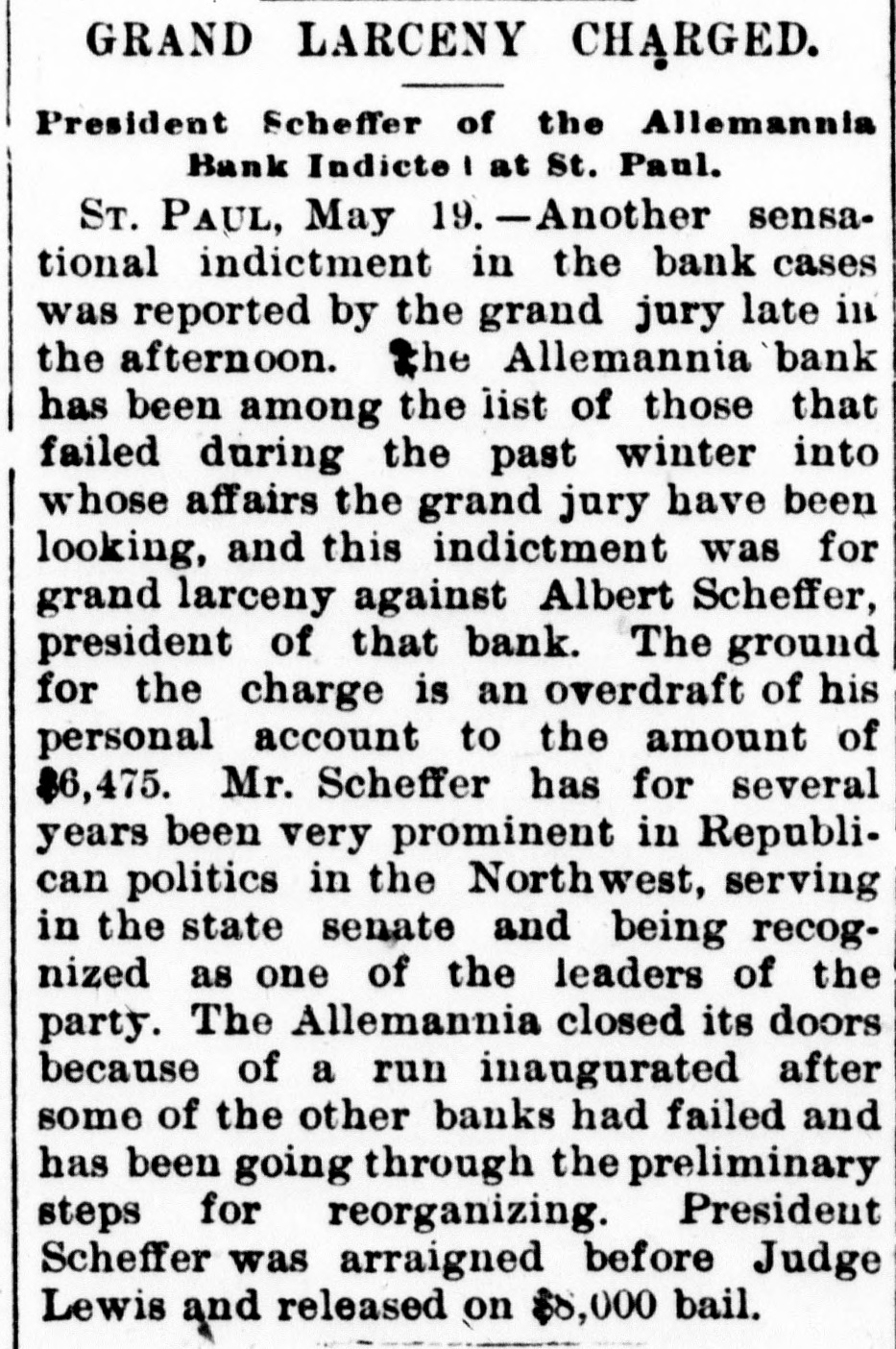
Grand larceny charged. President Scheffer of the Allemannia Bank indicted at St. Paul... ground for the charge is an overdraft of his personal account of $6,475.
Source
newspapers
5. June 19, 1897 Other
Newspaper Excerpt
Proceedings regarding resignation and replacement of receiver Maurice Auerbach and petitions by depositors over appointment of successor receivers.
Source
newspapers
6. May 27, 1898 Reopening
Newspaper Excerpt
BANK TO REOPEN TODAY ALLEMANNIA TO RESUME ON EAST THIRD STREET... final judgment and decree authorizing the bank to again begin business and approving of the reorganization plan were filed.
Source
newspapers

Newspaper Articles (25)

Article from The Saint Paul Globe, November 8, 1896

Click image to open full size in new tab

Article Text

sion or for fear of the instability of the banks. In many, if not most instances, the depositors were out of employment and needed their savings. Of course there were some who closed their accounts and put their money in safety deposit vaults and other places for safe keeping. The usual effort to withdraw in gold was resisted by the banks and most of the money is now coming back to us in rolls of bills that the depositors have had hoarded in secret places since its withdrawal. Less than $60,000 was withdrawn in this way during the past four months. Most of It has returned, the balance will sooner or later, and we are opening new accounts with new depositors hourly. There are many who are holding back until they are quite certain that the election of McKinley means a stable money market, and then they will come in again, also. The future is bright with the prospect of a business revival." "Eastern capital is already seeking investment in Minnesota," said C. W. Eberlein, secretary of the St. Paul Trust company, "and the election of Gov. Clough means as much to the people of Minnesota as the election of McKinley to the nation. The money lenders of the East have had experience with the Populist states of the West and they are shy of placing their money in such states. If Minnesota had been so unfortunate as to be under the reign of a Populist governor, I doubt if the Eastern men could have been persuaded to send their money here. As it is, they are offering it freely. There will be plenty of money offered now to move the crops and that is the basis of our business in this country. The good effects of the election will be felt in every channel of trade within a short time. I have had little opportunity to judge whether there was much hoarding or withdrawals from the banks, but I do know. that while there was plenty of money, none could be borrowed while the uncertainty concerning the financial policy of the nation existed. Now there is no more money, but there is a freedom of movement and willingness to invest. There is already noticeable in the business of this company a more prompt payment of interest, and rents and other accounts that have been neglected during the past four months. There is no question but that the tide has already turned and that good times will follow on the heels of the general feeling of confidence." One banker cited as an instance of the general feeling that the election of McKinley would have a beneficial effect on the money market, the fact that a customer of the bank, who had $20,000 in gold on deposit, loaned half the amount the day after election, before even the official figures had been hinted at. "McKinley's elected, and that's all I want to know," said the man with the $20,000 and he was given the sum he wanted to loan, which went at once into the grain business of the Northwest. This man was but a single instance of the many whom the bankers cite as evidence that only confidence in the stability of the money system was needed to restore that measure of confidence that insures success in business circles. Some men, large holders of ready capital, too, were anxious to secure their deposits from the banks in gold. This was denied them, as the bankers knew that the men had no place to lend money, but sought to withdraw It simply for the purpose of placing it in safety deposit vaults. Frustrated in their designs some of the depositors bought drafts and in this way secured their gold from the subtreasuries. But all that money is finding its way back into the banks and will soon be oiling the wheels of commerce. President Albert Scheffer, of the Allemannia bank, said that as the result of the financial agitation, business had been practically at a standstill during

Article from The Record-Union, January 5, 1897

Click image to open full size in new tab

Article Text

Demands Made Upon Them. Expected That They Will Soon be Reorganized and Reopened. The President of One of the Institutions Makes a Statement in Which He Charges That Evil Disposed Persons Maliciously Directed the Attempt to Break the Bank Over Which He Presided. ST. PAUL, Jan. 4.-The Germania, Allemannia and West Side Banks, all doing business as State Banks, to-day closed their doors. The failure of the Bank of Minnesota December 22d caused unrest in the community, and depositors withdrew their money from these banks to such an extent that they were forced to go to the wall because they had not Lunds enough on hand to meet the demands made upon them. Any of the three, however, is solvent, and they will be re-organized as soon as the money for that purpose can be put into use. The directors of the Germania met this afternoon and appointed a committee on re-organization. The Germania is in the hands of P. M. Kerst as assignee, and the other two are in the hands of Bank Examiner Kenyon. A receiver will be appointed for the Allemannia tomorrow, and the West Side Bank will try to make arrangements with its creditors and re-open without the intervention of receiver. The last official statement of the Germania Bank showed total resources of $1,625,768, $253,847 of this being in the building and $975,420 in loans and discounts. Liabilities $1,625,768, including $400,000 capital stock and $633,019 in time certificates of deposits. The deposits subject to check are $44,551. The closing of the Germania was in pursuance of the action of the directors on Saturday night, who concluded to protect their depositors by suspending. President Willius prepared a statement in which he said: "As soon as the result of the Presidential election became known matters began to improve in a remarkable degree. and there did not seem to be any doubt on May 1st the bank would be in so strong and impregnable condition that an assessment could successfully be made on the stock. This was the condition on the 22d of December, when the suspension of the Bank of Minnesota occurred, following immediately upon the failure of the National Bank of Illinois of Chicago, which came as unexpectedly as a stroke of lightning in midwinter. Failures of other Minnesota banks increased the panicky feeling, but I did not fear any disastrous outcome until it became apparent that certain eveil disposed persons maliciously directed the attempt toward the Germania Bank, circulating false and manufactured reports regardI ing it with systematic persistency. hoped from day to day that the excitement would subside and make room for better judgment, but it grew in intensity. The attack became bolder every day. After the close of business on Saturday, the 2d of January, we found that the withdrawal of deposits had assumed such dimensions that we did not feel justified to continue receiving deposits or to pay out money beyond that day without submitting the condition of affairs to the directors. Consequently we called a special meeting of the board on said day at 7:30 p. m. We had paid off nearly $225,000 deposits in nine business days, and kept on hand and in reserve fund $70,000. which shows the unreasonableness of the attack. The directors came immediately to the conclusion that the action of the officers had been correct, and however deplorable it might be, it became their duty, for the protection of depositors and other creditors, to close the doors and place the assets of the bank in charge of an assignee." The Allemannia closed a few minutes before 11 o'clock, with a crowd of depositors clamoring at the paying telJer's window for their money. President Scheffer said: "Our suspension is due to the large number of withdrawals this morning, and the fact that most of the new depositors withheld their deposits. The news of the suspension of our neighbor, the Germania, precipitated the run here, and of course with all the deposits being withheld, and the fact that there was a steady withdrawal we could not stem the tide. When the full force of the Germania's failure burst on them the crowd seemed to become panic-stricken, and they came down upon us like a wolf on the fold. When the Bank of Minnesota failed the business men fortunately were not disturbed, and few were caught. The feeling of ease returned shortly. and might have continued had it not beeen for the failure of the four banks in Minneapolis. Then the panicky feeling came back, and was intensified by the fact that the business men caught it very badly. The feeling naturally spread over here. and the people have not been easy since then. When the Germania closed its doors this morning that was the last straw in the case, and they came down upon us like a herd of wolves." The total resources of the Allemannia, according to their report of the same day. was $1,061,009. including $706,842 of loans and discounts. Liabilities also $1,061,009. including capital stock of $400,000 and deposits of $329, 789. Speaking of the failure of the West Side Bank, President Staples said: "Our suspension was due to the Allemannia. We did all of our clearing through the Allemannia. and this morning they failed to cover our clearings, and sent them all back to us. News of the suspension of the Germania and Allemannia spread through West St. Paul, and our depositors began scram-


Article from The Saint Paul Globe, January 6, 1897

Click image to open full size in new tab

Article Text

Rubber company. A deputy sheriff served copies of the attachments on the Hanover National bank. An attachment for $3,000 was issued today against property of the Allemannia Bank of St. Paul in favor of the American Exchange National bank on a bill of exchange made Dec. 31. A deputy sheriff served copies of the attachment on two banks." County Treasurer Elmund reports $56,000 as being the amount of county funds tied up in the suspended banks.


Article from The Greenville Times, January 9, 1897

Click image to open full size in new tab

Article Text

Closed Its Doors. EAU CLAIRE, Wis., Jan. 7.-The - Commercial bank of Eau Claire, capital $30,000, has closed. The failure is due to the suspension of the Allemannia bank of St. Paul, President Allen states that the depositors will be paid in full.


Article from The Saint Paul Globe, January 9, 1897

Click image to open full size in new tab

Article Text

ancient prestige. The bank has honor-* ed me with the presidency, and I feel that I am under a moral obligation to leave nothing undone that will tend to a reorganization. That is my position. The press and the public have treated us with uniform kindness and courtesy, and we are under a deep sense of obligation to them." WEST SIDE BANK. Assignee Staples, of the West Side bank, was seen also on the status of affairs at that institution. Said he: "We are busily at work on the schedules, and it will be impossible to do anything until that matter is settled." "How about reorganization?" "The people are all anxious that the West Side bank be reorganized, but no definite action has been taken in that direction, and will not be until such time as the statement is got ready for presentation to the court. Several members of the board of directors are inclined that way, and everything looks favorable." NORTH ST. PAUL BANK. Capt. H. A. Castle, president of the North St. Paul bank, said yesterday, speaking about the appointment of John F. Fitzpatrick as receiver of that institution, that he was assured the bank would be able to pay all its depositors in full. He said that the total deposits amounted to less than $22,000. while the petiti n for the receiver stated that the assets of the bank would amount to about $35,000. Capt. Castle said that he thought this was a trifle larger than it should be. The bulk of the money in the bank is public money, the deposits of the state, county, village and school district. Capt. Castle took hold of the bank about three years ago. At that time the officers in control of the bank were ready to throw up the entire matter, and Capt. Castle took charge to protect himself, he being on the bonds of the bank. In the three years he has had control the deposits have been greatly reduced, and it was the intention to further reduce the indebtedness and the capital stock until it reached a point where it was of the right size for a bank in a town the size of North St. Paul. As an instance of the way in which the indebtedness has been reduced Capt. Castle stated last evening that when he took charge of the bank it owed the state over $24,000, which amount has been reduced to $2,900. The reserve fund of the bank was deposited in the Allemannia bank. ATTACHMENTS ISSUE. NEW YORK, Jan. 8.-An attachment for $10,000 was issued today against property of the Allemannia Bank of St. Paul in favor of the American Exchange National bank on two bills of exchange made last week. The sheriff today received another attachment against the Germania Bank of St. Paul in favor of Houston M. Sadler for $3,249 on an assigned claim of the St. Paul Rubber company.


Article from The Sauk Centre Herald, January 14, 1897

Click image to open full size in new tab

Article Text

MINOR ITEMS OF INTEREST. Steps are being taken to reorganize the Allemannia bank at St. Paul, which recently suspended. Count Maravieff, the present envoy of Russia to Denmark, has been appcinted minister of foreign affairs. The directors of the New York, New Haven and Hartford railroad have declared the regular quarterly dividend of 2 per cent.


Article from Little Falls Weekly Transcript, January 15, 1897

Click image to open full size in new tab

Article Text

MINOR ITEMS OF INTEREST. Steps are being taken to reorganize the Allemannia bank at St. Paul, which recently suspended. Count Maravieff, the present envoy of Russia to Denmark, has been appcinted minister of foreign affairs. The directors of the New York, New Haven and Hartford railroad have declared the regular quarterly dividend of 2 per cent.


Article from The Saint Paul Globe, February 10, 1897

Click image to open full size in new tab

Article Text

BANK VERSUS BANK. West Side Wants Notes Held by the Allemannia, Charles F. Staples, as assignee of the West Side Bank of St. Paul, has brought an action in the district court against Maurice Auerbach as receiver of the Allemannia Bank of St. Paul to recover the possession of thirteen promissory notes, or the value thereof, aggregating $11,595. The plaintiff alleges that the notes belong to the West side bank and that Receiver Auerbach, of the Allemannia bank, has refused to deliver the notes to the piaintiff.


Article from The Saint Paul Globe, April 13, 1897

Click image to open full size in new tab

Article Text

Allemannia Bank. STATE OF MINNESOTA, COUNTY OF Ramsey-District Court, Second Judicial District. In the matter of the receivership of the Allemannia Bank, insolvent. Notice is hereby given that the time heretofore limited by order of this court within which proofs of claims in the above entitled matter may be filed with the receiver in said matter has been extended to and including the 15th day of June, 1897, on or before which day all proofs of claims must be filed with the undersigned, Dated April 10th, 1897, MAURICE AUERBACH, Receiver, Cor. Third and Robert Sts., St. Paul, Minn. A: G. Briggs, Autorney for Receiver.


Article from The Saint Paul Globe, May 5, 1897

Click image to open full size in new tab

Article Text

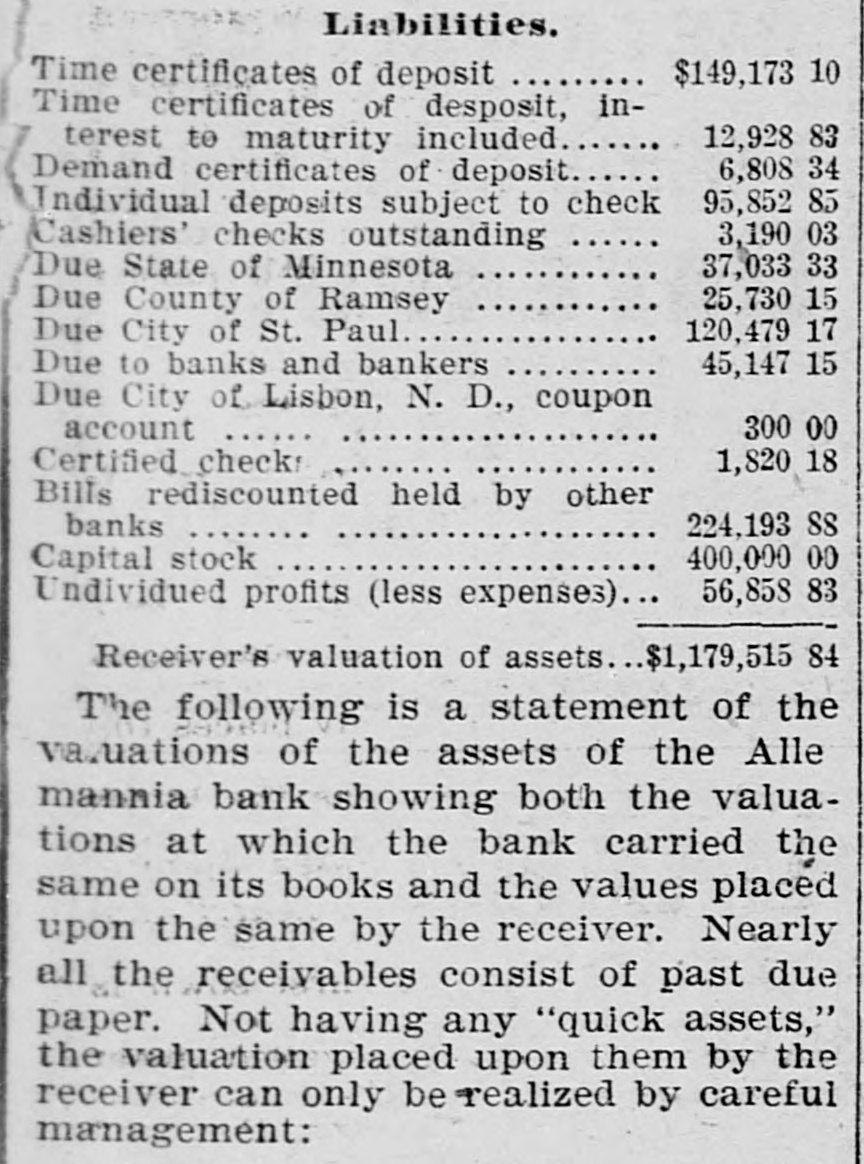
Liabilities. Time certificates of deposit $149,173 10 Time certificates of desposit, in- terest to maturity included 12,928 83 Demand certificates of deposit 6,808 34 Individual deposits subject to check 95,852 85 Cashiers' checks outstanding 3,190 03 Due State of Minnesota 37,033 33 Due County of Ramsey 25,730 15 Due City of St. Paul 120,479 17 Due to banks and bankers 45,147 15 Due City of Lisbon, N. D., coupon account 300 00 Certified checks 1,820 18 Bills rediscounted held by other banks 224,193 88 Capital stock 400,000 00 Undividued profits (less expenses) 56,858 83 Receiver's valuation of assets $1,179,515 84 The following is a statement of the valuations of the assets of the Alle- mannia bank showing both the valuations at which the bank carried the same on its books and the values placed upon the same by the receiver. Nearly all the receivables consist of past due paper. Not having any "quick assets," the valuation placed upon them by the receiver can only be realized by careful management:


Article from The Madison Daily Leader, May 19, 1897

Click image to open full size in new tab

Article Text

GRAND LARCENY CHARGED. President Scheffer of the Allemannia Bank Indicte I at St. Paul. ST. PAUL, May 19.-Another sensational indictment in the bank cases was reported by the grand jury late in the afternoon. the Allemannia bank has been among the list of those that failed during the past winter into whose affairs the grand jury have been looking, and this indictment was for grand larceny against Albert Scheffer, president of that bank. The ground for the charge is an overdraft of his personal account to the amount of $6,475. Mr. Scheffer has for several years been very prominent in Republican politics in the Northwest, serving in the state senate and being recognized as one of the leaders of the party. The Allemannia closed its doors because of a run inaugurated after some of the other banks had failed and has been going through the preliminary steps for reorganizing. President Scheffer was arraigned before Judge Lewis and released on $8,000 bail.


Article from Little Falls Weekly Transcript, May 21, 1897

Click image to open full size in new tab

Article Text

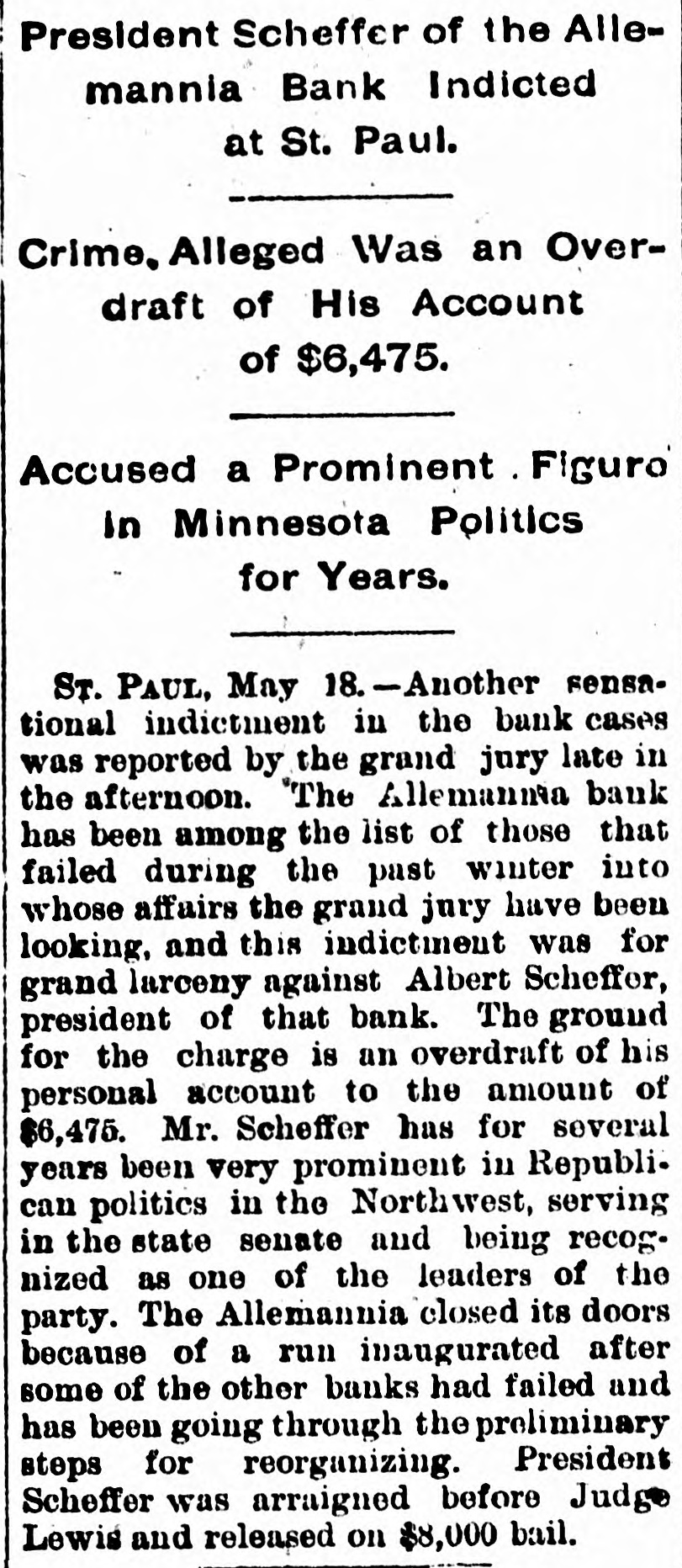
President Scheffer of the Allemannia Bank Indicted at St. Paul. Crime, Alleged Was an Overdraft of His Account of $6,475. Accused a Prominent Figuro in Minnesota Politics for Years. ST. PAUL, May 8.-Another sensational indictment in the bank cases was reported by the grand jury late in the afternoon. The Allemanna bank has been among the list of those that failed during the past winter into whose affairs the grand jury have been looking, and this indictment was for grand larceny against Albert Scheffer, president of that bank. The ground for the charge is an overdraft of his personal account to the amount of $6,475. Mr. Scheffer has for several years been very prominent in Republican politics in the Northwest, serving in the state senate and being recognized as one of the leaders of the party. The Allemannia closed its doors because of a run inaugurated after some of the other banks had failed and has been going through the preliminary steps for reorganizing. President Scheffer was arraigned before Judge Lewis and released on $8,000 bail.


Article from The Saint Paul Globe, June 9, 1897

Click image to open full size in new tab

Article Text

Claims Against the Allemannia. Receiver Auerbach, of the Allemannia bank, is sending out notices to the effect that all claims against that institution must be filed with him on or before June 15 in order to be honored. All claims not so filed will have to be presented later with the formality of going through the tedium of the court.


Article from The Saint Paul Globe, June 11, 1897

Click image to open full size in new tab

Article Text

STATE OF MINNESOTA, COUNTY OF Ramsey - District Court, Second Judicial District. In the matter of the receivership of the Allemannia Bank. The resignation of Maurice Auerbach, as receiver in the above entitled matter, having been tendered to this court, and it appearing desirable that the acceptance of the same, as well as the acceptance of his account as such receiver, and the appointment of a successor, be acted upon with all convenient speed, It is ordered, that the matter of the resignation, accounting and discharge of said Maurice Auerbach, as receiver in this matter, and the appointment of his successor, as receiver herein, be heard by this court at a special term thereof to be held in the Court House in St. Paul, Minnesota, on the 19th day of June, 1897, at 10 o'clock a. m., or as soon thereafter as counsel can be heard. It is further ordered that notice of such hearing be given to all persons interested by serving a copy of this order on Hon. H. W. Childs, attorney general of the state of Minnesota, forthwith, and by publishing the same with all convenient speed in the Daily Pioneer Press, the St, Paul Dispatch and the St. Paul Globe, three daily newspapers printed and published at St. Paul, Minnesota, for two successive days. Dated June 10, 1897. CHAS. E. OTIS, District Judge.


Article from The Saint Paul Globe, June 19, 1897

Click image to open full size in new tab

Article Text

ALLEMANNIA RECEIVERSHIP. Protest to Be Presented Against Cer. tain Names. Today at special term Judge Otis will take up the matter of the resignation of Maurice Auerbach, as receiver of the Allemannia bank. The receiver's account will be submitted and when approved, Mr. Auerbach will be duly discharged. Then will arise the question in which the creditors of the bank are vital interested, and that is, whom shall the court appoint to succeed Mr. Auerbach as receiver or receivers? One set of depositors have already been at work, in proof of which they will submit a petition with a long string of signers urging the court to appoint William Hamm, Bernard Kuhl and J. M. Pottgieser as receivers. But this will not be the only petition. As a result of a meeting of objecting depositors, held at 15 East Third street last night, a committee of the objectors will present a petition requesting the court not to appoint any stockholder, officer or debtor of the Allemannia bank as receiver thereof nor any relative of a stockholder or officer. Last night's meeting was attended by about thirty depositors, O. Silberman presided. The petition was signed by about thirty-five depositors


Article from The Saint Paul Globe, June 19, 1897

Click image to open full size in new tab

Article Text

ALLEMANNIA RECEIVERSHIP. Protest to Be Presented Against Cer. tain Names, Today at special term Judge Otis will take up the matter of the resignation of Maurice Auerbach, as receiver of the Allemannia bank. The receiver's account will be submitted and when approved, Mr. Auerbach will be duly discharged. Then will arise the question in which the creditors of the bank are vital interested, and that is, whom shall the court appoint to succeed Mr. Auerbach as receiver or receivers? One set of depositors have already been at work, in proof of which they will submit a petition with a long string of signers urging the court to appoint William Hamm, Bernard Kuhl and J. M. Pottgieser as receivers. But this will not be the only petition. As a result of a meeting of objecting depositors, held at 15 East Third street last night, a committee of the objectors will present a petition requesting the court not to appoint any stockholder, officer or debtor of the Allemannia bank as receiver thereof nor any relative of a stockholder or officer. Last night's meeting was attended by about thirty depositors, O. Silberman presided. The petition was signed by about thirty-five depositors


Article from The Saint Paul Globe, September 16, 1897

Click image to open full size in new tab

Article Text

ganization set forth in the order are as follows: 1. To pay to the objecting creditors the amount of their respective claims in full. 2. To pay to the state of Minnesota any balance which shall then be due from said bank to said state. 3. To pay or arrange for the payment to the mutual satisfaction of the bank, the county of Ramsey and the city of St. Paul, the amount due to the county and the city. 4. To have returned to the Allemannia bank a certificate of deposit for $10,000 of the West Side Bank of St. Paul, now in the possession of the Mechanics' National Bank of New York, and to make adjustment and mutual offsets of the various claims as to the said bank and the West Side Bank of St. Paul. 5. To pay all of its unsecured indebtedness in five equal installments, and payable, respectively, in 1, 2, 3, 4, and 5 years after the date of the reopening of said bank under said reorganization plan, with interest from the date of such reopening at the rate of 2 per cent per annum. 6. To have an unimpaired capital stock of at least $100,000, and to have cash on hand to the amount of at least $100,000. Continuing, the order provides as follows: The said Allemannia bank, by its officers, shall present to Judge John W. Willis, at his chambers, Monday, Oct. 18, at 12 o'clock, or at such other time, not exceeding ninety days from the date of this order, which the said judge may, on Oct. 18, determine satisfactory evidence in the following facts: 1. That bank has an unimpaired capital stock of at least $100,000 paid up in cash or in approved secured evidence of indebtedness. 2. That it has placed in the hands of its receivers, John D. O'Brien and Timothy R. Palmer, for the parties respectively entitled thereto, the certificates of indebtedness covering all of its secured indebtedness made and executed in the manner and according to the terms and conditions in that behalf hereinbefore set forth. to be by said recoivers held for and delivered to said parties, respectively, on demand and upon the surrender by them to said receivers of such evidences of indebtedness as they may hold, and in place of which such new certificates are to be issued. 3. That bank is pledged to the careful, conservative and economical administration of its affairs, and that until the certificates are paid in full, the president and cashier will devote their whole time and attention to such administration, with salaries not to exceed in the aggregate $5,000 per annum. All other officers of the bank not occupying clerical positions and not devoting their entire time thereto, to receive no compensation for their services. 4. That in payment of the indebtedness of the bank there shall be no preference Or priority, save as herein provided, and all creditors of the same class shall receive like treatment and be paid equally and ratably, provided that the bank may Inticipate and make prepayment of any of its indebtedness upon such terms and conditions as its board of directors may from time to time prescribe, in case in their judgment the best interests of the bank will be thereby subserved. The stockholders present and past of the bank shall not in any way or to any extent be relieved from any existing liability by reason of the reorganization, except as to the amount which any such stockholder shall pay into said bank prior to the reorganization, and "the entry of said udgment of reorganization herein provided for shall operate as a bar to all proceedings and all suits and proceedings now pending against said stockholders or any of them for the enforcement of stockholders' liability, and all such suits and proceedings shall be thereupon dismissed by proper proceedings therein to that end. Speaking of the city's deposit of $120,000, Corporation Attorney Markham said yesterday that he was informed that the officers of the bank were preparing a proposition to be submitted to the common council relative to the payment of the bank's indebtedness to the city. If the proposition was satisfactory to the council it would be accepted. In the meantime the city does not waive any of the rights possessed by the objecting creditors. The immediate payment of the $120,000, Mr. Markham said, was out of the question, as it was impossible to get that amount out of the $100,000 the bank will have on hand when it reopens. Should the bank's proposition prove


Article from The Saint Paul Globe, May 1, 1898

Click image to open full size in new tab

Article Text

ment of Details. The reorganization of the Allemannia bank was practically decided upon, in special term before Judge Willis yesterday, where the entire day was spent in consideration of the questions bearing upon the case. The matter went over, however, without formal adjustment, until April 16, when the final order granting the permission to reopen the bank's doors, it is understood, will be granted. The reorganization plan provides that all creditors objecting to the reorganization shall be paid in full and that the unsecured indebtedness shall be paid in five equal installments. These installments will be paid yearly In one, two, three, four and five years, with interest at 2 per cent. Edward Yanish will be the president of the reopened bank and E. J. Devitt will be the cashier. It Is provided that these two officers shall give their entire attention to the affairs of the institution and shall receive as compensation a salary aggregating not more than $5,000 per annum during the existence of the reorganization plan. The capital stock of the bank is provided for in the sum of $100,000. There is at present $20,000 in the hands of the receivers. In granting a continuance of the case Judge Willis directed an accounting of the receivers April 16. During yesterday's proceedings there were but few objectors among the creditors of the bank to the plan of reorganization and the demands of such of these were met and in a manner leaving no obstacles in the way of the bank resuming business. When the final order of the court is made two weeks from yesterday the institution will be at liberty to open its doors as soon as those having its affairs in charge shall desire. The bank expects to open in the building formerly occupied by the old Commercial bank at Third and Robert street. The Allemannia bank closed its doors Jan. 3, 1897. Shortly afterward Maurice Auerbach was appointed receiver. Mr. Auerbach subsequently resigned and was succeeded by Edward Yanish. The petition of Albert Scheffer, on behalf of a majority of the creditors for the reorganization of the bank, was filed April 9, 1897, and the matter has since been in litigation in the district seourt.


Article from The Saint Paul Globe, May 27, 1898

Click image to open full size in new tab

Article Text

BANK TO REOPEN TODAY ALLEMANNIA TO RESUME ON EAST THIRD STREET Judge Willis Formally Announces in District Court the Terms on Which the Reorganization Is to Be Permitted-Those Who Helped With Cash Are to Be Exempt From Further Liability. The Allemannia bank will throw open Its doors for business this morning, under an order issued by Judge Willis in the district court yesterday afternoon. The reorganization plan was formally submitted to Judge Willis in chambers yesterday by the creditors and an hour later the final judgment and decree. authorizing the bank to again begin business and approving of the reorganization plan, were filed. In his decree Judge Willis deals in a brief way with the indebtedness of the bank and the plans that have been made to discharge the obligations. He approves of the reorganization plan and confirms it, and orders that title to all property in the hands of the receivers pass to the bank. Under the decree the bank is compelled to resume business today and will at once pay to the city in cash $24,770.51, and certificates of indebtedness for the balance due. $5,289.12 must be paid at once to Ramsey county with certificates of indebtedness for the balance due and the state will receive in cash $20,482.80. It is further ordered that all the creditors objecting to the reorganization plan, sixteen in number, shall be paid in full. These sixteen claims aggregate $14,496.54. The remainder of the indebtedness will be paid in five equal installments, one, two, three, four and five years from date. All creditors with unsecured indebtedness are restrained from enforcing or attempting to enforce payment of their claims except in accordance with the plans of reorganization. It is provided that the capital stock shall be reduced to $100,000, but the present stockholders shall not be released in any way from any existing liability by reason of the reorganization, except those that have, prior to the reorganization, paid into the bank money to aid in the reorganization. Such stockholders are released from further liability on the amounts so paid in. Judge Willis states that the entry of the decree shall operate as a bar to all further proceedings in any and all suits and proceedings now pending in the courts against the stockholders of the bank in the enforcement of stockholders' liability, and that all such suits are to be dismissed on eight days' notice. It is provided that until the indebtedness of the bank is satisfied the president and cashier shall give their undivided attention to the affairs of the bank at a joint salary not to exceed $5,000 per year, and that no other offlcials in the bank, except those occupying clerical positions, shall receive pav. With the decree of Judge Willis was filed the final report and account of the receivers, Timothy R. Palmer and J. D. O'Brien. The report shows that the total receipts from all sources were $59,430.97, of which $30,525.97 was for notes, rents, interest, etc., and $28,905 amounts paid in by stockholders and others. The total amount of bills receivable collected was $18,255.47. The total disbursements were $9,449.51 and cash on hand, $49,981.46.


Article from The Saint Paul Globe, May 28, 1898

Click image to open full size in new tab

Article Text

CITY WAS PAID EARLY. Allemannia Bank Pays Off an Old Obligation. City Treasurer Horst yesterday received the first installment of the moneys to be paid to the city under the plan of reorganization of the Allemannia bank. It was in the form of a check for $24,770.51, which was perfectly good. The payment is the first made of five that were provided for. The payments were arranged and the pledges put in tangible form by the issuance of five certificates of deposits ranging over a period of five years. By an understanding arrived at with the city treasurer the last of these certificates was paid first, and the others will be paid at the end of each year for four years. State Treasurer Koerner also received $21,482.60, that being the sum which the state had in the Allemannia bank at the time that it suspended.


Article from The Saint Paul Globe, May 1, 1899

Click image to open full size in new tab

Article Text

DEBTS OF ALLEMANNIA. Mr. Welz's Application Suggests a Hitch in the Plans. The application made to the board of county commissioners by F. R. Welz, that a settlement be made by the county for $7,000 in cash to cover the $20,000 due from the Allemannia bank, is under consideration. When the Allemannia closed its doors in January, 1897, it had on deposit $25,000 belonging to the county and $123,000 of the city funds on its books. Receivers were appointed, and after these officers were discharged and the bank started on a reorganization an agreement was made by which one-fifth of the amounts due the county and city were paid in cash, and the balance to be met, with certificates of indebtedness running for four years and drawing 2 per cent interest. The county treasury received $5,289.12 as the first of the five payments, and the city treasury received $24,770.51. The other certificates, the first of which are due and payable to the city and county next month, are in the hands of the respective treasurers. The application of Mr. Welz, who is one of the securities on the bond given the county by the bank, would indicate that there will be some hitch in the payment of the first certificate due the county by the reorganized bank. In fact Mr. Welz, in his application, states that the certificates cannot be paid by the bank. Edward Yanish, president of the reorganized Allemannia bank, seen Saturday evening, said he did not care to discuss the matter. As to whether the bank would again go into the hands of a receiver Mr. Yanish also declined to discuss. The agreement made between the city and the bank provides that in case of failure to pay any of the certificates given in the settlement action shall be commenced against the sureties on the bond given the city for the original deposit. The first certificate, for $24,770.51, given to the city is due May 23. City Treasurer Horst stated that he had heard nothing about the possibility of a default in the payment of the first certificate given by the bank. The amount still owing the city is $99,082.04.


Article from The Saint Paul Globe, April 15, 1900

Click image to open full size in new tab

Article Text

WHEN THE ALLEMANNIA BANK SUSPENDED IN 1898 THE CITY HAD ON DEPOSIT OVER $100,000 IN THE INSTITUTION. IN MAY, 1899, THE CITY OFFICIALS ACCEPTED $30,957 IN FULL FOR THE AMOUNT DUE THE CITY FROM THE BANK. HERE IS A CHANCE FOR M'CARDY TO INFORM THE VOTERS ABOUT A DEBT REDUCTION. AS THE BANK OFFICIALS AND THE BONDSMEN ARE "OUR PEOPLE" THE CHANCES ARE THAT M'CARDY WILL NOT SAY A WORD.


Article from The Saint Paul Globe, April 15, 1900

Click image to open full size in new tab

Article Text

WHEN THE ALLEMANNIA BANK SUSPENDED IN 1898 THE CITY HAD ON DEPOSIT OVER $100,000 IN THE INSTITUTION. IN MAY, 1899, THE CITY OFFICIALS ACCEPTED $30,957 IN FULL FOR THE AMOUNT DUE THE CITY FROM THE BANK. HERE IS A CHANCE FOR M'CARDY TO INFORM THE VOTERS ABOUT A DEBT REDUCTION. AS THE BANK OFFICIALS AND THE BONDSMEN ARE "OUR PEOPLE" THE CHANCES ARE THAT M'CARDY WILL NOT SAY A WORD.


Article from The Saint Paul Globe, April 15, 1900

Click image to open full size in new tab

Article Text

THE WHEN ALLEMANNIA BANK SUSPENDED IN 1898 THE CITY HAD ON \DEPOSIT OVER $100,000 IN THE INSTITUTION. IN MAY, 1899, THE CITY OFFICIALS ACCEPTED $30,957 IN FULL FOR THE AMOUNT DUE THE CITY FROM THE BANK. HERE IS A CHANCE FOR M'CARDY TO INFORM THE VOTERS ABOUT A DEBT REDUCTION. AS THE BANK OFFICIALS AND THE BONDSMEN ARE "OUR PEOPLE" THE CHANCES ARE THAT M'CARDY WILL NOT SAY A WORD.


Article from The Saint Paul Globe, July 4, 1902

Click image to open full size in new tab

Article Text

ASSESSED TOO HIGH Supreme Court Supports Po sition Taken by Allemannia Stockholders NEED NOT PAY TWICI Receiver's Action in Calling for Ful Assessment From Those Who Had Paid 50 Per Cent IllegalOther Decisions. In his appeal to the supreme cour from the ruling of the Ramsey count district court in the Allemannia banl cases, W. F. Hunt, receiver of th bank, has gained nothing. The highe tribunal, in a decision handed dow: yesterday, upholds the trial court 1: the judgment that the stockholders o the bank who paid half of the amoun of their liability for the reorganization of the institution after its first failur are liable only for the remainder 0 their stock liability. This point wa tested upon the question of the liabil ity of Charles C. Roosen, who held $50 of stock in the bank and paid $250 to ward the reorganization. Mr. Hunt who was appointed receiver of th bank subsequent to this reorganiza tion, sued all of the stockholders fo the full amount of their statutory lia bility, and on behalf of the plaintiff question was raised as to the legalit of the reorganization. The amount in volved in this decision of yesterday 1 aproximately $100,000. Another highly important decision 0 yesterday is that in the case of th Minneapolis Fire and Marine Insur ance company, in which also the cour affirms the order of the trial court The purpose of this suit was to enforc the liability of stockholders of the Min neapolis Fire and Marine Mutual In surance company, and by reason 0 the fact that the receivers of the com pany, William S. Dwinnell and John 0 Sweet, were unable to produce a cer tain note of $1,000, which was claime to have been a part of the company' guaranty fund, it could not be prover that the company had ever been legall; authorized to do a marine insuranc business, and therefore it was held b; both trial and the supreme court tha the stockholders could not be held t be liable under $199,000 of similar note which went to make up the remainde of the guaranty fund. The note 11 question was said to have been signe by Frank Heywood, a business man o Minneapolis, and one of the stockhold ers of the company. The syllabi in the above, and othe cases decided yesterday, are as fol lows: Cannot Be Assessed Twice. Wm. F. Hunt. as Receiver of the Alle mannia Bank, Appellant, vs. Charles G Roosen, Respondent. banking corporation organized under th 1. The Allemannia Bank of St. Paul, banking corporation organized under th laws of the state, became insolvent 1 1897, and receivers were appointed t take charge of and wind up its affairs Subsequently, in April following, the ap pointment of receivers, a majority of th creditors petitioned the district court 0 Ramsey county to permit and authorize under chapter 89, Laws 1897, a reorgan ization of the bank on the terms an conditions of that statute, but was afte due hearing ordered dismissed. Som four months subsequently, but without no tice to creditors and interested parties the same petition was again presented t that court, but to a judge other than th judge who had previously ordered it dismissal, granted its prayer and ordere the entry of final judgment approving an adopting the proposed plan of reorganiza tion, and adjudging and determinin therein and thereby that all stockholder who should pay any portion of their liabil ity as such to aid and assist in the pur poses of the reorganization should be re leased from their statutory liability t the extent of the amount so paid. The re ceivers were thereupon discharged, an the officers of the bank resumed contro of its affairs and issued to all the cred itors, payable in five equal annual in stallments certificates of deposit for th amount of their respective claims, whic the creditors accepted and retained an at no time did any of them, who are no creditors. in any way call in questio the validity of the reorganization or th judgment authorizing it. Defendant wa a stockholder of the corporation and paid in reliance upon the terms of judgment one-half the par value of the stock hel by him to aid in the reorganization: whic was affected in the interests of creditor and for the payment of their debts. is held: (1). That the findings of th trial court to the effect that all the cred itors of the bank acquiesced in and sus tained by the evidence; and (2), tha though the judgment adopting and ap proving the plan of reorganization wa void, because based upon a petition whic had been dismissed, the creditors who ac quiesced therein and accepted and re tained benefits accruing therefrom ar estopped from now calling the validity o such proceedings in question. 2. Section 4, C. 89, Laws 1897. con strued and held to preserve and continu the liability of stockholders, notwith standing a sale of their stock to a perio