Columbiana Bank (Lisbon, OH)

Episode Information

Episode UID
530732790503
Episode Type
Suspension โ†’ Closure
Bank Type
state
Bank ID
53073279 hash
Start Date
November 29, 1841
Location
Lisbon, Ohio (40.775, -80.763)

Metadata

Model
gpt-5-mini (chosen from majority vote of a three-model LLM ensemble)
Short Digest
62bc5d4ff065ff63

Response Measures

None

Description

Charter expiration and stockholders called to wind up affairs indicate voluntary winding up/closure.

Events (2)

1. November 29, 1841 Other
Newspaper Excerpt
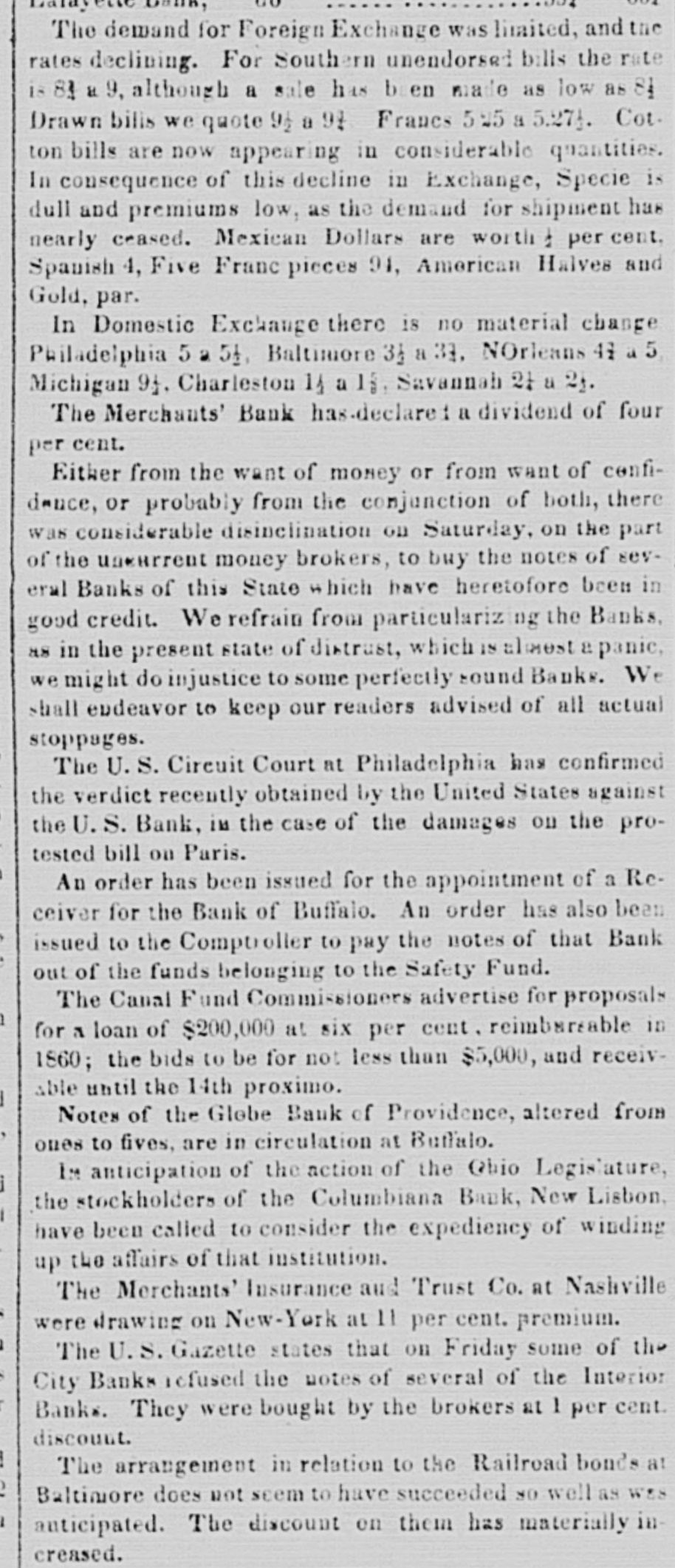
In anticipation of the action of the Ohio Legislature, the stockholders of the Columbiana Bank, New Lisbon, have been called to consider the expediency of winding up the affairs of that institution.
Source
newspapers
2. January 1, 1843 Suspension
Cause
Voluntary Liquidation
Cause Details
Charter expired on January 1, 1843, implying winding up/cessation of banking operations.
Newspaper Excerpt
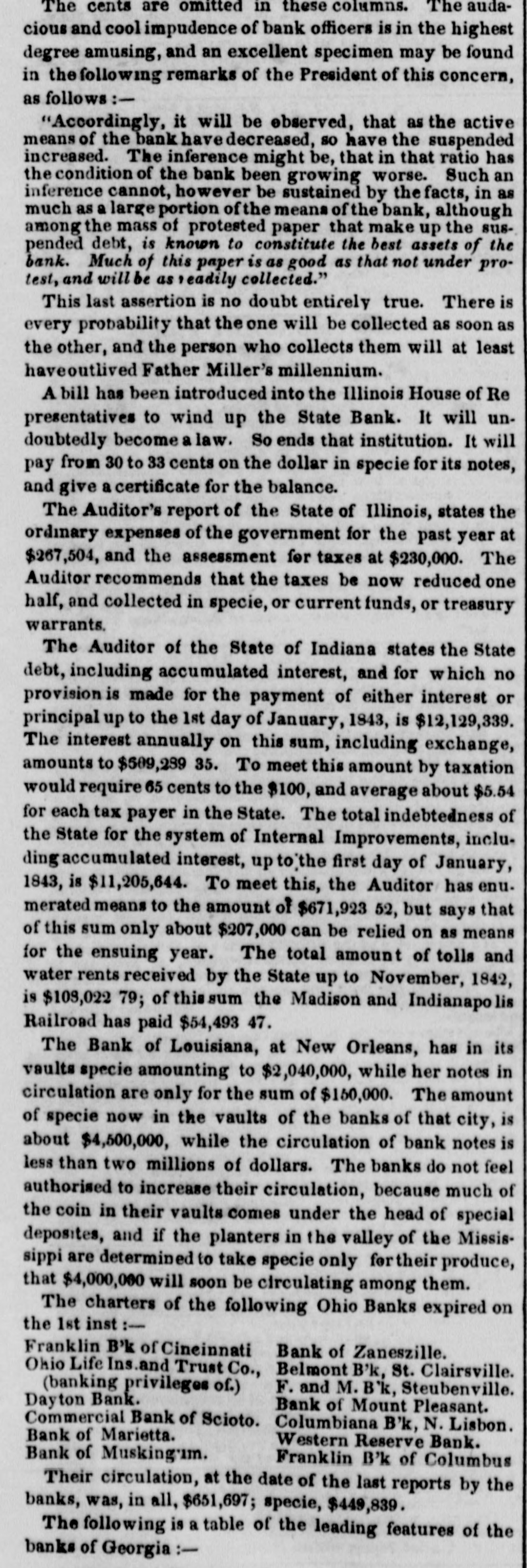
The charters of the following Ohio Banks expired on the 1st inst: ... Columbiana B'k, N. Lisbon.
Source
newspapers

Newspaper Articles (2)

Article from New-York Tribune, November 29, 1841

Click image to open full size in new tab

Article Text

00 Larayett Dath, The demand for Foreign Exchange was limited, and the rates declining. For Southern unendorsed bills the rate is 81 it 9, although a sale has been made as low as 81 Drawn bills we quote 9/2 a 92 Francs 525 a 5.273. Cot. ton bills are now appearing in considerable quantities. In consequence of this decline in Exchange, Specie is dull and premiums low, as the demand for shipment has nearly ceased. Mexican Dollars are worth & per cent. Spanish 4, Five Franc pieces 91, American Halves and Gold, par. In Domestic Exchange there is no material change Philadelphia 5 a 54, Baltimore 31 a 33. NOrleans 43 is 5 Michigan 91. Charleston 11 a 15. Savannah 21 u 21. The Merchants' Bank has-declared a dividend of four per cent. Either from the want of money or from want of centidance, or probably from the conjunction of both, there was considerable disinclination on Saturday, on the part of the uncurrent money brokers, to buy the notes of several Banks of this State which have heretofore been in good credit. We refrain from particularizing the Banks, as in the present state of distrust, which 18 almost a panic, we might do injustice to some perfectly sound Banks. We shall endeavor to keep our readers advised of all actual stoppages. The U.S. Circuit Court at Philadelphia has confirmed the verdict recently obtained by the United States against the U.S. Bank, in the case of the damages on the protested bill on Paris. An order has been issued for the appointment of a Receiver for the Bank of Buffalo. An order has also been issued to the Comptroller to pay the notes of that Bank out of the funds belonging to the Safety Fund. The Canal Fund Commissioners advertise for proposals for a loan of $200,000 at six per cent. reimbarrable in 1860; the bids to be for not less than $5,000, and receivable until the 14th proximo. I Notes of the Globe Bank of Providence, altered from ones to fives, are in circulation at Buffalo. In anticipation of the action of the Ohio Legislature, i the stockholders of the Columbiana Bank, New Lisbon. have been called to consider the expediency of winding up the affairs of that institution. The Merchants' Insurance and Trust Co. at Nashville were drawing on New-York at 11 per cent. premium. The U.S. Gazette states that on Friday some of the City Banks refused the notes of several of the Interior Banks. They were bought by the brokers at 1 per cent. discount. ! The arrangement in relation to the Railroad bonds at Baltimore does not seem to have succeeded 30 well as was I anticipated. The discount on them has materially increased.

Article from The New York Herald, January 10, 1843

Click image to open full size in new tab

Article Text

The cents are omitted in these columns. The audacious and cool impudence of bank officers is in the highest degree amusing, and an excellent specimen may be found in the following remarks of the President of this concern, as follows :"Accordingly, it will be observed, that as the active means of the bank have decreased, so have the suspended increased. The inference might be, that in that ratio has the condition of the bank been growing worse. Such an inference cannot, however be sustained by the facts, in as much as a large portion of the means of the bank, although among the mass of protested paper that make up the suspended debt, is known to constitute the best assets of the bank. Much of this paper is as good as that not under protest, and will be as eadily collected." This last assertion is no doubt entirely true. There is every probability that the one will be collected as soon as the other, and the person who collects them will at least haveoutlived Father Miller's millennium. A bill has been introduced into the Illinois House of Re presentatives to wind up the State Bank. It will undoubtedly become a law. So ends that institution. It will pay from 30 to 33 cents on the dollar in specie for its notes, and give a certificate for the balance. The Auditor's report of the State of Illinois, states the ordinary expenses of the government for the past year at $267,504, and the assessment for taxes at $230,000. The Auditor recommends that the taxes be now reduced one half, and collected in specie, or current funds, or treasury warrants. The Auditor of the State of Indiana states the State debt, including accumulated interest, and for which no provision is made for the payment of either interest or principal up to the 1st day of January, 1843, is $12,129,339. The interest annually on this sum, including exchange, amounts to $509,289 35. To meet this amount by taxation would require 65 cents to the $100, and average about $5.54 for each tax payer in the State. The total indebtedness of the State for the system of Internal Improvements, including accumulated interest, up to the first day of January, 1843, is $11,205,644. To meet this, the Auditor has enu. merated means to the amount of $671,923 52, but says that of this sum only about $207,000 can be relied on as means for the ensuing year. The total amount of tolls and water rents received by the State up to November, 1842, is $103,022 79; of this sum the Madison and Indianapo lis Railroad has paid $54,493 47. The Bank of Louisiana, at New Orleans, has in its vaults specie amounting to $2,040,000, while her notes in circulation are only for the sum of $150,000. The amount of specie now in the vaults of the banks of that city, is about $4,500,000, while the circulation of bank notes is less than two millions of dollars. The banks do not feel authorised to increase their circulation, because much of the coin in their vaults comes under the head of special deposites, and if the planters in the valley of the Mississippi are determined to take specie only for their produce, that $4,000,000 will soon be circulating among them. The charters of the following Ohio Banks expired on the 1st inst :Franklin B'k of Cineinnati Bank of Zaneszille. Okio Life Ins and Trust Co., Belmont B'k, St. Clairsville. (banking privileges of.) F. and M.B'k, Steubenville. Dayton Bank. Bank of Mount Pleasant. Commercial Bank of Scioto. Columbiana B'k, N. Lisbon. Bank of Marietta. Western Reserve Bank. Bank of Musking-im. Franklin B'k of Columbus Their circulation, at the date of the last reports by the banks, was, in all, $651,697; specie, $449,839. The following is a table of the leading features of the banks of Georgia :-