National Bank of Kentucky (Louisville, KY)

Episode Information

Episode UID
531201571
Episode Type
Run โ†’ Suspension โ†’ Closure
Bank Type
national
Bank ID
53120 national
Charter Number
5312
Start Date
November 17, 1930
Location
Louisville, Kentucky (38.254, -85.759)

Metadata

Model
gpt-5-mini (chosen from majority vote of a three-model LLM ensemble)
Short Digest
ba244ad0a1b3e280

Response Measures

Public signal of financial health, Full suspension, Books examined

Receivership Details

Depositor recovery rate
77.0%
Date receivership started
1930-11-17
OCC cause of failure
Governance
Share of assets assessed as good
56.0%
Share of assets assessed as doubtful
28.9%
Share of assets assessed as worthless
15.1%

Description

Bank was placed in hands of a federal receiver on Nov. 17, 1930 and did not resume operations; later litigation and liquidation proceeded.

Events (6)

1. April 28, 1900 Chartered
Source
historical_nic
2. November 17, 1930 Receivership
Source
historical_nic
3. November 17, 1930 Receivership
Newspaper Excerpt
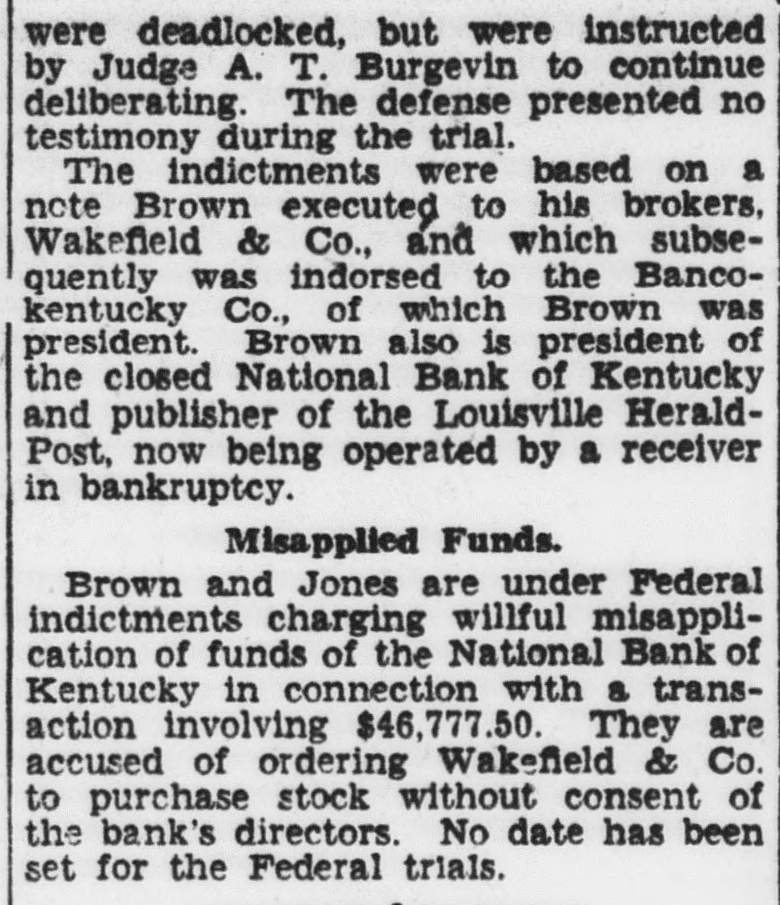
The National Bank of Kentucky ... was placed in the hands of Paul Keyes of the federal comptroller's office as receiver.
Source
newspapers
4. November 17, 1930 Run
Cause
Bank Specific Adverse Info
Cause Details
Withdrawals accelerated by circulating rumors and adverse publicity linking the bank with Caldwell & Co.; examiners' reports showed large doubtful assets and heavy losses.
Measures
Board resolved to close the bank temporarily; other local banks issued statements of solvency and some closed as precaution.
Newspaper Excerpt
Alarmed at the closing of the National Bank of Kentucky, depositors today started a run on practically every bank in the city.
Source
newspapers
5. November 17, 1930 Suspension
Cause
Government Action
Cause Details
Board resolution placed the bank in the hands of the national bank examiner/receiver following heavy withdrawals and unresolved problems identified by examiners.
Newspaper Excerpt
The National Bank of Kentucky ... was closed today by resolution of its board of directors and placed in the hands of national bank examiner.
Source
newspapers
6. December 1, 1930* Other
Newspaper Excerpt
Paul Keyes, receiver for the National Bank of Kentucky, was subpoenaed ... for questioning in investigation of bank closings here.
Source
newspapers

Newspaper Articles (25)

Article from Times Herald, November 17, 1930

Click image to open full size in new tab

Article Text

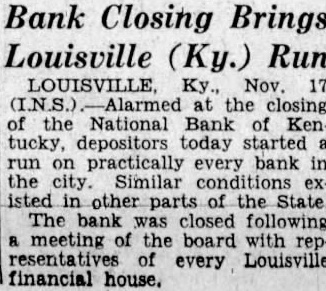
Bank Closing Brings Louisville (Ky.) Run LOUISVILLE, Ky., Nov. 17 (I.N.S.) at the closing of the National Bank of Kentucky, depositors today started a run on practically every bank in the city. Similar conditions existed in other parts of the State. The bank was closed following a meeting of the board with rep resentatives of every Louisville financial house.


Article from The Paducah Sun, November 17, 1930

Click image to open full size in new tab

Article Text

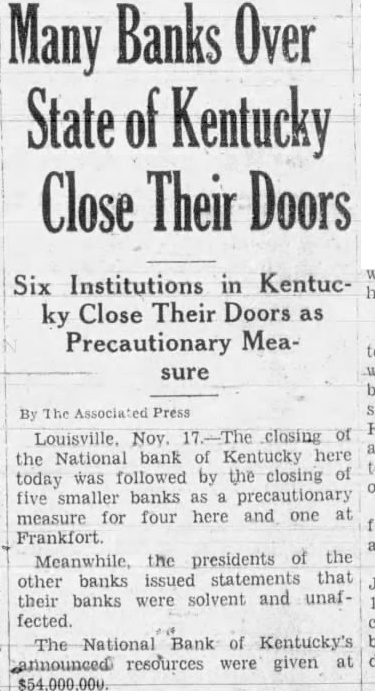
National of Kentucky Closes Five Smaller Banks Closed as Precautionary Move LOUISVILLE, KY., Nov. Closing the National Bank Kentucky here today followed five smaller banks closing as precautionary measure. here and one in Franklin, Ky. Meanwhile presidents of the other banks in city issued statements asserting their solvent every respect and would not affected. The National Bank of Kentucky which James Brown president was placed the hands of Paul Keyes of the federal comptrolgeneral's office as receiver. The other Louisville banks closed the Security Bank which was stated was closed purely precaution; the Louisville Trust Company which is affiliated with the National Bank of Kentucky, and two small Negro banks, the American Union Savings Bank and the First Standard Bank. The latter two members local clearing house association but their clearing through the Louisville Trust Company. Bankers Optimistic The McElwain Bank and Trust company Franklin, the fifth close. Its said had to shut because the National Bank Kentucky one of its correspondents and that its depositors would paid in full. In Louisville slightly more than the normal numbers patrons gathered the other banks but nothing approaching was noted and bank officials issued timistic statements that the public would not become excited. Crowds the National Bank Kentucky and the Louisville Trust Company delayed traffic slightly and special police were duty. LOUISVILLE, Nov. National Bank of Kentucky, the oldest bank in Kentucky, was closed today by resolution of its board of directors and placed in the hands of national bank examiner. The Louisville Trust company, an affiliated institution, also closed by action of its board of directors. James Brown, president of the National Bank of Kentucky, issued the following statement: "Due to withdrawals in the past and constantly rumors on the streets was deemed advisable by majority of the board of directors to close the bank, least temporarily, for the best interests of depositors and all concerned." Presidents of other Louisville banks issued statements that their institutions were solvent. The National Bank Kentucky, founded in 1834 the Bank Kentucky, and capitalized at $5.last statement listed and deposits Act Protect Creditors Directors of the bank in their resolution the action was taken conserve resources of this bank for the benefit of its crediDirectors of the trust com-


Article from The Washington Times, November 17, 1930

Click image to open full size in new tab

Article Text

Bank Closing Brings Louisville (Ky.) Run LOUISVILLE, Ky Nov. 17 (I.N.S.).-Alarmed at the closing of the National Bank of Kentucky, depositors today started a run on practically every bank in the city. Similar conditions existed in other parts of the State. The bank was closed following a meeting of the board with representatives of every, Louisville financial house,


Article from Martinez News-Gazette, November 17, 1930

Click image to open full size in new tab

Article Text

Closing of Bank Institutes "Runs" LOUISVILLE. Ky., Nov. (INS) -Alarmed at the closing of the National Bank of Kentucky, positors today started a run practically every bank in the city. Similar conditions existed in other parts of the state. Most of the institutions *ssued statements declaring, they had no connection with the Bank of Kentucky.


Article from Abilene Daily Reporter, November 17, 1930

Click image to open full size in new tab

Article Text

THIRTY BANKS CLOSE IN ARK Continued from Page financial difficulties of Caldwell Company, bankers Tenn." also said affairs Caldwell & remote Arkansas nothing but an from excited public could have forced closing of this strong Nov. the closing the National Bank of Kentucky. today started run depositors every the city practically Similar existed in other parts the Most institutions issued of statements they no connection with the bank of Kentucky. The bank was closed following meeting of the board with repreof Louisville finanhouse. The meeting was in cial session from p.m. Saturday until 10 p.m. Sunday, when agreed that no immediate solution could be attained. SPRINGFIELD, Ill., Nov. Illinois banks were closed today, the number of failures in the state since Friday The Bartlett and Wallace State bank, Clayton. and Timewell State bank, Timewell, were closed today, auditor Oscar Nelson announced. All the closings in connection with the failure of the State Savings Loan and Trust company of Qunicy, which Timewell and Clayton institutions were correspondents. Timewell bank had deposits of $150,000 and the Clayton bank $50,000. NASHVILLE, Tenn., Nov. 17. Federal Judge John Gore today sustained for creditors' bill against Caldwell Company, investment banking house and dered to their claims before next July JEFFERSON CITY, Mo., Nov. Exchange bank, Rutledge, in with total of $43,790, and the Downing State bank, at Downing, in Schuyler county, were clostoday placed the hands the state finance department. The Downing bank had total resources of $193,929. Both banks were closed as sult the failure recently of the State Savings Loan Trust company Quincy, III., where they transacted business. LOUISVILLE, Ky., Nov. 17. Security bank, affiliated the bank Louisville Trust company through inclusion in the company, temporary suspension here today. LOUISVILLE Ky., Nov. 17.Kentucky, the oldest bank Kentucky, was closed by resolution of its board of placed the hands National bank examiner. The Trust company, an was closed by action of its board James B. Brown, president of the National of Kentucky, issued the to withdrawals in the past week and ruon the streets was advisable majority of the board of directors to close the bank, least temporarily, for the best interests of depositors and all concerned." Presidents of other Louisville banks issued statements that their institutions were solvent.


Article from The Oakland Post Enquirer, November 17, 1930

Click image to open full size in new tab

Article Text

Run on Banks In Louisville LOUISVILLE, Ky., Nov. 17 (INS)Alarmed at the closing of the National Bank of Kentucky, depositors today started run on practically every bank in the city. Similar conditions existed in other parts of state. Most of the institutions issued statements declaring they had no connection with the Bank of Kentucky.


Article from The Daily Plainsman, November 18, 1930

Click image to open full size in new tab

Article Text

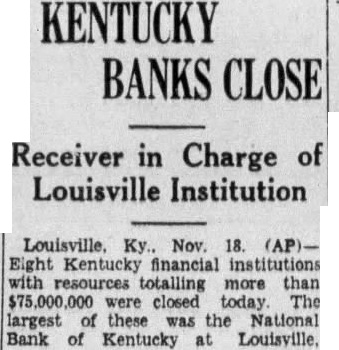
Eight Kentucky Banks Are Closed Eight Kentucky financial institutions with resources totaling more than $75.030,000 were closed today. The largest of these was the National Bank of Kentucky, at Louisville, which was under the


Article from The Journal, November 18, 1930

Click image to open full size in new tab

Article Text

KENTUCKY BANKS CLOSE Receiver in Charge of Louisville Institution Louisville. Ky., Nov. 18. (AP)Eight Kentucky financial institutions with resources totalling more than $75,000,000 were closed today The largest of these was the National Bank of Kentucky at Louisville.


Article from The Indianapolis Times, November 20, 1930

Click image to open full size in new tab

Article Text

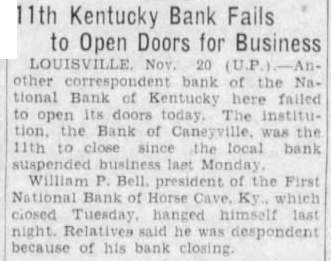
Kentucky Bank Fails By United Press LOUISVILLE, Nov. 20.-Another correspondent bank of the National Bank of Kentucky here. failed to open it's doors today. The institution, the bank of Caneyville, was the eleventh to close since the local bank suspended business last Monday.


Article from The Wichita Eagle, November 20, 1930

Click image to open full size in new tab

Article Text

was found hanging in a barn behind his residence late today. The First National bank suspended operations when the directors learned the National Bank of Kentucky, at Louisville, had closed. The Louisville institution was correspondent for the local bank. Daughters of Isabella will hold a benefit bridge Friday at p. m. at the Johnson Brothers Electric club hall, 211 South Lawrence


Article from The Buffalo News, November 20, 1930

Click image to open full size in new tab

Article Text

11th Kentucky Bank Fails to Open Doors for Business LOUISVILLE bank of the tional Bank of Kentucky here failed to open doors The tion the Bank of Caneyville, was the 11th to bank last William Bell First Ky Tuesday last Relatives said despondent of his bank closing.


Article from Mount Vernon Argus, November 29, 1930

Click image to open full size in new tab

Article Text

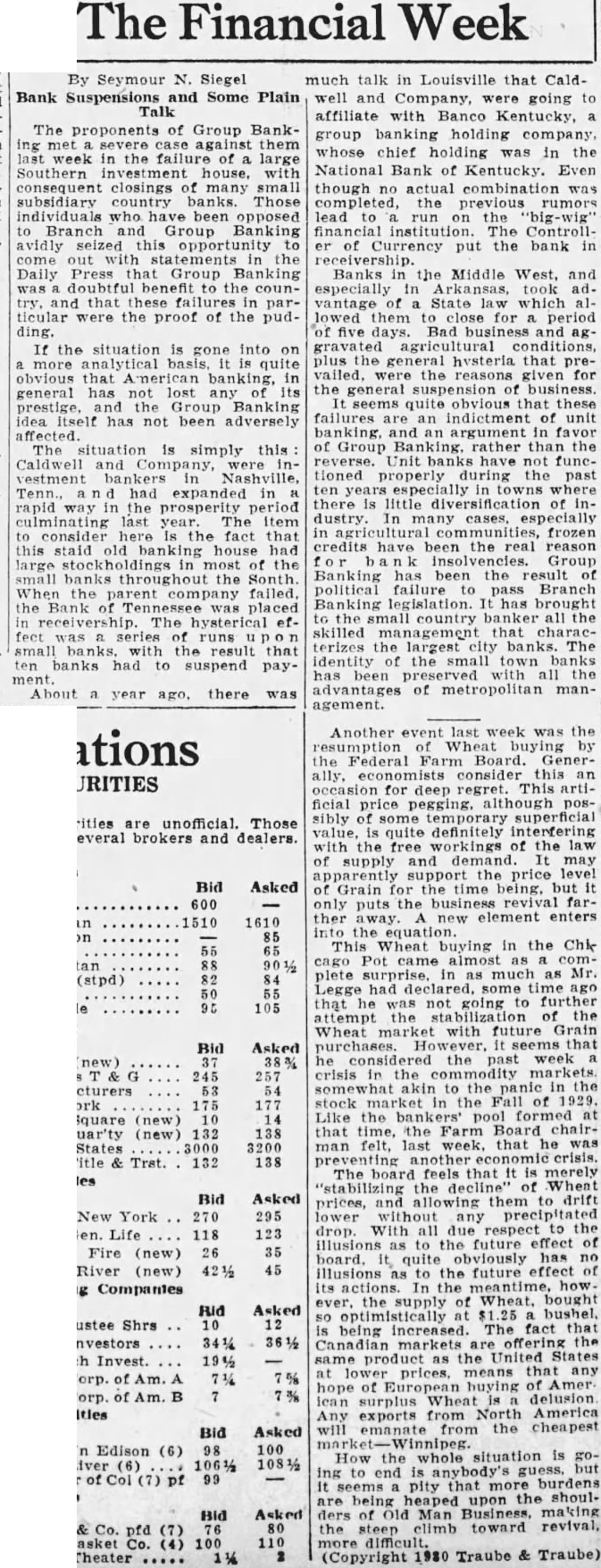
The Financial Week By Seymour N. Siegel Bank Suspensions and Some Plain Talk The proponents of Group Bankagainst them last week in the failure large Southern investment house, with consequent closings of many small subsidiary country banks. Those individuals who have been opposed to Branch and Group Banking avidly seized this opportunity to come statements Daily Press Group Banking the counthat in particular were the proof of the pudding. If the situation is gone into on more analytical basis, quite obvious that American banking, general has not lost any its prestige. the Group Banking idea has not been adversely affected. The situation is simply this Caldwell and vestment bankers Nashville, Tenn. had expanded in rapid way the prosperity period culminating last year. The Item to consider here is the fact that this staid old house had large most the small the Sonth the Bank of placed receivership. The hysterical effect series of runs u banks, with result that ten banks had to suspend payAbout year ago, there was much talk in Louisville that Caldwell and Company, were going to affiliate with Banco Kentucky, group banking holding company, whose chief holding was in the National Bank of Kentucky. Even though actual combination completed, the previous rumors lead to run on the financial institution. The Controller of Currency put the bank in receivership. Banks the Middle West, and in took vantage of State law which lowed for period five days. Bad ag. gravated agricultural conditions, plus general hysteria that prevalled, were reasons given for the general suspension of business. that these failures an indictment of unit banking, argument in favor of Group Banking. rather than the reverse. Unit banks not funetioned properly during the past ten especially in towns where there is little diversification of industry. In many cases, especially in frozen credits have been the real reason insolvencies. Group Banking has been the result political failure to pass Branch Banking legislation. has brought the small country banker all the skilled management that characterizes the largest city The identity the banks has been with the advantages of metropolitan management. Another event last week was the resumption of Wheat buying by the Federal Board. Generally, this for regret. artificial pegging, although possibly some temporary superficial value, quite definitely interfering with the free workings of the law of supply and demand. It may apparently support the price of Grain for the being, only puts the farther new element enters into the equation. This Wheat buying in the Chk cago Pot came almost as plete surprise. in as much as Mr. Legge had declared. ago that not going to further the of the attempt Wheat with future Grain purchases. seems that he the past week crisis the markets somewhat akin to the panic in the stock market the of 1929 Like the formed at the Farm chairthat time, man felt, last week, that he crisis. The board feels that It merely "stabilizing the decline" of prices, allowing them drift lower without any precipitated drop. With all due the future effect of board. quite obviously has illusions to the future effect its actions. In the meantime, how supply of Wheat. bought ever. optimistically being increased. The fact that Canadian offering the as the United at prices, means that any hope of European buying Amer lean surplus Wheat delusion exports from North America will emanate from the cheapest How the whole situation is ing end is that burdens pity being heaped upon the shoulof Old Man making the steep climb toward more difficult. (Copyright 1980 Traube & Traube) years.


Article from The Town Talk, December 6, 1930

Click image to open full size in new tab

Article Text

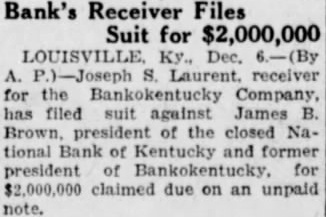
Bank's Receiver Files Suit for $2,000,000 LOUISVILLE, Ky., Dec. S. Laurent. receiver for the Company, filed suit against James Brown, of the closed National Bank of Kentucky and president for $2,000,000 claimed due on an unpaid note.


Article from The Lewiston Daily Sun, December 12, 1930

Click image to open full size in new tab

Article Text

BANKER BANKRUPT LOUISVILLE, Dec. -James President of National Bank Kentucky and former President the Banco tucky filed voluntary petition Federal of institutions the which are the hands receivers.


Article Text

SUBPOENA BANK RECEIVER LOUISVILLE. Jan. 13 (By Paul Keyes, receiver for the National Bank of Kentucky, was subpoenaed today to appear before the grand jury Friday for questioning in Commonwealth Attorney W. Clark Otte's investigation of bank closings here. Keyes said he would gladly answer all questions concerning the


Article Text

Body of Arlene Draves Exhumed While Curious Throng Watches (Continued from First Page.) table Coroner W. L. Henry lifted lid. brother and sister stood Arlene's the foot the coffin. quietly Charles elderly to sobbed just the started as they beThe spectators held the body the three months dead. The were rouged. the eyes and the After Arlene's relatives had looked the body authorupon ities cleared the room all but the two for the State and two physicians, physicians remained the while the room again in October, 1927, by Chief Examiner institution was required to charge estimated of $137,000 April, and was charged in the in October The was severely account cessive loans, credit slow and doubtful aslines and matters less sets, Both serious and chief examiner the setting detail all criticisms of the bank, and mat- the and stated ters needing of the bank reports the affairs by President are James Calls Unsafe Banker. apparent the "Although controller that examiners was not safe shown disregard and had the for the and although charged the of to shake the faith did not seem the president bank. directors of in 1927 letters based on were written letters covered all which contained in the to and and. were required to they their "They ward and Examiner John ports to in St. the evident affairs them was had not the bank sufficient been the They bank was conservative policy making and and in or improving the action of had been condition requested to review "They carefully the letters from the the next board and take the to the affairs of the bank satisThereafter letters factory were received from the directors adhad reporting Criticisms Renewed. Examiner October that year Chief Examiner The aminers again the large amount the large was required charge 000 off at time of the tion October March the Controller wrote Chief Examiner Wood and stated the affairs dominatby President that member of was important the board advised unsatisfactory instructed Chief Examiner to ascertain whether examinations and office actually and considered by the and they had any being carried proposed leave the situation in the hands of the active officers. the delay of the On letters and giving the chief examiwas instructed the ter the directors the time of the next examination the Eliminations Urged. "Upon of exin questing give particular tention the and doubtful asthat materially and with was brought management the with Knitting Company Murray Van Camp Company Consolidated Realty Company and The the controller's that for the refinancing very large of unthe examination in Examiner had been again and of slow assets this crowds milled about the muddy main street. When the doctors finally emerged, to say. The samthey had nothing ple from the was dispatched the attorChicago, neys sped made to Arlene to her were grave. stricken father before going to his home Gary his son and daughter paid another to his daughter's grave. As though he were talking instead the milling group of curious, he Why couldn't they have left my child in peace?" agement seemed to have definite plans for the with the Louisville Trust Company, under State "The chief examiner stated in his report expected be functioning State within days After this amination, officers advised that plans rapidly being developed whereby the Bank would consolidated with the Trust Company Formation Told. "Upon of of exwritten to with respect the and condition bank but no reply was until the had ten letters requesting detailed report the correcting of criticism listed tion cashier the that $50,000,000 the BancoKentucky and September 19. bank days, make withdraw the National with the Louisville Trust Company under State There was apparently some doubt the the examiner as or not examined view the management withdrawing the National sysIn his ing this matter the structed the examiner the was made December 1929 and was than at previous examinations report disclosed slow assets aggregating and estimated aggregating $386 The stated President and diwhich Controller Writes Immediately this the the calling attention to the the various critthem carefully and advise over ual letters written the of the At the time the next 1930 Chief Examiner estimated losses and directors promised eliminate the amounting June and on September to and amount doubtful than the aggregate being found to be loans various including to officers and Corby the the bank July and September for the ascertaining whether not directors had kept their assets 000 May letter was written to the board of directors the examination and covering all as shown the and as detail examiner the of his examination was that the report and the letter each the and that meeting forwarded Controller advising him tion in connection of each the brought their special atten practice making loans by stock the that the practice met the disapproval the Controller's The directors to make immediand such loans with minimum of Letter Reports Progress. "The directors on August which the cashier that the had been and had The September progress again that his based on the last report had letter be tion the stock of the was entirely the controller's had inite being listed and Chicago by stock not listed by the excontroller's office was informed had had one in Caldwell and interest had given 900 On Mr Robert who had reFISH chief of the Federal District CHOWDER Examiner informed controller Mooney had A whole meal in Bank for Kentucky the purpose itself, and mighty the direchad kept promise to elimsatisfying one, items you add that fine and reported old seasoning been for part the the LEA & and that the bank was lending Caldwell & Co. large amount PERRINS through its immediate SAUCE was Chief Neill was instructed. and began his of the on September 17. 1930. KEEP criticisms of the and by troller examiners despite the fact that the bank had reKLAD quired to charge out of its assets large amounts at previous considerable period. President was dicthe Safe, Dependable tating the bank's and dominating affairs Caldwell & Co. proved disastrous The Sepsale at Good tember 17 Chief Neill DRUG was not October 1930 At that the bank had STORES Home capital of and surplus undivided profits and reserve aggre- gating The examiner estilosses aggregating 356,000. in to slow and doubtful addition amounting to $4,542,000 and $686,000, bank was found to be carrying shares stock of the Bancoon its at which had previously been substituted was also found for cirticised that the bank had loans to Caldwell Co., Rogers Caldwell $2.- afaggregating 065,000. collateraled largely by stock Inter-Southern Life Insurance Company Loan Exceeded Law. the course this "During used his best the examiner to have the losses eliminated He held two meetings the with the ecutive He succeeded in having formed Though placing the affairs the and in hands He had of the elimfrom the promise to correct matters criticism enough Although the loan to Caldwell & Co. exceeded the limit prescribed by the examiner before and after the he left committee had appointthat granted anthe other loan $300,000 to Caldwell & Co. without the approval the directors The brought matter the attention of the board of directors. report examination was received the The 28. signed directors, dated Octo- tant 24. advising of the action ternity the of the examination during Vestal with respect the tional the creaSenator and tion an sought containing correct rowing ous matters placother cates the responsibility for ing ized Caldwell & Co. on Presbills of the report of ex"Upon the controller letter amination by was written directors the criticism to the 12 and unlawful loans to dangerous Caldwell The letter requested the the directors forward frequently detailed the made Caldwell Watched. "On account President Caldwell Co. and Rogers Caldwell the was with constant Chief Examiner in an effort to further extension of and matters to Caldwell & and its were be dan. and the controller only demand that they be elim inated The could not at the time examination although unbut with value ure Caldwell Co. evident that the National Bank Kentucky was which could not be Within days. the bank lost million dollars, was that the being careful analysis of the situation the November clearly withdrawals had proportions that do but the bank did not open for business on


Article Text

NEILL CALLED IN BANK PROBE Robert H. Neill, chief national bank Eighth Federal St. Louis, who has aiding the receiver the National Bank Kentucky the closing last summoned by the Jefferson County jury which investigating the William and Speed. director and Frank Dugan. vice president of the bank


Article Text

Responsible? Fifteen ago James years accounted the ablest Brown financier and the most potent litical power Louisville. Robert Bingham, who had gained spicuity after his advent to Louishad recently come into large wealth. According to general ports Mr. Brown and Judge ham were on the most intimate litical and business terms. Accordcurrent belief Mr. Brown very great assistance to Judge Bingham, both in politics and business. In 1918, we recall, the Kenas tucky Jockey Club was organized. Mr. Brown and Judge Bingham both became directors of that ganization. When the fight was made to repeal the law authorizing the system of betting Judge Bingham appeared before the and made most earnand eloquent argument against repeal of that law. Judge Bingham afterward sold his stock in the Kentucky Jockey Club and resigndirector thereof, again accordto general reports, because of personal break with certain directors the club. An estrangement arose between Judge Bingham and Mr. Brown. Under the influence of Percy Haly the Courier-Journal joined hands with those who sought repeal the law authorizing the use of the system of wagering. From the embers of the former intimacy between Mr. Brown and Mr. Bingham there arose bitter feud. Mr. Brown bought the Louis ville Herald and consolidated with the Louisville Post under the name of The fires of enmity Mr. Brown and Mr. Bingham raged with increasing ferocity entered into business, political, financial and social life. In the heyday of the era of consolidation and expansion the Banco Kentucky organized. In the spring 1930 statement lished that there had been solidation merger the and Caldwell and Company. the of 1930 mors gained currency that Caldwell and Company were in serious financial difficulty. As soon as the mors regard Caldwell and Company being difficulty became current the and Times gave widespread publicity them. emphasizing the previous nouncement that there had been arrangements made for merger between the and Caldwell and Company. On November 1930, lished front page story, intent of which to emphasize the fact that there merger tween Banco-Kentucky and Caldwell and Company and that any difficulty that involved Cald. and Company would involve the When we read that story claimed that looked as Bob Bingham was willing precipitate run on the National Bank of Kentucky injure Jim Brown. We made our mind to write an ed. itorial condemning such methods but upon consideration felt that unwise under the existing circumstances to make comment that would add fuel to the flame of unrest and uncertainty that might sult on National Bank of Kentucky and possibly bring its close. Day after day the Courier-Journal and the Times flashed up news about Caldwell and Company and the negotiations and relationship between the and Caldwell Company. On Sunday, November 16. as recall, the directors of the National Bank of Kentucky determined to close its doors and the greatest financial catastrophe that ever hapin Louisville brought pened The Louisville Trust Comabout. was also closed. James pany Brown, who had been president National Bank of Kentucky, the the most potent financial ercising Louisville, with influence in influence, was held nant closing of the responsible for the cast from the bank and in day pedestal of power. incidents of the Among other closing of the that Louisville owned by James B. Brown, placed in the hands of receiver. From the day of the closing of that bank the and the Times exploited to the very limall news about Caldwell and Company, about the National Bank of Kentucky and about the Louisville Trust Company and, so far possible for publicity to have effect, apparently endeavored to create violent antagonism and vere condemnation Mr. Brown and those connected with those institutions, The result of those failures, while working direst disaster to hundreds business firms and thousands individuals, resulted in giving the and Times, owned Mr. Bingham, practically the exclusive newspaper field in the city Louisville, SO that Judge Bingham sits on the pedestal of power and Mr. Brown is in the dust Two grand juries have met Louisville since the closing of those banks, one March, April. In the report of the grand jury held March stated: An audit of the bank made. However, the condithe referred to evidence heard believe bank was insolvent the open for prior thereto. grand attributes disaster the following causes The Caldwell large amount of loans extended the trust company Bank Kentucky with Banco collatgeneral *financial and publicity given the deal Banco undermined public confidence circles with respect Banco The grand jury that was held in April submitted its report May and published Sunday, May In that report it is said: From the testimony have heard believe March grand statement that the National Louisville Trust solvent. We further dence to support this concluknown Bank Kentucky after losses closing, from assets the bank initial payment cent, We derstand value bank that such bank should been closed, and impressed with how lamentable was this closing and the and its thereby. statement of remarkable incident showing as sinister purpose any know of in financial history is stated in the following: Saturday, November according to statement executive president the TransCorporation, who had been Louisville York, with board, Louisville, whom been unable ascertain diligent effort, telephoned that been tucky effect this phone block deal Transameriand seems to instigated for this belief that the National Bank The report of the grand jury closes with pregnant comment that ground for most thoughtful consideration by citizens of Louisville who were directly fected and by all citizens of Kentucky who were more less affected by the closing of the Na tional Bank of Kentucky. Its closing paragraph This grand jury is of the that every interested the their do thing public confidence their financial and person who would circulate any whether true false financial should the National Bank Kentucky the Louisville Trust there siderable think and warranted. such things should repeated. result the "considerable publicity" which the grand jury unjustified and unwarranted Louisville Courier-Journal and the Louisville Times owned by Judge Bingham have undisputed possession of the newspaper field Louisville and Judge Bingham and General Haly are sitting on the top of the world looking down on the caused by the failure the bank of which James Brown was joking when he said he came for operation on his dastardly criticism persists that art on the decline in AmerIca when there hardly filling station in the country that does not whitewash its curbstone least twice month. Many oldtimers believe the motor car ruining the country but more careful survey discloses that mostly the telephone poles. Although, as one noted minister declares, "man is never really satisfied," our observation has been that couple of extra shots of the real stuff his gin rickey generally makes him better satisfied. Now that A1 Smith deliberately invited Herbert Hoover to help dedicate the new Empire bad luck overtakes will be Al's fault. Another thing that makes the tired man more so all this darn fool pessimistic talk about business not going to coup. Alphonso is not only building more castles in the air but he not able to occupy the one that was built on the ground. Those old-fashioned folk believed the soldier bonus not go. ing to help business are requested to note that automobile sales increased 56,000 since the boys began to borrow. It just well that Ghandi has decided not to visit America this summer as those of us who have been criticising the he dresses couldn't afford to have him drop one of our bathing beaches when the weather warms up.


Article Text

Herald Asks Was ResponLexington sible For Bank Collapse?" relationship between the BancoKentucky and Caldwell and Company. On November 16, the directors of the National Bank of Kentucky termined close its doors the greatest financial catastrophe that ever happened in Louisville was brought about. The Louisville Trust Company was also closed. James B. Brown, been president of the National Bank of Kentucky. exercising the most potent financial influence Louisville, with dominant political influence. was held responsible for the closing of the bank and in day cast from the pedestal of power Among other incidents of the closing of the was that the Louisville Heraldowned by James B. was placed in the hands of ceiver. From the day the closing that bank the and the Times exploited to limit all the news about Caldwell and Company about the Louisville Trust Company and far possible for have effect. apparently endeavored create violent antagonand severe condemnation Mr. Brown and those connected with those institutions. The result those while working direst disaster hundreds of business firms and thousands of individuals, resulted in giving the owned by Mr. Bingham, practically the exclusive newspafield in the city of per that Judge Bingham sits the pedestal of power and Mr Brown in the dust of humiliation. (From Lexington Herald) Fifteen ago James B. years Brown was accounted the ablest and the most potent political power in Lousiville RobW Bingham, who had gained conspicuity after advent to had recently come into large wealth. According to general reports Mr Brown and Judge the most intimate political business According current belief Mr. Brown of very great assistance to Judge Bingham, both in politics and business. In 1918, as recall, the Kentucky Jockey Club was organizMr. Brown and Judge ham both became directors that organization. When the fight made to repeal the thorizing the pari-mutuel system betting Judge Bingham appeared before the legislature and made most earnest and eloquent against the repeal that law Judge Bingham erward sold his stock in the Kentucky Jockey Club and resigned thereof. again accordto general reports, because personal break with certain directors of the club. An estrangement arose between Judge Bingham and Mr. Brown. Under the influence of Percy Haly the joined hands with those sought to repeal the law authorizing the use of the system of wagFrom the embers of the former intimacy Mr. Brown and Mr. there arose bitter feud. Mr. Brown bought the Herald and consolidated with the under the name of The fires enmity between Mr Brown and Mr. Bingham raged Two grand juries have met with increasing ferocity and Louisville since the closing of tered into business, political, those one in March, one nancial and social life. in April. In the report of the In the heyday the era grand jury held in March consolidation expansion the stated: was organized. In the spring of 1930 stateAn audit of the bank ment was published that there of November 15 was not had been consolidation or mermade. However, in view of ger between the Banco-Kentucky the as reflected by and Caldwell and Company. In the two federal reports the fall of 1930 rumors gained ferred to and the evidence that Caldwell and Comheard we do not believe were serious financial pany the bank insolvent the difficulty soon as the rumors last it was open for day regard to Caldwell and Combusiness prior thereto. being difficulty became pany the grand In current the and attributes the banking jury Times widespread publicity disaster to the following them, emphasizing the previcauses: announcement that there had The Caldwell deal. been arrangements made for amount of large merger between loans extended by the trust and Caldwell and Comtucky company and National Bank pany. of Kentucky with Banco as On November 1930, it published front story, the page The general financial and tent which seemed to emphabusiness depression. size fact that there given the publicity between the Baneco-Knmerger deal with Banco Caldwell tucky and Caldwell and Company undermined public confidence and that difficulty that any in to create volved Caldwell and Company financial circles with respect would involve the to Banco banks. tucky When we read that story The grand that was held jury exclaimed that looked its April Bob Bingham willing and was published Sunday run on the National that report cipitate May In to injure Jim said: Bank of Kentucky We made mind Brown. up From the testimony we write an editorial condemning heard we believe the considera- have such methods but upon un- March grand jury was correct tion felt that was unwise to in its statement that the Nader the existing circumstances Kentucky and would tional Bank make comment that and the Louisville Trust Company to the flame of unrest fuel solvent. have result were that might evidence to support this Bank ther on the National conclusion in the fact, known and bring about Kentucky possibly that the deposito close. tors the National Bank of after day the CourierDay in brief time aftand the flashed up Kentucky Journal Times closed, and Com- the bank was news about Caldwell and due and after losses expense and the negotiations to the are receiving from assets the bank initial payment 67 per an approximately $15,cent or We understand this be remarkable proof of the intrinsic value the bank and worth We believe that such bank should never have been closed. and are impressed with how lamentable was this closing and the colossal losses inflicted on Louisville and its people thereby. A statement of as remarkable incident showing as sinister purpose any know of history is stated in following: On Saturday, November according to the statement Mr. vice president of the america Corporation, who been Louisville negotiating the deal, and who on that day was in New York, completing the last negotiations with board, someone Louisville, whom we have been unable ascertain after diligent effort. telephoned him that a meeting had been called to look into the condition the Bank of Kentucky. The effect this telephone call was block the deal between Comthe Corporation, and seems to have been instigated for this purpose. our belief that this one the causes the closing of the National Bank of Kentucky. The report of the grand jury closes with pregnant most thoughtful consideration by citizens Louisville were directly fected and by all citizens of Kentucky who were more or less affected the closing the National Bank Its closing paragraph This grand jury opinion that every terested the their community possible to feeling public faith and confidence in their financial institutions and any person would circulate story, whether true or untrue, any rumor, false not, about financial institution, should be severely condmned. the case the National Bank of and Louisville Trust Company there was considerable publicity which we think unjustified and unwarranted such things should not be repeated. result of the "considerable publicity" which grand jury pronounces unjustified warranted the Louisville CourierJournal and the Louisville Times owned Judge Bingham have by the undisputed possession newspaper field Louisville and Judge Bingham and General Haly sitting the top of world looking down on tress caused by of which the bank Brown was president


Article Text

of the re-organized Louisville Trust company is expected to release gross deposit liabilities of $13,859,914. This would make a total of gross deposit liabilities released of $20,270,591. The state banking department estimates that amount of gross deposit liabilities of state banks in suspension from the period beginning January 1, 1929, will be $8,816,846 after the re-opening of the Louisville Trust company, All but nine of these state bank suspensions date after the closing of the Louisville Trust company and the National Bank of Kentucky in Louisville last November. Liabilities of the National Bank of Kentucky are not included in the state banking department's statistics as it was under the supervision of the federal banking department. The National Bank of Kentucky has already paid a 67 per cent dividend Banks that closed prior to Novem- other one. the Guaranty Bank ber have been or are being liquidated. These banks with the date of Trust Company of Lexington, has been taken over by the Citizens their closing and their gross deposit Bank and Trust company under the liabilities are listed here: Hickman presidency of W. A. Dicken, former Bank & Trust Company, Hickman, state banking commissioner. Decemberf 30, 1929, $595,862: Hargis Thirty-seven banks and trust com- Bank & Trust Company, Jackson, panies, under the supervision of the February 5, 1930, $554,368; Grayson state banking department, have been County Bank, Leitchfield, March 10, suspended since January 1, 1929 1930, $357,254; the Peoples Bank, The gross deposit liabilities of these Mt. Vernon, April 22, 1930, $260,institutions totaled $29,087,437. Of 855; La Grange Bank and Trust the banks re-opened or liabilities Company, LaGrange, May 26, 1930. assumed, the gross deposit liabilities $352,232; Bank of Russellville, Rustotaled $6,410,677. The re-opening sellville, June 12. 1930. $183,660; Hazel Green Bank, Hazel Green, June 30. 1930, $184,054: Elsmere Savings Bank, Erlanger, July 3, 1930. $192,870: Vine Grove State Bank, Vine Grove, $91,464. The banks that have re-opened since November of last year include the Security Bank. Louisville with approximate gross deposit liabilities of $1,996,001. It was able to open for business a few days after November 17. Other banks, with their gross deposit liabilities, that have reopened are: McElwain-McGuiar Bank & Trust Co., Franklin. $373,509: Bank of St. Helens, Shively, $412,824: Peoples Bank, Sulphur, $132,950; Bank of Caneyville, Caneyville, $318,216; Crestwood State Bank. Crestwood, $139,297: Fern Creek Bank, Buechel, $151,279; Farmers Bank, Fulton, $292,638; Bank of Sturgis, Sturgis, $256,463. Two Negro banks, the First Standard Bank and the American Mu- tual Savings Bank. which closed in Louisville November 17. were later consolidated into the Mutual Standard Bank. The bank resulting from the merger closed May 7 of this year and is being liquidated. Liquidating agents have been appointed for the following banks closed since November: Owsley County bank, Boonevill, $100,329; Union Central Bank, Louisville, $503,578; Bankers Trust Company, Louisville, $553,279; Hopkins County Bank, Madisonville, $717,587; Woodbury Deposit Bank, Woodbury, $37,693; Citizens Bank & Trust Co., Middlesboro, $495,977; Webster County bank, Clay, $164,676: Bank of Ludlow, Ludlow, $363,359: Bank of Hardinsburg & Trust Co., Hardinsburg, $523,381 Liquidating agents hav not been appointed for five state banks which have closed since the first of July. These banks are: Citizens Bank, Drakesboro, $81,755; Bank of Barlow, $91,910: Butler Deposit Bank. Butler, $614,388; Bank of Wayland, Wayland, $145,348; Beaver Valley State Bank. Weaksbury, $113,269. Kentucky's Tourist Trade Geoffrey Morgan, acting executive secretary of the Kentucky Progress commission, attributes the increase in gasoline consumption in Kentucky this year to the Progress commission's efforts in advertising the state's tourist attractions. The first six months of this year showed an increase in gasoline taxes of $180,178.03 over the same period last year. "It certainly pays to advertise," said Mr. Morgan, citing these statistics. "Take the figures for Janusry. The tax commission showed gasoline taxes collected in January of this year totaled $620,885.50 as compared with $503,046.73 for January of 1930. That is an enormous difference. The reason for it is this. We had an open winter the first of this year. So the tourists in Florida began flocking home. We had been advertising Kentucky among the tourists and the result was many of these tourists returned northward by way of Kentucky."

Article Text

National Bank Directors Can Be Required To Pay Own Fortunes To Depositors If Proven Negligent (By United Press) WASHINGTON, Dec. 21.-Bank directors can be compelled in specific cases to compensate losses to depositors to the full amount of their own as sets instead of just the amount of their stockholdings, Comptroller of the Currency Poole told the United Press today. Establishing the liability of the bank directors to the full amount of their assets may be one of the laws evolved to protect money and reduce bank suspensions. Such a law would inflict heavy penalities on violators. The government is now conducting a case against that directors of the National Bank of Kentucky at Louisville to recover $14,000,000 for depositors. A great deal of this sum, if awarded, will come from private assets other than shares held by directors. Should the government win its case the effect will be far reaching Considerable sums of money have been collected from bank directors, said Poole when they had misused their powers and failed to adhere to principles prescribed by law and advised by inspectors.


Article Text

APPEAL IN BANK CASE IS FILED Appeal from the decision of Federal Judge Charles I. Dawson in dismissing the suit of Margaret W. Long and her trustee, George W. Cushing, both of Boston, holders of trustees participating shares in the National Bank of Kentucky and the old Louisville Trust Company, was filed Friday with the United States Circuit Court of Appeals at Cincinnati. The suit, which was filed in the Federal Court here, sought to recover $10,000 from the directors of the Banco-Kentucky Company, which owned the stock of the two banks. The suit alleged that the directors of the Banco-Kentucky Company were negligent in the management of the company's affairs and that this negligence resulted in the failure of the two banks. Judge Dawson dismissed the suit on the ground that the plaintiffs had no right to sue the directors of the Banco-Kentucky Company, as they were not stockholders in that company, but were holders of trustees participating shares in the two banks.


Article Text

Receiver Appointment of M. Keyes, of the staff of the Comptroller of the Currency receiver for the National Bank of Kentucky at Louisville. yesterday by Awalt. Acting Anderson will relieve Paul Keyes, to resume his reguduties examiner of ceivers.


Article from Evening Star, October 29, 1933

Click image to open full size in new tab

Article Text

$14,000,000 Suit Argued. LOUISVILLE. Ky., October 28 (P).A decision in the $14,000,000 receiver's suit against directors of the National Bank of Kentucky is expected to be given son by Federal Judge Arthur J. Tuttle of Detroit, who heard final arguments in the case here yesterday. The arguments started before Judge Tuttle October 17.


Article Text

Louisville, Aug. 29.โ€”A motion charging Henry Vogt, former director of the National Bank of Kentucky, with concealing assets in excess of $2,000,000 to prevent collection under a judgment of $3,800,709 against him in the failure of the bank, was filed in federal court here Wednesday by attorneys for A. M. Anderson, receiver.