Abingdon Square Savings Bank (New York, NY)

Episode Information

Episode UID
5380128990920
Episode Type
Suspension β†’ Closure
Bank Type
savings
Bank ID
538012899 hash
Start Date
August 10, 1876
Location
New York, New York (40.714, -74.006)

Metadata

Model
gpt-5-mini (chosen from majority vote of a three-model LLM ensemble)
Short Digest
4089b06b6a6ce920

Response Measures

None

Description

Bank was ordered to suspend and placed in receivership and did not resume as an operating bank.

Events (3)

1. August 10, 1876 Suspension
Cause
Government Action
Cause Details
Ordered to suspend by the Supreme Court/Bank Department after injunctions and concerns over assets and examiner reports.
Newspaper Excerpt
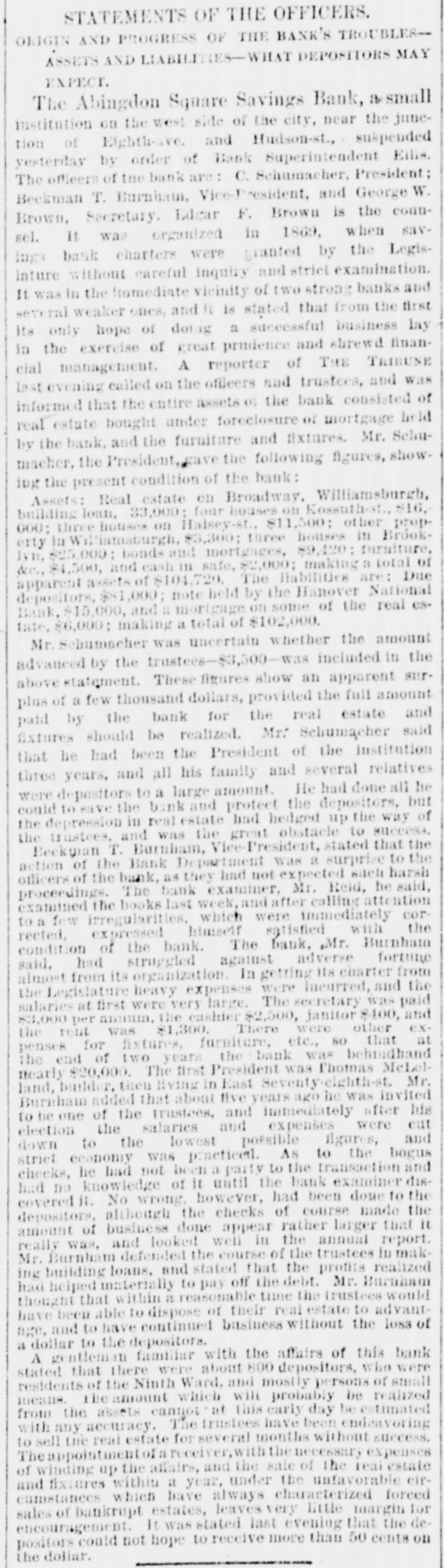
This bank was closed by the Bank Department August 10, 1876
Source
newspapers
2. August 12, 1876 Receivership
Newspaper Excerpt
The trustees last evening agreed upon John R. Voorhis ... for receiver, and it is believed that his appointment will be concurred in by the Bank Department. The appointment will probably be made on Tuesday.
Source
newspapers
3. February 7, 1877 Other
Newspaper Excerpt
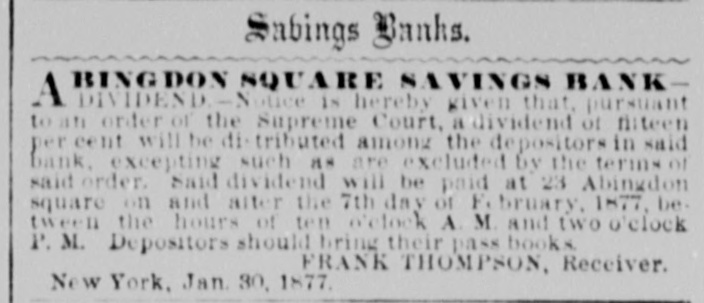
a dividend of nineteen per cent will be distributed among the depositors in said bank. ... on and after the 7th day of February, 1877. Depositors should bring their pass books FRANK THOMPSON, Receiver.
Source
newspapers

Newspaper Articles (22)

Article from New-York Tribune, August 12, 1876

Click image to open full size in new tab

Article Text

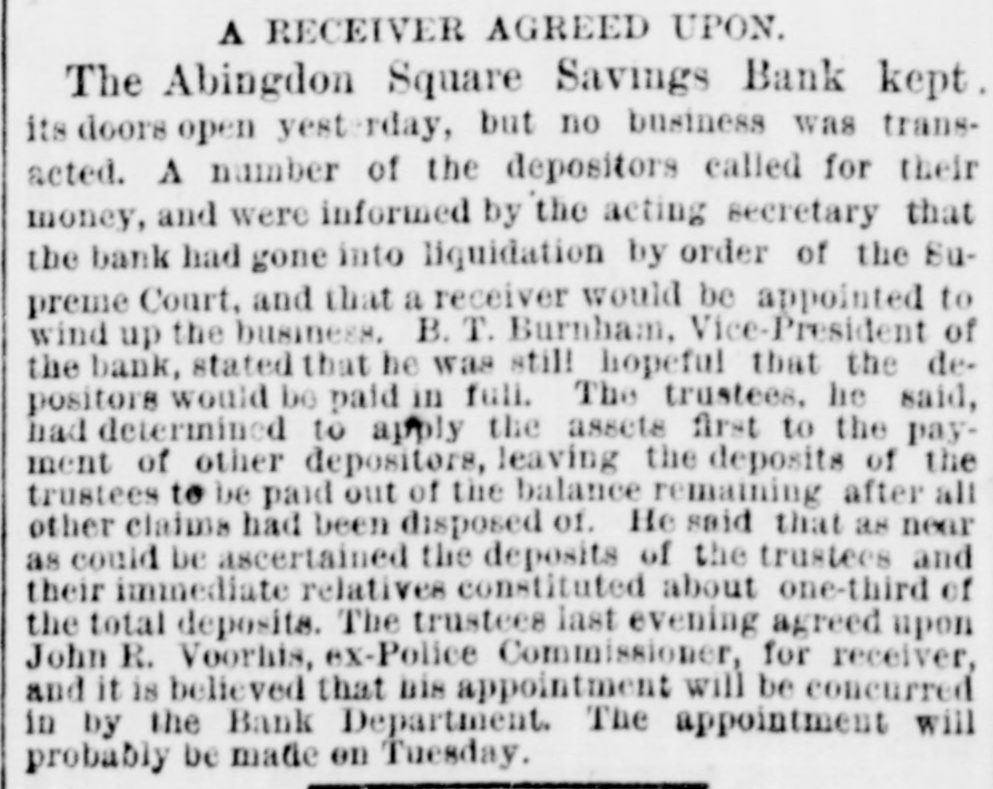
A RECEIVER AGREED UPON. The Abingdon Square Savings Bank kept its doors open yesterday, but no business was transacted. A number of the depositors called for their money, and were informed by the acting secretary that the bank had gone into liquidation by order of the Supreme Court, and that a receiver would be appointed to wind up the business. B. T. Burnham, Vice-President of the bank, stated that he was still hopeful that the depositors would be paid in full. The trustees. he said, had determined to apply the assets first to the payment of other depositors, leaving the deposits of the trustees to be paid out of the balance remaining after all other claims had been disposed of. He said that as near as could be ascertained the deposits of the trustees and their immediate relatives constituted about one-third of the total deposits. The trustees last evening agreed upon John R. Voorhis, ex-Police Commissioner, for receiver, and it is believed that his appointment will be concurred in by the Bank Department. The appointment will probably be made on Tuesday.


Article from The New York Herald, August 12, 1876

Click image to open full size in new tab

Article Text

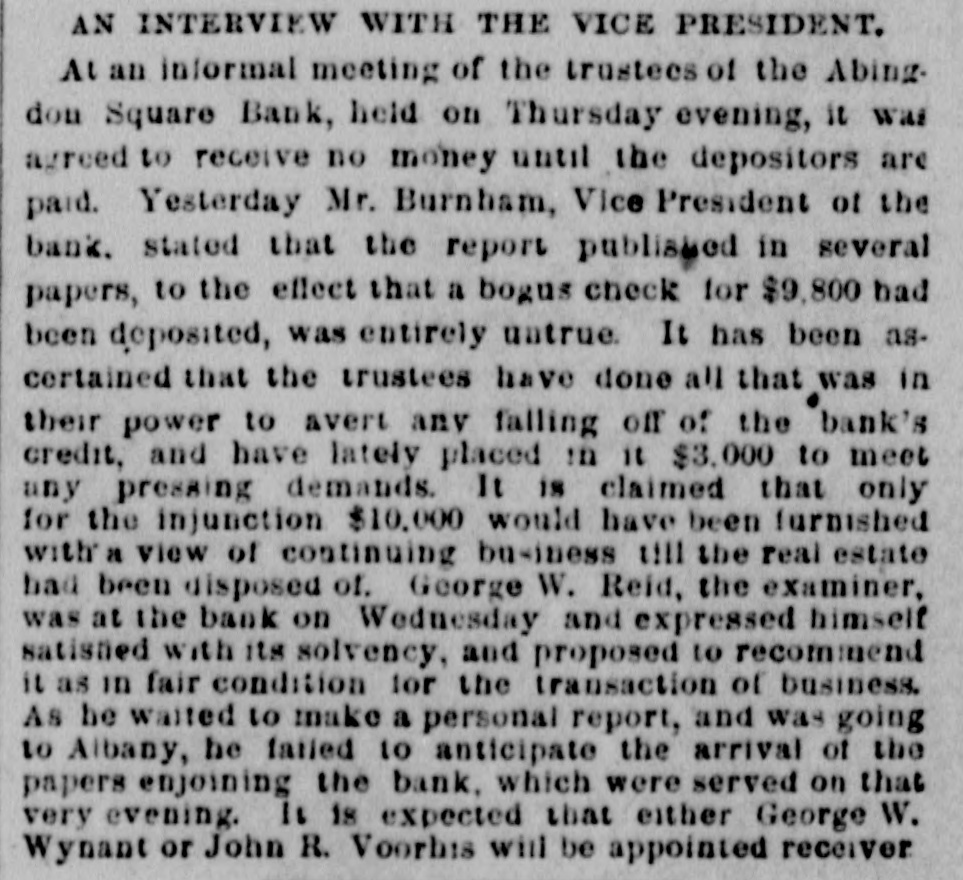
AN INTERVIEW WITH THE VICE PRESIDENT. At an informal meeting of the trustees of the Abing. dou Square Bank, held on Thursday evening, it was agreed to receive no money until the depositors are paid. Yesterday Mr. Burnham, Vice President of the bank. stated that the report published in several papers, to the effect that a bogus check for $9,800 had been deposited, was entirely untrue. It has been ascertained that the trustees have done all that was in their power to avert any falling off of the bank's credit, and have lately placed in it $3,000 to meet any pressing demands. It is claimed that only for the injunction $10,000 would have been furnished with a view of continuing business till the real estate had been disposed of. George W. Reid, the examiner, was at the bank on Wednesday and expressed himself satisfied with its solvency, and proposed to recommend it as in fair condition for the transaction of business. As be waited to make a personal report, and was going to Albany, he fatled to anticipate the arrival of the papers enjoining the bank. which were served on that very evening. is is expected that either George W. Wynant or John R. Voorbis will be appointed receiver


Article from The New York Herald, August 13, 1876

Click image to open full size in new tab

Article Text

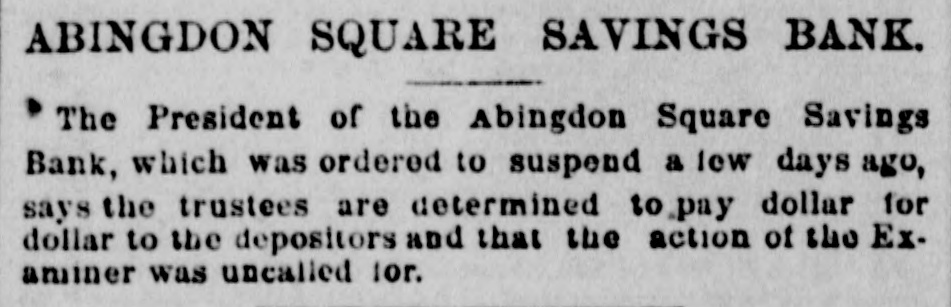
ABINGDON SQUARE SAVINGS BANK. The President of the Abingdon Square Savings Bank, which was ordered to suspend a low days ago, says the trustees are determined to pay dollar for dollar to the depositors and that the action of the Ex. animer was uncalled lor.


Article from The Sun, August 13, 1876

Click image to open full size in new tab

Article Text

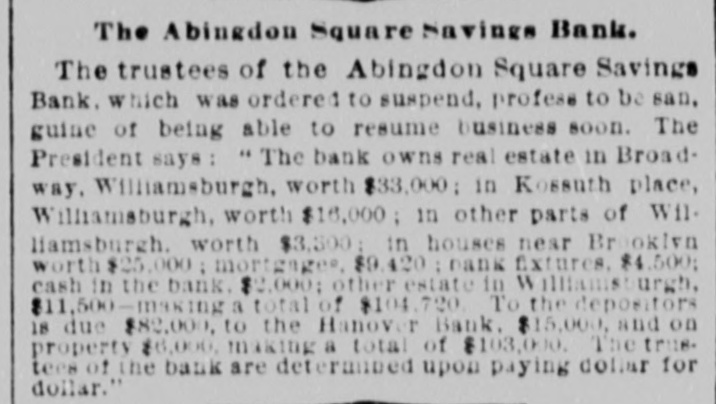
# The Abingdon Square Savings Bank. The trustees of the Abingdon Square Savings Bank, which was ordered to suspend, profess to be san- guine of being able to resume business soon. The President says: "The bank owns real estate in Broad- way, Williamsburgh, worth $33,000; in Kossuth place, Williamsburgh, worth $16,000; in other parts of Wil- liamsburgh, worth $3,500; in houses near Brooklyn worth $25.000; mortgages, $9.420; bank fixtures, $4.500; cash in the bank, $2.000; other estate in Williamsburgh, $11,500-making a total of $104.720. To the depositors is due $82.000, to the Hanover Bank, $15,000, and on property $6,000, making a total of $103,000. The trus- tees of the bank are determined upon paying dollar for dollar."


Article from The Sun, August 26, 1876

Click image to open full size in new tab

Article Text

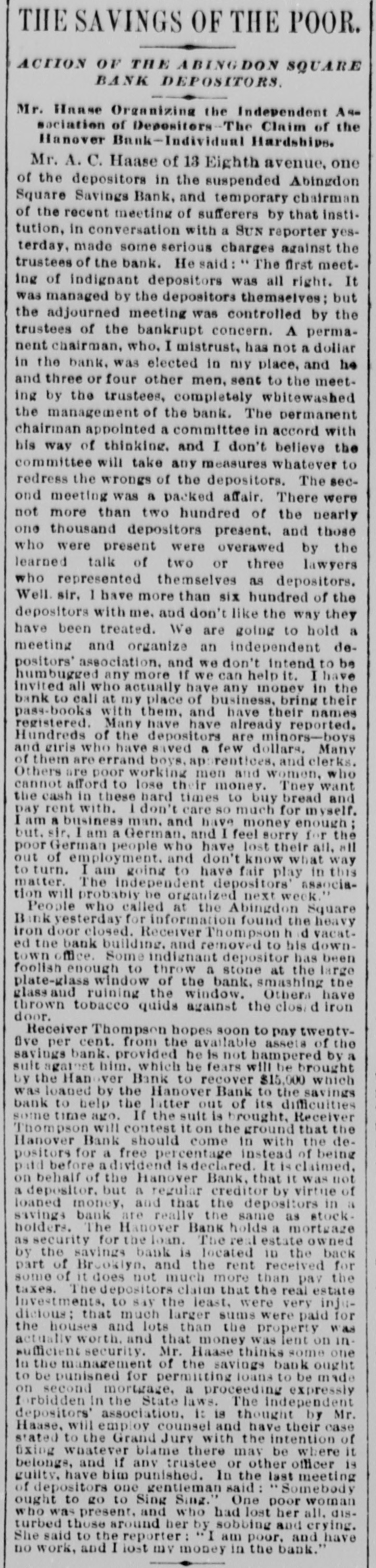
The Thermometer in New York Yesterday At Hudnut's at 3 o'clock A. M., 71Β°: 6. 9. 76Β°; M., 83Β°: 3:30 P. M., 87Β° 6. 84Β°; 9. 79Β°, 2.77Β°. JOTTINGS ABOUT TOWN. Commodore Vanderbilt's condition remained unchanged yesterday. be steamer Seth Lowkvill make an excursion to the Cholera banks to-norrow. Temperance meeting in Dr. Tyng's Gospel Tent at 2:30 o'clock o-morrow afternoon. Trower's mammoth Centennial Excursion to Iona Island takes place on Monday next. No receiver has been appointed for the lately suspended Ablogdon Square Savings Bank. John Twigg, a carpenter, fell from a building in Laight street, yesterday. and was fatally injured. Frederick Styles fell overboard from the steamer William Cook and John Fullum, the water rescued him. Emma Kubulke, aged 14 years, of 77 Ridge street, was yesterday 80 seriously burned by a kerosene lamp explosion that she died. John Weir got off from the front platform of a Belt line CAR Tast evening He fell, and the wheels crushed his right arm. Amputation was necessary. At Fleetwood. yesterday, Walker's Yorkville Boy beat Hart's Mary Jane 11. 3:03, 8:00, and 3:02: and Walker's Grocery Girl beat McGinn's Brown Dan in 2:51 and 2:174g The four upper stories of Stewart's Working Women's Hotel in Fourth avenue are finished. No im portant change has been made in the plan. Masons, plasterers, and painters are at work. Arthur McDaniel, a lawyer, was arraigned in the Washington Place Police Court, yesterday for com initial to an insane asylum; but he argued that his mind was sound, and a medical examination will be made. The Liberal Club last evening heard an adareas by Prot. Adolphe Otto, formerly a member of the club, and now Professor in one of the colleges in Zurich, and one of the Commissioners from Switzer land to the Patiadelphia show. Robert Lurch. ten years old. a son of David Lurch, gunsmith, of 157 Grand street, WIS terday. David LΓΌrch was absent, and his uppliew. David Froom, in charge of the store, was it pistol to a customer. The weapon was accidently discharged. the ball passing through the buy's heart. The Commissioner of Public Works requests the people to carefully abstain from wasting the Croton water. H the continued cry weather his 80 dwsadled that feed the Croton river. that a large quantity of water has had to orawn from the lakes and storage reservoirs in Putnam county. The case of the United States Medallion Com. pany. 11. sensuer & Co., against William T. Harden. brook. for insappropriation of money, was dismissed yesterday by Justice Murray. Proof was given that Hardenbrook was a member of from. That ended the criminal suit, and made the case one of violation of agreement. The question of a military parade ground above High Bridge was discussed in the Supreme Court yesterday. Corporation Counsel Whitney, on behalf of The Departments of Parks and Public Works, handed 1 XX the petition and asked for AD adjournment. The Presi. dent of the Department of Public Parks has signed the required declaration that he believes the parage ground would be an improvement which It would be for the in terest of the city to have carried out; but the Commit sioner of Puello Works saye that be cannot do the same


Article from The New York Herald, September 23, 1876

Click image to open full size in new tab

Article Text

ABINGDON SQUARE SAVINGS BANK. Mr. Frank Thompson, the receiver of the Abingdon Square Savings Bank, is busily engaged preparing his report, which he says he expects will be ready in about ten days. He expressed the hope of being able to pay a dividend of twenty-tive per cent this fall, and said that an examination ot the affairs of the bank had shown that for the last two years it had been doing business on a margin of maximum profits of $1,000 a year, and that its investments in real estate security bad been made with such bad judgment that but little would be realized for the depositors, unless sales of the property were postponed for a rising market.


Article from New-York Tribune, September 28, 1876

Click image to open full size in new tab

Article Text

THE ABINGDON SQUARE BANK. The report of the receiver of the Abingdon Square Savings Bank, Francis Thompson, is not yet finished. It is shown, however, that the liabilities of the bank are as follows: $88,000 in the accounts of depositors, and a claim of $15,000 held by the Hanover Bank. The assets will be sufficient to pay this Fall 20 or 25 per cent, and consist entirely of real estate In Brooklyn, situated on Broadway, near Halsey-st., and in Kossuth-place. The officers of the Hanover Bank say its claim of $15,000 is covered by mortgage on certain parcels of this real estate.


Article from The New York Herald, October 1, 1876

Click image to open full size in new tab

Article Text

RUN ON THE SAVINGS BANKS. Yesterday morning the excitement among the smaller depositors in the savings banks of the east side, which began to manifest itself on Thursday and culminated in a perfect panic on Friday, in no degree abated, but in the afternoon there was a very perceptible decrease in the number of applicants for a settlement of accounts. The cause of this sudden withdrawal of deposits lies in the suspension of the New Amsterdam and Bond street savings banks. When the trustees of these establishments announced their intention of giving over business, but found themsolves unable to go into voluntary liquidation, a doubt of the security of other kindred institutions became broadcast. The recollection of the Third Avenue Bank's failure and the close of the Mutual, the Germania and the Abingdon Square is yet green in the memory of most depositors, and there was consequently a grand rush to the paying telsers' desks. The Dry Dock Bank, at corner of Bowery and Third street, came in for more than a fair sbare of this run. A large gathering had assembied before it at an early hour, and after dark the employΓ©s were still busy handing over money to importuning depositors. it seemed to be generally taken for granted that the bank was going to suspend payment, and the only thought in the minds of all comers was how to most readily reach the counters and withdraw such deposits as they had made. However, it was clear that no one bad a definite notion of what they had to fear. nor could any one give any idea of what their doubts were founded on. It was stated by one or two, though on what authority it would be difficult to determine, that the bank officials were unable to pay the interest on the mortgage which they had been obliged to take out in order to complete the building. and that it was consequently to be sold on account of a foreclosure suit. It was claimed by others that the Dry Dock Bank bad large securities invested in those institutions which have recently suspended and that it had its finances further crippled through that means. In conversation with William V. Webster, the secretary of the bank, a HERALD reporter learned that the securities held by the bank could be realized in a short time, and that even if they were sold at the lowest market rate there would be left a surplus of over $60,000. He said that there was no cause whatever for apprehension among the depositors, but that if they persisted in their intentions of withdrawing their deposits the trustees fancied that, far from damaging the bank's interests, they would only be advancing them. "This run," said Mr. Webster, "will be of benefit to us, because we will not only escspe the ob. ligation of paying interest upon the sums withdrawn, but we will be freed from the payment of the State tax, and that of itself is a matter worth considering." The excitement was not confined to depositors of the Dry Dock Bank alone, but circulated among people who had placed their savings in the Bowery, Bleecker Street and Metronolitan Banks. In these there were fewer amounts drawn and the officers in all cases expressed themselves satisfied of their institutions being able to weather the run. However confident these gentlemen may by of their financial security, there is no doubt but that a wide-spread feeling exists that in this crisis every bank whose finances are not on a solid basis will be sorely pushed. The recent suspensions have inspired a lack of confidence, under which many such institutions may succumb if it be not speedily removed.


Article from The Sun, October 13, 1876

Click image to open full size in new tab

Article Text

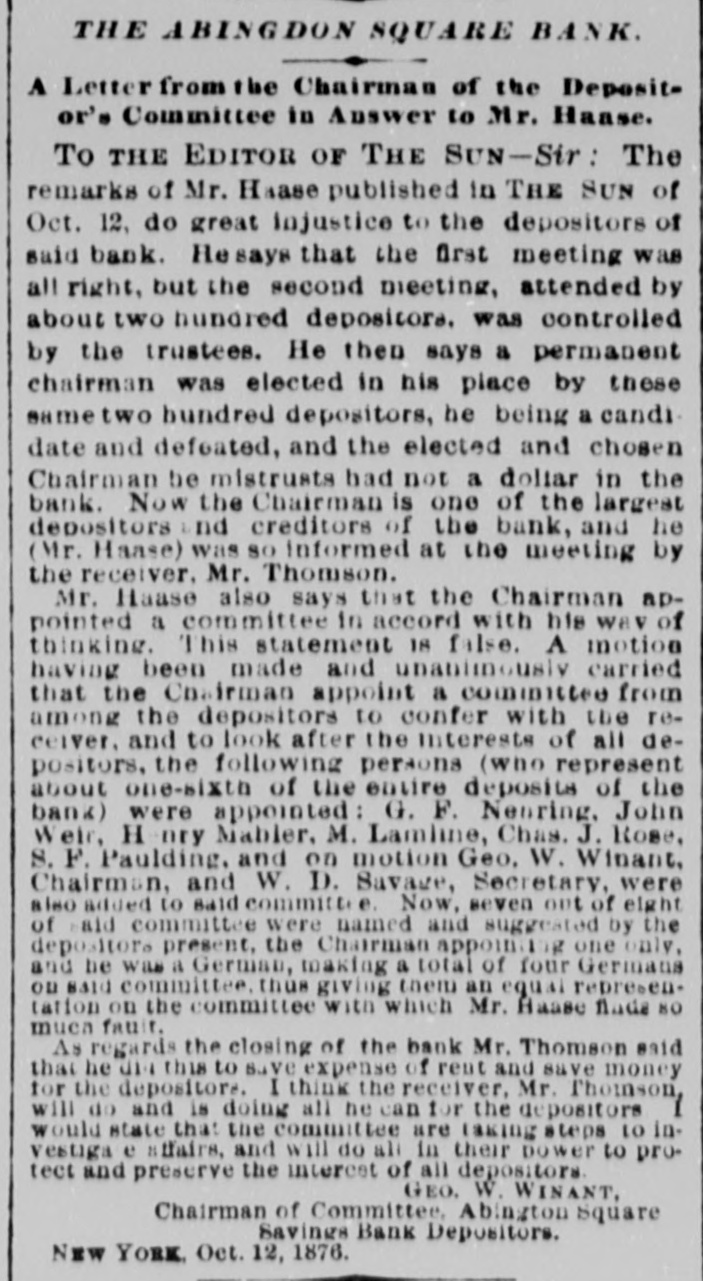
THE ABINGDON SQUARE BANK. A Letter from the Chairman of the Depositor's Committee in Answer to Mr. Haase. To THE EDITOR OF THE SUN-Sir: The remarks of Mr. Haase published in THE SUN of Oct. 12, do great Injustice to the depositors of said bank. Hesays that the first meeting was all right, but the second meeting, attended by about two hundred depositore. was controlled by the trustees. He then says a permanent chairman was elected in his place by these same two hundred depositors, he being a candi date and defeated, and the elected and chosen Chairman be mistrusts had not a doltar in the bank. Now the Chairman is one of the largest depositors nd creditors of the bank, and he (Mr. Hanse) was so informed at the meeting by the receiver. Mr. Thomson. Mr. Haase also says that the Chairman appointed a committee in accord with his WAV of thinking. This statement 18 false. A motion having been made and unabimously carried that the Chairman appoint a committee from among the depositors to confer with the receiver. and to look after the interests of all depositors. the following persons (who represent about one-sixto of the entire deposits of the bank) were appointed: G. F. Nearing, John Weir, H nry Mabler, M. Lamline, Chas. J. Rose. S. F. Paulding. and on motion Geo. W. Winant, Chairman, and W. D. Savage, Secretary, were also added to Baid committee. Now, seven out of eight of said committee were named and suggested by the depositor. present, the Chairman appointing one only. and be was a German, making a total of four Germans ou said committee. thus giving them an equal representation on the committee with which Mr. Haase nade 80 muca fault. As regards the closing of the bank Mr. Thomson said that he did this to save expense of reut and save money for the depositore. I think the receiver, Mr. Thomson, will do and is doing all he can for the depositors would state that the committee are taking steps to investiga e affairs, and will do all in their power to protect and preserve the interest of all depositors GEO. W. WINANT, Chairman of Committee. Abington Square Savings Bank Depositors. NEW YORK Oct. 12, 1876.


Article from New-York Tribune, December 16, 1876

Click image to open full size in new tab

Article Text

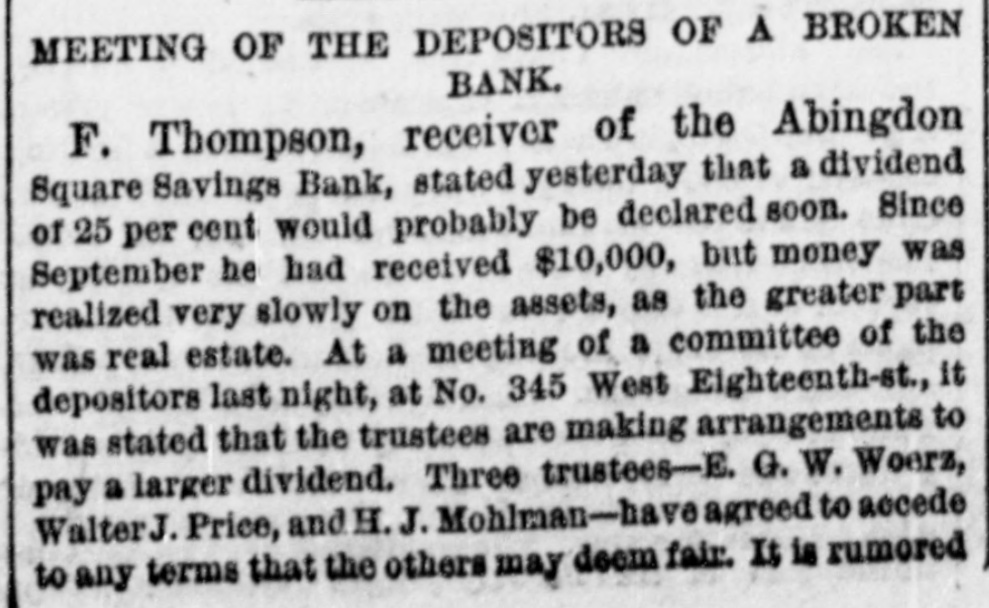
MEETING OF THE DEPOSITORS OF A BROKEN BANK. F. Thompson, receiver of the Abingdon Square Savings Bank, stated yesterday that a dividend of 25 per cent would probably be declared soon. Since September he had received $10,000, but money was realized very slowly on the assets, as the greater part was real estate. At a meeting of a committee of the depositors last night, at No. 345 West Eighteenth-st., it was stated that the trustees are making arrangements to pay a larger dividend. Three trustees-E. G. W. Woerz, Walter J. Price, and H. J. Mohlman-haveagreed to accede to any terms that the others may deem fair. It is rumored


Article from The Sun, December 16, 1876

Click image to open full size in new tab

Article Text

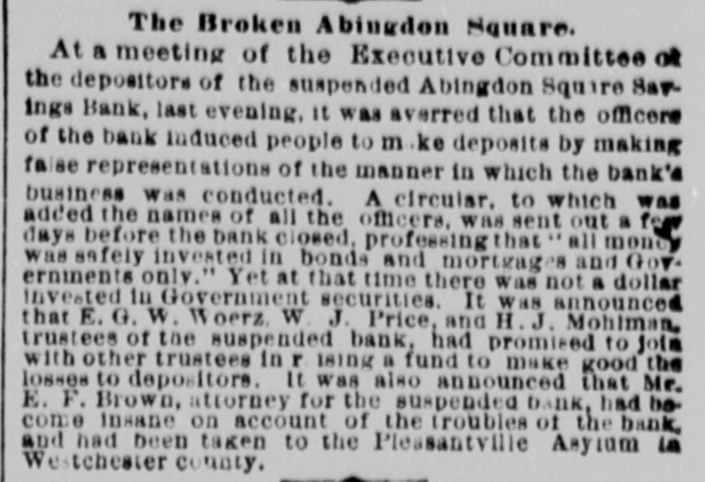
The Broken Abingdon Square. At a meeting of the Executive Committee of the depositors of the suspended Abingdon Squire Sarings Bank, last evening. it was averred that the officers of the bank induced people to .ke deposits by making false representations of the manner in which the bank's business was conducted. A circular. to which was added the names of all the officers. was sent out a for days before the bank closed, professing that all money was safely invested in bonds and mortgages and Governments only." Yet at that time there was not a dollar invested in Government securities. It was announced that E. G. W. Woerz W. J. Price, and H.J. Mohiman, trustees of the suspended bank, had promised to jota with other trustees in r 1810g a fund to make good the losses to depositore. It was also announced that Mr. E. F. Brown, attorney for the suspended bank, had be come insane on account of the troubles of the bank, and had been taken to the Pleasantville Asyium la Westchester county.


Article from The Sun, January 31, 1877

Click image to open full size in new tab

Article Text

Sabings Banks. A BINGDON SQUARE SAVINGS BANKDIVIDEND Notice is hereby given that, pursuant to an order of the Supreme Court, a dividend of niteen per cent will be di tributed among the depositors in said bank. excepting such as are excluded by the terms of said order. Said dividend will be paid at 23 Abingdon square on and after the 7th day of F. bruary, 1877. be. tween the hours of ten o'clock A M. and two o'clock P. M. Depositors should bring their pass books FRANK THOMPSON, Receiver. New York, Jan 30, 1877


Article from The New York Herald, April 6, 1877

Click image to open full size in new tab

Article Text

RECOVERING HIS PROPERTY. Justice Pratt granted a motion, yesterday, in the Sepreme Court, Kings county. vacating a sale made under a decree of foreclosure in the suit of the Abing. don Square Savings Bank against Patrick Cas-idy and others, in 1875. The property involved consisted of three valuable buildings on Court and Butler streets and ten lots on Plymouth, Bridge and Front streets. The valuation of the property IS $50,000, and it was bid in under the sale by the bank for $12,000. The bank, being insolvent, passed into the hands of Mr. Frank Thompson, as receiver. The property is now ordered to be restored to Cassidy on his paying what is due by bim.


Article from New-York Tribune, April 24, 1877

Click image to open full size in new tab

Article Text

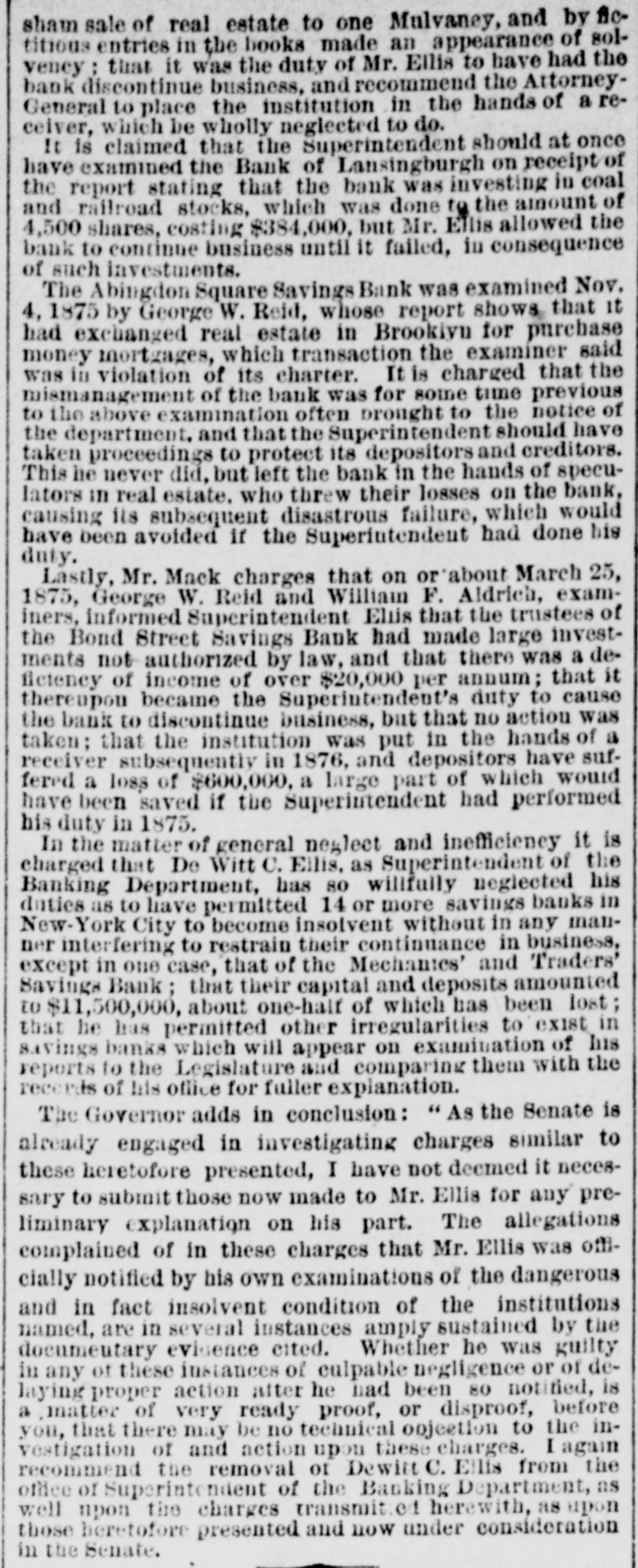
sham sale of real estate to one Mulvaney, and by fictitious entries in the books made an appearance of solveney; that it was the duty of Mr. Ellis to have had the bank discontinue business, and recommend the AttorneyGeneral to place the institution in the hands of a receiver, which be wholly neglected to do. It is claimed that the Superintendent should at once have examined the Bank of Lausingburgh on receipt of the report stating that the bank was investing in coal and railroad stocks, which was done to the amount of 4,500 shares, costing $384,000, but Mr. Ellis allowed the bank to continue business until it failed, in consequence of such investments. The Abingdon Square Savings Bank was examined Nov. 4, 1875 by George W. Reid, whose report shows that it had exchanged real estate in Brookivn for purchase money mortgages, which transaction the examiner said was in violation of its charter. It is charged that the mismanagement of the bank was for some time previous to the above examination often brought to the notice of the department, and that the Superintendent should have taken proceedings to protect its depositors and creditors. This he never did, but left the bank in the hands of speculators in real estate. who threw their losses on the bank, causing its subsequent disastrous failure, which would have been avoided if the Superintendent had done his duty. Lastly, Mr. Mack charges that on or about March 25, 1875, George W. Reid and William F. Aldrich, examiners, informed Superintendent Elis that the trustees of the Bond Street Savings Bank had made large investments not authorized by law, and that there was a defietency of income of over $20,000 per annum; that it thereupon became the Superintendent's duty to cause the bank to discontinue business, but that no action was taken; that the institution was put in the hands of a receiver subsequently in 1876, and depositors have suffered a loss of $600,000, a large part of which would have been saved if the Superintendent had performed his duty in 1875. In the matter of general neglect and inefficiency it is charged that De Witt C. Ellis, as Superintendent of the Banking Department, has so willfully neglected his duties as to have permitted 14 or more savings banks in New-York City to become insolvent without in any manner interfering to restrain their continuance in business, except in one case, that of the Mechanies' and Traders' Savings Bank; that their capital and deposits amounted to $11,500,000, about one-half of which has been lost; that he has permitted other irregularities to exist in savings banks which will appear on examination of his reports to the Legislature and comparing them with the records of his office for fuller explanation. The Governor adds in conclusion: "As the Senate is already engaged in investigating charges similar to these heretofore presented, I have not deemed it necessary to submit those now made to Mr. Ellis for any preliminary explanation on his part. The allegations complained of in these charges that Mr. Ellis was officially notified by his own examinations of the dangerous and in fact insolvent condition of the institutions named, are in several instances amply sustained by the documentary evidence cited. Whether he was guilty in any of these instances of culpable negligence or of delaying proper action after he had been 80 notified, is a matter of very ready proof, or disproof, before you, that there may be no technical conjection to the investigation of and action upon these charges. I again recommend the removal of Dewitt C. Ellis from the office of Superinte ndent of the Banking Department, as well upon the charges transmit ed herewith, as upon those heretofore presented and now under consideration in the Senate.


Article from The New York Herald, April 28, 1877

Click image to open full size in new tab

Article Text

BOTTOMLESS MONEY BOXES. LOST PLEIADS OF OUR SAVINGS BANK SYSTEMNEW MATTERS FOR THE ELLIS INVESTIGATING COMMITTEE-HOW TO PREVENT FRAUDS. It is claimed by many influential merchants and others who have been interviewed on the subject that the present investigation of the official course pursued by Superintendent Ellis will clearly show that his neglect of duty has caused much of the suffering resulting from recent failures of savings banks. It is also contended that, in addition to the banking institu. tions named in Governor Robinson's late message to the investigating committee, there are other corporations whose cases have not been cited. but which furnish new prima facie evidence against the Bank Superintendent. Among these may be cited the Loaners' Bank of New York. About November, 1875, the Bank Superintendent was asked for a report upon the condition of this establishment, but it appeared that, the bank never having been examined, Mr. Eltis could furnish no information about its status. At the same time a lawyer wrote to the Superintendent asking to have the Loaners' Bank examined, but no examination took place, and the institution failed in May, 1876. A gentleman acquainted with its affairs says:"Its operations were worse than those of a low class pawnshop." The community lost $500,000 by the failure, much 01 which, it is claimed, might have been saved had the Banking Department held the corporation to strict account when required to do so. ANOTHER STARTLING CASE. In relation to the New York State Loan and Trust Company responsible parties state that about March, 1875, Mr. Ell's was officially informed by Mr. George W. Reid, examiner, and Mr. William T. Aidrich and others, that the capital stock had suffered an impairment equal to at least twenty per cent. It was the Bank Superintendent's duty to have caused this deneit to be made good, or to have closed the doors of the company under instructions from the Attorney General. No steps were taken by Mr. Exis and the concern was allowed to remain in the hands of the same parties until January 29, 1876, when the impairment of the capital amounted 10 about ninety per cent, and the trustees voluntarily relinquished the remaining ten conts on the dollar to a receiver. The loss 10 the public was about nine hundred thousand dollars. The wretched condition of this company was known to all persons familiar with us general operations at the time. By the statute of 1874 the superintendence of trust companies chartered by the State was placed under the charge of Mr. Ellis, and the condition of this concern was or should have been well known to him. A FRIGHTFUL LIST OF LOSSES. In conversation with Mr. John Mack, of No. 365 Fifth avenue, that gentleman gave the following estimates of the losses suffered by depositors 10 the suspended savings banks, and says that he believes the greater part of the immense sums which are given below migot have been saved if Bank Superintendent Eths bad properly discharged his important duties:$150,000 Abingdon Square Bank 1,730,000 Bona Street Savings Bank 500,000 German Savings Bank, Morrisanta 2,000,000 Mechanics and Traders' Savings Bank 450,000 Mutual Benefit Savings Bank 750,000 New Amsterdam Savings Bank 200,000 People's Savings Bank 400,000 Security Savings Bank 1,440,000 Third Avenue Savings Bank. 120,000 Traders' Savings Bank 1,000,000 Bank of Lainsburg 1,000,000 New York State Loan and Trust Company Loaner's Rauk 500,000 500,000 Security Bank Manufacturers and Builders' Bank. 460,000 Total $11,200,000 HOW TO PREVENT FRAUDS


Article from The New York Herald, May 10, 1877

Click image to open full size in new tab

Article Text

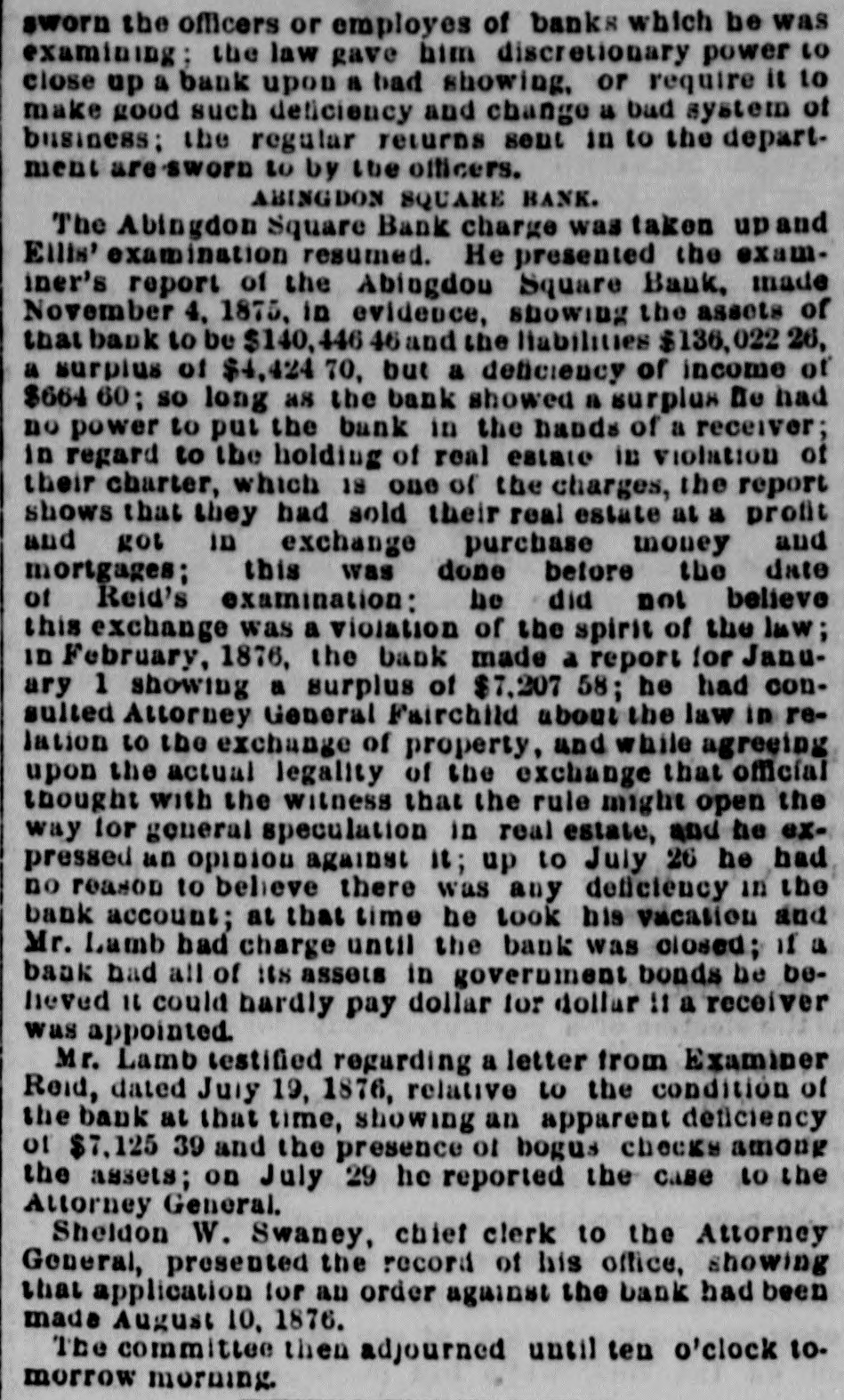
sworn the officers or employes of banks which be was examining: the law gave him discretionary power to close up a bank upon a bad showing, or require it to make good such deficiency and change is bad system of business; the regular returns sent in to the department are sworn to by the officers. ABINGDON SQUARE BANK. The Abingdon Square Bank charge was taken up and Ellis' examination resumed. He presented the examiner's report of the Abingdou Square Bank, made November 4, 1875, in evidence, showing the assets of that bank to be $140,446 46 and the liabilities $136,022 26, a surplus of $4,424 70, but a deficiency or income of $664 60; so long as the bank showed a surplus no had no power to put the bank in the hands of a receiver; in regard to the holding of real estate in violation of their charter, which 18 one of the charges, the report shows that they had sold their real estate at a profit and got in exchange purchase money and mortgages; this was done before the date of Reid's examination: be did not believe this exchange was a violation of the spirit of the law; ID February, 1876, the bank made a report for January 1 showing a surplus of $7,207 58; he had consulted Attorney General Fairchild about the law in relation to the exchange of property, and while agreeing upon the actual legality of the exchange that official thought with the witness that the rule might open the way for general speculation in real estate, and he expressed un opinion against it; up to July 26 he had no reason to believe there was any deficiency in the bank account; at that time he took his vacation and Mr. Lamb had charge until the bank was closed; if a bank had all of its assets in government bonds be beheved 11 could hardly pay dollar for dollar 11 a receiver was appointed. Mr. Lamb testified regarding a letter from Examiner Reid, dated July 19, 1876, relative to the condition of the bank at that time, showing an apparent deficiency of $7,125 39 and the presence of bogus checks among the assets; on July 29 he reported the case to the Attorney General. Sheldon W. Swaney, chief clerk to the Attorney General, presented the record of his office, showing that application for an order against the bank had been made August 10, 1876. The committee then adjourned until ten o'clock 10. morrow morning


Article from New-York Tribune, July 30, 1878

Click image to open full size in new tab

Article Text

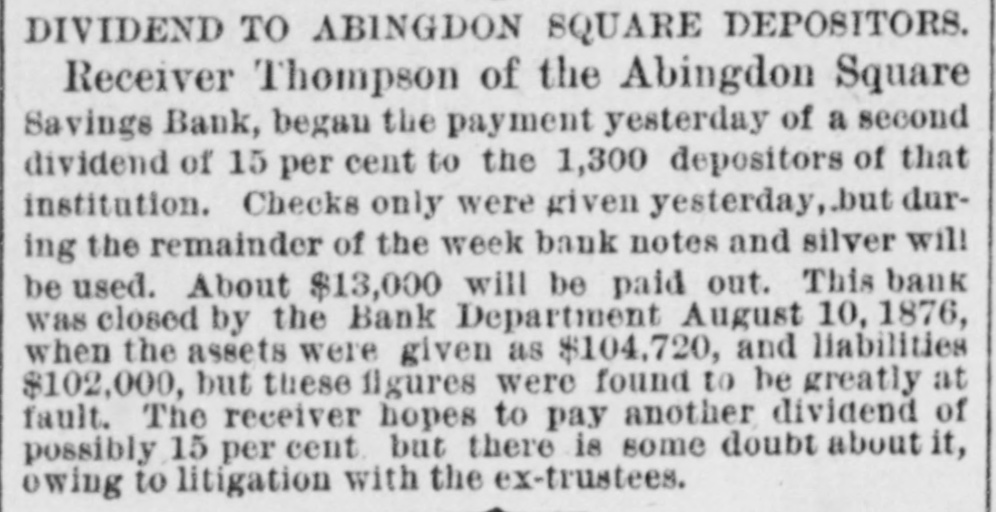
DIVIDEND TO ABINGDON SQUARE DEPOSITORS. Receiver Thompson of the Abingdon Square Savings Bank, began the payment yesterday of a second dividend of 15 per cent to the 1,300 depositors of that institution. Checks only were given yesterday, but during the remainder of the week bank notes and silver will be used. About $13,000 will be paid out. This bank was closed by the Bank Department August 10, 1876, when the assets were given as $104,720, and liabilities $102,000, but these figures were found to be greatly at fault. The receiver hopes to pay another dividend of possibly 15 per cent. but there is some doubt about it, owing to litigation with the ex-trustees.


Article from The New York Herald, February 22, 1879

Click image to open full size in new tab

Article Text

WANTED, A DIVIDEND. To THE EDITOR OF THE HERALD:-Why does not the receiver of the Abingdon Square Savings Bank declare a dividend? The bank failed in 1876. The depositors have received only two dividends of fifteen per cent. ANXIOUS DEPOSITOR


Article from The Sun, June 8, 1879

Click image to open full size in new tab

Article Text

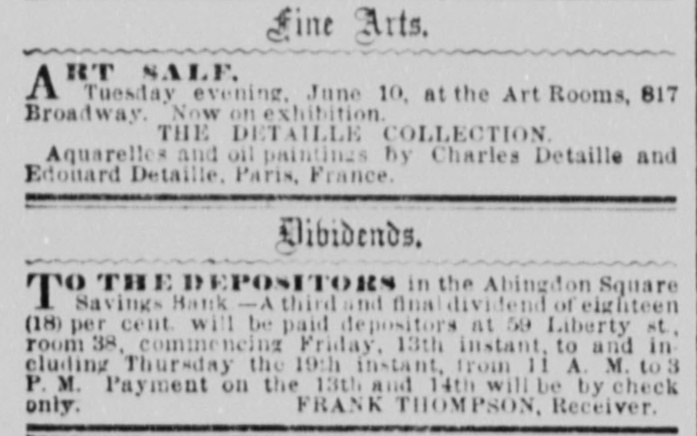
Line Arts. RT SALE. A Tuesday evening, June 10, at the Art Rooms, 817 Broadway. Now on exhibition. THE DETAILLE COLLECTION. Aquarelles and oil paintings by Charles Detaille and Edonard Detaille, Paris, France. Dibidends. TOTHE DEPOSITORS in the Abingdon Square Bank -A third and finaldividend of eighteen (18) per cent. will be paid depositors at 59 Liberty st., room 38, commencing Friday, 13th instant, to and in cluding Thursday the 19th instant, from 11 A. M. to 3 P. M. Payment on the 13th and 14th will be by check FRANK THOMPSON, Receiver. only.


Article from The Sun, May 2, 1895

Click image to open full size in new tab

Article Text

Sult Against Receiver Wasserman, Suit has been brought in the Supreme Court by Ernst G. W. Woerz. through Guggenheimer, Untermyer & Marshall, his attorneys, against Charles A. Schumacher, Samuel Wasserman, receiver of the Abingdon Square Savings Bank, and others, for the purpose of determining the ownership of a trust fund in the hands of Mr. Woerz, who has about $30,000 in his possession. Mr. Wasserman was appointed receiver last July by Judge Stover in the place of Frank G. Thompson. The receiver will contest the suit.


Article from The Evening Times, August 14, 1902

Click image to open full size in new tab

Article Text

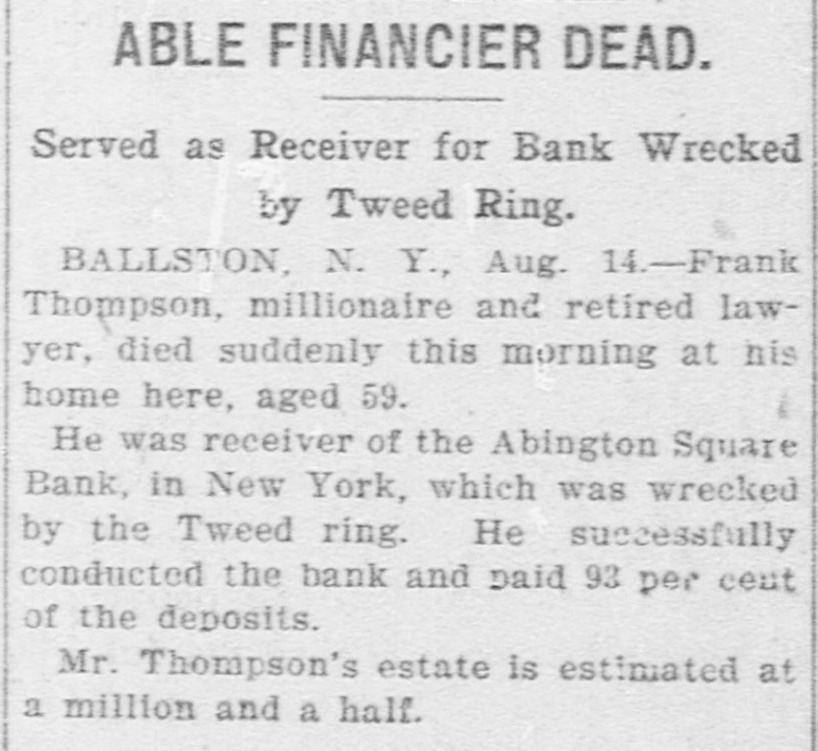
# ABLE FINANCIER DEAD. Served as Receiver for Bank Wrecked by Tweed Ring. BALLSTON, N. Y., Aug. 14.-Frank Thompson, millionaire and retired lawyer, died suddenly this morning at his home here, aged 59. He was receiver of the Abington Square Bank, in New York, which was wrecked by the Tweed ring. He successfully conducted the bank and paid 93 per cent of the deposits. Mr. Thompson's estate is estimated at a million and a half.


Article from New-York Tribune, August 15, 1902

Click image to open full size in new tab

Article Text

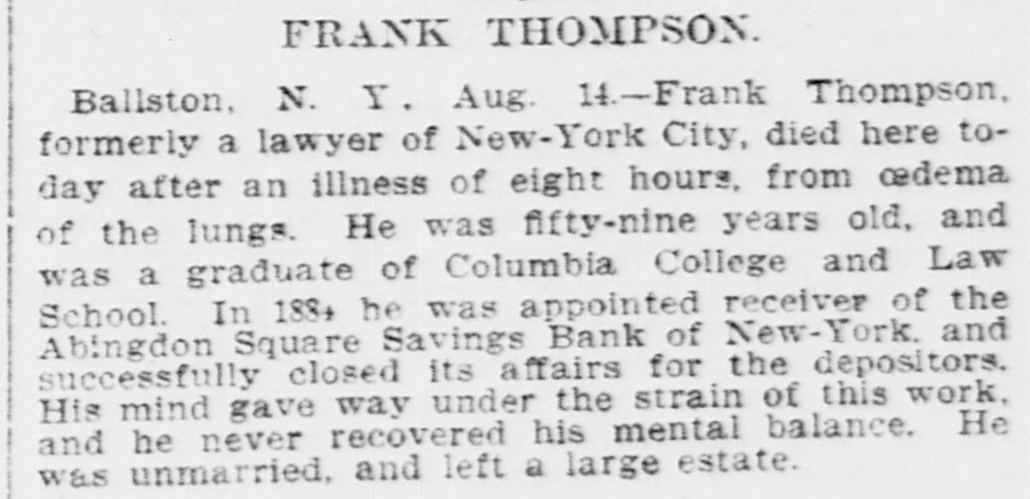
FRANK THOMPSON. Ballston. N. Y. Aug. 14.-Frank Thompson, formerly a lawyer of New-York City, died here today after an illness of eight hours, from cedema of the lungs. He was fifty-nine years old, and was a graduate of Columbia College and Law School In 188+ he was appointed receiver of the Abingdon Square Savings Bank of New-York. and successfully closed its affairs for the depositors. His mind gave way under the strain of this work, and he never recovered his mental balance. He was unmarried, and left a large estate.