Donnell, Lawson & Simpson (New York, NY)

Episode Information

Episode UID
5481493491013
Episode Type
Suspension β†’ Reopening
Bank Type
private
Bank ID
548149349 hash
Start Date
May 15, 1884
Location
New York, New York (40.714, -74.006)

Metadata

Model
gpt-5-mini (chosen from majority vote of a three-model LLM ensemble)
Short Digest
b01ae08899f46242

Response Measures

None

Description

Firm made an assignment on suspension; later announced resumption in October 1884.

Events (4)

1. May 15, 1884 Suspension
Cause
Local Banks
Cause Details
Suspension occurred immediately after and in the wake of the Metropolitan National Bank's suspension and the wider Wall Street panic; firm cited combination of circumstances and connections with Metropolitan.
Newspaper Excerpt
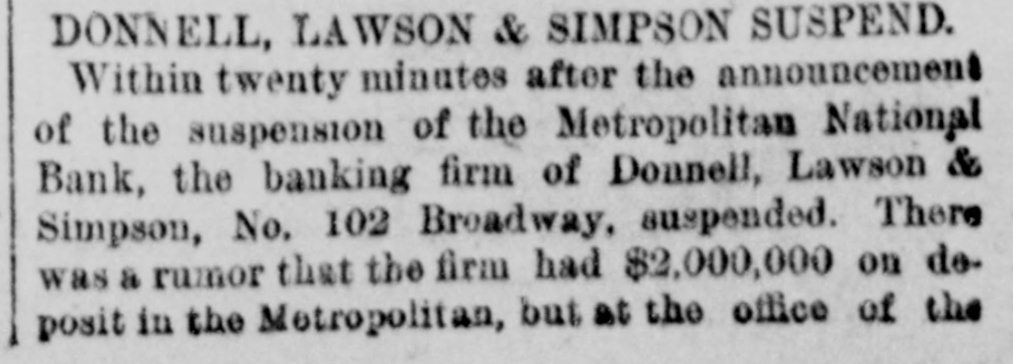
Within twenty minutes after the announcement of the suspension of the Metropolitan National Bank, the banking firm of Donnell, Lawson & Simpson, No. 102 Broadway, suspended.
Source
newspapers
2. May 17, 1884 Other
Newspaper Excerpt
On Wednesday dispatches were received at Butte announcing that Donnell, Lawson & Sunpson had resumed payment and that so far as that bank was concerned it was all right.
Source
newspapers
3. May 23, 1884 Other
Newspaper Excerpt
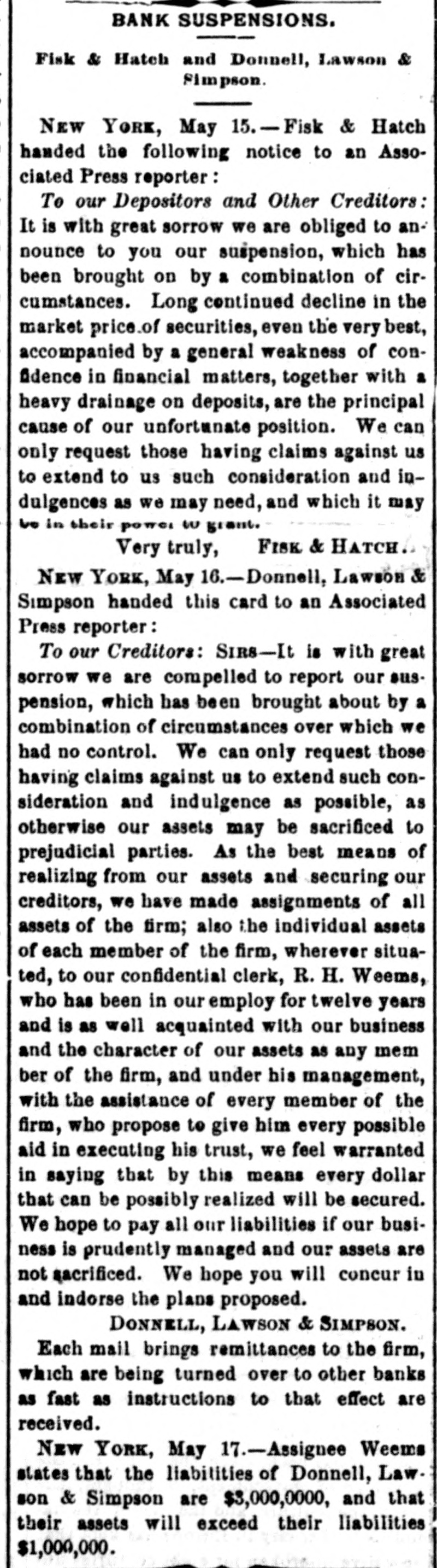
Donnell, Lawson & Simpson handed this card to an Associated Press reporter: To our Creditors: SIRs-It is with great sorrow we are compelled to report our suspension...we have made assignments of all assets of the firm; also the individual assets ... to our confidential clerk, R. H. Weems ...
Source
newspapers
4. October 21, 1884 Reopening
Newspaper Excerpt
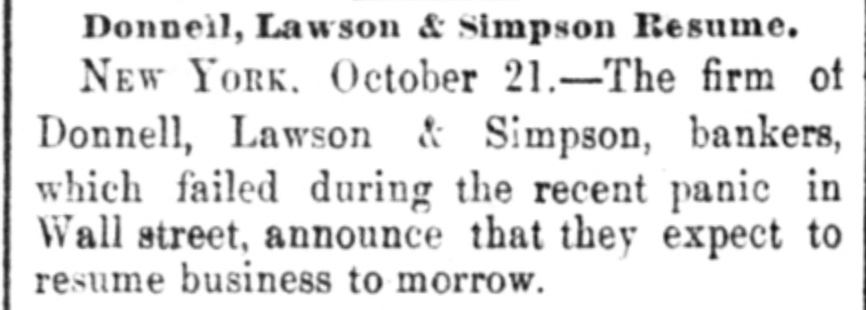
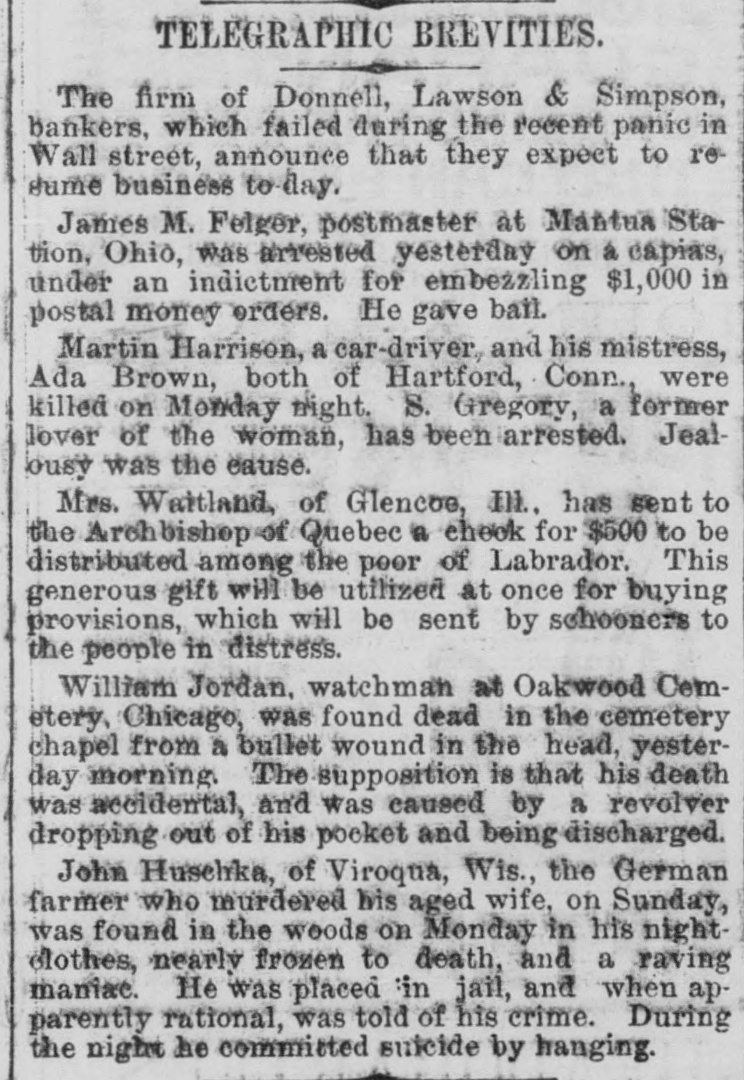
The firm of Donnell, Lawson & Simpson, bankers, which failed during the recent panic in Wall street, announce that they expect to resume business to-morrow.
Source
newspapers

Newspaper Articles (23)

Article from New-York Tribune, May 15, 1884

Click image to open full size in new tab

Article Text

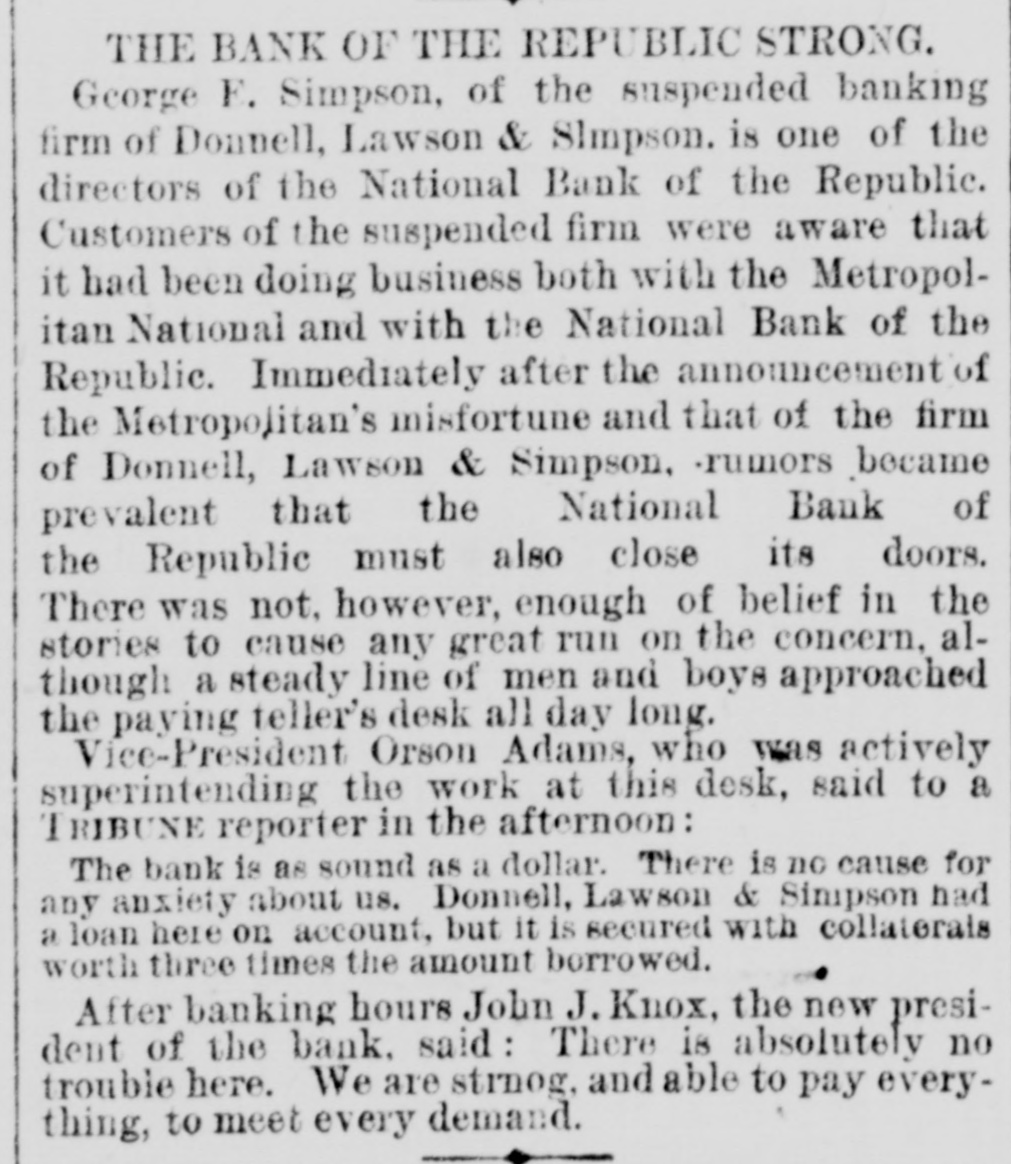
THE BANK OF THE REPUBLIC STRONG. George E. Simpson, of the suspended banking firm of Donnell, Lawson & Slmpson. is one of the directors of the National Bank of the Republic. Customers of the suspended firm were aware that it had been doing business both with the Metropolitan National and with the National Bank of the Republic. Immediately after the announcement of the Metropolitan's misfortune and that of the firm of Donnell, Lawson & Simpson, -rumors became prevalent that the National Bank of the Republic must also close its doors. There was not, however, enough of belief in the stories to cause any great run on the concern, although a steady line of men and boys approached the paying teller's desk all day long. Vice-President Orson Adams, who was actively superintending the work at this desk, said to a TRIBUNE reporter in the afternoon: The bank is as sound as a dollar. There is no cause for any anxiety about us. Donnell, Lawson & Simpson had a loan here on account, but it is secured with collaterais worth three times the amount borrowed. After banking hours John J. Knox, the new president of the bank. said: There is absolutely no trouble here. We are strnog, and able to pay everything, to meet every demand.


Article from Morning Journal and Courier, May 15, 1884

Click image to open full size in new tab

Article Text

FROM ALL QUARTERS. A FINANCIAL CRASH. Disasters Falling Thick and Fast. WALL STREET IN A PANIC. Many Firms Caught in the Whirl. A RAPID ROUND OF FAILURES. The Day a Second Black Friday. A WALL STREET CRASH. A Paule on Change- Failures Fellow Each Other in Rapid Succession-Old Houses Caught 1a the Whirl-Philanthropist Seney Among the NumberBank Closes its Doors The Story of a Day That Was Another Black Friday NEW YORK, May 14.-The financial complications of the past week resulted to-day in a succession of disasters that made the wildest havoc in Wall street. The announcement of failures began with the opening of the Stock Exchange and succeeded each other rapidly, each new disaster adding to the panicky feeling which manifested itself in all directions. The first failures published were those of Nelson Rebinson & Co. and Goffe & Randle. Soen afterward it was known that O. M. Bogart & Co. had suspended. This announcement was soon followed by the suspersion of J. C. Williams. The excitement was greatly intensified when it was first whis pered that Hatch & Foote had been compelled to cease business, and almost immediately afterwards it was rumored that the Metropolitan bank had closed its doors. This Fumor was premature, but it was not long before it became fact and the doors of the bank were actually shuf. The street was wild with excitement and it seemed that another black Friday had cast its bale ful light upon the financial horizon. Men and boys were rushing about, forcing their ways through the crewds that stood wedged in the streets about the Exchange. The news of the disasters seemed to have spread with wonderful rapidity. Private carriages, with liveried servants, from the up-town districts WERE SEEN FLYING THROUGH THE STREETS, and many stood outside the doors of the various banks and banking-houses The directors of nearly all the banks were either in session or present in their buildings ready for any emergency. The doors of the Stock Exchange were guarded by policemen and the visitors' galleries were cleared. No one was admitted to the building except members, clerks, and messengers. This was done because the crowd endeavoring to get admits tance grew too large for the capacity of the building. THE FIRST FAILURE OF THE DAY, that of Nelson Robinson & Ce., wascaused, according to the statement of Mr. Robinson, by the general shrinkage of securities, the disturbed condition of the times, and the circulation of disquieting rumors. He was unable to furnish any statement of liabilities and assets. Most of their loans, he said, were well protected, if the holders did not lose their heads and want to get their money in day. Mr. Randall, of Goffe & Randall, said their failure was due mainly to the troubles of Dyett & Co. Orlando M. Bogart, of O. M. Bogart & Co., said their suspension was due to the indirect influence of the Grant & Ward failure, the shrinkage in 80curities, the many calls on the firm for mon losses through outside parties. The firm simply unable to withstand the general pressure upon it. He could not make any statement of assets and liabilities, but he knew that the present condition of affairs was bad. The firm had been established, he said, for at least twenty five years Tb assignee, Mr. Wheeler, said that he had unex pectedly been called to his position, which he bad accepted reluctantly, and that he was un able to give any information as yet in regard to the firm's affairs. Bogart & Co. give preferences for $55,000. THE SUSPENSION OF JOSEPH C. WILLIAMS was announced early in the day. He bad not been large speculator and the number of his creditors is probably small. THE FAILURE OF HATCH FOOTE caused great excitement, as the firm has long been prominent on the street Mr. Foote said the failure was due to the embarrassment caused by the shrinkage of securities, some of which belonged to the firm, while others were carried for customers. The firm made an assignment to Henry W. Reighley, and the liabilities are thought to amount to half million. But the greatest sensation of the day came when the news was announced that THE METROPOLITAN BANK HAD SUSPENDED. The first news came that the suspension had been ordered by Mr. Seney, the president, in order to prevent run for which the bank might not be prepared. The failure is generally supposed to be due to the railroad speculations of President Seney. The bank owes the clearing house $500,000. AT THE MEETING OF BANK PRESIDENTS this afternoon a committee was appointed to examine the assets of the Metropolitan The bank and ascertain its actual position. committee was instructed to assure the bank tust if the examination proved satisfactory the associated banks would do all in their power to allow the Metropolitan to resume business The committee at once proceeded to the bank and began its nvestigation. The committee also adopted the following Resolved, That in view of the present crisis the banks of the Clearing House assooi ation, for the parpose of sustaining each other, do appoint committee of five to receive from the banks members of the association bills receivable or other securities to be appropriated by said committee, who shall be authorized to issue therefor to such depositing banks loan certificates bearing interest at six per cent. per annum, not in excess of seventy -five per cent. of seou: rities or bills receivable 80 deposited except in the case of United States bonds, and said certificates shall be rece in settlement of balances at the clearing house THIS ACTION HAD GOOD EFFECT on the street. perintendent Camp, of the clearing house, said to reporter: "In 1878 we made the fatal mistake of not appointing a committee on the first day. Deferring action was disastrous. hope this trouble will be over to-morrow and we are doing our best to end it." It is agreed by all that the scenes of excitement in and around the Exchange to day equalled those of 1873. In the midst of the panic, however, few cool headed "old stagers" were observed to be buying large amounts of stock at around the lowest figures touched. BRADSTREET'S SAYS HATCH FOOTE had been in business eighteen years and had never before been seriously embarrassed. They were supposed to be worth $500,000 They were great bulls in the market and have lost heavily. One of their Washington customers who sold out his long stock last week and went short is said to have made $100,000 profit by the turn, but this is swept away with the rest of the firm's losses. The firm had large patronage in Washington including judges, senators, representa tives and politicians. Donnell, Lawson & Simpson's failure was due large deposit being looked up in the Metropolitan bank. They did large business in State, county and municipal bonds and were the financial agents of Missouri, Kansas, Nebraska and other western States. The senior partner, Robert Donnell, is of the firm of Donnell, Clark & Larabee, bankers at Butte City, Mentana, and part owner of the First NaLodge. Montana The


Article from The Dallas Daily Herald, May 15, 1884

Click image to open full size in new tab

Article Text

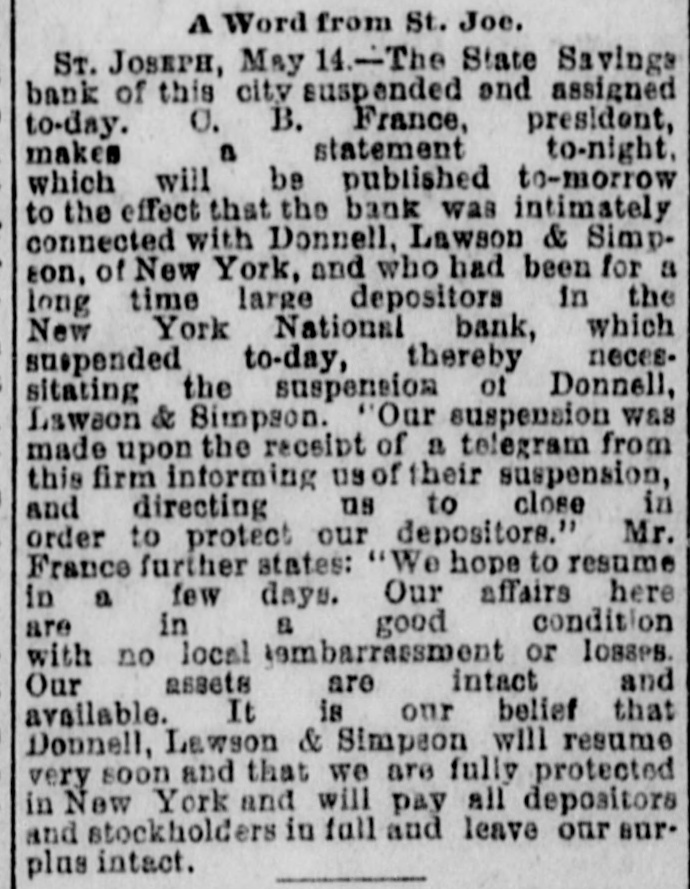
A Word from St. Joe. ST. JOSEPH, May 14-The State Savings bank of this city suspended and assigned to-day. C. B. France, president, makes a statement to-night, which will be published to-morrow to the effect that the bank was intimately connected with Donnell, Lawson & Simpson, of New York, and who had been for a long time large depositors in the New York National bank, which suspended to-day, thereby necessitating the suspension of Donnell, Lawson & Simpson. "Our suspension was made upon the receipt of a telegram from this firm informing us of their suspension, and directing as to close in order to protect our depositors." Mr. France further states: "We hope to resume in a few days. Our affairs here condition a in are good with no local iembarrassment or losses. Our assets are intact and available. It is our belief that Donnell, Lawson & Simpson will resume very soon and that we are fully protected in New York and will pay all depositors and stockholders in fall and leave our surplus intact.


Article from New-York Tribune, May 15, 1884

Click image to open full size in new tab

Article Text

DONNELL, LAWSON & SIMPSON SUSPEND. Within twenty minutes after the announcement of the suspension of the Metropolitan National Bank, the banking firm of Donnell, Lawson & Simpson, No. 102 Broadway, suspended. There was a rumor that the firm had $2,000,000 on deposit in the Metropolitan, but at the office of the


Article from The Indianapolis Journal, May 16, 1884

Click image to open full size in new tab

Article Text

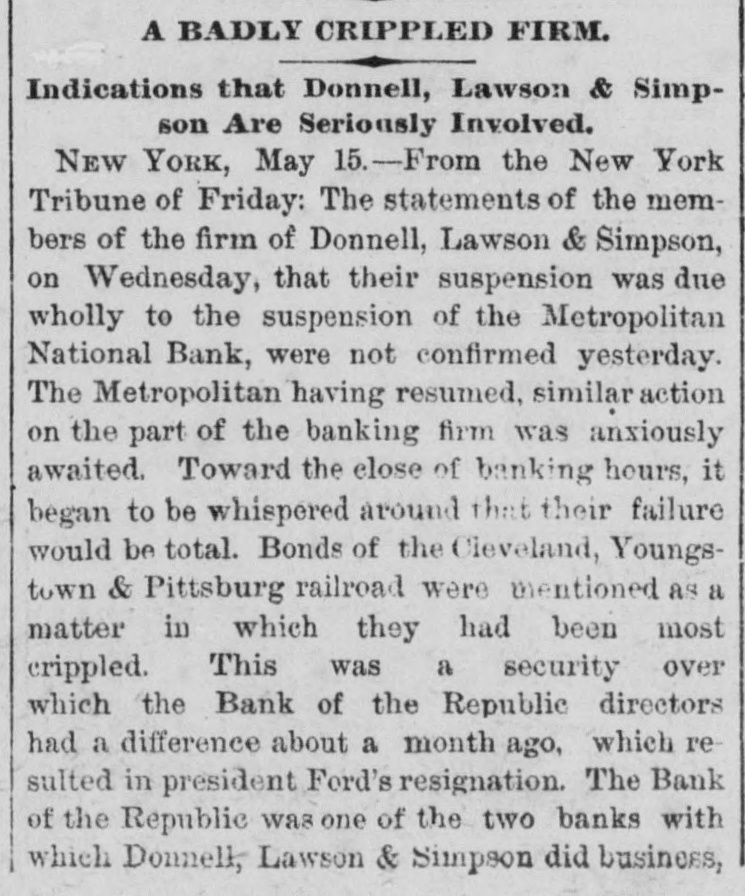
A BADLY CRIPPLED FIRM. Indications that Donnell, Lawson & Simpson Are Seriously Involved. NEW YORK, May - From the New York Tribune of Friday: The statements of the members of the firm of Donnell, Lawson & Simpson, on Wednesday, that their suspension was due wholly to the suspension of the Metropolitan National Bank, were not confirmed yesterday. The Metropolitan having resumed, similar action on the part of the banking firm was anxiously awaited. Toward the elose of banking hours, it began to be whispered around that their failure would be total. Bonds of the Cieveland, Youngstown & Pittsburg railroad were mentioned as a matter in which they had been most crippled. This was a security over which the Bank of the Republic directors had a difference about a month ago, which resulted in president Ford's resignation. The Bank of the Republic was one of the two banks with which Donnell, Lawson & Simpson did business,


Article from The Dillon Tribune, May 17, 1884

Click image to open full size in new tab

Article Text

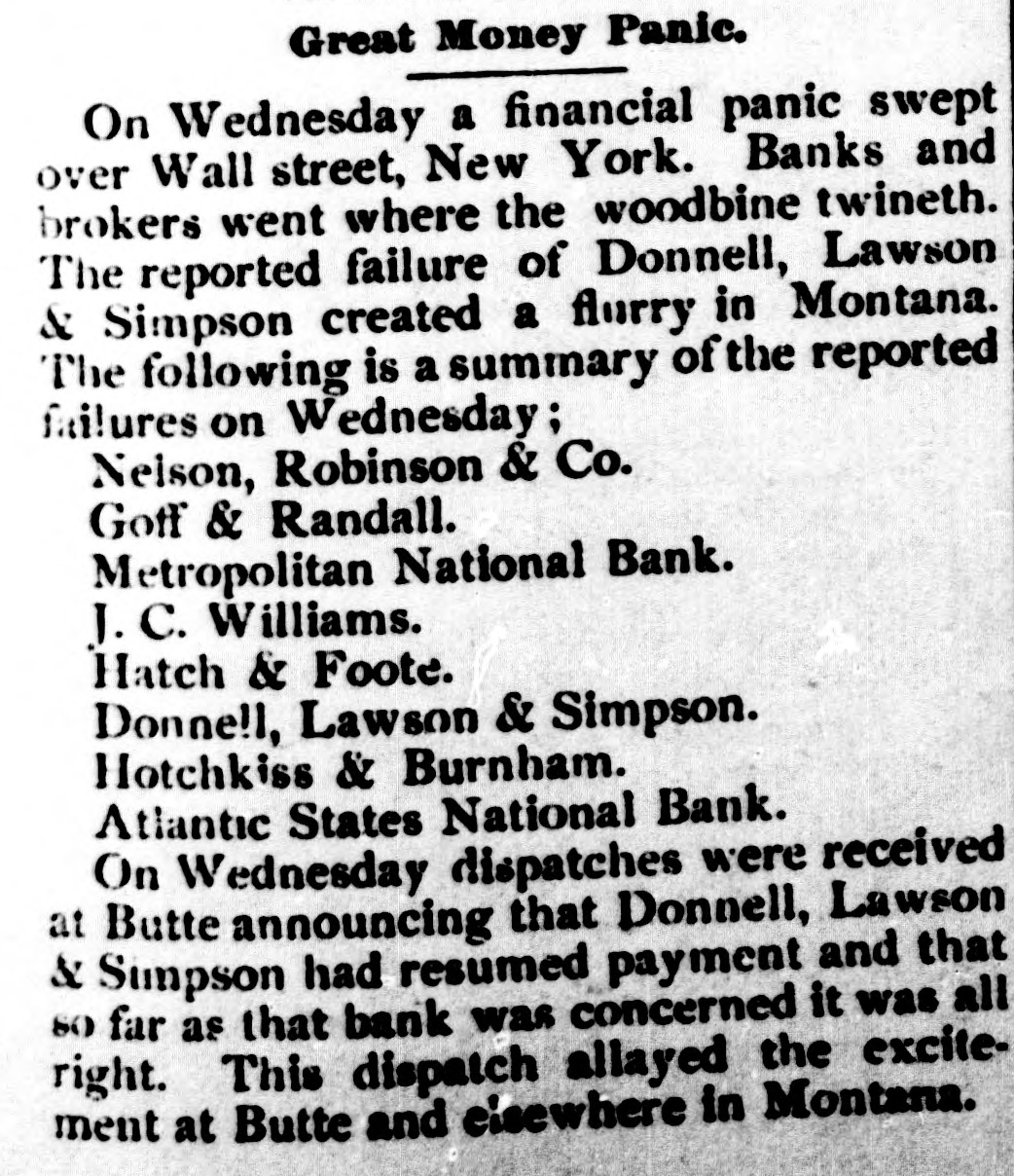
Great Money Panic. On Wednesday a financial panic swept over Wall street, New York. Banks and brokers went where the woodbine twineth. The reported failure of Donnell, Lawson & Simpson created a flurry in Montana. The following is a summary of the reported failures on Wednesday; Neison, Robinson & Co. Goff & Randall. Metropolitan National Bank. 1. C. Williams. Hatch & Foote. Donnell, Lawson & Simpson. Hotchkiss & Burnham. Atlantic States National Bank. On Wednesday dispatches were received at Butte announcing that Donnell, Lawson & Sunpson had resumed payment and that so far as that bank was concerned it was all right. This dispatch allayed the excitement at Butte and elsewhere in Montana.


Article from The River Press, May 21, 1884

Click image to open full size in new tab

Article Text

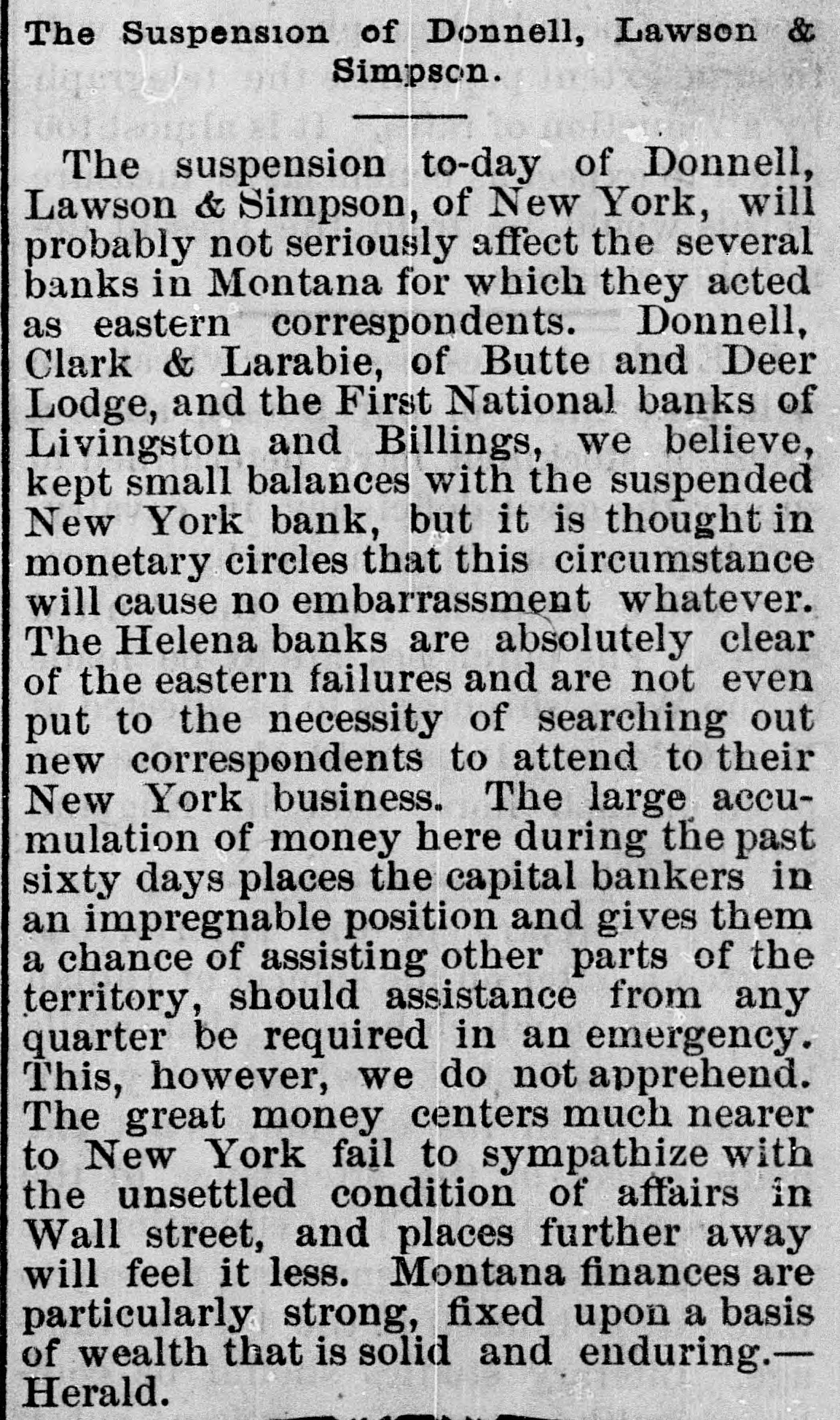
The Suspension of Donnell, Lawson & Simpson. The suspension to-day of Donnell, Lawson & Simpson, of New York, will probably not seriously affect the several banks in Montana for which they acted as eastern correspondents. Donnell, Clark & Larabie, of Butte and Deer Lodge, and the First National banks of Livingston and Billings, we believe, kept small balances with the suspended New York bank, but it is thought in monetary circles that this circumstance will cause no embarrassment whatever. The Helena banks are absolutely clear of the eastern failures and are not even put to the necessity of searching out new correspondents to attend to their New York business. The large accumulation of money here during the past sixty days places the capital bankers in an impregnable position and gives them a chance of assisting other parts of the territory, should assistance from any quarter be required in an emergency. This, however, we do not apprehend. The great money centers much nearer to New York fail to sympathize with the unsettled condition of affairs in Wall street, and places further away will feel it less. Montana finances are particularly strong, fixed upon a basis of wealth that is solid and enduring.Herald.


Article from The Ketchum Keystone, May 21, 1884

Click image to open full size in new tab

Article Text

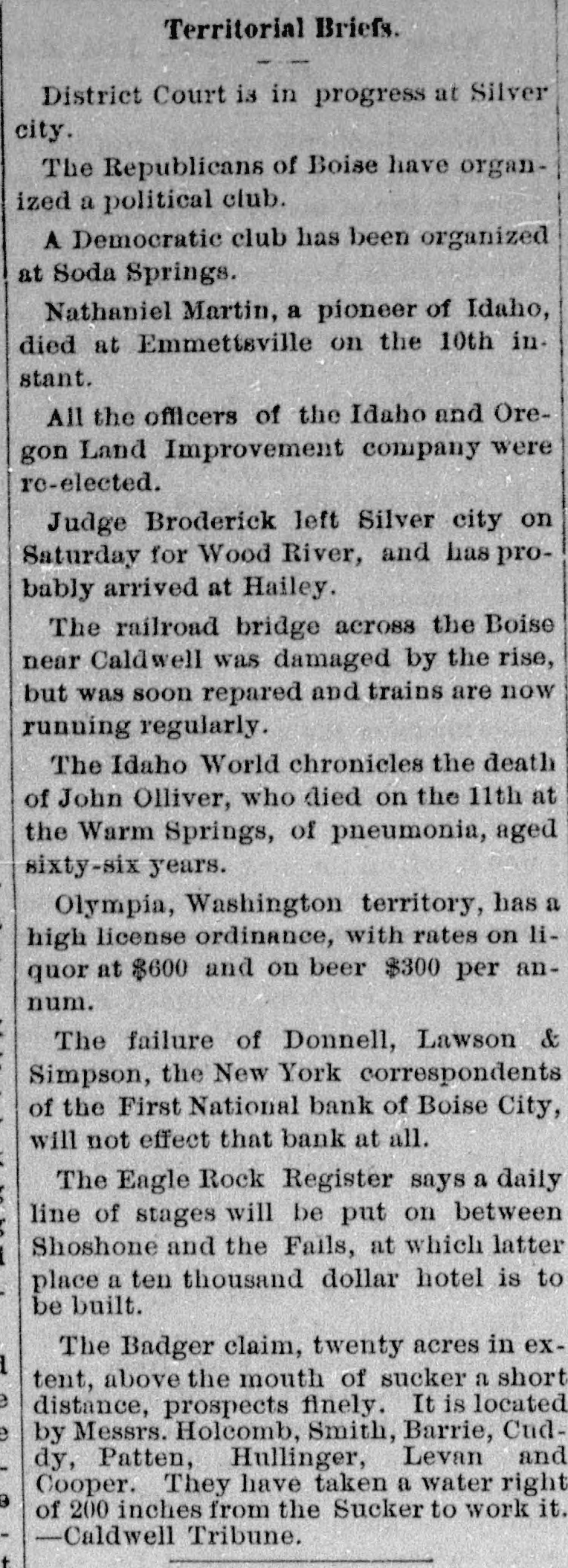
Territorial Briefs. District Court is in progress at Silver city. The Republicans of Boise have organized a political club. A Democratic club has been organized at Soda Springs. Nathaniel Martin, a pioneer of Idaho, died at Emmettsville on the 10th instant. All the officers of the Idaho and Oregon Land Improvement company were re-elected. Judge Broderick left Silver city on Saturday for Wood River, and has probably arrived at Hailey. The railroad bridge across the Boise near Caldwell was damaged by the rise, but was soon repared and trains are now running regularly. The Idaho World chronicles the death of John Olliver, who died on the 11th at the Warm Springs, of pneumonia, aged sixty-six years. Olympia, Washington territory, has a high license ordinance, with rates on liquor at $600 and on beer $300 per annum. The failure of Donnell, Lawson & Simpson, the New York correspondents of the First National bank of Boise City, will not effect that bank at all. The Eagle Rock Register says a daily line of stages will be put on between Shoshone and the Fails, at which latter place a ten thousand dollar hotel is to be built. The Badger claim, twenty acres in extent, above the mouth of sucker a short distance, prospects finely. It is located by Messrs. Holcomb, Smith, Barrie, Cuddy, Patten, Hullinger, Levan and Cooper. They have taken a water right of 200 inches from the Sucker to work it. --Caldwell Tribune.


Article from The Austin Weekly Statesman, May 22, 1884

Click image to open full size in new tab

Article Text

mour's bank, which prefers to pay dollar for dollar. The balances at the clearing house will be announced this afternoon, when a plan of settlement will be agreed upon. It is thought the plan in New York will be agreed P n here. There was some excitement this morning,but this materially subsided at noon. NEW YORK, May 15.-There was a much better feeling in the stock exchange circles early in the day, due to the action of the Clearing house, and to the resumption of the Metropolitan bank. Shortly after opening, a slightly weaker feeling prevailed, owing to the announcement of the failure of A. W. Dimmock & Co. This was succeeded by strong buying for foreign and home account, and there was a general improvement. Canadian Pacific rose 3 to 47; Central Pac. 41/2 to 421/4; C. B. & Q., 1Β½ to 116; Northwestern, 2 to 1051/2, preferred 51/2 to 130Β½; Lackawanna, 3 to 113; Lake Shore, 23/3 to 921/2; Mo. Pac., 514 to 73; Kans. & Tex., 13/8 to 143/8; N. Y. Cent., 23/4 to 1101/4; Northern Pac. preferred 51/4 to 49 Oregon Trans., 21/3 to 241/3; Pac. Mail, 3 to 39; Omaha preferred 6 to 90; Texas Pac., 13/3 to 12; Union Pac., 3 to 44; Western Union, 33/4 to 541/4. At the clearing house new certificates were ready for delivery at an early hour, and the banks availed themselves to extend $47,000,000. The resumption of the Merchants Bank also had a favorable effect, as it set at rest the rumors that the suspension was of the Marine Bank character. Buying for European account was an special feature of the market, and every house with foreign connections had liberal orders to purchase. At times during the day when the market flagged, these purchases turned the course of speculation. The extent of this foreign buying movement is plainly shown by the foreign exchanges. There was a larger supply of bills than for a long time, and the pressure to sell caused a sharp decline in the high rates of money at this centre. Foreign capital, and leading English and German institutions, telegraphed their agents here to draw for any amount. Buying stocks for home account was also very large, brokers offices being crowded with investors. This is usually the Case alter a disturbance like the past few days. Stocks SO bought, it should be understood, are paid in full. This operation, aside from reducing the amount of stocks to be carried on the street, brings in SO much fresh capital to aid the money market. Investment purchases, therefore, naturally had an important influence in the direction of improvement just before the close of the suspension of Fisk & Hatch was announced, and there was evidence of strong support in the final dealings, and, compared with last night's, the closing prices were five per cent higher. Donnell, Lawson & Simpson have over four hundred banks for whom they transacted New York business, scattered through Georgia, Florida, Texas, Missouri, Kansas, Arkansas, Nebraska, lowa, Colorado, Utah and other territories, and over one hundred bulletins were posted on the door. Inside, Donnell and Simpson were busy all day trying to see where they stand. Lawson is in Europe. To a Tribune reporter Simpson said: We are still figuring up and trying to get to a point where we can resume. We can't tell you anything until about to-morrow afternoon. There is a prospect we will resume. That is the point towards which our arrangements are tending." "Has an assignee or receiver been ?" decided "No, sir: nothing of that kind has been or will be done, now. We shall not make an assignment unless satisfied that we cannot go on or settle our business satisfactorily withoutit." A RUN ON A BANK. BRIDGEPORT, CONN., May 15.-The raid on the banking house of Watson & Co. was resumed this morning, but the excitement subsided by 10 o'clock. KANSAS CITY, May 15.-The slight flurry of this morning disappeared this afternoon. A large number of deposits were drawn out this morning, but nearly all small amounts, the larger depositors appearing confident that the scare was artificial, and the concerted action of the banks, coupled with the encouraging eastern advices brought about an early reaction, and the excitement gradually subsided. The report which got abroad that the bank of Kansas City was involved seems to have originated in the impression that the bank had a large account with Donnell, Lawson & Simpson. Their books show they had only $39,000 with the New York firm, a comparatively small amount. The feeling now 18 that all occasion for apprehension of serious trouble is over. WALL STREET, 12:40 P. M.-Comparative quiet reigns on the stock exchange, and it is more apparent every moment that the crisis is past. The suspension of Hawley & Co., of Boston, was caused by a run on the banking department of the house of Beliene. It will be temporary. BOSTON, May 15.-F. S. Hawley & Co., bankers and brokers, have suspended and cannot give a statement of their liabilities. They state that their failute is due to the failure to ascertain just where they stand. They have been doing business as bank depositors and the amount due depositors is unknown. The house was rated at $100,000. It wasstated the Bank of Commerce was this morning a debtor to the Clearing house $500,000. Examiner Scribas' work has been discontinued, and the official advices in general continue reassuring. The Commercial says the general subject of discussion was the remarkable position assumed by President Seney and the directors of the Metropolitan bank, who announced the bank


Article from The New North-West, May 23, 1884

Click image to open full size in new tab

Article Text

BANK SUSPENSIONS. Fisk & Hatch and Donnell, Lawson & Simpson. NEW YORK, May 15.-Fisk & Hatch handed the following notice to an Associated Press reporter: To our Depositors and Other Creditors: It is with great sorrow we are obliged to announce to you our suspension, which has been brought on by a combination of circumstances. Long continued decline in the market price.of securities, even the very best, accompanied by a general weakness of confidence in financial matters, together with a heavy drainage on deposits, are the principal cause of our unfortunate position. We can only request those having claims against us to extend to us such consideration and indulgences as we may need, and which it may vo in their power to grant. Very truly, FISK & HATCH NEW YORK, May 16.-Donnell, Lawson & Simpson handed this card to an Associated Press reporter: To our Creditors: SIRs-It is with great sorrow we are compelled to report our suspension, which has been brought about by a combination of circumstances over which we had no control. We can only request those having claims against us to extend such consideration and indulgence as possible, as otherwise our assets may be sacrificed to prejudicial parties. As the best means of realizing from our assets and securing our creditors, we have made assignments of all assets of the firm; also the individual assets of each member of the firm, wherever situated, to our confidential clerk, R. H. Weems, who has been in our employ for twelve years and is as well acquainted with our business and the character of our assets as any mem ber of the firm, and under his management, with the assistance of every member of the firm, who propose to give him every possible aid in executing his trust, we feel warranted in saying that by this means every dollar that can be possibly realized will be secured. We hope to pay all our liabilities if our business is prudently managed and our assets are not sacrificed. We hope you will concur in and indorse the plans proposed. DONNELL, LAWSON & SIMPSON. Each mail brings remittances to the firm, which are being turned over to other banks as fast as instructions to that effect are received. NEW YORK, May 17.-Assignee Weems states that the liabilities of Donnell, Lawson & Simpson are $3,000,0000, and that their assets will exceed their liabilities $1,000,000.


Article from The New North-West, May 23, 1884

Click image to open full size in new tab

Article Text

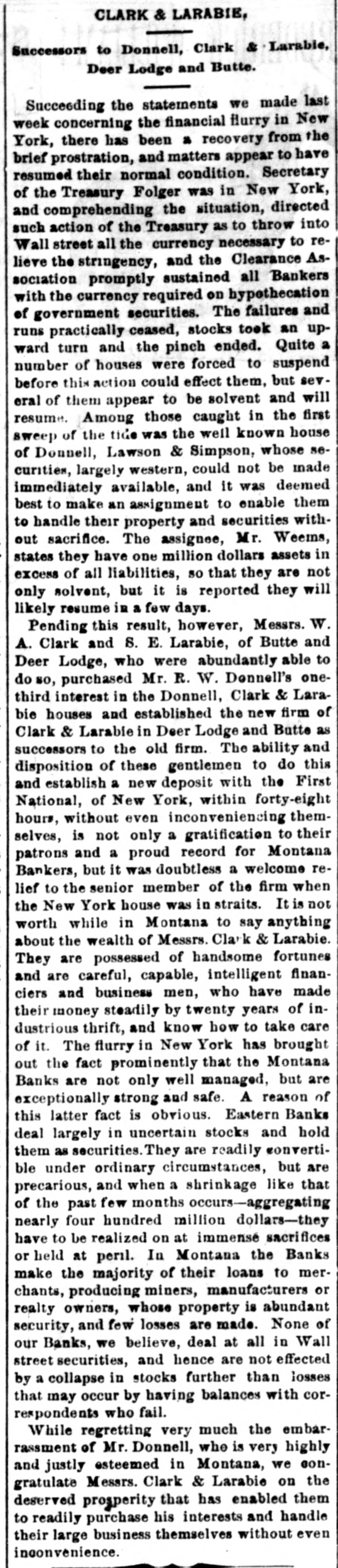
CLARK & LARABIE, Successors to Donnell, Clark & Larabie, Deer Lodge and Butte. Succeeding the statements we made last week concerning the financial Hurry in New York, there has been a recovery from the brief prostration, and matters appear to have resumed their normal condition. Secretary of the Treasury Folger was in New York, and comprehending the situation, directed such action of the Treasury as to throw into Wall street all the currency necessary to relieve the stringency, and the Clearance Association promptly sustained all Bankers with the currency required on hypothecation of government securities. The failures and runs practically ceased, stocks took an upward turn and the pinch ended. Quite a number of houses were forced to suspend before this action could effect them, but several of them appear to be solvent and will resume. Among those caught in the first sweep of the tide was the well known house of Donnell, Lawson & Simpson, whose securities, largely western, could not be made immediately available, and it was deemed best to make an assignment to enable them to handle their property and securities without sacrifice. The assignee, Mr. Weems, states they have one million dollars assets in excess of all liabilities, so that they are not only solvent, but it is reported they will likely resume in a few days. Pending this result, however, Messrs. W. A. Clark and S. E. Larabie, of Butte and Deer Lodge, who were abundantly able to do so, purchased Mr. R. W. Donnell's onethird interest in the Donnell, Clark & Larabie houses and established the new firm of Clark & Larabie in Deer Lodge and Butte as successors to the old firm. The ability and disposition of these gentlemen to do this and establish a new deposit with the First National, of New York, within forty-eight hours, without even inconveniencing themselves, is not only a gratification to their patrons and a proud record for Montana Bankers, but it was doubtless a welcome relief to the senior member of the firm when the New York house was in straits. It is not worth while in Montana to say anything about the wealth of Messrs. Clark & Larabie. They are possessed of handsome fortunes and are careful, capable, intelligent financiers and business men, who have made their money steadily by twenty years of industrious thrift, and know how to take care of it. The flurry in New York has brought out the fact prominently that the Montana Banks are not only well managed, but are exceptionally strong and safe. A reason of this latter fact is obvious. Eastern Banks deal largely in uncertain stocks and hold them as securities. They are readily sonvertible under ordinary circumstances, but are precarious, and when a shrinkage like that of the past few months occurs-aggregating nearly four hundred million dollars-they have to be realized on at immense sacrifices or held at peril. In Montana the Banks make the majority of their loans to merchants, producing miners, manufacturers or realty owners, whose property is abundant security, and few losses are made. None of our Banks, we believe, deal at all in Wall street securities, and hence are not effected by a collapse in stocks further than losses that may occur by having balances with correspondents who fail. While regretting very much the embarrassment of Mr. Donnell, who is very highly and justly esteemed in Montana, we congratulate Messrs. Clark & Larabie on the deserved prosperity that has enabled them to readily purchase his interests and handle their large business themselves without even inconvenience.


Article from Wood County Reporter, May 29, 1884

Click image to open full size in new tab

Article Text

THE suspension of the firm of Don. nell, Lawson & Simpson, the New York private bankers and brokers, was the most serious incident of last week's financial disturbrnce as far as the West was directly concerned, inasmuch as it involved a number of banking institutions in Missouri, Iowa and Indiana.


Article from Morning Journal and Courier, June 3, 1884

Click image to open full size in new tab

Article Text

J. Edward Simmons was elected president of the Stock Exchange yesterday afternoon, receiving 601 votes against 131 for his opponeat, O. N. Stead. Donnell, Lawson & Simpson, the New York bankers and brokers who suspended during the recent panic, propese to resume business and payments within thirty days. The Baltimore and Ohio Telegraph company has again reduced its commercial rates between the cities of St. Louis, Washington, Philadelphia, Baltimore and New York from fifty to forty cents for ten words. The Massachusetts House yesterday enacted the civil service bill with amendments. It now awaits the Governor's signature. The Senate by 14 to 11 passed a bill raising the salaries of State House clerks from $2,500 to $3,000. Base ball yesterday: At Providence, Providence 9, New Yorks 3; at Boston, Bostons 10, Philadelphias 1; at Detroit, Detroits 6, Clevelands 3; at Washington, Keystones 8, Nationals 3-Cincinnatis 3, Washingtons o; at Baltimore, Baltimore Unions 7, Boston Unions 2; at Philadelphia, St. Louis 5, Athletics 3; at Brooklyn, Indianapolis 8, Brooklyns 7; at Baltimore, Baltimores 10, Columbus 5; at Worcester, Woroesters 10, Springfields 8; at Amherst, Amherets 17, Rochester University 5; at New York, Metropolitans 18, Jaspers 3.


Article from The Waco Daily Examiner, July 3, 1884

Click image to open full size in new tab

Article Text

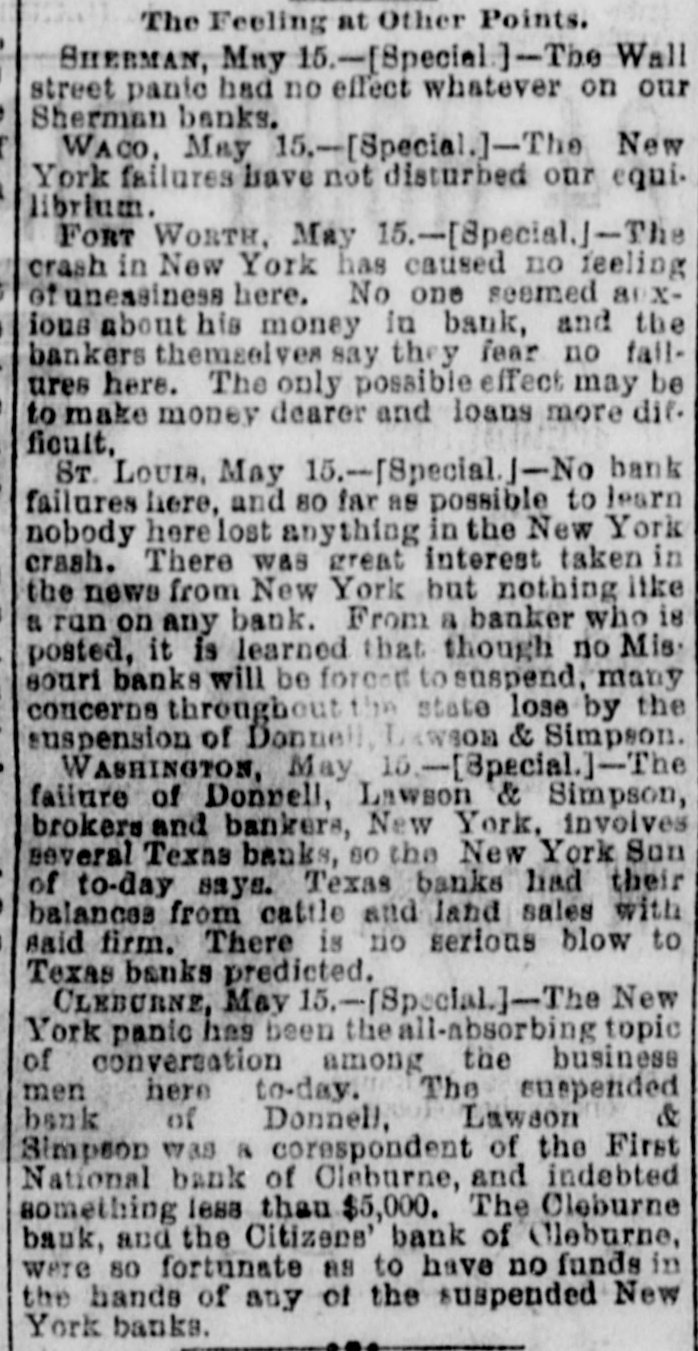
A number of Texas banks suffered severely by the suspension of Donnell, Lawson & Simpson, bankers of New York, and it will no doubt be good news to them to learn that the firm is in a fair way to recume


Article from Wheeling Register, October 22, 1884

Click image to open full size in new tab

Article Text

Donneil, Lawson & Simpson Resume. NEW YORK. October 21.-The firm of Donnell, Lawson & Simpson, bankers, which failed during the recent panic in Wall street, announce that they expect to resume business to morrow.


Article from The Rock Island Argus, October 22, 1884

Click image to open full size in new tab

Article Text

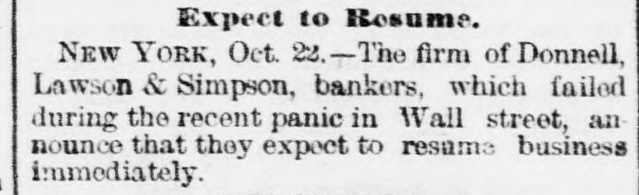
Expect to Resume. NEW YORK, Oct. 22.-The firm of Donnell, Lawson & Simpson, bankers, which failed during the recent panic in Wall street, announce that they expect to resume business immediately.


Article from The Salt Lake Herald, October 22, 1884

Click image to open full size in new tab

Article Text

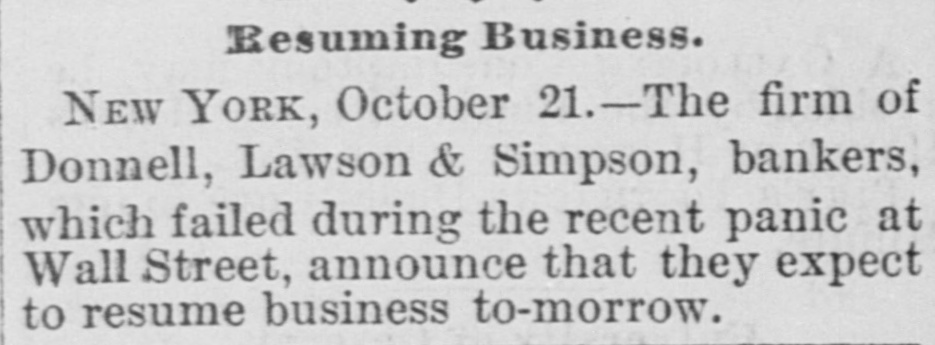
Resuming Business. NEW YORK, October 21.-The firm of Donnell, Lawson & Simpson, bankers, which failed during the recent panic at Wall Street, announce that they expect to resume business to-morrow.


Article from The Daily Cairo Bulletin, October 22, 1884

Click image to open full size in new tab

Article Text

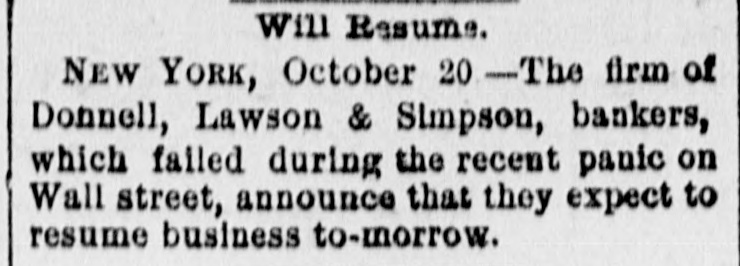
Will Resume. NEW YORK, October 20 -The firm of Donnell, Lawson & Simpson, bankers, which failed during the recent panic on Wall street, announce that they expect to resume business to-morrow.


Article from The Stark County Democrat, October 23, 1884

Click image to open full size in new tab

Article Text

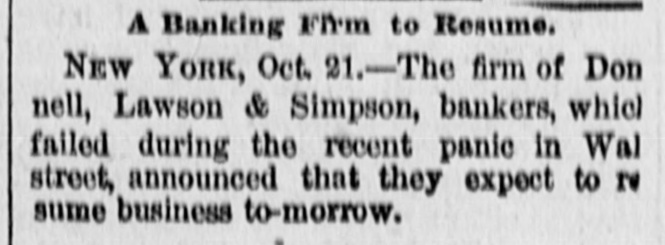
A Banking Firm to Resume. NEW YORK, Oct. 21.-The firm of Don nell, Lawson & Simpson, bankers, which failed during the recent panic in Wal street, announced that they expect to IV sume business to-morrow.


Article from The Dallas Weekly Herald, October 23, 1884

Click image to open full size in new tab

Article Text

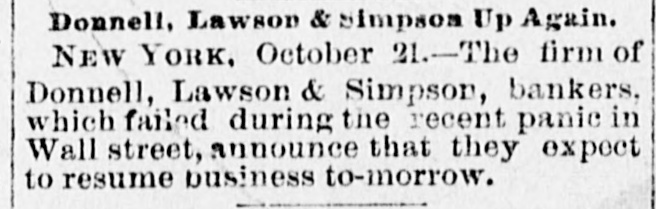
Donnell, Lawson & simpson Up Again. NEW YORK, October 21.-The firm of Donnell, Lawson & Simpson, bankers. which failed during the recent panic in Wall street, announce that they expect to resume business to-morrow.


Article from Daily Inter Mountain, October 30, 1900

Click image to open full size in new tab

Article Text

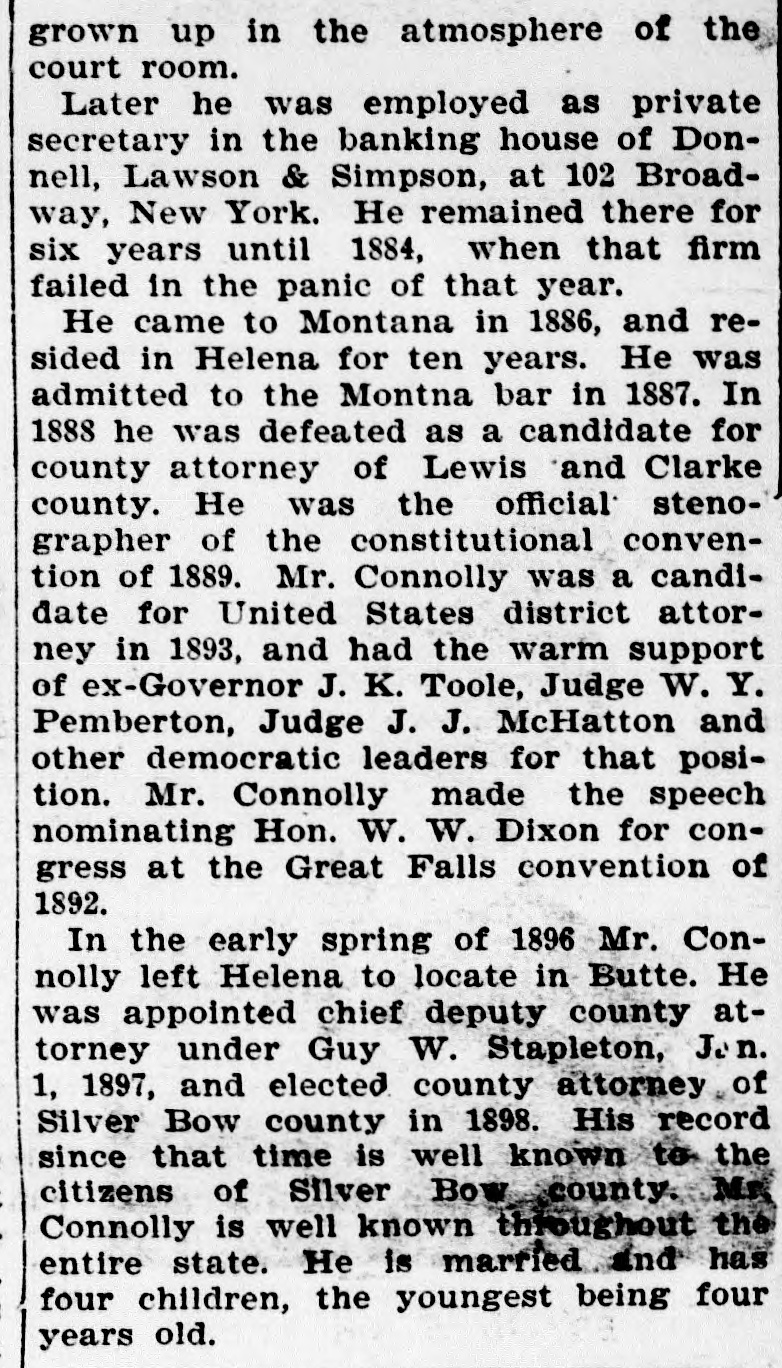
grown up in the atmosphere of the court room. Later he was employed as private secretary in the banking house of Donnell, Lawson & Simpson, at 102 Broadway, New York. He remained there for six years until 1884, when that firm failed in the panic of that year. He came to Montana in 1886, and resided in Helena for ten years. He was admitted to the Montna bar in 1887. In 1888 he was defeated as a candidate for county attorney of Lewis and Clarke county. He was the official stenographer of the constitutional convention of 1889. Mr. Connolly was a candidate for United States district attorney in 1893, and had the warm support of ex-Governor J. K. Toole, Judge W. Y. Pemberton, Judge J. J. McHatton and other democratic leaders for that position. Mr. Connolly made the speech nominating Hon. W. W. Dixon for congress at the Great Falls convention of 1892. In the early spring of 1896 Mr. Connolly left Helena to locate in Butte. He was appointed chief deputy county attorney under Guy W. Stapleton, Jon. 1, 1897, and elected county attorney of Silver Bow county in 1898. His record since that time is well known to the citizens of Silver Bow county. Mr. Connolly is well known throughout the entire state. He is married and has four children, the youngest being four years old.


Article from The Minneapolis Journal, September 21, 1906

Click image to open full size in new tab

Article Text

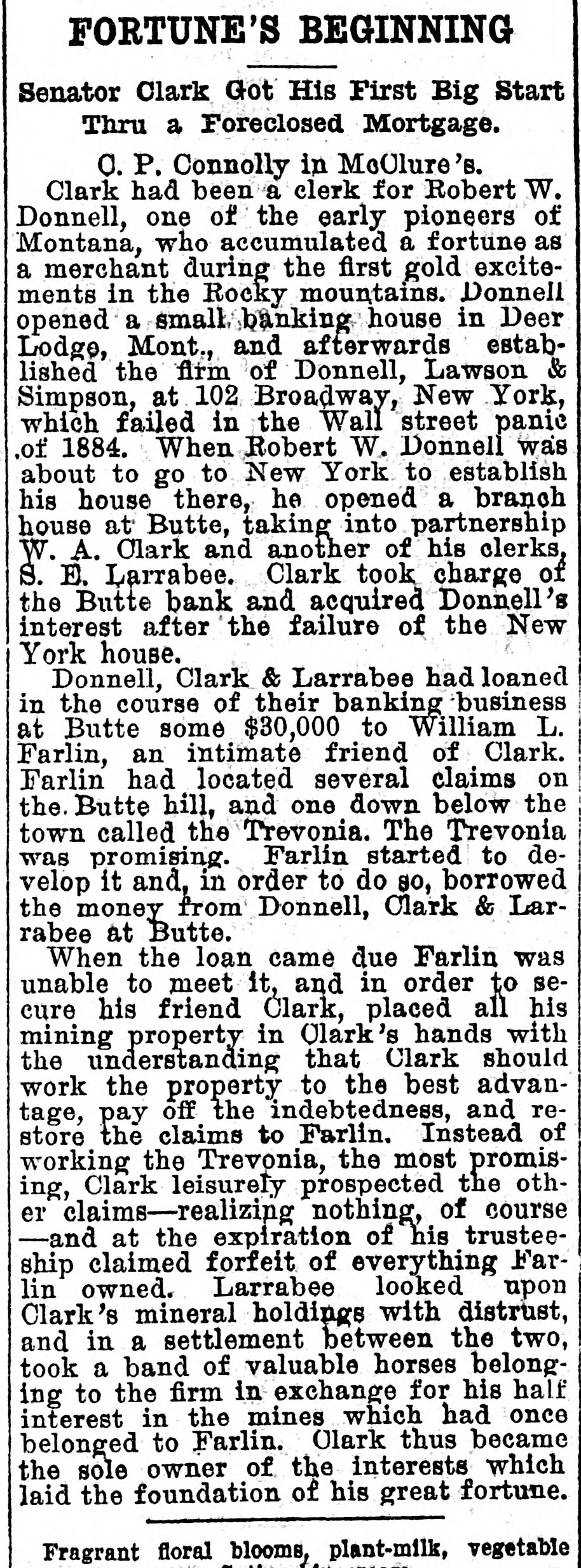
FORTUNE'S BEGINNING Senator Clark Got His First Big Start Thru a Foreclosed Mortgage. O.P. Connolly in McClure's. Clark had been a clerk for Robert W. Donnell, one of the early pioneers of Montana, who accumulated a fortune as a merchant during the first gold excitements in the Rocky mountains. Donnell opened a small banking house in Deer Lodge, Mont., and afterwards established the firm of Donnell, Lawson & Simpson, at 102 Broadway, New York, which failed in the Wall street panic of 1884. When Robert W. Donnell was about to go to New York to establish his house there, he opened a branch house at Butte, taking into partnership W. A. Clark and another of his clerks, S. E. Larrabee. Clark took charge of the Butte bank and acquired Donnell's interest after the failure of the New York house. Donnell, Clark & Larrabee had loaned in the course of their banking business at Butte some $30,000 to William L. Farlin, an intimate friend of Clark. Farlin had located several claims on the. Butte hill, and one down below the town called the Trevonia. The Trevonia was promising. Farlin started to develop it and, in order to do so, borrowed the money from Donnell, Clark & Larrabee at Butte. When the loan came due Farlin was unable to meet it, and in order to secure his friend Clark, placed all his mining property in Clark's hands with the understanding that Clark should work the property to the best advantage, pay off the indebtedness, and restore the claims to Farlin. Instead of working the Trevonia, the most promising, Clark leisurely prospected the other claims-realizing nothing, of course -and at the expiration of his trusteeship claimed forfeit of everything Farlin owned. Larrabee looked upon Clark's mineral holdings with distrust, and in a settlement between the two, took a band of valuable horses belonging to the firm in exchange for his half interest in the mines which had once belonged to Farlin. Clark thus became the sole owner of the interests which laid the foundation of his great fortune. Fragrant floral blooms, plant-milk, vegetable


Article from Omaha Daily Bee, October 14, 1906

Click image to open full size in new tab

Article Text

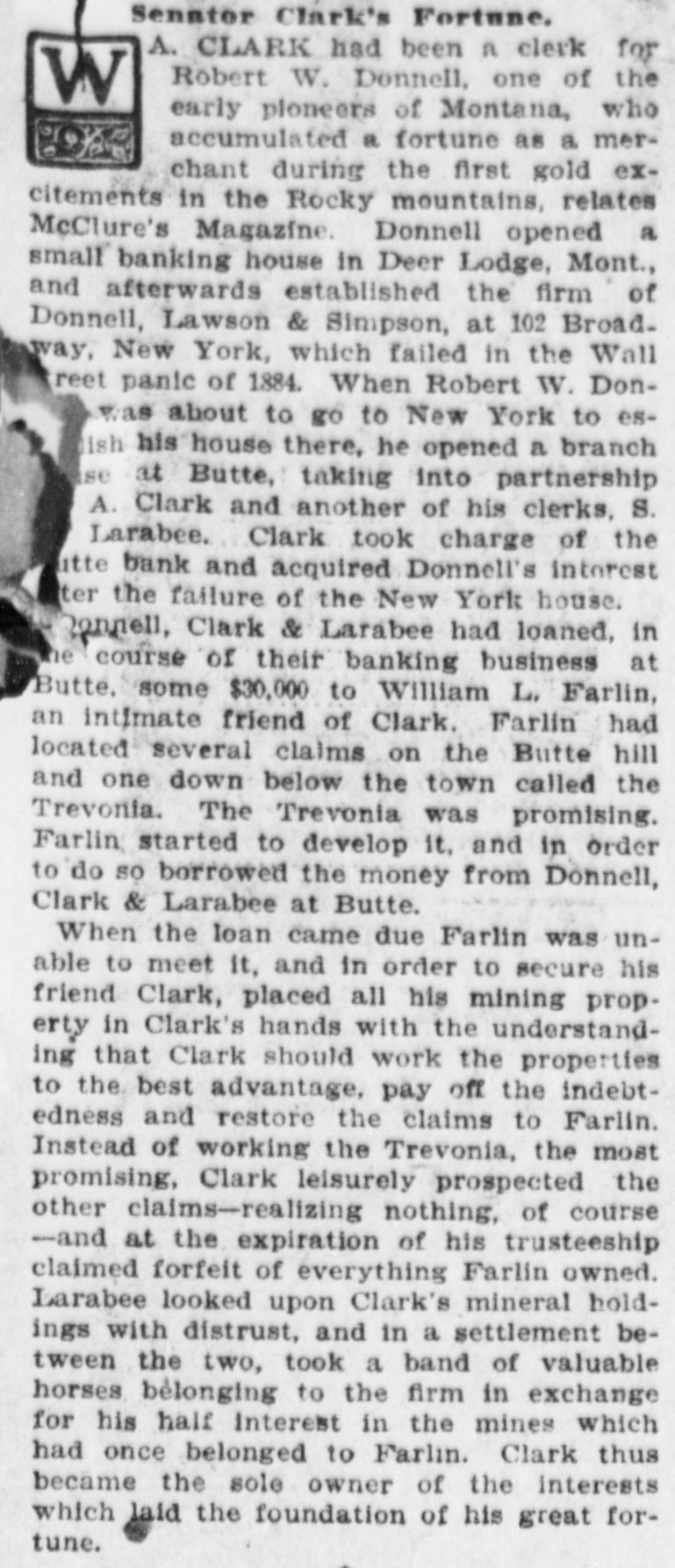
Senator Clark's Fortune. A. CLARK had been R clerk for Robert W. Donnell, one of the W early ploneers of Montana, who accumulated a fortune as a merchant during the first gold excitements in the Rocky mountains, relates McClure's Magazine. Donnell opened a small banking house in Deer Lodge, Mont., and afterwards established the firm of Donnell, Lawson & Simpson, at 102 Broad. way, New York, which failed in the Wall reet panic of 1884. When Robert W. Donwas about to go to New York to esish his house there, he opened a branch se at Butte, taking into partnership A. Clark and another of his clerks, S. Larabee. Clark took charge of the utte bank and acquired Donnell's intorest ter the failure of the New York house. Ronnell, Clark & Larabee had loaned, in the course of their banking business at Butte, some $30,000 to William L. Farlin, an intimate friend of Clark. Farlin had located several claims on the Butte hill and one down below the town called the Trevonia. The Trevonia was promising. Farlin started to develop it, and in order to do so borrowed the money from Donnell, Clark & Larabee at Butte. When the loan came due Farlin was unable to meet It, and in order to secure his friend Clark, placed all his mining property in Clark's hands with the understanding that Clark should work the properties to the best advantage, pay off the indebtedness and restore the claims to Farlin. Instead of working the Trevonia, the most promising, Clark leisurely prospected the other claims-realizing nothing, of course -and at the expiration of his trusteeship claimed forfeit of everything Farlin owned. Larabee looked upon Clark's mineral holdings with distrust, and in a settlement between the two, took a band of valuable horses bΓ©longing to the firm in exchange for his half Interest in the mines which had once belonged to Farlin. Clark thus became the sole owner of the interests which laid the foundation of his great fortune.