First National Bank (Indianapolis, IN)

Episode Information

Episode UID
5500885
Episode Type
Run → Suspension → Reopening
Bank Type
national
Bank ID
550 national
Charter Number
55
Start Date
September 25, 1873
Location
Indianapolis, Indiana (39.768, -86.158)

Metadata

Model
gpt-5-mini (chosen from majority vote of a three-model LLM ensemble)
Short Digest
92a5f6a38af1e564

Response Measures

Accommodated withdrawals, Partial suspension

Clearinghouse involved: Yes (loan, examination, or other measures)

Events (5)

1. August 8, 1863 Chartered
Source
historical_nic
2. September 25, 1873 Run
Cause
Local Banks
Cause Details
Runs on other local banks (Ritzinger's/Indianapolis Savings) and general financial excitement triggered withdrawals at First National
Measures
Kept open an hour later to allow depositors to withdraw; met withdrawals and received more than it paid out
Newspaper Excerpt
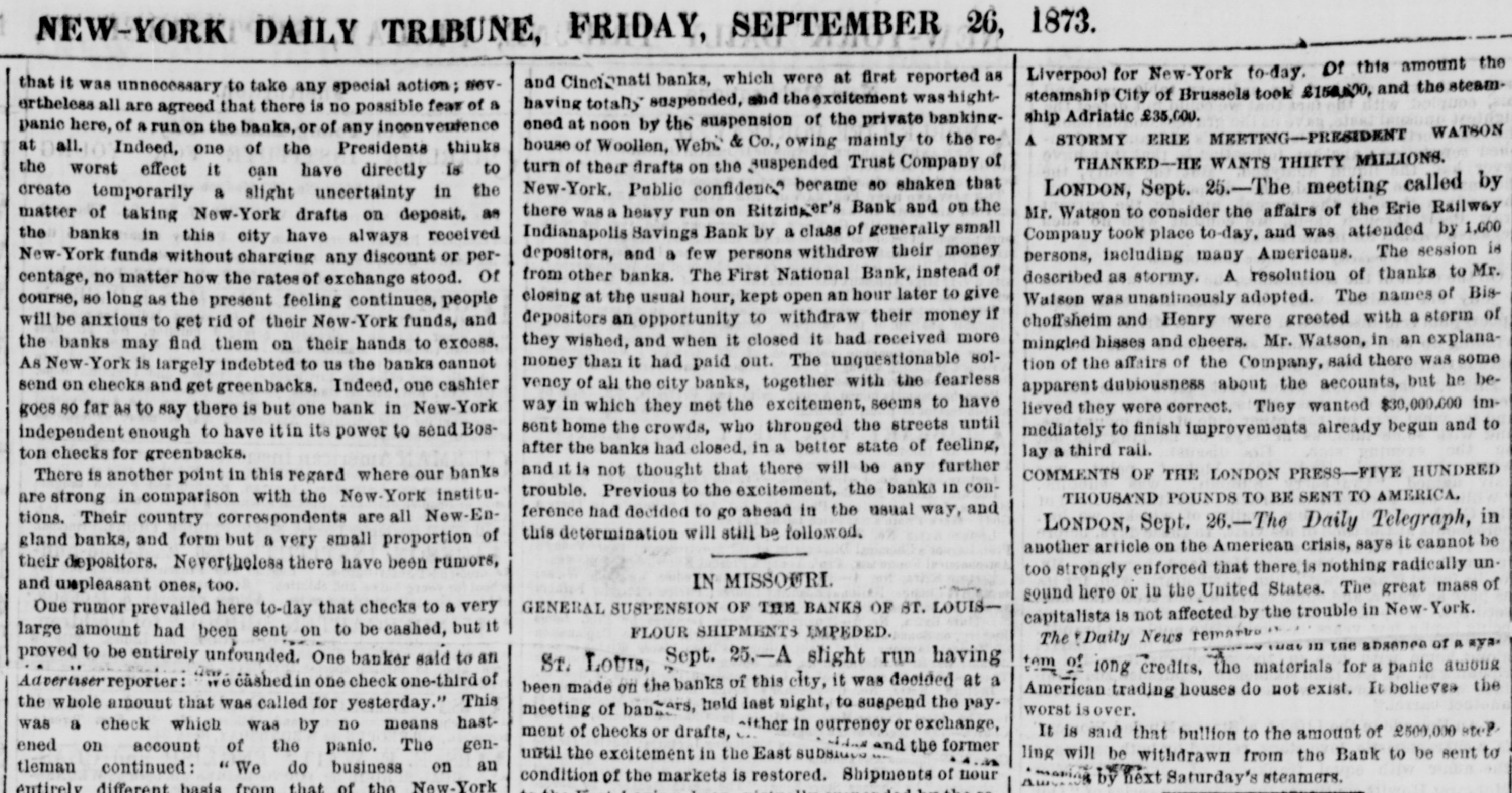
there was a heavy run on Ritzinger's Bank and on the Indianapolis Savings Bank by a class of generally small depositors, and a few persons withdrew their money from other banks. The First National Bank, instead of closing at the usual hour, kept open an hour later to give depositors an opportunity to withdraw their money if they wished
Source
newspapers
3. September 26, 1873 Suspension
Cause
Macro News
Cause Details
Clearing-house instituted a short, city-wide partial suspension in response to the broader Panic of 1873 and regional banking suspensions/uncertainty
Newspaper Excerpt
The Indianapolis Clearing-house, at their meeting this morning, resolved to adopt for two days substantially the same plan adopted in New-York. Chicago, and Cincinnati.
Source
newspapers
4. October 21, 1873 Reopening
Newspaper Excerpt
The banks of Indianapolis have decided to resume full currency payments.
Source
newspapers
5. November 11, 1886 Voluntary Liquidation
Source
historical_nic

Newspaper Articles (4)

Article from New-York Tribune, September 26, 1873

Click image to open full size in new tab

Article Text

that it was unnecessary to take any special action; nevertheless all are agreed that there is no possible fear of a panic here, of a run on the banks, or of any inconvenience at all. Indeed, one of the Presidents thinks the worst effect it can have directly is to create temporarily a slight uncertainty in the matter of taking New-York drafts on deposit, as the banks in this city have always received New-York funds without charging any discount or percentage, no matter how the rates of exchange stood. Of course, so long as the present feeling continues, people will be anxious to get rid of their New-York funds, and the banks may find them on their hands to excess. As New-York is largely indebted to us the banks cannot send on checks and get greenbacks. Indeed, one cashier goes so far as to say there is but one bank in New-York independent enough to have it in its power to send Boston checks for greenbacks. There is another point in this regard where our banks are strong in comparison with the New-York institutions. Their country correspondents are all New-England banks, and form but a very small proportion of their depositors. Nevertheless there have been rumors, and unpleasant ones, too. One rumor prevailed here to-day that checks to a very large amount had been sent on to be cashed, but it proved to be entirely unfounded. One banker said to an Advertiser reporter: "We cashed in one check one-third of the whole amount that was called for yesterday." This was a check which was by no means hastened on account of the panic. The gentleman continued: "We do business on an entirely different basis from that of the New-York and Cincinnati banks, which were at first reported as having totally suspended, and the excitement was heightened at noon by the suspension of the private banking-house of Woollen, Webb & Co., owing mainly to the return of their drafts on the suspended Trust Company of New-York. Public confidence became so shaken that there was a heavy run on Ritzinger's Bank and on the Indianapolis Savings Bank by a class of generally small depositors, and a few persons withdrew their money from other banks. The First National Bank, instead of closing at the usual hour, kept open an hour later to give depositors an opportunity to withdraw their money if they wished, and when it closed it had received more money than it had paid out. The unquestionable solvency of all the city banks, together with the fearless way in which they met the excitement, seems to have sent home the crowds, who thronged the streets until after the banks had closed, in a better state of feeling, and it is not thought that there will be any further trouble. Previous to the excitement, the banks in conference had decided to go ahead in the usual way, and this determination will still be followed. IN MISSOURI. GENERAL SUSPENSION OF THE BANKS OF ST. LOUIS—FLOUR SHIPMENTS IMPEDED. ST. LOUIS, Sept. 25.—A slight run having been made on the banks of this city, it was decided at a meeting of bankers, held last night, to suspend the payment of checks or drafts, either in currency or exchange, until the excitement in the East subsides and the former condition of the markets is restored. Shipments of flour to the East in large quantities are impeded by the refusal of the banks to buy drafts. The grain market is also affected. The general feeling is that the suspension will be of short duration. Liverpool for New-York to-day. Of this amount the steamship City of Brussels took £150,000, and the steamship Adriatic £35,000. A STORMY ERIE MEETING—PRESIDENT WATSON THANKED—HE WANTS THIRTY MILLIONS. LONDON, Sept. 25.—The meeting called by Mr. Watson to consider the affairs of the Erie Railway Company took place to-day, and was attended by 1,600 persons, including many Americans. The session is described as stormy. A resolution of thanks to Mr. Watson was unanimously adopted. The names of Bischoffsheim and Henry were greeted with a storm of mingled hisses and cheers. Mr. Watson, in an explanation of the affairs of the Company, said there was some apparent dubiousness about the accounts, but he believed they were correct. They wanted $30,000,000 immediately to finish improvements already begun and to lay a third rail. COMMENTS OF THE LONDON PRESS—FIVE HUNDRED THOUSAND POUNDS TO BE SENT TO AMERICA. LONDON, Sept. 26.—The Daily Telegraph, in another article on the American crisis, says it cannot be too strongly enforced that there is nothing radically unsound here or in the United States. The great mass of capitalists is not affected by the trouble in New-York. The Daily News remarks that in the absence of a system of long credits, the materials for a panic among American trading houses do not exist. It believes the worst is over. It is said that bullion to the amount of £500,000 sterling will be withdrawn from the Bank to be sent to America by next Saturday's steamers.
Article from New-York Tribune, September 27, 1873

Click image to open full size in new tab

Article Text

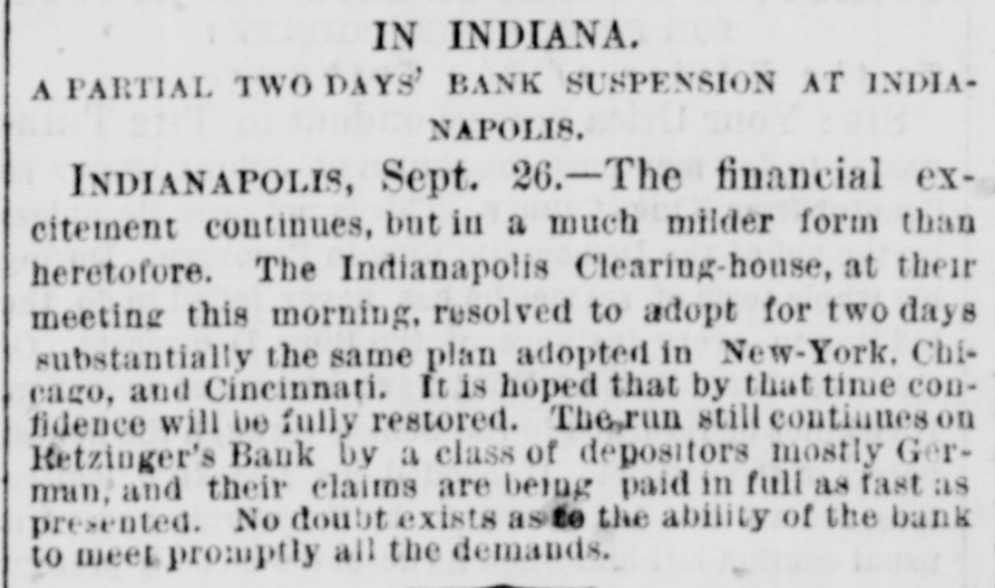
IN INDIANA. A PARTIAL TWO DAYS' BANK SUSPENSION AT INDIANAPOLIS. INDIANAPOLIS, Sept. 26.-The financial excitement continues, but in a much milder form than heretofore. The Indianapolis Clearing-house, at their meeting this morning, resolved to adopt for two days substantially the same plan adopted in New-York. Chicago, and Cincinnati. It is hoped that by that time confidence will be fully restored. The,run still continues on Retzinger's Bank by a class of depositors mostly German, and their claims are being paid in full as fast as presented. No doubt exists asite the ability of the bank to meet promptly all the demands.


Article from Elizabeth Daily Monitor, October 22, 1873

Click image to open full size in new tab

Article Text

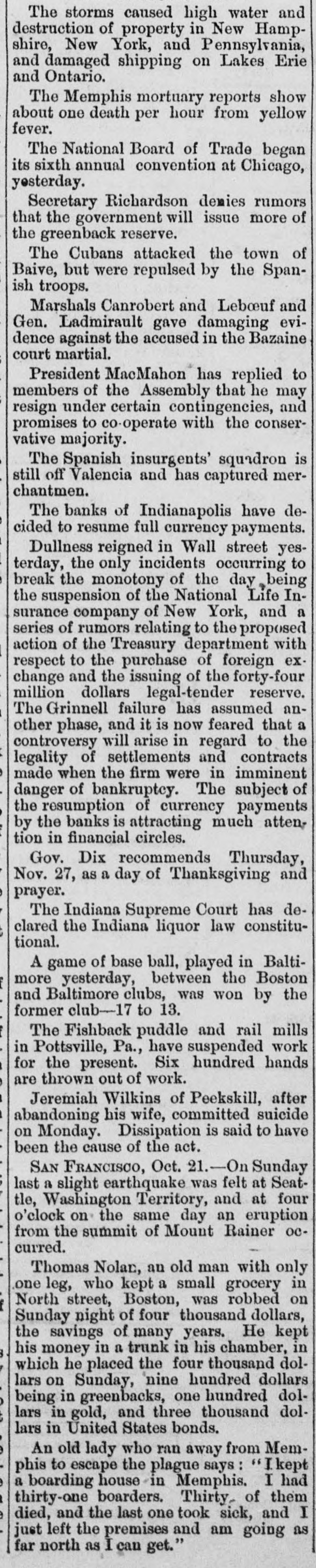
The storms caused high water and destruction of property in New Hampshire, New York, and Pennsylvania, and damaged shipping on Lakes Erie and Ontario. The Memphis mortuary reports show about one death per hour from yellow fever. The National Board of Trade began its sixth annual convention at Chicago, yesterday. Secretary Richardson denies rumors that the government will issue more of the greenback reserve. The Cubans attacked the town of Baive, but were repulsed by the Spanish troops. Marshals Canrobert and Lebœuf and Gen. Ladmirault gave damaging evidence against the accused in the Bazaine court martial. President MacMahon has replied to members of the Assembly that he may resign under certain contingencies, and promises to co-operate with the conservative majority. The Spanish insurgents' squadron is still off Valencia and has captured merchantmen. The banks of Indianapolis have decided to resume full currency payments. Dullness reigned in Wall street yesterday, the only incidents occurring to break the monotony of the day being the suspension of the National Life Insurance company of New York, and a series of rumors relating to the proposed action of the Treasury department with respect to the purchase of foreign exchange and the issuing of the forty-four million dollars legal-tender reserve. The Grinnell failure has assumed another phase, and it is now feared that a controversy will arise in regard to the legality of settlements and contracts made when the firm were in imminent danger of bankruptcy. The subject of the resumption of currency payments by the banks is attracting much attention in financial circles. Gov. Dix recommends Thursday, Nov. 27, as a day of Thanksgiving and prayer. The Indiana Supreme Court has declared the Indiana liquor law constitutional. A game of base ball, played in Baltimore yesterday, between the Boston and Baltimore clubs, was won by the former club—17 to 13. The Fishback puddle and rail mills in Pottsville, Pa., have suspended work for the present. Six hundred hands are thrown out of work. Jeremiah Wilkins of Peekskill, after abandoning his wife, committed suicide on Monday. Dissipation is said to have been the cause of the act. SAN FRANCISCO, Oct. 21.—On Sunday last a slight earthquake was felt at Seattle, Washington Territory, and at four o'clock on the same day an eruption from the summit of Mount Rainer occurred. Thomas Nolar, an old man with only one leg, who kept a small grocery in North street, Boston, was robbed on Sunday night of four thousand dollars, the savings of many years. He kept his money in a trunk in his chamber, in which he placed the four thousand dollars on Sunday, nine hundred dollars being in greenbacks, one hundred dollars in gold, and three thousand dollars in United States bonds. An old lady who ran away from Memphis to escape the plague says: "I kept a boarding house in Memphis. I had thirty-one boarders. Thirty of them died, and the last one took sick, and I just left the premises and am going as far north as I can get."


Article from New-York Tribune, April 13, 1875

Click image to open full size in new tab

Article Text

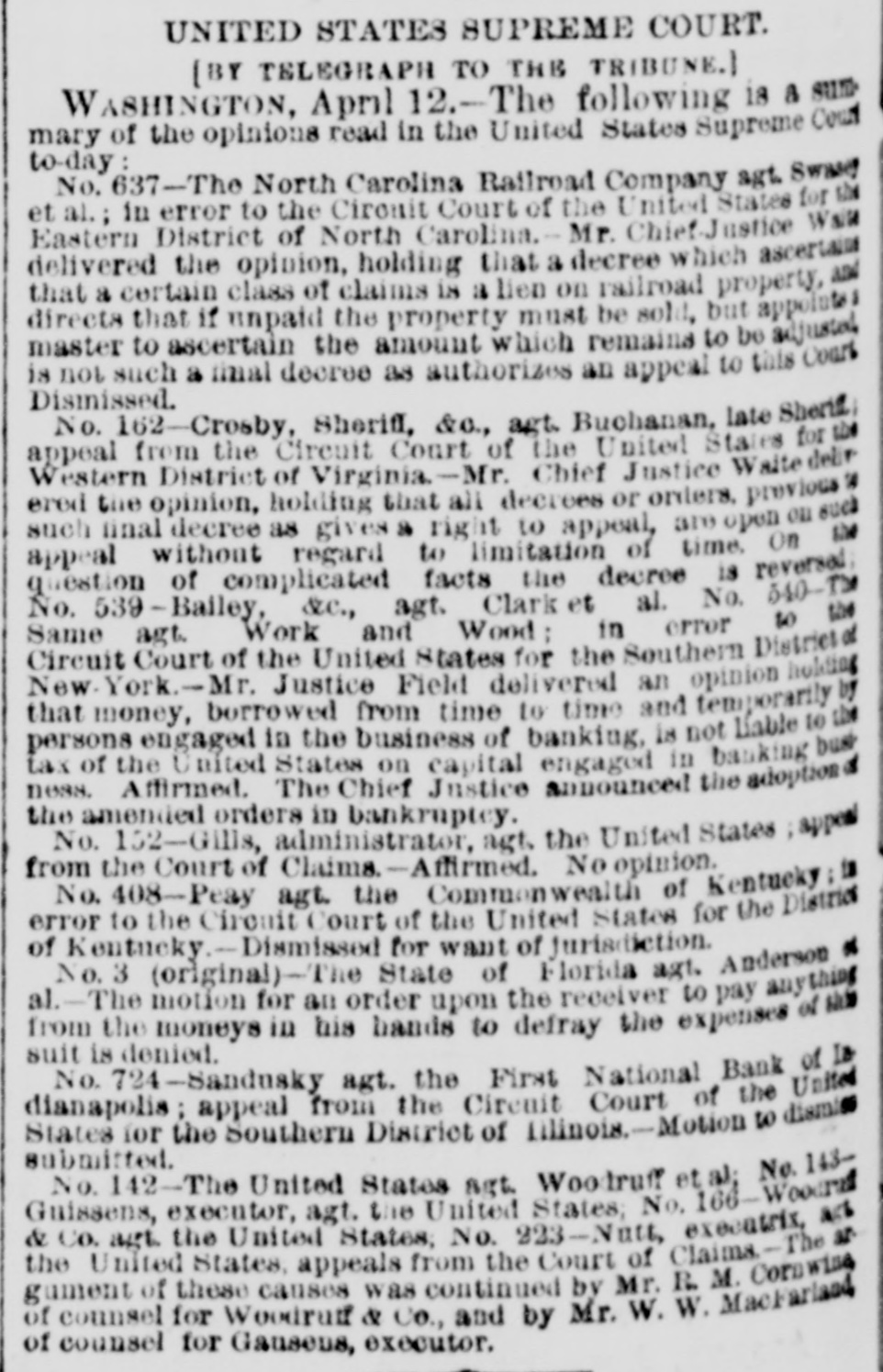
# UNITED STATES SUPREME COURT. [BY TELEGRAPH TO THE TRIBUNE.] WASHINGTON, April 12. The following is a summary of the opinions read in the United States Supreme Court to-day: No. 637-The North Carolina Railroad Company agt. Swasey et al.; in error to the Circuit Court of the United States for the Eastern District of North Carolina. Mr. Chief Justice Waite delivered the opinion, holding that a decree which ascertains that a certain class of claims is a lien on railroad property, and directs that if unpaid the property must be sold, but appoints a master to ascertain the amount which remains to be adjusted, is not such a final decree as authorizes an appeal to this Court. Dismissed. No. 162-Crosby, Sheriff, &c., agt. Buchanan, late Sheriff; appeal from the Circuit Court of the United States for the Western District of Virginia. Mr. Chief Justice Waite delivered the opinion, holding that all decrees or orders, previous to such final decree as gives a right to appeal, are open on such appeal without regard to limitation of time. On the question of complicated facts the decree is reversed. No. 539-Bailey, &c., agt. Clark et al. No. 540-The Same agt. Work and Wood; in error to the Circuit Court of the United States for the Southern District of New-York. Mr. Justice Field delivered an opinion holding that money, borrowed from time to time and temporarily by persons engaged in the business of banking, is not liable to the tax of the United States on capital engaged in banking business. Affirmed. The Chief Justice announced the adoption of the amended orders in bankruptcy. No. 152-Gills, administrator, agt, the United States; appeal from the Court of Claims. - Affirmed. No opinion. No. 408-Peay agt, the Commonwealth of Kentucky; in error to the Circuit Court of the United States for the District of Kentucky. Dismissed for want of jurisdiction. No. 3 (original)-The State of Florida agt. Anderson et al. The motion for an order upon the receiver to pay anything from the moneys in his hands to defray the expenses of this suit is denied. No. 724-Sandusky agt. the First National Bank of Indianapolis; appeal from the Circuit Court of the United States for the Southern District of Illinois. Motion to dismiss submitted. No. 142-The United States agt. Woodruff et al; No. 143-Guissens, executor, agt. the United States; No. 166-Woodruff & Co. agt, the United States, No. 223-Nutt, executrix, agt the United States, appeals from the Court of Claims. The argument of these causes was continued by Mr. R. M. Corwine of counsel for Woodruff & Co., and by Mr. W. W. Macfarland of counsel for Gausens, executor.