Click image to open full size in new tab
Article Text
General Bank Gossip.
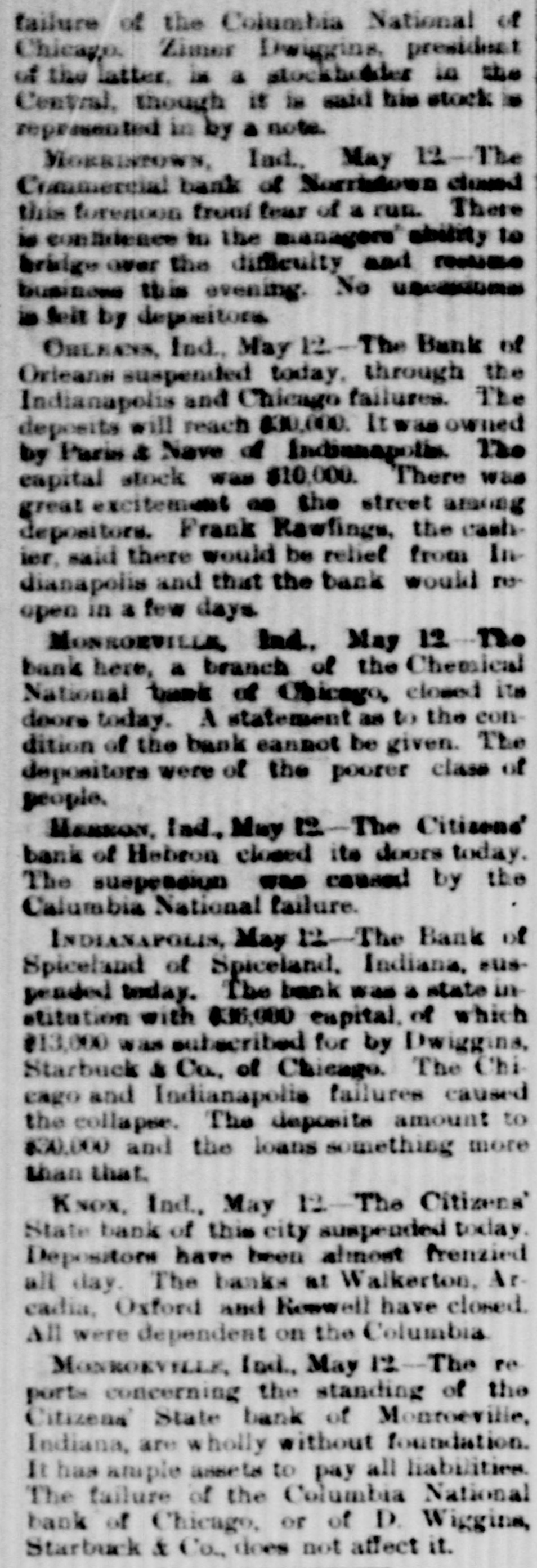
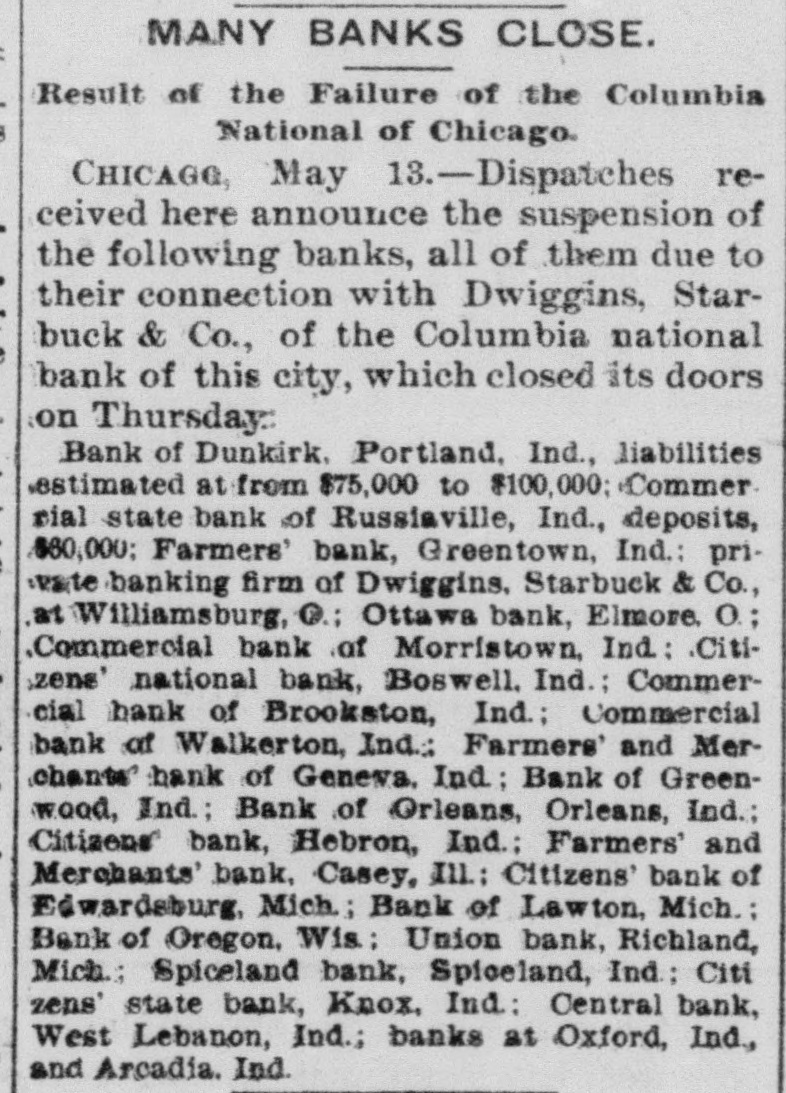
There is faith that the Commercial Bank, of Morristown, will resume.
The Commercial Bank, of Russiaville, which closed its doors, had deposits aggregating $60,000.
By the closing of the bank at Monroeville, which was a small concern, a number of poor depositors were seriously embarrassed.
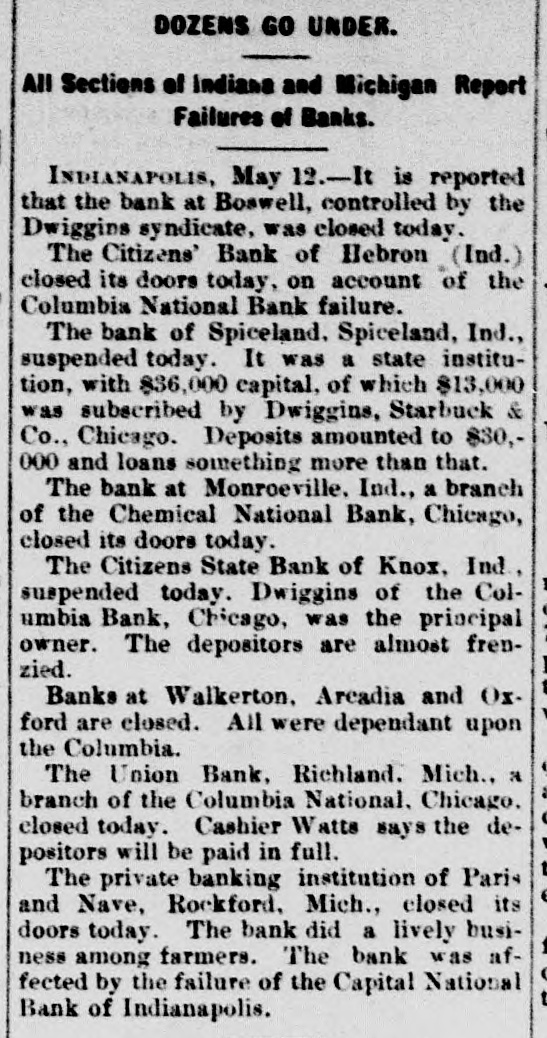
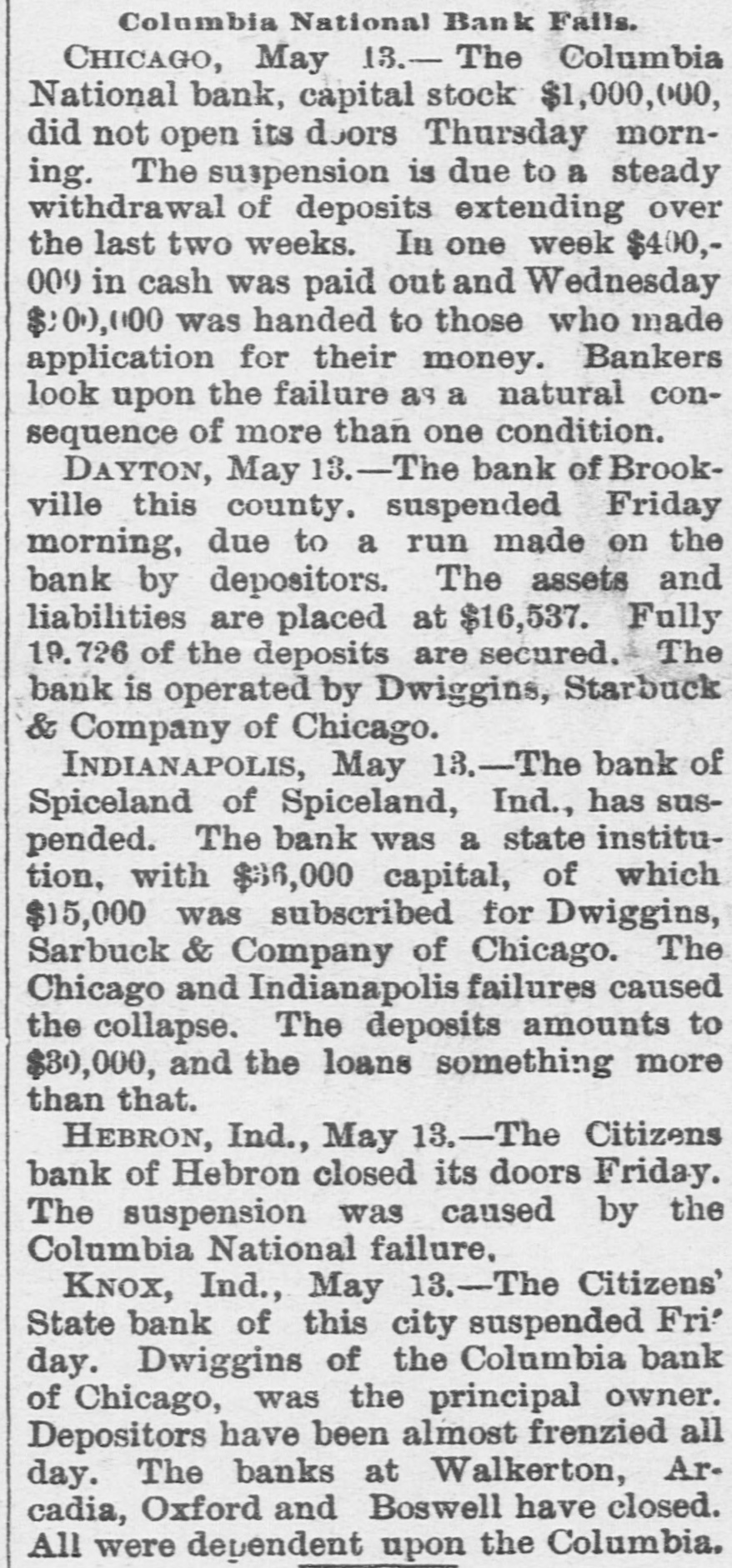
The Citizens' State Bank, of Knox, suspended last evening, due to a run by depositors. Dwiggins, of the Columbia Bank, Chicago, was the principal owner.
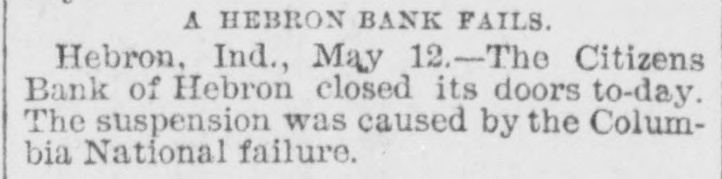
The Citizens' Bank of Hebron, which has suspended, lays the blame on the Columbia National failure. No statement of its assets and liabilities has been submitted.
A deputy sheriff levied upon the assets of the Dunkirk Bank in the interest of Edward Fitzpatrick, a depositor, for $2,000, and he found $2,000 in cash and a few notes. The liabilities are said to aggregate $75,000.
The suspended Greenwood Bank had about $35,000 individual deposits. The cashier posted a notice that business was discontinued on account of financial complications in banking circles at Indianapolis and Chicago.
The defunct Russiaville Bank had $30,000 capital stock, all but $12,000 of which was held by farmers and business men of that community. The remainder was held by the United States Trust and Loan Company.
The Bank of Orleans closed yesterday. It was owned and controlled by Paris & Nave, of Indianapolis, with Frank Rawlings as cashier. The suspension was due to the failure of the Columbia, of Chicago, and the Capital, of Indianapolis. The capital stock is placed at $10,000, with $25,000 deposits.
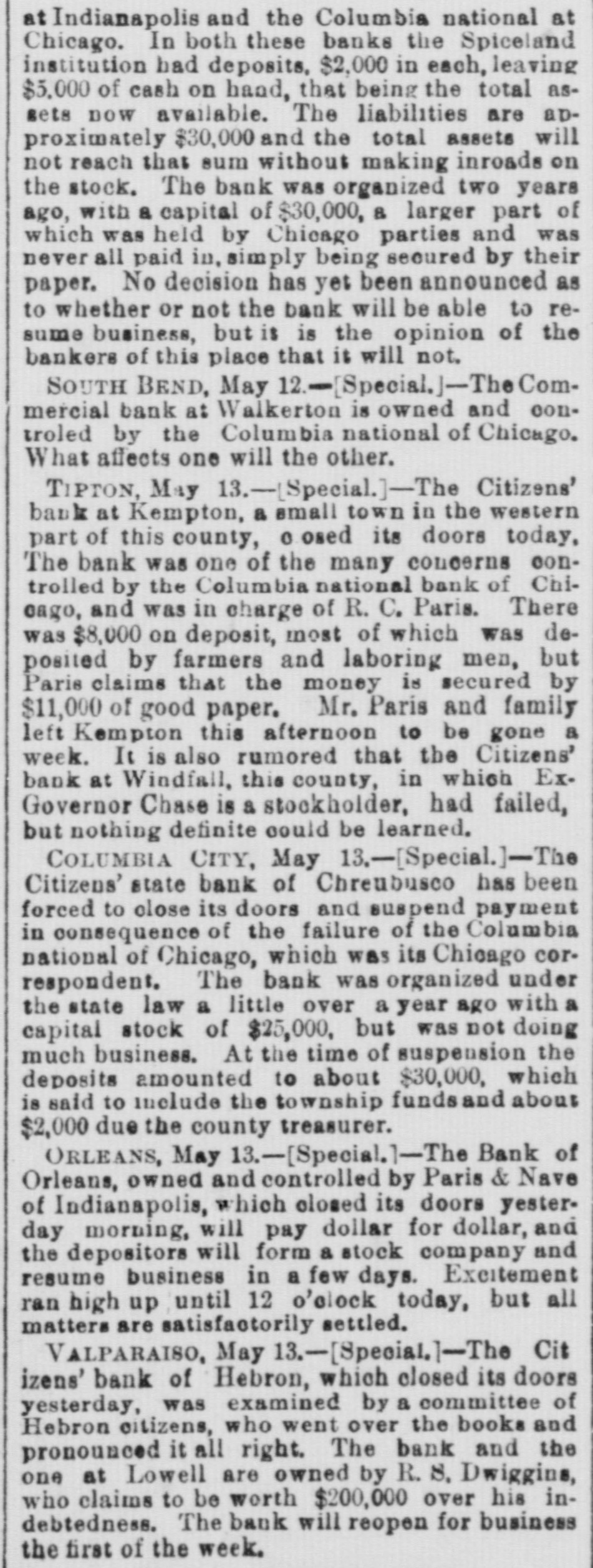
The Bank of Spiceland, which has closed its doors, was a State institution, and $19,000 of its capital stock was held by Dwiggins, Starbuck & Co., and was paid for by credit to that amount in the Columbia National, of Chicago. It was also a correspondent of the Capital, of Indianapolis. The deposits aggregate $30,000, with loans somewhat in excess of that amount.
Zimri Dwiggins, of Chicago, was a factor in the organization of the Hamilton County Bank, at Noblesville, but his interest was afterward purchased by local capitalists, and the institution was merged into a national affair. The bank is now known as the First National, of Noblesville. It was not affected by the Chicago failures. It is stated that Mr. Dwiggins was also organizer and president of the United States Loan and Trust Company, which did a large business in Hamilton county on farm loans. The money was loaned to farmers at 8 per cent., interest paid semi-annually. The borrower was required to execute a first mortgage for the principal, which mortgage bond had coupons attached for interest at 6 per cent. Mr. Dwiggins then took a second mortgage and notes for the other 2 per cent. interest. The first mortgage bond was sold throughout the country, and the money thus obtained placed in other loans. Mr. Dwiggins's profit lay in the 2 per cent. notes secured by second mortgage and what premium he could realize on sale of the first mortgage bond.