Closed as a branch when its correspondent (Bank of Minnesota) was taken by the state examiner; later placed in receivership and wound up.
Events (2)
1.December 22, 1896Suspension
Cause
Correspondent
Cause Details
Closed simultaneously with and because it cleared through the Bank of Minnesota which was taken by the state examiner; had large deposits at Bank of Minnesota.
Newspaper Excerpt
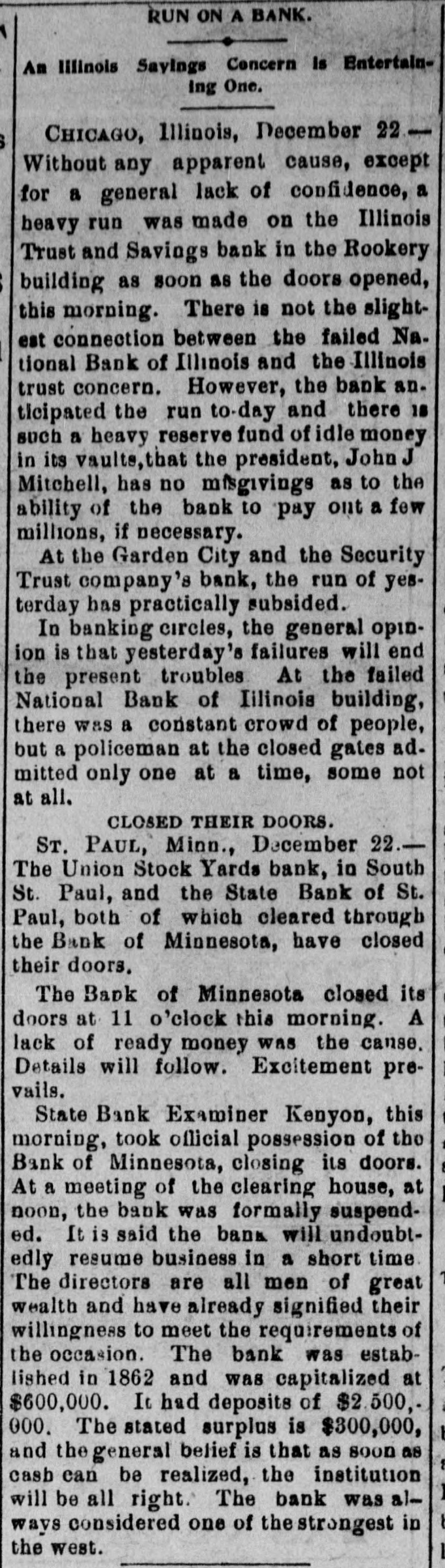
The Union Stock Yards bank, in South St. Paul, ... have closed their doors. The Bank of Minnesota closed its doors at 11 o'clock this morning.
Source
newspapers
2.*Receivership
Newspaper Excerpt
Receiver M. H. Sullivan, of the Union Stock Yards bank, at South St. Paul, yesterday declared a dividend of 38 per cent.
An Illinois Sayings Concern is EntertainIng One. CHICAGO, Illinois, December 22. Without any apparent cause, except for a general lack of confidence, a heavy run was made on the Illinois Trust and Savings bank in the Rookery : building as soon as the doors opened, this morning. There is not the slightest connection between the failed Na. tional Bank of Illinois and the Illinois trust concern. However, the bank an. ticipated the run to-day and there 18 such a heavy reserve fund of idle money in its vaults, that the president, John J Mitchell, has no mfsgivings as to the ability of the bank to pay out a few millions, if necessary. At the Garden City and the Security Trust company's bank, the run of yesterday has practically subsided. In banking circles, the general opinion is that yesterday's failures will end the present troubles At the failed National Bank of Illinois building, there was a constant crowd of people, but a policeman at the closed gates ad. mitted only one at a time, some not at all. CLOSED THEIR DOORS. ST. PAUL, Minn., December 22.The Union Stock Yards bank, in South St. Paul, and the State Bank of St. Paul, both of which cleared through the Bank of Minnesota, have closed their doors. The Bank of Minnesota closed its doors at 11 o'clock this morning. A lack of ready money was the cause. Details will follow. Excitement prevails. State Bank Examiner Kenyon, this morning, took official possession of the Bank of Minnesota, closing its doors. At a meeting of the clearing house, at noon, the bank was formally suspended. It is said the bank will undoubtedly resume business in a short time The directors are all men of great wealth and have already signified their willingness to meet the requirements of the occasion. The bank was established in 1862 and was capitalized at $600,000. It had deposits of $2.500,000. The stated surplus is $300,000, and the general belief is that as soon as cash can be realized, the institution will be all right The bank was always considered one of the strongest in the west. 1
2.December 23, 1896Birmingham State HeraldBirmingham, AL
Click image to open full size in new tab
Article Text
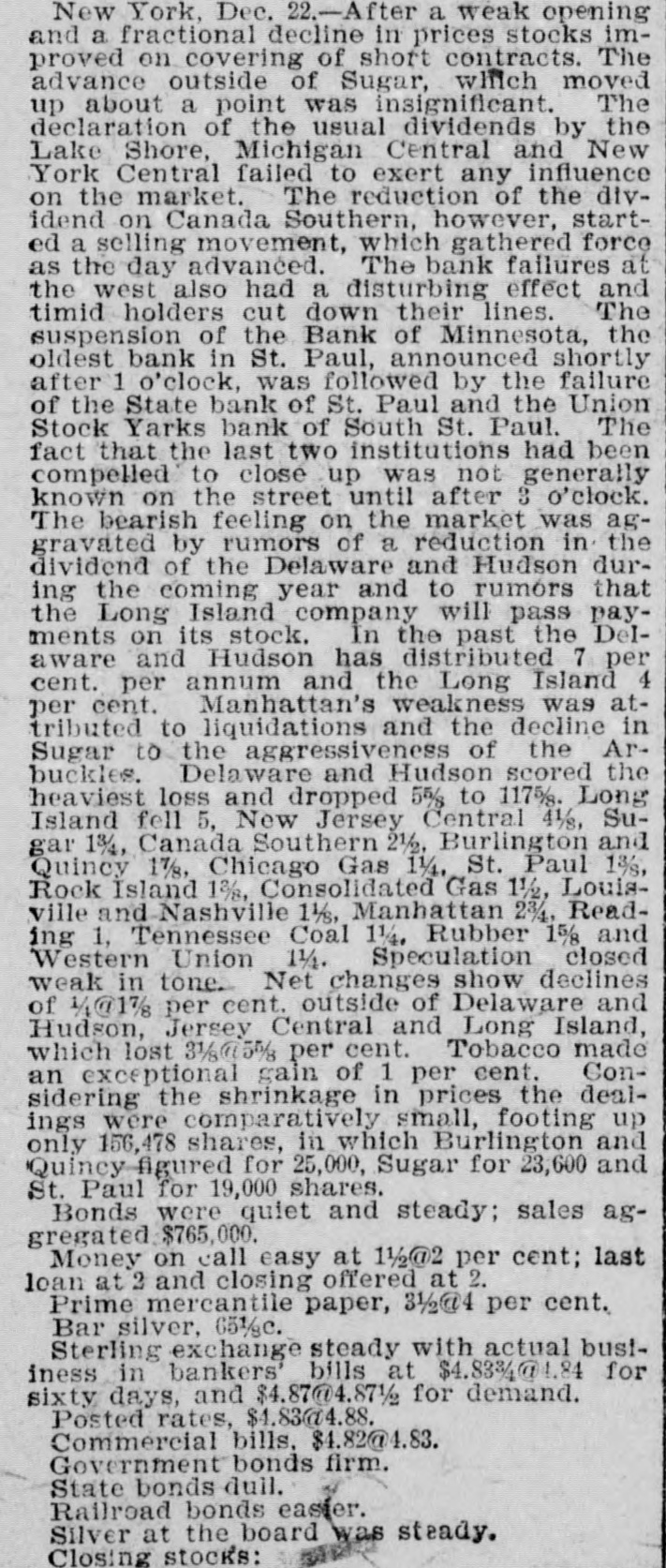
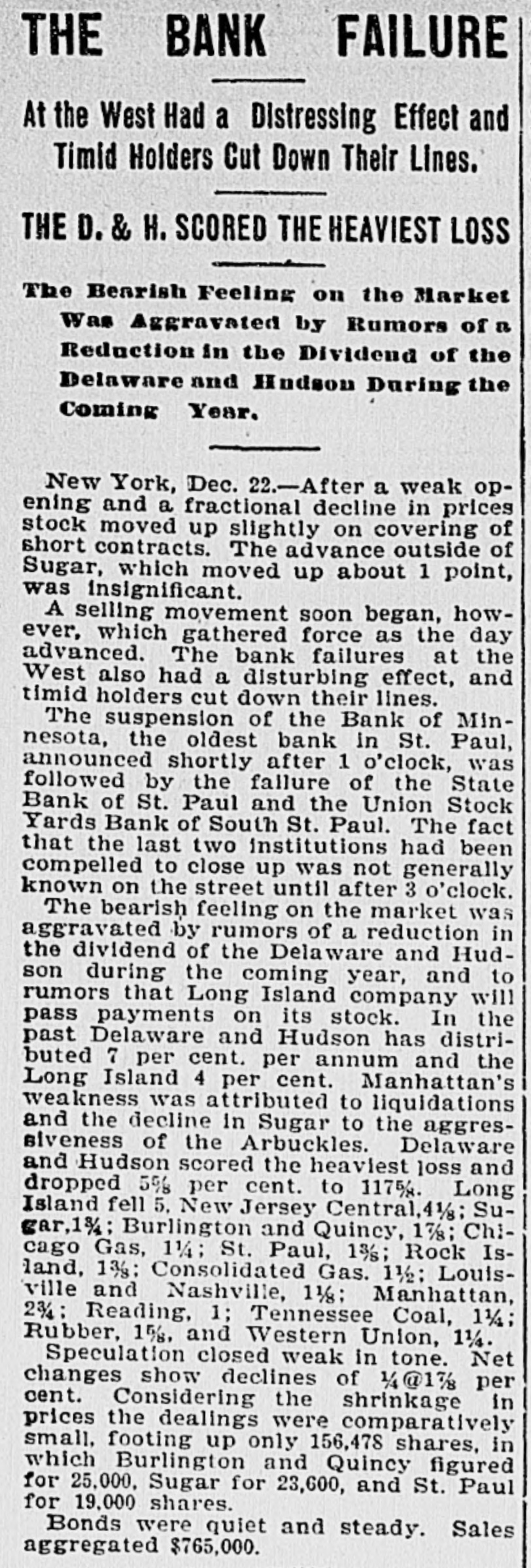
New York, Dec. 22.-After a weak opening and a fractional decline in prices stocks improved on covering of short contracts. The advance outside of Sugar, which moved up about a point was insignificant. The declaration of the usual dividends by the Lake Shore, Michigan Central and New York Central failed to exert any influence on the market. The reduction of the dividend on Canada Southern, however, started a selling movement, which gathered force as the day advančed. The bank failures at the west also had a disturbing effect and timid holders cut down their lines. The suspension of the Bank of Minnesota, the oldest bank in St. Paul, announced shortly after 1 o'clock, was followed by the failure of the State bank of St. Paul and the Union Stock Yarks bank of South St. Paul. The fact that the last two institutions had been compelled to close up was not generally known on the street until after 3 o'clock. The bearish feeling on the market was aggravated by rumors of a reduction in the dividend of the Delaware and Hudson during the coming year and to rumórs that the Long Island company will pass payments on its stock. In the past the Delaware and Hudson has distributed 7 per cent. per annum and the Long Island 4 per cent. Manhattan's weakness was attributed to liquidations and the decline in Sugar to the aggressiveness of the Arbuckles. Delaware and Hudson scored the heaviest loss and dropped 5% to 1175/8. Long Island fell 5, New Jersey Central 41/8, Sugar 1%, Canada Southern 2½, Burlington and Quincy 17/8, Chicago Gas 11/4, St. Paul 1%, Rock Island 1½, Consolidated Gas 1½, Louisville and Nashville 1½, Manhattan 23/4, Reading 1, Tennessee Coal 11/4. Rubber 15/8 and Western Union 11/1. Speculation closed weak in tone. Net changes show declines of 4@1% per cent. outside of Delaware and Hudson, Jersey Central and Long Island, which lost 3½ per cent. Tobacco made an exceptional gain of 1 per cent. Considering the shrinkage in prices the dealings were comparatively small, footing up only 156,478 shares, in which Burlington and Quincy figured for 25,000, Sugar for 23,600 and St. Paul for 19,000 shares. Bonds were quiet and steady; sales aggregated $765,000. Money on call easy at 1½2 per cent; last loan at 2 and closing offered at 2. Prime mercantile paper, 31/2@4 per cent. Bar silver, 651/gc. Sterling exchange steady with actual bustiness in bankers' bills at $4.83%@4.84 for sixty days, and $4.87@4.87% for demand. Posted rates, $4.83@4.88. Commercial bills, $4.82@4.83. Government bonds firm. State bonds dull. Railroad bonds easter. Silver at the board was steady. Closing stocks:
3.December 23, 1896The Salt Lake HeraldSalt Lake City, UT
Click image to open full size in new tab
Article Text
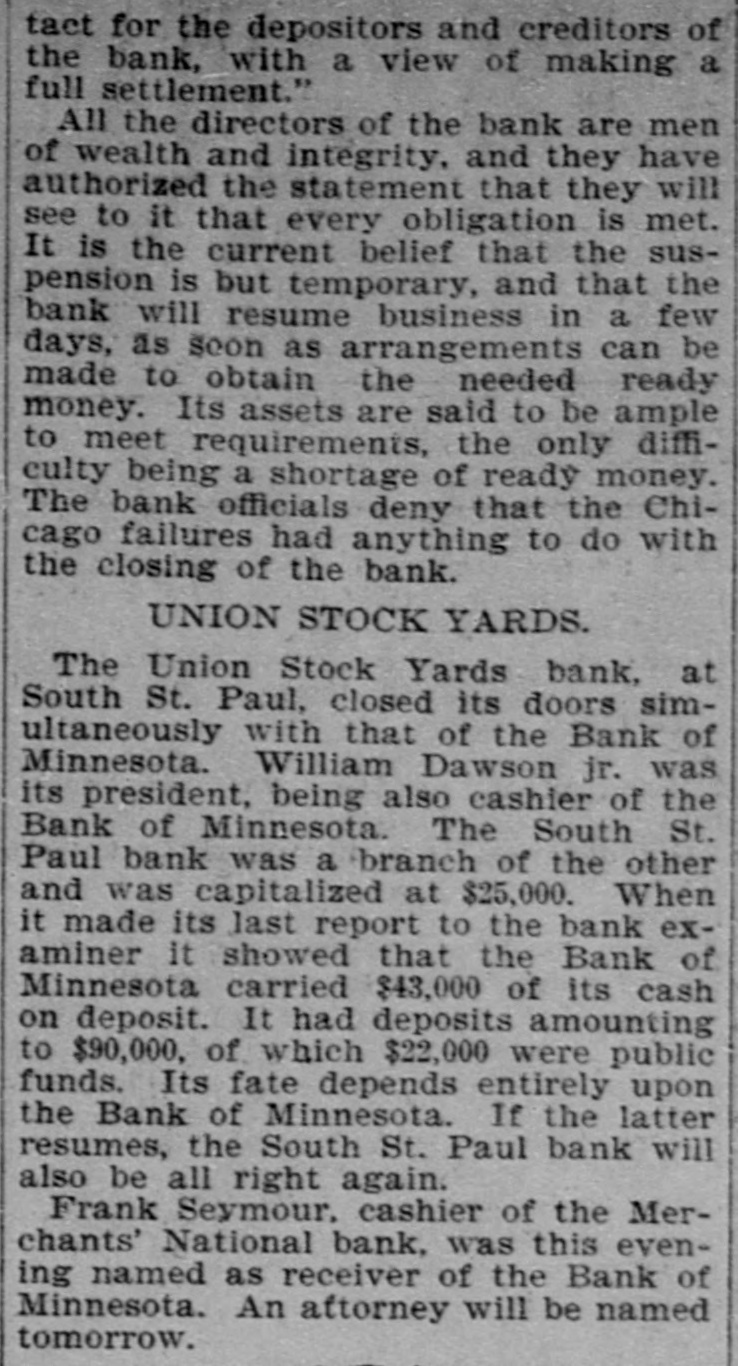
tact for the depositors and creditors of the bank, with a view of making a full settlement." All the directors of the bank are men of wealth and integrity, and they have authorized the statement that they will see to it that every obligation is met. It is the current belief that the suspension is but temporary, and that the bank will resume business in a few days, as soon as arrangements can be made to obtain the needed ready money. Its assets are said to be ample to meet requirements, the only difficulty being a shortage of ready money. The bank officials deny that the Chicago failures had anything to do with the closing of the bank. UNION STOCK YARDS. The Union Stock Yards bank, at South St. Paul, closed its doors simultaneously with that of the Bank of Minnesota. William Dawson jr. was its president, being also cashier of the Bank of Minnesota. The South St. Paul bank was a branch of the other and was capitalized at $25,000. When it made its last report to the bank examiner it showed that the Bank of Minnesota carried $43,000 of its cash on deposit. It had deposits amounting to $90,000, of which $22,000 were public funds. Its fate depends entirely upon the Bank of Minnesota. If the latter resumes, the South St. Paul bank will also be all right again. Frank Seymour, cashier of the Merchants' National bank, was this evening named as receiver of the Bank of Minnesota. An attorney will be named tomorrow.
4.December 23, 1896The Daily Morning Journal and CourierNew Haven, CT
Click image to open full size in new tab
Article Text
Financial
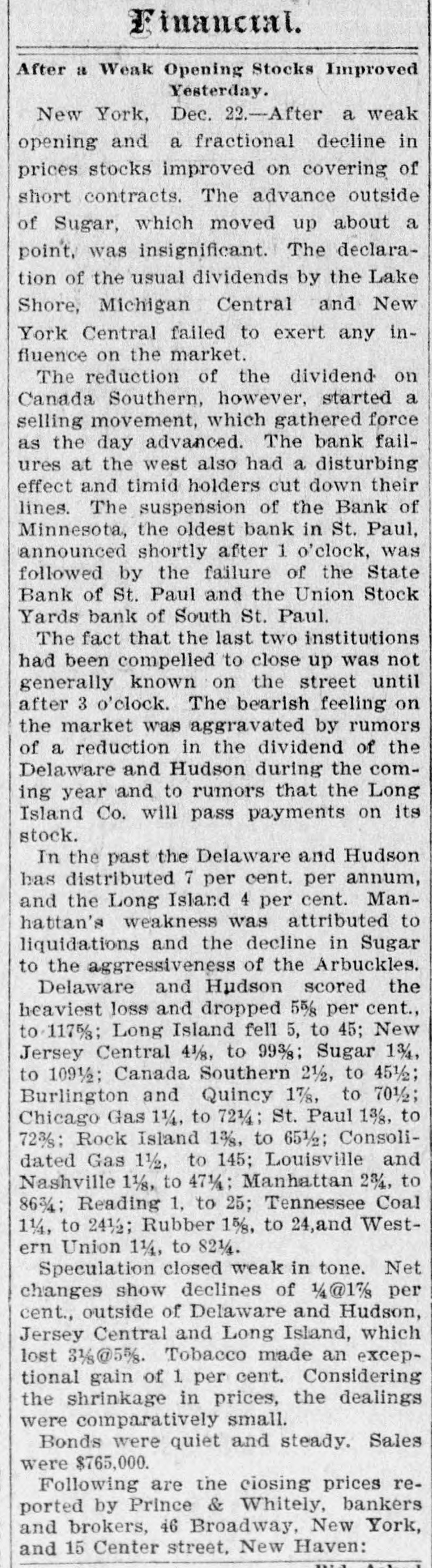
After a Weak Opening Stocks Improved Yesterday. New York, Dec. 22.-After a weak opening and a fractional decline in prices stocks improved on covering of short contracts. The advance outside of Sugar, which moved up about a point, was insignificant. The declaration of the usual dividends by the Lake Shore, Michigan Central and New York Central failed to exert any influence on the market. The reduction of the dividend on Canada Southern, however, started a selling movement, which gathered force as the day advanced. The bank failures at the west also had a disturbing effect and timid holders cut down their lines. The suspension of the Bank of Minnesota, the oldest bank in St. Paul, announced shortly after 1 o'clock, was followed by the failure of the State Bank of St. Paul and the Union Stock Yards bank of South St. Paul. The fact that the last two institutions had been compelled to close up was not generally known on the street until after 3 o'clock. The bearish feeling on the market was aggravated by rumors of a reduction in the dividend of the Delaware and Hudson during the coming year and to rumors that the Long Island Co. will pass payments on its stock. In the past the Delaware and Hudson has distributed 7 per cent. per annum, and the Long Island 4 per cent. Manhattan's weakness was attributed to liquidations and the decline in Sugar to the aggressiveness of the Arbuckles. Delaware and Hudson scored the heaviest loss and dropped 5% per cent., to.117%; Long Island fell 5, to 45; New Jersey Central 41/8, to 99%; Sugar 13/4, to 1091/2; Canada Southern 2½, to 45½; Burlington and Quincy 17/8, to 701/2; Chicago Gas 11/4, to 721/4; St. Paul 1%, to 72%; Rock Island 1%, to 651/2; Consolidated Gas 1½, to 145; Louisville and Nashville 1½, to 47½; Manhattan 23/4, to 863/4; Reading 1, to 25; Tennessee Coal 11/4, to 241/2; Rubber 15, to 24,and Western Union 11/1, to 821/4. Speculation closed weak in tone. Net changes show declines of 1/4@1% per cent., outside of Delaware and Hudson, Jersey Central and Long Island, which lost 31/s@5%. Tobacco made an exceptional gain of 1 per cent. Considering the shrinkage in prices, the dealings were comparatively small. Bonds were quiet and steady. Sales were $765,000. Following are the closing prices reported by Prince & Whitely, bankers and brokers, 46 Broadway, New York, and 15 Center street, New Haven:
5.December 23, 1896The Norfolk VirginianNorfolk, VA
Click image to open full size in new tab
Article Text
THE BANK FAILURE At the West Had a Distressing Effect and Timid Holders Cut Down Their Lines. THE D. & H. SCORED THE HEAVIEST LOSS The Bearish Feeling on the Market Was Aggravated by Rumors of n Reduction in the Dividend of the Delaware and Hudson During the Coming Year. New York, Dec. 22.-After a weak opening and a fractional decline in prices stock moved up slightly on covering of short contracts. The advance outside of Sugar, which moved up about 1 point, was insignificant. A selling movement soon began, however, which gathered force as the day advanced. The bank failures at the West also had a disturbing effect, and timid holders cut down their lines. The suspension of the Bank of Minnesota, the oldest bank in St. Paul, announced shortly after 1 o'clock, was followed by the fallure of the State Bank of St. Paul and the Union Stock Yards Bank of South St. Paul. The fact that the last two institutions had been compelled to close up was not generally known on the street until after 3 o'clock. The bearish feeling on the market was aggravated by rumors of a reduction in the dividend of the Delaware and Hudson during the coming year, and to rumors that Long Island company will pass payments on its stock. In the past Delaware and Hudson has distributed 7 per cent. per annum and the Long Island 4 per cent. Manhattan's weakness was attributed to liquidations and the decline in Sugar to the aggressiveness of the Arbuckles. Delaware and Hudson scored the heaviest loss and dropped 5% per cent. to 117%. Long Island fell 5. New Jersey Central,4% Sugar,1%; Burlington and Quincy, 1%; Chicago Gas, 11/4; St. Paul, 1%; Rock Island, 1%; Consolidated Gas. 1½; Louisville and Nashville, 1½; Manhattan, 23/4; Reading, 1; Tennessee Coal, 1½; Rubber, 1%, and Western Union, 1½. Speculation closed weak in tone. Net changes show declines of 1/4@1% per cent. Considering the shrinkage in prices the dealings were comparatively small, footing up only 156,478 shares, in which Burlington and Quincy figured for 25,000, Sugar for 23,600, and St. Paul for 19,000 shares. Bonds were quiet and steady. Sales aggregated $765,000.
6.December 24, 1896River Falls JournalRiver Falls, WI
Click image to open full size in new tab
Article Text
LATER NEWS
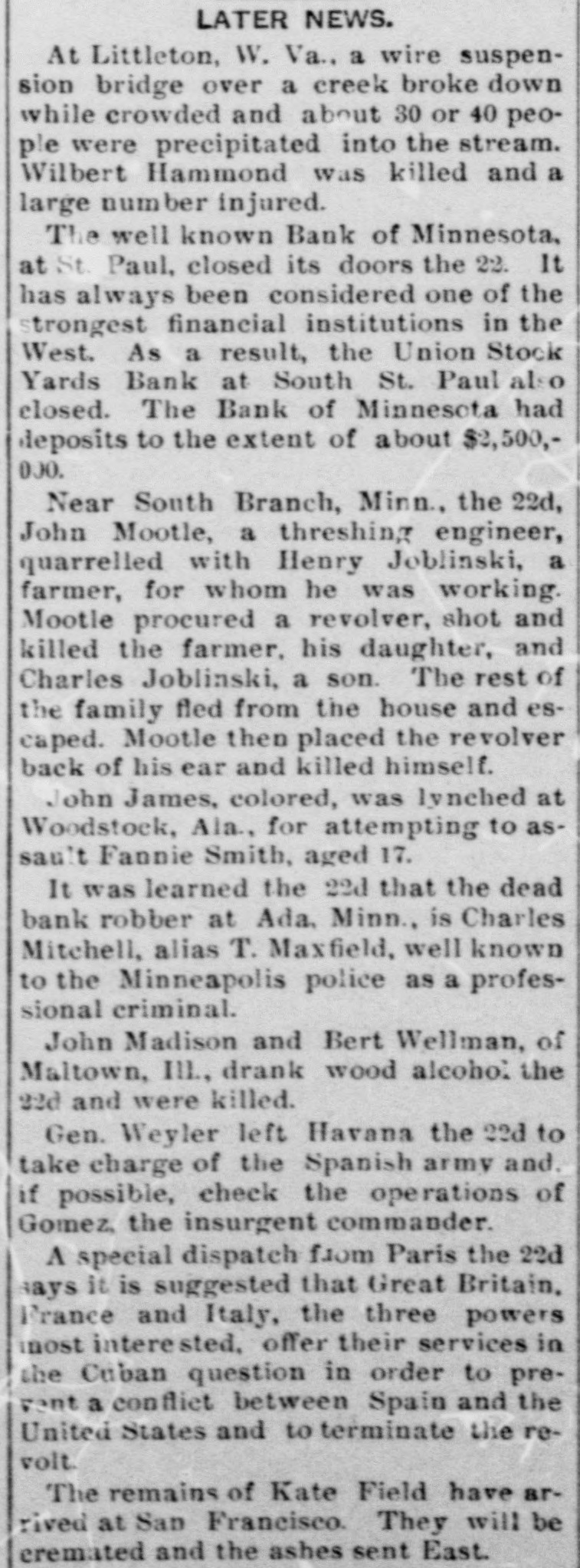
At Littleton, W. Va., a wire suspension bridge over a creek broke down while crowded and about 30 or 40 people were precipitated into the stream. Wilbert Hammond was killed and a large number injured. The well known Bank of Minnesota, at St. Paul, closed its doors the 22. It has always been considered one of the strongest financial institutions in the West. As a result, the Union Stock Yards Bank at South St. Paul also closed. The Bank of Minnesota had deposits to the extent of about $2,500,000. Near South Branch, Minn, the 22d, John Mootle, a threshing engineer, quarrelled with Henry Joblinski, a farmer, for whom he was working. Mootle procured a revolver, shot and killed the farmer, his daughter, and Charles Joblinski, a son. The rest of the family fled from the house and escaped. Mootle then placed the revolver back of his ear and killed himself. John James, colored, was lynched at Woodstock, Ala., for attempting to assault Fannie Smith, aged 17. It was learned the 22d that the dead bank robber at Ada, Minn., is Charles Mitchell, alias T. Maxfield, well known to the Minneapolis police as a professional criminal. John Madison and Bert Wellman, of Maltown, Ill., drank wood alcohol the 22d and were killed. Gen. Weyler left Havana the 22d to take charge of the Spanish army and. if possible, check the operations of Gomez, the insurgent commander. A special dispatch from Paris the 22d says it is suggested that Great Britain, France and Italy, the three powers most interested, offer their services in the Cuban question in order to prevent a conflict between Spain and the United States and to terminate the revolt. The remains of Kate Field have arrived at San Francisco. They will be cremated and the ashes sent East.
7.December 25, 1896Vermont PhœnixBrattleboro, Bellows Falls, Ludlow, VT
Click image to open full size in new tab
Article Text
LATE NEWS
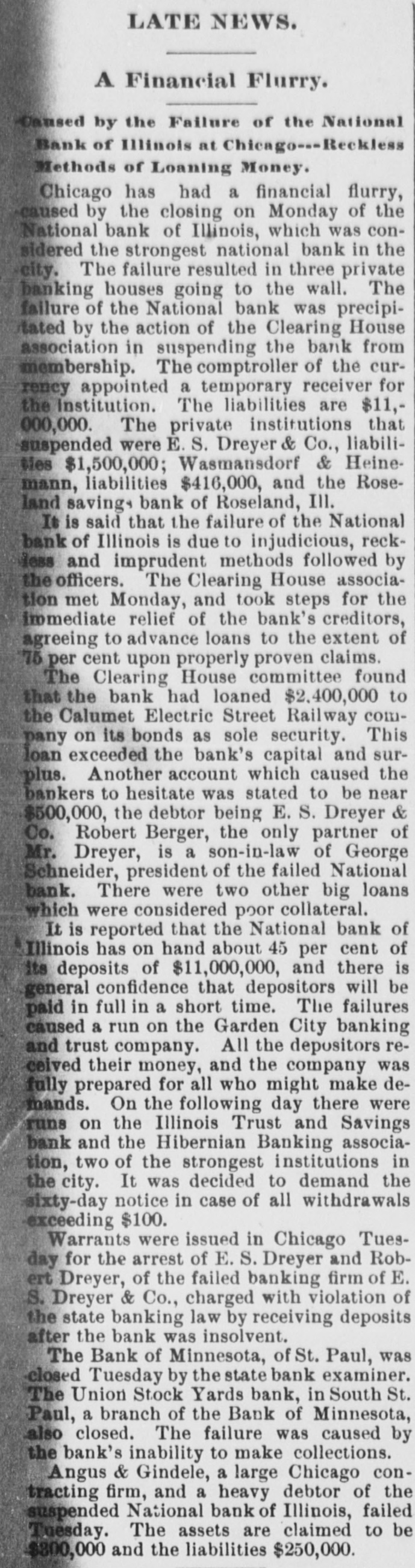
A Financial Flurry. Caused by the Failure of the National Bank of Illinois at Chicago---Reckless Methods of Loaning Money. Chicago has had a financial flurry, caused by the closing on Monday of the National bank of Illinois, which was considered the strongest national bank in the city. The failure resulted in three private banking houses going to the wall. The failure of the National bank was precipitated by the action of the Clearing House association in suspending the bank from membership. The comptroller of the currency appointed a temporary receiver for the Institution. The liabilities are $11,000,000. The private institutions that suspended were E.S. Dreyer & Co., liabilities $1,500,000; Wasmansdorf & Heinemann, liabilities $416,000, and the Roseland savings bank of Roseland, III. It is said that the failure of the National bank of Illinois is due to injudicious, reckless and imprudent methods followed by the officers. The Clearing House association met Monday, and took steps for the immediate relief of the bank's creditors, agreeing to advance loans to the extent of 75 per cent upon properly proven claims. The Clearing House committee found that the bank had loaned $2,400,000 to the Calumet Electric Street Railway company on its bonds as sole security. This loan exceeded the bank's capital and surplus. Another account which caused the bankers to hesitate was stated to be near $500,000, the debtor being E. S. Dreyer & Co. Robert Berger, the only partner of Mr. Dreyer, is a son-in-law of George Schneider, president of the failed National bank. There were two other big loans which were considered poor collateral. It is reported that the National bank of Illinois has on hand about 45 per cent of its deposits of $11,000,000, and there is general confidence that depositors will be paid in full in a short time. The failures caused a run on the Garden City banking and trust company. All the depositors received their money, and the company was fully prepared for all who might make demands. On the following day there were runs on the Illinois Trust and Savings bank and the Hibernian Banking association, two of the strongest institutions in the city. It was decided to demand the sixty-day notice in case of all withdrawals exceeding $100. Warrants were issued in Chicago Tuesday for the arrest of E. S. Dreyer and Robert Dreyer, of the failed banking firm of E. S. Dreyer & Co., charged with violation of the state banking law by receiving deposits after the bank was insolvent. The Bank of Minnesota, of St. Paul, was closed Tuesday by the state bank examiner. The Union Stock Yards bank, in South St. Paul, a branch of the Bank of Minnesota, also closed. The failure was caused by the bank's inability to make collections. Angus & Gindele, a large Chicago contracting firm, and a heavy debtor of the suspended National bank of Illinois, failed Tuesday. The assets are claimed to be $800,000 and the liabilities $250,000.
8.December 30, 1896The Saint Paul GlobeSaint Paul, MN
Click image to open full size in new tab
Article Text
TO THE PUBLIC
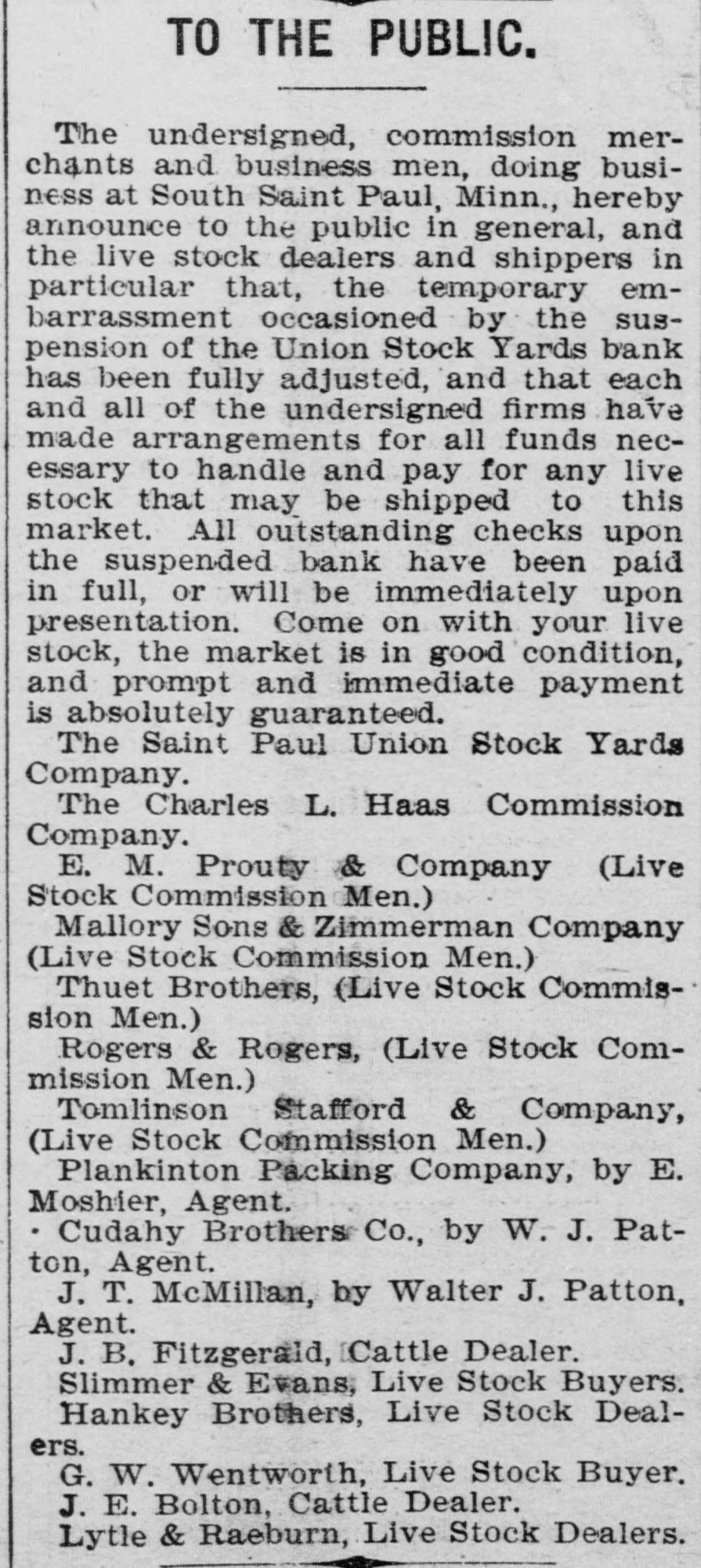
The undersigned, commission merchants and business men, doing business at South Saint Paul, Minn., hereby announce to the public in general, and the live stock dealers and shippers in particular that, the temporary embarrassment occasioned by the suspension of the Union Stock Yards bank has been fully adjusted, and that each and all of the undersigned firms have made arrangements for all funds necessary to handle and pay for any live stock that may be shipped to this market. All outstanding checks upon the suspended bank have been paid in full, or will be immediately upon presentation. Come on with your live stock, the market is in good condition, and prompt and immediate payment is absolutely guaranteed. The Saint Paul Union Stock Yards Company. The Charles L. Haas Commission Company. E. M. Prouty & Company (Live Stock Commission Men.) Mallory Sons & Zimmerman Company (Live Stock Commission Men.) Thuet Brothers, (Live Stock Commission Men.) Rogers & Rogers, (Live Stock Commission Men.) Tomlinson Stafford & Company, (Live Stock Commission Men.) Plankinton Packing Company, by E. Moshier, Agent. Cudahy Brothers Co., by W. J. Patton, Agent. J. T. McMillan, by Walter J. Patton, Agent. J. B. Fitzgerald, Cattle Dealer. Slimmer & Evans, Live Stock Buyers. Hankey Brothers, Live Stock Dealers. G. W. Wentworth, Live Stock Buyer. J. E. Bolton, Cattle Dealer. Lytle & Raeburn, Live Stock Dealers.
9.January 5, 1897Evening StarWashington, DC
Click image to open full size in new tab
Article Text
PASSING OF THE SCARE
More Confident Feeling in St. Paul Banking Circles. ST. PAUL, Minn., January 5.-In banking circles today it seemed almost as if the scare had gone with the blizzard, for the banks were much less worried by withdrawals. The banks that closed yesterday were in charge of their clerical forces, making up the reports. Maurice Auerbach, as receiver, took the place of Bank Examiner Kenyon, in charge of the Allemania, his bond for $250,500 being filed this morning. The reorganization committee of the stockholders of the Bank of Minnesota is meeting with the heavier depositors to devise a method of reorganization. Thirty depositors, with $175,000 in the bank, were at yesterday's meeting. The depositors of the Union Stock Yards Bank at South St. Paul are to meet later in the week to consider the subject of reorganization, the receiver's report showing the bank to be in good condition. The January meeting of the directors of the Second National Bank yesterday declared a semi-annual dividend of 7 per cent. This bank has 51 per cent of its deposits on hand in cash. The other national banks make similar showings. The savings banks, for the protection of depositors, are still requiring the sixty days' notice for withdrawal of deposits, and this, together with the strong showing of the other banks, has had a quieting effect on the general public.
10.January 5, 1897The Topeka State JournalTopeka, KS
Click image to open full size in new tab
Article Text
BANK SCARE SUBSIDIES
All is Quiet Today in St. Paul Business Circles. St. Paul, Jan. 5.-In banking circles today it seems almost as if the scare had ended with the blizzard, for the banks were much less worried by withdrawals. The banks that closed yesterday were in charge of their clerical forces making up the reports. Maurice Auerbach, as receiver, took the place of Bank Examiner Kenyon, in charge of the Allemania, his bond for $250,000 being filed this morning. The reorganization committee of the stockholders of the Bank of Minnesota had a meeting with the heavier stockholders to devise a method of reorganization. Thirty depositors with $175,000 in the bank were at yesterday's meeting. The depositors of the Union Stock Yards bank at South St. Paul are to meet later in the week to consider the subject of reorganization, the receiver's report showing that bank to be in good condition. The January meeting of the directors of the Second National bank yesterday declared a semi-annual dividend of 7 per cent. This bank has 51 per cent of its deposits on hand in cash. The other national banks made similar showings. The savings banks, for the protection of depositors, are still requiring the sixty days notice for withdrawal of deposits, and this, together with the strong showing of other banks, has had a quieting effect upon the public.
11.January 6, 1897The Indianapolis JournalIndianapolis, IN
Click image to open full size in new tab
Article Text
ST. PAUL PANIC ENDED. Depositors in Banks Getting Over Their Fright of Monday. ST. PAUL, Jan. 5.-In banking circles today it seemed almost as if the scare had gone with the blizzard, for the banks were much less worried by withdrawals. The banks that closed yesterday were in charge of their clerical forces, making up the reports. Maurice Auerbach, as receiver, took the place of Bank Examiner Kenyon, in charge of the Allemania, his bond for $250,000 being filed this morning. The reorganization committee of the stockholders of the Bank of Minnesota is meeting with heavy depositors to devise a method of reorganization. Thirty depositors, with $175,000 in the bank, were at yesteray's meeting. The depositors of the Union Stock Yards Bank, at South St. Paul, are to meet later in the week to consider the subject of reorganization. The receiver's report shows the bank to be in good condition. The January meeting of the directors of the Second National Bank yesterday declared a semi-annual dividend of 7 per cent. This bank has 51 per cent. of its deposits on hand in cash. The other national banks made similar showings. The savings bank, for the protection of depositors, is still requiring sixty days' notice for withdrawal of deposits, and this, together with the strong showing of the other banks, has had a quieting effect on the general public. John L. Bradley, a banker and creditor of the Germania Bank, came before Judge Bunn to-day with an application for the removal of Peter M. Kerst as assignee of the Germania Bank and the appointment of some other suitable person in his place. Judge Bunn, after reading the application, signed an order to show cause, returnable to-morrow morning at 10 o'clock. Mr. Bradley is understood to be a creditor of the bank to the amount of some $20,000. The ground upon which the application is based is that Mr. Kerst is an officer of the bank. and as such ought not to act as assignee. When the matter comes up for hearing before Judge Bunn it is understood that Mr. Childs, the attorney general, will join in the application in behalf of the State. The latter will ask for the appointment of a receiver. At a special meeting of the board of directors of the Germania Bank, held to-day, the following resolution was unanimously adopted: "That a committee of seven stockholders, of which the president shall be exofficio chairman, shall be appointed by him for the purpose of taking measures for the speedy reorganization of the Germania Bank of St. Paul.
12.January 6, 1897The Abbeville Press and BannerAbbeville, SC
Click image to open full size in new tab
Article Text
ST. PAUL BANKS CLOSED. Bank of Minnesota and Two of Its Branches Fail. State Bank Examiner Kenyon took possession of the Bank of Minnesota at St. Paul, Minn., and as a result of the closing of this bank, the Union Stock Yards Bank and the South St. Paul Bank suspended. The Bank of Minnesota was the oldest bank in St. Paul. It was established by Dawson & Co. in 1859. The other banks cleared through the Bank of Minnesota, and their closing followed as a matter of course. The failure was caused by the bank's inability to make collections on which it had depended to meet obligations due at this time. The average deposits of the Union Stock Yards Bank of South St. Paul are $95,000, the capital $25,000, and the average loans and discounts $90,000.
13.January 6, 1897Wheeling RegisterWheeling, WV
Click image to open full size in new tab
Article Text
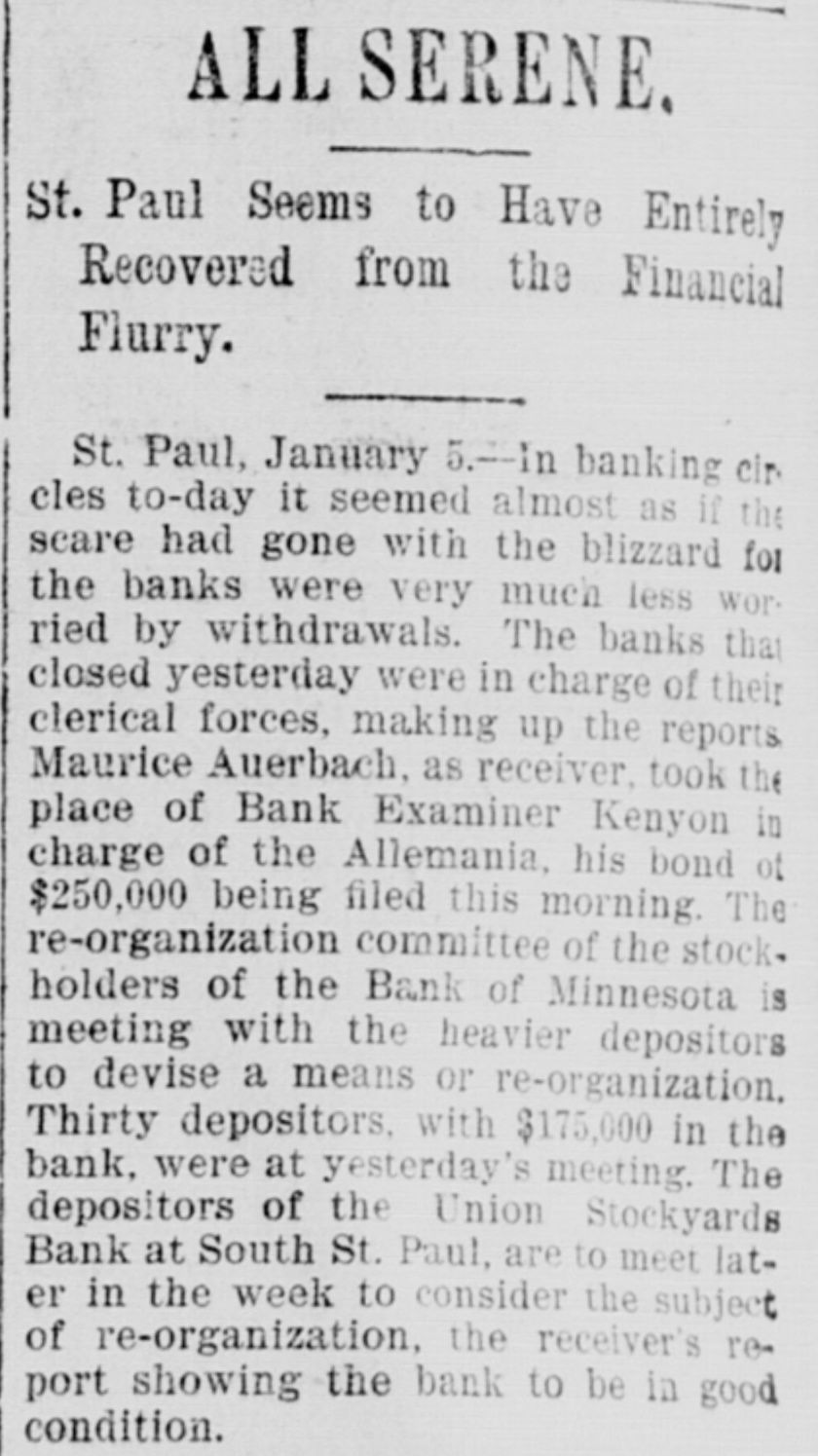
ALL SERENE
St. Paul Seems to Have Entirely Recovered from the Financial Flurry. St. Paul, January 5.-In banking cir. cles to-day it seemed almost as if the scare had gone with the blizzard for the banks were very much less wor. ried by withdrawals. The banks that closed yesterday were in charge of their clerical forces, making up the reports Maurice Auerbach, as receiver, took the place of Bank Examiner Kenyon in charge of the Allemania, his bond of $250,000 being filed this morning. The re-organization committee of the stock. holders of the Bank of Minnesota is meeting with the heavier depositors to devise a means or re-organization. Thirty depositors, with $175,000 in the bank, were at yesterday's meeting. The depositors of the Union Stockyards Bank at South St. Paul, are to meet later in the week to consider the subject of re-organization, the receiver's report showing the bank to be in good condition.
14.February 3, 1897The Saint Paul GlobeSaint Paul, MN
Click image to open full size in new tab
Article Text
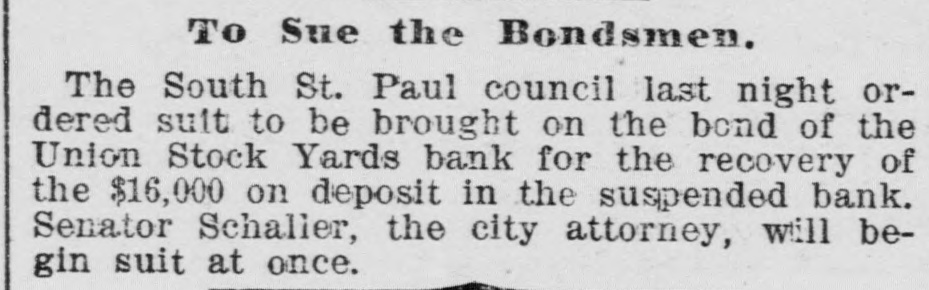
To Sue the Bondsmen
The South St. Paul council last night ordered suit to be brought on the bond of the Union Stock Yards bank for the recovery of the $16,000 on deposit in the suspended bank. Senator Schaller, the city attorney, will begin suit at once.
15.May 2, 1897The Saint Paul GlobeSaint Paul, MN
Click image to open full size in new tab
Article Text
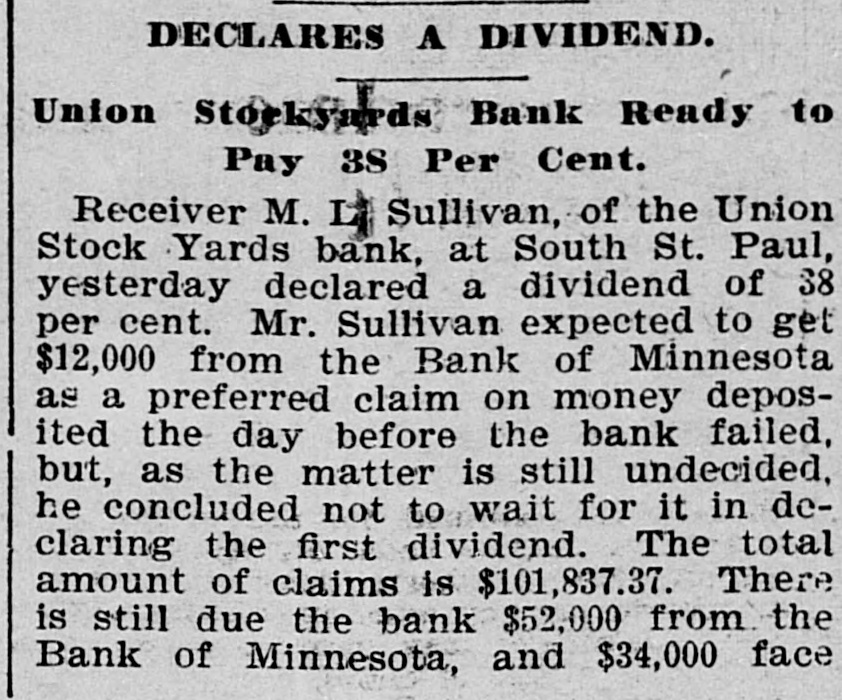
DECLARES A DIVIDEND
Union Stockyards Bank Ready to Pay 3S Per Cent. Receiver M. If Sullivan, of the Union Stock Yards bank, at South St. Paul, yesterday declared a dividend of 38 per cent. Mr. Sullivan expected to get $12,000 from the Bank of Minnesota as a preferred claim on money deposited the day before the bank failed, but, as the matter is still undecided, he concluded not to wait for it in declaring the first dividend. The total amount of claims is $101,837.37. There is still due the bank $52,000 from the Bank of Minnesota, and $34,000 face
16.June 30, 1897The Saint Paul GlobeSaint Paul, MN
Click image to open full size in new tab
Article Text
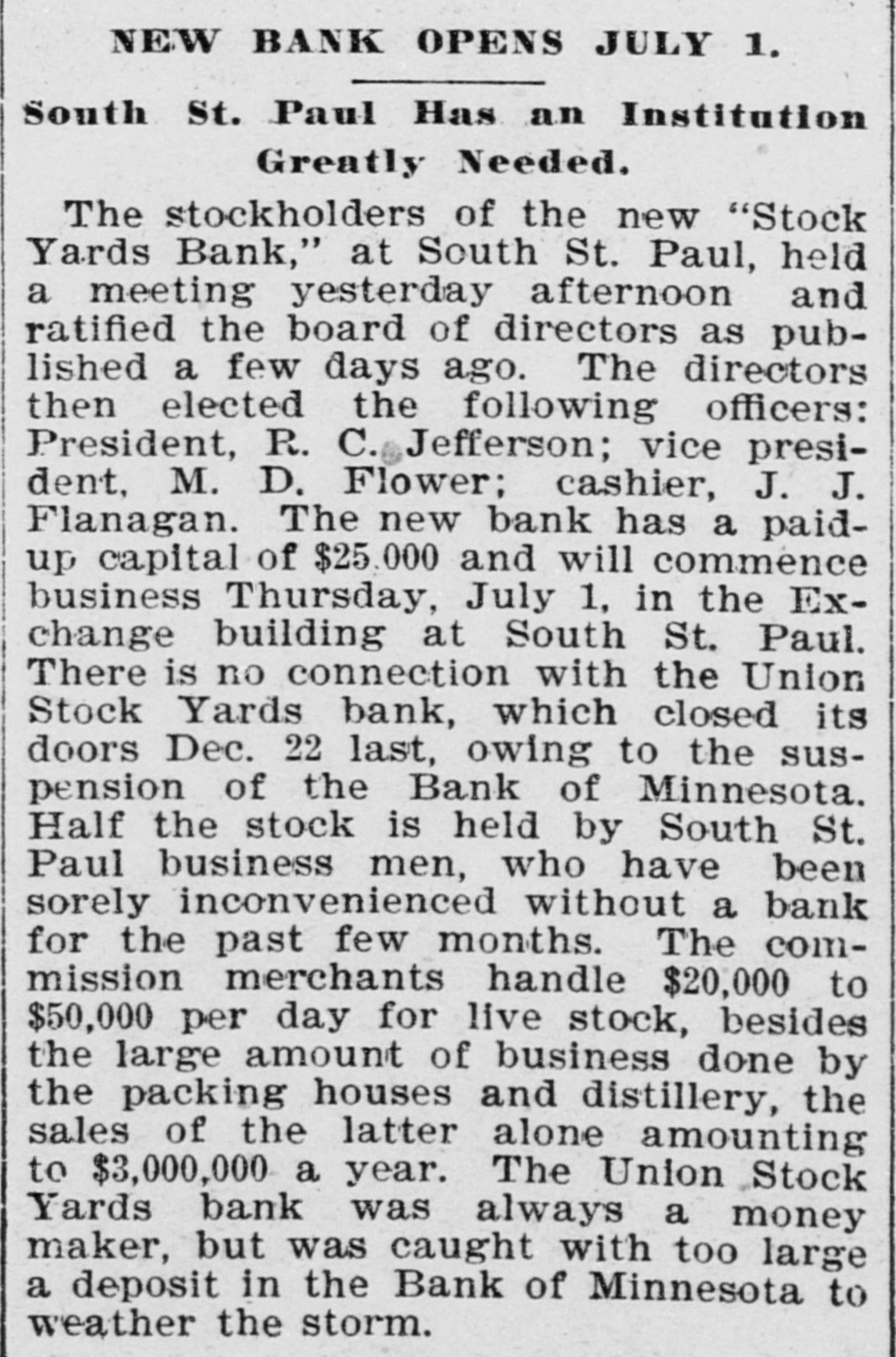
NEW BANK OPENS JULY 1
South St. Paul Has an Institution Greatly Needed. The stockholders of the new "Stock Yards Bank," at South St. Paul, held a meeting yesterday afternoon and ratified the board of directors as published a few days ago. The directors then elected the following officers: President, R. C. Jefferson; vice president, M. D. Flower; cashier, J. J. Flanagan. The new bank has a paidup capital of $25,000 and will commence business Thursday, July 1, in the Exchange building at South St. Paul. There is no connection with the Union Stock Yards bank, which closed its doors Dec. 22 last, owing to the suspension of the Bank of Minnesota. Half the stock is held by South St. Paul business men, who have been sorely inconvenienced without a bank for the past few months. The commission merchants handle $20,000 to $50,000 per day for live stock, besides the large amount of business done by the packing houses and distillery, the sales of the latter alone amounting to $3,000,000 a year. The Union Stock Yards bank was always a money maker, but was caught with too large a deposit in the Bank of Minnesota to weather the storm.
17.July 24, 1897The Saint Paul GlobeSaint Paul, MN
Click image to open full size in new tab
Article Text
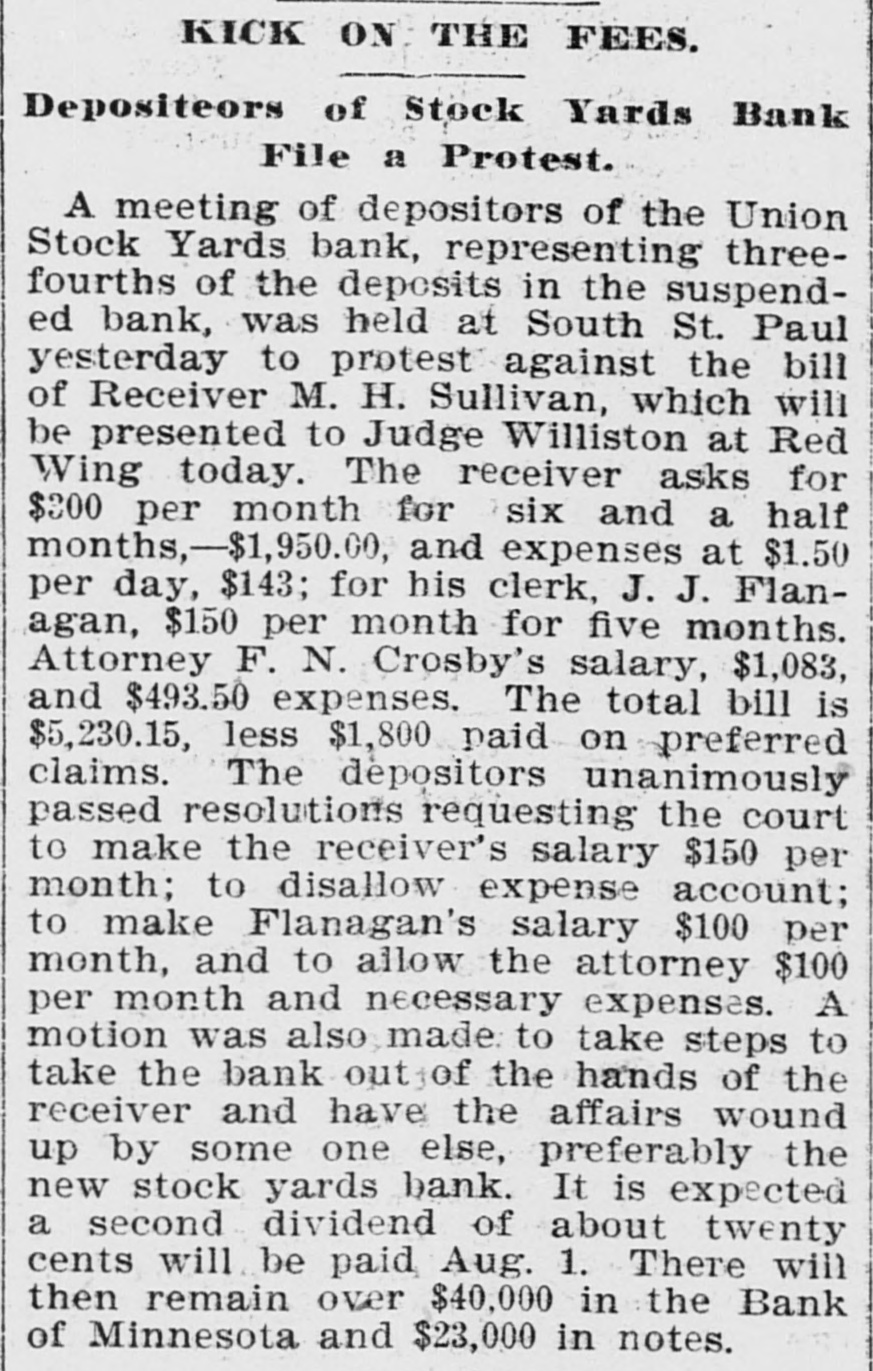
KICK ON THE FEES
Depositeors of Stock Yards Bank File a Protest. A meeting of depositors of the Union Stock Yards bank, representing threefourths of the deposits in the suspended bank, was held at South St. Paul yesterday to protest against the bill of Receiver M. H. Sullivan, which will be presented to Judge Williston at Red Wing today. The receiver asks for $300 per month for six and a half months,-$1,950.00, and expenses at $1.50 per day, $143; for his clerk, J. J. Flanagan, $150 per month for five months. Attorney F. N. Crosby's salary, $1,083, and $493.50 expenses. The total bill is $5,230.15, less $1,800 paid on preferred claims. The depositors unanimously passed resolutions requesting the court to make the receiver's salary $150 per month; to disallow expense account; to make Flanagan's salary $100 per month, and to allow the attorney $100 per month and necessary expenses. A motion was also made: to take steps to take the bank out of the hands of the receiver and have the affairs wound up by some one else, preferably the new stock yards bank. It is expected a second dividend of about twenty cents will be paid Aug. 1. There will then remain over $40,000 in the Bank of Minnesota and $23,000 in notes.
18.November 9, 1897The Saint Paul GlobeSaint Paul, MN
Click image to open full size in new tab
Article Text
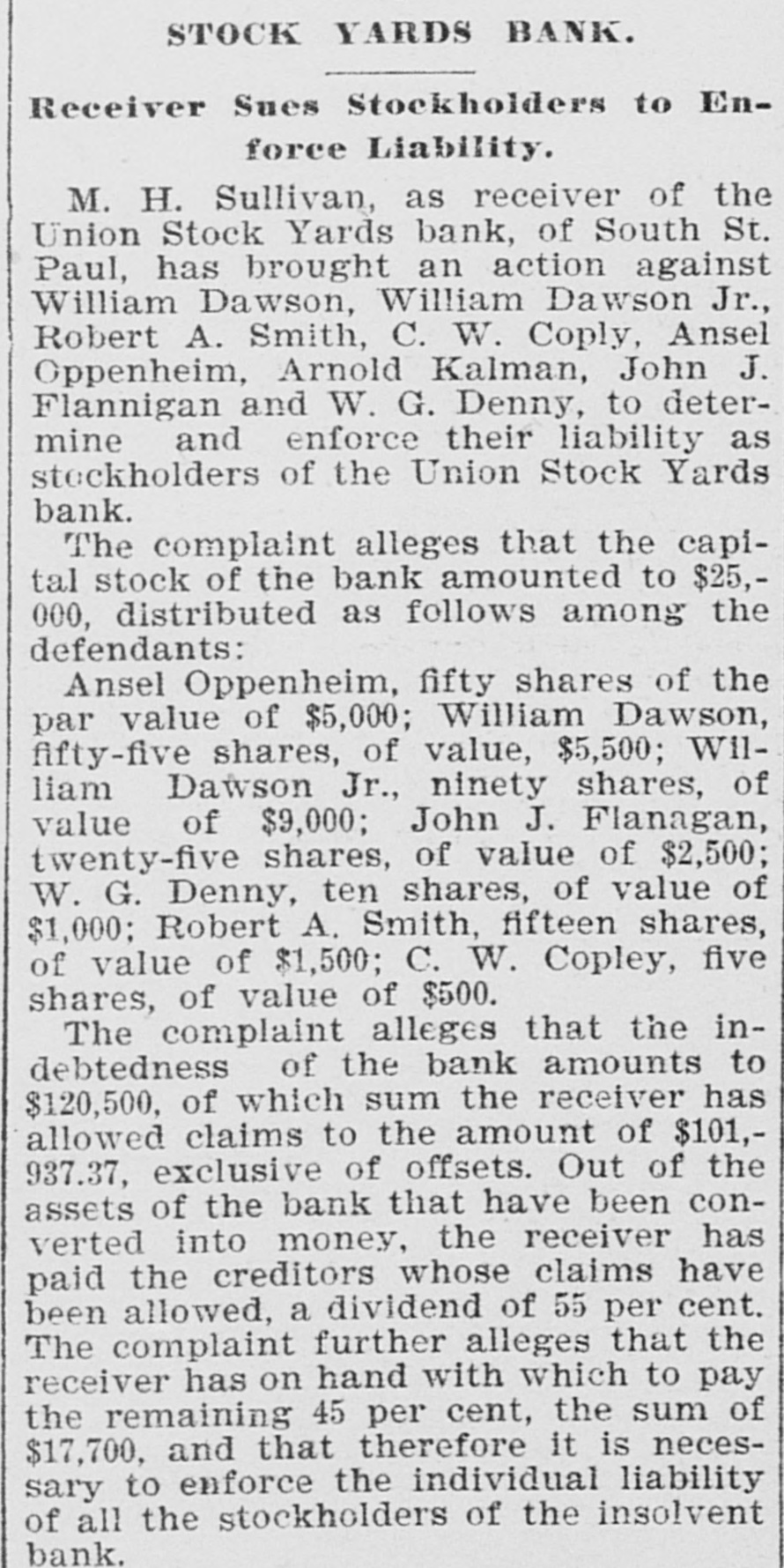
STOCK YARDS BANK
Receiver Sues Stockholders to Enforce Liability. M. H. Sullivan, as receiver of the Union Stock Yards bank, of South St. Paul, has brought an action against William Dawson, William Dawson Jr., Robert A. Smith, C. W. Coply, Ansel Oppenheim, Arnold Kalman, John J. Flannigan and W. G. Denny, to determine and enforce their liability as stockholders of the Union Stock Yards bank. The complaint alleges that the capital stock of the bank amounted to $25,000, distributed as follows among the defendants: Ansel Oppenheim, fifty shares of the par value of $5,000; William Dawson, fifty-five shares, of value, $5,500; William Dawson Jr., ninety shares, of value of $9,000; John J. Flanagan, twenty-five shares, of value of $2,500; W. G. Denny, ten shares, of value of $1,000; Robert A. Smith, fifteen shares, of value of $1,500; C. W. Copley, five shares, of value of $500. The complaint alleges that the indebtedness of the bank amounts to $120,500, of which sum the receiver has allowed claims to the amount of $101,937.37, exclusive of offsets. Out of the assets of the bank that have been converted into money, the receiver has paid the creditors whose claims have been allowed, a dividend of 55 per cent. The complaint further alleges that the receiver has on hand with which to pay the remaining 45 per cent, the sum of $17,700, and that therefore it is necessary to enforce the individual liability of all the stockholders of the insolvent bank.
19.February 19, 1898The Saint Paul GlobeSaint Paul, MN
Click image to open full size in new tab
Article Text
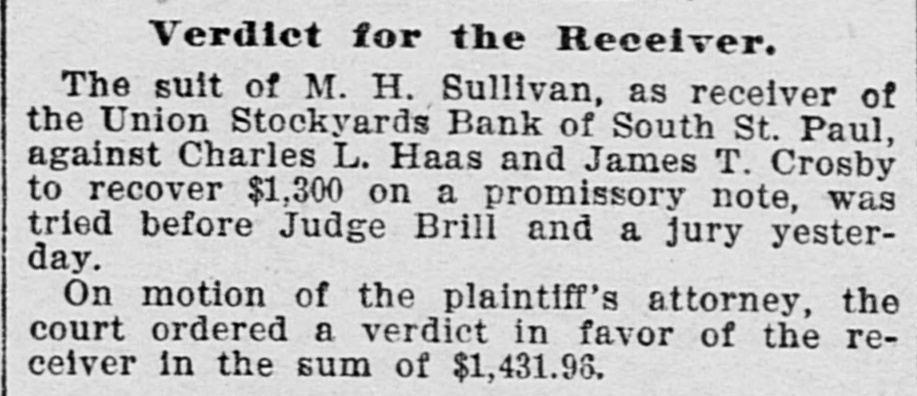
Verdict for the Receiver
The suit of M. H. Sullivan, as receiver of the Union Stockyards Bank of South St. Paul, against Charles L. Haas and James T. Crosby to recover $1,300 on a promissory note, was tried before Judge Brill and a jury yesterday. On motion of the plaintiff's attorney, the court ordered a verdict in favor of the receiver in the sum of $1,431.96.
20.May 14, 1899The Saint Paul GlobeSaint Paul, MN
Click image to open full size in new tab
Article Text
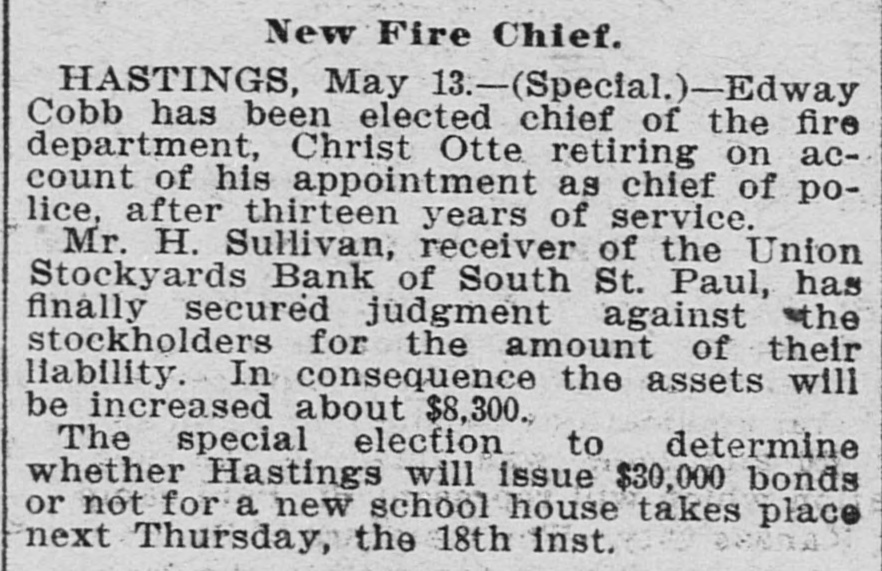
New Fire Chief
HASTINGS, May 13.-(Special.)-Edway Cobb has been elected chief of the fire department, Christ Otte retiring on account of his appointment as chief of police, after thirteen years of service. Mr. H. Sullivan, receiver of the Union Stockyards Bank of South St. Paul, has finally secured judgment against the stockholders for the amount of their liability. In consequence the assets will be increased about $8,300. The special election to determine whether Hastings will issue $30,000 bonds or not for a new school house takes place next Thursday, the 18th inst.
21.August 9, 1901The Saint Paul GlobeSaint Paul, MN
Click image to open full size in new tab
Article Text
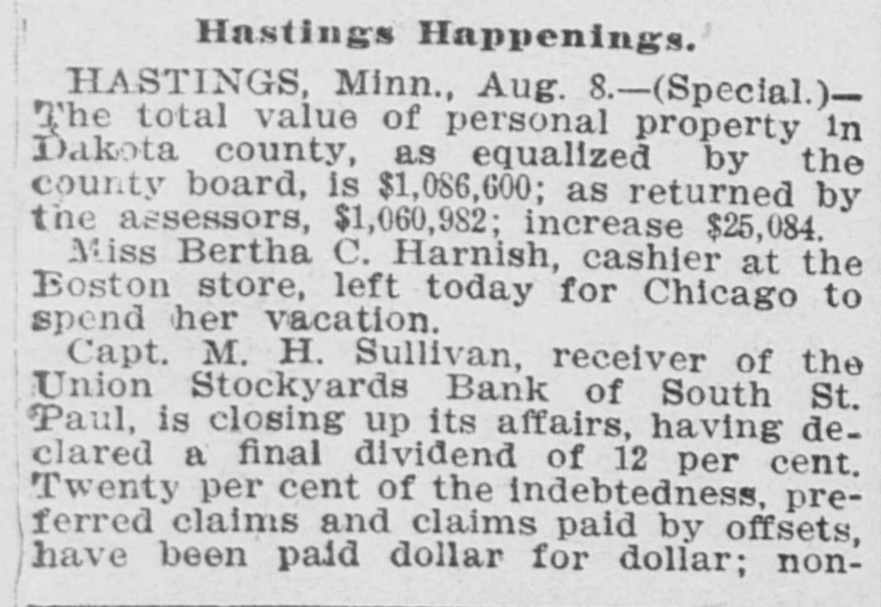
Hastings Happenings
HASTINGS, Minn., Aug. 8.-(Special.)The total value of personal property in Dakota county, as equalized by the county board, is $1,086,600; as returned by the assessors, $1,060,982; increase $25,084. Miss Bertha C. Harnish, cashier at the Boston store, left today for Chicago to spend her vacation. Capt. M. H. Sullivan, receiver of the Union Stockyards Bank of South St. Paul, is closing up its affairs, having declared a final dividend of 12 per cent. Twenty per cent of the indebtedness, preferred claims and claims paid by offsets, have been paid dollar for dollar; non-
Bank runs are almost always and everywhere a deterioration of bank fundamentals.
But not for you.
You are the measure-zero exception: great fundamentals, solid bank, and yet the Diamond Dybvig fairy spread its rumor. Depositors woke up. Your collateral was not prepositioned. The Clearinghouse had it for you.
Do not pass Go. Do not collect $200. Go directly to jail… or worse.