Wilkin Hale State Bank (Oklahoma City, OK)

Episode Information

Episode UID
5738763291467
Episode Type
Run โ†’ Suspension โ†’ Closure
Bank Type
state
Bank ID
573876329 hash
Start Date
March 8, 1922
Location
Oklahoma City, Oklahoma (35.468, -97.516)

Metadata

Model
gpt-5-mini (chosen from majority vote of a three-model LLM ensemble)
Short Digest
7e9c8399a58957dd

Response Measures

None

Description

Liquidation followed suspension; large amount of worthless notes reported by liquidator.

Events (4)

1. March 8, 1922 Receivership
Newspaper Excerpt
being placed in the hands of the State Banking Department for reorganization. Roy Walcott, Acting State Bank Commissioner, said that a quiet run of three weeks had necessitated suspension.
Source
newspapers
2. March 8, 1922 Run
Cause
Rumor Or Misinformation
Cause Details
Persistent street rumors and gossip about the bank's solvency triggered a slow three-week withdrawal of deposits
Measures
Attempted to obtain national charter; clearing house offered help which was declined
Newspaper Excerpt
Rumors concerning the bank's condition started a slow but decided run on the bank which has extended over the last three weeks
Source
newspapers
3. March 8, 1922 Suspension
Cause
Government Action
Cause Details
Closed and placed in hands of State Banking Department for reorganization after run and inability to meet withdrawals
Newspaper Excerpt
The Wilkin Hale State bank... closed its doors today with an announcement that its affairs had been placed in the hands of the state banking department for reorganizaton.
Source
newspapers
4. November 1, 1925 Other
Newspaper Excerpt
Prentice Price, liquidator for the Wilkin-Hale Bank, Oklahoma City, says another small dividend will be paid in connection with the failure of that institution, though he says more than $600,000 in worthless notes is on hand, with no hope of collection.
Source
newspapers

Newspaper Articles (9)

Article from The Rock Island Argus and Daily Union, March 8, 1922

Click image to open full size in new tab

Article Text

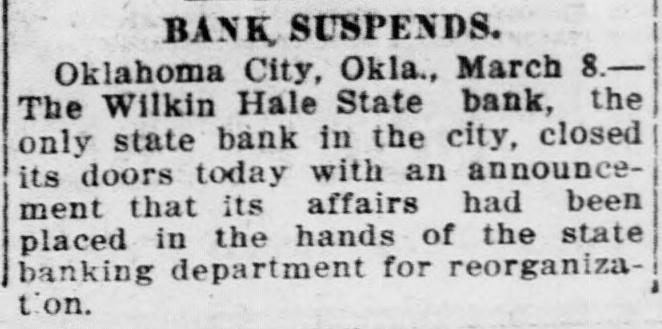
BANK SUSPENDS. Oklahoma City, Okla., March 8.The Wilkin Hale State bank, the only state bank in the city, closed its doors today with an announcement that its affairs had been placed in the hands of the state banking department for reorganizaton.


Article from The Guthrie Daily Leader, March 8, 1922

Click image to open full size in new tab

Article Text

WilkinHaleBank Fails Oklahoma City, March 8-The Wilkin-Hale bank of this city was closed to business today. The bank is in the hands of Bank Commissioner Waleott. Attempt at reorganization has been begun. Officers of the closed bank are J.L. Wilkin, president : John M. Hale and W. C. Ernest, vicepresidents : R 11. Wilkin, cashier, and Luther Jones and Patrick Roben, assistant cashiers. No other city banks are affected, it is declared. Treasurer Leocraft said $200,000 in state funds were deposited in the bank. Rumors St. rted Run The following statement was given out: Rumors concerning the bank's condition started a slow hnt decided run on the bank which has extended over the last three weeks resulting in the necessity of closing the doors. The bank had thought to nationalize but failing in this was 1111able to withstand the strain. First application for a national charter was made last November "All state, city and county funds, aggregating $245,000. are secured by Liberty bonds. We hope to be able to reorganize the bank but should we fail we are confident that the depositors will get their money as a result of limidation procedure. Clearing House Offered Help That help had been tendered the bank last Saturday by the Oklahoma City Clearing House association, but declined, was the announcement made by Dan W. Hogan. president of the association The statement, passed upon by the association. declared that closing of the Wilkin-Hale bank "does not in any way involve any other institution in this city, and it is paradoxical that it should occur at a time when the combined statements of all the other clearing house banks show the strongest reserve in the history of the institution." The statement added that the embarrassment of the Wilkin-Hale bank is an "isolated case not related to present conditions." The last state bank statement showed deposits of $2,204,627.70 in the Wilkin-Hale bank and loans and discounts of $1.570,073.69. Resources and liabilities were each given as $2,728,759.09


Article from The New York Herald, March 9, 1922

Click image to open full size in new tab

Article Text

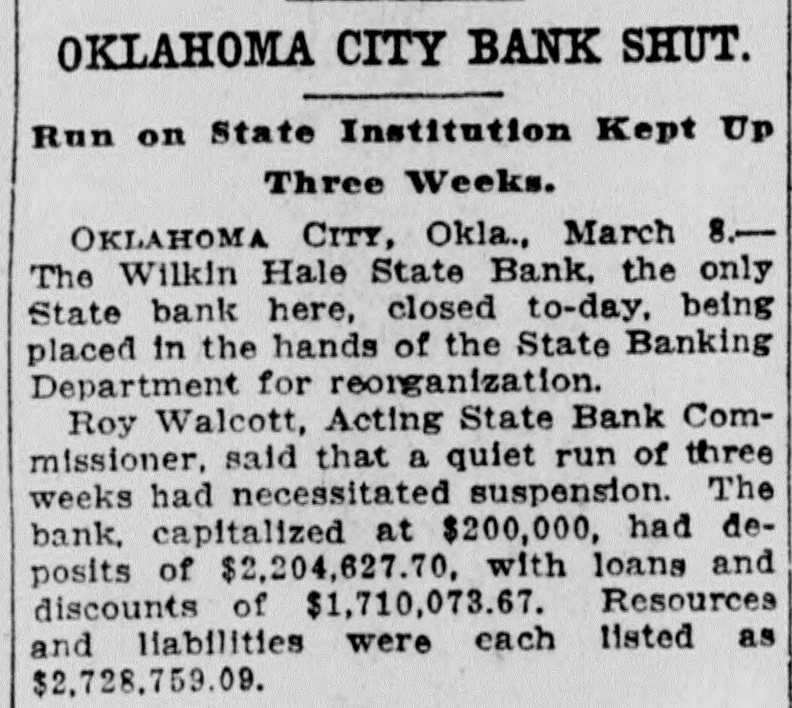
OKLAHOMA CITY BANK SHUT. Run on State Institution Kept Up Three Weeks. OKLAHOMA CITY, Okla., March 8.The Wilkin Hale State Bank, the only State bank here, closed to-day. being placed in the hands of the State Banking Department for reorganization. Roy Walcott, Acting State Bank Commissioner, said that a quiet run of three weeks had necessitated suspension. The bank, capitalized at $200,000, had deposits of $2,204,627.70, with loans and discounts of $1,710,073.67. Resources and liabilities were each listed as $2,728,759.09.


Article from The Butler Weekly Times and the Bates County Record, March 16, 1922

Click image to open full size in new tab

Article Text

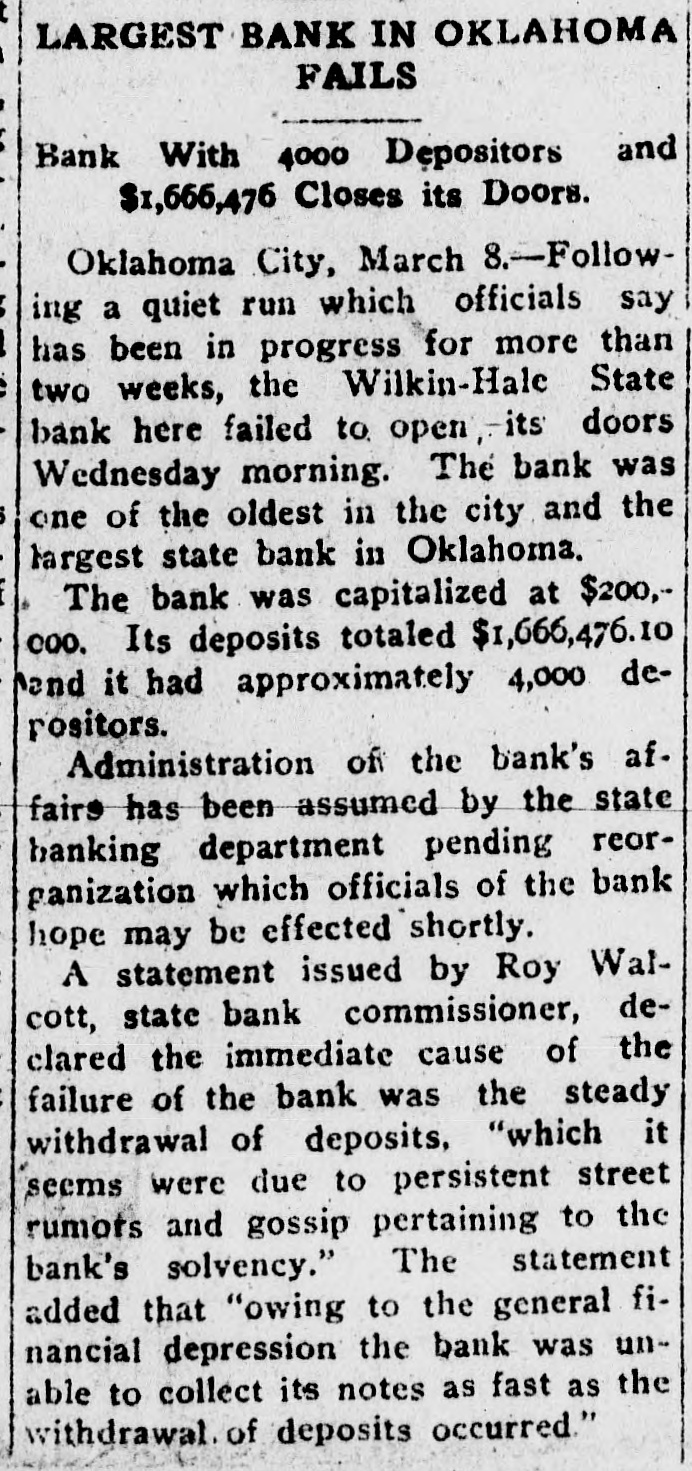
LARGEST BANK IN OKLAHOMA FAILS Bank With 4000 Depositors and $1,666,476 Closes its Doors. Oklahoma City, March 8.-Following a quiet run which officials say has been in progress for more than two weeks, the Wilkin-Hale State bank here failed to open its doors Wednesday morning. The bank was one of the oldest in the city and the largest state bank in Oklahoma. The bank was capitalized at $200,000. Its deposits totaled $1,666,476.10 and it had approximately 4,000 depositors. Administration of the bank's affairs has been assumed by the state banking department pending reorpanization which officials of the bank hope may be effected shortly. A statement issued by Roy Walcott, state bank commissioner, declared the immediate cause of the failure of the bank was the steady withdrawal of deposits, "which it seems were due to persistent street rumots and gossip pertaining to the bank's solvency." The statement added that "owing to the general financial depression the bank was unable to collect its notes as fast as the withdrawal. of deposits occurred."


Article from The Chickasha Daily Express, March 24, 1922

Click image to open full size in new tab

Article Text

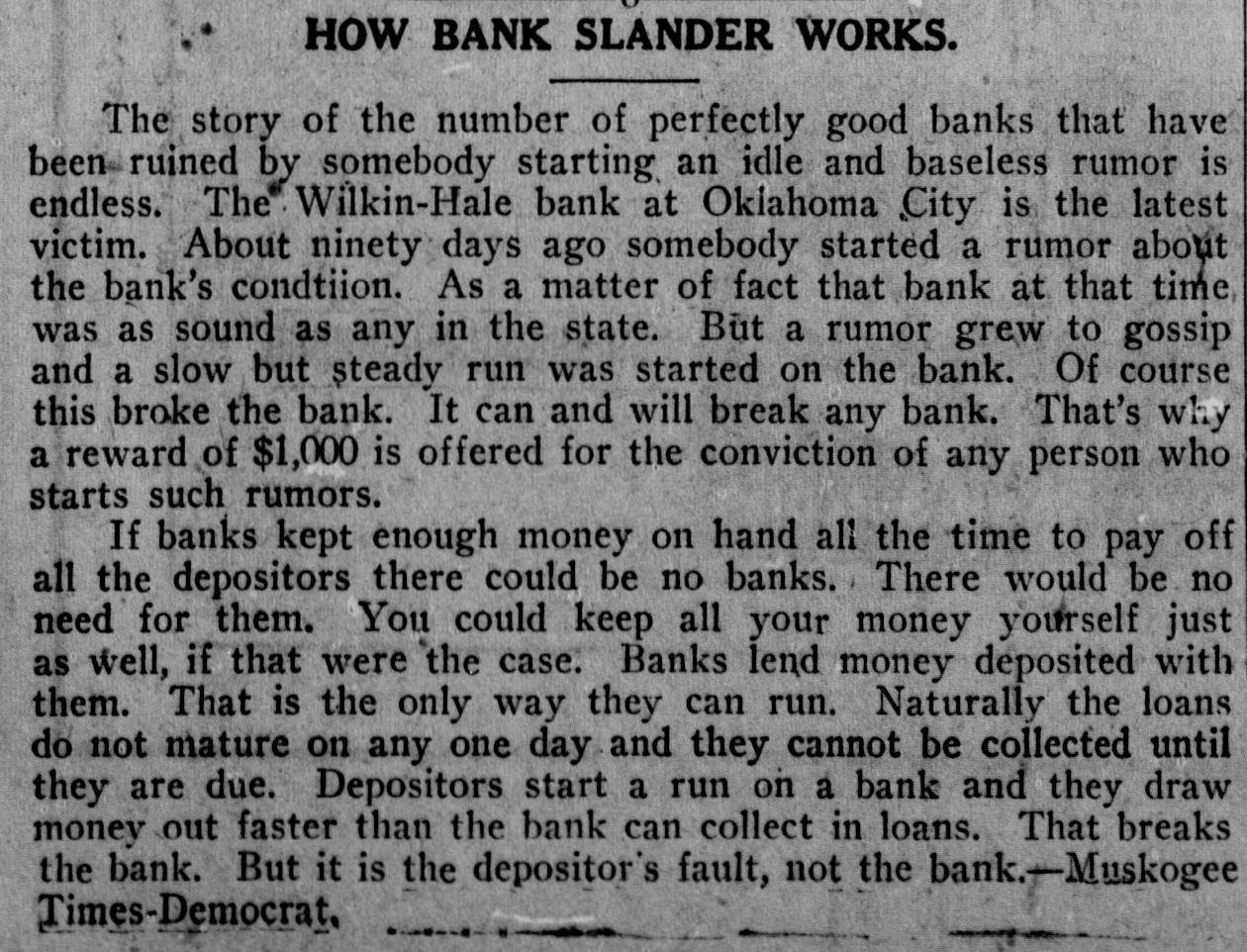
# HOW BANK SLANDER WORKS. The story of the number of perfectly good banks that have been ruined by somebody starting an idle and baseless rumor is endless. The Wilkin-Hale bank at Oklahoma City is the latest victim. About ninety days ago somebody started a rumor about the bank's condtiion. As a matter of fact that bank at that time was as sound as any in the state. But a rumor grew to gossip and a slow but steady run was started on the bank. Of course this broke the bank. It can and will break any bank. That's why a reward of $1,000 is offered for the conviction of any person who starts such rumors. If banks kept enough money on hand all the time to pay off all the depositors there could be no banks. There would be no need for them. You could keep all your money yourself just as well, if that were the case. Banks lend money deposited with them. That is the only way they can run. Naturally the loans do not mature on any one day and they cannot be collected until they are due. Depositors start a run on a bank and they draw money out faster than the bank can collect in loans. That breaks the bank. But it is the depositor's fault, not the bank. - Muskogee Times-Democrat,


Article from The Chickasha Daily Express, June 9, 1922

Click image to open full size in new tab

Article Text

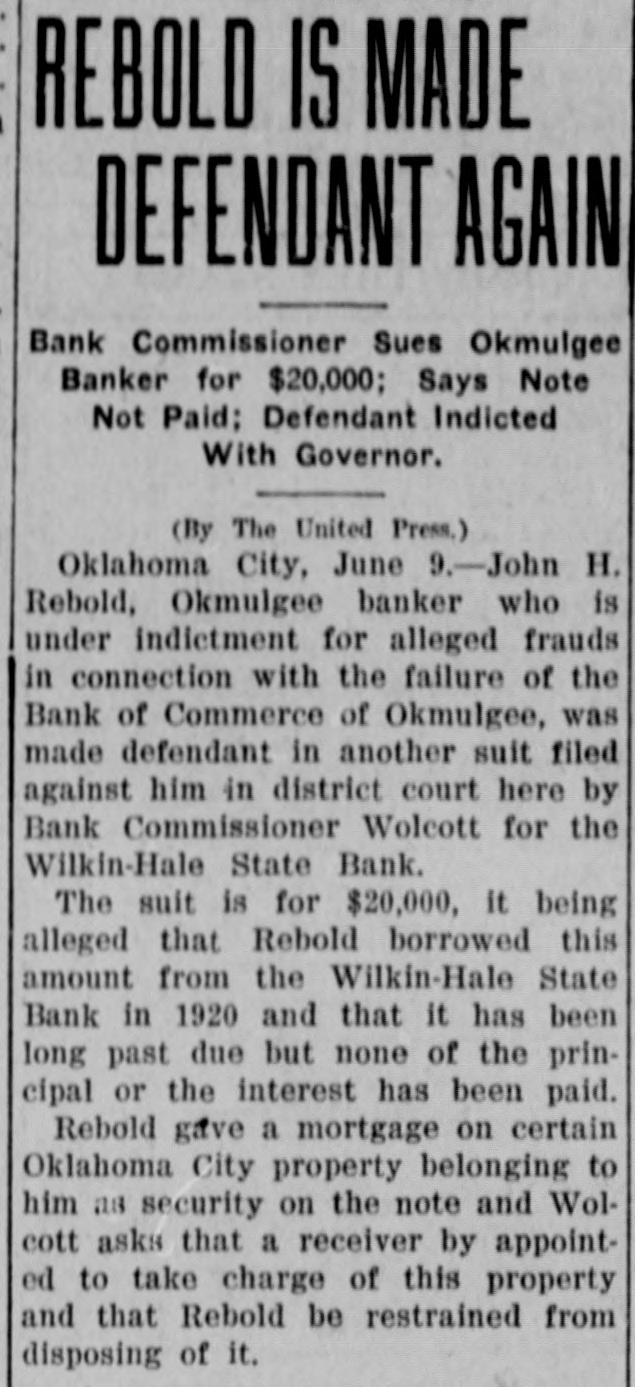
REBOLD IS MADE DEFENDANT AGAIN Bank Commissioner Sues Okmulgee Banker for $20,000; Says Note Not Paid: Defendant Indicted With Governor. (By The United Press.) Oklahoma City, June 9.-John H. Rebold, Okmulgee banker who is under indictment for alleged frauds in connection with the failure of the Bank of Commerce of Okmulgee, was made defendant in another suit filed against him in district court here by Bank Commissioner Wolcott for the Wilkin-Hale State Bank. The suit is for $20,000, it being alleged that Rebold borrowed this amount from the Wilkin-Hale State Bank in 1920 and that it has been long past due but none of the principal or the interest has been paid. Rebold gave a mortgage on certain Oklahoma City property belonging to him as security on the note and Wolcott asks that a receiver by appointed to take charge of this property and that Rebold be restrained from disposing of it.


Article from The Tulsa Tribune, July 15, 1923

Click image to open full size in new tab

Article Text

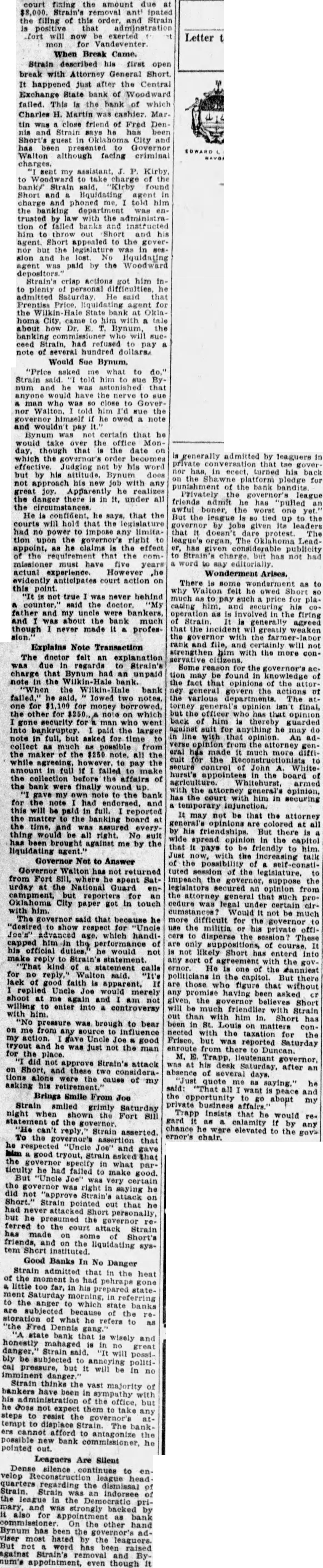
court fixing the amount due at $8,000. Strain's removal anticipated the filing of this order, and Strain is positive that administration effort will now be exerted to atone for Vandeventer. When Break Came. Strain described his first open break with Attorney General Short. It happened just after the Central Exchange State bank of Woodward failed. This is the bank of which Charles H. Martin was cashier. Martin was a close friend of Fred Dennis and Strain says he has been Short's guest in Oklahoma City and has been presented to Governor Walton although facing criminal charges. "I sent my assistant, J. P. Kirby, to Woodward to take charge of the bank," Strain said. "Kirby found Short and a liquidating agent in charge and phoned me. I told him the banking department was entrusted by law with the administration of failed banks and instructed him to throw out Short and his agent. Short appealed to the governor but the legislature was in session and he lost. No liquidating agent was paid by the Woodward depositors." Strain's crisp actions got him into plenty of personal difficulties, he admitted Saturday. He said that Prentiss Price, liquidating agent for the Wilkin-Hale State bank at Oklahoma City, came to him with a tale about how Dr. E. T. Bynum, the banking commissioner who will succeed Strain, had refused to pay a note of several hundred dollars. Would Sue Bynum. "Price asked me what to do," Strain said. "I told him to sue Bynum and he was astonished that anyone would have the nerve to sue a man who was so close to Governor Walton. I told him I'd sue the governor himself if he owed a note and wouldn't pay it." Bynum was not certain that he would take over the office Monday, though that is the date on which the governor's order becomes effective. Judging not by his word but by his attitude, Bynum does not approach his new job with any great joy. Apparently he realizes the danger there is in it, under all the circumstances. He is confident, he says, that the courts will hold that the legislature had no power to impose any limitation upon the governor's right to appoint, as he claims is the effect of the requirement that the commissioner must have five years actual experience. However, he evidently anticipates court action on this point. "It is not true I was never behind a counter," said the doctor. "My father and my uncle were bankers, and I was about the bank much though I never made it a profession." Explains Note Transaction. The doctor felt an explanation was due in regards to Strain's charge that Bynum had an unpaid note in the Wilkin-Hale bank. "When the Wilkin-Hale bank failed," he said, "I owed two notes, one for $1,100 for money borrowed, the other for $250, a note on which I gone security for a man who went into bankruptcy. I paid the larger note in full, but asked for time to collect as much as possible from the maker of the $250 note, all the while agreeing, however, to pay the amount in full if I failed to make the collection before the affairs of the bank were finally wound up. "I gave my own note to the bank for the note I had endorsed, and this will be paid in full. I reported the matter to the banking board at the time, and was assured everything would be all right. No suit has been brought against me by the liquidating agent." Governor Not to Answer. Governor Walton has not returned from Fort Sill, where he spent Saturday at the National Guard encampment, but reporters for an Oklahoma City paper got in touch with him. The governor said that because he "desired to show respect for 'Uncle Joe's' advanced age, which handicapped him in the performance of his official duties," he would not make reply to Strain's statement. "That kind of a statement calls for no reply," Walton said. "It's lack of good faith is apparent. If I replied Uncle Joe would merely shoot at me again and I am not willing to enter into a controversy with him. "No pressure was brought to bear on me from any source to influence my action. I gave Uncle Joe a good tryout and he was just not the man for the place. "I did not approve Strain's attack on Short, and these two considerations alone were the cause of my asking his retirement." Brings Smile From Joe. Strain smiled grimly Saturday night when shown the Fort Sill statement of the governor. "He can't reply," Strain asserted. To the governor's assertion that he respected "Uncle Joe" and gave him a good tryout, Strain asked that the governor specify in what particularity he had failed to make good. But "Uncle Joe" was very certain the governor was right in saying he did not "approve Strain's attack on Short." Strain pointed out that he had never attacked Short personally, but he presumed the governor referred to the court attack Strain has made on some of Short's friends, and on the liquidating system Short instituted. Good Banks In No Danger. Strain admitted that in the heat of the moment he had perhaps gone a little too far, in his prepared statement Saturday morning, in referring to the anger to which state banks are subjected because of the restoration of what he refers to as "the Fred Dennis gang." "A state bank that is wisely and honestly managed is in no great danger," Strain said. "It will possibly be subjected to annoying political pressure, but it will be in no imminent danger." Strain thinks the vast majority of bankers have been in sympathy with his administration of the office, but he does not expect them to take any steps to resist the governor's attempt to displace Strain. The bankers cannot afford to antagonize the possible new bank commissioner, he pointed out. Leaguers Are Silent. Dense silence continues to envelop Reconstruction league headquarters regarding the dismissal of Strain. Strain was an indorsee of the league in the Democratic primary, and was strongly backed by it also for appointment as bank commissioner. On the other hand Bynum has been the governor's adviser most hated by the leaguers. But not a word has been raised against Strain's removal and Bynum's appointment, even though it is generally admitted by leaguers in private conversation that the governor has, in effect, turned his back on the Shawne platform pledge for punishment of the bank bandits. Privately the governor's league friends admit he has "pulled an awful boner, the worst one yet." But the league is so tied up to the governor by jobs given its leaders that it doesn't dare protest. The league's organ, The Oklahoma Leader, has given considerable publicity to Strain's charge, but has not had a word to say editorially. Wonderment Arises. There is some wonderment as to why Walton felt he owed Short so much as to pay such a price for placating him, and securing his cooperation as is involved in the firing of Strain. It is generally agreed that the incident will greatly weaken the governor with the farmer-labor rank and file, and certainly will not strengthen him with the more conservative citizens. Some reason for the governor's action may be found in knowledge of the fact that opinions of the attorney general govern the actions of the various departments. The attorney general's opinion isn't final, but the officer who has that opinion back of him is thereby guarded against suit for anything he may do in line with that opinion. An adverse opinion from the attorney general has made it much more difficult for the Reconstructionists to secure control of John A. Whitehurst's appointees in the board of agriculture. Whitehurst, armed with the attorney general's opinion, has the court with him in securing a temporary injunction. It may not be that the attorney general's opinions are colored at all by his friendships. But there is a wide spread opinion in the capitol that it pays to be friendly to him. Just now, with the increasing talk of the possibility of a self-constituted session of the legislature, to impeach the governor, suppose the legislators secured an opinion from the attorney general that such procedure was legal under certain circumstances? Would it not be much more difficult for the governor to use the militia or his private officers to disperse the session? These are only suppositions, of course. It is not likely Short has entered into any sort of agreement with the governor. He is one of the canniest politicians in the capitol. But there are those who figure that without any promise having been asked or given, the governor believes Short will be much friendlier with Strain out than with him in. Short has been in St. Louis on matters connected with the taxation for the Frisco, but was reported Saturday enroute from there to Duncan. M. E. Trapp, lieutenant governor, was at his desk Saturday, after an absence of several days. "Just quote me as saying," he said: "That all I want is peace and the opportunity to go about my private business affairs." Trapp insists that he would regard it as a calamity if by any chance he were elevated to the governor's chair.

Article from Oklahoma State Register, July 19, 1923

Click image to open full size in new tab

Article Text

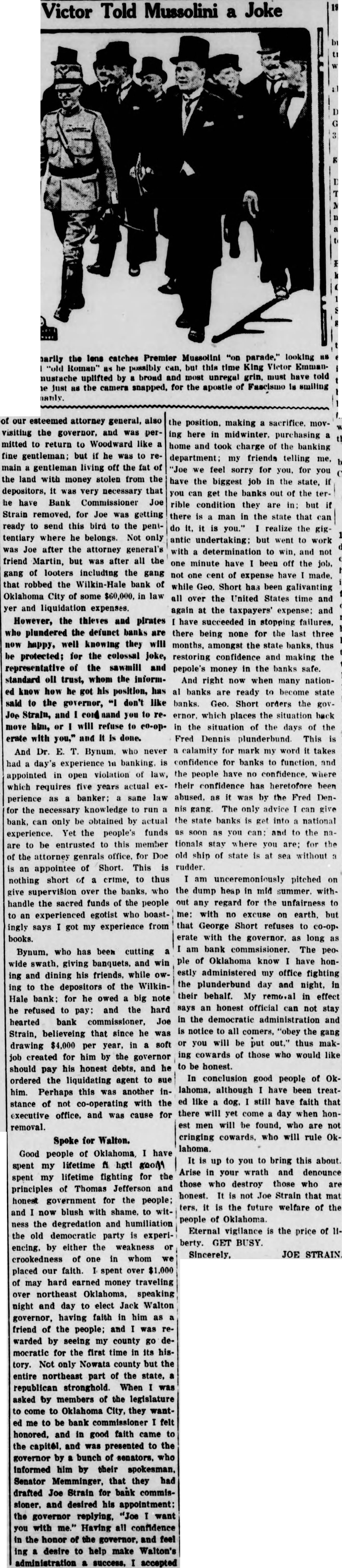
Victor Told Mussolini a Joke ...arily the lens catches Premier Mussolini "on parade," looking as much a "old Roman" as he possibly can, but this time King Victor Emmanuel, mustache uplifted by a broad and most unregal grin, must have told a joke just as the camera snapped, for the apostle of Fascismo is smiling humanly. of our esteemed attorney general, also visiting the governor, and was permitted to return to Woodward like a fine gentleman; but if he was to remain a gentleman living off the fat of the land with money stolen from the depositors, it was very necessary that he have Bank Commissioner Joe Strain removed, for Joe was getting ready to send this bird to the penitentiary where he belongs. Not only was Joe after the attorney general's friend Martin, but was after all the gang of looters including the gang that robbed the Wilkin-Hale bank of Oklahoma City of some $60,000, in lawyer and liquidation expenses. However, the thieves and pirates who plundered the defunct banks are now happy, well knowing they will be protected; for the colossal joke, representative of the sawmill and standard oil trust, whom the informed know how he got his position, has said to the governor, "I don't like Joe Strain, and I command you to remove him, or I will refuse to co-operate with you," and it is done. And Dr. E. T. Bynum, who never had a day's experience in banking, is appointed in open violation of law, which requires five years actual experience as a banker; a sane law for the necessary knowledge to run a bank, can only be obtained by actual experience. Yet the people's funds are to be entrusted to this member of the attorney general's office, for Doc is an appointee of Short. This is nothing short of a crime, to thus give supervision over the banks, who handle the sacred funds of the people to an experienced egotist who boastingly says I got my experience from books. Bynum, who has been cutting a wide swath, giving banquets, and wining and dining his friends, while owing to the depositors of the Wilkin-Hale bank; for he owed a big note he refused to pay; and the hard hearted bank commissioner, Joe Strain, believing that since he was drawing $4,000 per year, in a soft job created for him by the governor should pay his honest debts, and he ordered the liquidating agent to sue him. Perhaps this was another instance of not co-operating with the executive office, and was cause for removal. Spoke for Walton. Good people of Oklahoma, I have spent my lifetime fighting for the principles of Thomas Jefferson and honest government for the people; and I now blush with shame, to witness the degradation and humiliation the old democratic party is experiencing, by either the weakness or crookedness of one in whom we placed our faith. I spent over $1,000 of may hard earned money traveling over northeast Oklahoma, speaking night and day to elect Jack Walton governor, having faith in him as a friend of the people; and I was rewarded by seeing my county go democratic for the first time in its history. Not only Nowata county but the entire northeast part of the state, a republican stronghold. When I was asked by members of the legislature to come to Oklahoma City, they wanted me to be bank commissioner I felt honored, and in good faith came to the capitol, and was presented to the governor by a bunch of senators, who informed him by their spokesman, Senator Memminger, that they had drafted Joe Strain for bank commissioner, and desired his appointment; the governor replying, "Joe I want you with me." Having all confidence in the honor of the governor, and feeling a desire to help make Walton's administration a success, I accepted the position, making a sacrifice, moving here in midwinter, purchasing a home and took charge of the banking department; my friends telling me, "Joe we feel sorry for you, for you have the biggest job in the state, if you can get the banks out of the terrible condition they are in; but if there is a man in the state that can do it, it is you." I realize the gigantic undertaking; but went to work with a determination to win, and not one minute have I been off the job, not one cent of expense have I made, while Geo. Short has been galivanting all over the United States time and again at the taxpayers' expense; and I have succeeded in stopping failures, there being none for the last three months, amongst the state banks, thus restoring confidence and making the people's money in the banks safe. And right now when many national banks are ready to become state banks, Geo. Short orders the governor, which places the situation back in the situation of the days of the Fred Dennis plunderbund. This is a calamity for mark my word it takes confidence for banks to function, and the people have no confidence, where their confidence has heretofore been abused, as it was by the Fred Dennis gang. The only advice I can give the state banks is get into a national as soon as you can; and to the nationals stay where you are; for the old ship of state is at sea without a rudder. I am unceremoniously pitched on the dump heap in mid summer, without any regard for the unfairness to me; with no excuse on earth, but that George Short refuses to co-operate with the governor, as long as I am bank commissioner. The people of Oklahoma know I have honestly administered my office fighting the plunderbund day and night, in their behalf. My removal in effect says an honest official can not stay in the democratic administration and is notice to all comers, "obey the gang or you will be put out," thus making cowards of those who would like to be honest. In conclusion good people of Oklahoma, although I have been treated like a dog, I still have faith that there will yet come a day when honest men will be found, who are not cringing cowards, who will rule Oklahoma. It is up to you to bring this about. Arise in your wrath and denounce those who destroy those who are honest. It is not Joe Strain that matters, it is the future welfare of the people of Oklahoma. Eternal vigilance is the price of liberty. GET BUSY. Sincerely, JOE STRAIN.


Article from The Oklahoma Banker, November 1, 1925

Click image to open full size in new tab

Article Text

W. W. Bowman, Secretary of the Kansas Bankers Association, reveals the fact that a threatening communication came through the mails a few days since, addressed to a bank, member of the Kansas Bankers Association, in language substantially as follows: "Place $1,200 in a tin can, and place the can containing the money at (here designating the exact spot) not one minute later than (here specifying the time). Failing to do so you will be killed." The letter was printed in common type, was undated, and of course unsigned. It is too daring and serious to be a practical joke, and it is conjectural whether it be the venture of a local amateur or the beginning of an organized plot to be carried out on a large scale in a similar way by professional or semi-professional bandits operating over an extended territory. If the latter, the black-hand method may be coming to supplement or in some cases substitute for the daylight hold-up. In any case the banks should be informed of this particular instance. The Pawnee News, in commenting on the combined statement of the banks of Pawnee County ,said: "Pawnee County is fortunate in having the safe and solid financial institutions she has. The bank balances as set out by the various statements are the best evidence of the soundness and of the prosperous condition of the people of this part of Oklahoma. Crops were not as good as they have been, yet much cotton, plenty of sorghum feed including kafir well headed, a fair crop of hay with an average crop of corn and some wheat and oats were grown." The First National Bank of Holdenville believes in preparedness. They constructed a vault of such a character that it could not be successfully drilled by a bunch of criminal moles who burrowed down through the roof of the building. hoping to gain entrance through an excavation in the top of the vault, but were prevented from doing so when they struck a covering on the top of the vault that would not yield to their most persuasive efforts. heir identity has not been obtained. Every bank should have a vault like that. The Oklahoma Cotton Growers Association seems to be forging ahead as indicated by the amount of cotton handled each year since its organization. Total receipts in 1921 were 91,311 bales: in 1922, 65,868; in 1923, 118,743; in 1924, 141,440 bales. The total handled by the Association in four and one-half years to October 23 this year is more than 469,000 bales. O. L. Bane was elected Cashier of the First National Bank of Waynoka, at a recent meeting of the board. At the same meeting R. W. Naidley was advanced to the position of Acting Vice President. R. B. Mellon, President of the Mellon National Bank of Pittsburgh, was on November 4th elected by the stockholders of the Guaranty Trust Co as a director of that institution. The First National Bank of Los Angeles, The Pacific Southwest Trust and Savings Bank and the First Securities Company joined on Oct. 20 in doing honor to John M. Elliott, Chairman of the Board of the First National, who just rounded his 44 years of service with that institution. On Oct. 6 Mr. Elliott celebrated his eighty-first birthday. The Financial Advertisers Association held an interesting convention recently at Columbus, Ohio. The next annual convention is to be held at Detroit. The dates have not been set. Elizabeth Weitzenhoffer inspires us with the thought that you should know she arrived on Armistice Day. that she is very peaceful and that her lungs have been tested and are working fine. Oh, yes, she is anxious for you to know that her daddy is the G. S. Weitzenhoffer who helps to run the Security National Bank at Oklahoma City and that her mother is very proud of her. Prentice Price, liquidator for the Wilkin-Hale Bank, Oklahoma" City, says another small dividend will be paid in connection with the failure of that institution, though he says more than $600,000 in worthless notes is on hand, with no hope of collection. The First Bank & Trust Company of Waggoner, Okla., have completed arrangements to add to their farm loan department an abstract plant, so that there will be nothing in connection with making a farm loan they cannot handle in every detail through their own office. Mr. and Mrs. Robert B. Atkisson have accepted positions with the Seaboard National Bank of Los Angeles, Calif., an institution of which George L. Browning, formerly an Oklahoma City banker, is President. Mr. Atkisson was chief clerk of the Board of Affairs and Mrs. Atkisson has been in charge of departmental work in the Liberty National Bank of Oklahoma City. Earl Cochran has accepted a position as bookkeeper in the Producers National Bank of Wilson, Okla. O. A. Nation, former Vive President of the Wanette State Bank, Wanette, Okla., was sentenced to serve nine months in the penitentiary and to pay a fine of $100 on his plea of guilty of the eighteen charges growing out of the failure of the bank. O. B. Mothersead, State Bank Commissioner, has filed suit to collect the double liability amounting to $76,000 from the stockholders of the Planters & Mechanics Bank, Tulsa, which failed some time ago,