Bank of Louisiana (New Orleans, LA)

Episode Information

Episode UID
5748072790741
Episode Type
Suspension β†’ Reopening
Bank Type
state
Bank ID
574807279 hash
Start Date
September 16, 1861
Location
New Orleans, Louisiana (29.955, -90.075)

Metadata

Model
gpt-5-mini (chosen from majority vote of a three-model LLM ensemble)
Short Digest
f914bcc7f0be02b6

Response Measures

None

Description

Bank suspended specie payments in Sept 1861 under state/military pressure; later placed in liquidation (military commissioners) in 1863 and resumed business by 1866.

Events (5)

1. September 16, 1861 Suspension
Cause
Government Action
Cause Details
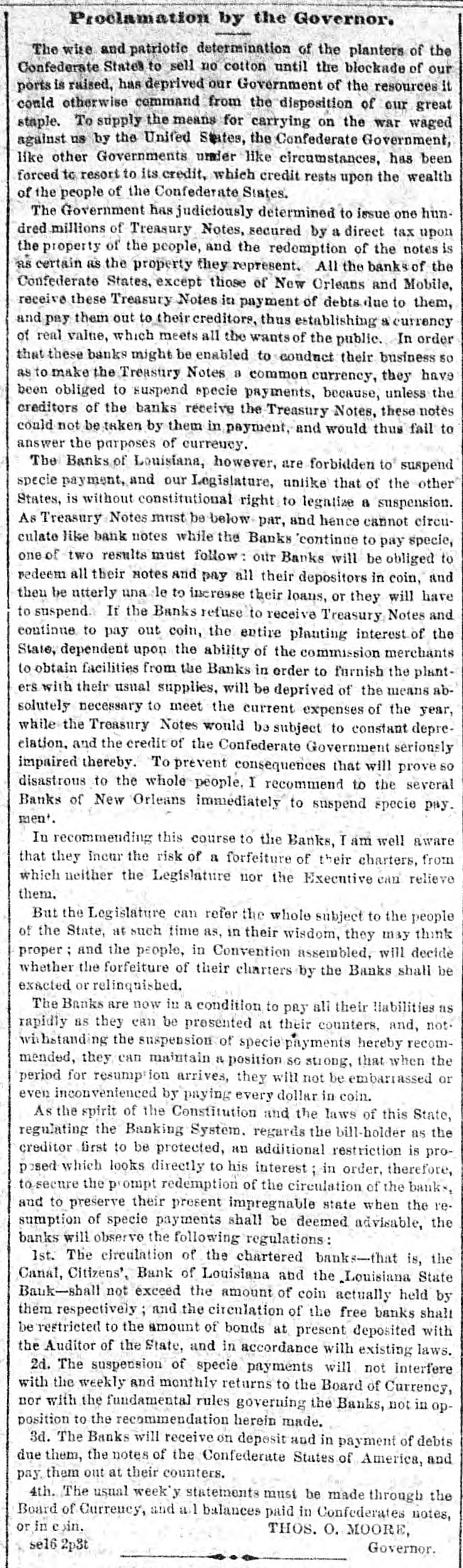
Governor's proclamation and Confederate currency policies led banks (including Bank of Louisiana) to suspend specie payments and accept Confederate Treasury notes.
Newspaper Excerpt
On the 16th of September, 1861, the city of New Orleans ... they not only suspended specie payments
Source
newspapers
2. September 20, 1861 Other
Newspaper Excerpt
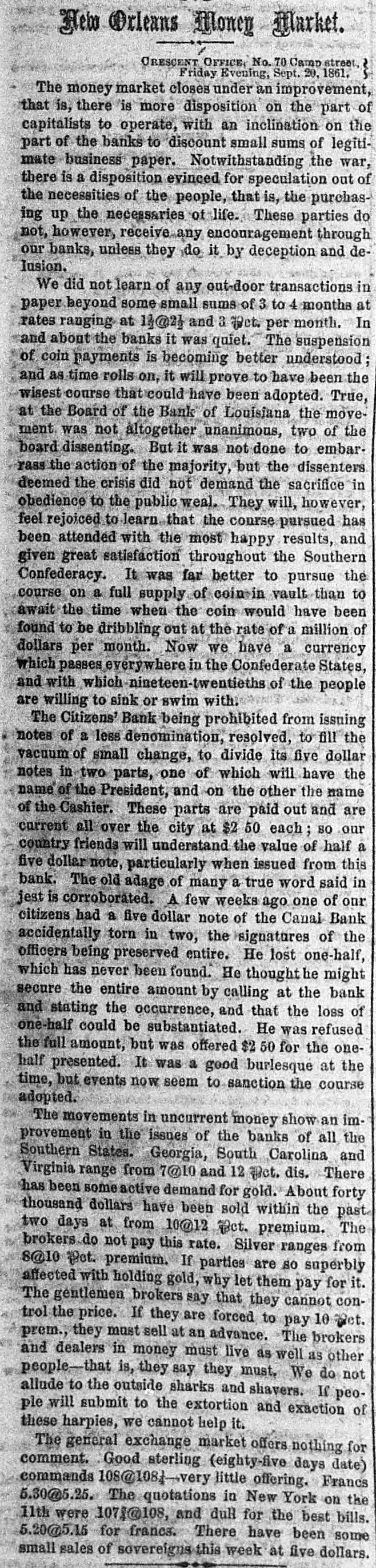
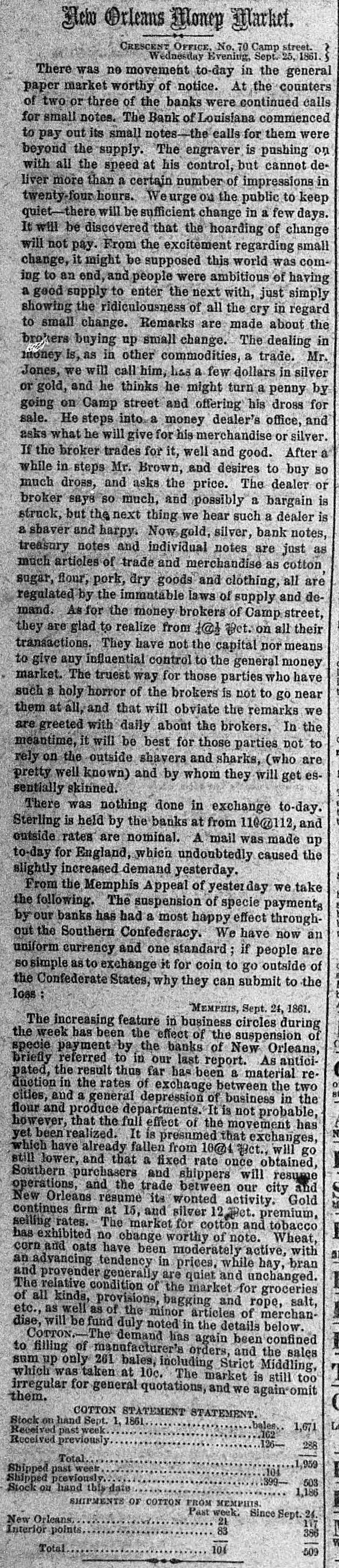
The Bank of Louisiana commenced to pay out its small notes ... suspension of coin payments is becoming better understood and ... has been attended with the most happy results, and given great satisfaction throughout the Southern Confederacy.
Source
newspapers
3. February 28, 1863 Other
Newspaper Excerpt
The Bank of Louisiana (burnt out last week) has resumed business in the Crescent City Bank building.
Source
newspapers
4. June 19, 1863 Receivership
Newspaper Excerpt
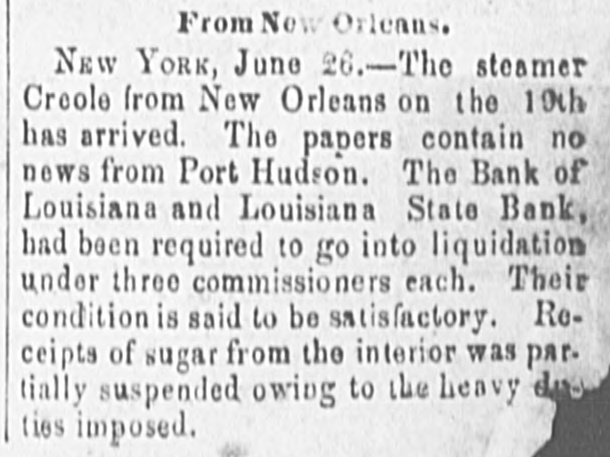
The Bank of Louisiana and Louisiana State Bank had been required to go into liquidation under three commissioners each. Their condition is said to be satisfactory.
Source
newspapers
5. November 14, 1866 Reopening
Newspaper Excerpt
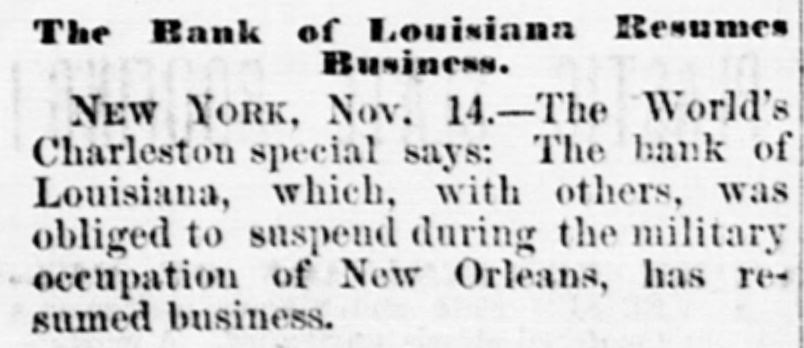
The Bank of Louisiana, which was obliged to suspend during the military occupation of New Orleans, has resumed business.
Source
newspapers

Newspaper Articles (21)

Article from New Orleans Daily Crescent, September 17, 1861

Click image to open full size in new tab

Article Text

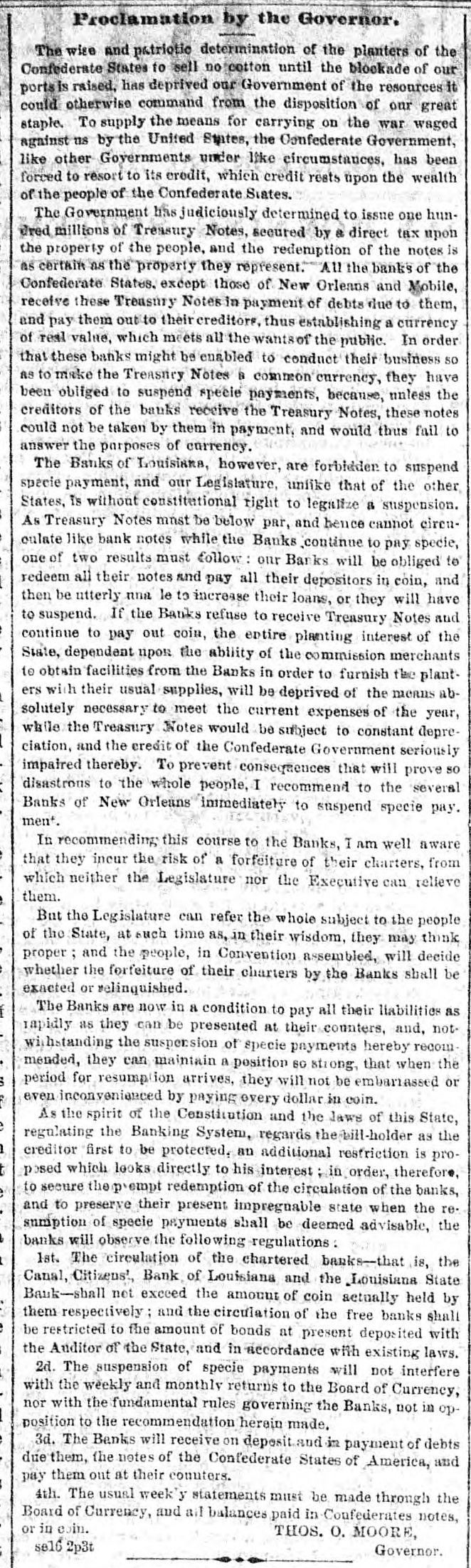
Proclamation by the Governor. The wise and patriotic determination of the planters of the Confederate States to sell no cotton until the blockade of our ports is raised, has deprived our Government of the resources it could otherwise command from the disposition of our great staple. To supply the means for carrying on the war waged against us by the Unifed States, the Confederate Government, like other Governments under like circumstances, has been forced to resort to its credit, which credit rests upon the wealth of the people of the Confederate States. The Government has judiciously determined to issue one hundred millions of Treasury Notes, secured by a direct tax upon the property of the people, and the redemption of the notes is as certain as the property they represent. All the banks of the Confederate States, except those of New Orleans and Mobile, receive these Treasury Notes in payment of debts due to them, and pay them out to their creditors, thus establishing a currency of real value, which meets all the wants of the public. In order that these banks might be enabled to conduct their business so as to make the Treasury Notes 8 common currency, they have been obliged to suspend specie payments, because, unless the creditors of the banks receive the Treasury Notes, these notes could not be taken by them in payment. and would thus fail to answer the parposes of currency. The Banks of Louisiana, however, are forbidden to suspend specie payment, and our Legislature, unlike that of the other States, is without constitutional right to legalize a suspension. As Treasury Notes must be below par, and hence cannot circuculate like bank notes while the Banks continue to pay specie, one of two results must follow: our Banks will be obliged to redeem all their notes and pay all their depositors in coin, and theu be utterly una le to increase their loans, or they will have to suspend. If the Banks refuse to receive Treasury Notes and continue to pay out coin, the entire planting interest of the State, dependent upon the ability of the commission merchants to obtain facilities from the Banks in order to furnish the planters with their usual supplies, will be deprived of the means absolutely necessary to meet the current expenses of the year, while the Treasury Notes would be subject to constant depreelation, and the credit of the Confederate Government seriously impaired thereby. To prevent consequences that will prove so disastrous to the whole people, I recommend to the several Banks of New Orleans immΓ©diately to suspend specie pay. men't In recommending this course to the Banks, T am well aware that they incur the risk of a forfeiture of their charters, from which neither the Legislature nor the Executive can relieve them. But the Legislature can refer the whole subject to the people of the State, at such time as, in their wisdom, they may think proper; and the people, in Convention assembled, will decide whether the forfeiture of their charters by the Banks shall be exacted or relinquished, The Banks are now in a condition to pay all their liabilities as rapidly as they ean be presented at their counters, and, not withstanding the suspension of specie payments hereby recommended, they can maintain a position SO strong, that when the period for resumption arrives, they will not be embarrassed or even inconvenienced by paying every dollar in coin. As the spirit of the Constitution and the laws of this State, regulating the Banking System. regards the bill-holder as the creditor first to be protected, an additional restriction is proposed which looks directly to his interest in order, therefore, secure the prompt redemption of the circulation of the banks, and to preserve their present impregnable state when the resumption of specie payments shall be deemed advisable, the banks will observe the following regulations: 1st. The circulation of the chartered banks-that is, the Canal, Citizens', Bank of Louisiana and the Louisiana State Bauk-shall not exceed the amount of coin actually held by them respectively; and the circulation of the free banks shalt be restricted to the amount of bonds at present deposited with the Auditor of the State, and in accordance wilh existing laws. 2d. The suspension of specie payments will not interfere with the weekly and monthly returns to the Board of Currency, nor with the fundamental rules governing the Banks, not in opposition to the recommendation herein made. 3d. The Banks will receive on deposit and in payment of debts due them, the notes of the Confederate States of America, and pay them out at their counters. 4th. The usual week'y statements must be made through the Board of Currency, and all balances paid in Confederates notes, or in coin. THOS, O. MOORE, sel6 2p3t Governor.
Article from New Orleans Daily Crescent, September 18, 1861

Click image to open full size in new tab

Article Text

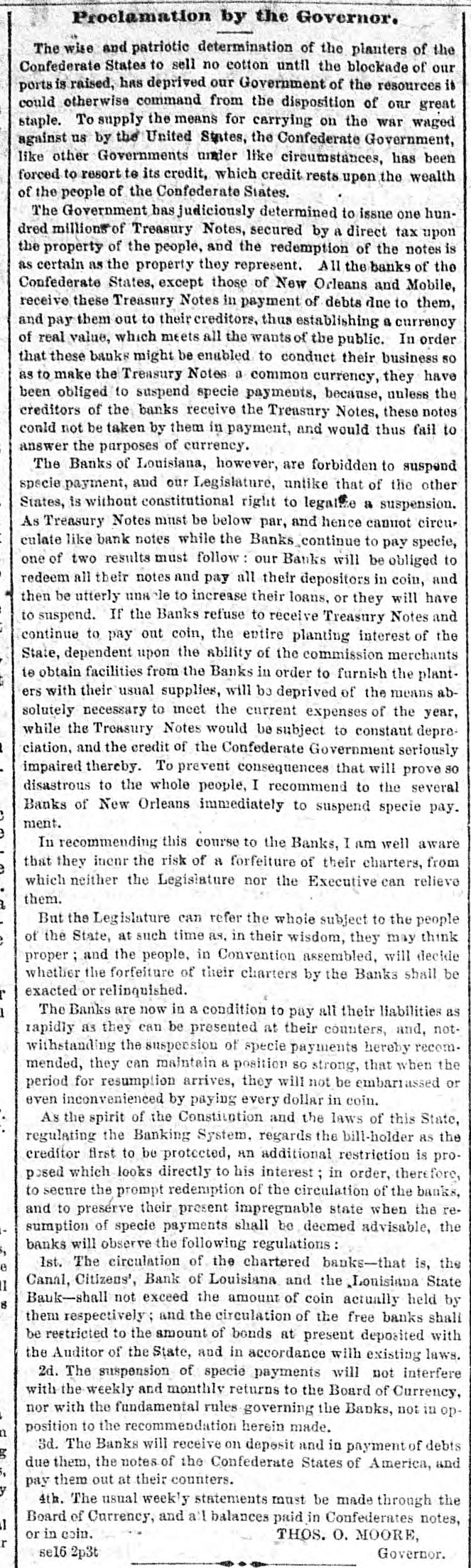
Proclamation by the Governor. The wise and patriotic determination of the planters of the Confederate States to sell no cotton until the blookade of our portsis raised, has deprived our Government of the resources it could otherwise command from the disposition of our great staple. To supply the means for carrying on the war waged against us by the United States, the Confederate Government, like other Governments under like circumstances, has been forced to resort to its credit, which credit rests upon the wealth of the people of the Confederate States. The Government has judiciously determined to issue one hundred millions of Treasury Notes, secured by a direct tax upon the property of the people, and the redemption of the notes is as certain as the property they represent. All the banks of the Confederate States. except those of New Orleans and Mobile, receive these Treasury Notes in payment of debts due to them, and pay them out to their creditors, thus establishing a currency of real value, which meets all the wants of the public. In order that these banks might be enabled to conduct their business so AS to make the Treasney Notes B common currency, they have been obliged to suspend specie payments, because, unless the creditors of the banks receive the Treasury Notes, these notes could not be taken by them in payment. and would thus fail to answer the purposes of currency. The Banks of Louisiana, however, are forbidder to suspend specie payment, and our Legislature, unlike that of the other States, is without constitutional right to legalize a suspension. As Treasury Notes mnst be below par, and hence cannot circuculate like bank notes while the Banks (continue to pay specie, one of two results must follow: our Banks will be obliged to redeem all their notes and pay all their depositors in coin, and then be utterly nna le to increase their loans, or they will have to suspend. If the Banks refuse to receive Treasury Notes and continue to pay out coin, the entire planting interest of the State, dependent upon the ability of the commission merchants to obtain facilities from the Banks in order to furnish the planters with their usual supplies, will be deprived of the morns absolutely necessary to meet the current expenses of the year, while the Treasury Notes would be subject to constant depreI ciation, and the credit of the Confederate Government seriously impaired thereby. To prevent consequences that will prove so : disastrous to the whole people, I recommend to the several Banks of New Orleans immediately to suspend specie pay. men't In recommending this course to the Banks, I am well aware that they incur the risk of a forfeiture of their charters, from which neither the Legislature nor the Executive can relieve them. ) But the Legislature can refer the whole subject to the people of the State, at such time as, in their wisdom, they may think proper ; and the people, in Convention assembled, will decide whether the forfeiture of their charters by the Banks shall be exacted or relinquished. f The Banks are now in a condition to pay all their liabilities as rapidly as they can be presented at their counters, and, notwithstanding the suspension of specie payments hereby recom mended, they can maintain a position 60 strong, that when the $ period for resumption arrives, they will not be embariassed or F even inconvenienced by paying every dollar in coin. As the spirit of the Constitution and the Jaws of this State, ) regulating the Banking System, regards the bill-holder as the 1 creditor first to be protected. an additional restriction is prot posed which looks directly to his interest in order, therefore, e to secure the prempt redemption of the circulation of the banks, and to preserve their present impregnable state when the resumption of specie payments shall be deemed advisable, the / banks will observe the following regulations : 1st. The circulation of the chartered banks-that is, the Canal, Citizens!, Bank of Louisiana and the Louisiana State Bauk-shall net exceed the amount of coin actually held by : them respectively ; and the circulation of the free banks shall e be restricted to the amount of bonds at present deposited with the Auditor of the State, and in accordance with existing laws. 2d. The suspension of specie payments will not interfere 1 with the weekly and monthly returns to the Board of Currency, nor with the fundamental rules governing the Banks, not in opposition to the recommendation herein made. : 3d. The Banks will receive on deposit and in payment of debts due them, the notes of the Confederate States of America, and pay them out at their counters. : 4th. The usual week'y statements must be made through the Board of Currency, and all balances paid in Confederates notes, or in coin. THOS. O. MOORE, self 2p3t Governor.


Article from New Orleans Daily Crescent, September 19, 1861

Click image to open full size in new tab

Article Text

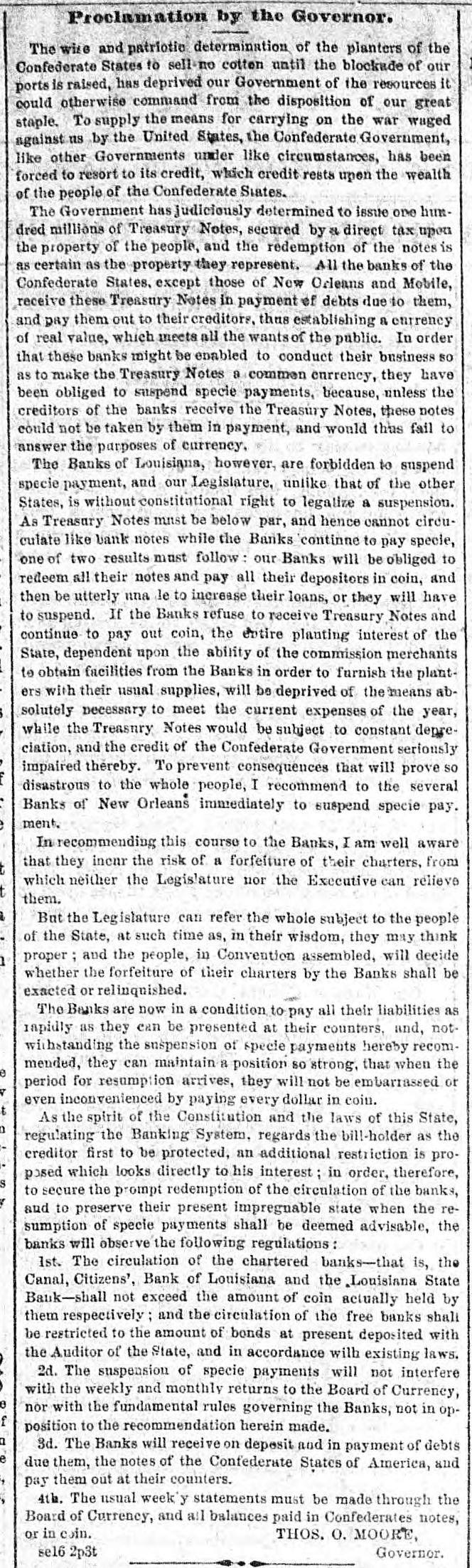
Proclamation by the Governor. The wise and patriotic determination of the planters of the Confederate States to sell no cotton until the blockade of our ports is raised, has deprived our Government of the resources it could otherwise command from the disposition of our great staple. To supply the means for carrying on the war waged against us by the United States, the Confederate Government, like other Governments under like circumstances, has been forced to resort to its credit, which credit rests upon the wealth of the people of the Confederate States. The Government has judiciously determined to issue one hundred millions of Treasury Notes, secured by a direct tax upon the property of the people, and the redemption of the notes is as certain as the property they represent. All the banks of the Confederate States, except those of New Orleans and Mobile, receive these Treasury Notes in payment of debts due to them, and pay them out to their creditors, thus establishing a currency of real value, which meets all the wants of the public. In order that these banks might be enabled to conduct their business so as to make the Treasury Notes a common currency, they have been obliged to suspend specie payments, because, unless the creditors of the banks receive the Treasury Notes, these notes could not be taken by them in payment, and would thus fail to answer the purposes of currency. The Banks of Louisiana, however, are forbidden to suspend spscie payment, and our Legislature, unlike that of the other States, is without constitutional right to legalize a suspension. As Treasury Notes must be below par, and hence cannot circuculate like bank notes while the Banks continue to pay specie, one of two results must follow our Banks will be obliged to redeem all their notes and pay all their depositors in coin, and then be utterly unacl to increase their loans, or they will have to suspend. If the Banks refuse to receive Treasury Notes and continue to pay out coin, the entire planting interest of the State, dependent upon the ability of the commission merchants to obtain facilities from the Banks in order to furnish the planters with their usual supplies, will be deprived of the means absolutely necessary to meet the current expenses of the year, while the Treasury Notes would be subject to constant depre1 ciation, and the credit of the Confederate Government seriously impaired thereby. To prevent consequences that will prove so disastrous to the whole people, I recommend to the several Banks of New Orleans immediately to suspend specie pay. ment. In recommending this course to the Banks, I am well aware that they inenr the risk of 8 forfeiture of their charters, from which neither the Legislature nor the Executive can relieve them. But the Legislature can refer the whole subject to the people of the State, at such time as. in their wisdom, they may think proper ; and the people, in Convention assembled, will decide whether the forfeiture of their charters by the Banks shall be exacted or relinquished. The Banks are now in a condition to pay all their liabilities as rapidly as they can be presented at their counters, and, notwithstanding the suspersion of specie payments hereby recommended, they can maintain 8 position SO strong, that when the period for resumption arrives, they will not be embarrassed or even inconvenienced by paying every dollar in coin. As the spirit of the Constitution and the laws of this State, regulating the Banking System. regards the bill-holder as the creditor first to be protected, an additional restriction is proposed which looks directly to his interest; in order, therefore, to secure the prompt redemption of the circulation of the banks, and to preserve their present impregnable state when the resumption of specie payments shall be deemed advisable, the banks will observe the following regulations: , 1st. The circulation of the chartered banks-that is, the e Canal, Citizens', Bank of Louisiana and the Louisiana State 11 Bauk-shall not exceed the amount of coin actually held by 8 them respectively and the circulation of the free banks shall be restricted to the amount of bonds at present deposited with the Auditor of the State, and in accordance wilh existing laws. 2d. The suspension of specie payments will not interfere with the weekly and monthly returns to the Board of Currency, nor with the fundamental rules governing the Banks, not in opposition to the recommendation herein made. n 3d. The Banks will receive on deposit and in payment of debts g due them, the notes of the Confederate States of America, and pay them out at their counters. y 4th. The usual weekly statements must be made through the Board of Currency, and all balances paid in Confederates notes, I or in coin. THOS. O. MOORE, r Governor. se16 2p3t


Article from New Orleans Daily Crescent, September 20, 1861

Click image to open full size in new tab

Article Text

Proclamation by the Governor. The wite and patriotic determination of the planters of the Confederate States to sell-no cotten until the blockade of our ports is raised, has deprived our Government of the resources it could otherwise command from the disposition of our great staple. To supply the means for carrying on the war waged against us by the United States, the Confederate Government, like other Governments under like circumstances, has been forced to resort to its credit, which credit rests upon the wealth of the people of the Confederate States. The Government has judiciously determined to issue one humdred millions of Treasury Notes, secured by a direct tax upon the property of the people, and the redemption of the notes is as certain as the property they represent. All the banks of the Confederate States, except those of New Orleans and Mobile, receive these Treasury Notes in payment of debts due to them, and pay them out to their creditors, thus establishing a currency of real value, which meets all the wants of the public. In order that these banks might be enabled to conduct their business so as to make the Treasury Notes a commen currency, they have been obliged to suspend specie payments, because, unless the creditors of the banks receive the Treasury Notes, these notes could not be taken by them in payment, and would thus fail to answer the purposes of currency, The Banks of Louisiana, however, are forbidden to suspend specie payment, and our Legislature, unlike that of the other States, is without constitutional right to legalize a suspension. As Treasury Notes must be below par, and hence cannot circuculate like bank notes while the Banks continue to pay specie, one of two results must follow: our Banks will be obliged to redeem all their notes and pay all their depositors in coin, and then be utterly una le to increase their loans, or they will have to suspend. If the Banks refuse to receive Treasury Notes and continue to pay out coin, the entire planting interest of the State, dependent upon the ability of the commission merchants to obtain facilities from the Banks in order to furnish the planters with their usual supplies, will be deprived of the means absolutely necessary to meet the current expenses of the year, while the Treasury Notes would be subject to constant depreciation, and the credit of the Confederate Government seriously impaired thereby. To prevent consequences that will prove SO disastrous to the whole people, I recommend to the several Banks of New Orleans immediately to suspend specie pay. ment. In recommending this course to the Banks, I am well aware that they incur the risk of a forfeiture of their charters, from which neither the Legislature nor the Executive can relieve them. But the Legislature can refer the whole subject to the people of the State, at such time as, in their wisdom, they may think proper; and the people, in Convention assembled, will decide 1 whether the forfeiture of their charters by the Banks shall be exacted or relinquished. The Banks are now in a condition to pay all their liabilities as rapidly as they can be presented at their counters, and, notwithstanding the suspension of specie payments hereby recommended, they can maintain a position so strong, that when the e period for resumption arrives, they will not be embarrassed or even inconvenienced by paying every dollar in coin. t As the spirit of the Constitution and the laws of this State, b regulating the Banking System. regards the bill-holder as the creditor first to be protected, an additional restriction is proposed which looks directly to his interest; in order, therefore, S to secure the prompt redemption of the circulation of the banks, and to preserve their present impregnable state when the resumption of specie payments shall be deemed advisable, the banks will observe the following regulations 1st. The circulation of the chartered banks-that is, the Canal, Citizens', Bank of Louisiana and the Louisiana State Bank-shall not exceed the amount of coin actually held by them respectively ; and the circulation of the free banks shall be restricted to the amount of bonds at present deposited with the Auditor of the State, and in accordance wilh existing laws. 2d. The suspension of specie payments will not interfere with the weekly and monthly returns to the Board of Currency, nor with the fundamental rules governing the Banks, not in opf position to the recommendation herein made. a 3d. The Banks will receive on deposit and in payment of debts e due them, the notes of the Confederate States of America, and pay them out at their counters. 4th. The usual weekly statements must be made through the Board of Currency, and all balances paid in Confederates notes, or in coin. THOS, O. MOORE, Governor. se16 2p3t


Article from New Orleans Daily Crescent, September 21, 1861

Click image to open full size in new tab

Article Text

Hebo Orleans Money Market. CRESCENT OFFICE No. 70 Camp street, Friday Evening, Sept. 20, 1861. The money market closes under an improvement, that is, there is more disposition on the part of capitalists to operate, with an inclination on the part of the banks to discount small sums of legitimate business paper. Notwithstanding the war, there is a disposition evinced for speculation out of the necessities of the people, that is, the purchasing up the necessaries of life. These parties do not, however, receive any encouragement through our banks, unless they do it by deception and delusion. We did not learn of any out-door transactions in paper beyond some small sums of 3 to 4 months at rates ranging at 1122 and 3 Pet. per month. In and about the banks it was quiet. The suspension of coin payments is becoming better understood and as time rolls on, it will prove to have been the wisest course that could have been adopted. True, at the Board of the Bank of Louisiana the movement. was not altogether unanimous, two of the board dissenting. But it was not done to embarrass the action of the majority, but the dissenters deemed the erisis did not demand the sacrifice in obedience to the public weal. They will, ho wever, feel rejoiced to learn that the course pursued has been attended with the most happy results, and given great satisfaction throughout the Southern Confederacy. It was far better to pursue the course on a full supply of coin in vault than to await the time when the coin would have been found to be dribbling out at the rate of a million of dollars per month. Now we have a currency which passes everywhere in the Confederate States, and with which-nineteen-twentieths of the people are willing to sink or swim with. The Citizens' Bank being prohibited from issuing notes of a less denomination, resolved, to fill the vacuum of small change, to divide its five dollar notes in two parts, one of which will have the name of the President, and on the other the name of the Cashier. These parts are paid out and are current all over the city at $2 50 each SO our country friends will understand the value of half a five dollar note, particularly when issued from this bank. The old adage of many a true word said in jest is corroborated. A few weeks ago one of our citizens had a five dollar note of the Canal Bank accidentally torn in two, the signatures of the officers being preserved entire. He lost one-half, which has never been found. He thought he might secure the entire amount by calling at the bank and stating the occurrence, and that the loss of one-half could be substantiated. He was refused the full amount, but was offered $2 50 for the onehalf presented. It was a good burlesque at the time, but events now seem to sanction the course adopted. The movements in uncurrent money show an improvement in the issues of the banks of all the Southern States. Georgia, South Carolina and Virginia range from 7@10 and 12 Oct. dis. There has been some active demand for gold. About forty thousand dollars have been sold within the past two days at from 10@12 Pct. premium. The brokers do not pay this rate. Silver ranges from 8@10 Pot. premium. If parties are so superbly affected with holding gold, why let them pay for it. The gentlemen brokers say that they cannot control the price. If they are forced to pay 10 Pet. prem., they must sell at an advance. The brokers and dealers in money must live as well as other people-that is, they say they must. We do not allude to the outside sharks and shavers. If people will submit to the extortion and exaction of these harpies, we cannot help it. The general exchange market offers nothing for comment. Good sterling (eighty-five days date) commands 108@108.-very little offering. Francs 5.30@5.25. The quotations in New York on the 11th were 107 @ 108, and dull for the best bills. 5.20@5.16 for francs. There have been some small sales of sovereigns this week at five dollars.


Article from New Orleans Daily Crescent, September 26, 1861

Click image to open full size in new tab

Article Text

Hew Orleans Money Market. CRESCENT OFFICE. No. 70 Camp street. Wednesday Evening, Sept. 25, 1861. There was no movement to-day in the general paper market worthy of notice. At the counters of two or three of the banks were continued calls for small notes. The Bank of Louisiana commenced to pay out its small notes-the calls for them were beyond the supply. The engraver is pushing on with all the speed at his control, but cannot deliver more than a certain number of impressions in twenty-1 hours. eurge on the public to keep quiet-there will be sufficient change in a few days. It will be discovered that the hoarding of change will not pay. From the excitement regarding small change, it might be supposed this world was coming to an end, and people were ambitious of having a good supply to enter the next with, just simply showing the ridiculousness of all the cry in regard to small change. Remarks are made about the brokers buying up small change. The dealing in money is, as in other commodities, a trade. Mr. Jones, we will call him, has a few dollars in silver or gold, and he thinks he might turn a penny by going on Camp street and offering his dross for sale. He steps into a money dealer's office, and asks what he will give for his merchandise or silver. If the broker trades for it, well and good. After a while in steps Mr. Brown, and desires to buy so much dross, and asks the price. The dealer or broker says so much, and possibly a bargain is struck, but the next thing we hear such a dealer is a shaver and harpy. Now gold, silver, bank notes, treasury notes and individual notes are just as much articles of trade and merchandise as cotton sugar, flour, pork, dry goods and clothing, all are regulated by the immutable laws of supply and demand. As for the money brokers of Camp street, they are glad to realize from @ Oct. on all their transactions. They have not the capital nor means to give any influential control to the general money market. The truest way for those parties who have such a holy horror of the brokers is not to go near them at all, and that will obviate the remarks we are greeted with daily about the brokers. In the meantime, it will be best for those parties not to rely on the outside shavers and sharks, (who are pretty well known) and by whom they will get essentially skinned. There was nothing done in exchange to-day. Sterling is held by the banks at from 110@112, and outside rates are nominal. A mail was made up to-day for England, which undoubtedly caused the slightly increased demand yesterday. From the Memphis Appeal of yester day we take the following. The suspension of specie payment by our banks has had a most happy effect throughout the Southern Confederacy. We have now an uniform currency and one standard; if people are simple as to exchange it for coin to go outside of the Confederate States, why they can submit to the loss MEMPHIS, Sept. 24, 1861. The increasing feature in business circles during the week has been the effect of the suspension of specie payment by the banks of New Orleans, briefly referred to in our last report. As anticipated, the result thus far has been a material reduetion in the rates of exchange between the two cities, and a general depression of business in the flour and produce departments. It is not probable, however, that the full effect of the movement has yet been realized. It is presnmed that exchanges, which have already fallen from 10@4 Oct., will go still lower, and that a fixed rate once obtained, Southern purchasers and shippers will resume operations, and the trade between our city and New Orleans resume its wonted activity. Gold continues firm at 15, and silver 12 Pet. premium, selling rates. The market for cotton and tobacco has exhibited no change worthy of note. Wheat, corn and oats have been moderately active, with an advancing tendency in prices, while hay, bran and provender generally are quiet and unchanged. The relative condition of the market for groceries of all kinda, provisions, bagging and rope, salt, etc., as well as of the minor articles of merchandise, will be fund duly noted in the details below. Corron.-The demand has again been confined to filling of manufacturer's orders, and the sales sum up only 261 bales, including Strict Middling, which was taken at 10c. The market is still too irregular for general quotations, and we again omit them. COTTON STATEMENT STATEMENT. Stock on hand Sept. 1, 1861 bales L 1,671 Received past week 762 Received previously 126288 Total 1,959 Shipped past week I 104 Shipped previously 399 503 Stock on hand this date 1,186 SHIPMENTS OF COTTON FROM MEMPHIS. Past week. Since Sept. 24 New Orleans 21 117 I 83 Interior points 386 W Total 104 509


Article from New Orleans Daily Crescent, March 28, 1862

Click image to open full size in new tab

Article Text

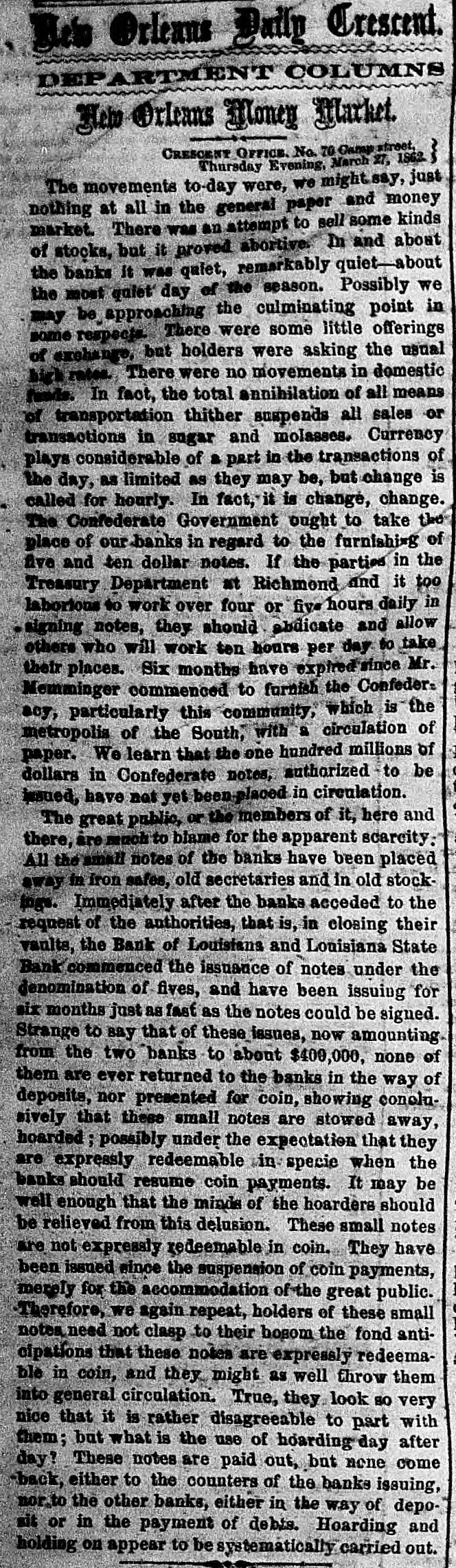
Orleans Dallp Crescent. DEP ARTMENT COLUMNS Helo Orleans Money Market. CRESCENT OFFICE. No. Camp street, Evening, March 27, 1962 movements were, we The to-day Thursday general might.say, and money just nothing at all in the paper an attempt to of but it abortive market. stocks, There was proved remarkably sell In quiet-about some and about kinds the banks it was quiet, day of the season. Possibly we be the There were some some may the most respects approaching quiet' culminating little point offerings in of exchange but holders were asking the usual birthrates. There were no movements in domestic funds: In fact, the total annibilation of all means of transportation thither suspends all sales or transactions in sugar and molasses. Currency plays considerable of a part in the transactions of the day, as limited as they may be, but change is called for hourly. In fact, it is change, change. The Confederate Government ought to take the place of our banks in regard to the furnishi=g of five and ten dollar notes. If the parties in the Treasury Department at Richmond and it too laborious to work over four or five hours daily in signing notes, they should abdicate and allow others who will work ten hours per day to take their places. Six months have expired'since Mr. Memminger commenced to furnish the Confeder: acy, particularly this community, which is the metropolis of the South, with a circulation of paper. We learn that the one hundred millions of dollars in Confederate notes, authorized to be issued, have not yet been placed in circulation. The great public, or the members of it, here and there, are much to blame for the apparent scarcity. All the small notes of the banks have been placed away in iron safes, old secretaries and in old stock togs. Immediately after the banks acceded to the request of the authorities, that is, in closing their vaults, the Bank of Louisiana and Louisiana State Bank commenced the issuance of notes under the denomination of fives, and have been issuing for six months just as fast as the notes could be signed. Strange to say that of these issues, now amounting. from the two banks to about $400,000, none of them are ever returned to the banks in the way of deposits, nor presented for coin, showing conolusively that these small notes are stowed away, hoarded; possibly under the expectation that they are expressly redeemable in specie when the banks should resume coin payments. It may be well enough that the minda of the hoarders should be relieved from this delusion. These small notes are not expressly redeemable in coin. They have been issued since the suspension of coin payments, merely for the accommodation of the great public. Therefore, we again repeat, holders of these small notes need not clasp to their bosom the fond anticipations that these notes are expressly redeemable in coin, and they might as well throw them into general circulation. True, they look SO very nice that it is rather disagreeable to part with them; but what is the use of hoarding day after day? These notes are paid out, bnt none come back, either to the counters of the banks issuing, nor.l the other banks, either in the way of deposit or in the payment of debts. Hoarding and holding on appear to be systematically carried out.


Article from New Orleans Daily Crescent, April 4, 1862

Click image to open full size in new tab

Article Text

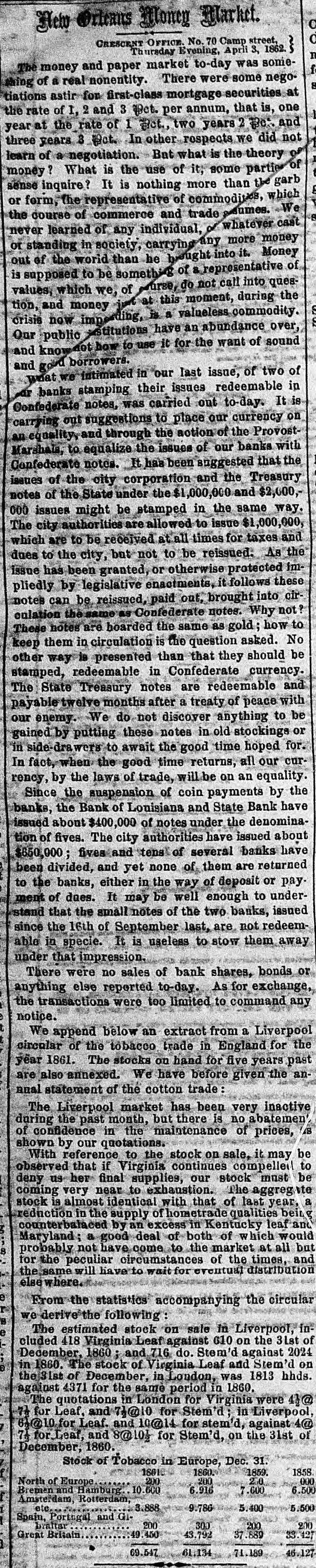
Hely Orients Money Market. CRESCENT OFFICE No. 70 Camp street, Tb Tursday Evening, April 3, 1862. The money and paper market to-day was something of a real nonentity. There were some negotiations astir for first-class mortgage securities at the rate of I, 2 and 3 Pet. per annum, that is, one year at the rate of I Act., two years 2 Po and three years 3 Oct. In other respects we did not learn of a negotiation. Bat what is the theory of money? What is the use of it; some parties of sense inquire? It is nothing more than the garb or form, the representative of commodite which the course of commerce and trade sumes. We cast never learned of any individual, whatever or standing in society, carrying any more money out of the worid than he b ,Jught into it. Money is supposed to be somethi of a.representative of values, which we, of urse, do not call into ques and at this moment, during the tion, money crisis now imp ding, is a valueless commodity. titutions have an abundance over, Our public and know not how to use it for the want of sound and good borrowers. what we intimated in our last issue, of two of ar banks stamping their issues redeemable in Confederate notes, was carried out to-day. It is carrying out suggestions to place our currency on an equality, and through the action of the ProvostMarshain, to equalize the issues of our banks with Confederate notes. It has been suggested that the issues of the city corporation and the Treasury notes of the State under the $1,000,000 and $2,000, 000 issues might be stamped in the same way. The city authorities are allowed to issue $1,000,000, which are to be received at all times for taxes and dues to the city, but not to be reissued. As the issue has been granted, or otherwise protected impliedly by legislative enactments, it follows these notes can be reissued, paid out, brought into cir culation the same as Confederate notes. Why not These notes are boarded the same as gold; how to keep them in circulation is the question asked. No other way is presented than that they should be stamped, redeemable in Confederate currency. The State Treasury notes are redeemable and payabletwelve months after a treaty of peace with our enemy. We do not discover anything to be gained by putting these notes in old stockings or in side drawers to await the good time hoped for. In fact, when the good time returns, all our currency, by the laws of trade, will be on an equality. Since the suspension of coin payments by the banks, the Bank of Louisiana and State Bank have issued about $400,000 of notes under the denomination of fives. The city authorities have issued about $650,000; fives and tens of several banks have been divided, and yet none of them are returned to the banks, either in the way of deposit or pay ment of does. It may be well enough to understand that the small notes of the two banks, issued since the 16th of September last, are not redeemable in specie. It is useless to stow them away under that impression, There were no sales of bank shares, bonds or anything else reported to-day. As for exchange, the transactions were too limited to command any notice. We append below an extract from a Liverpool circular of the tobacco trade in England for the year 1861. The stocks on hand for five years past are also annexed. We have before given the an anal statement of the cotton trade: The Liverpool market has been very inactive during the past month, but there is no abatement of confidence in the maintenance of prices, AB shown by our quotations. With reference to the stock on sale, it may be observed that if Virginia continues compelled to deny us her final supplies, our stock must be coming very near to exhaustion. The aggregat stock is almost identical with that of last year, a reduction in the supply of hometrade qualities bein counterbalaced by an excess in Kentucky leaf and Maryland a good deal of both of which would probably not have come to the market at all but for the peculiar circumstances of the times, and the same will have to wait for eventual distribution e where. e From the statistics accompanying the circular we derive the following B The estimated stock on sale in Liverpool, in e cluded 418 Virginia Leaf against 610 on the 31st of December, 1860 and 716 do. Stem'd against 2024 in 1860. The stock of Virginia Leaf and Stem'd on the 31st of December, in London, was 1813 hhds. against 4371 for the same period in 1860. The quotations in London for Virginia were 4β‚«@ 76 for Leaf, and 71@10 for Stem'd in Liverpool, @10 for Leaf. and 10@14 for stem'd, against 4@ 7 for Leaf, and 8@101 for Stem'd, on the 31st of December, 1860. Stock of Tobacco in Europe, Dec. 31. 1661 1860. 1859. 1858 f 200 200 000 250 North of Europe 10 600 6.500 Bremen and Hamburg. 7.600 6.916 Amsterdam, Rotterdam, 3.888 9.786 5.400 etc. 5.500 Spain, Portigal and GI. 200 200 300 200 brattan 49.450 Great Britain 37.889 43.792 33.427 i 69.547 71.189 61.134 46.127


Article from Memphis Daily Appeal, April 26, 1862

Click image to open full size in new tab

Article Text

On Phaage-Business News. We have nothing new to report of doings on 'Change. The receipts were: 23 sacks bran, 6 kegs but ter, 10 easks bacon, 736 sacks corn, 6 head cattle, sacks dried fruit, 95 sacks flour, 50 bales hay, 2 kegs and 1 bar rel lard, 103 sacks oats, 11 casks pork, 14 sacks potatoes, 91 sacks wheat The New Orleans banks, after a meeting at which no agreement was come to, have been paying out more or less gold. This act created much consternation, as it was believed to be done from an expectation that the enemay would be victorious in his attempts against the city. The New Orleans Crescent of Wednesday says: The press at the counter of the M. chanica' and Traders' Bank was largely beyond that of any other bank, yet the cails or presensation of notes were very small, ranging from five and ten dollars up to one hundred dollars, which were paid. At the Bank of Louisiana there were some calls, but all in small amma; and some parties, on being offered silver, refused, wanting gold only. These parties who are 80 very tenacious and desire gold because it is more susceptible for placing in out-of the way nooks, may be somewhat surprised if within a few days, or a few hours, an order may be received from the highest authority, commanding the banks to retain all coin in vaults, and decline at once the paying out, either in circulation or deposits. The greatest press to-day was in and around the Me. chanies' and Traders' Bank. Its circulation is only $245,000 against $663,000 in coin. It will not be many days before our banks will be asked by those who were most clamorous for coin to receive bags of silver and tin boxes containing gold on special deposits. We at once urge on our bank mandators to decline all special de posits of this character The same paper of Thursday states: The most important feature in financial circles to-day was the reception of a decree by some of the banks from the highest authority forbidding the paying out of specie or CO n. It was received early in the day by some of the banks, but up to 12 o'clock it had not been received by other banks. The Mechanics and Traders' Bank was paying out silver up to I bleck, but in very small sums. In fact, the holders of circulation of the banks have run out, completely prostrated; they have no more promises to pay or circulation of the banks. At an early hour in the day the State Bank received notice to suspend the payment of coin. The State has a heavy interest in this bank, and the mandate was promptly obeyed; so at the Citizens' Bank, it had to follow the instructions. It was, however, very late in the day before all the banks received the order. In obedienee to the mandate from the authorities the paying out of coin was generally suspended before 2 o'clock.


Article from Memphis Daily Appeal, June 14, 1862

Click image to open full size in new tab

Article Text

Important Decision in New Orleans. From the Delta, June 10 PROVOST COURT - Major Joseph M. Bill, Judge - Monday, June 9 -Case against the Bank of Louisiana-Amcdee - Durand, Complainant.-On the 16th of September, 1861, the city of New Orleans enjoyed a financial system second to none in the country. The banks were all in a sound condition. On that day they not only suspended specie payments, but also ceased to pay out their own notes. Instead they substituted notes of the Confederate States, and all transactions were conducted in that currency. After the 15th of September, 1861, the claimant made a deposit in the bank of Confederate notes. He now demands that the amount of his deposit shall be paid him in current funds. The court held that the Constitution of the Southern Confederacy made coin the only legal tender, and no law exists compelling the receipt of Confederate notes in the payment of debts. The banks, by their action in withdrawing their own notes from circulation, and advertising their willingness to receive Confederate notes, reduce the currency of the public to such Contederate notes. The complainant had for a long time been a depositor in the Bank of Louisiana. It is admitted that all of his deposits since September 16.h have been in Confederate notes, or paper which he knew was to be paid in Confederate notes. He nas not deposited a dollar of money. But the bank is estoped to deny that these de posits are money. It, with others, aided to make them the only currency for the people. It would pay out nothing but Confederate notes: it received them as money, without objection; there was no element of compulsion, physical or meral, in their reception by the bank. It would be to allow them to take advantage on their own wrong to permit them now to say that these notes are not money. It would work a Laud upon their customers who are at the mercy of the banks. The deposits of the complainaut can in no legal sense be called "special deposits. Such deposits are too well understood to need exposition. This case has nothing in common with the cases previously decided, where the parties were compelled to receive Confederate notes as money. Judgment for complainant. The counsel for the bank, J Ad. Rosier. Esq, was permitted to have & copy of the complaint properly filed, and filed his answer and objection thereto. He was also permitted to file an exception to the jurisdiction of the court. The case will probably be taken up before Gen. Batler. Judge Bell, however, refused to grant a : uspension appeal, but insisted on the execution of the judgment. Col. A. P. Field appeared and made a strong argument against the bank. Since the above was written, we learn that the bank, through J. Ad. R sier, attorney, made ape plication for a stay of proceedings, in order to of obtain a revision of the judgment. Gen Butler e granted a delay, in order to have time to examine the application.


Article from Alexandria Gazette, February 28, 1863

Click image to open full size in new tab

Article Text

private, charged tish subject from Richmond; G. T. Tansill has been in the Confederate service, and stated he would be there again but for his wounds received in the service. Cassius M. Clay, who is about to return to Russia, as the U. S. Minister, has published a brief letter, in which he explains why he did not enter the field as an officer of the army.He says:-"I told President Lincoln that I could not, and would not, enter the field unless the policy of liberating the slaves of Confederates was adopted. As soon as the President issued his proclamation of the 22d September, I offered my. services at once to Gen. Halleck. I was received in such manner that Secretary Chase, who was present, and had urged me by the most pressing arguments to take a command, was satisfied, as well as myself, that I could not serve the country or my own reputation by entering the service. Justice to the country and to my own character for frankness, demands of me to say that I regard Gen Halleck as too pro slavery to do justice to any man of my views of the great political issues pending. I have done what I could, and [ shall do what I can, to induce the President to put Gen. Benj. F. Butler in his place." A letter from New Orleans in the N. Y. World says, "The Bank of Louisiana (burnt out last week) has resumed business in the Crescent City Bank building. Business is dull. Thirty-six bales of cotton were sold yesterday, good ordinary to low middling, at sixtyfour cents per pound. There are daily transactions in sugar and molasses to a limited extent. Gold is lower here than it is in New York. Greenbacks are not SO popular as city currency." A fire originated yesterday at 207 Fulton street, N. Y., in a coffee establishment, and before it was put out, three buildings were burnt. The loss was six thousand dollars, which is covered by insurance. The celebrated racing stock of Messrs. Kenner and Minor, consisting of the stallions Panic Ben West, Viceroy, Whale and Bob Cheathem and thirteen blooded mares and fillies, were to have been sold at New Orleans on Monday last, for the benefit of the U. S. Government, by order of Gen. Banks.


Article from New-York Daily Tribune, June 27, 1863

Click image to open full size in new tab

Article Text

LATER FROM NEW-ORLEANS. Nothing Later from Port Hudson. The steamer Creole, from New-Orleans on the 19th inst., arrived here on Friday afternoon. The newspapers to hand contain no news from Port Hudson. The Bank of Louisiana and Louisiana State Bank had been required to go into liquidation under three commissioners each. Their condition is said to be satisfactory. The receipts of sugar from the interior were partially suspended, owing to the heavy dutiesimposed. A large mass meeting of Union citizens was held at New-Orleans on the evening of the 18th inst. The anniversary of the Battle of Bunker Hill was celebrated by the Bunker Hill Company of the 47th Massachusetts Regiment at Camp Parapet, Louisiana. The steamers George Cromwell, Key West, Patapsco, and Suffolk, had arrived from New-York. QUARANTINE, New-York HARBOR, June 26-Evening. U. S. steamer Matanzas, Capt. Liesgang, from New-Orleans, June 17, Key West, 20, has arrived here.


Article from Evening Star, June 27, 1863

Click image to open full size in new tab

Article Text

From New Orleans. NEW YORK, June 26.-The bark Creole, from New Orleans on the 19th inst., has arrived. The papers contain no news from Port Hudson. The "Bank of Louisiana" and the "Louisiana State Bank" have been required to go into liquidation under three commissioners each. Their condition is said to be satisfactory. The receipts of sugar from the interior has been partly suspended, owing to the heavy duties imposed. A large mass meeting of Union citizens was held at New Orleans on the evening of the 18th.


Article from Alexandria Gazette, June 27, 1863

Click image to open full size in new tab

Article Text

THE SIEGE OF VICKSBURG. MEMPHIS, June 23, via CAIRO, June 25.---Official intelligence from Grant's army to the 20th has been received. Johnston is said to have withdrawn his forces from across the Big Black, moving towards Clinton. About a thousand Texans attacked Lake Providence on the 10th but were repulsed with loss by the negro troops who fought bravely. Colonel Phillips with eight hundred cavalry, was attaked by two hundred Cofederate infantry and one thousand cavalry under Rockerford on the Tallahatchie. The fight was severe. Phillips lost seven killed and ninety wounded. He cut his way out and came in yesterday. The Cofederates are in force at Boonville, Generals Roddy, Ruggles, Chalmers, and Biffiers, threaten the lines and troops are reported moving north from Okolona. Stirring news may be expected from this section. The Baltimore American says:-"All the turnpike roads leading to the city are now not only thoroughly guarded, but pretty well barricaded, in order to prevent any advance to the town by the Confederates. Inconsequence of these preparations, and the peculiar state of affairs which now exists, it has been deemed wise and prudent to per nit no citizens to leave the place without first securing passes." The N. Y. Times says, that when the New Jersey troops reached Po., they we. refused acceptance unless they would be sworn into the U. S. service for six months, under the President's proclamation. The Governor of Penn., moreover instructed his transportation agents at Philadelphia to forward no troops to Harrisburg who would not enter the U. S. service under the six months' call. This was not what the New Jersey troops had offered to do, nor what Gov. Parker had called on them to do nor what he had, any authority by State law to require them to do. And, therefore, he ordered them home, the entire expense of his volunteer services, it seems, falling on the State of N. Jersey. The New Orleans papers contain no news from Port Hudson. The Bank of Louisiana and the Louisiana State Bank have been required to go into liquidation, under three commissioners each. Their condition is said to be satisfactory. The receipts of sugar from the interior have been partly suspended, owing to the heavy duties imposed. A large mass meeting of Union citizens was held in N. Orleans on the 18th inst. Gen. Butler, arrived in Washington yesterday evening, and is stopping at Willard's. It is rumored that the object of his visit is to look after his interests in the question of seniority between himself and General Fremont, now pending before a military commission. Rev. Dr. Leacock, of New Orleans, recently


Article from Cleveland Morning Leader, June 27, 1863

Click image to open full size in new tab

Article Text

FROM NEW ORLEANS. NEW YORK, June 26. The steamer Creole, from New Orleans on the 19th of June, has arrived. Papers come to hand contain no news from Port Hudson. The Bank of Louisiana and the Louisiana State Bank had been required to go into liquidation under three commissioners each; their condition is said to be satisfactory. Receipts of sugar from the interior were partially suspended owing to the heavy duties imposed.


Article from The Weekly Register, July 2, 1863

Click image to open full size in new tab

Article Text

From New Orleans. NEW YORK, June 26.-The steamer Creole from New Orleans on the 10th has arrived. The papers contain no news from Port Hudson. The Bank of Louisiana and Louisiana State Bank, had been required to go into liquidation under three commissioners each. Their condition is said to be satisfactory. Receipts of sugar from the interior was partially suspended owing to the heavy ties imposed.


Article from The Weekly Register, July 2, 1863

Click image to open full size in new tab

Article Text

From New Orleans. NEW YORK, June 26.-The steamer Creole from New Orleans on the 19th has arrived. The papers contain no news from Port Hudson. The Bank of Louisiana and Louisiana State Bank, had been required to go into liquidation under three commissioners each. Their condition is said to be satisfactory. Receipts of sugar from the interior was partially suspended owing to the heavy due ties imposed.


Article from Baton Rouge Tri-Weekly Gazette & Comet, December 5, 1865

Click image to open full size in new tab

Article Text

to parish Judgesystem as it existed under the Constitution of 1812, and to my diffident comprohension, return to that system will be as universally approved as seems to be the repudiation of an elective judiciary. If this be accepted admitted, and I thinkit will/not be disputed, the duties of Recorders could be performed by clerk of courts, who in turn, should be disqualified from the performance of judicial acts, unless in the absence of Judges. The olection of Judges, Recorders, Clerksand Sheriffs mainly from personal or political feeling rather than capacity and fitness of the individual for the trust, has shaken public confidence in the administration of justice, besides rendering it expensive, tardy, and to the last degree uncertain. Bred to the vocation of agriculture, I cannot speak on this subject with technical familiarity, nordo iaim at doing so, contented if I can embody in clear and comprehensiv recommendation present system know to exist, for your correction: Provision will have to be made to re build the State Penicentiary, and to erect a State house. The former will require all needful dispatch. In selecting a site for the latter. regard should be paid to the locality. Crowded or ill-ventilated places)ahould belavoided, and if need be, large and roomy space, capable of admit ting the erection, in detached shape, of all the public buildings necesbary for the State officers and archives, to be provided for suitably should/be obtained in the neighborhood of New Orleans. The thoroughfares and crowded streets of a great city are unsuited for such purposes. It is scarcely required that I should dwell upon the urgency of an immediate and perfect organization of the militia of the State. This cannot with/safety be deferred; for it is not compatible with the reconstruction policy of the Government to maintain armies in the States for the purpose of police. The reorganization of our State, which will be completely accomplished on the admission or our delegations to Congress,swill, without question, be speedily followed by the abolition of martial law within our borders, and the withdrawal of all troops not required for garrison or fort purposes. That this may not happen before a State force can supply its place, you will, am sure, fully guard I have endeavored without success to procure the transfer of the banks of New Orleans, now under military liquidation, from the control.of the Commander of this Department to the civil power. The banks thus unaccountablyciroumetanced, are the Bank of Louisiana State Bank, Merchants' Union, Orencent City and Bank of New Orleans. Why the military usurped the authority to take possession of these banks and regulate their administration any more than the reason for their continued retention of them. I have never been able to know or understand. As they stand in the relation to their creditors of insolvent institutions, I especially refer to them, so that you may take such action to have them administered in accordance with law and the just rights of all concerned, as cireumstances will warrant. The present condition of the New Orleans and Jackson and New Orleaus and Opelousas Railroads inspires uneasiness. The for mer road as, unexpectedly to me, handed over by the military authority to the ad ministration of a few man, who had conducted it after some fashion. They refuse to explain its affairs from the -occupation of this city by the National forces until the relinquishment of the road by the Commauding General Acting upon the gestions of President Johnson, who consid ered it should be a step precedent to the delivery of the roads to the control of loy al directorschosen by the stock holders, the Mayor of New Orleans called for new election by the stockholders of each pany His call was fully responded to, and directors of the highest respectability and reliability were chosen. he old directors of the New Orleans and Jackson Railroad fearing accountability or unwilling to re linquish their places, resisted the demand fora surrender of the control of the corporation and its affairs, and appealed to the lawsto sustain them. They hold possession and give no account of their stewardship. The large interest of the State in both of these important enterprises made it incum bent upon me to sustain the action of the Mayor of New Orleans, in his exertions to have their true present state exposed for public information. The New Orleans and Opelousas Railroad is still held and run by the military, who declinate relinquish it to its stockholders unless the Board of Directors release the Government from all Preclamations on socount of the enormoussum received by its officers since the road has been in their hands. Donations of land made by Congress to the Opelousas road are likely to lapse from a failure of condition,1f not attended to Your early attention to the roads and all connected with them is much demanded. Various public works, of greater or less importance, as well as the reparation of the vees, will have to be undertaken by the State. In connection with them, the creation of a Board of Public Works, or the adoption of some other way for planning and sepervising them will be requisite. Ex perience will be a safe guide as to which plan, that of a Board or of a Chief Engineer, is more preferable No other legislative bodies that have ever before been convened in this State have beene harged with the consideration of legslation embracing 80 many, various and momentous subjects. Upon their enlightned,just and prompt settlement, everything affecting the 1-being, happiness and prosperity of the people and State debends. Procrastination is ruin ; postponement is death The faithful oitizen, called by an wise nd omniscient Providence to administer his powerful Government, watches with offectionatesolicitudeyour proceedings. He ay great stress upon the course of Louisana is anxious she should take her true place in the Republic has manifested by numerous kindnesses of manner and acts 18 warm sympathy with us, and will be low to believe that we will ever disappoint him. The people have already given


Article from The Wheeling Daily Intelligencer, November 15, 1866

Click image to open full size in new tab

Article Text

New York News. NEW YORK, Nov.14.-A Washington special says: On the meeting of Congress a resolution will be introduced calling for all the information on the subject of the action of Prussia against American citizens. The whole matter will be thoroughly investigated. In the opinion of many prominent gentlemen,our Minister at the seat of the Prussian Government has pursued an ulterior course, highly reprehensible. It is understood that the Government is not particularly well satisfied with his conduct. There are a number of candidates for the vacancy in the Judgeship of the United States District Court for the Northern District of Ohio, occasioned by the death of Judge Wilson. Among the number of applicants are Franklin J. Dickinson, F. Backus Sherlock, J. Andrews, and others. The case of the broker, Smithson, against the Secretary of W ar, has gone through all the pleadings, and is now ready to go to a jury. It understood to be a test case, and great interest is felt in the resnlt. Last week 1,000 stand of arms were abstracted from the armory in this city, and are now concealed near New York. This was done while the guards were on duty around it. The United States Marshal and Capt. Shillington hunting up the parties. The cabinet o-day, among other matters, considered the appointment of a successor to Wm. Dart, District Attorndy for northern New York, and Judge Geo. Munger's appointment was determined upon. R. M. T. Hunter, of Virginia, had an interview with the President this afternoon. He desires to have certain property of his in West Virginia barred from confiscation: but as it has already been under previous decisions of the Federal authorities, there is no doubt their action will be sustained. Within the last few days the President has directed pardons to be issued to the following persons, one of whom sought for pardon under the first exception of the Amnesty Proclrmation, having held a petty office under the Confederacy, and the remainder having applied under the $20,000 clause: Willis Benham, of Georgia; A. Pegram, of La.; K. H. Reynolds, of Arkansas; J. D. Epps, of Mississippi; W.A. Henderson, William Jones and John M. Brown, of Tennessee. The Tribune's St. Louis special says The Conservative canvassers have been induced to throw out all the votes in Clinton county, except those cast in one town, thereby endangering the election of Van Horn. A claim has been made to Knox to count the votes cast after sundown, as the polls had not been closed. If allowed, Blair is defeated; Noell has about 40 majority. In the case of Charles Lockwood against the New York Central Railroad heretofore reported, a verdict for the plaintiff was rendered yesterday, giving him the full amount claimed, which is $25,000. There was a large and enthusiastic Fenian meeting in Temperance Hall last evening. It was addressed by Gen. Spears and Senators Mehan and Morrison. The World's special from Washing ton and New Haven report that there were seen a few meteors last night through powerful observatory telescopes, but there was no great shower any where. The World's Washington special says; The Government has information professing that the Fenians are ready for an immediate invasion of Canada. It is not probable that any action will be taken in the premises, as the news is donbted somewhat. The World's special says: The Bank of Louisiana, which was obliged to suspend during the military occupation of New Orleans, has resumed business. The Herald's Washington special says: It is said that Hon. John A. Bingham, who is preparing articles of impeachment against Mr. Johnson, will charge him with aiding and abetting the assassination of Mr. Lincoln. It is understood that Mr. McCulloch will, in his report, urge upon Congress the necessity for the passage of a law looking towards an early resumption of specie payment. The report will be quite voluminous, and will be one of the most interesting ever issued from that department. Gen. Sickles, commander of the Department of South Carolina, has been The ordered to Washington. precise import of the order not known.


Article from The Wheeling Daily Register, November 15, 1866

Click image to open full size in new tab

Article Text

The Bank of Louisiana Resumes Business. NEW YORK, Nov. 14.-The World's Charleston special says: The bank of Louisiana, which, with others, was obliged to suspend during the military occupation of New Orleans, has re+ sumed business.


Article from The Wheeling Daily Register, December 17, 1866

Click image to open full size in new tab

Article Text

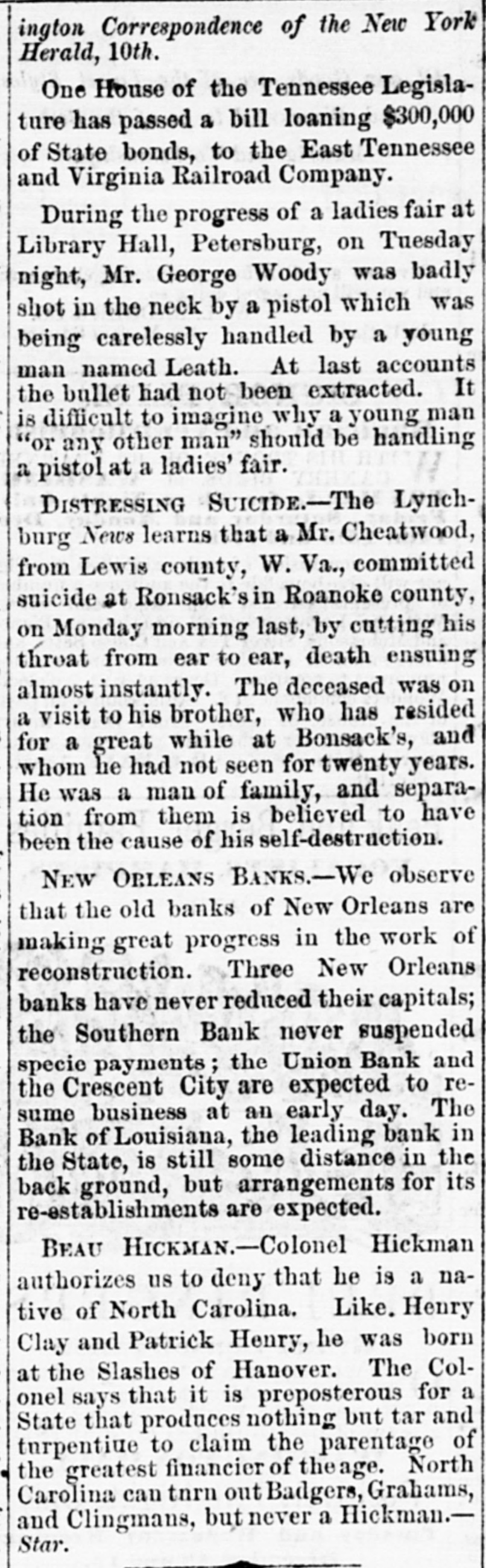
ington Correspondence of the New York Herald, 10th. One House of the Tennessee Legislature has passed a bill loaning $300,000 of State bonds, to the East Tennessee and Virginia Railroad Company. During the progress of a ladies fair at Library Hall, Petersburg, on Tuesday night, Mr. George Woody was badly shot in the neck by a pistol which was being carelessly handled by a young man named Leath. At last accounts the bullet had not been extracted. It is difficult to imagine why a young man "or any other man" should be handling a pistol at a ladies' fair. DISTRESSING SUICIDE.-The Lynchburg News learns that a Mr. Cheatwood, from Lewis county, W. Va., committed suicide at Ronsack's in Roanoke county, on Monday morning last, by cutting his throat from ear to ear, death ensuing almost instantly. The deceased was on a visit to his brother, who has resided for a great while at Bonsack's, and whom he had not seen for twenty years. He was a man of family, and separation from them is believed to have been the cause of his self-destruction. NEW ORLEANS BANKS.-We observe that the old banks of New Orleans are making great progress in the work of reconstruction. Three New Orleans banks have never reduced their capitals; the Southern Bank never suspended specie payments; the Union Bank and the Crescent City are expected to resume business at an early day. The Bank of Louisiana, the leading bank in the State, is still some distance in the back ground, but arrangements for its re-establishments are expected. BEAU HICKMAN.-Colonel Hickman authorizes us to deny that he is a native of North Carolina. Like. Henry Clay and Patrick Henry, he was born at the Slashes of Hanover. The Colonel says that it is preposterous for a State that produces nothing but tar and turpentiue to claim the parentage of the greatest financier of theage. North Carolina can tnrn out Badgers, Grahams, and Clingmans, but never a Hickman.Star.